Galatians 4:18

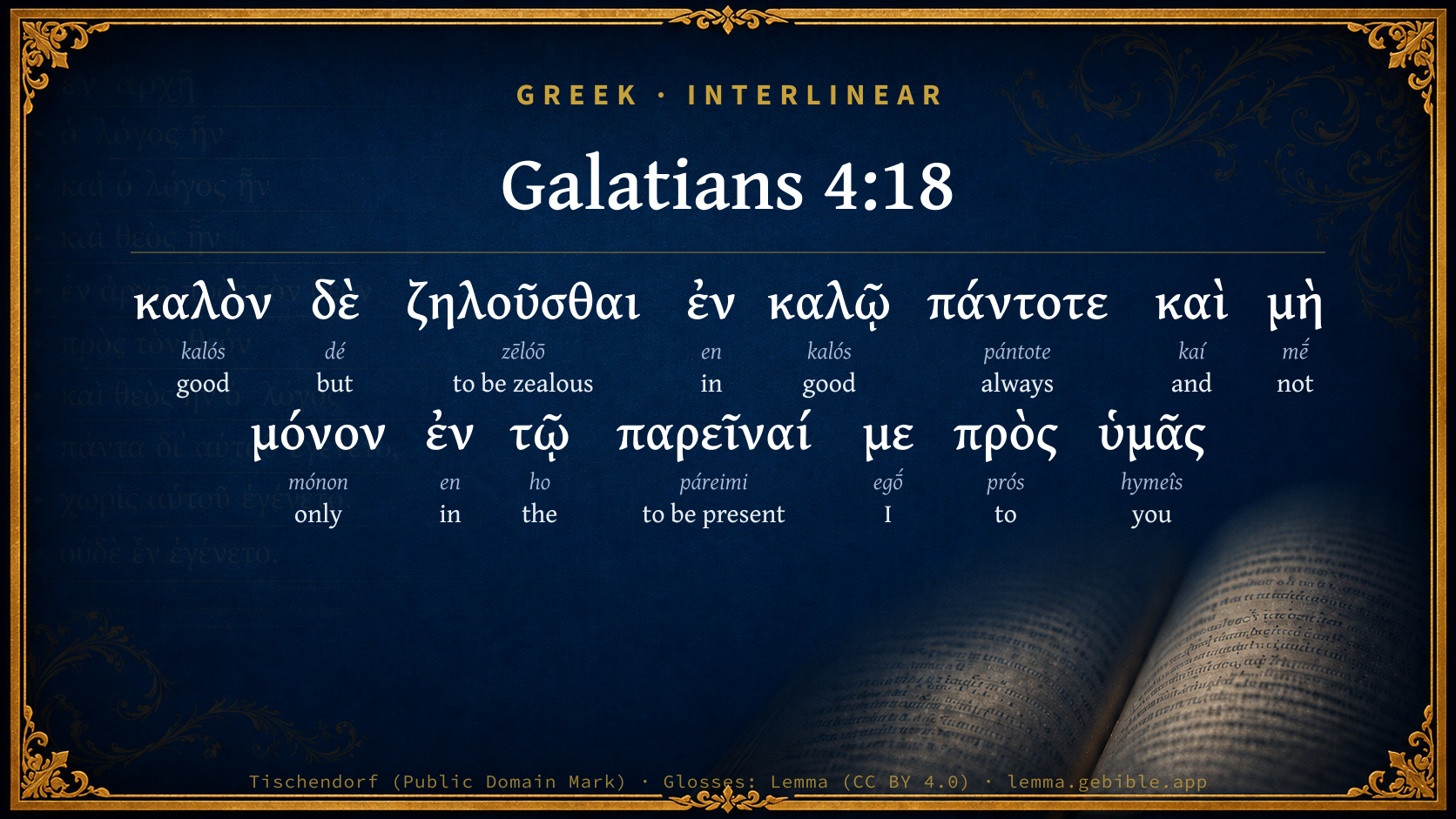
Greek (Tischendorf 8th ed.) Galatians 4:18 appears in the Greek New Testament. The text above is from the Tischendorf 8th edition. Each word links to its Strong’s number and a concise gloss. Click any word for its full Thayer’s Greek Lexicon entry.
Download image
Cite this verse

Galatians 4:18 (World English Bible). Public Domain. Lemma interlinear Bible study tool, https://lemma.gebible.app/v/galatians/4/18.

Show BibTeX & RIS
BibTeX
RIS
English Translation
But it is always good to be zealous in a good cause, and not only when I am present with you.
World English Bible · Public Domain
Download a study sheet

One document with this verse’s original text, its word-by-word gloss line, the meaning frame, cross-references with their text, attributed commentary, and full source and license credits — printable, and it pastes into notes with its structure intact.

This verse Autodidact and up

Study sheet (.html) Plain text (.txt)

A passage Seminary Student

Up to 50 verses in one chapter. A passage sheet keeps up to 6 commentary sources and 12 cross-references per verse, in the order this page ranks them, and says so on the sheet whenever that leaves anything out. Ask for a single verse and you get the Autodidact verse sheet above.

Everything on this page stays free to read, with no account — the sheet is a download of what is already on screen, not access to it.

Want to remove ads? Support Godless Engineer
Compare translations 3

The same verse in 3 English versions, stacked beneath the original-language interlinear above. Click any original word for its lexicon entry.

Each is an independent rendering of the whole verse — the interlinear is not word-aligned to these translations.

Highlighted words mark where these versions differ — a whole-verse word diff, not a word-by-word alignment.

  • World English Bible Public Domain
    But it is always good to be zealous in a good cause, and not only when I am present with you.
  • King James Version Public Domain
    But it is good to be zealously affected always in a good thing, and not only when I am present with you.
  • unfoldingWord Literal Text CC BY-SA 4.0
    But good to be zealous for good at all times and not only when I am present with you.

unfoldingWord Literal Text — © unfoldingWord, licensed CC BY-SA 4.0. Word-aligned USFM3 via Door43 (git.door43.org/unfoldingWord/en_ult).

Versions to compare (up to 4)

3 of 4 selected

Show all 19 translations

Every available English version of this verse, each an independent rendering of the whole verse.

  • World English Bible Public Domain
    But it is always good to be zealous in a good cause, and not only when I am present with you.
  • Berean Standard Bible Public Domain
    Nevertheless, it is good to be zealous if it serves a noble purpose—at any time, and not only when I am with you.
  • Majority Standard Bible Public Domain
    Nevertheless, it is good to be zealous if it serves a noble purpose—at any time, and not only when I am with you.
  • King James Version Public Domain
    But it is good to be zealously affected always in a good thing, and not only when I am present with you.
  • American Standard Version (1901) Public Domain
    But it is good to be zealously sought in a good matter at all times, and not only when I am present with you.
  • Revised Version (1885) Public Domain
    But it is good to be zealously sought in a good matter at all times, and not only when I am present with you.
  • Geneva Bible (1599) Public Domain
    But it is a good thing to loue earnestly alwayes in a good thing, and not onely when I am present with you,
  • Douay-Rheims (1899) Public Domain
    But be zealous for that which is good in a good thing always: and not only when I am present with you.
  • Young's Literal Translation Public Domain
    and `it is' good to be zealously regarded, in what is good, at all times, and not only in my being present with you;
  • Literal Standard Version CC BY-SA 4.0
    and [it is] good to be zealously regarded, in what is good, at all times, and not only in my being present with you;
  • Unlocked Literal Bible CC BY-SA 4.0
    It is always good to be zealous for a good purpose, and not only when I am present with you.
  • unfoldingWord Literal Text CC BY-SA 4.0
    But good to be zealous for good at all times and not only when I am present with you.
  • Darby Bible Public Domain
    But [it is] right to be zealous at all times in what is right, and not only when I am present with you --
  • World Messianic Bible Public Domain
    But it is always good to be zealous in a good cause, and not only when I am present with you.
  • Webster's Bible Public Domain
    But it is good to be zealously affected always in a good thing, and not only when I am present with you.
  • Free Bible Version CC BY-SA 4.0
    Of course it's good to want to do good. But this should be at all times, not just when I'm there with you!
  • Bible in Basic English Public Domain
    But it is good to have an interest in a good cause at all times, and not only when I am present with you.
  • Text-Critical English NT CC BY 4.0
    Now it is good to be zealous for a good purpose, and to be so at all times and not just when I am with you.
  • Tyndale New Testament (1534) Public Domain
    It is good alwayes to be fervent so it be in a good thinge and not only when I am present with you.

Literal Standard Version (2020), Covenant Press — licensed CC BY-SA 4.0. Text via the HelloAO Bible API (eBible.org). Unlocked Literal Bible (unfoldingWord) — licensed CC BY-SA 4.0. Text via the HelloAO Bible API (eBible.org). unfoldingWord Literal Text — © unfoldingWord, licensed CC BY-SA 4.0. Word-aligned USFM3 via Door43 (git.door43.org/unfoldingWord/en_ult). Free Bible Version, Dr. Jonathan Gallagher — licensed CC BY-SA 4.0. Text via the HelloAO Bible API (eBible.org).

Word by word

More ways to search: Search by grammar → Find every occurrence → Compare this word →

Practice this passage: Drill this verse → Learn its vocabulary →

ζηλοῦσθαι
zēlóō
G2206
“to be zealous”
Verb, Present, Passive, Infinitive
Part of Speech
Verb
Tense
Present
Voice
Passive
Mood
Infinitive
Full Thayer's Definition

Origin: from G2205

TDNT: 16:42,3

1. to burn with zeal a. to be heated or to boil with envy, hatred, anger 1. in a good sense, to be zealous in the pursuit of good b. to desire earnestly, pursue 1. to desire one earnestly, to strive after, busy one's self about him 2. to exert one's self for one (that he may not be torn from me) 3. to be the object of the zeal of others, to be zealously sought after c. to envy
  1. καλὸν kalós G2570 “good” Adjective, Nominative, Singular, Neuter
  2. δὲ dé G1161 “but” Conjunction
  3. ἐν en G1722 “in” Preposition
  4. καλῷ kalós G2570 “good” Adjective, Dative, Singular, Neuter
  5. πάντοτε pántote G3842 “always” Adverb
  6. καὶ kaí G2532 “and” Conjunction
  7. μὴ mḗ G3361 “not” Particle, Negative
  8. μόνον mónon G3440 “only” Adverb
  9. ἐν en G1722 “in” Preposition
  10. τῷ ho G3588 “the” Article, Dative, Singular, Neuter
  11. παρεῖναί páreimi G3918 “to be present” Verb, Present, Active, Infinitive
  12. με egṓ G1473 “I” Personal pronoun, 1st person, Accusative, Singular
  13. πρὸς prós G4314 “to” Preposition
  14. ὑμᾶς hymeîs G5210 “you” Personal pronoun, 2nd person, Accusative, Plural

About this verse

These counts appear in no published source. They are computed here, from the morphology-tagged text and Lemma’s own curated glosses. What Lemma adds →

15
words
13
distinct lemmas
Pauline Epistles
section

Notable vocabulary

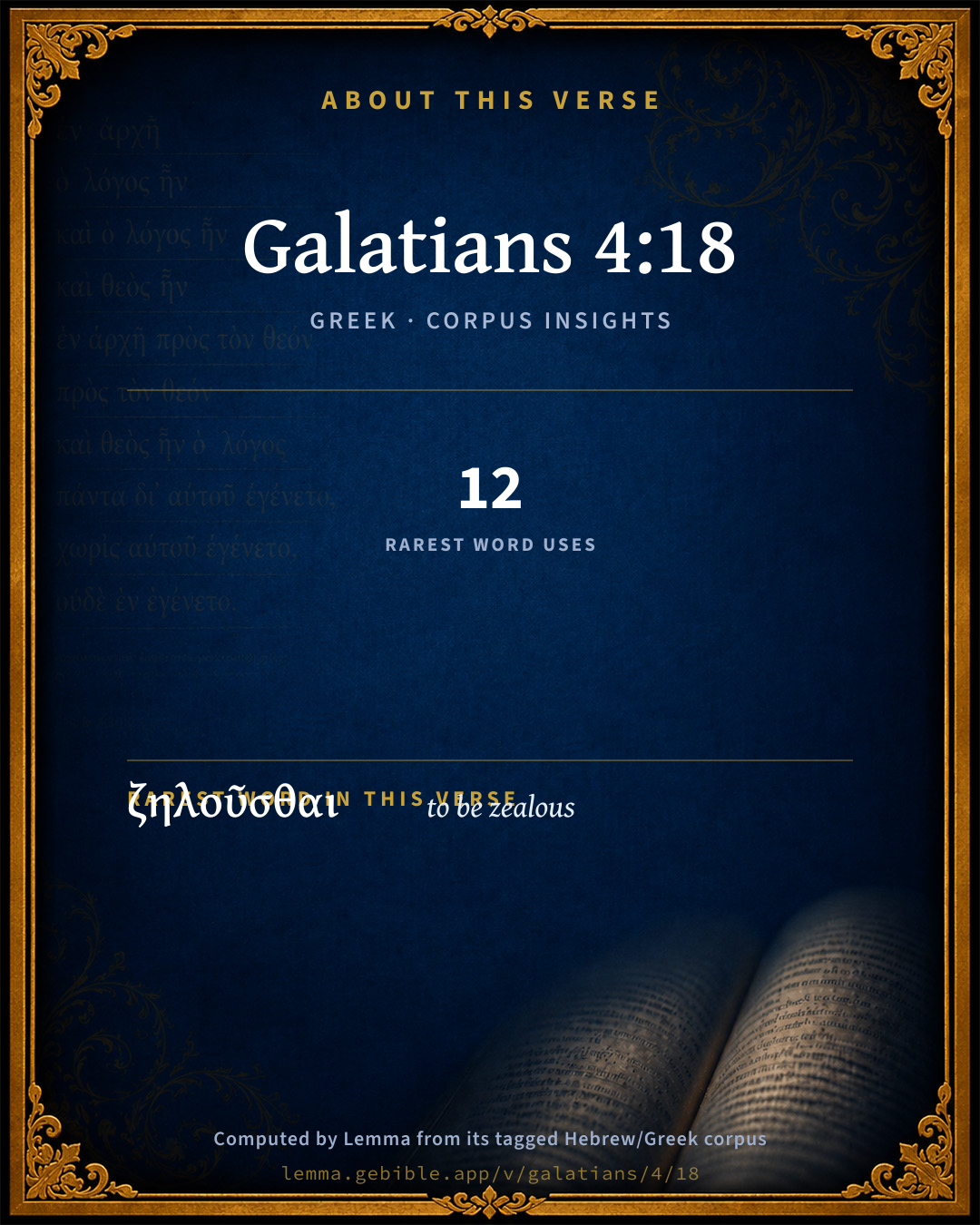
The rarest word here is ζηλοῦσθαι to be zealous G2206 — appearing just 12 times in the whole Greek New Testament.

Shared distinctive vocabulary

ζηλοῦσθαι to be zealous G2206 occurs in 11 verses of the Greek New Testament. Also found in:

Repetition

Words recur within this verse:

Cross-references

12

Topical passages linked to Galatians 4:18 in the Treasury of Scripture Knowledge — connected by theme and wording, ordered by reader-vote popularity; previews shown in the World English Bible.

  • Philippians 2:12 So then, my beloved, even as you have always obeyed, not only in my presence, but now much more in my absence, work out your own salvation with fear and trembling.
  • Philippians 1:27 Only let your manner of life be worthy of the Gospel of Christ, that, whether I come and see you or am absent, I may hear of your state, that you stand firm in one spirit, with one soul striving for the faith of the Gospel;
  • Revelation 3:19 As many as I love, I reprove and chasten. Be zealous therefore, and repent.
  • Psalms 119:139 My zeal wears me out, Because my enemies ignore your words.
  • 1 Corinthians 15:58 Therefore, my beloved brothers, be steadfast, immovable, always abounding in the Lord's work, because you know that your labor is not in vain in the Lord.
  • Galatians 4:13 but you know that because of weakness of the flesh I preached the Gospel to you the first time.
  • Titus 2:14 who gave himself for us, that he might redeem us from all iniquity, and purify for himself a people for his own possession, zealous for good works.
  • Numbers 25:11–13 Phinehas, the son of Eleazar, the son of Aaron the priest, has turned my wrath away from the children of Israel, in that he was jealous with my jealousy among them, so that I didn't consume the children of Israel in my jealousy.
  • Psalms 69:9 For the zeal of your house consumes me. The reproaches of those who reproach you have fallen on me.
  • Isaiah 59:17 He put on righteousness as a breastplate, and a helmet of salvation on his head; and he put on garments of vengeance for clothing, and was clad with zeal as a mantle.
  • John 2:17 His disciples remembered that it was written, "Zeal for your house will eat me up."
  • Galatians 4:20 but I could wish to be present with you now, and to change my tone, for I am perplexed about you.

Cross-references courtesy of OpenBible.info (CC BY 4.0).

Commentary

Notes on Galatians 4:18 from classic Christian and Jewish commentators (each source and its license shown beneath its notes). The classic Christian expositions comment on the surrounding passage and are grouped to its opening verse, so a note may address several verses; the Jewish commentaries on the Tanakh (Rashi and others) are per-verse, so they appear only where the commentator wrote on this verse.

Lemma curates 59 commentaries, every one of them public domain or Creative Commons licensed, each selected and text-cleaned for this edition rather than reprinted as found. About our sources →

Jamieson, Fausset & Brown

Robert Jamieson, A. R. Fausset & David Brown

good to be zealously affected--rather, to correspond to "zealously court" in Gal 4:18, "to be zealously courted." I do not find fault with them for zealously courting you, nor with you for being zealously courted: provided it be "in a good cause" (translate so), "it is a good thing" (Co1 9:20-23). My reason for saying the "not well" (Gal 4:17; the Greek is the same as that for "good," and "in a good cause," in Gal 4:28), is that their zealous courting of you is not in a good cause. The older interpreters, however, support English Version (compare Gal 1:14).

always--Translate and arrange the words thus, "At all times, and not only when I am present with you." I do not desire that I exclusively should have the privilege of zealously courting you. Others may do so in my absence with my full approval, if only it be in a good cause, and if Christ be faithfully preached (Phi 1:15-18).

Jamieson, Fausset & Brown — Commentary Critical and Explanatory on the Whole Bible (1871) — public domain (CC PDM 1.0). Text via the HelloAO Bible API.

The Biblical Illustrator

Joseph S. Exell

Gal_4:18

Am I therefore become your enemy, because I tell you the truth?

The right mode of giving and receiving reproof

Men commonly assign a number of the persons and things within their sphere to the classes, respectively, of friends and enemies. There are beings that have in them aa evil spirit toward us, and there are those that have a good one. Many things in our notions, tastes, habits, practices, if traced back to the cause, are what they are, because such and such men were regarded by us as friends or as enemies. How disastrous, therefore, that perversity of apprehension through which enemies have so often been accounted friends, and friends enemies! And especially conspicuous has this perversity been in regard to the point suggested in our text, namely, whether it should be esteemed the part of a friend faithfully to tell men the truth; and whether the suppression of truth, and the substitution of its opposite, should not be held to mark the character of an enemy, Where and when has it been that flatterers were not admitted and welcomed as friends? What a prodigious singularity in history were it, if there were recorded any nation, or tribe, or city, in which these were generally and practically discouraged and silenced, and honest truth was the way to favour! Whenever was it, that honest truth was the obvious expedient of self-interest? Self-interest with men is to be promoted by giving them the persuasion that we are their friends. Well then, has their faithfulness been the way in which men have gone about to make their fellow-mortals esteem them for friends? How often has the amicable state of feeling been broken up by telling the truth, even when done in a proper spirit and manner! The great apostle himself seems not without apprehension of such an effect, sincere as he was, and affectionate, and venerable, and even speaking to them with the authority of God. And still, and always, is not this honest expression of truth one of the most difficult and hazardous things a friend has to do? All which is but one more example to show that, in this world, whatever is the best in a thing, is the most difficult to be had, and to be kept in that thing. But now, in a general theoretical judgment, men would approve, by implication at least, what is so unwelcome when it comes to the practice. What would you wish your friend to be? Answer: I would wish him to be such that, as the last result of my communications with him, a great deal of whatever may be defective and wrong in me shall have been disciplined away. But, by what manner of operation, if he is never to hint at such a thing? Is it to be by some moral magic? Or is he to presume no further than to admonish by example? What! not even if he perceives that that admonition does not take effect? How many pointed suggestions of his mind is he to withhold from putting into words, in waiting to see whether they will arise in your own thoughts? May he not justly despair of accomplishing much beneficial correction, so long as he must not say that he intends or wishes to do it? so long, in short, as he feels himself in hazard of becoming, in your regard, an enemy by telling you the truth? Thus men will profess, and perhaps unthinkingly believe, that they derive the most essential benefits derivable from a true friend; but if he shall offer to impart them, he becomes an enemy! But consider, what an invitation, the while, this temper of mind gives to real enemies--to the flatterer, to the designing hypocrite, to every imposition the mind can put on itself, and to the great deceiver of souls--to anything but salutary truth! The great cause of this perversity and repugnance is, that it cannot be but that plain truth (by whatever voice) must say many things that are unpleasing. All censure is so; as it hurts that most quick, and delicate, and constant of all feelings, self-love. Another thing greatly contributing to this feeling toward him is, a want of the real earnest desire to be in all things set right; a kind of hollow truce which is kept up with conscience, with great difficulty, easily disturbed, and the disturbance painful; therefore, do not, do not come to provoke the enemy within! And then, again, there is pride, reacting against a fellow-mortal and fellow-sinner. We note only one thing more, as tending to excite in a person hearing unpleasant truth a feeling as toward an enemy, and that is, an unfavourable opinion or surmise, as to the motives of the teller of this truth. If it is truth, and useful truth, the motives of him that says it should make no material difference. Even from an enemy real instruction has an undiminished value. But, as we are constituted, this consideration does make a great difference. But the person reprehended should reflect how strongly the nature of the case tempts him to think unfavourably of the motives. Let him consider how slowly such surmises are entertained by him when he receives approbation or applause; But, to look now at the other side of the question, we shall do well to insist on a circumstance or two of propriety, in respect to the telling of unpleasant truth. For one thing, it is self-evident that those who have to do this should well exercise themselves to understand what they speak of. If this be a rule of propriety generally, in the utterance of thoughts and judgments, it is especially so in respect to those which are to be expressed as reprehensions, directly applied to persons and to friends; where some pain and displeasure may be expected to be caused, and opposition provoked. On such occasions how needful a knowledge of the subject, well-considered opinion, clear representation, pertinent sound argument. It hardly needs be said, that a real and evident friendly intention is of great avail. It may be added, that there should not be the same stress laid on everything that may not be exactly as the corrective instructor thinks it ought. Indeed, many minor things may wisely be altogether passed over. Again, in presenting admonitory or accusatory truth, it should be the instructors aim that the authority may be conveyed in the truth itself, and not seem to be assumed by him as the speaker of it; that he may be the mere conveyer of the force of the subject. Then, too, the teller of unpleasant truths should take care to select favourable times and occasions; when an inquisitive or docile disposition is most apparent; when some circumstance or topic naturally leads, without formality or abruptness; when there appears to be in the way the least to put the person reproved in the attitude of pride and hostile self-defence. (J. Foster.)

Toleration

This section is full of pathos. In it the theologian gives way to the man; or rather, the sanctified heart proves itself to be in full harmony with the inspired intellect; and the most vehement indignation against error is shown to be quite consistent with the utmost tenderness and affection towards those falling from the truth. It is a fine combination of the spirit of faithfulness with the spirit of toleration; a rare union of jealous regard for the truth of God and consideration for the weakness and infirmity of man.

I. The duty of maintaining dogmatic truth in a critical and sceptical age.

II. The spirit in which dogmatic truth should be upheld.

1. Not in the spirit of violence and persecution. Faith cannot be created by force. The action of the mind is essentially free.

2. Not in the spirit of unfairness, vindictiveness, and misrepresentation. This is the old spirit of persecution showing itself under new forms. If by using this unhallowed means, we excite mens enmity, we have only ourselves to blame.

3. The truth of God is to be upheld and advanced in the spirit of toleration, and by those means by which alone the minds of men are informed, their reason convinced, their confidence won. (Emilius Bayley, B. D.)

Him who tells us the truth, we ought to count for our true and best friend. (Heubner.)

In the world matters go altogether strangely, and against reason, namely, he that speaks truth becomes an unwelcome guest, yea, is counted for an enemy; but this is not so among good friends, and still less among Christians. (Luther.)

He that hates any one, because he tells him the truth, such an one betrays himself very clearly as no child of God. (Starke.)

Truth often unpopular

As the friar wittily told the people, that the truth he then preached unto them seemed to be like holy water, which every one called for apace, yet, when it came to be cast upon them, they turned aside their faces as though they did not like it; just so it is that almost every man calls fast for truth, commends truth, nothing will down but truth, yet they cannot endure to have it cast in their faces. They love truth when it only pleads itself, and shows itself; but they cannot abide it, when it presses upon them, and shows them themselves: they would have it shine out unto all the world in its glory, but by no means so much as peep out to reprove their own errors. (Senhouse.)

Falsehood cheaper than truth

Something sure is in it, that impostors find such quick return for their ware, while truth hangs upon the hand. And is it not this? that they offer to sell heaven cheaper to their disciples than Christ will to His? He that sells cheapest will have the most customers, though at last the best will be the cheapest; truth with self.denial will be a better pennyworth than error with flesh-pleasing. (W. Gurnall.)

Truth sacrificed to self-interest

Truth is so connatural to the mind of man, that it would certainly be entertained by all men, did it not by accident contradict some beloved interest or other, The thief hates the break of day; not but that he naturally loves the light as well as other men; but his condition makes him dread and abhor that which, of all things, he knows to be the likeliest means of his discovery. (R. South, D. D.)

Hostility to the truth

I. Arises from--

1. Ignorance.

2. Prejudice.

3. The influences of

(1) early training;

(2) subsequent sophistry.

4. Wilful sin.

II. Should be met by--

1. Patient instruction of the ignorant.

2. Gentle persuasion in the case of prejudice.

3. Convincing argument with those who have been brought up in it, or have been seduced from it.

4. Stern denunciation when truth is wilfully opposed.

III. Its utter unreasonableness

1. Truth must prevail.

2. Should truth be temporarily overcome, the truth-killer is involved in the ruin of the truth. Truthfulness is a corner-stone in character, and if it is not firmly laid in youth, there will ever after be a weak spot in the foundation.

Truth telling

I. Its importance. He who begins by loving Christianity better than truth will proceed by loving his own sect better than Christianity, and end in loving himself better than all. (Coleridge.)

II. Its value. The liar is like the wrecker of old, who by the false light of misrepresentation would lure his unwary victim to injury or destruction. The truthteller is like the skilful pilot, who, acquainted with all the features and practices of the coast, keeps the ship, it may be for the time being far out on the stormy sea, but conducts it eventually with safety into port.

III. The confidence it does and should inspire. Account that man thy friend who desires thy good rather than thy good will. (Bishop Hall.)

Talent is by no means rare in the world, nor is even genius. But can the talent be trusted? Can the genius? Not unless based on truthfulness. It is this quality more than any other that commands the esteem and respect, and secures the confidence of others. (S. Smiles.)

Am I therefore become your enemy … truth. Speaking of the want of any real self-sacrifice in the general actions of charity! of Christians, Gordon says, I say it is the fault of the preachers not speaking out. You need not come to Africa for the martyrs crown; there are plenty to be given in England. Speak out, and you will find sharper pricks than you will get from the native lances, and plenty of poison to envenom the wound.

Reproof makes enemies

There was a foolish law among the Lacaedemonians that none should tell his neighbour any ill news befallen him; but every one should be left to find it out for himself. There are many that would be glad if there were a law that would tie up ministers mouths from scaring them with their sins. Most are more careful to run From the discourse of their misery than to get out of the danger of it; are more offended with the talk of hell than troubled for that sinful state that shall bring them thither. But, alas! when, then, shall ministers have a fitting time to tell sinners of their danger, if not now? Hereafter there remain no more offices of love to be done for them. Hell is a pest house; there cannot be written so much on the door of it as Lord, have mercy on them that are in it. (Spencer.)

Breaking the looking-glass

Lais broke her looking-glass because it showed the wrinkles on her face. Many men are angry with them that tell them their faults: when they should be angry only with the faults that are told them. (Venning.)

Contending the truth a crime

As he who stands by and sees another commit murder without giving an alarm is accounted accessory to the murder; or as he who sees a blind man running into a pit, in which he is drowned, and makes no effort to save him, is guilty of death; so is he who sees his brother kill his soul without aa effort to prevent it. (Cawdray.)

Gods covenant with Abraham

The question handled in this chapter is given in Gal_4:2. Received ye the Spirit by the works of the law, or by the hearing of faith? It is argued in two ways--from the Scriptures and from analogy. It is first shown by the testimony of several passages that we receive the promise of the Spirit through faith (Gal_4:14). The second argument from analogy commences with the 15th verse, and is applied in Gal_4:16-18 to Abraham, the conclusion being the same as that of the first argument, viz., that the inheritance is of promise, and not of the law.

I. state the argument, and trace its course.

1. The argument is this. According to the customs of men (I speak after the manner of men), a covenant, if confirmed, cannot be disannulled or added to. An agreement, when signed and sealed, is binding. This is evident; it is according to one of the first principles of justice. Now if such be the ease with human engagements, how much more must it be with the solemn engagements of the God of truth, with whom is no variableness, neither shadow of turning!

2. Inquire into the nature of this Divine covenant. A covenant means either a last will or testament, or an agreement between two parties. The second meaning is the better here. But it is generally understood as equivalent to a promise. When God established His covenant with Noah, there was no engagement on Noahs part. A promise given by God, who cannot lie has all the force and indefeasibility of the most sacred contract.

3. In Gal_4:16 the apostle begins to apply his argument. God established a covenant with Abraham, i.e., to him and his seed were the promises made. The Holy Ghost intended Christ by his seed. Here we may interpose an important reflection. When we speak of the covenant being an agreement between two parties, is it not strictly true that the covenant was of this nature, the Father and the Son being the high contracting parties? The counsel of peace was between them both. And all the promises of God are yea and amen (given and fulfilled) in Christ (2Co_1:20).

4. In Gal_4:17 St. Paul proceeds in the application of the analogy. And this I say--I affirm. This covenant with Abraham was confirmed by God, and confirmed four hundred and thirty years before the giving of the law, and therefore the law cannot disannul it, that it should make the promise of none effect. The inheritance could only have come to Abraham in one of two ways--either by the law or by promise. As a matter of history God gave it to Abraham by promise. The conclusion is, that the gift of the Spirit, or salvation, is not of law, but of promise--not by works, but by faith. The covenant was confirmed in that remarkable vision in Gen_15:1-21. The smoking furnace and the burning lamp were emblems of the Divine majesty. These passing through the parts of the sacrificed animals signified the ratification of the covenant. It was necessary that the covenant should be confirmed by the shedding of blood. The inheritance here means the Holy Spirit. The question is, How did ye receive the Spirit--by works or by faith? The answer is, The blessing of Abraham--the promise of the Spirit--is by faith. God gave this inheritance to Abraham by promise (Comp. Eph_1:13-14).

II. Gather up some of the lessons.

1. Christ has the promises. So verse 19, Till the Seed should come, to whom the promise was made. All spiritual blessing is wrapped up in Him. On His exaltation He received the promise of the Holy Ghost, and poured Him forth upon the infant Church (Act_2:33). How foolish the Galatians to seek the blessing by ritual! How foolish now are they who want the blessing to stay away from Christ! (Expose common excuses. Some think they are too wicked; others waiting till they can see themselves more vile, etc.; and speak of the glory of Christ as the Friend of Sinners. Enlarge on this.)

2. The Holy Spirit is a gift. Some talk of religion as if it were a trade to which to be apprenticed, and at which they must labour before they can earn the title of being religious. Let them accept the gift of God. How much more will your heavenly Father give the Holy Spirit to them that ask Him! The law, or works, bid a man wait till the moving of the waters; Christs waters of salvation are always being moved, and He invites every stoner to step in at once and be healed. This subject is most important as bearing upon sanctification. Having begun in the Spirit, are ye now made perfect in the flesh? No--we are made perfect in the Spirit; we are sanctified by faith. We must receive by faith from the Lord Jesus the supply of His Spirit. (W. J. Chapman, M. A.)

Gal_4:18

Zealously affected always in a good thing.

Value and importance of Christian zeal

I. Examine the Christian quality spoken of.

1. Its foundation. Supreme love to Jesus Christ, the fruit of spiritual regeneration, is the only solid basis of true zeal.

2. Its nature. Sincere and warm regard for Gods glory. A compound of strong faith and disinterested regard, manifesting itself by patient endurance and constant exertion.

3. Its objects.

(1) Plain acknowledged truths, such as mans ruin by nature, his redemption by Christ, his renewal by the Holy Spirit.

(2) Matters of real importance. Not the shell or garment of religion, but the life and heart of it.

(3) The advancement of the Divine glory is the object nearest every true believers heart, and he will use all his influence to uphold and support the means calculated to promote it. The instruction of the young, the distribution of the Scriptures, the propagation of the gospel at home and abroad, etc.

4. Its properties.

(1) Enlightened and prudent.

(2) Mild and gentle.

(3) Modest and humble.

(4) Warm and active.

II. Its value and importance in the Christian cause.

1. It facilitates the progress of those who possess it in their Christian course.

2. It makes the practical part of religion easy and delightful.

3. It promotes a Christians usefulness. He feels a desire to do something for the interest and benefit of his fellows.

Application:

1. Let those who possess this Christian quality cultivate it.

2. Let strangers to Christian zeal seek to become partakers in it. (T. Lewis.)

Definition of zeal

Zeal may be defined as the heat or fervour of the mind, prompting its vehemence of indignation against anything which it conceives to be evil--prompting its vehemence of desire towards anything which it imagines to be good, In itself, it has no moral character at all. It is the simple instinct of energetic nature, never wholly divested of a sort of rude nobility, and never destitute of influence upon the lives and characters of others. The word zeal is used indiscriminately in Scripture in order to denote a strong feeling of the mind, whether bent upon evil design or on cultivating the things which are of good report and lovely. (W. M. Punshon, D. D.)

True zeal

True zeal is like the vital heat in us that we live upon, which we never feel to be angry or troublesome. (Cudworth.)

Heavenly zeal

Our zeal, if it be heavenly, if it be true vestal fire kindled from above, will not delight to tarry here below, burning up straw and stubble and such combustible things, and sending up nothing but gross earthly flames to heaven; but it will rise up and return back pure as it came down, and will be ever striving to carry up mens hearts to God along with it. (Cudworth.)

Constancy of zeal

We do not value an intermitting spring so much as the clear brooklet which our childhood knew, and which has laughed on its course unheeding, and which could never be persuaded to dry up, though it has had to battle against the scorchings of a jubilee of summers suns. We do not guide ourselves by the glow-worms bead of light, or with the marsh-lamps fitful flame. No, we look to the ancient sun, which in our infancy struggled through the window, and danced upon the wall of the nursery, as if he knew how much we delighted to see him light up the flower-cup and peep through the shivering leaf. And, for ourselves, we do not value the affection of a stranger awakened by some casual congeniality, and displayed in kindly greeting or in occasional courtesy. Our wealth is in the patient bearing, and the unnoticed deed, and the anticipated wish, and the ready sympathies, which make a summer and a paradise wherever there is a home. And not only in the natural and the social relations, but in the enterprise of the world, in the busy activities of men, the necessity for uniformity in earnestness is readily acknowledged. Society very soon brands a man if he has not got a perseverance as well as an earnestness about him. The world has got so matter-of fact now, that it jostles the genius off the footpath, while the plodder, whose eye sparkles less brilliantly but more evenly, steadily proceeds on his way to success. (W. M. Punshon, D. D.)

Interest in holy work to be maintained

It is of the utmost importance to keep up our interest in the holy work in which we are engaged, for the moment our interest flags the work will become wearisome. Humboldt says that the copper-coloured native of Central America, far more accustomed than the European traveller to the burning heat of the climate, yet complains more when upon a journey, because he is stimulated by no interest. The same Indian, who would complain when in botanizing he was loaded with a box full of plants, would row his canoe fourteen or fifteen hours together against the current without a murmur, because he wished to return to his family. Labours of love are light. Love much, and you can do much. Impossibilities disappear when zeal is fervent. (C. H. Spurgeon.)

Quality of action

The Hebrews have a saying that God is more delighted in adverbs than in nouns; tis not so much the matter thats done, but the matter how tis done, that God minds. Not how much, but how well! Tis the well-doing that meets with a Well done! Let us therefore serve God, not nominally or verbally, but adverbially. (Venning.)

Zeal and prudence

Two ships were aground at London Bridge. The proprietors of one sent for a hundred horses, and pulled it to pieces; the proprietors of the other waited for the tide, and with sails and rudder directed it as they pleased. (C Simeon.)

Zeal and discretion

Zeal and discretion united together are like the two lions which supported the throne of Solomon; and he who has them both is like Moses for mildness and like Phineas for his service; therefore, as wine is tempered with water, so let discretion temper zeal. (H. Smith.)

It is good to be zealously affected always in a good thing

I. What is the nature of true Christian zeal?

1. The original word means heat. When the passions are strongly moved to good and against evil there is religious zeal.

2. Love is the chief ingredient in its composition. But it is love in the highest degree--fervent love.

II. It follows, therefore, that the properties of love are the properties of zeal (see 1Co_13:1-13.).

1. Humility.

2. Meekness.

3. Patience.

4. Permanence.

5. Proportioned to that which is good.

(1) For the Church.

(2) More for Church ordinances.

(3) More still for works of mercy.

(4) Most for love itself.

III. Practical inferences. If this be true, then--

1. Christian zeal is inimical to--

(1) Hatred, bitterness, prejudice, bigotry, persecution.

(2) Pride.

(3) Anger.

(4) Murmuring and impatience. And,

2. Is not fervour for

(1) Any evil thing.

(2) Indifferent things.

(3) Opinions. (J. Wesley.)

Zeal

I. Its objects--Good things.

1. Acts of worship.

2. Acts of our secular calling.

3. Acts of righteousness.

4. Acts of charity and mercy.

II. Its nature.

1. Forward and cheerful.

2. Resolute in spite of discouragements.

3. Diligent and earnest.

4. Constant.

III. Its place in religion.

1. It is a note of Gods people.

2. It is the fruit of Christs death.

(1) By way of obligation.

(2) Because Christ has purchased for us the Spirit of power.

IV. Application.

1. How earnest men are in sin--shall Satan be served better than God?

2. Consider how zealous you once were.

3. We cannot afford to be lukewarm.

(1) Time is short.

(2) The enemy is earnest.

4. The object deserves the warmest zeal.

5. Coldness is dangerous to ourselves and others.

6. Christian comfort depends on zeal.

7. The want of zeal is odious to God and dishonourable. (Manton.)

Christian zeal

I. Its nature.

1. In general the heat or fervour of the mind prompting its vehemence of indignation against evil, of desire for good; the simple instinct of energetic nature, never wholly divested of a sort of rude nobility, and never destitute of influence upon the lives and character of others.

2. Christian zeal--

(1) Springs from a Christian motive. If it does not spring from love it will be a blind distempered emotion.

(2) Is displayed in a Christian manner--merciful and tolerant.

(3) Is used for Christian ends--peace and good-will.

II. Its permanence--On which rests its main value.

1. We see this in nature, social relationships, business.

2. The temptations to make it fitful.

(1) Religious lukewarmness.

(2) The race for wealth.

(3) Ministerial preferences. But if religion is a good thing, it is always so.

III. Its profitablness. It is good--

1. In itself.

2. In its influences.

3. In its effects. (W. M. Punshon, D. D.)

The reasonableness of Christian zeal

The world applauds the zealous in everything but religion. The warrior whose breast shall shine with stars, the scholar who makes a hush as he appears--they are those who set an object before them and strive for it through the hazard of years, and would deem it a shame if they did not put heart into their work. And shall not the Christian be in earnest with a cause that ennobles, with a responsibility which he may not transfer, with the destinies of his fellows for ever trembling in the balance, and in some sort committed to his fidelity as a witness for God? With the solemn concerns of the soul shall there be trifling? When a moments opportunity welcomed or slighted may decide the fortunes of an eternity, shall languid counsels prosper or faint desires prevail? When a real strife is waged, fiercer far than the fabled battle between the giants and the gods, and heaven and hell are in earnest for the possession of the man, shall those who have been won for God be craven or traitorous in the fight? (W. M. Punshon, D. D.)

The causes of declining zeal

Commercial prosperity and business cares, the eagerness after pleasure and the exigencies of political life, diffused doubt and wide-spread artistic and literary culture, eat the very life out of thousands in our Churches, and lower their fervour till, like the molten iron cooling in the air, what was once all glowing with ruddy heat is crusted over with foul black scoriae, ever encroaching on the tiny central warmth. (A. Maclaren, D. D.)

Zeal illustrated

During the battle of Gettysburg, Chaplain Eastman was so badly injured by a fall of his horse as to be compelled to lie down on the field for the night. As he lay in the darkness, he heard a voice say, Oh, my God! and thought, How can I get at him? Unable to walk, he started to roll to the sufferer, and rolled through blood, among the dead bodies, till he came to the dying man, to whom he preached Christ. This service done, he was sent for to attend a dying officer, to whom he had to be carried by two soldiers. Thus he passed the long night; the soldiers carrying him from one dying man to another, to whom he preached Christ, and with whom he prayed, while he was compelled to lie upon his back beside them. (Foster.)

Christian zeal

At a missionary meeting in Edinburgh, the Rev. W. C. Bunning related that a friend of his was once riding between Glasgow and Greenock, when the train began to flag, and at length stood still. The gentleman got out, and going up to the engine, said to the driver, Whats the matter? Have you run out of water? No, was the reply, weve plenty of water, but its not boiling. (R. Brewin.)

Zeal the need of the Church

A fearful storm was raging, when the cry was heard, Man overboard! A human form was seen manfully breasting the furious elements, in the direction of the shore; but the dominant waves bore the struggler rapidly outward, and, ere boats could be lowered, a fearful space sundered the victim from help. Above the shriek of the storm and roar of the waters rose his rending cry. It was an agonizing moment. With bated breath and blanched cheek, every eye was strained to the struggling man. Manfully did the brave rowers strain every nerve in that race of mercy, but all their efforts were in vain. One wild shriek of despair, and the victim went down.

A piercing cry, Save him, save him! rang through the hushed crowd; and into their midst darted an agitated man, throwing his arms wildly into the air, shouting, A thousand pounds for the man who saves his life! but his starting eye rested only on the spot where the waves rolled remorselessly over the perished. He whose strong cry broke the stillness of the crowd was captain of the ship from whence the drowned man fell, and was his brother. This is just the feeling now wanted in the various ranks of those bearing commission under the great Captain of our salvation. Save him! he is my brother. (Biblical Treasury.)

Zeal in religion

Reasons why we should be zealous in Christs service.

1. Manliness requires it.

2. The character and services of the Master render anything short of this a crime and a betrayal of an infinite trust.

3. The reward promised may well tax every power of our being to its utmost capacity. (American Homiletic Review.)

Work aids zeal

When Dr. Kane was in the Arctic regions he one day wanted to light a fire, and being away from camp where he could not get matches, he took a piece of ice, clear as crystal, and cutting it into the shape of a convex lens, he held it up to the sun, and in a few moments kindled a pile of dry leaves and sticks into a blaze. I presume the ice in its turn was melted in the fire it had kindled. If any one of us are in a cold state religiously; if in the place of a heart glowing with the love of Christ which we once had, we have only a frozen lump of religious respectability in our bosom, I wish we could go among the lost and sinning and impenitent, and just tell them as best we can how Christ died to save them, and I believe it would open their hearts as the sunlight opens the frozen bulbs. And in Him our own hearts would be thawed and melted. (A. J. Gordon.)

The military value of enthusiasm

It is good to be zealously.., with you. A good general, a well-organized system, good instruction, and severe discipline, aided by effective establishments, will always make good troops, independently of the cause for which they fight. At the same time a love of country, a spirit of enthusiasm, and a sense of national honour, will operate Upon young soldiers with advantage. (Maxim Lev_1:1-17.)

An object unworthy of zeal

An eccentric writer tells this story about a man who was more eccentric than himself:--Being still ignorant, he took a vow upon him not to wear a hat, because he had heard that Sir Isaac Newton took off his hat when he thought upon God. Thomas B--thought he would outdo Sir Isaac, for he would not wear a hat at all, and kept his vow faithfully for eight years under the bitterest persecution, In his own strength he took his legal bondage upon him; and, self-will being his ruling passion, he would go through fire and water for the Lord and his own way, more under law than gospel. What a useful man he might have been if his zeal had been well directed! If he had suffered persecution on account of his devotion to religious duties, and in obedience to authority ordained by God! (From The Gospeller.)

Christian zeal

I. The nature of christian zeal.

1. A spiritual principle, and therefore Divine in its origin. A man may be zealous in sin; he may be a zealous bigot or sectarian; but no man can be spiritually zealous, until he is a spiritual man.

2. Christian zeal is an intellectual principle, and therefore the result of knowledge. It not only warms, but it illumines.

3. Christian zeal is a modest and humble principle.

4. Christian zeal is a constant, enduring principle. Not the feverish heat of a diseased body, but regular, constitutional warmth.

5. Christian zeal is an active, vigorous principle. It loosens the tongue, opens the hand, swiftens the feet. It prays, as well as believes; it labours as well as hopes.

6. Christian zeal is an affectionate principle, and is always connected with fervent love. No anathemas; no shibboleths. It is not suspicious, but open; not narrow, but broad, liberal, generous.

II. The object of Christian zeal. A twofold sphere for the exercise of Christian zeal.

1. In securing the greatest possible amount of good to ourselves. Zealous in seeking extensive knowledge. Zealously labouring after more of the spirit of Christ. In communicating all the good in our power to those around us. What aa enlarged sphere! The world itself is our field. But especially those in our immediate neighbourhood.

III. The excellency of Christian zeal

1. It is good to the soul which is under its influence. The same as exercise to the body. It produces energy, buoyancy, safety, happiness.

2. It is good for the Church.

3. It is good for the world at large.

4. It is good, as it associates us with the highest intelligences of the heavenly world. The angels are distinguished especially for zeal. And how zealous was our blessed Saviour!

IV. The importance of Christian zeal.

1. It is pre-eminently important when the object contemplated is great and glorious.

2. It is pre-eminently important when difficulties are numerous.

3. It is pre-eminently important when the time of action is limited.

4. When the responsibilities are momentous. It is not a secondary concern. Not optional. It is imperative that we be zealously affected in every good work. Our destiny awaits us according to the spirit and practice we have pursued on earth.

Application:

1. Let Christians cherish this holy principle.

2. Let unpardoned sinners zealously seek the salvation of their souls.

3. Let the Church be zealous for the instruction of the rising age. (J. Burns, D. D.)

Religious zeal

Zeal about religion may be very far from religious zeal; and as the abuse of the best thing is proverbially the worst, there are few passions that have proved more truly Satanic in their operations and consequences, than a blind and misguided zeal about God and divine things.

I. We must be sure that its object is the true one. Personal religion. There may be a great deal of profession, with little life or spirit. It must have the heart, as well as the mind in it.

II. It must always be in a good thing.

1. A truth.

2. A duty.

III. The principle or motive of zeal must be good. Gods glory, not our own advantage or comfort.

IV. It must be properly proportioned. Every truth and every duty is good, and ought to be attended to in its proper place; but truths and duties have various degrees of importance, and we must not prosecute the lower to the neglect of the higher.

V. It must be consistent, uniform, and persevering. It does not burn and shiver alternately, nor pass with uncertain and capricious mutability from the torrid to the frigid, and from the frigid to the torrid zone of feeling. It is not the sudden and flickering flame, however brilliant; and lively, that fuses the hard ore, but the glowing heat of the well-regulated furnace.

VI. The means, as well as the object, of christian zeal must be good. Nothing may be used that is at variance with any of the great principles of moral rectitude. We cannot advance the Divine honour by first doing dishonour to the Divine law. No fighting or persecuting zeal, no indulgence of passion, can be tolerated in this hallowed cause. (R. Wardlaw, D. D.)

Temporary zeal

This is a human feeling, which exists in many, even pious souls. They are zealous in good, when faithful teachers are present, but when they are absent, or it may be dead, they slacken in their zeal. (Starke.)

Christian zeal

Many things must be attended to, in order that our zeal may be as efficient as possible; that it may not be injurious, but acquire a proper tone, and be made useful to ourselves and others.

I. It should be real and conscientious.

1. There are many kinds of zeal which do not stand this test.

(1) Zeal of sympathy, which is only that of a soldier, who, though himself a coward, is urged on to battle by the example of the general.

(2) Constitutional zeal, mere animal warmth, no more allied to our spirit than are our arms or feet.

(3) Zeal of sentimentality, requiring some powerful excitement, and dying away when that is gone.

(4) Zeal of affectation, which is in fact hypocrisy, only put on for the sake of appearances.

2. The zeal that is proper is a fair demonstration of what is felt within us. It seeks not the eye of man, but acts under the keen, all-searching eye of God. It is influenced by what is real and true; it is fed by the real and great blessings which Christianity has to bestow; and then it becomes a constituent part of the character, and maintains its dominion in the soul.

II. It should be intelligent, accompanied with knowledge. That it be sincere alone, is not enough. It may be that, and yet mistaken. So we must take care to be fully instructed in that on behalf of which we put forth zeal.

III. Prudence in the exercise and manifestation of our religious zeal. Prudence does not clamp our zeal, but enables us better to accomplish our object. You cannot be too zealous in obtaining personal religion, but you cannot be too prudent in the means you adopt to promote it.

IV. Its exercise must always consist with moral integrity.

V. It must be under the influence of charity. (Dr. Thomson.)

The duty of Christian zeal

The word zeal refers to fire; to be zealously affected is to be warm, to glow, to burn. It implies an ardour which agitates our whole being, rouses every dormant faculty, touches every spring of sensibility, and calls forth-all our energy in vigorous exertion towards the object to which our efforts are directed. The heart of the true Christian is the altar where this holy flame glows and burns, and to fan this pure flame of love into a brighter blaze was St. Pauls design when he wrote this passage.

I. Let us adduce a few considerations illustrative of the truth of the proposition in the text.

1. An object really and pre-eminently good, deserves and demands aa ardent continuous zeal in its promotion. And is not Christianity such?

2. An object really and pre-eminently good, is not ordinarily to be attained without an ardent persevering zeal How readily is this recognized with respect to worldly affairs. And shall those in pursuit of a souls salvation fold their hands in idle self-complacency? Are not the angels zealous? Was not our Lord consumed with zeal? What but this brought Him down to earth--from a throne of glory to an ignominious Cross?

3. Zeal, in promotion of an object really and pre-eminently good, is sure, sooner or later, to be crowned with success. Truth is indestructible, cannot die, must prevail. There are no difficulties that cannot be conquered by ardent, persevering zeal; there is no work which it cannot achieve.

II. Let us learn some of those lessons of practical instruction which the maxim of the text is well calculated to teach.

1. Let us always see to it that the object of our zeal is really good.

2. How can any persons professing religion justify their claim to the Christian character while destitute of zeal?

3. Let us see that our zeal be constant and stable.

4. Those who are thus zealous are not the fools, but the wise men. (R. Newton.)

Excellency of Christian zeal

To be zealously affected as to spiritual things will be found to be good--

1. As an evidence of the liveliness of grace in our own souls.

2. Because it is a most suitable means of preserving and increasing Divine grace.

3. Because of its beneficial tendency to arouse the zeal of others.

4. Because of the usefulness accomplished by this excellent quality in the welfare of mankind at large.

5. Because of the especial glory which is thereby brought unto God. (John Garwood, M. A.)

Holy and unholy zeal contrasted

Fire may be employed for good or evil. Heat is essential to life, yet may prove the forerunner of widespread consumption. If on the one hand it is genial, restorative, purifying; on the other it is devastating and destructive. So we speak of the warmth of love, the heat of passion, the fire of persecution, etc., to describe various affections and emotions of the mind. Zeal is a word invented by the Greeks to express the glowing intensity of any mental affection, whether usefully or perniciously directed. Observe--

I. The zeal that is reprehensible.

1. A zeal for rites and forms and ceremonies, as if they were of any value in themselves.

2. A zeal for tradition.

3. An ignorant zeal.

4. A persecuting zeal. This always defeats its own end.

II. The zeal that is commendable.

1. That which proceeds from true love to God.

2. A zeal for Gods spiritual worship.

3. A zeal for good works.

4. Zeal for the edification of the Church. (J. D. Sirr, D. D.)

Motives of Christian zeal

1. The command of Christ.

2. The example of Christ.

3. The love of Christ in the heart.

4. The examples of holy men.

5. The personal advantages derived from it.

6. The good which it may accomplish.

7. The commendation which is given of it, and its examples in the Scriptures. (John Bate.)

The profitableness of Christian zeal

It is good; no higher praise than that can be given to it. It is good--the very thing that was said of the fairly finished earth, on the morning of Jehovahs rest and pleasure. It is good--the very thing that is spoken of God Himself: Thou art good, and doest good.

1. To be always zealously affected in a good thing is good in itself. Where the heart preserves the ardour of devotion, it will preserve the ardour of enterprise. It will be always at work for the best interests of men. There will be no time for dalliance with temptation, or for the misgiving of unbelief. The active love and the loyal heart will be mutually helpful to each other, and the man will grow like a cedar--his roots wedging themselves close and firm into the Rock of Ages, his branches flinging themselves upward with such graceful aim that no tree in the garden of God shall be like unto him in his beauty.

2. Good in its influences. Who shall estimate the effect upon the progress of the Redeemers Kingdom, when the Church is filled with the spirit of Christian zeal? Oh! a prospect of ineffable spiritual beauty rises up before the prophetic eye, informed by the spirit of the Master. Each member of the Church becomes a missionary of the truth, and there is neither silence nor faltering in the testimony; the cords of love, which are the bands of a Man, enclose thousands in the gospel fellowship; the Church itself, in growing purity and strength, becomes the dominion of ever-ripening authority; the world, charged by the Word as the living epistles speak it, bows its rank, and its intellect, and its pride, before the feet of Jesus; He reigns whose right it is, over a regenerate people, made willing in the day of His power.; and then cometh the end--the finished mystery of the Cross, the consummated glories of redemption. (W. M. Punshon, D. D.)

Objects of Christian zeal

1. The salvation of the soul of him who is the subject of it.

2. The House of God in its worship, its word, its attendance.

3. Promotion of family religion.

4. The conversion of sinners.

5. The general welfare of all the means, ordinances, and institutions of the Church.

6. Whatever concerns the real welfare of mankind. (John Bate.)

Obligation to Christian zeal

1. The value of personal salvation.

2. The difficulties in the way of its exercise.

3. The duties and privileges of religion.

4. The claims of the Church.

5. The condition of the world.

6. The glory of Christ. (John Bate.)

Regulation of Christian zeal

1. It should be guided by charity.

2. By the wisdom which cometh from above.

3. By a due regard to times, circumstances, places, and persons.

4. By the relative claims of each object.

5. By an aim to the glory of God. (John Bate.)

False zeal

A false zeal in religion is always, in some respect or other, a misdirected zeal, or a zeal not according to knowledge--a zeal seeking some false end, seeking its promotion in some unauthorized way. Jehu had a good zeal, which he called zeal for the Lord of Hosts. His fault was, not that he was too zealous, but that his zeal was really directed to his own advancement. The Jews in the days of Christ had a zeal for God, but it was so misdirected as to fire them with a frenzy to destroy the Son of God and extinguish the Light of the world. There are countless forms of false zeal now at work; but in all eases they sin, not by excess, but by misdirection. Some are flaming with a zeal to spread some of the corruptions of Christianity, and to carry men away from its great and cardinal truths. Some are equally zealous to build up a sect or party on other foundations than those which God has laid in Zion; and that which taints their zeal is the purpose to which they employ it, and not any excessive fervour of their zeal itself. (H. Bonar, D. D.)

Zeal

I. As to the true nature of Godly zeal, in the general it is a great vehemency and ardency in religion. It is a fire of the sanctuary, not a profane flame. It is the warmth and vigour of holy persons in their prosecution of what is good and virtuous. More particularly, this zeal is either internal or external. I will speak first of that which is internal, and hath its seat in the mind and soul. This is no other than the vehemency and fervour of the affections, or it is the affections inflamed with religion. It is a burning of all the passions, namely, a fervent desire of God and goodness; it is a holy anger for sin stirred up to a great height; it is an exalted love of whatever is good; it is a perfect hatred and detestation of vice; it is vehemency of grief, because God is offended and religion despised; it is a seraphic joy and gladness springing from the delight which is taken in holiness. But though zeal be the utmost intention and fervent acting of all the affections, yet it is chiefly the heat and earnestness of these two, namely, love and anger. First, it is an ecstasy of love: and that love respects both God and man. He that doth not love God dearly cant be zealous: for zeal is an inflamed love of the beauties and excellences of the Divine nature, and (as the consequence of this) it is a passionate longing to exalt Gods glory in the world. Again, he that ardently loves God, will love those who bear His image. Wherefore an earnest love of the brethren must needs be an inseparable attendant of godly zeal, according to that of St. Peter, Love one another with a pure heart fervently. Thus zeal is the flame of love. And from this love flows anger and indignation against sin, and the doers of it; for he that loves God will show his wrath against that which offends and displeaseth Him. We find ourselves incensed and exasperated to a very high degree when we see affronts and injuries offered to our parents, and those whom we love most; much more, when our heavenly Father is affronted and injured, our hearts must needs rise within us, and we cannot but feel them stirred with anger and a holy revenge; for zeal is an indignation conceived for the wrong done to those whom we dearly love. Thus zeal is no other than love angered. Secondly, this godly zeal is not only inward, but outward. First, the Christian zeal manifests itself by words, as it is said of Apollos, that being fervent in spirit, he spake and taught diligently the things of the Lord (Act_18:25); and, he spake boldly in the synagogue (verse 26). So the apostles, We cannot but speak the things which we have seen and heard (Act_4:20). Zeal gives utterance, and will not suffer the truth to be stifled and concealed; for truth is of absolute necessity, and error is damnable as well as vice. Secondly, zeal displays itself in all religious actions and performances. But to let you see that zeal manifests itself in outward actions, and never wants ways of expressing and openly displaying itself, I will mention some of the chiefest duties required in Christianity. The first I will name, is repentance. This and zeal must go hand in hand, according to that advice given to the Church of Laodicea, Be zealous and repent (Rev_3:19). And St. Paul, speaking to the Corinthians of the several effects and concomitants of repentance, demands of them what zeal it wrought in them (2Co_7:11). Again, true evangelical charity is never void of this; wherefore you hear St. Peter exhorting the Christians thus, Have fervent charity among yourselves (1Pe_4:8). And hence the Corinthians forwardness in alms-deeds, in distributing and ministering to the saints, is called zeal (2Co_9:2). Moreover, the zeal of Christians must be discovered in prayer, that most necessary duty of our religion. This is called by St. Paul labouring (or striving) fervently in prayer (Col_4:12). In the next place, hearing the Word ought to be with zealous attention and vigour, because it is for our lives, or eternal welfare is concerned. Farther, I might show you that an extraordinary fervour and zeal must accompany the partaking of the holy communion. Here, if ever, our life and heat must display themselves. There must be fire on this altar: our hearts must be a burnt-offering. Zeal is when our graces are in their zenith or vertical point. Zeal is heroic virtue in the Christian philosophy: it is the highest pitch and most exalted degree of every endowment, grace, and duty. I will now (according to what I proposed) annex the properties of it, which are these: First, this zeal which I have described, is real and sincere, in opposition to counterfeit zeal. And we may know the sincerity of it--

1. By this, namely, if we are most offended and incensed because God is dishonoured and injured; for zeal shows itself in the things that belong to Gods glory. Thus Christ showed the truth of His zeal for His Fathers house (Joh_2:17). This is one way to try the sincerity of your zeal, viz., if you signally show it against Gods enemies, whilst in the meantime you discover a great deal of clemency to those who are your own, and have particularly injured yourselves.

2. The right genuine zeal may be known by this; that it spends not itself about lesser matters, and things that are wholly indifferent. Some mens zeal runs out into this one main thing, viz., to uphold some doubtful opinion, and to defy and detest all that are not of their persuasion as to that particular. But a wise, good man proportions his zeal according to the worth dud importance of the matters he is conversant about. And because indifferent things are not important and weighty, he knows that they deserve not his zeal. All was not massy gold that Solomons merchants brought over in their ships: apes and peacocks were part of their cargo. Thus in our merchandising for truth, we meet with some slight and trifling things, nice points, notions for embellishment only. And next to these, are external ceremonies and rites, particular modes and circumstances in religious worship But we ought to lay out our zeal on those things which are in their own nature worthy, necessary, and indispensible.

3. This is another trial: if your zeal be accompanied with love and charity, you may infer it is sincere; but if it be so fierce and greedy as to devour these, and to stir you up to be cruel and implacable, then conclude that your zeal is not the evangelical zeal.

4. Sometimes gain and profit are the only spring of mens zeal, and then you may conclude it to be false and counterfeit, and not the true religious zeal. Those who make gain their godliness are no true zealots.

5. When zeal proceeds from pride and ambition, there is reason to believe that it is not sincere. Secondly, this is another property of zeal, that it be accompanied with, and guided by knowledge, in opposition to blind zeal. St. Paul bears record of the Jews, that they had a zeal of God, but not according to knowledge (Rom_10:2). And of himself he saith, that he had formerly been exceedingly zealous of the traditions of his fathers (Gal_1:14), which were a medley of ignorance and superstition. But he tells us in another place how pernicious that zeal proved to him, and what vile enormities it excited him to. But true zeal is built on knowledge. This heat doth not want light, but is conducted by judgment and wisdom. Thirdly, there ought to be this property of our zeal, that it be according to a rule, and that it keep within its due limits, in opposition to irregular and lawless zeal. Zeal must have its certain limits and boundaries. This fire must be kept on the hearth, in its due place. We ought to act in religion by certain rules and measures, for it is a regular and well-guided zeal that God accepts. Fourthly, I will add this as another property, it must be peaceable and well-tempered, sedate and discreet, in opposition to turbulent and rash zeal. This carnal zeal is an immoderate heat, an exorbitant commotion of the mind, an excess and transport, whereby men disorder both themselves and others. Between this zeal and the other, there is as much difference as between the quick and fierce lightnings which are observed sometimes in the skies, and the suns mild, yet active flame. False zeal is full of noise and clamour, and violent motion. They who are acted by it think that it is of the nature of some rivers, which are never so useful as when they overflow. Christian zeal is a natural and kindly heat, not a burning fever or calenture. The mind or soul of man with all its functions and faculties, is in Scripture often called the heart, that being thought, of old, to be the chief place of its residence. But we may learn, by the by, from this denomination, that the mind of man ought to resemble his heart, from whence it borrows its name. Now the motion of this in healthful persons is even and placid, propagates the like pulse into all the several arteries which overspread the body. All its stops and intervals are equal and harmonious, as if nature kept time in these organs of the body. This high pulse argues no less than an inflamation of the mind, than a feverish distemper of the soul. Lastly, the text affords another character of this zeal: it must be constant and persevering. We are to be zealously affected always. This holy fire must ever be burning on the altar. This is, according to the apostles expression, instantly (or intensely) serving God day and night (Act_26:7). As no adverse accidents and calamitous circumstances, so no allurements and smiles of the world are able to make the truly zealous person alter the tenour of his life. He hath set himself to a just pitch, and there he continues. False zeal spends itself too fast, and like some meteor is seen to blaze only a short time, and then to vanish. But that zeal which is true and genuine, like the sun shineth more and more unto a perfect day, and is a never-failing source of light and heat.

II. Having finished the first general part of my discourse, wherein I have displayed the true nature of Christian zeal, I am now in the next place (but more briefly) to show you how reasonable it is to put in practice this grace, Or rather this complication of graces and virtues. The reasonableness of this is contained in those words in the front of the text.

1. I say it is good in respect of God, and that if you consider Him, either as He is in His own nature, or as He is to us. First, in Himself, and in His own nature, He is a spirit, and therefore our service to Him must be spiritual, lively, and zealous. But will you offer dead services to the living God? Will you offer a body without a soul? For such is our service and worship, if it be devoid of zeal and fervency. Secondly, if you consider God as He is to us, every ways good and gracious, continually loading us with His benefits, and laying obligations on us by all ways imaginable, we are engaged on this account to be zealous. We must do our homage and service to God, as to our great King and Lord in the highest strain, and with the greatest intention.

2. Zeal is most reasonable in respect of ourselves, and that, first, because it is necessary, in order to our happiness, Neither grace nor glory are attained otherwise, as our Saviour assures us, telling us that the kingdom of heaven suffereth violence, and the violent take it by force (Mat_11:12). And secondly, zeal is not only necessary but advantageous. The benefits of it are very numerous; it shall suffice to mention some of them only. Zeal takes up our thoughts, and employs our minds wholly, and therefore is beneficial on this account, that it frees us from worldly cares and solicitudes. It suffers us not to be anxious about earthly things, because it fixes our hearts on heavenly ones: it causes us to set our affections on things above, and consequently we are not troubled with those below. Again, zeal makes us contented and cheerful. When we are spirited with this excellent quality, we are able to serve God with ineffable joy and gladness. This likewise produceth fortitude and courage. If we be zealous, we shall be valiant for the truth, we shall not fear the greatest opposition, but undauntedly make our way through all difficulties and disasters. Zeal will enable us to suffer anything for a good cause. Let me add, that zeal renders all things in religion easy. There are some things so sublime in every virtue, that it is hard to attain to them. But zeal facilitates all; this makes the way of religion plain and smooth, and helps us to run, and not faint. This is as wind to the sails, as bellows to the fire, and as an edge to the sword. Lastly, steadiness is begot by zeal, this crowns us with constancy and perseverance.

3. Not only in respect of God and ourselves, but in regard of our brethren also, this is our duty and concern. For zeal is the best promoter of religion in others, according to that of the apostle, Your zeal hath provoked many (2Co_9:2). No wonder that there are so few converts, that religion gains no more ground in the world, since there is so little zeal.

III. And last task must be to apply the foregoing doctrine, which I will do in these two particulars, namely, by way of reproof and of exhortation. First, this reproves all lukewarmness, carelessness, and indifferency in religion. What a frigid zone do we live in now? How perfunctory are we in all our religious duties and services? O thou Christian zeal, whither art thou banished? Now to back my exhortation, I will offer these serious considerations to you.

1. It will not be improper for some, yea, most of you, to reflect on your former indifferency and coldness: and let that consideration move you to be very zealous for the future. It is high time to mend our pace.

2. It may be some of you have been zealots in the worst sense, that is, exceeding eager and hot against religion and the ways of holiness. The thoughts of this should make you for the future zealously affected in that which is good.

3. All of us ought to consider the end and design of Christs meritorious undertakings for us. He gave Himself for us, saith the apostle, that He might redeem us from all iniquity, and purify unto Himself a peculiar people, zealous of good works.

4. Let us weigh well the important nature of those things which we are bid to concern ourselves for.

5. There is this consideration to urge you to this duty, that the neglect of it will prove very dangerous to you, as appears from what was said to the Church of Laodicea (Rev_3:16).

6. Set before you the examples of the best and chiefest servants of God. As we see in natures fabric the most excellent bodies, as the sun and stars, are the most restless and active, so it is in the economy of grace, the most eminent saints of God have been always most earnest and zealous, continually moving and acting in the way of godliness. How zealous were Moses, Phineas, Elias, David, John the Baptist, Paul, and other saints recorded in holy Scripture?

7. Would yon be zealous, then seriously study the last things. Think often of death, and that will inspire you with zeal. (John Edwards, D. D.)

The Biblical Illustrator, edited by Joseph S. Exell (c. 1880s–1900s) — public domain. Text from a community e-Sword module.

Tyndale Open Study Notes

Tyndale Open Resources

4:18 Paul’s statement might mean that it was fine for people to seek the Galatians’ loyalty, but those other teachers were not in fact eager to do good things for them. Alternatively, this verse could be translated It is good to be always sought eagerly for good things, and not just when I’m with you. In this case it would mean that it was good for the Galatians to continue eagerly embracing Paul and his message and not change their attitude toward him in his absence.

Tyndale Open Study Notes — © Tyndale Open Resources, licensed CC BY-SA 4.0. Text via the HelloAO Bible API.

Bengel's Gnomon

Johann Albrecht Bengel

Gal 4:18. Καλὸν δὲ, but it is good) He advises them not to allow themselves to be excluded.—τὸ ζηλοῦσθαι) After the active he uses the middle. It is the duty of Paul in the name of Christ ζηλοῦν, 2Co 11:2: it is the part of the Church, as the bride, ζηλοῦσθαι, to respond to the ardent love [of the Bridegroom and of His minister], to kindle zeal by zeal (see Chrys.), to be zealous for one another [zelare inter se, to love zealously among themselves]; τὸ makes an emphatic addition [Epitasis. See Append.]—ἐν καλῷ, in a good thing) when the matter in hand is good. ἐν τῷ παρεῖναι, when I am present, answers to this; and so also πάντοτε, always, corresponds to it. The latter is the time in general, while the expression, when I am present, is the time in particular, and that too modified so as at the same time to comprehend the ground of that zeal on their part, viz. that they had been able to exult, as they had done, at the presence of Paul: the ἐν καλῷ is in consonance with ἐν τῷ παρεῖναι, and may be taken with always for one idea, Whensoever any good thing is presented in your way, and not merely when I am present.—ἐν τῷ παρεῖναί με, when I am present) They had formerly shown towards Paul, when present, great earnestness [zeal] of love, and had in turn sharpened the zeal of Paul, Gal 4:15.

Bengel's Gnomon of the New Testament — English translation (T&T Clark, Edinburgh, 1860) — public domain. Text from a community e-Sword module.

Meyer's Critical & Exegetical Commentary

Heinrich August Wilhelm Meyer

Gal_4:18. Paul knew that the state of things mentioned in Gal_4:17 was but too assuredly based upon reality. So long as he had been with them (on the first occasion, and still even during his short second visit), the Galatians had shown zeal in that which was good, viz. in the actual case: zeal for their apostle and his true gospel, as was their duty (consequently what was morally right and good). But after his departure this zeal veered round in favour of the Judaizing teachers and their doctrine. Hence the apostle continues, giving a gentle reproof, and for that reason expressing the first half of the sentence merely in a general form: Good, however, is the becoming zealous in a good thing always, and not merely during my presence with you; that is, It is good when zealous endeavours are continuously applied in a good cause, and not merely, etc. The chief emphasis rests on this πάντοτε with its antithesis. The special form, in which Paul has clothed his thought, arises from his inclination for deliberately using the same word in a modified shade of meaning (Rom_14:13; 1Co_3:17, et al.; comp. Wilke, Rhetor, p. 343 f.). But the very point of this mode of expression requires that ζηλοῦσθαι should not be taken in a sense essentially different from the correct view of it in Gal_4:17; consequently neither as invidiose tractari (Koppe), nor as to endure envy (Rückert), which, besides, cannot be conveyed by the simple passive. In Usteris view, Paul intends to say, How much was I not the object of your ζῆλος (zeal and interest), when I was with you! But if it should cease again so soon after my departure from you, it must have lost much of its value. But the very καὶ μὴ μόνον ἐν τῷ παρεῖναί με πρὸς ὑμᾶς plainly shows that Paul did not conceive himself as the object of the ζηλοῦσθαι; in order to be understood, he must have added this με to ζηλοῦσθαι, since there was no previous mention of himself as the object of the ζῆλος. This objection also applies to the view of Reiche, although the latter takes it more distinctly and sharply: Bonum, honestum et salutare (Gal_6:9; 1Co_7:1; 1Th_5:21), vero est, expeti aliorum studio et amore, modo et consilio honesto, ἐν καλῷ (conf. 2Co_11:2; Θωοῦ ζήλῳ), idque continuo ac semper πάντοτε, nec tantum praesente me inter vos. But ἐν καλῷ[203] cannot mean modo et consilio honesto (this is expressed by καλῶς in Gal_4:17); it denotes the object of the ζηλοῦσθαι, and that conceived of as the sphere in which the ζηλοῦσθαι takes place. Schott interprets, unsuitably to the καὶ μὴ μόνον κ.τ.λ. which follows: Laudabile est, quovis tempore appeti vel trahi ad partes alicujus, si agitur de bono et honesto colendo. So also, in substance, de Wette, with relation to the passive demeanour of the Galatians, and with an extension of the idea of the verb: It is, however, beautiful to be the object of zealous attention in what is good, by which are indicated the qualities and advantages on account of which people are admired, loved, and courted.[204] Similarly Ewald: It is beautiful to be the object of zealous love in what is beautiful, ζηλοῦσιν and ΖΗΛΟῦΤΕ in Gal_4:17 being understood in a corresponding sense. But this interpretation also does not harmonize with the ΚΑῚ ΜῊ ΜΌΝΟΝ Κ.Τ.Λ. which follows; and hence Ewald changes the idea of ΖΗΛΟῦΣΘΑΙ into that of being worthy of love, and consequently into the sense of ζηλωτὸν εἶναι. Hofmann over-refines and obscures the correct apprehension of the passage, by bringing Gal_4:18, in consequence of his erroneous reference of ὭΣΤΕ ἘΧΘΡῸς Κ.Τ.Λ. (see on Gal_4:16), into connection with this sentence, considering the idea to be: Just as his person had formerly been the object of their affection, it ought to have remained so, instead of his now being their enemy in consequence of the self-seeking solicitude with which his opponents take pains about them if he speaks to them the truth. For in his case the morally good had been the ground, on account of which he had been the object of their loving exertion, etc. The earlier expositors,[205] as also Olshausen and Matthias (the latter in keeping with his factitive interpretation of the active), mostly take ζηλοῦσθαι as middle, in sense equivalent to ζηλοῦν, with very different definitions of the meaning,[206] but inconsistently with the usus loquendi.

[203] Ἐν καλῷ, used adverbially, means either at the fit time (Plat. Pol. ix. p. 571 B; Xen. Hell. iv. 3. 5) or at the suitable place (Xen. Hell. ii. 1. 25), and in general, fitly (see Sturz, Lex. Xen. II. p. 643), but does not occur in the N.T.

[204] Theophylact (comp. also Chrysostom and Theodoret) has evidently understood the passage substantively, just as de Wette: τοῦτο αἰνίττεται, ὡς ἄρα ζηλωτοὶ ἦσαν πᾶσιν ἐπὶ τῇ τελειότητι. Linguistically unobjectionable. Comp. Xen. Mem. ii. 1. 19: ἐπαινομένους κ. ζηλουμένους ὑπὸ τῶν ἄλλων. Sympos. 4. 45; Hiero, 1. 9; Eur. Alc. 903; Soph. El. 1016; Aesch. Pers. 698; Plat. Gorg. p. 473 C, ζηλωτὸς ὢν καὶ εὐδαιμονιζόμενος. See generally, Blomf. Gloss. Aesch. Prom. 338; Pierson, ad Moer. p. 169.

[205] Not all. The learned Grotius has evidently understood it passively: Rectum erat, ut semper operam daretis, ut ego a vobis amari expeterem; est enim hoc amari honestum. Also Michaelis (comp. Er. Schmidt): It is good when others court our favour. Both interpretations come very near to that of Usteri.

[206] Erasmus, Paraphr.: Vidistis me legis ceremonias negligere, nihil praedicare praeter Christum, aemulabamini praesentem. Si id rectum erat, cur nunc absente me vultis alios aemulare in iis, quae recta non sunt? Luther, 1524: Bonum quidem est aemulari et imitari alios, sed hoc praestate in re bona semper, nunquam in mala, non tantum me praesente, sed etiam absente. Comp. Calvin: Imitari vel eniti ad alterius virtutem. Beza: At noster amor longe est alius; vos enim bonam ob causam non ad tempus, sed semper, non solum praesens, sed etiam absens absentes vehementissime complector. Locke (ἐν καλῷ masculine): Vos amabatis me praesentem tanquam bonum, fas itaque est idem facere in absentem. Bengel: Zelo zelum accendere, zelare inter se. Morus: Laudabile autem est, sectari praeceptorem in re bona semper, neque solum, etc.; substantially, therefore, as Erasmus. Others interpret in various ways. Olshausen: Paul desires to make known that he finds the zeal of the Galatians in itself very praiseworthy, and certainly would not damp it; and he therefore says, that the being zealous is good if it takes place on account of a good cause, and is maintained not merely in his presence, but also in his absence. So already Calovius and others.

Meyer — Critical and Exegetical Commentary on the New Testament — English translation by Peter Christie, edited by Frederick Crombie (T&T Clark, 1880) — public domain. Text from a community e-Sword module.

Geneva Bible (1599)

Geneva Bible translators

He setteth his own true and good love, which he earnestly bent towards them, against the naughty vicious love of the false apostles.

Geneva Bible (1599) marginal notes — public domain. Text via Bolls.life.

Adam Clarke's Commentary

Verse 18. It is good to be zealously affected] It is well to have a determined mind and an ardent heart in reference to things which are laudable and good.

Not only when I am present] You were thus attached to me when I was among you, but now ye have lost both your reverence and affection for me. Your false teachers pretended great concern for you, that you might put all your confidence in them; they have gained their end; they have estranged you from me, and got you to renounce the Gospel, and have brought you again into your former bondage.

Adam Clarke's Commentary on the Bible (1810–1826) — public domain. Text from a community e-Sword/MySword module.

John Calvin's Commentaries

18. But it is good to be the object of jealousy. It is hard to say whether this refers to himself or to the Galatians. Good ministers are exhorted to cherish holy jealousy in watching over the churches,

“that they may present them as a chaste virgin to Christ.” (2 Corinthians 11:2.)

If it refers to Paul, the meaning will be: “I confess that I also am jealous of you, but with a totally different design: and I do so as much when I am absent as when I am present, because I do not seek my own advantage.” But I am rather inclined to view it as referring to the Galatians, though in this case it will admit of more than one interpretation. It may mean: “They indeed attempt to withdraw your affections from me, that, when you are thrown destitute, you may go over to them; but do you, who loved me while I was present, continue to cherish the same regard for me when I am absent.” But a more correct explanation is suggested by the opposite senses which the word ζηλοῦσθαι bears. As, in the former verse, he had used the word jealous in a bad sense, denoting an improper way of accomplishing an object, so here he uses it in a good sense, denoting a zealous imitation of the good qualities of another. By condemning improper jealousy, he now exhorts the Galatians to engage in a different sort of competition, and that, too, while he was absent.

John Calvin's Commentaries (1540-1563) — public domain. Text from the Calvin Translation Society English edition (1840s-50s) via the Christian Classics Ethereal Library (ccel.org). Calvin's coverage is partial (roughly two-thirds of the Bible); uncommented books and verses are honest gaps, never fabricated. The 19th-century editor's footnotes and remarks are omitted so the notes are faithfully Calvin's own voice.

Ellicott's Commentary for English Readers

(18) It is good to be zealously affected always in a good thing.—A disinterested zeal between teachers and taught is indeed good in itself. The Apostle does not wish to dissuade the Galatians from that. He would be only too glad to see such a mutual interchange himself—in his absence as well as in his presence. It seems a mistake to refer this either to the Galatians alone or to St. Paul alone. The proposition is stated in a general form, so as to cover both. It is right to be zealously affected always. Their eager zeal should not have its ebbs and flows, but should subsist constantly, whether those between whom it is felt are present together or not.

In a good thing.—This expression corresponds to “but not well” in the last verse, and means honestly, disinterestedly, with a view to the spread of the gospel, and not to personal ascendancy.

A Bible Commentary for English Readers, edited by Charles John Ellicott (1878–1897) — public domain. Text from a community e-Sword module.

John Gill's Exposition

My little children,.... A soft and tender way of speaking, used by Christ to his disciples, and frequently by that affectionate and beloved disciple, John. It is expressive of the apostle's strong love and affection for them, and points out their tenderness in the faith, and that small degree of spiritual light and knowledge they had, as well as signifies that he had been, as he hoped, and in a judgment of charity believed, an instrument of their conversion, and was their spiritual parent: hence it follows,

of whom I travail in birth again; he compares himself to a woman with child, as the church in bringing forth souls to Christ sometimes is; and all his pains and labours in the ministry of the word to the sorrows of a woman during the time of childbearing, and at the birth. When he first came among them, he laboured exceedingly; he preached the Gospel in season, and out of season; he followed his indefatigable endeavours with importunate prayers; and his ministry among them was attended with much weakness of body, and with many reproaches, afflictions, and persecutions, comparable to the birth throes of a woman in travail: however, as he hoped he was the means of their being born again, of the turning of them from Heathenism to Christianity, and from serving idols to serve the living God, and believe in his Son Jesus Christ; but the false apostles coming among them had so strangely wrought upon them, and they were so much gone back and degenerated, that they seemed to be like so many abortions, or as an unformed foetus; wherefore he laboured again with all his might and main, by writing to them, using arguments with them, sometimes giving them good words, at other times rough ones, and fervently praying for them, if possible, to recover them from Judaism, to which they were inclined, to the pure Gospel of Christ.

Until Christ be formed in you; which is the same as to be created in Christ, to be made new creatures, or new men in him; or, in other words, to have the principle of grace wrought in the soul, which goes by the name of Christ formed in the heart; because it is from him, he is the author of it, and it bears a resemblance to him, and is that by which he lives, dwells, and reigns in the souls of his people. Now though, as he hoped, this new man, new creature, or Christ, was formed in them before, when he first preached the Gospel to them; yet it was not a perfect man; particularly their knowledge of Christ, of his Gospel, and Gospel liberty, was far from being so, in which they went backwards instead of forwards; and therefore he was greatly concerned, laboured exceedingly, and vehemently endeavoured, which he calls travailing in birth again, to bring them to the unity of the faith, and of the knowledge of the Son of God unto a perfect man, unto the measure of the stature of the fulness of Christ. It is also the same as to be conformed to the image of Christ, which in regeneration is stamped upon the saints, and is gradually increased, and will be perfected in heaven; and that this might more manifestly appear, over which a veil was drawn, by their departure in any degree from the truths of the Gospel, was what he earnestly sought after: once more, it is the same as to have the form of Christ; that is, of the Gospel of Christ upon them, or to be cast into the form of doctrine, and mould of the Gospel, and to receive a Gospel impression and spirit from it; which is to have a spirit of liberty, in opposition to legal bondage; to live by faith on Christ, and not on the works of the law; to derive comfort alone from him, and not from any services and duties whatever; to have repentance, and the whole course of obedience, influenced by the grace of God, and love of Christ; and to be zealous of good works, and yet have no dependence on them for justification and salvation. This is what the apostle so earnestly desired, when, instead of it, these Galatians seemed to have the form of Moses, and of the law.

John Gill's Exposition of the Whole Bible (1746–1763) — public domain (CC PDM 1.0). Text via the HelloAO Bible API.

Trapp's Complete Commentary

John Trapp

18 But it is good to be zealously affected always in a good thing, and not only when I am present with you.

Ver. 18. To be zealously affected in a good thing] In a good cause, for a good end, and in a good manner. There is a counterfeit zeal, as is that of the Popish martyrs, or traitors rather, of whom Campian in his epistle to the honourable counsellors of Queen Elizabeth, Quamdiu vel unus quispiam e nobis supererit qui Tiburno vestro fruatur, &c. As long as there shall be left any one of us to wear a Tyburn tippet, {a} we will not cease our suit.

And not only when I am present] Since even absent I teach and tell you the truth of God by letters.

{a} A jocular name for a hangman’s rope: usually Tyburn tippet. ŒD

John Trapp, A Commentary or Exposition upon All the Books of the Old and New Testament (1647–1656) — public domain. Text from a community e-Sword module.

Albert Barnes' Notes on the Bible

But it is good to be, zealously affected - The meaning of this is, “Understand me: I do not speak against zeal. I have not a word to say in its disparagement. In itself, it is good; and their zeal would be good if it were in a good cause.” Probably, they relied much on their zeal; perhaps they maintained, as errorists and deceivers are very apt to do, that zeal was sufficient evidence of the goodness of their cause, and that persons who are so very zealous could not possibly be bad men. How often is this plea set up by the friends of errorists and deceivers!

And not only when I am present with you - It seems to me that there is great adroitness and great delicacy of irony in this remark; and that the apostle intends to remind them as gently as possible, that it would have been as well for them to have shown their zeal in a good cause when he was absent, as well as when he was with them. The sense may be, “You were exceedingly zealous in a good cause when I was with you. You loved the truth; you loved me. Since I left you, and as soon almost as I was out of your sight, your zeal died away, and your ardent love for me was transferred to others. Allow me to remind you, that it would be well to be zealous of good when I am away, as well as when I am with you. There is not much true affection in that which dies away as soon as a man’s back is turned.” The doctrine is, that true zeal or love will live alike when the object is near and when it is removed; when our friends are present with us, and when they leave us; when their eye is upon us, and when it is turned away.

Albert Barnes' Notes on the Bible (1834–1885) — public domain. Text from a community e-Sword/MySword module.

Matthew Poole's English Annotations

It is good to be zealously affected always in a good thing: the apostle, in the former verses, had been speaking of a great zeal, or warmth of affection, (for that zeal signifieth), which these Galatians had for and declared towards him, when he first preached the gospel amongst them; and also of a great warmth and degree of affection which these false tcachers had pretended to this church. These words are so delivered that they are applicable to either of these; but the latter words seem to make them most properly applicable to the former; so the term

always is emphatical: There was a time, when you were very warm in your love to me; the cause being good, your warmth of affection ought not to have abated, but continued always,

and not only while you saw me, and I was

present with you.

Matthew Poole's English Annotations on the Holy Bible (1683–1685) — public domain. Text from a community e-Sword/MySword module.

Whedon's Commentary on the Bible

Daniel D. Whedon

18. Zealously affected—Rather courted, treated with friendly zeal.

In a good thing—In a right way, for a good purpose. Connect always with and not only as antithetical. I admit that the being treated with zealous attentions, if rightly done, is a good thing; and that not only when I am present with you to render them, but always, my little children, of whom I travail in birth until Christ is imaged in your characters.

It will be seen that this paraphrase connects Gal_4:17-18, as a single sentence, as Ellicott, Lightfoot, and Wordsworth. This avoids a detachment of Gal_4:19-20 into a separate fragment, and connects both clauses present with you in the same paragraph.

Daniel D. Whedon (gen. ed.), Commentary on the Old and New Testaments (1874–1909) — public domain. Text from a community e-Sword module.

The Pulpit Commentary

But it is good to be zealously affected always in a good thing, and not only when I am present with you (kalon de zhlousqai, Receptus, to zhlousqai ejn kalw pantote kai mhnon ejn tw pareinai me prov uJmav); but good it is to be admired, in what is good, at all times and not only when I am present with you. That is, but as to being admired and felicitated, the good kind of admiring felicitation is that which, being tendered on a good account, is enjoyed at all times, and not only, my little children, when 1 am with you, as on that first occasion when you were so full of mutual felicitation and joy in the newly found sense of God"s adoption and love in Christ Jesus. In signification, this zhlousqai, to be admired, is equivalent to makarizesqai, to be congratulated, and was illustrated in the first note on ver. 17, especially by the reference to Aristophanes, "Nubes," 1188. Zhlousqai ejn tw pareinai me prov uJmav, "to be objects of admiration when I am present with you," is manifestly a recital of the makarismov uJmwn, "the gratulation of yourselves," of ver. 15. The vivid remembrance of the simple-hearted joy and frank sympathy with each other"s happiness of those days comes back to the apostle"s mind with fresh force, after his brief mention and rebuke of the false-hearted gratulations and compliments by which they were now in danger of being ensnared. With a gentle reprehension of their levity, in that they were now bartering that former well-founded happiness for this later poor gratification of being recipients of mere false flattery, he yearns to bring them back to what they were so senselessly casting away, and that they should hold it fast, a stable joy, whether he was with them or not. This would be the case if "Christ were truly formed in them." The phrase, ejn kalw, "in what is good," is similar to ejn kruptw; (Joh_7:4) oJ ejn tw fanerw ejn tw kruptw jIoudaiov. (Rom_2:28, Rom_2:29) The sphere in which this admiring felicitation acts must be "what is good;" here that highest good which these Galatians were in danger of losing, if, indeed, they possessed it being, and knowing themselves to be, sons of God. It is a doubtful point whether ver. 19 should be conjoined with this present verse, with a colon between vers. 19 and 20, and a comma only at the end of ver. 18; or whether the sentences should be separated as they appear in our Authorized Version. But at all events, the earnest, anxious, tender affectionateness which, as it were, wrings the apostle"s heart in writing ver. 19, is to be felt already working in his soul in the writing of this eighteenth verse. The sense above given to the verb zhloun, though disallowed by Alford and Bishops Ellicott and Lightfoot, appears to be that recognized by the Greek commentators Chrysostom and Theophylact.

The Pulpit Commentary (1880–1919), ed. H.D.M. Spence-Jones & Joseph S. Exell — public domain. Text from a community e-Sword module.

John Wesley's Explanatory Notes

In a good thing - In what is really worthy our zeal. True zeal is only fervent love.

John Wesley, Explanatory Notes Upon the Whole Bible (1754–1765) — public domain. Text via the GEBible commentary corpus.

Luther on Galatians

Martin Luther

VERSE 18. But it is good to be zealously affected always in a good thing, and not only when I am present with you.

"When I was present with you, you loved me, although I preached the Gospel to you in the infirmity of my flesh. The fact that I am now absent from you ought not to change your attitude towards me. Although I am absent in the flesh, I am with you in spirit and in my doctrine which you ought to retain by all means because through it you received the Holy Spirit."

Martin Luther — Commentary on the Epistle to the Galatians (1535), English translation by Theodore Graebner (Zondervan, 1939) — public domain (U.S. copyright not renewed). Text from a community e-Sword module.

Burkitt's Expository Notes on the New Testament

William Burkitt

Note here, That although there is a zeal in a bad cause, which is to be condemned and avoided, yet there is a zeal in a just and righteous cause, which is so laudable and worthy to be practised; when it is a zeal guided by religion, governed by prudence, attended with perseverance; when in a good thing we are affected, zealously affected, and zealously affected always. This the apostle desires that the Galatians should be, and that as well when he was absent from them, as when he was present with them.

William Burkitt's Expository Notes on the New Testament (1700–1703) — public domain. Text from a community e-Sword module.

McGarvey & Pendleton's Commentaries

J. W. McGarvey

But it is good to be zealously sought in a good matter at all times, and not only when I am present with you . [The Jews showed great zeal in proselyting ( Gal_1:14 ; Mat_23:15 ; Rom_2:10 ), and the apostle states that in this case their zeal exhibited itself in courting the Galatians in an unworthy manner, and, what was more serious, for an unrighteous purpose. They were zealous to exclude the Galatians from the church and kingdom of God, by showing them to be not rightly converted; that, feeling themselves forlorn and lost, the Galatians might seek the Judaizers for counsel and advice, and might thus come to look upon them as great shepherds and deliverers. As the apostle sees in imagination the Galatians seeking earnestly for the instruction of the Judaizers, he remembers how they had once sought him, whom they had now forsaken, so he adds: I find no fault with you for zealously courting them, but with the evil cause for which they have you seek them; for it is at all times good to be zealously sought as a teacher in a good cause, and so, for my cause's sake, you should thus seek me, not only when present, but when absent.]

J. W. McGarvey (with Philip Y. Pendleton), Commentaries on the New Testament (The Fourfold Gospel, 1914; Acts; and the epistles) — public domain. Text from a community e-Sword/MySword module.

The People's New Testament

B. W. Johnson

18. It is good to be zealously affected. To exhibit zeal and feeling is a good thing. It was good to show this feeling when he was present with them. But now it was changed in respect of himself. It was only when he was present.

B. W. Johnson's The People's New Testament with Notes (1889–1891) — public domain. Electronic text from the Christian Classics Ethereal Library (CCEL) ThML edition.

Cambridge Greek Testament for Schools and Colleges

18. ζηλοῦσθαι. for -αι אB read -ε, probably by mere indifference to spelling, but it is read as an imperative by Jerome and the Vulgate (aemulamini).

18. καλὸν δὲ ζηλοῦσθαι ἐν καλῷ πάντοτε. “It is good to be paid court to in a good cause always”: see notes on Textual Criticism. ζηλοῦσθαι must be passive, for the middle is found nowhere, as it appears, in Greek literature, although the verb is so common. But who is the subject? (1) Is it St Paul that ought to be courted by the Galatians? It is good for me to be the object of your zeal etc., but for some reason your affections have cooled towards me. This truth is so self-evident as to be hardly worth saying. (2) It is better therefore to understand the words to mean: “It is good for you to be paid court to always” by me or anybody else, so long as it is done in a good way. You need, that is to say, someone to take an interest in you; I do not grudge this for a moment, provided that it be taken honourably. I do not want you to be dependent on my presence for a true friend. But he implies by ἐν καλῷ what he has already stated in Gal 4:17 that this interest has not been honourable on the part of the false teachers. Ramsay (Gal. pp. 444, 463) ingeniously, but unnecessarily, sees also in the words a hint that the Galatians had expressed their need of some such helper and guide, and that in Gal 4:20 he foreshadows his intention of leaving a trusty representative (? Silas) with them.

καὶ μὴ μόνον. Elsewhere in the N.T. οὐ μόνον with an infinitive. Burton, Moods and Tenses, § 481.

ἐν τῷ παρεῖναί με πρὸς ὑμᾶς, “when I am present with you.” παρ. πρὸς Gal 4:20, 2Co 11:9. In Act 12:20 the underlying thought of motion is more evident, cf. Col 1:6.

Cambridge Greek Testament for Schools and Colleges (Cambridge University Press, 1896; 21 vols, various authors incl. Carr, Maclear, Plummer, Farrar, Lumby, Moule, M. R. James, Simcox) — public domain. Text from a community e-Sword module.

Alford’s Greek Testament

Henry Alford

18.] Two meanings are open to us: (1) as E. V. (apparently: but perhaps ‘zealously affected’ may be meant for the passive—for ‘earnestly courted’) and many Commentators taking ζηλοῦσθαι as middle—or passive with a signification nearly the same, ‘it is good to be zealously affected in a good cause, and not only during my presence with you:’ in which case the sense must be referred back to vv.13-15, and the allusion must be to their zeal while he was with them. But, considering that this context is broken at ver. 17,—that the words ζηλοῦσθαι ἐν καλῷ are an evident reference to ζηλοῦσιν ὑμ. οὐ καλῶς, and that the wider context of the whole passage adduces a contrast between their conduct when he was with them and now, I think it much better (2) to explain thus: ‘I do not mean to blame them in the abstract for τὸ ζηλοῦν ὑμᾶς: any teacher who did this καλῶς, preaching Christ, would be a cause of joy to me (Php 1:15-18): and it is an honourable thing (for you) to be the objects of this zeal (‘ambiri’) ἐν καλῷ, in a good cause (I still cannot see how this rendering of ἐν καλῷ ‘alters the meaning of the verb’ (Ellic.): it rather seems to me that the non-use of καλῶς, while the paronomasia is retained, leads to this meaning), at all times and by every body, not only when I am (or was) present with you:’ q. d. ‘I have no wish, in thus writing, to set up an exclusive claim to ζηλοῦν ὑμᾶς—whoever will really teach you good, at any time, let him do it and welcome.’ Then the next verse follows naturally also, in which he narrows the relation between himself and them, from the wide one of a mere ζηλωτής, to the closer one of their parent in Christ, much as in 1Co 4:14 f.,—ὡς τέκνα μου ἀγαπητὰ νουθετῶ· ἐὰν γὰρ μυρίους παιδαγωγοὺς ἔχητε ἐν χριστῷ, ἀλλʼ οὐ πολλοὺς πατέρας· ἐν γὰρ χρ. Ἰησοῦ διὰ τ. εὐαγγελίου ἐγὼ ὑμᾶς ἐγέννησα.

On other interpretations, I may remark, (α) that after ζηλοῦσιν, the strict passive meaning is the only suitable one for ζηλοῦσθαι, as it is indeed the only one justified by usage: (β) that ζηλόω must keep its meaning throughout, which will exclude all such renderings as ‘invidiose tractari’ here (Koppe): (γ) that all applications of the sentence to the Apostle himself as its object (ἐν καλῷ, in the matter of a good teacher, as Estius, Corn.-a-lap., al.) are beside the purpose.

Henry Alford, The Greek Testament (1849–1861) — public domain. Text from a community e-Sword module.

International Critical Commentary

18. καλὸν δὲ ζηλοῦσθαι ἐν καλῷ πάντοτε, καὶ μὴ μόνον ἐν τῷ παρεῖναί με πρὸς ὑμᾶς “But it is good to be zealously sought after in a good thing, always, and not only when I am present with you.” Most probably a reference to his own persistent seeking after the Galatians, which he by implication characterises as ἐν καλῷ in contrast with that of the judaisers, which was οὐ καλῶς, and for the continuance of which, even while absent, he justifies himself by this statement, enforced by v. 19. This interpretation retains as the implied subject of the passive ζηλοῦσθαι the object of the active ζηλοῦτε in v. 17b, and best comports with the tone of v. 19 into which he passes from this v. apparently without break in thought.

Ζηλοῦσθκι must be taken as a passive, no instance of the middle being found elsewhere, and there being no occasion for change from active to middle form. ἐν καλῷ defines the sphere in which alone καλὸν ζηλοῦσθαι is true. πάντοτε is in evident antithesis to the following phrase, καὶ μὴ … πρὸς ὑμᾶς. The addition of this phrase, with its definite personal pronoun shows that καλὸν … καλῷ, though in form simply a general maxim, had in the apostle’s mind specific reference to the existing situation, the relations of the Galatians to Paul and his opponents. The words might therefore mean, “I do not object to others as well as myself seeking to gain your friendship, so only they do it in a good thing, in the realm of that which is for your good.” It is an objection to this interpretation that μὴ μόνον … ὑμᾶς awkwardly expresses the idea “by others as well as myself,” and that such a disclaimer of desire on the apostle’s part to monopolise the interest and affection of the Galatians does not lead naturally to v. 19. The words may also be explained by taking Paul as the implied subject of ζηλοῦσθαι. “It is a fine thing—I myself could desire—to be sought after, in a good thing—always, when I am away from you as well as when I am present.” In this case the sentence is a thinly veiled reproach of the Galatians for their fickleness in changing their attitude towards him, now that he is no longer with them. The change in implied subject of ζηλοῦσθαι without indication that the reference is now to the apostle himself is an objection to this interpretation, though not a decisive one; the apostle may have preferred to leave the reference somewhat veiled. But it is difficult on this interpretation to account for ἐν καλῷ, no such qualification being called for if the apostle is thinking of the Galatians seeking after him. Probably, therefore, the interpretation first proposed is the true one. δέ is in that case adversative, marking an antithesis between the ζηλοῦν of the judaisers, which he disapproves, and his own, which he justifies.

International Critical Commentary — older volumes (1896–1929), various authors — public domain. Text from a community e-Sword module.

Vincent's Word Studies in the New Testament

Marvin R. Vincent

It is good - in a good thing. Zhlousqai to be zealously sought, in the same sense as before. It is passive. It is good for you Galatians to be zealously sought. In a good thing [εν καλω] answers to ouj kalwv not honorably, verse 17. In a good matter - the interest of the gospel. Thus Paul would say : "These Judaisers zealously strive to win you over to their views; but they do not do this in an honorable way. There is no harm in seeking to interest and enlist you, provided it is in a good cause."

Marvin R. Vincent, Word Studies in the New Testament (1887–1900) — public domain. Text from a community e-Sword/MySword module.

Lesson kit

Teaching starters — assembled from the data on this page, not authored interpretation. Every prompt links to the verse data it draws on. Edit before teaching.

Galatians, in the Pauline Epistles, opens this verse with 15 words (13 distinct Greek lemmas). Its most distinctive word is zēlóō (“to be zealous”). A historical commentator’s framing appears above. Read the whole chapter for the surrounding context.

Discussion questions

  1. How does “to be zealous” (zēlóō) shape what this verse is saying?
  2. How does Acts 7:9, which shares the word «to be zealous», read alongside this verse?
  3. What does the repetition of “good” (2× in this one verse) do in this verse?
  4. The translations on this page render this verse differently — a whole-verse word diff, not a word-by-word alignment. What might account for the different wordings?
  5. Compare how Jamieson, Fausset & Brown and The Biblical Illustrator read this verse. Where do they agree or differ?

Things to notice

  • These translations choose different wording for 8 words in this verse.
  • “good” occurs 2× in this single verse.
  • 13 distinct Greek lemmas span 15 words in this verse.

Reading settings

Reading text

Shown beneath each verse's original-language words.

Old Testament
Old Testament edition

Read the OT as the Masoretic Hebrew (MT) or the Greek Septuagint (LXX).

English shown for the Greek Septuagint (in the Hebrew ↔ Greek comparison).

Comparing translations? Open the Compare panel on any verse page to stack up to four side by side.