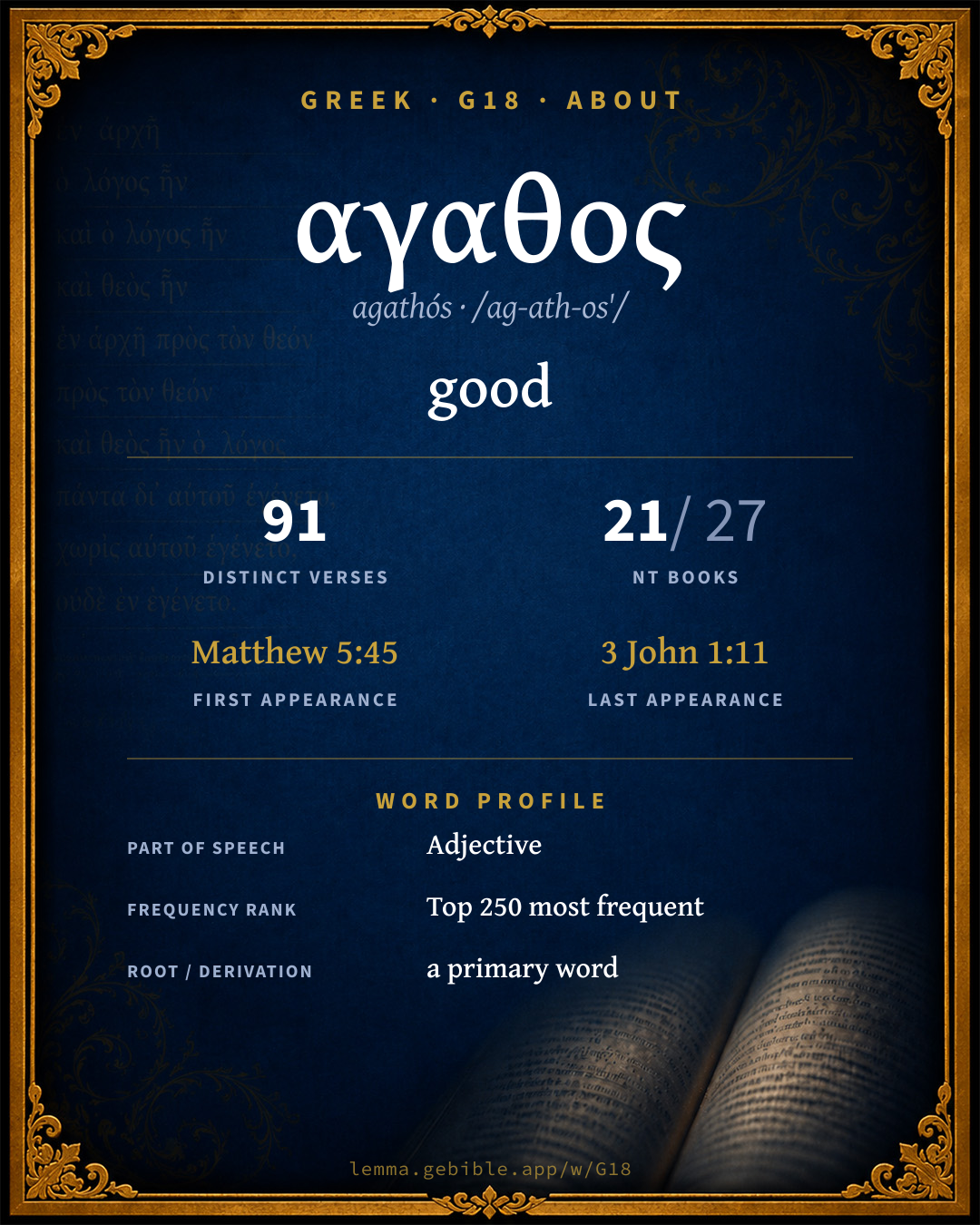
ἀγαθός
good
‘good’ is one of 5 main senses fuller range ↓
Full lexicon entry — Thayer's Greek Lexicon
From Thayer's Greek Lexicon
Where this word appears
See every Accusative-case word in the Greek New Testament →
Grammar key — what these labels mean
Part of speech
- Adjective
- A word that describes or qualifies a noun.
Case
- Accusative
- The case of the direct object and of extent.
- Nominative
- The case of the subject (and the predicate nominative).
- Dative
- The case of the indirect object, means, or location — “to / for / with / in.”
- Genitive
- The case of source, possession, or “of” — answers “whose / from what.”
- Vocative
- The case of direct address (“O Lord”).
Gender
- Neuter
- Grammatically neuter.
- Masculine
- Grammatically masculine.
- Feminine
- Grammatically feminine.
Number
- Singular
- One.
- Plural
- More than one.
Grammatical forms 21 distinct
- Adjective, Accusative, Singular, Neuter 26 times (25%)
- Adjective, Accusative, Plural, Neuter 10 times (10%)
- Adjective, Nominative, Singular, Masculine 10 times (10%)
- Adjective, Accusative, Singular, Feminine 8 times (8%)
- Adjective, Dative, Singular, Neuter 6 times (6%)
- Adjective, Nominative, Singular, Neuter 6 times (6%)
- Adjective, Genitive, Singular, Neuter 5 times (5%)
- Adjective, Vocative, Singular, Masculine 5 times (5%)
+13 more forms (26 occurrences)
Parsed forms decoded from the imported morphology (Robinson–Tischendorf, public domain), counted across 102 parsed occurrences — not distinct verses.
Every verse where G18 appears — 91 distinct verses across 21 books. Click any verse to open its interlinear word-by-word view. Verse text shown in the World English Bible for context — . Each verse’s Greek form is shown with its reference; the English is not keyword-highlighted, since the data carries no word-level English alignment. Use “Compare translations” on any verse to read it across multiple English versions. This concordance covers the Greek New Testament; Septuagint (Greek Old Testament) occurrences of this word are not indexed here.
Matthew 12 verses
- Matthew 5:45 ἀγαθοὺς adj acc pl masc that you may be children of your Father who is in heaven. For he makes his sun to rise on the evil and the good, and sends rain on the just and the unjust.
- Matthew 7:11 ἀγαθὰ ἀγαθὰ adj acc pl neut adj acc pl neut If you then, being evil, know how to give good gifts to your children, how much more will your Father who is in heaven give good things to those who ask him!
- Matthew 7:17 ἀγαθὸν adj nom sg neut Even so, every good tree produces good fruit; but the corrupt tree produces evil fruit.
- Matthew 7:18 ἀγαθὸν adj nom sg neut A good tree can't produce evil fruit, neither can a corrupt tree produce good fruit.
- Matthew 12:34 ἀγαθὰ adj acc pl neut You offspring of vipers, how can you, being evil, speak good things? For out of the abundance of the heart, the mouth speaks.
- Matthew 12:35 ἀγαθὸς ἀγαθοῦ ἀγαθά adj nom sg masc adj gen sg masc adj acc pl neut The good man out of his good treasure brings out good things, and the evil man out of his evil treasure brings out evil things.
- Matthew 19:16 ἀγαθὸν adj acc sg neut Behold, one came to him and said, "Good teacher, what good thing shall I do, that I may have eternal life?"
- Matthew 19:17 ἀγαθοῦ ἀγαθός adj gen sg neut adj nom sg masc He said to him, "Why do you call me good? No one is good but one, that is, God. But if you want to enter into life, keep the commandments."
- Matthew 20:15 ἀγαθός adj nom sg masc Isn't it lawful for me to do what I want to with what I own? Or is your eye evil, because I am good?'
- Matthew 22:10 ἀγαθούς adj acc pl masc Those servants went out into the highways, and gathered together as many as they found, both bad and good. The wedding was filled with guests.
- Matthew 25:21 ἀγαθὲ adj voc sg masc "His lord said to him, 'Well done, good and faithful servant. You have been faithful over a few things, I will set you over many things. Enter into the joy of your lord.'
- Matthew 25:23 ἀγαθὲ adj voc sg masc "His lord said to him, 'Well done, good and faithful servant. You have been faithful over a few things, I will set you over many things. Enter into the joy of your lord.'
Mark 3 verses
- Mark 3:4 ἀγαθὸν adj acc sg neut He said to them, "Is it lawful on the Sabbath day to do good, or to do harm? To save a life, or to kill?" But they were silent.
- Mark 10:17 ἀγαθέ adj voc sg masc As he was going out into the way, one ran to him, knelt before him, and asked him, "Good Teacher, what shall I do that I may inherit eternal life?"
- Mark 10:18 ἀγαθόν ἀγαθὸς adj acc sg masc adj nom sg masc Jesus said to him, "Why do you call me good? No one is good except one-- God.
Luke 13 verses
- Luke 1:53 ἀγαθῶν adj gen pl masc He has filled the hungry with good things. He has sent the rich away empty.
- Luke 6:45 ἀγαθὸς ἀγαθοῦ ἀγαθόν adj nom sg masc adj gen sg masc adj acc sg neut The good man out of the good treasure of his heart brings out that which is good, and the evil man out of the evil treasure of his heart brings out that which is evil, for out of the abundance of the heart, his mouth speaks.
- Luke 8:8 ἀγαθήν adj acc sg fem Other fell into the good ground, and grew, and brought forth fruit one hundred times." As he said these things, he called out, "He who has ears to hear, let him hear!"
- Luke 8:15 ἀγαθῇ adj dat sg fem That in the good ground, these are such as in an honest and good heart, having heard the word, hold it tightly, and bring forth fruit with patience.
- Luke 10:42 ἀγαθὴν adj acc sg fem but one thing is needed. Mary has chosen the good part, which will not be taken away from her."
- Luke 11:13 ἀγαθὰ adj acc pl neut If you then, being evil, know how to give good gifts to your children, how much more will your heavenly Father give the Holy Spirit to those who ask him?"
- Luke 12:18 ἀγαθά adj acc pl neut He said, 'This is what I will do. I will pull down my barns, and build bigger ones, and there I will store all my grain and my goods.
- Luke 12:19 ἀγαθὰ adj acc pl neut I will tell my soul, "Soul, you have many goods laid up for many years. Take your ease, eat, drink, be merry."'
- Luke 16:25 ἀγαθά adj acc pl neut "But Abraham said, 'Son, remember that you, in your lifetime, received your good things, and Lazarus, in like manner, bad things. But now here he is comforted and you are in anguish.
- Luke 18:18 ἀγαθέ adj voc sg masc A certain ruler asked him, saying, "Good Teacher, what shall I do to inherit eternal life?"
- Luke 18:19 ἀγαθόν ἀγαθὸς adj acc sg masc adj nom sg masc Jesus asked him, "Why do you call me good? No one is good, except one--God.
- Luke 19:17 ἀγαθὲ adj voc sg masc "He said to him, 'Well done, you good servant! Because you were found faithful with very little, you shall have authority over ten cities.'
- Luke 23:50 ἀγαθὸς adj nom sg masc Behold, a man named Joseph, who was a member of the council, a good and righteous man
John 3 verses
- John 1:47 ἀγαθὸν adj nom sg neut Jesus saw Nathanael coming to him, and said about him, "Behold, an Israelite indeed, in whom is no deceit!"
- John 5:29 ἀγαθὰ adj acc pl neut and will come out; those who have done good, to the resurrection of life; and those who have done evil, to the resurrection of judgment.
- John 7:12 ἀγαθός adj nom sg masc There was much murmuring among the multitudes concerning him. Some said, "He is a good man." Others said, "Not so, but he leads the multitude astray."
Acts 3 verses
- Acts 9:36 ἀγαθῶν adj gen pl neut Now there was at Joppa a certain disciple named Tabitha, which when translated, means Dorcas. This woman was full of good works and acts of mercy which she did.
- Acts 11:24 ἀγαθὸς adj nom sg masc For he was a good man, and full of the Holy Spirit and of faith, and many people were added to the Lord.
- Acts 23:1 ἀγαθῇ adj dat sg fem Paul, looking steadfastly at the council, said, "Brothers, I have lived before God in all good conscience until this day."
Romans 19 verses
- Romans 2:7 ἀγαθοῦ adj gen sg neut to those who by patience in well-doing seek for glory and honor and incorruptibility, eternal life;
- Romans 2:10 ἀγαθόν adj acc sg neut But glory and honor and peace to every man who works good, to the Jew first, and also to the Greek.
- Romans 3:8 ἀγαθά adj nom pl neut Why not (as we are slanderously reported, and as some affirm that we say), "Let us do evil, that good may come?" Those who say so are justly condemned.
- Romans 5:7 ἀγαθοῦ adj gen sg masc For one will hardly die for a righteous man. Yet perhaps for a righteous person someone would even dare to die.
- Romans 7:12 ἀγαθή adj nom sg fem Therefore the law indeed is holy, and the commandment holy, and righteous, and good.
- Romans 7:13 ἀγαθὸν ἀγαθοῦ adj nom sg neut adj gen sg neut Did then that which is good become death to me? May it never be! But sin, that it might be shown to be sin, by working death to me through that which is good; that through the commandment sin might become exceeding sinful.
- Romans 7:18 ἀγαθόν adj acc sg neut For I know that in me, that is, in my flesh, dwells no good thing. For desire is present with me, but I don't find it doing that which is good.
- Romans 7:19 ἀγαθόν adj acc sg neut For the good which I desire, I don't do; but the evil which I don't desire, that I practice.
- Romans 8:28 ἀγαθόν adj acc sg neut We know that all things work together for good for those who love God, to those who are called according to his purpose.
- Romans 9:11 ἀγαθὸν adj acc sg neut For being not yet born, neither having done anything good or bad, that the purpose of God according to election might stand, not of works, but of him who calls,
- Romans 10:15 ἀγαθά adj acc pl neut And how will they preach unless they are sent? As it is written: "How beautiful are the feet of those who preach the Gospel of peace, Who bring glad tidings of good things!"
- Romans 12:2 ἀγαθὸν adj nom sg neut Don't be conformed to this world, but be transformed by the renewing of your mind, so that you may prove what is the good, well-pleasing, and perfect will of God.
- Romans 12:9 ἀγαθῷ adj dat sg neut Let love be without hypocrisy. Abhor that which is evil. Cling to that which is good.
- Romans 12:21 ἀγαθῷ adj dat sg neut Don't be overcome by evil, but overcome evil with good.
- Romans 13:3 ἀγαθῷ ἀγαθὸν adj dat sg neut adj acc sg neut For rulers are not a terror to the good work, but to the evil. Do you desire to have no fear of the authority? Do that which is good, and you will have praise from the same,
- Romans 13:4 ἀγαθόν adj acc sg neut for he is a servant of God to you for good. But if you do that which is evil, be afraid, for he doesn't bear the sword in vain; for he is a minister of God, an avenger for wrath to him who does evil.
- Romans 14:16 ἀγαθόν adj acc sg neut Then don't let your good be slandered,
- Romans 15:2 ἀγαθὸν adj acc sg neut Let each one of us please his neighbor for that which is good, to be building him up.
- Romans 16:19 ἀγαθόν adj acc sg neut For your obedience has become known to all. I rejoice therefore over you. But I desire to have you wise in that which is good, but innocent in that which is evil.
2 Corinthians 2 verses
- 2 Corinthians 5:10 ἀγαθὸν adj acc sg neut For we must all be revealed before the judgment seat of Christ; that each one may receive the things in the body, according to what he has done, whether good or bad.
- 2 Corinthians 9:8 ἀγαθόν adj acc sg neut And God is able to make all grace abound to you, that you, always having all sufficiency in everything, may abound to every good work.
Galatians 2 verses
Ephesians 4 verses
- Ephesians 2:10 ἀγαθοῖς adj dat pl neut For we are his workmanship, created in Christ Jesus for good works, which God prepared before that we would walk in them.
- Ephesians 4:28 ἀγαθόν adj acc sg neut Let him who stole steal no more; but rather let him labor, working with his hands the thing that is good, that he may have something to give to him who has need.
- Ephesians 4:29 ἀγαθὸς adj nom sg masc Let no corrupt speech proceed out of your mouth, but such as is good for building up as the need may be, that it may give grace to those who hear.
- Ephesians 6:8 ἀγαθόν adj acc sg neut knowing that whatever good thing each one does, he will receive the same again from the Lord, whether he is bound or free.
Philippians 1 verse
Colossians 1 verse
1 Thessalonians 2 verses
- 1 Thessalonians 3:6 ἀγαθὴν adj acc sg fem But when Timothy came just now to us from you, and brought us glad news of your faith and love, and that you have good memories of us always, longing to see us, even as we also long to see you;
- 1 Thessalonians 5:15 ἀγαθὸν adj acc sg neut See that no one returns evil for evil to anyone, but always follow after that which is good, for one another, and for all.
2 Thessalonians 2 verses
1 Timothy 4 verses
- 1 Timothy 1:5 ἀγαθῆς adj gen sg fem but the end of the charge is love, out of a pure heart and a good conscience and unfeigned faith;
- 1 Timothy 1:19 ἀγαθὴν adj acc sg fem holding faith and a good conscience; which some having thrust away made a shipwreck concerning the faith;
- 1 Timothy 2:10 ἀγαθῶν adj gen pl neut but (which becomes women professing godliness) with good works.
- 1 Timothy 5:10 ἀγαθῷ adj dat sg neut being approved by good works, if she has brought up children, if she has been hospitable to strangers, if she has washed the saints' feet, if she has relieved the afflicted, and if she has diligently followed every good work.
2 Timothy 2 verses
- 2 Timothy 2:21 ἀγαθὸν adj acc sg neut If anyone therefore purges himself from these, he will be a vessel for honor, sanctified, and suitable for the master's use, prepared for every good work.
- 2 Timothy 3:17 ἀγαθὸν adj acc sg neut that the man of God may be complete, thoroughly equipped for every good work.
Titus 4 verses
- Titus 1:16 ἀγαθὸν adj acc sg neut They profess that they know God, but by their works they deny him, being abominable, disobedient, and unfit for any good work.
- Titus 2:5 ἀγαθάς adj acc pl fem to be sober-minded, chaste, workers at home, kind, being in subjection to their own husbands, that God's word may not be blasphemed.
- Titus 2:10 ἀγαθήν adj acc sg fem not stealing, but showing all good fidelity; that they may adorn the doctrine of God, our Savior, in all things.
- Titus 3:1 ἀγαθὸν adj acc sg neut Remind them to be in subjection to rulers and to authorities, to be obedient, to be ready for every good work,
Philemon 2 verses
- Philemon 1:6 ἀγαθοῦ adj gen sg neut that the fellowship of your faith may become effective, in the knowledge of every good thing which is in us in Christ Jesus.
- Philemon 1:14 ἀγαθόν adj nom sg neut But I was willing to do nothing without your consent, that your goodness would not be as of necessity, but of free will.
Hebrews 3 verses
- Hebrews 9:11 ἀγαθῶν adj gen pl neut But Christ having come as a high priest of the coming good things, through the greater and more perfect tabernacle, not made with hands, that is to say, not of this creation,
- Hebrews 10:1 ἀγαθῶν adj gen pl neut For the law, having a shadow of the good to come, not the very image of the things, can never with the same sacrifices year by year, which they offer continually, make perfect those who draw near.
- Hebrews 13:21 ἀγαθῷ adj dat sg neut make you complete in every good work to do his will, working in you that which is well pleasing in his sight, through Jesus Christ, to whom be the glory forever and ever. Amen.
James 2 verses
- James 1:17 ἀγαθὴ adj nom sg fem Every good gift and every perfect gift is from above, coming down from the Father of lights, with whom can be no variation, nor turning shadow.
- James 3:17 ἀγαθῶν adj gen pl masc But the wisdom that is from above is first pure, then peaceful, gentle, reasonable, full of mercy and good fruits, without partiality, and without hypocrisy.
1 Peter 6 verses
- 1 Peter 2:18 ἀγαθοῖς adj dat pl masc Servants, be in subjection to your masters with all fear; not only to the good and gentle, but also to the wicked.
- 1 Peter 3:10 ἀγαθὰς adj acc pl fem For, "He who would love life, And see good days, Let him keep his tongue from evil, And his lips from speaking deceit.
- 1 Peter 3:11 ἀγαθόν adj acc sg neut Let him turn away from evil, and do good. Let him seek peace, and pursue it.
- 1 Peter 3:13 ἀγαθοῦ adj gen sg neut Now who is he who will harm you, if you become imitators of that which is good?
- 1 Peter 3:16 ἀγαθήν ἀγαθὴν adj acc sg fem adj acc sg fem having a good conscience; that, while you are spoken against as evildoers, they may be disappointed who curse your good manner of life in Christ.
- 1 Peter 3:21 ἀγαθῆς adj gen sg fem This is a symbol of baptism, which now saves you-- not the putting away of the filth of the flesh, but the answer of a good conscience toward God, through the resurrection of Jesus Christ,
3 John 1 verse
About this entry
At a glance — auto-summarized from this page’s data, not written by a person. Every figure links to its source below. This summary describes the numbers; it doesn’t interpret them.
αγαθος — transliterated agathós — is a Greek adjective carrying the sense “good.” Thayer's distinguishes 5 senses for it. Spanning 91 verses in 21 books, it ranks among the moderately common words of the Greek New Testament. Its earliest occurrence is Matthew 5:45. Sharing its root, it stands alongside αγαθοεργεω, αγαθοποιος and αγαθωσυνη. Each statement above links to its evidence; the full detail follows below.
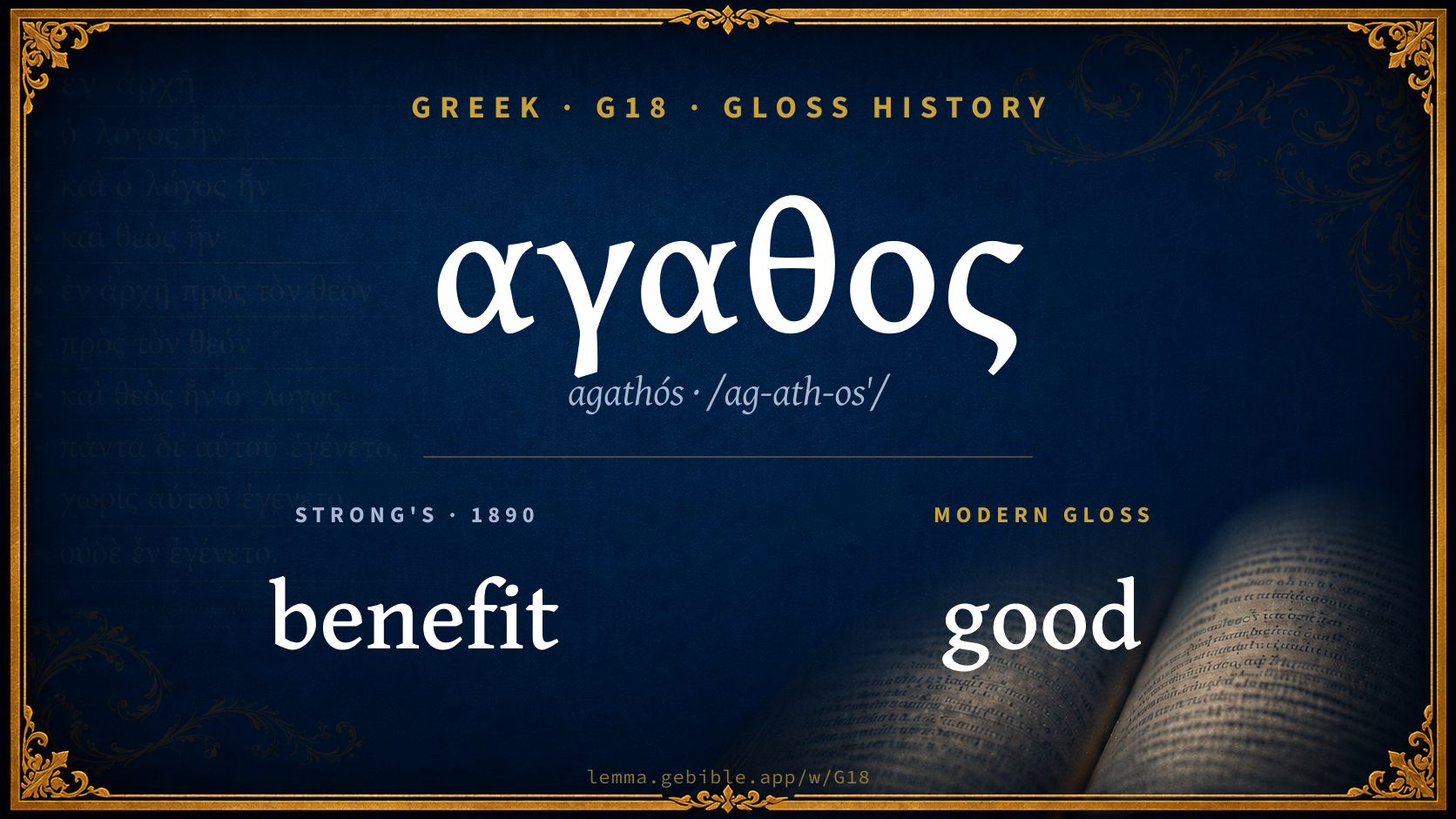
Gloss history
Strong's 1890 vs modern scholarship
About this word
Strong's G18 catalogs a Greek word from the Greek New Testament.
These counts are not copied from any lexicon or concordance. They are computed here, from the morphology-tagged Greek New Testament. What Lemma adds →
- 91
- distinct verses
- The word appears in 91 distinct verses.
- 21 / 27
- NT books
- The word appears in 21 of 27 New Testament books.
- #160
- by frequency
- Top 250 most frequent Greek words (rank 160 of 5,347 Greek words by occurrence).
View all 91 occurrences in the concordance →
By section of the New Testament
By traditional corpus
Conventional, traditional groupings — biblical authorship is debated, so this is a traditional corpus grouping, not an authorship claim. Some books belong to more than one corpus (Luke is in both the Gospels and the Lukan corpus, and so on), so these shares overlap and need not total 100%. Each figure is a share of the word’s 91 distinct verses.
- Pauline corpus 45 verses · 49%
- Gospels 31 verses · 34%
- Lukan (Luke–Acts) 16 verses · 18%
- General (Catholic) Epistles 9 verses · 10%
- Johannine 4 verses · 4%
- Hebrews 3 verses · 3%
How translations render this word
Counts come from each version’s own published word-to-Strong’s tagging or interlinear alignment — an approximate guide to how each version renders this word, not a word-level alignment the data otherwise carries. Because each total is that version’s own tagged count, the per-version totals vary from one another and need not match the appearance or distinct-verse counts above. These counts may also differ from a printed concordance because Lemma counts each distinctly tagged rendering and does not collapse phrase taggings into a single head-word total. This is a fixed set of word-tagged versions (KJV, ASV, BSB, ULT) and does not change with the reading translation you choose elsewhere. Each version’s license is shown beside its name below (and on Sources).
- King James Version: Good 65×, Is good 10×, Good things 9×
- American Standard Version: Good 64×, Is good 11×, Good things 9×
- Berean Standard Bible: Good 78×, Good things 7×, Clear 3×
- unfoldingWord Literal Text: Good 83×, Good things 12×, Is good 4×
King James Version Public Domain
Renders G18 across 100 tagged occurrences — most commonly:
Plus 5 renderings that appear only once — usually multi-word phrases or single function words the recovered tagging swept in, not distinct renderings. Not rendered by a distinct English word in 2 further occurrences.
American Standard Version Public Domain
Renders G18 across 99 tagged occurrences — most commonly:
Plus 9 renderings that appear only once — usually multi-word phrases or single function words the recovered tagging swept in, not distinct renderings.
Berean Standard Bible Public Domain
Renders G18 across 99 tagged occurrences — most commonly:
Plus 9 renderings that appear only once — usually multi-word phrases or single function words the recovered tagging swept in, not distinct renderings. Not rendered by a distinct English word in 1 further occurrence.
unfoldingWord Literal Text CC BY-SA 4.0
Renders G18 across 103 tagged occurrences — most commonly:
Plus 2 renderings that appear only once — usually multi-word phrases or single function words the recovered tagging swept in, not distinct renderings.
Senses in Thayer's
The 5 senses Thayer's distinguishes for this word, in lexicon order (not ranked by frequency or importance). The full entry — with sub-senses — is in the Lexicon Entry tab.
- of good constitution or nature
- useful, salutary
- good, pleasant, agreeable, joyful, happy
- excellent, distinguished
- upright, honourable
Word origin
Origin: a primary word
A primary word; good (in any sense often as noun): - benefit good (-s things) well. Compare G2570 .
— Strong’s Exhaustive Concordance (1890), public domain.
Forms in the corpus
The 22 distinct written forms G18 takes in the Greek New Testament, most frequent first — each parse links to that case’s occurrences in the concordance.
Same root — word family
Other Thayer's entries built from the same root as G18, grouped by Strong’s listed origin. These share a root / origin per the lexicon — not necessarily a shared meaning. Each links to that word’s own entry.
Derived from this word
- αγαθοεργεω agathoergéō G14 to do good
- αγαθοποιος agathopoiós G17 good
- αγαθωσυνη agathōsýnē G19 goodness
Compare all same-root words → They share a root, not necessarily a meaning.
Septuagint usage
The same Greek word αγαθος appears 401 times in the Greek Old Testament (Septuagint), across 361 verses in 29 books.
- 401
- LXX occurrences
- Tagged occurrences of this Greek word in the Septuagint.
- 361
- verses
- Distinct Septuagint verses containing this word.
- 29 / 39
- OT books
- The word appears in 29 of the 39 Old Testament books.
Sample Septuagint occurrences
- Genesis 24:10 ἀγαθός
- Exodus 3:8 ἀγαθός
- Numbers 10:32 ἀγαθός
- Deuteronomy 1:25 ἀγαθός
- Joshua 23:13 ἀγαθός
- Judges 8:35 ἀγαθός
- Ruth 2:22 ἀγαθός
- 1 Samuel 1:8 ἀγαθός
- 2 Samuel 2:6 ἀγαθός
- 1 Kings 1:42 ἀγαθός
- 2 Kings 2:19 ἀγαθός
- 1 Chronicles 4:40 ἀγαθός
Septuagint occurrences (same lexeme)
Every verse where the same Strong’s number (G18) appears in the Greek Septuagint — showing the first 50 of 361. Verse text shown in the World English Bible for context; the Greek form is the matched word — the English is not keyword-highlighted.
- Genesis 24:10 ἀγαθός The servant took ten camels, of his master's camels, and departed, having all goodly things of his master's in his hand. He arose, and went to Mesopotamia, to the city of Nahor.
- Genesis 45:18 ἀγαθός Take your father and your households, and come to me, and I will give you the good of the land of Egypt, and you will eat the fat of the land.'
- Genesis 45:20 ἀγαθός Also, don't concern yourselves about your belongings, for the good of all of the land of Egypt is yours."
- Genesis 45:23 ἀγαθός To his father, he sent after this manner: ten donkeys loaded with the good things of Egypt, and ten female donkeys loaded with grain and bread and provision for his father by the way.
- Genesis 50:20 ἀγαθός As for you, you meant evil against me, but God meant it for good, to bring to pass, as it is this day, to save many people alive.
- Exodus 3:8 ἀγαθός I have come down to deliver them out of the hand of the Egyptians, and to bring them up out of that land to a good and large land, to a land flowing with milk and honey; to the place of the Canaanite, the Hittite, the Amorite, the Perizzite, the Hivite, and the Jebusite.
- Exodus 18:9 ἀγαθός Jethro rejoiced for all the goodness which Yahweh had done to Israel, in that he had delivered them out of the hand of the Egyptians.
- Exodus 20:12 ἀγαθός "Honor your father and your mother, that your days may be long in the land which Yahweh your God gives you.
- Numbers 10:32 ἀγαθός It shall be, if you go with us, yes, it shall be, that whatever good Yahweh shall do to us, the same will we do to you.
- Numbers 14:7 ἀγαθός and they spoke to all the congregation of the children of Israel, saying, The land, which we passed through to spy it out, is an exceeding good land.
- Numbers 14:23 ἀγαθός surely they shall not see the land which I swore to their fathers, neither shall any of those who despised me see it:
- Numbers 32:11 ἀγαθός Surely none of the men who came up out of Egypt, from twenty years old and upward, shall see the land which I swore to Abraham, to Isaac, and to Jacob; because they have not wholly followed me:
- Deuteronomy 1:25 ἀγαθός They took of the fruit of the land in their hands, and brought it down to us, and brought us word again, and said, It is a good land which Yahweh our God gives to us.
- Deuteronomy 1:35 ἀγαθός Surely there shall not one of these men of this evil generation see the good land, which I swore to give to your fathers,
- Deuteronomy 1:39 ἀγαθός Moreover your little ones, whom you said should be a prey, and your children, who this day have no knowledge of good or evil, they shall go in there, and to them will I give it, and they shall possess it.
- Deuteronomy 3:25 ἀγαθός Please let me go over and see the good land that is beyond the Jordan, that goodly mountain, and Lebanon.
- Deuteronomy 4:22 ἀγαθός but I must die in this land, I must not go over the Jordan; but you shall go over, and possess that good land.
- Deuteronomy 6:11 ἀγαθός and houses full of all good things, which you didn't fill, and cisterns dug out, which you didn't dig, vineyards and olive trees, which you didn't plant, and you shall eat and be full;
- Deuteronomy 6:18 ἀγαθός You shall do that which is right and good in the sight of Yahweh; that it may be well with you, and that you may go in and possess the good land which Yahweh swore to your fathers,
- Deuteronomy 8:7 ἀγαθός For Yahweh your God brings you into a good land, a land of brooks of water, of springs and springs, flowing forth in valleys and hills;
- Deuteronomy 8:10 ἀγαθός You shall eat and be full, and you shall bless Yahweh your God for the good land which he has given you.
- Deuteronomy 9:4 ἀγαθός Don't speak in your heart, after that Yahweh your God has thrust them out from before you, saying, For my righteousness Yahweh has brought me in to possess this land; whereas for the wickedness of these nations Yahweh does drive them out from before you.
- Deuteronomy 9:6 ἀγαθός Know therefore, that Yahweh your God doesn't give you this good land to possess it for your righteousness; for you are a stiff-necked people.
- Deuteronomy 11:17 ἀγαθός and the anger of Yahweh be kindled against you, and he shut up the sky, so that there shall be no rain, and the land shall not yield its fruit; and you perish quickly from off the good land which Yahweh gives you.
- Deuteronomy 26:11 ἀγαθός and you shall rejoice in all the good which Yahweh your God has given to you, and to your house, you, and the Levite, and the foreigner who is in the midst of you.
- Deuteronomy 28:11 ἀγαθός Yahweh will make you plenteous for good, in the fruit of your body, and in the fruit of your cattle, and in the fruit of your ground, in the land which Yahweh swore to your fathers to give you.
- Deuteronomy 28:12 ἀγαθός Yahweh will open to you his good treasure in the sky, to give the rain of your land in its season, and to bless all the work of your hand: and you shall lend to many nations, and you shall not borrow.
- Deuteronomy 28:47 ἀγαθός Because you didn't serve Yahweh your God with joyfulness, and with gladness of heart, by reason of the abundance of all things;
- Deuteronomy 30:9 ἀγαθός Yahweh your God will make you plenteous in all the work of your hand, in the fruit of your body, and in the fruit of your cattle, and in the fruit of your ground, for good: for Yahweh will again rejoice over you for good, as he rejoiced over your fathers;
- Deuteronomy 30:15 ἀγαθός Behold, I have set before you this day life and good, and death and evil;
- Deuteronomy 31:20 ἀγαθός For when I shall have brought them into the land which I swore to their fathers, flowing with milk and honey, and they shall have eaten and filled themselves, and grown fat; then will they turn to other gods, and serve them, and despise me, and break my covenant.
- Deuteronomy 31:21 ἀγαθός It shall happen, when many evils and troubles are come on them, that this song shall testify before them as a witness; for it shall not be forgotten out of the mouths of their seed: for I know their imagination which they frame this day, before I have brought them into the land which I swore.
- Joshua 23:13 ἀγαθός know for a certainty that Yahweh your God will no more drive these nations from out of your sight; but they shall be a snare and a trap to you, and a scourge in your sides, and thorns in your eyes, until you perish from off this good land which Yahweh your God has given you.
- Joshua 23:15 ἀγαθός It shall happen, that as all the good things are come on you of which Yahweh your God spoke to you, so will Yahweh bring on you all the evil things, until he have destroyed you from off this good land which Yahweh your God has given you.
- Judges 8:35 ἀγαθός neither shown they kindness to the house of Jerubbaal, [who is] Gideon, according to all the goodness which he had shown to Israel.
- Judges 9:2 ἀγαθός Please speak in the ears of all the men of Shechem, Whether is better for you, that all the sons of Jerubbaal, who are seventy persons, rule over you, or that one rule over you? Remember also that I am your bone and your flesh.
- Judges 9:11 ἀγαθός But the fig tree said to them, Should I leave my sweetness, and my good fruit, and go to wave back and forth over the trees?
- Judges 10:15 ἀγαθός The children of Israel said to Yahweh, We have sinned: do you to us whatever seems good to you; only deliver us, we pray you, this day.
- Judges 11:25 ἀγαθός Now are you anything better than Balak the son of Zippor, king of Moab? did he ever strive against Israel, or did he ever fight against them?
- Judges 15:2 ἀγαθός Her father said, I most assuredly thought that you had utterly hated her; therefore I gave her to your companion: isn't her younger sister more beautiful than she? Please take her, instead.
- Judges 18:9 ἀγαθός They said, Arise, and let us go up against them; for we have seen the land, and, behold, it is very good: and are you still? don't be slothful to go and to enter in to possess the land.
- Judges 18:19 ἀγαθός They said to him, Hold your peace, lay your hand on your mouth, and go with us, and be to us a father and a priest: is it better for you to be priest to the house of one man, or to be priest to a tribe and a family in Israel?
- Judges 19:24 ἀγαθός Behold, here is my daughter a virgin, and his concubine; them I will bring out now, and humble you them, and do with them what seems good to you: but to this man don't do any such folly.
- Ruth 2:22 ἀγαθός Naomi said to Ruth her daughter-in-law, It is good, my daughter, that you go out with his maidens, and that they not meet you in any other field.
- Ruth 3:13 ἀγαθός Stay this night, and it shall be in the morning, that if he will perform to you the part of a kinsman, well; let him do the kinsman's part: but if he will not do the part of a kinsman to you, then will I do the part of a kinsman to you, as Yahweh lives: lie down until the morning.
- Ruth 4:15 ἀγαθός He shall be to you a restorer of life, and sustain you in your old age, for your daughter-in-law, who loves you, who is better to you than seven sons, has borne him.
- 1 Samuel 1:8 ἀγαθός Elkanah her husband said to her, Hannah, why weep you? and why don't you eat? and why is your heart grieved? am I not better to you than ten sons?
- 1 Samuel 1:23 ἀγαθός Elkanah her husband said to her, Do what seems you good; wait until you have weaned him; only Yahweh establish his word. So the woman waited and nursed her son, until she weaned him.
- 1 Samuel 2:24 ἀγαθός No, my sons; for it is no good report that I hear: you make Yahweh's people to disobey.
- 1 Samuel 2:26 ἀγαθός The child Samuel grew on, and increased in favor both with Yahweh, and also with men.
These are occurrences of the same Greek lexeme (G18) in the Septuagint — not a translation of any one Hebrew word. The store carries no word-level Hebrew↔Greek alignment, so no Hebrew original is asserted here. Counts come from the recovered LXX Strong's tagging — high-frequency vocabulary is well covered, while rare or late forms may be untagged — so they reflect tagged occurrences and may slightly undercount.