1 Timothy 6:13

Greek (Tischendorf 8th ed.) 1 Timothy 6:13 appears in the Greek New Testament. The text above is from the Tischendorf 8th edition. Each word links to its Strong’s number and a concise gloss. Click any word for its full Thayer’s Greek Lexicon entry.
Download image
Cite this verse

1 Timothy 6:13 (World English Bible). Public Domain. Lemma interlinear Bible study tool, https://lemma.gebible.app/v/1-timothy/6/13.

Show BibTeX & RIS
BibTeX
RIS
English Translation
I charge you before God, who gives life to all things, and before Christ Jesus, who before Pontius Pilate testified the good confession,
World English Bible · Public Domain
Download a study sheet

One document with this verse’s original text, its word-by-word gloss line, the meaning frame, cross-references with their text, attributed commentary, and full source and license credits — printable, and it pastes into notes with its structure intact.

This verse Autodidact and up

Study sheet (.html) Plain text (.txt)

A passage Seminary Student

Up to 50 verses in one chapter. A passage sheet keeps up to 6 commentary sources and 12 cross-references per verse, in the order this page ranks them, and says so on the sheet whenever that leaves anything out. Ask for a single verse and you get the Autodidact verse sheet above.

Everything on this page stays free to read, with no account — the sheet is a download of what is already on screen, not access to it.

Want to remove ads? Support Godless Engineer
Compare translations 3

The same verse in 3 English versions, stacked beneath the original-language interlinear above. Click any original word for its lexicon entry.

Each is an independent rendering of the whole verse — the interlinear is not word-aligned to these translations.

Highlighted words mark where these versions differ — a whole-verse word diff, not a word-by-word alignment.

  • World English Bible Public Domain
    I charge you before God, who gives life to all things, and before Christ Jesus, who before Pontius Pilate testified the good confession,
  • King James Version Public Domain
    I give thee charge in the sight of God, who quickeneth all things, and before Christ Jesus, who before Pontius Pilate witnessed a good confession;
  • unfoldingWord Literal Text CC BY-SA 4.0
    I command you before God, the one making all alive, and Christ Jesus, the one having testified the good confession before Pontius Pilate,

unfoldingWord Literal Text — © unfoldingWord, licensed CC BY-SA 4.0. Word-aligned USFM3 via Door43 (git.door43.org/unfoldingWord/en_ult).

Versions to compare (up to 4)

3 of 4 selected

Show all 19 translations

Every available English version of this verse, each an independent rendering of the whole verse.

  • World English Bible Public Domain
    I charge you before God, who gives life to all things, and before Christ Jesus, who before Pontius Pilate testified the good confession,
  • Berean Standard Bible Public Domain
    I charge you in the presence of God, who gives life to all things, and of Christ Jesus, who made the good confession in His testimony before Pontius Pilate:
  • Majority Standard Bible Public Domain
    I charge you in the presence of God, who gives life to all things, and of Christ Jesus, who made the good confession in His testimony before Pontius Pilate:
  • King James Version Public Domain
    I give thee charge in the sight of God, who quickeneth all things, and before Christ Jesus, who before Pontius Pilate witnessed a good confession;
  • American Standard Version (1901) Public Domain
    I charge thee in the sight of God, who giveth life to all things, and of Christ Jesus, who before Pontius Pilate witnessed the good confession;
  • Revised Version (1885) Public Domain
    I charge thee in the sight of God, who quickeneth all things, and of Christ Jesus, who before Pontius Pilate witnessed the good confession;
  • Geneva Bible (1599) Public Domain
    I charge thee in the sight of God, who quickeneth all thinges, and before Iesus Christ, which vnder Pontius Pilate witnessed a good confession,
  • Douay-Rheims (1899) Public Domain
    I charge thee before God, who quickeneth all things, and before Christ Jesus, who gave testimony under Pontius Pilate, a good confession,
  • Young's Literal Translation Public Domain
    I charge thee, before God, who is making all things alive, and of Christ Jesus, who did testify before Pontius Pilate the right profession,
  • Literal Standard Version CC BY-SA 4.0
    I charge you, before God, who is making all things alive, and of Christ Jesus, who testified the right profession before Pontius Pilate,
  • Unlocked Literal Bible CC BY-SA 4.0
    I give you this command before God, who causes all things to live, and before Christ Jesus, who spoke what is true to Pontius Pilate:
  • unfoldingWord Literal Text CC BY-SA 4.0
    I command you before God, the one making all alive, and Christ Jesus, the one having testified the good confession before Pontius Pilate,
  • Darby Bible Public Domain
    I enjoin thee before God who preserves all things in life, and Christ Jesus who witnessed before Pontius Pilate the good confession,
  • World Messianic Bible Public Domain
    I command you before God who gives life to all things, and before Messiah Yeshua who before Pontius Pilate testified the good confession,
  • Webster's Bible Public Domain
    I give thee charge in the sight of God, who maketh alive all things, and before Christ Jesus, who before Pontius Pilate testified a good confession;
  • Free Bible Version CC BY-SA 4.0
    My charge to you before God the Life-giver, and before Christ Jesus who testified to the good news before Pontius Pilate,
  • Bible in Basic English Public Domain
    I give you orders before God, the giver of life, and Christ Jesus, who before Pontius Pilate gave witness to the faith,
  • Text-Critical English NT CC BY 4.0
    I charge yoʋ before God, who gives life to all things, and before Christ Jesus, who made the good confession in his testimony before Pontius Pilate,
  • Tyndale New Testament (1534) Public Domain
    I geve the charge in the sight of God which quickneth all thinges and before Iesu Christ which vnder Pocius Pilate witnessed a good witnessinge

Literal Standard Version (2020), Covenant Press — licensed CC BY-SA 4.0. Text via the HelloAO Bible API (eBible.org). Unlocked Literal Bible (unfoldingWord) — licensed CC BY-SA 4.0. Text via the HelloAO Bible API (eBible.org). unfoldingWord Literal Text — © unfoldingWord, licensed CC BY-SA 4.0. Word-aligned USFM3 via Door43 (git.door43.org/unfoldingWord/en_ult). Free Bible Version, Dr. Jonathan Gallagher — licensed CC BY-SA 4.0. Text via the HelloAO Bible API (eBible.org).

Word by word

More ways to search: Search by grammar → Find every occurrence → Compare this word →

Practice this passage: Drill this verse → Learn its vocabulary →

ζῳογονοῦντος
zōogonéō
G2225
“to preserve alive”
Verb, Present, Active, Participle, Genitive, Singular, Masculine
Part of Speech
Verb
Tense
Present
Voice
Active
Mood
Participle
Case
Genitive
Number
Singular
Gender
Masculine
Full Thayer's Definition

Origin: from the same as G2226 and a derivative of G1096

TDNT: 16:33,3

1. to bring forth alive 2. to give life 3. to preserve alive
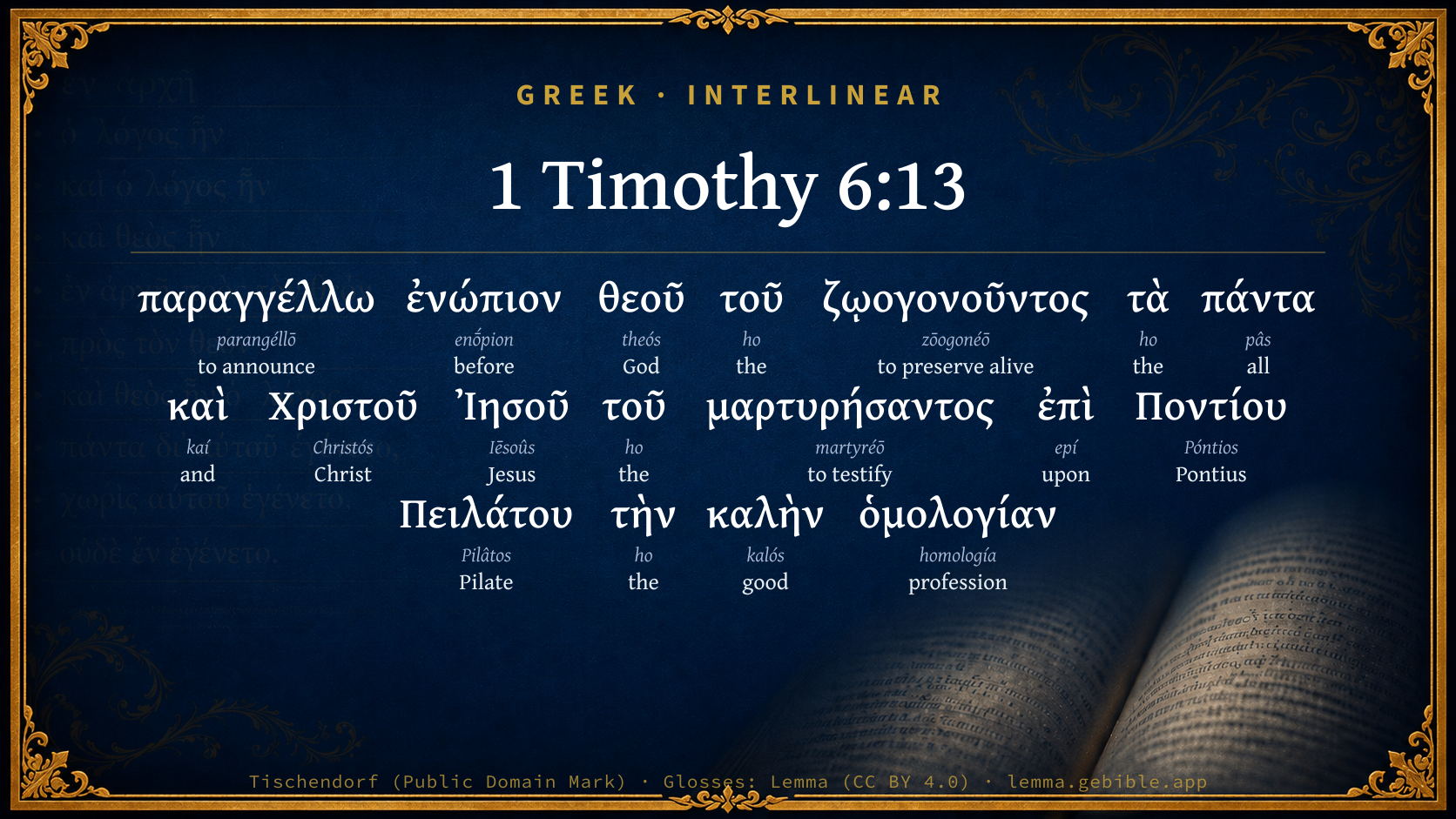
  1. παραγγέλλω parangéllō G3853 “to announce” Verb, Present, Active, Indicative, 1st person, Singular
  2. ἐνώπιον enṓpion G1799 “before” Adverb
  3. θεοῦ theós G2316 “God” Noun, Genitive, Singular, Masculine
  4. τοῦ ho G3588 “the” Article, Genitive, Singular, Masculine
  5. τὰ ho G3588 “the” Article, Accusative, Plural, Neuter
  6. πάντα pâs G3956 “all” Adjective, Accusative, Plural, Neuter
  7. καὶ kaí G2532 “and” Conjunction
  8. Χριστοῦ Christós G5547 “Christ” Noun, Genitive, Singular, Masculine
  9. Ἰησοῦ Iēsoûs G2424 “Jesus” Noun, Genitive, Singular, Masculine
  10. τοῦ ho G3588 “the” Article, Genitive, Singular, Masculine
  11. μαρτυρήσαντος martyréō G3140 “to testify” Verb, Aorist, Active, Participle, Genitive, Singular, Masculine
  12. ἐπὶ epí G1909 “upon” Preposition
  13. Ποντίου Póntios G4194 “Pontius” Noun, Genitive, Singular, Masculine
  14. Πειλάτου Pilâtos G4091 “Pilate” Noun, Genitive, Singular, Masculine
  15. τὴν ho G3588 “the” Article, Accusative, Singular, Feminine
  16. καλὴν kalós G2570 “good” Adjective, Accusative, Singular, Feminine
  17. ὁμολογίαν homología G3671 “profession” Noun, Accusative, Singular, Feminine

About this verse

These counts appear in no published source. They are computed here, from the morphology-tagged text and Lemma’s own curated glosses. What Lemma adds →

18
words
15
distinct lemmas
Pauline Epistles
section

Notable vocabulary

The rarest word here is ζῳογονοῦντος to preserve alive G2225 — appearing just 3 times in the whole Greek New Testament.

Shared distinctive vocabulary

ζῳογονοῦντος to preserve alive G2225 occurs in 3 verses of the Greek New Testament. Also found in:

Repetition

A word recurs within this verse:

Cross-references

17

Topical passages linked to 1 Timothy 6:13 in the Treasury of Scripture Knowledge — connected by theme and wording, ordered by reader-vote popularity; previews shown in the World English Bible.

  • John 18:36–37 Jesus answered, "My Kingdom is not of this world. If my Kingdom were of this world, then my servants would fight, that I wouldn't be delivered to the Jews. But now my Kingdom is not from here."
  • Matthew 27:11 Now Jesus stood before the governor: and the governor asked him, saying, "Are you the King of the Jews?" Jesus said to him, "So you say."
  • 1 Timothy 5:21 I charge you in the sight of God, and Christ Jesus, and the chosen angels, that you observe these things without prejudice, doing nothing by partiality.
  • John 5:21 For as the Father raises the dead and gives them life, even so the Son also gives life to whom he desires.
  • Revelation 1:5 and from Jesus Christ, the faithful witness, the firstborn of the dead, and the ruler of the kings of the earth. To him who loves us, and washed us from our sins by his blood;
  • Revelation 3:14 "To the angel of the assembly in Laodicea write: "The Amen, the Faithful and True Witness, the Head of God's creation, says these things:
  • Deuteronomy 32:39 See now that I, even I, am he, There is no god with me: I kill, and I make alive; I wound, and I heal; There is none who can deliver out of my hand.
  • 1 Samuel 2:6 Yahweh kills, and makes alive: He brings down to Sheol, and brings up.
  • John 5:26 For as the Father has life in himself, even so he gave to the Son also to have life in himself.
  • John 14:6 Jesus said to him, "I am the way, the truth, and the life. No one comes to the Father, except through me.
  • John 14:25–26 I have said these things to you, while still living with you.
  • John 19:11 Jesus answered, "You would have no power at all against me, unless it were given to you from above. Therefore he who delivered me to you has greater sin."
  • Acts 17:25 neither is he served by men's hands, as though he needed anything, seeing he himself gives to all life and breath, and all things.
  • 1 Timothy 2:5 For there is one God, and one mediator between God and men, the man Christ Jesus,
  • 1 Timothy 6:12 Fight the good fight of faith. Lay hold of the eternal life to which you were called, and you confessed the good confession in the sight of many witnesses.
  • Revelation 21:6 He said to me, "It is done! I am the Alpha and the Omega, the Beginning and the End. I will give freely to him who is thirsty from the spring of the water of life.
  • Revelation 22:1 He showed me a river of water of life, clear as crystal, proceeding out of the throne of God and of the Lamb,

Cross-references courtesy of OpenBible.info (CC BY 4.0).

Commentary

Notes on 1 Timothy 6:13 from classic Christian and Jewish commentators (each source and its license shown beneath its notes). The classic Christian expositions comment on the surrounding passage and are grouped to its opening verse, so a note may address several verses; the Jewish commentaries on the Tanakh (Rashi and others) are per-verse, so they appear only where the commentator wrote on this verse.

Lemma curates 59 commentaries, every one of them public domain or Creative Commons licensed, each selected and text-cleaned for this edition rather than reprinted as found. About our sources →

The Biblical Illustrator

Joseph S. Exell

1Ti_6:13-16

I give thee charge in the sight of God.

Motives to steadfastness

When earnest Christians realize that they are about to leave the world, they are concerned that those who will fill their places should be loyal to the principles they have tried to maintain. The commandment which the young evangelist was to keep must be taken, in its broadest sense, as referring to the great principles of righteousness and truth which Christ Jesus had embodied and maintained. Although of celestial origin, this commandment would not appear to men without spot, if its representatives were men of blemished reputation. Two motives to such steadfastness are suggested in the Verses before us: the one being drawn from the example of Christ, the other from the greatness of God.

I. The example of Christ is suggested in the allusion made to--

1. His good confession before Pontius Pilate. It is well for us when we either suffer, or compel, all the incidents of life to lead our thoughts back to Christ. It was partly in order to make this possible that the details of His life and ministry are so fully given in the Gospels. Temptations, troubles, friendships, joys, conflicts, all that go to make up our experience, find counterparts in Him. He witnessed a good confession, though He knew the price of it would be agony, shame, and death! There was a difference, however, between the Lords confession and Timothys or ours. Timothy confessed the good confession, Christ Jesus witnessed the good confession. Christ witnessed because He was identified with the truth He confessed, and was the source of every such confession after. Timothy confessed, for his confession was responsive and secondary, and found its inspiration in that of his Lord.

2. Christs achieved victory is another source of encouragement to His faithful followers. The Cross of Calvary was the immediate result of our Lords good confession; but that was not its final result. God, who quickeneth all things, has raised Him from the dead, and amongst the glorified and redeemed He already appears as Prince and Saviour. The victory of Christ is the encouragement and inspiration of all who are engaged in the conflicts of truth with error, of holiness with sin. Notice how this description of the expected appearing of Christ leads to the noble doxology which celebrates--

II. The greatness and glory of God, who is the blessed and only Potentate, the King of kings and Lord of lords; who only hath immortality, dwelling in the light which no man can approach unto; whom no man hath seen, nor can see; to whom be honour and power everlasting. Amen. If He be for us, who can be against us? Timothy is fittingly reminded that--

1. God is eternal. All time is at His disposal.

2. God is the blessed and only Potentate. If you substitute for blessed its synonym in modern English, you get the beautiful truth, that ours is a happy God--full of joy in Himself, the source of joy to all His creatures.

3. God quickeneth all things. He can so quicken us that out of sadness and difficulties and torpor He can raise us to newness of life.

4. God is incomprehensible--as yet to us--in Himself and in His doings; dwelling in the light which no man can approach unto. It is a beautiful thought, that He is not hidden from us through absence of light, but through excess of light. Therefore, amid the gradual development of His purposes, we have only to witness a good confession, leaving all the results to Him.

5. God is Almighty, the only Potentate, the King of kings and Lord of lords, the King of those who reign, the Lord of those who rule. All authority is in His hands. Let us not lose sight of Him to whom in this passage the great apostle ascribes honour and power everlasting. We too often regard ourselves as the rulers of the world, and forget our absolute dependence; but, in relation to the blessed and only Potentate, we are far more insignificant than insects are in relation to us. (A. Rowland, LL. B.)

The blessed and only Potentate.--

Christs service

One figure stands at the centre of mans history and dominates over it all--the figure of Christ. Now, there is no way to be securely and perfectly this except for him who takes Christ as his King, Would you resist temptation, would you be pure, kind, contented, truthful, honest? Well, then, enroll yourself with deliberate purpose as Christs soldier, His scholar, His servant, His subject. Christ our King! What kind of a king is He? His kingdom is not of this world. To understand Him you must lay aside altogether your notions of earthly sovereignty. From the Cross He has reigned. The throne of Solomon had its golden lions and ivory steps, and gorgeous was the jewelled chair of Byzantium; but the throne of the King of kings was a cross of shame. And, strange to say, the World, in its penitence, in its satiety, in its remorse, has turned away from its own petty potentates, has dropped its weapons, has torn the garland from its brow, has fallen low upon its knees before the Son of Man on His instrument of torture. It has gazed on Him in the faded purple of mockery, and in His crown of thorns, and nations have said, in awe-struck whispers, Behold your King! Yes; and kings themselves have bowed down before that throne of sorrows. When Henry IV. of Germany cowered before the thin old Pope at Canossa; when Barbarossa received upon his neck the foot of the proud potentate; when our own Henry

II. was scourged by monks before the shrine of Canterbury; when John received back his crown from Pandulf; when Godfrey refused to wear a crown of gold where his Saviour had a crown of thorns; when Rudolf of Hapsburg, not finding the sceptre in the temple of his coronation, seized upon the crucifix and swore that that should be his sceptre; when the most ancient crown of Europe was made, not of gold, but of iron, and that iron hammered, as men believed, out of a nail of the true cross--what was this but the homage of earthly kings to a Diviner royalty! Yes; and no power on earth has ever been able to resist Christ. Tell it out among the heathen that the Lord is King! Greece despised Him, and Greece glimmered into a dream; but the Cross remains. Rome hated Him, and Rome has crumbled into the dust; but the Cross remains. Philosophy rejected Him, and philosophy has sunk into impotence; but the Cross remains, Is ire your King? Or will you choose in His place some vile and worth less tyranny, some evil spirit, some despotic and besetting vice? Three centuries ago the Spaniards were besieging the little town of St. Quentin, on the frontiers of France. Its ramparts were in ruins, fever and famine were decimating its defenders, treason was gliding among its terrified population. One day the Spaniards shot over the walls a shower of arrows to which were attached little slips of parchment, promising the inhabitants that if they would surrender, their lives and property should be spared. Now, the governor of the town was the great leader of the Huguenots, Gaspard de Coligni. As his sole answer he took a piece of parchment, tied it to a javelin, wrote on it the two words, Regem habemus--We have a king, and hurled it back into the camp of the enemy. Now that was true loyalty, loyalty in imminent peril, loyalty ready to sacrifice all. But who was that king for whom, amidst sword and flame, amid fever and famine, Coligni was defending those breached and battered walls? It was the weak and miserable Henry II. of France, whose son, Charles IX., was afterwards guilty of the murder of Coligui and the infamies of St. Bartholomew. Have you a king? Is Christ your King? All, if He be, He is not a feeble, corrupt, false, treacherous man like Coliguis master, but a King who loves you, who died for you, who pleads with you even now on the right hand of the Majesty on High. Is Christ your King? If you are selfish and frivolous; if you are a better and a gambler; if you are a whisperer and one who delights in lies; if you are a fornicator or a profane person, as was Esau; if you worship Mammon; if your god is your ledger and you mind earthly things; if you are double-tongued, shifty, niggardly, worldly--say not that Christ is your King. Is Christ your King? If in sincerity and truth you will take Christ for your King and Captain I promise you two things. First, I promise you security. Principle is a noble thing; but in the fatal mirage of the passions principle is lost sight of, and amid the glamour of temptation principle not only loses something of its pristine splendour, but it becomes as if it were not. And the other blessing which Christ will give you is joy.; for Christ says, Peace I give you, My peace I leave with you; not as the world giveth give I unto you. Not as the world giveth! There has been a joy in dungeons and on scaffolds passing the joy of the harvest. Christ does not delude as Satan does with promises as. Serve me, and you shall be rich. (Archdeacon Farrar.)

The sovereignty of Christ

1. Jesus is a King in His own eternal and essential right. He is the Creator of all things; He is the Preserver of all things; He is the sovereign Lord and Proprietor of ell things. But, then, He is a King in another sense, and it is to that, that allusion is here made.

2. He has a mediatorial kingdom which was given Him by the Father as a recompense for His great and glorious undertaking on behalf of our world: and thus He is a mediatorial King. Now, in this view of the subject as a mediatorial King, and having mediatorial kingdom committed to His care, trust, management, and government, we may observe that this kingdom was small in its origin. At its first rising after His resurrection and ascension, the dimensions were small.

3. But, then, there is a third kingdom: if I may so speak, another kingdom within this kingdom--a kingdom in the hearts of His beloved people. The kingdom of God, it is said, is within you. It is in vain for men to pretend that they are the subjects of Christ merely because they are so outwardly.

4. I say He is a very bountiful Sovereign in whom you have trusted. He has promised to give everything which He possesses that He can give, and that His subjects can receive. He has made a covenant with them which is well ordered in all things and sure. All things are yours.

5. Observe, again, He is a tender-hearted and sympathizing Sovereign. He feels for all His subjects; for every one of you, and for the meanest subject that He has; so that everything which concerns them concerns Him. There is no trial which presses sore on the mind which He does not feel, and in which He does not participate.

6. Then, observe, He is a condescending Sovereign. He entreats you to come to His bosom--to make known to Him your every concern. Solomon has this expression, In the light of the kings countenance is life. There is doubtless here an allusion to the language of his royal Father: the father said, Lord, lift Thou up the light of Thy countenance upon us. So he says again, One thing have I desired of the Lord, that will I seek after; that I may dwell in the house of the Lord all the days of my life, to behold the beauty of the Lord, and to inquire in His temple. Then again it is said, In Thy presence is fulness of joy; at Thy right hand there are pleasures for evermore. (W. Wilkinson.)

Whom no man hath seen.--

God invisible

I. Consider what the eye itself is, the poor implement of which we demand so much. A ball of clay and mortality, it can act only on what is material and corruptible like itself. It is limited to a certain province even among these surrounding things. How delicate an organ it is, that is yet capable of taking in the broad scenes of the ocean and the land, and reaching as it were the stars at their immeasurable distances! At very short intervals of time it must be shut up within its fringes from the very light that it lives by; and when it is in its utmost vigour, the direct flash of a single sunbeam is more than it can bear. A tear dims it. A mote takes away from it every capacity but that of pain. A spark destroys it for ever. It cannot penetrate even the thin veils of outward nature. The true light may shine inward, though the body be dark. The soul sees otherwise and more nobly than through that narrow window. Is it through these lenses of flesh--so easily distempered, so often giving false pictures, so soon to perish--is it through these that we would gaze on the King Eternal?

II. Think, further, who He is whom we ask to be thus manifested to us. The very idea of God absolutely excludes the possibility of His being an object of sight. He is a pure Intelligence, circumscribed by no form, bounded by no space, and to be communicated with only through the Spirit which Himself imparts. But the unconvinced may say: This is not what we seek, or have ever imagined. But we would lay our eyes upon some undeniable signs and representatives of the Almighty Providence. Yet the Scriptures tell them, and their own religious reason tells them, that they are actually surrounded with just such signs and representatives in the natural creation. It is His spirit that gives it life. It is His wisdom that gives it law. It is not, however, with such as these, they may reply, that we are satisfied. We would have testimonies strictly miraculous, transcending all the powers of nature, and thus exhibiting an immediate connection with the Almighty One. The Scriptures and our religious reason then take up the word again and say: Foolish and slow of heart! unless ye see signs and wonders, ye will not believe. It does not seem, then, that there is the virtue you fancy in the spectacle that you ask. And why should there be? Why should transient visions and strange occurrences impart a steadier trust than the perpetual marvels of this glorious world, and the eternal chain of decrees and providences that can be held but in one sovereign hand? One thing more may be urged by those who withhold or utter faintly the ascription in the text, To whom be honour and power ever lasting, because no man hath seen nor can see Him. They may say, It is not even such wonders as you have alluded to that we crave. They are for the individual only, or at most have their chief concern with but a tribe or a generation of men. We would have a supernatural sign that should be permanent and universal. It should be for all eyes. To this suggestion we need not call on the Scriptures for a reply. It demands an open impossibility, and is inconsistent with itself. Whatever should be thus associated with the works of nature must necessarily be regarded as one of them, however marvellous and inexplicable it might appear. We can scarcely conceive of anything more wonderful than is somewhere or other already presented. From what has been said, I hope it has been made clear, that no one has cause for objection or mistrust because the Lord is invisible, for it is inconceivable how He should be otherwise. To Him, whom no man hath seen or can see, be honour and power everlasting. What we adore under the affection of our senses, says an old writer, deserves not the honour of so pure a title. Nor is it strange that we should place affection on that which is invisible. All that we truly love is thus. The soul itself--is it not invisible, like its Source? To be born as we are, animal and moral beings, into two states at once--to dwell in a world like this we inhabit of pale reflections and shadows, where what is the most real is the least obvious--and at the same time to think the outward shape everything, and the secret intelligence and power that makes all to be what it is, nothing--this is to want the very sense that best becomes and exults us. The Scriptures, with a beautiful boldness of expression, speak of seeing Him who is invisible. And when they thus speak, their meaning is twofold--to acquaint ourselves with him and to rejoice as in His presence. He that doeth evil, says John, hath not seen God. But Blessed are the pure in heart, it is for them that the double privilege is reserved of knowing and enjoying Him. (N. L. Frothingham.)

The invisible God

The atheist never saw God, and therefore knows not how to believe such a being; he cannot comprehend Him. He would not be a God, if He could fall within the narrow model of a human understanding. He would not be infinite if He were comprehensible, or to be terminated by our sight. How small a thing must that be which is seen by a bodily eye, or grasped by a weak mind! If God were visible or comprehensible, He would be limited. Shall it be a sufficient demonstration from a blind man, that there is no fire in the room, because he sees it not, though he feel the warmth of it? The knowledge of the effect if sufficient to conclude the existence of the cause. Who ever saw his own life! Is it sufficient to deny a man lives, because he beholds not his life, and only knows it by his motion? He never saw his own soul, but he knows he hath one by his thinking power. The air renders itself sensible to men in its operations, yet was never seen by the eye. If God should render Himself visible, they might still question as well as now, whether that which was visible were God, or some delusion. If He should appear glorious, we can as little behold Him in His majestic glory, as an owl can behold the sun in its brightness; we should still but see Him in His effects, as we do the sun by its beams. If He should show a new miracle, we should still see Him but by His works; so we see Him in His creatures, every one of which would be as great a miracle as any can be wrought, to one that had the first prospect of them. To require to see God is to require that which is impossible (1Ti_6:16). (S. Charnock.)

The Biblical Illustrator, edited by Joseph S. Exell (c. 1880s–1900s) — public domain. Text from a community e-Sword module.

Joseph Benson's Commentary

1Ti 6:13-16. I give thee charge, &c. — See note on 1Ti 5:21; in the sight — In the presence; of God — Whose eye is upon us both; and who quickeneth all things — Who is the source of life, natural, spiritual, and eternal, and therefore is able to raise those from the dead that suffer for him: a suitable, though oblique intimation, that should Timothy, after the example of his great Lord, sacrifice his life to the honour of his profession, God, who raised Christ from the dead, would raise him. See 2Ti 2:3; 2Ti 2:10-12. The earnestness and solemnity with which the apostle addresses Timothy on this occasion, did not proceed from any suspicion of his fidelity as a minister, but from his own deep sense of the importance of the truths which Timothy was to confess and maintain. Hence the ministers of the gospel may learn that these truths ought to be often and earnestly insisted on by them in their public discourses. And before — In the presence of; Jesus Christ, who before Pontius Pilate witnessed a good confession — This was made by our Lord most explicitly before Caiaphas and the Jewish council, when, being asked whether he was Christ, the Son of the Blessed, he acknowledged that he was; and added, Ye shall see the Son of man sitting on the right hand of power, &c, Mar 14:61-62. This confession was adhered to by our Lord in the presence of Pilate, when he acknowledged himself the King of the Jews, Joh 18:33; Joh 18:37; that is, acknowledged that he was Messiah the prince, and suffered death rather than conceal or retract it. And the apostle calls it a good confession, because all our hopes of salvation are built upon the truth of it. That thou keep this commandment — That thou observe whatsoever I have enjoined thee, or, that thou keep the doctrine which I have committed to thee; without spot — Without adding to it, detracting from it, concealing or misrepresenting any part of it; and unrebukable — So that no one may have cause to find any fault with thee, or reprove thee for thy neglect; till the appearing of our Lord Jesus Christ — Till he shall call thee hence by death; or the meaning of the exhortation is, that Timothy, by keeping the doctrines and precepts which the apostle had committed to him without spot, was to hand them down pure to his successors in the ministry, and thereby to contribute his part toward preserving them in the world till Christ’s second coming. Which appearing, in his appointed time — (The power, the knowledge, the revelation of which remain in his own eternal mind;) he shall show — In the most awful and conspicuous manner; who is the blessed and only Potentate — Before whom no other name or power is worthy of being mentioned; the King of kings, and Lord of lords — These titles the apostle gave to God, because all who have dominion, whether in heaven or on earth, have it from God, and are absolutely subject to him. The eastern princes affected these titles very improperly, being weak, mortal men: the true King of kings, and Lord of lords, who hath the fates and lives of all the monarchs on earth entirely in his hands, is alone worthy of them. Who only hath — Underived and independent; immortality — Life without beginning and without ending; and as this implies immutability, he only is immutable, as well as immortal; whence he is called, (Rom 1:23,) αφθαρτος Θεος, the incorruptible, or immutable God, as also 1Ti 1:17. Every other being, angel or man, that hath life without end, hath it by his gift. Dwelling in the light which no man can approach unto — Which is absolutely inaccessible to mortals, and probably also to angels. Whom no man hath seen, nor can see — With bodily eyes; yet there is a sense in which the pure in heart shall see God, in the future and eternal state: yea, shall see him as he is, Mat 5:8; 1Jn 3:2. To whom be honour, &c. — Ascribed by every intelligent being in the universe, through eternal ages.

Joseph Benson's Commentary on the Old and New Testaments (1811–1818) — public domain. Text from a community e-Sword module.

The Preacher's Complete Homiletical Commentary

Joseph S. Exell (gen. ed.)

CRITICAL AND EXPLANATORY NOTES

1Ti_6:13. God, who quickeneth all things.—R.V. margin, “preserveth all things alive.” It would almost seem as if St. Paul meant to say that, whatever perils gathered round the warrior for truth, an unseen shield should cover his head in the day of battle.

1Ti_6:15. The blessed and only Potentate.—All else derive their power from Him and hold it Dei gratiâ.

1Ti_6:16. Who only hath immortality.―“He in whom immortality essentially exists and who enjoys it neither derivatively nor by participation” (Ellicott). Dwelling in light which no man can approach unto.—All the fulsome eulogies of kings who “live for ever,” and whose faces shine on their favourites, are but poor, broken lights as compared with the God who is light.

MAIN HOMILETICS OF THE PARAGRAPH.—1Ti_6:13-16

A Solemn call to Fidelity—

I. Uttered as in the presence of the life-giving God and witnessing Christ (1Ti_6:13).—One cannot read this impressive verse without catching somewhat of the solemnity of tone in which it was uttered. As though conscious his own career was closing, the apostle seems to hand on his unfinished work to Timothy, and he urges him to faithfulness here by the present manifestation of God’s power in quickening and preserving all things, and by reminding him of the deep significance of the testimony that Christ sealed with His death. The testimony that Christ bore was that He was King and that His kingdom was of the truth—a testimony that embraced the whole gospel. Timothy’s confession was therefore to include the whole truth of Christianity. We see therefore the gravity of the charge committed to the young evangelist. Unborn generations were concerned in his fidelity.

II. In maintaining and handing down the truth inviolate to the latest times (1Ti_6:14).—If we have a pure gospel to-day, we owe it to the faithful and holy Timothys, who, living at the beginning of the gospel era, maintained the truth in its integrity, and passed it on unmixed and unimpaired to their immediate successors. It is not less our solemn duty to-day to preserve the truth inviolate, to faithfully and vigorously propagate it, and hand it down as a sacred deposit to the generation following. So shall the bright succession run till the glorious appearing of Him who is the living embodiment and transcendent theme of the highest truth.

III. Enforced by a sublime description of the Deity.—

1. As the absolute Ruler. “The blessed and only Potentate, the King of kings, and Lord of lords” (1Ti_6:15). Blessed in Himself, and the source of unspeakable blessedness to all who voluntarily submit to His loving and righteous rule.

2. As inherently and independently immortal. “Who only hath immortality” (1Ti_6:16). Having incorruptible life in Himself, in His own essential Divine essence, and not merely derived as in all other immortal beings, the Lord of life and glory bestows eternal life on all who believe on Him. Incorruptible life is not inherent in the human soul; it is the gift of God.

3. As dwelling in unapproachable splendour. “Dwelling in the light which no man can approach unto; whom no man hath seen, nor can see” (1Ti_6:16). If we cannot gaze at the sun because of its dazzling brightness, how much less can mortal man gaze upon the blinding and inexpressible glory of God! We must ourselves be clothed with the Divine splendour in order that we may bear the revelation of the beatific vision.

4. To whom everlasting honour and power are ascribed. “To whom be honour and power everlasting. Amen” (1Ti_6:16). This magnificent description of Jehovah would add solemnity and emphasis to the charge here given to Timothy. Our fidelity must be maintained as in the immediate presence of the all-seeing God, who is conscious of every defection of which we may be guilty, and who will not fail to help us in our struggles and reward our faithful devotion with unspeakable and lasting glory.

Lessons.—

1. The truth demands incorruptible fidelity.

2. God has committed the fortunes of His truth to His own commissioned messengers.

3. The progress of the truth is every moment watched by the all-seeing Eye.

GERM NOTES ON THE VERSES

1Ti_6:13-14. The Truth of the Gospel—

I. Was attested by Christ at a crucial moment (1Ti_6:13).

II. Is to be kept inviolate (1Ti_6:14).

III. The keeping of the truth is aided by the quickening and preservative power of God (1Ti_6:13).

IV. Is to be kept every moment as in the presence of God (1Ti_6:13).

V. Is to be kept to the end of the gospel dispensation (1Ti_6:14).

1Ti_6:15-16. The Glory of God—

I. Is revealed by Christ in all its beneficent and regal splendour (1Ti_6:15).

II. Seen in His possessing and bestowing immortality (1Ti_6:16).

III. Surpasses all human comprehension (1Ti_6:16).

IV. Will elicit everlasting praise (1Ti_6:16).

The Preacher's Complete Homiletical Commentary (gen. ed. Joseph S. Exell; Funk & Wagnalls, c. 1892) — public domain (pre-1929). A full-Bible homiletical/sermon-outline anthology covering 65 of 66 books (2 John is absent from the source module). Text from a community e-Sword module.

Tyndale Open Study Notes

Tyndale Open Resources

6:13 Paul emphasizes the historical nature of Christ’s mediating work (see 2:5-6). The testimony of Christ Jesus at his trial before Pontius Pilate (Matt 27:11-14; Luke 23:1-4; John 18:33-38; 19:9-11) holds up his example as an incentive for Timothy to remain steadfast under pressure.

Tyndale Open Study Notes — © Tyndale Open Resources, licensed CC BY-SA 4.0. Text via the HelloAO Bible API.

Bengel's Gnomon

Johann Albrecht Bengel

1Ti 6:13. Παραγγέλλω, I give thee charge) See how important is the office of preaching the Gospel; 2Ti 4:1.—τοῦ ζωοποιοῦντος τὰ πάντα, who quickeneth all things) LXX., Neh 9:6 [σὺ ἐποίησας—καὶ σὺ ζωοποιεῖς τὰ πάντα]. Here the creation of all things, which is there mentioned, is taken for granted. Part of the hymn is expressed, the whole hymn is implied. The power of God quickens (gives life to) thee also, O Timothy, in the discharge of thy duty, and will raise thee up to everlasting life.—τοῦ μαρτυρήσαντος, who witnessed) The confession of Christ quickens [gives life to] all confessions (professions, 1Ti 6:12). To witness a confession was the part of the Lord; to confess a confession (profession, 1Ti 6:12) belonged to Timothy.—ἐπὶ Ποντίου Πιλάτου, before Pontius Pilate) A well-known chronological era.—τὴν) that which all Christians know was made by Him, viz. that concerning His kingdom, 1Ti 6:15.

Bengel's Gnomon of the New Testament — English translation (T&T Clark, Edinburgh, 1860) — public domain. Text from a community e-Sword module.

Meyer's Critical & Exegetical Commentary

Heinrich August Wilhelm Meyer

1Ti_6:13-14. Παραγγέλλω σοι] Matthies regards τὴν καλὴν ὁμολογίαν as the subject belonging to this; but against this construction there is both the meaning of the verb and the τηρῆσαί σε following.[204] Leo justly says: quo magis ad finem vergit epistola, eo gravior existit apostoli oratio. To give his exhortation greater force, Paul adds to παραγγέλλω (comp. 1Ti_1:3) the words of adjuration: ἐνώπιον τοῦ Θεοῦ κ.τ.λ.

Τοῦ ζωογονοῦντος τὰ πάντα] ζωογονεῖν in the classic usage, equivalent to bring forth alive, make alive, serves in the LXX. for translating the Piel and Hiphil of הָיָה in the double signification: maintain in life, Exo_1:17; Jdg_8:19, and other passages; and make alive, 1Sa_2:6 (comp. 2Ki_5:7). In the N. T. it occurs here and at Luk_17:33, Act_7:19, in the sense of maintain in life. When connected with τὰ πάντα, ζωογ. is not to be understood specially of the resurrection (de Wette, van Oosterzee), but either of Gods might that upholds everything (Wiesinger, Hofmann), or, still better, of His power that quickens everything (Plitt), in the same sense as it is said of God in Neh_9:6 : ΣῪ ΖΩΟΠΟΙΕῖς ΤᾺ ΠΆΝΤΑ. God is therefore mentioned here as the source of life for the universe (ΤᾺ ΠΆΝΤΑ), there being a special reference to 1Ti_6:12 : ἘΠΙΛΑΒΟῦ Τῆς ΑἸΩΝΊΟΥ ΖΩῆς.

ΚΑῚ ΧΡ. ἸΗΣ. ΤΟῦ ΜΑΡΤΥΡΉΣΑΝΤΟς ἘΠῚ ΠΟΝΤΊΟΥ ΠΙΛΆΤΟΥ ΤῊΝ ΚΑΛῊΝ ὉΜΟΛΟΓΊΑΝ] ΤῊΝ Κ. ὉΜΟΛΟΓΊΑΝ is not dependent on ΠΑΡΑΓΓΈΛΛΩ (Matthies: I make known to thee … the good confession), but on ΜΑΡΤΥΡΉΣΑΝΤΟς. It is open to question, however, whether the ΚΑΛῊ ὉΜΟΛΟΓΊΑ is the confession of the Christian which Timothy too has made (Wiesinger, Plitt, Hofmann), or the confession which Christ made (Leo, van Oosterzee). In the former case, ΜΑΡΤΥΡΕῖΝ is much the same as testify, i.e. confirm, declare for truth; in the latter it is kindred in meaning with ὁμολογεῖν. Wiesinger asserts that μαρτυρεῖν never has the latter meaning, but unjustly; because in Joh_5:32 we have μαρτυρίαν μαρτυρεῖν, and in Joh_3:11 we have ὃ οἴδαμεν λαλοῦμεν καὶ ὃ ἑωράκαμεν μαρτυροῦμεν (1Jn_1:2; Rev_1:2). On the contrary, there is no passage to be found where μαρτυρεῖν with the accus. means so much as confirm the truth of an utterance by a testimony in regard to it.[205] The first view, therefore, is to be rejected as contrary to usage. Besides, the confession made by Jesus, and Timothys confession mentioned in 1Ti_6:12, are not in contents different from one another. De Wette thinks that ΜΑΡΤΥΡΕῖΝ is used here in the well-known ecclesiastical signification, consequently that Christ is represented as the first martyr, and that the meaning is: Christ confirmed the confession of the truth by His suffering and death. This is not only against the usage of the N. T., but fails also by generalizing in an arbitrary way the idea of Ἡ ΚΑΛῊ ὉΜΟΛΟΓΊΑ.

If Ἡ Κ. ὉΜΟΛ. is the confession which Christ witnessed of Himself, ἘΠῚ ΠΟΝΤ. ΠΙΛ. cannot mean: under Pontius Pilate (de Wette), but only: before Pontius Pilate. Ἐπί stands here as in Mat_28:14, Act_25:9; Act_26:2, and other passages.

As the words added with ΤΟῦ ΘΕΟῦ point back to ΤῊς ΑἸΩΝ. ΖΩῆς, so do those added here with ΧΡ. ἸΗΣ. point back to ΚΑῚ ὩΜΟΛΌΓΗΣΑς Κ.Τ.Λ.

ΤΗΡῆΣΑΊ ΣΕ ΤῊΝ ἘΝΤΟΛῊΝ ἌΣΠΙΛΟΝ, ἈΝΕΠΊΛΗΠΤΟΝ] These words, depending on ΠΑΡΑΓΓΈΛΛΩ), give the purpose of Pauls exhortation to Timothy. ΤΗΡΕῖΝ, joined with ἘΝΤΟΛΉ in many passages of the N. T., means keep, observe, as in chap. 1Ti_5:22 (de Wette and most expositors; Wiesinger differs).

ΤῊΝ ἘΝΤΟΛΉΝ is not a single moral or official law given specially to Timothy; it is synonymous with Ἡ ΠΑΡΑΓΓΕΛΊΑ in 1Ti_1:5 (so, too, Hofmann), pointing out the law of the gospel as the divine standard, according to which the Christian has to regulate his life.[206]

ἄσπιλον and ἀνεπίληπτον must, from their position, be referred to ἐντολήν (with de Wette, van Oosterzee, Plitt, Hofmann, and others), and not to σε, as Leo, Matthies, Wiesinger, and most suppose.[207] Expositors take ἌΣΠΙΛΟΝ and ἈΝΕΠΊΛΗΠΤΟΝ as two co-ordinate adjectives, so that for the sense ΚΑΊ has to be supplied between them (so hitherto in this commentary). This, however, is against usage; ΚΑΊ is dropped only when more than two attributes are reckoned, comp. e.g. 1Ti_3:2 ff., or when the one adjective forms one idea with the substantive, so that the other adjective defines the compound idea more precisely (comp. e.g. 1Co_10:4; see Winer, pp. 488 f. [E. T. p. 659]). It is more correct, therefore, to connect ἄσπιλον closely with ἘΝΤΟΛΉ, and to take ἈΝΕΠΊΛΗΠΤΟΝ in such a way that it declares how Timothy is to keep this ἘΝΤΟΛῊ ἌΣΠΙΛΟς: he is to keep the commandment which is in itself spotless, and to keep it so as to expose it to no blame.

ΜΈΧΡΙ Τῆς ἘΠΙΦΑΝΕΊΑς Τ. ΚΝΡΊΟΥ ἩΜ. ἸΗΣ. ΧΡ]. Ἡ ἘΠΙΦΆΝΕΙΑ is the second coming of Christ. The word occurs outside of the Pastoral Epistles only in 2Th_2:17 (2Ti_4:1; 2Ti_4:8; Tit_2:13; in 2Ti_1:10, it is used to denote Christs first coming in the flesh). For the second coming we usually have ἈΠΟΚΆΛΥΨΙς (1Co_1:7) or ΠΑΡΟΥΣΊΑ. The word ἘΠΙΦΆΝΕΙΑ brings into prominence the element of visibility in the ΠΑΡΟΥΣΊΑ; comp. 2Th_2:8 (Wiesinger). Chrysostoms explanation is wrong: ΜΈΧΡΙ Τῆς Σῆς ΤΕΛΕΥΤῆς.

Bengel: fideles in praxi sua proponebant sibi diem Christi, ut appropinquantem, nos solemus nobis horam mortis proponere.

[204] The objections made by Matthies against the correct construction are only founded on this, that he considers the definite article τήν to be unsuitable before καλὴν ὁμολογίαν.

[205] Had Paul wished to express the thought that Christ had confirmed, by word or deed, the truth of the Christian confession, he would have written the dative τῇ καλῇ ὁμολογίᾳ.The expression μαρτυρίαν μαρτυρεῖν, also occurring in classic Greek, does not mean: confirm the truth of a testimony, but simply: testify, i.e. make a testimony.The old expositors justly directed attention to Mat_27:11 and Joh_18:26 f. in regard to ἡ καλὴ ὁμολογία.

[206] The special reference to ver. 12 (van Oosterzee) is arbitrary. Still it might perhaps be said that Paul sums up in τὴν ἐντολήν commands which he gave to Timothy in vv. 11, 12. In this command, however, there is also contained the sum of the whole Christian law.

[207] Wiesinger thinks that ἄσπ. and ἀνεπίλ. denote the result of τηρῆσαι τὴν ἐντολήν. But how can this he justified grammatically?

Meyer — Critical and Exegetical Commentary on the New Testament — English translation by Peter Christie, edited by Frederick Crombie (T&T Clark, 1880) — public domain. Text from a community e-Sword module.

Expositor's Greek Testament

ed. W. Robertson Nicoll

1Ti 6:13 . παραγγέλλω σοι : St. Paul passes in thought from the past epoch in Timothy’s life, with its human witnesses, among whom was the apostle himself, to the present probation of Timothy, St. Paul far away; and he feels impelled to remind his lieutenant that there are Witnesses of his conduct whose real though unseen presence is an encouragement as well as a check. See on 1Ti 6:21 .

ζωογονοῦντος : This word has the sense preserve alive , as R.V. m. See reff. A good example from O.T. is 1Sa 2:6 , Κύριος θανατοῖ καὶ ζωογονεῖ . The word has here a special appropriateness. Timothy is stimulated to exhibit moral courage by an assurance that he is in the hands of One whose protective power is universal, and by the example of One who, as Man, put that protective power to a successful test, and was “saved out of death” (Heb 5:7 ).

τὴν καλὴν ὁμολογίαν must have the same reference here as in the preceding verse. We have seen that in the case of Timothy, it means his baptismal profession of faith in God as revealed by Jesus Christ. In the case of Jesus Himself it is best understood of His habitual sense of His heavenly Father’s presence and protection, which found its supreme expression on the Cross (Luk 24:46 ).

μαρτυρήσαντος : Although Jesus, as Man, and His followers make the same ὁμολογία , yet their respective relations to it are different. μαρτυρέω indicates a power of origination and authentication which ὁμολογέω does not. The utterances and acts of Jesus, as Man, are human; yet He spoke and acted as no other man ever did. Mat 17:27 (“That take, and give unto them for me and thee ,” not “for us ”) and Joh 20:17 (“I ascend unto my Father and your Father,” etc. not our Father or our God) illustrate very well this difference between Jesus and His brethren in relations which they share alike. This is why St. Paul does not here use ὁμολογέω ὁμολογίαν of Christ, but employs instead the unusual μαρτυρέω ὁμολογίαν . Jesus is ὁ μάρτυς ὁ πιστός , Rev 1:5 , ὁ μαρτ . ὁ πιστ . καὶ ἀληθινός , Rev 3:14 . Bengel suggests that the two verbs indicate the attitudes of the bystanders in each case: “ confessus est , cum assensione testium: testatus est , non assentiente Pilato”. The Vulg. treats τὴν καλ . ὁμολ . as an acc. of closer specification, qui testimonium reddidit sub Pontio Pilato, bonam confessionem .

ἐπὶ Ποντίου Πειλάτου : With the explanation of the ὁμολογία of Jesus which has just been given, it would be natural to render this, with the Vulg., under Pontius Pilate ; and this view is favoured by the change from ἐνώπιον , 1Ti 6:12 , to ἐπί , and by the likelihood that this is a fragment of a creed. Yet the rendering before Pontius Pilate (Chrys., etc.), is not inconsistent with the notion that the ὁμολογία in one sense was made all during our Lord’s ministry; for undoubtedly from one point of view it was when Jesus’ life was hanging in the balance, depending on the decision of Pontius Pilate, that His trust in the protective love of His Father was most tried. His calm repose of soul on the assurance of God’s wise and good disposition of events is well illustrated by His words as recorded in Joh 19:11 , “Thou wouldest have no power against me, except it were given thee from above”. Until it has been been proved that the Fourth Gospel is not a record of facts, it is reasonable to suppose that St. Paul and his contemporaries were acquainted with the general account of the trial of Jesus as therein described.

The Expositor's Greek Testament, edited by W. Robertson Nicoll (1897–1910) — public domain. Text from a community e-Sword module.

Geneva Bible (1599)

Geneva Bible translators

A most earnest request and charge, to observe and keep all the premises faithfully, with our eyes set upon the coming of Jesus Christ, whose glory we have to set against the vain glistering of this world, and his power, against all the terrors of the wicked.

Geneva Bible (1599) marginal notes — public domain. Text via Bolls.life.

Matthew Henry's Commentary

The apostle here charges Timothy to keep this commandment (that is, the whole work of his ministry, all the trust reposed in him, all the service expected from him) without spot, unrebukable; he must conduct himself so in his ministry that he might not lay himself open to any blame nor incur any blemish. What are the motives to move him to this?

I. He gives him a solemn charge: I give thee charge in the sight of God that thou do this. He charges him as he will answer it at the great day to that God whose eyes are upon us all, who sees what we are and what we do: - God, who quickens all things, who has life in himself and is the fountain of life. This should quicken us to the service of God that we serve a God who quickens all things. He charges him before Christ Jesus, to whom in a peculiar manner he stood related as a minister of his gospel: Who before Pontius Pilate witnessed a good confession. Observe, Christ died not only as a sacrifice, but as a martyr; and he witnessed a good confession when he was arraigned before Pilate, saying (Joh 18:36, Joh 18:37), My kingdom is not of this world: I am come to bear witness unto the truth. That good confession of his before Pilate, My kingdom is not of this world, should be effectual to draw off all his followers, both ministers and people, from the love of this world.

II. He reminds him of the confession that he himself had made: Thou hast professed a good profession before many witnesses (Ti1 6:12), namely, when he was ordained by the laying on of the hands of the presbytery. The obligation of that was still upon him, and he must live up to that, and be quickened by that, to do the work of his ministry.

III. He reminds him of Christ's second coming: "Keep this commandment - until the appearing of our Lord Jesus Christ; keep it as long as thou live, till Christ come at death to give thee a discharge. Keep it with an eye to his second coming, when we must all give an account of the talents we have been entrusted with," Luk 16:2. Observe, The Lord Jesus Christ will appear, and it will be a glorious appearing, not like his first appearing in the days of his humiliation. Ministers should have an eye to this appearing of the Lord Jesus Christ in all their ministrations, and, till his appearing, they are to keep this commandment without spot, unrebukable. Mentioning the appearing of Christ, as one that loved it, Paul loves to speak of it, and loves to speak of him who shall then appear. The appearing of Christ is certain (he shall show it), but it is not for us to know the time and season of it, which the Father has kept in his own power: let this suffice us, that in time he will show it, in the time that he thinks fit for it. Observe,

1. Concerning Christ and God the Father the apostle here speaks great things. (1.) That God is the only Potentate; the powers of earthly princes are all derived from him, and depend upon him. The powers that exist are ordained of God, Rom 13:1. He is the only Potentate that is absolute and sovereign, and perfectly independent. (2.) He is the blessed and the only Potentate, infinitely happy, and nothing can in the least impair his happiness. (3.) He is King of kings, and Lord of lords. All the kings of the earth derive their power from him; he gave them their crowns, they hold them under him, and he has a sovereign dominion over them. This is Christ's title (Rev 19:16), upon his vesture and his thigh; for he has a name higher than the kings of the earth. (4.) He only has immortality. He only is immortal in himself, and has immortality as he is the fountain of it, for the immortality of angels and spirits derived from him. (5.) He dwells in inaccessible light, light which no man can approach unto: no man can get to heaven but those whom he is pleased to bring thither, and admit into his kingdom. (6.) He is invisible: Whom no man hath seen, nor can see. It is impossible that mortal eyes should bear the brightness of the divine glory. No man can see God and live.

2. Having mentioned these glorious attributes, he concludes with a doxology: To him be honour and power everlasting. Amen. God having all power and honour to himself, it is our duty to ascribe all power and honour to him. (1.) What an evil is sin, when committed against such a God, the blessed and only Potentate! The evil of it rises in proportion to the dignity of him against whom it is committed. (2.) Great is his condescension, to take notice of such mean and vile creatures as we are. What are we then, that the blessed God, the King of kings and Lord of lords, should seek after us? (3.) Blessed are those who are admitted to dwell with this great and blessed Potentate. Happy are thy men (says the queen of Sheba to king Solomon), happy are these thy servants, who stand continually before thee, Kg1 10:8. Much more happy are those who are allowed to stand before the King of kings. (4.) Let us love, adore, and praise, the great God; for who shall not fear thee, O Lord, and glorify thy name? For thou only art holy, Rev 15:4.

IV. The apostle adds, by way of postscript, a lesson for rich people, Ti1 6:17-19.

1. Timothy must charge those that are rich to beware of the temptations, and improve the opportunities, of their prosperous estate. (1.) He must caution them to take heed of pride. This is a sin that easily besets rich people, upon whom the world smiles. Charge them that they be not high-minded, or think of themselves above what is meet, or be puffed up with their wealth. (2.) He must caution them against vain confidence in their wealth. Charge them that they trust not in uncertain riches. Nothing is more uncertain than the wealth of this world; many have had much of it one day and been stripped of all the next. Riches make themselves wings, and fly away as an eagle, etc., Pro 23:5. (3.) He must charge them to trust in God, the living God, to make him their hope, who giveth us richly all things to enjoy. Those who are rich must see God giving them their riches, and giving them to enjoy them richly; for many have riches, but enjoy them poorly, not having a heart to use them. (4.) He must charge them to do good with what they have (for what is the best estate worth, any more than as it gives a man an opportunity of doing so much the more good?): That they be rich in good works. Those are truly rich who are rich in good works. That they be ready to distribute, willing to communicate: not only to do it, but to do it willingly, for God loves a cheerful giver. (5.) He must charge them to think of another world, and prepare for that which is to come by works of charity: Laying up in store a good foundation against the time to come, that they may take hold on eternal life.

2. Hence we may observe, (1.) Ministers must not be afraid of the rich; be they ever so rich, they must speak to them, and charge them. (2.) They must caution them against pride, and vain confidence in their riches: That they be not high-minded, nor trust in uncertain riches. Stir them up to works of piety and charity: That they do good, etc. (3.) This is the way for the rich to lay up in store for themselves for the time to come, that they may lay hold on eternal life; in the way of well-doing we are to seek for glory, honour, and immortality, and eternal life will be the end of all, Rom 2:7. (4.) Here is a lesson for ministers in the charge given to Timothy: Keep that which is committed to thy trust. Every minister is a trustee, and it is a treasure committed to his trust, which he has to keep. The truths of God, the ordinances of God, keep these, avoiding profane and vain babblings; not affecting human eloquence, which the apostle calls vain babbling, or human learning, which often opposes the truths of God, but keep close to the written word, for that is committed to our trust. Some who have been very proud of their learning, their science, which is falsely so called, have by that been debauched in their principles and been drawn away from the faith of Christ, which is a good reason why we should keep to the plain word of the gospel, and resolve to live and die by that. Observe, [1.] Ministers cannot be too earnestly exhorted to keep what is committed to their trust, because it is a great trust lodged with them: O Timothy, keep that which is committed to thy trust! as if he had said, "I cannot conclude without charging thee again; whatever thou doest, be sure to keep this trust, for it is too great a trust to be betrayed." [2.] Ministers are to avoid babblings, if they would keep what is committed to them, because they are vain and profane. [3.] That science that opposes the truth of the gospel is falsely so called; it is not true science, for if it were it would approve of the gospel and consent to it. [4.] Those who are so fond of such science are in great danger of erring concerning the faith; those who are for advancing reason above faith are in danger of leaving faith.

V. Our apostle concludes with a solemn prayer and benediction: Grace be with thee. Amen. Observe, this is a short, yet comprehensive prayer for our friends, for grace comprehends in it all that is good, and grace is an earnest, yea, a beginning, of glory; for, wherever God gives grace, he will give glory, and will not withhold any good thing from him who walketh uprightly. Grace be with you all. Amen.

Matthew Henry's Commentary on the Whole Bible (1708–1710) — public domain (CC PDM 1.0). Text via the HelloAO Bible API.

Jamieson, Fausset & Brown

Robert Jamieson, A. R. Fausset & David Brown

quickeneth all things--that is, "maketh alive." But the oldest manuscripts read, "preserveth alive"; as the same Greek means in Act 7:19; compare Neh 9:6. He urges Timothy to faithfulness here by the present manifestation of God's power in preserving all things, as in Ti1 6:14, by the future manifestation of God's power at the appearing of Christ. The assurance that "eternal life," Ti1 6:12, will be the result of "fighting the good fight," rests on the fulness and power of Him who is the God of all life, present and to come.

witnessed--It was the Lord's part to witness, Timothy's part to confess (or "profess," Ti1 6:12) "the good confession" [BENGEL]. The confession was His testimony that He was King, and His kingdom that of the truth (see on Ti1 6:12; Ti1 6:15; Mat 27:11). Christ, in attesting, or bearing witness to this truth, attested the truth of the whole of Christianity. Timothy's profession, or confession, included therefore the whole of the Christian truth.

Jamieson, Fausset & Brown — Commentary Critical and Explanatory on the Whole Bible (1871) — public domain (CC PDM 1.0). Text via the HelloAO Bible API.

Adam Clarke's Commentary

Verse 13. I give thee charge] This is similar to that in 1Ti 5:21 of the preceding chapter, where see the note.

Who quickeneth all things] God, who is the fountain of life, and who is the resurrection; and who will raise thee up at the last day to a life of ineffable glory, if thou be faithful unto death. And should thy life fall a sacrifice to the performance of thy duty, all will be safe; for thy life is hid with Christ in God, and when he who is thy life shall appear, then shalt thou also appear with him in glory! Thy kingdom is not of this world; remember that this good confession was made by thy Master before Pilate. Keep disentangled from all earthly things, live to and for God, and all will be well.

A good confession] The confession made by Christ before Pontius Pilate is, that he was Messiah the King; but that his kingdom was not of this world; and that hereafter he should be seen coming in the clouds of heaven to judge the quick and dead. See Joh 18:36-37; and Mar 14:61-62.

Adam Clarke's Commentary on the Bible (1810–1826) — public domain. Text from a community e-Sword/MySword module.

John Calvin's Commentaries

13 I charge thee The great vehemence of solemn appeal, which Paul employs, is a proof how rare and hard a virtue it is, to persevere in the ministry, in a proper manner, till the end; for, although he exhorts others, in the person of Timothy, yet he addresses him also.

Before God, who quickeneth all things What he affirms concerning Christ and concerning God, has an immediate relation to the present subject; for, when he ascribes this to God, that he quickeneth all things, he wishes to meet the offense of the cross, which presents to us nothing but the appearance of death. He therefore means, that we should shut our eyes, when ungodly men hold out and threaten death; or rather, that we should fix our eyes on God alone, because it is he who restoreth the dead to life. The amount of the whole is, that, turning away our gaze from the world, we should learn to look at God alone.

And Christ Jesus, who testified a good confession before Pontius Pilate. What he now adds about Christ contains a remarkable confirmation; for we are taught, that we are not in the school of Plato, to learn philosophy from him, and to hear him discoursing in the shade about idle disputes; but that the doctrine which Timothy professes was ratified by the death of the Son of God. Christ made his confession before Pilate, not in a multitude of words, but in reality; that is, by undergoing a voluntary death; for, although Christ chose to be silent before Pilate, rather than speak in his own defense, because he had come thither — devoted already to a certain condemnation; yet in his silence there was a defense of his doctrine not less magnificent than if he had defended himself with a loud voice. He ratified it by his blood, and by the sacrifice of his death, better than he could have ratified it by his voice.

This confession the Apostle calls good. For Socrates also died; and yet his death was not a satisfactory proof of the doctrine which he held. But when we hear that the blood of the Son of God was shed, that is an authentic seal which removes all our doubt. Accordingly, whenever our hearts waver, let us remember that we should always go to the death of Christ for confirmation. What cowardice would there be in deserting such a leader going before us to show us the way!

John Calvin's Commentaries (1540-1563) — public domain. Text from the Calvin Translation Society English edition (1840s-50s) via the Christian Classics Ethereal Library (ccel.org). Calvin's coverage is partial (roughly two-thirds of the Bible); uncommented books and verses are honest gaps, never fabricated. The 19th-century editor's footnotes and remarks are omitted so the notes are faithfully Calvin's own voice.

Ellicott's Commentary for English Readers

(13) I give thee charge in the sight of God.—Better rendered, I charge thee in the sight of God. If possible, with increased earnestness and a yet deeper solemnity as the letter draws to an end does St. Paul charge that young disciple—from whom he hoped so much, and yet for whom he feared so anxiously—to keep the commandment and doctrine of his Master spotless; and, so far as in him lay, to preserve that doctrine unchanged and unalloyed till the coming again of the blessed Master. So he charges him as in the tremendous presence of God.

Who quickeneth all things.—The older authorities adopt here a reading which implies, who keepest alive, or preservest, all things. The Preserver rather than the Creator is here brought into prominence. Timothy is exhorted to fight his good fight, ever mindful that he is in the presence of that great Being who could and would—even if Timothy’s faithfulness should lead him to danger and to death—still preserve him, on earth or in Paradise.

And before Christ Jesus, who before Pontius Pilate witnessed a good confession.—Better rendered, who before Pontius Pilate bore witness to the good confession. The good confession which (1Ti_6:12) Timothy confessed before many witnesses, Jesus Christ, in the presence of Pilate, had already borne witness to. In other words, Jesus Christ, before Pontius Pilate, bore witness by His own solemn words, that He was the Messiah—the long-looked-for King of Israel. If the preposition which we have, with the majority of expositors, construed “before” (Pontius Pilate) have here its local meaning, the “witness” must be limited to the scene in the Judgment Hall—to the interview between the prisoner Jesus and the Roman governor.

Although this meaning here seems the most accurate, it is possible to understand this preposition in a temporal, not in a local, signification—under (that is, in the days of) Pontius Pilate—then the “witness” was borne by the Redeemer to the fact of His being “Messiah:” first, by His own solemn words; secondly, by His voluntary death. The confession was that “He, Jesus, was a King, though not of this world.” (See Mat_27:11; Joh_18:36-37, where the noble confession is detailed.) He bore His witness with a terrible death awaiting Him. It was, in some respects, a model confession for all martyrs, in so far as it was a bold confession of the truth with the sentence of death before His eyes.

A Bible Commentary for English Readers, edited by Charles John Ellicott (1878–1897) — public domain. Text from a community e-Sword module.

The Cambridge Bible for Schools and Colleges

gen. ed. J. J. S. Perowne

13. God, who quickeneth] The word which has the sanction of the mss. points to God as Preserver of Life, rather than as Creator; but R.V. leaves quickeneth in the text because ‘New every morning is the love Our wakening and uprising prove.’

The word is especially suitable, looking back to the charge to ‘lay hold strongly of the true heavenly life.’

before Pontius Pilate witnessed a good confession] the good confession. The meaning may be either (1) ‘suffered under (i.e. in the time of) Pontius Pilate,’ and as the faithful Witness (Rev_1:5) made that good confession of the Cross, and in it of His Father’s love, His own Sacrifice, which has inspired every life of witness and every martyr’s death, or (2) ‘before (i.e. before the tribunal of) Pontius Pilate attested the good confession’ as ‘true King,’ i.e. ‘very Lord and Christ;’ this it is which the oral Gospel must have taught as the basis on which Mat_27:11; Mar_15:2; Luk_23:3; Joh_18:33-37 were founded; this it is which from St Peter’s sermon (Act_2:36) to St John’s epistles (1Jn_4:14-15) and thence to every Ordination and every Holy Baptism has been confessed by Christendom. Though the whole passage is more than polemical, the form of ‘the charge’ is affected perhaps by the thought of that teaching which was beginning to assail the old ‘knowledge’ and creed about the person of Christ; and so the second which is the sharper, more defined, interpretation may be preferable. The later phraseology seems to take up and draw out more fully the language here, 1Jn_4:14-15; 1Jn_3:23.

‘Before’ of place and ‘under’ of time are equally admissible for the preposition: see note on 1Ti_5:19.

The Cambridge Bible for Schools and Colleges (gen. ed. J. J. S. Perowne; Cambridge University Press, 1878–1918) — public domain. Text from a community e-Sword module.

John Gill's Exposition

I give thee charge in the sight of God,.... Who is omniscient and omnipotent:

who quickeneth all things; all creatures, for all animate creatures have their life, motion, and bring in him; and who quickeneth all his people, at first conversion, when dead in sin, and afterwards when dull and lifeless; and who will quicken the dead at the last day. This seems to be mentioned to strengthen Timothy against the fears of death, that should he die in fighting the Lord's battles, he was able to raise him from the dead, and would do it.

And before Christ Jesus, who before Pontius Pilate witnessed a good confession; or rather "under Pontius Pilate"; or, as the Arabic and Ethiopic versions render it, "in the time of Pontius Pilate"; for this may refer not only to the confession Christ made in his presence, at his examination by him, when he owned himself to be a King, declared the nature of his kingdom, and signified that the end of his incarnation was to bear a testimony to the truth; but it may also refer to the faithful, plain, and open witness Christ bore to truth throughout the whole of his ministry, under Pontius Pilate, by his doctrine and miracles, and at last by his sufferings and death, which he endured under him; and this is mentioned for Timothy's imitation, and to encourage him, and all other saints, to hold fast the profession of their faith to the end.

John Gill's Exposition of the Whole Bible (1746–1763) — public domain (CC PDM 1.0). Text via the HelloAO Bible API.

Trapp's Complete Commentary

John Trapp

13 I give thee charge in the sight of God, who quickeneth all things, and before Christ Jesus, who before Pontius Pilate witnessed a good confession;

Ver. 13. Who before Pontius Pilate] Not dissembling the truth, though jeered by Pilate, who scornfully asked him, "What is truth?" q.d. Do you stand upon your life, and yet talk of truth Joh 18:38. Julian and his heathen instruments had set out certain foolish and false relations under Pilate’s name, purposely to cast dirt upon Christ, which are refuted by Augustine and Cyril.

John Trapp, A Commentary or Exposition upon All the Books of the Old and New Testament (1647–1656) — public domain. Text from a community e-Sword module.

Albert Barnes' Notes on the Bible

I give thee charge in the sight God - see the notes on 1Ti 5:21.

Who quickeneth all things - Who gives life to all; notes on Eph 2:1. It is not quite clear why the apostle refers to this attribute of God as enforcing the charge which he here makes. Perhaps he means to say that God is the source of life, and that as he had given life to Timothy - natural and spiritual - he had a right to require that it should be employed in his service; and that, if, in obedience to this charge and in the performance of his duties, he should be required to lay down his life, he should bear in remembrance that God had power to raise him up again. This is more distinctly urged in 2Ti 2:8-10.

And before Christ Jesus - As in the presence of Christ, and stimulated by his example.

Who before Pontius Pilate witnessed a good confession - Margin, “profession.” The same Greek word is used which in 1Ti 6:12 is translated “profession.” The reference is to the fact that the Lord Jesus, when standing at the bar of Pilate who claimed to have power over his life, did not shrink from an open avowal of the truth; Joh 18:36-37. Nothing can be better fitted to preserve our minds steadfast in the faith, and to enable us to maintain our sacred vows in this world when allured by temptation, or when ridiculed for our religion, than to remember the example of the Lord Jesus; Let us place him before us as he stood at the bar of Pilate - threatened with death in its most appalling form, and ridiculed for the principles which he maintained; let us look on him, friendless and alone, and see with what seriousness, and sincerity, and boldness he stated the simple truth about himself, and we shall have one of the best securities that we can have, that we shall not dishonor our profession. A clear view of the example of Christ our Saviour, in those circumstances, and a deep conviction that his eye is upon us to discern whether we are steadfast as he was, will do more than all abstract precepts to make us faithful to our christian calling.

Albert Barnes' Notes on the Bible (1834–1885) — public domain. Text from a community e-Sword/MySword module.

Haydock's Catholic Bible Commentary

Under Pontius Pilate, &c. Some expound it of the words and particular testimony Christ gave when he said he was king, but not of this world, who came to teach the truth. We may rather understand it with others, of all Christ taught and suffered under Pilate, or whilst he was governor of Judea. (Witham)

George Leo Haydock (1774–1849), Haydock's Catholic Family Bible and Commentary, 1859 edition — public domain. Excludes Psalms (Douay-Rheims chapter numbering differs from Protestant) and Deuterocanonical books (Catholic canon only).

Matthew Poole's English Annotations

The apostle’s care of the church showeth itself in these severe charges laid upon Timothy; though one whom he knew to be a faithful minister, he chargeth him, calling God to witness that he had fulfilled his part in laying this charge upon him. The name he here giveth unto God may possibly have a particular reference to the state of the gospel at that time, the doctrine and profession of which had many enemies, and so it is made use of here to comfort and encourage Timothy. God is called he

who quickeneth the dead, Rom 4:17; here, he

who quickeneth all things, and before Christ Jesus, who before Pontius Pilate witnessed a good confession; he proposeth the example of Christ to Timothy, as being the Head of those that witness a good confession.

Matthew Poole's English Annotations on the Holy Bible (1683–1685) — public domain. Text from a community e-Sword/MySword module.

Whedon's Commentary on the Bible

Daniel D. Whedon

13. I… charge—Solemnly and repeatedly, (v, 21, and 1Ti_1:18,) and this before a solemn audience—God and Christ.

Who before Pontius Pilate—In the face of pagan authority and in view of certain death.

Witnessed—Assorted as a testifier. A—Rather, the.

Good confession—Namely, of a truth hated by the world and condemning the world.

Daniel D. Whedon (gen. ed.), Commentary on the Old and New Testaments (1874–1909) — public domain. Text from a community e-Sword module.

The Pulpit Commentary

I charge thee for I give thee charge, A.V; of for before (in italics), A.V; the for a, A.V I charge thee. It has been well observed that the apostle"s language increases in solemnity as he approaches the end of the Epistle. This word paraggellw is of frequent use in St. Paul"s Epistles (1Co_7:10; 1Th_4:11: 2Th_3:4, 2Th_3:6, 2Th_3:10, 2Th_3:12; and above, 1Ti 3 4:11 5:7). In the sight of God, etc.. (compare the adjuration in 1Ti_5:21) Who quickeneth, etc. The T.R. has zwopoiountov. The R.T. has zwogonountov, with no difference of meaning. Both words are used in the LXX as the rendering of the Pihel and Hiphil of hyt As an epithet of God ," it sets before us the highest creative act of the Almighty as "the Lord, and the Giver of life;" and is equivalent to "the living God", (Mat_26:63) "the God of the spirits of all flesh". (Num_16:22) The existence of "life" is the one thing which baffles the ingenuity of science in its attempts to dispense with a Creator. The good confession refers to our Lord"s confession of himself as the Christ, the Son of God," Mat_27:11 Luk_23:3; Joh_18:36, Joh_18:37, which is analogous to the baptismal confession. (Act_8:37) (T.R.) (Act_16:31 Act_19:4, Act_19:5) The natural word to have followed marturein was marturian, as above oJmologian follows wJmologhsav; but St. Paul substitutes the word of cognate meaning, oJmologian, in order to keep the formula, h kalha.

Vers. 13-16.

The solemn charge pressed anew upon Timothy.

As he nears the end of the Epistle, the apostle, with a deeper solemnity of tone, repeats the charge he has given to his young disciple.

I THE NATURE AND RESPONSIBILITIES OF THE CHARGE. "I charge thee that thou keep the commandment without spot and without reproach.

1. The commandment is the Christian doctrine in its aspect as a rule of life and discipline.

2. It was to be kept with all purity and faithfulness spot and without reproach" so that it should be unstained by no error of life, or suffer from no reproach of unfaithfulness. He must preach the pure gospel sincerely, and his life must be so circumspect that his ministry should not be blamed by the Church here or by Christ hereafter.

II THE SOLEMN APPEAL BY WHICH THE CHARGE IS SUSTAINED. "I give thee charge in the sight of God, who keepeth all things alive, and Christ Jesus, who witnessed the good confession before Pontius Pilate." The apostle, having referred to Timothy"s earlier confession before many witnesses, reminds him of the more tremendous presence of God himself, and of Christ Jesus.

1. God is represented here as Preserver, in allusion to the dangers of Timothy in the midst of Ephesian enemies.

2. Christ Jesus is referred to as an Example of unshaken courage and fidelity to truth in the presence of death.

III THE CHARGE IS TO BE KEPT WITHOUT SPOT OR REPROACH TILL CHRIST"S SECOND COMING. "Until the appearance of our Lord Jesus Christ." He was to be "faithful unto death," yea, even unto the second advent.

1. It is according to apostolic usage to represent the end of Christian work as well as Christian expectation as terminating, not upon death, but upon the second advent. The complete redemption will then be fully realized.

2. It is not to be inferred from these words that the apostle expected the Lords coming in his own lifetime. The second Thessalonian Epistle, written many years before, dispels such an impression. The words in ver. 15, "in his own times," imply a long succession of cycles or changes.

3. The second advent is to be brought about by God himself. "Which in his own times he shall manifest, who is the blessed and only Potentate, King of kings, and Lord of lords." This picture of the Divine Majesty was designed

to encourage Timothy, who might hereafter be summoned to appear before the little kings of earth, by the thought of the immeasurable glory of the Potentate before whose throne all men must stand in the final judgment.

(1) He who is possessed of exhaustless powers and perfections is essentially immortal only hath immortality because he is the Source of it in all who partake of it; for out of him all is death.

(2) He has his dwelling in the glory of light ineffable in light unapproachable, whom no man ever saw or can see.

(a) God is light. (1Jn_1:5) He covereth himself with light as with a garment; (Psa_104:4) and he is the Fountain of light.

(b) God is invisible. This is true, though "the pure in heart shall see God", (Mat_5:8) and though it be that without holiness "no man shall see the Lord". (Heb_12:14) God is invisible

(a) to the eye of sense,

(b) but he will be visible to the believer in the clear intellectualvision of the supernatural state.

4. All praise and honor are to be ascribed to God, "to whom be honor and power everlasting. Amen." The doxology is the natural ending of such a solemn charge. T.C.

The Pulpit Commentary (1880–1919), ed. H.D.M. Spence-Jones & Joseph S. Exell — public domain. Text from a community e-Sword module.

John Wesley's Explanatory Notes

I charge thee before God, who quickeneth all things - Who hath quickened thee, and will quicken thee at the great day.

John Wesley, Explanatory Notes Upon the Whole Bible (1754–1765) — public domain. Text via the GEBible commentary corpus.

Fairbairn on Ezekiel, Jonah & the Pastoral Epistles

Patrick Fairbairn

Ver. 13. The mention of that confession or witness-bearing which had been made by Timothy seems to have suggested to the apostle’s mind another and still higher act of the same kind, which he interweaves in a solemn appeal and charge to Timothy: I charge thee before God, who preserveth alive (The correct text appears to be ζωογονοῦντος, the reading of A, D, F, G, not ζωοποιοῦντος, which is the received text, and is the reading of א, K, L; and the meaning of ζωογ. in the sense of preserving alive is confirmed by the only other passages where it occurs, Luk 17:33, Act 7:19.) all things, and Christ Jesus, who before Pontius Pilate witnessed the good confession. The object of this appeal, and of the specific characters under which God and Christ are here presented, is obviously to strengthen the exhortation which follows, and brace the mind of Timothy to its faithful discharge. God is represented as the preserver of all, and consequently as able to minister protection and support to those who were ready to obey His will, and hazard all for His glory. Then, as the highest example of One who did thus show that He made account of nothing in comparison of the fealty he owed to the claims of truth and righteousness, the apostle points to the fearless and uncompromising testimony given by Christ before Pontius Pilate. (Ἐπὶ admits of being taken in the sense either of under, with the Vulgate, Gothic, English versions, De Wette, Ellicott, etc., or before, as the Syriac, Chrysostom, Huther, Alford, etc.; but the latter seems the more natural sense, as it is only in connection with the closing scenes of our Lord’s life, and especially with the testimony He then bore to His own person and kingdom, and so shortly after sealed with His blood, that the evangelical record brings Him into contact with Pontius Pilate.) And in regard to the testimony itself, there is, I think, room for the distinction drawn between it and Timothy’s in the preceding verse, indicated by Bengel: testari confessionem, erat Domini; confiteri confessionem, Timothei. The one was of a fundamental or primary character, the other responsive and secondary. Christ bore witness to the truth respecting Himself and His kingdom, as in the closest manner identified with it, and being it; and His confession, as Bengel justly says, “animates all other confessions”—Timothy’s among the rest—gave birth to them, indeed. But we may still say, with Huther, that the confession which the disciple of Christ is called to make, and which is declared to have been made by Timothy, is as to its nature nothing else than that which was testified by Christ; and hence it is in each case “the good confession”—a specific and formal utterance in respect to the essentials of the Christian faith—differing, it may be, and doubtless often does, in words, but coinciding in the substance of the doctrines confessed. Some commentators appear to broaden the difference between the confessions beyond what the language necessarily implies, or even properly admits of.

Patrick Fairbairn — An Exposition of Ezekiel (1851), Jonah (1849), and The Pastoral Epistles (1874) — public domain. Text from a community e-Sword module.

Burkitt's Expository Notes on the New Testament

William Burkitt

Observe here, what a solemn adjuration and vehement charge is given to Timothy, by our apostle to watch and guard against the sin of covetousness, and avoid the eager pursuit of worldly wealth: I charge thee before God and Christ, that thou keep this commandment spotless and unrebukable, until the coming of Christ, and mayest be found such at his appearing.

Observe, 2. What a glorious display our apostle here makes of the adorable attributes of God; he styles him the God that quickeneth all things, that is all things that have, or shall have life; the blessed and only Potentate, because all power is essential in him, and derived from him; who only hath immortality, that is, an original, primative, simple, independent, essential immortality, that is only proper and peculiar to God; he only is essentially and necessarily of himself immortal; dwelling in the light which is inaccessible, and none can approach unto; and whom no man hath seen, nor can see.

God is invisible in his essence; the nature and essence of God never was seen, nor shall be seen. But we are by the sight of God in heaven, to understand a more clear and full manifestation of God unto us, even so far as our glorified natures can bear it; it will be abundantly beyond expression, yea, beyond our comprehension.

Observe, 3. The testimony which the holy apostle bears to our Lord Jesus Christ when here on earth, that before Pontius Pilate he witnessed a good confession: that is, he did not deny the truth to save his life, but gave all his ministers and people an example of courage and constancy in owning the truth, and sealing it with his blood.

William Burkitt's Expository Notes on the New Testament (1700–1703) — public domain. Text from a community e-Sword module.

Godbey's Commentary on the New Testament

William B. Godbey

ARGUMENT 17

IMMORTALITY

“You testified a beautiful testimony in presence of many witnesses.” Timothy was all right on experience and testimony, always ready to ring out clear and straight.

13. Here we are assured that our Savior was always prompt and bold on testimony, even in the presence of Pilate, the world’s ruler. Of course, this occurred during his arraignment, and doubtless on other occasions, as he preached three years under the administration of Pilate.

14. “That you keep the commandment spotless and blameless unto the appearing of our Lord Jesus Christ.” We see Paul and his preachers were

not looking for death, but for Jesus. That is the true attitude of New Testament saintship. O the brightness it would flash over the gloomy escutcheon of the howling wilderness of Christianity of the present age, if they would exchange the anticipation of the old grim monster for the glorified Savior!

15. “Whom the blessed and only Sovereign King of kings and Lord of lords will reveal in his own times.” The Son sits at the right hand of the Father, awaiting his time to send him back to this world, while his faithful Bride, toiling and suffering, is waiting her Lord’s return to reign in his glory. The shepherds on the plains, old Simeon and Anna, Zacharias and Elizabeth, Joseph and Mary, were vividly anticipating the first coming; yet the time was known only to the Father.

The spirit of prophecy is still prevalent among the saints of God, in proportion to their proximity to the Throne, revealing to them the crowning climax of the world’s history; i.e., the return of the glorified God-man to take charge of this world, casting out Satan and his myrmidons.

16. “Who alone hath immortality.” As this clause has become the battle- cry of the soul-sleeping heresy, it is pertinent that it receive our especial attention. Perhaps you are apprised that the above heresy despiritualizes you altogether, leaving you without a soul, and simply conceding physical immortality to the saints only, leaving final annihilation for the wicked. Thus it brutalizes humanity, depriving them of their immortality. It has even had the audacity to tinker with the inspired original, the very words of the Holy Ghost, and change the punctuation of our Savior’s words to the dying thief, so as to read, “I say unto thee this day, thou shalt be with me in Paradise,” thus making our Savior commit a solecism, as if he were not speaking to the thief in the present tense. They are constrained to make this silly change to save their idol, their poor little creed, which, like all other creedists, they worship as a god; since the true reading, which I here have in the Sinaitic manuscript, the oldest Greek Testament in the world, reads, “Truly I say unto thee, This day thou shalt be with me in Paradise,” revealing clearly and unequivocally the existence of the thief after his body was dead, and proving positively from the Savior’s lips the soul’s immortality. The rich man and Lazarus (Luke 16) both existed in all the consciousness of their immortal being, after their bodies were dead and their souls had left this world, illustrating the soul’s immortality beyond the possibility of cavil, on the responsibility of our Savior himself. This irrefutable testimony they utterly discard as legitimate proof, because they say, “It is a parable.” If it were a parable, it is perfectly authentic as proof of the soul’s immortality, even on the hypothesis of parabolic truth. However, it is not a parable, but a positive and infallible history of two literal men, who lived and died in a bygone age, each surviving his body, the one reporting from Abraham’s bosom, and the other from a place of fire and torment in Hades; both seen by the retrospective eye of the omniscient Savior. These and all other cases proving the soul’s immortality, they must encumber all their wits to darken and pervert, in order to save the life of their poor little idol. In Isa 14:9-10, we have his inspired testimony to the arrival of Belshazzar, the last Chaldean monarch, in hell, and his salutation by his royal predecessors—rather a wholesale confirmation of the soul’s immortality. Let us drop back to their hackneyed battle-cry, “He alone hath immortality.” The word here for immortality is athanasia, from a, not, and thanatos, death. Hence, it means freedom from death. Of course, this is a great primary truth; i.e., God alone is free from death and its liabilities. All finite beings are in some way susceptible of death and liable to it. God alone is light and life. Yet he imparts light and life to whom he will. Life in all finite beings is exotic from the Creator, and not indigenous in the creature. In their helter-skelter application of this passage to the nullification of the soul’s immortality, they palm off a lot of occult sophistries on unthinking and uninvestigating people, thus blinding their eyes, stupefying their consciences, and degrading their spiritual aspirations, to accept their brutalizing heresy, despiritualizing them and actually letting the unregenerate down to the level of the brute creation, and offering the saints of God nothing but physical immortality in the restored Eden of this world; thus sweeping away the very existence of heaven and hell. You would be astonished at the prevalence of this specious heresy in the different States of the Union. They adopt all sorts of stratagems to scatter their pestilential literature clandestinely over the land. At this you need not be astonished. It is peculiar to all heretics, as Jesus said, to compass sea and land to make proselytes, and to make them twofold more the children of hell. A man will die for his god. Their pusillanimous little creed is their god, for which they will cheerfully labor, suffer, and die. The power of religion is wonderful, and an awful instrument of destruction when in the hands of the devil. Now let me post you in the adroit sophistries which lie at the foundation of this heresy.

(a.) They confound life and existence, which are entirely different things. They treat them as synonymous; e.g., Satan died when he sinned, and is this day the deadest thing in the universe. Yet his personal existence is as real as that of God. So all the innumerable demons thronging the pandemonium and invading this world are utterly dead; i.e., destitute of spiritual life. Yet these dead, lost, and miserable spirits have their actual, personal existence, as real as the angels. It is equally true of the soul of every sinner, though dead in trespasses and sins. (Eph 2:1.) His spiritual existence is as real as that of Paul.

(b.) It is equally true of this heresy that it confounds death and nonexistence, which are utterly distinct realities. There is no such thing as annihilation. Burn a log of wood, and the ashes and gases will weigh just as much as the log before it was burnt. Annihilation does not belong to the province of Omnipotence, which simply has all power within its sphere when it is merely a question of power. There are some things which God can not do; he can not lie; he can not antagonize his own character and attributes. If it were possible, I think it highly probable that God, in mercy, would annihilate the devil and all his myrmidons and all the human souls in hell. But, unfortunately for them, they received immortality from the creative fiat, which opened to them the widest door in the universe for enlargement, achievement, aggrandizement, glorification, and eternal fruition. All this they forfeited by the unhappy verdict of their own free will. Good Lord, help us all to sink out of self, and die to everything but God and his truth, forever losing sight of all human creeds, and, like little Samuel lying on his pallet, meekly say, “Speak, Lord, thy servant heareth.” “Inhabiting light unapproachable, whom no one of men has seen nor is able to see.” We must keep in mind the glorious Trinity in Divine unity, not drifting off into the tritheistic heresy of three Gods instead of One; but still keeping constantly before our eyes the three distinct personalities of the glorious indivisible Divinity—i.e., Father, Son, and Holy Ghost; remembering that God is revealed in the incarnate Christ. Hence, through the flight of eternal ages the glorified humanity of Christ, filled with the Divinity, will be the inscrutable majesty and magnetism of the celestial universe, thus exalting our redeemed and transfigured humanity above all other created intelligences.

17. “Command the rich in the present age not to think about exalted things, nor to trust in uncertain wealth, but in God, who conferreth on us richly all things for our enjoyment.” The proud people rush madly after the golden apples, which Satan everywhere waves in the air to attract their deluded gaze, which, the moment received, turn to the ashes of Sodom on the disappointed lips. Meanwhile the humble poor, forsaking all the world and desiring nothing but God, are surprised unutterably and astonished ineffably, not only at the unearthly fruitions of his grace giving them a heaven in which to go to heaven, but lost in incomprehensible bewilderment to find their bodies literally flooded with the munificence of his providence, giving them more than heart can wish.

18. “To do good, to be rich in beautiful works, to be free givers, ready communicators,

19. “Laying up for themselves a beautiful foundation for the world to come, that they may lay hold on eternal life.” Paul again, as in 1Ti 6:12, uses the powerful Greek compound verb, epilambanoo, which means to receive unto yourself “eternal life.” Let these two clear statements by the inspired apostle forever settle all controversy on the problem of eternal life, revealing positively the forfeitability of that life during probation, and sweeping away the Satanic subterfuge into which many a poor backslider has fallen, and been lulled to sleep by the diabolical lullaby, “O you know you were once converted, and you can’t lose eternal life, so take another nap.” So Satan sings another tune while he goes fast asleep till the devil can dump him into hell. Here, in the twelfth verse, Paul exhorts Timothy to be courageous, “fight the good fight of faith, lay hold on eternal life;” i.e., when he enters the pearly portals. In 1Ti 6:19 he pours his burning exhortation on these paragon saints, whose lives have been flooded with holy philanthropy, thus “laying up for themselves a good foundation for the world to come, that they may lay hold on eternal life;” thus clearly confirming the conclusion that none of us receive eternal life in a non- forfeitable sense till we pass our probation and enter heaven. These Scriptures confirm beyond the possibility of controversy the great Bible truth of our probation and liability to fall to the end of life. This truth should be proclaimed upon the housetops, as the only available antidote to the devil’s soporific incantations, “once in grace, always in grace.” If this dogma be true, there is not a solitary backslider in hell; whereas, the very contradictory is true. Hell is for none but backsliders, Satan to begin with, who was once an archangel. (Isa 14:12.) And as the devils were created angels, as God never made a devil nor a sinner. They were all on probation as we are, and, unfortunately, “they kept not their first estate.” (Jude.) By the glorious redemption of Christ all the human race are born in the kingdom of God like the prodigal son, and only get out by sinning out. Hence, it is an undeniable fact that instead of no backslider going to hell, none go but apostates; all the devils being fallen angels, and all human souls having enjoyed infantile innocence, were justified in the Father’s house before they turned prodigals.

20. “O Timothy, guard the trust!” The Greek word here is the verb form of phulake, strictly military; as when a Roman soldier stood sentinel the lives of the army and the cause of his country were entrusted to his keeping; if he went to sleep, the penalty was death. The preacher is God’s sentinel on the walls of Zion. “Son of man, I have made thee a watchman to the whole house of Israel.”

“O watchman, what of the night?

The myriad foe come on to try thee with their might If thou shalt fail one note thy trump to sound, I will hang upon these battlements the watchman on his round”

During the pioneer Indian wars, a man was killed every night at a certain post. After several nights had elapsed, the notoriety of that dangerous post so spread throughout the army that no one was willing there to stand sentinel. Hence, they have to call for a volunteer. A stalwart backwoodsman enlists, and is sent to the post. About midnight he sees a large hog rooting round among the leaves. He observes the animal moving about, but getting near. He calls out to the hog, “Give me the countersign!” He calls the third time. No answer comes. He fires on the hog, and out wallops an old Indian. So God’s sentinel is to take no risk; but fire on the innocent hog when there is good reason for suspicion. God help us to be true sentinels! “Avoiding common empty talks.” “Profane babblings” in E.V. does not really convey the idea of the original. The above translation is literal from the original. You observe that Paul repeats this phrase over and over. Hence, it must be exceedingly important. Every speech, exhortation, sermon, prayer, testimony, and song, without the Holy Ghost, is empty. The Greek kenophoonias is from kenos, empty, and phoonee, voice. Hence, it literally means all empty utterances. Our voices belong to God, and should only be articulated for his glory. Therefore all of our utterances without the Holy Ghost are empty. At this point Satan utterly sidetracks the preachers, and gets them to preach, pray, sing, and talk without the Holy Ghost, simply utilizing their intellect and learning. I have known preachers who actually served as a clown for the entertainment of their members. Whenever without the Spirit, we are empty, burning our powder for mere fireworks. “Be ye filled with the Spirit” is a positive commandment of God. True to that commandment, you will never speak empty words in the pulpit nor out of it. O how obedience to these plain commandments would bring cyclones of power into the pulpit, and Niagaras of salvation into the pews, and “oppositions of science falsely so-called!” Satan’s people have always been trying to array science against the Bible. Bob Ingersoll arraigns Moses for his mistakes on the days of creation; because geology reveals that the earth passed through long periods during its formation. Hence, these demiurgic days were not twenty-four hours, but unknown years. It so happens that the mistakes turn out on Bob’s side of the controversy, as the Bible says (2Pe 3:8) that God’s day is a thousand years, thus beautifully harmonizing with geology. Of course, these were not man’s days, as he was not in existence at that time, neither were the solar days, as there was no sun to measure them till the fourth day. Hence, they were God’s days, embracing the period of an indefinite thousand years, in harmony with the Hebrew word yom, translated “day,” which means a period of time, as we say Paul’s day. Heaven in R.V. is always singular, as the translators seem to take no stock in astronomy; while the Greek is generally ouranoi, plural, corroborating strikingly the astronomical discoveries of innumerable worlds, and some of them tremendously magnitudinous, constituting the celestial universe.

21. “Which certain ones proclaiming have made shipwreck concerning the faith.” O how cunningly and magnitudinously is Satan this day, using these “common empty talks” and misnamed “opposition of science” to sidetrack and wreck deluded millions! “Grace be with you.” See what a sweet, nice little benediction Paul here gives us, and how convenient when brevity is in demand.

William B. Godbey, Commentary on the New Testament (1896–1900) — public domain. Text from a community e-Sword module.

The People's New Testament

B. W. Johnson

13–16. I charge thee. See 1:5, 18. The whole epistle is a charge, and here at the close Paul renews the charge very solemnly. Quickeneth. Giveth life to. Who before Pontius Pilate witnessed a good confession. The Greek may be rendered “under Pontius Pilate.” Jesus before the Sanhedrim confessed that he was the Christ, the Son of God, and on that confession they condemned him to death and hurried him to Pilate for execution. I believed this is what Paul refers to. Though before Pilate our Lord reaffirmed in substance this same confession.

B. W. Johnson's The People's New Testament with Notes (1889–1891) — public domain. Electronic text from the Christian Classics Ethereal Library (CCEL) ThML edition.

unfoldingWord translationNotes

Door43 World Missions Community

Connecting Statement:

Paul talks of Christ's coming, gives specific instructions to the rich, and lastly closes with a special message to Timothy.

I give you this command

"This is what I command you"

before God, who causes all things to live

"in the presence of God, who causes all things to live." It is implied that Paul as asking God to be his witness. AT: "with God, who causes all things to live, as my witness" (See: Assumed Knowledge and Implicit Information)

before Christ Jesus, who spoke ... Pilate

"in the presence of Christ Jesus, who spoke ... Pilate." It is implied that Paul as asking Jesus to be his witness. AT: "with Christ Jesus, who spoke ... Pilate, as my witness" (See: Assumed Knowledge and Implicit Information)

without spot or blame

The word "spot" is a metaphor for moral fault. Possible meanings are 1) Jesus will not find fault with Timothy or blame him for doing wrong or 2) other people will not find fault with Timothy or blame him for doing wrong.

until the appearance of our Lord Jesus Christ

"until our Lord Jesus Christ comes again"

translationWords

command

God

Jesus

true

Pilate

perfect

reproach

lord

unfoldingWord translationNotes — © Distant Shores Media and the Door43 World Missions Community, licensed CC BY-SA 4.0. Source: git.door43.org/Door43/en_tn.

Cambridge Greek Testament for Schools and Colleges

13. Tischendorf follows א*G and some Latin authorities in omitting σοι; ins. אcAD2KLP &c.

Before θεοῦ AD2GKLP insert τοῦ, but Tischendorf following אrejects the article.

Rec. text has ζωοποιοῦντος with אKL; but ζωογονοῦντος is the reading of AD2GP 17.

Χριστοῦ Ἰησοῦ. So AD2KLP d and Harclean Syriac; Ἰησοῦ Χρ. is read in אG f g, the Peshito Syriac and Egyptian versions. See critical note on 1Ti 1:16.

13. παραγγέλλω σοι ἐνώπιον τοῦ θεοῦ τοῦ ζωογονοῦντος τὰ πάντα. St Paul charges Timothy in the face of a more awful Witness than those who stood by and heard his baptismal confession at the first. ζωογονεῖν (see crit. note) is ‘to preserve alive’; the thought of the prize of eternal life leads up to the thought of Him who is the Source of all life, who preserveth all things alive. The word is perhaps suggested by the thought of Timothy’s baptism, when he was ‘born again’ of water and the Spirit. He who gives spiritual life in baptism also ‘preserves it alive.’ ζωογονεῖν does not occur again in St Paul, but it is found in LXX. (Exo 1:17-18; Jdg 8:19; 1Sa 27:9) and was known to St Luke (Luk 17:33 and Act 7:19). In medical writers it is common in the sense of ‘to endue with life’ or ‘to produce alive[533].’

[533] See Hobart, Medical Language of St Luke, p. 155.

καὶ Χρ. Ἰη. τοῦ μαρτυρήσαντος ἐπὶ Ποντίου Πειλάτου τὴν καλ. ὁμολ., and of Christ Jesus who under Pontius Pilate attested the good confession, sc. the Revelation which He came to bring. Jesus is ὁ μάρτυς ὁ πιστός (Rev 1:5) and He came that He might bear witness to the truth (Joh 18:37); He was thus, strictly, the First Martyr. ἐπί followed by a gen. may mean either (a) in the presence of (as in Mar 13:9), or (b) in the time of (as in Mar 2:26); and thus ἐπὶ Ποντίου may be taken as equivalent (a) to coram Pontio, the publicity of the witness delivered before the imperial authority being the emphatic matter; or (b) to sub Pontio, as it has been taken in the Apostles’ Creed, in the days of Pontius Pilate, the reference being merely to the time when the witness in question was given. Taking into account the change of preposition from ἑνώπιον to ἐπί, and the fact that μαρτυρήσαντος is the emphatic word, in contrast with ὡμολόγησας of the preceding verse, we decide for (b). Timothy at his baptism had confessed the good confession of the Faith of Jesus Christ, which the Lord Himself attested with power in the days of Pontius Pilate, not only by His words before His judge, but by His Death and Resurrection.

It seems not improbable that the words of this verse rehearse the phrases of some primitive form of baptismal creed, in which mention was made of God as the Sustainer of Life, of the Passion of Jesus Christ under Pontius Pilate, and of His Second Coming in judgement; cp. 2Ti 2:8; 2Ti 4:1.

Cambridge Greek Testament for Schools and Colleges (Cambridge University Press, 1896; 21 vols, various authors incl. Carr, Maclear, Plummer, Farrar, Lumby, Moule, M. R. James, Simcox) — public domain. Text from a community e-Sword module.

Alford’s Greek Testament

Henry Alford

13.] I charge thee (ch. 1:3) in the presence of God who endues all things with life (for the sense, see reff.: most probably a reference to αἰώνιος ζωή above: hardly, as De W., al., after Chrys., to the resurrection, reminding him that death for Christ’s sake was not to be feared: for there is here no immediate allusion to danger, but only to the duty of personal firmness in the faith in his own religious life), and of Christ Jesus, who testified (‘testari confessionem erat Domini, confiteri confessionem erat Timo nei,’ Bengel. See Ellicott’s note) before Pontius Pilate (De W., al. (and Ellicott: see below on ὁμολογ.) would render it, as in the Apostles’ creed, ‘under Pontius Pilate:’ but the immediate reference here being to His confession, it seems more natural to take the meaning, ‘coram:’ and so Chrys., who as a Greek, and familiar with the Creed, is a fair witness)—the good confession (viz. that whole testimony to the verity of his own Person and to the Truth, which we find in John 18., and which doubtless formed part of the oral apostolic teaching. Those who render ἐπί, ‘under,’ understand this confession of our Lord’s sufferings and death—which at least is far-fetched.

There is no necessity, with Huther, to require a strict parallel between the circumstances of the confession of our Lord and that of Timotheus, nor to infer in consequence of this verse that his confession must have been one before a heathen magistrate: it is the fact of a confession having been made in both cases that is put in the foreground—and that our Lord’s was made in the midst of danger and with death before him, is a powerful argument to firmness for his servant in his own confession. Another rendering of this verse is given by Mack, al.: it makes τὴν καλὴν ὁμολογίαν governed by παραγγέλλω, and understands by it the same confession as in verse 12: ‘I enjoin on thee,—in the presence … and of Christ Jesus who bore testimony before Pontius Pilate—the good confession.’ But this is quite inadmissible. For it is opposed both to the sense of παραγγέλλω, and to the following context, in which ἡ ἐντολή, not ἡ καλὴ ὁμολογία, is the thing to be observed), that thou keep (preserve: cf. ἄσπιλον below, and ch. 5:22) the commandment (used not to designate any special command just given, but as a general compendium of the rule of the Gospel, after which our lives and thoughts must be regulated: cf. παραγγελία in the same sense, ch. 1:5) without spot and without reproach (both epithets belong to τὴν ἐντολήν, not to σε, as most Commentators, some, as Est., maintaining that ἀνεπίληπτος can be used of persons only. But this De W. has shewn not to be the case: we have ἡ ἀνεπίληπτος τέχνη in Philo de opif. 22, vol. i. p. 15: ἀνεπιληπτότερον τὸ λεγόμενον in Plato, Phileb. p. 43 c. Besides, the ordinary construction with τηρεῖν is that the qualifying adjective should belong to its object: cf. ch. 5:22: Jas 1:27: 2Co 11:9. The commandment, entrusted to thee as a deposit (cf. ver. 20), must be kept by thee unstained and unreproached. Consult Ellic.’s note) until the appearance (reff.) of our Lord Jesus Christ (τουτέστι, says Chrys., μέχρι τῆς σῆς τελευτῆς, μέχρι τῆς ἐξόδου. But surely both the usage of the word ἐπιφάνεια and the next verse should have kept him from this mistake. Far better Bengel: “fideles in praxi sua proponebant sibi diem Christi ut appropinquantem: nos solemus nobis horam mortis proponere.” We may fairly say that whatever impression is betrayed by the words that the coming of the Lord would be in Timotheus’s lifetime, is chastened and corrected by the καιροῖς ἰδίοις of the next verse. That, the certainty of the coming in God’s own time, was a fixed truth respecting which the Apostle speaks with the authority of the Spirit: but the day and hour was hidden from him as from us: and from such passages as this we see that the apostolic age maintained that which ought to be the attitude of all ages, constant expectation of the Lord’s return)

15,

Henry Alford, The Greek Testament (1849–1861) — public domain. Text from a community e-Sword module.

International Critical Commentary

13. Cf. 5:21. Here the appeal is to God and Christ as those in whom he had professed faith at Baptism, who are strong enough to support him in all persecution, and who will judge him at the final judgment.

There may be a semi-quotation of some Baptismal form—faith in God, maker of all things, and in Jesus Christ, as King who is to come again.

ζωογονοῦντος] used in LXX = (i) to give life (1 S 2:6 ὁ κύριος θανατοῖ καὶ ζωογονεῖ, Symm. Gen 3:23 ζωογόνος, Symm. = Eve. mother of all living, Encyc. Bibl. i. p. 61); (ii) to save alive, Exo 1:17-22, Jdg 8:19 etc. Hence the thought here may include (1) God who is the source of all life (cf. Neh 9:6 σὺ ζωοποιεῖς τὰ πάντα), with a reminiscence of 4:4. In this meaning it will be parallel to the credal expansions of the Baptismal formula; cf. Justin M. Apol. i. 61, ἐπʼ ὀνόματος τοῦ πατρὸς τῶν ὅλων: Iren. c. Hœr. i. 10, τὸν πεποιηκότα τὸν οὐρανὸν καὶ τὴν γῆν καὶ πάντα τὰ ἐν αὐτοῖς: Tert. de Proescr. 36, “unum Deum novit, creatorem universitatis.” In Pap. Lond. 121529 it is used of the Sun, ὁ τὰ ὅλα συνέχων καὶ ζωογονῶν (M. M. s.v.). (ii) God who can protect you in all danger and persecution; cf. 12 and 16; τῆς ἀναστάσεως ὑπόμνησις, Chrys.

ἐπὶ Π. Π.] not “in the time of,” though that is supported by Ign. Trall. 9, Smyrn. 1, and expanded in Magn. 11 into ἐν καιπῷ τῆς ἡγεμονίας II. II.: but there stress is laid on the historical reality of the facts, which is not in question here; here it is part of an appeal for courage, and corresponds to ἐνώπιον πολλῶν μαρτύρων of Timothy’s own confession, hence “in the presence of,” “at the bar of.”

τὴν κ. ὁμολογίαν] The noble profession of His Messiahship and the nature of His Kingdom. τὴν κ. μαρτυρίαν would have been more natural, but he wishes “to mark the essential identity of the confession which Timothy might soon have to maintain with the Lord’s own confession” (Hort on Rev 1:2) and with that which he had already made 12.

International Critical Commentary — older volumes (1896–1929), various authors — public domain. Text from a community e-Sword module.

Vincent's Word Studies in the New Testament

Marvin R. Vincent

Quickeneth [ζωογονουντος] . o P. Rend. who preserveth alive. Quickeneth is according to the reading zwopoiountov maketh alive. Comp. LXX, Exo 1:17; Jud 8:19. This association of God as the preserver with confession is noteworthy in Mt 10:28 - 33.

Witnessed a good confession [μαρτυρησαντος την καλην ομολογιαν] . Letter, the or his good confession. The phrase is unique. The good confession is the historical confession of Jesus before Pilate, which is the warrant for the truthfulness of Timothy's confession. Christ is called is the faithful and true witeness " [μαρτυς] , Rev 1:5; Rev 3:14. It is true that martuv was used very early of those who laid down their lives for the truth (see Act 22:20; Rev 2:13), and Polycarp speaks of to marturion tou staurou the witness of the cross (Philippians 7.); but this did not become general until after the end of the second century. 128 Before Pontius Pilate. The mention of Pontius Pilate in connection with the crucifixion is of constant occurrence in early Christian writings. See Ignatius, Magn. xi; Tral. ix; Smyrn. 1 It has been supposed that these words were taken from a liturgical confession in which the Christian faith was professed.

Marvin R. Vincent, Word Studies in the New Testament (1887–1900) — public domain. Text from a community e-Sword/MySword module.

Lesson kit

Teaching starters — assembled from the data on this page, not authored interpretation. Every prompt links to the verse data it draws on. Edit before teaching.

1 Timothy, in the Pauline Epistles, opens this verse with 18 words (15 distinct Greek lemmas). Its most distinctive word is zōogonéō (“to preserve alive”). A historical commentator’s framing appears above. Read the whole chapter for the surrounding context.

Discussion questions

  1. What does “to preserve alive” (zōogonéō) contribute to the verse as a whole?
  2. How does Luke 17:33, which shares the word «to preserve alive», read alongside this verse?
  3. What does the repetition of “the” (4× in this one verse) do in this verse?
  4. These translations render this verse differently; the difference is in the English rendering, not the original. What questions does that raise?
  5. Compare how The Biblical Illustrator and Joseph Benson's Commentary read this verse. Where do they agree or differ?

Things to notice

Reading settings

Reading text

Shown beneath each verse's original-language words.

Old Testament
Old Testament edition

Read the OT as the Masoretic Hebrew (MT) or the Greek Septuagint (LXX).

English shown for the Greek Septuagint (in the Hebrew ↔ Greek comparison).

Comparing translations? Open the Compare panel on any verse page to stack up to four side by side.