
Luke 6:38

Greek (Tischendorf 8th ed.) Luke 6:38 appears in the Greek New Testament. The text above is from the Tischendorf 8th edition. Each word links to its Strong’s number and a concise gloss. Click any word for its full Thayer’s Greek Lexicon entry.
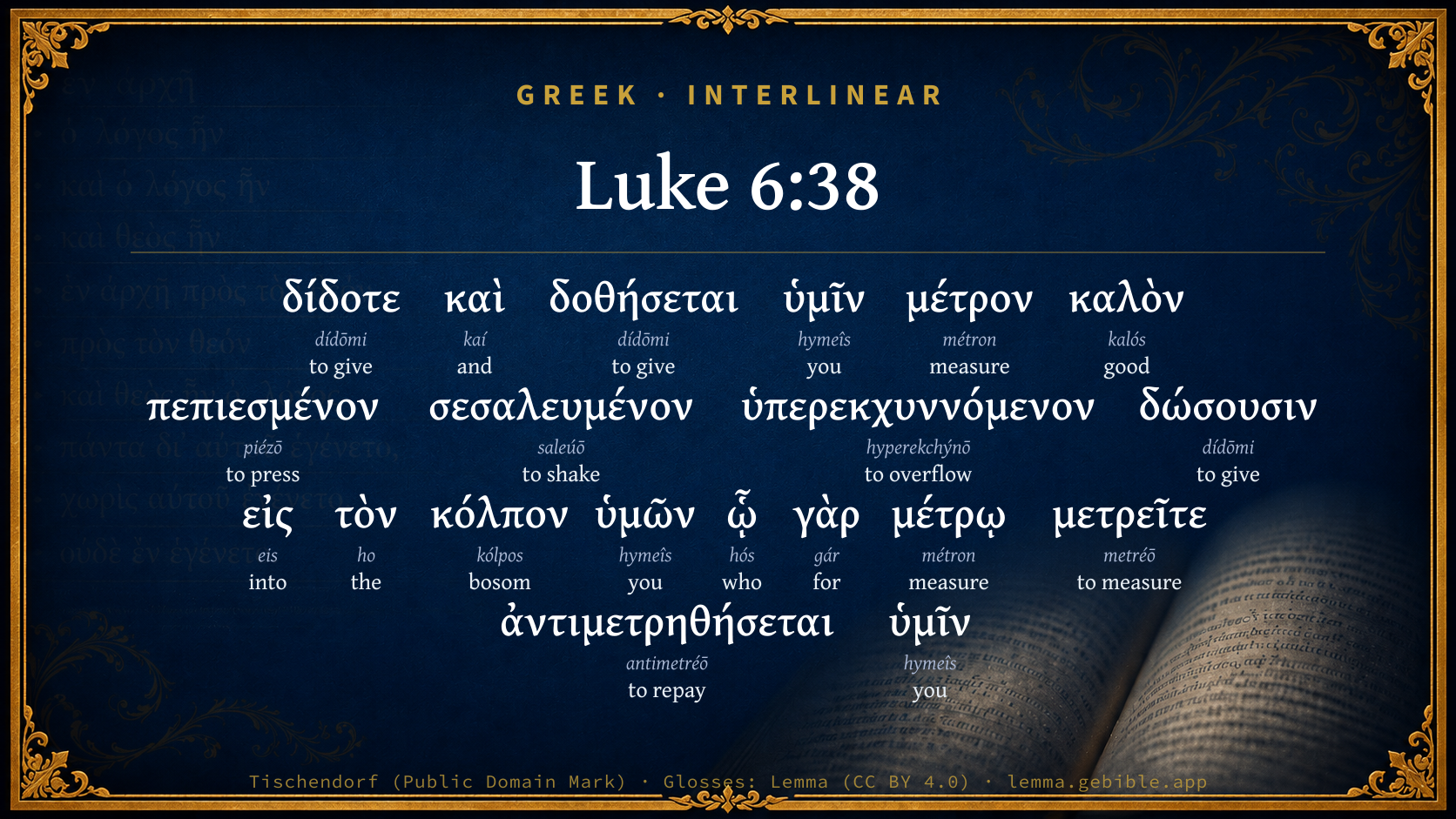
Download image
Cite this verse

Luke 6:38 (World English Bible). Public Domain. Lemma interlinear Bible study tool, https://lemma.gebible.app/v/luke/6/38.

Show BibTeX & RIS
BibTeX
RIS
English Translation
"Give, and it will be given to you: good measure, pressed down, shaken together, and running over, will be given to you. For with the same measure you measure it will be measured back to you."
World English Bible · Public Domain
Highlights
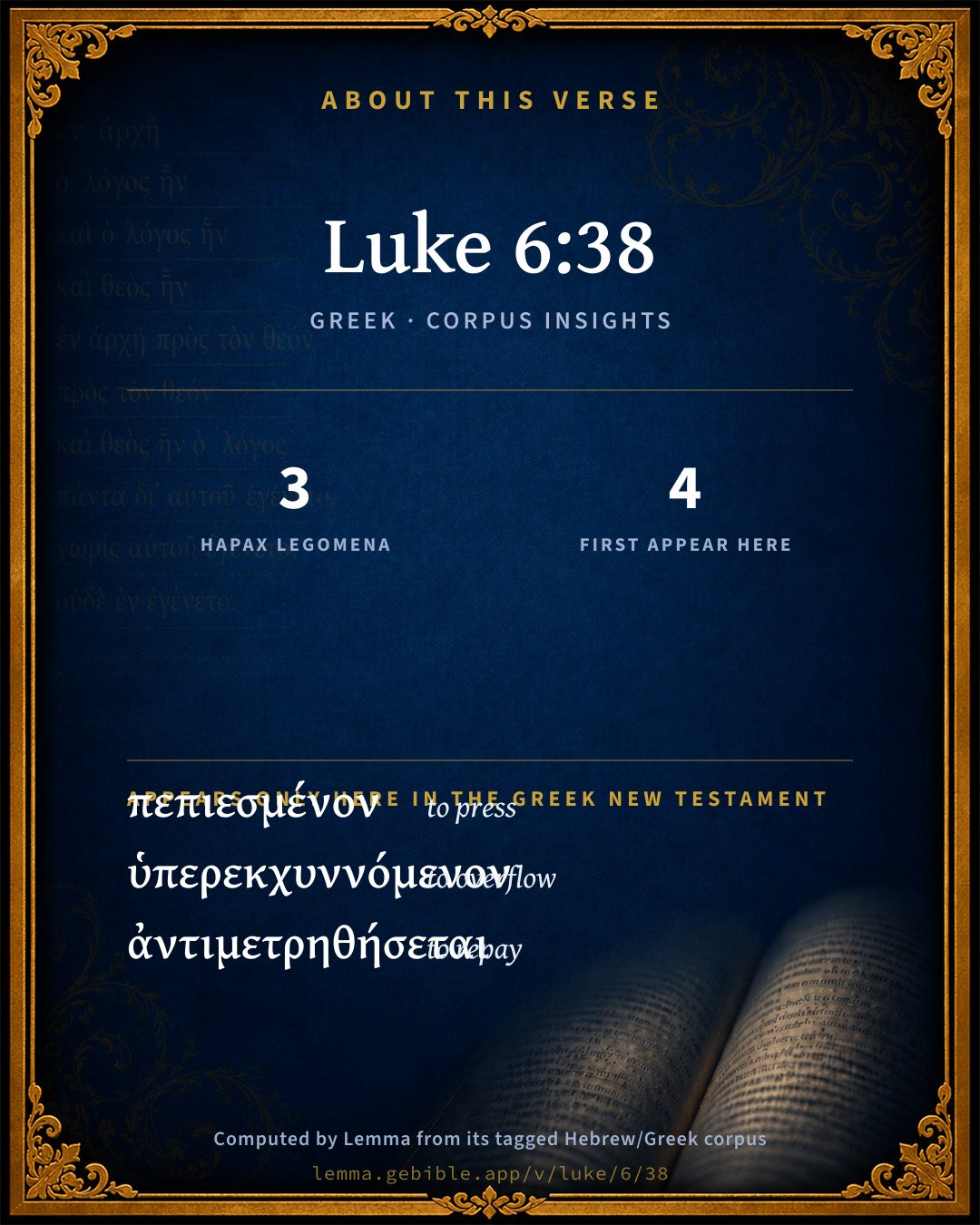
  • 3 hapax legomena — only here in the Greek New Testament
  • 4 first appearances in the Greek New Testament
Full analysis ↓
Download a study sheet

One document with this verse’s original text, its word-by-word gloss line, the meaning frame, cross-references with their text, attributed commentary, and full source and license credits — printable, and it pastes into notes with its structure intact.

This verse Autodidact and up

Study sheet (.html) Plain text (.txt)

A passage Seminary Student

Up to 50 verses in one chapter. A passage sheet keeps up to 6 commentary sources and 12 cross-references per verse, in the order this page ranks them, and says so on the sheet whenever that leaves anything out. Ask for a single verse and you get the Autodidact verse sheet above.

Everything on this page stays free to read, with no account — the sheet is a download of what is already on screen, not access to it.

Want to remove ads? Support Godless Engineer
Compare translations 3

The same verse in 3 English versions, stacked beneath the original-language interlinear above. Click any original word for its lexicon entry.

Each is an independent rendering of the whole verse — the interlinear is not word-aligned to these translations.

Highlighted words mark where these versions differ — a whole-verse word diff, not a word-by-word alignment.

  • World English Bible Public Domain
    "Give, and it will be given to you: good measure, pressed down, shaken together, and running over, will be given to you. For with the same measure you measure it will be measured back to you."
  • King James Version Public Domain
    Give, and it shall be given unto you; good measure, pressed down, and shaken together, and running over, shall men give into your bosom. For with the same measure that ye mete withal it shall be measured to you again.
  • unfoldingWord Literal Text CC BY-SA 4.0
    Give, and it will be given to you: a good measure—pressed down, shaken together, spilling over—they will pour into your lap. For with the measure by which you measure, it will be measured back to you.”

unfoldingWord Literal Text — © unfoldingWord, licensed CC BY-SA 4.0. Word-aligned USFM3 via Door43 (git.door43.org/unfoldingWord/en_ult).

Versions to compare (up to 4)

3 of 4 selected

Show all 19 translations

Every available English version of this verse, each an independent rendering of the whole verse.

  • World English Bible Public Domain
    "Give, and it will be given to you: good measure, pressed down, shaken together, and running over, will be given to you. For with the same measure you measure it will be measured back to you."
  • Berean Standard Bible Public Domain
    Give, and it will be given to you. A good measure, pressed down, shaken together, and running over will be poured into your lap. For with the measure you use, it will be measured back to you.”
  • Majority Standard Bible Public Domain
    Give, and it will be given to you. A good measure, pressed down, shaken together, and running over will be poured into your lap. For with the same measure you use, it will be measured back to you.”
  • King James Version Public Domain
    Give, and it shall be given unto you; good measure, pressed down, and shaken together, and running over, shall men give into your bosom. For with the same measure that ye mete withal it shall be measured to you again.
  • American Standard Version (1901) Public Domain
    give, and it shall be given unto you; good measure, pressed down, shaken together, running over, shall they give into your bosom. For with what measure ye mete it shall be measured to you again.
  • Revised Version (1885) Public Domain
    give, and it shall be given unto you; good measure, pressed down, shaken together, running over, shall they give into your bosom. For with what measure ye mete it shall be measured to you again.
  • Geneva Bible (1599) Public Domain
    Giue, and it shalbe giuen vnto you: a good measure, pressed downe, shaken together and running ouer shall men giue into your bosome: for with what measure ye mete, with the same shall men mete to you againe.
  • Douay-Rheims (1899) Public Domain
    Give, and it shall be given to you: good measure and pressed down and shaken together and running over shall they give into your bosom. For with the same measure that you shall mete withal, it shall be measured to you again.
  • Young's Literal Translation Public Domain
    `Give, and it shall be given to you; good measure, pressed, and shaken, and running over, they shall give into your bosom; for with that measure with which ye measure, it shall be measured to you again.'
  • Literal Standard Version CC BY-SA 4.0
    Give, and it will be given to you; good measure, pressed, and shaken, and running over, they will give into your bosom; for with that measure with which you measure, it will be measured to you again.”
  • Unlocked Literal Bible CC BY-SA 4.0
    Give, and it will be given to you. A generous amount—pressed down, shaken together and spilling over—will pour into your lap. For with the measure you use, it will be measured back to you.”
  • unfoldingWord Literal Text CC BY-SA 4.0
    Give, and it will be given to you: a good measure—pressed down, shaken together, spilling over—they will pour into your lap. For with the measure by which you measure, it will be measured back to you.”
  • Darby Bible Public Domain
    Give, and it shall be given to you; good measure, pressed down, and shaken together, and running over, shall be given into your bosom: for with the same measure with which ye mete it shall be measured to you again.
  • World Messianic Bible Public Domain
    “Give, and it will be given to you: good measure, pressed down, shaken together, and running over, will be given to you. For with the same measure you measure it will be measured back to you.”
  • Webster's Bible Public Domain
    Give, and it shall be given to you; good measure, pressed down, and shaken together, and running over, shall men give into your bosom. For with the same measure that ye give to others, it shall be measured to you again.
  • Free Bible Version CC BY-SA 4.0
    give, and you will be given generously in return. When what you're given is measured out, it's pressed down so more can be added, spilling out over the top, pouring into your lap! For how much you give will determine how much you receive.”
  • Bible in Basic English Public Domain
    Give, and it will be given to you; good measure, crushed down, full and running over, they will give to you. For in the same measure as you give, it will be given to you again.
  • Text-Critical English NT CC BY 4.0
    Give, and it will be given to you. A good measure, pressed down, shaken together, and running over, will be put into your lap. For with the same measure you use it will be measured to you in return.”
  • Tyndale New Testament (1534) Public Domain
    Geve and that shalbe geven vnto you: good measure pressed doune shaken to geder and runnynge over shall men geve into youre bosomes. For with what measure ye mete with ye same shall men mete to you agayne.

Literal Standard Version (2020), Covenant Press — licensed CC BY-SA 4.0. Text via the HelloAO Bible API (eBible.org). Unlocked Literal Bible (unfoldingWord) — licensed CC BY-SA 4.0. Text via the HelloAO Bible API (eBible.org). unfoldingWord Literal Text — © unfoldingWord, licensed CC BY-SA 4.0. Word-aligned USFM3 via Door43 (git.door43.org/unfoldingWord/en_ult). Free Bible Version, Dr. Jonathan Gallagher — licensed CC BY-SA 4.0. Text via the HelloAO Bible API (eBible.org).

Word by word

More ways to search: Search by grammar → Find every occurrence → Compare this word →

Practice this passage: Drill this verse → Learn its vocabulary →

πεπιεσμένον
piézō
G4085
“to press”
Verb, Perfect, Passive, Participle, Accusative, Singular, Neuter
Part of Speech
Verb
Tense
Perfect
Voice
Passive
Mood
Participle
Case
Accusative
Number
Singular
Gender
Neuter
Full Thayer's Definition

Origin: another form for G4084

TDNT: None

1. to press, press together
  1. δίδοτε dídōmi G1325 “to give” Verb, Present, Active, Imperative, 2nd person, Plural
  2. καὶ kaí G2532 “and” Conjunction
  3. δοθήσεται dídōmi G1325 “to give” Verb, Future, Passive, Indicative, 3rd person, Singular
  4. ὑμῖν hymeîs G5210 “you” Personal pronoun, 2nd person, Dative, Plural
  5. μέτρον métron G3358 “measure” Noun, Accusative, Singular, Neuter
  6. καλὸν kalós G2570 “good” Adjective, Accusative, Singular, Neuter
  7. σεσαλευμένον saleúō G4531 “to shake” Verb, Perfect, Passive, Participle, Accusative, Singular, Neuter
  8. ὑπερεκχυννόμενον hyperekchýnō G5240 “to overflow” Verb, Present, Passive, Participle, Accusative, Singular, Neuter
  9. δώσουσιν dídōmi G1325 “to give” Verb, Future, Active, Indicative, 3rd person, Plural
  10. εἰς eis G1519 “into” Preposition
  11. τὸν ho G3588 “the” Article, Accusative, Singular, Masculine
  12. κόλπον kólpos G2859 “bosom” Noun, Accusative, Singular, Masculine
  13. ὑμῶν hymeîs G5210 “you” Personal pronoun, 2nd person, Genitive, Plural
  14. ᾧ hós G3739 “who” Relative pronoun, Dative, Singular, Neuter
  15. γὰρ gár G1063 “for” Conjunction
  16. μέτρῳ métron G3358 “measure” Noun, Dative, Singular, Neuter
  17. μετρεῖτε metréō G3354 “to measure” Verb, Present, Active, Indicative, 2nd person, Plural
  18. ἀντιμετρηθήσεται antimetréō G488 “to repay” Verb, Future, Passive, Indicative, 3rd person, Singular
  19. ὑμῖν hymeîs G5210 “you” Personal pronoun, 2nd person, Dative, Plural

About this verse

These counts appear in no published source. They are computed here, from the morphology-tagged text and Lemma’s own curated glosses. What Lemma adds →

20
words
15
distinct lemmas
Gospels
section

Notable vocabulary

3 hapax legomena — words that appear only here in the entire Greek New Testament:

  • πεπιεσμένον to press G4085
  • ὑπερεκχυννόμενον to overflow G5240
  • ἀντιμετρηθήσεται to repay G488

First appearance in Scripture

These words make their first canonical appearance in the Greek New Testament here:

  • πεπιεσμένον to press G4085
  • ὑπερεκχυννόμενον to overflow G5240
  • κόλπον bosom G2859
  • ἀντιμετρηθήσεται to repay G488

Shared distinctive vocabulary

κόλπον bosom G2859 occurs in 6 verses of the Greek New Testament. Also found in:
Repetition

Words recur within this verse:

  • δίδοτε to give G1325 ×3
  • μέτρον measure G3358 ×2
  • ὑμῖν you G5210 ×3

Cross-references

26

Topical passages linked to Luke 6:38 in the Treasury of Scripture Knowledge — connected by theme and wording, ordered by reader-vote popularity; previews shown in the World English Bible.

  • 2 Corinthians 9:6–8 Remember this: he who sows sparingly will also reap sparingly. He who sows bountifully will also reap bountifully.
  • Deuteronomy 15:10 You shall surely give him, and your heart shall not be grieved when you give to him; because that for this thing Yahweh your God will bless you in all your work, and in all that you put your hand to.
  • Mark 4:24 He said to them, "Take heed what you hear. With whatever measure you measure, it will be measured to you, and more will be given to you who hear.
  • Proverbs 3:9–10 Honor Yahweh with your substance, With the first fruits of all your increase:
  • Matthew 7:2 For with whatever judgment you judge, you will be judged; and with whatever measure you measure, it will be measured to you.
  • Proverbs 22:9 He who has a generous eye will be blessed; For he shares his food with the poor.
  • Proverbs 19:17 He who has pity on the poor lends to Yahweh; He will reward him.
  • Proverbs 10:22 Yahweh's blessing brings wealth, And he adds no trouble to it.
  • Matthew 10:42 Whoever gives one of these little ones just a cup of cold water to drink in the name of a disciple, most assuredly I tell you he will in no way lose his reward."
  • Luke 6:30 Give to everyone who asks you, and don't ask him who takes away your goods to give them back again.
  • 2 Corinthians 8:14–15 but for equality. Your abundance at this present time supplies their lack, that their abundance also may become a supply for your lack; that there may be equality.
  • Ecclesiastes 11:1–2 Cast your bread on the waters; For you shall find it after many days.
  • James 2:13 For judgment is without mercy to him who has shown no mercy. Mercy triumphs over judgment.
  • Psalms 41:1–2 Blessed is he who considers the poor: Yahweh will deliver him in the day of evil.
  • Job 42:11 Then came there to him all his brothers, and all his sisters, and all those who had been of his acquaintance before, and ate bread with him in his house. They comforted him, and consoled him concerning all the evil that Yahweh had brought on him. Everyone also gave him a piece of money, and everyone a ring of gold.
  • Philippians 4:17–19 Not that I seek for the gift, but I seek for the fruit that increases to your account.
  • Psalms 79:12 Pay back to our neighbors seven times into their bosom Their reproach with which they have reproached you, Lord.
  • Isaiah 65:6–7 Behold, it is written before me: I will not keep silence, but will recompense, yes, I will recompense into their bosom,
  • Psalms 18:25–26 With the merciful you will show yourself merciful. With the perfect man, you will show yourself perfect.
  • Deuteronomy 19:16–21 If an unrighteous witness rise up against any man to testify against him of wrong-doing,
  • Job 31:16–20 "If I have withheld the poor from their desire, Or have caused the eyes of the widow to fail,
  • Judges 1:7 Adoni-bezek said, "Seventy kings, having their thumbs and their great toes cut off, gathered [their food] under my table: as I have done, so God has requited me." They brought him to Jerusalem, and he died there.
  • Esther 9:25 but when [the matter] came before the king, he commanded by letters that his wicked device, which he had devised against the Jews, should return on his own head, and that he and his sons should be hanged on the gallows.
  • Ezra 7:27–28 Blessed be Yahweh, the God of our fathers, who has put such a thing as this in the king's heart, to beautify the house of Yahweh which is in Jerusalem;
  • Revelation 16:5–6 I heard the angel of the waters saying, "You are righteous, who are and who were, you Holy One, because you have judged these things.
  • Esther 7:10 So they hanged Haman on the gallows that he had prepared for Mordecai. Then was the king's wrath pacified.

Cross-references courtesy of OpenBible.info (CC BY 4.0).

Commentary

Notes on Luke 6:38 from classic Christian and Jewish commentators (each source and its license shown beneath its notes). The classic Christian expositions comment on the surrounding passage and are grouped to its opening verse, so a note may address several verses; the Jewish commentaries on the Tanakh (Rashi and others) are per-verse, so they appear only where the commentator wrote on this verse.

Lemma curates 59 commentaries, every one of them public domain or Creative Commons licensed, each selected and text-cleaned for this edition rather than reprinted as found. About our sources →

The Biblical Illustrator

Joseph S. Exell

Luk_6:38

Give, and it shall be given unto you; good measure, pressed down

On Christian giving

I.

GET, GATHER. Are there not many persona of a very careless and prodigal disposition?

II. GIVE. Begin to give as soon as you begin to get. That will prevent the danger of a growing covetousness.

III. THE GIVING SHOULD BE IN SOME PROPORTION TO THE INCOME. I do not presume to fix the proportion. But I the more insist on the principle of a fair and just proportion, and on the duty o! the individual to turn the principle into practice. This proportion, however, will never be reached, or at any rate, will hardly for any long time be continued, except in connection with another principle of far deeper hold and wider sway, the principle that--

IV. WHAT IS LEFT IS GIVEN TOO. It is also true that we shall never understand really what Christian giving is until--

V. WE GET BEYOND WHAT IS CALLED THE DUTY OF IT TO THE HIGHER GROUND OF THE BLESSEDNESS OF IT. It is more blessed to give than to receive, is a universal truth applicable not to money alone, but to the whole of lifes experiences.

1. Thought.

2. Sympathy.

3. Life itself.

The possibility of giving life, self, to God for ever. The certainty of having at length to yield the gift of life into the hand of God. (A. Raleigh, D. D.)

The duty of giving

I. WHY SHOULD WE GIVE? It is our duty. It is for Gods glory. It is more blessed to give than to receive.

II. WHAT SHOULD WE GIVE?

1. Ourselves. St. Paul says of the Macedonians that they first gave their own selves unto the Lord. This will make all else well-pleasing unto the Lord.

2. Our time.

3. Our influence.

4. Our money. We are but stewards of all that we possess.

III. HOW ARE WE TO GIVE?

1. Willingly.

2. Unostentatiously. Let not thy right hand, &c.

3. Lovingly--from a principle of love to God and man in the heart.

IV. HOW MUCH ARE WE TO GIVE? The Bible does not give us exact and particular rules, but lays down general principles by which we are to govern our conduct. We must not offer to the Lord that which doth cost us nothing.

V. WHEN ARE WE TO GIVE? When cases of need, objects of compassion, or means of advancing the honour of God or the good of our fellow-men come before us. The injunction of the apostle was, On the first day of the week, &c. (1Co_16:2).

VI. WHERE ARE WE TO GIVE? That question may be best answered by asking another, Where are we not to give? VII. WHO IS TO GIVE? The answer is every man--the rich of their abundance, the poor something even of their poverty. Widow and two mites. Lay up for yourselves treasures in heaven. (H. Whitehead, M.A.)

The reward of the giver

There are, doubtless, those who think that this statement is not borne out by the facts of their own experience. Too often they have obtained not even gratitude. And others there are who listen doubtfully to such words, not on account of any personal disappointments of their own, for they have not put themselves in the way of suffering such disappointments, but rather from observation of other peoples experience, as well as from their own theory of life. What, then, are we to make of our Lords statement that men shall give this good measure?

1. Our Lord did not say that men would do anything of the kind. We are to hope for nothing again (Luk_6:35).

2. Yet our Lord proposes a reward. Yes. Ye shall be the children of the Highest. The reward, then, consists in being like God. Whatever else is mentioned in the nature of reward is not an object to be sought after, but a consequence which must needs ensue.

3. Among these consequences will be found a measure even of human gratitude. For if our Lord did not say that men shall give the good measure, it may also be observed that He did not say they will not. The good measure will be given, and even men will have their share in giving it. (H. Whitehead, M. A.)

Penalty of not giving to God

There are hundreds of business men, Christian men, in New York city, who have gone down, for the simple reason, as I believe, that they did not give to God that which belonged to Him. They did not give Him any percentage at all, or such a very small percentage that the Lord God collected His own bills, by fire, by storm, or by death. Two men I knew very well, some years ago, on the streets of New York. They were talking about the matter of benevolence. One said to the other, You give too much. I will wait until I get a large pile of money, and then I will give. No, said the other, I will give as God prospers me. Hear the sequel. The former lives in New York city to-day, dollarless. The latter gathered two hundred and fifty thousand dollars. I believe that the reason why many people are kept poor is because they do not give enough. If a man gives in the right spirit to the Lord Jesus Christ and to the Church, he is insured for time and for eternity. The Bank of England is a weak institution compared with the bank that any Christian man can draw upon. (Dr. Talmage.)

Righteous retribution

One remembers, of course, the Regent Morton hugged to death by the maiden he had been the means of introducing into Scotland. The French doctor, Guillotin, is even now not uncommonly believed to have perished in the Reign of Terror by the instrument invented by and named after him; whereas he quietly died in his bed, many many years later than that. But the Revolution history is well stored with instances like that of Chalier, condemned to death by the criminal tribunal at Lyons--the guillotine which he had sent for from Paris to destroy his enemies being first destined to sever his own head from his body. A bungling executioner prolonged the last agonies of this man, who, in fact, was hacked to death, not decapitated. He tasted slowly, as Lamartine says, of the death, a thirst for which he had so often sought to excite in the people; he was glutted with blood, but it was his own. Alison recognizes in the death of Murat a memorable instance of the moral retribution which often attends on great deeds of iniquity, and by the instrumentality of the very acts which appeared to place them beyond its reach, He underwent in 1815 the very fate to which, seven years before, he had consigned a hundred Spaniards at Madrid, guilty of no other crime than that of defending their country; and this, as Sir Archibald adds, by the application of a law to his own case which he himself had introduced to check the attempt of the Bourbons to regain a throne which he had usurped. (Francis Jacox.)

God a good paymaster

A boy, hearing the Rev. J. Wesley preach, cheerfully put a shilling on the plate. Twenty years afterwards the boy told Mr. Wesley that God was a good paymaster; for he was then worth £20,000, and had the grace of God in his heart. (Sunday School Treasury.)

Happiness in doing good

Alexander, the Emperor, was one day out hunting; and hating gone ahead of his suite, he fancied he heard a groan; the groan pierced his heart; he alighted on the spot, looked around him, and found a poor man at the point of death. He bent over him, chafed his temples; excited the poor man, or tried to do so; he went by a public road, and called the attention of a surgeon to the case of the poor man. Oh! said the surgeon, he is dead; he is dead. Try what you can do, said Alexander. The surgeon adopted a set of experimental processes at the command of the emperor; and at last a drop of blood appeared. At the mouth of the opened vein there was suction; respiration was forming in the chest of the man. Alexanders eyes flashed fire, and he said Oh! this is the happiest day of my life; I have saved another mans life! What said another great man among ourselves--Lord Eldon? In a letter to his sister, which he wrote in his old age, he says--It was my duty, as Lord Chancellor, to listen to the record of the sentences passed by the Recorder of the City of London. It used to be a formal thing, when the sentences of death were read over, that the chancellor should give his assent; but I determined after the first time that I would go into each case, and have each case clearly and distinctly stated. It used to give me a great deal of trouble in addition to all my other duties; but the consequence of this was, that I saved the lives of several persons. I say, do good in the cause of truth and righteousness, and you will promote your own honour and happiness; and when the eye sees you it will bless you, and when the ear hears you it will bear witness to you. (J. Beaumont.)

The naturalness of giving

If we view this microcosm, the human body, we shall find that the heart does not receive the blood to store it up, but while it pumps it in at one valve, it sends it forth at another. The blood is always circulating everywhere, and is stagnant nowhere; the same is true of all the fluids in a healthy body; they are in a constant state of expenditure.

If one cell stores up for a few moments its peculiar secretion, it only retains it till it is perfectly fitted for its appointed use in the body; for if any cell in the body should begin to store up its secretion, its store would soon become the cause of inveterate disease; nay, the organ would soon lose the power to secrete at all, if it did not give forth its products. The whole of the human system lives by giving. The eye cannot say to the foot, I have no need of thee, and will not guide thee; for if it does not perform its watchful office, the whole man will be in the ditch, and the eye will be covered with mire. If the members refuse to contribute to the general stock, the whole body will become poverty-stricken, and be given up to the bankruptcy of death. Let us learn, then, from the analogy of nature, the great lesson, that to get, we must give; that to accumulate, we must scatter; that to make ourselves happy, we must make others happy; and that to get good and become spiritually vigorous, we must do good, and seek the spiritual good of others. (C. H. Spurgeon.)

Reward of effort for others

A traveller, ready to perish amid the snows of the Alps, meets a fellow-traveller in worse condition than himself. He puts forth every effort to save him, and is rewarded by the life of his fellow, and by new warmth and life in his own freezing limbs.

Benefits of liberality

I never prospered more in my small estate than when I gave most and needed least. My own rule hath been, first, to contrive to need myself as little as may be, and lay out none on need-nots, but to bye frugally on a little; second, to serve God in my place, upon that competency which He allowed me to myself, that what I had myself might be as good a work for common good as that which I gave to others; and, third, to do all the good I could with the rest, preferring the most public and the most durable object, and the nearest. And the more I have practised this, the more I have had to do it with; and, when I gave almost all, more came in (without anys gift), I scarce knew how, at least unexpected: but when by improvidence I have cast myself into necessities of using more upon myself, or upon things in themselves of less importance, I have prospered much less than when I did otherwise. And when I had contented myself to devote that stock which I had gotten to charitable uses after my death, instead of laying out at present, that so I might secure somewhat for myself while I lived, in probability all that is like to be lost; whereas, when I took that present opportunity, and trusted God for the time to come, I wanted nothing, and lost nothing. (Richard Baxter.)

The liberal man is always rich

In defiance of all the torture, of all the might, of all the malice of the world, the liberal man will ever be rich; for Gods providence is his estate, Gods wisdom and power are his defence, Gods love and favour are his reward, and Gods Word is his security. (Isaac Barrow, D. D.)

The reward of giving

I. AS TO TEMPORAL THINGS.

1. A good conscience. Sometimes the requital of a mans openheartedness, and the readiness with which he has bestowed of what he has upon others, is furnished to him in the feelings of his own heart; and he herein gains a rich, abundant, and blessed recompense. Labour may have been sweet to him; he may have been willing to toil on, as he was gradually making progress to his object; success has been full of delight, as he gradually mastered difficulties, and looking back upon the way which he had passed, found how he had climbed to heights, to which his youthful ambition hardly dared to aspire. But neither is labour so sweet, nor its most successful results so delightful, as when a man whom God has prospered in his getting, has the heart readily and liberally to bestow. When he has gone to the habitations of the poor, when he has stood by the bedside of the sick, when he has ministered to those human necessities which fell within the compass of his ability to remove, then there has been in his own soul a far better requital for his expenditure, than if he had bestowed his money in any other possible way,

2. Gratitude of those benefited. The most prosperous man, the man to whom in Gods providence there seems to be a larger than usual amount of success appointed, has no security; he cannot tell what a year, or even a day, may bring forth. His fortune may be laid in the dust; his riches may make themselves wings; he may be reduced lower even than he was at his starting-place. Be it so; God has not forgotten him. Then will come the very especial occasion on which he will prove, by his own individual instance, that the promise of the text is true. When he possessed much, he gave liberally; he was the friend of all who were in necessity; he turned no deaf ear to the supplications of the desolate; he was not inaccessible to the sons and daughters of sorrow; and in his own day of disaster, many a heart and many a hand are open to him. For whom is it, that a whole neighbourhood are anxious? For whose affliction is it that all are concerned? For whose renovated fortunes are all deeply anxious? Is it not the man who, when he was in other circumstances, held himself the steward of God, and because he possessed all things in charge, used them as one who had to give account. Perhaps it may be that even his temporal condition is restored; but, whether that be so or not, does he not gain a most blessed return for all his charges and all his labour, in that there are hearts which feel for him, and friends who sympathise deeply with him, and those in whose prayers he knows that he has a place?

II. IN SPIRITUAL THINGS. Application to devoted preachers of the gospel, missionaries, &c. Also to parents who have brought up their children conscientiously. Our own portion in heaven will be all the more blessed, because of its being shared with those to whom on earth we were helpers. (S. Robins, M. A.)

The gift and its return

The New Testament is full of the idea of a natural and necessary reciprocity between man and the things by which he is surrounded (Gal_6:7; 2Co_9:6). The world seems to be a great field in which every man drops his seed, and which gives back to every man, not just the same thing which he dropped there, any more than the brown earth holds up to you in the autumn the same black berry which you hid under its bosom in the spring, but something which has its true correspondence and proportion to the seed to which it is the legitimate and natural reply. Every gift has its return, every act has its consequence, every call has its answer in this great live, alert world, where man stands central, and all things have their eyes on him and their ears open to his voice. (Phillips Brooks, D. D.)

The law of reciprocity

It is a law of vast extent and wonderful exactness. The world is far more orderly than we believe; a deeper and a truer justice runs through it than we imagine. We all go about calling ourselves victims, discoursing on the cruel world, and wondering that it should treat us so, when really we are only meeting the rebound of our own lives. What we have been to things about us has made it necessary that they should be this to us. As we have given ourselves to them, so they have given themselves to us.

1. Even with mans relations to the material earth the law is true. What different things she is to all of us, this earth we live in I Why is it that one man laughs at anothers view about the earth, and thinks him mad because of some strange value that he places on it? Three men stand in the same field and look around them: and then they all cry out together. One of them exclaims, How rich! another cries, How strange! another cries, How beautiful! and then the three divide the field between them, and they build their houses there; and in a year you come back and see what answer the same earth has made to each of her three questioners. They have all talked with the ground on which they lived, and heard its answers. They have all held out their several hands, and the same ground has put its own gift into each of them. What have they got to show you? One cries, Come here and see my barn; another cries, Come here and see my museum; the other says, Let me read you my poem. That is a picture of the way in which a generation or the race takes the great earth and makes it different things to all its children. With what measure we mete to it, it measures to us again.

2. The same law holds good with regard to our relations to the world of men. What does it mean, that one man cannot go among any kind of men, however base and low, without getting happiness and good; while another man cannot go into the midst of the noblest and sweetest company without bringing out misery and despair and sin? Here are Jesus and Judas: both go and give themselves to the Pharisees; both stand in the Pharisees presence and hear what they have to say. To Jesus these Pharisees give back in return every day a deeper consciousness of His own wondrous nature, a devouter consecration to His Father, and a more earnest pity for them. To Judas they give only blacker dreams of treason, a falser disregard of friendship and loyalty and honour. Take two boys in a class at college; two clerks in a shop in town. It is not good when either of them is made cynical, and sneers at the possibility of virtue because of the vice which he has felt in its contamination at his side. The true soul, with a character of its own, will learn the possibility of being good from his own consciousness, all the more strongly because of the vice that touches him. No soul, bad in itself, can really learn the possibility of goodness by mere sight and touch even of a world of saints, and no soul really good can lose the noble consciousness that man was made for goodness, even though all the world but him is steeped in wickedness, nay, in subtle ways he will feed that consciousness there.

3. The same law applies to the truths which men believe, or the causes for which they labour. Generous or stingy, large-idead or small-idead, appreciative or unappreciative of other occupations than your own; these things you will be, not invariably according to the kind of trade you are engaged in, but distinctively according to the kind of manhood which you put into your trade. And so with creeds. A creed must fill a mans character before it really takes possession of his mind, as the ocean has to fill a vessel with its water before it can swallow it up into its depth. You cannot finally judge men by their creeds. A man may hold the most spiritual doctrine, and be carnal and mercenary; a man may hold the broadest truth, and be a bigot; and, on the other hand, all our religious history bears witness that a man may hold hard crude, narrow doctrine, and yet gather out of his belief in it rich, warm, sweet holiness which men and God must love.

4. I turn to one more illustration of the working of our law--the highest, the completest of them all. It is the gift of oneself to Jesus. There are different measures in which men give themselves to Christ, and Christ despises none of them; but in different measures He again is compelled to give Himself back to them. See how they come! One man approaches the Divine Redeemer asking no Divine redemption, but touched and fascinated by the beauty of that perfect life. He would feed his wonder, he would cultivate his taste, upon it. To him Jesus gives what he asks, and with delighted wonder and with cultivated taste the satisfied asker goes away. It is as if a man painted a mountain for its picturesqueness, and carried off his picture in delight, never dreaming that he left behind him in the mountains bosom treasures of gold which only waited for his hand to gather them. Another man comes to Jesus with a self that is all alive with curiosity. He takes Christs revelations--for Christ does not refuse him either--and goes away content to know much of God and man, and what there is beyond this world. Another man comes to Jesus with a self all trembling with fear, all eager for safety, and Jesus satisfies him; He lets him know that even the humblest, and most ignorant, and least aspiring soul, which repents of and forsakes its sin, and seeks forgiveness, shall not be lost. Each gets from Jesus that which the nature which he brings can take. With what measure each gives himself to the Saviour, the Saviour gives Himself in His salvation back to each. Only when at last there comes a man with his self all open, with door behind door, back into the most secret chambers, all unclosed, ready to give himself entirely, wanting everything, ready to take everything that Jesus has to give, wanting and ready to take the whole of Jesus into the whole of himself, only then are the last gates withdrawn; and as when the ocean gathers itself up and enters with its tide the open mouth of the river, like a conqueror riding into a surrendered town, so does the Lord in all His richness, with His perfect standards, His mighty motives, His infinite hopes, give Himself to the soul which has been utterly given to Him. It is not enough that Christ should stand ready to give us His blessings. He must give us the nature to which those blessings can be given. What we want of Him is not merely His gifts; it is ourselves; He must give us them first. To them only can He give Himself, which is His perfect gift. Not merely with outstretched hands but with open hearts we must stand before Him. We must pray not merely that the kingdom of heaven may come, but that we may be born again, so that we may see it. (Phillips Brooks, D. D. )

The Biblical Illustrator, edited by Joseph S. Exell (c. 1880s–1900s) — public domain. Text from a community e-Sword module.

Tyndale Open Study Notes

Tyndale Open Resources

6:38 pressed down, shaken together: A generous grain merchant would top off the buyer’s container, press it down, shake it to make more room, and then pour until the grain overflowed into the buyer’s lap.

Tyndale Open Study Notes — © Tyndale Open Resources, licensed CC BY-SA 4.0. Text via the HelloAO Bible API.

Bengel's Gnomon

Johann Albrecht Bengel

Luk 6:38. Καλὸν, good) in the quality, or even in the quantity, of those things, which are estimated by weight, number, or other means of measuring.—πεπιεσμένον, pressed down) in the case of dry goods.—σεσαλευμένον, shaken together) in the case of soft goods.—ὑπερεκχυνόμενον, flowing over) in the case of liquids.

Bengel's Gnomon of the New Testament — English translation (T&T Clark, Edinburgh, 1860) — public domain. Text from a community e-Sword module.

Expositor's Greek Testament

ed. W. Robertson Nicoll

Luk 6:38 . δίδοτε : this form of mercy is suggested by Mat 7:2 , ἐν ᾧ μέτρῳ μετρεῖτε , etc.: be giving, implying a constant habit, and therefore a generous nature. μέτρον καλὸν , good, generous measure; these words and those which follow apply to man’s giving as well as to the recompense with which the generous giver shall be rewarded. πεπιεσμένον , etc., pressed down, shaken, and overflowing; graphic epexegesis of good measure, all the terms applicable to dry goods, e.g. , grain. Bengel takes the first as referring to dry ( in aridis ), the second to soft ( in mollibus ), the third to liquids ( in liquidis ). κόλπον : probably the loose bosom of the upper robe gathered in at the waist, useful for carrying things (De Wette, Holtz., H. C., al. ). It is implied that God gives so, e.g. , “plenteous redemption” (Psa 130:7 ).

The Expositor's Greek Testament, edited by W. Robertson Nicoll (1897–1910) — public domain. Text from a community e-Sword module.

Geneva Bible (1599)

Geneva Bible translators

These are borrowed kinds of speeches taken from them which use to measure dry things, as corn and such like, who use a frank kind of dealing therein, and thrust it down and shake it together, and press it and heap it.

Geneva Bible (1599) marginal notes — public domain. Text via Bolls.life.

Adam Clarke's Commentary

Verse 38. Give, and it shall be given] "Christian charity will make no difficulty in giving that which eternal truth promises to restore. Let us give, neither out of mere human generosity, nor out of vanity, nor from interest, but for the sake of God, if we would have him place it to account. There is no such thing as true unmixed generosity but in God only; because there is none but him who receives no advantage from his gifts, and because he engages himself to pay these debts of his creatures with an excessive interest. So great is the goodness of God, that, when he might have absolutely commanded us to give to our neighbour, he vouchsafes to invite us to this duty by the prospect of a reward, and to impute that to us as a desert which he has a right to exact of us by the title of his sovereignty over our persons and estates."

Men live in such a state of social union as renders mutual help necessary; and, as self-interest, pride, and other corrupt passions mingle themselves ordinarily in their commerce, they cannot fail of offending one another. In civil society men must, in order to taste a little tranquillity, resolve to bear something from their neighbours; they must suffer, pardon, and give up many things; without doing which they must live in such a state of continual agitation as will render life itself insupportable. Without this giving and forgiving spirit there will be nothing in civil society, and even in Christian congregations, but divisions, evil surmisings, injurious discourses, outrages, anger, vengeance, and, in a word, a total dissolution of the mystical body of Christ. Thus our interest in both worlds calls loudly upon us to GIVE and to FORGIVE.

Bosom.] κολπον, or lap. Almost all ancient nations wore long, wide, and loose garments; and when about to carry any thing which their hands could not contain, they used a fold of their robe in nearly the same way as women here use their aprons. The phrase is continually occurring in the best and purest Greek writers. The following example from Herodotus, b. vi., may suffice to show the propriety of the interpretation given above, and to expose the ridiculous nature of covetousness. "When Croesus had promised to Alcmaeon as much gold as he could carry about his body at once, in order to improve the king's liberality to the best advantage, he put on a very wide tunic, (κιθωνα μεγαν,) leaving a great space in the BOSOM, κολπον βαθυν, and drew on the largest buskins he could find. Being conducted to the treasury, he sat down on a great heap of gold, and first filled the buskins about his legs with as much gold as they could contain, and, having filled his whole BOSOM, κολπον, loaded his hair with ingots, and put several pieces in his mouth, he walked out of the treasury, c." What a ridiculous figure must this poor sinner have cut, thus heavy laden with gold, and the love of money! See many other examples in Kypke and Raphelius. See also Ps 129:7; Pr 6:27; Pr 17:23.

The same measure that ye mete withal, it shall be measured to you again.] The same words we find in the Jerusalem Targum on Ge 38:26. Our Lord therefore lays down a maxim which themselves allowed.

Adam Clarke's Commentary on the Bible (1810–1826) — public domain. Text from a community e-Sword/MySword module.

Ellicott's Commentary for English Readers

(38) Good measure, pressed down.—The imagery clearly points to a measure of grain, so pressed and shaken that it could hold no more.

Into your bosom.—The large fold of an Eastern dress over the chest, often used as a pocket.

With the same measure that ye mete.—See Notes on Mat_7:2, Mar_4:24, for the varied applications of the proverb.

A Bible Commentary for English Readers, edited by Charles John Ellicott (1878–1897) — public domain. Text from a community e-Sword module.

The Cambridge Bible for Schools and Colleges

gen. ed. J. J. S. Perowne

38. into your bosom] Pockets were unknown to the ancients. All that was necessary was carried in the fold of the robe (Heb. Cheyk., Psa_35:13, &c.; Lat. sinus) or in the girdle.

with the same measure that ye mete] A proverb almost verbally identical with this is found in the Talmud (Duke’s Rabbin. Blumenlese, p. 162), but it must be remembered that the earliest parts of the Talmud were not committed to writing till more than two centuries after Christ, and long before that time His sayings may have been ‘in the air,’ i.e. they may have passed unconsciously into the store of the national wisdom even among His enemies.

The Cambridge Bible for Schools and Colleges (gen. ed. J. J. S. Perowne; Cambridge University Press, 1878–1918) — public domain. Text from a community e-Sword module.

John Gill's Exposition

And he spake a parable unto them,.... The Vulgate Latin reads, "he spake also a parable unto them"; besides what he said; and the Arabic version renders it, "another similitude", parable, or proverb, distinct from the comparisons, allusions, and proverbial expressions in the preceding verses. Though it should be observed, that these words were not spoken at the same time, nor on the mount, as the foregoing were; but this, and what follow, are a collection of various expressions of Christ at different times, some delivered on the mount, and others elsewhere; unless it should be rather thought, that these proverbs and sentences were repeated at different places and times, which is not improbable:

can the blind lead the blind? they may do so, as the blind Scribes and Pharisees led the blind people of the Jews, which is what our Lord intends; but if they do, as they did,

shall they not both fall into the ditch? yes, verily, what else can be expected? See Gill on Mat 15:14.

John Gill's Exposition of the Whole Bible (1746–1763) — public domain (CC PDM 1.0). Text via the HelloAO Bible API.

Trapp's Complete Commentary

John Trapp

38 Give, and it shall be given unto you; good measure, pressed down, and shaken together, and running over, shall men give into your bosom. For with the same measure that ye mete withal it shall be measured to you again.

Ver. 38. Into your bosom] The Jews wore large and loose garments, so that they could bear away much in their bosoms. Hence this expression.

John Trapp, A Commentary or Exposition upon All the Books of the Old and New Testament (1647–1656) — public domain. Text from a community e-Sword module.

Haydock's Catholic Bible Commentary

Here all solicitude of diffidence, all delay of avarice, is cut off; for what truth promises to repay, humility may safe expend. (St. Leo, Serm. vi.)

George Leo Haydock (1774–1849), Haydock's Catholic Family Bible and Commentary, 1859 edition — public domain. Excludes Psalms (Douay-Rheims chapter numbering differs from Protestant) and Deuterocanonical books (Catholic canon only).

Matthew Poole's English Annotations

To let us know how God favoureth acts of charity and justice we shall observe, that there are no good deeds that God so rewardeth by retaliation, as such which are the products of these habits; nor any sins which God so punishes by way of retaliation, as sins contrary to these, especially such as are more eminently contrary. This verse speaks of acts of charity.

Give, and it shall be given unto you, and that not bare measure, but

good measure, pressed down, and shaken together, and running over. Nothing can more concur to make good measure, than the shaking of the bushel, the crowding and pressing down of the corn or meal with the hand, and the pouring in till the measure runneth over. So as that which is here promised, is a plentiful reward to charitable and merciful actions, either from the hand of God more mediately, God stirring up others to be as kind to us as we are to others; or more immediately, himself blessing us by his unexpected providential dispensations: to this purpose are abundance of scriptures, Deu 24:19; Psa 41:1-3; Pro 11:25; 28:27; 2Co 9:6. If men will not be so just as to requite the good which their brethren have done them, having it in their power, yet God will be faithful to his promises, and by his providence take care that those who have done acts of mercy, not in a mere commiseration to human condition, but in a just obedience to his will, shall not lose by what they have done; they shall be rewarded fully and plentifully, finding again (though it may be after many days) the bread which they have cast upon the waters, according to his command.

Matthew Poole's English Annotations on the Holy Bible (1683–1685) — public domain. Text from a community e-Sword/MySword module.

The Pulpit Commentary

Give, and it shall be given unto you; good measure, pressed down, and shaken together, and running over. The grand characteristic feature of the society of his followers must be generosity. They must be known among men as givers rather than judges. Boundless generosity, limitless kindness to all, saint and sinner that is what he, the Master, would press home to those who would follow his lead. (see 3Jn_1:5, 6) Men would find out in time what generous friends they were, and would in their turn freely give to them. Shall men give into your bosom. The image is an Eastern one. In the dress then worn, a largo bag-shaped fold in the robe above the cincture or girdle was used instead of a pocket.

Vers. 39, 40. Christian teaching.

We may learn from this parable some truths of the greatest consequence to all those who are teachers of religion; and this will include not only all Christian pastors and evangelists, but all those who are training the young, whether at school or at home.

I THAT THE WISDOM OF THE WORLD DEPENDS VERY LARGELY ON THAT OF ITS RELIGIOUS TEACHERS. The multitude have never yet been able to think great theological questions through; they have not attempted the settlement of them by their own examination. They have left that very largely indeed to their religious leaders. It is so in other departments of human knowledge, and so it has been and will be in the realm of "religion. What our teachers teach the people will believe concerning the great and supreme questions affecting our relation to God, to our neighbours, to the future.

II THAT BLINDNESS ON THE PART OF THE TEACHER MEANS DISASTROUS ERROR TO THE PEOPLE. "Both will fall into the ditch." Religious truth is the most elevating of all knowledge; but error in religion is the most injurious of all errors. Men can make mistakes in the realms of literature, of physical science, of philosophy, and even of political economy, without fatal consequences. But serious errors in religion are nothing short of calamities. Teacher and taught fall into a deep ditch, from which they do not escape without much injury, both done and suffered. These evil consequences include:

1. Departure and distance of the mind from the thought of God, from truth and wisdom.

2. Superstitions which degrade and demoralize; or, on the other hand, unbelief which robs the soul of its true heritage, and leaves life without nobility and death without hope.

3. Morbid fancies which prey upon the mind, or shocking cruelties practised on the victim of error himself or on others.

4. Spiritual death.

III THAT THE TEACHER OF TRUTH IS LIMITED IN HIS INFLUENCE BY HIS OWN ATTAINMENTS. "The disciple is not above his master." It is indeed true that a teacher may bring a disciple into connection with Jesus Christ; and from him and from his followers and his institutions he may gain help which his first teacher could not have imparted; but this is not derived from the teacher himself. This man, as teacher, can only render to his disciples the good which he has in himself the knowledge he has in his own mind, the worth he has in his own character, the wisdom contained in the principles on which he is fashioning his own life. Let every teacher be impressed with the serious truth of this limitation. He cannot give what he has not gained. He has to say, "Follow me so far as I am following Christ, not a step further. If he ceases to acquire, if his path of progress in the knowledge or the likeness of God is arrested, there is stopped at the same hour his power of leading his disciples on and up those sacred and glorious heights. Therefore let him be always acquiring, always attaining.

IV. THAT THE FAITHFUL TEACHER HAS A VERY NOBLE OPPORTUNITY. Every one that has been fully instructed "shall be as his master." If he is a" true philanthropist who makes two blades of grass to grow where only one grew before," what shall we not think of him who plants in the hearts of men true thoughts of God, of the human soul, of human life, of the future? This is the teacher"s lofty function. And he can go beyond this. By the power of language, especially when that is illuminated by deep conviction and intense earnestness of spirit, he can pass on to his disciples so much of Divine truth, and he can communicate so much of heavenly wisdom, that they who "have been fully instructed," who are his mature or "perfect" disciples, will have in them the mind and temper which are in him. So that they will be "as he is," will think as he thinks, will feel what he feels, will live for the same objects for which he is living. Surely there is no nobler work that any man can do than this; it is well worth while the teacher"s

(1) most careful preparation,

(2) most energetic effort,

(3) most earnest prayer. C.

The Pulpit Commentary (1880–1919), ed. H.D.M. Spence-Jones & Joseph S. Exell — public domain. Text from a community e-Sword module.

John Wesley's Explanatory Notes

Into your bosom - Alluding to the mantles the Jews wore, into which a large quantity of corn might be received. With the same measure that ye mete with, it shall be measured to you again - Amazing goodness! So we are permitted even to carve for ourselves! We ourselves are, as it were, to tell God how much mercy he shall show us! And can we be content with less than the very largest measure? Give then to man, what thou designest to receive of God.

John Wesley, Explanatory Notes Upon the Whole Bible (1754–1765) — public domain. Text via the GEBible commentary corpus.

Scofield Reference Notes

C. I. Scofield

Give

See, Pro 28:27 (See Scofield "2Co 8:1")

The Scofield Reference Bible (1917 edition), notes by C. I. Scofield — public domain. Text from a community e-Sword module.

Burkitt's Expository Notes on the New Testament

William Burkitt

I think there is not one text of scripture that declares the bounty of God more fully in rewarding acts of charity and mercy than this before us. O how liberal a paymaster is God! How sure and bountiful are the returns Christ makes to us for the relief given to him in his members!

He promises us here, 1. Not bare measure but good measure.

2. Pressed down, shaken together, and running over; nothing adds more to the measure than the shaking of the bushel, the crowding and pressing of the corn, and heaping till the measure runs over: now a measure will run over as long as you will pour.

Learn hence, that charities done in faith, in obedience to God, and with an eye to the glory of God, will produce a certain and plentiful increase. Liberality is the way to riches; giving is the best and surest way of thriving. A little charity from us, if we have but a little, is looked upon by God as a great deal. But it is the greatest imprudence as well as impiety, to do but a little when we have the ability to do much; for he that sows bountifully shall reap bountifully: good measure, pressed down, and running over.

William Burkitt's Expository Notes on the New Testament (1700–1703) — public domain. Text from a community e-Sword module.

unfoldingWord translationNotes

Door43 World Missions Community

it will be given to you

Jesus does not say exactly who will give. Possible meanings are 1) "someone will give it to you" or 2) "God will give it to you" (See: Active or Passive)

A generous amount—pressed down, shaken together and spilling over—will pour into your lap

Jesus speaks either of God or of people giving generously as if he were speaking of a generous grain merchant. AT: "God will pour into your lap a generous amount—pressed down, shaken together and spilling over" or "Like a generous grain merchant who presses down the grain and shakes it together and pours in so much grain that it spills over, they will give generously to you" (See: Metaphor)

A generous amount

"A large amount"

it will be measured back to you

Jesus does not say exactly who will measure. Possible meanings are 1) "they will measure things back to you" or 2) "God will measure things back to you" (See: Active or Passive)

unfoldingWord translationNotes — © Distant Shores Media and the Door43 World Missions Community, licensed CC BY-SA 4.0. Source: git.door43.org/Door43/en_tn.

Cambridge Greek Testament for Schools and Colleges

38. δώσουσιν. ‘Shall they give.’ Who? The A.V[141] supplies “men.” Euthymius says ‘those whom you have benefited’ for God will seem to give in their behalf. But St Luke was probably thinking of angels, as in Luk 16:9 (comp. Mat 24:31) and in Luk 12:20; Luk 12:48.

[141] A.V. Authorised Version.

εἰς τὸν κόλπον ὑμῶν. Pockets were unknown to the ancients. All that was necessary was carried in the fold of the robe (Heb. cheyk, Psa 35:13, &c.; Lat. sinus), or in the girdle.

ᾧ γὰρ μέτρῳ μετρεῖτε. A proverb almost verbally identical with this is found in the Talmud (Duke’s Rabbin. Blumenlese, p. 162), but it must be remembered that the earliest parts of the Talmud were not committed to writing till more than two centuries after Christ; and long before that time His sayings may have been ‘in the air,’ i.e. they may have passed unconsciously into the store of the national wisdom even among His enemies.

Cambridge Greek Testament for Schools and Colleges (Cambridge University Press, 1896; 21 vols, various authors incl. Carr, Maclear, Plummer, Farrar, Lumby, Moule, M. R. James, Simcox) — public domain. Text from a community e-Sword module.

Alford’s Greek Testament

Henry Alford

38.] The similitude is taken from a very full measure of some dry thing such as corn. That no liquid is intended by ὑπερεκχ., as Bengel supposes, is evident—for the three present participles all apply to the same μέτ. καλ. and form a climax.

δώσουσιν] The subject of this verb answers to the unexpressed agents of ἀντιμετρηθήσεται; such agents being indefinite, and the meaning thereby rendered solemn and emphatic: see on ch. 12:20. If we are to find a nom., it should be the Angels, who are in this matter the ministers of the divine purposes (so Meyer).

This saying is found with a totally different import Mar 4:24; one of the many instances how the Lord turned about, so to speak, the Light of Truth contained in His declarations, so as to shine upon different departments of life and thought.

Henry Alford, The Greek Testament (1849–1861) — public domain. Text from a community e-Sword module.

International Critical Commentary

38. The transition is easy from charity in judging others to benevolence in general. Comp. ver. 30 and 3:2. God remains in debt to no man. “He giveth not by measure” (Joh 3:34), nor does He recompense by measure, unless man serves Him by measure. Disciples who serve in the spirit of love make no such calculations, and are amply repaid. We are here assured of this fact in an accumulation of metaphors, which form a climax. They are evidently taken from the measuring of corn, and Bengal is clearly wrong in interpreting ὑπερεκχυννόμενον of fluids: εἰς τὸν κόλπον is conclusive. The asyndeton is impressive.

The form ὑπερεκχυννόμενον seems to occur nowhere else, excepting as v.l. Joe 2:24. The class. form is ὑπερεκχέω.

δώσουσιν εἰς τὸν κόλπον ὑμῶν. Who shall give? Not the persons benefited, but the instruments of God’s bounty. The verb is almost impersonal, “there shall be given,” δοθήσεται. Comp. αἰτοῦσιν (12:20) and αἰτήσουσιν (12:48). The κόλπος is the fold formed by a loose garment overhanging a girdle. This was often used as a pocket (Exo 4:6; Pro 6:27; and esp. Psa 79:12; Isa 65:6; Jer 32:18). Comp. Hdt. 6:125, 5; Liv. 21:18, 10; Hor. Sat. 2:3, 172, and other illustrations in Wetst.

ᾧ γὰρ μέτρῳ μετρεῖτε. There is no inconsistency, as Weiss states (stimmt immer nicht recht), with what precedes; but he is right in condemning such interpretations as τῷ αὐτῷ μέτρῳ, οὐ μὴν τοσούτῳ (Theophyl.) and eadem mensura in genere sed exuberans (Grot.) as evasions. The loving spirit uses no measure in its services; and then God uses no measure in requiting. But the niggardly and grudging servant, who tries to do just the minimum, receives just the minimum in return. In Mar 4:24, Mar 4:25 we have this saying with a different application.

International Critical Commentary — older volumes (1896–1929), various authors — public domain. Text from a community e-Sword module.

Vincent's Word Studies in the New Testament

Marvin R. Vincent

Pressed down [πεπιεσμενον] . Only here in New Testament. A common medical term for pressing strongly on a part of the body, and opposed to yauein, to touch gently.

Shaken together, running over. Bengel says, "Pressed down, as dry articles; shaken together, as soft goods; running over, as liquids." But this is fanciful and incorrect. The allusion in every case is to a dry measure; and the climax in the three participles would be destroyed by Bengel's interpretation.

Bosom [τον κολπον] . The gathered fold of the wide upper garment, bound together with the girdle, and thus forming a pouch. In the Eastern markets at this day vendors may be seen pouring the contents of a measure into the bosom of a purchaser. In Rut 3:15, Boaz says to Ruth, "Bring the vail (the mantle, so Rev., Old Testament), that thou hast upon thee, and hold it (hold it open) : and he measured six measures of barley into it." Compare Isa 65:7, " I will measure their former work into their bosom; also Jer 32:18. In Act 27:39, the word is used of a bay in a beach, forming a bend in the land like the hollow of a robe. Similarly, the Latin sinus means both the hanging, baggy bosom of a robe and a bay.

Marvin R. Vincent, Word Studies in the New Testament (1887–1900) — public domain. Text from a community e-Sword/MySword module.

Lesson kit

Teaching starters — assembled from the data on this page, not authored interpretation. Every prompt links to the verse data it draws on. Edit before teaching.

Luke, in the Gospels, opens this verse with 20 words (15 distinct Greek lemmas). Its most distinctive word is piézō (“to press”). A historical commentator’s framing appears above. Read the whole chapter for the surrounding context.

Discussion questions

  1. The word piézō carries the sense “to press.” How does it shape the verse?
  2. This verse holds 3 words here found nowhere else in the Greek New Testament. What might the rare words draw attention to?
  3. 4 words here appear for the first time in Scripture. What is being introduced at this debut?
  4. Luke 16:22 shares the word «bosom» with this verse. How do the two illuminate each other?
  5. “to give” occurs 3× in this one verse. What is the effect of the repetition?
  6. These translations render this verse differently; the difference is in the English rendering, not the original. What questions does that raise?
  7. Reading how The Biblical Illustrator and Tyndale Open Study Notes read this verse, where do the two commentators agree and where do they part?

Things to notice

  • 3 words in this verse appear nowhere else in the Greek New Testament.
  • 4 words make their first canonical appearance in Scripture here.
  • These translations choose different wording for 19 words in this verse.
  • “to give” occurs 3× in this single verse.
  • 15 distinct Greek lemmas span 20 words in this verse.

Reading settings

Reading text

Shown beneath each verse's original-language words.

Old Testament
Old Testament edition

Read the OT as the Masoretic Hebrew (MT) or the Greek Septuagint (LXX).

English shown for the Greek Septuagint (in the Hebrew ↔ Greek comparison).

Comparing translations? Open the Compare panel on any verse page to stack up to four side by side.