2 Corinthians 8:21

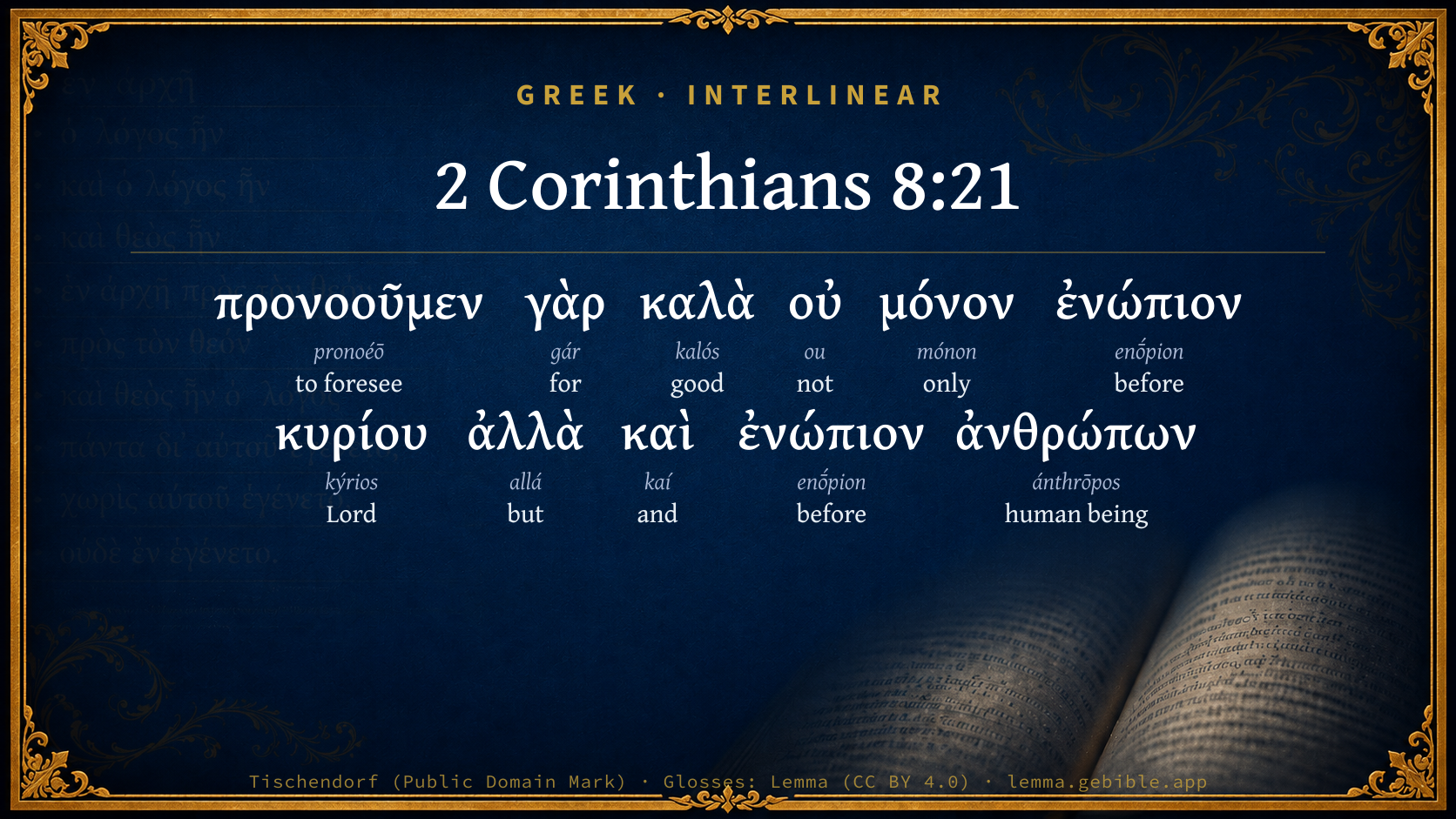
Greek (Tischendorf 8th ed.) 2 Corinthians 8:21 appears in the Greek New Testament. The text above is from the Tischendorf 8th edition. Each word links to its Strong’s number and a concise gloss. Click any word for its full Thayer’s Greek Lexicon entry.
Download image
Cite this verse

2 Corinthians 8:21 (World English Bible). Public Domain. Lemma interlinear Bible study tool, https://lemma.gebible.app/v/2-corinthians/8/21.

Show BibTeX & RIS
BibTeX
RIS
English Translation
Having regard for honorable things, not only in the sight of the Lord, but also in the sight of men.
World English Bible · Public Domain
Download a study sheet

One document with this verse’s original text, its word-by-word gloss line, the meaning frame, cross-references with their text, attributed commentary, and full source and license credits — printable, and it pastes into notes with its structure intact.

This verse Autodidact and up

Study sheet (.html) Plain text (.txt)

A passage Seminary Student

Up to 50 verses in one chapter. A passage sheet keeps up to 6 commentary sources and 12 cross-references per verse, in the order this page ranks them, and says so on the sheet whenever that leaves anything out. Ask for a single verse and you get the Autodidact verse sheet above.

Everything on this page stays free to read, with no account — the sheet is a download of what is already on screen, not access to it.

Want to remove ads? Support Godless Engineer
Compare translations 3

The same verse in 3 English versions, stacked beneath the original-language interlinear above. Click any original word for its lexicon entry.

Each is an independent rendering of the whole verse — the interlinear is not word-aligned to these translations.

Highlighted words mark where these versions differ — a whole-verse word diff, not a word-by-word alignment.

  • World English Bible Public Domain
    Having regard for honorable things, not only in the sight of the Lord, but also in the sight of men.
  • King James Version Public Domain
    Providing for honest things, not only in the sight of the Lord, but also in the sight of men.
  • unfoldingWord Literal Text CC BY-SA 4.0
    For we consider beforehand good, not only before the Lord, but also before men.

unfoldingWord Literal Text — © unfoldingWord, licensed CC BY-SA 4.0. Word-aligned USFM3 via Door43 (git.door43.org/unfoldingWord/en_ult).

Versions to compare (up to 4)

3 of 4 selected

Show all 19 translations

Every available English version of this verse, each an independent rendering of the whole verse.

  • World English Bible Public Domain
    Having regard for honorable things, not only in the sight of the Lord, but also in the sight of men.
  • Berean Standard Bible Public Domain
    For we are taking great care to do what is right, not only in the eyes of the Lord, but also in the eyes of men.
  • Majority Standard Bible Public Domain
    We are taking great care to do what is right, not only in the eyes of the Lord, but also in the eyes of men.
  • King James Version Public Domain
    Providing for honest things, not only in the sight of the Lord, but also in the sight of men.
  • American Standard Version (1901) Public Domain
    for we take thought for things honorable, not only in the sight of the Lord, but also in the sight of men.
  • Revised Version (1885) Public Domain
    for we take thought for things honourable, not only in the sight of the Lord, but also in the sight of men.
  • Geneva Bible (1599) Public Domain
    Prouiding for honest thinges, not onely before the Lord, but also before men.
  • Douay-Rheims (1899) Public Domain
    For we forecast what may be good not only before God, but also before men.
  • Young's Literal Translation Public Domain
    providing right things, not only before the Lord, but also before men;
  • Literal Standard Version CC BY-SA 4.0
    providing right things, not only before the LORD, but also before men;
  • Unlocked Literal Bible CC BY-SA 4.0
    We take care to do what is honorable, not only before the Lord, but also before people.
  • unfoldingWord Literal Text CC BY-SA 4.0
    For we consider beforehand good, not only before the Lord, but also before men.
  • Darby Bible Public Domain
    for we provide for things honest, not only before [the] Lord, but also before men.
  • World Messianic Bible Public Domain
    Having regard for honorable things, not only in the sight of the Lord, but also in the sight of men.
  • Webster's Bible Public Domain
    Providing for honest things, not only in the sight of the Lord, but also in the sight of men.
  • Free Bible Version CC BY-SA 4.0
    We're concerned to do things the right way, not only in the eyes of the Lord, but also in the eyes of everyone.
  • Bible in Basic English Public Domain
    For the business has been so ordered by us as to have the approval, not only of the Lord, but of men.
  • Text-Critical English NT CC BY 4.0
    For we are giving careful thought to do what is right, not only in the sight of the Lord but also in the sight of men.
  • Tyndale New Testament (1534) Public Domain
    and therfore make provision for honest thynges not in the sight of god only but also in the sight of men.

Literal Standard Version (2020), Covenant Press — licensed CC BY-SA 4.0. Text via the HelloAO Bible API (eBible.org). Unlocked Literal Bible (unfoldingWord) — licensed CC BY-SA 4.0. Text via the HelloAO Bible API (eBible.org). unfoldingWord Literal Text — © unfoldingWord, licensed CC BY-SA 4.0. Word-aligned USFM3 via Door43 (git.door43.org/unfoldingWord/en_ult). Free Bible Version, Dr. Jonathan Gallagher — licensed CC BY-SA 4.0. Text via the HelloAO Bible API (eBible.org).

Word by word

More ways to search: Search by grammar → Find every occurrence → Compare this word →

Practice this passage: Drill this verse → Learn its vocabulary →

About this verse

These counts appear in no published source. They are computed here, from the morphology-tagged text and Lemma’s own curated glosses. What Lemma adds →

11
words
10
distinct lemmas
Pauline Epistles
section

Notable vocabulary

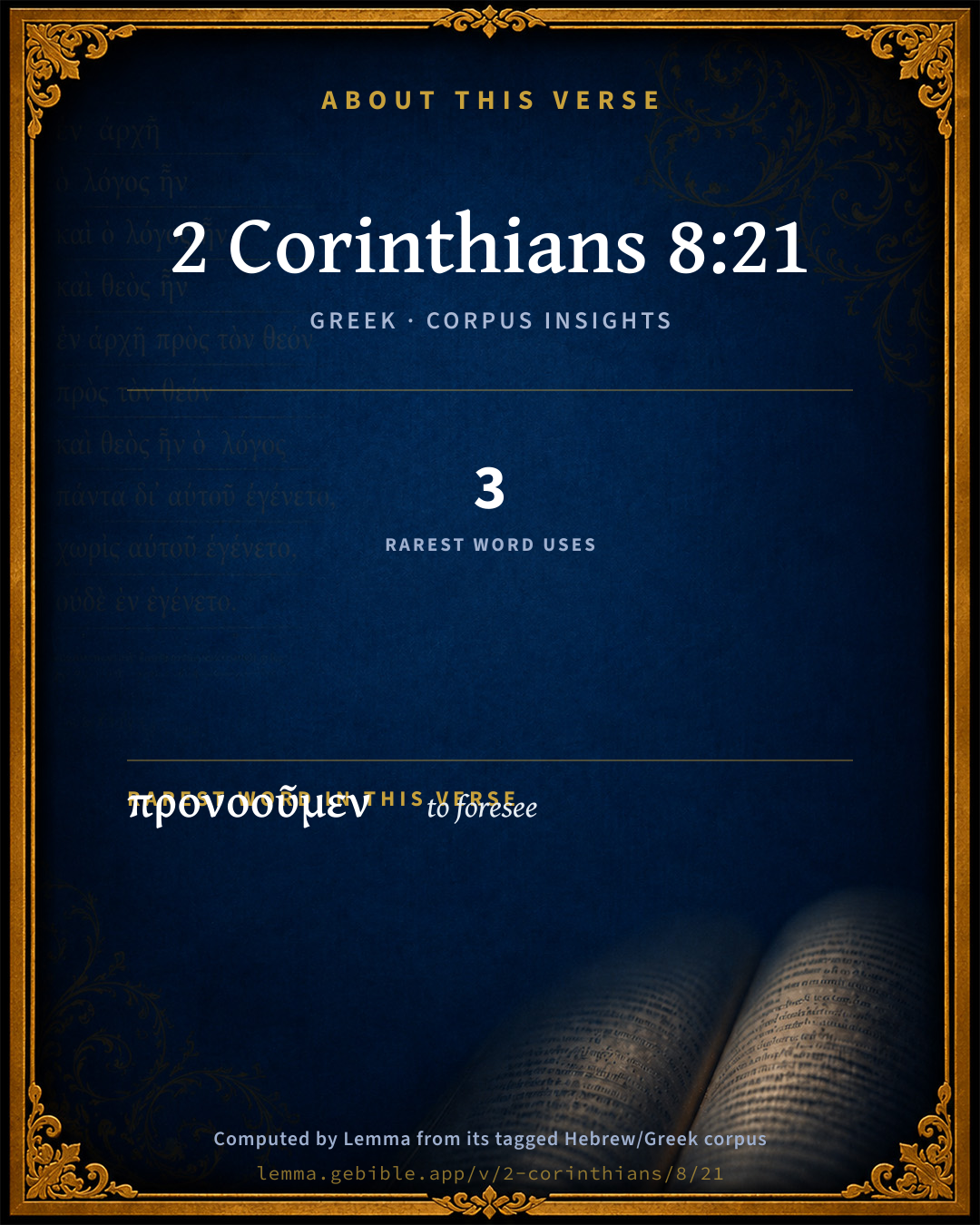
The rarest word here is προνοοῦμεν to foresee G4306 — appearing just 3 times in the whole Greek New Testament.

Shared distinctive vocabulary

προνοοῦμεν to foresee G4306 occurs in 3 verses of the Greek New Testament. Also found in:

Repetition

A word recurs within this verse:

  • ἐνώπιον before G1799 ×2

Cross-references

13

Topical passages linked to 2 Corinthians 8:21 in the Treasury of Scripture Knowledge — connected by theme and wording, ordered by reader-vote popularity; previews shown in the World English Bible.

  • Romans 12:17 Repay no one evil for evil. Respect what is honorable in the sight of all men.
  • 1 Peter 2:12 having good behavior among the nations, so in that which they speak against you as evil-doers, they may by your good works, which they see, glorify God in the day of visitation.
  • Philippians 4:8 Finally, brothers, whatever things are true, whatever things are honorable, whatever things are just, whatever things are pure, whatever things are lovely, whatever things are of good report; if there is any virtue, and if there is any praise, think about these things.
  • Titus 2:5–8 to be sober-minded, chaste, workers at home, kind, being in subjection to their own husbands, that God's word may not be blasphemed.
  • Matthew 5:16 Even so, let your light shine before men; that they may see your good works, and glorify your Father who is in heaven.
  • Matthew 6:4 so that your merciful deeds may be in secret, then your Father who sees in secret will reward you openly.
  • Romans 14:18 For he who serves Christ in these things is acceptable to God and approved by men.
  • 2 Corinthians 2:17 For we are not as so many, peddling the word of God. But as of sincerity, but as of God, in the sight of God, we speak in Christ.
  • 1 Thessalonians 5:22 Abstain from every form of evil.
  • 2 Corinthians 5:9–11 Therefore also we make it our aim, whether at home or absent, to be well pleasing to him.
  • 1 Timothy 5:14 I desire therefore that the younger widows marry, bear children, rule the household, and give no occasion to the adversary for reviling.
  • Matthew 6:1 "Be careful that you don't do your charitable giving before men, to be seen by them, or else you have no reward from your Father who is in heaven.
  • Matthew 23:5 But all their works they do to be seen by men. They make their phylacteries broad, enlarge the fringes of their garments,

Cross-references courtesy of OpenBible.info (CC BY 4.0).

Commentary

Notes on 2 Corinthians 8:21 from classic Christian and Jewish commentators (each source and its license shown beneath its notes). The classic Christian expositions comment on the surrounding passage and are grouped to its opening verse, so a note may address several verses; the Jewish commentaries on the Tanakh (Rashi and others) are per-verse, so they appear only where the commentator wrote on this verse.

Lemma curates 59 commentaries, every one of them public domain or Creative Commons licensed, each selected and text-cleaned for this edition rather than reprinted as found. About our sources →

Bengel's Gnomon

Johann Albrecht Bengel

2Co 8:21. Ἐνώπιον Κυρίου, in the sight of the Lord) in private, in truth: comp. Rom 12:17, note.

Bengel's Gnomon of the New Testament — English translation (T&T Clark, Edinburgh, 1860) — public domain. Text from a community e-Sword module.

Meyer's Critical & Exegetical Commentary

Heinrich August Wilhelm Meyer

2Co_8:21. Ground of this precautionary measure. For our anxiety is directed to what is good, not merely before the Lord, not merely so that we set before us God in this way (Pro_3:4), but also before men. Comp. on Rom_12:17. Were it merely the former, we should not need such precautionary measures, since to God we πεφανερώμεθα, 2Co_5:11; but propter alios fama necessaria est, Augustine. The misuse of the latter consideration is guarded against by ἐνώπ. κυρίου.

προνοεῖν, prospicere, also in the active; comp. Plato, Clit. p. 408 E; Xen. Mem. ii. 10. 3; Aelian, V. H. ii. 21; Wis_6:7; Hesych.: προνοεῖ· ἐπιμελεῖται.

For analogous Rabbinical sayings, see Wetstein.

Meyer — Critical and Exegetical Commentary on the New Testament — English translation by Peter Christie, edited by Frederick Crombie (T&T Clark, 1880) — public domain. Text from a community e-Sword module.

Expositor's Greek Testament

ed. W. Robertson Nicoll

2Co 8:21 . προνοοῦμεν γὰρ κ . τ . λ .: for “we provide things honest” not only “in the sight of the Lord,” but also “in the sight of men,” an injunction in the Proverbs which the Apostle quotes again at Rom 12:17 . Where other people’s money is in question, one cannot be too careful; and the prudence of the method pursued in this collection, whereby the contributing Churches appointed colleagues to accompany St. Paul and to check his accounts, is worthy of close imitation in the ecclesiastical finance of a later age ( cf. 2Co 6:3 ).

The Expositor's Greek Testament, edited by W. Robertson Nicoll (1897–1910) — public domain. Text from a community e-Sword module.

Jamieson, Fausset & Brown

Robert Jamieson, A. R. Fausset & David Brown

The Septuagint (Pro 3:4; Rom 12:17). The oldest manuscripts read, "For we provide."

honest things--"things honorable."

Jamieson, Fausset & Brown — Commentary Critical and Explanatory on the Whole Bible (1871) — public domain (CC PDM 1.0). Text via the HelloAO Bible API.

Adam Clarke's Commentary

Verse 21. Providing for honest things] Taking care to act so as not only to be clear in the sight of God, but also to be clear in the sight of all men; avoiding even the appearance of evil. I wish the reader to refer to the excellent note on "1Co 16:4", which I have extracted from Dr. Paley.

Adam Clarke's Commentary on the Bible (1810–1826) — public domain. Text from a community e-Sword/MySword module.

John Calvin's Commentaries

21. Providing things honest I am of opinion, that there were not wanting, even among the Corinthians, some who would have proceeded so far as to revile, if occasion had been allowed them. Hence he wished them to know the state of matters, that he might shut the mouths of all everywhere. Accordingly he declares, that he is not merely concerned to have a good conscience in the sight of God, but also to have a good character among men. At the same time, there can be no doubt, that he designed to instruct the Corinthians, as well as all others, by his example, that, in doing what is right, the opinion of men is not to be disregarded. The first thing, it is true, is that the person take care, that he be a good man. This is secured, not by mere outward actions, but by an upright conscience. The next thing is, that the persons, with whom you are conversant, recognize you as such.

Here, however, the object in view must be looked to. Nothing, assuredly, is worse than ambition, which vitiates the best things in the world, disfigures, I say, the most graceful, and makes sacrifices of the sweetest smell have an offensive odor before the Lord. Hence this passage is slippery, so that care must be taken lest one should pretend to be desirous, in common with Paul, of a good reputation, and yet be very far from having Paul’s disposition, for he provided things honest in the sight of men, that no one might be stumbled by his example, but that, on the contrary, all might be edified. Hence we must, if we would desire to be like him, take care that we be not on our own account desirous of a good name. “He that is regardless of fame,” says Augustine, “is cruel, because it is not less necessary before our neighbor, than a good conscience is before God.” This is true, provided you consult the welfare of your brethren with a view to the glory of God, and in the mean time are prepared to bear reproaches and ignominy in place of commendation, if the Lord should see it meet. Let a Christian man, however, always take care to frame his life with a view to the edification of his neighbors, and diligently take heed, that the ministers of Satan shall have no pretext for reviling, to the dishonor of God and the offense of the good.

John Calvin's Commentaries (1540-1563) — public domain. Text from the Calvin Translation Society English edition (1840s-50s) via the Christian Classics Ethereal Library (ccel.org). Calvin's coverage is partial (roughly two-thirds of the Bible); uncommented books and verses are honest gaps, never fabricated. The 19th-century editor's footnotes and remarks are omitted so the notes are faithfully Calvin's own voice.

Ellicott's Commentary for English Readers

(21) Providing for honest things . . .—Many of the best MSS. give: “For we provide for honest things,” as though he gave the general principle on which he was now acting in this particular instance. The rule of life is repeated, a few months afterwards, in Rom_12:17. The English reader does not recognise the fact, which the Greek reader would see at once, that the words are a quotation from Pro_3:4. where the Greek version has: “Write them upon the table of thine heart, and thou shalt find favour. Provide things honest in the sight of God and man. The citation is interesting, as showing that even one who was taught by the Spirit, as St. Paul was, could yet find guidance for his daily conduct in a book which seems to many almost to be below the level of the spiritual life. In this case, had the Apostle had only the judgment of God to consider, he could with a pure conscience have taken up the money to Jerusalem by himself. But he had to consider that men were judging him, and might suspect him, and therefore he insisted, as has been said above, on having his accounts audited.

A Bible Commentary for English Readers, edited by Charles John Ellicott (1878–1897) — public domain. Text from a community e-Sword module.

The Cambridge Bible for Schools and Colleges

gen. ed. J. J. S. Perowne

21. providing] Most MSS. and editors here read for we provide, or rather, take care beforehand to do, i.e. it is our custom to give no occasion for suspicion. See Rom_12:17, where the same words occur. They are, as Dr Plumptre has reminded us, a quotation of Pro_3:4. Cf. also Rom_14:6; 1Ti_5:14; 1Ti_6:1; Tit_2:8. Also ch. 2Co_6:3.

honest things] Rather, what is honourable. The word implies what is of good repute among mankind, and hence what is honourable and noble in itself. See note on ch. 2Co_4:2.

also in the sight of men] It is not enough for the Christian to have a clear conscience. He must give no man an opportunity of insinuating that his conscience is not clear. See Mat_5:14-16.

The Cambridge Bible for Schools and Colleges (gen. ed. J. J. S. Perowne; Cambridge University Press, 1878–1918) — public domain. Text from a community e-Sword module.

John Gill's Exposition

And we have sent with him our brother,.... This is a third person sent about this business. The apostle, in this, conformed to the customs of his nation; at least if he did not purposely do it, it agrees with the Jewish canons, which require three persons for the distribution of alms.

"The alms dish, (they say (x)) is by three; nor do they appoint "overseers" of it "less than three".''

Again, they say (y),

"the poor's chest is collected by two, "but distributed by three"; it is collected by two, because they do not appoint governors over a congregation less than two, and it is distributed by three, even as pecuniary judgments; but the alms dish is collected by three, and distributed by three; for the collection and distribution are alike:''

who this brother was, sent by the apostle with Titus and the other person, is as uncertain as the former. Some think it was Luke, others Apollos, others Timothy, others Sosthenes, others Epaenetus, others Silas, others Zenas the lawyer; a brother he was, and a very considerable character is given of him:

whom we have oftentimes proved diligent in many things; he was a very diligent and industrious man, and so fit for this service; he had been tried and proved, and was found to be so, not only once or twice, but oftentimes; and that not in a few instances, but in many; and in nothing did he ever show more diligence than in this matter:

but now much more diligent; than ever he had been in anything before:

upon the great confidence which I have in you; what doubled and increased this brother's diligence, and made him so eager for, and forward to this work, was, his observing the great confidence the apostle expressed of the very great readiness and liberality of the Corinthians; and which tacitly carries in it an argument exciting them thereunto: or this last clause may be read, "which he hath in you"; and so regards the confidence this brother had in them, which made him so ready to engage with, and join the other messengers.

(x) T. Hieros. Peah, fol. 21. 1. (y) Misn. Peah, c. 8. sect. 7. & Jarchi, Maimonides & Bartenora, in ib. T. Bab. Bava Bathra, fol. 8. 2. Maimon. Mattanot Anayim, c. 9. sect. 5.

John Gill's Exposition of the Whole Bible (1746–1763) — public domain (CC PDM 1.0). Text via the HelloAO Bible API.

Trapp's Complete Commentary

John Trapp

21 Providing for honest things, not only in the sight of the Lord, but also in the sight of men.

Ver. 21. Providing] Projecting, procuring, προνοουμενοι. A good name is a great blessing, and therefore the same word in Hebrew signifieth both, Pro 28:20, ברכה

John Trapp, A Commentary or Exposition upon All the Books of the Old and New Testament (1647–1656) — public domain. Text from a community e-Sword module.

Albert Barnes' Notes on the Bible

Providing for honest things - The expression used here occurs in Rom 12:17; see the note on that place. In that place, however, it refers to the manner in which we are to treat those who injure us; here it refers to the right way of using property; and it seems to have been a kind of maxim by which Paul regulated his life, a “vade mecum” that was applicable to everything. The sentiment is, that we are to see to it beforehand that all our conduct shall be comely or honest. The word rendered “providing for” (προνωύμενοι pronōumenoi) means foreseeing, or perceiving beforehand; and the idea is, that we are to make it a matter of previous calculation, a settled plan, a thing that is to be attended to of set design. In the middle voice, the form in which it occurs here, it means to provide for in one’s own behalf; to apply oneself to anything; to practice diligently - Robinson. The word rendered “things honest” (καλὰ kala) means properly beautiful, or comely.

The idea which is presented here is, that we are to see beforehand, or we are to make it a matter of set purpose that what we do shall be comely, that is, just, honorable, correct, not only in the sight of the Lord, but in the sight of mankind. Paul applies this in his own case to the alms which were to be entrusted to him. His idea is, that he meant so to conduct in the whole transaction as that his conduct should be approved by God, but that it should also be regarded as beautiful or correct in the sight of people. He knew how much his own usefulness depended on an irreproachable character. He, therefore, procured the appointment of one who had the entire confidence of the churches to travel with him. But there is no reason for confining this to the particular case under consideration. It seems to have been the leading maxim of the life of Paul, and it should be of ours. The maxim may be applied to everything which we have to do; and should constantly regulate us.

It may be applied to the acquisition and use of property; to the discharge of our professional duties; to our contact with others; to our treatment of inferiors and dependents; to our charities, etc. - in all of which we should make it a matter of previous thought, of earnest diligence, that our conduct should be perfectly honest and comely before God and man. Let us learn from this verse also, that ministers of the gospel should be especially careful that their conduct in money matters. and especially in the appropriation of the charities of the church, should be above suspicion. Much is often entrusted to their care, and the churches and individual Christians often commit much to their discretion. Their conduct in this should be without reproach; and in order to this, it is well to follow the example of Paul, and to insist that others who have the entire confidence of the churches should be associated with them. Nothing is easier than to raise a slanderous report against a minister of the gospel; and nothing gratifies a wicked world more than to be able to do it - and perhaps especially if it pertains to some improper use of money. It is not easy to meet such reports when they are started; and a minister, therefore, should be guarded, as Paul was, at every possible point, that he may be freed from that “whose breath outvenoms all the worms of Nile” - Slander.

Albert Barnes' Notes on the Bible (1834–1885) — public domain. Text from a community e-Sword/MySword module.

Matthew Poole's English Annotations

He had said the same, Rom 12:17. In both places he instructeth us, what is the great duty of all Christians, but of ministers especially, (who are as cities built upon a hill, and cannot be hid, and against whom ill men are much more ready to open their mouths, than against private Christians of a more obscure condition), viz. to provide things honest, not only in the sight of God, ( having an eye, that in our actions we do nothing which God hath forbidden us, nor omit any thing which God hath commanded us), but also looking that in our conversation we (as much as in us lies) do those things which have a good report amongst men, Phi 4:8. For besides that we are obliged to give no offence to Jews or Gentiles, nor any way to alienate them from the ways of God, we are also obliged to do what in us lieth to win and gain them to Christ; to which, the doing of actions which they account dishonest (though, it may be, some are not so upon a strict inquiry) is no fitting mean.

Matthew Poole's English Annotations on the Holy Bible (1683–1685) — public domain. Text from a community e-Sword/MySword module.

Whedon's Commentary on the Bible

Daniel D. Whedon

21. Honest—In its old sense honourable—above wrong and above suspicion.

In… sight of men—Guarding wisely not only against evil, but against the appearance of evil.

Daniel D. Whedon (gen. ed.), Commentary on the Old and New Testaments (1874–1909) — public domain. Text from a community e-Sword module.

The Pulpit Commentary

Honest things. The word "honest" means "honourable" (Rom_12:17; Pro_3:4) Not only in the sight of the Lord. Such precautions would be unnecessary if others were not concerned, for God knows our honesty. (2Co_5:11) But also before men. Although the text "avoid all appearance of evil" should be rendered "avoid every species of evil," the mistranslation conveys a wise lesson. "In a field of melons," says the Chinese proverb. "do not stoop to tie your shoe;" for that will look as if you wanted to steal one of the melons.

Things honourable.

It might have been supposed that the apostle would have considered himself superior to the considerations here adduced. His life was so completely unselfish, so obviously governed by higher than interested principles, that it seems as if he might have taken it for granted that no suspicion could attach to his personal administration of the alms to be forwarded to Judaea. Probably others thought thus; few, if any, could have suspected Paul of fraud and misappropriation. But he judged himself by a standard which was applicable to all Christian agents, a standard which every wise man, experienced in the ways of the world, will do well to adopt as his own.

I THE RULE OF CONDUCT HERE PROPOSED.

1. Things honourable are things actually good, admirable, beautiful, inthemselves. The word in the original denotes primarily this. What things are morally excellent and praiseworthy, let these things be done.

2. Things honourable are things reputable and approved. It is especiallyprudent to be very careful and scrupulous, and very open, in the administration of public money, and so to act that there may be no opening for slander or misrepresentation. And the same rule applies to other departments of conduct. It should not be a prominent motive with us to secure men"s approval, yet our conduct should be such as to secure that approval, and even to command it.

3. Things honourable may best be provided by endeavouring to realize the inquisitive inspection of men and the all-searching gaze of the omniscient God.

II THE MOTIVES URGING TO THE PRACTICAL ADOPTION OF THIS RULE.

1. It will tend to the satisfaction and peace of our own conscience.

2. It will tend to the honour of the religion we profess, when it is seen tobe, not a cloak for covetousness, but an impulse to disinterestedness and a principle of integrity.

3. It will be for the glory of God. Actions done in his sight and at hiscommand, from the motive of his love, and with the hope of his approbation, are the actions which the Christian should aim consistently and constantly to perform, in all positions and in all relations of life T.

Honest before God and man.

Pro_3:4, which, in the Greek Version reads, "Write them upon the table of thine heart, and thou shalt find favour. Provide things honest in the sight of God and man." This may be treated as a general precept, applicable to all Christian people; or it may be regarded as a reminder of the care which the apostle had taken that, in the administration of money affairs, he should not be misunderstood or blamed. Consider

I THE COUNSEL AS APPLIED TO THE APOSTLE HIMSELF. As a fact he had been jealously providing for honest things, and doing everything possible in order to secure the due checking of the gifts and safety of the stored money. Calvin says, "He was not so satisfied with himself as to think it unworthy of his dignity to avoid calumny." Dean Plumptre says, "In this case, had the apostle had only the judgment of God to consider, he could with a pure conscience have taken up the money to Jerusalem by himself. But he had to consider that men were judging him, and might suspect him, and therefore he insisted on having his accounts audited." F.W. Robertson says, "In this is to be observed St. Paul"s wisdom, not only as a man of the world, but as a man of God. He knew that he lived in a censorious age, that he was as a city set on a hill, that the world would scan his every act and his every word, and attribute all conceivable and even inconceivable evil to what he did in all honour. It was just because of St. Paul"s honour and innocence that he was likely to have omitted this prudence." Archdeacon Farrar indicates the kind of things that were said about the apostle by his Corinthian enemies, which made such an earnest self-vindication absolutely necessary. He represents them as saying that St. Paul was "half demented," and yet there was some method in his madness which showed itself partly in self-importance and partly in avarice, both of which were very injurious to the interests of his followers. What, for instance, could be more guileful and crafty than his entire conduct about this collection which he was so suspiciously eager to set on foot? He had ordered them to get up a subscription in his first letter, had, in answer to their inquiries, directed that it should be gathered, as in the Galatian Churches, by a weekly offertory, and had, since this, sent Titus to stimulate zeal in the matter. They dared to insinuate that all this was only a cunning device to hide his real intentions, and give him a securer grasp of their money." Give in detail the arrangements made by the apostle to secure the due safety and auditing of the collection; and urge that all who have responsible positions in relation to Christian monies should show a similar anxiety to "provide things honest.

II THE COUNSEL AS APPLIED TO CHRISTIAN GIVING. Those who give must give only that which is honourably their own. The man who is in debt must pay his debts before he gives. The man who has family claims is bound to make adequate provision for them before he gives. To use the familiar proverb, "A man must be just before he is generous." When this rule is neglected, a man"s gifts can neither be acceptable to God nor right in the sight of his fellow men. R.T.

The Pulpit Commentary (1880–1919), ed. H.D.M. Spence-Jones & Joseph S. Exell — public domain. Text from a community e-Sword module.

McGarvey & Pendleton's Commentaries

J. W. McGarvey

for we take thought for things honorable, not only in the sight of the Lord, but also in the sight of men . [Paul welcomed the appointment of assistance in this work, for their co-operation lifted him above suspicion, which was according to his desire, for he wished not only to have a good character in the sight of God, but also a fair reputation among men.]

J. W. McGarvey (with Philip Y. Pendleton), Commentaries on the New Testament (The Fourfold Gospel, 1914; Acts; and the epistles) — public domain. Text from a community e-Sword/MySword module.

Cambridge Greek Testament for Schools and Colleges

21. προνοοῦμεν γάρ (אBDFGP, Latt. Arm.) rather than προνοούμενοι (CEL), which is adopted in the Rec. and A.V.

21. προνοοῦμεν γὰρ καλά. For we take forethought for things honourable. See critical note. For the remainder of the verse comp. Rom 12:17, where the same quotation from Pro 3:4 is found.

ἀλλὰ καὶ ἐνώπιον ἀνθρ. But also in the sight of men. He must not only be honest, but be seen to be honest. This is quoted by Polycarp (6); comp. 2Co 3:2, 2Co 4:14.

Cambridge Greek Testament for Schools and Colleges (Cambridge University Press, 1896; 21 vols, various authors incl. Carr, Maclear, Plummer, Farrar, Lumby, Moule, M. R. James, Simcox) — public domain. Text from a community e-Sword module.

Alford’s Greek Testament

Henry Alford

21.] ‘And such caution is in accordance with our general practice.’ See reff. Rom. and Prov.

Henry Alford, The Greek Testament (1849–1861) — public domain. Text from a community e-Sword module.

International Critical Commentary

21. προνοοῦμεν γὰρ καλά. He is quoting LXX of Pro 3:4, καὶ προνοοῦ καλὰ ἐνώπιον Κυρίου καὶ ἀνθρώπων, where the Heb. gives, ‘And thou shalt find favour and good understanding in the sight, etc.’ See Toye, ad loc. St Paul quotes the text again Rom 12:17, προνοούμενοι καλὰ ἐνώπιον πάντων ἀνθρώπων, as a reason for not being revengeful, in both cases following LXX rather than the Heb. ‘For we aim at things honourable’; lit. ‘we take forethought for’; cf. Wisd. 6:8. Caput autem est in omni procuratione negotii et muneris publici, ut avaritiae pellatur minima suspitio (Cic. De Off. 11. 21:75). Coram Deo sufficit bona conscientia, sed coram hominibus necessaria est bona fama (Herveius). Not to care what others think of us may be unfair to them. It would have been disastrous to his converts for them to be able to suspect the Apostle of dishonesty. Qui fidens conscientiae suae negligit famam suam crudelis est, says Augustine (Serm. 355). That St Paul was merely establishing a precedent, to protect future bearers of charitable funds from suspicion, is not probable. He knew that his critics would suspect him. Cf. Ep. of Polycarp, vi. 1.

προνοοῦμεν γὰρ καλά (א B D F G P, Latt. Syrr.) rather than προνοούμενοι καλά (K L) co-ordinate with στελλόμενος, or than προνοούμενοι γὰρ καλά (C, Copt. Goth.).

International Critical Commentary — older volumes (1896–1929), various authors — public domain. Text from a community e-Sword module.

Vincent's Word Studies in the New Testament

Marvin R. Vincent

We take thought [προνοουμενοι] . Beforehand [προ] . See on Rom 12:17. The words are from Pro 3:4, where the Septuagint reads, take thought for honorable things in the sight of the Lord and of men.

Marvin R. Vincent, Word Studies in the New Testament (1887–1900) — public domain. Text from a community e-Sword/MySword module.

Lesson kit

Teaching starters — assembled from the data on this page, not authored interpretation. Every prompt links to the verse data it draws on. Edit before teaching.

2 Corinthians, in the Pauline Epistles, opens this verse with 11 words (10 distinct Greek lemmas). Its most distinctive word is pronoéō (“to foresee”). A historical commentator’s framing appears above. Read the whole chapter for the surrounding context.

Discussion questions

  1. What does “to foresee” (pronoéō) contribute to the verse as a whole?
  2. How does Romans 12:17, which shares the word «to foresee», read alongside this verse?
  3. What does the repetition of “before” (2× in this one verse) do in this verse?
  4. These translations render this verse differently. What is at stake in choosing one wording over another?
  5. Compare how Bengel's Gnomon and Meyer's Critical & Exegetical Commentary read this verse. Where do they agree or differ?

Things to notice

Reading settings

Reading text

Shown beneath each verse's original-language words.

Old Testament
Old Testament edition

Read the OT as the Masoretic Hebrew (MT) or the Greek Septuagint (LXX).

English shown for the Greek Septuagint (in the Hebrew ↔ Greek comparison).

Comparing translations? Open the Compare panel on any verse page to stack up to four side by side.