1 Timothy 3:7

Greek (Tischendorf 8th ed.) 1 Timothy 3:7 appears in the Greek New Testament. The text above is from the Tischendorf 8th edition. Each word links to its Strong’s number and a concise gloss. Click any word for its full Thayer’s Greek Lexicon entry.

Download image
Cite this verse

1 Timothy 3:7 (World English Bible). Public Domain. Lemma interlinear Bible study tool, https://lemma.gebible.app/v/1-timothy/3/7.

Show BibTeX & RIS
BibTeX
RIS
English Translation
Moreover he must have good testimony from those who are outside, to avoid falling into reproach and the snare of the devil.
World English Bible · Public Domain
Download a study sheet

One document with this verse’s original text, its word-by-word gloss line, the meaning frame, cross-references with their text, attributed commentary, and full source and license credits — printable, and it pastes into notes with its structure intact.

This verse Autodidact and up

Study sheet (.html) Plain text (.txt)

A passage Seminary Student

Up to 50 verses in one chapter. A passage sheet keeps up to 6 commentary sources and 12 cross-references per verse, in the order this page ranks them, and says so on the sheet whenever that leaves anything out. Ask for a single verse and you get the Autodidact verse sheet above.

Everything on this page stays free to read, with no account — the sheet is a download of what is already on screen, not access to it.

Want to remove ads? Support Godless Engineer
Compare translations 3

The same verse in 3 English versions, stacked beneath the original-language interlinear above. Click any original word for its lexicon entry.

Each is an independent rendering of the whole verse — the interlinear is not word-aligned to these translations.

Highlighted words mark where these versions differ — a whole-verse word diff, not a word-by-word alignment.

  • World English Bible Public Domain
    Moreover he must have good testimony from those who are outside, to avoid falling into reproach and the snare of the devil.
  • King James Version Public Domain
    Moreover he must have a good report of them which are without; lest he fall into reproach and the snare of the devil.
  • unfoldingWord Literal Text CC BY-SA 4.0
    But it is also necessary to have a good testimony from the ones outside, so that he may not fall into reproach and a trap of the devil.

unfoldingWord Literal Text — © unfoldingWord, licensed CC BY-SA 4.0. Word-aligned USFM3 via Door43 (git.door43.org/unfoldingWord/en_ult).

Versions to compare (up to 4)

3 of 4 selected

Show all 19 translations

Every available English version of this verse, each an independent rendering of the whole verse.

  • World English Bible Public Domain
    Moreover he must have good testimony from those who are outside, to avoid falling into reproach and the snare of the devil.
  • Berean Standard Bible Public Domain
    Furthermore, he must have a good reputation with outsiders, so that he will not fall into disgrace and into the snare of the devil.
  • Majority Standard Bible Public Domain
    Furthermore, he must have a good reputation with outsiders, so that he will not fall into disgrace and into the snare of the devil.
  • King James Version Public Domain
    Moreover he must have a good report of them which are without; lest he fall into reproach and the snare of the devil.
  • American Standard Version (1901) Public Domain
    Moreover he must have good testimony from them that are without; lest he fall into reproach and the snare of the devil.
  • Revised Version (1885) Public Domain
    Moreover he must have good testimony from them that are without; lest he fall into reproach and the snare of the devil.
  • Geneva Bible (1599) Public Domain
    He must also be well reported of, euen of them which are without, lest he fall into rebuke, and the snare of the deuill.
  • Douay-Rheims (1899) Public Domain
    Moreover he must have a good testimony of them who are without: lest he fall into reproach and the snare of the devil.
  • Young's Literal Translation Public Domain
    and it behoveth him also to have a good testimony from those without, that he may not fall into reproach and a snare of the devil.
  • Literal Standard Version CC BY-SA 4.0
    and it is required of him also to have a good testimony from those outside, that he may not fall into reproach and a snare of the Devil.
  • Unlocked Literal Bible CC BY-SA 4.0
    He must also have a good reputation with those outside, so that he does not fall into disgrace and the trap of the devil.
  • unfoldingWord Literal Text CC BY-SA 4.0
    But it is also necessary to have a good testimony from the ones outside, so that he may not fall into reproach and a trap of the devil.
  • Darby Bible Public Domain
    But it is necessary that he should have also a good testimony from those without, that he may fall not into reproach and [the] snare of the devil.
  • World Messianic Bible Public Domain
    Moreover he must have good testimony from those who are outside, to avoid falling into reproach and the snare of the devil.
  • Webster's Bible Public Domain
    Moreover, he must have a good report of them who are without; lest he fall into reproach and the snare of the devil.
  • Free Bible Version CC BY-SA 4.0
    People outside the church should also speak well of him so that he won't disgrace himself and fall into the devil's trap.
  • Bible in Basic English Public Domain
    And he is to have a good name among those outside the church, so that nothing may be said against him and he may not be taken by the designs of the Evil One.
  • Text-Critical English NT CC BY 4.0
    He must also have a good reputation among outsiders, so that he does not fall into the reproach and snare of the devil.
  • Tyndale New Testament (1534) Public Domain
    He must also be well reported of amonge them which are with out forth lest he fall into rebuke and snare of the evyll speaker.

Literal Standard Version (2020), Covenant Press — licensed CC BY-SA 4.0. Text via the HelloAO Bible API (eBible.org). Unlocked Literal Bible (unfoldingWord) — licensed CC BY-SA 4.0. Text via the HelloAO Bible API (eBible.org). unfoldingWord Literal Text — © unfoldingWord, licensed CC BY-SA 4.0. Word-aligned USFM3 via Door43 (git.door43.org/unfoldingWord/en_ult). Free Bible Version, Dr. Jonathan Gallagher — licensed CC BY-SA 4.0. Text via the HelloAO Bible API (eBible.org).

Word by word

More ways to search: Search by grammar → Find every occurrence → Compare this word →

Practice this passage: Drill this verse → Learn its vocabulary →

ὀνειδισμὸν
oneidismós
G3680
“reproach”
Noun, Accusative, Singular, Masculine
Part of Speech
Noun
Case
Accusative
Number
Singular
Gender
Masculine
Full Thayer's Definition

Origin: from G3679

TDNT: 09:01,7

1. a reproach a. such as Christ suffered, for the cause of God, from his enemies
  1. δεῖ deî G1163 “it is necessary” Verb, Present, Active, Indicative, 3rd person, Singular
  2. δὲ dé G1161 “but” Conjunction
  3. καὶ kaí G2532 “and” Conjunction
  4. μαρτυρίαν martyría G3141 “testimony” Noun, Accusative, Singular, Feminine
  5. καλὴν kalós G2570 “good” Adjective, Accusative, Singular, Feminine
  6. ἔχειν échō G2192 “to have” Verb, Present, Active, Infinitive
  7. ἀπὸ apó G575 “from” Preposition
  8. τῶν ho G3588 “the” Article, Genitive, Plural, Masculine
  9. ἔξωθεν éxōthen G1855 “outside” Adverb
  10. ἵνα hína G2443 “that” Conjunction
  11. μὴ mḗ G3361 “not” Particle, Negative
  12. εἰς eis G1519 “into” Preposition
  13. ἐμπέσῃ empíptō G1706 “to fall into” Verb, Aorist, Active, Subjunctive, 3rd person, Singular
  14. καὶ kaí G2532 “and” Conjunction
  15. παγίδα pagís G3803 “snare” Noun, Accusative, Singular, Feminine
  16. τοῦ ho G3588 “the” Article, Genitive, Singular, Masculine
  17. διαβόλου diábolos G1228 “slanderous” Adjective, Genitive, Singular, Masculine

About this verse

These counts appear in no published source. They are computed here, from the morphology-tagged text and Lemma’s own curated glosses. What Lemma adds →

18
words
16
distinct lemmas
Pauline Epistles
section

Notable vocabulary

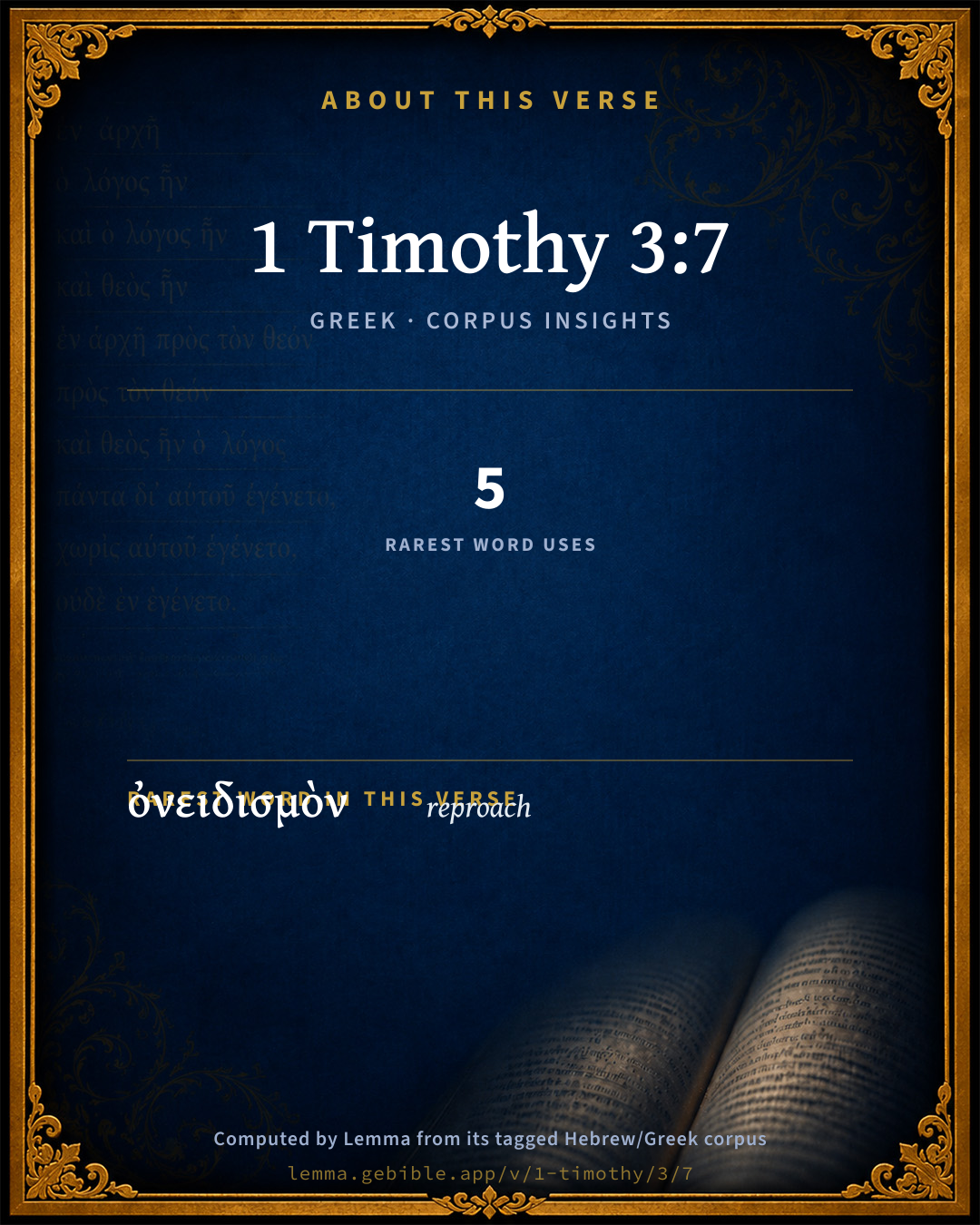
The rarest word here is ὀνειδισμὸν reproach G3680 — appearing just 5 times in the whole Greek New Testament.

Shared distinctive vocabulary

ὀνειδισμὸν reproach G3680 occurs in 5 verses of the Greek New Testament. Also found in:

Repetition

Words recur within this verse:

Cross-references

20

Topical passages linked to 1 Timothy 3:7 in the Treasury of Scripture Knowledge — connected by theme and wording, ordered by reader-vote popularity; previews shown in the World English Bible.

  • 2 Corinthians 8:21 Having regard for honorable things, not only in the sight of the Lord, but also in the sight of men.
  • Colossians 4:5 Walk in wisdom toward those who are outside, redeeming the time.
  • 2 Timothy 2:26 and they may recover themselves out of the devil's snare, having been taken captive by him to his will.
  • Acts 6:3 Therefore select from among you, brothers, seven men of good report, full of the Holy Spirit and of wisdom, whom we may appoint over this business.
  • 1 Corinthians 10:32 Give no occasions for stumbling, either to Jews, or to Greeks, or to the assembly of God;
  • 2 Corinthians 6:3 We give no occasion of stumbling in anything, that our service may not be blamed,
  • 1 Thessalonians 4:12 that you may walk properly toward those who are outside, and may have need of nothing.
  • 1 Timothy 6:9 But those who are determined to be rich fall into a temptation and a snare and many foolish and harmful lusts, such as drown men in ruin and destruction.
  • Titus 2:8 and soundness of speech that can't be condemned; that he who opposes you may be ashamed, having no evil thing to say about us.
  • 1 Thessalonians 5:22 Abstain from every form of evil.
  • Titus 2:5 to be sober-minded, chaste, workers at home, kind, being in subjection to their own husbands, that God's word may not be blasphemed.
  • 1 Samuel 2:24 No, my sons; for it is no good report that I hear: you make Yahweh's people to disobey.
  • Mark 4:11 He said to them, "To you is given the mystery of the Kingdom of God, but to those who are outside, all things are done in parables,
  • Acts 10:22 They said, "Cornelius, a centurion, a righteous man and one who fears God, and well spoken of by all the nation of the Jews, was directed by a holy angel to invite you to his house, and to listen to what you say."
  • Acts 22:12 One Ananias, a devout man according to the law, well reported of by all the Jews who lived in Damascus,
  • 1 Corinthians 5:12 For what have I to do with also judging those who are outside? Don't you judge those who are within?
  • 1 Timothy 5:14 I desire therefore that the younger widows marry, bear children, rule the household, and give no occasion to the adversary for reviling.
  • 1 Timothy 5:24–25 Some men's sins are evident, preceding them to judgment, and some also follow later.
  • 1 Peter 4:14–16 If you are insulted for the name of Christ, blessed are you; because the Spirit of glory and of God rests on you. On their part he is blasphemed, but on your part he is glorified.
  • 3 John 1:12 Demetrius has the testimony of all, and of the truth itself; yes, we also testify, and you know that our testimony is true.

Cross-references courtesy of OpenBible.info (CC BY 4.0).

Commentary

Notes on 1 Timothy 3:7 from classic Christian and Jewish commentators (each source and its license shown beneath its notes). The classic Christian expositions comment on the surrounding passage and are grouped to its opening verse, so a note may address several verses; the Jewish commentaries on the Tanakh (Rashi and others) are per-verse, so they appear only where the commentator wrote on this verse.

Lemma curates 59 commentaries, every one of them public domain or Creative Commons licensed, each selected and text-cleaned for this edition rather than reprinted as found. About our sources →

Joseph Benson's Commentary

1Ti 3:7. Moreover, he must have a good report — That is, a fair or good character, or good testimony, namely, as to the time past; of them that are without — That are not Christians; lest he fall into reproach — By their rehearsing his former life; and the snare of the devil — Which Satan might make a snare of to discourage and cast him down, or in some other way entangle him in unbelief and sin. Here Macknight remarks, “It is intimated, that the sins which a person has formerly committed, when cast in his teeth after he becomes a minister, may be the means of tempting him to repeat these sins, by the devil’s suggesting to him that he has little reputation to lose. Nor is this the only evil. The people, knowing his former miscarriages, will be less affected with what he says to them. All who are candidates for the ministry ought to consider these things seriously.”

Joseph Benson's Commentary on the Old and New Testaments (1811–1818) — public domain. Text from a community e-Sword module.

Tyndale Open Study Notes

Tyndale Open Resources

3:7 Paul expected Christians to live in a way that could be respected by people outside the church (see also 6:1; Titus 2:5-10). • The trap might pertain to the false teachers (see 1 Tim 1:20; 5:14-15; 6:9; 2 Tim 2:26).

Tyndale Open Study Notes — © Tyndale Open Resources, licensed CC BY-SA 4.0. Text via the HelloAO Bible API.

Bengel's Gnomon

Johann Albrecht Bengel

1Ti 3:7. Καὶ μαρτυρίαν, also a good report) Not even former life should be open to any reproach. Mere report is not sufficient; but there ought to be a good report along with the practice of the virtues, nay, a good testimony. Paul wishes that the character of Christians should be in high esteem; comp. ch. 1Ti 5:14, note.—ἀπὸ τῶν ἔξωθεν, from those that are without) that they may be more easily gained over, and the glory of God be promoted.—ὀνειδισμὸν, reproach) Comp. ch. 1Ti 5:14. The devil may occasion the greatest trouble to the minister who is subjected to bad reports, by himself (the devil), and by means of the calumnies of men.—καὶ παγίδα, and a snare) Comp. Mat 22:15.

Bengel's Gnomon of the New Testament — English translation (T&T Clark, Edinburgh, 1860) — public domain. Text from a community e-Sword module.

Meyer's Critical & Exegetical Commentary

Heinrich August Wilhelm Meyer

1Ti_3:7. Δεῖ δὲ καὶ μαρτυρίαν καλὴν ἔχειν ἀπὸ τῶν ἔξωθεν] Δεῖ δέ (which does not present something opposed to 1Ti_3:6) adds a new requirement to those already given in 1Ti_3:2-6, a requirement needed for the sake of those who are not Christians. Thus δεῖ here becomes connected with the δεῖ in 1Ti_3:2.

μαρτυρία occurs in the Pauline Epistles only here and in Tit_1:13.

ἀπὸ τῶν ἔξωθεν] οἱ ἔξωθεν (for which Paul commonly uses οἱ ἔξω) are those outside the church; ἀπό is equivalent not to among, but to from; the testimony comes from those who are not Christians. In the choice of a bishop, care is to be taken that he is a man who has led an irreproachable life even in the eyes of those who are not Christians. The reason is added just as in 1Ti_3:6 : ἵνα μὴ εἰς ὀνειδισμὸν ἐμπέσῃ καὶ παγίδα τοῦ διαβόλου] ὀνειδισμόν may be taken absolutely (Wiesinger, Plitt), or joined with τοῦ διαβ. (van Oosterzee). The former view is supported by the fact that ἐμπέσῃ separates ὀνειδ. from παγίδα; the latter, by the fact that the preposition is not repeated before παγίδα. The passage in 1Ti_3:14-15, when compared with this, supports the former view, which is further established as correct by the consideration that we cannot well suppose ὀνειδίζειν to be an act of the devil. Since ὀνειδισμός is not defined more precisely, it must be taken as quite general in meaning.

καὶ παγίδα τοῦ διαβόλου] the same expression in 2Ti_2:26; in 1Ti_6:9 it stands without τοῦ διαβ., and there, too, it is joined with πειρασμός (elsewhere only in Rom_11:9, which follows Psa_69:23). It is a figurative name for the lying in wait of the devil, who is represented as a hunter. The idea of its association with ὀνειδισμός is this, that the disgrace incurred by one who has not a good testimony from the non-Christians, is used by the devil as a snare, not only to tempt him, but also to seduce him into apostasy from the gospel.[125]

[125] In explaining τοῦ διαβόλου, Hofmann explains ἐμπέσῃ (εἰς) παγ. τ. διαβ. to mean, that the slanderer tries to ensnare such a one in the sense of showing him as an evidence of the state of morality in an association which selects such a man as its head (!).

Meyer — Critical and Exegetical Commentary on the New Testament — English translation by Peter Christie, edited by Frederick Crombie (T&T Clark, 1880) — public domain. Text from a community e-Sword module.

Expositor's Greek Testament

ed. W. Robertson Nicoll

1Ti 3:7 . τῶν ἔξωθεν : οἱ ἔξω in Mar 4:11 ( ἔξωθεν , W.H. m.) means those who came into contact more or less close with Jesus, but who were not His disciples. In the Pauline use (see reff.) it means the non-Christian Society in which the Church lives. St. Paul’s attitude towards them that are without is one of the many proofs of his sanity of judgment. On the one hand, they are emphatically outside the Church; they have no locus standi in it, no right to interfere. On the other hand, they have the law of God written in their hearts; and, up to a certain point, their moral instincts are sound and their moral judgments worthy of respect. In the passage before us, indeed, St. Paul may be understood to imply that the opinion of “those without” might usefully balance or correct that of the Church. There is something blameworthy in a man’s character if the consensus of outside opinion be unfavourable to him; no matter how much he may be admired and respected by his own party. The vox populi , then, is in some sort a vox Dei : and one cannot safely assume, when we are in antagonism to it, that, because we are Christians, we are absolutely in the right and the world wholly in the wrong. Thus to defy public opinion in a superior spirit may not only bring discredit , ὀνειδισμός , on oneself and on the Church, but also catch us in the devil’s snare, viz. , a supposition that because the world condemns a certain course of action, the action is therefore right and the world’s verdict may be safely set aside.

We cannot infer with Alford and von Soden, from the absence of another preposition before παγίδα , that ὀνειδισμόν also depends on τοῦ διαβόλου . It would not be easy to explain satisfactorily ὀνειδ . τ . διαβόλου .

The Expositor's Greek Testament, edited by W. Robertson Nicoll (1897–1910) — public domain. Text from a community e-Sword module.

Jamieson, Fausset & Brown

Robert Jamieson, A. R. Fausset & David Brown

a good report--Greek, "testimony." So Paul was influenced by the good report given of Timothy to choose him as his companion (Act 16:2).

of them which are without--from the as yet unconverted Gentiles around (Co1 5:12; Col 4:5; Th1 4:12), that they may be the more readily won to the Gospel (Pe1 2:12), and that the name of Christ may be glorified. Not even the former life of a bishop should be open to reproach [BENGEL].

reproach and the snare of the devil--reproach of men (Ti1 5:14) proving the occasion of his falling into the snare of the devil (Ti1 6:9; Mat 22:15; Ti2 2:26). The reproach continually surrounding him for former sins might lead him into the snare of becoming as bad as his reputation. Despair of recovering reputation might, in a weak moment, lead some into recklessness of living (Jer 18:12). The reason why only moral qualities of a general kind are specified is, he presupposes in candidates for a bishopric the special gifts of the Spirit (Ti1 4:14) and true faith, which he desires to be evidenced outwardly; also he requires qualifications in a bishop not so indispensable in others.

Jamieson, Fausset & Brown — Commentary Critical and Explanatory on the Whole Bible (1871) — public domain (CC PDM 1.0). Text via the HelloAO Bible API.

Adam Clarke's Commentary

Verse 7. The sixteenth requisite is, that he should have a good report of them which are without] That he should be one who had not been previously a profligate, or scandalous in his life. Such a person, when converted, may be a worthy private member of religious society; but I believe God rarely calls such to the work of the ministry, and never to the episcopate. Them that are without are the Jews, Gentiles, and the unconverted of all kinds. For the meaning of this term see Clarke's note on "Col 4:5".

Lest he fall into reproach] For his former scandalous life.

And the snare of the devil.] Snares and temptations, such as he fell in and fell by before. This is called the snare of the devil; for, as he well knows the constitution of such persons, and what is most likely to prevail, he infers that what was effectual before to their transgressing may be so still; therefore on all suitable occasions he tempts them to their old sins. Backsliders in general fall by those sins to which they were addicted previously to their conversion. Former inveterate habits will revive in him who does not continue to deny himself, and watch unto prayer.

The snare of the devil.-Some would translate παγιδα του διαβολου, the snare of the accuser; and they give the same meaning to the word in 1Ti 3:6, because it is evident that διαβολους has that meaning, 1Ti 3:11, and our translators render it slanderers. Now, though διαβολος signifies an accuser, yet I do not see that it can, with any propriety, be restrained to this meaning in the texts in question, and especially as the word is emphatically applied to Satan himself; for he who, in Re 12:10, is called the accuser of the brethren, is, in Re 12:9, called the great dragon, the old serpent, the DEVIL, διαβολος, and Satan.

Adam Clarke's Commentary on the Bible (1810–1826) — public domain. Text from a community e-Sword/MySword module.

John Calvin's Commentaries

7 A good report from those who are without. This appears to be very difficult, that a religious man should have, as witnesses of his integrity, infidels themselves, who are furiously mad to tell lies against us. But the apostle means, that, so far as relates to external behavior, even unbelievers themselves shall be constrained to acknowledge him to be a good man; for, although they groundlessly slander all the children of God, yet they cannot pronounce him to be a wicked man, who leads a good and inoffensive life amongst them. Such is that acknowledgment of uprightness which Paul here describes. The reason is added, —

Lest he fall into reproach and the snare of the devil; which I explain in this manner: “lest, being subject to reproach, he begin to be hardened, and abandon himself the more freely to all iniquity, which is to entangle himself in the snares of the devil.” For what hope is left for him who sins without any shame?

John Calvin's Commentaries (1540-1563) — public domain. Text from the Calvin Translation Society English edition (1840s-50s) via the Christian Classics Ethereal Library (ccel.org). Calvin's coverage is partial (roughly two-thirds of the Bible); uncommented books and verses are honest gaps, never fabricated. The 19th-century editor's footnotes and remarks are omitted so the notes are faithfully Calvin's own voice.

Ellicott's Commentary for English Readers

(7) Moreover he must have a good report of them which are without.—The man to be chosen as a responsible office-bearer in the Church, should be one possessing a stainless reputation for integrity and honour with the world outside the Church’s pale; he should be one regarded by the world at large as having led a self-restrained, decorous life—a life free from those disorders and licentious practices which worldly men, even while themselves indulging in them, are the first to condemn in others.

Lest he fall into reproach and the snare of the devil.—For such a one, bringing with him into the new society his unhappy reputation, earned in the old thoughtless days—if placed in the new society in a prominent position of authority—would draw down upon himself and the brotherhood over whom he presided many a reproach, many a sneer. Those who once knew him among other associations living a very different life, would be only too ready to attack the blameless character of the congregation, through the stained and scarred reputation of their minister. The temptation to fall away and deny his Lord in such a case, would be overwhelming. The man might be in earnest, might be wishful to lead a new and better life, but the risk that one with such connections, with such memories of old days, would of necessity run, must be very great. Weakened and disheartened, such a presbyter would be likely to fall an easy prey into some snare skilfully laid by the Enemy, and, by his fall, cause a terrible and damaging injury to the Church of Christ. For these weighty reasons St. Paul charged Timothy to be very watchful when he chose his presiding elders, to elect only those who, in the dissolute society of Ephesus, had known how, even in old days, to preserve their good name stainless, their character unscarred.

The snare of the devil.—The teaching here of St. Paul respecting the Evil One is deserving of a special comment. What he says in 1Ti_3:6-7 is simply introduced as part of the main argument, which relates exclusively to the care to be exercised in the selection of fit persons for the sacred offices in the congregations. It is evidently not introduced as a special teaching on this mysterious subject. No disputings on this point as yet had been originated at this early period in Christian history. It lays down, however, certain broad principles which must have been the ground-work of St. Paul’s belief in this now disputed question; and receiving as we do St. Paul’s words in this and in his other epistles as an authoritative declaration of the mind and will of the Holy Spirit, it seems that these broad principles should have all weight whenever the doctrine respecting the Spirit of Evil is discussed. The lines hero sketched are as follows: (1) The personality of the Evil One is distinctly affirmed. (2; This unhappy being has fallen and has been condemned, and is now able to lay snares for and to tempt men. (3) An overweening pride seems to have been the cause which led to this once mighty one’s fall. (4) All idea of dualism—the old Persian belief adopted in the Manichsean heresy, and in so many other false creeds, that of two principles eternally opposed to one another—presiding respectively over the realms of light and darkness—is distinctly here repudiated by Paul, who in the course of his argument casually introduces the Evil One—the Enemy of man, as one who at some remote period rebelled, was crushed, and condemned, but to whom, in the supreme Providence of God, some terrible power over man was left.

A Bible Commentary for English Readers, edited by Charles John Ellicott (1878–1897) — public domain. Text from a community e-Sword module.

The Cambridge Bible for Schools and Colleges

gen. ed. J. J. S. Perowne

7. them which are without] Outside the circle of believers, the Christian Church: the same phrase is used by St Paul, 1Th_4:12, ‘walk honestly toward them that are without’; cf. 1Co_5:12-13.

the snare of the devil] Probably we should take this as a separate phrase apart from ‘reproach,’ considering the use in 2Ti_2:26, ‘recover themselves out of the snare of the devil.’ The genitive here must be subjective, ‘the snare laid by the devil.’ So Huther, ‘It is a figurative name for the lying in wait of the devil, who is represented as a hunter.’ See Appendix, K.

The devil entraps a man, that is, into ‘proud despair’ by the temptation arising out of the ‘reproach’ for the past thrown in his teeth; ‘You can never be of use or in repute; these old sins will dog and clog you; you may as well return to your “wallowing in the mire” ’; cf. 2Sa_12:14, By this deed thou hast given great occasion to the enemies of the Lord to blaspheme.’ We know the terrible struggle David’s life was to him afterwards, through the weakening of his authority, in consequence of the old, well-known fall; how for example he was drawn again into deeds of violence and injustice by the sons of Zeruiah, who, as he bitterly complained, were ‘too hard’ for him.

The Cambridge Bible for Schools and Colleges (gen. ed. J. J. S. Perowne; Cambridge University Press, 1878–1918) — public domain. Text from a community e-Sword module.

John Gill's Exposition

Moreover, he must have a good report of them which are without, That is, "without the church", as the Arabic version reads; for wicked men, though they dislike the principles and profession of godly ministers, and despise their office, yet cannot but speak well of their becoming life and conversation. And this part of their character is necessary to invite persons to hear them, and to recommend their ministry to them, as well as for the reasons that follow:

lest he fall into reproach; into the reproach of men; not only of the world, but of professors of religion; who may be apt to upbraid him with his past sins; especially such that may fall under his censures, admonitions, and reproofs, which hereby will become in a great measure useless and ineffectual:

and the snare of the devil; lest Satan should take encouragement from hence to tempt him to other and greater sins; or lest finding himself slighted and despised by the people of God, because of his former sins, he should break out into anger and revenge against them; or into despondency and despair in himself; or should be negligent of his duty, and timorous of exhorting and reproving others, lest they should retort upon him, and reproach him with his former crimes. The Jews have a regard to the wisdom, prudence, gravity, and manners, of a man they appoint as a minister of a congregation. Their rule is this (z):

"they do not appoint a messenger or minister of a congregation, but he who is the greatest in the congregation for wisdom and works; and if he is an elderly man, it is the better; and they take care that the messenger or minister of the congregation be a man whose voice is pleasant, and he is used to read: but he whose beard is not full grown, though he is a very considerable man, he may not be a minister of the congregation, because of the honour of the congregation.''

(z) Maimon. Hilchot Tephilla, c. 8. sect. 11.

John Gill's Exposition of the Whole Bible (1746–1763) — public domain (CC PDM 1.0). Text via the HelloAO Bible API.

Trapp's Complete Commentary

John Trapp

7 Moreover he must have a good report of them which are without; lest he fall into reproach and the snare of the devil.

Ver. 7. A good report of them, &c.] For a workman that needeth not to be ashamed; such a one as may muzzle the black mouth of any Campian, that shall say, as he doth of our Church, Ministris eorum nihil vilius; this is most true of Popish greasy hedge priests. {See Trapp on "1Ti 3:6"}

Of the devil] Or, of the slanderer, who by carrying tales and finding faults, do the devil’s work. {See Trapp on "1Ti 3:6"}

John Trapp, A Commentary or Exposition upon All the Books of the Old and New Testament (1647–1656) — public domain. Text from a community e-Sword module.

Albert Barnes' Notes on the Bible

Moreover he must have a good report of them which are without - Who are without the church; that is, of those who are not Christians. This includes, of course, “all” classes of those who are not Christians - pagans, infidels, Jews, moral people, and scoffers. The idea is, that he must have a fair reputation with them for integrity of character. His life must be in their view upright. He must not be addicted to anything which they regard as inconsistent with good morals. His deportment must be such that they shall regard it as not inconsistent with his profession. He must be true and just and honest in his dealings with his fellow-men, and so live that they cannot say that he has wronged them. He must not give occasion for scandal or reproach in his contact with the other sex, but must be regarded as a man of a pure life and of a holy walk. The “reason” for this injunction is obvious.

It is his business to endeavor to do such people good, and to persuade them to become Christians. “But no minister of the gospel can possibly do such people good, unless they regard him as an upright and honest man.” No matter how he preaches or prays; no matter how orthodox, learned, or apparently devout he may be, all his efforts will be in vain unless they regard him as a man of incorruptible integrity. If they hate religion themselves, they insist justly that since he has professed it he shall be governed by its principles; or if they feel its importance, they will not be influenced to embrace it by a man that they regard as hypocritical and impure. Go to a man whom you have defrauded, or who regards you as having done or attempted wrong to any other one, and talk to him about the necessity of religion, and he will instinctively say that he does not “want” a religion which will not make its professor true, honest, and pure. It is impossible, therefore, for a minister to over-estimate the importance of having a fair character in the view of the world, and no man should be introduced into the ministry, or sustained in it, who has not a fair reputation; compare Col 4:5 note; 1Th 4:12 note.

Lest he fall into reproach - That is, in such a way as to bring dishonor on the ministerial character. His life will be such as to give people occasion to reproach the cause of religion.

And the snare of the devil - The snare which the devil lays to entrap and ruin the ministers of the gospel and all good people. The snare to which reference is here made, is that of “blasting the character and influence of the minister of the gospel.” The idea is, that Satan lays this snare so to entangle him as to secure this object, and the means which he uses is the vigilance and suspicion of those who are out of the church. If there is anything of this kind in the life of a minister which they can make use of, they will be ready to do it. Hence, the necessity on his part of an upright and blameless life. Satan is constantly aiming at this thing; the world is watching for it, and if the minister has any “propensity” which is not in entire accordance with honesty, Satan will take advantage of it and lead him into the snare.

Albert Barnes' Notes on the Bible (1834–1885) — public domain. Text from a community e-Sword/MySword module.

Matthew Poole's English Annotations

Moreover he must have a good report of them which are without: the apostle would have ministers men of good reputation amongst such as were without the pale of the church, for that is the meaning of that term, which are without; see 1Co 5:12; 1Th 4:12; others might be admitted as members of the church, but not as rulers in it, because the glory of God was much concerned in the reputation of such persons, they were as lights set upon a hill.

Lest he fall into reproach; lest men reproach such persons for their former infamous life, and so prejudice others against the doctrine they bring.

And the snare of the devil; and the snare, either of some accuser, or of the devil, who hath this name from his accusing of the brethren; or lest he fall into some temptation to revenge, hatred, undue anger, or to be cowardly in the discharge of his duty, lest he should by faithfulness provoke others to reproach him for his former course of life.

Matthew Poole's English Annotations on the Holy Bible (1683–1685) — public domain. Text from a community e-Sword/MySword module.

Whedon's Commentary on the Bible

Daniel D. Whedon

7. Good report… without—His public reputation, not only within but without the Church, must be good.

Fall into reproach—As disgracing his preaching by his character and practice.

Snare of the devil—Who is here a huntsman that sets traps and snares for the ministers specially. And if the minister has lost character with the public amid whom he preaches, the devil has a great advantage both to destroy the value of his preaching and to bring him to a downfall, whether by his own imprudences in difficulty, or by bearing him down by scandal.

Daniel D. Whedon (gen. ed.), Commentary on the Old and New Testaments (1874–1909) — public domain. Text from a community e-Sword module.

The Pulpit Commentary

Good testimony from for a good report of, A.V; that for which, A.V Good testimony. (marturian kalhn see 1Ti_5:10) So it is said of Timothy himself that ejmartureito, "he was well reported of by the brethren". (Act_16:2) In accordance with this rule, letters testimonial are required of all persons to be ordained, to the importance of character in a clergyman. (comp. 2Co_6:3) Them that are without (twn exwqen); used in Mat_23:27; Luk_11:39; 1Pe_3:3; Rev_11:2, etc., of that; which is outside or external literally, as the outside of the cup, the outer ornament of the body, the outside of the sepulcher, the outer court of the temple. It is synonymous with the more common form, e (For the phrase, "they that are without" (oiJ exw), as applied to those who are not members of the Church, (see Mar_4:11; Joh_9:34, Joh_9:35; 1Co_5:12, 1Co_5:13; Col_4:5; 1Th_4:12) The opposite is esw eswqen. (1Co_5:12; Mat_23:25, etc.) So exoteric and esoteric, of doctrines intended respectively for the outside world or the inner circle of disciples. Reproach (ojneidismon); the reproaches anti revilings cast upon him by unbelievers. (Rom_15:3; Heb_10:33 Heb_11:26 Heb_13:13) The verb ojneidizein has the same sense (1Ti_4:10; Mat_5:11; Mar_15:32; Luk_6:22 1Pe_4:14) and so in classical Greek. This reproach is further described as the snare of the devil (comp. 1Ti_6:9; 2Ti_2:26) because it is through these revilings that the devil seeks to impair the power of his ministry and frighten him from the exercise of it. The genitive tou diabolou depends only upon pasida, not upon ojneidismon. The kai does not indicate that there are two separate things into which he falls, but adds, as a description of the ojneidismov, that it is "a snare of the devil." The idea in 1Pe_5:8 is analogous. There it is by afflictions that the devil seeks to devour the disciple who is weak in faith. Those afflictions might well be described as pagida tou diabolou," a snare of the devil," set for weak souls.

The pastor must have an honest preparation before the world.

He must stand well both without and within the Church.

I THE IMPORTANCE OF AN UNBLEMISHED REPUTATION. "But he must also have a good testimony from them that are without.

1. It is a mistake to ignore or defy the opinion of the world in matters falling fairly within its judgment. What we do ought not only to be "acceptable to God, but approved of men". (Rom_14:18) "Let not your good be evil spoken of". (Rom_14:16) The world understands the principles of natural justice. The minister cannot violate these without loss of reputation and influence.

2. A blameless life is calculated to make a deep impression on the world. "Let your light so shine before men, that they, seeing your good works, may glorify your Father which is in heaven". (Mat_5:16) Your holy walk ought to attract "those that are without" into the happy communion of the Church.

3. It is a great evil to blast the reputation if Christian ministers, for it undermines their influence for good.

II THE DANGERS OF A DOUBTFUL REPUTATION BEFORE THE WORLD. "Lest he fall into reproach and the snare of the devil." It would be a great risk to introduce into the ministry one who had once followed a loose life, because those who were familiar with his history would be ready to suspect the purity of his congregation from the blemished reputation of its pastor. The effect in the minister might be diverse.

1. He might be excited to an angry resentment of such disagreeable attacks.

2. He might fall into despair, and thus become reckless, and ultimately justly the worst imputations of the world.

3. He might cease to reprove transgressors because he had not the courage to condemn faults which were only too observable in himself. Thus the devil would set its snares around him for his undoing. When George III was asked to give a bishopric to a clergyman who had made a serious lapse from virtue, and was told that the clergyman had long ago repented of it, his appropriate answer was, "I would rather appoint bishops who had not that particular sin to repent of. T.C.

The Pulpit Commentary (1880–1919), ed. H.D.M. Spence-Jones & Joseph S. Exell — public domain. Text from a community e-Sword module.

John Wesley's Explanatory Notes

He ought also to have a good report - To have had a fair character in time past. From them that are without - That are not Christians. Lest he fall into reproach - By their rehearsing his former life, which might discourage and prove a snare to him.

John Wesley, Explanatory Notes Upon the Whole Bible (1754–1765) — public domain. Text via the GEBible commentary corpus.

Fairbairn on Ezekiel, Jonah & the Pastoral Epistles

Patrick Fairbairn

Ver. 7. But he must also have a good testimony from those that are without. Here, too, we have something that is not only additional, and to be connected with the preceding by a moreover, but this coupled with a sort of counter element, and fitly introduced by the adversative δέ: the person chosen to the pastorate must not be a neophyte, lest he prove unequal to the difficulties and dangers connected with the office; but, more than that, he must be well reported of by those who stand without the pale of the religious community, as well as known to be of approved Christian worth by those who are within. The one cannot be dispensed with, though he should have the other. The expression those without (οἱ ἔξωθεν or ἔξω, often used, as at 1Co 5:12, 1Co 5:19; Col 4:5; 1Th 4:12) is a natural mode of designating such as, in regard to the church of God, are extra fores, not of the household of faith. Directly, persons of this description have no right to interfere with the appointment of a Christian pastor; but it is of importance that they have nothing to object—that the person raised to such an office be in good repute even among them, so that no occasion may be given them by his appointment to think lightly of the Christian church, or to encourage them in the hope of marring the success of his ministry. Where the minister of the gospel does not enjoy the esteem of the world, it becomes comparatively easy for the instruments of the wicked one to stir up prejudices against him, and involve him in trouble. This seems to be what is meant in the reason assigned by the apostle for the requirement—lest he fall into reproach and the snare of the devil. It is disputed whether only snare here should be coupled with the devil, or reproach also should be included. The question is scarcely worth raising. The devil, as the general head and representative of all evil agencies, may well enough be associated with any mischief or disaster befalling a servant of God—reproach as well as anything else. But in the usual style of Scripture, it is with crafty wiles and moral embroilments that his agency is more commonly connected, rather than outward obloquy or shame; and the related passage in 2Ti 2:26, where snare alone is mentioned, still further favours this view. The most natural explanation, then, of the apostle’s fear regarding the appointment of pastors who were not in good repute with the world, is that they would in such a case be exposed to the taunts of ungodly men, disparaged as unworthy of their position, and, conscious of this, would probably be tempted to do things which would entangle them in Satan’s net of unseemly wranglings or dangerous relationships. No one who has much experience in life can be at a loss for examples of this nature.

Thus ends the apostle’s list of qualifications, which he desired to see meeting in every one who might be placed in the responsible position of an overseer of Christ’s flock. They are, as already stated, predominantly moral, and consist of attributes of character rather than of gifts and endowments of mind. The latter also to some extent are included, in so far especially as they might be required to form clear perceptions of truth and duty, to distinguish between things that differ, and in difficult or perplexing circumstances to discern the right, and know how to maintain and vindicate it. Yet, withal, it is the characteristics which go to constitute the living, practical Christian, which together make the man of God, that in this delineation of pastoral equipments are alone brought prominently into view. And whatever else the church may, in the changeful circumstances of her position and history, find it necessary to add to the number, in order to render her responsible heads fit for the varied work and service to which they are called, the grand moral characteristics here specified must still be regarded as the primary and more essential elements in the qualifications of a true spiritual overseer.

Patrick Fairbairn — An Exposition of Ezekiel (1851), Jonah (1849), and The Pastoral Epistles (1874) — public domain. Text from a community e-Sword module.

Burkitt's Expository Notes on the New Testament

William Burkitt

Note here, How needful it is for a minister to be of an untainted reputation; a bishop must be of good report, saith St. Paul; it is necessary for his own salvation that he be good, and for the salvation of others that he be accounted so: great is their sin, then, who go about to blast a minister’s reputation, because something of reputation is absolutely necessary to render his ministry successful.

Note farther, He must have a good report of them that are without, that is, without the church, unbelieving Jews or Gentiles, with whom he formerly conversed; lest becoming contemptible, and so not able to perform his duty as he should, he give occasion to the heathen to blaspheme Christianity, and to reproach him for his former course of life.

William Burkitt's Expository Notes on the New Testament (1700–1703) — public domain. Text from a community e-Sword module.

The People's New Testament

B. W. Johnson

7. Moreover, he must have a good report of them which are without. Have an established character which speaks well for the church among the unconverted. Lest he fall into reproach. Into some snare of the devil, some improper conduct, which will bring reproach on the church.

B. W. Johnson's The People's New Testament with Notes (1889–1891) — public domain. Electronic text from the Christian Classics Ethereal Library (CCEL) ThML edition.

Cambridge Greek Testament for Schools and Colleges

7. Rec. text after δεῖ δὲ inserts αὐτόν with D2KLP and Latin Vss.; om. אAGH.

7. δὲ καί The καί serves to connect this with 1Ti 3:6; but he must also &c.

μαρτυρίαν. Not μαρτύριον as in 1Ti 2:6; there the reference is to the witness to the truth of facts and doctrines, here to the character of persons.

ἀπὸ τε͂ν ἔξωθεν. οἱ ἔξω is St Paul’s regular description (1Co 5:12; Col 4:5; 1Th 4:12) for those who are not Christians and so οἰκεῖοι τῆς πίστεως (Gal 6:10). Far from being a new convert, it is desirable that a bishop should be a Christian of standing and repute among his heathen neighbours.

εἰς ὀνειδισμὸν κ.τ.λ. Again, the important words are τοῦ διαβόλου, which are evidently here gen. subjecti, not gen. objecti. The context of παγὶς τοῦ διαβόλου in 2Ti 2:26 determines τοῦ δ. to refer there to the devil; but here as plainly the context requires us to take it in the more general sense of the slanderer or accuser. 1Ti 3:6-7 refer to the reputation of the ἐπίσκοπος, an important matter, for he must be ἀνεπίλημπτος (1Ti 3:2), and not to the snares set for him by Satan. We thus take both ὀνειδισμός and παγίς with τοῦ διαβόλου, and translate … the reproaches and snares prepared by slanderers. An ὀνειδισμός from οἱ ἔξω is a thought familiar to St Paul: cp. Rom 15:3 (Psa 69:9) οἱ ὀνειδισμοὶ τῶν ὀνειδιζόντων σὲ ἐπέπεσαν ἐπʼ ἐμέ, and also Rom 11:9 (Psa 69:22).

A comparison of the qualifications of ἐπίσκοποι enumerated above with the characteristics of the Stoic σοφός (Diog. Laert. VII. 116 ff.) is interesting. We cannot think it impossible that the Apostle was acquainted with the latter list, which was one of the commonplaces of Stoic teaching of the day. And, although there are wide divergences, as might be anticipated, between the teaching of Zeno and of St Paul (cp. for instance the Stoic thesis that the σοφός should be pitiless (§ 123)), yet the coincidences are striking. The ἐπίσκοπος is to be a married man and his family is spoken of as an object of his affection (1Ti 3:2; 1Ti 3:4-5); so too with the σοφός (§§120, 121). The ἐπίσκοπος is not to be a novice ἵνα μὴ τυφωθείς &c. (1Ti 3:6); the σοφός is to be ἄτυφος. The ἐπίσκοπος is not to be πάροινος (1Ti 3:3) and yet Timothy is advised (1Ti 5:23) to use wine in moderation; for the σοφός it is prescribed καὶ οἰνωθήσεσθαι μέν, οὐ μεθυσθήσεσθαι δέ (§ 118). Two attributes of the ἐπίσκοπος are given in the order σώφρονα, κόσμιον (1Ti 3:2); in connexion with the virtues of the σοφός it is said τῇ δὲ σωφροσύνῃ [ἕπεται] κοσμιότης (§ 126). And lastly the instructions to Timothy about bodily exercise (1Ti 4:8) recall the practice of the σοφός in the same matter: τὴν ἄσκησιν ἀποδέξεται ὑπὲρ τῆς τοῦ σώματος ὑπομονῆς (§ 123).

Cambridge Greek Testament for Schools and Colleges (Cambridge University Press, 1896; 21 vols, various authors incl. Carr, Maclear, Plummer, Farrar, Lumby, Moule, M. R. James, Simcox) — public domain. Text from a community e-Sword module.

Alford’s Greek Testament

Henry Alford

7.] Moreover (δέ, bringing in the contrast of addition; ‘more than this,’ … καί, the addition itself of a new particular) he must have a good testimony (reff.) from those without (lit. ‘those from without:’ the unusual -θεν (reff.) being added as harmonizing with the ἀπό, the testimony coming ‘from without’), lest he fall into (a question arises which must be answered before we can render the following words. Does ὀνειδισμόν (1) stand alone, ‘into reproach, and the snare of the devil,’ or is it (2) to be joined with παγίδα as belonging to διαβόλου? For (1), which is the view of Thl., Est., Wolf, Heyden., Huther, Wiesinger, al. (and Ellic. doubtfully), it is alleged, that ὀνειδισμόν is separated from καὶ παγίδα by ἐμπέσῃ. But this alone cannot decide the matter. The Apostle may have intended to write merely εἰς ὀνειδισμὸν ἐμπέσῃ τοῦ διαβόλου. Then in adding καὶ παγίδα, we may well conceive that he would keep εἰς ὀν. ἐμπ. for uniformity with the preceding verse, and also not to throw κ. παγίδα into an unnatural prominence, as would be done by placing it before ἐμπέσῃ. We must then decide on other grounds. Wiesinger, seeing that the ὀνειδισμὸς τοῦ διαβόλου, if these are to be taken together, must come immediately from οἱ ἔξωθεν, objects, that he doubts whether any where the devil is said facere per se that which he facit per alterum. But surely 1Jn 3:8 is a case in point: ὁ ποιῶν τὴν ἁμαρτίαν ἐκ τοῦ διαβόλου ἐστίν, ὅτι ἀπʼ ἀρχῆς ὁ διάβολος ἁμαρτάνει. εἰς τοῦτο ἐφανερώθη ὁ υἱὸς τοῦ θεοῦ, ἵνα λύσῃ τὰ ἔργα τοῦ διαβόλου,—and indeed Eph 2:2, τὸ πνεῦμα τὸ νῦν ἐνεργοῦν ἐν τοῖς υἱοῖς τῆς ἀπειθείας. Huther supports this view by ch. 5:14: but I am unable to see how that verse touches the question: for whether the ὀνειδισμός belong to τοῦ διαβ. or not, it clearly must come in either case from οἱ ἔξωθεν. One consideration in favour of this view has not been alleged:—that ἡ παγὶς τοῦ διαβόλου seems, from 2Ti 2:26, to be a familiar phrase with the Apostle, and therefore less likely to be joined with another governing substantive.

For (2), we have Thdrt. (τῶν ἔξωθεν τῶν ἀπίστων λέγει. ὁ γὰρ καὶ παρʼ ἐκείνοις πλείστην ἔχων πρὸ τῆς χειροτονίας διαβολήν, ἐπονείδιστος ἔσται, καὶ πολλοῖς ὀνείδεσι περιβαλεῖ τὸ κοινόν, καὶ εἰς τὴν προτέραν ὅτι τάχιστα παλινδρομήσει παρανομίαν, τοῦ διαβόλου πάντα πρὸς τοῦτο μηχανωμένου), al.,—Bengel (“diabolus potest antistiti malis testimoniis laboranti plurimum excitare molestiæ, per se et per homines calumniatores”), De W., al. The chief grounds for this view are, (a) grammatical—that the εἰς is not repeated before παγίδα. I am not sure, whether we are right in applying such strict rules to these Pastoral Epistles: but the consideration cannot but have some weight. (b) contextual—that the Apostle would hardly have alleged the mere ἐμπεσεῖν εἰς ὀνειδισμόν as a matter of sufficient importance to be parallel with ἐμπ. εἰς παγίδα τοῦ διαβόλου. This latter, I own, inclines me to adopt (2), but I would not by any means speak strongly in repudiation of the other) the reproach and the snare of the devil (reff. This latter is usually taken as meaning, the danger of relapse (cf. Thdrt. cited above): so Calv.: “ne infamiæ expositus, perfrictæ frontis esse incipiat, tantoque majore licentia se prostituat ad omnem nequitiam: quod est diaboli plagis se irretire. Quid enim spei restat ubi nullus est peccati pudor?” Grot. gives it a different turn: ‘ne contumeliis notatus quærat se ulcisci.’ These, and many other references, may well be contained in the expression, and we need not, I think, be at the pains precisely to specify any one direction which the evil would take. Such an one’s steps would be shackled—his freedom hampered—his temper irritated—his character lost—and the natural result would be a fall from his place, to the detriment not of himself only, but of the Church of Christ).

Henry Alford, The Greek Testament (1849–1861) — public domain. Text from a community e-Sword module.

International Critical Commentary

7. τῶν ἔξωθεν] For St. Paul’s care for the opinion outside the Church, cf. 1Th 4:12, 1Co 10:32, Col 4:5.

εἰς ὀνενιδισμὸν καὶ πάγιδα] cf. 6 note.

International Critical Commentary — older volumes (1896–1929), various authors — public domain. Text from a community e-Sword module.

Vincent's Word Studies in the New Testament

Marvin R. Vincent

A good report [μαρτυριαν καλην] . Comp. Act 6:3. Not only does kalov occur in the Pastorals nearly twice as many times as in Paul, but the usage is different. Out of 16 instances in Paul, there is but one in which kalov is not used substantively (Rom 7:16), while in the Pastorals it is, almost without exception, used adjectively. Marturian, better testimony. Comp. Tit 1:13. Not in Paul, who uses marturion.

Of them which are without [απο των εξωθεν] . Exwqen only once in Paul (2Co 7:6), and oiJ exwqen nowhere in Paul, and only here in Pastorals. Paul 's phrase is oJ exw : see 1Co 5:12, 13; 2Co 4:16; 1Th 4:12.

Reproach [ονειδισμον] . By Paul in Rom 14:3 only here in Pastorals : three times in Hebrews.

Snare [παγιδα] . Comp. ch. 1ti 6:9; 2Ti 2:26. In Paul, Rom 11:9, see note. Both reproach and snare govern diabolou.

Marvin R. Vincent, Word Studies in the New Testament (1887–1900) — public domain. Text from a community e-Sword/MySword module.

Lesson kit

Teaching starters — assembled from the data on this page, not authored interpretation. Every prompt links to the verse data it draws on. Edit before teaching.

1 Timothy, in the Pauline Epistles, opens this verse with 18 words (16 distinct Greek lemmas). Its most distinctive word is oneidismós (“reproach”). A historical commentator’s framing appears above. Read the whole chapter for the surrounding context.

Discussion questions

  1. What does “reproach” (oneidismós) contribute to the verse as a whole?
  2. How does Romans 15:3, which shares the word «reproach», read alongside this verse?
  3. What does the repetition of “and” (2× in this one verse) do in this verse?
  4. The translations on this page render this verse differently — a whole-verse word diff, not a word-by-word alignment. What might account for the different wordings?
  5. Compare how Joseph Benson's Commentary and Tyndale Open Study Notes read this verse. Where do they agree or differ?

Things to notice

Reading settings

Reading text

Shown beneath each verse's original-language words.

Old Testament
Old Testament edition

Read the OT as the Masoretic Hebrew (MT) or the Greek Septuagint (LXX).

English shown for the Greek Septuagint (in the Hebrew ↔ Greek comparison).

Comparing translations? Open the Compare panel on any verse page to stack up to four side by side.