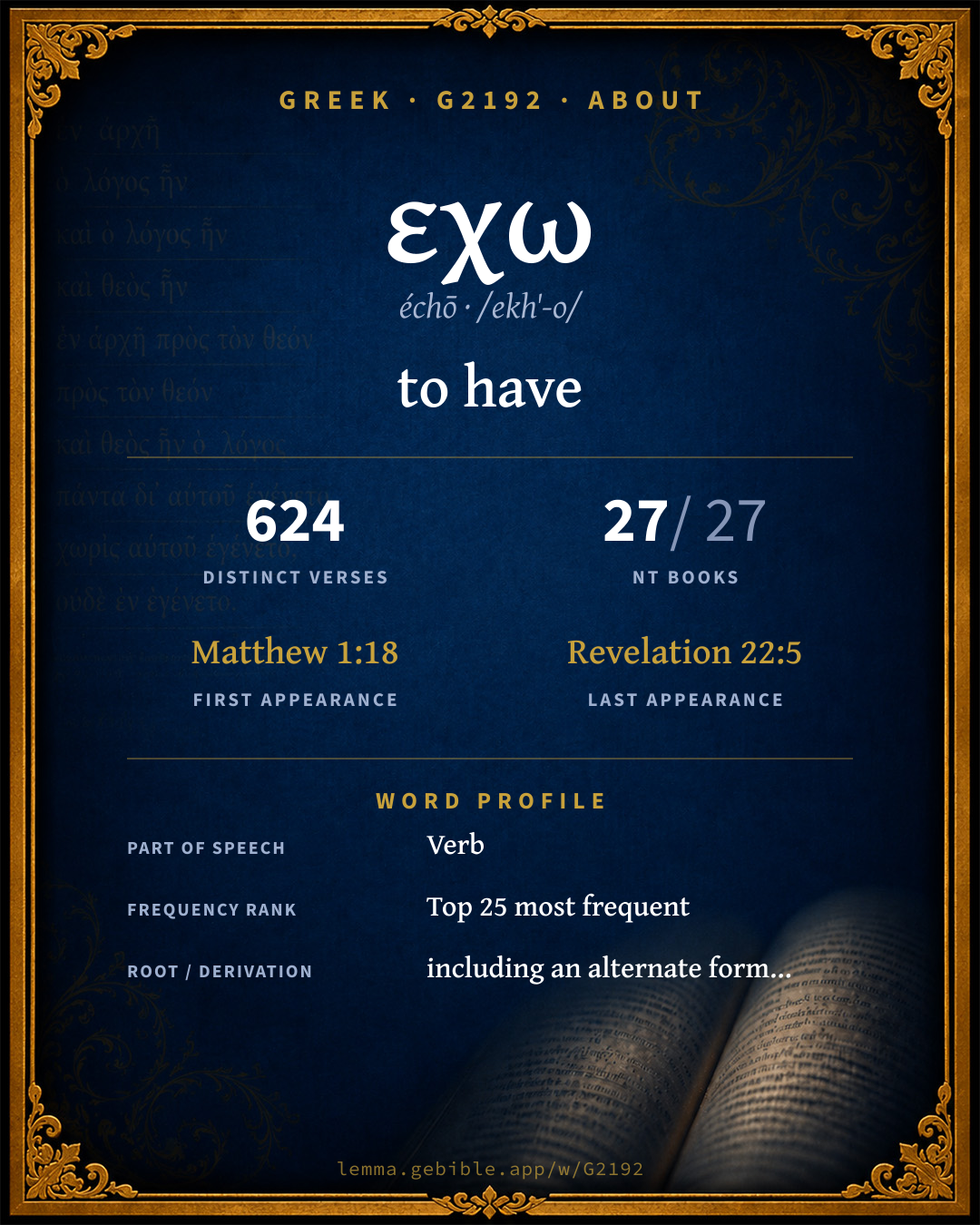
ἔχω
to have
‘to have’ is one of 4 main senses fuller range ↓
Full lexicon entry — Thayer's Greek Lexicon
From Thayer's Greek Lexicon
Where this word appears
See every Present-tense verb in the Greek New Testament →
Grammar key — what these labels mean
Part of speech
- Verb
- An action or state-of-being word.
Tense
- Present
- Ongoing or general action in present time (imperfective aspect).
- Imperfect
- Continuous or repeated action in past time (“was writing”).
- Future
- Action expected in future time.
- Aorist
- Action viewed as a simple whole, without regard to duration — often past (perfective aspect).
- Perfect
- A completed past action with continuing present results.
Voice
- Active
- The subject performs the action.
- Passive
- The subject receives the action.
Mood
- Indicative
- States a fact or asks a factual question (the mood of reality).
- Participle
- A verbal adjective (“writing,” “having written”).
- Infinitive
- A verbal noun (“to write”), unmarked for person or number.
- Subjunctive
- Expresses probability, purpose, or possibility (the mood of contingency).
- Imperative
- Expresses a command or request.
- Optative
- Expresses a wish or a remote possibility.
Case
- Nominative
- The case of the subject (and the predicate nominative).
- Accusative
- The case of the direct object and of extent.
- Dative
- The case of the indirect object, means, or location — “to / for / with / in.”
- Genitive
- The case of source, possession, or “of” — answers “whose / from what.”
Person
- 3rd person
- The one spoken about (“he / she / it / they”).
- 2nd person
- The one addressed (“you”).
- 1st person
- The speaker (“I / we”).
Gender
- Masculine
- Grammatically masculine.
- Feminine
- Grammatically feminine.
- Neuter
- Grammatically neuter.
Number
- Singular
- One.
- Plural
- More than one.
52 verses where G2192 appears in the Present tense in the Book of Matthew. Filtered view — show all forms. Click any verse to open its interlinear word-by-word view. Verse text shown in the World English Bible for context — . Each verse’s Greek form is shown with its reference; the English is not keyword-highlighted, since the data carries no word-level English alignment. Use “Compare translations” on any verse to read it across multiple English versions. This concordance covers the Greek New Testament; Septuagint (Greek Old Testament) occurrences of this word are not indexed here.
Matthew
- Matthew 1:18 ἔχουσα pres act ptcp nom sg fem Now the birth of Jesus Christ was like this; for after his mother, Mary, was engaged to Joseph, before they came together, she was found pregnant by the Holy Spirit.
- Matthew 3:9 ἔχομεν pres act ind 1pl Don't think to yourselves, 'We have Abraham for our father,' for I tell you that God is able to raise up children to Abraham from these stones.
- Matthew 3:14 ἔχω pres act ind 1sg But John would have hindered him, saying, "I need to be baptized by you, and you come to me?"
- Matthew 4:24 ἔχοντας pres act ptcp acc pl masc The report about him went out into all Syria. They brought to him all who were sick, afflicted with various diseases and torments, possessed with demons, epileptics, and paralytics; and he healed them.
- Matthew 5:23 ἔχει pres act ind 3sg "If therefore you are offering your gift at the altar, and there remember that your brother has anything against you,
- Matthew 5:46 ἔχετε pres act ind 2pl For if you love those who love you, what reward do you have? Don't even the tax collectors do the same?
- Matthew 6:1 ἔχετε pres act ind 2pl "Be careful that you don't do your charitable giving before men, to be seen by them, or else you have no reward from your Father who is in heaven.
- Matthew 6:8 ἔχετε pres act ind 2pl Therefore don't be like them, for your Father knows what things you need, before you ask him.
- Matthew 7:29 ἔχων pres act ptcp nom sg masc for he taught them with authority, and not like the scribes.
- Matthew 8:9 ἔχων pres act ptcp nom sg masc For I am also a man under authority, having under myself soldiers. I tell this one, 'Go,' and he goes; and tell another, 'Come,' and he comes; and tell my servant, 'Do this,' and he does it."
- Matthew 8:16 ἔχοντας pres act ptcp acc pl masc When evening came, they brought to him many possessed with demons. He cast out the spirits with a word, and healed all who were sick;
- Matthew 8:20 ἔχουσιν ἔχει pres act ind 3pl pres act ind 3sg Jesus said to him, "The foxes have holes, and the birds of the sky have nests, but the Son of Man has nowhere to lay his head."
- Matthew 9:6 ἔχει pres act ind 3sg But that you may know that the Son of Man has authority on earth to forgive sins..." (then he said to the paralytic), "Get up, and take up your mat, and go up to your house."
- Matthew 9:12 ἔχουσιν ἔχοντες pres act ind 3pl pres act ptcp nom pl masc When Jesus heard it, he said to them, "Those who are healthy have no need for a physician, but those who are sick do.
- Matthew 9:36 ἔχοντα pres act ptcp nom pl neut But when he saw the multitudes, he was moved with compassion for them, because they were harassed and scattered, like sheep without a shepherd.
- Matthew 11:15 ἔχων pres act ptcp nom sg masc He who has ears to hear, let him hear.
- Matthew 11:18 ἔχει pres act ind 3sg For John came neither eating nor drinking, and they say, 'He has a demon.'
- Matthew 12:10 ἔχων pres act ptcp nom sg masc And behold there was a man with a withered hand. They asked him, "Is it lawful to heal on the Sabbath day?" that they might accuse him.
- Matthew 13:5 εἶχεν ἔχειν impf act ind 3sg pres act inf Others fell on rocky ground, where they didn't have much soil, and immediately they sprang up, because they had no depth of earth.
- Matthew 13:6 ἔχειν pres act inf When the sun had risen, they were scorched. Because they had no root, they withered away.
- Matthew 13:9 ἔχων pres act ptcp nom sg masc He who has ears to hear, let him hear."
- Matthew 13:12 ἔχει ἔχει ἔχει pres act ind 3sg pres act ind 3sg pres act ind 3sg For whoever has, to him will be given, and he will have abundance, but whoever doesn't have, from him will be taken away even that which he has.
- Matthew 13:21 ἔχει pres act ind 3sg yet he has no root in himself, but endures for a while. When oppression or persecution arises because of the word, immediately he stumbles.
- Matthew 13:27 ἔχει pres act ind 3sg The servants of the householder came and said to him, 'Sir, didn't you sow good seed in your field? Where did this darnel come from?'
- Matthew 13:43 ἔχων pres act ptcp nom sg masc Then the righteous will shine forth like the sun in the Kingdom of their Father. He who has ears to hear, let him hear.
- Matthew 13:44 ἔχει pres act ind 3sg "Again, the Kingdom of Heaven is like a treasure hidden in the field, which a man found, and hid. In his joy, he goes and sells all that he has, and buys that field.
- Matthew 14:4 ἔχειν pres act inf For John said to him, "It is not lawful for you to have her."
- Matthew 14:16 ἔχουσιν pres act ind 3pl But Jesus said to them, "They don't need to go away. You give them something to eat."
- Matthew 14:17 ἔχομεν pres act ind 1pl They told him, "We only have here five loaves and two fish."
- Matthew 14:35 ἔχοντας pres act ptcp acc pl masc When the men of that place recognized him, they sent into all that surrounding region, and brought to him all who were sick,
- Matthew 15:30 ἔχοντες pres act ptcp nom pl masc Great multitudes came to him, having with them the lame, blind, mute, maimed, and many others, and they put them down at his feet. He healed them,
- Matthew 15:32 ἔχουσιν pres act ind 3pl Jesus summoned his disciples and said, "I have compassion on the multitude, because they continue with me now three days and have nothing to eat. I don't want to send them away fasting, or they might faint on the way."
- Matthew 15:34 ἔχετε pres act ind 2pl Jesus said to them, "How many loaves do you have?" They said, "Seven, and a few small fish."
- Matthew 17:20 ἔχητε pres act subj 2pl He said to them, "Because of your unbelief. For most assuredly I tell you, if you have faith as a grain of mustard seed, you will tell this mountain, 'Move from here to there,' and it will move; and nothing will be impossible for you.
- Matthew 18:8 ἔχοντα pres act ptcp acc sg masc If your hand or your foot causes you to stumble, cut it off, and cast it from you. It is better for you to enter into life maimed or crippled, rather than having two hands or two feet to be cast into the eternal fire.
- Matthew 18:9 ἔχοντα pres act ptcp acc sg masc If your eye causes you to stumble, pluck it out, and cast it from you. It is better for you to enter into life with one eye, rather than having two eyes to be cast into the Gehenna of fire.
- Matthew 18:25 ἔχοντος εἶχεν pres act ptcp gen sg masc impf act ind 3sg But because he couldn't pay, his lord commanded him to be sold, with his wife, his children, and all that he had, and payment to be made.
- Matthew 19:22 ἔχων pres act ptcp nom sg masc But when the young man heard the saying, he went away sad, for he was one who had great possessions.
- Matthew 21:3 ἔχει pres act ind 3sg If anyone says anything to you, you shall say, 'The Lord needs them,' and immediately he will send them."
- Matthew 21:21 ἔχητε pres act subj 2pl Jesus answered them, "Most assuredly I tell you, if you have faith, and don't doubt, you will not only do what is done to the fig tree, but even if you told this mountain, 'Be taken up and cast into the sea,' it would be done.
- Matthew 21:26 ἔχουσιν pres act ind 3pl But if we say, 'From men,' we fear the multitude, for all hold John as a prophet."
- Matthew 22:12 ἔχων pres act ptcp nom sg masc and he said to him, 'Friend, how did you come in here not wearing wedding clothing?' He was speechless.
- Matthew 22:24 ἔχων pres act ptcp nom sg masc saying, "Teacher, Moses said, 'If a man dies, having no children, his brother shall marry his wife, and raise up seed for his brother.'
- Matthew 22:25 ἔχων pres act ptcp nom sg masc Now there were with us seven brothers. The first married and died, and having no seed left his wife to his brother.
- Matthew 24:19 ἐχούσαις pres act ptcp dat pl fem But woe to those who are with child and to nursing mothers in those days!
- Matthew 25:25 ἔχεις pres act ind 2sg I was afraid, and went away and hid your talent in the earth. Behold, you have what is yours.'
- Matthew 25:28 ἔχοντι pres act ptcp dat sg masc Take away therefore the talent from him, and give it to him who has the ten talents.
- Matthew 25:29 ἔχοντι ἔχοντος ἔχει pres act ptcp dat sg masc pres act ptcp gen sg masc pres act ind 3sg For to everyone who has will be given, and he will have abundance, but from him who has not, even that which he has will be taken away.
- Matthew 26:7 ἔχουσα pres act ptcp nom sg fem a woman came to him having an alabaster jar of very expensive ointment, and she poured it on his head as he sat at the table.
- Matthew 26:11 ἔχετε ἔχετε pres act ind 2pl pres act ind 2pl For you always have the poor with you; but you don't always have me.
- Matthew 26:65 ἔχομεν pres act ind 1pl Then the high priest tore his clothing, saying, "He has spoken blasphemy! Why do we need any more witnesses? Behold, now you have heard his blasphemy.
- Matthew 27:65 ἔχετε pres act ind 2pl Pilate said to them, "You have a guard. Go, make it as secure as you can."
About this entry
At a glance — auto-summarized from this page’s data, not written by a person. Every figure links to its source below. This summary describes the numbers; it doesn’t interpret them.
The Greek verb εχω centers on the idea of “to have.” Its English rendering has broadened — “have” classically, “has” (Berean Standard Bible) in modern versions; see the renderings breakdown. Spanning 624 verses in 27 books, it ranks among the most common words of the Greek New Testament. Its earliest occurrence is Matthew 1:18. Lexicons map it across 4 senses. For the data behind this summary, explore the sense tree and the renderings breakdown below.
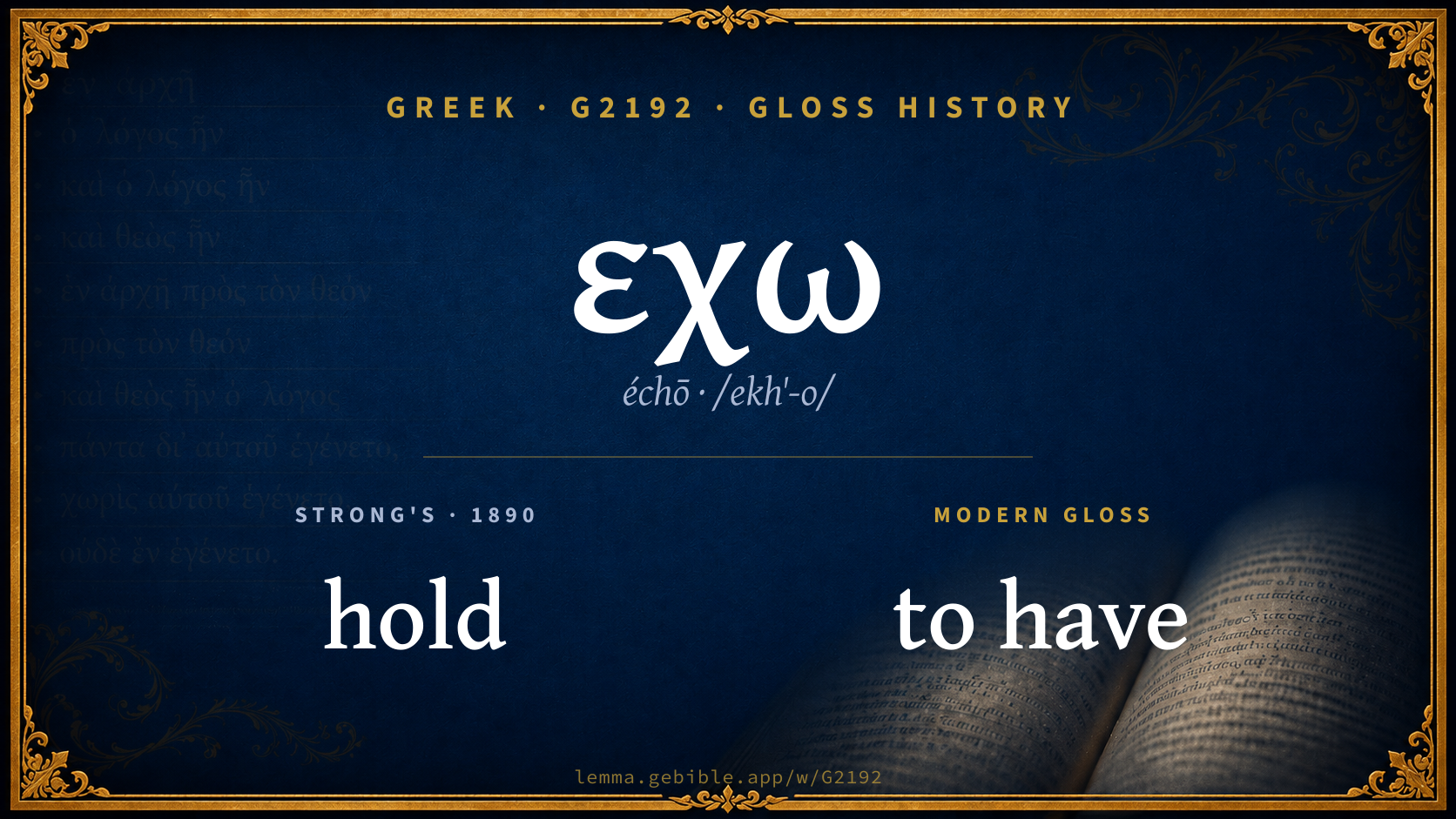
Gloss history
Strong's 1890 vs modern scholarship
About this word
Strong's G2192 catalogs a Greek word from the Greek New Testament.
These counts are not copied from any lexicon or concordance. They are computed here, from the morphology-tagged Greek New Testament. What Lemma adds →
- 624
- distinct verses
- The word appears in 624 distinct verses.
- 27 / 27
- NT books
- The word appears in 27 of 27 New Testament books.
- #25
- by frequency
- Top 25 most frequent Greek words (rank 25 of 5,347 Greek words by occurrence).
View all 624 occurrences in the concordance →
Most concentrated in
- Revelation 91 verses 15%
- John 75 verses 12%
- Luke 65 verses 10%
By section of the New Testament
By traditional corpus
Conventional, traditional groupings — biblical authorship is debated, so this is a traditional corpus grouping, not an authorship claim. Some books belong to more than one corpus (Luke is in both the Gospels and the Lukan corpus, and so on), so these shares overlap and need not total 100%. Each figure is a share of the word’s 624 distinct verses.
- Gospels 266 verses · 43%
- Johannine 193 verses · 31%
- Pauline corpus 143 verses · 23%
- Lukan (Luke–Acts) 108 verses · 17%
- Revelation 91 verses · 15%
- General (Catholic) Epistles 45 verses · 7%
- Hebrews 36 verses · 6%
How translations render this word
Counts come from each version’s own published word-to-Strong’s tagging or interlinear alignment — an approximate guide to how each version renders this word, not a word-level alignment the data otherwise carries. Because each total is that version’s own tagged count, the per-version totals vary from one another and need not match the appearance or distinct-verse counts above. These counts may also differ from a printed concordance because Lemma counts each distinctly tagged rendering and does not collapse phrase taggings into a single head-word total. This is a fixed set of word-tagged versions (KJV, ASV, BSB, ULT) and does not change with the reading translation you choose elsewhere. Each version’s license is shown beside its name below (and on Sources).
- King James Version: Have 90×, Having 82×, Hath 80×
- American Standard Version: Having 92×, Hath 87×, Have 80×
- Berean Standard Bible: Has 68×, Have 67×, With 35×
- unfoldingWord Literal Text: Having 208×, Have 145×, Has 57×
King James Version Public Domain
Renders G2192 across 701 tagged occurrences — most commonly:
Plus other, less common renderings. Plus 78 renderings that appear only once — usually multi-word phrases or single function words the recovered tagging swept in, not distinct renderings. Not rendered by a distinct English word in 23 further occurrences.
American Standard Version Public Domain
Renders G2192 across 700 tagged occurrences — most commonly:
Plus other, less common renderings. Plus 90 renderings that appear only once — usually multi-word phrases or single function words the recovered tagging swept in, not distinct renderings.
Berean Standard Bible Public Domain
Renders G2192 across 624 tagged occurrences — most commonly:
Plus other, less common renderings. Plus 157 renderings that appear only once — usually multi-word phrases or single function words the recovered tagging swept in, not distinct renderings. Not rendered by a distinct English word in 46 further occurrences.
unfoldingWord Literal Text CC BY-SA 4.0
Renders G2192 across 824 tagged occurrences — most commonly:
Plus other, less common renderings. Plus 56 renderings that appear only once — usually multi-word phrases or single function words the recovered tagging swept in, not distinct renderings.
Senses in Thayer's
The 4 senses Thayer's distinguishes for this word, in lexicon order (not ranked by frequency or importance). The full entry — with sub-senses — is in the Lexicon Entry tab.
- to have (hold) in the hand…
- to have i.e. own, possess
- to hold one's self or find one's self so and so, to be in such or such a condition
- to hold one's self to a thing, to lay hold of a thing, to adhere or cling to
Word origin
Origin: including an alternate form scheo skheh'-o, used in certain tenses only), a primary verb
A primary verb (including an alternate form σχέω scheō skheh'-o used in certain tenses only); to hold (used in very various applications literally or figuratively direct or remote; such as possession ability contiguity relation or condition ): - be (able X hold possessed with) accompany + begin to amend can (+ -not) X conceive count diseased do + eat + enjoy + fear following have hold keep + lack + go to law lie + must needs + of necessity + need next + recover + reign + rest return X sick take for + tremble + uncircumcised use.
— Strong’s Exhaustive Concordance (1890), public domain.
Forms in the corpus
The 61 distinct written forms G2192 takes in the Greek New Testament, most frequent first — each parse links to that tense’s occurrences in the concordance.
The 60 most common forms are shown; 1 rarer form follow in the full concordance.
Same root — word family
Other Thayer's entries built from the same root as G2192, grouped by Strong’s listed origin. These share a root / origin per the lexicon — not necessarily a shared meaning. Each links to that word’s own entry.
Derived from this word
- εξης hexēs G1836 next in order
- εξις héxis G1838 habit
- εσχατος éschatos G2078 last
- ευνουχος eunoûchos G2135 eunuch
- ισχυς ischýs G2479 strength
- οχλος óchlos G3793 multitude
- οχυρωμα ochýrōma G3794 fortress
- σχεδον schedón G4975 near
- σχημα schēma G4976 appearance
- σχολη scholḗ G4981 leisure
Compare all same-root words → Showing 4 of 11 — not the complete family. They share a root, not necessarily a meaning.
Septuagint usage
The same Greek word εχω appears 266 times in the Greek Old Testament (Septuagint), across 252 verses in 30 books.
- 266
- LXX occurrences
- Tagged occurrences of this Greek word in the Septuagint.
- 252
- verses
- Distinct Septuagint verses containing this word.
- 30 / 39
- OT books
- The word appears in 30 of the 39 Old Testament books.
Sample Septuagint occurrences
- Genesis 1:29 ἔχω
- Exodus 2:1 ἔχω
- Leviticus 6:3 ἔχω
- Numbers 2:2 ἔχω
- Deuteronomy 2:25 ἔχω
- Joshua 5:8 ἔχω
- Judges 4:11 ἔχω
- 1 Samuel 4:18 ἔχω
- 2 Samuel 11:5 ἔχω
- 1 Kings 1:9 ἔχω
- 2 Kings 8:12 ἔχω
- 1 Chronicles 2:30 ἔχω
Septuagint occurrences (same lexeme)
Every verse where the same Strong’s number (G2192) appears in the Greek Septuagint — showing the first 50 of 252. Verse text shown in the World English Bible for context; the Greek form is the matched word — the English is not keyword-highlighted.
- Genesis 1:29 ἔχω God said, "Behold, I have given you every herb yielding seed, which is on the surface of all the earth, and every tree, which bears fruit yielding seed. It will be your food.
- Genesis 1:30 ἔχω To every animal of the earth, and to every bird of the sky, and to everything that creeps on the earth, in which there is life, I have given every green herb for food." And it was so.
- Genesis 7:22 ἔχω All in whose nostrils was the breath of the spirit of life, of all that was on the dry land, died.
- Genesis 8:11 ἔχω The dove came back to him at evening, and, behold, in her mouth was an olive leaf plucked off. So Noah knew that the waters were abated from off the earth.
- Genesis 16:4 ἔχω He went in to Hagar, and she conceived. When she saw that she had conceived, her mistress was despised in her eyes.
- Genesis 16:5 ἔχω Sarai said to Abram, "This wrong is your fault. I gave my handmaid into your bosom, and when she saw that she had conceived, I was despised in her eyes. Yahweh judge between me and you."
- Genesis 16:11 ἔχω The angel of Yahweh said to her, "Behold, you are with child, and will bear a son. You shall call his name Ishmael, because Yahweh has heard your affliction.
- Genesis 18:10 ἔχω He said, "I will certainly return to you when the season comes round. Behold, Sarah your wife will have a son." Sarah heard in the tent door, which was behind him.
- Genesis 18:31 ἔχω He said, "See now, I have taken it on myself to speak to the Lord. What if there are twenty found there?" He said, "I will not destroy it for the twenty's sake."
- Genesis 19:15 ἔχω When the morning arose, then the angels hurried Lot, saying, "Arise, take your wife, and your two daughters who are here, lest you be consumed in the iniquity of the city."
- Genesis 23:8 ἔχω He talked with them, saying, "If it be your mind that I should bury my dead out of my sight, hear me, and entreat for me to Ephron the son of Zohar,
- Genesis 24:15 ἔχω It happened, before he had done speaking, that behold, Rebekah came out, who was born to Bethuel the son of Milcah, the wife of Nahor, Abraham's brother, with her pitcher on her shoulder.
- Genesis 24:45 ἔχω Before I had done speaking in my heart, behold, Rebekah came forth with her pitcher on her shoulder. She went down to the spring, and drew. I said to her, 'Please let me drink.'
- Genesis 34:14 ἔχω and said to them, "We can't do this thing, to give our sister to one who is uncircumcised; for that is a reproach to us.
- Genesis 37:24 ἔχω and they took him, and threw him into the pit. The pit was empty. There was no water in it.
- Genesis 38:23 ἔχω Judah said, "Let her keep it, lest we be shamed. Behold, I sent this kid, and you haven't found her."
- Genesis 38:24 ἔχω It happened about three months later, that it was told Judah, saying, "Tamar, your daughter-in-law, has played the prostitute; and moreover, behold, she is with child by prostitution." Judah said, "Bring her forth, and let her be burnt."
- Genesis 38:25 ἔχω When she was brought forth, she sent to her father-in-law, saying, "By the man, whose these are, I am with child." She also said, "Please discern whose are these-- the signet, and the cords, and the staff."
- Genesis 41:23 ἔχω and, behold, seven heads of grain, withered, thin, and blasted with the east wind, sprung up after them.
- Genesis 41:38 ἔχω Pharaoh said to his servants, "Can we find such a one as this, a man in whom is the Spirit of God?"
- Genesis 43:26 ἔχω When Joseph came home, they brought him the present which was in their hand into the house, and bowed down themselves to him to the earth.
- Genesis 43:27 ἔχω He asked them of their welfare, and said, "Is your father well, the old man of whom you spoke? Is he yet alive?"
- Genesis 44:19 ἔχω My lord asked his servants, saying, 'Have you a father, or a brother?'
- Genesis 49:25 ἔχω Even by the God of your father, who will help you, By the Almighty, who will bless you, With blessings of heaven above, Blessings of the deep that lies below, Blessings of the breasts, and of the womb.
- Exodus 2:1 ἔχω A man of the house of Levi went and took a daughter of Levi as his wife.
- Exodus 21:22 ἔχω "If men fight and hurt a pregnant woman so that she gives birth prematurely, and yet no harm follows, he shall be surely fined as much as the woman's husband demands and the judges allow.
- Exodus 26:3 ἔχω Five curtains shall be coupled together one to another; and the other five curtains shall be coupled one to another.
- Exodus 28:43 ἔχω They shall be on Aaron, and on his sons, when they go in to the tent of meeting, or when they come near to the altar to minister in the holy place; that they don't bear iniquity, and die: it shall be a statute forever to him and to his descendants after him.
- Exodus 33:12 ἔχω Moses said to Yahweh, "Behold, you tell me, 'Bring up this people:' and you haven't let me know whom you will send with me. Yet you have said, 'I know you by name, and you have also found favor in my sight.'
- Exodus 36:2 ἔχω Moses called Bezalel and Oholiab, and every wise-hearted man, in whose heart Yahweh had put wisdom, even everyone whose heart stirred him up to come to the work to do it:
- Leviticus 6:3 ἔχω or has found that which was lost, and dealt falsely therein, and swearing to a lie; in any of all these things that a man does, sinning therein;
- Leviticus 11:21 ἔχω Yet you may eat these: of all winged creeping things that go on all fours, which have legs above their feet, with which to hop on the earth.
- Leviticus 21:23 ἔχω He shall not come near to the veil, nor come near to the altar, because he has a blemish; that he may not profane my sanctuaries, for I am Yahweh who sanctifies them.'"
- Leviticus 22:20 ἔχω But whatever has a blemish, that you shall not offer: for it shall not be acceptable for you.
- Leviticus 22:22 ἔχω Blind, injured, maimed, having a wart, festering, or having a running sore, you shall not offer these to Yahweh, nor make an offering by fire of them on the altar to Yahweh.
- Leviticus 25:30 ἔχω If it isn't redeemed within the space of a full year, then the house that is in the walled city shall be made sure in perpetuity to him who bought it, throughout his generations. It shall not be released in the Jubilee.
- Numbers 2:2 ἔχω "The children of Israel shall encamp every man by his own standard, with the ensigns of their fathers' houses: at a distance from the tent of meeting shall they encamp around it."
- Numbers 2:5 ἔχω Those who encamp next to him shall be the tribe of Issachar: and the prince of the children of Issachar shall be Nethanel the son of Zuar.
- Numbers 2:7 ἔχω The tribe of Zebulun: and the prince of the children of Zebulun shall be Eliab the son of Helon.
- Numbers 2:12 ἔχω "Those who encamp next to him shall be the tribe of Simeon. The prince of the children of Simeon shall be Shelumiel the son of Zurishaddai.
- Numbers 2:14 ἔχω "The tribe of Gad: and the prince of the children of Gad shall be Eliasaph the son of Reuel.
- Numbers 2:17 ἔχω "Then the tent of meeting shall set out, with the camp of the Levites in the midst of the camps. As they encamp, so shall they set out, every man in his place, by their standards.
- Numbers 2:20 ἔχω "Next to him shall be the tribe of Manasseh: and the prince of the children of Manasseh shall be Gamaliel the son of Pedahzur.
- Numbers 2:22 ἔχω "The tribe of Benjamin: and the prince of the children of Benjamin shall be Abidan the son of Gideoni.
- Numbers 2:27 ἔχω "Those who encamp next to him shall be the tribe of Asher: and the prince of the children of Asher shall be Pagiel the son of Ochran.
- Numbers 2:29 ἔχω "The tribe of Naphtali: and the prince of the children of Naphtali shall be Ahira the son of Enan.
- Numbers 2:34 ἔχω Thus the children of Israel did. According to all that Yahweh commanded Moses, so they encamped by their standards, and so they set out, everyone by their families, according to their fathers' houses.
- Numbers 7:9 ἔχω But to the sons of Kohath he gave none, because the service of the sanctuary belonged to them; they carried it on their shoulders.
- Numbers 16:3 ἔχω and they assembled themselves together against Moses and against Aaron, and said to them, You take too much on you, seeing all the congregation are holy, everyone of them, and Yahweh is among them: why then lift yourselves up above the assembly of Yahweh?
- Numbers 19:2 ἔχω This is the statute of the law which Yahweh has commanded, saying, Speak to the children of Israel, that they bring you a red heifer without spot, in which is no blemish, [and] on which never came yoke.
These are occurrences of the same Greek lexeme (G2192) in the Septuagint — not a translation of any one Hebrew word. The store carries no word-level Hebrew↔Greek alignment, so no Hebrew original is asserted here. Counts come from the recovered LXX Strong's tagging — high-frequency vocabulary is well covered, while rare or late forms may be untagged — so they reflect tagged occurrences and may slightly undercount.