1 Timothy 5:12

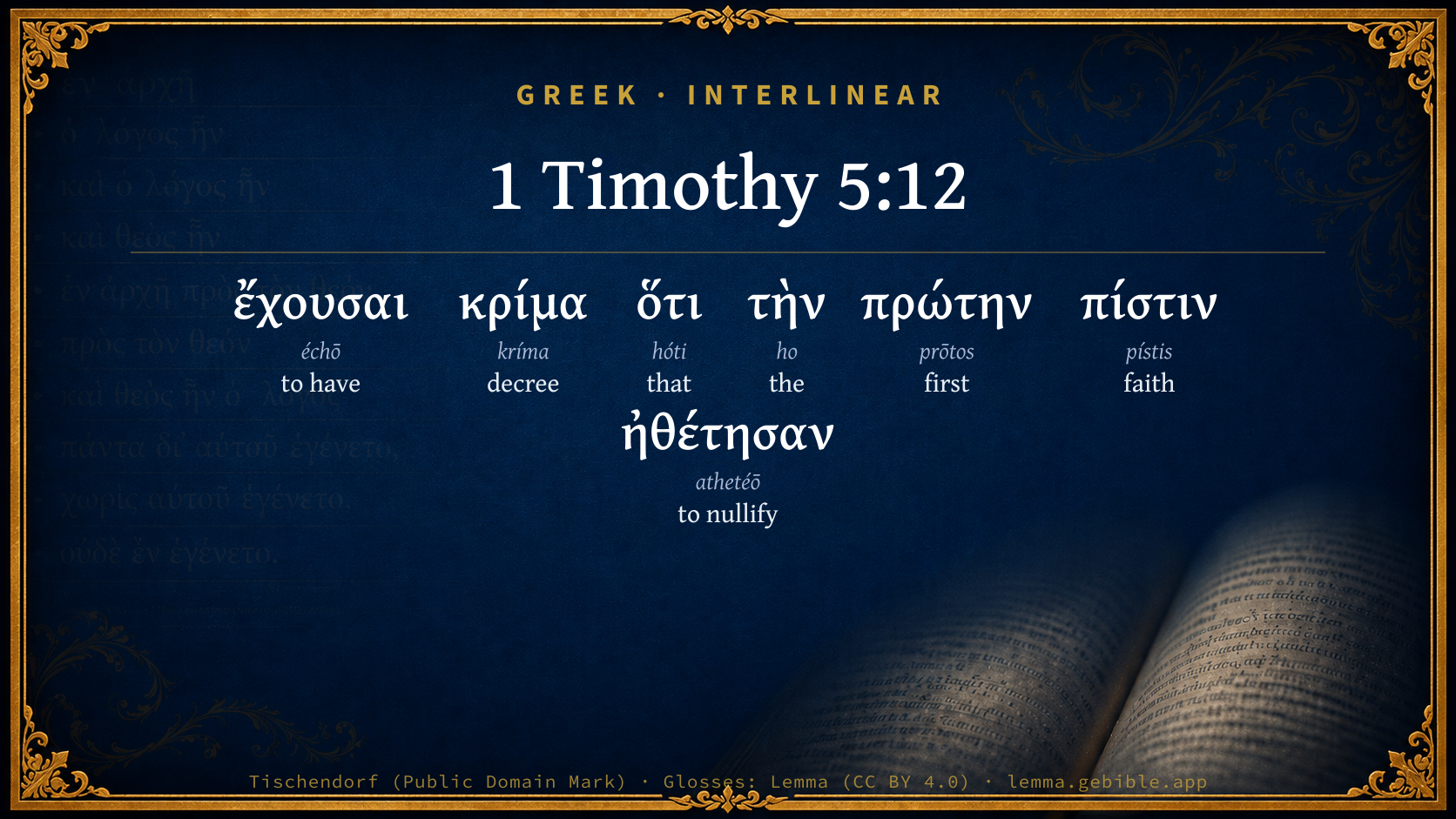
Greek (Tischendorf 8th ed.) 1 Timothy 5:12 appears in the Greek New Testament. The text above is from the Tischendorf 8th edition. Each word links to its Strong’s number and a concise gloss. Click any word for its full Thayer’s Greek Lexicon entry.
Download image
Cite this verse

1 Timothy 5:12 (World English Bible). Public Domain. Lemma interlinear Bible study tool, https://lemma.gebible.app/v/1-timothy/5/12.

Show BibTeX & RIS
BibTeX
RIS
English Translation
having condemnation, because they have rejected their first pledge.
World English Bible · Public Domain
Download a study sheet

One document with this verse’s original text, its word-by-word gloss line, the meaning frame, cross-references with their text, attributed commentary, and full source and license credits — printable, and it pastes into notes with its structure intact.

This verse Autodidact and up

Study sheet (.html) Plain text (.txt)

A passage Seminary Student

Up to 50 verses in one chapter. A passage sheet keeps up to 6 commentary sources and 12 cross-references per verse, in the order this page ranks them, and says so on the sheet whenever that leaves anything out. Ask for a single verse and you get the Autodidact verse sheet above.

Everything on this page stays free to read, with no account — the sheet is a download of what is already on screen, not access to it.

Want to remove ads? Support Godless Engineer
Compare translations 3

The same verse in 3 English versions, stacked beneath the original-language interlinear above. Click any original word for its lexicon entry.

Each is an independent rendering of the whole verse — the interlinear is not word-aligned to these translations.

Highlighted words mark where these versions differ — a whole-verse word diff, not a word-by-word alignment.

  • World English Bible Public Domain
    having condemnation, because they have rejected their first pledge.
  • King James Version Public Domain
    Having damnation, because they have cast off their first faith.
  • unfoldingWord Literal Text CC BY-SA 4.0
    having judgment because they have annulled the first faith.

unfoldingWord Literal Text — © unfoldingWord, licensed CC BY-SA 4.0. Word-aligned USFM3 via Door43 (git.door43.org/unfoldingWord/en_ult).

Versions to compare (up to 4)

3 of 4 selected

Show all 19 translations

Every available English version of this verse, each an independent rendering of the whole verse.

  • World English Bible Public Domain
    having condemnation, because they have rejected their first pledge.
  • Berean Standard Bible Public Domain
    and thus will incur judgment because they are setting aside their first faith.
  • Majority Standard Bible Public Domain
    and thus will incur judgment because they are setting aside their first faith.
  • King James Version Public Domain
    Having damnation, because they have cast off their first faith.
  • American Standard Version (1901) Public Domain
    having condemnation, because they have rejected their first pledge.
  • Revised Version (1885) Public Domain
    having condemnation, because they have rejected their first faith.
  • Geneva Bible (1599) Public Domain
    Hauing damnation, because they haue broken the first faith.
  • Douay-Rheims (1899) Public Domain
    Having damnation, because they have made void their first faith.
  • Young's Literal Translation Public Domain
    having judgment, because the first faith they did cast away,
  • Literal Standard Version CC BY-SA 4.0
    having judgment, because they cast away the first faith,
  • Unlocked Literal Bible CC BY-SA 4.0
    In this way they incur guilt because they revoke their first commitment.
  • unfoldingWord Literal Text CC BY-SA 4.0
    having judgment because they have annulled the first faith.
  • Darby Bible Public Domain
    being guilty, because they have cast off their first faith.
  • World Messianic Bible Public Domain
    having condemnation, because they have rejected their first pledge.
  • Webster's Bible Public Domain
    Having damnation, because they have cast off their first faith.
  • Free Bible Version CC BY-SA 4.0
    In this they are guilty of breaking their previous commitment.
  • Bible in Basic English Public Domain
    And they are judged because they have been false to their first faith;
  • Text-Critical English NT CC BY 4.0
    thus bringing judgment on themselves because they have broken their previous pledge.
  • Tyndale New Testament (1534) Public Domain
    havynge damnacion because they have broke their fyrst fayth.

Literal Standard Version (2020), Covenant Press — licensed CC BY-SA 4.0. Text via the HelloAO Bible API (eBible.org). Unlocked Literal Bible (unfoldingWord) — licensed CC BY-SA 4.0. Text via the HelloAO Bible API (eBible.org). unfoldingWord Literal Text — © unfoldingWord, licensed CC BY-SA 4.0. Word-aligned USFM3 via Door43 (git.door43.org/unfoldingWord/en_ult). Free Bible Version, Dr. Jonathan Gallagher — licensed CC BY-SA 4.0. Text via the HelloAO Bible API (eBible.org).

Word by word

More ways to search: Search by grammar → Find every occurrence → Compare this word →

Practice this passage: Drill this verse → Learn its vocabulary →

About this verse

These counts appear in no published source. They are computed here, from the morphology-tagged text and Lemma’s own curated glosses. What Lemma adds →

7
words
7
distinct lemmas
Pauline Epistles
section

Notable vocabulary

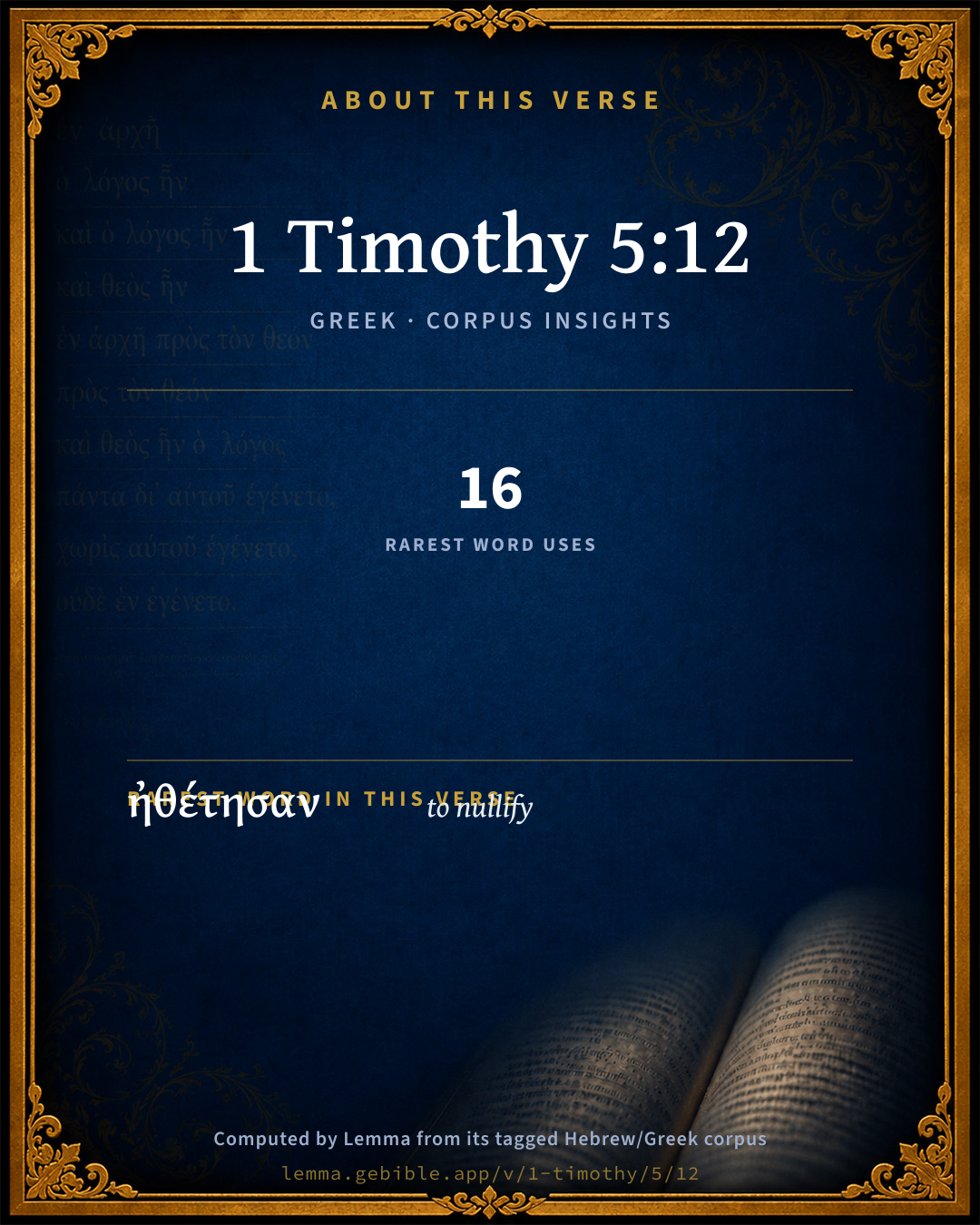
The rarest word here is ἠθέτησαν to nullify G114 — appearing just 16 times in the whole Greek New Testament.

Shared distinctive vocabulary

ἠθέτησαν to nullify G114 occurs in 12 verses of the Greek New Testament. Also found in:

Cross-references

5

Topical passages linked to 1 Timothy 5:12 in the Treasury of Scripture Knowledge — connected by theme and wording, ordered by reader-vote popularity; previews shown in the World English Bible.

  • Galatians 1:6 I marvel that you are so quickly deserting him who called you in the grace of Christ to a different gospel;
  • James 3:1 Let not many of you be teachers, my brothers, knowing that we will receive heavier judgment.
  • 1 Corinthians 11:34 But if anyone is hungry, let him eat at home, lest your coming together be for judgment. The rest I will set in order whenever I come.
  • 1 Peter 4:17 For the time has come for judgment to begin at the house of God. If it begins first with us, what will happen to those who don't obey the Gospel of God?
  • Revelation 2:4–5 But I have this against you, that you left your first love.

Cross-references courtesy of OpenBible.info (CC BY 4.0).

Commentary

Notes on 1 Timothy 5:12 from classic Christian and Jewish commentators (each source and its license shown beneath its notes). The classic Christian expositions comment on the surrounding passage and are grouped to its opening verse, so a note may address several verses; the Jewish commentaries on the Tanakh (Rashi and others) are per-verse, so they appear only where the commentator wrote on this verse.

Lemma curates 59 commentaries, every one of them public domain or Creative Commons licensed, each selected and text-cleaned for this edition rather than reprinted as found. About our sources →

Bengel's Gnomon

Johann Albrecht Bengel

1Ti 5:12. Ἔχουσαι, having) for certain, by this time.—ὅτι) because.—τὴν πρώτην πίστιν ἠθέτησαν) πίστιν ἀθετεῖν, as Raphelius shows from Polybius, is not to keep the faith; comp. 1Ti 5:8. It is called πρώτη πίστις, their first faith, the faith of their early life, which they had before they were enrolled among the widows. Their second vows break this faith, and are opposed to it; comp. “thy first love,” Rev 2:4.

Bengel's Gnomon of the New Testament — English translation (T&T Clark, Edinburgh, 1860) — public domain. Text from a community e-Sword module.

Meyer's Critical & Exegetical Commentary

Heinrich August Wilhelm Meyer

1Ti_5:12. Ἔχουσαι κρίμα, ὅτι] Almost all expositors take ὅτι as introducing the object, so that what follows describes the κρίμα which the widows have to suffer. There is variance only in the more precise definition of κρίμα, whether it is to be understood as the judgment of God (Wiesinger, van Oosterzee), or the judgment of men (Wegscheider: they draw blame on themselves; Plitt: they meet with reproof), or the judgment of their own conscience (so in this commentary; comp. 1Ti_4:2 : κεκαυτηριασένοι τὴν ἰδίαν συνείδησιν). Hofmann takes ὅτι as because, as there is no article with κρίμα: they are liable to condemnation; but this makes the meaning of κρίμα ἔχειν too vague. Since the use of the article in the N. T. is so wavering, it is difficult to come to a definite conclusion. Plitts explanation may be taken as the most natural.

ὅτι τὴν πρώτην πίστιν ἠθέτησαν] τὴν πίστιν ἀθετεῖν in Polybius (who often uses ἀθετεῖν by itself) is fidem fallere, break a pledge. This meaning has rightly been maintained here by most. So Chrysostom: παρέβησαν τὰς συνθήκας; Augustine on Ps. lxxv.: primam fidem irritam fecerunt; voverunt et non reddiderunt. We cannot infer from this expression that any formal oath not to marry again was demanded when they were received into the number of church-widows; but it certainly does follow that the reception pledged the widows to devote their lives only to the service of the Lord. To this pledge they were unfaithful so soon as they began the behaviour described in 1Ti_5:11. It is out of place here to appeal to such passages in the Fathers as testify that in later times the deaconesses had to vow that they would not marry. Πρώτην does not stand for πρότεραν, but is used by the apostle because the vow (tacit or expressed) to serve the Lord was taken at the beginning of their new position in life. Calvin wrongly takes the πρώτη πίστις as the fides in baptismo data, referring the unfaithfulness to the desire to marry, which is defined more precisely by ὅταν καταστρηνιάσωσι τ. Χρ.

Meyer — Critical and Exegetical Commentary on the New Testament — English translation by Peter Christie, edited by Frederick Crombie (T&T Clark, 1880) — public domain. Text from a community e-Sword module.

Expositor's Greek Testament

ed. W. Robertson Nicoll

1Ti 5:12 . ἔχουσαι κρίμα : deserving censure . There is no special force in ἔχουσαι , as Ell. explains, “bearing about with them a judgment, viz. , that they broke their first faith”. This seems forced and unnatural. ἔχειν κρίμα is correlative to λαμβάνεσθαι κρίμα (Mar 12:40 ; Luk 20:47 ; Rom 13:2 ; Jas 3:1 ). They have condemnation because, etc., habentes damnationem quia (Vulg. [281] ). κρίμα of course by itself means, judgment ; but where the context, as here, implies that the judgment is a sentence of guiltiness, it is reasonable so to translate it.

[281] Speculum

τὴν πρώτην πίστιν : This has been already explained. On the use of πρῶτος for πρότερος see Blass, Gram . p. 34.

ἠθέτησαν : annulled, irritam fecerunt (Vulg. [282] ).

[282] Speculum

The Expositor's Greek Testament, edited by W. Robertson Nicoll (1897–1910) — public domain. Text from a community e-Sword module.

Jamieson, Fausset & Brown

Robert Jamieson, A. R. Fausset & David Brown

Having--Bringing on themselves, and so having to bear as a burden (Gal 5:10) judgment from God (compare Ti1 3:6), weighing like a load on them.

cast off their first faith--namely, pledged to Christ and the service of the Church. There could be no hardship at the age of sixty or upwards in not marrying again (end of Ti1 5:9), for the sake of serving better the cause of Christ as presbyteresses; though, to ordinary widows, no barrier existed against remarriage (Co1 7:39). This is altogether distinct from Rome's unnatural vows of celibacy in the case of young marriageable women. The widow-presbyteresses, moreover, engaged to remain single, not as though single life were holier than married life (according to Rome's teaching), but because the interests of Christ's cause made it desirable (see on Ti1 3:2). They had pledged "their first faith" to Christ as presbyteress widows; they now wish to transfer their faith to a husband (compare Co1 7:32, Co1 7:34).

Jamieson, Fausset & Brown — Commentary Critical and Explanatory on the Whole Bible (1871) — public domain (CC PDM 1.0). Text via the HelloAO Bible API.

Adam Clarke's Commentary

Verse 12. Having damnation] In the sense in which we use this word I am satisfied the apostle never intended it. It is likely that he refers here to some promise or engagement which they made when taken on the list already mentioned, and now they have the guilt of having violated that promise; this is the κριμα, or condemnation, of which the apostle speaks.

They have cast off their first faith.] By pledging their fidelity to a husband they have cast off their fidelity to Christ, as a married life and their previous engagement are incompatible. Dr. Macknight translates these two verses thus: But the younger widows reject, for when they cannot endure Christ's rein, they will marry; incurring condemnation, because they have put away their first fidelity.

Adam Clarke's Commentary on the Bible (1810–1826) — public domain. Text from a community e-Sword/MySword module.

John Calvin's Commentaries

12 Having condemnation, because they have renounced their first faith. “To have condemnation,” is interpreted by some as signifying “to deserve reproof.” But I take it to be a statement of greater severity, that Paul terrifies them by the damnation of eternal death; as if he reproved them by saying that that excellent order, which ought rather to have united them to Christ, was the very ground of their condemnation. And the reason is added, that they entirely “revolt from the faith” of baptism and from Christianity. I am aware that there are some who interpret it differently; that is, that they break the pledge which they gave to the Church by marrying, having formerly promised that they would live unmarried till death. This is exceedingly absurd. Besides, why should he call it their first faith?

Accordingly, Paul rises to greater vehemence against them, and magnifies the enormity of the offense, by saying that not only would they bring disgrace on Christ and his Church by departing from the condition to which they had agreed, but they likewise broke their “first faith” by wicked revolt. Thus it usually happens, that he who has once transgressed the bounds of modesty gives himself up to all impudence. It grieved him that the levity of those women was a reproach to the godly, and that their lustfulness was reproved, or, at least, was liable to reproof. This led them to proceed to greater and greater degrees of licentiousness, till they renounced Christianity. That amplification is exceedingly appropriate; for is there anything more absurd than that they should, through a wish to promote the advantage of persons, open the door to the denial of Christ?

The attempt of the Papists to support, by means of this passage, a vow of perpetual celibacy, is absurd. Granting that it was customary to exact from the widows an engagement in express terms, still they would gain nothing by this admission. First, we must consider the end. The reason why widows formerly promised to remain unmarried, was not that they might lead a holier life than in a state of marriage, but because they could not, at the same time, be devoted to husbands and to the Church; but in Popery, they make a vow of continence, as if it were a virtue acceptable to God on its own account. Secondly, in that age they renounced the liberty of marrying at the time when they ceased to be marriageable; for they must have been, at least, sixty years old, and, by being satisfied with being once married, must have already given a proof of their chastity. But now, vows are made among the Papists to renounce marriage, either before the time, or in the midst of time ardor of youthful years.

Now we disapprove of the tyrannical law about celibacy, chiefly for two reasons. First, they pretend that it is meritorious worship before God; and secondly, by rashness in vowing, they plunge souls into destruction. Neither of these was to be found in the ancient institution. They did not make a direct vow of continence, as if the married life were less acceptable to God, but only, so far as it was rendered necessary by the office to which they were elected, they promised to keep from the tie of marriage for their whole life; nor did they deprive themselves of the liberty of marrying, till the time when, though they had been ever so free, it was foolish and unreasonable for them to marry. In short, those widows differed as much from the nuns, as Anna the prophetess from Claude the Vestal.

John Calvin's Commentaries (1540-1563) — public domain. Text from the Calvin Translation Society English edition (1840s-50s) via the Christian Classics Ethereal Library (ccel.org). Calvin's coverage is partial (roughly two-thirds of the Bible); uncommented books and verses are honest gaps, never fabricated. The 19th-century editor's footnotes and remarks are omitted so the notes are faithfully Calvin's own voice.

Ellicott's Commentary for English Readers

(12) Having damnation.—Judgment, not necessarily “damnation.” The Greek word krima is often thus unhappily translated. The context of the passage must in all cases decide the nature of the “judgment,” whether favourable or the contrary. Here it signifies that those who in after days give up a work which for their Master’s sake they had undertaken, expose themselves to a searching judgment, which will thoroughly sift the reasons that induced them to forsake the begun toil, and that, if the reasons be not satisfactory, will be unfavourable, and will surely involve condemnation.

Because they have cast off their first faith.—Though, probably, no vows respecting marriage were required from those widows who devoted themselves to the Lord’s service, yet virtually such a solemn enrolment partook of the nature of a life-long engagement—an engagement which, if they married again, must necessarily be given up.

Such a going back, such a giving up the higher and the more devoted life—the life of self-sacrifice, of self-abnegation—for the ordinary joys and cares of domestic life, for the useful but still every-day pursuits of ordinary men and women—such a going back, would be indeed a casting off their first faith, and such an example of backsliding could not fail to harm the cause of Christ.

A Bible Commentary for English Readers, edited by Charles John Ellicott (1878–1897) — public domain. Text from a community e-Sword module.

The Cambridge Bible for Schools and Colleges

gen. ed. J. J. S. Perowne

12. Corruptio optimi fit pessima; Christ, trust in Christ, the life of Christ, were supreme during the former marriage; into the loneliness of widowhood, not safeguarded by age, the flesh and the devil have penetrated, and have dethroned Christ: a rebel’s name only can be hers. Cf. 1Ti_5:15.

having damnation] Rather, condemnation; a present ‘judgment,’ of being self-condemned as rebels, deserters: because they have rejected their first faith: ‘faith’ being most naturally used here as above, 1Ti_5:8, the phrase ‘their first faith’ may thus best refer to their early Christian life, just as in the Epistle to Ephesus (the same Church to which this letter goes) the condemnation is that they ‘have left their first love,’ and the exhortation is to ‘do the first works.’ The word ‘reject’ is the same as in Jude 1Ti_5:8, ‘these … defile the flesh and set at nought dominion,’ where the thought and subject are very much the same, ‘turning the grace of our God into lasciviousness, and denying our only Master and Lord, Jesus Christ.’ To make the reference to the breaking of a vow or pledge of widowhood seems both inadequate and misleading.

The Cambridge Bible for Schools and Colleges (gen. ed. J. J. S. Perowne; Cambridge University Press, 1878–1918) — public domain. Text from a community e-Sword module.

John Gill's Exposition

And withal they learn to be idle,.... Being at ease, and without labour, living at the expense of the church: "wandering about from house to house"; having nothing else to do: such an one is what the Jews (z) call , "the gadding widow"; who, as the gloss says,

"goes about and visits her neighbours continually; and these are they that corrupt the world.''

Of this sort of women must the Jews be understood, when they say (a), it is one of the properties of them to be "going out", or gadding abroad, as Dinah did; and that it is another to be "talkative", which agrees with what follows:

and not only idle, but tattlers also; full of talk, who have always some news to tell, or report to make of the affairs of this, or the other person, or family:

and busy bodies; in the matters of other persons, which do not concern them:

speaking things which they ought not; which either are not true, and, if they are, are not to be spoken of, and carried from place to place: this is a very great inconvenience, the apostle observes, arising from the admission of such young widows to be relieved and maintained at the church's charge.

(z) T. Bab. Sota, fol. 22. 1. (a) Bereshit Rabba, sect. 45. fol. 40. 3.

John Gill's Exposition of the Whole Bible (1746–1763) — public domain (CC PDM 1.0). Text via the HelloAO Bible API.

Trapp's Complete Commentary

John Trapp

12 Having damnation, because they have cast off their first faith.

Ver. 12. Having damnation] Or public reproach, as 1Ti 5:14, for their desultory lightness and inconsiderate rashness.

Cast off their first faith] Not that of their baptism (as various of the Indians do that have been baptized by the Spaniards), but their vidual {a} promised chastity and service to the saints.

{a} Of or belonging to, befitting, a widow or widowhood; widowed. ŒD

John Trapp, A Commentary or Exposition upon All the Books of the Old and New Testament (1647–1656) — public domain. Text from a community e-Sword module.

Albert Barnes' Notes on the Bible

Having damnation - Or, rather, having “condemnation;” or incurring guilt. This does not mean of necessity that they would lose their souls; see the phrase explained in the notes on 1Co 11:29. The meaning is, that they would contract guilt, if they had been admitted among this class of persons, and then married again. The apostle does not say that that would be wrong in itself (compare notes on 1Ti 5:14), or that they would be absolutely prohibited from it, but that injury would be done if they were admitted among those who were “widows indeed” - who were supported by the church, and who were entrusted with a certain degree of care over the more youthful females - and then should leave that situation. It might give occasion for scandal it might break in upon the arrangements; it would show that there was a relaxing of the faith, and of the deadness to the world, which they were supposed to have; and it was better that they should be married 1Ti 5:14, without having been thus admitted.

Because they have cast off their first faith - This does not mean that they would lose all their religion, or wholly fall away, but that this would show that they had not the strong faith, the deadness to the world, the simple dependence on God 1Ti 5:5, and the desire which they had to be weaned from worldly cares and influences, which they once had. When they became widows, all their earthly hopes seemed to be blasted. They were then dead to the world, and felt their sole dependence on God. But if, under the influence of these strong emotions, they were admitted to the “class of widows” in the church, there was no certainty that they would continue in this state of mind. Time would do much to modify their grief. There would be a reviving love of the world, and under the influence of this they would be disposed to enter again into the marriage relation, and thus show that they had not the strong and simple faith which they had when the blow which made them widows fell heavily upon then.

Albert Barnes' Notes on the Bible (1834–1885) — public domain. Text from a community e-Sword/MySword module.

Haydock's Catholic Bible Commentary

Having, or incurring and making themselves liable to damnation, by a breach of their first faith, their vow or promise, (Witham) by which they had engaged themselves to Christ. (Challoner)

George Leo Haydock (1774–1849), Haydock's Catholic Family Bible and Commentary, 1859 edition — public domain. Excludes Psalms (Douay-Rheims chapter numbering differs from Protestant) and Deuterocanonical books (Catholic canon only).

Matthew Poole's English Annotations

This sentence is not without its difficulties: here are two questions:

1. What is meant by κριμα, which we both here and elsewhere translate damnation.

2. How they cast off their first faith.

Many think the Greek word by us translated damnation, ought to have had a softer sense, it being certainly capable of it. Some think it signifies here no more than guilt, or a blot; others, a public infamy; others, the judgment of good men against them. But it may be we cannot so well determine this without understanding what is meant by

their first faith, which they are here said to have cast off: by which some understand their profession of Christianity; others, their promise or engagement to the church, not to marry. The latter sense supposeth that all those widows that were taken into the ministry of the church before mentioned, promised that they would keep themselves unmarried, which is a most groundless supposition. I do rather think that by their first faith, he means their first or former profession of Christianity; which was a crime that did expose them not only to the judgment and censure of sober Christians, but to eternal damnation. I shall offer my own sense of this text thus: it is certain these Christians were lilies among thorns, a small handful amongst a far greater number of pagans; and it is not improbable, that some younger widows, out of a desire to marry, might marry to pagans, and be by them tempted to apostacy from the Christian profession; upon which the apostle orders, that none under sixty years of age should be henceforth taken into the ministry of the church, lest doing such a thing when they were under that character, it should be a greater scandal. This seems the more probable from 1Ti 5:15, where the apostle adds, for some are already turned aside after Satan.

Matthew Poole's English Annotations on the Holy Bible (1683–1685) — public domain. Text from a community e-Sword/MySword module.

Whedon's Commentary on the Bible

Daniel D. Whedon

12. Having damnation—Rather, the judgment of their own conscience that (not because) they have, etc. Not because they marry, but because of the apostate state of mind and behaviour which resulted in the marriage, and of which the marriage was, perhaps, the best remedy.

First faith— Like the first love of Ephesus. Rev_2:4. The word faith here is taken by the great body of commentators to signify a vow taken by the widow on enrolment, or ordination as eldress or deaconess, including obligation of celibacy. But, 1. The word never signifies vow, so far as our investigation goes, in the New Testament. 2. If these were an order of eldresses or deaconesses the description of them should have taken place in the third chapter. 3. It seems a most reasonable conclusion that this widow list was simply a continuation, or rather recurrence, of the beneficiary widowhood of Act_6:1-6, which existed before any official class existed except the apostles, and was, therefore, itself no official class.

Daniel D. Whedon (gen. ed.), Commentary on the Old and New Testaments (1874–1909) — public domain. Text from a community e-Sword module.

The Pulpit Commentary

Condemnation for dare, ration, A.V,; rejected for cast off, A.V Condemnation; krima, variously translated in the A.V "damnation," "condemnation," and "judgment." The word means a "judgment," "decision," or "sentence," but generally an adverse sentence, a "condemnation." And this is the meaning of the English word "damnation," which has only recently acquired the signification of "eternal damnation." Rejected (hjqethsan); literally, have set aside, or displaced, and hence disregarded, an oath, treaty, promise, or the like. In the A.V variously rendered "reject," "despise," "bring to nothing," "frustrate," "disannul," "east off." The krima which these widows Brought upon themselves was that, whereas they had devoted themselves to a life of prayer and special service of the Church, they had now set aside this their first faith, and returned to the ordinary pleasures and avocations of the world.

The Pulpit Commentary (1880–1919), ed. H.D.M. Spence-Jones & Joseph S. Exell — public domain. Text from a community e-Sword module.

John Wesley's Explanatory Notes

They have rejected their first faith - Have deserted their trust in God, and have acted contrary to the first conviction, namely, that wholly to devote themselves to his service was the most excellent way. When we first receive power to believe, does not the Spirit of God generally point out what are the most excellent things; and at the same time, give us an holy resolution to walk in the highest degree of Christian severity? And how unwise are we ever to sink into anything below it!

John Wesley, Explanatory Notes Upon the Whole Bible (1754–1765) — public domain. Text via the GEBible commentary corpus.

Fairbairn on Ezekiel, Jonah & the Pastoral Epistles

Patrick Fairbairn

Ver. 12. Hence the severe judgment pronounced on their case: having condemnation, because they made void their first faith—not broke their vow or promise to the church to remain in perpetual widowhood, and which, if it had been referred to, could at most have been designated their former, not their first faith; but their simple faith in Christ and consecration to His service when they first assumed the Christian name, and were admitted by baptism into the church. Bengel: Prima fides, primi temporis fides, quam initio habebant, priusquam viduis adscribebantur. So also Calvin, who, with reference to the other view, justly remarks, it affords too tame a sense, and asks, why the apostle should in that case have said first faith? He therefore holds that the charge is of a much heavier kind—namely, “that they had fallen away from the faith of their baptism, and from Christianity. For so is it wont to be the case, that they who once overstep the bounds of modesty prostitute themselves to all manner of shamelessness.” The greater part of modern commentators follow Tertullian, Chrysostom, and others of the ancients, whose ascetic tendencies naturally led them to see here the breach of a promise of widowhood, coupled with active service to the church. But of such a promise and of such service nothing whatever (as we have seen) is said by the apostle, and indeed it belongs to a much later period. If the placing of the persons in question on the church’s list of widows proceeded on a sort of tacit understanding or purpose that they would continue in widowhood, it is the whole that can fairly be supposed. And to represent a simple departure from such an understanding or purpose as of itself inferring a renunciation of their Christian faith, and an incurring of divine condemnation, had been a severity which it seems impossible to reconcile with the genius of the gospel, or with the liberty conceded and sanctioned by the apostle himself. It is not, therefore, we conclude, the simple question of adherence to a state of widowhood, or of departure from it, but such a course of defection from the decorum and purity becoming the gospel of Christ as argued a virtual abandonment of the faith.

Patrick Fairbairn — An Exposition of Ezekiel (1851), Jonah (1849), and The Pastoral Epistles (1874) — public domain. Text from a community e-Sword module.

The People's New Testament

B. W. Johnson

12. Having damnation. Not because they marry, but because after entering a class consecrated entirely to church work, they forsake its duties in order to marry.

B. W. Johnson's The People's New Testament with Notes (1889–1891) — public domain. Electronic text from the Christian Classics Ethereal Library (CCEL) ThML edition.

Cambridge Greek Testament for Schools and Colleges

12. ἔχουσαι κρίμα, having judgement; i.e. they are self-condemned, ἔχουσαι being almost equivalent to ἑαυταῖς παρέχουσαι. Cp. 1Ti 5:20 and Rom 13:2.

ὅτι τὴν πρώτην πίστιν ἠθέτησαν, because they have made void their first faith, sc. with the heavenly Bridegroom. πίστις is not Christian faith, but the pledge which they undertook on being enrolled in the χηρικόν (cp. Rev 2:4). There is no thought, of course, of the pledge of faithfulness to the first husband; he is not in question. πρώτην is used, as commonly in N.T. Greek, for προτέραν (e.g. Act 1:1).

Cambridge Greek Testament for Schools and Colleges (Cambridge University Press, 1896; 21 vols, various authors incl. Carr, Maclear, Plummer, Farrar, Lumby, Moule, M. R. James, Simcox) — public domain. Text from a community e-Sword module.

International Critical Commentary

12. κρίμα] liable to severe judgment, i.e. primarily of men (cf. 14), though the thought of the divine judgment lies in the background, cf. 24; Apost. Const. iii. 1, λόγον ὑφέξει τῷ θεῷ.

τὴν πρώτην πίστιν (cf. Rev 2:4 τὴν ἀγάπην τὴν πρώτην, 2:5 τὰ πρῶτα ἔργα), the original impulse of faith which led her to join the widows; or more exactly “the first troth” or “promise of allegiance” made when she joined, τὴν συνθήκην λέγει, Chrys. “primam fidem susceptae viduitatis,” Tert. de Monog. 13. ὅτι τὴν ἑαύτης ἐπαγγελίαν οὐκ ἐφύλαξε, Apost. Const. iii. 1 (cc. 1-3 are an expansion and interesting later comment on this section). Cf. Psa 14:4 ὁ ὀμνύων τῷ πλησίον αὐτοῦ καὶ οὐκ ἀθετῶν.

International Critical Commentary — older volumes (1896–1929), various authors — public domain. Text from a community e-Sword module.

Vincent's Word Studies in the New Testament

Marvin R. Vincent

Having damnation [εχουσαι κριμα] . The phrase only here. See on 1Ti 3:6. Damnation is an unfortunate rendering in the light of the present common understanding of the word, as it is also in 1Co 11:29. Better, judgment or condemnation, as Rom 3:8; Rom 13:2. The meaning is that they carry about with them in their new, married life a condemnation, a continuous reproach. Comp. ch. 1ti 4:2; Gal 5:10. It should be said for the translators of 1611 that they used damnation in this sense of, judgment or condemnation, as is shown by the present participle having. In its earlier usage the word implied no allusion to a future punishment. Thus Chaucer

"For wel thou woost (knowest) thyselven verraily That thou and I be dampned to prisoun." Knight's T. 1175.

Wielif : "Nethir thou dredist God, that thou art in the same dampnacioun?" Luk 23:40. Laud. : "Pope Alexander 3 condemned Peter Lombard of heresy, and he lay under that damnation for thirty and six years." " A legacy by damnation " was one in which the testator imposed on his heir an obligation to give the legatee the thing bequeatheds and which afforded the legatee a personal claim against the heir.

They have cast off their first faith [την πρωτην πιστιν ηθετησαν] . Aqetein is to set aside, do away with, reject or slight. See Mr 6:26; Luk 10:16; Heb 10:28. Often in LXX Pistin is pledge : so frequently in Class. with give and receive. See, for instance, Plato, Phaedr. 256 D. In LXX, 3 Macc. 3 10. The phrase pistin ajqetein N. T. o. o LXX There are, however, a number of expressions closely akin to it, as Gal. iii. 15, diaqhkhn ajqetein to render a covenant void. In LXX with oath, 9 2Ch 36:13. Psa 14:4 : He that sweareth to his neighbor kai oujk ajqetwn. Psa 88:34; Psa 131:11; 1 Macc. 6 62. The meaning here is, having broken their first pledge; and this may refer to a pledge to devote themselves, after they became widows, to the service of Christ and the church. The whole matter is obscure.

Marvin R. Vincent, Word Studies in the New Testament (1887–1900) — public domain. Text from a community e-Sword/MySword module.

Lesson kit

Teaching starters — assembled from the data on this page, not authored interpretation. Every prompt links to the verse data it draws on. Edit before teaching.

1 Timothy, in the Pauline Epistles, opens this verse with 7 words (7 distinct Greek lemmas). Its most distinctive word is athetéō (“to nullify”). A historical commentator’s framing appears above. Read the whole chapter for the surrounding context.

Discussion questions

  1. How does “to nullify” (athetéō) shape what this verse is saying?
  2. How does Mark 6:26, which shares the word «to nullify», read alongside this verse?
  3. The translations on this page render this verse differently — a whole-verse word diff, not a word-by-word alignment. What might account for the different wordings?
  4. Compare how Bengel's Gnomon and Meyer's Critical & Exegetical Commentary read this verse. Where do they agree or differ?

Things to notice

Reading settings

Reading text

Shown beneath each verse's original-language words.

Old Testament
Old Testament edition

Read the OT as the Masoretic Hebrew (MT) or the Greek Septuagint (LXX).

English shown for the Greek Septuagint (in the Hebrew ↔ Greek comparison).

Comparing translations? Open the Compare panel on any verse page to stack up to four side by side.