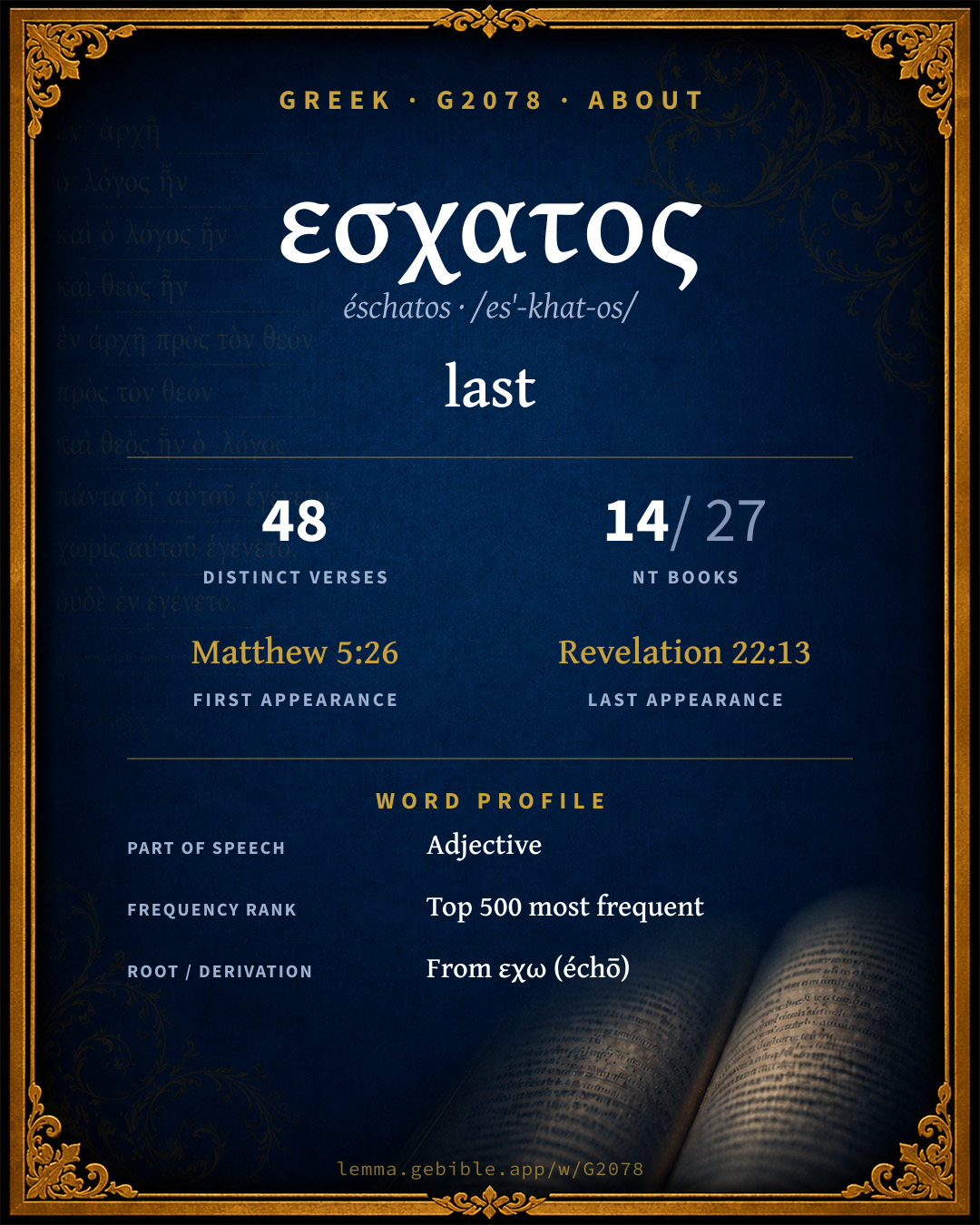
ἔσχατος
last
‘last’ is one of 4 main senses fuller range ↓
Full lexicon entry — Thayer's Greek Lexicon
From Thayer's Greek Lexicon
Where this word appears
See every Nominative-case word in the Greek New Testament →
Grammar key — what these labels mean
Part of speech
- Adjective
- A word that describes or qualifies a noun.
Case
- Nominative
- The case of the subject (and the predicate nominative).
- Dative
- The case of the indirect object, means, or location — “to / for / with / in.”
- Accusative
- The case of the direct object and of extent.
- Genitive
- The case of source, possession, or “of” — answers “whose / from what.”
Gender
- Masculine
- Grammatically masculine.
- Feminine
- Grammatically feminine.
- Neuter
- Grammatically neuter.
Number
- Plural
- More than one.
- Singular
- One.
Degree
- Superlative
- Expresses the greatest degree (“greatest,” “most”).
Grammatical forms 16 distinct
- Adjective, Nominative, Plural, Masculine, Superlative 9 times (17%)
- Adjective, Dative, Singular, Feminine, Superlative 8 times (15%)
- Adjective, Nominative, Singular, Masculine, Superlative 6 times (11%)
- Adjective, Accusative, Singular, Masculine, Superlative 5 times (9%)
- Adjective, Genitive, Singular, Masculine, Superlative 4 times (8%)
- Adjective, Dative, Plural, Feminine, Superlative 3 times (6%)
- Adjective, Nominative, Plural, Neuter, Superlative 3 times (6%)
- Adjective, Nominative, Singular, Feminine, Superlative 3 times (6%)
+8 more forms (12 occurrences)
Parsed forms decoded from the imported morphology (Robinson–Tischendorf, public domain), counted across 53 parsed occurrences — not distinct verses.
Every verse where G2078 appears — 48 distinct verses across 14 books. Click any verse to open its interlinear word-by-word view. Verse text shown in the World English Bible for context — . Each verse’s Greek form is shown with its reference; the English is not keyword-highlighted, since the data carries no word-level English alignment. Use “Compare translations” on any verse to read it across multiple English versions. This concordance covers the Greek New Testament; Septuagint (Greek Old Testament) occurrences of this word are not indexed here.
Matthew 8 verses
- Matthew 5:26 ἔσχατον adj acc sg masc supl Most assuredly I tell you, you shall by no means get out of there, until you have paid the last penny.
- Matthew 12:45 ἔσχατα adj nom pl neut supl Then he goes, and takes with himself seven other spirits more evil than he is, and they enter in and dwell there. The last state of that man becomes worse than the first. Even so will it be also to this evil generation."
- Matthew 19:30 ἔσχατοι ἔσχατοι adj nom pl masc supl adj nom pl masc supl But many will be last who are first; and first who are last.
- Matthew 20:8 ἐσχάτων adj gen pl masc supl When evening had come, the lord of the vineyard said to his steward, 'Call the laborers and pay them their wages, beginning from the last to the first.'
- Matthew 20:12 ἔσχατοι adj nom pl masc supl saying, 'These last have spent one hour, and you have made them equal to us, who have borne the burden of the day and the scorching heat!'
- Matthew 20:14 ἐσχάτῳ adj dat sg masc supl Take that which is yours, and go your way. It is my desire to give to this last just as much as to you.
- Matthew 20:16 ἔσχατοι ἔσχατοι adj nom pl masc supl adj nom pl masc supl So the last will be first, and the first last. For many are called, but few are chosen."
- Matthew 27:64 ἐσχάτη adj nom sg fem supl Command therefore that the tomb be made secure until the third day, lest perhaps his disciples come at night and steal him away, and tell the people, 'He is risen from the dead;' and the last deception will be worse than the first."
Mark 4 verses
- Mark 9:35 ἔσχατος adj nom sg masc supl He sat down, and called the twelve; and he said to them, "If any man wants to be first, he shall be last of all, and servant of all."
- Mark 10:31 ἔσχατοι ἔσχατοι adj nom pl masc supl adj nom pl masc supl But many who are first will be last; and the last first."
- Mark 12:6 ἔσχατον adj acc sg masc supl Therefore still having one, his beloved son, he sent him last to them, saying, 'They will respect my son.'
- Mark 12:22 ἔσχατον adj acc sg neut supl and the seven took her and left no children. Last of all the woman also died.
Luke 5 verses
- Luke 11:26 ἔσχατα adj nom pl neut supl Then he goes, and takes seven other spirits more evil than himself, and they enter in and dwell there. The last state of that man becomes worse than the first."
- Luke 12:59 ἔσχατον adj acc sg neut supl I tell you, you will by no means get out of there, until you have paid the very last penny."
- Luke 13:30 ἔσχατοι ἔσχατοι adj nom pl masc supl adj nom pl masc supl Behold, there are some who are last who will be first, and there are some who are first who will be last."
- Luke 14:9 ἔσχατον adj acc sg masc supl and he who invited both of you would come and tell you, 'Make room for this person.' Then you would begin, with shame, to take the lowest place.
- Luke 14:10 ἔσχατον adj acc sg masc supl But when you are invited, go and sit in the lowest place, so that when he who invited you comes, he may tell you, 'Friend, move up higher.' Then you will be honored in the presence of all who sit at the table with you.
John 8 verses
- John 6:39 ἐσχάτῃ adj dat sg fem supl This is the will of my Father who sent me, that of all he has given to me I should lose nothing, but should raise him up at the last day.
- John 6:40 ἐσχάτῃ adj dat sg fem supl This is the will of the one who sent me, that everyone who sees the Son, and believes in him, should have eternal life; and I will raise him up at the last day."
- John 6:44 ἐσχάτῃ adj dat sg fem supl No one can come to me unless the Father who sent me draws him, and I will raise him up in the last day.
- John 6:54 ἐσχάτῃ adj dat sg fem supl He who eats my flesh and drinks my blood has eternal life, and I will raise him up at the last day.
- John 7:37 ἐσχάτῃ adj dat sg fem supl Now on the last and greatest day of the feast, Jesus stood and cried out, "If anyone is thirsty, let him come to me and drink!
- John 8:9 ἐσχάτων adj gen pl masc supl They, when they heard it, being convicted by their conscience, went out one by one, beginning from the oldest, even to the last. Jesus was left alone with the woman where she was, in the middle.
- John 11:24 ἐσχάτῃ adj dat sg fem supl Martha said to him, "I know that he will rise again in the resurrection at the last day."
- John 12:48 ἐσχάτῃ adj dat sg fem supl He who rejects me, and doesn't receive my sayings, has one who judges him. The word that I spoke, the same will judge him in the last day.
Acts 3 verses
- Acts 1:8 ἐσχάτου adj gen sg masc supl But you will receive power when the Holy Spirit has come upon you. You will be witnesses to me in Jerusalem, in all Judea and Samaria, and to the uttermost parts of the earth."
- Acts 2:17 ἐσχάταις adj dat pl fem supl 'It will be in the last days, says God, That I will pour out my Spirit on all flesh. Your sons and your daughters will prophesy. Your young men will see visions. Your old men will dream dreams.
- Acts 13:47 ἐσχάτου adj gen sg neut supl For so has the Lord commanded us, saying, 'I have set you as a light for the Gentiles, That you should bring salvation to the uttermost parts of the earth.'"
1 Corinthians 5 verses
- 1 Corinthians 4:9 ἐσχάτους adj acc pl masc supl For, I think that God has displayed us, the apostles, last of all, like men sentenced to death. For we are made a spectacle to the world, both to angels and men.
- 1 Corinthians 15:8 ἔσχατον adj acc sg masc supl and last of all, as to the child born at the wrong time, he appeared to me also.
- 1 Corinthians 15:26 ἔσχατος adj nom sg masc supl The last enemy that will be abolished is death.
- 1 Corinthians 15:45 ἔσχατος adj nom sg masc supl So also it is written, "The first man, Adam, became a living soul." The last Adam became a life-giving spirit.
- 1 Corinthians 15:52 ἐσχάτῃ adj dat sg fem supl in a moment, in the twinkling of an eye, at the last trumpet. For the trumpet will sound, and the dead will be raised incorruptible, and we will be changed.
2 Timothy 1 verse
Hebrews 1 verse
James 1 verse
1 Peter 2 verses
2 Peter 2 verses
- 2 Peter 2:20 ἔσχατα adj nom pl neut supl For if, after they have escaped the defilement of the world through the knowledge of the Lord and Savior Jesus Christ, they are again entangled therein and overcome, the last state has become worse with them than the first.
- 2 Peter 3:3 ἐσχάτων adj gen pl fem supl knowing this first, that in the last days mockers will come, walking after their own lusts,
1 John 1 verse
Jude 1 verse
Revelation 6 verses
- Revelation 1:17 ἔσχατος adj nom sg masc supl When I saw him, I fell at his feet like a dead man. He laid his right hand on me, saying, "Don't be afraid. I am the first and the last,
- Revelation 2:8 ἔσχατος adj nom sg masc supl "To the angel of the assembly in Smyrna write: "The first and the last, who was dead, and has come to life says these things:
- Revelation 2:19 ἔσχατα adj acc pl neut supl I know your works, your love, faith, service, patient endurance, and that your last works are more than the first.
- Revelation 15:1 ἐσχάτας adj acc pl fem supl I saw another great and marvelous sign in the sky: seven angels having the seven last plagues, for in them God's wrath is finished.
- Revelation 21:9 ἐσχάτων adj gen pl fem supl One of the seven angels who had the seven bowls, who were loaded with the seven last plagues came, and he spoke with me, saying, "Come here. I will show you the wife, the Lamb's bride."
- Revelation 22:13 ἔσχατος adj nom sg masc supl I am the Alpha and the Omega, the First and the Last, the Beginning and the End.
About this entry
At a glance — auto-summarized from this page’s data, not written by a person. Every figure links to its source below. This summary describes the numbers; it doesn’t interpret them.
εσχατος — transliterated éschatos — is a Greek adjective carrying the sense “last.” Its lexical range runs to 4 senses. Spanning 48 verses in 14 books, it ranks among the moderately common words of the Greek New Testament. Debuting at Matthew 5:26, it then recurs through the corpus. From the same root come εχω, εξης and εξις. See the sense tree, 48-verse concordance, and the renderings breakdown below.
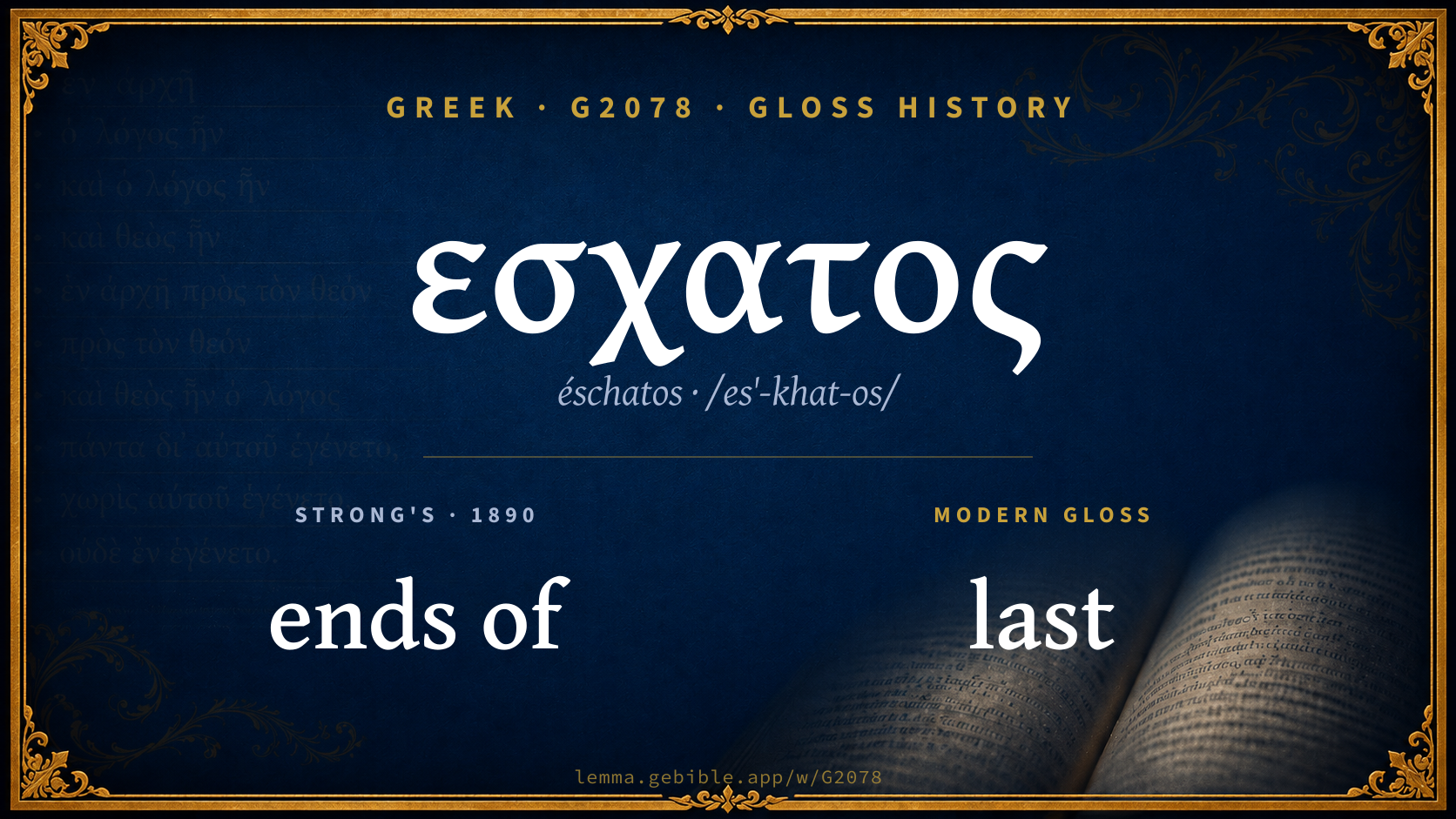
Gloss history
Strong's 1890 vs modern scholarship
About this word
Strong's G2078 catalogs a Greek word from the Greek New Testament.
These counts are not copied from any lexicon or concordance. They are computed here, from the morphology-tagged Greek New Testament. What Lemma adds →
- 48
- distinct verses
- The word appears in 48 distinct verses.
- 14 / 27
- NT books
- The word appears in 14 of 27 New Testament books.
- #300
- by frequency
- Top 500 most frequent Greek words (rank 300 of 5,347 Greek words by occurrence).
View all 48 occurrences in the concordance →
Most concentrated in
- Matthew 8 verses 17%
- John 8 verses 17%
- Revelation 6 verses 13%
By section of the New Testament
By traditional corpus
Conventional, traditional groupings — biblical authorship is debated, so this is a traditional corpus grouping, not an authorship claim. Some books belong to more than one corpus (Luke is in both the Gospels and the Lukan corpus, and so on), so these shares overlap and need not total 100%. Each figure is a share of the word’s 48 distinct verses.
- Gospels 25 verses · 52%
- Johannine 15 verses · 31%
- Lukan (Luke–Acts) 8 verses · 17%
- General (Catholic) Epistles 7 verses · 15%
- Pauline corpus 6 verses · 13%
- Revelation 6 verses · 13%
- Hebrews 1 verse · 2%
How translations render this word
Counts come from each version’s own published word-to-Strong’s tagging or interlinear alignment — an approximate guide to how each version renders this word, not a word-level alignment the data otherwise carries. Because each total is that version’s own tagged count, the per-version totals vary from one another and need not match the appearance or distinct-verse counts above. These counts may also differ from a printed concordance because Lemma counts each distinctly tagged rendering and does not collapse phrase taggings into a single head-word total. This is a fixed set of word-tagged versions (KJV, ASV, BSB, ULT) and does not change with the reading translation you choose elsewhere. Each version’s license is shown beside its name below (and on Sources).
- King James Version: Last 47×, Lowest 2×
- American Standard Version: Last 43×, End 2×, Lowest 2×
- Berean Standard Bible: Last 42×, Final 5×, Ends 2×
- unfoldingWord Literal Text: Last 42×, End 2×, Last ones 2×
King James Version Public Domain
Renders G2078 across 54 tagged occurrences — most commonly:
Plus 5 renderings that appear only once — usually multi-word phrases or single function words the recovered tagging swept in, not distinct renderings.
American Standard Version Public Domain
Renders G2078 across 54 tagged occurrences — most commonly:
Plus 7 renderings that appear only once — usually multi-word phrases or single function words the recovered tagging swept in, not distinct renderings.
Berean Standard Bible Public Domain
Renders G2078 across 52 tagged occurrences — most commonly:
Plus 3 renderings that appear only once — usually multi-word phrases or single function words the recovered tagging swept in, not distinct renderings. Not rendered by a distinct English word in 1 further occurrence.
unfoldingWord Literal Text CC BY-SA 4.0
Renders G2078 across 51 tagged occurrences — most commonly:
Plus 3 renderings that appear only once — usually multi-word phrases or single function words the recovered tagging swept in, not distinct renderings.
Senses in Thayer's
The 4 senses Thayer's distinguishes for this word, in lexicon order (not ranked by frequency or importance). The full entry — with sub-senses — is in the Lexicon Entry tab.
- extreme
- last, referring to time
- of space, the uttermost part, the end, of the earth
- of rank, grade of worth, last i.e. lowest
Word origin
Derived from εχω (échō) (G2192) — to have.
A superlative probably from G2192 (in the sense of contiguity ); farthest final (of place or time): - ends of last latter end lowest uttermost.
— Strong’s Exhaustive Concordance (1890), public domain.
Forms in the corpus
The 12 distinct written forms G2078 takes in the Greek New Testament, most frequent first — each parse links to that case’s occurrences in the concordance.
Same root — word family
Other Thayer's entries built from the same root as G2078, grouped by Strong’s listed origin. These share a root / origin per the lexicon — not necessarily a shared meaning. Each links to that word’s own entry.
Derives from
Shares the same root
- εξης hexēs G1836 next in order
- εξις héxis G1838 habit
- ευνουχος eunoûchos G2135 eunuch
- ισχυς ischýs G2479 strength
- οχλος óchlos G3793 multitude
- οχυρωμα ochýrōma G3794 fortress
- σχεδον schedón G4975 near
- σχημα schēma G4976 appearance
- σχολη scholḗ G4981 leisure
Derived from this word
Compare all same-root words → Showing 4 of 12 — not the complete family. They share a root, not necessarily a meaning.
Septuagint usage
The same Greek word εσχατος appears 100 times in the Greek Old Testament (Septuagint), across 98 verses in 26 books.
- 100
- LXX occurrences
- Tagged occurrences of this Greek word in the Septuagint.
- 98
- verses
- Distinct Septuagint verses containing this word.
- 26 / 39
- OT books
- The word appears in 26 of the 39 Old Testament books.
Sample Septuagint occurrences
- Leviticus 23:16 ἔσχατος
- Deuteronomy 4:30 ἔσχατος
- Joshua 1:4 ἔσχατος
- Judges 15:7 ἔσχατος
- Ruth 3:10 ἔσχατος
- 1 Samuel 29:2 ἔσχατος
- 2 Samuel 2:26 ἔσχατος
- 1 Kings 9:15 ἔσχατος
- 1 Chronicles 23:27 ἔσχατος
- 2 Chronicles 9:29 ἔσχατος
- Ezra 8:13 ἔσχατος
- Job 8:7 ἔσχατος
Septuagint occurrences (same lexeme)
Every verse where the same Strong’s number (G2078) appears in the Greek Septuagint — showing the first 50 of 98. Verse text shown in the World English Bible for context; the Greek form is the matched word — the English is not keyword-highlighted.
- Leviticus 23:16 ἔσχατος even to the next day after the seventh Sabbath you shall number fifty days; and you shall offer a new meal offering to Yahweh.
- Leviticus 27:18 ἔσχατος But if he dedicates his field after the Jubilee, then the priest shall reckon to him the money according to the years that remain to the Year of Jubilee; and an abatement shall be made from your valuation.
- Deuteronomy 4:30 ἔσχατος When you are in oppression, and all these things are come on you, in the latter days you shall return to Yahweh your God, and listen to his voice:
- Deuteronomy 28:49 ἔσχατος Yahweh will bring a nation against you from far, from the end of the earth, as the eagle flies; a nation whose language you shall not understand;
- Deuteronomy 31:29 ἔσχατος For I know that after my death you will utterly corrupt yourselves, and turn aside from the way which I have commanded you; and evil will happen to you in the latter days; because you will do that which is evil in the sight of Yahweh, to provoke him to anger through the work of your hands.
- Deuteronomy 34:2 ἔσχατος and all Naphtali, and the land of Ephraim and Manasseh, and all the land of Judah, to the hinder sea,
- Joshua 1:4 ἔσχατος From the wilderness, and this Lebanon, even to the great river, the river Euphrates, all the land of the Hittites, and to the great sea toward the going down of the sun, shall be your border.
- Joshua 10:14 ἔσχατος There was no day like that before it or after it, that Yahweh listened to the voice of a man: for Yahweh fought for Israel.
- Joshua 24:27 ἔσχατος Joshua said to all the people, Behold, this stone shall be a witness against us; for it has heard all the words of Yahweh which he spoke to us: it shall be therefore a witness against you, lest you deny your God.
- Judges 15:7 ἔσχατος Samson said to them, If you do after this manner, surely I will be avenged of you, and after that I will cease.
- Ruth 3:10 ἔσχατος He said, Blessed are you by Yahweh, my daughter: you have shown more kindness in the latter end than at the beginning, inasmuch as you didn't follow young men, whether poor or rich.
- 1 Samuel 29:2 ἔσχατος The lords of the Philistines passed on by hundreds, and by thousands; and David and his men passed on in the rearward with Achish.
- 2 Samuel 2:26 ἔσχατος Then Abner called to Joab, and said, "Shall the sword devour forever? Don't you know that it will be bitterness in the latter end? How long shall it be then, before you bid the people return from following their brothers?"
- 2 Samuel 13:16 ἔσχατος She said to him, Not so, because this great wrong in putting me forth is [worse] than the other that you did to me. But he would not listen to her.
- 2 Samuel 19:12 ἔσχατος You are my brothers, you are my bone and my flesh: why then are you the last to bring back the king?
- 2 Samuel 19:13 ἔσχατος Say you to Amasa, Aren't you my bone and my flesh? God do so to me, and more also, if you aren't captain of the host before me continually in the room of Joab.
- 2 Samuel 23:1 ἔσχατος Now these are the last words of David. David the son of Jesse says, The man who was raised on high says, The anointed of the God of Jacob, The sweet psalmist of Israel:
- 2 Samuel 24:25 ἔσχατος David built there an altar to Yahweh, and offered burnt offerings and peace-offerings. So Yahweh was entreated for the land, and the plague was stayed from Israel.
- 1 Kings 9:15 ἔσχατος This is the reason of the levy which king Solomon raised, to build the house of Yahweh, and his own house, and Millo, and the wall of Jerusalem, and Hazor, and Megiddo, and Gezer.
- 1 Kings 17:13 ἔσχατος Elijah said to her, Don't be afraid; go and do as you have said; but make me of it a little cake first, and bring it forth to me, and afterward make for you and for your son.
- 1 Chronicles 23:27 ἔσχατος For by the last words of David the sons of Levi were numbered, from twenty years old and upward.
- 2 Chronicles 9:29 ἔσχατος Now the rest of the acts of Solomon, first and last, aren't they written in the history of Nathan the prophet, and in the prophecy of Ahijah the Shilonite, and in the visions of Iddo the seer concerning Jeroboam the son of Nebat?
- 2 Chronicles 12:15 ἔσχατος Now the acts of Rehoboam, first and last, aren't they written in the histories of Shemaiah the prophet and of Iddo the seer, after the manner of genealogies? There were wars between Rehoboam and Jeroboam continually.
- 2 Chronicles 16:11 ἔσχατος Behold, the acts of Asa, first and last, behold, they are written in the book of the kings of Judah and Israel.
- 2 Chronicles 20:34 ἔσχατος Now the rest of the acts of Jehoshaphat, first and last, behold, they are written in the history of Jehu the son of Hanani, which is inserted in the book of the kings of Israel.
- 2 Chronicles 25:26 ἔσχατος Now the rest of the acts of Amaziah, first and last, behold, aren't they written in the book of the kings of Judah and Israel?
- 2 Chronicles 26:22 ἔσχατος Now the rest of the acts of Uzziah, first and last, did Isaiah the prophet, the son of Amoz, write.
- 2 Chronicles 28:26 ἔσχατος Now the rest of his acts, and all his ways, first and last, behold, they are written in the book of the kings of Judah and Israel.
- 2 Chronicles 35:27 ἔσχατος and his acts, first and last, behold, they are written in the book of the kings of Israel and Judah.
- Ezra 8:13 ἔσχατος Of the sons of Adonikam, [who were] the last; and these are their names: Eliphelet, Jeuel, and Shemaiah; and with them sixty males.
- Ezra 15:15 ἔσχατος
- Ezra 18:18 ἔσχατος
- Job 8:7 ἔσχατος Though your beginning was small, Yet your latter end would greatly increase.
- Job 8:13 ἔσχατος So are the paths of all who forget God. The hope of the godless man shall perish,
- Job 11:7 ἔσχατος "Can you fathom the mystery of God? Or can you probe the limits of the Almighty?
- Job 18:20 ἔσχατος Those who come after shall be astonished at his day, As those who went before were frightened.
- Job 23:8 ἔσχατος "If I go east, he is not there; If west, I can't find him;
- Job 42:12 ἔσχατος So Yahweh blessed the latter end of Job more than his beginning. He had fourteen thousand sheep, six thousand camels, one thousand yoke of oxen, and a thousand female donkeys.
- Psalms 72:17 ἔσχατος His name endures forever. His name continues as long as the sun. Men shall be blessed by him. All nations will call him blessed.
- Psalms 134:7 ἔσχατος
- Psalms 138:5 ἔσχατος Yes, they will sing of the ways of Yahweh; For great is Yahweh's glory.
- Psalms 138:9 ἔσχατος
- Proverbs 5:11 ἔσχατος You will groan at your latter end, When your flesh and your body are consumed,
- Proverbs 19:20 ἔσχατος Listen to counsel and receive instruction, That you may be wise in your latter end.
- Proverbs 23:32 ἔσχατος In the end, it bites like a snake, And poisons like a viper.
- Proverbs 25:8 ἔσχατος Don't be hasty in bringing charges to court. What will you do in the end when your neighbor shames you?
- Proverbs 29:21 ἔσχατος He who pampers his servant from youth Will have him become a son in the end.
- Proverbs 31:26 ἔσχατος She opens her mouth with wisdom. Faithful instruction is on her tongue.
- Ecclesiastes 1:11 ἔσχατος There is no memory of the former; neither shall there be any memory of the latter that are to come, among those that shall come after.
- Ecclesiastes 4:16 ἔσχατος There was no end of all the people, even of all them over whom he was--yet those who come after shall not rejoice in him. Surely this also is vanity and a chasing after wind.
These are occurrences of the same Greek lexeme (G2078) in the Septuagint — not a translation of any one Hebrew word. The store carries no word-level Hebrew↔Greek alignment, so no Hebrew original is asserted here. Counts come from the recovered LXX Strong's tagging — high-frequency vocabulary is well covered, while rare or late forms may be untagged — so they reflect tagged occurrences and may slightly undercount.