
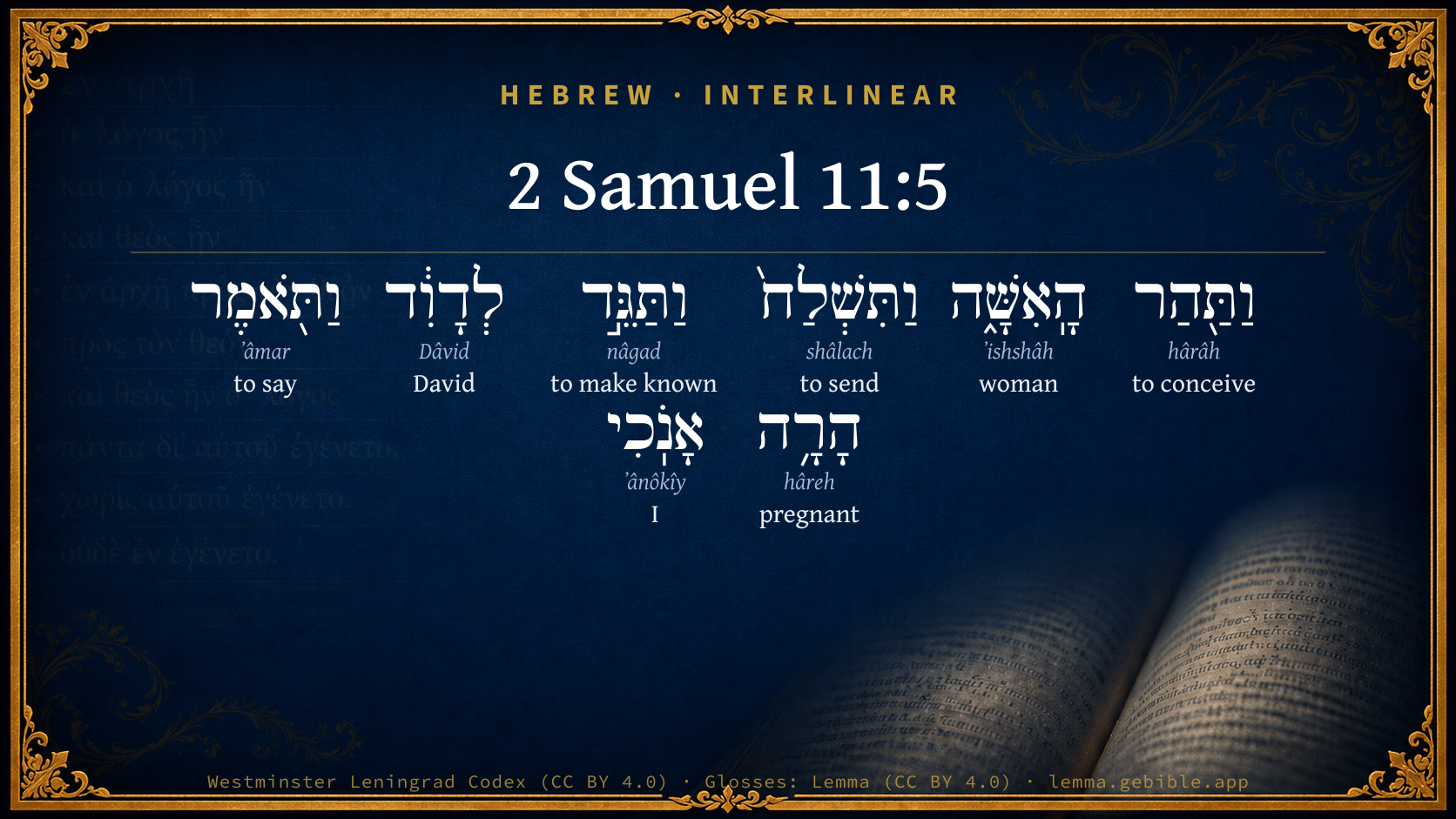
2 Samuel 11:5

Hebrew (Westminster Leningrad Codex) 2 Samuel 11:5 appears in the Hebrew Old Testament. The text above is from the Westminster Leningrad Codex. Each word links to its Strong’s number, a concise gloss, and parsing drawn from the Open Scriptures Hebrew Bible morphology. Click any word for its full Brown-Driver-Briggs (BDB) entry.
Download image
Cite this verse

2 Samuel 11:5 (World English Bible). Public Domain. Lemma interlinear Bible study tool, https://lemma.gebible.app/v/2-samuel/11/5.

Show BibTeX & RIS
BibTeX
RIS
English Translation
The woman conceived; and she sent and told David, and said, I am with child.
World English Bible · Public Domain
Download a study sheet

One document with this verse’s original text, its word-by-word gloss line, the meaning frame, cross-references with their text, attributed commentary, and full source and license credits — printable, and it pastes into notes with its structure intact.

This verse Autodidact and up

Study sheet (.html) Plain text (.txt)

A passage Seminary Student

Up to 50 verses in one chapter. A passage sheet keeps up to 6 commentary sources and 12 cross-references per verse, in the order this page ranks them, and says so on the sheet whenever that leaves anything out. Ask for a single verse and you get the Autodidact verse sheet above.

Everything on this page stays free to read, with no account — the sheet is a download of what is already on screen, not access to it.

Want to remove ads? Support Godless Engineer
Compare translations 3

The same verse in 3 English versions, stacked beneath the original-language interlinear above. Click any original word for its lexicon entry.

Each is an independent rendering of the whole verse — the interlinear is not word-aligned to these translations.

Highlighted words mark where these versions differ — a whole-verse word diff, not a word-by-word alignment.

  • World English Bible Public Domain
    The woman conceived; and she sent and told David, and said, I am with child.
  • King James Version Public Domain
    And the woman conceived, and sent and told David, and said, I am with child.
  • unfoldingWord Literal Text CC BY-SA 4.0
    And the woman became pregnant, and she sent and declared to David, and she said, “I pregnant.”

unfoldingWord Literal Text — © unfoldingWord, licensed CC BY-SA 4.0. Word-aligned USFM3 via Door43 (git.door43.org/unfoldingWord/en_ult).

Versions to compare (up to 4)

3 of 4 selected

Show all 18 translations

Every available English version of this verse, each an independent rendering of the whole verse.

  • World English Bible Public Domain
    The woman conceived; and she sent and told David, and said, I am with child.
  • Berean Standard Bible Public Domain
    And the woman conceived and sent word to David, saying, “I am pregnant.”
  • Majority Standard Bible Public Domain
    And the woman conceived and sent word to David, saying, “I am pregnant.”
  • King James Version Public Domain
    And the woman conceived, and sent and told David, and said, I am with child.
  • American Standard Version (1901) Public Domain
    And the woman conceived; and she sent and told David, and said, I am with child.
  • Revised Version (1885) Public Domain
    And the woman conceived; and she sent and told David, and said, I am with child.
  • Geneva Bible (1599) Public Domain
    And the woman conceiued: therefore shee sent and tolde Dauid, and sayd, I am with childe.
  • Douay-Rheims (1899) Public Domain
    And she returned to her house having conceived. And she sent and told David, and said: I have conceived.
  • Young's Literal Translation Public Domain
    and the woman conceiveth, and sendeth, and declareth to David, and saith, `I `am' conceiving.'
  • Literal Standard Version CC BY-SA 4.0
    and the woman conceives, and sends, and declares [it] to David, and says, “I [am] conceiving.”
  • Unlocked Literal Bible CC BY-SA 4.0
    The woman conceived, and she sent and told David; she said, “I am pregnant.”
  • unfoldingWord Literal Text CC BY-SA 4.0
    And the woman became pregnant, and she sent and declared to David, and she said, “I pregnant.”
  • Darby Bible Public Domain
    And the woman conceived, and sent and told David, and said, I am with child.
  • World Messianic Bible Public Domain
    The woman conceived; and she sent and told David, and said, “I am with child.”
  • Webster's Bible Public Domain
    And the woman conceived, and sent and told David, and said, I am with child.
  • Free Bible Version CC BY-SA 4.0
    Bathsheba became pregnant and sent a message to David to tell him, “I'm pregnant.”
  • Bible in Basic English Public Domain
    And the woman became with child; and she sent word to David that she was with child.
  • JPS Tanakh (1917) Public Domain
    And the woman conceived; and she sent and told David, and said: 'I am with child.'

Literal Standard Version (2020), Covenant Press — licensed CC BY-SA 4.0. Text via the HelloAO Bible API (eBible.org). Unlocked Literal Bible (unfoldingWord) — licensed CC BY-SA 4.0. Text via the HelloAO Bible API (eBible.org). unfoldingWord Literal Text — © unfoldingWord, licensed CC BY-SA 4.0. Word-aligned USFM3 via Door43 (git.door43.org/unfoldingWord/en_ult). Free Bible Version, Dr. Jonathan Gallagher — licensed CC BY-SA 4.0. Text via the HelloAO Bible API (eBible.org).

Word by word

More ways to search: Search by grammar → Find every occurrence → Compare this word →

Practice this passage: Drill this verse → Learn its vocabulary →

About this verse

These counts appear in no published source. They are computed here, from the morphology-tagged text and Lemma’s own curated glosses. What Lemma adds →

8
words
8
distinct lemmas
Historical
section

Notable vocabulary

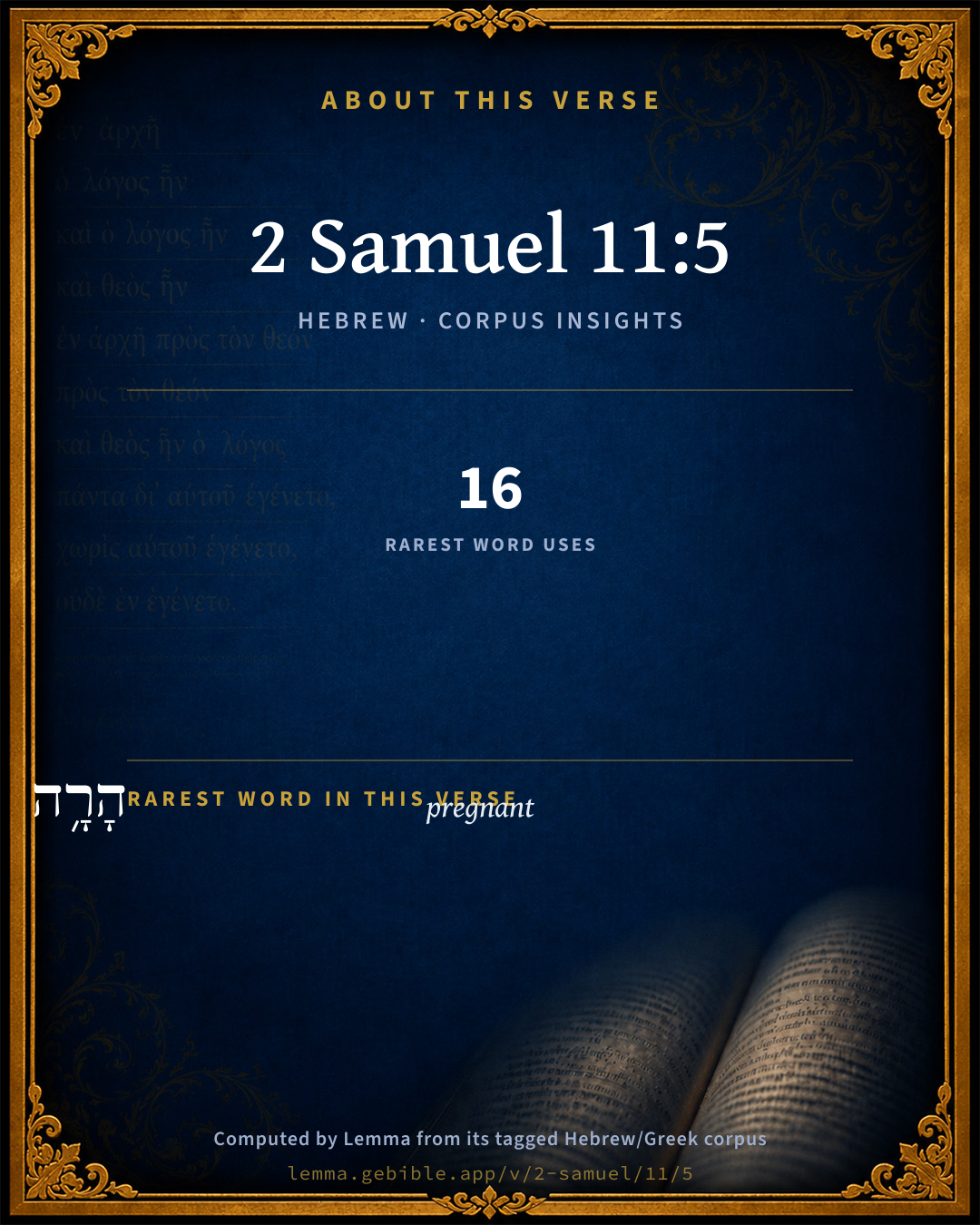
The rarest word here is הָרָ֥ה pregnant H2030 — appearing just 16 times in the whole Hebrew Bible.

Shared distinctive vocabulary

הָרָ֥ה pregnant H2030 occurs in 16 verses of the Hebrew Bible. Also found in:

Grammatical profile

  • 4 verbs
  • 2 nouns
  • 1 adjective
  • 1 pronoun

Verb forms

  • וַתַּ֖הַר Qal · Sequential Imperfect
  • וַתִּשְׁלַח֙ Qal · Sequential Imperfect
  • וַתַּגֵּ֣ד Hiphil · Sequential Imperfect
  • וַתֹּ֖אמֶר Qal · Sequential Imperfect

Hebrew & Septuagint length

In English translation the verse runs 15 words from the Hebrew and 16 from the Septuagint (LXX English) — closely comparable.

A rough comparison of the two English renderings, which tokenize alike — not a word-level alignment.

Word counts can differ between the Hebrew and the Greek without any difference in meaning — e.g. the Hebrew direct-object marker אֵת has no separate Greek word, and Greek often adds the article ὁ.

Cross-references

2

Topical passages linked to 2 Samuel 11:5 in the Treasury of Scripture Knowledge — connected by theme and wording, ordered by reader-vote popularity; previews shown in the World English Bible.

  • Deuteronomy 22:22 If a man be found lying with a woman married to a husband, then they shall both of them die, the man who lay with the woman, and the woman: so shall you put away the evil from Israel.
  • Proverbs 6:34 For jealousy arouses the fury of the husband. He won't spare in the day of vengeance.

Cross-references courtesy of OpenBible.info (CC BY 4.0).

Hebrew and Greek witnesses Masoretic Hebrew ↔ Greek Septuagint

The same verse in the two great witnesses to the Old Testament, shown verse-for-verse.

These are two independent witnesses, not word-aligned to each other, and the Septuagint is shown in lemma (dictionary) form.

Hebrew 2 Samuel 11:5 Masoretic · Westminster Leningrad Codex

וַתַּ֖הַר הָֽאִשָּׁ֑ה וַתִּשְׁלַח֙ וַתַּגֵּ֣ד לְדָוִ֔ד וַתֹּ֖אמֶר הָרָ֥ה אָנֹֽכִי

The woman conceived; and she sent and told David, and said, I am with child.

World English Bible · Public Domain

Greek LXX 2 Samuel 11:5 Septuagint · lemma form

καί ἐν γαστήρ λαμβάνω ὁ γυνή καί ἀποστέλλω ἀποἀγγέλλω ὁ δαυίδ καί εἶπον ἐγώ εἰμί ἐν γαστήρ ἔχω

And the woman conceived; and she sent and told David, and said, I am with child.

LXX2012 (modern English Septuagint) · Public Domain

Hebrew: Westminster Leningrad Codex (CC BY 4.0). Greek: Septuagint (public domain); English from LXX2012 (modern English Septuagint) (Public Domain). How the Septuagint differs from the Hebrew →

Targum (Aramaic paraphrase)

1

The Targum is the ancient Jewish Aramaic paraphrase of the Hebrew Scriptures — an interpretive translation, not the Hebrew text itself. Onkelos (literal) and Pseudo-Jonathan (expansive) render the Torah, and Jonathan the Prophets. Coverage is partial: where no permissively-licensed English translation exists for a verse, only the Aramaic is shown. This is verse-level text, not a word-by-word alignment to the Hebrew.

  1. Targum Jonathan Prophets (Joshua–Malachi)
    וְעַדִיאַת אִתְּתָא וּשְׁלָחַת וְחַוִיאַת לְדָוִד וַאֲמַרַת מְעַדְיָא אֲנָא:

    (no public-domain English translation for this verse)

    Targum Jonathan — Aramaic: “Mikraot Gedolot” (public domain). English: “Sefaria Community Translation” (CC0 1.0 (public-domain dedication)); “London "Chaldee Paraphrase," 1871” (public domain). Text via Sefaria.

Commentary

Notes on 2 Samuel 11:5 from classic Christian and Jewish commentators (each source and its license shown beneath its notes). The classic Christian expositions comment on the surrounding passage and are grouped to its opening verse, so a note may address several verses; the Jewish commentaries on the Tanakh (Rashi and others) are per-verse, so they appear only where the commentator wrote on this verse.

Lemma curates 59 commentaries, every one of them public domain or Creative Commons licensed, each selected and text-cleaned for this edition rather than reprinted as found. About our sources →

Trapp's Complete Commentary

John Trapp

2Sa 11:5 And the woman conceived, and sent and told David, and said, I [am] with child.

Ver. 5. And sent and told David.] Chrysostom saith, She went to David, and said, O king, I am undone, I am with child, the fruit of my sin buddeth, I carry an accuser within me, my betrayer is in my womb, my husband will slay me, &c. Whereupon that father inferreth, Videte et admiramini fratres, See here and admire, my brethren, what a mischief there is in sweet sins, what a happiness in freedom from foul offences. {a} Hoc curabat ne lapidaretur, saith Vatablus here. Now all her care was, lest she should be stoned to death, according to the law of God.

{a} Chrysost., in Psa 50:1-23.

John Trapp, A Commentary or Exposition upon All the Books of the Old and New Testament (1647–1656) — public domain. Text from a community e-Sword module.

Joseph Benson's Commentary

2Sa 11:5-6. The woman conceived, and sent and told David — She was afraid of infamy, and perhaps of the severity of her husband, who might cause her to be stoned. And therefore she prays David to consult her honour and safety. Send me Uriah the Hittite — It is likely David ordered an account of the state of the war to be sent by him, as a colour for having sent for him home.

Joseph Benson's Commentary on the Old and New Testaments (1811–1818) — public domain. Text from a community e-Sword module.

Geneva Bible (1599)

Geneva Bible translators

Fearing lest she should be stoned according to the Law.

Geneva Bible (1599) marginal notes — public domain. Text via Bolls.life.

Jamieson, Fausset & Brown

Robert Jamieson, A. R. Fausset & David Brown

the woman conceived, and sent and told David--Some immediate measures of concealing their sin were necessary, as well for the king's honor as for her safety, for death was the punishment of an adulteress (Lev 20:10).

Jamieson, Fausset & Brown — Commentary Critical and Explanatory on the Whole Bible (1871) — public domain (CC PDM 1.0). Text via the HelloAO Bible API.

Adam Clarke's Commentary

Verse 5. And the woman conceived] A proof of the observation on 2Sa 11:4; as that is the time in which women are most apt to conceive.

Adam Clarke's Commentary on the Bible (1810–1826) — public domain. Text from a community e-Sword/MySword module.

Ellicott's Commentary for English Readers

(5) Sent and told David.—Because her sin must now become known, and by the Law (Lev_20:10) adulterers must both be punished with death.

A Bible Commentary for English Readers, edited by Charles John Ellicott (1878–1897) — public domain. Text from a community e-Sword module.

The Cambridge Bible for Schools and Colleges

gen. ed. J. J. S. Perowne

5. sent and told David] That he might devise some plan to shield her from the consequences of her sin; for by the Mosaic law she was liable to be put to death (Lev_20:10). David accordingly sent for Uriah, in the hope that his return to his wife might cover the shame of his own crime.

The Cambridge Bible for Schools and Colleges (gen. ed. J. J. S. Perowne; Cambridge University Press, 1878–1918) — public domain. Text from a community e-Sword module.

John Gill's Exposition

And the woman conceived,.... Whereby the sin would be discovered, and shame, and disgrace, or worse, would follow upon it:

and sent and told David, and said, I am with child; this message she sent to David, that he might think of some ways and means to prevent the scandal that would fall both upon him and her, and the danger she was exposed unto; fearing the outcries of the people against her, in acting so unfaithful a part to her husband, so brave a man, who was now fighting for his king and country; and the rage and jealousy of her husband when he should come to the knowledge of it, and the death which by the law she was guilty of, even to be stoned with stones, see Joh 8:5.

John Gill's Exposition of the Whole Bible (1746–1763) — public domain (CC PDM 1.0). Text via the HelloAO Bible API.

Matthew Poole's English Annotations

Consider therefore what to do for thy own honour, and for my safety, whom thou hast brought into a most shameful and dangerous condition.

Matthew Poole's English Annotations on the Holy Bible (1683–1685) — public domain. Text from a community e-Sword/MySword module.

Whedon's Commentary on the Bible

Daniel D. Whedon

5. Sent and told David — The law required the death of both parties in the crime of adultery, (Lev_20:10,) and so, says Josephus, she admonished the king that he should contrive some way of concealing their guilt. This he at once set himself to do.

Daniel D. Whedon (gen. ed.), Commentary on the Old and New Testaments (1874–1909) — public domain. Text from a community e-Sword module.

The Pulpit Commentary

The woman told David. Her crime was one that made her liable to the penalty of death, (Lev_20:10) and Uriah was a man likely to exact it; consequently she was in great alarm, and the king shared her anxiety. Already was the punishment beginning to be required from both the guilty sharers in the wickedness.

Vers. 5-15. (JERUSALEM, RABBAH.)

Entanglements of sin.

He who once leaves the right path little knows how far he may go astray or how great will be his perplexities and perils. Possibly he may never return; certainly he will not return without overcoming immense difficulties, and finding out by bitter experience his folly and perversity.

The gates of hell are open night and day; Smooth the descent, and easy is the way; But to return and view the cheerful skies, In this the task and mighty labour lies. (Dryden"s "Virgil.")

Sin is commonly attended (as in the case of David) by

I GUILTY FEARS. After his sudden fall he probably felt some measure of compunction; but repressed the reproaches of conscience, and continued, in the view of men, the same as he had ever been. It is evident that, when the message (ver. 5) came to him, he was not truly penitent.

1. It awakened his fears concerning the possible exposure of his sin. Would not the wife of Uriah, on the return of her husband, be constrained. to declare the author of her shame?

2. His fears were intensified by the probable consquences of such exposure. Even if he should be able to save Bathsheba, and himself escape legal punishment, by virtue of his high position as the Lord"s anointed, how could he avert the private vengeance of Uriah, or maintain the confidence, affection, and allegiance of his army and people? What other Eastern monarchs did with impunity, could not be done by him in Israel without incurring the moral indignation of the people, and causing the enemies of the Lord to blaspheme.

3. He was impelled by his fears to use his utmost efforts with a view to the concealment of his sin. "And David sent to Joab, saying, Send me Uriah the Hittite" (ver. 6). His endeavour to hide his transgression "as Adam" (Job_31:33) was itself a tacit acknowledgment of its disreputable character. And "he that covereth his sins shall not prosper," etc. (Pro_28:13) Would that men, after their first wrong step, immediately confessed their error, made reparation, and returned to the way of truth and righteousness!

II FRUSTRATED DEVICES.

1. In their attempts at concealment men are wont to employ extraordinary ingenuity, (1Sa_18:17-30) and to hide their base designs under the cover of kindness (vers. 7-9).

2. Their crafty purposes are often defeated by simplicity and sincerity, beyond their calculation. "The ark," etc. (vers. 9-12). "This answer expressed the feelings and the consciousness of duty which ought to animate one who was fighting for the cause of God, in such plain and unmistakable terms, that it was well adapted to prick the king to the heart. But David"s soul was so beclouded by the wish to keep clear of the consequences of his sin in the eyes of the world, that he did not feel the sting, but simply made a still further attempt to attain his purpose with Uriah" (Keil).

3. Although defeated, their attempts are usually repeated (ver. 13), butonly to issue in greater disappointment, perplexity, and anxiety. The devices of sin are like a labyrinth, in which the sinner becomes more and more inextricably involved. They are like the meshes of a net, in which he becomes more and more hopelessly entangled.

III INCREASING CRIMINALITY. (Vers. 14, 15.) "He sent back the unsuspicious warrior to Babbah, to Joab, with a letter, which, under the name of "Uriah"s letter," has become notorious throughout the world. It was written with the same pen with which the sweet psalmist had written his psalms" (Krummacher).

1. The course of sin is downward into ever deeper moral abasement. "It is the nature of sin to multiply itself, and to draw the wretched sinner on to greater and greater enormities." Adultery was followed by

(1) deception,

(2) ingratitude,

(3) injustice,

(4) meanness,

(5) temptation (ver. 13; Hab_2:15)

(6) treachery,

(7) murder.

One sin another doth provoke; Murder"s as near to lust, as flame to smoke.

2. It is so because of its blinding, hardening, and enslaving power (2Pe_2:19; Pro_6:22) its delusive promises of good, its specious pleas of necessity, its urgent impulses to desperate expedients. "Such are the accursed entanglements of sin; such the workings and gradations of it in the distracted, bewildered breast that admits it. Millions have been lost in these Labyrinths of guilt; but none, sure, in any more intricate and perplexing than this!" (Delany).

3. Although it may be followed by apparent and temporary success, it cannot ultimately prosper. "The Lord shall reward," etc. (2 Samuel (Pro_11:21; Isa_5:18) "The means which David took to extricate himself from the complications in which his adultery involved him appeared well chosen; but there was one thing he had not taken into consideration that he could not here, as in former embarassments, confidently expect the assistance of God. It was God"s design that David"s sin should be fully manifested, for only in this way was perfect cure possible, and therefore he suffered the means to fail" (Hengstenberg). D.

The Pulpit Commentary (1880–1919), ed. H.D.M. Spence-Jones & Joseph S. Exell — public domain. Text from a community e-Sword module.

Lesson kit

Teaching starters — assembled from the data on this page, not authored interpretation. Every prompt links to the verse data it draws on. Edit before teaching.

2 Samuel, in the Historical, opens this verse with 8 words (8 distinct Hebrew lemmas). Its most distinctive word is hâreh (“pregnant”). A historical commentator’s framing appears above. Read the whole chapter for the surrounding context.

Discussion questions

  1. How does “pregnant” (hâreh) shape what this verse is saying?
  2. Genesis 16:11 shares the word «pregnant» with this verse. How do the two illuminate each other?
  3. These translations render this verse differently. What is at stake in choosing one wording over another?
  4. The verb «וַתַּ֖הַר» is Qal Sequential Imperfect. How does its form color the action?
  5. Reading how Trapp's Complete Commentary and Joseph Benson's Commentary read this verse, where do the two commentators agree and where do they part?

Things to notice

Reading settings

Reading text

Shown beneath each verse's original-language words.

Old Testament
Old Testament edition

Read the OT as the Masoretic Hebrew (MT) or the Greek Septuagint (LXX).

English shown for the Greek Septuagint (in the Hebrew ↔ Greek comparison).

Comparing translations? Open the Compare panel on any verse page to stack up to four side by side.