Galatians 4:27

Greek (Tischendorf 8th ed.) Galatians 4:27 appears in the Greek New Testament. The text above is from the Tischendorf 8th edition. Each word links to its Strong’s number and a concise gloss. Click any word for its full Thayer’s Greek Lexicon entry.
Download image
Cite this verse

Galatians 4:27 (World English Bible). Public Domain. Lemma interlinear Bible study tool, https://lemma.gebible.app/v/galatians/4/27.

Show BibTeX & RIS
BibTeX
RIS
English Translation
For it is written, "Rejoice, you barren who don't bear. Break forth and shout, you that don't travail. For more are the children of the desolate than of her who has a husband."
World English Bible · Public Domain
Download a study sheet

One document with this verse’s original text, its word-by-word gloss line, the meaning frame, cross-references with their text, attributed commentary, and full source and license credits — printable, and it pastes into notes with its structure intact.

This verse Autodidact and up

Study sheet (.html) Plain text (.txt)

A passage Seminary Student

Up to 50 verses in one chapter. A passage sheet keeps up to 6 commentary sources and 12 cross-references per verse, in the order this page ranks them, and says so on the sheet whenever that leaves anything out. Ask for a single verse and you get the Autodidact verse sheet above.

Everything on this page stays free to read, with no account — the sheet is a download of what is already on screen, not access to it.

Want to remove ads? Support Godless Engineer
Compare translations 3

The same verse in 3 English versions, stacked beneath the original-language interlinear above. Click any original word for its lexicon entry.

Each is an independent rendering of the whole verse — the interlinear is not word-aligned to these translations.

Highlighted words mark where these versions differ — a whole-verse word diff, not a word-by-word alignment.

  • World English Bible Public Domain
    For it is written, "Rejoice, you barren who don't bear. Break forth and shout, you that don't travail. For more are the children of the desolate than of her who has a husband."
  • King James Version Public Domain
    For it is written, Rejoice, thou barren that bearest not; break forth and cry, thou that travailest not: for the desolate hath many more children than she which hath an husband.
  • unfoldingWord Literal Text CC BY-SA 4.0
    For it is written, “Rejoice, you barren woman, the one not giving birth; break forth and shout, you not suffering the pains of childbirth; because the children of the desolate one many more than of the one having a husband.”

unfoldingWord Literal Text — © unfoldingWord, licensed CC BY-SA 4.0. Word-aligned USFM3 via Door43 (git.door43.org/unfoldingWord/en_ult).

Versions to compare (up to 4)

3 of 4 selected

Show all 19 translations

Every available English version of this verse, each an independent rendering of the whole verse.

  • World English Bible Public Domain
    For it is written, "Rejoice, you barren who don't bear. Break forth and shout, you that don't travail. For more are the children of the desolate than of her who has a husband."
  • Berean Standard Bible Public Domain
    For it is written: “Rejoice, O barren woman, who bears no children; break forth and cry aloud, you who have never travailed; because more are the children of the desolate woman than of her who has a husband.”
  • Majority Standard Bible Public Domain
    For it is written: “Rejoice, O barren woman, who bears no children; break forth and cry aloud, you who have never travailed; because more are the children of the desolate woman than of her who has a husband.”
  • King James Version Public Domain
    For it is written, Rejoice, thou barren that bearest not; break forth and cry, thou that travailest not: for the desolate hath many more children than she which hath an husband.
  • American Standard Version (1901) Public Domain
    For it is written, Rejoice, thou barren that bearest not; Break forth and cry, thou that travailest not: For more are the children of the desolate than of her that hath the husband.
  • Revised Version (1885) Public Domain
    For it is written, Rejoice, thou barren that bearest not; Break forth and cry, thou that travailest not: For more are the children of the desolate than of her which hath the husband.
  • Geneva Bible (1599) Public Domain
    For it is written, Reioyce thou barren that bearest no children: breake forth, and cry, thou that trauailest not: for the desolate hath many moe children, then she which hath an husband.
  • Douay-Rheims (1899) Public Domain
    For it is written: Rejoice, thou barren, that bearest not: break forth and cry, thou that travailest not: for many are the children of the desolate, more than of her that hath a husband.
  • Young's Literal Translation Public Domain
    for it hath been written, `Rejoice, O barren, who art not bearing; break forth and cry, thou who art not travailing, because many `are' the children of the desolate -- more than of her having the husband.'
  • Literal Standard Version CC BY-SA 4.0
    for it has been written: “Rejoice, O barren, who is not bearing; break forth and cry, you who are not travailing, because many [are] the children of the desolate—more than of her having the husband.”
  • Unlocked Literal Bible CC BY-SA 4.0
    For it is written, “Rejoice, you barren one who does not give birth; cry out and shout for joy, you who are not suffering the pains of childbirth; because the children of the abandoned woman are more numerous than those of the woman who has a husband.”
  • unfoldingWord Literal Text CC BY-SA 4.0
    For it is written, “Rejoice, you barren woman, the one not giving birth; break forth and shout, you not suffering the pains of childbirth; because the children of the desolate one many more than of the one having a husband.”
  • Darby Bible Public Domain
    For it is written, Rejoice, thou barren that bearest not; break out and cry, thou that travailest not; because the children of the desolate are more numerous than [those] of her that has a husband.
  • World Messianic Bible Public Domain
    For it is written, “Rejoice, you barren who don’t bear. Break out and shout, you who don’t travail. For the desolate women have more children than her who has a husband.”
  • Webster's Bible Public Domain
    For it is written, Rejoice, thou barren that bearest not; break forth and cry, thou that travailest not: for the desolate hath many more children than she who hath a husband.
  • Free Bible Version CC BY-SA 4.0
    As Scripture says, “Rejoice you who are childless and who have never given birth! Shout aloud for joy, you who have never been in labor—for the abandoned woman has more children than the woman who has a husband!”
  • Bible in Basic English Public Domain
    For it is in the Writings, You who have never given birth, be glad; give cries of joy, you who have had no birth-pains; for the children of her who has been given up by her husband are more than those of the woman who has a husband.
  • Text-Critical English NT CC BY 4.0
    For it is written, “Rejoice, O barren woman, who has never given birth; break forth and shout, yoʋ who have never been in labor! For many are the children of the desolate woman, more than those of the woman who has a husband.”
  • Tyndale New Testament (1534) Public Domain
    For it is written: reioyce thou bare that bearest no chyldre: breake forthe and crye thou that travelest not. For the desolate hath many moo chyldren then she which hath an husband.

Literal Standard Version (2020), Covenant Press — licensed CC BY-SA 4.0. Text via the HelloAO Bible API (eBible.org). Unlocked Literal Bible (unfoldingWord) — licensed CC BY-SA 4.0. Text via the HelloAO Bible API (eBible.org). unfoldingWord Literal Text — © unfoldingWord, licensed CC BY-SA 4.0. Word-aligned USFM3 via Door43 (git.door43.org/unfoldingWord/en_ult). Free Bible Version, Dr. Jonathan Gallagher — licensed CC BY-SA 4.0. Text via the HelloAO Bible API (eBible.org).

Word by word

More ways to search: Search by grammar → Find every occurrence → Compare this word →

Practice this passage: Drill this verse → Learn its vocabulary →

ὠδίνουσα
ōdínō
G5605
“to travail”
Verb, Present, Active, Participle, Nominative, Singular, Feminine
Part of Speech
Verb
Tense
Present
Voice
Active
Mood
Participle
Case
Nominative
Number
Singular
Gender
Feminine
Full Thayer's Definition

Origin: from G5604

TDNT: 20:07,1

1. to feel the pains of child birth, to travail
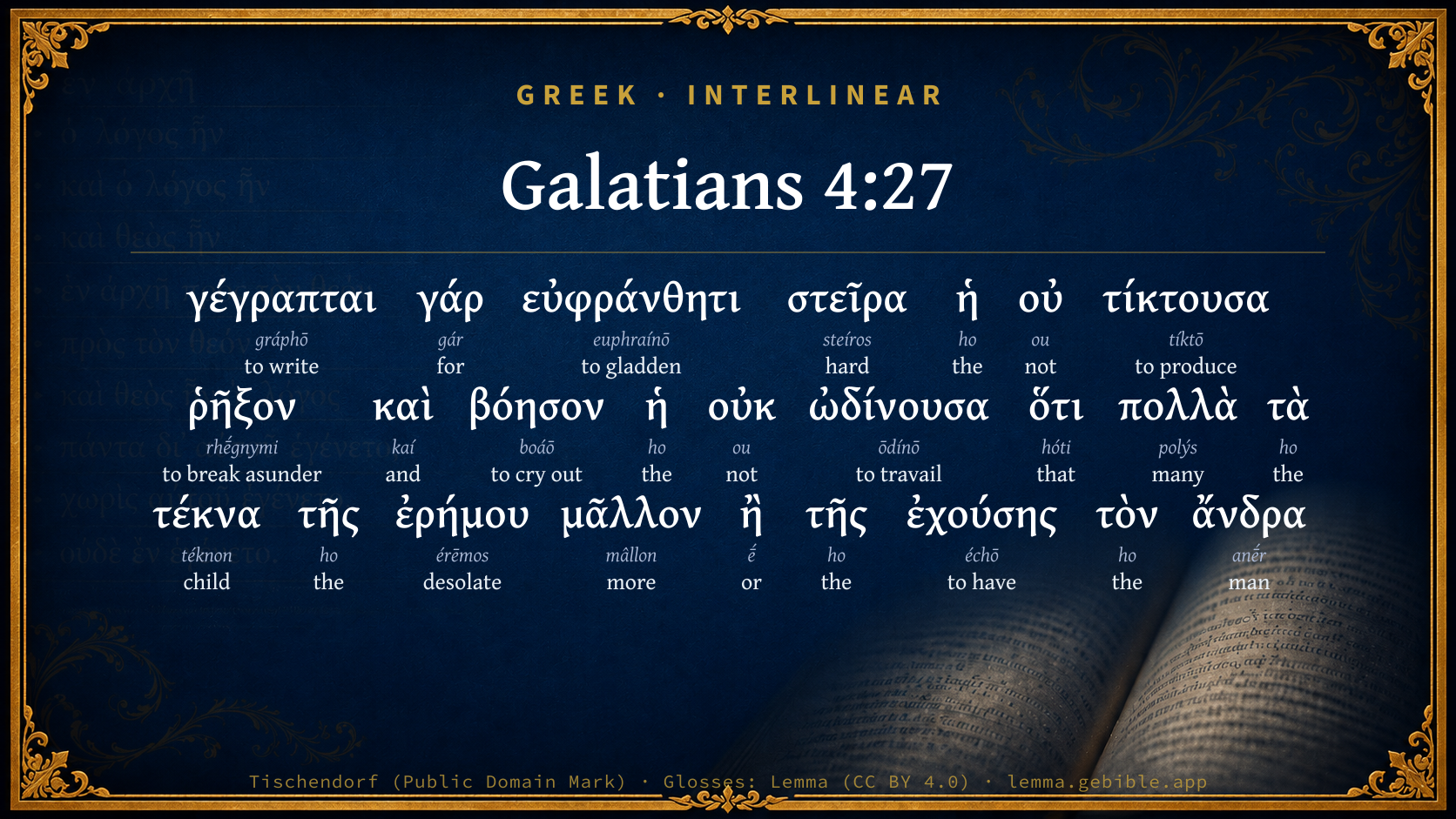
  1. γέγραπται gráphō G1125 “to write” Verb, Perfect, Passive, Indicative, 3rd person, Singular
  2. γάρ gár G1063 “for” Conjunction
  3. εὐφράνθητι euphraínō G2165 “to gladden” Verb, Aorist, Passive, Imperative, 2nd person, Singular
  4. στεῖρα steíros G4723 “hard” Noun, Vocative, Singular, Feminine
  5. ἡ ho G3588 “the” Article, Nominative, Singular, Feminine
  6. οὐ ou G3756 “not” Particle, Negative
  7. τίκτουσα tíktō G5088 “to produce” Verb, Present, Active, Participle, Nominative, Singular, Feminine
  8. ῥῆξον rhḗgnymi G4486 “to break asunder” Verb, Aorist, Active, Imperative, 2nd person, Singular
  9. καὶ kaí G2532 “and” Conjunction
  10. βόησον boáō G994 “to cry out” Verb, Aorist, Active, Imperative, 2nd person, Singular
  11. ἡ ho G3588 “the” Article, Nominative, Singular, Feminine
  12. οὐκ ou G3756 “not” Particle, Negative
  13. ὅτι hóti G3754 “that” Conjunction
  14. πολλὰ polýs G4183 “many” Adjective, Nominative, Plural, Neuter
  15. τὰ ho G3588 “the” Article, Nominative, Plural, Neuter
  16. τέκνα téknon G5043 “child” Noun, Nominative, Plural, Neuter
  17. τῆς ho G3588 “the” Article, Genitive, Singular, Feminine
  18. ἐρήμου érēmos G2048 “desolate” Adjective, Genitive, Singular, Feminine
  19. μᾶλλον mâllon G3123 “more” Adverb
  20. ἢ ḗ G2228 “or” Particle
  21. τῆς ho G3588 “the” Article, Genitive, Singular, Feminine
  22. ἐχούσης échō G2192 “to have” Verb, Present, Active, Participle, Genitive, Singular, Feminine
  23. τὸν ho G3588 “the” Article, Accusative, Singular, Masculine
  24. ἄνδρα anḗr G435 “man” Noun, Accusative, Singular, Masculine

About this verse

These counts appear in no published source. They are computed here, from the morphology-tagged text and Lemma’s own curated glosses. What Lemma adds →

25
words
19
distinct lemmas
Pauline Epistles
section

Notable vocabulary

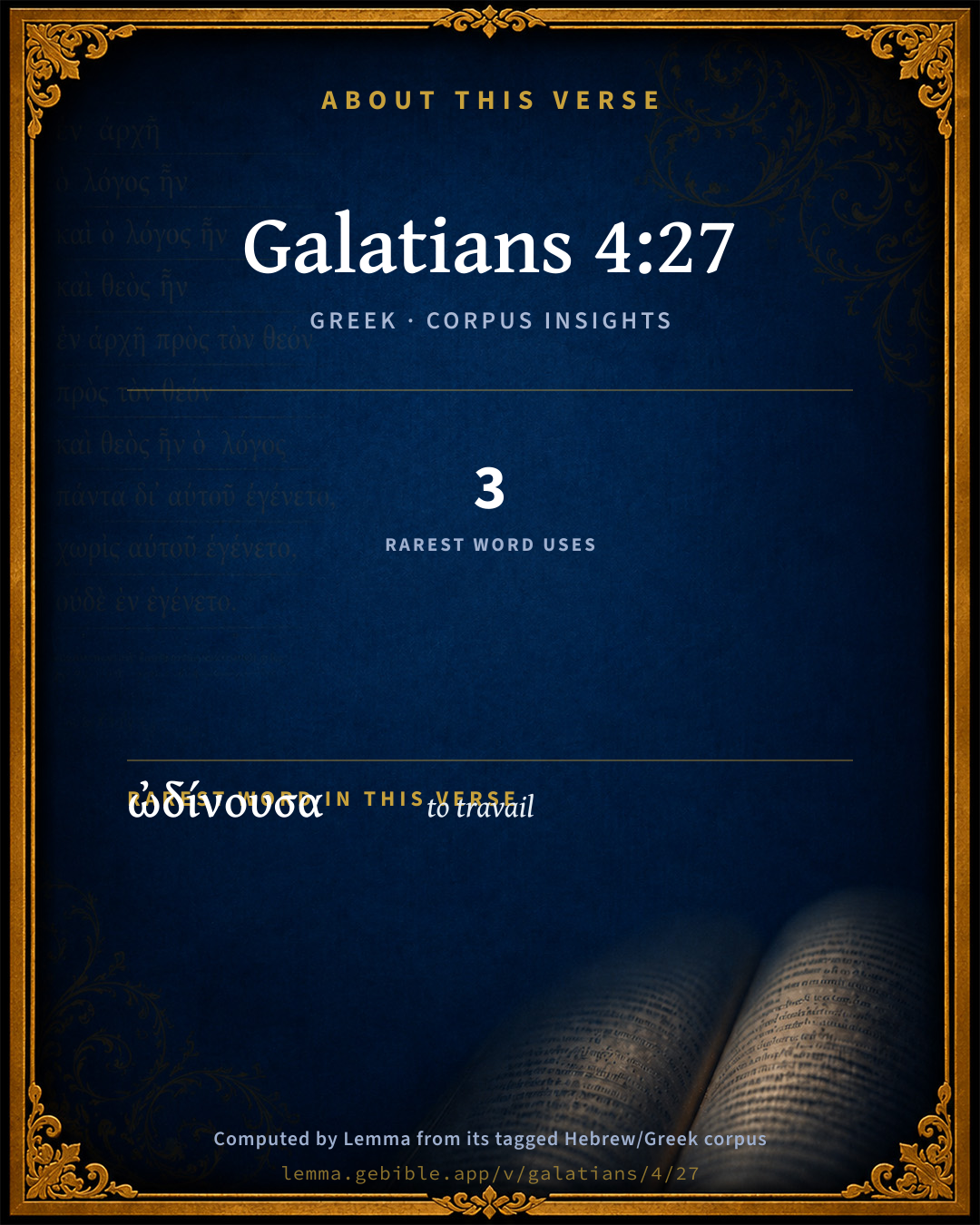
The rarest word here is ὠδίνουσα to travail G5605 — appearing just 3 times in the whole Greek New Testament.

Shared distinctive vocabulary

ὠδίνουσα to travail G5605 occurs in 3 verses of the Greek New Testament. Also found in:

Repetition

Words recur within this verse:

Cross-references

8

Topical passages linked to Galatians 4:27 in the Treasury of Scripture Knowledge — connected by theme and wording, ordered by reader-vote popularity; previews shown in the World English Bible.

  • Isaiah 54:1–5 Sing, barren, you who didn't bear; break forth into singing, and cry aloud, you who did not travail with child: for more are the children of the desolate than the children of the married wife, says Yahweh.
  • Psalms 113:9 He settles the barren woman in her home, As a joyful mother of children. Praise Yah!
  • Ruth 4:14–16 The women said to Naomi, Blessed be Yahweh, who has not left you this day without a near kinsman; and let his name be famous in Israel.
  • 1 Samuel 2:5 Those who were full have hired out themselves for bread; Those who were hungry have ceased [to hunger]: Yes, the barren has borne seven; She who has many children languishes.
  • Ruth 1:11–13 Naomi said, Turn again, my daughters: why will you go with me? have I yet sons in my womb, that they may be your husbands?
  • 1 Timothy 5:5 Now she who is a widow indeed, and desolate, has her hope set on God, and continues in petitions and prayers night and day.
  • 2 Samuel 13:20 Absalom her brother said to her, Has Amnon your brother been with you? but now hold your peace, my sister: he is your brother; don't take this thing to heart. So Tamar remained desolate in her brother Absalom's house.
  • Isaiah 49:21 Then shall you say in your heart, Who has conceived these for me, seeing I have been bereaved of my children, and am solitary, an exile, and wandering back and forth? and who has brought up these? Behold, I was left alone; these, where were they?

Cross-references courtesy of OpenBible.info (CC BY 4.0).

Commentary

Notes on Galatians 4:27 from classic Christian and Jewish commentators (each source and its license shown beneath its notes). The classic Christian expositions comment on the surrounding passage and are grouped to its opening verse, so a note may address several verses; the Jewish commentaries on the Tanakh (Rashi and others) are per-verse, so they appear only where the commentator wrote on this verse.

Lemma curates 59 commentaries, every one of them public domain or Creative Commons licensed, each selected and text-cleaned for this edition rather than reprinted as found. About our sources →

The Biblical Illustrator

Joseph S. Exell

Gal_4:27-28

Rejoice, thou barren, that bearest not.

Rejoice, thou barren

I. The Church in her sadness.

1. The figure is drawn from the closest tie that nature knows, that of marriage relationship, and teaches that as both male and female are incomplete without each other, so the happiness of God is incomplete without the love of the creature He has made to love Him.

2. The picture, however, is that of a wife whose husband has forsaken her. She is

(1) barren, desolate, and therefore

(2) sorrowful.

3. This applies to the Hebrew Church.

II. The Church in her gladness.

1. Restrictions between Jew and Gentile broken down.

2. Arbitrary barriers of race and rank and law are removed.

3. All nations are redeemed and gathered into a common salvation. (C. Clemance, D. D.)

Songs for desolate hearts

Take the text to refer--

I. To the Church of God.

1. For a long season before the Advent the Church was desolate.

2. During Christs temporal stay with her her condition was not much better.

3. Suddenly after His departure, on the Day of Pentecost, she became fruitful.

4. And continued fruitful (luring the whole apostolic age.

Notice--

1. That at all seasons when the Church has been desolate and barren God has appeared to her.

(1) In the dark ages the Church was barren, but the Lord appeared through Luther, and she became fruitful.

(2) In the last century the Church was barren, but God appeared and made her fruitful through the Wesleys and Whitefield.

2. That in the present age of comparative barrenness we may expect revival.

II. To any one church.

1. There are some separate Churches that are in a sad condition, with a lifeless ministry, worldly officers, and declining membership.

2. What is the present duty of members of such Churches?

(1) Labour to be conscious of your state, of its evil and danger.

(2) Pray earnestly for revival.

(3) Do all you can personally to bring it about.

III. To the poor, helpless sinner.

1. His fruitlessness.

2. Desolation.

3. Help in Christ.

4. Trust in Him, and He will make thee fruitful.

IV. To the depressed believer.

1. Barrenness is the platform of Divine power.

2. Desolation the setting for Gods everlasting love.

V. To those Christians who have not been successful in doing good.

1. It is good for you while you are barren to feel desolate.

2. But you may be barren only in your own esteem.

3. Wait, and toil on, for in due season you will reap if you faint not.

4. If your barrenness is real let it humble you, but repair to the source of fruitfulness. (C. H. Spurgeon.)

Christianity not a failure

While Christianity is speaking in languages more numerous, by tongues more eloquent, in nations more populous than ever before: marshalling better troops with richer harmony; shrinking from no foe, rising triumphant from every conflict; shaking down the towers of old philosophies that exalt themselves against God; making the steam press rush under the demand for her Scriptures, and the steam horse groan under the weight of her charities; emancipating the enslaved, civilizing the lawless, refining literature, inspiring poetry; sending forth art and science no longer clad in soft raiment to linger in kings palaces, but as hardy prophets of God to make earth bud and blossom as the rose; giving God-like breadth and freedom and energy to the civilization that bears its name, elevating savage islands into civilized states, leading forth Christian martyrs from the mountains of Madagascar, turning the clubs of cannibals into the railings of the altars before which Fiji savages call upon Jesus; repeating the Pentecost by many an ancient river and many a palmy plain; thundering at the seats of ancient Paganism; sailing all waters, cabling all oceans, scaling all mountains in the march of its might, and ever enlarging the diameter of those circles of light which it has kindled on earth, and which will soon meet in a universal illumination--you call it a failure! A little more such failure and we shall have, over all the globe, the new heavens and the new earth wherein dwelleth righteousness. (E. Thompson.)

The enlargement of the Church

I. Depends on the promise--made to Abraham and secured in Christ--is effected by the Spirit--realized in the children of promise (Gal_4:28).

II. Is certain--because the revealed purpose of God--which must surmount all the difficulties of barrenness and apparent desolation.

III. Will be glorious--surpassing all experience--hope--faith.

IV. Will be a source of unspeakable joy- to all believers- to the world at large. (J. Lyth.)

The children of promise

I. The resemblance of the Gentile Christians to Isaac.

1. They had been promised.

2. They had been begotten (spiritually) by a supernatural and extraordinary operation.

II. The spiritual character of the promise.

1. It appealed to faith.

2. Its fulfilment was by Divine grace.

III. The dignity and privilege of the relation it creates. The relation is--

1. Immediate.

2. Vital.

3. Spiritual. (A. F. Muir, M. A.)

The Biblical Illustrator, edited by Joseph S. Exell (c. 1880s–1900s) — public domain. Text from a community e-Sword module.

Tyndale Open Study Notes

Tyndale Open Resources

4:27 The quoted passage, Isa 54:1, promised Israel that they would be fruitful after the Exile. Because those who have faith in Christ are Sarah’s children (Gal 4:26), they fulfill the promise that Sarah (the childless woman) would be more abundantly fruitful than the slave-wife Hagar. To the Judaizers, those who don’t follow the law may have been considered “barren,” but through faith they are abundantly fruitful as the bride of Christ (2 Cor 11:2; Eph 5:31-33).

Tyndale Open Study Notes — © Tyndale Open Resources, licensed CC BY-SA 4.0. Text via the HelloAO Bible API.

Bengel's Gnomon

Johann Albrecht Bengel

Gal 4:27. Γέγραπται, it is written) Isa 54:1—εὐφράνθητι, rejoice) with singing.—στεῖρα, barren) Sion, Jerusalem above.—ῥῆξον, break forth) into crying.—καὶ βόησον, and shout) for joy.—τῆς ἐρήμου, of the desolate) i.e. The New Testament Church, collected for the most part from the Gentiles, who had not [answering to τῆς ἐρήμου, the desolate] the promise; and as this New Testament Church was made up of those who heretofore were seen to have had no such aims, it is called “not bearing,” “not travailing,”—τῆς ἐχούσης, than she who hath) the Jewish Church.

Bengel's Gnomon of the New Testament — English translation (T&T Clark, Edinburgh, 1860) — public domain. Text from a community e-Sword module.

Meyer's Critical & Exegetical Commentary

Heinrich August Wilhelm Meyer

Gal_4:27. Proof from Scripture[221] that no other than this, the free Jerusalem (ἥτις), is our mother. This, namely, is according to Paul the subject addressed, the unfruitful one, because Sarahwho, according to the allegory, answers to the heavenly Jerusalemwas, as is well known, barren. The historical sense of the prophecy (Isa_54:1, exactly according to the LXX.) is the joyful promise of a great increase to the depressed people of God in its state of freedom after the Babylonian exile. The desolate, uninhabited Jerusalem, which had become like an unfruitful wife, is summoned to rejoice, because itand in this light, certainly, it is poetically compared with itself as a second person (in opposition to Hofmann)is to become more populous, more rich in children, than formerly, when it was the husband-possessing spouse (of Jehovah). The fulfilment of this Messianic prophecy

Messianic because pervaded by the idea of the victorious theocracyis discerned by Paul in the great new people of God, which belongs to the ἄνω Ἱερουσαλήμ, to this Sarah in the sense of the fulfilment, as its mother. Before the emergence of the Christian people of God, this heavenly Jerusalem was still unpeopled, childless; it was ΣΤΕῖΡΑ, Οὐ ΤΊΚΤΟΥΣΑ, ΟὐΚ ὨΔΊΝΟΥΣΑ, ἜΡΗΜΟς (solitaria, that is, in conformity with the contrast: without conjugal intercourse), consequently quite the Sarah of the allegory, before she became the mother of Isaac. But in and with the emergence of the Christian people of God, the ἄνω Ἱερουσαλήμ has become a fruitful mother, rejoicing over her wealth of children, richer in children than Ἡ ΝῦΝ ἹΕΡΟΥΣΑΛΉΜ, this mother of the ancient people of God, which hitherto, like Hagar, had been בְעוּלָה, Ἡ ἜΧΟΥΣΑ ΤῸΝ ἌΝΔΡΑ. This ἈΝΉΡ is God (not the law, as Luther interprets), whose relation to the theocratical commonwealth of the old covenant is conceived as conjugal intercourse. In virtue of this idea, the relation of God to the ΝῦΝ ἹΕΡΟΥΣΑΛΉΜthe latter regarded as a woman Ἡ ἜΧΟΥΣΑ ΤῸΝ ἌΝΔΡΑis the counterpart of the relation of Abraham to the ΠΑΙΔΊΣΚΗ Hagar, whose descendants came into life ΚΑΤᾺ ΣΆΡΚΑ. On the other hand, the relation of God to the ἌΝΩ ἹΕΡΟΥΣΑΛΉΜthe latter likewise regarded as a woman, who, however, had hitherto been ΣΤΕῖΡΑ Κ.Τ.Λ.is the counterpart of the relation of Abraham to the free Sarah, whose far more numerous descendants were children of promise (Gal_4:28). Comp. Rom_9:8.

Ἡ Οὐ ΤΊΚΤΟΥΣΑ] not for the past participle (Grotius and others), but expressing the state of the case as it stands: which does not bear, the consequence of στεῖρα, sterilis, unfruitful, as Sara was עֲקָרָה. In the same way afterwards, Ἡ ΟὐΚ ὨΔΊΝΟΥΣΑ.

ῬῆΞΟΝ] ΦΩΝΉΝ is usually supplied. For many instances of ῥήγνυμι φωνήν or αὐδήν (Eur. Suppl. 710), to unchain the voice, that is, to speak aloud, see Wetstein, in loc.; Loesner, Obss. p. 333; Jacobs, ad Anthol. X. p. 385, XI. p. 57, XII. p. 131. Comp. the Latin rumpere vocem (Drakenborch, ad Sil. It. iv. 528). But since the verb alone is never thus used, it is safer to derive the supplement from what has preceded; hence Kypke and Schott correctly supply εὐφροσύνην (rumpe jubilum, begin to rejoice), not because פִּצְחִי רִנָּה stands in the Hebrew (Schott), but because ΕὐΦΡΟΣΎΝΗΝ flows from the previous ΕὐΦΡΆΝΘΗΤΙ;[222] rejoice, let it break forth. The opposite is ῥήγνυμι κλαυθμόν (Plut. Per. 36), ῬΉΓΝ. ΔΑΚΡΎΩΝ ΝΆΜΑΤΑ (Soph. Trach. 919).

στεῖρα κ.τ.λ.] applies in the connection of the original text to Jerusalem, and is also here necessarily (see Gal_4:26)according to the Messianic fulfilment of the prophecy, in the light of which Paul apprehends the Scriptural sayingto be referred to Jerusalem, but to the ἄνω Ἱερουσαλήμ, ἥτις ἐστὶ μήτηρ ἡμῶν, whereas the ἡ ἔχουσα τὸν ἄνδρα which is placed in comparison with it is the νῦν Ἱερουσαλήμ. See above. Chrysostom and his successors, Bengel and others, consider that the words στεῖρα κ.τ.λ. apply to the Gentile Christians (she who had the husband being the Jewish church); but against this view it may be urged that that ἥτις ἐστὶ μήτηρ ἡμῶν, which refers to all Christians, is to be proved by Gal_4:27.

ΠΟΛΛᾺ … ΜᾶΛΛΟΝ Ἤ] not used instead of ΠΛΕΊΟΝΑ Ἤ, which would leave the multitude of children entirely undetermined; but it affirms that both had many children,the solitary one, however, the greater number: for numerous are the children of the solitary one in a higher degree than those of her who possessed the husband. So the LXX. has rightly understood the Hebrew רַבִּים מִבְּנֵי.

[221] For this Scriptural proof, the particular passage Isa_54:1 is selected with great skill and true tact, since the ἄνω Ἱερουσαλήμ is the allegorical counterpart of Sarah, this στεῖρα ἡ οὐ τίκτουσα κ.τ.λ.

[222] The LXX. probably did not read רִנָּה.

Meyer — Critical and Exegetical Commentary on the New Testament — English translation by Peter Christie, edited by Frederick Crombie (T&T Clark, 1880) — public domain. Text from a community e-Sword module.

Expositor's Greek Testament

ed. W. Robertson Nicoll

Gal 4:27 . The prophecy of Isa 54:1 , here quoted from the LXX, describes the restoration of Zion, the enlargement of her borders and increase of her people, under the figure of a wife long neglected and barren, but now restored to the favour of her husband and fruitful in children. This picture was perhaps suggested to the prophet by the history of Sarah’s prolonged barrenness before she became the fruitful mother of Israel, and is peculiarly appropriate for describing the long delayed but fertile growth of the Christian Church, of which she was the typical mother.

The Expositor's Greek Testament, edited by W. Robertson Nicoll (1897–1910) — public domain. Text from a community e-Sword module.

Geneva Bible (1599)

Geneva Bible translators

She that is destroyed and wasted.

He showeth that in this allegory, he hath followed the steps of Isaiah, who foretold that the Church should be made and consist of the children of barren Sarah, that is to say, of them which only spiritually should be made Ahraham’s children by faith, rather than of fruitful Hagar, even then foreshowing the casting off of the Jews, and calling of the Gentiles.

Geneva Bible (1599) marginal notes — public domain. Text via Bolls.life.

Jamieson, Fausset & Brown

Robert Jamieson, A. R. Fausset & David Brown

(Isa 54:1).

thou barren--Jerusalem above: the spiritual Church of the Gospel, the fruit of "the promise," answering to Sarah, who bore not "after the flesh": as contrasted with the law, answering to Hagar, who was fruitful in the ordinary course of nature. Isaiah speaks primarily of Israel's restoration after her long-continued calamities; but his language is framed by the Holy Spirit so as to reach beyond this to the spiritual Zion: including not only the Jews, the natural descendants of Abraham and children of the law, but also the Gentiles. The spiritual Jerusalem is regarded as "barren" while the law trammeled Israel, for she then had no spiritual children of the Gentiles.

break forth--into crying.

cry--shout for joy.

many more--Translate as Greek, "Many are the children of the desolate (the New Testament Church made up in the greater part from the Gentiles, who once had not the promise, and so was destitute of God as her husband), more than of her which hath an (Greek, 'THE') husband (the Jewish Church having GOD for her husband, Isa 54:5; Jer 2:2)." Numerous as were the children of the legal covenant, those of the Gospel covenant are more so. The force of the Greek article is, "Her who has THE husband of which the other is destitute."

Jamieson, Fausset & Brown — Commentary Critical and Explanatory on the Whole Bible (1871) — public domain (CC PDM 1.0). Text via the HelloAO Bible API.

Adam Clarke's Commentary

Verse 27. Rejoice, thou barren that bearest not] This quotation is taken from Isa 54:1, and is certainly a promise which relates to the conversion of the Gentiles, as the following clause proves; for the desolate - the Gentile world, hath many more children - is a much larger and more numerous Church, than she - Jerusalem, the Jewish state, which hath a husband - has been so long in covenant with God, living under his continual protection, and in possession of a great variety of spiritual advantages; and especially those offered to her by the Gospel, which she has rejected, and which the Gentiles have accepted.

Adam Clarke's Commentary on the Bible (1810–1826) — public domain. Text from a community e-Sword/MySword module.

John Calvin's Commentaries

27. For it is written. The apostle proves, by a quotation from Isaiah, that the lawful sons of the Church are born according to the promise. The passage is in Isaiah 54 where the prophet speaks of the kingdom of Christ and the calling of the Gentiles, and promises to the barren wife and the widow a numerous offspring; for it is on this ground that he exhorts the Church to “sing” and “rejoice.” The design of the apostle, let it be carefully remarked, is to deprive the Jews of all claim to that spiritual Jerusalem to which the prophecy relates. Isaiah proclaims, that her children shall be gathered out of all the nations of the earth, and not by any preparation of hers, but by the free grace and blessing of God.

He next concludes that we become the sons of God by promise, after the example (κατὰ ᾿Ισαὰκ) of Isaac, and that in no other way do we obtain this honor. To readers little skilled or practiced in the examination of Scripture, this reasoning may appear inconclusive; because they do not hold the most undoubted of all principles, that all the promises, being founded on the Messiah, are of free grace. It was because the apostle took this for granted, that he so fearlessly contrasted the promise with the law.

John Calvin's Commentaries (1540-1563) — public domain. Text from the Calvin Translation Society English edition (1840s-50s) via the Christian Classics Ethereal Library (ccel.org). Calvin's coverage is partial (roughly two-thirds of the Bible); uncommented books and verses are honest gaps, never fabricated. The 19th-century editor's footnotes and remarks are omitted so the notes are faithfully Calvin's own voice.

Ellicott's Commentary for English Readers

(27) Rejoice, thou barren.—The quotation is from Isa_54:1. It has reference, in the first instance, to the restoration of the exiled Jews to Jerusalem and to the coming greatness of the newly-settled city. Though at present it is desolate and in ruins, it shall become greater and more populous than ever it had been in its best days before. The revived theocracy under Zerubbabel is naturally taken as a type of the final theocratic reign of the Messiah. The representation of the theocracy under the figure of marriage is common, both in the prophetic writings and in St. Paul.

Thou barren that bearest not.—This was originally spoken of the revived condition of Jerusalem, in which for a long time no children had been born. Here it is applied to the despised and persecuted condition of the early Church.

Break forth—i.e., into singing. The phrase is expressed in full in the Authorised version of Isa_54:1.

The desolate. . . . she which hath an husband.—In the original, Jerusalem after the exile, opposed to Jerusalem in the time of its prosperity under David and Solomon; in the typical application, Sarah, who had long been barren, as opposed to Hagar, whose marriage had been fruitful; in the anti-typical application, the new dispensation, Christianity, with its small beginnings, as opposed to the old dispensation, with its material possessions and privileges.

A Bible Commentary for English Readers, edited by Charles John Ellicott (1878–1897) — public domain. Text from a community e-Sword module.

The Cambridge Bible for Schools and Colleges

gen. ed. J. J. S. Perowne

27. For it is written] The quotation is taken exactly from the Septuagint version of Isa_54:1.

By the ‘barren’ we must understand Sarah, who was a type of the Gospel dispensation. Small and persecuted in its early days, the Church of Christ has now ‘many more children’ than the Jewish Church could ever boast of. ‘She which hath an husband’ (rather, ‘the husband’) is Hagar, who took the place of Sarah in the conjugal society of the husband. She represents the Jewish people, nationally and ecclesiastically, and for a time enjoyed the peculiar favour of her God—a relation to Him which in the O.T. is frequently described as that between husband and wife. St Paul’s use of this passage of Isaiah in no wise interferes with its primary reference to the promised deliverance of Israel from exile and oppression. Those who overlook or deny a primary and literal fulfilment of the prophecies of the Old Testament unconsciously weaken the foundation on which the hope (or the belief) of a spiritual and ultimate accomplishment of them rests.

The Cambridge Bible for Schools and Colleges (gen. ed. J. J. S. Perowne; Cambridge University Press, 1878–1918) — public domain. Text from a community e-Sword module.

John Gill's Exposition

Now we, brethren, as Isaac was,.... The Ethiopic version reads, "you, brethren"; and so one of Stephens's copies. As the two women, Hagar and Sarah, might be, and are allegorized; so likewise their respective offspring. Isaac signified, and was a type and figure of Abraham's spiritual seed, whether Jews or Gentiles, under the Gospel dispensation: and as he was, so they are,

the children of promise; as Isaac was promised unto Abraham, so were this spiritual seed, when it was said unto him, that he should be the father of many nations, as he is the father of us all, even of all them that believe, be they of what nation soever; and as Isaac was born by virtue, and in consequence of a promise made to Abraham of God's free good will and pleasure, and his generation and conception were beyond the strength and course of nature, were the effects of a divine power, and were something supernatural; so this spiritual seed are born again, by virtue, and in consequence of a promise, not only made to Abraham, but to the Lord Jesus Christ, the head of the covenant, that he should see his seed, enjoy a numerous offspring, and which should endure for ever; and also to the church, of whom it is said, that this and that man should be born in her; and particularly in consequence of the promise cited in the foregoing verse, from whence these words are an inference, deduction, or illustration: and these children of the promise, so called from hence, are born again, above and beyond the strength of nature; not through the power and free will of man, but through the abundant mercy and sovereign will of God, by his powerful and efficacious grace, and by the word of promise, the Gospel, as a means. Moreover, to these children, or spiritual seed of Abraham, signified by Isaac, do all the promises belong, as that of God, as a covenant God gave unto them; of Christ, as a Saviour and Redeemer; of the Holy Spirit, as a sanctifier and comforter; and of all good things, of temporal mercies, so far as are for their real good; and of all spiritual blessings, as righteousness, peace, pardon, comfort, all supplies of grace, and eternal life: and these likewise receive these promises; the Holy Spirit, as a spirit of promise, opens and applies them to them, puts them into the hand of faith, and enables them to plead them with God, and to believe the performance of them; so that this character in all respects agrees with them.

John Gill's Exposition of the Whole Bible (1746–1763) — public domain (CC PDM 1.0). Text via the HelloAO Bible API.

Trapp's Complete Commentary

John Trapp

27 For it is written, Rejoice, thou barren that bearest not; break forth and cry, thou that travailest not: for the desolate hath many more children than she which hath an husband.

Ver. 27. For it is written] When these testimonies of the Old Testament are thus cited in the New, it is not only by way of accommodation, but because they are the proper meaning of the places.

John Trapp, A Commentary or Exposition upon All the Books of the Old and New Testament (1647–1656) — public domain. Text from a community e-Sword module.

Albert Barnes' Notes on the Bible

For it is written - This passage is found in Isa 54:1. For an exposition of its meaning as it occurs there, see my notes at Isaiah. The object of the apostle in introducing it here seems to be to prove that the Gentiles as well as the Jews would partake of the privileges connected with the heavenly Jerusalem. He had in the previous verse spoken of the Jerusalem from above as the common mother of all, true Christians, whether by birth Jews or Gentiles. This might be disputed or doubted by the Jews; and he therefore adduces this proof from the Old Testament. Or if it was not doubted, still the quotation was pertinent, and would illustrate the sentiment which he had just uttered. The mention of Jerusalem as a mother seems to have suggested this text. Isaiah had spoken of Jerusalem as a female that had been long desolate and childless, now rejoicing by a large accession from the Gentile world, and increased in numbers like a female who should have more children than one who had been long married. To this Paul appropriately refers when he says that the whole church, Jews and Gentiles, were the children of the heavenly Jerusalem, represented here as a rejoicing mother. He has not quoted literally from the Hebrew, but he has used the Septuagint version, and has retained the sense. The sense is, that the accession from the Gentile world would be far more numerous than the Jewish people had ever been; a prophecy that has been already fulfilled.

Rejoice thou barren that bearest not - As a woman who has had no children would rejoice. This represents probably the pagan world as having been apparently forsaken and abandoned, and with whom there had been none of the true children of God.

Break forth and cry - Or “break forth and exclaim;” that is, break out into loud and glad exclamations at the remarkable accession. The cry here referred to was to be a joyful cry or shout; the language of exultation. So the Hebrew word in Isa 54:1 צהל tsaahal means.

For the desolate - She who was desolate and apparently forsaken. It literally refers to a woman who had seemed to be desolate and forsaken, who was unmarried. In Isaiah it may refer to Jerusalem, long forsaken and desolate, or as some suppose to the Gentile world; see my note at Isa 54:1.

Than she which hath an husband - Perhaps referring to the Jewish people as in covenant with God, and often spoken of as married to him; Isa 62:4-5; Isa 54:5.

Albert Barnes' Notes on the Bible (1834–1885) — public domain. Text from a community e-Sword/MySword module.

Matthew Poole's English Annotations

It is written, Isa 54:1. Some think that the apostle doth but allude to that of the prophet; and that the sense of the prophet was only to comfort the Jews, whose city, though it should be for a present time barren, thin of inhabitants, during the time of the Babylonish captivity; yet it should be again replenished with people, and be more populous than other cities. But the apostle seemeth rather to interpret that prophecy, than merely to allude to it; so that verse is one of those prophetical passages about the calling of the Gentiles, of which are many in that prophet. In this sense, the Gentiles are to be understood under the notion of the woman that was barren and desolate. The church of the Jews is represented under the notion of a woman that had a husband and children. The prophet, by the Spirit of prophecy, calleth upon the Gentiles, that brought forth no children to God, and to whom God was not a husband, to rejoice, and to cry out for joy, for there should be more believers, more children brought forth to God, amongst them, than were amongst the Jews: so as the church of the Gentiles are compared to Sarah, who was a long time barren, but then brought forth the child of the promise, the seed in which all the nations of the earth were to be blessed.

Matthew Poole's English Annotations on the Holy Bible (1683–1685) — public domain. Text from a community e-Sword/MySword module.

Whedon's Commentary on the Bible

Daniel D. Whedon

27. Written—St. Paul adorns his allegory with a choice gem from old prophetic poetry. Isa_54:1. The passage is clearly Messianic, and is spoken in view of the gathering in of the Gentiles, Gal_4:3. She who was barren, and that travailed not, has now a numerous offspring. The barrenness, according to Paul, is the effeteness of fallen Judaism, and the new fertility is the life and increase of new Christianity.

Daniel D. Whedon (gen. ed.), Commentary on the Old and New Testaments (1874–1909) — public domain. Text from a community e-Sword module.

The Pulpit Commentary

For it is written (gegraptai gar). The points indicated in the section of Isaiah (54.) referred to by the quotation which is made of the first verse, and which amply make good what the apostle has been stating and implying, are these: that a new economy was to appear; that by this economy a multitude of servants of God should be called into being; that this multitude should in numbers far surpass those called into being heretofore; that this economy, though newly manifested, had been in existence before, but comparatively unblest with offspring; that it was to be known as an economy of forgiving, adopting love, involving a principle of spiritual life and of spontaneous, no longer constrained and servile, obedience. We need not hesitate in asserting that the last-named features of the new economy were, in the apostle"s view, included in the prediction he means to refer to, although not contained in those words of the prophet which he has expressly quoted. For it is one of the characteristics of a Jewish religious teacher"s method of citing Scripture, noted by the learned Dr. Biesenthal, himself a Jew, in his "Commentary on the Epistle to the Hebrews" ("Einleitung," p. 54), that he is wont to omit in his express citation more or less of the passage referred to, leaving it to his hearer or reader to supply the omitted portions from his own knowledge, even when these are most material for the argument; as e.g. in Heb_6:13, Heb_6:14, the" oath," fully recorded in Gen_22:16, is not itself contained in the citation made by the writer. The above-named, then, we may assume to have been points which the apostle regarded as contained in the passage he refers to, because they are contained in the section of which the cited words are an integral portion. Whatever may be thought of the applicability, in a measure, of the prophet"s language in the section alluded to, to the case of Israel restored from the Babylonian captivity, yet that such an application furnishes no complete explanation of its import is clear from the circumstance that this jubilant prophesying follows immediately upon the delineation in the preceding chapter of the sufferings of Christ a delineation which ended with the intimation of the results which should follow in the triumph over mighty powers opposing the Sufferer, and in the work of justification which he would accomplish upon "many". (Isa_51:10-12) That the section was understood by our Lord to refer to the new economy which he was himself to introduce, is evidenced by his citing the words, "All thy children shall be taught of the Lord" (ver 13), as pointing to the spiritual illumination which should at the time referred to characterize the people of God universally, so universally that none would be numbered amongst God"s true people, that is, amongst the disciples of his Son, who had not "heard from the Father". (Joh_6:45) We have, then, in this section of Isaiah a distinctly predictive description of a condition of spiritual well-being which was to result from Christ"s mediation; that is, of the illumination, peace and joyful sense of God"s love which then should be the "heritage of the servants of the Lord." This, construed in the apostle"s imagery, connecting itself with that of the words which he expressly quotes, is the large multiplication of the children of the freewoman, bringing forth her offspring into a state of freedom and adoption in the great Father"s family. The Greek rendering of the passage given by the apostle is identical with that of the Vatican text of the Septuagint. The Alexandrian text varies only in adding kairpou, "and be glad," to the word bohson, "cry." apparently to explain what kind of crying out was intended. Rejoice, thou barren that bearest not (eujfranqhti steira hJ ouj tiktousa). The Authorized Version as well as the Revised thus renders the Greek here; but in the original passage in Isaiah the former renders, "that didst not bear." the Hebrew having the preterite indicative; and similarly, the "travailest not" in the next clause here is "didst not travail" there. The participles, tiktousa and wjdinousa, may be classed with tuflopw in Joh_9:25, expressing the normal state as hitherto known, though just now subjected to a change. Break forth and cry, thou that travailest not (rJhxon kaihson hJ ounousa) break forth and shout, thou that travailest not. But the Hebrew has "break forth into singing" instead of "break forth and shout;" and so Isa_49:13; the word for "singing" denoting unarticulatedcries of joy, as in Psa_30:5, and often. The Hebrew word for "break forth" appears to mean "scream (for joy) as in mou Isa_12:6, etc. For the desolate hath many more children than she which hath a husband (oti polla takna thv ejrh mallon h thv ejcoushv ton andra); for more are the children of the desolate than of her which hath the husband. The word "desolate" represents the same Hebrew participle inousa, 2Sa_13:20, where the Septuagint has chreu) widowed. It points in the present case to the solitary and unhappy condition of a woman "forsaken by her husband". (comp. Isa_54:6) On the other hand, the words, thv ejcoushv ton andra, render the one Hebrew word be"ulah, the passive participle of the verb ba"al, cohabit with. Compare the use of this verb in Deuteronomy 24. I ("married her," Authorized Version; sunoikhsh aujth, Septuagint); Deu_21:13, "and be her husband." The words, therefore, denote her that had her husband living with her as such; "hath," as Joh_4:18; and 1Co_5:1 1Co_7:2. "The husband" is conceived of as belonging both to her and of right to the "desolate one." Perhaps ton a may be rendered "her husband." In the prophet"s view, the "woman which had her husband" was the visible Israel, possessing the temple and the other tokens of the Lord"s dwelling in her midst; the "desolate one" was the spiritual or the ideal Israel to be manifested in the future; for the present out of sight and seemingly in abeyance; but thereafter to he quickened into fertility by the inhabitation of the Lord (for he in the prophet"s vision, ver. 5, is the Husband), revealed in his first suffering then glorified Servant as portrayed in the foregoing prophesying. So exactly do these two images correspond with "the Jerusalem that now is" and "the Jerusalem that is above," of the apostle"s imagery, that his use of the prophet"s words is plainly no mere accommodation to his purpose of language which was in reality alien to the subject, but is the citation of a passage regarded by him as strictly predictive, and therefore probative of the truth of his representation. The view of this prophecy of Isaiah found in Clemens Romanus, Ep. it., "Ad Corinthians," and in Justin Martyr, "Apol.," p. 88, which regards it as referring to the Gentile Church as contrasted with the Jewish, is plainly a misconception of its import: the rejoicing mother of the prophet, as well as the supernal Jerusalem of the apostle, knows of no distinction in her believing offspring, between Jew and Gentile, comprising both alike.

The Pulpit Commentary (1880–1919), ed. H.D.M. Spence-Jones & Joseph S. Exell — public domain. Text from a community e-Sword module.

John Wesley's Explanatory Notes

For it is written - Those words in the primary sense promise a flourishing state to Judea, after its desolation by the Chaldeans. Rejoice. thou barren, that bearest not - Ye heathen nations, who, like a barren woman, were destitute, for many ages, of a seed to serve the Lord. Break forth and cry aloud for joy, thou that, in former time, travailedst not: for the desolate hath many more children than she that hath an husband - For ye that were so long utterly desolate shall at length bear more children than the Jewish church, which was of old espoused to God. Isaiah liv, 1.

John Wesley, Explanatory Notes Upon the Whole Bible (1754–1765) — public domain. Text via the GEBible commentary corpus.

Luther on Galatians

Martin Luther

VERSE 27. For it is written, Rejoice, thou barren that bearest not; break forth and cry, thou that travailest not: for the desolate hath many more children than she which hath an husband.

Paul quotes the allegorical prophecy of Isaiah to the effect that the mother of many children must die desolately, while the barren woman shall have an abundance of children. (Isa 54:1.) He applies this prophecy to Hagar and Sarah, to the Law and the Gospel. The Law as the husband of the fruitful woman procreates many children. For men of all ages have had the idea that they are right when they follow after the Law and outwardly perform its requirements.

Although the Law has many children, they are not free. They are slaves. As servants they cannot have a share in the inheritance, but are driven from the house as Ishmael was cast out of the house of Abraham. In fact the servants of the Law are even now barred from the kingdom of light and liberty, for "he that believeth not, is condemned already." (Joh 3:18.) As the servants of the Law they remain under the curse of the Law, under sin and death, under the power of the devil, and under the wrath and judgment of God.

On the other hand, Sarah, the free Church, seems barren. The Gospel of the Cross which the Church proclaims does not have the appeal that the Law has for men, and therefore it does not find many adherents. The Church does not look prosperous. Unbelievers have always predicted the death of the Church. The Jews were quite certain that the Church would not long endure. They said to Paul: "As concerning this sect, we know that everywhere it is spoken against." (Act 28:22.) No matter how barren and forsaken, how weak and desolate the Church may seem, she alone is really fruitful before God. By the Gospel she procreates an infinite number of children that are free heirs of everlasting life.

The Law, "the old husband," is really dead. But not all people know it, or want to know it. They labor and bear the burden and the heat of the day, and bring forth many children, children that are bastards like themselves, children born to be put out of the house like Ishmael to perish forever. Accursed be that doctrine, life, and religion which endeavors to obtain righteousness before God by the Law and its creeds.

The scholastics think that the judicial and ceremonial laws of Moses were abolished by the coming of Christ, but not the moral law. They are blind. When Paul declares that we are delivered from the curse of the Law he means the whole Law, particularly the moral law which more than the other laws accuses, curses, and condemns the conscience. The Ten Commandments have no right to condemn that conscience in which Jesus dwells, for Jesus has taken from the Ten Commandments the right and power to curse us.

Not as if the conscience is now insensitive to the terrors of the Law, but the Law cannot drive the conscience to despair. "There is now no condemnation to them which are in Christ Jesus." (Rom 8:1.) "If the Son shall make you free, ye shall be free indeed." (Joh 8:36.)

You will complain: "But I am not doing anything." That is right. You cannot do a thing to be delivered from the tyranny of the Law. But listen to the glad tidings which the Holy Ghost brings to you in the words of the prophet: "Rejoice, thou barren." As Christ is greater than the Law, so much more excellent is the righteousness of Christ than the righteousness of the Law.

In one more respect the Law has been abolished. The civil laws of Moses do not concern us, and should not be put back in force. That does not mean that we are exempt from obedience to the civil laws under which we live. On the contrary, the Gospel commands Christians to obey government "not only for wrath, but also for conscience sake." (Rom 13:5.)

Neither do the ordinances of Moses or those of the Pope concern us. But because life cannot go on without some ordinances, the Gospel permits regulations to be made in the Church in regard to special days, times, places, etc., in order that the people may know upon what day, at what hour, and in what place to assemble for the Word of God. Such directions are desirable that "all things be done decently and in order." (1Co 14:40.) These directions may be changed or omitted altogether, as long as no offense is given to the weak.

Paul, however, refers particularly to the abolition of the moral law. If faith alone in Christ justifies, then the whole Law is abolished without exception. And this the Apostle proves by the testimony of Isaiah, who bids the barren to rejoice because she will have many children, whereas she that has a husband and many children will be forsaken.

Isaiah calls the Church barren because her children are born without effort by the Word of faith through the Spirit of God. It is a matter of birth, not of exertion. The believer too works, but not in an effort to become a son and an heir of God. He is that before he goes to work. He is born a son and an heir. He works for the glory of God and the welfare of his fellowmen.

Martin Luther — Commentary on the Epistle to the Galatians (1535), English translation by Theodore Graebner (Zondervan, 1939) — public domain (U.S. copyright not renewed). Text from a community e-Sword module.

Burkitt's Expository Notes on the New Testament

William Burkitt

Our apostle here proceeds, and still goes on in his former allegory: the church of the Gentiles he compares to Sarah, who was a long time barren, but at last brought forth a child of the promise, a seed in which all the families of the earth were blessed. The church of the Jews is represented under the notion of a women who had an husband and many children; but the barren Gentiles are, by a spirit of prophecy, called upon to rejoice, and shout for joy, because there should be more children brought forth to God amongst them, than were amongst the Jews.

Here and hence observe, That it is not the church’s lot to be always alike fruitful in bringing forth children unto God; she hath her barren times, in which the labours of her ministers are attended with little success, and few are converted and brought home to God: in the first beginnings of the Christian church, though Christ himself was the preacher, she was one that beareth not, and travaileth not.

Learn, 2. That upon the enlargement of Christ’s kingdom, and the weakening of Satan’s interest in the world, when souls are gathered in, and brought home to Christ; by the power of converting grace, all the churches of Christ ought to rejoice, and break forth into singing, as being matter of exceeding joy and great exultation: Rejoice, thou barren that bearest not; break forth into singing, &c.

William Burkitt's Expository Notes on the New Testament (1700–1703) — public domain. Text from a community e-Sword module.

McGarvey & Pendleton's Commentaries

J. W. McGarvey

For it is written [ Isa_54:1 ; Isa_51:2 ], Rejoice, thou barren that bearest not; Break forth and cry, thou that travailest not: For more are the children of the desolate than of her that hath the husband.

J. W. McGarvey (with Philip Y. Pendleton), Commentaries on the New Testament (The Fourfold Gospel, 1914; Acts; and the epistles) — public domain. Text from a community e-Sword/MySword module.

The People's New Testament

B. W. Johnson

27. For it is written. Isaiah 54:1. In that connection the prophet speaks of the Babylonian bondage, of Abraham and Sarah, and then of the deliverance, looking onward to the glorious deliverance in Christ. Chapter 53 is all concerning Christ, and chapter 54 speaks of the great deliverance. Thou barren. Sarah, the type of the church, long childless. The desolate. Sarah, or rather the church, that has more children by far than the children of the old covenant.

B. W. Johnson's The People's New Testament with Notes (1889–1891) — public domain. Electronic text from the Christian Classics Ethereal Library (CCEL) ThML edition.

Cambridge Greek Testament for Schools and Colleges

27. γέγραπται γὰρ. γὰρ. I say that not the visible, but the invisible Jerusalem is our mother, for this stands prophesied of her, in Isa 54:1. The quotation is taken verbally from the LXX., which represents the Hebrew accurately, save that for the simple ῥῆξον the latter has “break forth into singing.” The prophet is speaking of the greater population etc. of the restored Zion than of the earlier. It is to have the experience of Sarah, to possess a progeny far greater than that of Hagar (with a silent reference to Gen 16:2-4). The prophet refers however to Zion in words transcending the fulfilment in the return from Babylon. Thus St Paul’s quotation is more than a play on words; it gives the essential part of the original meaning, that there is to be a Jerusalem other than that which we now see, and that the number of its children is to be far greater.

Cambridge Greek Testament for Schools and Colleges (Cambridge University Press, 1896; 21 vols, various authors incl. Carr, Maclear, Plummer, Farrar, Lumby, Moule, M. R. James, Simcox) — public domain. Text from a community e-Sword module.

Alford’s Greek Testament

Henry Alford

27.] Proof of this relation from Prophecy. The portion of Isaiah from which this is taken, is directly Messianic: indicating in its foreground the reviviscence of Israel after calamity, but in language far surpassing that event. See Stier, Jesaias nicht pseudo-Jesaias, vol. ii. p. 512. The citation is from the LXX, verbatim.

ῥῆξον] sc. φωνήν: cf. many examples in Wetst. Probably the rule of supplying ellipses from the context (following which Kypke and Schött. here supply εὐφ οσύνην, from εὐφράνθητι, and Isa 49:13; Isa 52:9; cf. also ‘erumpere gaudium, Ter. Eun. iii. 5. 2 (Ellic.)) need hardly be applied here; the phrase with φωνήν was so common, as to lead at last to the omission of the substantive.

The Hebrew רִנָּה, ‘into joyful shouting,’ seems not to have been read by the LXX.

St. Paul here interprets the barren of Sara, who bore not according to the flesh (= the promise), and the fruitful of Agar (= the law). Clem. Rom., Eph_2. ad Cor. 2, p. 333, takes the στεῖρα of the Gentile Church, ἐπεὶ ἔρημος ἐδόκει εἶναι ἀπὸ τοῦ θεοῦ, ὁ λαὸς ἡμῶν, νυνὶ δὲ πιστεύσαντες πλείονες ἐγενόμεθα τῶν δοκούντων ἔχειν θεόν (the Jewish Church), and similarly Origen (in Rom., lib. vi. 7, vol. iv. p. 578), … ‘quod multo plures ex gentibus quam ex circumcisione crediderint.’ And this has been the usual interpretation. It only shews how manifold is the ‘perspective of prophecy:’ this sense neither is incompatible with St. Paul’s, nor surely would it have been denied by him. (So Chrys., al., in this passage, which is clearly wrong: for ἡμῶν, even without πάντων, must apply to all Christians for the argument to hold.)

ὅτι πολ] not, as E. V., “many more &c.,” which is inaccurate: but, many are the children of the desolate, more than (rather than; both being numerous, hers are the more numerous) of her, &c.

τὸν ἄνδρα] The E. V. has perhaps done best by rendering ‘an husband,’ though thus the force of the Greek is not given. ‘The husband’ would mislead, by pointing at the one husband (Abraham) who was common to Sara and Agar, which might do in this passage, but would not in Isaiah: whereas ἐχ. τὸν ἄνδρα means, ‘her (of the two) who has (the) husband,’ the other having none: a fineness of meaning which we cannot give in English.

Henry Alford, The Greek Testament (1849–1861) — public domain. Text from a community e-Sword module.

International Critical Commentary

27. γέγραπται γὰρ “Εὐφράνθητι, στεῖρα ἡ οὐ τίκτουσα· ῥῆξον καὶ βόησον, ἡ οὐκ ὠδίνουσα· ὅτι πολλὰ τὰ τέκνα τῆς ἐρήμου μᾶλλἠ ἢ τῆς ἐχούσης τὸν ἄνδρα.” “For it is written, Rejoice thou barren woman that bearest not, break forth and shout, thou that travailest not. For more are the children of the desolate than of her that hath the husband.” The quotation is from Isa 54:1, and follows exactly the text of the Lxx (BאA Q), which neglects to translate the רִנָּה, “rejoicing,” “singing,” of the Hebrew. In the prophet the words are probably to be joined with 52:12; they are conceived of as addressed to the ideal Zion, bidding her rejoice in the return of the exiles, Yahweh leading (cf. 52:7-12). The barren woman is Jerusalem in the absence of the exiles, the woman that hath a husband is Jerusalem before the exile; and the comparison signifies that her prosperity after the return from exile was to exceed that which she had enjoyed before the captivity. There may possibly underlie the words of the prophet a reference to Sarah and Hagar as suggesting the symbolism of the passage (cf. 51:2), but there is no clear indication of this. The apostle, also, in quoting them may have thought of the barren woman as corresponding to Sarah, who till late in life had no child, and the woman that hath a husband to Hagar. But his chief thought is of the O. T. passage as justifying or illustrating his conception of a new redeemed Jerusalem whose glory is to surpass that of the old, the language being all the more appropriate for his purpose because it involved the same figure of Jerusalem as a mother, which he had himself just employed, unless, indeed, v. 26 is itself suggested by the passage which was about to be quoted. There is a possible further basis for the apostle’s use of the passage in the fact that its context expresses the thought that God is the redeemer not of Israel after the flesh, but of those in whose heart is his law (cf. 51:1-8, esp. v. 7). But whether the apostle had this context in mind is not indicated. The γάρ is doubtless confirmatory, and connects the whole statement with ἥτις ἐστὶν μήτηρ ἡμῶν.

International Critical Commentary — older volumes (1896–1929), various authors — public domain. Text from a community e-Sword module.

Lesson kit

Teaching starters — assembled from the data on this page, not authored interpretation. Every prompt links to the verse data it draws on. Edit before teaching.

Galatians, in the Pauline Epistles, opens this verse with 25 words (19 distinct Greek lemmas). Its most distinctive word is ōdínō (“to travail”). A historical commentator’s framing appears above. Read the whole chapter for the surrounding context.

Discussion questions

  1. What does “to travail” (ōdínō) contribute to the verse as a whole?
  2. How does Galatians 4:19, which shares the word «to travail», read alongside this verse?
  3. What does the repetition of “the” (6× in this one verse) do in this verse?
  4. The translations on this page render this verse differently — a whole-verse word diff, not a word-by-word alignment. What might account for the different wordings?
  5. Compare how The Biblical Illustrator and Tyndale Open Study Notes read this verse. Where do they agree or differ?

Things to notice

Reading settings

Reading text

Shown beneath each verse's original-language words.

Old Testament
Old Testament edition

Read the OT as the Masoretic Hebrew (MT) or the Greek Septuagint (LXX).

English shown for the Greek Septuagint (in the Hebrew ↔ Greek comparison).

Comparing translations? Open the Compare panel on any verse page to stack up to four side by side.