
Matthew 27:65

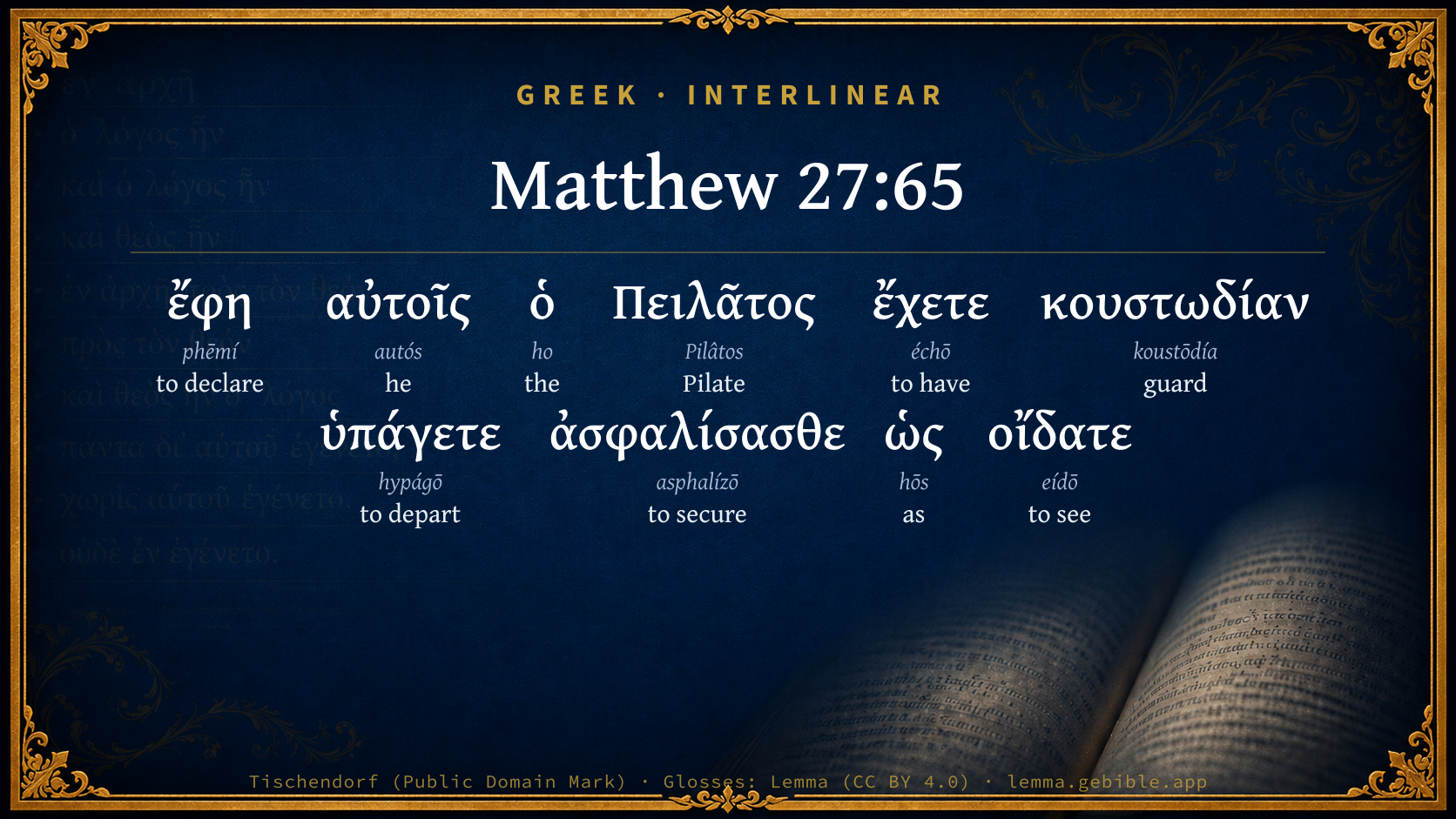
Greek (Tischendorf 8th ed.) Matthew 27:65 appears in the Greek New Testament. The text above is from the Tischendorf 8th edition. Each word links to its Strong’s number and a concise gloss. Click any word for its full Thayer’s Greek Lexicon entry.
Download image
Cite this verse

Matthew 27:65 (World English Bible). Public Domain. Lemma interlinear Bible study tool, https://lemma.gebible.app/v/matthew/27/65.

Show BibTeX & RIS
BibTeX
RIS
English Translation
Pilate said to them, "You have a guard. Go, make it as secure as you can."
World English Bible · Public Domain
Highlights
  • 1 first appearance in the Greek New Testament
Full analysis ↓
Download a study sheet

One document with this verse’s original text, its word-by-word gloss line, the meaning frame, cross-references with their text, attributed commentary, and full source and license credits — printable, and it pastes into notes with its structure intact.

This verse Autodidact and up

Study sheet (.html) Plain text (.txt)

A passage Seminary Student

Up to 50 verses in one chapter. A passage sheet keeps up to 6 commentary sources and 12 cross-references per verse, in the order this page ranks them, and says so on the sheet whenever that leaves anything out. Ask for a single verse and you get the Autodidact verse sheet above.

Everything on this page stays free to read, with no account — the sheet is a download of what is already on screen, not access to it.

Want to remove ads? Support Godless Engineer
Compare translations 3

The same verse in 3 English versions, stacked beneath the original-language interlinear above. Click any original word for its lexicon entry.

Each is an independent rendering of the whole verse — the interlinear is not word-aligned to these translations.

Highlighted words mark where these versions differ — a whole-verse word diff, not a word-by-word alignment.

  • World English Bible Public Domain
    Pilate said to them, "You have a guard. Go, make it as secure as you can."
  • King James Version Public Domain
    Pilate said unto them, Ye have a watch: go your way, make it as sure as ye can.
  • unfoldingWord Literal Text CC BY-SA 4.0
    And Pilate said to them, “You have a guard. Go, secure as you know.”

unfoldingWord Literal Text — © unfoldingWord, licensed CC BY-SA 4.0. Word-aligned USFM3 via Door43 (git.door43.org/unfoldingWord/en_ult).

Versions to compare (up to 4)

3 of 4 selected

Show all 19 translations

Every available English version of this verse, each an independent rendering of the whole verse.

  • World English Bible Public Domain
    Pilate said to them, "You have a guard. Go, make it as secure as you can."
  • Berean Standard Bible Public Domain
    “You have a guard,” Pilate said. “Go, make the tomb as secure as you know how.”
  • Majority Standard Bible Public Domain
    “You have a guard,” Pilate said. “Go, make the tomb as secure as you know how.”
  • King James Version Public Domain
    Pilate said unto them, Ye have a watch: go your way, make it as sure as ye can.
  • American Standard Version (1901) Public Domain
    Pilate said unto them, Ye have a guard: go, make it `as' sure as ye can.
  • Revised Version (1885) Public Domain
    Pilate said unto them, Ye have a guard: go your way, make it as sure as ye can.
  • Geneva Bible (1599) Public Domain
    Then Pilate saide vnto them, Ye haue a watch: goe, and make it sure as ye knowe.
  • Douay-Rheims (1899) Public Domain
    Pilate saith to them: You have a guard; go, guard it as you know.
  • Young's Literal Translation Public Domain
    And Pilate said to them, `Ye have a watch, go away, make secure -- as ye have known;'
  • Literal Standard Version CC BY-SA 4.0
    And Pilate said to them, “You have a guard, go away, make [it] secure—as you have known”;
  • Unlocked Literal Bible CC BY-SA 4.0
    Pilate said to them, “Take a guard. Go and make it as secure as you can.”
  • unfoldingWord Literal Text CC BY-SA 4.0
    And Pilate said to them, “You have a guard. Go, secure as you know.”
  • Darby Bible Public Domain
    And Pilate said to them, Ye have a watch: go, secure it as well as ye know how.
  • World Messianic Bible Public Domain
    Pilate said to them, “You have a guard. Go, make it as secure as you can.”
  • Webster's Bible Public Domain
    Pilate said to them, Ye have a watch: go, make it as secure as ye can.
  • Free Bible Version CC BY-SA 4.0
    “I'll give you a guard of soldiers,” Pilate told them. “Now go, and make it as secure as you possibly can.”
  • Bible in Basic English Public Domain
    Pilate said to them, You have watchmen; go and make it as safe as you are able.
  • Text-Critical English NT CC BY 4.0
    Pilate said to them, “You have a guard of soldiers. Go and make it as secure as you know how.”
  • Tyndale New Testament (1534) Public Domain
    Pilate sayde vnto them. Take watche men: Go and make it as sure as ye can.

Literal Standard Version (2020), Covenant Press — licensed CC BY-SA 4.0. Text via the HelloAO Bible API (eBible.org). Unlocked Literal Bible (unfoldingWord) — licensed CC BY-SA 4.0. Text via the HelloAO Bible API (eBible.org). unfoldingWord Literal Text — © unfoldingWord, licensed CC BY-SA 4.0. Word-aligned USFM3 via Door43 (git.door43.org/unfoldingWord/en_ult). Free Bible Version, Dr. Jonathan Gallagher — licensed CC BY-SA 4.0. Text via the HelloAO Bible API (eBible.org).

Word by word

More ways to search: Search by grammar → Find every occurrence → Compare this word →

Practice this passage: Drill this verse → Learn its vocabulary →

About this verse

These counts appear in no published source. They are computed here, from the morphology-tagged text and Lemma’s own curated glosses. What Lemma adds →

10
words
10
distinct lemmas
Gospels
section

Notable vocabulary

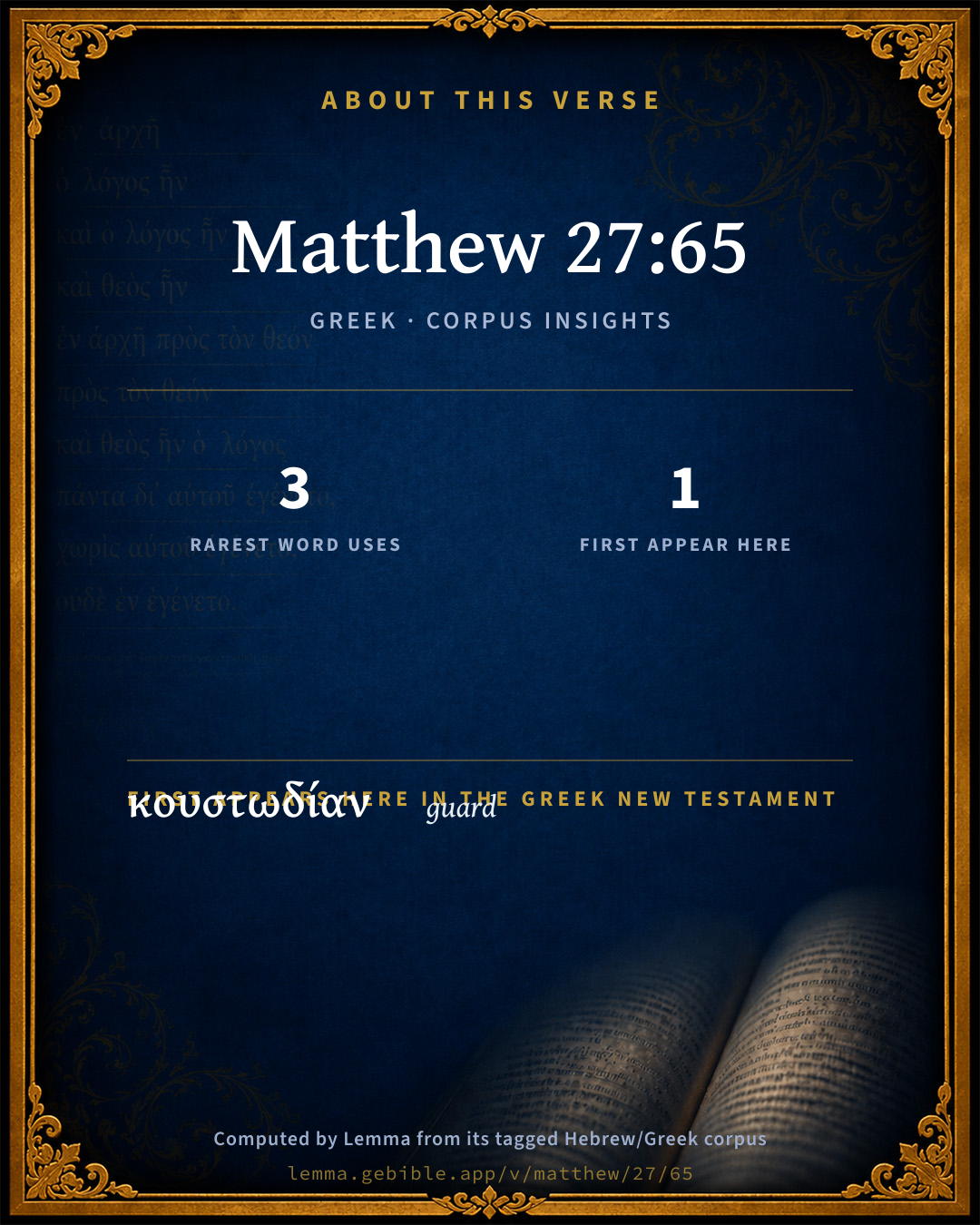
The rarest word here is κουστωδίαν guard G2892 — appearing just 3 times in the whole Greek New Testament.

First appearance in Scripture

This word makes its first canonical appearance in the Greek New Testament here:

  • κουστωδίαν guard G2892

Shared distinctive vocabulary

κουστωδίαν guard G2892 occurs in 3 verses of the Greek New Testament. Also found in:
Cross-references

4

Topical passages linked to Matthew 27:65 in the Treasury of Scripture Knowledge — connected by theme and wording, ordered by reader-vote popularity; previews shown in the World English Bible.

  • Matthew 27:66 So they went with the guard and made the tomb secure, sealing the stone.
  • Matthew 28:11–15 Now while they were going, behold, some of the guards came into the city, and told the chief priests all the things that had happened.
  • Psalms 76:10 Surely the wrath of man praises you. The survivors of your wrath are restrained.
  • Proverbs 21:30 There is no wisdom nor understanding Nor counsel against Yahweh.

Cross-references courtesy of OpenBible.info (CC BY 4.0).

Commentary

Notes on Matthew 27:65 from classic Christian and Jewish commentators (each source and its license shown beneath its notes). The classic Christian expositions comment on the surrounding passage and are grouped to its opening verse, so a note may address several verses; the Jewish commentaries on the Tanakh (Rashi and others) are per-verse, so they appear only where the commentator wrote on this verse.

Lemma curates 59 commentaries, every one of them public domain or Creative Commons licensed, each selected and text-cleaned for this edition rather than reprinted as found. About our sources →

Bengel's Gnomon

Johann Albrecht Bengel

Mat 27:65. Ἔχετε, κ.τ.λ., ye have, etc.) Pilate gives the guards quickly: and yet, as it were with indignation (cf. ch. Mat 28:11-12), dismisses the calumniators quickly also.

Bengel's Gnomon of the New Testament — English translation (T&T Clark, Edinburgh, 1860) — public domain. Text from a community e-Sword module.

Meyer's Critical & Exegetical Commentary

Heinrich August Wilhelm Meyer

Mat_27:65 f. Pilates reply is sharp and peremptory.

ἔχετε κουστωδίαν] with Luther, Vatablus, Wolf, Paulus, de Wette, Keim, Steinmeyer, ἔχετε is to be taken as an imperative, habetote (comp. Xen. Cyrop. viii. 7. 11; Mar_9:50; Mar_11:22; Soph. Phil. 778): ye shall have a watch! For if it be taken as an indicative, as is generally done in conformity with the Vulgate, we must not suppose that the reference is to Roman soldiers (Grotius, Fritzsche), for the Sanhedrim had not any such placed at their disposal, not even to the detachment that guarded the cross (Kuinoel), for its duties were now over, but simply to the ordinary temple guards. But it is evident from Mat_28:14 that it was not these latter who were set to watch the grave. This duty was assigned to a company of Roman soldiers, which company the Acta Pil. magnifies into a cohort.

ὡς οἴδατε] as, by such means as, ye know how to prevent it, i.e. in the best way you can. The idea: vereor autem, ut satis communire illud possitis (Fritzsche), is foreign to the text.

μετὰ τῆς κουστωδίας] belongs to ἠσφαλίς. τ. τάφ.; they secured the grave by means of (Stallbaum, ad Plat. Rep. p. 530 D) the watch, which they posted in front of it. The intervening σφραγίς. τ. λίθ. is to be understood as having preceded the ἠσφαλ. τ. τ. μετὰ τ. κουστ.: after they had sealed the stone. To connect μετὰ τ. κουστωδ. with σφραγίς. (Chrysostom) would result either in the feeble and somewhat inappropriate idea that the watch had helped them with the sealing (Bleek), or in the harsh and unnecessary assumption that our expression is an abbreviation for μετὰ τοῦ προσθεῖναι τὴν κουστωδίαν (Fritzsche).

σφραγίς.] Comp. Dan_6:17. The sealing was effected by stretching a cord across the stone at the mouth of the sepulchre, and then fastening it to the rock at either end by means of sealing-clay (Paulsen, Regier. d. Morgenl. p. 298; Harmar, Bcobacht. II. p. 467); or if the stone at the door happened to be fastened with a cross-beam, this latter was sealed to the rock (Strauss, Sinai und Golgatha, p. 205).

REMARK.

As it is certain that Jesus cannot have predicted His resurrection in any explicit or intelligible manner even to His own disciples; as, moreover, it is impossible to suppose that the women who visited the grave on the resurrection morning could have contemplated embalming the body, or would have concerned themselves merely about how the stone was to be rolled away, if they had been aware that a watch had been set, and that the grave had been sealed; and finally, as the supposition that Pilate complied with the request for a guard, or at all events, that the members of the Sanhedrim so little understood their own interest as both to leave the body of Jesus in the hands of His followers instead of taking possession of it themselves, and to bribe the soldiers to give false testimony instead of duly calling them to account, as they might have done, for their culpable neglect, is in the highest degree improbable, just as much so as the idea that the procurator would be likely to take no notice of a dereliction of duty on the part of his own soldiers, who, by maintaining the truth of a very stupid fabrication, would only be proclaiming how much they themselves were to blame in the matter: it follows that the story about the watching of the gravea story which is further disproved by the fact that nowhere in the discussions belonging to the apostolic age do we find any reference confirmatory or otherwise to the alleged stealing of the bodymust be referred to the category of unhistorical legend. And a clue to the origin of this legend is furnished by the evangelist himself in mentioning the rumour about the stealing of the body,a rumour emanating to all appearance from a Jewish source, and circulated with the hostile intention of disproving the resurrection of Jesus (Paulus, exeg. Handb. III. p. 837 ff.; Strauss, II. p. 562 ff.; Schleiermacher, L. J. p. 458 ff.; Weisse, Ewald, Hase, Bleek, Keim, Scholten, Hilgenfeld). The arguments advanced by Hug in the Freyburg. Zeitschr. 1831, 3, p. 184 ff.; 5, p. 80 ff.; Kuinoel, Hofmann, Krabbe, Ebrard, Lange, Riggenbach, Steinmeyer, against the supposition of a legend, resolve themselves into arbitrary assumptions and foreign importations which simply leave the matter as historically incomprehensible as ever. The same thing may be said with regard to the emendation which Olshausen takes the liberty of introducing, according to which it is made to appear that the Sanhedrim did not act in their corporate capacity, but that the affair was managed simply on the authority of Caiaphas alone. Still the unhistorical character of the story by no means justifies the assumption of an interpolation (in opposition to Stroth in Eichhorns Repert. IX. p. 141),an interpolation, too, that would have had to be introduced into three different passages (Mat_27:62; Mat_27:66, Mat_28:4; Mat_28:11 ff.); yet one can understand how this apocryphal story should have most readily engrafted itself specially and exclusively upon the Gospel of Matthew, a Gospel originating in Judaeo-Christian circles, and having, by this time, the more developed form in which it has come down to us. For a further amplification of the legend, see Ev. Nicod. 14.

Meyer — Critical and Exegetical Commentary on the New Testament — English translation by Peter Christie, edited by Frederick Crombie (T&T Clark, 1880) — public domain. Text from a community e-Sword module.

Expositor's Greek Testament

ed. W. Robertson Nicoll

Mat 27:65 . ἔχετε : probably imperative, not indicative = have your watch, the ready assent of a man who thinks there is not likely to be much need for it, but has no objections to gratify their wish in a small matter. So most recent interpreters Meyer, Weiss, Holtz., Weizsäcker, Morison, Spk., Com. , Alford. The Vulgate takes it as indicative = habetis , which Schanz follows. This rendering implies that Pilate wished them to be content with what they had already, either their own temple watch or soldiers already put at their disposal. Carr (Camb. N. T.) doubts the correctness of the modern interpretation on the ground that no clear example of the use of ἔχειν in the sense of “to take” occurs in either classical or Hellenistic Greek. κουστωδίαν , a guard, a Latinism, a natural word for the Roman Pilate to use. ὑπάγετε ἀσφαλίσασθε , the three verbs: ἔχ . ὑπάγ . ἀσφαλ ., following each other without connecting particles form an asyndeton “indicating impatience on the part of Pilate” (Camb. N. T.). ὡς οἴδατε , as ye know how.

The Expositor's Greek Testament, edited by W. Robertson Nicoll (1897–1910) — public domain. Text from a community e-Sword module.

Geneva Bible (1599)

Geneva Bible translators

The soldiers of the garrison, which were appointed to keep the Temple.

Geneva Bible (1599) marginal notes — public domain. Text via Bolls.life.

Jamieson, Fausset & Brown

Robert Jamieson, A. R. Fausset & David Brown

Pilate said unto them, Ye have a watch--The guards had already acted under orders of the Sanhedrim, with Pilate's consent; but probably they were not clear about employing them as a night watch without Pilate's express authority.

go your way, make it as sure as ye can--as ye know how, or in the way ye deem securest. Though there may be no irony in this speech, it evidently insinuated that if the event should be contrary to their wish, it would not be for want of sufficient human appliances to prevent it.

Jamieson, Fausset & Brown — Commentary Critical and Explanatory on the Whole Bible (1871) — public domain (CC PDM 1.0). Text via the HelloAO Bible API.

Adam Clarke's Commentary

Verse 65. Ye have a watch] The Jews had a corps of Roman troops, consisting of several companies, as a guard for the temple, Ac 4:1. These companies mounted guard by turns, see Lu 22:4. Some of these companies, which were not then on duty, Pilate gave them leave to employ to watch the tomb.

Adam Clarke's Commentary on the Bible (1810–1826) — public domain. Text from a community e-Sword/MySword module.

Ellicott's Commentary for English Readers

(65) Ye have a watch.—Better, Take ye a guard. The Greek verb may be either imperative or indicative. The former gives the better meaning. The “watch,” or “guard,” was a body of Roman soldiers (St. Matthew uses the Latin term custodia), who could not be set to such a task without Pilate’s permission. If the priests had had such a “guard” at their disposal before, there would have been no need for them to apply to Pilate.

A Bible Commentary for English Readers, edited by Charles John Ellicott (1878–1897) — public domain. Text from a community e-Sword module.

The Cambridge Bible for Schools and Colleges

gen. ed. J. J. S. Perowne

65. Ye have a watch] The meaning is either (1) that Pilate refuses the request; “Ye have a watch of your own”—(a) the Levitical temple guard, or (b) a small body of soldiers whom Pilate may have already placed at their disposal—or (2) he grants it curtly and angrily, “Take a watch; begone.”

The latter view is generally adopted now. It seems quite clear from ch. Mat_28:14 that the guard was of Roman soldiers.

The Cambridge Bible for Schools and Colleges (gen. ed. J. J. S. Perowne; Cambridge University Press, 1878–1918) — public domain. Text from a community e-Sword module.

John Gill's Exposition

So they went,.... From Pilate's palace, to the garden of Joseph, and to the sepulchre there; which whether more than a sabbath day's journey, or two thousand cubits, may be inquired; and if so, then they broke one of their own traditions, which allowed a person to go no further on a sabbath day; See Gill on Act 1:12.

And made the sepulchre sure; in the following manner,

sealing the stone; that was rolled to the door of it, it may be with some public seal, with Pilate's, or with the sanhedrim's; as the stone at the mouth of the lions' den, in which Daniel was put, was sealed with the king's signet, and with the signet of his lords, Dan 6:17, that there might be no change of the sentence upon him, and by which it appeared, that his deliverance was by no human assistance: so the stone at Christ's sepulchre was sealed, that it could not be removed without breaking it; which would show, whether any fraudulent methods were taken to remove the body:

and setting a watch; a guard of soldiers, to observe and prevent any person coming near it; or "with the watch": they made sure the sepulchre with the watch; or sealed the stone, the watch being present; all which was overruled by the providence of God, for the greater confirmation of the truth of Christ's resurrection: by the methods taken, it clearly appears, there could be no fraud in the case; the body was laid in a tomb, where no corpse had ever been before; in a tomb hewed out of a rock, to which there was no access, but at the door; where a great stone was rolled; and this had a seal upon it, and a guard of soldiers about it; and hereby there were more witnesses of Christ's resurrection, than otherwise would have been; as the soldiers, though they were afterwards bribed to tell another story; and even the chief priests and Pharisees were convicted that he was risen, or they would never have taken such a method with the soldiers, as they did.

Next: Matthew Chapter 28

John Gill's Exposition of the Whole Bible (1746–1763) — public domain (CC PDM 1.0). Text via the HelloAO Bible API.

Trapp's Complete Commentary

John Trapp

65 Pilate said unto them, Ye have a watch: go your way, make it as sure as ye can.

Ver. 65. Pilate said unto them] He was willing to please both sides; and therefore condescends both to Joseph of Arimathea for his burial, and to the priests for securing the sepulchre. Κοινοφιλης, erat utpote qui ab omnibus gratiam inire cupiebat; quales quidam per iocum placentas dixit. But if I yet please men, saith Paul, as once I did when I was a Pharisee, "I am no more the servant of Christ," Gal 1:10. He scorns that such base deceit should be found in his followers, Col 2:8. Mordecai will not crouch or curry favour, to die for it. Micaiah will not budge, though sure to kiss the stocks for his stiffness.

Ye have a watch] Appointed for the use and service of the temple, a band of garrison soldiers who had their captain, Act 4:1, and are here set to watch that true temple, wherein "the Godhead dwelt bodily," i.e. personally.

John Trapp, A Commentary or Exposition upon All the Books of the Old and New Testament (1647–1656) — public domain. Text from a community e-Sword module.

Albert Barnes' Notes on the Bible

Ye have a watch - The Jews had a guard of Roman soldiers, who kept watch in the tower of Antonia, on the northwest of the temple. Pilate either referred to these, or to the “watch” that attended the crucifixion - the whole “band” that had been appointed for that. As the torments of crucifixion sometimes lasted many days, the band had been probably granted to them during that time, and they were therefore still at the direction of the chief priests.

Albert Barnes' Notes on the Bible (1834–1885) — public domain. Text from a community e-Sword/MySword module.

Haydock's Catholic Bible Commentary

You have a guard; supposed to be a company of Roman soldiers, destined for the guard of the temple: (Bible de Vence) or, may take a guard; go, and make it secure; which they did, sealing the stone, and placing guards at the monument. Providence ordered this, to make Christ’s resurrection more certain and evident. (Witham)

George Leo Haydock (1774–1849), Haydock's Catholic Family Bible and Commentary, 1859 edition — public domain. Excludes Psalms (Douay-Rheims chapter numbering differs from Protestant) and Deuterocanonical books (Catholic canon only).

Whedon's Commentary on the Bible

Daniel D. Whedon

65. Ye have a watch — The imperative construction which the Greek verb would bear, Have a watch, is not natural. Yet the indicative mood of the verb possesses essentially the same force as the imperative. The Jews desired that a custodia or guard of Roman soldiers should be placed at their command to watch the body. Pilate gives his consent by reminding them that they have one already; alluding probably to the quaternion who watched the crucifixion. Compare Act_12:4 and Joh_19:23. The Jews by this measure intended to prevent the existence of any proof of the divinity of Christ, but they furnished in fact, by their precaution, an additional confirmation. Here, as previously, Pilate appears chary of having any thing to do in the transaction, and determined to leave all action and responsibility with them.

Daniel D. Whedon (gen. ed.), Commentary on the Old and New Testaments (1874–1909) — public domain. Text from a community e-Sword module.

The Pulpit Commentary

Ye have a watch (ecete koustwdian , take a guard). Pilate answers briefly and haughtily, "Well, I give permission; do as you like; take a body of soldiers as a guard, and go your way. " This last verb is imperative, so the former is most probably imperative also. If taken as indicative, the question arises What guard had they? This is difficult to answer, unless, as Alford supposes, it may refer to some detachment placed at their disposal during the feast. But of this we know nothing historically.

Make it as sure (asfalisasye , secure it for yourselves) as ye can; literally, as ye know how. Take any precaution you think fit to employ.

The Pulpit Commentary (1880–1919), ed. H.D.M. Spence-Jones & Joseph S. Exell — public domain. Text from a community e-Sword module.

John Wesley's Explanatory Notes

Ye have a guard - Of your own, in the tower of Antonia, which was stationed there for the service of the temple.

John Wesley, Explanatory Notes Upon the Whole Bible (1754–1765) — public domain. Text via the GEBible commentary corpus.

The People's New Testament

B. W. Johnson

65. Ye have a guard. That is, ye can have a guard. He granted them a guard of Roman soldiers.

B. W. Johnson's The People's New Testament with Notes (1889–1891) — public domain. Electronic text from the Christian Classics Ethereal Library (CCEL) ThML edition.

unfoldingWord translationNotes

Door43 World Missions Community

a guard

This consisted of four to sixteen Roman soldiers.

sealing the stone

Possible meanings are 1) they put a cord around the stone and attached it to the rock wall on either side of the entrance to the tomb or 2) they put seals between the stone and the wall.

placing the guard

"telling the soldiers to stand where they could keep people from tampering with the tomb"

translationWords

Pilate

grave

seal

unfoldingWord translationNotes — © Distant Shores Media and the Door43 World Missions Community, licensed CC BY-SA 4.0. Source: git.door43.org/Door43/en_tn.

Cambridge Greek Testament for Schools and Colleges

65. ἔχετε κουστωδίαν. The meaning is either (1) that Pilate refuses the request; ‘Ye have a watch of your own’—(a) the Levitical temple guard, or more probably (b) a small body of soldiers whom Pilate may have already placed at their disposal—or (2) he grants it curtly and angrily, ‘Take a watch; begone.’

The latter view is generally adopted now; but it involves a meaning of ἔχειν (‘to take’) of which no clear example appears either in classical or Hellenistic Greek. See, however, Alford on 1Ti 2:13, who argues for such a meaning in that passage: ὑποτύπωσιν ἔχε ὑγιαινόντων λόγων, ‘have (take) an ensample of (the) healthy words,’ &c. It should also be mentioned that in modern Greek ἔχειν and λαμβάνειν are so nearly connected in meaning that the defective parts of ἔχειν (aor. and 2nd future) are supplied from λαμβάνω. Still the argument in favour of retaining the ordinary meaning of ἔχειν in this passage is strong, and the objection that we have no record of a body of Roman soldiers being placed occasionally under the orders of the Sanhedrin need not have great weight. In this case Pilate may well have held it to be a measure on the side of order.

It seems quite clear from ch. Mat 28:14 that the guard was of Roman soldiers.

In any view the asyndeton ἔχετε ὑπάγετε ἀσφαλίσασθε indicates impatience on the part of Pilate.

κουστωδίαν appears to have meant a guard of 60 men. See quotation from Theophylact, note on Mat 27:27 of this chapter.

ἀσφαλίσασθε … ἠσφαλίσαντο. The middle voice has its proper form, ‘secure for yourselves.’ A providential point, for if the Roman soldiers had secured the sepulchre the Jews might still have affirmed that deceit had been practised.

ἀσφαλίζειν is a Polybian word which does not seem to have been used earlier. Cp. Act 16:24, τοὺς πόδας ἠσφαλίσατο αὐτῶν εἰς τὸ ξύλον. The verb does not occur elsewhere in N.T.

Cambridge Greek Testament for Schools and Colleges (Cambridge University Press, 1896; 21 vols, various authors incl. Carr, Maclear, Plummer, Farrar, Lumby, Moule, M. R. James, Simcox) — public domain. Text from a community e-Sword module.

Alford’s Greek Testament

Henry Alford

65.] ἔχετε—either 1), indicative, Ye have:—but then the question arises, What guard had they? and if they had one, why go to Pilate? Perhaps we must understand some detachment placed at their disposal during the feast—but there does not seem to be any record of such a practice. That the guards were under the Sanhedrim is plain from ch. 28:11, where they make their report (‘ut mos militiæ, factum esse quod imperasset,’ Tacitus, Ann. i. 6), not to Pilate, but to the chief priests:—or 2), as De Wette and Meyer take it, imperative; which doubtless it may be, see 2Ti 1:13 and note: and the sense here on that hypothesis would be, Take a body of men for a guard. And έο this latter I now rather incline, on account of the order of the words, in which ἔχετε seems to have an emphasis hardly satisfied on the other view.

ὡς οἴδατε] as you know how:—in the best manner you can. There is no irony in the words, as has been supposed.

Henry Alford, The Greek Testament (1849–1861) — public domain. Text from a community e-Sword module.

Vincent's Word Studies in the New Testament

Marvin R. Vincent

Ye have [εχετε] . Or, as some render, imperatively : Have a guard ! Rev., in margin, take.

Marvin R. Vincent, Word Studies in the New Testament (1887–1900) — public domain. Text from a community e-Sword/MySword module.

Lesson kit

Teaching starters — assembled from the data on this page, not authored interpretation. Every prompt links to the verse data it draws on. Edit before teaching.

Matthew, in the Gospels, opens this verse with 10 words (10 distinct Greek lemmas). Its most distinctive word is koustōdía (“guard”). A historical commentator’s framing appears above. Read the whole chapter for the surrounding context.

Discussion questions

  1. How does “guard” (koustōdía) shape what this verse is saying?
  2. The word “guard” first appears here in Scripture. What is being introduced at this debut?
  3. Matthew 27:66 shares the word «guard» with this verse. How do the two illuminate each other?
  4. The translations on this page render this verse differently — a whole-verse word diff, not a word-by-word alignment. What might account for the different wordings?
  5. Reading how Bengel's Gnomon and Meyer's Critical & Exegetical Commentary read this verse, where do the two commentators agree and where do they part?

Things to notice

  • 1 word makes its first canonical appearance in Scripture here.
  • These translations choose different wording for 9 words in this verse.
  • 10 distinct Greek lemmas span 10 words in this verse.

Reading settings

Reading text

Shown beneath each verse's original-language words.

Old Testament
Old Testament edition

Read the OT as the Masoretic Hebrew (MT) or the Greek Septuagint (LXX).

English shown for the Greek Septuagint (in the Hebrew ↔ Greek comparison).

Comparing translations? Open the Compare panel on any verse page to stack up to four side by side.