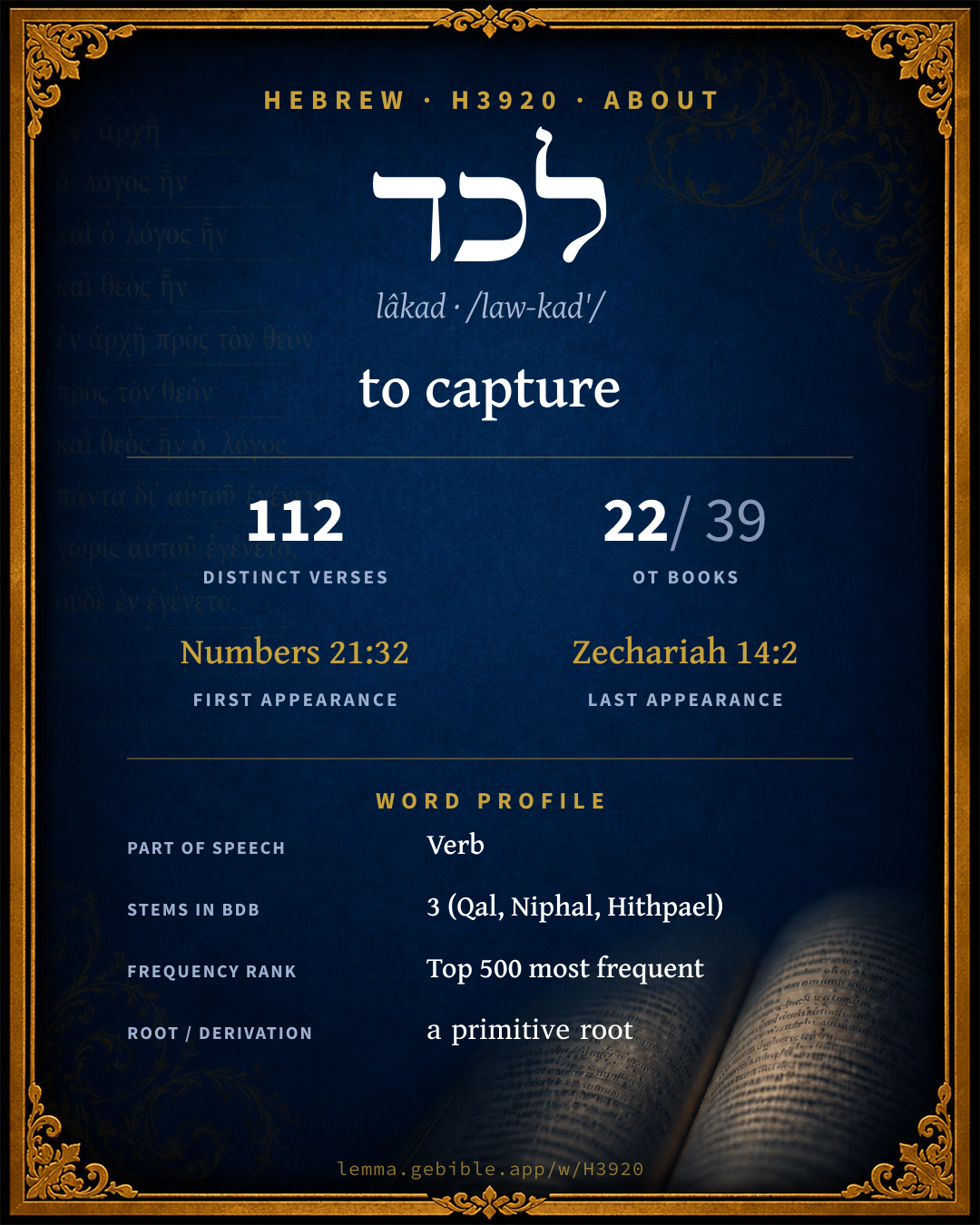
לָכַד
to capture
also: take, seize fuller range ↓
Full lexicon entry — Brown-Driver-Briggs (BDB)
From Brown-Driver-Briggs (BDB)
Where this word appears
See every Qal verb in the Hebrew Bible →
Grammar key — what these labels mean
Part of speech
- Verb
- An action or state-of-being word.
Stem
- Qal
- The basic, simple active stem — the plain form of the verb (“he wrote”). Here: ‘capture’
- Niphal
- Usually the simple passive or reflexive of the Qal (“he was written”). Here: ‘be captured in war’
- Hithpael
- The reflexive or reciprocal stem (the subject acts on itself).
Form
- Sequential Imperfect
- An imperfect with prefixed waw — the standard past-narrative form (waw-consecutive imperfect).
- Perfect
- A completed action or state — Hebrew marks aspect (completeness) more than strict tense (“he wrote”).
- Sequential Perfect
- A perfect with prefixed waw continuing a preceding imperfect or command (waw-consecutive perfect).
- Imperfect
- An incomplete, ongoing, or future action (“he will / would write”).
- Infinitive Absolute
- An unbound verbal noun, often intensifying or standing in for a finite verb.
- Imperative
- A direct command (“write!”).
- Infinitive Construct
- A bound verbal noun, frequently with prepositions (“to write / in writing”).
- Participle Active
- A verbal adjective expressing ongoing or characteristic action (“writing / one who writes”).
State
- Construct
- A noun bound to a following noun in a possessive / “of” relationship (the construct chain).
- Absolute
- The independent form of a noun, not bound to a following word.
Person
- 3rd Person
- The one spoken about (“he / she / it / they”).
- 1st Person
- The speaker (“I / we”).
- 2nd Person
- The one addressed (“you”).
Gender
- Masculine
- Grammatically masculine.
- Feminine
- Grammatically feminine.
- Common
- Either gender — not distinguished for this form.
Number
- Singular
- One.
- Plural
- More than one (in Hebrew, generally three or more).
Grammatical forms 33 distinct
- Verb, Qal, Sequential Imperfect, 3rd Person, Masculine, Singular 27 times (22%)
- Verb, Qal, Sequential Imperfect, 3rd Person, Masculine, Plural 16 times (13%)
- Verb, Qal, Perfect, 3rd Person, Masculine, Singular 11 times (9%)
- Verb, Niphal, Perfect, 3rd Person, Feminine, Singular 10 times (8%)
- Verb, Niphal, Sequential Imperfect, 3rd Person, Masculine, Singular 7 times (6%)
- Verb, Qal, Sequential Perfect, 3rd Person, Masculine, Singular 7 times (6%)
- Verb, Niphal, Imperfect, 3rd Person, Masculine, Plural 4 times (3%)
- Verb, Qal, Imperfect, 3rd Person, Masculine, Singular 4 times (3%)
+25 more forms (35 occurrences)
Parsed forms decoded from the imported morphology (morphhb / Westminster Leningrad Codex — WLC text public domain, morphhb tagging CC BY 4.0), counted across 121 parsed occurrences — not distinct verses.
Every verse where H3920 appears — 112 distinct verses across 22 books. Click any verse to open its interlinear word-by-word view. Verse text shown in the World English Bible for context — . Each verse’s Hebrew form is shown with its reference; the English is not keyword-highlighted, since the data carries no word-level English alignment. Use “Compare translations” on any verse to read it across multiple English versions. This concordance covers the Hebrew Bible; Septuagint (Greek Old Testament) occurrences are not indexed here.
Numbers 4 verses
- Numbers 21:32 וַֽ/יִּלְכְּד֖וּ conj + Qal wimpf 3mp Moses sent to spy out Jazer; and they took the towns of it, and drove out the Amorites who were there.
- Numbers 32:39 וַֽ/יִּלְכְּדֻ֑/הָ conj + Qal wimpf 3mp + sfx pers 3fs The children of Machir the son of Manasseh went to Gilead, and took it, and dispossessed the Amorites who were therein.
- Numbers 32:41 וַ/יִּלְכֹּ֖ד conj + Qal wimpf 3ms Jair the son of Manasseh went and took the towns of it, and called them Havvoth Jair.
- Numbers 32:42 וַ/יִּלְכֹּ֥ד conj + Qal wimpf 3ms Nobah went and took Kenath, and the villages of it, and called it Nobah, after his own name.
Deuteronomy 3 verses
- Deuteronomy 2:34 וַ/נִּלְכֹּ֤ד conj + Qal wimpf 1cp We took all his cities at that time, and utterly destroyed every inhabited city, with the women and the little ones; we left none remaining:
- Deuteronomy 2:35 לָכָֽדְנוּ Qal pf 1cp only the cattle we took for a prey to ourselves, with the spoil of the cities which we had taken.
- Deuteronomy 3:4 וַ/נִּלְכֹּ֤ד conj + Qal wimpf 1cp We took all his cities at that time; there was not a city which we didn't take from them; sixty cities, all the region of Argob, the kingdom of Og in Bashan.
Joshua 21 verses
- Joshua 6:20 וַֽ/יִּלְכְּד֖וּ conj + Qal wimpf 3mp So the people shouted, and [the priests] blew the trumpets; and it happened, when the people heard the sound of the trumpet, that the people shouted with a great shout, and the wall fell down flat, so that the people went up into the city, every man straight before him, and they took the city.
- Joshua 7:14 יִלְכְּדֶ֨/נּוּ יִלְכְּדֶ֤/נָּה יִלְכְּדֶ֣/נּוּ Qal impf 3ms + sfx pers 3ms Qal impf 3ms + sfx pers 3fs Qal impf 3ms + sfx pers 3ms In the morning therefore you shall be brought near by your tribes: and it shall be, that the tribe which Yahweh takes shall come near by families; and the family which Yahweh shall take shall come near by households; and the household which Yahweh shall take shall come near man by man.
- Joshua 7:15 הַ/נִּלְכָּ֣ד ptcl def.art + Niphal ptcp.act ms It shall be, that he who is taken with the devoted thing shall be burnt with fire, he and all that he has; because he has transgressed the covenant of Yahweh, and because he has done folly in Israel.
- Joshua 7:16 וַ/יִּלָּכֵ֖ד conj + Niphal wimpf 3ms So Joshua rose up early in the morning, and brought Israel near by their tribes; and the tribe of Judah was taken:
- Joshua 7:17 וַ/יִּלְכֹּ֕ד וַ/יִּלָּכֵ֖ד conj + Qal wimpf 3ms conj + Niphal wimpf 3ms and he brought near the family of Judah; and he took the family of the Zerahites: and he brought near the family of the Zerahites man by man; and Zabdi was taken:
- Joshua 7:18 וַ/יִּלָּכֵ֗ד conj + Niphal wimpf 3ms and he brought near his household man by man; and Achan, the son of Carmi, the son of Zabdi, the son of Zerah, of the tribe of Judah, was taken.
- Joshua 8:19 וַֽ/יִּלְכְּד֑וּ/הָ conj + Qal wimpf 3mp + sfx pers 3fs The ambush arose quickly out of their place, and they ran as soon as he had stretched out his hand, and entered into the city, and took it; and they hurried and set the city on fire.
- Joshua 8:21 לָכַ֤ד Qal pf 3ms When Joshua and all Israel saw that the ambush had taken the city, and that the smoke of the city ascended, then they turned again, and killed the men of Ai.
- Joshua 10:1 לָכַ֨ד Qal pf 3ms Now it happened, when Adoni-zedek king of Jerusalem heard how Joshua had taken Ai, and had utterly destroyed it; as he had done to Jericho and her king, so he had done to Ai and her king; and how the inhabitants of Gibeon had made peace with Israel, and were among them;
- Joshua 10:28 לָכַ֨ד Qal pf 3ms Joshua took Makkedah on that day, and struck it with the edge of the sword, and the king of it: he utterly destroyed them and all the souls who were therein; he left none remaining; and he did to the king of Makkedah as he had done to the king of Jericho.
- Joshua 10:32 וַֽ/יִּלְכְּדָ/הּ֙ conj + Qal wimpf 3ms + sfx pers 3fs and Yahweh delivered Lachish into the hand of Israel; and he took it on the second day, and struck it with the edge of the sword, and all the souls who were therein, according to all that he had done to Libnah.
- Joshua 10:35 וַֽ/יִּלְכְּד֜וּ/הָ conj + Qal wimpf 3mp + sfx pers 3fs and they took it on that day, and struck it with the edge of the sword; and all the souls who were therein he utterly destroyed that day, according to all that he had done to Lachish.
- Joshua 10:37 וַ/יִּלְכְּד֣וּ/הָ conj + Qal wimpf 3mp + sfx pers 3fs and they took it, and struck it with the edge of the sword, and the king of it, and all the cities of it, and all the souls who were therein; he left none remaining, according to all that he had done to Eglon; but he utterly destroyed it, and all the souls who were therein.
- Joshua 10:39 וַֽ/יִּלְכְּדָ֞/הּ conj + Qal wimpf 3ms + sfx pers 3fs and he took it, and the king of it, and all the cities of it; and they struck them with the edge of the sword, and utterly destroyed all the souls who were therein; he left none remaining: as he had done to Hebron, so he did to Debir, and to the king of it; as he had done also to Libnah, and to the king of it.
- Joshua 10:42 לָכַ֥ד Qal pf 3ms All these kings and their land did Joshua take at one time, because Yahweh, the God of Israel, fought for Israel.
- Joshua 11:10 וַ/יִּלְכֹּ֣ד conj + Qal wimpf 3ms Joshua turned back at that time, and took Hazor, and struck the king of it with the sword: for Hazor before was the head of all those kingdoms.
- Joshua 11:12 לָכַ֧ד Qal pf 3ms All the cities of those kings, and all the kings of them, did Joshua take, and he struck them with the edge of the sword, and utterly destroyed them; as Moses the servant of Yahweh commanded.
- Joshua 11:17 לָכַ֔ד Qal pf 3ms from Mount Halak, that goes up to Seir, even to Baal Gad in the valley of Lebanon under Mount Hermon: and all their kings he took, and struck them, and put them to death.
- Joshua 15:16 וּ/לְכָדָ֑/הּ conj + Qal wpf 3ms + sfx pers 3fs Caleb said, He who strikes Kiriath Sepher, and takes it, to him will I give Achsah my daughter as wife.
- Joshua 15:17 וַֽ/יִּלְכְּדָ֛/הּ conj + Qal wimpf 3ms + sfx pers 3fs Othniel the son of Kenaz, the brother of Caleb, took it: and he gave him Achsah his daughter as wife.
- Joshua 19:47 וַ/יִּלְכְּד֥וּ conj + Qal wimpf 3mp The border of the children of Dan went out beyond them; for the children of Dan went up and fought against Leshem, and took it, and struck it with the edge of the sword, and possessed it, and lived therein, and called Leshem, Dan, after the name of Dan their father.
Judges 13 verses
- Judges 1:8 וַ/יִּלְכְּד֣וּ conj + Qal wimpf 3mp The children of Judah fought against Jerusalem, and took it, and struck it with the edge of the sword, and set the city on fire.
- Judges 1:12 וּ/לְכָדָ֑/הּ conj + Qal wpf 3ms + sfx pers 3fs Caleb said, He who strikes Kiriath Sepher, and takes it, to him will I give Achsah my daughter as wife.
- Judges 1:13 וַֽ/יִּלְכְּדָ/הּ֙ conj + Qal wimpf 3ms + sfx pers 3fs Othniel the son of Kenaz, Caleb's younger brother, took it: and he gave him Achsah his daughter as wife.
- Judges 1:18 וַ/יִּלְכֹּ֤ד conj + Qal wimpf 3ms Also Judah took Gaza with the border of it, and Ashkelon with the border of it, and Ekron with the border of it.
- Judges 3:28 וַֽ/יִּלְכְּד֞וּ conj + Qal wimpf 3mp He said to them, Follow after me; for Yahweh has delivered your enemies the Moabites into your hand. They went down after him, and took the fords of the Jordan against the Moabites, and didn't allow a man to pass over.
- Judges 7:24 וְ/לִכְד֤וּ וַ/יִּלְכְּד֣וּ conj + Qal impv 2mp conj + Qal wimpf 3mp Gideon sent messengers throughout all the hill-country of Ephraim, saying, Come down against Midian, and take before them the waters, as far as Beth Barah, even the Jordan. So all the men of Ephraim were gathered together, and took the waters as far as Beth Barah, even the Jordan.
- Judges 7:25 וַֽ/יִּלְכְּד֡וּ conj + Qal wimpf 3mp They took the two princes of Midian, Oreb and Zeeb; and they killed Oreb at the rock of Oreb, and Zeeb they killed at the winepress of Zeeb, and pursued Midian: and they brought the heads of Oreb and Zeeb to Gideon beyond the Jordan.
- Judges 8:12 וַ/יִּלְכֹּ֞ד conj + Qal wimpf 3ms Zebah and Zalmunna fled; and he pursued after them; and he took the two kings of Midian, Zebah and Zalmunna, and confused all the host.
- Judges 8:14 וַ/יִּלְכָּד conj + Qal wimpf 3ms He caught a young man of the men of Succoth, and inquired of him: and he described for him the princes of Succoth, and the elders of it, seventy-seven men.
- Judges 9:45 וַ/יִּלְכֹּד֙ conj + Qal wimpf 3ms Abimelech fought against the city all that day; and he took the city, and killed the people who were therein: and he beat down the city, and sowed it with salt.
- Judges 9:50 וַֽ/יִּלְכְּדָֽ/הּ conj + Qal wimpf 3ms + sfx pers 3fs Then went Abimelech to Thebez, and encamped against Thebez, and took it.
- Judges 12:5 וַ/יִּלְכֹּ֥ד conj + Qal wimpf 3ms The Gileadites took the fords of the Jordan against the Ephraimites. It was so, that when [any of] the fugitives of Ephraim said, Let me go over, the men of Gilead said to him, Are you an Ephraimite? If he said, No;
- Judges 15:4 וַ/יִּלְכֹּ֖ד conj + Qal wimpf 3ms Samson went and caught three hundred foxes, and took firebrands, and turned tail to tail, and put a firebrand in the midst between every two tails.
1 Samuel 5 verses
- 1 Samuel 10:20 וַ/יִּלָּכֵ֖ד conj + Niphal wimpf 3ms So Samuel brought all the tribes of Israel near, and the tribe of Benjamin was taken.
- 1 Samuel 10:21 וַ/תִּלָּכֵ֖ד וַ/יִּלָּכֵד֙ conj + Niphal wimpf 3fs conj + Niphal wimpf 3ms He brought the tribe of Benjamin near by their families; and the family of the Matrites was taken; and Saul the son of Kish was taken: but when they sought him, he could not be found.
- 1 Samuel 14:41 וַ/יִּלָּכֵ֧ד conj + Niphal wimpf 3ms Therefore Saul said to Yahweh, the God of Israel, Show the right. Jonathan and Saul were taken [by lot]; but the people escaped.
- 1 Samuel 14:42 וַ/יִּלָּכֵ֖ד conj + Niphal wimpf 3ms Saul said, Cast [lots] between me and Jonathan my son. Jonathan was taken.
- 1 Samuel 14:47 לָכַ֥ד Qal pf 3ms Now when Saul had taken the kingdom over Israel, he fought against all his enemies on every side, against Moab, and against the children of Ammon, and against Edom, and against the kings of Zobah, and against the Philistines: and wherever he turned himself, he put [them] to the worse.
2 Samuel 6 verses
- 2 Samuel 5:7 וַ/יִּלְכֹּ֣ד conj + Qal wimpf 3ms Nevertheless David took the stronghold of Zion; the same is the city of David.
- 2 Samuel 8:4 וַ/יִּלְכֹּ֨ד conj + Qal wimpf 3ms David took from him one thousand seven hundred horsemen, and twenty thousand footmen: and David hamstrung all the chariot horses, but reserved of them for one hundred chariots.
- 2 Samuel 12:26 וַ/יִּלְכֹּ֖ד conj + Qal wimpf 3ms Now Joab fought against Rabbah of the children of Ammon, and took the royal city.
- 2 Samuel 12:27 לָכַ֖דְתִּי Qal pf 1cs Joab sent messengers to David, and said, I have fought against Rabbah; yes, I have taken the city of waters.
- 2 Samuel 12:28 וְ/לָכְדָ֑/הּ אֶלְכֹּ֤ד conj + Qal impv 2ms + sfx pers 3fs Qal impf 1cs Now therefore gather the rest of the people together, and encamp against the city, and take it; lest I take the city, and it be called after my name.
- 2 Samuel 12:29 וַֽ/יִּלְכְּדָֽ/הּ conj + Qal wimpf 3ms + sfx pers 3fs David gathered all the people together, and went to Rabbah, and fought against it, and took it.
1 Kings 2 verses
- 1 Kings 9:16 וַ/יִּלְכֹּ֤ד conj + Qal wimpf 3ms Pharaoh king of Egypt had gone up, and taken Gezer, and burnt it with fire, and slain the Canaanites who lived in the city, and given it for a portion to his daughter, Solomon's wife.
- 1 Kings 16:18 נִלְכְּדָ֣ה Niphal pf 3fs It happened, when Zimri saw that the city was taken, that he went into the castle of the king's house, and burnt the king's house over him with fire, and died,
2 Kings 3 verses
- 2 Kings 12:17 וַֽ/יִּלְכְּדָ֑/הּ conj + Qal wimpf 3ms + sfx pers 3fs Then Hazael king of Syria went up, and fought against Gath, and took it; and Hazael set his face to go up to Jerusalem.
- 2 Kings 17:6 לָכַ֤ד Qal pf 3ms In the ninth year of Hoshea the king of Assyria took Samaria, and carried Israel away to Assyria, and placed them in Halah, and on the Habor, the river of Gozan, and in the cities of the Medes.
- 2 Kings 18:10 וַֽ/יִּלְכְּדֻ֗/הָ נִלְכְּדָ֖ה conj + Qal wimpf 3mp + sfx pers 3fs Niphal pf 3fs At the end of three years they took it: in the sixth year of Hezekiah, which was the ninth year of Hoshea king of Israel, Samaria was taken.
1 Chronicles 2 verses
- 1 Chronicles 11:5 וַ/יִּלְכֹּ֤ד conj + Qal wimpf 3ms The inhabitants of Jebus said to David, You shall not come in here. Nevertheless David took the stronghold of Zion; the same is the city of David.
- 1 Chronicles 18:4 וַ/יִּלְכֹּד֩ conj + Qal wimpf 3ms David took from him one thousand chariots, and seven thousand horsemen, and twenty thousand footmen; and David hamstrung all the chariot horses, but reserved of them for one hundred chariots.
2 Chronicles 8 verses
- 2 Chronicles 12:4 וַ/יִּלְכֹּ֛ד conj + Qal wimpf 3ms He took the fortified cities which pertained to Judah, and came to Jerusalem.
- 2 Chronicles 13:19 וַ/יִּלְכֹּ֤ד conj + Qal wimpf 3ms Abijah pursued after Jeroboam, and took cities from him, Bethel with the towns of it, and Jeshanah with the towns of it, and Ephron with the towns of it.
- 2 Chronicles 15:8 לָכַ֖ד Qal pf 3ms When Asa heard these words, and the prophecy of Oded the prophet, he took courage, and put away the abominations out of all the land of Judah and Benjamin, and out of the cities which he had taken from the hill-country of Ephraim; and he renewed the altar of Yahweh, that was before the porch of Yahweh.
- 2 Chronicles 17:2 לָכַ֖ד Qal pf 3ms He placed forces in all the fortified cities of Judah, and set garrisons in the land of Judah, and in the cities of Ephraim, which Asa his father had taken.
- 2 Chronicles 22:9 וַֽ/יִּלְכְּדֻ֜/הוּ conj + Qal wimpf 3mp + sfx pers 3ms He sought Ahaziah, and they caught him (now he was hiding in Samaria), and they brought him to Jehu, and killed him; and they buried him, for they said, He is the son of Jehoshaphat, who sought Yahweh with all his heart. The house of Ahaziah had no power to hold the kingdom.
- 2 Chronicles 28:18 וַֽ֠/יִּלְכְּדוּ conj + Qal wimpf 3mp The Philistines also had invaded the cities of the lowland, and of the South of Judah, and had taken Beth-shemesh, and Aijalon, and Gederoth, and Soco with the towns of it, and Timnah with the towns of it, Gimzo also and the towns of it: and they lived there.
- 2 Chronicles 32:18 יִלְכְּד֥וּ Qal impf 3mp They cried with a loud voice in the Jews' language to the people of Jerusalem who were on the wall, to frighten them, and to trouble them; that they might take the city.
- 2 Chronicles 33:11 וַ/יִּלְכְּד֥וּ conj + Qal wimpf 3mp Therefore Yahweh brought on them the captains of the host of the king of Assyria, who took Manasseh in chains, and bound him with fetters, and carried him to Babylon.
Nehemiah 1 verse
Job 4 verses
- Job 5:13 לֹכֵ֣ד Qal ptcp.act ms He takes the wise in their own craftiness; The counsel of the cunning is carried headlong.
- Job 36:8 יִ֝לָּכְד֗וּ/ן Niphal impf 3mp + sfx n If they are bound in fetters, And are taken in the cords of afflictions,
- Job 38:30 יִתְלַכָּֽדוּ Hithpael impf 3mp The waters become hard like stone, When the surface of the deep is frozen.
- Job 41:17 יִ֝תְלַכְּד֗וּ Hithpael impf 3mp They are joined one to another; They stick together, so that they can't be pulled apart.
Psalms 3 verses
- Psalms 9:15 נִלְכְּדָ֥ה Niphal pf 3fs The nations have sunk down in the pit that they made; In the net which they hid, their own foot is taken.
- Psalms 35:8 תִּלְכְּד֑/וֹ Qal impf 3fs + sfx pers 3ms Let destruction come on him unawares. Let his net that he has hidden catch himself. Let him fall into that destruction.
- Psalms 59:12 וְ/יִלָּכְד֥וּ conj + Niphal impf 3mp For the sin of their mouth, and the words of their lips, Let them be caught in their pride, For the curses and lies which they utter.
Proverbs 4 verses
- Proverbs 5:22 יִלְכְּדֻ/נ֥וֹ Qal impf 3mp + sfx pers 3ms The evil deeds of the wicked ensnare him. The cords of his sin hold him firmly.
- Proverbs 6:2 נִ֝לְכַּ֗דְתָּ Niphal pf 2ms You are trapped by the words of your mouth. You are ensnared with the words of your mouth.
- Proverbs 11:6 יִלָּכֵֽדוּ Niphal impf 3mp The righteousness of the upright shall deliver them, But the unfaithful will be trapped by evil desires.
- Proverbs 16:32 מִ/לֹּכֵ֥ד prep + Qal ptcp.act ms cs One who is slow to anger is better than the mighty; One who rules his spirit, than he who takes a city.
Ecclesiastes 1 verse
Isaiah 4 verses
- Isaiah 8:15 וְ/נִלְכָּֽדוּ conj + Niphal wpf 3cp Many shall stumble thereon, and fall, and be broken, and be snared, and be taken.
- Isaiah 20:1 וַֽ/יִּלְכְּדָֽ/הּ conj + Qal wimpf 3ms + sfx pers 3fs In the year that Tartan came to Ashdod, when Sargon the king of Assyria sent him, and he fought against Ashdod and took it;
- Isaiah 24:18 יִלָּכֵ֖ד Niphal impf 3ms It shall happen, that he who flees from the noise of the fear shall fall into the pit; and he who comes up out of the midst of the pit shall be taken in the snare: for the windows on high are opened, and the foundations of the earth tremble.
- Isaiah 28:13 וְ/נִלְכָּֽדוּ conj + Niphal wpf 3cp Therefore shall the word of Yahweh be to them precept on precept, precept on precept; line on line, line on line; here a little, there a little; that they may go, and fall backward, and be broken, and snared, and taken.
Jeremiah 21 verses
- Jeremiah 5:26 יִלְכֹּֽדוּ Qal impf 3mp For among my people are found wicked men: they watch, as fowlers lie in wait; they set a trap, they catch men.
- Jeremiah 6:11 יִלָּכֵ֔דוּ Niphal impf 3mp Therefore I am full of the wrath of Yahweh; I am weary with holding in: pour it out on the children in the street, and on the assembly of young men together; for even the husband with the wife shall be taken, the aged with him who is full of days.
- Jeremiah 8:9 וַ/יִּלָּכֵ֑דוּ conj + Niphal wimpf 3mp The wise men are disappointed, they are dismayed and taken: behold, they have rejected the word of Yahweh; and what manner of wisdom is in them?
- Jeremiah 18:22 לְ/לָכְדֵ֔/נִי prep + Qal inf.cs + sfx pers 1cs Let a cry be heard from their houses, when you shall bring a troop suddenly on them; for they have dug a pit to take me, and hid snares for my feet.
- Jeremiah 32:3 וּ/לְכָדָֽ/הּ conj + Qal wpf 3ms + sfx pers 3fs For Zedekiah king of Judah had shut him up, saying, Why do you prophesy, and say, Thus says Yahweh, Behold, I will give this city into the hand of the king of Babylon, and he shall take it;
- Jeremiah 32:24 לְ/לָכְדָ/הּ֒ prep + Qal inf.cs + sfx pers 3fs Behold, the mounds, they are come to the city to take it; and the city is given into the hand of the Chaldeans who fight against it, because of the sword, and of the famine, and of the pestilence; and what you have spoken has happened; and, behold, you see it.
- Jeremiah 32:28 וּ/לְכָדָֽ/הּ conj + Qal wpf 3ms + sfx pers 3fs Therefore thus says Yahweh: Behold, I will give this city into the hand of the Chaldeans, and into the hand of Nebuchadrezzar king of Babylon, and he shall take it:
- Jeremiah 34:22 וּ/לְכָד֖וּ/הָ conj + Qal wpf 3cp + sfx pers 3fs Behold, I will command, says Yahweh, and cause them to return to this city; and they shall fight against it, and take it, and burn it with fire: and I will make the cities of Judah a desolation, without inhabitant.
- Jeremiah 37:8 וּ/לְכָדֻ֖/הָ conj + Qal wpf 3cp + sfx pers 3fs The Chaldeans shall come again, and fight against this city; and they shall take it, and burn it with fire.
- Jeremiah 38:3 וּ/לְכָדָֽ/הּ conj + Qal wpf 3ms + sfx pers 3fs Thus says Yahweh, This city shall surely be given into the hand of the army of the king of Babylon, and he shall take it.
- Jeremiah 38:28 נִלְכְּדָ֣ה נִלְכְּדָ֖ה Niphal pf 3fs Niphal pf 3fs So Jeremiah abode in the court of the guard until the day that Jerusalem was taken.
- Jeremiah 48:1 נִלְכְּדָ֖ה Niphal pf 3fs Of Moab. Thus says Yahweh of Hosts, the God of Israel: Woe to Nebo! for it is laid waste; Kiriathaim is disappointed, it is taken; Misgab is put to shame and broken down.
- Jeremiah 48:7 תִּלָּכֵ֑דִי Niphal impf 2fs For, because you have trusted in your works and in your treasures, you also shall be taken: and Chemosh shall go forth into captivity, his priests and his princes together.
- Jeremiah 48:41 נִלְכְּדָה֙ Niphal pf 3fs Kerioth is taken, and the strongholds are seized, and the heart of the mighty men of Moab at that day shall be as the heart of a woman in her pangs.
- Jeremiah 48:44 יִלָּכֵ֖ד Niphal impf 3ms He who flees from the fear shall fall into the pit; and he who gets up out of the pit shall be taken in the snare: for I will bring on him, even on Moab, the year of their visitation, says Yahweh.
- Jeremiah 50:2 נִלְכְּדָ֨ה Niphal pf 3fs Declare you among the nations and publish, and set up a standard; publish, and don't conceal: say, Babylon is taken, Bel is disappointed, Merodach is dismayed; her images are disappointed, her idols are dismayed.
- Jeremiah 50:9 תִּלָּכֵ֑ד Niphal impf 3fs For, behold, I will stir up and cause to come up against Babylon a company of great nations from the north country; and they shall set themselves in array against her; from there she shall be taken: their arrows shall be as of an expert mighty man; none shall return in vain.
- Jeremiah 50:24 נִלְכַּדְתְּ֙ Niphal pf 2fs I have laid a snare for you, and you are also taken, Babylon, and you weren't aware: you are found, and also caught, because you have striven against Yahweh.
- Jeremiah 51:31 נִלְכְּדָ֥ה Niphal pf 3fs One post shall run to meet another, and one messenger to met another, to show the king of Babylon that his city is taken on every quarter:
- Jeremiah 51:41 נִלְכְּדָ֣ה Niphal pf 3fs How is Sheshach taken! and the praise of the whole earth seized! how is Babylon become a desolation among the nations!
- Jeremiah 51:56 וְ/נִלְכְּדוּ֙ conj + Niphal wpf 3cp for the destroyer is come on her, even on Babylon, and her mighty men are taken, their bows are broken in pieces; for Yahweh is a God of recompenses, he will surely requite.
Lamentations 1 verse
Daniel 2 verses
- Daniel 11:15 וְ/לָכַ֖ד conj + Qal wpf 3ms So the king of the north shall come, and cast up a mound, and take a well-fortified city: and the forces of the south shall not stand, neither his chosen people, neither shall there be any strength to stand.
- Daniel 11:18 וְ/לָכַ֣ד conj + Qal wpf 3ms After this shall he turn his face to the isles, and shall take many: but a prince shall cause the reproach offered by him to cease; yes, moreover, he shall cause his reproach to turn on him.
Amos 2 verses
- Amos 3:4 לָכָֽד Qal pf 3ms Will a lion roar in the thicket, When he has no prey? Does a young lion cry out of his den, If he has caught nothing?
- Amos 3:5 וְ/לָכ֖וֹד יִלְכּֽוֹד conj + Qal inf.abs Qal impf 3ms Can a bird fall in a trap on the earth, Where no snare is set for him? Does a snare spring up from the ground, When there is nothing to catch?
Habakkuk 1 verse
Zechariah 1 verse
About this entry
At a glance — auto-summarized from this page’s data, not written by a person. Every figure links to its source below. This summary describes the numbers; it doesn’t interpret them.
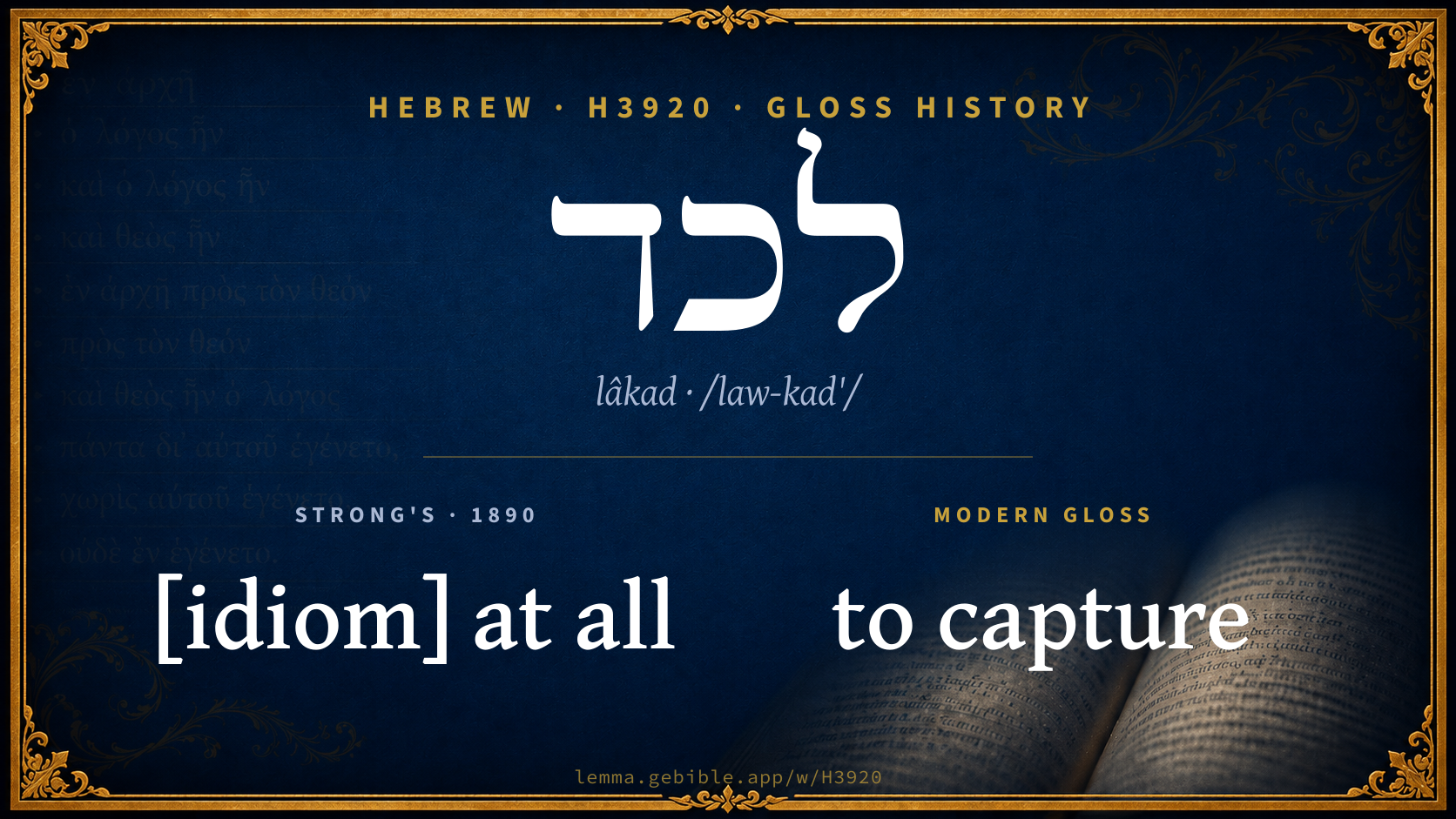
At its core, לכד (lâkad) means “to capture.” Its English rendering has broadened — “took” classically, “captured” (Berean Standard Bible) in modern versions; see the renderings breakdown. Spanning 112 verses in 22 books, it ranks among the common words of the Hebrew Bible. It first appears in Numbers 21:32. Across 3 stems, its meaning turns on the binyan (Qal, Niphal). Each statement above links to its evidence; the full detail follows below.
Gloss history
Strong's 1890 vs modern scholarship
About this word
Strong's H3920 catalogs a Hebrew word from the Hebrew Old Testament.
These counts are not copied from any lexicon or concordance. They are computed here, from the morphology-tagged Hebrew Old Testament. What Lemma adds →
- 112
- distinct verses
- The word appears in 112 distinct verses.
- 22 / 39
- OT books
- The word appears in 22 of 39 Old Testament books.
- #358
- by frequency
- Top 500 most frequent Hebrew words (rank 358 of 8,640 Hebrew words by occurrence).
View all 112 occurrences in the concordance →
By section of the Old Testament
By traditional corpus
Conventional, traditional groupings — biblical authorship is debated, so this is a traditional corpus grouping, not an authorship claim. Each share is this word’s portion of its verses in that division of the Hebrew canon. Each figure is a share of the word’s 112 distinct verses.
- Prophets (Nevi'im) 79 verses · 71%
- Writings (Ketuvim) 26 verses · 23%
- Torah (Pentateuch) 7 verses · 6%
How translations render this word
Counts come from each version’s own published word-to-Strong’s tagging or interlinear alignment — an approximate guide to how each version renders this word, not a word-level alignment the data otherwise carries. Because each total is that version’s own tagged count, the per-version totals vary from one another and need not match the appearance or distinct-verse counts above. These counts may also differ from a printed concordance because Lemma counts each distinctly tagged rendering and does not collapse phrase taggings into a single head-word total. This is a fixed set of word-tagged versions (KJV, ASV, BSB, ULT) and does not change with the reading translation you choose elsewhere. Each version’s license is shown beside its name below (and on Sources).
- King James Version: Took 27×, Was taken 12×, Take 9×
- American Standard Version: Took 21×, Was taken 11×, He took 6×
- Berean Standard Bible: Captured 25×, Was selected 8×, Captured it 7×
- unfoldingWord Literal Text: Captured 16×, And 15×, They captured 8×
King James Version Public Domain
Renders H3920 across 121 tagged occurrences — most commonly:
Plus other, less common renderings. Plus 25 renderings that appear only once — usually multi-word phrases or single function words the recovered tagging swept in, not distinct renderings.
American Standard Version Public Domain
Renders H3920 across 121 tagged occurrences — most commonly:
Plus other, less common renderings. Plus 35 renderings that appear only once — usually multi-word phrases or single function words the recovered tagging swept in, not distinct renderings.
Berean Standard Bible Public Domain
Renders H3920 across 120 tagged occurrences — most commonly:
Plus other, less common renderings. Plus 37 renderings that appear only once — usually multi-word phrases or single function words the recovered tagging swept in, not distinct renderings. Not rendered by a distinct English word in 1 further occurrence.
unfoldingWord Literal Text CC BY-SA 4.0
Renders H3920 across 124 tagged occurrences — most commonly:
Plus other, less common renderings. Plus 34 renderings that appear only once — usually multi-word phrases or single function words the recovered tagging swept in, not distinct renderings.
9 senses and sub-senses in the full BDB
Hebrew verbs can shift meaning by stem (binyan): Qal is the basic action, Niphal is often passive or reflexive, Piel often intensifies or makes it factitive, and Hiphil is typically causative. The senses below are grouped under the stem BDB assigns to each. This entry also uses Hithpael (reflexive or reciprocal).
What do BDB’s symbols mean?
BDB uses these scholarly abbreviations:
| Symbol | Meaning |
|---|---|
| 𝔊 | the Septuagint (the ancient Greek translation, LXX) |
| 𝔙 | the Vulgate (the Latin translation) |
| 𝔖 | the Syriac version (the Peshitta) |
| 𝔗 | the Targum (the Aramaic translation) |
| ψ | the Psalms |
| √ | root (the underlying root or stem) |
| ‖ | parallel passage (a synonymous or contrasted parallel) |
| † | the dagger: every passage where the word occurs is cited |
The 9 senses and sub-senses the full Brown-Driver-Briggs lexicon distinguishes for this word, in lexicon order (not ranked by frequency), with BDB’s own verbatim wording and sub-sense lettering. Shown in Hebrew script with BDB’s own scholarly abbreviations. The condensed entry is in the Lexicon Entry tab. See also the Forms in the corpus table below.
Qal
- Pf. ל׳ Jos 8:21 +, לָכַדְתִּי 2 S 12:27 etc.; Impf. 3 ms. יִלְכּוֹד Am 3:5; וַיִּלְכֹּד Ju 8:12 +, etc.; Imv. ms. sf. לָכְדָהּ 2 S 12:28, mpl. לִכְדוּ; Inf. abs. לָכוֹד Am 3:5; cstr. sf. לְלָכְדֵנִי Je 18:22, לְלָכְדָהּ 32:24; Pt. לֹכֵד Jb 5:13 Pr 16:32;— e.g. Joshua 8:21
- 1. capture, seize (not in P) c. acc., usually a city or town, in war Ju 1:8, 12 Jos 8:21; 10:1 (JE), Dt 2:35 + 48 times (but Ju 1:18 del. as gloss Bu Kit GFM al.); land Jos 10:42 (D), Dn 11:18; water-courses (fords), Ju 3:28; 7:24(×2); 12:5; obj. men (usually princes, kings) in battle Ju 7:25; 8:12, 14 Jos 11:12, 17 (D), 2 Ch 22:9; 33:11; captives and spoils 2 S 8:4 = 1 Ch 18:4; of Saul’s seizing the kingdom (הַמְּלוּכָה), i. e. acquiring it actually by force of arms 1 S 14:47; also of Samson’s catching the foxes Ju 15:4; of a lion catching his prey Am 3:4; of a trap, snare, לָכוֹד יִלְכּוֹד 3:5. e.g. Judges 1:8
- 2. fig. of entrapping men Je 5:26 ψ 35:8, cf. Pr 5:22 Jb 5:13 and (of a pit) Je 18:22. e.g. Jeremiah 5:26
- 3. of taking by lot Jos 7:14(×3), 17 (JE; v. Niph. 3). e.g. Joshua 7:14
Niphal
- Pf. נִלְכַּד La 4:20; 3 fs. נִלְכְּדָה 1 K 16:18 +, etc.; Impf. יִלָּכֵד Is 24:18 Je 48:44; יִלָּ֫כֶד בָּהּ Ec 7:26; וַיִּלָּכֵד Jos 7:16 +, etc.; Pt. נִלְכָּד Jos 7:15;— e.g. Lamentations 4:20
- 1. be captured in war, of city 1 K 16:18 2 K 18:10 Je 38:28(×2); 48:1, 41; 50:2, 9, 24; 51:31, 41 Zc 14:2; of men Je 51:56 La 4:20 (cf. Qal 1). e.g. 1 Kings 16:18
- 2. of men, be caught, viz. in a snare or trap, only fig., usually by divine judgment Is 8:15; 24:18; 28:13 ψ 9:16; 59:13 Pr 6:2; 11:6 Je 6:11; 8:9; so of Moab Je 48:7, 44; of being ensnared by a woman Ec 7:26; of being caught by cords of distress, בְּחַבְלֵי עֹ֑נִי, Jb 36:8. e.g. Isaiah 8:15
- 3. be taken by lot Jos 7:15, 16, 17, 18 (all JE), 1 S 10:20, 21(×2); 14:41, 42 (cf. Qal 3). e.g. Joshua 7:15
Hithpael
- Impf. 3 mpl.; יִתְלַכְּדוּ וְלֹא יִתְפָּרָ֑דוּ Jb 41:9 they grasp each other, and cannot be separated, of crocodile’s scales (‖ אִישׁ בְּאָחִיהוּ יְדֻבָּ֑קוּ); פְּנֵי תְהוֹם יִתְלַכָּ֑דוּ Jb 38:30 the face of the deep compacts (of freezing; ‖ כָּאֶבֶן מַיִם יִתְחַבָּ֑אוּ; vbs. transp., plausibly, by Me Bi Siegf Bu). e.g. Job 41:9
Senses from the full Brown-Driver-Briggs lexicon (Brown, Driver, Briggs; Oxford 1906 — public domain), digitized via Sefaria, supplemented by the OpenScriptures HebrewLexicon (CC BY 4.0). Full attribution on Sources.
Word origin
vb. capture, seize, take (by lot) (Ph. לכד take out, choose (?); 𝔗 לְכַד as BH; Arabic لَكَدَ is strike, push, with the hand, etc., مِلْكَدٌ pestel, cf. mod. لَكَد attack WetzstZMG xxii. 1868, 140; لَكِدَ stick or cleave to);—
— Brown-Driver-Briggs (Oxford 1906, public domain), digitized via Sefaria, supplemented by the OpenScriptures HebrewLexicon (CC BY 4.0). See Sources.
Origin: a primitive root
Jastrow Dictionary
A second Hebrew/Aramaic lexicon for comparison, covering Aramaic and post-biblical (Talmudic, Targumic, Midrashic) usage that the biblical-Hebrew BDB does not. Matched by lemma rather than by Strong’s number, so a lemma may carry more than one Jastrow headword (shown separately below), and the entries cover usage well beyond the Bible.
לָכַד
- (b. h.) to seize, conquer. Yalk. Ex. 168.
- to be caught, seized. Ib. נִלְכְּדָה העיר the city was taken. Ex. R. s. 30 ולבסוף נ׳ בזקנתו וכ׳ and finally in his old age he was caught (in the tempter’s net), and began to be afraid &c. Pesik. R. s. 31 אימתי תִּילָּכֵד when will she (Jerusalem) be taken?; a. e.
לְכַד
- 1. same, to seize. Targ. Prov. XXVI, 17.—
- *2. to contain. Targ. II Esth. I, 8 לָכֵיד ed. Lag. (ed. Amst. למוד).
- to be seized, caught. Targ. Koh. VII, 26.
A Dictionary of the Targumim, the Talmud Babli and Yerushalmi, and the Midrashic Literature (Marcus Jastrow; London, Luzac, 1903) — Public Domain. Digitized via Sefaria. Digitized via Sefaria. Full attribution on Sources.
Forms in the corpus
The 88 distinct written forms H3920 takes in the Hebrew Bible, most frequent first — each parse links to that stem’s occurrences in the concordance. Hebrew forms include their vowel points and cantillation, so a single lemma takes many written forms.
The 60 most common forms are shown; 28 rarer forms follow in the full concordance.
Same root — word family
Other BDB entries built from the same root as H3920, grouped by Strong’s listed origin. These share a root / origin per the lexicon — not necessarily a shared meaning. Each links to that word’s own entry.
Derived from this word
Compare all same-root words → They share a root, not necessarily a meaning.
Septuagint verse parallels
This word appears in 104 verses that also exist in the Greek Old Testament (Septuagint), out of the 112 Hebrew verses it occurs in. You can read those verses in Greek by switching the Old Testament edition to the Septuagint.
Read these verses in the Septuagint
- Numbers 21:32
- Deuteronomy 2:34
- Joshua 6:20
- Judges 1:8
- 1 Samuel 10:20
- 2 Samuel 5:7
- 1 Kings 9:16
- 2 Kings 12:17
- 1 Chronicles 11:5
- 2 Chronicles 12:4
- Job 5:13
- Psalms 9:15
This is a verse-level parallel only — the same verses exist in both the Hebrew and Greek Old Testaments. No word-level Hebrew↔Greek correspondence is claimed: the data carries no such alignment, so no Greek word is shown as this Hebrew word’s translation. Coverage is not total — the Septuagint omits the deuterocanon and renumbers the Psalms, so some Hebrew verses have no direct Greek parallel.