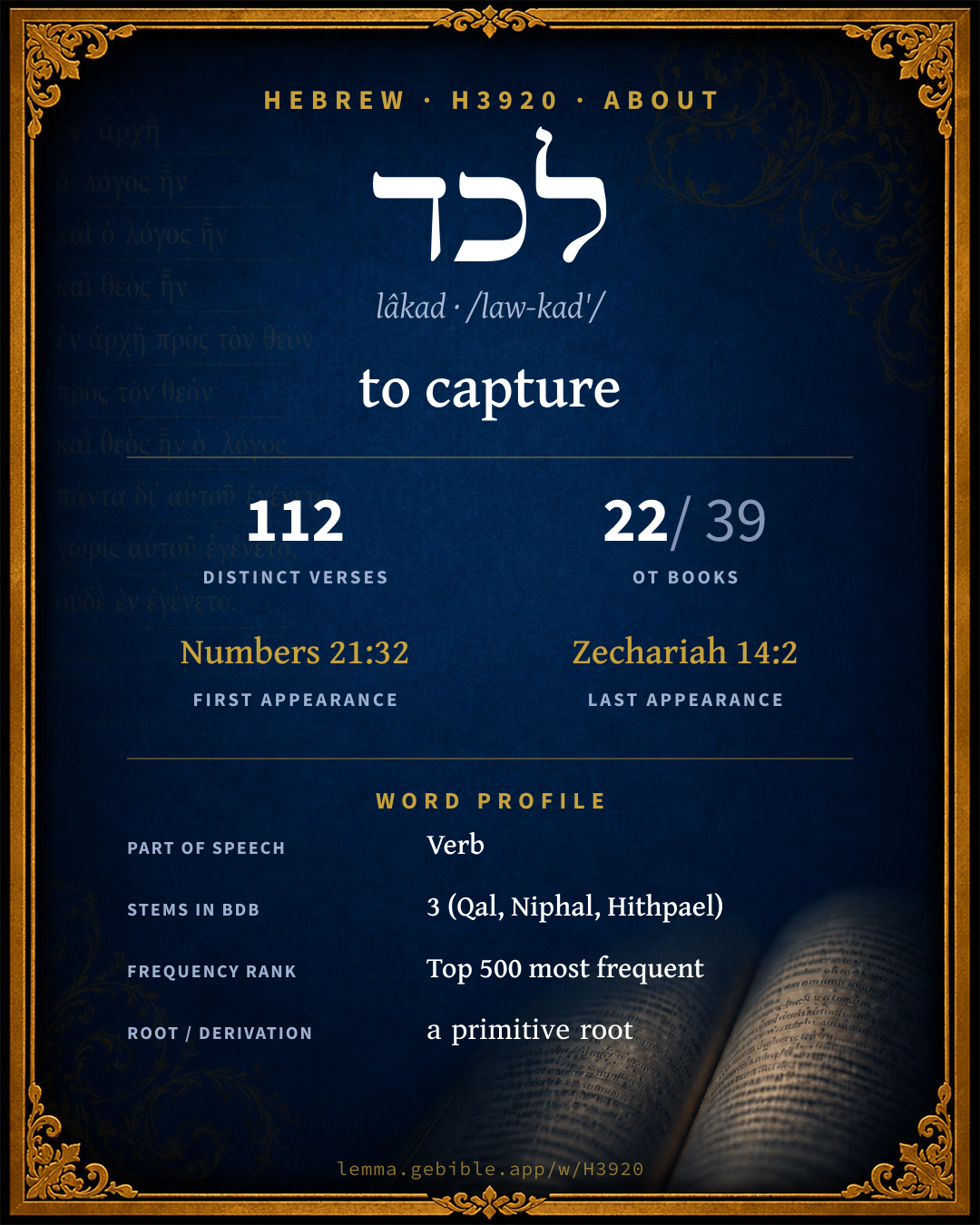
לָכַד
to capture
also: take, seize fuller range ↓
Full lexicon entry — Brown-Driver-Briggs (BDB)
From Brown-Driver-Briggs (BDB)
Where this word appears
See every Qal verb in the Hebrew Bible →
Grammar key — what these labels mean
Part of speech
- Verb
- An action or state-of-being word.
Stem
- Qal
- The basic, simple active stem — the plain form of the verb (“he wrote”). Here: ‘capture’
- Niphal
- Usually the simple passive or reflexive of the Qal (“he was written”). Here: ‘be captured in war’
- Hithpael
- The reflexive or reciprocal stem (the subject acts on itself).
Form
- Sequential Imperfect
- An imperfect with prefixed waw — the standard past-narrative form (waw-consecutive imperfect).
- Perfect
- A completed action or state — Hebrew marks aspect (completeness) more than strict tense (“he wrote”).
- Sequential Perfect
- A perfect with prefixed waw continuing a preceding imperfect or command (waw-consecutive perfect).
- Imperfect
- An incomplete, ongoing, or future action (“he will / would write”).
- Infinitive Absolute
- An unbound verbal noun, often intensifying or standing in for a finite verb.
- Imperative
- A direct command (“write!”).
- Infinitive Construct
- A bound verbal noun, frequently with prepositions (“to write / in writing”).
- Participle Active
- A verbal adjective expressing ongoing or characteristic action (“writing / one who writes”).
State
- Construct
- A noun bound to a following noun in a possessive / “of” relationship (the construct chain).
- Absolute
- The independent form of a noun, not bound to a following word.
Person
- 3rd Person
- The one spoken about (“he / she / it / they”).
- 1st Person
- The speaker (“I / we”).
- 2nd Person
- The one addressed (“you”).
Gender
- Masculine
- Grammatically masculine.
- Feminine
- Grammatically feminine.
- Common
- Either gender — not distinguished for this form.
Number
- Singular
- One.
- Plural
- More than one (in Hebrew, generally three or more).
34 distinct verses where H3920 appears in the Niphal stem, across 12 books. Filtered view — show all forms. Click any verse to open its interlinear word-by-word view. Verse text shown in the World English Bible for context — . Each verse’s Hebrew form is shown with its reference; the English is not keyword-highlighted, since the data carries no word-level English alignment. Use “Compare translations” on any verse to read it across multiple English versions. This concordance covers the Hebrew Bible; Septuagint (Greek Old Testament) occurrences are not indexed here.
Joshua 4 verses
- Joshua 7:15 הַ/נִּלְכָּ֣ד ptcl def.art + Niphal ptcp.act ms It shall be, that he who is taken with the devoted thing shall be burnt with fire, he and all that he has; because he has transgressed the covenant of Yahweh, and because he has done folly in Israel.
- Joshua 7:16 וַ/יִּלָּכֵ֖ד conj + Niphal wimpf 3ms So Joshua rose up early in the morning, and brought Israel near by their tribes; and the tribe of Judah was taken:
- Joshua 7:17 וַ/יִּלְכֹּ֕ד וַ/יִּלָּכֵ֖ד conj + Qal wimpf 3ms conj + Niphal wimpf 3ms and he brought near the family of Judah; and he took the family of the Zerahites: and he brought near the family of the Zerahites man by man; and Zabdi was taken:
- Joshua 7:18 וַ/יִּלָּכֵ֗ד conj + Niphal wimpf 3ms and he brought near his household man by man; and Achan, the son of Carmi, the son of Zabdi, the son of Zerah, of the tribe of Judah, was taken.
1 Samuel 4 verses
- 1 Samuel 10:20 וַ/יִּלָּכֵ֖ד conj + Niphal wimpf 3ms So Samuel brought all the tribes of Israel near, and the tribe of Benjamin was taken.
- 1 Samuel 10:21 וַ/תִּלָּכֵ֖ד וַ/יִּלָּכֵד֙ conj + Niphal wimpf 3fs conj + Niphal wimpf 3ms He brought the tribe of Benjamin near by their families; and the family of the Matrites was taken; and Saul the son of Kish was taken: but when they sought him, he could not be found.
- 1 Samuel 14:41 וַ/יִּלָּכֵ֧ד conj + Niphal wimpf 3ms Therefore Saul said to Yahweh, the God of Israel, Show the right. Jonathan and Saul were taken [by lot]; but the people escaped.
- 1 Samuel 14:42 וַ/יִּלָּכֵ֖ד conj + Niphal wimpf 3ms Saul said, Cast [lots] between me and Jonathan my son. Jonathan was taken.
1 Kings 1 verse
2 Kings 1 verse
Job 1 verse
Psalms 2 verses
- Psalms 9:15 נִלְכְּדָ֥ה Niphal pf 3fs The nations have sunk down in the pit that they made; In the net which they hid, their own foot is taken.
- Psalms 59:12 וְ/יִלָּכְד֥וּ conj + Niphal impf 3mp For the sin of their mouth, and the words of their lips, Let them be caught in their pride, For the curses and lies which they utter.
Proverbs 2 verses
Ecclesiastes 1 verse
Isaiah 3 verses
- Isaiah 8:15 וְ/נִלְכָּֽדוּ conj + Niphal wpf 3cp Many shall stumble thereon, and fall, and be broken, and be snared, and be taken.
- Isaiah 24:18 יִלָּכֵ֖ד Niphal impf 3ms It shall happen, that he who flees from the noise of the fear shall fall into the pit; and he who comes up out of the midst of the pit shall be taken in the snare: for the windows on high are opened, and the foundations of the earth tremble.
- Isaiah 28:13 וְ/נִלְכָּֽדוּ conj + Niphal wpf 3cp Therefore shall the word of Yahweh be to them precept on precept, precept on precept; line on line, line on line; here a little, there a little; that they may go, and fall backward, and be broken, and snared, and taken.
Jeremiah 13 verses
- Jeremiah 6:11 יִלָּכֵ֔דוּ Niphal impf 3mp Therefore I am full of the wrath of Yahweh; I am weary with holding in: pour it out on the children in the street, and on the assembly of young men together; for even the husband with the wife shall be taken, the aged with him who is full of days.
- Jeremiah 8:9 וַ/יִּלָּכֵ֑דוּ conj + Niphal wimpf 3mp The wise men are disappointed, they are dismayed and taken: behold, they have rejected the word of Yahweh; and what manner of wisdom is in them?
- Jeremiah 38:28 נִלְכְּדָ֣ה נִלְכְּדָ֖ה Niphal pf 3fs Niphal pf 3fs So Jeremiah abode in the court of the guard until the day that Jerusalem was taken.
- Jeremiah 48:1 נִלְכְּדָ֖ה Niphal pf 3fs Of Moab. Thus says Yahweh of Hosts, the God of Israel: Woe to Nebo! for it is laid waste; Kiriathaim is disappointed, it is taken; Misgab is put to shame and broken down.
- Jeremiah 48:7 תִּלָּכֵ֑דִי Niphal impf 2fs For, because you have trusted in your works and in your treasures, you also shall be taken: and Chemosh shall go forth into captivity, his priests and his princes together.
- Jeremiah 48:41 נִלְכְּדָה֙ Niphal pf 3fs Kerioth is taken, and the strongholds are seized, and the heart of the mighty men of Moab at that day shall be as the heart of a woman in her pangs.
- Jeremiah 48:44 יִלָּכֵ֖ד Niphal impf 3ms He who flees from the fear shall fall into the pit; and he who gets up out of the pit shall be taken in the snare: for I will bring on him, even on Moab, the year of their visitation, says Yahweh.
- Jeremiah 50:2 נִלְכְּדָ֨ה Niphal pf 3fs Declare you among the nations and publish, and set up a standard; publish, and don't conceal: say, Babylon is taken, Bel is disappointed, Merodach is dismayed; her images are disappointed, her idols are dismayed.
- Jeremiah 50:9 תִּלָּכֵ֑ד Niphal impf 3fs For, behold, I will stir up and cause to come up against Babylon a company of great nations from the north country; and they shall set themselves in array against her; from there she shall be taken: their arrows shall be as of an expert mighty man; none shall return in vain.
- Jeremiah 50:24 נִלְכַּדְתְּ֙ Niphal pf 2fs I have laid a snare for you, and you are also taken, Babylon, and you weren't aware: you are found, and also caught, because you have striven against Yahweh.
- Jeremiah 51:31 נִלְכְּדָ֥ה Niphal pf 3fs One post shall run to meet another, and one messenger to met another, to show the king of Babylon that his city is taken on every quarter:
- Jeremiah 51:41 נִלְכְּדָ֣ה Niphal pf 3fs How is Sheshach taken! and the praise of the whole earth seized! how is Babylon become a desolation among the nations!
- Jeremiah 51:56 וְ/נִלְכְּדוּ֙ conj + Niphal wpf 3cp for the destroyer is come on her, even on Babylon, and her mighty men are taken, their bows are broken in pieces; for Yahweh is a God of recompenses, he will surely requite.
Lamentations 1 verse
Zechariah 1 verse
About this entry
At a glance — auto-summarized from this page’s data, not written by a person. Every figure links to its source below. This summary describes the numbers; it doesn’t interpret them.
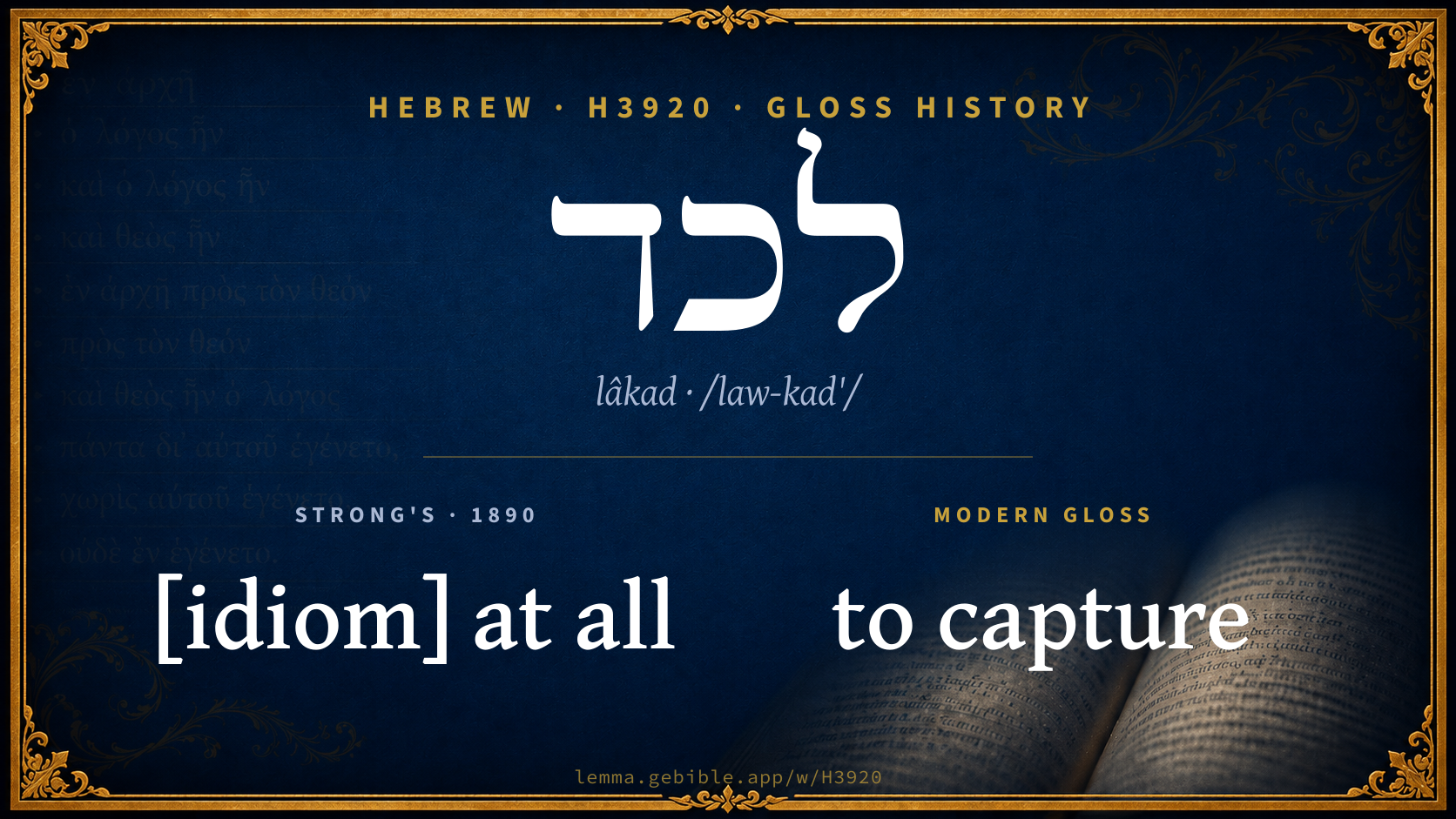
At its core, לכד (lâkad) means “to capture.” Its English rendering has broadened — “took” classically, “captured” (Berean Standard Bible) in modern versions; see the renderings breakdown. Spanning 112 verses in 22 books, it ranks among the common words of the Hebrew Bible. It first appears in Numbers 21:32. Across 3 stems, its meaning turns on the binyan (Qal, Niphal). Each statement above links to its evidence; the full detail follows below.
Gloss history
Strong's 1890 vs modern scholarship
About this word
Strong's H3920 catalogs a Hebrew word from the Hebrew Old Testament.
These counts are not copied from any lexicon or concordance. They are computed here, from the morphology-tagged Hebrew Old Testament. What Lemma adds →
- 112
- distinct verses
- The word appears in 112 distinct verses.
- 22 / 39
- OT books
- The word appears in 22 of 39 Old Testament books.
- #358
- by frequency
- Top 500 most frequent Hebrew words (rank 358 of 8,640 Hebrew words by occurrence).
View all 112 occurrences in the concordance →
By section of the Old Testament
By traditional corpus
Conventional, traditional groupings — biblical authorship is debated, so this is a traditional corpus grouping, not an authorship claim. Each share is this word’s portion of its verses in that division of the Hebrew canon. Each figure is a share of the word’s 112 distinct verses.
- Prophets (Nevi'im) 79 verses · 71%
- Writings (Ketuvim) 26 verses · 23%
- Torah (Pentateuch) 7 verses · 6%
How translations render this word
Counts come from each version’s own published word-to-Strong’s tagging or interlinear alignment — an approximate guide to how each version renders this word, not a word-level alignment the data otherwise carries. Because each total is that version’s own tagged count, the per-version totals vary from one another and need not match the appearance or distinct-verse counts above. These counts may also differ from a printed concordance because Lemma counts each distinctly tagged rendering and does not collapse phrase taggings into a single head-word total. This is a fixed set of word-tagged versions (KJV, ASV, BSB, ULT) and does not change with the reading translation you choose elsewhere. Each version’s license is shown beside its name below (and on Sources).
- King James Version: Took 27×, Was taken 12×, Take 9×
- American Standard Version: Took 21×, Was taken 11×, He took 6×
- Berean Standard Bible: Captured 25×, Was selected 8×, Captured it 7×
- unfoldingWord Literal Text: Captured 16×, And 15×, They captured 8×
King James Version Public Domain
Renders H3920 across 121 tagged occurrences — most commonly:
Plus other, less common renderings. Plus 25 renderings that appear only once — usually multi-word phrases or single function words the recovered tagging swept in, not distinct renderings.
American Standard Version Public Domain
Renders H3920 across 121 tagged occurrences — most commonly:
Plus other, less common renderings. Plus 35 renderings that appear only once — usually multi-word phrases or single function words the recovered tagging swept in, not distinct renderings.
Berean Standard Bible Public Domain
Renders H3920 across 120 tagged occurrences — most commonly:
Plus other, less common renderings. Plus 37 renderings that appear only once — usually multi-word phrases or single function words the recovered tagging swept in, not distinct renderings. Not rendered by a distinct English word in 1 further occurrence.
unfoldingWord Literal Text CC BY-SA 4.0
Renders H3920 across 124 tagged occurrences — most commonly:
Plus other, less common renderings. Plus 34 renderings that appear only once — usually multi-word phrases or single function words the recovered tagging swept in, not distinct renderings.
9 senses and sub-senses in the full BDB
Hebrew verbs can shift meaning by stem (binyan): Qal is the basic action, Niphal is often passive or reflexive, Piel often intensifies or makes it factitive, and Hiphil is typically causative. The senses below are grouped under the stem BDB assigns to each. This entry also uses Hithpael (reflexive or reciprocal).
What do BDB’s symbols mean?
BDB uses these scholarly abbreviations:
| Symbol | Meaning |
|---|---|
| 𝔊 | the Septuagint (the ancient Greek translation, LXX) |
| 𝔙 | the Vulgate (the Latin translation) |
| 𝔖 | the Syriac version (the Peshitta) |
| 𝔗 | the Targum (the Aramaic translation) |
| ψ | the Psalms |
| √ | root (the underlying root or stem) |
| ‖ | parallel passage (a synonymous or contrasted parallel) |
| † | the dagger: every passage where the word occurs is cited |
The 9 senses and sub-senses the full Brown-Driver-Briggs lexicon distinguishes for this word, in lexicon order (not ranked by frequency), with BDB’s own verbatim wording and sub-sense lettering. Shown in Hebrew script with BDB’s own scholarly abbreviations. The condensed entry is in the Lexicon Entry tab. See also the Forms in the corpus table below.
Qal
- Pf. ל׳ Jos 8:21 +, לָכַדְתִּי 2 S 12:27 etc.; Impf. 3 ms. יִלְכּוֹד Am 3:5; וַיִּלְכֹּד Ju 8:12 +, etc.; Imv. ms. sf. לָכְדָהּ 2 S 12:28, mpl. לִכְדוּ; Inf. abs. לָכוֹד Am 3:5; cstr. sf. לְלָכְדֵנִי Je 18:22, לְלָכְדָהּ 32:24; Pt. לֹכֵד Jb 5:13 Pr 16:32;— e.g. Joshua 8:21
- 1. capture, seize (not in P) c. acc., usually a city or town, in war Ju 1:8, 12 Jos 8:21; 10:1 (JE), Dt 2:35 + 48 times (but Ju 1:18 del. as gloss Bu Kit GFM al.); land Jos 10:42 (D), Dn 11:18; water-courses (fords), Ju 3:28; 7:24(×2); 12:5; obj. men (usually princes, kings) in battle Ju 7:25; 8:12, 14 Jos 11:12, 17 (D), 2 Ch 22:9; 33:11; captives and spoils 2 S 8:4 = 1 Ch 18:4; of Saul’s seizing the kingdom (הַמְּלוּכָה), i. e. acquiring it actually by force of arms 1 S 14:47; also of Samson’s catching the foxes Ju 15:4; of a lion catching his prey Am 3:4; of a trap, snare, לָכוֹד יִלְכּוֹד 3:5. e.g. Judges 1:8
- 2. fig. of entrapping men Je 5:26 ψ 35:8, cf. Pr 5:22 Jb 5:13 and (of a pit) Je 18:22. e.g. Jeremiah 5:26
- 3. of taking by lot Jos 7:14(×3), 17 (JE; v. Niph. 3). e.g. Joshua 7:14
Niphal
- Pf. נִלְכַּד La 4:20; 3 fs. נִלְכְּדָה 1 K 16:18 +, etc.; Impf. יִלָּכֵד Is 24:18 Je 48:44; יִלָּ֫כֶד בָּהּ Ec 7:26; וַיִּלָּכֵד Jos 7:16 +, etc.; Pt. נִלְכָּד Jos 7:15;— e.g. Lamentations 4:20
- 1. be captured in war, of city 1 K 16:18 2 K 18:10 Je 38:28(×2); 48:1, 41; 50:2, 9, 24; 51:31, 41 Zc 14:2; of men Je 51:56 La 4:20 (cf. Qal 1). e.g. 1 Kings 16:18
- 2. of men, be caught, viz. in a snare or trap, only fig., usually by divine judgment Is 8:15; 24:18; 28:13 ψ 9:16; 59:13 Pr 6:2; 11:6 Je 6:11; 8:9; so of Moab Je 48:7, 44; of being ensnared by a woman Ec 7:26; of being caught by cords of distress, בְּחַבְלֵי עֹ֑נִי, Jb 36:8. e.g. Isaiah 8:15
- 3. be taken by lot Jos 7:15, 16, 17, 18 (all JE), 1 S 10:20, 21(×2); 14:41, 42 (cf. Qal 3). e.g. Joshua 7:15
Hithpael
- Impf. 3 mpl.; יִתְלַכְּדוּ וְלֹא יִתְפָּרָ֑דוּ Jb 41:9 they grasp each other, and cannot be separated, of crocodile’s scales (‖ אִישׁ בְּאָחִיהוּ יְדֻבָּ֑קוּ); פְּנֵי תְהוֹם יִתְלַכָּ֑דוּ Jb 38:30 the face of the deep compacts (of freezing; ‖ כָּאֶבֶן מַיִם יִתְחַבָּ֑אוּ; vbs. transp., plausibly, by Me Bi Siegf Bu). e.g. Job 41:9
Senses from the full Brown-Driver-Briggs lexicon (Brown, Driver, Briggs; Oxford 1906 — public domain), digitized via Sefaria, supplemented by the OpenScriptures HebrewLexicon (CC BY 4.0). Full attribution on Sources.
Word origin
vb. capture, seize, take (by lot) (Ph. לכד take out, choose (?); 𝔗 לְכַד as BH; Arabic لَكَدَ is strike, push, with the hand, etc., مِلْكَدٌ pestel, cf. mod. لَكَد attack WetzstZMG xxii. 1868, 140; لَكِدَ stick or cleave to);—
— Brown-Driver-Briggs (Oxford 1906, public domain), digitized via Sefaria, supplemented by the OpenScriptures HebrewLexicon (CC BY 4.0). See Sources.
Origin: a primitive root
Jastrow Dictionary
A second Hebrew/Aramaic lexicon for comparison, covering Aramaic and post-biblical (Talmudic, Targumic, Midrashic) usage that the biblical-Hebrew BDB does not. Matched by lemma rather than by Strong’s number, so a lemma may carry more than one Jastrow headword (shown separately below), and the entries cover usage well beyond the Bible.
לָכַד
- (b. h.) to seize, conquer. Yalk. Ex. 168.
- to be caught, seized. Ib. נִלְכְּדָה העיר the city was taken. Ex. R. s. 30 ולבסוף נ׳ בזקנתו וכ׳ and finally in his old age he was caught (in the tempter’s net), and began to be afraid &c. Pesik. R. s. 31 אימתי תִּילָּכֵד when will she (Jerusalem) be taken?; a. e.
לְכַד
- 1. same, to seize. Targ. Prov. XXVI, 17.—
- *2. to contain. Targ. II Esth. I, 8 לָכֵיד ed. Lag. (ed. Amst. למוד).
- to be seized, caught. Targ. Koh. VII, 26.
A Dictionary of the Targumim, the Talmud Babli and Yerushalmi, and the Midrashic Literature (Marcus Jastrow; London, Luzac, 1903) — Public Domain. Digitized via Sefaria. Digitized via Sefaria. Full attribution on Sources.
Forms in the corpus
The 88 distinct written forms H3920 takes in the Hebrew Bible, most frequent first — each parse links to that stem’s occurrences in the concordance. Hebrew forms include their vowel points and cantillation, so a single lemma takes many written forms.
The 60 most common forms are shown; 28 rarer forms follow in the full concordance.
Same root — word family
Other BDB entries built from the same root as H3920, grouped by Strong’s listed origin. These share a root / origin per the lexicon — not necessarily a shared meaning. Each links to that word’s own entry.
Derived from this word
Compare all same-root words → They share a root, not necessarily a meaning.
Septuagint verse parallels
This word appears in 104 verses that also exist in the Greek Old Testament (Septuagint), out of the 112 Hebrew verses it occurs in. You can read those verses in Greek by switching the Old Testament edition to the Septuagint.
Read these verses in the Septuagint
- Numbers 21:32
- Deuteronomy 2:34
- Joshua 6:20
- Judges 1:8
- 1 Samuel 10:20
- 2 Samuel 5:7
- 1 Kings 9:16
- 2 Kings 12:17
- 1 Chronicles 11:5
- 2 Chronicles 12:4
- Job 5:13
- Psalms 9:15
This is a verse-level parallel only — the same verses exist in both the Hebrew and Greek Old Testaments. No word-level Hebrew↔Greek correspondence is claimed: the data carries no such alignment, so no Greek word is shown as this Hebrew word’s translation. Coverage is not total — the Septuagint omits the deuterocanon and renumbers the Psalms, so some Hebrew verses have no direct Greek parallel.