Numbers 21:32

Hebrew (Westminster Leningrad Codex) Numbers 21:32 appears in the Hebrew Old Testament. The text above is from the Westminster Leningrad Codex. Each word links to its Strong’s number, a concise gloss, and parsing drawn from the Open Scriptures Hebrew Bible morphology. Click any word for its full Brown-Driver-Briggs (BDB) entry.
Download image
Cite this verse

Numbers 21:32 (World English Bible). Public Domain. Lemma interlinear Bible study tool, https://lemma.gebible.app/v/numbers/21/32.

Show BibTeX & RIS
BibTeX
RIS
English Translation
Moses sent to spy out Jazer; and they took the towns of it, and drove out the Amorites who were there.
World English Bible · Public Domain
Highlights
  • 2 first appearances in the Hebrew Bible
Full analysis ↓
Download a study sheet

One document with this verse’s original text, its word-by-word gloss line, the meaning frame, cross-references with their text, attributed commentary, and full source and license credits — printable, and it pastes into notes with its structure intact.

This verse Autodidact and up

Study sheet (.html) Plain text (.txt)

A passage Seminary Student

Up to 50 verses in one chapter. A passage sheet keeps up to 6 commentary sources and 12 cross-references per verse, in the order this page ranks them, and says so on the sheet whenever that leaves anything out. Ask for a single verse and you get the Autodidact verse sheet above.

Everything on this page stays free to read, with no account — the sheet is a download of what is already on screen, not access to it.

Want to remove ads? Support Godless Engineer
Compare translations 3

The same verse in 3 English versions, stacked beneath the original-language interlinear above. Click any original word for its lexicon entry.

Each is an independent rendering of the whole verse — the interlinear is not word-aligned to these translations.

Highlighted words mark where these versions differ — a whole-verse word diff, not a word-by-word alignment.

  • World English Bible Public Domain
    Moses sent to spy out Jazer; and they took the towns of it, and drove out the Amorites who were there.
  • King James Version Public Domain
    And Moses sent to spy out Jaazer, and they took the villages thereof, and drove out the Amorites that were there.
  • unfoldingWord Literal Text CC BY-SA 4.0
    And Moses sent to spy out Jazer, and they captured its daughters and dispossessed the Amorite who there.

unfoldingWord Literal Text — © unfoldingWord, licensed CC BY-SA 4.0. Word-aligned USFM3 via Door43 (git.door43.org/unfoldingWord/en_ult).

Versions to compare (up to 4)

3 of 4 selected

Show all 18 translations

Every available English version of this verse, each an independent rendering of the whole verse.

  • World English Bible Public Domain
    Moses sent to spy out Jazer; and they took the towns of it, and drove out the Amorites who were there.
  • Berean Standard Bible Public Domain
    After Moses had sent spies to Jazer, Israel captured its villages and drove out the Amorites who were there.
  • Majority Standard Bible Public Domain
    After Moses had sent spies to Jazer, Israel captured its villages and drove out the Amorites who were there.
  • King James Version Public Domain
    And Moses sent to spy out Jaazer, and they took the villages thereof, and drove out the Amorites that were there.
  • American Standard Version (1901) Public Domain
    And Moses sent to spy out Jazer; and they took the towns thereof, and drove out the Amorites that were there.
  • Revised Version (1885) Public Domain
    And Moses sent to spy out Jazer, and they took the towns thereof, and drove out the Amorites that were there.
  • Geneva Bible (1599) Public Domain
    And Moses sent to searche out Iaazer, and they tooke the townes belonging thereto, and rooted out the Amorites that were there.
  • Douay-Rheims (1899) Public Domain
    And Moses sent some to take a view of Jazer: and they took the villages of it, and conquered the inhabitants.
  • Young's Literal Translation Public Domain
    and Moses sendeth to spy out Jaazer, and they capture its villages, and dispossess the Amorite who `is' there,
  • Literal Standard Version CC BY-SA 4.0
    and Moses sends to spy out Jaazer, and they capture its villages, and dispossess the Amorite who [is] there,
  • Unlocked Literal Bible CC BY-SA 4.0
    Then Moses sent men to look at Jazer. They took its villages and drove out the Amorites who were there.
  • unfoldingWord Literal Text CC BY-SA 4.0
    And Moses sent to spy out Jazer, and they captured its daughters and dispossessed the Amorite who there.
  • Darby Bible Public Domain
    And Moses sent to spy out Jaazer, and they took its dependent villages, and he dispossessed the Amorites that were there.
  • World Messianic Bible Public Domain
    Moses sent to spy out Jazer. They took its villages, and drove out the Amorites who were there.
  • Webster's Bible Public Domain
    And Moses sent to explore Jaazer, and they took its villages, and drove out the Amorites that were there.
  • Free Bible Version CC BY-SA 4.0
    Moses sent men to explore Jazer. The Israelites conquered its surrounding villages and expelled the Amorites living there.
  • Bible in Basic English Public Domain
    And Moses sent men secretly to Jazer, and they took its towns, driving out the Amorites who were living there.
  • JPS Tanakh (1917) Public Domain
    And Moses sent to spy out Jazer, and they took the towns thereof, and drove out the Amorites that were there.

Literal Standard Version (2020), Covenant Press — licensed CC BY-SA 4.0. Text via the HelloAO Bible API (eBible.org). Unlocked Literal Bible (unfoldingWord) — licensed CC BY-SA 4.0. Text via the HelloAO Bible API (eBible.org). unfoldingWord Literal Text — © unfoldingWord, licensed CC BY-SA 4.0. Word-aligned USFM3 via Door43 (git.door43.org/unfoldingWord/en_ult). Free Bible Version, Dr. Jonathan Gallagher — licensed CC BY-SA 4.0. Text via the HelloAO Bible API (eBible.org).

Word by word

More ways to search: Search by grammar → Find every occurrence → Compare this word →

Practice this passage: Drill this verse → Learn its vocabulary →

יַעְזֵ֔ר
Yaʻăzêyr
H3270
“Jazer”
Noun, Proper
Part of Speech
Noun
Type
Proper
Full BDB Definition

Origin: from H5826

TWOT: None

Jazer or Jaazer = "helped" - a Levitical city east of the Jordan, in Gilead in the territory of Gad, formerly an Amorite city; site uncertain
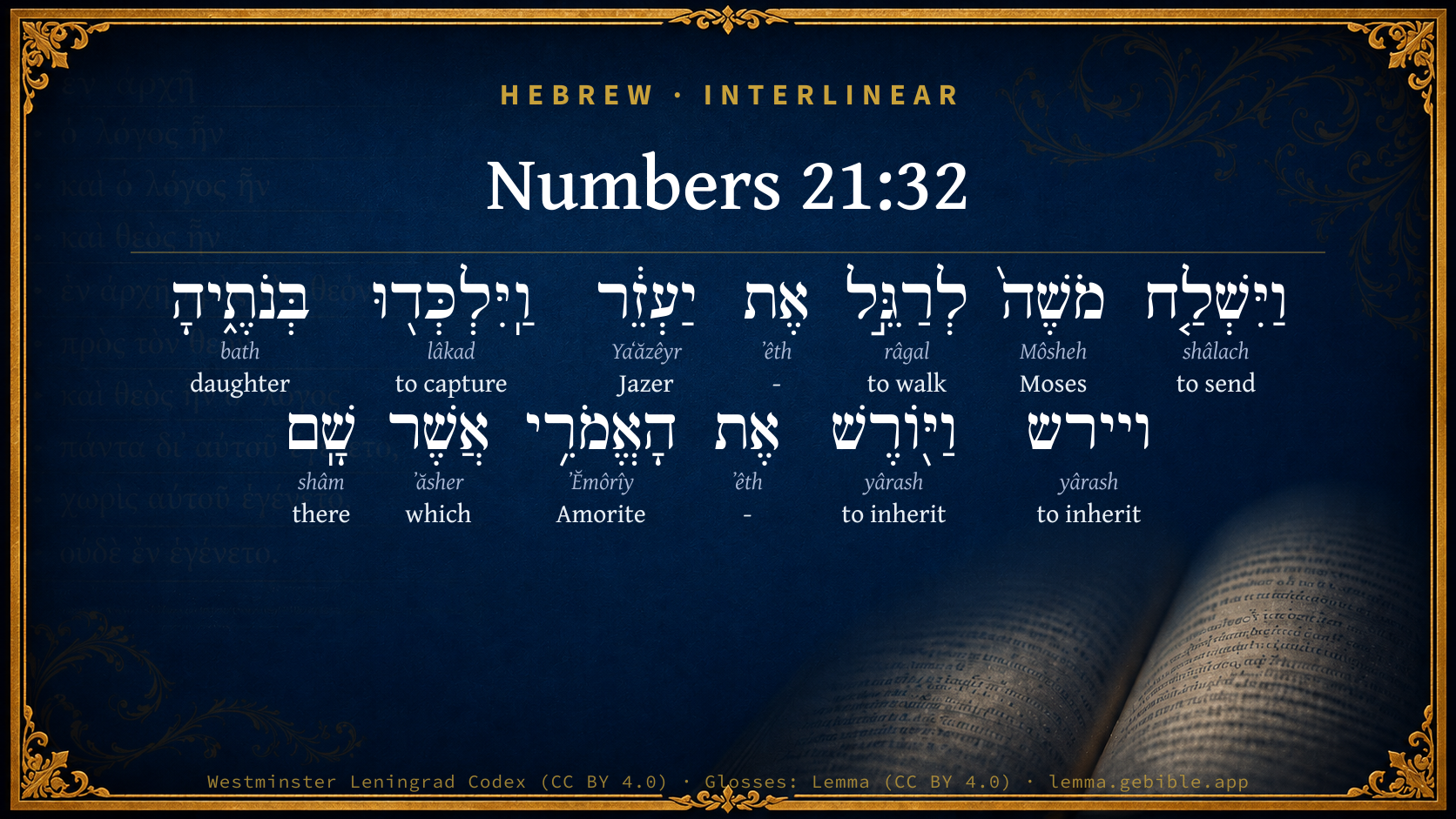
  1. וַיִּשְׁלַ֤ח shâlach H7971 “and · to send” Conjunction + Verb, Qal, Sequential Imperfect, 3rd Person, Masculine, Singular
  2. מֹשֶׁה֙ Môsheh H4872 “Moses” Noun, Proper
  3. לְרַגֵּ֣ל râgal H7270 “to walk” Preposition + Verb, Piel, Infinitive Construct
  4. אֶת ʼêth H853 “-” Particle, Direct Object
  5. וַֽיִּלְכְּד֖וּ lâkad H3920 “and · to capture” Conjunction + Verb, Qal, Sequential Imperfect, 3rd Person, Masculine, Plural
  6. בְּנֹתֶ֑יהָ bath H1323 “daughters · her” Noun, Common, Feminine, Plural, Construct + Suffix, Personal, 3rd Person, Feminine, Singular
  7. ויירש yârash H3423 “and · to inherit” Conjunction + Verb, Qal, Sequential Imperfect, 3rd Person, Masculine, Singular
  8. וַיּ֖וֹרֶשׁ yârash H3423 “and · to inherit” Conjunction + Verb, Hiphil, Sequential Imperfect, 3rd Person, Masculine, Singular
  9. אֶת ʼêth H853 “-” Particle, Direct Object
  10. הָאֱמֹרִ֥י ʼĔmôrîy H567 “the · Amorite” Particle, Definite Article + Noun, Gentilic, Masculine, Singular, Absolute
  11. אֲשֶׁר ʼăsher H834 “which” Particle, Relative
  12. שָֽׁם shâm H8033 “there” Adverb

About this verse

These counts appear in no published source. They are computed here, from the morphology-tagged text and Lemma’s own curated glosses. What Lemma adds →

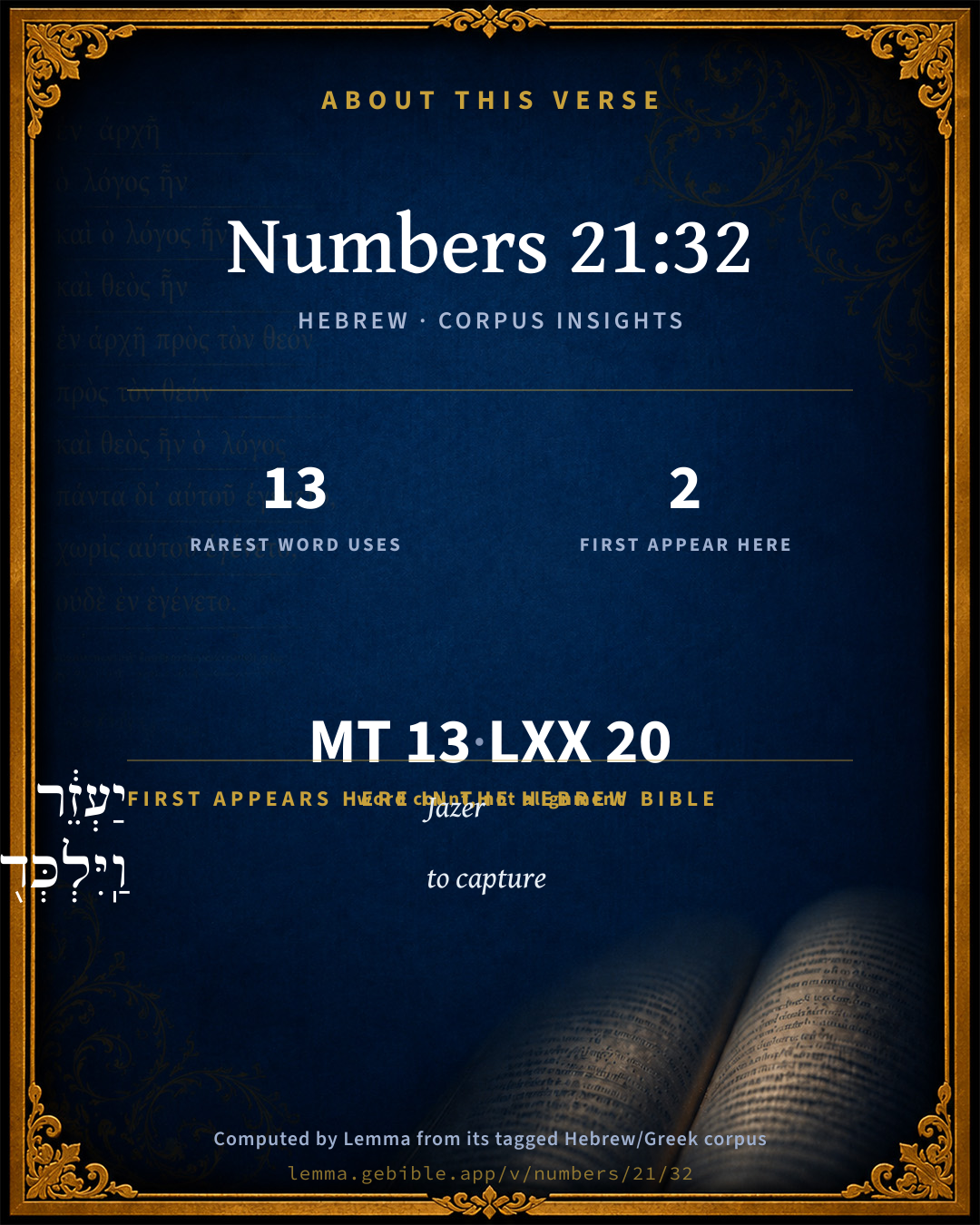
13
words
11
distinct lemmas
Pentateuch
section

Notable vocabulary

The rarest word here is יַעְזֵ֔ר Jazer H3270 — appearing just 13 times in the whole Hebrew Bible.

First appearance in Scripture

These words make their first canonical appearance in the Hebrew Bible here:

  • יַעְזֵ֔ר Jazer H3270
  • וַֽיִּלְכְּד֖וּ to capture H3920

Shared distinctive vocabulary

יַעְזֵ֔ר Jazer H3270 occurs in 12 verses of the Hebrew Bible. Also found in:

Grammatical profile

  • 5 verbs
  • 4 nouns
  • 1 adverb
  • 3 particles

Verb forms

  • וַיִּשְׁלַ֤ח Qal · Sequential Imperfect
  • לְרַגֵּ֣ל Piel · Infinitive Construct
  • וַֽיִּלְכְּד֖וּ Qal · Sequential Imperfect
  • ויירש Qal · Sequential Imperfect
  • וַיּ֖וֹרֶשׁ Hiphil · Sequential Imperfect

Repetition

A word recurs within this verse — often emphatic in Hebrew:

  • ויירש to inherit H3423 ×2

Hebrew & Septuagint length

In English translation the verse runs 21 words from the Hebrew and 22 from the Septuagint (LXX English) — closely comparable.

A rough comparison of the two English renderings, which tokenize alike — not a word-level alignment.

Word counts can differ between the Hebrew and the Greek without any difference in meaning — e.g. the Hebrew direct-object marker אֵת has no separate Greek word, and Greek often adds the article ὁ.

In the original languages it is 13 Hebrew tokens and 20 Greek tokens — but the two are counted differently (Hebrew bundles its prefixes and suffixes into one token; the Greek is in lemma form), so that isn’t a like-for-like length.

Cross-references

5

Topical passages linked to Numbers 21:32 in the Treasury of Scripture Knowledge — connected by theme and wording, ordered by reader-vote popularity; previews shown in the World English Bible.

  • Numbers 32:1 Now the children of Reuben and the children of Gad had a very great multitude of cattle: and when they saw the land of Jazer, and the land of Gilead, that behold, the place was a place for cattle;
  • Jeremiah 48:32 With more than the weeping of Jazer will I weep for you, vine of Sibmah: your branches passed over the sea, they reached even to the sea of Jazer: on your summer fruits and on your vintage the destroyer is fallen.
  • Numbers 32:35 and Atrothshophan, and Jazer, and Jogbehah,
  • Numbers 32:3 Ataroth, and Dibon, and Jazer, and Nimrah, and Heshbon, and Elealeh, and Sebam, and Nebo, and Beon,
  • Isaiah 16:8–9 For the fields of Heshbon languish, [and] the vine of Sibmah; the lords of the nations have broken down the choice branches of it, which reached even to Jazer, which wandered into the wilderness; its shoots were spread abroad, they passed over the sea.

Cross-references courtesy of OpenBible.info (CC BY 4.0).

Hebrew and Greek witnesses Masoretic Hebrew ↔ Greek Septuagint

The same verse in the two great witnesses to the Old Testament, shown verse-for-verse.

These are two independent witnesses, not word-aligned to each other, and the Septuagint is shown in lemma (dictionary) form.

Hebrew Numbers 21:32 Masoretic · Westminster Leningrad Codex

וַיִּשְׁלַ֤ח מֹשֶׁה֙ לְרַגֵּ֣ל אֶת יַעְזֵ֔ר וַֽיִּלְכְּד֖וּ בְּנֹתֶ֑יהָ ויירש וַיּ֖וֹרֶשׁ אֶת הָאֱמֹרִ֥י אֲשֶׁר שָֽׁם

Moses sent to spy out Jazer; and they took the towns of it, and drove out the Amorites who were there.

World English Bible · Public Domain

Greek LXX Numbers 21:32 Septuagint · lemma form

καί ἀποστέλλω μωυσῆς κατασκέπτομαι ὁ ιαζηρ καί καταλαμβάνω αὐτός καί ὁ κώμη αὐτός καί ἐκβάλλω ὁ ἀμορραῖος ὁ καταοἰκέω ἐκεῖ

And Moses sent to spy out Jazer; and they took it, and its villages, and cast out the Amorite that lived there.

LXX2012 (modern English Septuagint) · Public Domain

On this verse, Haydock's Catholic Bible Commentary discusses the Septuagint’s reading. Read the note in Commentary ↓

Hebrew: Westminster Leningrad Codex (CC BY 4.0). Greek: Septuagint (public domain); English from LXX2012 (modern English Septuagint) (Public Domain). How the Septuagint differs from the Hebrew →

Targum (Aramaic paraphrase)

2

The Targum is the ancient Jewish Aramaic paraphrase of the Hebrew Scriptures — an interpretive translation, not the Hebrew text itself. Onkelos (literal) and Pseudo-Jonathan (expansive) render the Torah, and Jonathan the Prophets. Coverage is partial: where no permissively-licensed English translation exists for a verse, only the Aramaic is shown. This is verse-level text, not a word-by-word alignment to the Hebrew.

  1. Targum Onkelos Torah (Genesis–Deuteronomy)
    וּשְׁלַח משֶׁה לְאַלָלָא יָת יַעְזֵר וּכְבָשׁוּ כַּפְרָנָהָא וְתָרִיךְ יָת אֱמוֹרָאָהּ דִי תַמָן

    (no public-domain English translation for this verse)

    Targum Onkelos — Aramaic: “Onkelos Genesis” (public domain); “Onkelos Exodus” (public domain); “Onkelos Leviticus” (public domain); “Onkelos Numbers” (public domain); “Onkelos Deuteronomy” (public domain). English: “Sefaria Community Translation” (CC0 1.0 (public-domain dedication)); “J.W. Etheridge. The Targums of Onkelos and Jonathan Ben Uzziel on the Pentateuch. London: Longmans, Green, 1862” (public domain). Text via Sefaria.

  2. Targum Pseudo-Jonathan Torah (Genesis–Deuteronomy)
    וְשָׁדַר משֶׁה יַת כָּלֵב וְיַת פִּנְחָס לְאַלָלָא יַת מַכְבַּר וּכְבָשׁוּ כּוּפְרָנָהָא וְשֵׁיצוּן יַת אֱמוֹרָאֵי דְתַמָן

    And Mosheh sent Kaleb and Phineas to examine Makbar, and they subdued the villages, and destroyed the Amorites who were there.

    Targum Pseudo-Jonathan — Aramaic: “Targum Jonathan on Genesis” (public domain); “Targum Jonathan on Exodus” (public domain); “Targum Jonathan on Leviticus” (public domain); “Targum Jonathan on Numbers” (public domain); “Targum Jonathan on Deuteronomy” (public domain). English: “The Targum of Jonathan ben Uzziel, trans. J. W. Etheridge, London, 1862” (public domain). Text via Sefaria.

Commentary

Notes on Numbers 21:32 from classic Christian and Jewish commentators (each source and its license shown beneath its notes). The classic Christian expositions comment on the surrounding passage and are grouped to its opening verse, so a note may address several verses; the Jewish commentaries on the Tanakh (Rashi and others) are per-verse, so they appear only where the commentator wrote on this verse.

Lemma curates 59 commentaries, every one of them public domain or Creative Commons licensed, each selected and text-cleaned for this edition rather than reprinted as found. About our sources →

The Biblical Illustrator

Joseph S. Exell

Num_21:32-35

Og the king of Bashan went out against them.

War with the king of Bashan

When God had removed one great rub out of Israels way to Canaan, namely, Sihon, king of Heshbon, now starts up another remora, greater (at least in person) than the former, namely, Og king of Bashan, who came forth to war against them (Num_21:33-35), but more largely described (Deu_3:1-22), wherein Gods kindness to Israel in that war with the king of Bashan is amply characterised.

1. The occasion of the war. Og came forth and gave the first assault against Israel, before they assaulted him or his people (Num_21:2), together with which we are told what a formidable adversary this king was, being a man of prodigious stature, whereof a conjecture may easily be collected from the vast length of his bed (Num_21:11).

2. The management of this war.

(1) God doth encourage Israel with comfortable words, and enabled them to do the deed in conquering the enemy (Num_21:2-3).

(2) Then Israel (thus encouraged and enabled by the Lord of Hosts) went forth in the strength of the Lord (Psa_71:16), and smote them taking all their cities and villages, walled and unwalled, and their whole country, destroying all ages and sexes, and taking the spoil of all their cattle (Num_21:4-10).

3. The event of this conquest, which was the consequence of the victory, namely, the distribution of this new conquered country to the tribes of Reuben and Gad, and to the half tribe of Manasseh (verses 12-17), and the terms upon which this country was thus distributed to those tribes (verses 18-20), which happy event was a pledge for encouraging Joshua to be confident of all his future conquests (verses 21, 22). From this whole history arises this following, namely, when one evil or impediment in our way to heaven is removed, God often permits another and worse to spring up for our new exercise; as it was here with Israel, no sooner had they vanquished Sihon (who stood in their way to Canaan), but immediately Og starts up to make them a new opposition. His formidable stature might have made Israel to fly, as niter Goliath made them, for want of faith (1Sa_17:24). He was likely one of the remnant of those Rephaims, or giants, whom Chedorlaomer and his company of kings smote in Ashtoreth (Gen_14:5, with Jos_13:12), for Og reigned there. (C. Ness.)

.

The Biblical Illustrator, edited by Joseph S. Exell (c. 1880s–1900s) — public domain. Text from a community e-Sword module.

Joseph Benson's Commentary

Num 21:32. Jaazer — One of the cities of Moab, formerly taken from them by Sihon, and now taken from him by the Israelites.

Joseph Benson's Commentary on the Old and New Testaments (1811–1818) — public domain. Text from a community e-Sword module.

The Cambridge Bible for Schools and Colleges

gen. ed. J. J. S. Perowne

32. The capture of Jazer stands in a curiously isolated position, after the general statement in Num_21:31. It is probably taken from another source which described the capture of several individual towns. It is not mentioned either in Deuteronomy 2 or Judges 11.

Jazer] The site is unknown, and more than one suggestion has been made for its identification. Isa_16:8 suggests that it was some distance from Heshbon. It appears to have lain to the east, near the Ammonite border (Num_32:35, Jos_13:25).

33–35 (D ). The defeat of Og the king of Bashan.

This defeat is mentioned in the following passages of the Hexateuch: Num_32:33, Deu_1:4; Deu_3:1-13; Deu_4:47; Deu_29:7; Jos_9:10; Jos_12:4; Jos_13:30. Of these the first and last are assigned to P , and all the others are Deuteronomic. If the present passage is compared with Deu_3:1-3 it will be seen that it agrees almost verbatim with the latter, except for the substitution of the third person for the first. In the Pesh. version there are several insertions in Numbers of passages from Deut., and this is probably an earlier instance in the Heb. text. It is to be noticed also that there is no reference to Og in Num_22:2. The account of the conquest of Bashan, therefore, is not preserved in any tradition earlier than Deut., and many writers on that account doubt if it is historical. The question cannot be decided with certainty; but there is nothing in the nature of the case to render such a conquest improbable. Bashan was a fertile and attractive district; and there is no evidence that Israel stayed east of the Jordan such a short time as to make an advance to the north improbable. See G. A. Smith, H. G. [Note: . G. Historical Geography of the Holy Land.] 575 f. and Appendix III.

The Cambridge Bible for Schools and Colleges (gen. ed. J. J. S. Perowne; Cambridge University Press, 1878–1918) — public domain. Text from a community e-Sword module.

Albert Barnes' Notes on the Bible

Jaazer - To he identified probably with the ruins Sir or es-Sir 10 miles north of Heshbon. The occupation of it by the Israelites virtually completed their conquest of the Amorite kingdom; and prepared the way for the pastoral settlements in it which they not long after established Num 32:35.

Albert Barnes' Notes on the Bible (1834–1885) — public domain. Text from a community e-Sword/MySword module.

Haydock's Catholic Bible Commentary

Jazer, a famous city, 15 miles from Hesebon, given afterwards to the Levites. Moses "took the Amorrhites who were there" prisoners, according to the Hebrew; or, "drove them away," (Septuagint) putting to death those who continued to make resistance. (Calmet)

George Leo Haydock (1774–1849), Haydock's Catholic Family Bible and Commentary, 1859 edition — public domain. Excludes Psalms (Douay-Rheims chapter numbering differs from Protestant) and Deuterocanonical books (Catholic canon only).

Matthew Poole's English Annotations

Jaazer; one of the cities of Moab, formerly taken from them by Sihon, and now taken from him by the Israelites, Num 32:1,3,35; and after the decay or destruction of the kingdom of the ten tribes, repossessed by the Moabites, Jer 48:32.

Matthew Poole's English Annotations on the Holy Bible (1683–1685) — public domain. Text from a community e-Sword/MySword module.

Whedon's Commentary on the Bible

Daniel D. Whedon

32. Jaazer — See Jos_13:25. After this reconnaissance it was captured and destroyed, as we infer from Num_32:35.

Daniel D. Whedon (gen. ed.), Commentary on the Old and New Testaments (1874–1909) — public domain. Text from a community e-Sword module.

The Pulpit Commentary

Jaazer. Perhaps the present es-Szir, some way to the north of Heshbon. (see on Jer_48:32) This victory completed the conquest of Sihon"s kingdom.

The Pulpit Commentary (1880–1919), ed. H.D.M. Spence-Jones & Joseph S. Exell — public domain. Text from a community e-Sword module.

John Wesley's Explanatory Notes

Jaazer - One of the cities of Moab formerly taken from them by Sihon, and now taken from him by the Israelites.

John Wesley, Explanatory Notes Upon the Whole Bible (1754–1765) — public domain. Text via the GEBible commentary corpus.

Rashi

Rabbi Shlomo Yitzchaki (Rashi)

וישלח משה לרגל את יעזר AND MOSES SENT TO SPY OUT JAAZER — The spies captured it (as the text goes on to state, “and they captured it”). They said: We will not do as the former spies, for we have confidence in the power of Moses’ prayer to be able to fight against it (Midrash Tanchuma, Chukat 24).

Rashi on the Tanakh — English translations: “The Judaica Press complete Tanach with Rashi, translated by A. J. Rosenberg” (CC BY 4.0); “Pentateuch with Rashi's commentary by M. Rosenbaum and A.M. Silbermann, 1929-1934” (public domain); “The Metsudah Tanach series, Lakewood, N.J” (CC BY 4.0); and “The Book of Joshua, Metsudah Publications, 1997” (CC BY 4.0). Text via Sefaria.

Lesson kit

Teaching starters — assembled from the data on this page, not authored interpretation. Every prompt links to the verse data it draws on. Edit before teaching.

Numbers, in the Pentateuch, opens this verse with 13 words (11 distinct Hebrew lemmas). Its most distinctive word is Yaʻăzêyr (“Jazer”). A historical commentator’s framing appears above. Read the whole chapter for the surrounding context.

Discussion questions

  1. What does “Jazer” (Yaʻăzêyr) contribute to the verse as a whole?
  2. 2 words here appear for the first time in Scripture. What is being introduced at this debut?
  3. Numbers 32:1 shares the word «Jazer» with this verse. How do the two illuminate each other?
  4. “to inherit” occurs 2× in this one verse. What is the effect of the repetition?
  5. These translations render this verse differently; the difference is in the English rendering, not the original. What questions does that raise?
  6. The verb «וַיִּשְׁלַ֤ח» is Qal Sequential Imperfect. How does its form color the action?
  7. Reading how The Biblical Illustrator and Joseph Benson's Commentary read this verse, where do the two commentators agree and where do they part?

Things to notice

Reading settings

Reading text

Shown beneath each verse's original-language words.

Old Testament
Old Testament edition

Read the OT as the Masoretic Hebrew (MT) or the Greek Septuagint (LXX).

English shown for the Greek Septuagint (in the Hebrew ↔ Greek comparison).

Comparing translations? Open the Compare panel on any verse page to stack up to four side by side.