
Jeremiah 18:22

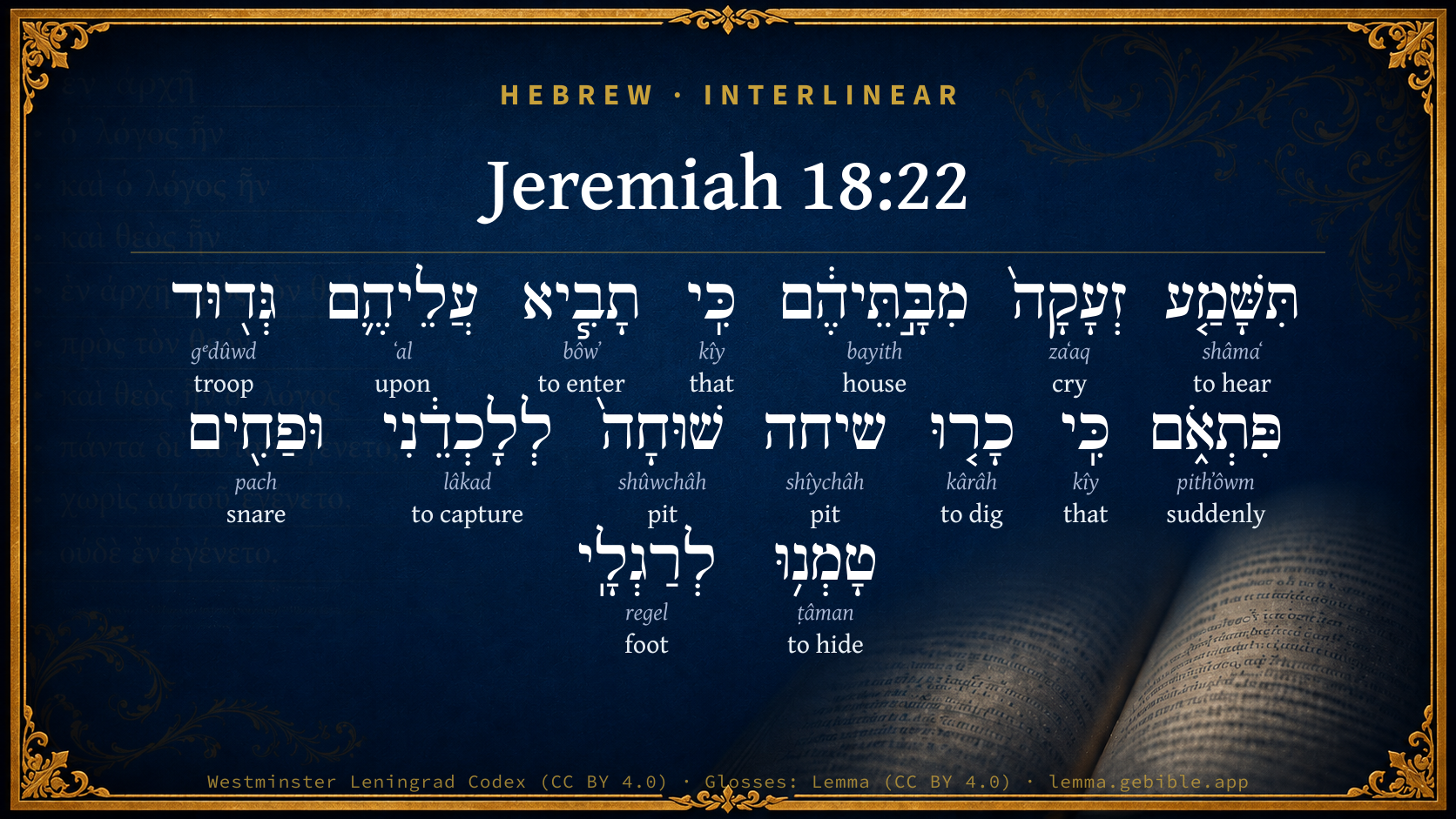
Hebrew (Westminster Leningrad Codex) Jeremiah 18:22 appears in the Hebrew Old Testament. The text above is from the Westminster Leningrad Codex. Each word links to its Strong’s number, a concise gloss, and parsing drawn from the Open Scriptures Hebrew Bible morphology. Click any word for its full Brown-Driver-Briggs (BDB) entry.
Download image
Cite this verse

Jeremiah 18:22 (World English Bible). Public Domain. Lemma interlinear Bible study tool, https://lemma.gebible.app/v/jeremiah/18/22.

Show BibTeX & RIS
BibTeX
RIS
English Translation
Let a cry be heard from their houses, when you shall bring a troop suddenly on them; for they have dug a pit to take me, and hid snares for my feet.
World English Bible · Public Domain
Download a study sheet

One document with this verse’s original text, its word-by-word gloss line, the meaning frame, cross-references with their text, attributed commentary, and full source and license credits — printable, and it pastes into notes with its structure intact.

This verse Autodidact and up

Study sheet (.html) Plain text (.txt)

A passage Seminary Student

Up to 50 verses in one chapter. A passage sheet keeps up to 6 commentary sources and 12 cross-references per verse, in the order this page ranks them, and says so on the sheet whenever that leaves anything out. Ask for a single verse and you get the Autodidact verse sheet above.

Everything on this page stays free to read, with no account — the sheet is a download of what is already on screen, not access to it.

Want to remove ads? Support Godless Engineer
Compare translations 3

The same verse in 3 English versions, stacked beneath the original-language interlinear above. Click any original word for its lexicon entry.

Each is an independent rendering of the whole verse — the interlinear is not word-aligned to these translations.

Highlighted words mark where these versions differ — a whole-verse word diff, not a word-by-word alignment.

  • World English Bible Public Domain
    Let a cry be heard from their houses, when you shall bring a troop suddenly on them; for they have dug a pit to take me, and hid snares for my feet.
  • King James Version Public Domain
    Let a cry be heard from their houses, when thou shalt bring a troop suddenly upon them: for they have digged a pit to take me, and hid snares for my feet.
  • unfoldingWord Literal Text CC BY-SA 4.0
    Let a cry be heard from their houses when you bring a raiding band against them suddenly, for they have dug a pit to capture me, and they have hidden traps for my feet.

unfoldingWord Literal Text — © unfoldingWord, licensed CC BY-SA 4.0. Word-aligned USFM3 via Door43 (git.door43.org/unfoldingWord/en_ult).

Versions to compare (up to 4)

3 of 4 selected

Show all 18 translations

Every available English version of this verse, each an independent rendering of the whole verse.

  • World English Bible Public Domain
    Let a cry be heard from their houses, when you shall bring a troop suddenly on them; for they have dug a pit to take me, and hid snares for my feet.
  • Berean Standard Bible Public Domain
    Let a cry be heard from their houses when You suddenly bring raiders against them, for they have dug a pit to capture me and have hidden snares for my feet.
  • Majority Standard Bible Public Domain
    Let a cry be heard from their houses when You suddenly bring raiders against them, for they have dug a pit to capture me and have hidden snares for my feet.
  • King James Version Public Domain
    Let a cry be heard from their houses, when thou shalt bring a troop suddenly upon them: for they have digged a pit to take me, and hid snares for my feet.
  • American Standard Version (1901) Public Domain
    Let a cry be heard from their houses, when thou shalt bring a troop suddenly upon them; for they have digged a pit to take me, and hid snares for my feet.
  • Revised Version (1885) Public Domain
    Let a cry be heard from their houses, when thou shalt bring a troop suddenly upon them: for they have digged a pit to take me, and hid snares for my feet.
  • Geneva Bible (1599) Public Domain
    Let the crye bee heard from their houses, when thou shalt bring an hoste suddenly vpon them: for they haue digged a pit to take me, and hid snares for my feete.
  • Douay-Rheims (1899) Public Domain
    Let a cry be heard out of their houses: for thou shalt bring the robber upon them suddenly: because they have digged a pit to take me, and have hid snares for my feet.
  • Young's Literal Translation Public Domain
    A cry is heard from their houses, For Thou bringest against them suddenly a troop, For they dug a pit to capture me, And snares they have hidden for my feet.
  • Literal Standard Version CC BY-SA 4.0
    A cry is heard from their houses, || For You suddenly bring a troop against them, || For they dug a pit to capture me, || And they have hidden snares for my feet.
  • Unlocked Literal Bible CC BY-SA 4.0
    Let a distressed shout be heard from their houses, as you suddenly bring raiders against them. For they have dug a pit to capture me and have hidden traps for my feet.
  • unfoldingWord Literal Text CC BY-SA 4.0
    Let a cry be heard from their houses when you bring a raiding band against them suddenly, for they have dug a pit to capture me, and they have hidden traps for my feet.
  • Darby Bible Public Domain
    Let a cry be heard from their houses, when thou shalt bring a troop suddenly upon them; for they have digged a pit to take me, and have hidden snares for my feet.
  • World Messianic Bible Public Domain
    Let a cry be heard from their houses when you bring a troop suddenly on them; for they have dug a pit to take me and hidden snares for my feet.
  • Webster's Bible Public Domain
    Let a cry be heard from their houses, when thou shalt bring a troop suddenly upon them: for they have digged a pit to take me, and hid snares for my feet.
  • Free Bible Version CC BY-SA 4.0
    May cries of agony be heard from their houses when you suddenly bring invaders to attack them, because they dug a pit to capture me and hid traps to catch me as I walk along.
  • Bible in Basic English Public Domain
    Let a cry for help go up from their houses, when you send an armed band on them suddenly: for they have made a hole in which to take me, and have put nets for my feet secretly.
  • JPS Tanakh (1917) Public Domain
    Let a cry be heard from their houses, when thou shalt bring a troop suddenly upon them; for they have digged a pit to take me, and hid snares for my feet.

Literal Standard Version (2020), Covenant Press — licensed CC BY-SA 4.0. Text via the HelloAO Bible API (eBible.org). Unlocked Literal Bible (unfoldingWord) — licensed CC BY-SA 4.0. Text via the HelloAO Bible API (eBible.org). unfoldingWord Literal Text — © unfoldingWord, licensed CC BY-SA 4.0. Word-aligned USFM3 via Door43 (git.door43.org/unfoldingWord/en_ult). Free Bible Version, Dr. Jonathan Gallagher — licensed CC BY-SA 4.0. Text via the HelloAO Bible API (eBible.org).

Word by word

More ways to search: Search by grammar → Find every occurrence → Compare this word →

Practice this passage: Drill this verse → Learn its vocabulary →

שיחה
shîychâh
H7882
“pit”
Noun, Common, Feminine, Singular, Absolute
Part of Speech
Noun
Type
Common
Gender
Feminine
Number
Singular
State
Absolute
Full BDB Definition

Origin: for H7745

TWOT: 2343 . 1b

pit
  1. תִּשָּׁמַ֤ע shâmaʻ H8085 “to hear” Verb, Niphal, Imperfect, 3rd Person, Feminine, Singular
  2. זְעָקָה֙ zaʻaq H2201 “cry” Noun, Common, Feminine, Singular, Absolute
  3. מִבָּ֣תֵּיהֶ֔ם bayith H1004 “from · houses · their” Preposition + Noun, Common, Masculine, Plural, Construct + Suffix, Personal, 3rd Person, Masculine, Plural
  4. כִּֽי kîy H3588 “that” Conjunction
  5. תָבִ֧יא bôwʼ H935 “to enter” Verb, Hiphil, Imperfect, 2nd Person, Masculine, Singular
  6. עֲלֵיהֶ֛ם ʻal H5921 “upon · them” Preposition + Suffix, Personal, 3rd Person, Masculine, Plural
  7. גְּד֖וּד gᵉdûwd H1416 “troop” Noun, Common, Masculine, Singular, Absolute
  8. פִּתְאֹ֑ם pithʼôwm H6597 “suddenly” Adverb
  9. כִּֽי kîy H3588 “that” Conjunction
  10. כָר֤וּ kârâh H3738 “to dig” Verb, Qal, Perfect, 3rd Person, Common, Plural
  11. שׁוּחָה֙ shûwchâh H7745 “pit” Noun, Common, Feminine, Singular, Absolute
  12. לְלָכְדֵ֔נִי lâkad H3920 “to capture · me” Preposition + Verb, Qal, Infinitive Construct + Suffix, Personal, 1st Person, Common, Singular
  13. וּפַחִ֖ים pach H6341 “and · snares” Conjunction + Noun, Common, Masculine, Plural, Absolute
  14. טָמְנ֥וּ ṭâman H2934 “to hide” Verb, Qal, Perfect, 3rd Person, Common, Plural
  15. לְרַגְלָֽי regel H7272 “to/for · feet · my” Preposition + Noun, Common, Feminine, Dual, Construct + Suffix, Personal, 1st Person, Common, Singular

About this verse

These counts appear in no published source. They are computed here, from the morphology-tagged text and Lemma’s own curated glosses. What Lemma adds →

16
words
15
distinct lemmas
Prophets
section

Notable vocabulary

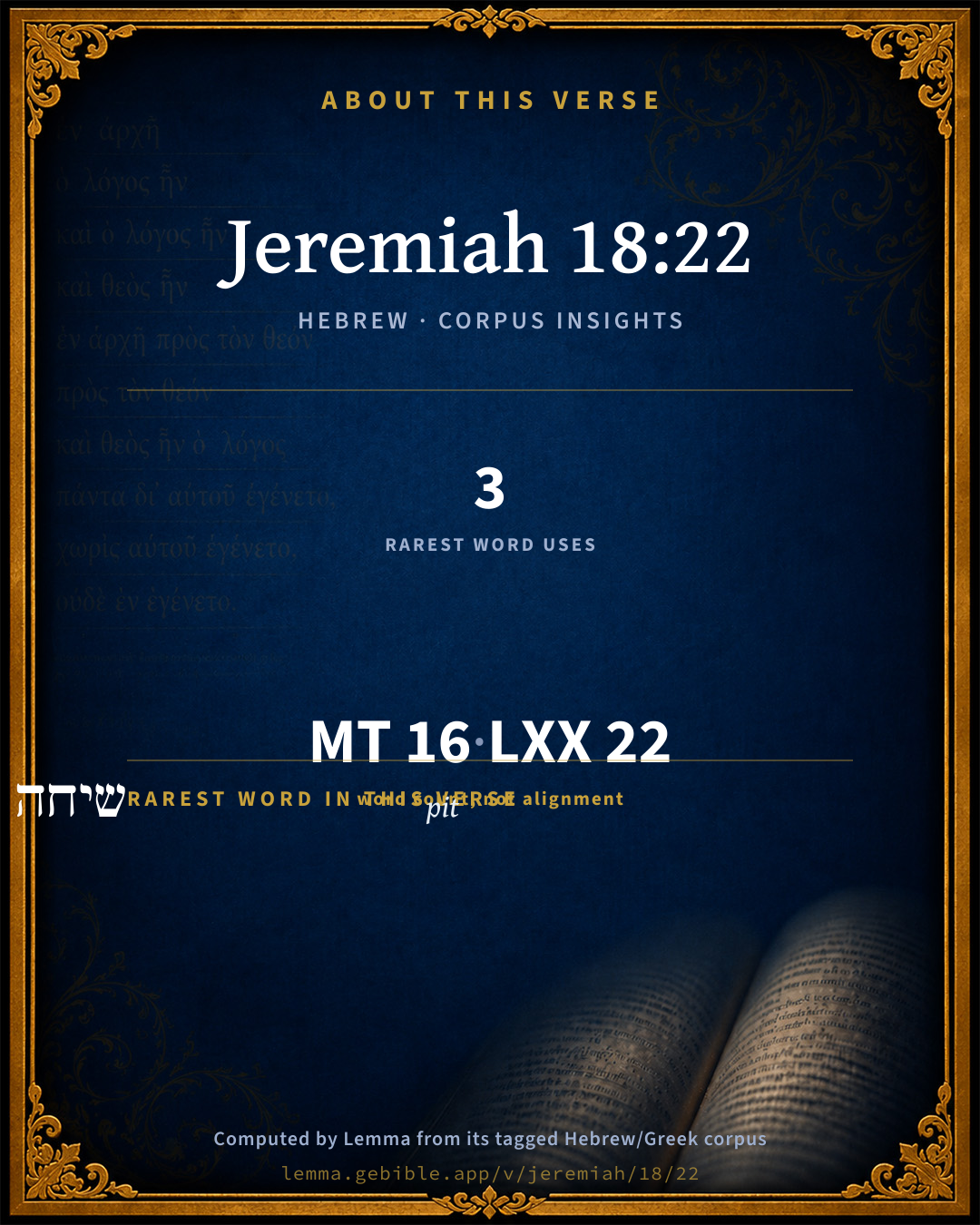
The rarest word here is שיחה pit H7882 — appearing just 3 times in the whole Hebrew Bible.

Shared distinctive vocabulary

שיחה pit H7882 occurs in 3 verses of the Hebrew Bible. Also found in:

Grammatical profile

  • 5 verbs
  • 7 nouns
  • 1 preposition
  • 2 conjunctions
  • 1 adverb

Verb forms

  • תִּשָּׁמַ֤ע Niphal · Imperfect
  • תָבִ֧יא Hiphil · Imperfect
  • כָר֤וּ Qal · Perfect
  • לְלָכְדֵ֔נִי Qal · Infinitive Construct
  • טָמְנ֥וּ Qal · Perfect

Repetition

A word recurs within this verse — often emphatic in Hebrew:

  • כִּֽי that H3588 ×2

Hebrew & Septuagint length

In the original languages it is 16 Hebrew tokens and 22 Greek tokens — but the two are counted differently (Hebrew bundles its prefixes and suffixes into one token; the Greek is in lemma form), so that isn’t a like-for-like length.

Cross-references

18

Topical passages linked to Jeremiah 18:22 in the Treasury of Scripture Knowledge — connected by theme and wording, ordered by reader-vote popularity; previews shown in the World English Bible.

  • Jeremiah 6:26 Daughter of my people, gird you with sackcloth, and wallow yourself in ashes: make you mourning, as for an only son, most bitter lamentation; for the destroyer shall suddenly come on us.
  • Psalms 140:5 The proud have hidden a snare for me, They have spread the cords of a net by the path. They have set traps for me. Selah.
  • Jeremiah 25:34–36 Wail, you shepherds, and cry; and wallow [in ashes], you principal of the flock; for the days of your slaughter and of your dispersions are fully come, and you shall fall like a goodly vessel.
  • Zephaniah 1:10–11 In that day, says Yahweh, there will be the noise of a cry from the fish gate, a wailing from the second quarter, and a great crashing from the hills.
  • Psalms 56:5–7 All day long they twist my words. All their thoughts are against me for evil.
  • Isaiah 10:30 Cry aloud with your voice, daughter of Gallim! listen, Laishah! You poor Anathoth!
  • Zephaniah 1:16 a day of the trumpet and alarm, against the fortified cities, and against the high battlements.
  • Psalms 38:12 They also who seek after my life lay snares. Those who seek my hurt speak mischievous things, And meditate deceits all day long.
  • Psalms 64:4–5 To shoot innocent men from ambushes. They shoot at him suddenly and fearlessly.
  • Isaiah 22:1–4 The burden of the valley of vision. What ails you now, that you are wholly gone up to the housetops?
  • Jeremiah 4:19–20 My anguish, my anguish! I am pained at my very heart; my heart is disquieted in me; I can't hold my peace; because you have heard, O my soul, the sound of the trumpet, the alarm of war.
  • Jeremiah 4:31 For I have heard a voice as of a woman in travail, the anguish as of her who brings forth her first child, the voice of the daughter of Zion, who gasps for breath, who spreads her hands, [saying], Woe is me now! for my soul faints before the murderers.
  • Jeremiah 9:20–21 Yet hear the word of Yahweh, you women, and let your ear receive the word of his mouth; and teach your daughters wailing, and everyone her neighbor lamentation.
  • Jeremiah 18:20 Shall evil be recompensed for good? for they have dug a pit for my soul. Remember how I stood before you to speak good for them, to turn away your wrath from them.
  • Jeremiah 20:10 For I have heard the defaming of many, terror on every side. Denounce, and we will denounce him, [say] all my familiar friends, those who watch for my fall; peradventure he will be persuaded, and we shall prevail against him, and we shall take our revenge on him.
  • Jeremiah 47:2–3 Thus says Yahweh: Behold, waters rise up out of the north, and shall become an overflowing stream, and shall overflow the land and all that is therein, the city and those who dwell therein; and the men shall cry, and all the inhabitants of the land shall wail.
  • Jeremiah 48:3–5 The sound of a cry from Horonaim, desolation and great destruction!
  • Matthew 22:15 Then the Pharisees went and took counsel how they might entrap him in his talk.

Cross-references courtesy of OpenBible.info (CC BY 4.0).

Hebrew and Greek witnesses Masoretic Hebrew ↔ Greek Septuagint

The same verse in the two great witnesses to the Old Testament, shown verse-for-verse.

These are two independent witnesses, not word-aligned to each other, and the Septuagint is shown in lemma (dictionary) form.

Hebrew Jeremiah 18:22 Masoretic · Westminster Leningrad Codex

תִּשָּׁמַ֤ע זְעָקָה֙ מִבָּ֣תֵּיהֶ֔ם כִּֽי תָבִ֧יא עֲלֵיהֶ֛ם גְּד֖וּד פִּתְאֹ֑ם כִּֽי כָר֤וּ שיחה שׁוּחָה֙ לְלָכְדֵ֔נִי וּפַחִ֖ים טָמְנ֥וּ לְרַגְלָֽי

Let a cry be heard from their houses, when you shall bring a troop suddenly on them; for they have dug a pit to take me, and hid snares for my feet.

World English Bible · Public Domain

Greek LXX Structure differs

In the Septuagint, Jeremiah is about an eighth shorter than the Hebrew and arranges its material differently — the Oracles Against the Nations (Hebrew chapters 46–51) appear in the middle of the Greek book, after 25:13. Because the chapter and verse boundaries do not line up, a verse-for-verse comparison with the Hebrew is not shown.

A verse-for-verse comparison isn’t shown here because the chapters and verses don’t line up. Switch to the LXX edition with the MT / LXX toggle above to read the Greek directly.

Hebrew: Westminster Leningrad Codex (CC BY 4.0). Greek: Septuagint (public domain); English from a public-domain English Septuagint. How the Septuagint differs from the Hebrew →

Targum (Aramaic paraphrase)

1

The Targum is the ancient Jewish Aramaic paraphrase of the Hebrew Scriptures — an interpretive translation, not the Hebrew text itself. Onkelos (literal) and Pseudo-Jonathan (expansive) render the Torah, and Jonathan the Prophets. Coverage is partial: where no permissively-licensed English translation exists for a verse, only the Aramaic is shown. This is verse-level text, not a word-by-word alignment to the Hebrew.

  1. Targum Jonathan Prophets (Joshua–Malachi)
    תִּשְׁתְּמַע צְוַחְתָּא מִבָּתֵּיהוֹן אֲרֵי תֵיתֵי עֲלֵיהוֹן מַשִׁרְיָן בִּתְכֵּיף אֲרֵי כְרוֹ פַחַת לְמִקְטְלִי וְקוֹלִין צְלוֹ לְפִרְסַת רִגְלָי:

    (no public-domain English translation for this verse)

    Targum Jonathan — Aramaic: “Mikraot Gedolot” (public domain). English: “Sefaria Community Translation” (CC0 1.0 (public-domain dedication)); “London "Chaldee Paraphrase," 1871” (public domain). Text via Sefaria.

Commentary

Notes on Jeremiah 18:22 from classic Christian and Jewish commentators (each source and its license shown beneath its notes). The classic Christian expositions comment on the surrounding passage and are grouped to its opening verse, so a note may address several verses; the Jewish commentaries on the Tanakh (Rashi and others) are per-verse, so they appear only where the commentator wrote on this verse.

Lemma curates 59 commentaries, every one of them public domain or Creative Commons licensed, each selected and text-cleaned for this edition rather than reprinted as found. About our sources →

Trapp's Complete Commentary

John Trapp

Jer 18:22 Let a cry be heard from their houses, when thou shalt bring a troop suddenly upon them: for they have digged a pit to take me, and hid snares for my feet.

Ver. 22. When thou shalt bring a troop.] The Vulgate rendereth it, Latronem, a thief, or robber - viz., Nebuchadnezzar, that arch-thief, whose monarchy was grande latrociuium, grand thief, and whose regiment, without righteousness, was robbery by authority.

John Trapp, A Commentary or Exposition upon All the Books of the Old and New Testament (1647–1656) — public domain. Text from a community e-Sword module.

Jamieson, Fausset & Brown

Robert Jamieson, A. R. Fausset & David Brown

cry--by reason of the enemy bursting in: let their houses be no shelter to them in their calamities [CALVIN].

digged . . . pit-- (Jer 18:20; Psa 57:6; Psa 119:85).

Jamieson, Fausset & Brown — Commentary Critical and Explanatory on the Whole Bible (1871) — public domain (CC PDM 1.0). Text via the HelloAO Bible API.

John Calvin's Commentaries

He proceeds with his imprecation, he then wishes that a cry should he heard from the houses, as though he had said, “Let there be no refuge for them when their calamity shall happen:” For his own house is to every one his place of safetyin a disordered state of things. The Prophet then wished them to be slain by their enemies even when concealed in their houses; for it appears from the preceding verse that he meant slaughter. For why should a cry be, except on account of enemies breaking in and raging against them, while they, being not able to defend their life, were driven to lamentations and howlings? Let a cry then be heard from their houses, when thou bringest an army upon them suddenly; and he adds: For they have digged a pit to take me

The Prophet indeed seems here to be the defender of his own cause: but there is no doubt, but that apart from anything personal, he hated the impiety of those of whom he speaks, because they insidiously assailed him, when yet he was doing the work of God. For the Prophet neither sowed nor reaped for himself, but only labored to obey God. When therefore they artfully assailed and circumvented him, what was it but openly to carry on war with God? Let us then remember, that the Prophet does not here complain of troubles which he underwent, or of injuries, but that he only pleads a public cause; for these ungodly men treated him perfidiously, while he was doing nothing else but spending his labor for God, and indeed for their salvation. At last he adds —

John Calvin's Commentaries (1540-1563) — public domain. Text from the Calvin Translation Society English edition (1840s-50s) via the Christian Classics Ethereal Library (ccel.org). Calvin's coverage is partial (roughly two-thirds of the Bible); uncommented books and verses are honest gaps, never fabricated. The 19th-century editor's footnotes and remarks are omitted so the notes are faithfully Calvin's own voice.

Ellicott's Commentary for English Readers

(22) Let a cry be heard from their houses.—i.e., let their city be taken by the enemy and the people suffer all the outrage and cruelty which their heathen invaders can inflict. What these were, the history of all wars, above all of Eastern wars, tells us but too plainly (2Ki_8:12; Hos_13:16). Some of them, prisoners impaled or flayed alive, are brought vividly before our eyes by the Assyrian sculptures.

The “snares” are those of the bird-catcher (Psa_140:5; Psa_142:3).

A Bible Commentary for English Readers, edited by Charles John Ellicott (1878–1897) — public domain. Text from a community e-Sword module.

The Cambridge Bible for Schools and Colleges

gen. ed. J. J. S. Perowne

22. The havoc wrought in battle outside the walls is followed by the sacking of the houses of the city.

they have digged a pit … and hid snares] Cp. Psa_57:6.

The Cambridge Bible for Schools and Colleges (gen. ed. J. J. S. Perowne; Cambridge University Press, 1878–1918) — public domain. Text from a community e-Sword module.

Albert Barnes' Notes on the Bible

The sack of the city follows with all the horrible cruelties practiced at such a time.

Albert Barnes' Notes on the Bible (1834–1885) — public domain. Text from a community e-Sword/MySword module.

Haydock's Catholic Bible Commentary

For. Protestants, "when." (Haydock) --- Robber. So Nabuchodonosor and all professional conquerors are styled. (Calmet)

George Leo Haydock (1774–1849), Haydock's Catholic Family Bible and Commentary, 1859 edition — public domain. Excludes Psalms (Douay-Rheims chapter numbering differs from Protestant) and Deuterocanonical books (Catholic canon only).

Matthew Poole's English Annotations

That is, Let the enemy break into their houses, which are, in an ordinary course of providence, men’s castles and sanctuaries, and cause such shrieks as use to be heard in such cases, for their malicious seeking my life by all secret practices.

Matthew Poole's English Annotations on the Holy Bible (1683–1685) — public domain. Text from a community e-Sword/MySword module.

Whedon's Commentary on the Bible

Daniel D. Whedon

22. From their houses — To the terrors of war and famine are added the sack and pillage of the city.

Daniel D. Whedon (gen. ed.), Commentary on the Old and New Testaments (1874–1909) — public domain. Text from a community e-Sword module.

Rashi

Rabbi Shlomo Yitzchaki (Rashi)

for they dug a pit to seize me that they suspected him of intimacy with a married woman, as it is stated (Prov. 23:27): “For a harlot is a deep pit (ֹשוּחָה).”

Rashi on the Tanakh — English translations: “The Judaica Press complete Tanach with Rashi, translated by A. J. Rosenberg” (CC BY 4.0); “Pentateuch with Rashi's commentary by M. Rosenbaum and A.M. Silbermann, 1929-1934” (public domain); “The Metsudah Tanach series, Lakewood, N.J” (CC BY 4.0); and “The Book of Joshua, Metsudah Publications, 1997” (CC BY 4.0). Text via Sefaria.

Lesson kit

Teaching starters — assembled from the data on this page, not authored interpretation. Every prompt links to the verse data it draws on. Edit before teaching.

Jeremiah, in the Prophets, opens this verse with 16 words (15 distinct Hebrew lemmas). Its most distinctive word is shîychâh (“pit”). A historical commentator’s framing appears above. Read the whole chapter for the surrounding context.

Discussion questions

  1. The word shîychâh carries the sense “pit.” How does it shape the verse?
  2. Psalms 57:6 shares the word «pit» with this verse. How do the two illuminate each other?
  3. “that” occurs 2× in this one verse. What is the effect of the repetition?
  4. These translations render this verse differently; the difference is in the English rendering, not the original. What questions does that raise?
  5. The verb «תִּשָּׁמַ֤ע» is Niphal Imperfect. How does its form color the action?
  6. Reading how Trapp's Complete Commentary and Jamieson, Fausset & Brown read this verse, where do the two commentators agree and where do they part?

Things to notice

Reading settings

Reading text

Shown beneath each verse's original-language words.

Old Testament
Old Testament edition

Read the OT as the Masoretic Hebrew (MT) or the Greek Septuagint (LXX).

English shown for the Greek Septuagint (in the Hebrew ↔ Greek comparison).

Comparing translations? Open the Compare panel on any verse page to stack up to four side by side.