
Joshua 11:17

Hebrew (Westminster Leningrad Codex) Joshua 11:17 appears in the Hebrew Old Testament. The text above is from the Westminster Leningrad Codex. Each word links to its Strong’s number, a concise gloss, and parsing drawn from the Open Scriptures Hebrew Bible morphology. Click any word for its full Brown-Driver-Briggs (BDB) entry.
Download image
Cite this verse

Joshua 11:17 (World English Bible). Public Domain. Lemma interlinear Bible study tool, https://lemma.gebible.app/v/joshua/11/17.

Show BibTeX & RIS
BibTeX
RIS
English Translation
from Mount Halak, that goes up to Seir, even to Baal Gad in the valley of Lebanon under Mount Hermon: and all their kings he took, and struck them, and put them to death.
World English Bible · Public Domain
Highlights
  • 2 first appearances in the Hebrew Bible
Full analysis ↓
Download a study sheet

One document with this verse’s original text, its word-by-word gloss line, the meaning frame, cross-references with their text, attributed commentary, and full source and license credits — printable, and it pastes into notes with its structure intact.

This verse Autodidact and up

Study sheet (.html) Plain text (.txt)

A passage Seminary Student

Up to 50 verses in one chapter. A passage sheet keeps up to 6 commentary sources and 12 cross-references per verse, in the order this page ranks them, and says so on the sheet whenever that leaves anything out. Ask for a single verse and you get the Autodidact verse sheet above.

Everything on this page stays free to read, with no account — the sheet is a download of what is already on screen, not access to it.

Want to remove ads? Support Godless Engineer
Compare translations 3

The same verse in 3 English versions, stacked beneath the original-language interlinear above. Click any original word for its lexicon entry.

Each is an independent rendering of the whole verse — the interlinear is not word-aligned to these translations.

Highlighted words mark where these versions differ — a whole-verse word diff, not a word-by-word alignment.

  • World English Bible Public Domain
    from Mount Halak, that goes up to Seir, even to Baal Gad in the valley of Lebanon under Mount Hermon: and all their kings he took, and struck them, and put them to death.
  • King James Version Public Domain
    Even from the mount Halak, that goeth up to Seir, even unto Baalgad in the valley of Lebanon under mount Hermon: and all their kings he took, and smote them, and slew them.
  • unfoldingWord Literal Text CC BY-SA 4.0
    from Mount Halak, the one ascending to Seir, and unto Baal Gad in the Valley of Lebanon below Mount Hermon. And he captured all of their kings and struck them and killed them.

unfoldingWord Literal Text — © unfoldingWord, licensed CC BY-SA 4.0. Word-aligned USFM3 via Door43 (git.door43.org/unfoldingWord/en_ult).

Versions to compare (up to 4)

3 of 4 selected

Show all 18 translations

Every available English version of this verse, each an independent rendering of the whole verse.

  • World English Bible Public Domain
    from Mount Halak, that goes up to Seir, even to Baal Gad in the valley of Lebanon under Mount Hermon: and all their kings he took, and struck them, and put them to death.
  • Berean Standard Bible Public Domain
    from Mount Halak, which rises toward Seir, as far as Baal-gad in the Valley of Lebanon at the foot of Mount Hermon. He captured all their kings and struck them down, putting them to death.
  • Majority Standard Bible Public Domain
    from Mount Halak, which rises toward Seir, as far as Baal-gad in the Valley of Lebanon at the foot of Mount Hermon. He captured all their kings and struck them down, putting them to death.
  • King James Version Public Domain
    Even from the mount Halak, that goeth up to Seir, even unto Baalgad in the valley of Lebanon under mount Hermon: and all their kings he took, and smote them, and slew them.
  • American Standard Version (1901) Public Domain
    from mount Halak, that goeth up to Seir, even unto Baal-gad in the valley of Lebanon under mount Hermon: and all their kings he took, and smote them, and put them to death.
  • Revised Version (1885) Public Domain
    from mount Halak, that goeth up to Seir, even unto Baal-gad in the valley of Lebanon under mount Hermon: and all their kings he took, and smote them, and put them to death.
  • Geneva Bible (1599) Public Domain
    From the mount Halak, that goeth vp to Seir, euen vnto Baal-gad in the valley of Lebanon, vnder mount Hermon: and all their Kings he tooke, and smote them, and slewe them.
  • Douay-Rheims (1899) Public Domain
    And part of the mountain that goeth up to Seir as far as Baalgad, by the plain of Libanus under mount Hermon: all their kings he took, smote and slew.
  • Young's Literal Translation Public Domain
    from the mount of Halak, which is going up `to' Seir, and unto Baal-Gad, in the valley of Lebanon, under mount Hermon; and all their kings he hath captured, and he smiteth them, and putteth them to death.
  • Literal Standard Version CC BY-SA 4.0
    from the Mount of Halak, which is going up [to] Seir, and to Ba‘al-Gad, in the Valley of Lebanon, under Mount Hermon; and he has captured all their kings, and he strikes them, and puts them to death.
  • Unlocked Literal Bible CC BY-SA 4.0
    From Mount Halak near Edom, and going north as far as Baal Gad in the valley near Lebanon below Mount Hermon, he captured all their kings and killed them.
  • unfoldingWord Literal Text CC BY-SA 4.0
    from Mount Halak, the one ascending to Seir, and unto Baal Gad in the Valley of Lebanon below Mount Hermon. And he captured all of their kings and struck them and killed them.
  • Darby Bible Public Domain
    from the smooth mountain, which rises toward Seir, as far as Baal-Gad in the valley of Lebanon, at the foot of mount Hermon; and he took all their kings, and smote them, and put them to death.
  • World Messianic Bible Public Domain
    from Mount Halak, that goes up to Seir, even to Baal Gad in the valley of Lebanon under Mount Hermon. He took all their kings, struck them, and put them to death.
  • Webster's Bible Public Domain
    Even from the mount Halak, that goeth up to Seir, even to Baal-gad, in the valley of Lebanon under mount Hermon: and all their kings he took, and smote them, and slew them.
  • Free Bible Version CC BY-SA 4.0
    This covered land from Mount Halak leading to Seir in the south, right up to Baal Gad in the north, below Mount Hermon in the valley of Lebanon. Joshua captured and killed all their kings.
  • Bible in Basic English Public Domain
    From Mount Halak, which goes up to Seir, as far as Baal-gad in the valley of Lebanon under Mount Hermon: and all their kings he overcame and put to death.
  • JPS Tanakh (1917) Public Domain
    from the bare mountain, that goeth up to Seir, even unto Baal-gad in the valley of Lebanon under mount Hermon; and all their kings he took, and smote them, and put them to death.

Literal Standard Version (2020), Covenant Press — licensed CC BY-SA 4.0. Text via the HelloAO Bible API (eBible.org). Unlocked Literal Bible (unfoldingWord) — licensed CC BY-SA 4.0. Text via the HelloAO Bible API (eBible.org). unfoldingWord Literal Text — © unfoldingWord, licensed CC BY-SA 4.0. Word-aligned USFM3 via Door43 (git.door43.org/unfoldingWord/en_ult). Free Bible Version, Dr. Jonathan Gallagher — licensed CC BY-SA 4.0. Text via the HelloAO Bible API (eBible.org).

Word by word

More ways to search: Search by grammar → Find every occurrence → Compare this word →

Practice this passage: Drill this verse → Learn its vocabulary →

הֶֽחָלָק֙
Châlâq
H2510
“the · Halak”
Particle, Definite Article + Noun, Proper
Part of Speech
Particle + Noun
Type
Proper
Full BDB Definition

Origin: the same as H2509

TWOT: None

Halak = "smooth" - a mountain in southern Judah which is the southern limit of Joshua's conquest; site unknown
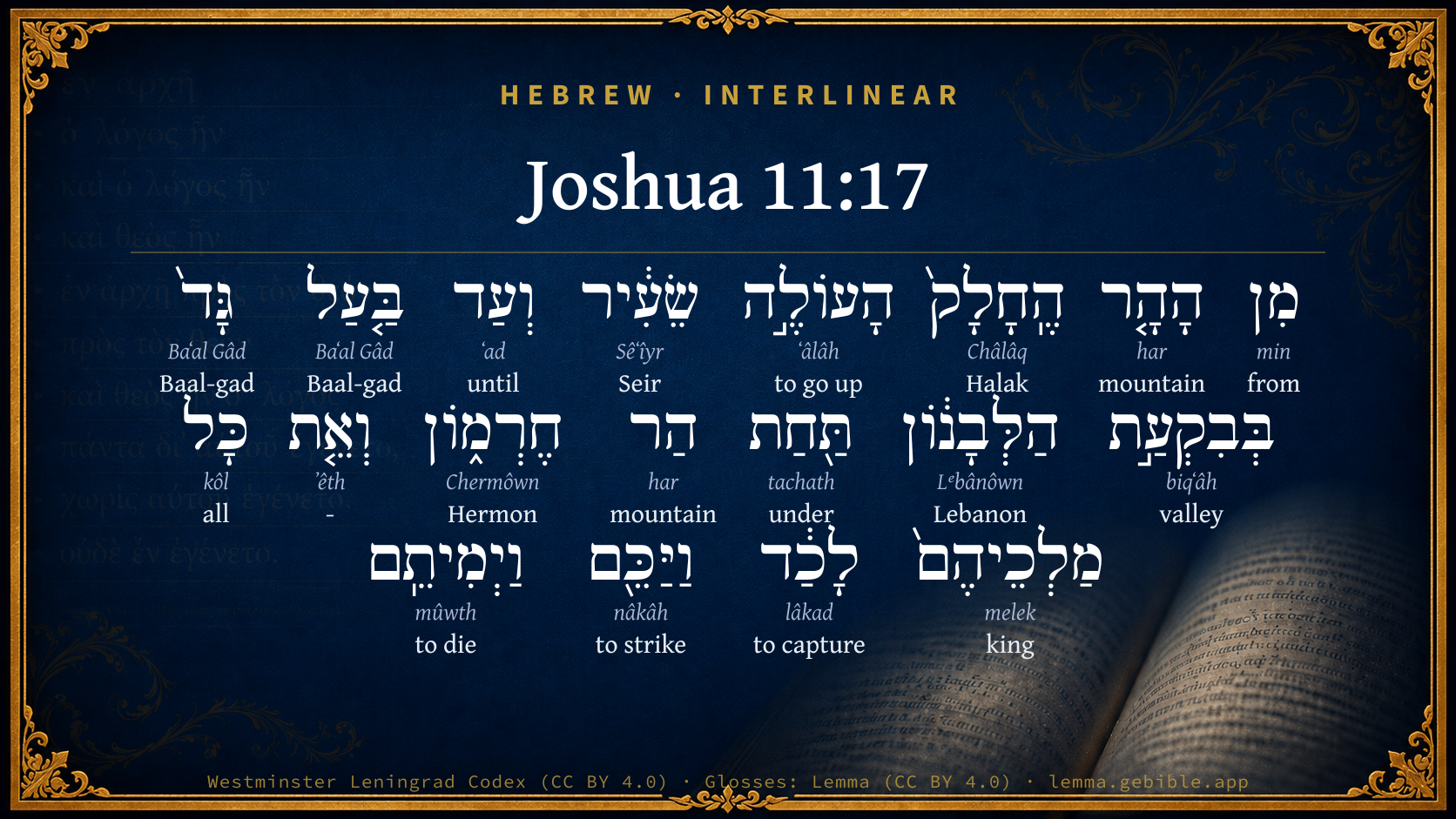
  1. מִן min H4480 “from” Preposition
  2. הָהָ֤ר har H2022 “the · mountain” Particle, Definite Article + Noun, Common, Masculine, Singular, Absolute
  3. הָעוֹלֶ֣ה ʻâlâh H5927 “the · going up” Particle, Definite Article + Verb, Qal, Participle Active, Masculine, Singular, Absolute
  4. שֵׂעִ֔יר Sêʻîyr H8165 “Seir” Noun, Proper
  5. וְעַד ʻad H5704 “and · until” Conjunction + Preposition
  6. בַּ֤עַל Baʻal Gâd H1171 “Baal-gad” Noun, Proper
  7. גָּד֙ Baʻal Gâd H1171 “Baal-gad” Noun, Proper
  8. בְּבִקְעַ֣ת biqʻâh H1237 “in/at · valley of” Preposition + Noun, Common, Feminine, Singular, Construct
  9. הַלְּבָנ֔וֹן Lᵉbânôwn H3844 “the · Lebanon” Particle, Definite Article + Noun, Proper
  10. תַּ֖חַת tachath H8478 “under” Preposition
  11. הַר har H2022 “mountain of” Noun, Common, Masculine, Singular, Construct
  12. חֶרְמ֑וֹן Chermôwn H2768 “Hermon” Noun, Proper
  13. וְאֵ֤ת ʼêth H853 “and · -” Conjunction + Particle, Direct Object
  14. כָּל kôl H3605 “all of” Noun, Common, Masculine, Singular, Construct
  15. מַלְכֵיהֶם֙ melek H4428 “kings · their” Noun, Common, Masculine, Plural, Construct + Suffix, Personal, 3rd Person, Masculine, Plural
  16. לָכַ֔ד lâkad H3920 “to capture” Verb, Qal, Perfect, 3rd Person, Masculine, Singular
  17. וַיַּכֵּ֖ם nâkâh H5221 “and · to strike · them” Conjunction + Verb, Hiphil, Sequential Imperfect, 3rd Person, Masculine, Singular + Suffix, Personal, 3rd Person, Masculine, Plural
  18. וַיְמִיתֵֽם mûwth H4191 “and · to die · them” Conjunction + Verb, Hiphil, Sequential Imperfect, 3rd Person, Masculine, Singular + Suffix, Personal, 3rd Person, Masculine, Plural

About this verse

These counts appear in no published source. They are computed here, from the morphology-tagged text and Lemma’s own curated glosses. What Lemma adds →

19
words
17
distinct lemmas
Historical
section

Notable vocabulary

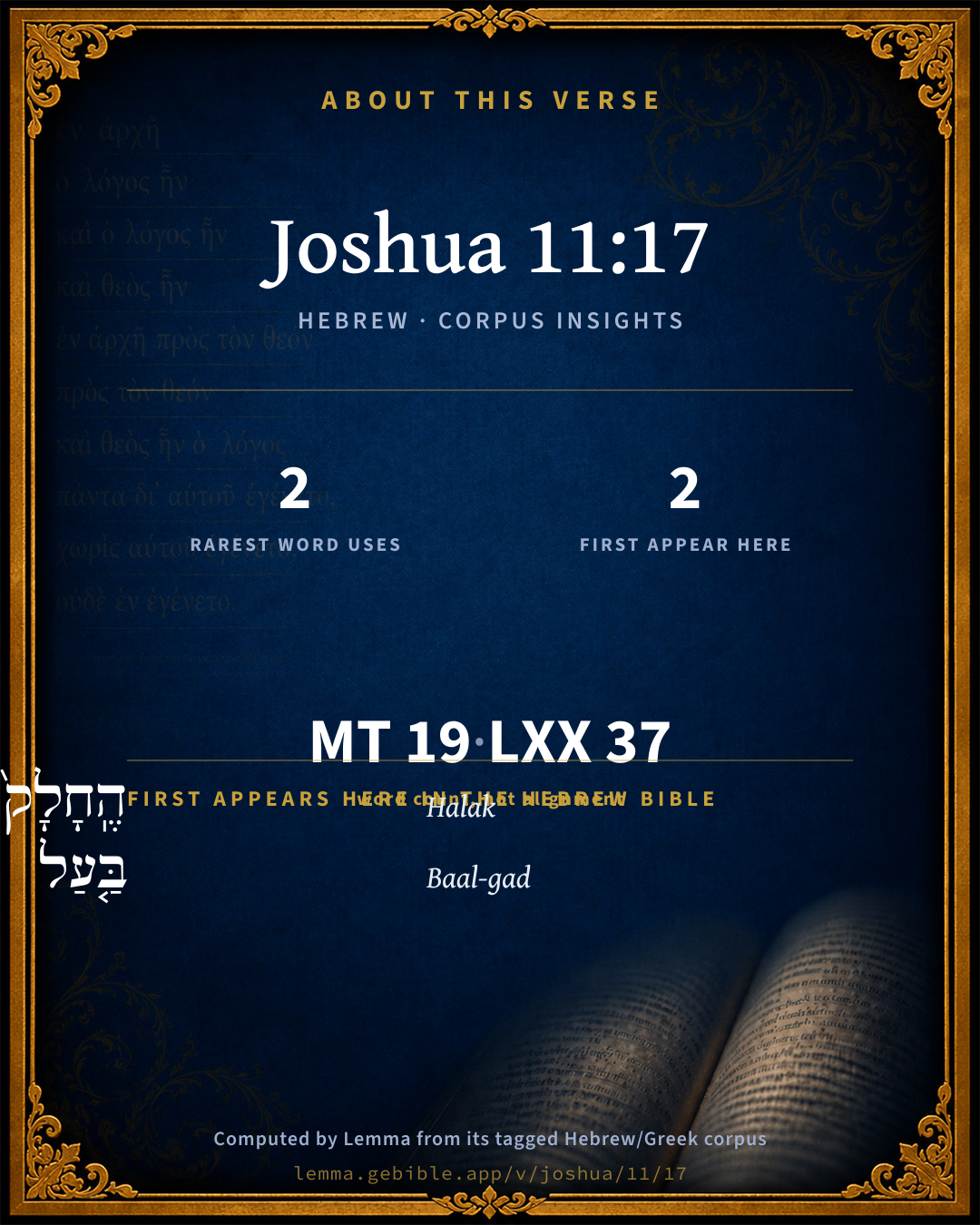
The rarest word here is הֶֽחָלָק֙ Halak H2510 — appearing just 2 times in the whole Hebrew Bible.

First appearance in Scripture

These words make their first canonical appearance in the Hebrew Bible here:

  • הֶֽחָלָק֙ Halak H2510
  • בַּ֤עַל Baal-gad H1171

Shared distinctive vocabulary

הֶֽחָלָק֙ Halak H2510 occurs in 2 verses of the Hebrew Bible. Also found in:

Grammatical profile

  • 4 verbs
  • 11 nouns
  • 3 prepositions
  • 1 particle

Verb forms

  • הָעוֹלֶ֣ה Qal · Participle Active
  • לָכַ֔ד Qal · Perfect
  • וַיַּכֵּ֖ם Hiphil · Sequential Imperfect
  • וַיְמִיתֵֽם Hiphil · Sequential Imperfect

Repetition

Words recur within this verse — often emphatic in Hebrew:

  • הָהָ֤ר mountain H2022 ×2
  • בַּ֤עַל Baal-gad H1171 ×2

Hebrew & Septuagint length

In English translation the verse runs 34 words from the Hebrew and 36 from the Septuagint (LXX English) — closely comparable.

A rough comparison of the two English renderings, which tokenize alike — not a word-level alignment.

Word counts can differ between the Hebrew and the Greek without any difference in meaning — e.g. the Hebrew direct-object marker אֵת has no separate Greek word, and Greek often adds the article ὁ.

In the original languages it is 19 Hebrew tokens and 37 Greek tokens — but the two are counted differently (Hebrew bundles its prefixes and suffixes into one token; the Greek is in lemma form), so that isn’t a like-for-like length.

Cross-references

8

Topical passages linked to Joshua 11:17 in the Treasury of Scripture Knowledge — connected by theme and wording, ordered by reader-vote popularity; previews shown in the World English Bible.

  • Deuteronomy 7:24 He will deliver their kings into your hand, and you shall make their name to perish from under the sky: there shall no man be able to stand before you, until you have destroyed them.
  • Joshua 11:3 to the Canaanite on the east and on the west, and the Amorite, and the Hittite, and the Perizzite, and the Jebusite in the hill-country, and the Hivite under Hermon in the land of Mizpah.
  • Joshua 13:5 and the land of the Gebalites, and all Lebanon, toward the sunrise, from Baal Gad under Mount Hermon to the entrance of Hamath;
  • Genesis 32:3 Jacob sent messengers in front of him to Esau, his brother, to the land of Seir, the field of Edom.
  • Deuteronomy 2:1 Then we turned, and took our journey into the wilderness by the way to the Red Sea, as Yahweh spoke to me; and we compassed Mount Seir many days.
  • Deuteronomy 33:2 He said, Yahweh came from Sinai, Rose from Seir to them; He shined forth from Mount Paran, He came from the ten thousands of holy ones: At his right hand was a fiery law for them.
  • Joshua 1:4 From the wilderness, and this Lebanon, even to the great river, the river Euphrates, all the land of the Hittites, and to the great sea toward the going down of the sun, shall be your border.
  • Joshua 12:7–24 These are the kings of the land whom Joshua and the children of Israel struck beyond the Jordan westward, from Baal Gad in the valley of Lebanon even to Mount Halak, that goes up to Seir; and Joshua gave it to the tribes of Israel for a possession according to their divisions;

Cross-references courtesy of OpenBible.info (CC BY 4.0).

Hebrew and Greek witnesses Masoretic Hebrew ↔ Greek Septuagint

The same verse in the two great witnesses to the Old Testament, shown verse-for-verse.

These are two independent witnesses, not word-aligned to each other, and the Septuagint is shown in lemma (dictionary) form.

Hebrew Joshua 11:17 Masoretic · Westminster Leningrad Codex

מִן הָהָ֤ר הֶֽחָלָק֙ הָעוֹלֶ֣ה שֵׂעִ֔יר וְעַד בַּ֤עַל גָּד֙ בְּבִקְעַ֣ת הַלְּבָנ֔וֹן תַּ֖חַת הַר חֶרְמ֑וֹן וְאֵ֤ת כָּל מַלְכֵיהֶם֙ לָכַ֔ד וַיַּכֵּ֖ם וַיְמִיתֵֽם

from Mount Halak, that goes up to Seir, even to Baal Gad in the valley of Lebanon under Mount Hermon: and all their kings he took, and struck them, and put them to death.

World English Bible · Public Domain

Greek LXX Joshua 11:17 Septuagint · lemma form

ὁ πρός ὁ ὄρος ἀπό ὄρος αχελ καί ὅς προσ ἀναβαίνω εἰς σηιρ καί ἕως βααλγαδ καί ὁ πεδίον ὁ λίβανος ὑπό ὁ ὄρος ὁ αερμων καί πᾶς ὁ βασιλεύς αὐτός λαμβάνω καί ἀνααἱρέω αὐτός καί ἀποκτείνω

from the mountain of Chelcha, and that which goes up to Seir, and as far as Balagad, and the plains of Libanus, under mount Aermon; and he took all their kings, and destroyed, and killed them.

LXX2012 (modern English Septuagint) · Public Domain

On this verse, The Pulpit Commentary discusses the Septuagint’s reading. Read the note in Commentary ↓

Hebrew: Westminster Leningrad Codex (CC BY 4.0). Greek: Septuagint (public domain); English from LXX2012 (modern English Septuagint) (Public Domain). How the Septuagint differs from the Hebrew →

Targum (Aramaic paraphrase)

1

The Targum is the ancient Jewish Aramaic paraphrase of the Hebrew Scriptures — an interpretive translation, not the Hebrew text itself. Onkelos (literal) and Pseudo-Jonathan (expansive) render the Torah, and Jonathan the Prophets. Coverage is partial: where no permissively-licensed English translation exists for a verse, only the Aramaic is shown. This is verse-level text, not a word-by-word alignment to the Hebrew.

  1. Targum Jonathan Prophets (Joshua–Malachi)
    מִן טוּרָא פְּלִיגָא דְסָלִיק לְשֵׂעִיר וְעַד מֵישַׁר גָד בְּבִקְעַת לִבְנָן שְׁפּוּלֵי טוּרָא דְחֶרְמוֹן וְיַת כָּל מַלְכֵיהוֹן כְּבַשׁ וּמְחָנוּן וְקַטְלִינוּן:

    (no public-domain English translation for this verse)

    Targum Jonathan — Aramaic: “Mikraot Gedolot” (public domain). English: “Sefaria Community Translation” (CC0 1.0 (public-domain dedication)); “London "Chaldee Paraphrase," 1871” (public domain). Text via Sefaria.

Commentary

Notes on Joshua 11:17 from classic Christian and Jewish commentators (each source and its license shown beneath its notes). The classic Christian expositions comment on the surrounding passage and are grouped to its opening verse, so a note may address several verses; the Jewish commentaries on the Tanakh (Rashi and others) are per-verse, so they appear only where the commentator wrote on this verse.

Lemma curates 59 commentaries, every one of them public domain or Creative Commons licensed, each selected and text-cleaned for this edition rather than reprinted as found. About our sources →

Trapp's Complete Commentary

John Trapp

Jos 11:17 [Even] from the mount Halak, that goeth up to Seir, even unto Baalgad in the valley of Lebanon under mount Hermon: and all their kings he took, and smote them, and slew them.

Ver. 17. Even from the mount Halak.] Or, The smooth or bare mountain; not unlike that they call Axylon, by which Manlius marched against the Gallo-Grecians. {a}

{a} Non ligni modo quicquam, sed ne spinas quidem habet. - Liv., lib. 38.

John Trapp, A Commentary or Exposition upon All the Books of the Old and New Testament (1647–1656) — public domain. Text from a community e-Sword module.

Joseph Benson's Commentary

Jos 11:17. That goeth up to Seir — That is, to the country of Seir or Edom, namely, to that part of it which was south from Judea. Unto Baal-gad, in the valley of Lebanon, &c. — As the preceding words express the bounds of Joshua’s conquest southward, so hither they extended northward. And this seems to be a description of the length of the country which he took from the king of Hazor, and all those who joined with him, as Archbishop Usher understands it.

Joseph Benson's Commentary on the Old and New Testaments (1811–1818) — public domain. Text from a community e-Sword module.

Geneva Bible (1599)

Geneva Bible translators

Or, the valley of Gad.

So called, because it was bare and without trees.

Geneva Bible (1599) marginal notes — public domain. Text via Bolls.life.

Jamieson, Fausset & Brown

Robert Jamieson, A. R. Fausset & David Brown

from the mount Halak--Hebrew, "the smooth mountain."

that goeth up to Seir--an irregular line of white naked hills, about eighty feet high, and seven or eight geographical miles in length that cross the whole Ghor, eight miles south of the Dead Sea, probably "the ascent of Akrabbim" [ROBINSON].

unto Baal-gad in the valley of Lebanon--the city or temple of the god of destiny, in Baalbec.

Jamieson, Fausset & Brown — Commentary Critical and Explanatory on the Whole Bible (1871) — public domain (CC PDM 1.0). Text via the HelloAO Bible API.

Adam Clarke's Commentary

Verse 17. From the mount Halak] All the mountainous country that extends from the south of the land of Canaan towards Seir unto Baal-gad, which lies at the foot of Mount Libanus or Hermon, called by some the mountains of Separation, which serve as a limit between the land of Canaan and that of Seir; see Jos 12:7.

The valley of Lebanon] The whole extent of the plain which is on the south, and probably north, of Mount Libanus. Calmet conjectures that Coelesyria is here meant.

Adam Clarke's Commentary on the Bible (1810–1826) — public domain. Text from a community e-Sword/MySword module.

Ellicott's Commentary for English Readers

(17) The mount Halak is marked as unknown in Conder’s Biblical Gazetteer. But “the smooth hill which goeth up to Seir,” may very possibly be the salt hill now called Khasur-Usdum, which has a glacier-like appearance, and forms a sufficiently striking object to be mentioned as a boundary-mark.

Baal-gad has by some been identified with Baal-hermon, afterwards Paneas, and Caesarea Philippi. Others think it is still unknown.

A Bible Commentary for English Readers, edited by Charles John Ellicott (1878–1897) — public domain. Text from a community e-Sword module.

The Cambridge Bible for Schools and Colleges

gen. ed. J. J. S. Perowne

17. even from the mount Halak] Or, as it is rendered in the margin, “the smooth mountain,” or “the bald mountain.” We find this name only once again, viz. in Jos_12:7, and there, as here, it seems to mark the southern limit of Joshua’s conquests. Several ranges near the southern border of Canaan might be thus described. (a) Some would identify it with the modern Jebel-el-Mukrah, 60 miles south of the Dead Sea; (b) others with the mountain Madurah, or Maderah; (c) while others would identify it with the range of white cliffs, which cuts the Arabah obliquely at about eight English miles to the south of the Dead Sea, and divides the great valley into the two parts El Ghor and El Arabah. This row of cliffs, which is about 60 to 80 feet high, might very well be called “the bald mountain which ascends to Seir,” for it was a point well adapted to form the southern boundary of Canaan, since it both touches the territory of Kadesh-Barnea, and joins in the east the upper chain of the mountains of Seir.—See Keil in loc.

even unto Baal-Gad] This was a town dedicated to Baal, under the aspect of “Gad” or the “god of good fortune” (Jos_12:7; Jos_13:5), probably the same as Baal-Hermon (Jdg_3:3; 1Ch_5:23). In later times it was known as Panium or Paneas, and when enlarged and embellished by Herod Philip, Cæsarea Philippi, to distinguish it from Cæsarea “Palestinæ” or Cæsarea “on the sea” (Mar_8:27). Dean Stanley calls it a Syrian Tivoli, and certainly there is much in the rocks, caverns, cascades, and the natural beauty of the scenery, to recall the Roman Tibur. Behind the village, in front of a great natural cavern, a river bursts forth from the earth, the “upper source” of the Jordan. Inscriptions and niches in the face of the cliff tell of the old idol worship of Baal and of Pan. Tristram’s Land of Israel, p. 581.

The Cambridge Bible for Schools and Colleges (gen. ed. J. J. S. Perowne; Cambridge University Press, 1878–1918) — public domain. Text from a community e-Sword module.

John Gill's Exposition

Even from the mount Halak, that goeth up unto Seir,.... Or the "smooth" and "bald" mountain, which had no trees on it, as some interpret it, observed by Kimchi; it was a mount on the borders of Edom, to which the land of Canaan reached on that side:

even unto Baalgad, in the valley of Lebanon, under Mount Hermon; and so describes the northern part of the land conquered by Joshua:

and all their kings he took, and smote them, and slew them; both in the southern and northern parts of the land.

John Gill's Exposition of the Whole Bible (1746–1763) — public domain (CC PDM 1.0). Text via the HelloAO Bible API.

Albert Barnes' Notes on the Bible

The mount Halak - See the margin and reference. The name serves to mark the southern limit of Joshua’s conquests. It suits equally well several of the ranges near the south border of Palestine, and it is uncertain which of them is the one here indicated.

Baal-gad Jos 12:7; Jos 13:5 is probably Paneas, the Caesarea Philippi of later times. The name means “troop or city of Baal,” or a place where Baal was worshipped as the giver of “good luck.” Compare Isa 65:11. It was probably the same as Baal-Hermon (Jdg 3:3; 1Ch 5:23; and see Deu 3:9).

Albert Barnes' Notes on the Bible (1834–1885) — public domain. Text from a community e-Sword/MySword module.

Haydock's Catholic Bible Commentary

And part. Hebrew, "from Mount Halak, (Haydock; or the bald mountain, destitute of wood) going up to Seir, (which is very shady; that is, from the southern parts of Chanaan, by Seir) as far as Baalgad," on the east side of the Jordan, perhaps unto Cœlosyria. (Calmet)

George Leo Haydock (1774–1849), Haydock's Catholic Family Bible and Commentary, 1859 edition — public domain. Excludes Psalms (Douay-Rheims chapter numbering differs from Protestant) and Deuterocanonical books (Catholic canon only).

Matthew Poole's English Annotations

That goeth up to Seir i.e. to the country of Seir or Edom, to wit, that part of it which was south from Judea, not that which was eastward from it, as appears from hence, that here, as also Jos 12:7, is mention of the two extreme bounds of the land conquered by Joshua; whereof the other which follows being in the north, this must needs be in the south of the land.

Baal-gad; a part of Mount Lebanon.

Matthew Poole's English Annotations on the Holy Bible (1683–1685) — public domain. Text from a community e-Sword/MySword module.

Whedon's Commentary on the Bible

Daniel D. Whedon

17. From the Mount Halak — The bald mount was south of the land of Canaan, toward Seir or Edom. “It is probably a row of white cliffs, sixty to eighty feet high, which cuts the Arabah obliquely at about eight English miles to the south of the Dead Sea, and divides the great valley into two parts.” — Keil. Baal-gad, fortune-bringing Baal, was evidently a well-known landmark in the time of Joshua, and designates the northern limit of his conquest, but its site has not been certainly identified. Some are disposed to identify it with Baalbek in Coele-Syria; others with Banias, near Cesarea Philippi.

Daniel D. Whedon (gen. ed.), Commentary on the Old and New Testaments (1874–1909) — public domain. Text from a community e-Sword module.

The Pulpit Commentary

The Mount Halak. The smooth mountain. Literally," monte glabro," Vulg.; leion , Symmachus. This may either be interpreted "the mountain bare of foliage," as opposed to Seir, the hairy or wooded mountain, as Masius and Rosenmuller suppose, or, as the latter also suggests, it may mean the mountain which has a smooth outline, as opposed to a precipitous cliff. This falls in with the character of the hills on the south of Palestine. (see note on Jos_10:40) The LXX rendersby a proper name. But this the article forbids. The Syriac interpreter renders "the dividing mountain." But qlj rather signifies in this sense to assign by lot. Keil would identify it with "the row of white cliffs which cuts the Arabah obliquely at about eight English miles to the south of the Dead Sea," and divides the great valley into two parts, the Ghor and the Arabah. He gives up the other "smooth" or "bald" mountains, because they do not "go up to Self." Later explorers have failed to settle its situation. Seir. This mountainous region was well known as the territory of Esau. (see Gen_32:2) Baal-gad in the valley of Lebanon. For valley (hqBi) see note on ver. 8. Baal-gad has been by some identified with Baalbek, or Heliopolis, a Syrian city, whose vast ruins strike the beholder with astonishment even now. But Baalbek lay considerably to the north of Palestine. It has therefore with greater probability been identified by Robinson, Von Raumer, and others, with Paneas or Caesarea Philippi. Baal-gad signifies "the lord of fortune," an aspect under which the Babylonian Baal or Bel was frequently worshipped. The word Gad, erroneously translated "troop" in our version, (Gen_30:11 Isa_65:11) is properly "fortune," and hence the god Fortune. The worship of Pan in later times supplanted that of Baal, but traces of both cults, in inscriptions and niches, may be found in the neighbourhood to the present day (see Tristram, "Land of Israel"). All travellers speak with enthusiasm of the situation of Banias. Josephus says that it affords a profusion of natural gifts. Seetzen corroborates him. Dean Stanley compares it to Tivoli, and Canon Tristram thinks that in its rocks, caverns, and cascades there is much to remind the visitor of what is perhaps the loveliest place in all Italy. He continues, "The situation of Banias is indeed magnificent. With tall limestone cliffs to the north and east, a rugged torrent of basalt to the south, and a gentle slope for its western front, Banias is almost hidden till the traveller is among the ruins." Banias stands at the end of a gorge of the Hermon range with the wide range of the Huleh plain opening out before it, as the Campagna and Rome in the distance are seen from the mouth of the gorge at Tivoli. Vandevelds, however, identifies Banias with Bethrehob, on the insufficient ground that Baal-gad is said to be in, not at, the mouth of the valley or Bik"ath of Lebanon. He prefers the castles either of Bostra or of Aisafa, the one an hour and a half, the other three hours north of Banias. It should be added that an arm of the Jordan rises and rushes through the gorge here, "praeceps," like the Anio at Tivoli. The valley of Lebanon is supposed by some not to be the valley between Lebanon and Anti-Lebanon, but the country on the southern declivity of Mount Hermon. But the term hqBi here unquestionably means the well-known Bukeia or Coele Syria, i.e., the tract between Lebanon and Anti-Lebanon (see Knobel).

The Pulpit Commentary (1880–1919), ed. H.D.M. Spence-Jones & Joseph S. Exell — public domain. Text from a community e-Sword module.

John Wesley's Explanatory Notes

To Seir - That is, To the country of Seir or Edom; namely, that part of it which was south from Judea, not that which was eastward from it, as appears from hence, that here is mention of the two extreme bounds of the land conquered by Joshua; whereof the other which follows being in the north, this must needs be in the south of the land. Baal-Gad - A part of mount Lebanon.

John Wesley, Explanatory Notes Upon the Whole Bible (1754–1765) — public domain. Text via the GEBible commentary corpus.

Rashi

Rabbi Shlomo Yitzchaki (Rashi)

The bare, divided mountain. A smooth mountain. This was a bare (smooth) mountain to Baal-gad, which was on the eastern border. During his lifetime, Yehoshua, was unable to conquer the entire eastern border to the north.

Baal-gad—the plain of gad.

Rashi on the Tanakh — English translations: “The Judaica Press complete Tanach with Rashi, translated by A. J. Rosenberg” (CC BY 4.0); “Pentateuch with Rashi's commentary by M. Rosenbaum and A.M. Silbermann, 1929-1934” (public domain); “The Metsudah Tanach series, Lakewood, N.J” (CC BY 4.0); and “The Book of Joshua, Metsudah Publications, 1997” (CC BY 4.0). Text via Sefaria.

Lesson kit

Teaching starters — assembled from the data on this page, not authored interpretation. Every prompt links to the verse data it draws on. Edit before teaching.

Joshua, in the Historical, opens this verse with 19 words (17 distinct Hebrew lemmas). Its most distinctive word is Châlâq (“Halak”). A historical commentator’s framing appears above. Read the whole chapter for the surrounding context.

Discussion questions

  1. How does “Halak” (Châlâq) shape what this verse is saying?
  2. 2 words here appear for the first time in Scripture. What is being introduced at this debut?
  3. Joshua 12:7 shares the word «Halak» with this verse. How do the two illuminate each other?
  4. “mountain” occurs 2× in this one verse. What is the effect of the repetition?
  5. These translations render this verse differently. What is at stake in choosing one wording over another?
  6. The verb «הָעוֹלֶ֣ה» is Qal Participle Active. How does its form color the action?
  7. Reading how Trapp's Complete Commentary and Joseph Benson's Commentary read this verse, where do the two commentators agree and where do they part?

Things to notice

Reading settings

Reading text

Shown beneath each verse's original-language words.

Old Testament
Old Testament edition

Read the OT as the Masoretic Hebrew (MT) or the Greek Septuagint (LXX).

English shown for the Greek Septuagint (in the Hebrew ↔ Greek comparison).

Comparing translations? Open the Compare panel on any verse page to stack up to four side by side.