Jeremiah 38:28

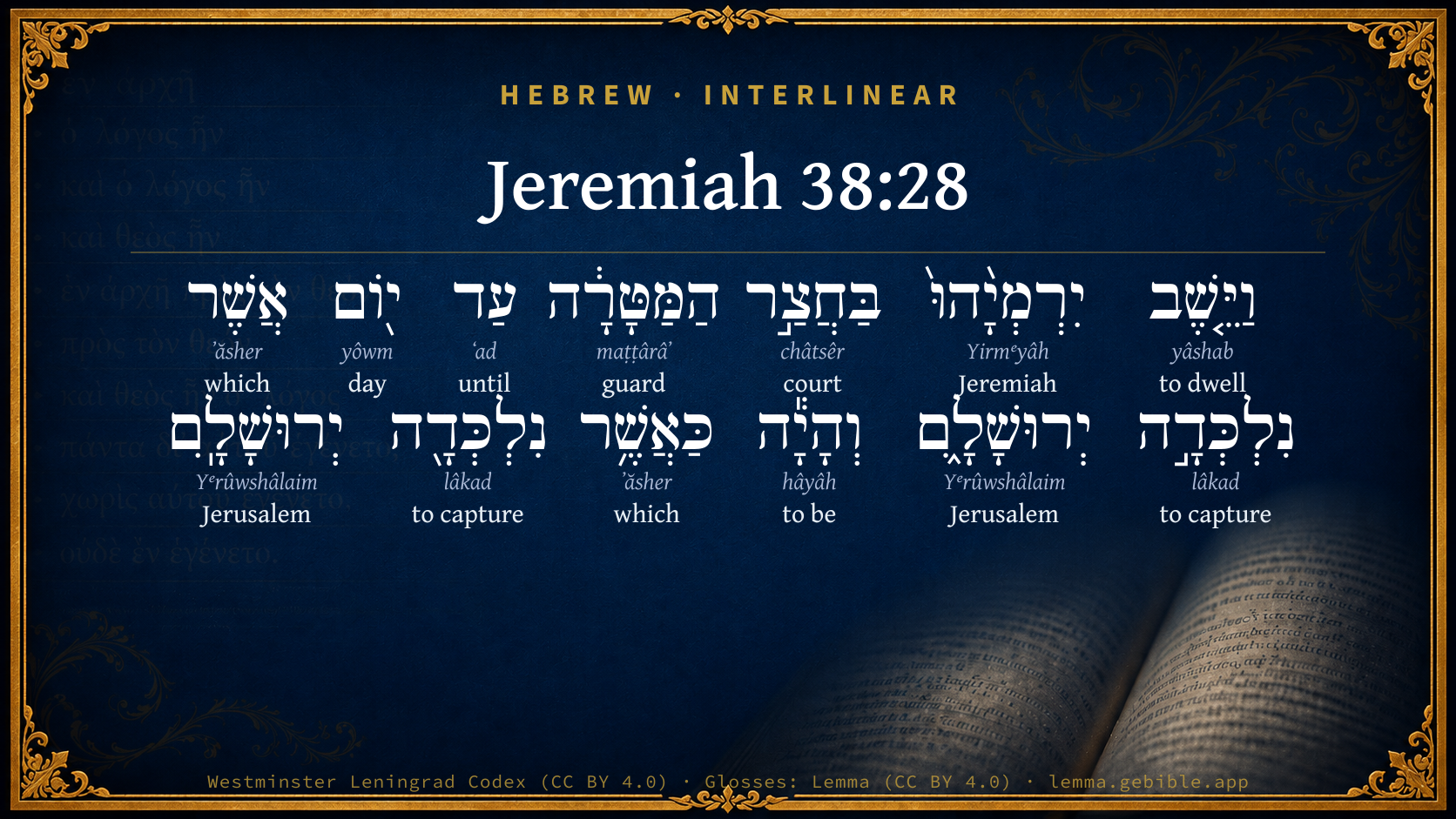
Hebrew (Westminster Leningrad Codex) Jeremiah 38:28 appears in the Hebrew Old Testament. The text above is from the Westminster Leningrad Codex. Each word links to its Strong’s number, a concise gloss, and parsing drawn from the Open Scriptures Hebrew Bible morphology. Click any word for its full Brown-Driver-Briggs (BDB) entry.
Download image
Cite this verse

Jeremiah 38:28 (World English Bible). Public Domain. Lemma interlinear Bible study tool, https://lemma.gebible.app/v/jeremiah/38/28.

Show BibTeX & RIS
BibTeX
RIS
English Translation
So Jeremiah abode in the court of the guard until the day that Jerusalem was taken.
World English Bible · Public Domain
Download a study sheet

One document with this verse’s original text, its word-by-word gloss line, the meaning frame, cross-references with their text, attributed commentary, and full source and license credits — printable, and it pastes into notes with its structure intact.

This verse Autodidact and up

Study sheet (.html) Plain text (.txt)

A passage Seminary Student

Up to 50 verses in one chapter. A passage sheet keeps up to 6 commentary sources and 12 cross-references per verse, in the order this page ranks them, and says so on the sheet whenever that leaves anything out. Ask for a single verse and you get the Autodidact verse sheet above.

Everything on this page stays free to read, with no account — the sheet is a download of what is already on screen, not access to it.

Want to remove ads? Support Godless Engineer
Compare translations 3

The same verse in 3 English versions, stacked beneath the original-language interlinear above. Click any original word for its lexicon entry.

Each is an independent rendering of the whole verse — the interlinear is not word-aligned to these translations.

Highlighted words mark where these versions differ — a whole-verse word diff, not a word-by-word alignment.

  • World English Bible Public Domain
    So Jeremiah abode in the court of the guard until the day that Jerusalem was taken.
  • King James Version Public Domain
    So Jeremiah abode in the court of the prison until the day that Jerusalem was taken: and he was there when Jerusalem was taken.
  • unfoldingWord Literal Text CC BY-SA 4.0
    So Jeremiah remained in the courtyard of the guard until the day Jerusalem was captured.

unfoldingWord Literal Text — © unfoldingWord, licensed CC BY-SA 4.0. Word-aligned USFM3 via Door43 (git.door43.org/unfoldingWord/en_ult).

Versions to compare (up to 4)

3 of 4 selected

Show all 18 translations

Every available English version of this verse, each an independent rendering of the whole verse.

  • World English Bible Public Domain
    So Jeremiah abode in the court of the guard until the day that Jerusalem was taken.
  • Berean Standard Bible Public Domain
    And Jeremiah remained in the courtyard of the guard until the day Jerusalem was captured.
  • Majority Standard Bible Public Domain
    And Jeremiah remained in the courtyard of the guard until the day Jerusalem was captured.
  • King James Version Public Domain
    So Jeremiah abode in the court of the prison until the day that Jerusalem was taken: and he was there when Jerusalem was taken.
  • American Standard Version (1901) Public Domain
    So Jeremiah abode in the court of the guard until the day that Jerusalem was taken.
  • Revised Version (1885) Public Domain
    So Jeremiah abode in the court of the guard until the day that Jerusalem was taken. And it came to pass when Jerusalem was taken,
  • Geneva Bible (1599) Public Domain
    So Ieremiah abode still in the court of the prison, vntill the day that Ierusalem was taken: and he was there, when Ierusalem was taken.
  • Douay-Rheims (1899) Public Domain
    But Jeremias remained in the entry of the prison, until the day that Jerusalem was taken: and it came to pass that Jerusalem was taken.
  • Young's Literal Translation Public Domain
    and Jeremiah dwelleth in the court of the prison till the day that Jerusalem hath been captured, and he was `there' when Jerusalem was captured.
  • Literal Standard Version CC BY-SA 4.0
    and Jeremiah dwells in the court of the prison until the day that Jerusalem has been captured, and he was [there] when Jerusalem was captured.
  • Unlocked Literal Bible CC BY-SA 4.0
    So Jeremiah remained in the courtyard of the guard until the day Jerusalem was captured.
  • unfoldingWord Literal Text CC BY-SA 4.0
    So Jeremiah remained in the courtyard of the guard until the day Jerusalem was captured.
  • Darby Bible Public Domain
    And Jeremiah remained in the court of the guard until the day that Jerusalem was taken.
  • World Messianic Bible Public Domain
    So Jeremiah stayed in the court of the guard until the day that Jerusalem was taken.
  • Webster's Bible Public Domain
    So Jeremiah abode in the court of the prison until the day that Jerusalem was taken: and he was there when Jerusalem was taken.
  • Free Bible Version CC BY-SA 4.0
    Jeremiah remained there in the guard's courtyard until the day Jerusalem was captured.
  • Bible in Basic English Public Domain
    So Jeremiah was kept in the place of the armed watchmen till the day when Jerusalem was taken.
  • JPS Tanakh (1917) Public Domain
    So Jeremiah abode in the court of the guard until the day that Jerusalem was taken. And it came to pass, when Jerusalem was taken —

Literal Standard Version (2020), Covenant Press — licensed CC BY-SA 4.0. Text via the HelloAO Bible API (eBible.org). Unlocked Literal Bible (unfoldingWord) — licensed CC BY-SA 4.0. Text via the HelloAO Bible API (eBible.org). unfoldingWord Literal Text — © unfoldingWord, licensed CC BY-SA 4.0. Word-aligned USFM3 via Door43 (git.door43.org/unfoldingWord/en_ult). Free Bible Version, Dr. Jonathan Gallagher — licensed CC BY-SA 4.0. Text via the HelloAO Bible API (eBible.org).

Word by word

More ways to search: Search by grammar → Find every occurrence → Compare this word →

Practice this passage: Drill this verse → Learn its vocabulary →

הַמַּטָּרָ֔ה
maṭṭârâʼ
H4307
“the · guard”
Particle, Definite Article + Noun, Common, Feminine, Singular, Absolute
Part of Speech
Particle + Noun
Type
Common
Gender
Feminine
Number
Singular
State
Absolute
Full BDB Definition

Origin: from H5201

TWOT: 1356a

guard, ward, prison, mark, target - guard, ward, prison - target, mark (figuratively of chastisement)
  1. וַיֵּ֤שֶׁב yâshab H3427 “and · to dwell” Conjunction + Verb, Qal, Sequential Imperfect, 3rd Person, Masculine, Singular
  2. יִרְמְיָ֨הוּ֙ Yirmᵉyâh H3414 “Jeremiah” Noun, Proper
  3. בַּחֲצַ֣ר châtsêr H2691 “in/at · court of” Preposition + Noun, Common, Both, Singular, Construct
  4. עַד ʻad H5704 “until” Preposition
  5. י֖וֹם yôwm H3117 “day” Noun, Common, Masculine, Singular, Absolute
  6. אֲשֶׁר ʼăsher H834 “which” Particle, Relative
  7. נִלְכְּדָ֣ה lâkad H3920 “to capture” Verb, Niphal, Perfect, 3rd Person, Feminine, Singular
  8. יְרוּשָׁלִָ֑ם Yᵉrûwshâlaim H3389 “Jerusalem” Noun, Proper
  9. וְהָיָ֕ה hâyâh H1961 “and · to be” Conjunction + Verb, Qal, Sequential Perfect, 3rd Person, Masculine, Singular
  10. כַּאֲשֶׁ֥ר ʼăsher H834 “like/as · which” Preposition + Particle, Relative
  11. נִלְכְּדָ֖ה lâkad H3920 “to capture” Verb, Niphal, Perfect, 3rd Person, Feminine, Singular
  12. יְרוּשָׁלִָֽם Yᵉrûwshâlaim H3389 “Jerusalem” Noun, Proper

About this verse

These counts appear in no published source. They are computed here, from the morphology-tagged text and Lemma’s own curated glosses. What Lemma adds →

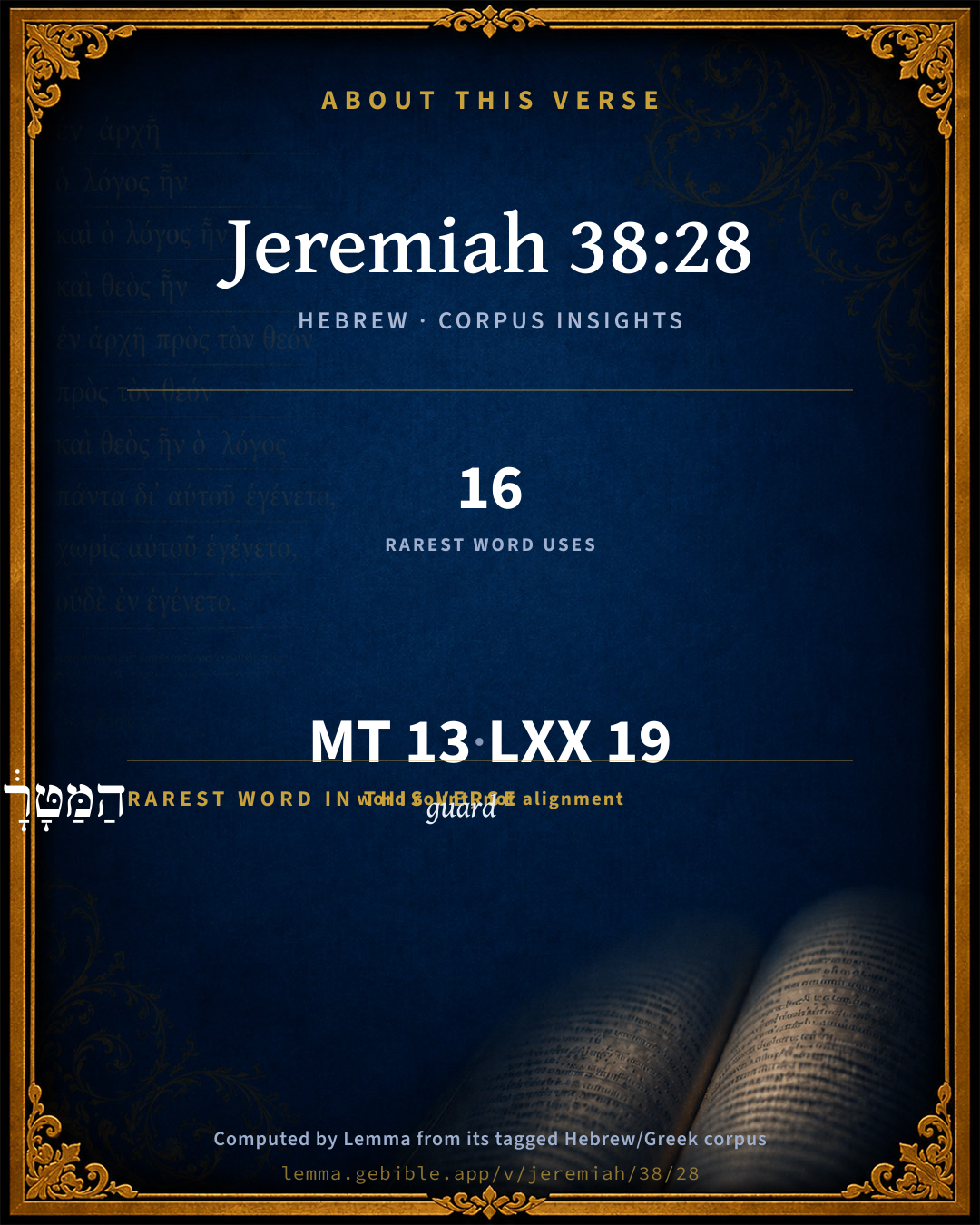
13
words
10
distinct lemmas
Prophets
section

Notable vocabulary

The rarest word here is הַמַּטָּרָ֔ה guard H4307 — appearing just 16 times in the whole Hebrew Bible.

Shared distinctive vocabulary

הַמַּטָּרָ֔ה guard H4307 occurs in 15 verses of the Hebrew Bible. Also found in:

Grammatical profile

  • 4 verbs
  • 6 nouns
  • 1 preposition
  • 2 particles

Verb forms

  • וַיֵּ֤שֶׁב Qal · Sequential Imperfect
  • נִלְכְּדָ֣ה Niphal · Perfect
  • וְהָיָ֕ה Qal · Sequential Perfect
  • נִלְכְּדָ֖ה Niphal · Perfect

Repetition

Words recur within this verse — often emphatic in Hebrew:

  • נִלְכְּדָ֣ה to capture H3920 ×2
  • יְרוּשָׁלִָ֑ם Jerusalem H3389 ×2
  • אֲשֶׁר which H834 ×2

Hebrew & Septuagint length

In the original languages it is 13 Hebrew tokens and 19 Greek tokens — but the two are counted differently (Hebrew bundles its prefixes and suffixes into one token; the Greek is in lemma form), so that isn’t a like-for-like length.

Cross-references

7

Topical passages linked to Jeremiah 38:28 in the Treasury of Scripture Knowledge — connected by theme and wording, ordered by reader-vote popularity; previews shown in the World English Bible.

  • Jeremiah 37:21 Then Zedekiah the king commanded, and they committed Jeremiah into the court of the guard; and they gave him daily a loaf of bread out of the bakers' street, until all the bread in the city was spent. Thus Jeremiah remained in the court of the guard.
  • Jeremiah 39:14 they sent, and took Jeremiah out of the court of the guard, and committed him to Gedaliah the son of Ahikam, the son of Shaphan, that he should carry him home: so he lived among the people.
  • Psalms 23:4 Even though I walk through the valley of the shadow of death, I will fear no evil, for you are with me. Your rod and your staff, they comfort me.
  • Jeremiah 15:20–21 I will make you to this people a fortified brazen wall; and they shall fight against you, but they shall not prevail against you; for I am with you to save you and to deliver you, says Yahweh.
  • Jeremiah 38:13 So they drew up Jeremiah with the cords, and took him up out of the dungeon: and Jeremiah remained in the court of the guard.
  • 2 Timothy 3:11 persecutions, and sufferings: those things that happened to me at Antioch, Iconium, and Lystra. I endured those persecutions. Out of them all the Lord delivered me.
  • 2 Timothy 4:17–18 But the Lord stood by me, and strengthened me, that through me the message might be fully proclaimed, and that all the Gentiles might hear; and I was delivered out of the mouth of the lion.

Cross-references courtesy of OpenBible.info (CC BY 4.0).

Hebrew and Greek witnesses Masoretic Hebrew ↔ Greek Septuagint

The same verse in the two great witnesses to the Old Testament, shown verse-for-verse.

These are two independent witnesses, not word-aligned to each other, and the Septuagint is shown in lemma (dictionary) form.

Hebrew Jeremiah 38:28 Masoretic · Westminster Leningrad Codex

וַיֵּ֤שֶׁב יִרְמְיָ֨הוּ֙ בַּחֲצַ֣ר הַמַּטָּרָ֔ה עַד י֖וֹם אֲשֶׁר נִלְכְּדָ֣ה יְרוּשָׁלִָ֑ם וְהָיָ֕ה כַּאֲשֶׁ֥ר נִלְכְּדָ֖ה יְרוּשָׁלִָֽם

So Jeremiah abode in the court of the guard until the day that Jerusalem was taken.

World English Bible · Public Domain

Greek LXX Structure differs

In the Septuagint, Jeremiah is about an eighth shorter than the Hebrew and arranges its material differently — the Oracles Against the Nations (Hebrew chapters 46–51) appear in the middle of the Greek book, after 25:13. Because the chapter and verse boundaries do not line up, a verse-for-verse comparison with the Hebrew is not shown.

A verse-for-verse comparison isn’t shown here because the chapters and verses don’t line up. Switch to the LXX edition with the MT / LXX toggle above to read the Greek directly.

On this verse, Lange's Commentary on the Holy Scriptures discusses the Septuagint’s reading. Read the note in Commentary ↓

Hebrew: Westminster Leningrad Codex (CC BY 4.0). Greek: Septuagint (public domain); English from a public-domain English Septuagint. How the Septuagint differs from the Hebrew →

Targum (Aramaic paraphrase)

1

The Targum is the ancient Jewish Aramaic paraphrase of the Hebrew Scriptures — an interpretive translation, not the Hebrew text itself. Onkelos (literal) and Pseudo-Jonathan (expansive) render the Torah, and Jonathan the Prophets. Coverage is partial: where no permissively-licensed English translation exists for a verse, only the Aramaic is shown. This is verse-level text, not a word-by-word alignment to the Hebrew.

  1. Targum Jonathan Prophets (Joshua–Malachi)
    וִיתֵיב יִרְמְיָה בְּדָרַת בֵּית אֲסִירַיָא עַד יוֹמָא דְאִתְכְּבִישַׁת יְרוּשְׁלֵם וַהֲוָה כַּד אִתְכְּבִישַׁת יְרוּשְׁלֵם:

    (no public-domain English translation for this verse)

    Targum Jonathan — Aramaic: “Mikraot Gedolot” (public domain). English: “Sefaria Community Translation” (CC0 1.0 (public-domain dedication)); “London "Chaldee Paraphrase," 1871” (public domain). Text via Sefaria.

Commentary

Notes on Jeremiah 38:28 from classic Christian and Jewish commentators (each source and its license shown beneath its notes). The classic Christian expositions comment on the surrounding passage and are grouped to its opening verse, so a note may address several verses; the Jewish commentaries on the Tanakh (Rashi and others) are per-verse, so they appear only where the commentator wrote on this verse.

Lemma curates 59 commentaries, every one of them public domain or Creative Commons licensed, each selected and text-cleaned for this edition rather than reprinted as found. About our sources →

Trapp's Complete Commentary

John Trapp

Jer 38:28 So Jeremiah abode in the court of the prison until the day that Jerusalem was taken: and he was [there] when Jerusalem was taken.

Ver. 28. So Jeremiah abode in the court of the prison.] Which now God had made to him a sanctuary of safety, and a very Bethlehem, or house of bread. God can easily turn a prison into a paradise, and brown bread and water into manchet and wine, as he did to the martyrs. One of them dated his letter thus, From the delectable orchard of the Leonine prison.

John Trapp, A Commentary or Exposition upon All the Books of the Old and New Testament (1647–1656) — public domain. Text from a community e-Sword module.

Lange's Commentary on the Holy Scriptures

B. THE EVENTS SUBSEQUENT TO THE CAPTURE OF JERUSALEM (CHS. 39–44)

1. Jeremiah liberated from the court of the guard and given in charge to Gedaliah

Jer_38:28 to Jer_39:14

28b. And he was there1 [And it came to pass] when Jerusalem was taken, XXXIX. 1 (In the ninth year of Zedekiah king of Judah, in the tenth month, came Nebuchadrezzar king of Babylon and all his army against Jerusalem, and they besieged 2it. And in the eleventh year of Zedekiah, in the fourth month, the ninth day 3of the month, the city was broken up. And [that] all the princes of the king of Babylon came in, and sat in the middle gate, even Nergal sharezer, Samgar-nebo, Sarsechim, Rab-saris, [or the chief of the eunuchs] Nergal sharezer, Rab-mag [or the chief of the Magi], with all the residue of the princes of the king of Babylon.

4And it came to pass, that when Zedekiah the king of Judah saw them, and all the men-of-war [or and all the men-of-war saw them], then they fled and went out of the city by night, by the way of [to] the king’s garden, by the gate betwixt the 5two walls: and he went out the way of the plain. But the Chaldeans’ army pursued [hastened] after them, and overtook Zedekiah in the plains of Jericho: and when they had taken him [and took him] they [and] brought him up to Nebuchadnezzar king of Babylon to Riblah in the land of Hamath, where he gave 6[held]2 judgment upon him. Then the king of Babylon slew the sons of Zedekiah in Riblah before his eyes: also the king of Babylon slew all the nobles of Judah. 7Moreover he put out Zedekiah’s eyes, and bound him with chains [a double chain], 8to carry [take] him to Babylon. And the Chaldeans burned the king’s house, and the houses of the people, with fire, and brake down the walls of Jerusalem.

9Then Nebuzar-adan the captain of the guard [halberdiers, lit.: executioners carried away captive into Babylon the remnant of the people that remained in the city, and those that fell away, that fell to him [the deserters, who had gone over to 10him], with the rest of the people that remained. But Nebuzar adan the captain of the guard left of the poor of the people, which had nothing, in the land of Judah,11and gave them vineyards and fields3 at the same time. Now Nebuchadrezzar king of Babylon gave charge concerning Jeremiah to Nebuzar-adan the captain 12of the guard, saying, Take him, and look well to him, [set thine eyes upon him] 13and do him no harm; but do unto him even as he shall say unto thee. So Nebuzar-adan the captain of the guard sent, and Nebushasban, Rab-saris [chief of the eunuchs] and Nergal-sharezer, Rab-mag [chief of the Magi], and all the king 14of Babylon’s princes: Even they sent, and took Jeremiah out of the court of the prison [guard], and committed him unto Gedaliah the son of Ahikam the son of Shaphan, that he should carry him home [into the house]: so he dwelt among the people.

EXEGETICAL AND CRITICAL

The text of this chapter is interwoven with portions from chap. 52 (2 Kings 25). Immediately after the opening words an abridged account is interpolated from Jer_52:4-7 (2Ki_25:1-4), of the capture of the city mentioned in these words (Jer_39:1-2). Then after Jer_39:3, Jer_39:4-10 a similarly abridged account of the flight, capture and punishment of the king, and of the burning of the city and deportation of the people is added from Jer_52:7-16 (2Ki_25:4-12). What further follows (Jer_39:11-14) is not derived from elsewhere, but with Jer_38:28 b, and Jer_39:3, forms the only independent portion of this section, Jer_39:1-14. The question, whether the statements in vers 11–13, agree with Jer_39:3, will be treated in the Exeg. Rems. Here it may simply be observed that after the excision thus made the original constituents of the section are occupied purely with the person of the prophet, informing us that by order of Nebuchadnezzar, the captain of dragoons Nebuzar-adan has the prophet brought out of the court of the guard and given in charge to Gedaliah, son of Ahikam, after which Jeremiah remained “among the people.”

Jer_38:28—Jer_39:2. And it came to pass . . . broken up. As the verses 1, 2 cannot in any way be grammatically connected with the preceding and following context, they may be regarded as a parenthesis. The mention of the capture of Jerusalem in Jer_38:28 b occasioned the insertion of this chronological notice relating thereto. It is evident that this insertion was not made by the prophet himself, but proceeded from a later source. Even Keil acknowledges that the account of the destruction of Jerusalem, which is contained in two recensions, Jeremiah 52 and 2Ki_24:18 to 2Ki_25:4, cannot have proceeded from the hand of the prophet (comp. Commentar zu den BB. d. Könige, 1865, S. 10, 11 with which, however, what is said in S. 378 Anm., does not quite agree). Since now vers Jer_39:1-2 are taken from that account of the destruction of Jerusalem which we find in Jeremiah 52 and 2 Kings 25, and this account (comp. the narrative of Jehoiachin’s end, Jer_52:31-34), must necessarily be of later date than Jeremiah, the extract from that account cannot have been made by Jeremiah. These verses are, therefore, to be regarded as a gloss, which probably came into the text, not by the will of the author, but by the fault of the transcriber. Once having entered the text, they pressed back also those words at the close of the previous chapter, since the parenthesis was doubtless then found to be too long and disjointed, and the connection of the words with Jer_39:3 impracticable. What means the oldest commentators took to fit the words to the previous context, we have already seen.

Jer_39:3. That all the princes . . king of Babylon. These words attach themselves as we have shown to Jer_38:28 b. How long after the capture of the city this event took place, the words themselves do not inform us. For the connection of the sentence, Jer_38:28 b, may designate both an immediate chronological sequence, or a longer interval. Let us first regard more particularly the place and object of the assembly, and the persons assembled. The place is called the gate of the middle. As is well known, David had first conquered and fortified (2Sa_5:7; 2Sa_5:9) Mount Zion, the city of David, which Josephus (Antiq. V., 2, 2) calls the καθύπερθεν πόλις in distinction from the κάτω πόλις. The expression seems to denote one of the gates in the wall separating this upper and lower city. It does not occur elsewhere. Perhaps, however, עִיר הַתִּיכֹנָה (Keriחָצֵר הַתִּיכֹנָה) 2Ki_20:4 is connected with it. Arnold (Herz.: R.-Enc. XVIII., S. 629) [Smith, Dict., I. 1027] supposes that the middle gate is to be sought in the middle of the north wall of Mt. Zion. If the gate of the middle is then to be sought, not in the outer city-wall, but in the interior of the city, perhaps as the main entrance to the upper city, it appears to be a central point quite favorable for the commander’s purpose. At the same time the sitting of the commander in this gate, as the central point of the city-life (comp. on the significance of the gate in this regard, Herzog’sR.-Enc. XIV., S. 721) may have been the signal of the formal and solemn taking possession. In taking their places where the rulers and elders of Jerusalem were accustomed to discharge their office, the Chaldean princes gave it to be understood that they were now masters of the city. That they had “taken up their quarters” in the gate, as Graf supposes, I do not think. For a gate is no place for living in, least of all for princes. As we perceive from 2Ki_25:1 (Jer_52:4), Nebuchadnezzar himself began the siege, but left its continuation to his generals, he himself being at the time of the capture in Riblah (2Ki_25:6; Jer_25:9; Jer_39:5). These generals are now enumerated. Hitzig has made the ingenious conjecture, that the four names which we here read, are to be reduced to three, of which each is followed by an official title. Thus Nergal-sharezer bears the title Samgar, which in the Persian signifies “he who has the cup,” so that it is equivalent to Rabshakeh (Isa_36:2) the cup-bearer. Nebo, which in compound names never occurs in the last place (which is certainly correct), is to be connected with the following name. Sar-sechim is identical with Rab-saris (for סָכִי from סָכָה, or שָׂכָהsecare, from which שָׂכִּיןknife, is equivalent to eunuch). This idle, sportive accumulation of designations of a man has now after Nebo supplanted the second half of the real name, Shasban (Jer_39:13). We thus obtain three names, each with a title: 1. Nergal-sharezer, cup-bearer; 2. Nebushasban, chief-eunuch; 3. Nergal-sharezer, chief-magian. This conjecture, on which Graf has bestowed his approbation, is very plausible, especially as Rabsaris is certainly called Nebushasban in Jer_39:13, and we cannot conceive why the chief-eunuch, of which there cannot well have been more than one, bears a different name in Jer_39:3, from that in Jer_39:13. According to Hitzig the last two names in Jer_39:13 agree with the corresponding ones in Jer_39:3, the only difference being in the first name, which is however fully explained by the circumstance, that during the interval which had elapsed between Jer_39:3 and Jer_39:15, Nebuzar-adan, who was highest in rank of all the princes, had arrived, and is therefore named first in the latter passage instead of the Nergal-sharezer of Jer_39:3. The sense and connection are thus in favor of Hitzig’s conjecture, but it still lacks a secure etymological basis. That Samgar means cupbearer, and Sar-sechim is equivalent to Rab-saris, is not yet sufficiently proved. On the name Nergal-sharezer comp. Niebuhr, Ass. u. Bab., S. 37, 42, 43, Anm. [On the identification of Nergal-sharezer with Neriglissat, son-in-law of Nebuchadnezzar, see Rawlinson, Ancient Monarchies, III. 232, 528, and Smith’sBible Dictionary, s. v.—S. R. A.] On Nebo also, Ib. S. 30, 34.

Jer_39:4-10. And it came to pass . . at the same time. This passage is, as already remarked, taken with abbreviations from Jer_52:7-16 (2Ki_25:4-12). The object is evidently to give, in a compressed picture of the general distress, a background to the original representation, relating merely to the fate of the prophet. That this was necessary, together with Jeremiah 52, must be doubted. For what author will unnecessarily write the same thing twice over? Or would not the author of Jeremiah 39 expect that the reader could himself derive the necessary elucidation of this narrative from ch 52? Jer_39:4-10 is however taken from Jeremiah 52, not from 2 Kings 25. For if we compare Jer_39:4 with Jer_52:7; Jer_39:5 with Jer_52:8-9; Jer_39:6 with Jer_52:10 (N. B.: the slaughter of the princes is not mentioned in 2 Kings 25) and Jer_39:7 with Jer_52:11, we shall find that the present, passage contains all which distinguishes the narrative of Jeremiah 52. from that in 2 Kings 25, while in no point does it agree with 2 Kings 25 in opposition to Jeremiah 52. In the verses Jer_39:8-10 the narrative in relation both to Jeremiah 52 and 2 Kings 25 is so much abbreviated, that any special relationship with one of the two passages is not perceptible. They differ in this section however only in single words, which have no bearing on the essential import, so that we may say that the present text is related to Jeremiah 52, as well as to 2 Kings 25, as extract and elucidation. On this more below. If, now, Jer_39:4-10 is indisputably of later date than Jeremiah 52, so as to presuppose this chapter, we cannot avoid regarding the text as originally a marginal gloss, which was gradually by the fault of the transcriber incorporated into the text. As regards particular points, the words “And it came to pass that when Zedekiah,” Jer_39:4, may be recognized as a skillfully added connecting gloss, for 1, the original text contains nothing of this; but lets the flight follow immediately on the breaking in of the Chaldeans, Jer_52:7; 2Ki_25:4; 2 Kings 2, it is also in itself improbable, that Zedekiah deferred his flight till the Chaldean princes had taken their post in the middle gate. The flight was effectuated in a direction opposite to that in which the enemies from the North approached, viz., by the exit to the South “on the way to the garden of the king through the gate between the double wall.” This garden of the king is mentioned only in Neh_3:15, where it borders on the pool of Siloah. Comp. Arnold in Herzog, R.-Enc., XVIII., S. 630 u. 635; Leyreb in the same, XIV. S. 371. [Smith,Dict., I., 653]. According to Arnold this garden of the king is probably identical with the garden of Uzza (2Ki_21:18; 2Ki_21:26). The gate between the double walls also is mentioned only here and in the parallel passages. It is to be sought for in the exit of the Tyropæon, and is probably identical with the gate of the fountain (Neh_2:14; Neh_3:15; Neh_12:37). Comp. Arnold, S. 629 et pass.; Thenius, BB. d. Könige, S. 456; Robinson, Pal. II., S. 142.—The double-wall mentioned besides here (and parallel passages) only in Isa_22:11, appears to have been a double connection between Zion and Ophel. But concerning this there are various views. Comp. Thenius, The graves of the kings of Judah in Illgru’sZeitschr. f. hist. Theol., 1844, I. S. 18 sqq.; Herzog, R.-Enc., V. S. 157; XIV. S. 374; XVIII. S. 633; Keil.BB. d. Kön., S. 381.

From this southern exit Zedekiah turned eastward to the עֲרָבָה. This is the general term for the plain or vale of the Jordan, both on its eastern (comp. Deu_1:1; Deu_3:17; Deu_4:49; Jos_12:1) and its western shore (comp. Jos_8:14; Jos_11:2; Jos_11:16; 2Sa_2:29). Yet it seems as though Arabah is not only to be taken in a narrower and wider sense, (in the wider it comprises the entire depression of the lake Gennesaret to the Elamitic gulf, of which the southern half, from the southern end of the Dead Sea, is still called Wady el Araba) but to be generally of a fluctuating character. For in Deu_11:30 for instance the region of Sichem, where Mts. Ebal and Gerizim are situated, is reckoned to the Arabah. Zedekiah is overtaken in the עַרְבוֹת יְרֵחוֹ. This is a part of the Arabah, the enlargement of the Jordan-valley, three leagues wide, near Jericho, watered by the brook of Elisha.

The captured king is taken to Riblah, the northern boundary city of Palestine, at the source of the Orontes, (Num_34:11) the point of juncture for the roads eastward to the Euphrates, southward to Damascus and the Jordan, and westward to Phœnicia, which had previously been the head-quarters of Pharaoh Necho (2Ki_23:33). Here Nebuchadnezzar held judgment over him. Nebuchadnezzar had made him king (2Ki_24:17), Zedekiah was therefore a rebel against him (Jer_52:3; 2Ki_24:20).

The punishment which Zedekiah had to suffer for his revolt was a cruel one: his children were slain before his eyes, likewise all the great men of Judah (הֹרֵי for שָׂרֵי Jer_52:10 probably as a reminiscence from Jer 27:30); he himself was blinded and carried in chains to Babylon. From to carry, Jer_39:7, onwards, the abridgement is great and in so far unfortunate that one main point is Omitted, viz., the circumstance that Nebuchadnezzar on the news of the capture of Jerusalem sent the captain of his body-guard, Nebuzaradan, to Jerusalem, who arrived there four weeks after the capture. The mention of this circumstance was important, because without it the appearance of Nebuzar-adan, from Jer_39:9 onwards, is wholly unaccounted for. One consequence of this omission is also that in Jer_39:8 it is not Nebuzar-adan who burns the city, but the Chaldeans. Why the temple is not mentioned among the objects burned is not clear. In Jer_39:4 the obscure and superfluous words “the poor of the people,” found in Jer_52:15, are omitted, and instead of “that fell to the king of Babylon,” we have simply “that fell to him,” עָלָיו (2Ki_25:11, עַל מֶלֶךְ ב׳, almost the only point in which Jeremiah 39 approaches more nearly to 2 Kings 25 than Jeremiah 52). Since the king of Babylon has not been named just before (comp Jer_39:6 fin.) “to him” can refer only to the Nebuzar adan mentioned in the following verse; a reference which cannot be historically justified, since by the deserters mentioned are to be understood such only as went over before the conquest. After the deserters our text mentions besides “the remnant of the people.” In antithesis to the “remnant of the people that remained in the city” can be understood only the inhabitants remaining in the country. In the place of the second הָעָם we find in 2Ki_25:11הֶהָמֹן, in Jer_52:15הָאָמֹן. The former denotes “tumult, multitude of people” (comp. Isa_13:4; Isa_17:12) and our text takes the latter doubtless in the same sense. Whether correctly is another question. Comp. rems. on Jer_52:15. Nebuzar-adan, the “captain of the guard,” is here named for the first time. Sent by the king to Jerusalem on receipt of the news that Jerusalem is taken (comp. Jer_52:12; 2Ki_25:8), he immediately assumes the chief command, as is evident from this passage, and the following (Jer_39:10-12; Jer_40:1-6). The nature of his office, as well as the expression “who stood before the king” in Jer_52:12, indicate that he took precedence of all other princes.—The tenth verse, in this differing from the rest, contains an extension of the original text, the expression “the poor” being explained by the addition “which had nothing,” wanting in Jeremiah 52 and 2 Kings 25. The author evidently held it to be desirable (though unnecessary), to call attention to the fact that דַּל is not here to be taken in the sense of “afflictus, miser.” The brief phrase “for vine-dressers and for husbandmen” in Jer_52:16; 2Ki_25:12 (Keri) he extends into a sentence.—The words “at the same time” (in the same day) are to mark the difference in time between what was last narrated and what follows. It might otherwise have seemed as if the events narrated in Jer_39:11 occurred contemporaneously with those in Jer_39:9-10.

Jer_39:11-14. Now Nebuchadnezzar . . . among the people. Struensee, Movers, Graf, Meier, dispute the genuineness of Jer_39:11-13, Hitzig only of Jer_39:13. The objections to the authenticity appear to be the following: 1. The commission given to Nebuzar-adan is, according to Jer_40:1, not executed. Only in Rama (Jer_40:1) does Nebuzar-adan (comp. Jer_40:4) what according to Jer_39:11-12 he was commanded to do. 2. If Nebuzar-adan, who according to Jer_52:12 came to Jerusalem four weeks after its capture, first ordered the liberation of Jeremiah from the court of the guard, Jeremiah had remained there four weeks after the capture, which is in contradiction to Jer 38:28. 3. The three vers. are wanting in the LXX. 4. As to Jer_39:13 in particular, it is a mere connecting clause, rendered necessary by the insertion of Jer_39:11-12. For Jer_39:14 could not be connected directly with Jer_39:12; for the subject of “sent” would then be obscure. By the mention of Nebuzar-adan the connection with Jer_39:12 and the previous context, and by the mention of the other princes the connection with Jer_39:13 is established. I do not think that these arguments are conclusive. As to the first point, Nebuzar-adan certainly made the necessary arrangements for the execution of his commission. He liberated the prophet from the court of the guard, and entrusted him to Gedaliah for his further maintenance. But he seems not to have been in a condition to keep the prophet specially in view, so that he might be preserved from any personal malignity. In the confusion which was necessarily connected with the destruction of the city, the prophet, who voluntarily or involuntarily had been included in the multitude of the people, was treated like the rest. He was bound like the others. It was only in Ramah, where probably the first halt was made, and the arrangement of the caravan was definitely adjusted, that the captain of the halberdiers remembered his commission with respect to the prophet. There he liberated him from the chains, which he had borne “among all that were carried away captive” (Jer_40:1) and committed him the second time to Gedaliah (Jer_40:6). With regard to the second point it should first of all be remarked that “day,” Jer_38:28, must not necessarily be understood in the most restricted sense. This word, as is well known, frequently designates the period of an historical event in general, without any thought of a day of twenty-four hours. Comp. Jer_7:25; Jer_11:7; Jdg_18:30, etc. If now we consider that the princes who, according to Jer_39:3, sat down in the middle gate, thus took possession of Jerusalem in the name of the Chaldean king, but could not undertake further measures with respect to the fate of the city till they had heard from him, it cannot truly be surprising that for four weeks, till the arrival of Nebuzar-adan (Jer_52:12) things remained essentially as before, and that thus Jeremiah could not be removed from the court of the guard. The absence of the Jer_39:11-13 in the LXX. (which moreover omits the whole section 4–13, while it has Jer_39:1-2) is of no significance, the reasons for it being apparent. The translator wished by the omission of Jer_39:11-12 to avoid an apparent contradiction, by the omission of Jer_39:13 a repetition. As to the fourth argument it falls to pieces of itself, in so far that Jer_39:13 seems necessary in any case, whether we regard Jer_39:11-12 as genuine or not. The names of the princes might indeed be named together after וַיִּשְׁלְחוּ. But we see that the author’s thoughts (after Jer_39:11-12) were so much occupied with Nebuzar-adan that he names him first and as the chief personage (hence וַיִּשְׁלַח Jer_39:13), adding the rest only by way of supplement. When now after the long series of names and titles he repeated the principal verb once more, and in the plural, this is evidently done purely in the interest of perspicuity. We cannot then regard the arguments against the genuineness of Jer_39:11-13 as valid. On the other hand the following positively favor the genuineness: 1. In point of idiom there is nothing which is foreign to the prophet’s usage. It is worth notice that in Jer_39:11 the name of the Chaldean king is Nebuchadrezzar (as Jeremiah is always accustomed to write it) while in Jer_39:5 we read Nebuchadnezzar. The expression בְּיַד is one current in Jeremiah. It is found thirty-eight times, more frequently than in any of the other prophets. The expression שִׂים עֵינֶיךָ is found besides here and Jer_40:4 only in Gen_44:21. The phrase “do him no harm” (on the Dag. f. in רָּע comp. Olsh. § 83, f.) is not indeed specifically Jeremian, but by no means as Graf asserts, an unnecessary explanatory addition. Could it have been unnecessary to enjoin on Nebuzar-adan that no harm should be done to Jeremiah? Was this beyond the reach of possibility? The actual fate of the prophet gives the answer to this question. Or could the רָּע be omitted? Then we should have an ambiguous expression. For, strictly taken, the sentence without רָע would make it Nebuzar-adan’s duty to behave indifferently towards Jeremiah 2. It is in favor of the authenticity that the passage (Jer_39:11-13) is shown to be neither a foreign property, borrowed from elsewhere (like Jer_39:1-2; Jeremiah 4-10), nor an interruption of the connection, but on the contrary as necessary to furnish a perfectly clear picture of the occurrences. That the passage is not borrowed is acknowledged by all. That the course of Nebuzar-adan, as it is related in Jer_40:1-6 presupposes a commission of Nebuchadnezzar is involved in the nature of the case. For how could Nebuzar-adan dare to distinguish a single person with such favors if he had not been sure of the approval of his master? And is it then improbable that this approval was assured to him by a positive commission? Must an interpolator have invented this commission when Nebuchadnezzar may have heard a thousand times from the mouth of deserters that there was a prophet in Jerusalem who incessantly and with constant danger to his life had designated Nebuchadnezzar as an instrument in the hand of the Lord and submission to him as the only way of escape? And if Nebuchadnezzar had heard this, is there any reason for regarding the commission as the idle, unhistorical conjecture of a later editor? I believe that the narrative in Jer_39:11-14, in most intimate connection with Jer_39:3, presents us with the events in a perfectly natural manner, both as to form and contents. It is not at all necessary to take וַיְצַו, Jer_39:11, as pluperfect. For this command was actually given after the event related in Jer_39:3, which we have regarded above as the act of solemn taking possession. After Nebuchadnezzar had received the news of the capture of Jerusalem he sent Nebuzar-adan with his further orders. Among these was one respecting the person of the prophet. This alone is here mentioned, as the subject of the verses Jer_39:3; Jer_39:11-14, is simply the personal experiences of Jeremiah. In the execution of this commission, the princes, at whose head no longer stood Nergalsharezer but Nebuzar-adan, had the prophet taken out of the court of the guard. This could not be done before, because till the arrival of Nebuchadnezzar all had to remain in general the same as it had been at the capture of the city. Jeremiah was now given in charge to Gedaliah, the son of Ahikam. This Ahikam, of a noble family (comp. 2Ki_22:12; 2Ki_22:14), had already favored the prophet (Jer_26:24). Gedaliah evidently belonged to that small party, who having taken Jeremiah’s prophecies as the rule of their political course, had gone over to the Chaldeans (Jer_38:19). Gedaliah was to bring the prophet from the court of the guard אֶל־הַבַּיִת. By this some have understood the temple (Hitzig), others the king’s house (Graf, et al.). But according to Jer_52:13 (2Ki_25:9), both these were burned down by Nebuzar-adan, together with the other houses of Jerusalem, directly on his arrival. And assuredly those large public buildings were not the last to which the Chaldeans applied the destroying hand. It is credible that some private dwellings might be preserved to the last, to afford shelter to some privileged persons. “Into the house” may thus designate the genus, private dwelling in general, in contrast to “quarters at the public expense,” such as the court afforded, it thus remaining undecided whether the private dwelling in which Jeremiah was taken were Gedaliah’s own house, or some other. In this private dwelling Jeremiah was not placed under confinement. He could freely go in and out. And so he had intercourse with the people, doubtless warning and comforting them with his prophetic words, and was thus in the vast confusion of the destruction, plundering and deportation, treated by the soldiers who had charge of the details like the mass of the populace, i.e., bound in chains, and placed in the trains of captives. Nebuchadnezzar’s order thus remained unobeyed, without any fault of Nebuzar-adan and Gedaliah, till they reached the station of Ramah.

DOCTRINAL AND ETHICAL

1. On Jer_39:11-12. “Elucet inde veritas illius Salomonis (Pro_21:1): Cor regis in manu Dei, quo vult illud inclinat.” Förster.

2. On Jer_39:11-14. “Nebuchadnezzar the king and Ebed-melech the Ethiopian enhanced the guilt of the Jews. For these, although they were heathens, were not shy of the prophet. The Jews, however, who had grown up with the prophetic words, paid no regard to the divine word, but on the contrary subjected the prophet to manifold maltreatment.” Theodoret.

3. On Jer_39:11-14. “Deus ex iisdem hominibus diversa singulis disponit præmia, qui ex iisdem elementis pro meritorum qualitate electis et reprobis diversas impendit remunerationes. Nam aqua maris rubri, quæ cultores Dei illæsos servabat Israelitas, eadem interfecit Ægyptios idololatras. Similiter flamma camini, quæ regis Babylonis juxta fornacem atroces interfecit ministros, eadem laudantes et benedicentes Dominum in medio ignis conservavit pueros, unde vir sapiens in laudibus Dei ait: creatura enim tibi factori deserviens excandescit in tormentum adversus injustos et lenior fit ad benefaciendum pro his, qui in te confidunt (Sap. 16, 24).” Rhabanus Maurus in Ghisler.

4. On Jer_39:15-18. “Well for him, whose help is the God of Jacob, whose hope is in the Lord his God (Psa_146:5). Well for the people, whose God is the Lord (Psa_144:15). For of what avail was it to Zedekiah that he was king? And of what injury was it to Ebed-melech that he was a servant? For the former had to endure all on account of his ungodliness, while the latter on account of his piety suffered no evil.” Theodoret.

5. On Jer_39:15-18. “Ecce principes, qui Jeremiam expetiverunt ad carceris pænam, Chaldaicæ captivitatis perpessi sunt vindictam. Hic autem Eunuchus, qui prophetam liberavit de carcere, Domino remunerante perfecta potitus est libertate.” Rhabanus Maurus in Ghisler.

6. On Jer_39:15-18. “This pious courtier had interceded for the prophet with the king, but the prophet had again interceded for him with God the Lord. Ebed-melech had drawn him out of the pit, but Jeremiah draws him by his prayer from the jaws of all Chaldean war-vortices. Those who receive a prophet shall receive a prophet’s reward (Mat_10:41). Preachers do their patrons more good than they get from them.” Cramer.

HOMILETICAL AND PRACTICAL

1. On Jer_39:11-14. Jeremiah’s deliverance an example of how wonderfully the Lord helps His own. 1. While in Jerusalem his fellow believers hate and persecute him, the heathen king in Riblah thinks of him, and commands to liberate him. 2. While the city of Jerusalem with all its population perishes, he is protected and brought into safety.

2. On Jer_39:15-18. What can we learn from the example of the believing Ebed-melech? 1. That faith is not connected with limits of any external communion; 2, that assent and confidence pertain to its nature (Jer_39:18); 3, that there is an internal (Jer_39:16) and external (Jer_39:17) reward of faith.

Footnotes:

[1]Jer_38:28 b.—These words cannot either logically or grammatically be connected with the previous context. The Vulg. and Chald. translate ungrammatically: et factum est, ut caperetur Hierosolyma. The Syr. omits the words altogether. The LXX. translate merely וְהָיָה, connecting it immediately with Jer_39:1. On the other hand, an entirely appropriate sense and connection is furnished, if the words are connected with Jer_39:3. On וְהָיָה, comp rems. on Jer_37:11. The Masoretes, moreover, objected to the present division of the text, as may be seen from their פִסְקָא בְּאֶמְצַע פְסוּקָא (lacuna in medio versu). Comp. Gesen.: Lehrgeb., S. 124; Hupfeld, Stud. u. Krit., 1837, S. 835. Similar cases are found in Gen_35:22; Num. 25:19; Jos_4:1; Eze_3:16, etc. Comp. Fuerst, Propylæa Masoræ, § 29 in the Concordance, p. 1369.—In Jer_39:1 בֶּעָשׂוֹר לַחדֶֹשׁ wanting in our text, possibly through the oversight of the transcriber; הוּא is likewise wanting before וְכָל־חֵילוֹ; וַיָּצֻרוּ עָלֶיהָ is contracted from the longer sentence “and pitched against it, and built forts against it round about, so the city was besieged.” Finally הָבְקְעָה הָעְיר is contracted from “the famine prevailed (was sore) in the city, and there was no bread for the people of the land, and the city was broken up.” It is evident that the author of this text was concerned only to present the main thoughts.

[2]Jer_39:5.—The expression דַּבֵּר מִשְׁפָטִים אֵת פ׳ for “to hold judgment,” occurs only in Jer_1:16; Jer_4:12; Jer_12:1. The present account also has the form hero only, while in 2Ki_25:6 we find מִשְׁכָּט. Moreover the expression is not found elsewhere with the following אֵת and with the meaning “litigare, hold judgment,” but it signifies elsewhere (Psa_37:30; Isa_32:7) simply “to speak justice.”—This is a point which would favor the Jeremian origin of Jeremiah 52 (comp. Haevernick, Einl., II. 3, S. 233), if this grammatical agreement might not be due to other causes.

[3]Jer_39:10.—יְגֵבִים is ἅπ. λεγ.

Lange's Commentary on the Holy Scriptures (Critical, Doctrinal, and Homiletical), ed. John Peter Lange, English translation edited by Philip Schaff (1864–1880) — public domain. Text from a community e-Sword module.

Jamieson, Fausset & Brown

Robert Jamieson, A. R. Fausset & David Brown

he was there when Jerusalem was taken--These words are made the beginning of the thirty-ninth chapter by many; but the accents and sense support English Version.

This chapter consists of two parts: the first describes the capture of Jerusalem, the removal of the people to Babylon, and the fate of Zedekiah, and that of Jeremiah. The second tells of the assurance of safety to Ebed-melech.

Next: Jeremiah Chapter 39

Jamieson, Fausset & Brown — Commentary Critical and Explanatory on the Whole Bible (1871) — public domain (CC PDM 1.0). Text via the HelloAO Bible API.

John Calvin's Commentaries

Some render the last words simply thus, “And it happened that Jerusalem was taken;” and others, “It happened accordingly that Jerusalem was taken;” but this seems unnatural. Others take the relative as a demonstrative pronoun, and of this I approve, “For it happened that according to this Jerusalem was taken.”

He first says that he dwelt in the court of the prison. It hence appears that he was not even then at liberty; for though the king wished him to be free, yet he dared not to release him. This is one thing. Then he says, that he was there until the day the city was taken We shall hereafter see that he was saved by the king’s command, and was brought out of prison. He was, then, until that day in the court of the prison, as though he had said, that he was a prisoner until the king was taken prisoner, together with his counselors, and also until the day the whole city was taken. And here we may see, as in a vivid form, the wonderful judgment of God. As long as the Jews boasted that they offered sacrifices to God, they kept Jeremiah shut up in prison, so that he was not a free man until the king was taken, the city perished, and almost all were driven into exile. I have no doubt but that he added the following by way of explanation, And it happened that according to this Jerusalem was taken; that is, he reminds readers in these words, that he had not been a false Prophet, but a true and faithful witness as to God’s judgment, for all his prophecies were verified by the event. He then says that the city was taken, not by chance, but because God had so declared. He now begins to narrate historically the destruction and the burning of the city. He therefore says, —

John Calvin's Commentaries (1540-1563) — public domain. Text from the Calvin Translation Society English edition (1840s-50s) via the Christian Classics Ethereal Library (ccel.org). Calvin's coverage is partial (roughly two-thirds of the Bible); uncommented books and verses are honest gaps, never fabricated. The 19th-century editor's footnotes and remarks are omitted so the notes are faithfully Calvin's own voice.

The Cambridge Bible for Schools and Colleges

gen. ed. J. J. S. Perowne

28. of the guard] See on Jer_32:2.

The Cambridge Bible for Schools and Colleges (gen. ed. J. J. S. Perowne; Cambridge University Press, 1878–1918) — public domain. Text from a community e-Sword module.

John Gill's Exposition

So Jeremiah abode in the court of the prison,.... Where he was ordered to be by the king, before he was cast into the dungeon, and where he was replaced by Ebedmelech; and which was now confirmed by the king, and here he continued:

until the day that Jerusalem was taken; but how long it was from his conversation with the king, to the taking of the city, is not certain:

and he was there when Jerusalem was taken; as appears from Jer 39:14. Kimchi connects this with the beginning of the next chapter; and so the Targum, rendering it,

"and it came to pass when Jerusalem was taken;''

namely, what is related in the following chapter.

Next: Jeremiah Chapter 39

John Gill's Exposition of the Whole Bible (1746–1763) — public domain (CC PDM 1.0). Text via the HelloAO Bible API.

Albert Barnes' Notes on the Bible

And he was there when ... - These words are altered by some to “and it came to pass when” etc., and taken to form the opening of Jer. 39.

Albert Barnes' Notes on the Bible (1834–1885) — public domain. Text from a community e-Sword/MySword module.

Matthew Poole's English Annotations

Thus God hath several ways to hide his people in an evil day; he hid Josiah from it in the grave; he hid Noah in an ark, Lot in Zoar, Jeremiah in a prison, which in probability was a safer place for him than the land of Benjamin, whither he would have gone had not Irijah stopped him, Jer 37:12,13. Conquerors have commonly the greatest kindness for those whom they find under the frowns of the conquered, especially when that which hath made them so hath been something spoken or done in the favour of the conquerors.

Matthew Poole's English Annotations on the Holy Bible (1683–1685) — public domain. Text from a community e-Sword/MySword module.

The Pulpit Commentary

And he was there when, etc. The words, of which this is an incorrect version, ought to begin the first verse of the next chapter. Render (with Coverdale), And it came to pass when Jerusalem was taken (in the ninth year of Zedekiah came Nebuchadrezzar, etc.; in the eleventh year...the city was cleft open) that all the princes, etc. The correctness of the reading is, however, open to some doubt (see introduction to next chapter)

The Pulpit Commentary (1880–1919), ed. H.D.M. Spence-Jones & Joseph S. Exell — public domain. Text from a community e-Sword module.

Lesson kit

Teaching starters — assembled from the data on this page, not authored interpretation. Every prompt links to the verse data it draws on. Edit before teaching.

Jeremiah, in the Prophets, opens this verse with 13 words (10 distinct Hebrew lemmas). Its most distinctive word is maṭṭârâʼ (“guard”). A historical commentator’s framing appears above. Read the whole chapter for the surrounding context.

Discussion questions

  1. How does “guard” (maṭṭârâʼ) shape what this verse is saying?
  2. 1 Samuel 20:20 shares the word «guard» with this verse. How do the two illuminate each other?
  3. “to capture” occurs 2× in this one verse. What is the effect of the repetition?
  4. These translations render this verse differently; the difference is in the English rendering, not the original. What questions does that raise?
  5. The verb «וַיֵּ֤שֶׁב» is Qal Sequential Imperfect. How does its form color the action?
  6. Reading how Trapp's Complete Commentary and Lange's Commentary on the Holy Scriptures read this verse, where do the two commentators agree and where do they part?

Things to notice

Reading settings

Reading text

Shown beneath each verse's original-language words.

Old Testament
Old Testament edition

Read the OT as the Masoretic Hebrew (MT) or the Greek Septuagint (LXX).

English shown for the Greek Septuagint (in the Hebrew ↔ Greek comparison).

Comparing translations? Open the Compare panel on any verse page to stack up to four side by side.