
Numbers 32:41

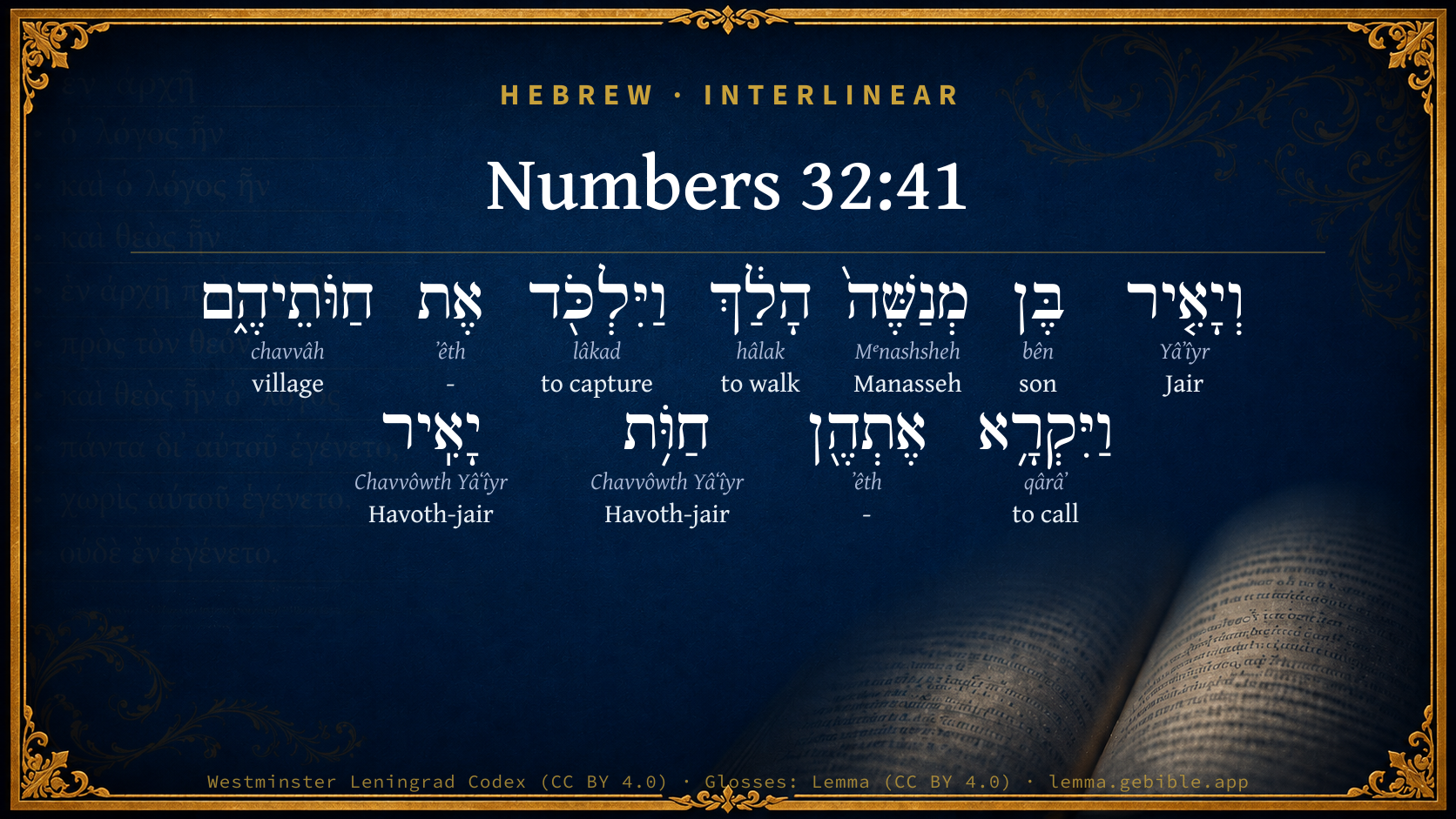
Hebrew (Westminster Leningrad Codex) Numbers 32:41 appears in the Hebrew Old Testament. The text above is from the Westminster Leningrad Codex. Each word links to its Strong’s number, a concise gloss, and parsing drawn from the Open Scriptures Hebrew Bible morphology. Click any word for its full Brown-Driver-Briggs (BDB) entry.
Download image
Cite this verse

Numbers 32:41 (World English Bible). Public Domain. Lemma interlinear Bible study tool, https://lemma.gebible.app/v/numbers/32/41.

Show BibTeX & RIS
BibTeX
RIS
English Translation
Jair the son of Manasseh went and took the towns of it, and called them Havvoth Jair.
World English Bible · Public Domain
Highlights
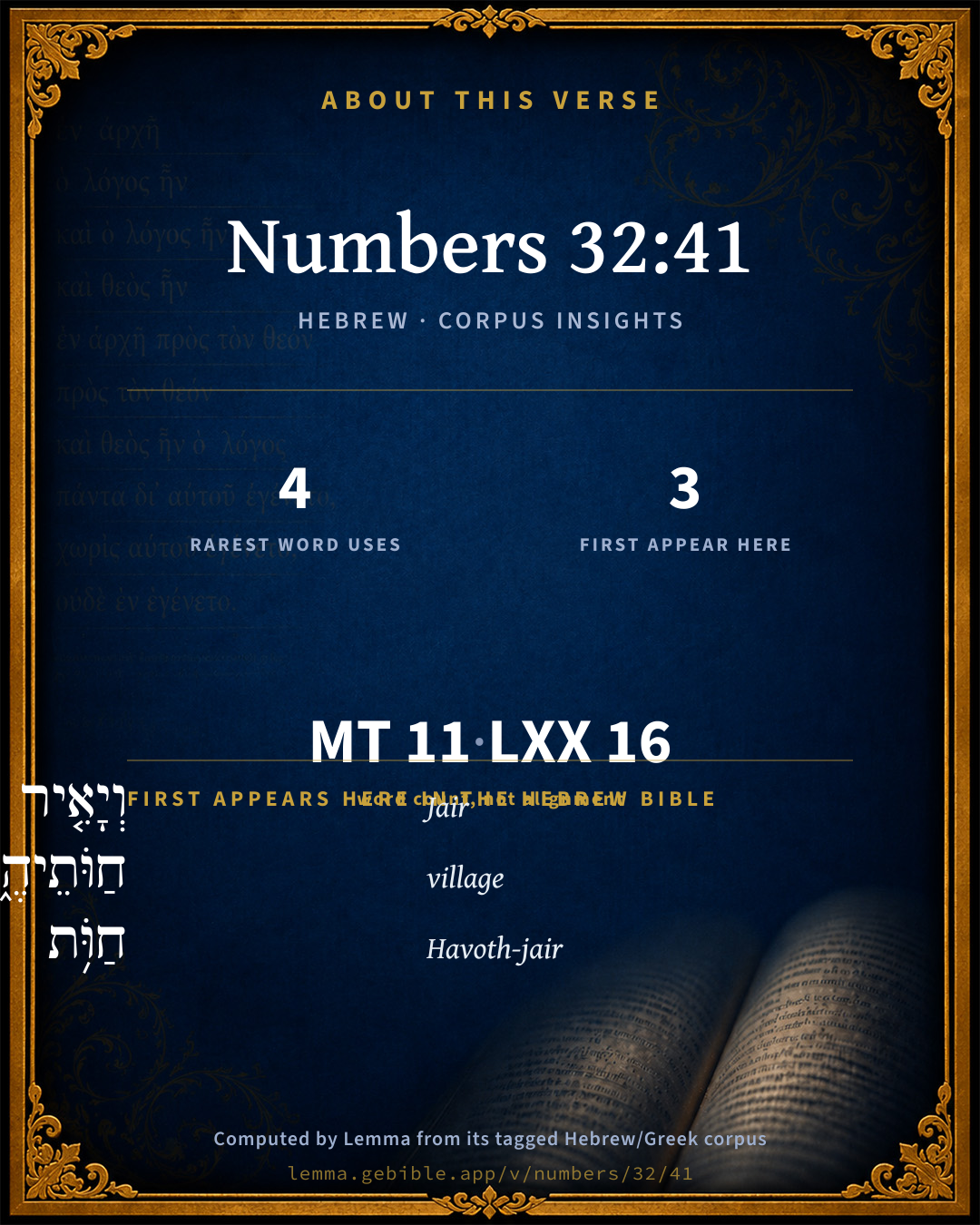
  • 3 first appearances in the Hebrew Bible
Full analysis ↓
Download a study sheet

One document with this verse’s original text, its word-by-word gloss line, the meaning frame, cross-references with their text, attributed commentary, and full source and license credits — printable, and it pastes into notes with its structure intact.

This verse Autodidact and up

Study sheet (.html) Plain text (.txt)

A passage Seminary Student

Up to 50 verses in one chapter. A passage sheet keeps up to 6 commentary sources and 12 cross-references per verse, in the order this page ranks them, and says so on the sheet whenever that leaves anything out. Ask for a single verse and you get the Autodidact verse sheet above.

Everything on this page stays free to read, with no account — the sheet is a download of what is already on screen, not access to it.

Want to remove ads? Support Godless Engineer
Compare translations 3

The same verse in 3 English versions, stacked beneath the original-language interlinear above. Click any original word for its lexicon entry.

Each is an independent rendering of the whole verse — the interlinear is not word-aligned to these translations.

Highlighted words mark where these versions differ — a whole-verse word diff, not a word-by-word alignment.

  • World English Bible Public Domain
    Jair the son of Manasseh went and took the towns of it, and called them Havvoth Jair.
  • King James Version Public Domain
    And Jair the son of Manasseh went and took the small towns thereof, and called them Havothjair.
  • unfoldingWord Literal Text CC BY-SA 4.0
    And Jair the son of Manasseh went and captured their tent villages, and he called them Havvoth Jair.

unfoldingWord Literal Text — © unfoldingWord, licensed CC BY-SA 4.0. Word-aligned USFM3 via Door43 (git.door43.org/unfoldingWord/en_ult).

Versions to compare (up to 4)

3 of 4 selected

Show all 18 translations

Every available English version of this verse, each an independent rendering of the whole verse.

  • World English Bible Public Domain
    Jair the son of Manasseh went and took the towns of it, and called them Havvoth Jair.
  • Berean Standard Bible Public Domain
    Jair, a descendant of Manasseh, went and captured their villages and called them Havvoth-jair.
  • Majority Standard Bible Public Domain
    Jair, a descendant of Manasseh, went and captured their villages and called them Havvoth-jair.
  • King James Version Public Domain
    And Jair the son of Manasseh went and took the small towns thereof, and called them Havothjair.
  • American Standard Version (1901) Public Domain
    And Jair the son of Manasseh went and took the towns thereof, and called them Havvoth-jair.
  • Revised Version (1885) Public Domain
    And Jair the son of Manasseh went and took the towns thereof, and called them Havvoth-jair.
  • Geneva Bible (1599) Public Domain
    And Iair the sonne of Manasseh went and tooke the small townes thereof, and called them Hauoth Iair.
  • Douay-Rheims (1899) Public Domain
    And Jair the son of Manasses went, and took the villages thereof, and he called them Havoth Jair, that is to say, the villages of Jair.
  • Young's Literal Translation Public Domain
    And Jair son of Manasseh hath gone and captureth their towns, and calleth them `Towns of Jair;'
  • Literal Standard Version CC BY-SA 4.0
    And Jair son of Manasseh has gone and captures their towns, and calls them “Towns of Jair”;
  • Unlocked Literal Bible CC BY-SA 4.0
    Jair son of Manasseh went and captured its towns and called them Havvoth Jair.
  • unfoldingWord Literal Text CC BY-SA 4.0
    And Jair the son of Manasseh went and captured their tent villages, and he called them Havvoth Jair.
  • Darby Bible Public Domain
    And Jair the son of Manasseh went and took their hamlets, and called them Havoth-Jair.
  • World Messianic Bible Public Domain
    Jair the son of Manasseh went and took its villages, and called them Havvoth Jair.
  • Webster's Bible Public Domain
    And Jair the son of Manasseh went and took its small towns, and called them Havoth-jair.
  • Free Bible Version CC BY-SA 4.0
    Jair, a descendant of Manasseh, attacked their villages and captured them. He named them the Villages of Jair.
  • Bible in Basic English Public Domain
    And Jair, the son of Manasseh, went and took the towns of Gilead, naming them Havvoth-Jair.
  • JPS Tanakh (1917) Public Domain
    And Jair the son of Manasseh went and took the villages thereof, and called them Havvoth-jair.

Literal Standard Version (2020), Covenant Press — licensed CC BY-SA 4.0. Text via the HelloAO Bible API (eBible.org). Unlocked Literal Bible (unfoldingWord) — licensed CC BY-SA 4.0. Text via the HelloAO Bible API (eBible.org). unfoldingWord Literal Text — © unfoldingWord, licensed CC BY-SA 4.0. Word-aligned USFM3 via Door43 (git.door43.org/unfoldingWord/en_ult). Free Bible Version, Dr. Jonathan Gallagher — licensed CC BY-SA 4.0. Text via the HelloAO Bible API (eBible.org).

Word by word

More ways to search: Search by grammar → Find every occurrence → Compare this word →

Practice this passage: Drill this verse → Learn its vocabulary →

חַוֺּתֵיהֶ֑ם
chavvâh
H2333
“villages · their”
Noun, Common, Feminine, Plural, Construct + Suffix, Personal, 3rd Person, Masculine, Plural
Part of Speech
Noun
Type
Common
Gender
Feminine
Number
Plural
State
Construct
Full BDB Definition

Origin: properly, the same as H2332 (life-giving, i.e. living-place)

TWOT: 617a

village, town, tent village
  1. וְיָאִ֤יר Yâʼîyr H2971 “and · Jair” Conjunction + Noun, Proper
  2. בֶּן bên H1121 “son of” Noun, Common, Masculine, Singular, Construct
  3. מְנַשֶּׁה֙ Mᵉnashsheh H4519 “Manasseh” Noun, Proper
  4. הָלַ֔ךְ hâlak H1980 “to walk” Verb, Qal, Perfect, 3rd Person, Masculine, Singular
  5. וַיִּלְכֹּ֖ד lâkad H3920 “and · to capture” Conjunction + Verb, Qal, Sequential Imperfect, 3rd Person, Masculine, Singular
  6. אֶת ʼêth H853 “-” Particle, Direct Object
  7. וַיִּקְרָ֥א qârâʼ H7121 “and · to call” Conjunction + Verb, Qal, Sequential Imperfect, 3rd Person, Masculine, Singular
  8. אֶתְהֶ֖ן ʼêth H853 “- · them” Particle, Direct Object + Suffix, Personal, 3rd Person, Feminine, Plural
  9. חַוֺּ֥ת Chavvôwth Yâʻîyr H2334 “Havoth-jair of” Noun, Common, Feminine, Plural, Construct
  10. יָאִֽיר Chavvôwth Yâʻîyr H2334 “Havoth-jair” Noun, Proper

About this verse

These counts appear in no published source. They are computed here, from the morphology-tagged text and Lemma’s own curated glosses. What Lemma adds →

11
words
9
distinct lemmas
Pentateuch
section

Notable vocabulary

The rarest word here is חַוֺּתֵיהֶ֑ם village H2333 — appearing just 4 times in the whole Hebrew Bible.

First appearance in Scripture

These words make their first canonical appearance in the Hebrew Bible here:

  • וְיָאִ֤יר Jair H2971
  • חַוֺּתֵיהֶ֑ם village H2333
  • חַוֺּ֥ת Havoth-jair H2334

Shared distinctive vocabulary

חַוֺּתֵיהֶ֑ם village H2333 occurs in 4 verses of the Hebrew Bible. Also found in:

Grammatical profile

  • 3 verbs
  • 6 nouns
  • 2 particles

Verb forms

  • הָלַ֔ךְ Qal · Perfect
  • וַיִּלְכֹּ֖ד Qal · Sequential Imperfect
  • וַיִּקְרָ֥א Qal · Sequential Imperfect

Repetition

A word recurs within this verse — often emphatic in Hebrew:

  • חַוֺּ֥ת Havoth-jair H2334 ×2

Hebrew & Septuagint length

In English translation the verse runs 17 words from the Hebrew and 18 from the Septuagint (LXX English) — closely comparable.

A rough comparison of the two English renderings, which tokenize alike — not a word-level alignment.

Word counts can differ between the Hebrew and the Greek without any difference in meaning — e.g. the Hebrew direct-object marker אֵת has no separate Greek word, and Greek often adds the article ὁ.

In the original languages it is 11 Hebrew tokens and 16 Greek tokens — but the two are counted differently (Hebrew bundles its prefixes and suffixes into one token; the Greek is in lemma form), so that isn’t a like-for-like length.

Cross-references

5

Topical passages linked to Numbers 32:41 in the Treasury of Scripture Knowledge — connected by theme and wording, ordered by reader-vote popularity; previews shown in the World English Bible.

  • Deuteronomy 3:14 Jair the son of Manasseh took all the region of Argob, to the border of the Geshurites and the Maacathites, and called them, even Bashan, after his own name, Havvoth Jair, to this day.)
  • Judges 10:4 He had thirty sons who rode on thirty donkey colts, and they had thirty cities, which are called Havvoth Jair to this day, which are in the land of Gilead.
  • Joshua 13:30 Their border was from Mahanaim, all Bashan, all the kingdom of Og king of Bashan, and all the towns of Jair, which are in Bashan, sixty cities:
  • 1 Kings 4:13 Ben Geber, in Ramoth-gilead (to him [pertained] the towns of Jair the son of Manasseh, which are in Gilead; [even] to him [pertained] the region of Argob, which is in Bashan, sixty great cities with walls and brazen bars);
  • 1 Chronicles 2:21–23 Afterward Hezron went in to the daughter of Machir the father of Gilead, whom he took [as wife] when he was sixty years old; and she bore him Segub.

Cross-references courtesy of OpenBible.info (CC BY 4.0).

Hebrew and Greek witnesses Masoretic Hebrew ↔ Greek Septuagint

The same verse in the two great witnesses to the Old Testament, shown verse-for-verse.

These are two independent witnesses, not word-aligned to each other, and the Septuagint is shown in lemma (dictionary) form.

Hebrew Numbers 32:41 Masoretic · Westminster Leningrad Codex

וְיָאִ֤יר בֶּן מְנַשֶּׁה֙ הָלַ֔ךְ וַיִּלְכֹּ֖ד אֶת חַוֺּתֵיהֶ֑ם וַיִּקְרָ֥א אֶתְהֶ֖ן חַוֺּ֥ת יָאִֽיר

Jair the son of Manasseh went and took the towns of it, and called them Havvoth Jair.

World English Bible · Public Domain

Greek LXX Numbers 32:41 Septuagint · lemma form

καί ιαϊρ ὁ ὁ μανασσή πορεύομαι καί λαμβάνω ὁ ἔπαυλις αὐτός καί ἐπιὀνομάζω αὐτός ἔπαυλις ιαϊρ

And Jair the son of Manasse went and took their villages, and called them the villages of Jair.

LXX2012 (modern English Septuagint) · Public Domain

On this verse, The Pulpit Commentary discusses the Septuagint’s reading. Read the note in Commentary ↓

Hebrew: Westminster Leningrad Codex (CC BY 4.0). Greek: Septuagint (public domain); English from LXX2012 (modern English Septuagint) (Public Domain). How the Septuagint differs from the Hebrew →

Targum (Aramaic paraphrase)

2

The Targum is the ancient Jewish Aramaic paraphrase of the Hebrew Scriptures — an interpretive translation, not the Hebrew text itself. Onkelos (literal) and Pseudo-Jonathan (expansive) render the Torah, and Jonathan the Prophets. Coverage is partial: where no permissively-licensed English translation exists for a verse, only the Aramaic is shown. This is verse-level text, not a word-by-word alignment to the Hebrew.

  1. Targum Onkelos Torah (Genesis–Deuteronomy)
    וְיָאִיר בַּר מְנַשֶׁה אֲזַל וּכְבַשׁ יָת כַּפְרָנֵיהוֹן וּקְרָא יַתְהֶן כַּפְרָנֵי יָאִיר

    (no public-domain English translation for this verse)

    Targum Onkelos — Aramaic: “Onkelos Genesis” (public domain); “Onkelos Exodus” (public domain); “Onkelos Leviticus” (public domain); “Onkelos Numbers” (public domain); “Onkelos Deuteronomy” (public domain). English: “Sefaria Community Translation” (CC0 1.0 (public-domain dedication)); “J.W. Etheridge. The Targums of Onkelos and Jonathan Ben Uzziel on the Pentateuch. London: Longmans, Green, 1862” (public domain). Text via Sefaria.

  2. Targum Pseudo-Jonathan Torah (Genesis–Deuteronomy)
    וְיָאִיר בַּר מְנַשֶׁה אָזַל וּכְבַשׁ יַת כַּפְרָנֵיהוֹן וּקְרָא יַתְהוֹן כּוּפְרָנֵי יָאִיר

    And Jair bar Menasheh went and subdued their villages, and called them the villages of Jair.

    Targum Pseudo-Jonathan — Aramaic: “Targum Jonathan on Genesis” (public domain); “Targum Jonathan on Exodus” (public domain); “Targum Jonathan on Leviticus” (public domain); “Targum Jonathan on Numbers” (public domain); “Targum Jonathan on Deuteronomy” (public domain). English: “The Targum of Jonathan ben Uzziel, trans. J. W. Etheridge, London, 1862” (public domain). Text via Sefaria.

Commentary

Notes on Numbers 32:41 from classic Christian and Jewish commentators (each source and its license shown beneath its notes). The classic Christian expositions comment on the surrounding passage and are grouped to its opening verse, so a note may address several verses; the Jewish commentaries on the Tanakh (Rashi and others) are per-verse, so they appear only where the commentator wrote on this verse.

Lemma curates 59 commentaries, every one of them public domain or Creative Commons licensed, each selected and text-cleaned for this edition rather than reprinted as found. About our sources →

Geneva Bible (1599)

Geneva Bible translators

That is, the villages of Jair.

Geneva Bible (1599) marginal notes — public domain. Text via Bolls.life.

Jamieson, Fausset & Brown

Robert Jamieson, A. R. Fausset & David Brown

Havoth-jair--that is, "tent-villages." Jair, who captured them, was a descendant of Manasseh on his mother's side (Ch1 1:21-22).

Jamieson, Fausset & Brown — Commentary Critical and Explanatory on the Whole Bible (1871) — public domain (CC PDM 1.0). Text via the HelloAO Bible API.

Adam Clarke's Commentary

Verse 41. Havoth-jair.] That is, the villages or habitations of Jair; and thus they should have been translated. As these two tribes and a half were the first, says Ainsworth, who had their inheritance assigned to them in the promised land, so they were the first of all Israel that were carried captive out of their own land, because of their sins. "For they transgressed against the God of their fathers, and went a whoring after other gods. And God delivered them into the hands of Pul and Tiglath-Pilneser, kings of Assyria, and they brought them to Halah, Habor, Hara, and Gozan, unto this day." See 1Ch 5:25-26.

Adam Clarke's Commentary on the Bible (1810–1826) — public domain. Text from a community e-Sword/MySword module.

Ellicott's Commentary for English Readers

(41) And Jair the son of Manasseh . . . —Jair was the son of Segub, the son of Hezron, who married the daughter of Machir, the son of Manasseh (1Ch_2:21-22). Jair was, therefore, the great-grandson of Manasseh, and was one of those Israelites who were reckoned as belonging to their maternal tribe.

A Bible Commentary for English Readers, edited by Charles John Ellicott (1878–1897) — public domain. Text from a community e-Sword module.

The Cambridge Bible for Schools and Colleges

gen. ed. J. J. S. Perowne

41. Jair the son of Manasseh] This Manassite clan that took Gilead and gave its name to the district Havvôth-Jair (‘the towns of Jair,’ marg. or better ‘the tent villages of J .’) is mentioned in Jdg_10:3-4 as Jair the Gileadite, and is represented as one of the judges of Israel. The territory which the clan occupied is identified in Deu_3:14 with Argob in Bashan (cf. Jos_13:30). But Deu_3:5 is not in agreement with that, because Argob is described as a region of fenced cities with ‘high walls, gates, and bars’; while the clan dwelt in tent villages. And in 1Ki_4:13 the two districts seem to be expressly distinguished.

The Cambridge Bible for Schools and Colleges (gen. ed. J. J. S. Perowne; Cambridge University Press, 1878–1918) — public domain. Text from a community e-Sword module.

John Gill's Exposition

And Nobah went and took Kenath, and the villages thereof,.... Who this Nobah was is not certain, very probably a descendant of Manasseh; it is said (u) he was among those that were born in Egypt, and died after the death of Moses, and was buried beyond Jordan, as it is said, also did Machir and Jair, so that there were none left but Caleb, and Joshua:

and called it Nobah, after his name; but it seems that in later times its ancient name was restored to it; for Jerom (w), says there was a village in Arabia, called Cannatha, which is supposed to be this place; though he also tells us (x), that eight miles from Heshbon; to the south, is shown a desert place called Naba. Pliny (y) places Cannatha in the Decapolis.

(u) Seder Olam Rabba, c. 9. p. 27. (w) Ut supra. (De loc. Heb. fol. 89. M.) (x) De loc. Heb. fol. 93. H. (y) Nat. Hist. l. 5. c. 18.

John Gill's Exposition of the Whole Bible (1746–1763) — public domain (CC PDM 1.0). Text via the HelloAO Bible API.

Albert Barnes' Notes on the Bible

The exploits of Jair - he was the conqueror of Argob Deu 3:14 - gave new. luster to his name; and the fame of the family is attested by the history of Jair the Israelite judge, doubtless a descendant; perhaps also by the mention of Jairus Luk 8:41, the ruler of the synagogue at the neighboring city of Capernaum.

Havoth-jair - That is, the villages, or rather groups of tents, or “kraals,” of Jair. Originally they were twenty-three in number 1Ch 2:22 : in the days of the youuger Jair, to whom they probably descended by inheritance, they either had increased to thirty, or were reckoned at that round number Jdg 10:4.

Albert Barnes' Notes on the Bible (1834–1885) — public domain. Text from a community e-Sword/MySword module.

Haydock's Catholic Bible Commentary

Jair was born of Segub, the son of Esron, by a daughter of Machir, 1 Paralipomenon i. 21. He did not remain in the tribe of Juda, but dwelt in that of his mother, (Calmet) or perhaps he married a descendant of Machir, and obtained these villages. (Selden, Suc. c. xviii.) --- Havoth, means "a circle of cabins or shepherds’ huts," in Arabic. (Bochart)

George Leo Haydock (1774–1849), Haydock's Catholic Family Bible and Commentary, 1859 edition — public domain. Excludes Psalms (Douay-Rheims chapter numbering differs from Protestant) and Deuterocanonical books (Catholic canon only).

Matthew Poole's English Annotations

Jair is called here

the son of Manasseh, partly because he was so by his mother, 1Ch 2:21,22; and partly because he joined himself with the Manassites in this expedition, and settled himself among them.

Matthew Poole's English Annotations on the Holy Bible (1683–1685) — public domain. Text from a community e-Sword/MySword module.

Whedon's Commentary on the Bible

Daniel D. Whedon

41. Havoth-jair — Towns of Jair. Jos_13:30, note.

Daniel D. Whedon (gen. ed.), Commentary on the Old and New Testaments (1874–1909) — public domain. Text from a community e-Sword module.

The Pulpit Commentary

Jair the son of Manasseh. This hero of Manasseh is mentioned here for the first time; in Deu_3:14 his conquests are somewhat more fully described. His genealogy, which is instructive and suggestive, is given here.

It will be seen that Segub, the father of Jair, was a Machirite in the female line only. His father Hezron, according to 1Ch_2:21, married the daughter of Manasseh in his old age, when his elder sons were probably already fathers of families. It may probably be conjectured also that Manasseh, who must have inherited exceptional wealth, (cf. Gen_48:17) and had but one grandson, left a large portion to his granddaughter, the young wife of Hezron. It was therefore very natural that Segub should have attached himself to the fortunes of his mother"s tribe. Is it not also very probable that Machir had other daughters, (cf. Gen_1:23) who also inherited large portions from their grandfather, and whose husbands were willing enough to enter into a family which had apparently brighter prospects than any others? If so, it would account at once for the existence of a large family of Machirites not descended from Gilead, and not on the most friendly terms with the rest of the tribe. It is quite possible that many of the more adventurous spirits amongst the tribe of Judah joined themselves to a family whose reputation and exploits they might naturally claim as their own (see on Jos_19:34). The small towns thereof, or, "their villages." Septuagint, taleiv autwn , i.e. the hamlets of the Amorites who dwelt in Argob, (Deu_3:14) the modern district of el Lejja, on the north-western waters of the Yermuk or Hieromax. And called them Havoth-jair. ryaiy tOWj. Septuagint, taleiv Iair , and so the Targums. The word chavvoth only occurs in this connection, and is supposed by some to be the plural of hWj, "life." There does not, however, seem to be anything except the very doubtful analogy of certain German names in favour of the rendering "Jair"s lives." It is more likely the corruption of some more ancient name. There is some discrepancy in subsequent references to the Chavvoth-jair. According to 1Ch_2:22, Jair had twenty-three towns in Gilead; from Jud_1:10:4 it appears that the sons of the later Jair had thirty cities "in the land of Gilead" which went under the name of Chavvoth-jair; while in Jos_13:30 "all the Chavvoth-jair which are in Bashan" are reckoned at sixty. The plausible, though not wholly satisfactory, explanation is, that the conquests of Nobah came to be subsequently included in those of his more famous contemporary, and the vague name of Chavvoth-jair extended to all the towns in that part of Gilead, and of Bashan too (see notes on the passages cited).

The Pulpit Commentary (1880–1919), ed. H.D.M. Spence-Jones & Joseph S. Exell — public domain. Text from a community e-Sword module.

Keil & Delitzsch

C. F. Keil & F. Delitzsch

The family of Manasseh named after Machir included "Jair the son (i.e., descendant) of Manasseh." Jair, that is to say, was the grandson of a daughter of Machir the son of Manasseh, and therefore a great-grandson of Manasseh on the mother's side. His father Segub was the son of Hezron of the tribe of Judah, who had married a daughter of Manasseh (Ch1 2:21-22); so that Jair, or rather Segub, had gone over with his descendants into the maternal tribe, contrary to the ordinary rule, and probably because Machir had portioned his daughter with a rich dowry like an heiress. Jair took possession of the whole of the province of Argob in Bashan, i.e., in the plain of Jaulan and Hauran (Deu 3:4 and Deu 3:14), and gave the conquered towns the name of Havvoth Jair, i.e., Jair's-lives (see at Deu 3:14).

Keil & Delitzsch — Biblical Commentary on the Old Testament (1861–1891) — public domain (CC PDM 1.0). Text via the HelloAO Bible API. (Old Testament only.)

Rashi

Rabbi Shlomo Yitzchaki (Rashi)

חותיהם This is rendered in the Targum by THEIR VILLAGES.

ויקרא אתהן חות יאיר AND HE CALLED THEM “THE VILLAGES OF JAIR” — Because he had no children, he named them after himself, as a memorial.

Rashi on the Tanakh — English translations: “The Judaica Press complete Tanach with Rashi, translated by A. J. Rosenberg” (CC BY 4.0); “Pentateuch with Rashi's commentary by M. Rosenbaum and A.M. Silbermann, 1929-1934” (public domain); “The Metsudah Tanach series, Lakewood, N.J” (CC BY 4.0); and “The Book of Joshua, Metsudah Publications, 1997” (CC BY 4.0). Text via Sefaria.

Ramban (Nachmanides)

Rabbi Moshe ben Nachman (Ramban / Nachmanides)

AND JAIR THE SON OF MENASHEH. This man [who was in fact from the tribe of Judah, as will be explained] is [here] traced back by genealogy to his mother’s family [Menasheh], because he took his inheritance together with them [i.e., the children of Menasheh]. And in the Book of Chronicles it says explicitly that he was a son, Verse 22). of Hezron, the son of Perez, the son of Judah, and his mother was the daughter of Machir the son of Menasheh, as it says, And afterward Hezron went in to the daughter of Machir the father of Gilead; whom he took to wife when he was threeescore years old, and she bore him Segub. And Segub begot Jair, who had three and twenty cities in the land of Gilead; and it is [further] written, And Geshur and Aram took the hamlets of Jair from them, Kenath, and the villages thereof, even threescore cities. All these were the sons of Machir the father of Gilead., Verse 23. From this [fact that Kenath is here described as being amongst ‘the hamlets of Jair’] it would appear that Nobach [mentioned here in Verse 42] who conquered Kenath and the villages thereof was a son of Jair, [although it is not mentioned here], and therefore these cities were also called ‘the hamlets of Jair.’ is: “Nobach called it [i.e., Kenath and the villages thereof] by his name” [i.e., by the name of Jair — his father — mentioned in the previous verse]; hence these towns also came to be called ‘the hamlets of Jair,’ as they are described in I Chronicles ibid.And the meaning of the verse, And Moses gave Gilead unto Machir the son of Menasheh is [not “unto Machir” himself, but unto] his family, for it was his sons who conquered it.. Similarly, And unto Machir I gave Gilead means “unto the Machirites,” for since Machir was an honored man and the chief of all his descendants, therefore his children were called by his name, and in the same way the verses refer to the heads of the tribes in connection with the inheritance [given to their children]: southward it was Ephraim’s, and northward it was Menasheh’s. So also: The land of Tappuah belonged to Menasheh etc., Verse 8. And when Scripture says in the Book of Joshua, And this was the lot for the tribe of Menasheh; for he was the firstborn of Joseph. As for Machir the firstborn of Menasheh, the father of Gilead, because he was a man of war, therefore he had Gilead and Bashan, Verse 1. it also refers to his sons, who were men of war, for it was they who went to Gilead and conquered it, and therefore Moses gave them a great part of these lands. Perhaps Machir was still alive [at the time of the division of the Land in the days of Joshua], for the decree [against the generation] of the wilderness [resulting from the incident of the spies, that they were to die in the desert] had not been decreed upon him, as he was not amongst those counted by Moses and Aaron, being he was more than sixty years old [at the time of the first census after the exodus], and he enjoyed longevity as did the earlier generations.

Ramban (Nachmanides) on the Tanakh — English translation: “Commentary on the Torah by Ramban (Nachmanides). Translated and annotated by Charles B. Chavel. New York, Shilo Pub. House, 1971-1976” (CC BY 4.0). Text via Sefaria.

Lesson kit

Teaching starters — assembled from the data on this page, not authored interpretation. Every prompt links to the verse data it draws on. Edit before teaching.

Numbers, in the Pentateuch, opens this verse with 11 words (9 distinct Hebrew lemmas). Its most distinctive word is chavvâh (“village”). A historical commentator’s framing appears above. Read the whole chapter for the surrounding context.

Discussion questions

  1. What does “village” (chavvâh) contribute to the verse as a whole?
  2. 3 words here appear for the first time in Scripture. What is being introduced at this debut?
  3. Joshua 13:30 shares the word «village» with this verse. How do the two illuminate each other?
  4. “Havoth-jair” occurs 2× in this one verse. What is the effect of the repetition?
  5. These translations render this verse differently. What is at stake in choosing one wording over another?
  6. The verb «הָלַ֔ךְ» is Qal Perfect. How does its form color the action?
  7. Reading how Geneva Bible (1599) and Jamieson, Fausset & Brown read this verse, where do the two commentators agree and where do they part?

Things to notice

Reading settings

Reading text

Shown beneath each verse's original-language words.

Old Testament
Old Testament edition

Read the OT as the Masoretic Hebrew (MT) or the Greek Septuagint (LXX).

English shown for the Greek Septuagint (in the Hebrew ↔ Greek comparison).

Comparing translations? Open the Compare panel on any verse page to stack up to four side by side.