
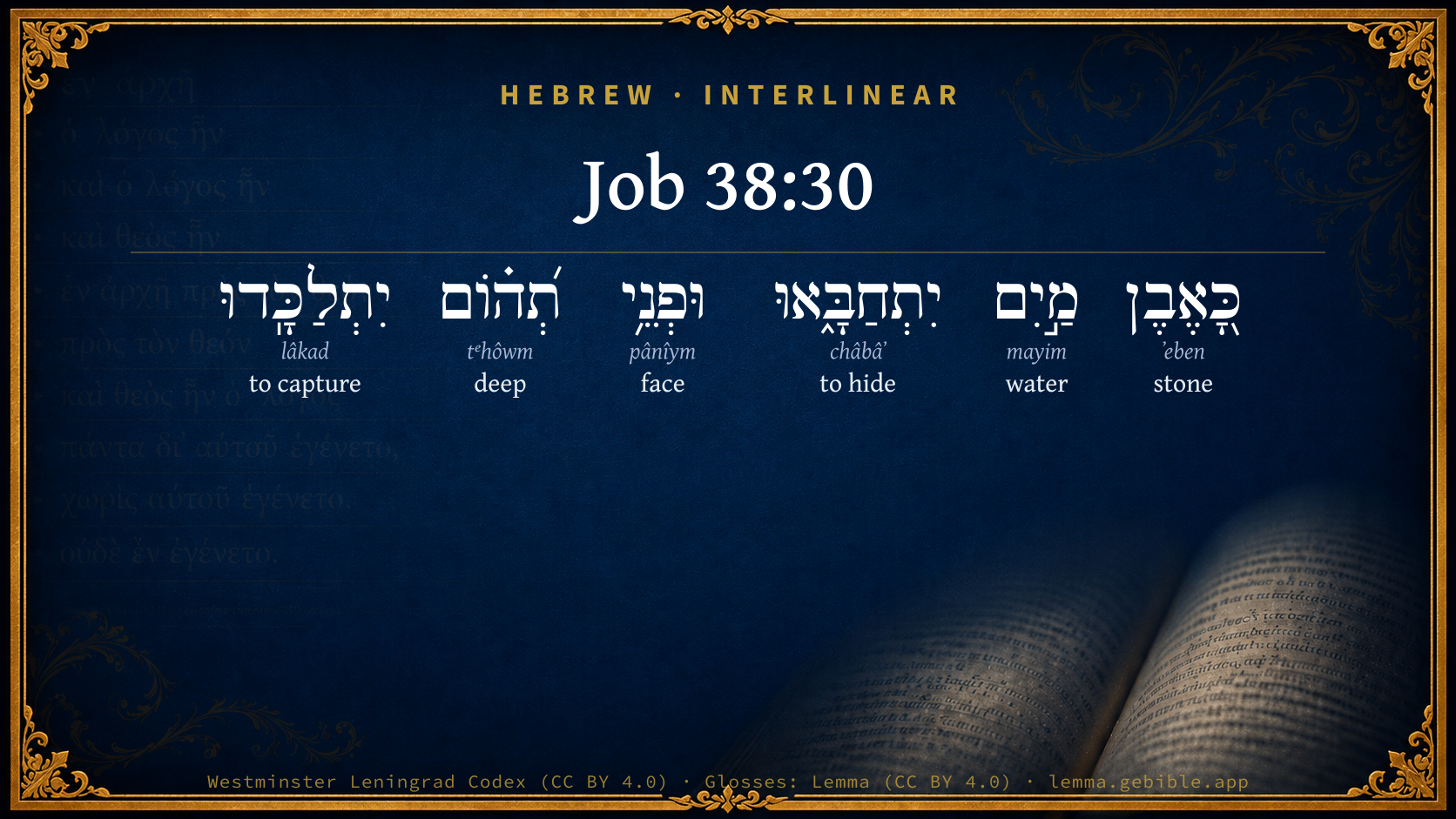
Job 38:30

Hebrew (Westminster Leningrad Codex) Job 38:30 appears in the Hebrew Old Testament. The text above is from the Westminster Leningrad Codex. Each word links to its Strong’s number, a concise gloss, and parsing drawn from the Open Scriptures Hebrew Bible morphology. Click any word for its full Brown-Driver-Briggs (BDB) entry.
Download image
Cite this verse

Job 38:30 (World English Bible). Public Domain. Lemma interlinear Bible study tool, https://lemma.gebible.app/v/job/38/30.

Show BibTeX & RIS
BibTeX
RIS
English Translation
The waters become hard like stone, When the surface of the deep is frozen.
World English Bible · Public Domain
Download a study sheet

One document with this verse’s original text, its word-by-word gloss line, the meaning frame, cross-references with their text, attributed commentary, and full source and license credits — printable, and it pastes into notes with its structure intact.

This verse Autodidact and up

Study sheet (.html) Plain text (.txt)

A passage Seminary Student

Up to 50 verses in one chapter. A passage sheet keeps up to 6 commentary sources and 12 cross-references per verse, in the order this page ranks them, and says so on the sheet whenever that leaves anything out. Ask for a single verse and you get the Autodidact verse sheet above.

Everything on this page stays free to read, with no account — the sheet is a download of what is already on screen, not access to it.

Want to remove ads? Support Godless Engineer
Compare translations 3

The same verse in 3 English versions, stacked beneath the original-language interlinear above. Click any original word for its lexicon entry.

Each is an independent rendering of the whole verse — the interlinear is not word-aligned to these translations.

Highlighted words mark where these versions differ — a whole-verse word diff, not a word-by-word alignment.

  • World English Bible Public Domain
    The waters become hard like stone, When the surface of the deep is frozen.
  • King James Version Public Domain
    The waters are hid as with a stone, and the face of the deep is frozen.
  • unfoldingWord Literal Text CC BY-SA 4.0
    As stone, the waters hide themselves, and the face of the deep freezes.

unfoldingWord Literal Text — © unfoldingWord, licensed CC BY-SA 4.0. Word-aligned USFM3 via Door43 (git.door43.org/unfoldingWord/en_ult).

Versions to compare (up to 4)

3 of 4 selected

Show all 18 translations

Every available English version of this verse, each an independent rendering of the whole verse.

  • World English Bible Public Domain
    The waters become hard like stone, When the surface of the deep is frozen.
  • Berean Standard Bible Public Domain
    when the waters become hard as stone and the surface of the deep is frozen?
  • Majority Standard Bible Public Domain
    when the waters become hard as stone and the surface of the deep is frozen?
  • King James Version Public Domain
    The waters are hid as with a stone, and the face of the deep is frozen.
  • American Standard Version (1901) Public Domain
    The waters hide themselves `and become' like stone, And the face of the deep is frozen.
  • Revised Version (1885) Public Domain
    The waters are hidden as with stone, and the face of the deep is frozen.
  • Geneva Bible (1599) Public Domain
    The waters are hid as with a stone: and the face of the depth is frosen.
  • Douay-Rheims (1899) Public Domain
    The waters are hardened like a stone, and the surface of the deep is congealed.
  • Young's Literal Translation Public Domain
    As a stone waters are hidden, And the face of the deep is captured.
  • Literal Standard Version CC BY-SA 4.0
    Waters are hidden as a stone, || And the face of the deep is captured.
  • Unlocked Literal Bible CC BY-SA 4.0
    The waters hide themselves and become like stone; the surface of the deep becomes frozen.
  • unfoldingWord Literal Text CC BY-SA 4.0
    As stone, the waters hide themselves, and the face of the deep freezes.
  • Darby Bible Public Domain
    When the waters lie hidden as in stone, and the face of the deep holdeth fast together.
  • World Messianic Bible Public Domain
    The waters become hard like stone, when the surface of the deep is frozen.
  • Webster's Bible Public Domain
    The waters are hid as with a stone, and the face of the deep is frozen.
  • Free Bible Version CC BY-SA 4.0
    Water turns into rock-hard ice; its surface freezes solid.
  • Bible in Basic English Public Domain
    The waters are joined together, hard as a stone, and the face of the deep is covered.
  • JPS Tanakh (1917) Public Domain
    The waters are congealed like stone, and the face of the deep is frozen.

Literal Standard Version (2020), Covenant Press — licensed CC BY-SA 4.0. Text via the HelloAO Bible API (eBible.org). Unlocked Literal Bible (unfoldingWord) — licensed CC BY-SA 4.0. Text via the HelloAO Bible API (eBible.org). unfoldingWord Literal Text — © unfoldingWord, licensed CC BY-SA 4.0. Word-aligned USFM3 via Door43 (git.door43.org/unfoldingWord/en_ult). Free Bible Version, Dr. Jonathan Gallagher — licensed CC BY-SA 4.0. Text via the HelloAO Bible API (eBible.org).

Word by word

More ways to search: Search by grammar → Find every occurrence → Compare this word →

Practice this passage: Drill this verse → Learn its vocabulary →

About this verse

These counts appear in no published source. They are computed here, from the morphology-tagged text and Lemma’s own curated glosses. What Lemma adds →

6
words
6
distinct lemmas
Wisdom
section

Shared distinctive vocabulary

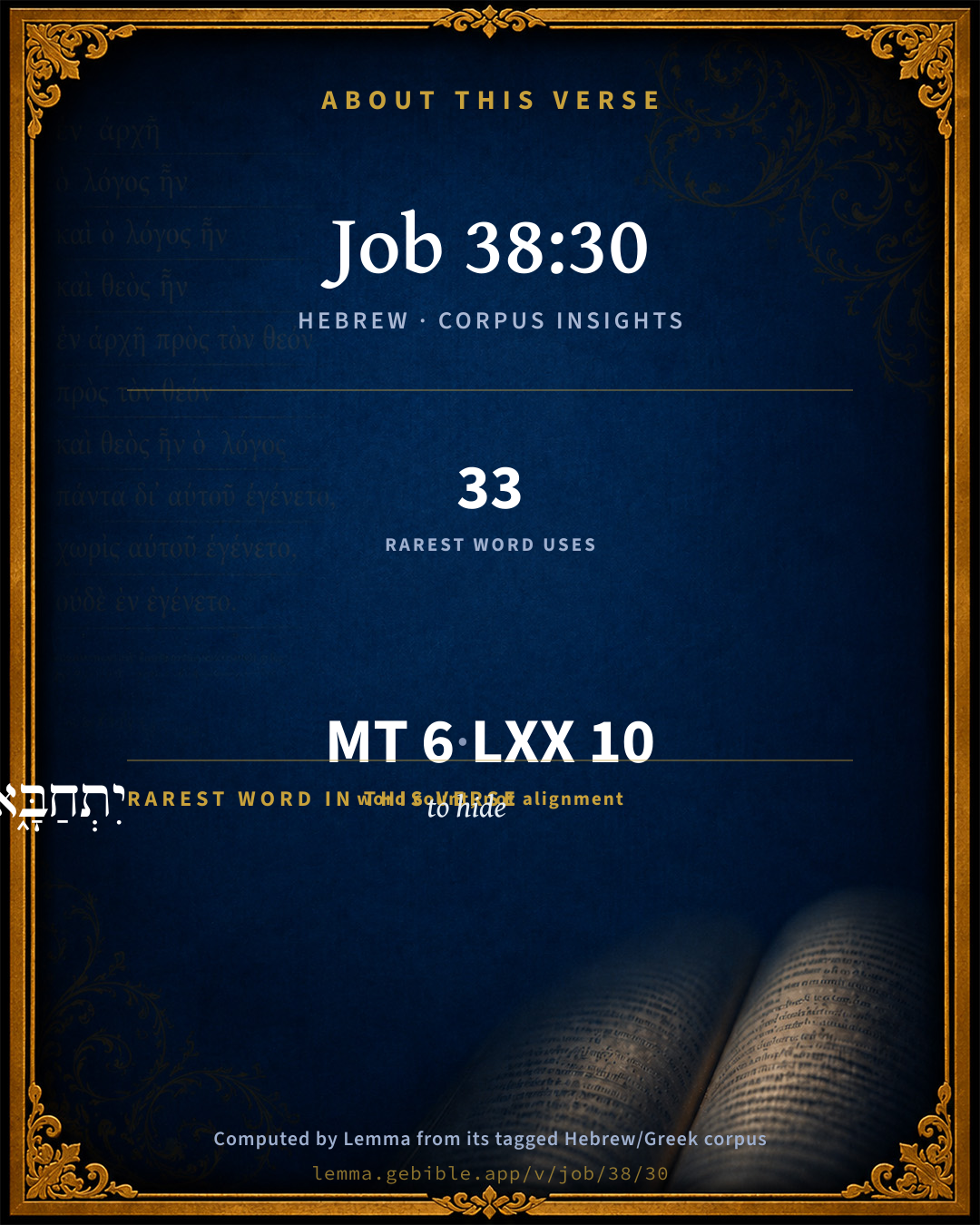
יִתְחַבָּ֑אוּ to hide H2244 occurs in 33 verses of the Hebrew Bible. Also found in:

Grammatical profile

  • 2 verbs
  • 4 nouns

Verb forms

  • יִתְחַבָּ֑אוּ Hithpael · Imperfect
  • יִתְלַכָּֽדוּ Hithpael · Imperfect

Hebrew & Septuagint length

In English translation the verse runs 14 words from the Hebrew and 13 from the Septuagint (LXX English) — closely comparable.

A rough comparison of the two English renderings, which tokenize alike — not a word-level alignment.

Word counts can differ between the Hebrew and the Greek without any difference in meaning — e.g. the Hebrew direct-object marker אֵת has no separate Greek word, and Greek often adds the article ὁ.

In the original languages it is 6 Hebrew tokens and 10 Greek tokens — but the two are counted differently (Hebrew bundles its prefixes and suffixes into one token; the Greek is in lemma form), so that isn’t a like-for-like length.

Cross-references

1

Topical passages linked to Job 38:30 in the Treasury of Scripture Knowledge — connected by theme and wording, ordered by reader-vote popularity; previews shown in the World English Bible.

  • Job 37:10 By the breath of God, ice is given, And the breadth of the waters is frozen.

Cross-references courtesy of OpenBible.info (CC BY 4.0).

Hebrew and Greek witnesses Masoretic Hebrew ↔ Greek Septuagint

The same verse in the two great witnesses to the Old Testament, shown verse-for-verse.

These are two independent witnesses, not word-aligned to each other, and the Septuagint is shown in lemma (dictionary) form.

Hebrew Job 38:30 Masoretic · Westminster Leningrad Codex

כָּ֭אֶבֶן מַ֣יִם יִתְחַבָּ֑אוּ וּפְנֵ֥י תְ֝ה֗וֹם יִתְלַכָּֽדוּ

The waters become hard like stone, When the surface of the deep is frozen.

World English Bible · Public Domain

Greek LXX Job 38:30 Septuagint · lemma form

ὅς καταβαίνω ὥσπερ ὕδωρ ῥέω πρόσωπον δέ ἄβυσσος τίς πήγνυμι

which descends like flowing water? who has terrified the face of the ungodly?

LXX2012 (modern English Septuagint) · Public Domain

Hebrew: Westminster Leningrad Codex (CC BY 4.0). Greek: Septuagint (public domain); English from LXX2012 (modern English Septuagint) (Public Domain). How the Septuagint differs from the Hebrew →

Commentary

Notes on Job 38:30 from classic Christian and Jewish commentators (each source and its license shown beneath its notes). The classic Christian expositions comment on the surrounding passage and are grouped to its opening verse, so a note may address several verses; the Jewish commentaries on the Tanakh (Rashi and others) are per-verse, so they appear only where the commentator wrote on this verse.

Lemma curates 59 commentaries, every one of them public domain or Creative Commons licensed, each selected and text-cleaned for this edition rather than reprinted as found. About our sources →

Trapp's Complete Commentary

John Trapp

Job 38:30 The waters are hid as [with] a stone, and the face of the deep is frozen.

Ver. 30. The waters are hid as with a stone] This is a further description of ice, which is hard as a stone and clear as crystal; so great is the force of frost; how much more, then, of God to do whatsoever he pleaseth.

And the face of the deep is frozen] Some deep rivers are ice to the bottom, so that loaden carts are driven over, fires made upon them, meat dressed, &c., as was here upon the Thames in the great frost, some forty-five years since, Quae aquae magno et diuturno frigore congelescunt, velut per 10 vel 20 annos continuos appellantur crystallus, velut in Alpibus. Yea, some seas are frozen over (Juvenal speaks of the icy ocean, et glacialem Oceanum) in the northern part of the world, the ice thereof, when once thawed, floateth in the waters like huge mountains, as in Greenland.

John Trapp, A Commentary or Exposition upon All the Books of the Old and New Testament (1647–1656) — public domain. Text from a community e-Sword module.

Geneva Bible (1599)

Geneva Bible translators

The ice covereth it, as though it were paved with stone.

Geneva Bible (1599) marginal notes — public domain. Text via Bolls.life.

Jamieson, Fausset & Brown

Robert Jamieson, A. R. Fausset & David Brown

The unfrozen waters are hid under the frozen, as with a covering of stone.

frozen--literally, "is taken"; the particles take hold of one another so as to cohere.

Jamieson, Fausset & Brown — Commentary Critical and Explanatory on the Whole Bible (1871) — public domain (CC PDM 1.0). Text via the HelloAO Bible API.

Adam Clarke's Commentary

Verse 30. The waters are hid as with a stone] Here is a reference to freezing in the winter, as we may learn from some of the constellations mentioned below, which arise above our horizon, in the winter months.

The word יתחבאו yithchabbau is understood by the versions in general as implying hardening or congelation; and we know in some intense frosts the ice becomes as hard as a stone; and even the face of the deep-the very seas themselves, not only in the polar circles, but even in northern countries, Norway, Sweden, Denmark, Holland, and parts of Germany, are really frozen, and locked up from all the purposes of navigation for several months in winter.

Adam Clarke's Commentary on the Bible (1810–1826) — public domain. Text from a community e-Sword/MySword module.

Ellicott's Commentary for English Readers

(30) The waters are hid.—Or, The waters hide themselves and become like stone. Water loses its familiar quality, and is turned into stone.

A Bible Commentary for English Readers, edited by Charles John Ellicott (1878–1897) — public domain. Text from a community e-Sword module.

The Cambridge Bible for Schools and Colleges

gen. ed. J. J. S. Perowne

30. as with a stone] lit. the waters hide themselves like a stone, that is, becoming like stone.

is frozen] lit. cleaveth together. The phenomenon of ice, rare in the East, naturally appeared wonderful.

The Cambridge Bible for Schools and Colleges (gen. ed. J. J. S. Perowne; Cambridge University Press, 1878–1918) — public domain. Text from a community e-Sword module.

John Gill's Exposition

Canst thou bring forth Mazzaroth in his season?.... Which are thought to be the same with "the chambers of the south", Job 9:9; the southern pole (m) with its stars, signified by chambers, because hidden from our sight in this part of the globe; and here by Mazzaroth, from, "nazar", to separate, because separated and at a distance from us; some think (n) the twelve signs of the Zodiac are meant, each of which are brought forth in their season, not by men, but by the Lord; see Isa 40:26;

or canst thou guide Arcturus with his sons? a constellation of many stars called its sons, of which see Job 9:9. Schmidt conjectures that Jupiter and his satellites are meant; but rather what we call the greater and lesser Bear, in the tail of which is the north pole star, the guide of mariners, said (o) to be found out by Thales, by which the Phoenicians sailed, but is not to be guided by men; this, constellation is fancied to be in the form of a wain or wagon, and is called Charles's wain; could this be admitted, there might be thought to be an allusion to it (p), and the sense be, canst thou guide and lead this constellation, as a wagon or team of horses can be guided and led? stars have their courses, Jdg 5:20; but are not steered, guided, and directed by men, but by the Lord himself.

(m) David de Pomis, Lexic. fol. 77. 3. (n) Vatablus, Codurcus, Schultens; so Suidas in voce (o) Callimachus apud Laert. Vit. Thalet. p. 16. (p) Vid. Hinckelman. Praefat. ad Alkoran. p. 29, 30.

John Gill's Exposition of the Whole Bible (1746–1763) — public domain (CC PDM 1.0). Text via the HelloAO Bible API.

Albert Barnes' Notes on the Bible

The waters are hid as with a stone - The solid ice is laid as a stone upon them, wholly concealing them from view.

And the face of the deep is frozen - Margin, “taken.” The idea is, they seem to take hold of one another (יתלכדוּ yitlâkadû); they hold together, or cohere. The formation of ice is thus appealed to as a proof of the wisdom of God, and as a thing which Job could not explain. No man could produce this effect; nor could Job explain how it was done.

Albert Barnes' Notes on the Bible (1834–1885) — public domain. Text from a community e-Sword/MySword module.

Matthew Poole's English Annotations

As with a stone, i.e. with ice as hard as a stone.

The face of the deep, i.e. the great sea, which is oft called the deep, as Gen 7:11; Psa 107:24; Isa 51:10; 63:13; 2Co 11:25, which in some parts is frozen, which is a wonderful work of God.

Matthew Poole's English Annotations on the Holy Bible (1683–1685) — public domain. Text from a community e-Sword/MySword module.

Whedon's Commentary on the Bible

Daniel D. Whedon

30. The waters are hid as with a stone — The waters harden like stone. Thus Furst, etc. The root idea of חבא is that of “hiding,” “concealing:” here used in the Hithpael it signifies “they hide themselves.” in other words, “congeal;” to which Umbreit gives the idea of “hiding under a stone.” The comparison to a stone is introduced rather to show the result of freezing, which is a hardness like that of stone, כאבן. The son of Sirach speaks of the cold north wind clothing the water as with a breastplate. Sir_43:20.

Is frozen — Cleaves together. See note on Job_37:10. The same word, יתלכדו, is used in Job_41:17 of the joining together of the scales of the leviathan. The face of the deep closes in together after the manner of the human face, (thus Hitzig,) whose lineaments constitute the countenance. Tyndall, in his treatise on “The Structure and Properties of Ice,” describes the transmission, in various directions, of sunbeams, condensed by a lens, through slabs of ice. “The path of every beam was observed to be instantly studded with lustrous spots, which increased in magnitude and number as the action continued. On examining the spots more closely they were found to be flattened spheroids, and around each of them the ice was so liquified as to form a beautiful flower-shaped figure possessing six petals. From this number there was no deviation. At first the edges of the liquid leaves were unindented; but a continuance of the action usually caused the edges to become serrated like those of ferns.” In his work on “Forms of Water,” (pp. 35-38.) the same author says, “In all cases the flowers are formed parallel to the surface of freezing. They are formed when the sun shines upon the ice of every lake; sometimes in myriads, and so small as to require a magnifying glass to see them.… Here we have a reversal of the process of crystallization… In this exquisite way every bit of the ice over which our skaters glide in winter is put together.”

Daniel D. Whedon (gen. ed.), Commentary on the Old and New Testaments (1874–1909) — public domain. Text from a community e-Sword module.

The Pulpit Commentary

The waters are hid as with a stone; rather, the waters are hardened" like unto stone. When the frost comes, the waters are congealed and rendered as hard as stone. (So Dillmann and Canon Cook.) And the face of the deep is frozen. By "the deep" ( is certainly not meant here either the open ocean, which, in the latitudes known to the dwellers in South Western Asia, never freezes, or the Mediterranean. Some of the lakes which abound in the regions inhabited by Job and his friends are probably meant. These may occasionally have been thinly coated with ice in the times when the Book of Job was written. (see the comment on Job_6:16)

The Pulpit Commentary (1880–1919), ed. H.D.M. Spence-Jones & Joseph S. Exell — public domain. Text from a community e-Sword module.

Rashi

Rabbi Shlomo Yitzchaki (Rashi)

Like a stone...hides because of the ice that congeals in drops upon their faces.

and the face of the deep is caught and held together by it.

Rashi on the Tanakh — English translations: “The Judaica Press complete Tanach with Rashi, translated by A. J. Rosenberg” (CC BY 4.0); “Pentateuch with Rashi's commentary by M. Rosenbaum and A.M. Silbermann, 1929-1934” (public domain); “The Metsudah Tanach series, Lakewood, N.J” (CC BY 4.0); and “The Book of Joshua, Metsudah Publications, 1997” (CC BY 4.0). Text via Sefaria.

Lesson kit

Teaching starters — assembled from the data on this page, not authored interpretation. Every prompt links to the verse data it draws on. Edit before teaching.

Job, in the Wisdom, opens this verse with 6 words (6 distinct Hebrew lemmas). Its most distinctive word is châbâʼ (“to hide”). A historical commentator’s framing appears above. Read the whole chapter for the surrounding context.

Discussion questions

  1. How does “to hide” (châbâʼ) shape what this verse is saying?
  2. How does Genesis 3:8, which shares the word «to hide», read alongside this verse?
  3. These translations render this verse differently; the difference is in the English rendering, not the original. What questions does that raise?
  4. «יִתְחַבָּ֑אוּ» is a Hithpael Imperfect verb. How does that grammatical form shape the action described?
  5. Compare how Trapp's Complete Commentary and Geneva Bible (1599) read this verse. Where do they agree or differ?

Things to notice

Reading settings

Reading text

Shown beneath each verse's original-language words.

Old Testament
Old Testament edition

Read the OT as the Masoretic Hebrew (MT) or the Greek Septuagint (LXX).

English shown for the Greek Septuagint (in the Hebrew ↔ Greek comparison).

Comparing translations? Open the Compare panel on any verse page to stack up to four side by side.