Jeremiah 50:24

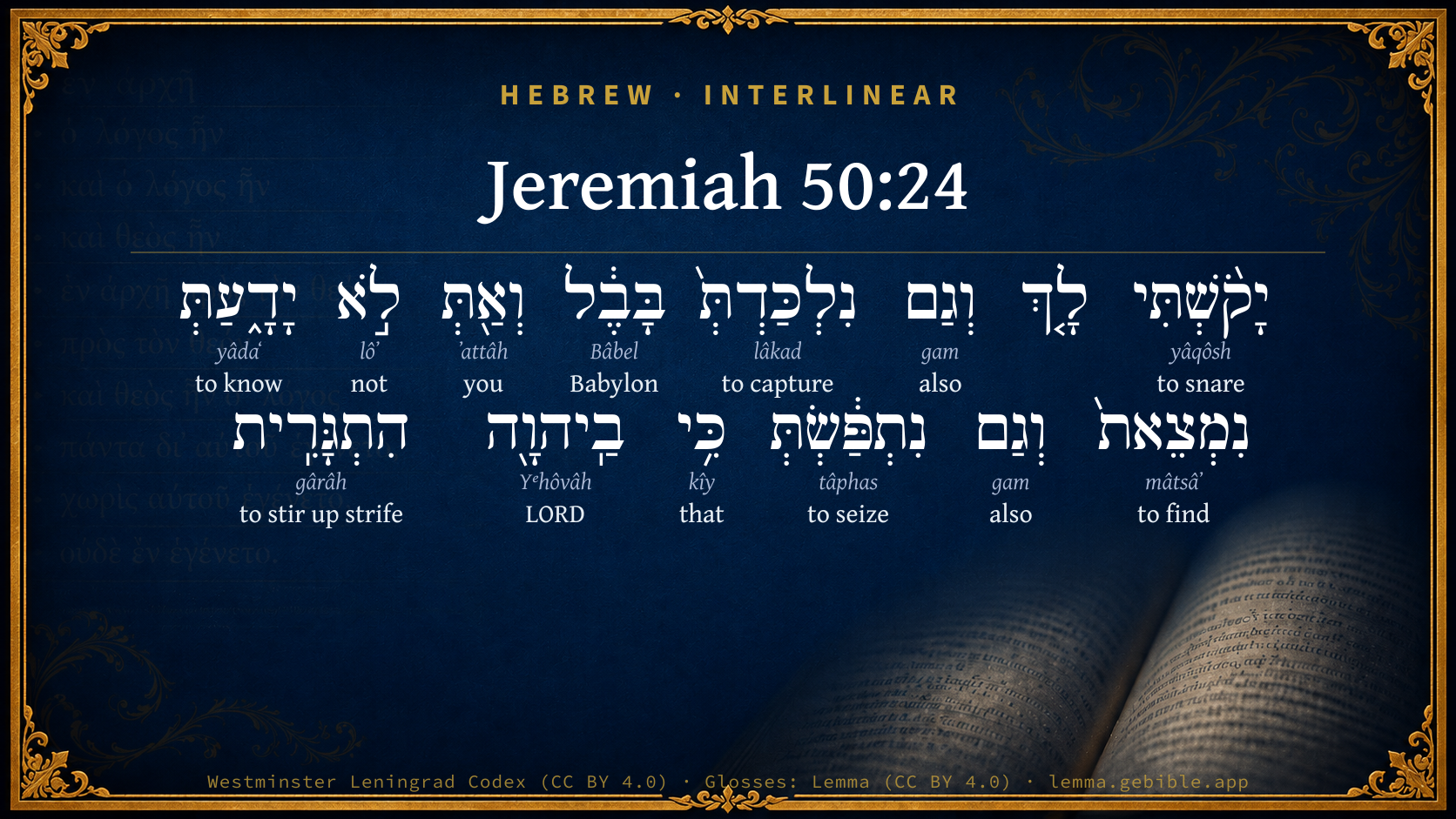
Hebrew (Westminster Leningrad Codex) Jeremiah 50:24 appears in the Hebrew Old Testament. The text above is from the Westminster Leningrad Codex. Each word links to its Strong’s number, a concise gloss, and parsing drawn from the Open Scriptures Hebrew Bible morphology. Click any word for its full Brown-Driver-Briggs (BDB) entry.
Download image
Cite this verse

Jeremiah 50:24 (World English Bible). Public Domain. Lemma interlinear Bible study tool, https://lemma.gebible.app/v/jeremiah/50/24.

Show BibTeX & RIS
BibTeX
RIS
English Translation
I have laid a snare for you, and you are also taken, Babylon, and you weren't aware: you are found, and also caught, because you have striven against Yahweh.
World English Bible · Public Domain
Download a study sheet

One document with this verse’s original text, its word-by-word gloss line, the meaning frame, cross-references with their text, attributed commentary, and full source and license credits — printable, and it pastes into notes with its structure intact.

This verse Autodidact and up

Study sheet (.html) Plain text (.txt)

A passage Seminary Student

Up to 50 verses in one chapter. A passage sheet keeps up to 6 commentary sources and 12 cross-references per verse, in the order this page ranks them, and says so on the sheet whenever that leaves anything out. Ask for a single verse and you get the Autodidact verse sheet above.

Everything on this page stays free to read, with no account — the sheet is a download of what is already on screen, not access to it.

Want to remove ads? Support Godless Engineer
Compare translations 3

The same verse in 3 English versions, stacked beneath the original-language interlinear above. Click any original word for its lexicon entry.

Each is an independent rendering of the whole verse — the interlinear is not word-aligned to these translations.

Highlighted words mark where these versions differ — a whole-verse word diff, not a word-by-word alignment.

  • World English Bible Public Domain
    I have laid a snare for you, and you are also taken, Babylon, and you weren't aware: you are found, and also caught, because you have striven against Yahweh.
  • King James Version Public Domain
    I have laid a snare for thee, and thou art also taken, O Babylon, and thou wast not aware: thou art found, and also caught, because thou hast striven against the LORD.
  • unfoldingWord Literal Text CC BY-SA 4.0
    I have set a trap for you and you were taken, Babylon, and you did not know it! You were found and captured, because you opposed Yahweh.

unfoldingWord Literal Text — © unfoldingWord, licensed CC BY-SA 4.0. Word-aligned USFM3 via Door43 (git.door43.org/unfoldingWord/en_ult).

Versions to compare (up to 4)

3 of 4 selected

Show all 18 translations

Every available English version of this verse, each an independent rendering of the whole verse.

  • World English Bible Public Domain
    I have laid a snare for you, and you are also taken, Babylon, and you weren't aware: you are found, and also caught, because you have striven against Yahweh.
  • Berean Standard Bible Public Domain
    I laid a snare for you, O Babylon, and you were caught before you knew it. You were found and captured because you challenged the LORD.
  • Majority Standard Bible Public Domain
    I laid a snare for you, O Babylon, and you were caught before you knew it. You were found and captured because you challenged the LORD.
  • King James Version Public Domain
    I have laid a snare for thee, and thou art also taken, O Babylon, and thou wast not aware: thou art found, and also caught, because thou hast striven against the LORD.
  • American Standard Version (1901) Public Domain
    I have laid a snare for thee, and thou art also taken, O Babylon, and thou wast not aware: thou art found, and also caught, because thou hast striven against Jehovah.
  • Revised Version (1885) Public Domain
    I have laid a snare for thee, and thou art also taken, O Babylon, and thou wast not aware: thou art found, and also caught, because thou hast striven against the LORD.
  • Geneva Bible (1599) Public Domain
    I haue snared thee, and thou art taken, O Babel, and thou wast not aware: thou art found, and also caught, because thou hast striuen against the Lord.
  • Douay-Rheims (1899) Public Domain
    I have caused thee to fall into a snare, and thou art taken, O Babylon, and thou wast not aware of it: thou art found and caught, because thou hast provoked the Lord.
  • Young's Literal Translation Public Domain
    I have laid a snare for thee, And also -- thou art captured, O Babylon, And thou -- thou hast known, Thou hast been found, and also art caught, For against Jehovah thou hast stirred thyself up.
  • Literal Standard Version CC BY-SA 4.0
    I have laid a snare for you, || And you are also captured, O Babylon, || And you have known, || You have been found, and are also caught, || For you have stirred yourself up against YHWH.
  • Unlocked Literal Bible CC BY-SA 4.0
    I have set a trap for you and you were taken, Babylon, and you did not know it! You were found and captured, because you opposed Yahweh.
  • unfoldingWord Literal Text CC BY-SA 4.0
    I have set a trap for you and you were taken, Babylon, and you did not know it! You were found and captured, because you opposed Yahweh.
  • Darby Bible Public Domain
    I have laid a snare for thee, and thou, Babylon, art also taken, and thou wast not aware; thou art found, and also caught, for thou hast contended with Jehovah.
  • World Messianic Bible Public Domain
    I have laid a snare for you, and you are also taken, Babylon, and you weren’t aware. You are found, and also caught, because you have fought against the LORD.
  • Webster's Bible Public Domain
    I have laid a snare for thee, and thou art also taken, O Babylon, and thou wast not aware: thou art found, and also caught, because thou hast striven against the LORD.
  • Free Bible Version CC BY-SA 4.0
    Babylon, I set a trap for you, and you were caught before you realized it. You were hunted down and captured because you fought against the Lord.
  • Bible in Basic English Public Domain
    I have put a net for you, and you have been taken, O Babylon, without your knowledge: you have been uncovered and taken because you were fighting against the Lord.
  • JPS Tanakh (1917) Public Domain
    I have laid a snare for thee, and thou art also taken, O Babylon, and thou wast not aware; thou art found, and also caught, because thou hast striven against the LORD.

Literal Standard Version (2020), Covenant Press — licensed CC BY-SA 4.0. Text via the HelloAO Bible API (eBible.org). Unlocked Literal Bible (unfoldingWord) — licensed CC BY-SA 4.0. Text via the HelloAO Bible API (eBible.org). unfoldingWord Literal Text — © unfoldingWord, licensed CC BY-SA 4.0. Word-aligned USFM3 via Door43 (git.door43.org/unfoldingWord/en_ult). Free Bible Version, Dr. Jonathan Gallagher — licensed CC BY-SA 4.0. Text via the HelloAO Bible API (eBible.org).

Word by word

More ways to search: Search by grammar → Find every occurrence → Compare this word →

Practice this passage: Drill this verse → Learn its vocabulary →

יָקֹ֨שְׁתִּי
yâqôsh
H3369
“to snare”
Verb, Qal, Perfect, 1st Person, Common, Singular
Part of Speech
Verb
Stem
Qal
Form
Perfect
Person
1st Person
Gender
Common
Number
Singular
Full BDB Definition

Origin: a primitive root

TWOT: 906

to lure, entice, snare, lay a snare or lure, set a trap - (Qal) - to lay snares (figuratively of devices of wicked) - fowlers (participle) - (Niphal) to be ensnared, be caught by a bait - (Pual) to be entrapped
  1. וְגַם gam H1571 “and · also” Conjunction + Particle, Accusative
  2. נִלְכַּדְתְּ֙ lâkad H3920 “to capture” Verb, Niphal, Perfect, 2nd Person, Feminine, Singular
  3. בָּבֶ֔ל Bâbel H894 “Babylon” Noun, Proper
  4. וְאַ֖תְּ ʼattâh H859 “and · you” Conjunction + Pronoun, Personal, 2nd Person, Feminine, Singular
  5. לֹ֣א lôʼ H3808 “not” Particle, Negative
  6. יָדָ֑עַתְּ yâdaʻ H3045 “to know” Verb, Qal, Perfect, 2nd Person, Feminine, Singular
  7. נִמְצֵאת֙ mâtsâʼ H4672 “to find” Verb, Niphal, Perfect, 2nd Person, Feminine, Singular
  8. וְגַם gam H1571 “and · also” Conjunction + Particle, Accusative
  9. נִתְפַּ֔שְׂתְּ tâphas H8610 “to seize” Verb, Niphal, Perfect, 2nd Person, Feminine, Singular
  10. כִּ֥י kîy H3588 “that” Conjunction
  11. בַֽיהוָ֖ה Yᵉhôvâh H3068 “in/at · LORD” Preposition + Noun, Proper
  12. הִתְגָּרִֽית gârâh H1624 “to stir up strife” Verb, Hithpael, Perfect, 2nd Person, Feminine, Singular

About this verse

These counts appear in no published source. They are computed here, from the morphology-tagged text and Lemma’s own curated glosses. What Lemma adds →

14
words
12
distinct lemmas
Prophets
section

Notable vocabulary

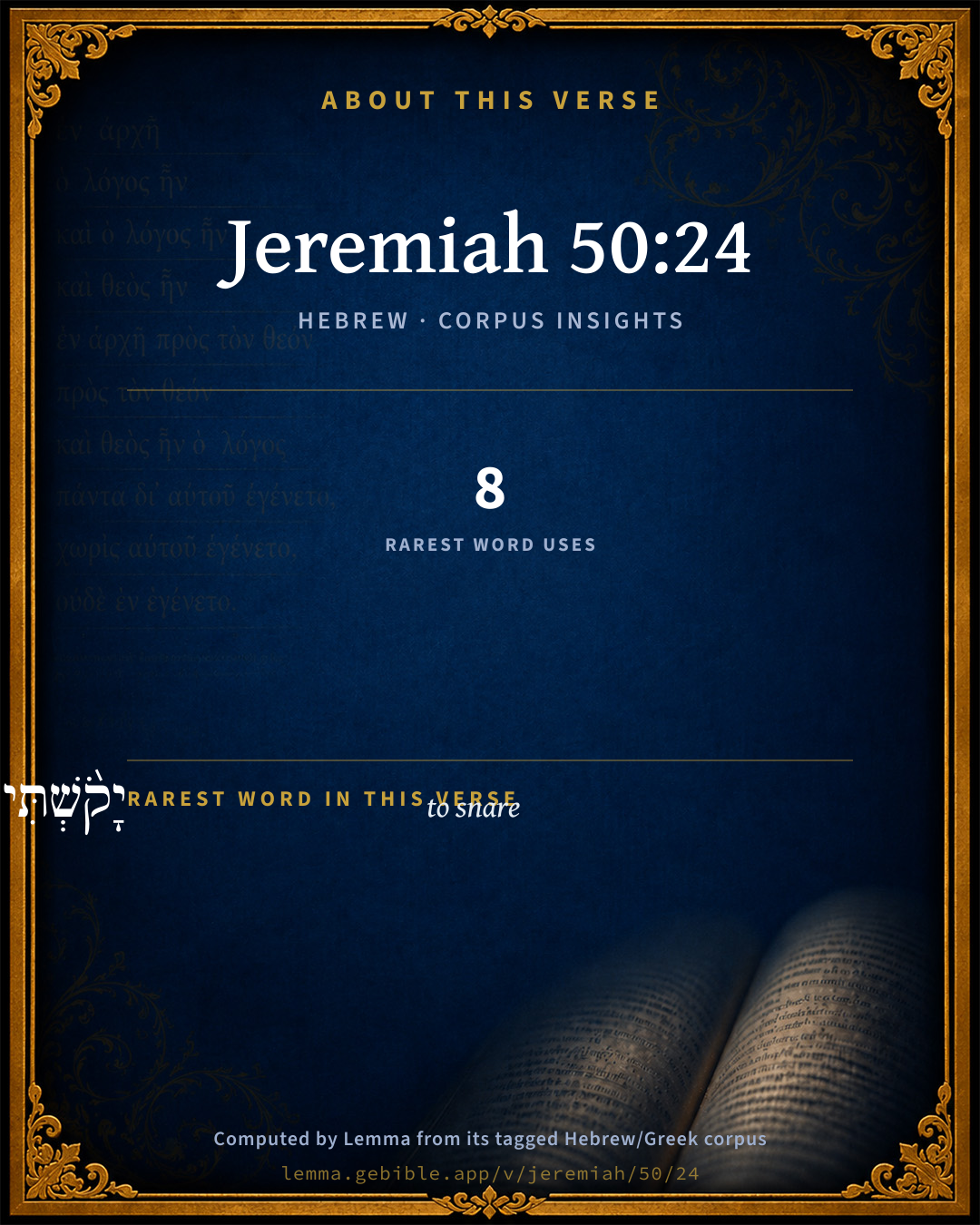
The rarest word here is יָקֹ֨שְׁתִּי to snare H3369 — appearing just 8 times in the whole Hebrew Bible.

Shared distinctive vocabulary

יָקֹ֨שְׁתִּי to snare H3369 occurs in 8 verses of the Hebrew Bible. Also found in:

Grammatical profile

  • 6 verbs
  • 2 nouns
  • 1 pronoun
  • 1 preposition
  • 1 conjunction
  • 3 particles

Verb forms

  • יָקֹ֨שְׁתִּי Qal · Perfect
  • נִלְכַּדְתְּ֙ Niphal · Perfect
  • יָדָ֑עַתְּ Qal · Perfect
  • נִמְצֵאת֙ Niphal · Perfect
  • נִתְפַּ֔שְׂתְּ Niphal · Perfect
  • הִתְגָּרִֽית Hithpael · Perfect

Repetition

A word recurs within this verse — often emphatic in Hebrew:

  • וְגַם also H1571 ×2

Cross-references

14

Topical passages linked to Jeremiah 50:24 in the Treasury of Scripture Knowledge — connected by theme and wording, ordered by reader-vote popularity; previews shown in the World English Bible.

  • Job 9:4 God who is wise in heart, and mighty in strength: Who has hardened himself against him, and prospered?
  • Daniel 5:30–31 In that night Belshazzar the Chaldean King was slain.
  • Job 40:2 "Shall he who argues contend with the Almighty? He who argues with God, let him answer it."
  • Job 40:9 Or have you an arm like God? Can you thunder with a voice like him?
  • Exodus 10:3 Moses and Aaron went in to Pharaoh, and said to him, "This is what Yahweh, the God of the Hebrews, says: 'How long will you refuse to humble yourself before me? Let my people go, that they may serve me.
  • Ecclesiastes 9:12 For man also doesn't know his time. As the fish that are taken in an evil net, and as the birds that are caught in the snare, even so are the sons of men snared in an evil time, when it falls suddenly on them.
  • Isaiah 13:11 I will punish the world for [their] evil, and the wicked for their iniquity: and I will cause the arrogance of the proud to cease, and will lay low the haughtiness of the terrible.
  • Isaiah 21:3–5 Therefore are my loins filled with anguish; pangs have taken hold on me, as the pangs of a woman in travail: I am pained so that I can't hear; I am dismayed so that I can't see.
  • Isaiah 45:9 Woe to him who strives with his Maker--a potsherd among the potsherds of the earth! Shall the clay ask him who fashions it, "What are you making?" or your work, "He has no hands?"
  • Jeremiah 51:8 Babylon is suddenly fallen and destroyed: wail for her; take balm for her pain, if so be she may be healed.
  • Jeremiah 51:31–39 One post shall run to meet another, and one messenger to met another, to show the king of Babylon that his city is taken on every quarter:
  • Jeremiah 51:57 I will make drunk her princes and her wise men, her governors and her deputies, and her mighty men; and they shall sleep a perpetual sleep, and not wake up, says the King, whose name is Yahweh of Hosts.
  • 2 Thessalonians 2:4 he who opposes and exalts himself against all that is called God or that is worshiped; so that he sits as God in the temple of God, setting himself up as God.
  • Revelation 18:7–8 However much she glorified herself, and grew wanton, so much give her of torment and mourning. For she says in her heart, 'I sit a queen, and am no widow, and will in no way see mourning.'

Cross-references courtesy of OpenBible.info (CC BY 4.0).

Hebrew and Greek witnesses Masoretic Hebrew ↔ Greek Septuagint

The same verse in the two great witnesses to the Old Testament, shown verse-for-verse.

These are two independent witnesses, not word-aligned to each other, and the Septuagint is shown in lemma (dictionary) form.

Hebrew Jeremiah 50:24 Masoretic · Westminster Leningrad Codex

יָקֹ֨שְׁתִּי לָ֤ךְ וְגַם נִלְכַּדְתְּ֙ בָּבֶ֔ל וְאַ֖תְּ לֹ֣א יָדָ֑עַתְּ נִמְצֵאת֙ וְגַם נִתְפַּ֔שְׂתְּ כִּ֥י בַֽיהוָ֖ה הִתְגָּרִֽית

I have laid a snare for you, and you are also taken, Babylon, and you weren't aware: you are found, and also caught, because you have striven against Yahweh.

World English Bible · Public Domain

Greek LXX Structure differs

In the Septuagint, Jeremiah is about an eighth shorter than the Hebrew and arranges its material differently — the Oracles Against the Nations (Hebrew chapters 46–51) appear in the middle of the Greek book, after 25:13. Because the chapter and verse boundaries do not line up, a verse-for-verse comparison with the Hebrew is not shown.

A verse-for-verse comparison isn’t shown here because the chapters and verses don’t line up. Switch to the LXX edition with the MT / LXX toggle above to read the Greek directly.

Hebrew: Westminster Leningrad Codex (CC BY 4.0). Greek: Septuagint (public domain); English from a public-domain English Septuagint. How the Septuagint differs from the Hebrew →

Targum (Aramaic paraphrase)

1

The Targum is the ancient Jewish Aramaic paraphrase of the Hebrew Scriptures — an interpretive translation, not the Hebrew text itself. Onkelos (literal) and Pseudo-Jonathan (expansive) render the Torah, and Jonathan the Prophets. Coverage is partial: where no permissively-licensed English translation exists for a verse, only the Aramaic is shown. This is verse-level text, not a word-by-word alignment to the Hebrew.

  1. Targum Jonathan Prophets (Joshua–Malachi)
    אִיתְצֵידִית לִיךְ וְאַף אִתְאֲחַדְתְּ בָּבֶל וְאַתְּ לָא יְדָעַתְּ אִתְבְּעִיאוּ חוֹבָךְ אִשְׁתַּכָּחוּ וְאַף אִתְאֲחַדְתְּ אֲרֵי בְּעַמָא יְיָ אִתְגְרֵית:

    (no public-domain English translation for this verse)

    Targum Jonathan — Aramaic: “Mikraot Gedolot” (public domain). English: “Sefaria Community Translation” (CC0 1.0 (public-domain dedication)); “London "Chaldee Paraphrase," 1871” (public domain). Text via Sefaria.

Commentary

Notes on Jeremiah 50:24 from classic Christian and Jewish commentators (each source and its license shown beneath its notes). The classic Christian expositions comment on the surrounding passage and are grouped to its opening verse, so a note may address several verses; the Jewish commentaries on the Tanakh (Rashi and others) are per-verse, so they appear only where the commentator wrote on this verse.

Lemma curates 59 commentaries, every one of them public domain or Creative Commons licensed, each selected and text-cleaned for this edition rather than reprinted as found. About our sources →

Trapp's Complete Commentary

John Trapp

Jer 50:24 I have laid a snare for thee, and thou art also taken, O Babylon, and thou wast not aware: thou art found, and also caught, because thou hast striven against the LORD.

Ver. 24. I have laid a snare for thee.] Thou wild bull. {Jer 50:27} Babylon was unexpectedly taken by a stratagem, while they were in the midst of their revels.

And thou wast not aware.] The palace was suddenly seized upon; but some parts of the city knew not that the enemy was entered till three days after; for it was the greatest city that ever the sun beheld, saith Pausanias, {a} and the most suddenly surprised.

Because thou hast striven against the Lord.] Heb., Hast mingled thyself with the Lord, in certamen scilicet, to wrestle a fall with him, and to try masteries.

{a} Aristot., Polit., Paus., Arcad.

John Trapp, A Commentary or Exposition upon All the Books of the Old and New Testament (1647–1656) — public domain. Text from a community e-Sword module.

Lange's Commentary on the Holy Scriptures

7. BABYLON SURPRISED AND DESTROYED, ISRAEL LIBERATED

Jer_50:24-28

24          I have placed23 a net for thee and thou art also taken,

O Babylon, and thou knowest it not.

Thou art found and also caught,

For against Jehovah hast thou striven.24

25     Jehovah hath opened his arsenal,

And brought forth the weapons of his wrath;

For the Lord Jehovah Zebaoth hath a work in the land of the Chaldeans.

26     Come hither even the last, open her storehouses,25

Cast it up as heaps of rubbish and burn it,26

Let there be nothing left of it.

27     Slay all her bullocks,

Down with them to the slaughter-house!

Woe unto them, for their day is come,

The time of their visitation.

28     Hark! the fleeing and escaped from the land of Babylon,

To proclaim in Zion the vengeance of Jehovah, our God,

The vengeance of his sanctuary.

EXEGETICAL AND CRITICAL

In this picture the element of secrecy and surprise as excluding all resistance, which will prevail at the capture of Babylon, is made prominent (ver, 24). This mode of capture is rendered possible by the Lord’s having opened His armory and brought into use all the means of attack which it affords. He has done this because He would manage the business with Babylon as a matter of the highest importance (Jer_50:25). As now, however, the Lord has emptied His arsenal against Babylon, so also shall all store-houses in Babylon be emptied and all living and dead treasures contained therein be destroyed (Jer_50:26-27). The escaped of Zion, however, shall bring home the joyful tidings of Jehovah’s vengeance (Jer_50:28). We see that these verses also furnish a complete picture progressing from the beginning to the close with special prominence of single specific elements.

Jer_50:24. I have placed … striven. In this placing of a net or snare lies the element of commencement on account of which we regard this verse as the commencement of a new picture. This must be so the rather as Jer_50:23 evidently contains a conclusion. The prophet in spirit sees Babylon unexpectedly caught in a net or snare. How literally this would be fulfilled Jeremiah himself might have no idea (comp. 1Pe_1:11). Twice was Babylon taken by stratagem, and both times so that the city was in the power of its enemies, before it was aware. Herodotus says (I. 191), with reference to the capture by Cyrus, that if the Babylonians had known or observed his plan (the diversion of the Euphrates) they could have inflicted great injury on the Persians. But these came upon them quite unexpectedly (ἐξ ἀπροσδοκήτον σφιπαρώστησαν οἱ ΙΙέρσαι), the outer parts of the city being already taken before those who dwelt in the central parts had observed what was going on (τοὺς τὸ μέσον οἰκεοντος οὐ μανθάνειν ἑαλωκότας). With reference to the capture by Darius Hystaspis, however, he says (III. 158) that a part of the Babylonians, who saw the entrance of the Persians through the gate opened by Zopyrus, fled, the rest remaining every one in his place till they also perceived that they were betrayed (ἐς ο͂ δὴ καὶ οὐτσι ἔμαθον προδεομένοι).

Jer_50:25-28. Jehovah … sanctuary. The capture of a city like Babylon by an overwhelming surprise is not possible without great means. Such are now provided by Jehovah, for He opens His arsenal (comp. Jer_10:13; Jer_51:16) to take from it all necessary implements of war (comp. Isa_13:5). This He does because He has a מְלאכה, a business in the land of the Chaldeans. A business or work of Jehovah is always a great and important matter, and is therefore not to be performed negligently (Jer_48:10). To the execution of this work He now summons His servants and instruments (Jer_50:26), who are to come מִקֵּץ. If we refer this to the city (attacked from the end, not from the middle) the meaning is feeble and unsuitable, for a city can only be attacked from without and thus from the ends of it. If it be rendered “from all ends” (round about, Jer_50:15; Jer_50:29) we miss the word for “all.” Hence it is best to take it with Ewald and Graf=ad unum omnes. If the outermost come, all come. Come. Gen_19:4; Gen_47:2; Isa_56:11; Eze_33:2. To the opening of the arsenal of Jehovah is to correspond the violent breaking open and emptying of the storehouses of Babylon.—Slay all, etc. The bullocks are the representatives and chief personages of the human population. Comp. Isa_34:6-7; Jer_48:15; Jer_51:40.—The time, etc. Comp. Jer_46:21.—Fleeing. Comp. Jer_50:4; Jer_50:8.—Vengeance. Comp. Jer_50:15; Jer_51:11.

DOCTRINAL AND ETHICAL

1. “Daniel’s Babylonian empire resumes, as it were, the thread which was broken off with the tower-erection and kingdom of Nimrod. In the Babylonian tower-building the whole of the then existing humanity was united against God; with the Babylonian kingdom began the period of the universal monarchies, which again aspired after an atheistical union of entire humanity. Babylon has since and even to the Revelation (Jeremiah 18) remained the standing type of this world.” Auberlen, Der proph. Daniel, S. 230.

2. For what reason does Babylon appear as a type of the world? Why not Nineveh, or Persepolis, or Tyre, or Memphis, or Rome? Certainly not because Babylon was greater, more glorious, more powerful or prouder and more ungodly than those cities and kingdoms. Nineveh especially was still greater than Babylon (comp. Duncker, Gesch. d. Alterth. I. S. 474, 5), and Assyria was not less hostile to the theocracy, having carried away into captivity the northern and larger half of the people of Israel. Babylon is qualified for this representation in two ways: 1. because it is the home of worldly princedom and titanic arrogance (Gen_10:8; Gen_11:1-4); 2. because Babylon destroyed the centre of the theocracy, Jerusalem, the temple and the theocratic kingdom, and first assumed to be the single supreme power of the globe.

3. “When God has used a superstitious, wicked and tyrannical nation long enough as His rod, He breaks it in pieces and finally throws it into the fire. For even those whom He formerly used as His chosen anointed instruments He then regards as but the dust in the streets or as chaff before the wind.” Cramer.

4. “No monarch is too rich, too wicked, too strong for God the Lord. And He can soon enlist and engage soldiers whom He can use against His declared enemies.” Cramer.

5. “Israel was founded on everlasting foundations, even God’s word and promise. The sins of the people brought about that it was laid low in the dust, but not without hope of a better resurrection. Babylon, on the other hand, must perish forever, for in it is the empire of evil come to its highest bloom. Jeremiah owns the nothingness of all worldly kingdoms, since they are all under this national order to serve only for a time. We are to be subject to them and seek their welfare for the sake of the souls of men, whom God is educating therein; a Christian however cannot be enthusiastic for them after the manner of the ancient heathen nor of ancient Israel, for here we have no abiding city, our citizenship is in heaven. The kingdoms of this world are no sanctuaries for us and we supplicate their continuance only with the daily bread of the fourth petition. Jeremiah applies many words and figures to Babylon which he has already used in the judgments on other nations, thus to intimate that in Babylon all the heathenism of the world culminates, and that here also must be the greatest anguish. What, however, is here declared of Babylon must be fulfilled again on all earthly powers in so far as, treading in its footprints, they take flesh for their arm and regard the material of this world as power, whether they be called states or churches.” Diedrich.

6. On Jer_50:2. In putting into the mouth of Israel, returning from Babylon, the call to an everlasting covenant with Jehovah, the prophet causes them 1. to confess that they have forgotten the first covenant; 2. he shows us that the time of the new covenant begins with the redemption from the Babylonish captivity. He was far, however, from supposing that this redemption would be only a weak beginning, that the appearance of the Saviour would be deferred for centuries, that Israel would sink still deeper as an external πολιτεία, and that finally the Israel of the new covenant would itself appear as a μυστήριον, εἰς ὃ ἐπιθυμοῦσιν ἄγγελοι παρακύψαι (1Pe_1:9-12).

7. From what Jeremiah has already said in Jer_31:31-34 of the new covenant we see that its nature and its difference from the old is not unknown to him. Yet he knows the new covenant only in general. He knows that it will be deeply spiritual and eternal, but how and why it will be so is still to him part of the μυστήριον.

8. On Jer_50:6. Jeremiah here points back to Jeremiah 23. Priests, kings and prophets, who should discharge the office of shepherds, prove to be wolves. Yea, they are the worst of wolves, who go about in official clothing. There is therefore no more dangerous doctrine than that of an infallible office. Jer_14:14; Mat_7:15; Mat_23:2-12.

9. On Jer_50:7. It is the worst condition into which a church of God can come, when the enemies who desolate it can maintain that they are in the right in doing so. It is, however, a just nemesis when those who will not hear the regular messengers of God must be told by the extraordinary messengers of God what they should have done. Comp. Jer_40:2-3.

10. On Jer_50:8. “Babylon is opened, and it must be abandoned not clung to, for the captivity is a temporary chastisement, not the divine arrangement for the children of God. God’s people must in the general redemption go like rams before the herd of the nations, that these may also attach themselves to Israel, as this was fulfilled at the time of Christ in the first churches and the apostles, who now draw the whole heathen world after them to eternal life. Here the prophet recognizes the new humanity, which proceeds from the ruins of the old, in which also ancient Israel leads the way; thus all, who follow it, become Israel.” Diedrich.—“The heathen felt somewhat of the divine punishment when they overcame so easily the usually so strongly protected nation. But Jeremiah shows them still how they deceived themselves in thinking that God had wholly rejected His people, for of the eternal covenant of grace they certainly understood nothing.” Heim and Hoffmann on the Major Prophets.

11. On Jer_50:18. “The great powers of the world form indeed the history of the world, but they have no future. Israel, however, always returns home to the dear and glorious land. The Jews might as a token of this return under Cyrus; the case is however this, that the true Holy One in Israel, Christ, guides us back to Paradise, when we flee to His hand from the Babylon of this world and let it be crucified for us.” Diedrich.

12. On Jer_50:23. “Although the Chaldeans were called of God for the purpose of making war on the Jewish nation on account of their multitudinous sins, yet they are punished because they did it not as God with a pure intention, namely, to punish the wrong in them and keep them for reformation; for they were themselves greater sinners than the Jews and continued with impenitence in their sins. Therefore they could not go scot-free and remain unpunished. Moreover, they acted too roughly and dealt with the Jews more harshly than God had commanded, for which He therefore fairly punished them. As God the Lord Himself says (Isa_47:6): When I was angry with My people I gave them into thine hands; but thou shewedst them no mercy. Therefore it is not enough that God’s will be accomplished, but there must be the good intention in it, which God had, otherwise such a work may be a sin and call down the divine punishment upon it.” Würtemb. Summ.

13. On Jer_50:31-34. “God calls Babylon Thou Pride, for pride was their inward force and impulse in all their actions. But worldly pride makes a Babylon and brings on a Babylon’s fate .… Pride must fall, for it is in itself a lie against God, and all its might must perish in the fire; thus will the humble and meek remain in possession of the earth: this has a wide application through all times, even to eternity.” Diedrich.

14. On Jer_51:33. “Israel is indeed weak and must suffer in a time of tyranny; it cannot help itself, nor needs it to do so, for its Redeemer is strong, His name The Lord Zebaoth—and He is, now, having assumed our flesh, among us and conducts our cause so that the world trembles.” Diedrich.

15. On Jer_50:45. “An emblem of the destruction of anti-christian Babylon, which was also the true hammer of the whole world. This has God also broken and must and will do it still more. And this will the shepherd-boys do, as is said here in Jer_51:45 (according to Luther’s translation), that is, all true teachers and preachers.” Cramer.

16. On Jeremiah 51. “The doctrines accord in all points with the previous chapter. And the prophet Jeremiah both in this and the previous chapter does nothing else but make out for the Babylonians their final discharge and passport, because they behaved so valiantly and well against the people of Judah, that they might know they would not go unrecompensed. For payment is according to service. And had they done better it would have gone better with them. It is well that when tyrants succeed in their evil undertakings they should not suppose they are God’s dearest children and lean on His bosom, since they will yet receive the recompense on their crown, whatever they have earned.” Cramer.

17. [“Though in the hand of Babylon is a golden cup; she chooses such a cup, in order that men’s eyes may be dazzled with the glitter of the gold, and may not inquire what it contains. But mark well, in the golden cup of Babylon is the poison of idolatry, the poison of false doctrines, which destroy the souls of men. I have often seen such a golden cup, in fair speeches of seductive eloquence: and when I have examined the venomous ingredients of the golden chalice, I have recognized the cup of Babylon.” Origen in Wordsworth.—S. R. A.]

“The seat and throne of Anti-christ is expressly named Babylon, namely, the city of Rome, built on the seven hills (Rev_17:9). Just as Babylon brought so many lands and kingdoms under its sway and ruled them with great pomp and pride (the golden cup, which made all the world drunk, was Babylon in the hand of the Lord (Jer_51:7), and all the heathen drank of the wine and became mad)—so has the spiritual Babylon a cup in its hand, full of the abomination and uncleanness of its whoredom, of which the kings of the earth and all who dwell on the earth have been made drunk. As it is said of Babylon that she dwells by great waters and has great treasures, so writes John of the Romish Babylon, that it is clothed in silk and purple and scarlet and adorned with gold, precious stones and pearls (Rev_18:12). Of Babylon it is said that the slain in Israel were smitten by her; so also the spiritual Babylon is become drunk with the blood of the saints (Rev_17:6). Just, however, as the Chaldean Babylon is a type of the spiritual in its pride and despotism, so also is it a type of the destruction which will come upon it. Many wished to heal Babylon but she would not be healed; so many endeavor to support the ruinous anti-christian Babylon, but all in vain. For as Babylon was at last so destroyed as to be a heap of stones and abode of dragons, so will it be with anti-christian Babylon. Of this it is written in Rev_14:8 : She is fallen, fallen, that great city, for she has made all nations drink of the wine of her fornication. And again, Babylon the great is fallen, and is become the habitation of devils and a hold of all foul and hateful birds (Rev_18:2). As the inhabitants of Babylon were admonished to flee from her, that every man might deliver his soul (Jer_51:6)—and again, My people, go ye out from the midst of her and deliver every man his soul, etc. (Jer_51:45)—so the Holy Spirit admonishes Christians almost in the same words to go out from the spiritual Babylon, that they be not polluted by her sins and at the same time share in her punishment. For thus it is written in Rev_18:4, I heard, says John, a voice from heaven saying, Go ye out of her, My people, that ye be not partakers of her sins and that ye receive not of her plagues, for her sins reach unto heaven and God remembers her iniquities.” Wurtemb. Summarien.

18. On Jer_51:5. “A monarch can sooner make an end of half a continent than draw a nail from a hut which the Lord protects.—And if it is true that Kaiser Rudolph, when he revoked the toleration of the Picards and the same day lost one of his principal forts, said, ‘I thought it would be so, for I grasped at God’s sceptre’ (Weismanni, Hist. Eccl. Tom. II. p. 320)—this was a sage remark, a supplement to the words of the wise.” Zinzendorf.

19. On Jer_51:9. We heal Babylon, but she will not be healed. Babylon is an outwardly beautiful but inwardly worm-eaten apple. Hence sooner or later the foulness must become noticeable. So is it with all whose heart and centre is not God. All is inwardly hollow and vain. When this internal vacuity begins to render itself externally palpable, when here and there a rent or foul spot becomes visible, then certainly come the friends and admirers of the unholy form and would improve, cover up, sew up, heal. But it does not avail. When once there is death in the body no physician can effect a cure.

20. On Jer_51:17; Jer_51:19-20. “The children of God have three causes why they may venture on Him. 1. All men are fools, their treasure is it not; 2. The Lord is their hammer; He breaks through everything, and 3, they are an instrument in His hand, a heritage; in this there is happiness.” Zinzendorf.

21. On Jer_51:41-44. “How was Sheshach thus won, the city renowned in all the world thus taken? No one would have thought it possible, but God does it. He rules with wonders and with wonders He makes His church free. Babylon is a wonder no longer for its power, but for its weakness. We are to know the world’s weakness even where it still appears strong. A sea of hostile nations has covered Babylon. Her land is now a desolation. God takes Bel, the principal idol of Babylon, symbolizing its whole civil powers in hand, and snatches his prey from his teeth. Our God is stronger than all worldly forces, and never leaves us to them.” Diedrich.

22. On Jer_51:58. “Yea, so it is with all walls and towers, in which God’s word is not the vital force, even though they be entitled churches and cathedrals … God’s church alone possesses permanence through His pure word.” Diedrich.

23. On Jer_51:60-64. When we wish to preserve an archive safely, we deposit it in a record-office where it is kept in a dry place that no moisture may get to it. Seraiah throws his book-roll into the waters of the Euphrates, which must wash it away, dissolve and destroy it. But this was of no account. The main point was that he, Seraiah, as representative of the holy nation had taken solemn stock of the word of God against Babylon, and as it were taken God at His word, and reminded Him of it. In this manner the matter was laid up in the most enduring and safest archive that could be imagined; it was made a case of honor with the omniscient and omnipotent God. Such matters can, however, neither be forgotten, nor remain in dead silence, nor be neglected. They must be brought to such an end as the honor of God requires.

HOMILETICAL AND PRACTICAL

1. On Jer_50:2. This text may be used on the feast of the Reformation, or any other occasion with reference to a rem bene gestam. The Triumph of the Good Cause, 1. over what enemies it is gained; 2. to what it should impel us; (a) to the avoidance of that over which we new triumph; (b) to the grateful proclamation of what the Lord has done for us, by word and by deed.

2. On Jer_50:4-8. The deliverance of Israel from the Babylonian captivity a type of the deliverance of the Church. 1. The Church must humbly acknowledge the captivity suffered as a judgment of God. 2. She must turn like Israel inwardly with an upright heart unto the Lord; 3. She must become like Israel to all men a pattern and leader to freedom.

3. On Jer_50:5. A confirmation sermon. “What is the hour of confirmation? 1. An hour which calls to separation; 2. an hour which leads to new connections; 3. an hour which fixes forever the old covenant with the soul’s friend.” Florey, 1853.

4. On Jer_50:18-20. Assyria and Babylon the types of all the spiritual enemies of the church as of individual Christians. Every one has his Assyria and his Babylon. Sin is the destruction of men. Forgiveness of sins is the condition of life, for only where forgiveness of sins is, is there life and blessedness. In Christ we find the forgiveness of sins. He destroys the handwriting. He washes us clean. He is also the good shepherd who leads our souls into green pastures, to the spiritual Carmel.

5. On Jer_50:31-32. Warning against pride. Babylon was very strong and powerful, rich and splendid. It seemed invincible by nature and by art. Had it not then a certain justification in being proud, at least towards men? No; for no one has to contend only with men. Every one who contends has the Lord either for his friend or his enemy. It is the Lord from whom cometh victory (Pro_21:31). He it is who teacheth our hands to fight (Psa_18:35; Psa_144:1). His strength is made perfect in weakness (2Co_12:9). He can make the lame (Isa_33:23; Mic_4:7) and mortally wounded (Jer_37:10) so strong that they overmaster the sound (comp. Jer_51:45). He can make one man put to flight a thousand (Deu_32:30; Isa_30:17). With him can one dash in pieces a troop and leap over a wall (Psa_18:29). No one accordingly should be proud. The word of the Lord, “I am against thee, thou proud one!” is a terrible word which no one should conjure up against himself.

6. On Jer_50:33-34. The consolation of the Church in persecution. 1. It suffers violence and injustice. 2. Its redeemer is strong.

7. On Jer_51:5. God the Lord manifests such favor to Israel as to declare Himself her husband (Jer_2:2; Jer_3:1). But now that Israel and Judah are in exile, it seems as if they were rejected or widowed women. This, however, is only appearance. Israel’s husband does not die. He may well bring a period of chastisement, of purification and trial on His people, but when this period is over, the Lord turns the handle, and smites those through whom He chastised Israel, when they had forgotten that they were not to satisfy their own desire, but only to accomplish the Lord’s will on Israel.

8. On Jer_51:6. A time may come when it is well to separate one’s self. For although it is said in Pro_18:1; he who separateth himself, seeketh that which pleaseth him and opposeth all that is good—and therefore separation, as the antipodes of churchliness, i.e., of churchly communion and humble subjection to the law of the co-operation of members (1Co_12:25 sqq.) is to be repudiated, yet there may come moments in the life of the church, when it will be a duty to leave the community and separate one’s self. Such a moment is come when the community has become a Babylon. It should, however, be noted that one should not be too ready with such a decision. For even the life of the church is subject to many vacillations. There are periods of decay, obscurations, as it were, comparable to eclipses of the stars, but to these, so long as the foundations only subsist, must always follow a restoration and return to the original brightness. No one is to consider the church a Babylon on account of such a passing state of disease. It is this only when it has withheld the objective divine foundations, the means of grace, the word and sacrament, altogether and permanently in their saving efficacy. Then, when the soul can no longer find in the church the pure and divine bread of life; it is well “to deliver the soul that it perish not in the iniquity of the church.” From this separation from the church is, however, to be carefully distinguished the separation within the church, from all that which is opposed to the healthy life of the church, and is therefore to be regarded as a diseased part of the ecclesiastical body. Such separation is the daily duty of the Christian. He has to perform it with respect to his private life in all the manifold relations, indicated to us in Mat_18:17; Rom_16:17; 1Co_5:9 sqq.; 2Th_3:6; Tit_3:10; 2Jn_1:10-11.—Comp. the article on Sects, by Palmer in Herzog, R.-Enc., XXI., S. 21, 22.

9. On Jer_51:10. The righteousness which avails before God. 1. Its origin (not our work or merit, but God’s grace in Christ); 2. Its fruit, praise of that which the Lord has wrought in us (a) by words, (b) by works.

10. On Jer_51:50. This text may be used at the sending out of missionaries or the departure of emigrants. Occasion may be taken to speak 1, of the gracious help and deliverance, which the Lord has hitherto shown to the departing; 2, they may be admonished to remain united in their distant land with their brethren at home by (a) remembering the Lord, i.e., ever remaining sincerely devoted to the Lord as the common shield of salvation; (b) faithfuly serving Jerusalem, i.e., the common mother of us all (Gal_4:26), the church, with all our powers in the proper place and measure, and ever keeping her in our hearts.

Footnotes:

[23]Jer_50:24.—The verb יקשׁ is not found elsewhere in Jeremiah. But compare יָקוּשׁ, Jer_5:26.

[24]Jer_50:24.—התנרית. This word does not occur elsewhere in Jeremiah. Comp. Deu_2:5; Deu_2:19; Deu_2:24; Pro_28:4

[25]Jer_50:26.—מאבסיה. This word is ἅπ. λεγ.

[26]Jer_50:26.—The suffix in סָלּוּהָ and הַ‍ֽחֲרִימוּהָ may be referred to the land or more fitly to the contents of the store houses. Comp. Jer_33:2-3; Naegelsb. Gr., § 60, 6, b.

Lange's Commentary on the Holy Scriptures (Critical, Doctrinal, and Homiletical), ed. John Peter Lange, English translation edited by Philip Schaff (1864–1880) — public domain. Text from a community e-Sword module.

Jamieson, Fausset & Brown

Robert Jamieson, A. R. Fausset & David Brown

I--Thou hast to do with God, not merely with men.

taken . . . not aware--HERODOTUS relates that one half of the city was taken before those in the other half were "aware" of it. Cyrus turned the waters of the Euphrates where it was defended into a different channel, and so entered the city by the dried-up channel at night, by the upper and lower gates (Dan 5:30-31).

Jamieson, Fausset & Brown — Commentary Critical and Explanatory on the Whole Bible (1871) — public domain (CC PDM 1.0). Text via the HelloAO Bible API.

Adam Clarke's Commentary

Verse 24. I have laid a snare for thee] It was not by storm that Cyrus took the city. The Euphrates ran through it; he dug a channel for the river in another direction, to divert its stream; he waited for that time in which the inhabitants had delivered themselves up to debauchery: in the dead of the night he turned off the stream, and he and his army entered by the old channel, now void of its waters. This was the snare of which the prophet here speaks. See Herodotus, lib. i., c. 191.

Adam Clarke's Commentary on the Bible (1810–1826) — public domain. Text from a community e-Sword/MySword module.

John Calvin's Commentaries

He then immediately answers in the person of God, I have ensnared thee, and therefore thou Babylon art taken Here God declares, that though it could not be possible that Babylon and its empire should fall through human means, yet its destruction was in his hand. Thou, he says, art taken, even because I ensnared thee; as though he had said, that the Chaldeans would not have to do with men, because he himself would carry on the war and guide and direct the Persians and the Medes, and also endue them with power: He would, in short, fight himself until he had overcome the Babylonians.

When he says, thou knewest not, he not only reproves the insensibility of that people, but at the same time derides their security, as though he had said, “Thou thinkest thyself beyond the reach of harm, but thou wilt find that no one can escape my hand.” We now then perceive the meaning of the Prophet. It is indeed true that the unbelieving, when God punishes them for their wickedness, do not acknowledge his hand; but the Prophet means another thing, — that though Babylon trusted in its strength and feared nothing, it would yet be taken, because it could not evade the snares.

He adds, Thou art found and therefore caught; and he states the reason, because she had contended with God. We shall presently explain how Babylon contended or litigated with or against God, even because God had taken under his protection and patronage the Israelites. This, then, is said with reference to the Church, as I shall presently explain more at large. It must be here briefly observed, that God so undertakes the cause of his people, as though he himself were injured, according to what he promises that they would be to him as the apple of his eye. (Zechariah 2:8.) It now follows, —

John Calvin's Commentaries (1540-1563) — public domain. Text from the Calvin Translation Society English edition (1840s-50s) via the Christian Classics Ethereal Library (ccel.org). Calvin's coverage is partial (roughly two-thirds of the Bible); uncommented books and verses are honest gaps, never fabricated. The 19th-century editor's footnotes and remarks are omitted so the notes are faithfully Calvin's own voice.

Ellicott's Commentary for English Readers

(24) I have laid a snare for thee.—The two captures of Babylon by Cyrus and Darius both answered to this description. Cyrus turned aside the waters of the Euphrates into another channel, and entered by the river-bed, so that the city was taken before those who lived in the middle of the city knew that it was attacked (Herod. i. 191). In the latter case the gates were opened to Darius by the treachery of the Babylonian general Zopyrus (Herod. iii. 158). (Comp. Dan_5:30; Isa_45:1.) In Jer_51:31-32 we have the same fact more vividly described.

A Bible Commentary for English Readers, edited by Charles John Ellicott (1878–1897) — public domain. Text from a community e-Sword module.

John Gill's Exposition

I have laid a snare for thee, and thou art also taken, O Babylon,.... Retorting to the stratagem that Cyrus used, in draining the river Euphrates, and marching his army up through it into the midst of the city of Babylon, and took it by surprise, while the inhabitants at night were feasting and revelling: this is said to be a snare laid by the Lord, because it was according to the counsel of his will, and through his directing and overruling providence:

and thou wast not aware; of what the enemy had done, of his march into the city, and taking of it; for, as Herodotus and Aristotle report, one part of the city was seized and taken before the other knew anything of it:

thou art found, and also caught; as wild beasts in a net, or birds in a snare. The Targum is,

"thy sins are sought, and are found, and also thou art taken:''

because thou hast striven against the Lord; as persons litigate a point with each other in courts of judicature, or as warriors strive against each other in battle; she sinned against the Lord, and offended him, not only by her idolatry and luxury, but by her oppression of his people, and profaning the vessels of his house; as Belshazzar did, the night Babylon was taken. The Targum is,

"for with the people of the Lord thou hast strove.''

John Gill's Exposition of the Whole Bible (1746–1763) — public domain (CC PDM 1.0). Text via the HelloAO Bible API.

Albert Barnes' Notes on the Bible

I have laid a snare for thee - Babylon, the impregnable, was taken (according to Herodotus) by Cyrus by stratagem. Having diverted the waters of the Euphrates, he entered the city by the river channel: but see Dan 5:1 note.

And thou wast not aware - Better literally, and thou didst not know it.

Albert Barnes' Notes on the Bible (1834–1885) — public domain. Text from a community e-Sword/MySword module.

Haydock's Catholic Bible Commentary

Aware. Men seemed to rise out of the earth, ver. 9.

George Leo Haydock (1774–1849), Haydock's Catholic Family Bible and Commentary, 1859 edition — public domain. Excludes Psalms (Douay-Rheims chapter numbering differs from Protestant) and Deuterocanonical books (Catholic canon only).

Matthew Poole's English Annotations

We are told that Cyrus with his great army diverted the river Euphrates, so as his army passed over and surprised the city so suddenly, that those in the midst of it did not know it when part of the city was already taken. God directed Cyrus to this stratagem for the taking of the city, which the prophet calls a

snare, wherein the Babylonians were taken. The reason of this unexpected ruin to this great people was their sinning against the Lord, Jer 50:14, which is here called a striving against him, as indeed all sin is.

Matthew Poole's English Annotations on the Holy Bible (1683–1685) — public domain. Text from a community e-Sword/MySword module.

Whedon's Commentary on the Bible

Daniel D. Whedon

24. Laid a snare for thee — Babylon was thought impregnable, but was literally caught in a snare which she herself had been at much pains to lay. Cyrus captured her by diverting from its natural channel the Euphrates, and thus opened up through its old watercourse a highway for his army.

Daniel D. Whedon (gen. ed.), Commentary on the Old and New Testaments (1874–1909) — public domain. Text from a community e-Sword module.

The Pulpit Commentary

I have laid a snare for thee. It was very natural, as long as Cyrus"s own account of the capture of Babylon was unknown, to refer for a fulfilment to the stratagem which, as Herodotus relates, that king employed, viz. diverting the waters of the Euphrates into an already existing reservoir, and entering the city unexpectedly by the river channel (Herod., 1:191). But the cylinder inscription, translated by Sir H. Rawlinson in 1880, shows that Babylon opened its gates of its own accord, on hearing the defeat and capture of Nabonidus. There is no occasion to look for any further fulfilment of the prophecy than the surprise which must ever come upon the bystander when he sees a mighty empire suddenly pass into the hands of its enemies. The tenses in this verse are not very happily rendered. It would be better to translate, I laid a snare for thee, and thou wast taken, O Babylon, unawares; thou wast found, etc., because thou hadst striven against the Lord.

The Pulpit Commentary (1880–1919), ed. H.D.M. Spence-Jones & Joseph S. Exell — public domain. Text from a community e-Sword module.

Rashi

Rabbi Shlomo Yitzchaki (Rashi)

I laid a snare for you Heb. יקשתי, an expression of a snare (מוֹקֵש).

Rashi on the Tanakh — English translations: “The Judaica Press complete Tanach with Rashi, translated by A. J. Rosenberg” (CC BY 4.0); “Pentateuch with Rashi's commentary by M. Rosenbaum and A.M. Silbermann, 1929-1934” (public domain); “The Metsudah Tanach series, Lakewood, N.J” (CC BY 4.0); and “The Book of Joshua, Metsudah Publications, 1997” (CC BY 4.0). Text via Sefaria.

Lesson kit

Teaching starters — assembled from the data on this page, not authored interpretation. Every prompt links to the verse data it draws on. Edit before teaching.

Jeremiah, in the Prophets, opens this verse with 14 words (12 distinct Hebrew lemmas). Its most distinctive word is yâqôsh (“to snare”). A historical commentator’s framing appears above. Read the whole chapter for the surrounding context.

Discussion questions

  1. The word yâqôsh carries the sense “to snare.” How does it shape the verse?
  2. Deuteronomy 7:25 shares the word «to snare» with this verse. How do the two illuminate each other?
  3. “also” occurs 2× in this one verse. What is the effect of the repetition?
  4. These translations render this verse differently. What is at stake in choosing one wording over another?
  5. The verb «יָקֹ֨שְׁתִּי» is Qal Perfect. How does its form color the action?
  6. Reading how Trapp's Complete Commentary and Lange's Commentary on the Holy Scriptures read this verse, where do the two commentators agree and where do they part?

Things to notice

Reading settings

Reading text

Shown beneath each verse's original-language words.

Old Testament
Old Testament edition

Read the OT as the Masoretic Hebrew (MT) or the Greek Septuagint (LXX).

English shown for the Greek Septuagint (in the Hebrew ↔ Greek comparison).

Comparing translations? Open the Compare panel on any verse page to stack up to four side by side.