Jeremiah 5:26

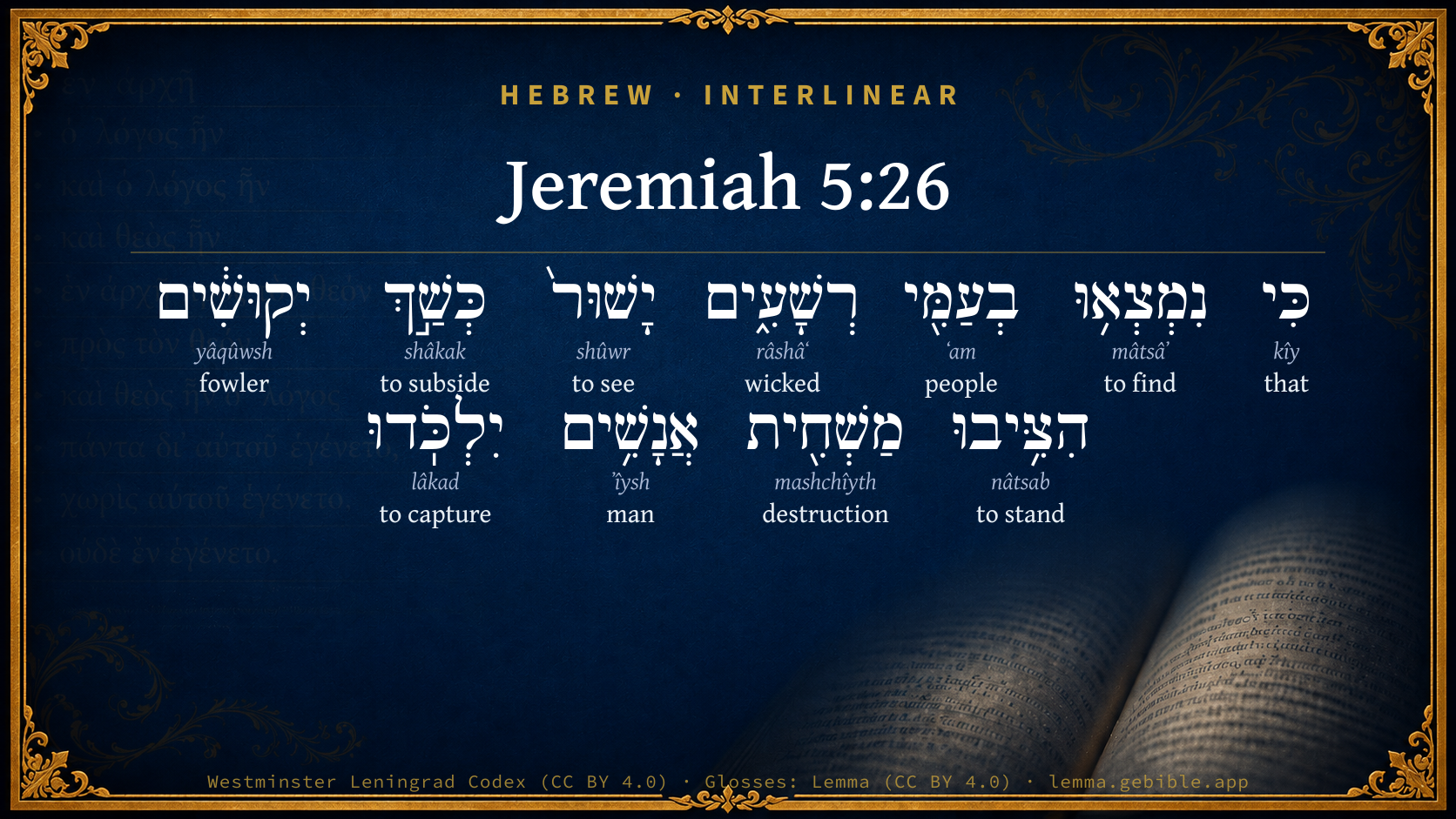
Hebrew (Westminster Leningrad Codex) Jeremiah 5:26 appears in the Hebrew Old Testament. The text above is from the Westminster Leningrad Codex. Each word links to its Strong’s number, a concise gloss, and parsing drawn from the Open Scriptures Hebrew Bible morphology. Click any word for its full Brown-Driver-Briggs (BDB) entry.
Download image
Cite this verse

Jeremiah 5:26 (World English Bible). Public Domain. Lemma interlinear Bible study tool, https://lemma.gebible.app/v/jeremiah/5/26.

Show BibTeX & RIS
BibTeX
RIS
English Translation
For among my people are found wicked men: they watch, as fowlers lie in wait; they set a trap, they catch men.
World English Bible · Public Domain
Download a study sheet

One document with this verse’s original text, its word-by-word gloss line, the meaning frame, cross-references with their text, attributed commentary, and full source and license credits — printable, and it pastes into notes with its structure intact.

This verse Autodidact and up

Study sheet (.html) Plain text (.txt)

A passage Seminary Student

Up to 50 verses in one chapter. A passage sheet keeps up to 6 commentary sources and 12 cross-references per verse, in the order this page ranks them, and says so on the sheet whenever that leaves anything out. Ask for a single verse and you get the Autodidact verse sheet above.

Everything on this page stays free to read, with no account — the sheet is a download of what is already on screen, not access to it.

Want to remove ads? Support Godless Engineer
Compare translations 3

The same verse in 3 English versions, stacked beneath the original-language interlinear above. Click any original word for its lexicon entry.

Each is an independent rendering of the whole verse — the interlinear is not word-aligned to these translations.

Highlighted words mark where these versions differ — a whole-verse word diff, not a word-by-word alignment.

  • World English Bible Public Domain
    For among my people are found wicked men: they watch, as fowlers lie in wait; they set a trap, they catch men.
  • King James Version Public Domain
    For among my people are found wicked men: they lay wait, as he that setteth snares; they set a trap, they catch men.
  • unfoldingWord Literal Text CC BY-SA 4.0
    For wicked ones are found among my people; he watches like fowlers lying in wait; they set a snare; they capture people.

unfoldingWord Literal Text — © unfoldingWord, licensed CC BY-SA 4.0. Word-aligned USFM3 via Door43 (git.door43.org/unfoldingWord/en_ult).

Versions to compare (up to 4)

3 of 4 selected

Show all 18 translations

Every available English version of this verse, each an independent rendering of the whole verse.

  • World English Bible Public Domain
    For among my people are found wicked men: they watch, as fowlers lie in wait; they set a trap, they catch men.
  • Berean Standard Bible Public Domain
    For among My people are wicked men; they watch like fowlers lying in wait; they set a trap to catch men.
  • Majority Standard Bible Public Domain
    For among My people are wicked men; they watch like fowlers lying in wait; they set a trap to catch men.
  • King James Version Public Domain
    For among my people are found wicked men: they lay wait, as he that setteth snares; they set a trap, they catch men.
  • American Standard Version (1901) Public Domain
    For among my people are found wicked men: they watch, as fowlers lie in wait; they set a trap, they catch men.
  • Revised Version (1885) Public Domain
    For among my people are found wicked men: they watch, as fowlers lie in wait; they set a trap, they catch men.
  • Geneva Bible (1599) Public Domain
    For among my people are founde wicked persons, that lay waite as hee that setteth snares: they haue made a pit, to catch men.
  • Douay-Rheims (1899) Public Domain
    For among my people are found wicked men, that lie in wait as fowlers, setting snares and traps to catch men.
  • Young's Literal Translation Public Domain
    For the wicked have been found among My people. It looketh about the covering of snares, They have set up a trap -- men they capture.
  • Literal Standard Version CC BY-SA 4.0
    For the wicked have been found among My people. He watches like one who sets snares, || They have set up a trap—they capture men.
  • Unlocked Literal Bible CC BY-SA 4.0
    For wicked men are found with my people. They watch as someone crouches to capture birds; they set a trap and catch people.
  • unfoldingWord Literal Text CC BY-SA 4.0
    For wicked ones are found among my people; he watches like fowlers lying in wait; they set a snare; they capture people.
  • Darby Bible Public Domain
    For among my people are found wicked [men]: they lay wait, as fowlers stoop down; they set a trap, they catch men.
  • World Messianic Bible Public Domain
    For wicked men are found among my people. They watch, as fowlers lie in wait. They set a trap. They catch men.
  • Webster's Bible Public Domain
    For among my people are found wicked men: they lay wait, as he that setteth snares; they set a trap, they catch men.
  • Free Bible Version CC BY-SA 4.0
    For there are wicked men among my people. They're like bird-trappers, secretly watching and waiting to catch people in their snare.
  • Bible in Basic English Public Domain
    For there are sinners among my people: they keep watch, like men watching for birds; they put a net and take men in it.
  • JPS Tanakh (1917) Public Domain
    For among My people are found wicked men; they pry, as fowlers lie in wait; they set a trap, they catch men.

Literal Standard Version (2020), Covenant Press — licensed CC BY-SA 4.0. Text via the HelloAO Bible API (eBible.org). Unlocked Literal Bible (unfoldingWord) — licensed CC BY-SA 4.0. Text via the HelloAO Bible API (eBible.org). unfoldingWord Literal Text — © unfoldingWord, licensed CC BY-SA 4.0. Word-aligned USFM3 via Door43 (git.door43.org/unfoldingWord/en_ult). Free Bible Version, Dr. Jonathan Gallagher — licensed CC BY-SA 4.0. Text via the HelloAO Bible API (eBible.org).

Word by word

More ways to search: Search by grammar → Find every occurrence → Compare this word →

Practice this passage: Drill this verse → Learn its vocabulary →

יְקוּשִׁ֔ים
yâqûwsh
H3353
“fowlers”
Noun, Common, Masculine, Plural, Absolute
Part of Speech
Noun
Type
Common
Gender
Masculine
Number
Plural
State
Absolute
Full BDB Definition

Origin: passive participle of H3369

TWOT: 906b

fowler, trapper, bait-layer
  1. כִּי kîy H3588 “that” Conjunction
  2. נִמְצְא֥וּ mâtsâʼ H4672 “to find” Verb, Niphal, Perfect, 3rd Person, Common, Plural
  3. בְעַמִּ֖י ʻam H5971 “in/at · people · my” Preposition + Noun, Common, Masculine, Singular, Construct + Suffix, Personal, 1st Person, Common, Singular
  4. רְשָׁעִ֑ים râshâʻ H7563 “wicked” Adjective, Adjective, Masculine, Plural, Absolute
  5. יָשׁוּר֙ shûwr H7789 “to see” Verb, Qal, Imperfect, 3rd Person, Masculine, Singular
  6. כְּשַׁ֣ךְ shâkak H7918 “like/as · to subside” Preposition + Verb, Qal, Infinitive Construct
  7. הִצִּ֥יבוּ nâtsab H5324 “to stand” Verb, Hiphil, Perfect, 3rd Person, Common, Plural
  8. מַשְׁחִ֖ית mashchîyth H4889 “destruction” Noun, Common, Masculine, Singular, Absolute
  9. אֲנָשִׁ֥ים ʼîysh H376 “men” Noun, Common, Masculine, Plural, Absolute
  10. יִלְכֹּֽדוּ lâkad H3920 “to capture” Verb, Qal, Imperfect, 3rd Person, Masculine, Plural

About this verse

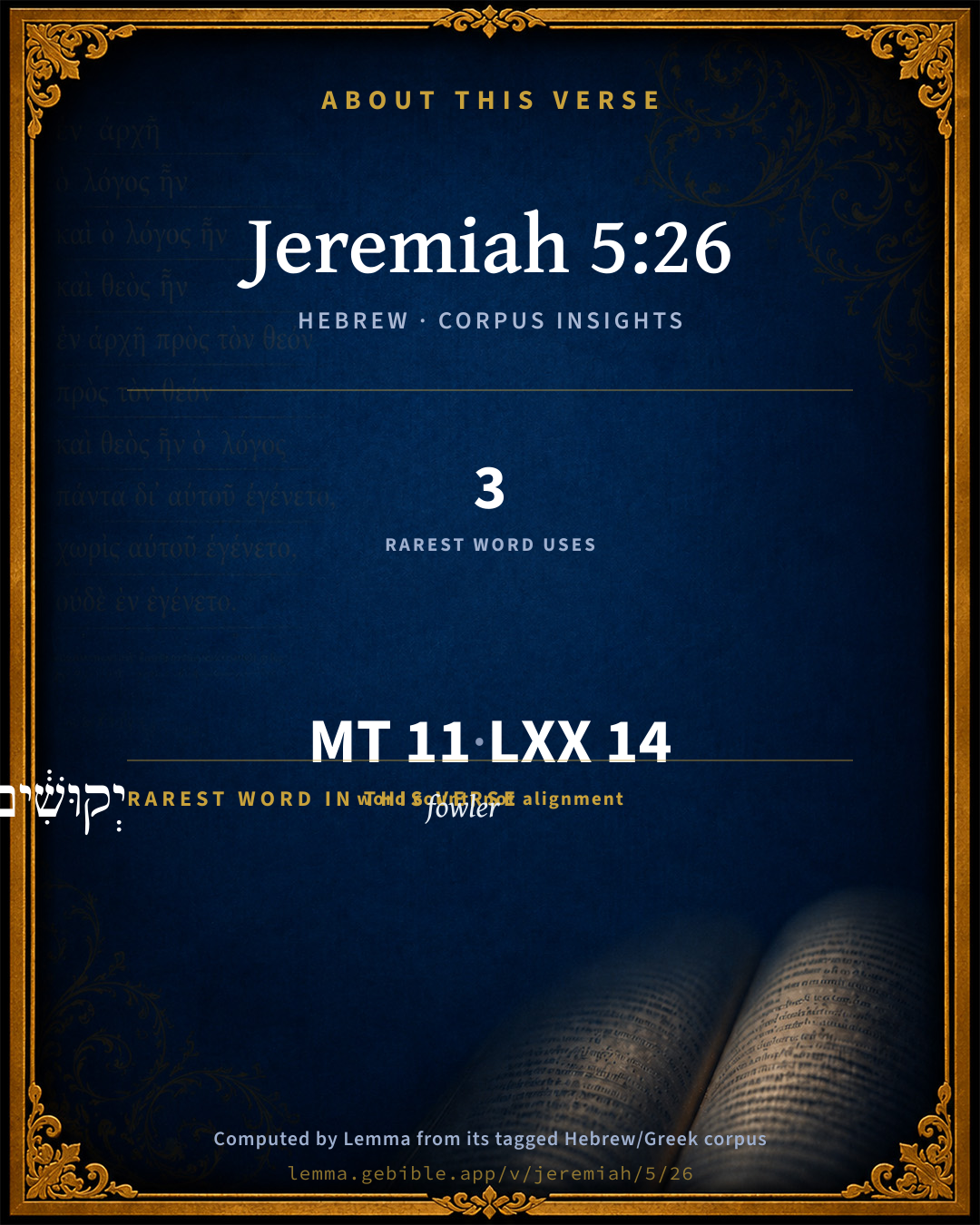
These counts appear in no published source. They are computed here, from the morphology-tagged text and Lemma’s own curated glosses. What Lemma adds →

11
words
11
distinct lemmas
Prophets
section

Notable vocabulary

The rarest word here is יְקוּשִׁ֔ים fowler H3353 — appearing just 3 times in the whole Hebrew Bible.

Shared distinctive vocabulary

יְקוּשִׁ֔ים fowler H3353 occurs in 3 verses of the Hebrew Bible. Also found in:

Grammatical profile

  • 5 verbs
  • 4 nouns
  • 1 adjective
  • 1 conjunction

Verb forms

  • נִמְצְא֥וּ Niphal · Perfect
  • יָשׁוּר֙ Qal · Imperfect
  • כְּשַׁ֣ךְ Qal · Infinitive Construct
  • הִצִּ֥יבוּ Hiphil · Perfect
  • יִלְכֹּֽדוּ Qal · Imperfect

Hebrew & Septuagint length

In the original languages it is 11 Hebrew tokens and 14 Greek tokens — but the two are counted differently (Hebrew bundles its prefixes and suffixes into one token; the Greek is in lemma form), so that isn’t a like-for-like length.

Cross-references

11

Topical passages linked to Jeremiah 5:26 in the Treasury of Scripture Knowledge — connected by theme and wording, ordered by reader-vote popularity; previews shown in the World English Bible.

  • Proverbs 1:11 If they say, "Come with us, Let's lay in wait for blood; Let's lurk secretly for the innocent without cause;
  • Psalms 64:5 They encourage themselves in evil plans. They talk about laying snares secretly. They say, "Who will see them?"
  • Jeremiah 18:22 Let a cry be heard from their houses, when you shall bring a troop suddenly on them; for they have dug a pit to take me, and hid snares for my feet.
  • Ezekiel 22:2–12 You, son of man, will you judge, will you judge the bloody city? then cause her to know all her abominations.
  • Psalms 10:9–10 He lurks in secret as a lion in his ambush. He lies in wait to catch the helpless. He catches the helpless, when he draws him in his net.
  • 1 Samuel 19:10–11 Saul sought to strike David even to the wall with the spear; but he slipped away out of Saul's presence, and he struck the spear into the wall: and David fled, and escaped that night.
  • Habakkuk 1:14–15 and make men like the fish of the sea, like the creeping things, that have no ruler over them?
  • Isaiah 58:1 Cry aloud, don't spare, lift up your voice like a trumpet, and declare to my people their disobedience, and to the house of Jacob their sins.
  • Jeremiah 4:22 For my people are foolish, they don't know me; they are foolish children, and they have no understanding; they are wise to do evil, but to do good they have no knowledge.
  • Luke 5:10 and so also were James and John, sons of Zebedee, who were partners with Simon. Jesus said to Simon, "Don't be afraid. From now on you will be catching people alive."
  • Proverbs 1:17–18 For in vain is the net spread in the sight of any bird:

Cross-references courtesy of OpenBible.info (CC BY 4.0).

Hebrew and Greek witnesses Masoretic Hebrew ↔ Greek Septuagint

The same verse in the two great witnesses to the Old Testament, shown verse-for-verse.

These are two independent witnesses, not word-aligned to each other, and the Septuagint is shown in lemma (dictionary) form.

Hebrew Jeremiah 5:26 Masoretic · Westminster Leningrad Codex

כִּי נִמְצְא֥וּ בְעַמִּ֖י רְשָׁעִ֑ים יָשׁוּר֙ כְּשַׁ֣ךְ יְקוּשִׁ֔ים הִצִּ֥יבוּ מַשְׁחִ֖ית אֲנָשִׁ֥ים יִלְכֹּֽדוּ

For among my people are found wicked men: they watch, as fowlers lie in wait; they set a trap, they catch men.

World English Bible · Public Domain

Greek LXX Structure differs

In the Septuagint, Jeremiah is about an eighth shorter than the Hebrew and arranges its material differently — the Oracles Against the Nations (Hebrew chapters 46–51) appear in the middle of the Greek book, after 25:13. Because the chapter and verse boundaries do not line up, a verse-for-verse comparison with the Hebrew is not shown.

A verse-for-verse comparison isn’t shown here because the chapters and verses don’t line up. Switch to the LXX edition with the MT / LXX toggle above to read the Greek directly.

Hebrew: Westminster Leningrad Codex (CC BY 4.0). Greek: Septuagint (public domain); English from a public-domain English Septuagint. How the Septuagint differs from the Hebrew →

Targum (Aramaic paraphrase)

1

The Targum is the ancient Jewish Aramaic paraphrase of the Hebrew Scriptures — an interpretive translation, not the Hebrew text itself. Onkelos (literal) and Pseudo-Jonathan (expansive) render the Torah, and Jonathan the Prophets. Coverage is partial: where no permissively-licensed English translation exists for a verse, only the Aramaic is shown. This is verse-level text, not a word-by-word alignment to the Hebrew.

  1. Targum Jonathan Prophets (Joshua–Malachi)
    אֲרֵי אִשְׁתְּכָחוּ בְעַמִי חַיָבִין בְּנִכְלִין אִשְׁדִין דַם זַכַּאי כִּלְבוּשׁ צַיָדִין דְמָחֵי וְקָטֵיל מִתְעַשְׁתִּין לְחַבָּלָא נַפְשִׁין קָטְלִין:

    (no public-domain English translation for this verse)

    Targum Jonathan — Aramaic: “Mikraot Gedolot” (public domain). English: “Sefaria Community Translation” (CC0 1.0 (public-domain dedication)); “London "Chaldee Paraphrase," 1871” (public domain). Text via Sefaria.

Commentary

Notes on Jeremiah 5:26 from classic Christian and Jewish commentators (each source and its license shown beneath its notes). The classic Christian expositions comment on the surrounding passage and are grouped to its opening verse, so a note may address several verses; the Jewish commentaries on the Tanakh (Rashi and others) are per-verse, so they appear only where the commentator wrote on this verse.

Lemma curates 59 commentaries, every one of them public domain or Creative Commons licensed, each selected and text-cleaned for this edition rather than reprinted as found. About our sources →

Trapp's Complete Commentary

John Trapp

Jer 5:26 For among my people are found wicked [men]: they lay wait, as he that setteth snares; they set a trap, they catch men.

Ver. 26. For among my people are found wicked men.] This was as bad as to find a nettle in a garden, unchastity in a virgin, or the devil in paradise. All the Lord’s people are or ought to be holy.

They lie in wait.] Or, Watch; or, Prey. See on Mic 7:2.

They set a trap, they catch men.] To spoil them or slay them. Such a one was Otto, the Pope’s Muscipulator (as the story styleth him), i.e., micecatcher, sent hither by Gregory IX to rake and take away our money. Tetzelius, sent by Leo X into Germany, was another.

John Trapp, A Commentary or Exposition upon All the Books of the Old and New Testament (1647–1656) — public domain. Text from a community e-Sword module.

The Biblical Illustrator

Joseph S. Exell

Jer_5:26-31

As a cage is full of birds, so are their houses full of deceit: therefore they are become great and waxen rich.

Wicked professors the bane of the Church

I. God has a people on earth.

1. His creation.

2. Called by Him from darkness to light.

3. Privileged, pardoned, regenerated, adopted.

II. In the Church there is an unhappy admixture of wicked men. This applies to--

1. Those religious establishments whose constitution and discipline offer no restraints to the admission of such characters.

2. Mere hearers of the Gospel.

3. Those who have entered the Church without real conversion.

(1) Some professors are secretly wicked.

(2) Some professors are deceivers.

4. Those wilfully inactive in the Church.

5. Those who interrupt the peace and harmony of the Church.

III. This mixture of the wicked with the godly is a fact. Are found--by whom?

1. Frequently by themselves (1Jn_2:19).

2. Persecution has, and so has temptation.

3. By Christians, to whom their unholy course is a grief.

4. By God (Rev_3:18). Odious to Him.

5. Some will not be found till the day of judgment (Mat_3:12; Mat_13:28-30).

IV. The injurious influence of the conduct of such professors.

1. They bring reproach upon religion (Rom_2:24).

2. The hearts of the godly are grieved and their hands weakened (Jos_7:12; Jos_7:25; 1Jn_2:7; Php_3:18).

3. The Church is in danger of being injured by them (Hos_5:3).

4. It frequently prevents accessions to the Church.

5. The guilt of such persons is highly aggravated, and their punishment will be awful. (Helps for the Pulpit.)

Wickedness rampant in the city

We have, in this chapter, a most melancholy set of pictures of untruthful men, which are drawn to the life with a grimly graphic touch which strongly reminds one of the series of Hogarths sketches known as the Rakes Progress. They hold the mirror up not only to the life, but to the heart of the men of the times. Jerusalem was rotten at the core: the nation was deceitful through and through. As a cage is full of birds, so are their houses full of deceit. They had schemes without number, plots without end, and tricks without limit, moving about in their minds like birds herded together in a little cage. (C. H. Spurgeon.)

My people love to have it so.--

Gods people love to have it so

Earnest people like to believe that the world is growing better all the time. They look upon the bright side of things; they behold the spread of the spirit of Christianity more and more in the affairs of nations; wars are discouraged; a higher standard of personal obligation obtains; the wrongs of the wretched and oppressed are being championed, and in many very important particulars redressed; man everywhere in civilised lands seems possessed of an enthusiasm to make the best of himself.

1. All of this sort of thing had its counterpart in the story of Israel in the olden time. We have gone beyond the ancient people of God in all sorts of ways; nevertheless, human nature is strangely akin still to what it was in those days.

(1) We have a host of prophets in these days. They begin by enlarging, as they call it, the notion of inspiration, so that it may include every one who fancies he has a bit of wisdom all his own to give to the world. Any bright author, or preacher, or poet may be a prophet, and if he is really bright, as men count brightness, his inspiration will not be gainsaid by many. We all love prophets, men of ideas, or great original thoughts. And they have many pleasant gospels to proclaim. For example, There is good in everything, every system, every creed, every earnest deed. It is a great mistake to suppose there is any absolute good, and that such things as do not square with its declarations are evil. There are many prophets of the good-in-everything doctrine. Another message to the world is that God is all mercy. It is a beautiful doctrine, is it not? It is certainly one most acceptable in these days, that there is no hell. Yet another of the prophecies which we love to hear is that the essence of all true religion is doing good to our fellow men. Charity and philanthropy are going to save souls. We are even told as if it were of direct revelation from out of heaven that God will not ask what a man believed, but only how he lived, when he appears for judgment. And the prophets who proclaim this truth are popular indeed. Still further, we have the gospel of making the most of ones self, the gospel of progress, development. Man has in himself all the possibilities of perfection, and if he will but develop himself on sound lines, the future has no limitations for him. All sacraments and supernatural helps of any kind are childs play, mythical superstitions, unworthy of thought on the part of strong-minded men.

(2) And as it was in Jeremiahs time, so also is it true today, that the priests bear rule by the means of these modern prophets. Think of the topics with which our modern pulpits generally deal. The unreality and absurdity of the doctrines of the Christian creed; the falsity of the notion of sin as something to be seriously treated, a moral iniquity, and one to be condignly punished; the nobility of man as a splendid, unfallen creature, called upon to make the most of himself, and so to rise to God-like proportions. What is the explanation of this universal enlargement of the scope of sermon utterance? We are told that preaching of this sort reaches people. Your venerable Gospel, such as the Fathers loved, does not pay in these days; wherever you find it preached you will find dearth of money, dearth of works of mercy. So the pulpit must keep abreast of the times, and the priests can only hope to bear rule, lead their flocks and maintain their influence and position, by heartily accepting the revelations of the new prophets and basing their gospel upon them.

(3) Jeremiah added of the men of his time, that Gods people loved to have it so. No doubt this is the real explanation of the success of the prophets and the priests; they have hit upon the things which appeal to the popular heart. Once in a while the heart of the God-serving community is fired with a revival of earnestness and breaks away from the degrading embrace of the world, and then the popular voice of the believing community demands a high spiritual tone of the clergy. As a rule, however, the unbelieving world is too strong for the professors of religion, and gradually lowers their moral tone towards its own cynical, utilitarian standards. Then the believers refuse to hearken to a gospel of strictness from their preachers, and demand an easier doctrine at the penalty of refusing to listen at all. This threat almost always brings the priests to terms, and they weakly salve their consciences by the thought that it is most important to keep some hold upon the people, and that half the Gospel is better than none.

2. It is a very common temptation to rail at the degeneracy of our own time, at the shortcomings of our own Church. We are all of us apt to fancy ourselves prophets of the Lord when we know that we are in earnest, and the reason we fancy ourselves so strong in that role is because one cannot easily see all sides of a question at one time. Most earnest people are very one-sided, often very unfair in their judgments. So I would not have you fancy for a moment that I wish to pose as a Jeremiah denouncing and endeavouring to reform the abuses of the Church of his time. We have an impersonal Jeremiah to utter the solemn warnings of the Lord in our ears. It is the voice of the Church herself. Well, we are very much concerned with the rest of the verse, My people love to have it so. Is that true?

(1) Are we quite powerless to prevent things from being so bad as they are? One need not rush into every controversial fray, and yet one may often speak his mind fairly and clearly and so free his soul from the guilt of silence. One can speak in the company of his fellows and say, I do not believe there is good in everything, for all systems of religion and philosophy which do not emanate from God must be wrong. There can only be one true doctrine about unearthly things, and whatever opposes itself to that which God has revealed is false and bad. There are abundant opportunities in most of our lives for bearing our witness against the fashionable delusion that works of mercy on behalf of our neighbours are the sure passport to heaven, and that nothing else is needed. We can say strongly and firmly, Nay, that is but the second commandment, Thou shalt love thy neighbour as thyself. The first and greatest of all is, Thou shalt love the Lord thy God. And no one will get to heaven on account of his benevolence to his fellows who neglects to worship and serve his Maker.

(2) It is not to be forgotten, however, that there is more than bearing witness in speech. There is the living of the life. (Arthur Ritchie.)

And what will ye do in the end thereof?--

What will ye do in the end?

I. There is an end. Every step is getting nearer to the termination.

II. It would seem to be of great importance at the end, what has been the character of the course. It is not so much a question with God how the man died, as what the man was when he came to die.

III. It is the part of a thoughtful and wise man, often to consider the connection between the present and the anticipated result. Every one admits this in matters of worldly experience.

IV. This question should be frequently and earnestly entertained by young men. It is most important how you begin, so that as you go on habit may be on your side and become your friend. (T. Binney, D. D.)

A question for the beginning

A large part of the wise conduct of life depends on grave consideration of consequences. It is a sharp pointed question, that pricks many a bubble, and brings much wisdom down into the category of folly.

I. A question which every wise man will ask himself. The consideration of consequences is not the highest guide, or always a sufficient one; or, by any means, in every case, an easily applied one. Do right! and face any results therefrom. He who is always forecasting possible issues will be so afraid of results that he will not dare to move; and his creeping prudence will often turn out the truest imprudence. But whilst many deductions must be made from the principle laid down, that the consideration of circumstances is a good guide in life, yet there are regions in which the question comes home with illuminating force. I believe that, in the long run, condition is the result of character and of conduct, and, for the most part, men are the architects of their own condition, and that they make the houses that they dwell in to fit the convolutions of the body that dwells within them. That being so, there can be nothing more ridiculous than that a man should refrain from marking the issue of his conduct, and saying to himself, What am I to do in the end? If you would only do that in regard of hosts of things in your daily life you could not be the men and women that you are. If the lazy student would only bring clearly before his mind the examination room, and the unanswerable paper, and the bitter mortification when the pass list comes out and his name is not there, he would not trifle as he does, but bind himself to his desk and his task. If the young man that begins to tamper with purity could see, as the older of us have seen, men with their bones full of the iniquity of their youth, do you think the temptations of the streets and low places of amusement would not be stripped of their fascination? What will you do in the end? Use that question as the Ithuriel spear which will touch the squatting tempter at your ear, and there will start up, in its own shape, the fiend. But the main application that I would ask you to make of the text is in reference to the final end, the passing from life. Death, the end, is likewise death, the beginning. Surely every wise man will take that into consideration. Surely, if it be true that we all of us are silently drifting to that one little gateway through which we have to pass one by one, and then find ourselves in a region all full of consequences of the present, he has a good claim to be counted a prince of fools who jumps the life to come, and, in all his calculations of consequences, which he applies wisely and prudently to the trifles of the present, forgets to ask himself, And, after all that is done, what shall I do then?

II. A question which a great many of us never think about. What will you do in the end? Why! half of us put away that question with the thought in our minds, if not expressed, at least most operative, There is not going to be any end; and it is always going to be just like what it is today. Did you ever think that there is no good ground for being sure that the sun will rise tomorrow; that it rose for the first time once; that there will come a day when it will rise for the last time? The uniformity of nature may be a postulate, but you cannot find any logical basis for it. Or, to come down from heights of that sort, have you ever laid to heart, that the only unchangeable thing in this world is change, and the only thing certain, that there is no continuance of anything; and that, therefore, you and I are bound, if we are wise, to look that fact in the face, and not to allow ourselves to be befooled by the difficulty of imagining that things will ever be different from what they are? Another reason why so many of us shirk this question is the lamentable want of the habit of living by principle and reflection. They tell us that in nature there is such a thing as protective mimicry, as it is called--animals having the power--some of them to a much larger extent than others--of changing their hues in order to match the gravel of the stream in which they swim or the leaves of the trees on which they feed. It is like what a great many of us do. Put us into a place where certain forms of frivolity or vice are common, and we go in for them. Take us away from these, and we change our hue to something a little whiter. But all through we never know what it is to put forth a good solid force of resistance, and to say, No! I will not! or, what is sometimes quite as hard to say, Yes! though--as Luther said in his strong way--there were as many devils in Worms as there are tiles on the housetops, I will! If people would live more by reflection and by the power of a resisting will, this question of my text would come oftener to them. And there is another cause that I must touch on for one moment, why so many people neglect this question, and that is because they know they durst not face it. What would you think of a man that never took stock because he knew he was insolvent, and yet did not want to know it? And what do you think of yourselves if, knowing that the thought of passing into that solemn eternity is anything but a cheering one, and that you have to pass into it, you never turn your head to look at it?

III. A question especially directed to you young folk. It is so because with your buoyancy, with your necessarily limited experience, with the small accumulation of results that you have already in your possession, and with the tendencies of your age to live rather by impulse than by reflection, you are specially tempted to forget the solemn significance of this interrogation. And it is a question especially for you, because you have special advantages in the matter of putting it. We older people are all fixed and fossils, as you are very fond of telling us. The iron has cooled and gone into rigid shapes with us. It is all fluent with you. You may be pretty nearly what you like. You have not yet acquired habits--that awful thing that may be our worst foe or our best friend--you have not yet acquired habits that almost smother the power of reform and change. You have perhaps years before you in which you may practise the lessons of wisdom, the self-restraint which this question fairly fronted would bring.

IV. A question which Jesus Christ alone enables a man to answer with calm confidence. As I have said, the end is a beginning; the passage from life is the entrance on a progressive and eternal state of retribution. And Jesus Christ tells us two other things. He tells us that that state has two parts: that in one there is union with Him, life, blessedness forever; and that in the other there is darkness, separation from Him, death, and misery. These are the facts as revealed by the incarnate Word of God on which answers to this question must be shaped. What will you do in the end? If I am trusting to Him; if I have brought my poor, weak nature and sinful soul to Him, and cast them upon His merciful sacrifice and mighty intercession and life-giving Spirit, then I can say: As for me, I shall behold Thy face in righteousness; I shall be satisfied when I awake with Thy likeness. (A. Maclaren, D. D.)

What will ye do in the end thereof

This is the message of God to sinful men in all times; and its characteristics are the same now as they were when it was first uttered.

I. An unwelcome question. As the bankrupt does not dare investigate his affairs, and the man who is contracting intemperate habits or tampering with his employers property does not dare think of the ruin and disgrace to which he is hastening, so the man whose conscience is not easy, who suspects there is something wrong, dreads to look into the future, and counts that man his enemy who ventures to insist on his doing so. The whisper of this question sometimes comes into the heart of the procrastinator--the worldling--the trifler--the backslider; and, with one horrified glance forward, he too often shrinks back and tries to forget all about it.

II. An unanswerable question. The moment a man stands in thought in the midst of the degradation, ruin, and misery he has brought on himself, all his excuses fly; like the man without the wedding garment, he is speechless. How mad to persevere in a course that has such an end!

III. An imperative question.

1. Because no forgetfulness of consequences will prevent them coming. A man may put to sea in a leaky vessel and refuse to consider the remonstrances of friends--he may even be ignorant of the facts; but that will not prevent his foundering in the storm.

2. Because it furnishes the direct antidote to the seductions of sin. The burnt child dreads the fire. The sailor avoids the sunken rock.

3. Because the end may be avoided. Now is the accepted time. (J Ogle.)

Think about the end

Lange translates as follows: What will they do when the end of the song comes?--I wonder if you are like some people whom I know: do you ever turn to the end of the book in order that you may see how it finishes? It is not a good method of reading, but this is what the prophet wished the Jews to do: he desired them to think about the end of life. So many people forget all about the end until it actually comes upon them. The farmer does not do so, for while he sows he thinks about the harvest that will end his toil; it is good for us all to consider often what the future will be. In the East there are men who have most wonderful power over serpents. They play music and the snakes remain quite still and obedient all the time that the song lasts; but what when the song is done? While people are well and prosperous in doing evil they do not think much about God, but what will they do when the song is all over? Then they will find that they have been deceived. There were some wicked men who once induced a large number of people to come together. These people paid their money to the men and they came into the hall; but the men ran away with the money. The people found then that they had been deceived. Some people do worse, for they deceive themselves; they hope that they are all right with God, they hope that they shall reach heaven at last, and do no more. Others are deceived by the opinions or books of those who seek to harm them. All sinners, we know, will one day find that they have been deceived, unless they repent at once and believe on Jesus. And then they will also learn that they are unhealed. What a dreadful thing it will be, if, when we die, we find that our hearts are evil still! When people are in very great pain the doctors sometimes give to them medicines that make the sick people sleep. They are not cured because they sleep, but they do not feel the pain quite so much. So business and other things deaden the feelings, but they do not cure the soul, for only Jesus can do that. There is a fable that illustrates what I mean. A piper once played such sweet music that all the children enjoyed it very much. While the piper played upon his pipe the children were delighted. They followed him from their homes until they were enticed into a cavern, and thus the song ended. This is what Satan does: he entices us by his promises, but when the song is done we shall find out that he has led us away from happiness and into suffering and pain. Think about the end when you are tempted, and think also about the end when it appears to be hard to do good. Ask yourselves, what will come after the end? (J. J. Ellis.)

.

The Biblical Illustrator, edited by Joseph S. Exell (c. 1880s–1900s) — public domain. Text from a community e-Sword module.

Tyndale Open Study Notes

Tyndale Open Resources

5:26-28 Among the people of Jerusalem were wicked men who grew fat and sleek by oppressing orphans and . . . the poor (7:6).

Tyndale Open Study Notes — © Tyndale Open Resources, licensed CC BY-SA 4.0. Text via the HelloAO Bible API.

Jamieson, Fausset & Brown

Robert Jamieson, A. R. Fausset & David Brown

(Pro 1:11, Pro 1:17-18; Hab 1:15).

as he that setteth snares--rather, "as fowlers crouch" [MAURER].

trap--literally, "destruction": the instrument of destruction.

catch men--not as Peter, to save (Luk 5:10), but to destroy men.

Jamieson, Fausset & Brown — Commentary Critical and Explanatory on the Whole Bible (1871) — public domain (CC PDM 1.0). Text via the HelloAO Bible API.

Adam Clarke's Commentary

Verse 26. They lay wait, as he that setteth snares] A metaphor taken from fowlers, who, having fixed their nets, lie down and keep out of sight, that when birds come, they may be ready to draw and entangle them.

Adam Clarke's Commentary on the Bible (1810–1826) — public domain. Text from a community e-Sword/MySword module.

John Calvin's Commentaries

What the previous verse contains is here confirmed, — that the Jews, through their own fault, had deprived themselves of God’s favor. It was necessary to do this; for otherwise they would have had some answer to give, inasmuch as hypocrites, being so perverse, do not easily yield. Hence the Prophet confirms what he had said, — that there were wicked men among God’s people. But this ought not to be confined to some among them, as it is done by interpreters, who seem not to explain quite correctly what the Prophet meant. For he does not reprove or condemn some only; but he says that the people, whom God had chosen, were wicked It is then a general condemnation of the whole people, when he says, that there were found wicked men among God’s people; as though he had said, “The wicked are not to be sought among heathens, but iniquity so reigns among the elect people, that there is in them nothing sound, nothing pure.”

When he says found, I understand his meaning to be, found guilty, or convicted: for he means that their sins were not secret, so that they could escape by evasions; but he says that they were found, as thieves are found, according to a common saying, in the very act of stealing. The Prophet then intimates that there was no need of long dispute, as though the Jews could find out some excuse, for they were manifestly guilty. But it was much more disgraceful that they should be found wicked, than that the blind and unbelieving should be found so; for God had adopted them as his people on this condition — that holiness and purity of life should prevail among them. Since then they were not only sinners, but רשעים, reshoim, wholly impious and wicked, it was, as I have said, a far more atrocious thing. And thus he takes away from them every pretense for evasion.

He afterwards urges still farther his charge, and says, that every one looked, or espied, for this is the meaning of the verb שור, shur. He indeed changes the number, but the sense is not rendered thereby more obscure: and to look here, is to lie in wait. Then look, or lie in wait, did every one, as though they were laying snares as fowlers do. He then says, that they were furnished with snares, by which they dragged men into destruction, after having caught them. What is particular is here mentioned for what is general: for the Prophet meant to shew that there was then no faithfulness nor integrity among the people, for every one by frauds and wicked crafts oppressed the simple. Since then they were so perfidious one towards another, he fitly compares them to fowlers, who by their snares entrap the simple birds: but he explains this more clearly in what follows —

John Calvin's Commentaries (1540-1563) — public domain. Text from the Calvin Translation Society English edition (1840s-50s) via the Christian Classics Ethereal Library (ccel.org). Calvin's coverage is partial (roughly two-thirds of the Bible); uncommented books and verses are honest gaps, never fabricated. The 19th-century editor's footnotes and remarks are omitted so the notes are faithfully Calvin's own voice.

Ellicott's Commentary for English Readers

(26) They lay wait.—Literally, he lieth in wait (used of the leopard in Hos_13:7), as in the crouching down of fowlers: they have set the snare. The indefinite singular in the first clause brings before us the picture of isolated guilt, the plural that of confederate evil.

A Bible Commentary for English Readers, edited by Charles John Ellicott (1878–1897) — public domain. Text from a community e-Sword module.

The Cambridge Bible for Schools and Colleges

gen. ed. J. J. S. Perowne

26. are found wicked men] men of such great wickedness as to infect all.

set a trap] lit. a destroyer. For an illustration of a bird-trap see on Amo_3:5 (C.B.). These men stealthily attack the poor and honest. Cp. Isa_29:21; Mic_7:2.

they catch men] They by their wiles do as Nimrod is supposed by ancient commentators to have done by force. The Targ. on Gen_10:9 speaks of him as “a hunter of the sons of men.”

The Cambridge Bible for Schools and Colleges (gen. ed. J. J. S. Perowne; Cambridge University Press, 1878–1918) — public domain. Text from a community e-Sword module.

John Gill's Exposition

For among my people are found wicked men,.... Not a few only, but in general they appeared to be so, upon an inquiry into their character and conduct; for otherwise it would not have been so difficult to find a good man among them, as is suggested Jer 5:1,

they lay wait as he that setteth snares; or, "they look about" (c); that is, as Kimchi interprets it, every man looks in the ways, to see if a man passed by, that he might rob him of what he had; as a man that lays snares, or sets a trap to catch birds in: or, "everyone looks out, when they that lay snares rest" (d); and so they are more diligent and constant in catching men than such persons are in catching birds:

they set a trap; or "dig a pit, or ditch" (e); for men to fall in; see Psa 7:15,

they catch men; and rob them of their substance; or by their ill examples and counsels draw them into sin, and so into ruin; or circumvent them in trade and business.

(c) "aspicit", Vatablus, i. e. "quisque eorum", Piscator; "aspicient", Pagninus. (d) "contemplatur quisque, cum quiescunt aucupes", De Dieu; so Ben Melech; "et cum resident aucupes", Piscator, Gataker; "sit quiet and unmoved, that they may not frighten the birds by any noise, watching and expecting when they would get into the net"; so Gussetius. (e) "fodiunt foveas", Tigurine version.

John Gill's Exposition of the Whole Bible (1746–1763) — public domain (CC PDM 1.0). Text via the HelloAO Bible API.

Haydock's Catholic Bible Commentary

Man. As some tyrants have done, though this implies (Calmet) the eagerness with which the wicked strive to corrupt mankind. (Haydock)

George Leo Haydock (1774–1849), Haydock's Catholic Family Bible and Commentary, 1859 edition — public domain. Excludes Psalms (Douay-Rheims chapter numbering differs from Protestant) and Deuterocanonical books (Catholic canon only).

Matthew Poole's English Annotations

Among my people are found wicked men; I need not search for such among the heathen nations, for they are found even among them that are called by my name, whereas all my people ought to have been holy.

They lay wait, or contemplate mischievous designs, under deceits, as fowlers do hide themselves, when they watch the birds coming to the snare or net, Pro 1:11; Mic 7:2; and therefore the next expression,

he that setteth snares, is but a periphrasis for a fowler, the Hebrew word being always so taken, Psa 91:3; Pro 6:5, and elsewhere; or they pry, i.e. they narrowly look where they may get an advantage; hence enemies are called priers, or observers, as you may frequently find in the Psalms Psa 5:8; 27:11; 56:2; 59:10; 92:11.

They set a trap, they catch men; intimating the success of their wicked policies in bringing their wicked decrees to pass, Psa 37:7, as false witnesses and trespassers use to do, when they go about to insnare men that are innocent; such a trap did Jezebel lay for Naboth, 1Ki 21:9,10. Such a one was that conspiracy of more than forty men against Paul, Act 23:13-15.

Matthew Poole's English Annotations on the Holy Bible (1683–1685) — public domain. Text from a community e-Sword/MySword module.

Whedon's Commentary on the Bible

Daniel D. Whedon

26-28. Wicked men — The fact of their rebellion, as well as its extent and bitter fruits, is set forth in the prevalent corruption. Men make a prey of each other; they are false to one another; they are prosperous in their wickedness; they close their ears to the prayer of the needy and the orphaned.

Daniel D. Whedon (gen. ed.), Commentary on the Old and New Testaments (1874–1909) — public domain. Text from a community e-Sword module.

The Pulpit Commentary

They lay wait, etc.; rather, they spy (literally, one spieth), as fowlers lie in wait. A trap; literally, a destroyer; i.e. an instrument of destruction (comp. Isa_54:16, where" the waster" (or destroyer) probably means the weapon referred to previously).

Vers. 26-29. The worst kind of wickedness found among the people of Jehovah.

God"s people are well acquainted with the voice of those scorners who speak as if hypocrisy was the invariable accompaniment of a religious profession. They do discover, it must be admitted, far more frequently than they ought to discover, that religious profession is a mere pretence; and thereupon they never forget the few well-established instances which are a ground, in season and out of season, for a sweeping charge of hypocrisy. But such people, unfortunately for themselves, are not readers of the Scriptures; else they would discover that God does not wait for outside malevolent critics to make the most of the hypocrisies to be found amongst his people. God not only sees and laments this peculiarly odious form of wickedness, but is exceedingly plain in his description and terribly severe in his denunciation. In this matter outsiders cannot tell God"s people anything they do not know already. Note

I THAT WHICH OUGHT TO BE FOUND AMONGST GOD"S PEOPLE. This is just the thing which makes the whole discovery so inexpressibly sad that this wickedness is found where there should have been found a character diametrically opposite. It is the scene of the wickedness that indescribably aggravates the wickedness itself. That a good man, a really good man, should be found in a den of thieves is impossible. Vain would it be for him to continue there and yet plead his uprightness. A den of thieves does actually give character to every one who willingly inhabits it, and so, passing from the bad to the good, a certain high reputation must attach to every one who openly ranks himself among the people of God. It was not because these Israelites dwelt in a certain territory or were descendants from certain ancestors that they were reckoned the people of God. There was a covenant, the terms of which were to be taught to every generation and diligently observed by it. And this covenant emphatically required that these people should live among themselves an upright, brotherly, loving life. Without this, worship was vain; indeed, without this, worship, in the true sense, was impossible. In the home, union was to be preserved by subordination and purity; and in society, by the safety of life and property to the individual. God"s people are the people of his pasture and the sheep of his hand," and it is manifest that, in the right order of things, a sheep"s clothing should cover a sheep and not a wolf.

II THAT WHICH ACTUALLY IS FOUND. Wicked men are found where none but the devout, the upright, and the gentle ought to be. Further, this wickedness is so marked off by bold and indignant expressions that every one guilty of it may know Jehovah"s eye to be upon him. For such a man there lies no way of escape among vague generalities. He cannot get off by alleging, with apparent seriousness, that, while there are undoubtedly deceivers among the people of God, he at all events is not to be numbered amongst them. If a man is behaving himself after the fashion here described, he certainly must know it. With regard to certain actions, the nature of them may come out so openly that it is easy to effect the consequent exclusion and separation of the offender from the people of God. But there yet remain many wickednesses, the worst of wickednesses, which a man may go on committing and yet keep his name written in the human record of those who profess service to God. He may even make his very position a vantage-ground for the laying of his snares and the perfecting of his wiles. He may be able so to conceal his hand and his purpose as to deceive even his victims, who, instead of arguing that because there is great wickedness the doer of it must be a bad man, begin at the other end and say that a maker of long prayers cannot possibly be bad; he may be driven to the infliction of a painful blow, but, that must be reckoned his calamity rather than his fault. Now, the descriptions in this passage make it evident that God sees into all the doings of such men. And at this particular time these men had become very successful, and we must infer very influential. Wherever money is heaped up it makes influence. And even though such oppressors were not numerous, their very position gave them power. But over against them, with all their power, all their wealth, all their pretensions, there is that God who marks every tear and groan and writhing of the oppressed. This passage is but one out of many in which God shows his hatred to all injustice. Some of the so-called friends of humanity, who are never tired of asserting their friendship and pressing their claims, make one of their great claims to be in this, that they oppose all acknowledgment of God. Depend upon it, God is the true Friend of humanity; he first, and afterwards are those whom he inspires with his own indignation against wrong, and endows with the strength, patience, resolution, and all Divine resources needed to destroy it. What wonder is it that God should speak of vengeance against such a nation as permits and extenuates the monstrous evils denounced in this passage? Y.

The Pulpit Commentary (1880–1919), ed. H.D.M. Spence-Jones & Joseph S. Exell — public domain. Text from a community e-Sword module.

John Wesley's Explanatory Notes

They catch - Such a trap did Jezebel lay for Naboth, 1 Kings xxi, 9, 10. Such an one was that conspiracy of more than forty men against Paul, Acts xxiii, 13-15.

John Wesley, Explanatory Notes Upon the Whole Bible (1754–1765) — public domain. Text via the GEBible commentary corpus.

unfoldingWord translationNotes

Door43 World Missions Community

General Information:

Yahweh continues to speak.

For wicked men are found with my people

This can be stated in active form. AT: "For I have found wicked men among my people" (See: Active or Passive)

They watch as someone crouches to capture birds

God speaks of wicked people wanting to harm someone as if they were waiting to capture birds. AT: "Like someone hiding and waiting to capture birds" (See: Simile)

they set a trap and catch people

God speaks of wicked people intentionally harming others as if they were setting a trap. AT: "They set things up so that they can take advantage of people" (See: Metaphor)

Like a cage full of birds, their houses are full of deceit

Here "deceit" represents the things that were taken by deceit. AT: Like a cage full of birds that a hunter has caught, wicked people's houses are full of things that they have taken by deceiving people (See: Simile and Metonymy)

they grow large and become rich

Here "large" represents powerful. AT: "these wicked people become powerful and rich" (See: Metaphor)

they shine with well-being

Possible meanings are 1) their skin shines because of the healthy food they eat, or 2) their body is smooth because of the muscle and fat between their bones and skin. It indicates that they eat well.

They crossed over all bounds of wickedness

Doing all kinds of wicked things is spoken of as if there were a boundary separating some wicked things from things that are even more wicked. AT: "They do all kinds of wicked things" or "They even do the most wicked things" (See: Metaphor)

They do not plead the cause of the people, or the cause of the orphan

"They do not plead with the rulers to give the people and the orphans what they need" or "They do not plead with the rulers to give justice to the people and the orphans"

they have not given justice to the needy

"they have not helped the needy by doing what is just for them"

Should I not punish ... a nation like this?

Yahweh uses this question to emphasize that the things that they are doing are so bad that he will no have mercy but will punish them. See how you translated a similar sentence in Jeremiah 5:9. AT: "So I will punish them, this is Yahweh's declaration. I will certainly get revenge for myself against them."(See: Rhetorical Question)

this is Yahweh's declaration

Yahweh speaks of himself by name to express the certainty of what he is declaring. See how you translated this in Jeremiah 1:8. AT: "this is what Yahweh has declared" or "this is what I, Yahweh, have declared" (See: First, Second, or Third Person)

translationWords

evil

people of God

snare

deceive

plea

avenge

unfoldingWord translationNotes — © Distant Shores Media and the Door43 World Missions Community, licensed CC BY-SA 4.0. Source: git.door43.org/Door43/en_tn.

Rashi

Rabbi Shlomo Yitzchaki (Rashi)

they lie in wait Heb. ישור. Comp. למען שוררי because of those who lie in wait for me (Psalms 27: 11), an expression of “I see him (אשורנו) but not near” (Num. 24:17).

as a trap bites As a trap that they make to catch deer in the forest, bites when his foot enters it and it bites him and holds onto his foot and he is caught, and the call this (piege in O. F.).

they stationed an ambush (Canbel in O.F.) So do those who lie in wait make for a city or on the road.

they station Heb. יציבו, like “the garrison (מצב) of the Philistines” (I Sam. 14:4).

Rashi on the Tanakh — English translations: “The Judaica Press complete Tanach with Rashi, translated by A. J. Rosenberg” (CC BY 4.0); “Pentateuch with Rashi's commentary by M. Rosenbaum and A.M. Silbermann, 1929-1934” (public domain); “The Metsudah Tanach series, Lakewood, N.J” (CC BY 4.0); and “The Book of Joshua, Metsudah Publications, 1997” (CC BY 4.0). Text via Sefaria.

Lesson kit

Teaching starters — assembled from the data on this page, not authored interpretation. Every prompt links to the verse data it draws on. Edit before teaching.

Jeremiah, in the Prophets, opens this verse with 11 words (11 distinct Hebrew lemmas). Its most distinctive word is yâqûwsh (“fowler”). A historical commentator’s framing appears above. Read the whole chapter for the surrounding context.

Discussion questions

  1. The word yâqûwsh carries the sense “fowler.” How does it shape the verse?
  2. Psalms 91:3 shares the word «fowler» with this verse. How do the two illuminate each other?
  3. These translations render this verse differently; the difference is in the English rendering, not the original. What questions does that raise?
  4. The verb «נִמְצְא֥וּ» is Niphal Perfect. How does its form color the action?
  5. Reading how Trapp's Complete Commentary and The Biblical Illustrator read this verse, where do the two commentators agree and where do they part?

Things to notice

Reading settings

Reading text

Shown beneath each verse's original-language words.

Old Testament
Old Testament edition

Read the OT as the Masoretic Hebrew (MT) or the Greek Septuagint (LXX).

English shown for the Greek Septuagint (in the Hebrew ↔ Greek comparison).

Comparing translations? Open the Compare panel on any verse page to stack up to four side by side.