
Isaiah 28:13

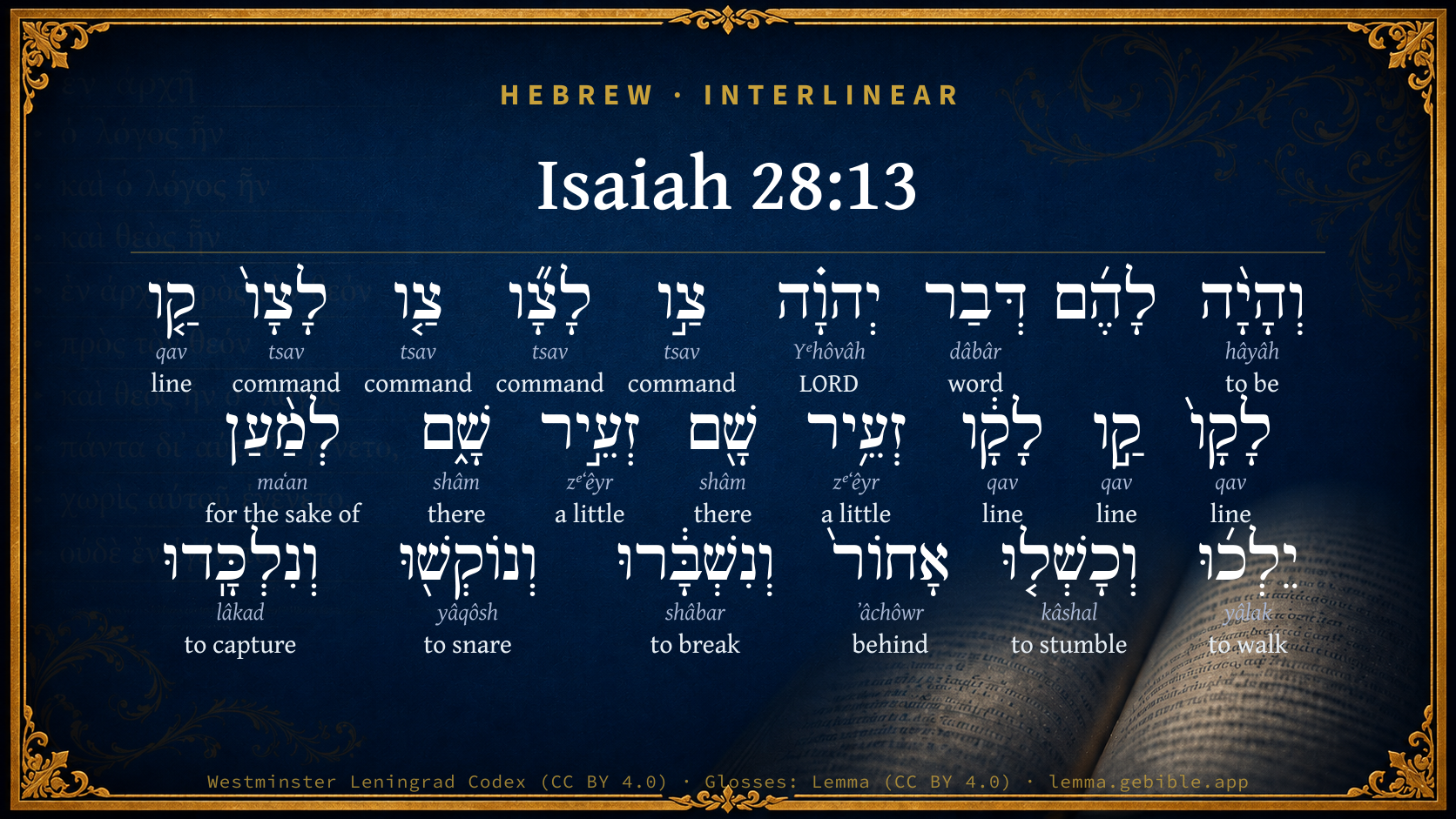
Hebrew (Westminster Leningrad Codex) Isaiah 28:13 appears in the Hebrew Old Testament. The text above is from the Westminster Leningrad Codex. Each word links to its Strong’s number, a concise gloss, and parsing drawn from the Open Scriptures Hebrew Bible morphology. Click any word for its full Brown-Driver-Briggs (BDB) entry.
Download image
Cite this verse

Isaiah 28:13 (World English Bible). Public Domain. Lemma interlinear Bible study tool, https://lemma.gebible.app/v/isaiah/28/13.

Show BibTeX & RIS
BibTeX
RIS
English Translation
Therefore shall the word of Yahweh be to them precept on precept, precept on precept; line on line, line on line; here a little, there a little; that they may go, and fall backward, and be broken, and snared, and taken.
World English Bible · Public Domain
Download a study sheet

One document with this verse’s original text, its word-by-word gloss line, the meaning frame, cross-references with their text, attributed commentary, and full source and license credits — printable, and it pastes into notes with its structure intact.

This verse Autodidact and up

Study sheet (.html) Plain text (.txt)

A passage Seminary Student

Up to 50 verses in one chapter. A passage sheet keeps up to 6 commentary sources and 12 cross-references per verse, in the order this page ranks them, and says so on the sheet whenever that leaves anything out. Ask for a single verse and you get the Autodidact verse sheet above.

Everything on this page stays free to read, with no account — the sheet is a download of what is already on screen, not access to it.

Want to remove ads? Support Godless Engineer
Compare translations 3

The same verse in 3 English versions, stacked beneath the original-language interlinear above. Click any original word for its lexicon entry.

Each is an independent rendering of the whole verse — the interlinear is not word-aligned to these translations.

Highlighted words mark where these versions differ — a whole-verse word diff, not a word-by-word alignment.

  • World English Bible Public Domain
    Therefore shall the word of Yahweh be to them precept on precept, precept on precept; line on line, line on line; here a little, there a little; that they may go, and fall backward, and be broken, and snared, and taken.
  • King James Version Public Domain
    But the word of the LORD was unto them precept upon precept, precept upon precept; line upon line, line upon line; here a little, and there a little; that they might go, and fall backward, and be broken, and snared, and taken.
  • unfoldingWord Literal Text CC BY-SA 4.0
    So the word of Yahweh will be to them command by command, command by command, line by line, line by line, a little here, a little there, so that they may go and stumble backward and be broken and be ensnared and be captured. q1

unfoldingWord Literal Text — © unfoldingWord, licensed CC BY-SA 4.0. Word-aligned USFM3 via Door43 (git.door43.org/unfoldingWord/en_ult).

Versions to compare (up to 4)

3 of 4 selected

Show all 18 translations

Every available English version of this verse, each an independent rendering of the whole verse.

  • World English Bible Public Domain
    Therefore shall the word of Yahweh be to them precept on precept, precept on precept; line on line, line on line; here a little, there a little; that they may go, and fall backward, and be broken, and snared, and taken.
  • Berean Standard Bible Public Domain
    Then the word of the LORD to them will become: “Order on order, order on order, line on line, line on line; a little here, a little there,” so that they will go stumbling backward and will be injured, ensnared, and captured.
  • Majority Standard Bible Public Domain
    Then the word of the LORD to them will become: “Order on order, order on order, line on line, line on line; a little here, a little there,” so that they will go stumbling backward and will be injured, ensnared, and captured.
  • King James Version Public Domain
    But the word of the LORD was unto them precept upon precept, precept upon precept; line upon line, line upon line; here a little, and there a little; that they might go, and fall backward, and be broken, and snared, and taken.
  • American Standard Version (1901) Public Domain
    Therefore shall the word of Jehovah be unto them precept upon precept, precept upon precept; line upon line, line upon line; here a little, there a little; that they may go, and fall backward, and be broken, and snared, and taken.
  • Revised Version (1885) Public Domain
    Therefore shall the word of the LORD be unto them precept upon precept, precept upon precept; line upon line, line upon line; here a little, there a little; that they may go, and fall backward, and be broken, and snared, and taken.
  • Geneva Bible (1599) Public Domain
    Therefore shall the worde of the Lord be vnto them precept vpon precept, precept vpon precept, line vnto line, line vnto line, there a litle and there a litle, that they may goe, and fall backward, and be broken, and be snared, and be taken.
  • Douay-Rheims (1899) Public Domain
    And the word of the Lord shall be to them: Command, command again; command, command again: expect, expect again; expect, expect again: a little there, a little there: that they may go, and fall backward, and be broken, and snared, and taken.
  • Young's Literal Translation Public Domain
    And to whom a word of Jehovah hath been, Rule on rule, rule on rule, line on line, line on line, A little here, a little there, So that they go and have stumbled backward, And been broken, and snared, and captured.
  • Literal Standard Version CC BY-SA 4.0
    And to whom a word of YHWH has been, || Rule on rule, rule on rule, || Line on line, line on line, || A little here, a little there, || So that they go and have stumbled backward, || And been broken, and snared, and captured.
  • Unlocked Literal Bible CC BY-SA 4.0
    So the word of Yahweh will be to them command upon command, command upon command; rule upon rule, rule upon rule; here a little, there a little; so that they may go and fall backward, and be broken, ensnared, and captured.
  • unfoldingWord Literal Text CC BY-SA 4.0
    So the word of Yahweh will be to them command by command, command by command, line by line, line by line, a little here, a little there, so that they may go and stumble backward and be broken and be ensnared and be captured. q1
  • Darby Bible Public Domain
    And the word of Jehovah was unto them precept upon precept, precept upon precept, line upon line, line upon line, here a little, there a little: that they might go, and fall backward, and be broken, and snared, and taken.
  • World Messianic Bible Public Domain
    Therefore the LORD’s word will be to them precept on precept, precept on precept; line on line, line on line; here a little, there a little; that they may go, fall backward, be broken, be snared, and be taken.
  • Webster's Bible Public Domain
    But the word of the LORD was to them, precept upon precept, precept upon precept; line upon line, line upon line; here a little, and there a little; that they might go, and fall backward, and be broken, and snared, and taken.
  • Free Bible Version CC BY-SA 4.0
    Therefore the Lord's message to them will become, “This blah and that blah, blah upon blah, and again blah and blah, and even more blah and blah, a bit here and a bit there,” so that they'll fall over backwards, and they'll be wounded, trapped, and captured.
  • Bible in Basic English Public Domain
    For this cause the word of the Lord will be to them rule after rule, line after line, here a little, there a little; so that they may go on their way, and falling back may be broken, and taken in the net.
  • JPS Tanakh (1917) Public Domain
    And so the word of the LORD is unto them precept by precept, precept by precept, line by line, line by line; here a little, there a little; that they may go, and fall backward, and be broken, and snared, and taken.

Literal Standard Version (2020), Covenant Press — licensed CC BY-SA 4.0. Text via the HelloAO Bible API (eBible.org). Unlocked Literal Bible (unfoldingWord) — licensed CC BY-SA 4.0. Text via the HelloAO Bible API (eBible.org). unfoldingWord Literal Text — © unfoldingWord, licensed CC BY-SA 4.0. Word-aligned USFM3 via Door43 (git.door43.org/unfoldingWord/en_ult). Free Bible Version, Dr. Jonathan Gallagher — licensed CC BY-SA 4.0. Text via the HelloAO Bible API (eBible.org).

Word by word

More ways to search: Search by grammar → Find every occurrence → Compare this word →

Practice this passage: Drill this verse → Learn its vocabulary →

זְעֵ֥יר
zᵉʻêyr
H2191
“a little”
Noun, Common, Masculine, Singular, Absolute
Part of Speech
Noun
Type
Common
Gender
Masculine
Number
Singular
State
Absolute
Full BDB Definition

Origin: from an unused root [akin (by permutation) to H6819 ], meaning to dwindle

TWOT: 571a

a little - of quantity - of time
  1. וְהָיָ֨ה hâyâh H1961 “and · to be” Conjunction + Verb, Qal, Sequential Perfect, 3rd Person, Masculine, Singular
  2. דְּבַר dâbâr H1697 “word of” Noun, Common, Masculine, Singular, Construct
  3. יְהוָ֗ה Yᵉhôvâh H3068 “LORD” Noun, Proper
  4. צַ֣ו tsav H6673 “command” Noun, Common, Masculine, Singular, Absolute
  5. לָצָ֞ו tsav H6673 “to/for · command” Preposition + Noun, Common, Masculine, Singular, Absolute
  6. צַ֤ו tsav H6673 “command” Noun, Common, Masculine, Singular, Absolute
  7. לָצָו֙ tsav H6673 “to/for · command” Preposition + Noun, Common, Masculine, Singular, Absolute
  8. קַ֤ו qav H6957 “line” Noun, Common, Masculine, Singular, Absolute
  9. לָקָו֙ qav H6957 “to/for · line” Preposition + Noun, Common, Masculine, Singular, Absolute
  10. קַ֣ו qav H6957 “line” Noun, Common, Masculine, Singular, Absolute
  11. לָקָ֔ו qav H6957 “to/for · line” Preposition + Noun, Common, Masculine, Singular, Absolute
  12. שָׁ֖ם shâm H8033 “there” Adverb
  13. זְעֵ֣יר zᵉʻêyr H2191 “a little” Noun, Common, Masculine, Singular, Absolute
  14. שָׁ֑ם shâm H8033 “there” Adverb
  15. לְמַ֨עַן maʻan H4616 “for the sake of” Preposition
  16. יֵלְכ֜וּ yâlak H3212 “to walk” Verb, Qal, Imperfect, 3rd Person, Masculine, Plural
  17. וְכָשְׁל֤וּ kâshal H3782 “and · to stumble” Conjunction + Verb, Qal, Sequential Perfect, 3rd Person, Common, Plural
  18. אָחוֹר֙ ʼâchôwr H268 “behind” Noun, Common, Masculine, Singular, Absolute
  19. וְנִשְׁבָּ֔רוּ shâbar H7665 “and · to break” Conjunction + Verb, Niphal, Sequential Perfect, 3rd Person, Common, Plural
  20. וְנוֹקְשׁ֖וּ yâqôsh H3369 “and · to snare” Conjunction + Verb, Niphal, Sequential Perfect, 3rd Person, Common, Plural
  21. וְנִלְכָּֽדוּ lâkad H3920 “and · to capture” Conjunction + Verb, Niphal, Sequential Perfect, 3rd Person, Common, Plural

About this verse

These counts appear in no published source. They are computed here, from the morphology-tagged text and Lemma’s own curated glosses. What Lemma adds →

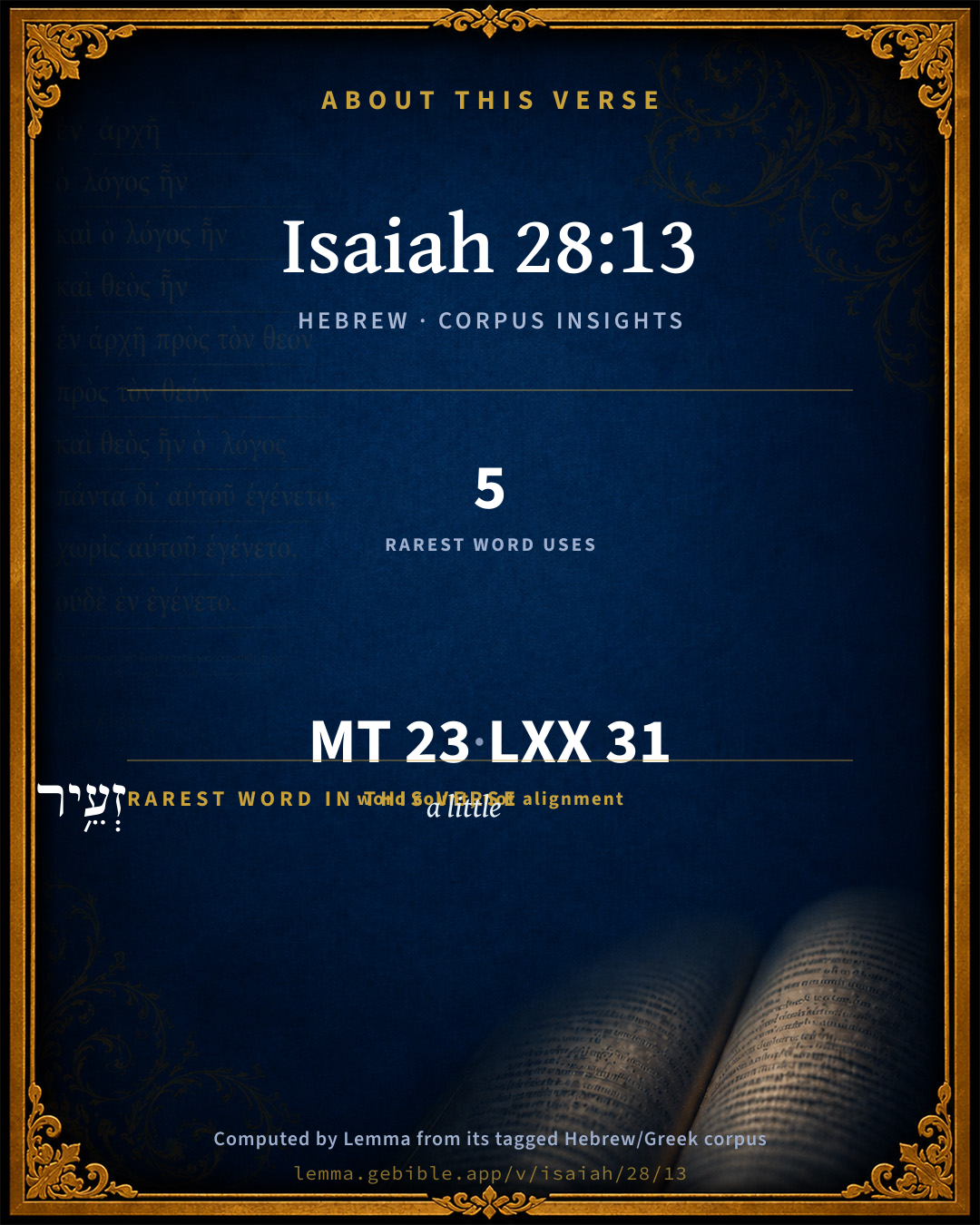
23
words
14
distinct lemmas
Prophets
section

Notable vocabulary

The rarest word here is זְעֵ֥יר a little H2191 — appearing just 5 times in the whole Hebrew Bible.

Shared distinctive vocabulary

זְעֵ֥יר a little H2191 occurs in 3 verses of the Hebrew Bible. Also found in:

Grammatical profile

  • 6 verbs
  • 13 nouns
  • 2 prepositions
  • 2 adverbs

Verb forms

  • וְהָיָ֨ה Qal · Sequential Perfect
  • יֵלְכ֜וּ Qal · Imperfect
  • וְכָשְׁל֤וּ Qal · Sequential Perfect
  • וְנִשְׁבָּ֔רוּ Niphal · Sequential Perfect
  • וְנוֹקְשׁ֖וּ Niphal · Sequential Perfect
  • וְנִלְכָּֽדוּ Niphal · Sequential Perfect

Repetition

Words recur within this verse — often emphatic in Hebrew:

  • צַ֣ו command H6673 ×4
  • קַ֤ו line H6957 ×4
  • זְעֵ֥יר a little H2191 ×2
  • שָׁ֖ם there H8033 ×2

Hebrew & Septuagint length

In English translation the verse runs 41 words from the Hebrew and 43 from the Septuagint (LXX English) — closely comparable.

A rough comparison of the two English renderings, which tokenize alike — not a word-level alignment.

Word counts can differ between the Hebrew and the Greek without any difference in meaning — e.g. the Hebrew direct-object marker אֵת has no separate Greek word, and Greek often adds the article ὁ.

In the original languages it is 23 Hebrew tokens and 31 Greek tokens — but the two are counted differently (Hebrew bundles its prefixes and suffixes into one token; the Greek is in lemma form), so that isn’t a like-for-like length.

Cross-references

13

Topical passages linked to Isaiah 28:13 in the Treasury of Scripture Knowledge — connected by theme and wording, ordered by reader-vote popularity; previews shown in the World English Bible.

  • Matthew 13:14 In them the prophecy of Isaiah is fulfilled, which says, 'By hearing you will hear, And will in no way understand; Seeing you will see, And will in no way perceive:
  • Isaiah 6:9–10 He said, "Go, and tell this people, 'You hear indeed, But don't understand; And you see indeed, But don't perceive.'
  • Psalms 69:22 Let their table before them become a snare. May it become a retribution and a trap.
  • Isaiah 8:14–15 He shall be for a sanctuary; but for a stone of stumbling and for a rock of offense to both the houses of Israel, for a gin and for a snare to the inhabitants of Jerusalem.
  • Isaiah 28:10 For it is precept on precept, precept on precept; line on line, line on line; here a little, there a little.
  • Jeremiah 23:36–38 The burden of Yahweh shall you mention no more: for every man's own word shall be his burden; for you have perverted the words of the living God, of Yahweh of Hosts our God.
  • Matthew 21:44 He who falls on this stone will be broken to pieces, but on whoever it will fall, it will scatter him as dust."
  • 2 Peter 3:16 as also in all of his letters, speaking in them of these things. In those are some things hard to be understood, which the ignorant and unsettled twist, as they also do to the other Scriptures, to their own destruction.
  • 1 Peter 2:7–8 For you therefore who believe is the honor, but for such as are disobedient, "The stone which the builders rejected, Has become the chief cornerstone,"
  • Hosea 6:5 Therefore I have cut them to pieces with the prophets; I killed them with the words of my mouth. Your judgments are like a flash of lightning.
  • Hosea 8:12 I wrote for him the many things of my law; But they were regarded as a strange thing.
  • Romans 11:9 David says, "Let their table be made a snare, and a trap, A stumbling block, and a retribution to them.
  • 2 Corinthians 2:16 to the one a stench from death to death; to the other a sweet aroma from life to life. Who is sufficient for these things?

Cross-references courtesy of OpenBible.info (CC BY 4.0).

Hebrew and Greek witnesses Masoretic Hebrew ↔ Greek Septuagint

The same verse in the two great witnesses to the Old Testament, shown verse-for-verse.

These are two independent witnesses, not word-aligned to each other, and the Septuagint is shown in lemma (dictionary) form.

Hebrew Isaiah 28:13 Masoretic · Westminster Leningrad Codex

וְהָיָ֨ה לָהֶ֜ם דְּבַר יְהוָ֗ה צַ֣ו לָצָ֞ו צַ֤ו לָצָו֙ קַ֤ו לָקָו֙ קַ֣ו לָקָ֔ו זְעֵ֥יר שָׁ֖ם זְעֵ֣יר שָׁ֑ם לְמַ֨עַן יֵלְכ֜וּ וְכָשְׁל֤וּ אָחוֹר֙ וְנִשְׁבָּ֔רוּ וְנוֹקְשׁ֖וּ וְנִלְכָּֽדוּ

Therefore shall the word of Yahweh be to them precept on precept, precept on precept; line on line, line on line; here a little, there a little; that they may go, and fall backward, and be broken, and snared, and taken.

World English Bible · Public Domain

Greek LXX Isaiah 28:13 Septuagint · lemma form

καί εἰμί αὐτός ὁ λόγιον κύριος ὁ θεός θλῖψις ἐπί θλῖψις ἐλπίς ἐπί ἐλπίς ἔτι μικρός ἔτι μικρός ἵνα πορεύομαι καί πίπτω εἰς ὁ ὀπίσω καί κινδυνεύω καί συντρίβω καί ἁλίσκω

Therefore the oracle of God shall be to them affliction on affliction, hope on hope, yet a little, and yet a little, that they may go and fall backward; and they shall be crushed and shall be in danger, and shall be taken.

LXX2012 (modern English Septuagint) · Public Domain

Hebrew: Westminster Leningrad Codex (CC BY 4.0). Greek: Septuagint (public domain); English from LXX2012 (modern English Septuagint) (Public Domain). How the Septuagint differs from the Hebrew →

Targum (Aramaic paraphrase)

1

The Targum is the ancient Jewish Aramaic paraphrase of the Hebrew Scriptures — an interpretive translation, not the Hebrew text itself. Onkelos (literal) and Pseudo-Jonathan (expansive) render the Torah, and Jonathan the Prophets. Coverage is partial: where no permissively-licensed English translation exists for a verse, only the Aramaic is shown. This is verse-level text, not a word-by-word alignment to the Hebrew.

  1. Targum Jonathan Prophets (Joshua–Malachi)
    דֵין יְהֵי כָס פּוּרְעֲנוּתְהוֹן עַל דַעֲבָרוּ עַל פִּתְגָמָא דַייָ וְעַל דְאִתְפַּקָדוּ לְמֶעְבַּד אוֹרַיְתָא וּמָא דְאִתְפַּקַדוּ לָא צְבִיאוּ לְמֶעְבַּד בְּכֵן יִתְמַסְרוּן לְעַמְמַיָא דְלָא יְדָעוּ אוֹרַיְתָא עַל דְהַלִיכוּ בִרְעוּת נַפְשְׁהוֹן וְלָא חֲמִידוּ לְמֶעְבַּד רְעוּתִי בְּכֵן יְסַבְּרוּן לְסָעִיד בְּעִדָן דְאַיְתִי עֲלֵיהוֹן עָקָא וְלָא יְהֵי לְהוֹן סָעִיד וְסָמִיךְ עַל דַהֲוָה זְעֵיר בְּעֵינֵיהוֹן בֵּית מַקְדָשִׁי לְמִפְלָח תַּמָן בְכֵן יִשְׁתָּאֲרוּן כִּזְעֵיר בֵּינֵי עַמְמַיָא דְיִגְלוֹן לְתַמָן בְּדִיל דִיהָכוּן וְיִתְקְלוּן לַאֲחוֹרָא וְיִתַּבְּרוּן וְיִתַּצְדוּן וְיִתְאַחֲדוּן:

    This shall be the cup of their punishment, because they have transgressed the word of the Lord, and because they were commanded to do my law, but would not do what they were commanded. Therefore they shall be delivered unto the nations, who do not know the law; because they walked after the desire of their soul, and had no delight to do my will. Therefore they shall hope for help at the time that I shall bring distress upon them; but they shall have no help or support. Because the house of my sanctuary was too little in their eyes to worship there, therefore they shall be left as a little thing in the eyes of the nations, among whom they shall go in captivity, in order that they may walk, and stumble backward, and be broken, and snared, and taken.

    Targum Jonathan — Aramaic: “Mikraot Gedolot” (public domain). English: “Sefaria Community Translation” (CC0 1.0 (public-domain dedication)); “London "Chaldee Paraphrase," 1871” (public domain). Text via Sefaria.

Commentary

Notes on Isaiah 28:13 from classic Christian and Jewish commentators (each source and its license shown beneath its notes). The classic Christian expositions comment on the surrounding passage and are grouped to its opening verse, so a note may address several verses; the Jewish commentaries on the Tanakh (Rashi and others) are per-verse, so they appear only where the commentator wrote on this verse.

Lemma curates 59 commentaries, every one of them public domain or Creative Commons licensed, each selected and text-cleaned for this edition rather than reprinted as found. About our sources →

John Gill's Exposition

Wherefore hear the word of the Lord, ye scornful men,.... Men of scorn and mockery, that scoffed and mocked at the word of God, as in the preceding verse Isa 28:13; or at the threatenings of punishment; and even made a jest of death and hell, as in the following words: "the word of the Lord" they are called upon to hear, hearken, and attend to, is either the word of promise of the Messiah, Isa 28:16 or rather the word threatening them with ruin, Isa 28:18 or it may be both:

that rule this people which is in Jerusalem; which must not be understood of the chief ruler Hezekiah, but rather of some subordinate rulers, such as Shebna and others; these set a very bad example to the common people: no wonder that irreligion and profaneness prevail, when civil magistrates are scoffers at religion. It agrees best with the rulers of the Jewish people in the times of Christ, who mocked at him and his ministry, and that of his apostles.

John Gill's Exposition of the Whole Bible (1746–1763) — public domain (CC PDM 1.0). Text via the HelloAO Bible API.

Trapp's Complete Commentary

John Trapp

Isa 28:13 But the word of the LORD was unto them precept upon precept, precept upon precept; line upon line, line upon line; here a little, [and] there a little; that they might go, and fall backward, and be broken, and snared, and taken.

Ver. 13. But the word of God was unto them precept upon precept, &c., ] i.e., A derision, {as Isa 28:10} therefore henceforth; hearing they shall hear and not understand: Sic Sanniones Deus punit.

That they may go, and fall backward.] Ut vadant et cadant retrorsum, tanquam turpiter ab hoste superati et resuperati, laid flat on their backs, brought to remediless ruin. This came of their obstinace; though not intentionally, yet eventually.

John Trapp, A Commentary or Exposition upon All the Books of the Old and New Testament (1647–1656) — public domain. Text from a community e-Sword module.

Joseph Benson's Commentary

Isa 28:13. But the word of the Lord was unto them, &c. — The sense of the passage thus rendered, may be, that they spake of God’s word with scorn and contempt, repeating the prophet’s words, (which are as peculiar in sound, as they are strong and expressive in sense, קו לקו, קו לקו, צו לצו, צו לצו, tzav latzav, tzav latzav, kav lakav, kav lakav,) in a scoffing manner, and with a ridiculous tone of voice; as if they had said, It seems the prophet takes us to be mere children, that need to be taught the very rudiments of knowledge, and that but slowly. Precept upon precept, line upon line, &c. — That these were scornful men and mockers, is affirmed Isa 28:14; Isa 28:22; and, as scoffers frequently catch the words out of other men’s mouths, and use them in the way of derision; so it may be thought they did with the prophet’s words. But the clause may be rendered a little otherwise, as indeed it is by divers learned men, thus: And the word of the Lord shall be unto them, precept upon precept, &c.; as this method has been used, and was altogether necessary for them, so it still is, and for the future shall be. As they were children in understanding, they shall continue to be such; they shall be ever learning, and never come to the knowledge of the truth; as they formerly would not, so now they shall not profit by the word, and their sin shall be their punishment. That they may, or might go, and fall backward — This will be the event, or consequence of their sin: they will fall backward, which is the worst and most dangerous way of falling; and so be broken to pieces.

Joseph Benson's Commentary on the Old and New Testaments (1811–1818) — public domain. Text from a community e-Sword module.

Tyndale Open Study Notes

Tyndale Open Resources

28:13 one line at a time, one line at a time, a little here, and a little there: The Hebrew here is difficult to understand. The words might be intentional nonsense to illustrate the point that the people were so spiritually blind that God’s clearest revelation was nonsense to them (see 6:9-10).

Tyndale Open Study Notes — © Tyndale Open Resources, licensed CC BY-SA 4.0. Text via the HelloAO Bible API.

Geneva Bible (1599)

Geneva Bible translators

Because they will not receive the word of God, when it is offered, it cometh of their own malice, if after their hearts be so hardened, that they care not for it, as before, Isa. 6:9.

Geneva Bible (1599) marginal notes — public domain. Text via Bolls.life.

Jamieson, Fausset & Brown

Robert Jamieson, A. R. Fausset & David Brown

But--rather, "Therefore," namely, because "they would not hear" (Isa 28:12).

that they might go--the designed result to those who, from a defect of the will, so far from profiting by God's mode of instructing, "precept upon precept," &c., made it into a stumbling-block (Hos 6:5; Hos 8:12; Mat 13:14).

go, and fall--image appropriately from "drunkards" (Isa 28:7-8, which they were) who in trying to "go forward fall backward."

Jamieson, Fausset & Brown — Commentary Critical and Explanatory on the Whole Bible (1871) — public domain (CC PDM 1.0). Text via the HelloAO Bible API.

Ellicott's Commentary for English Readers

(13) That they might go, and fall backward . . .—The words are an echo of those in Isa_8:14-15. The preaching which might have led to “rest and refreshing” would become to those who scorned it a “stumbling stone” on which they would fall, a “net” in which they, who boasted of their freedom, would be entangled.

A Bible Commentary for English Readers, edited by Charles John Ellicott (1878–1897) — public domain. Text from a community e-Sword module.

The Cambridge Bible for Schools and Colleges

gen. ed. J. J. S. Perowne

13. But the word of the Lord was] Render: And (so) the word of Jehovah shall be—all that they had scoffingly said about Isaiah’s message (Isa_28:10), a monotonous, intolerable, yet unavoidable, succession of judgments (cf. Isa_28:19).

that they might … backward] that they may go and stumble backwards (cf. ch. Isa_6:11-12). and be broken … taken] as in ch. Isa_8:15.

The Cambridge Bible for Schools and Colleges (gen. ed. J. J. S. Perowne; Cambridge University Press, 1878–1918) — public domain. Text from a community e-Sword module.

Albert Barnes' Notes on the Bible

But the word of the Lord was unto them - Or, rather, but the word of Yahweh “shall be” unto them. This refers to the mode in which God said He would instruct them in a foreign land. They had complained Isa 28:9-10 that his instructions had been like a short lesson constantly repeated, as we instruct children. God here says that it should be as they said it was - they would be carried away to a distant land, and long abide among strangers; they would have ample time there to acquire instruction, and all that they would receive would be lesson after lesson of the same kind - line upon line, one judgment following another, until the lesson of their disobedience had been fully inculcated, and they had been brought to true repentance.

Here a little, and there a little - So they had said Isa 28:10 the lessons of God were to them by the prophets. So God says his lessons “shall be” to them by judgment. It shall not come in one sudden and overpowering burst of indignation, but it shall be, as it were, dealt out to them in small portions that it may not be soon exhausted.

That they might go ... - That they may go into captivity, and stumble, and be broken by the judgments of God. God will so deal out the lessons of his judgment and wrath, that as a people they shall be broken up, and made prisoners, and be borne to a distant land.

Albert Barnes' Notes on the Bible (1834–1885) — public domain. Text from a community e-Sword/MySword module.

Haydock's Catholic Bible Commentary

CHAPTER XXVIII.

Taken. God will make his prophets speak, notwithstanding your repugnance; or he will reduce you to the necessity of learning an unknown language. (Calmet)

George Leo Haydock (1774–1849), Haydock's Catholic Family Bible and Commentary, 1859 edition — public domain. Excludes Psalms (Douay-Rheims chapter numbering differs from Protestant) and Deuterocanonical books (Catholic canon only).

Matthew Poole's English Annotations

The sense of the words thus rendered may be this, They spake of God’s word with scorn and contempt, repeating the prophet’s words in a scoffing manner, and with a stammering and ridiculous tone, saying, Precept upon precept, &c.; as if they had said, It seems the prophet takes us to be mere children, that need to be taught our first rudiments, and that but slowly. That these were scornful men. and mockers is affirmed, Isa 28:14,22; and as scoffers frequently catch the words out of other men’s mouths, and use them in way of derision, so it may be thought they did with the prophet’s words. But the words may be, and by divers learned men are, rendered a little otherwise;

And the word of the Lord shall be unto them precept upon precept, &c. As this method hath been used by them, and was altogether necessary for them; so it still is, and for the future shall be. As they were children in understanding, they shall still continue to be such; they shall be ever learning, and never come to the knowledge of the truth; as they formerly would not, so now they shall not, profit by the word; and their sin shall be their punishment. And this seems to suit with the following clause, which notes the dreadful design and effect of that judicial blindness,

that they may or might go and fall backward, & c.

That they might go, and fall backward, and be broken, and snared, and taken: according to the former, which is our translation, this clause notes only the event or consequent of their sin; according to the latter, it notes the judgment of God designed and inflicted for it; that God’s word being so horribly abused by them, might be an occasion at which they might stumble and fall, and that backward, which is the worst and most dangerous way of falling; and so be broken to pieces, or by which they might be snared and taken.

Matthew Poole's English Annotations on the Holy Bible (1683–1685) — public domain. Text from a community e-Sword/MySword module.

Whedon's Commentary on the Bible

Daniel D. Whedon

13. Word… unto them precept — God’s method of training this people is described, namely, by the most patient, ploddingly-repeated, lessons.

That — Two things are meant by this word. 1. The consequences to the people for their disloyalty to Jehovah, namely, ruin to them as a nation. 2. Intention to maintain the majesty of the divine law of righteousness. Scoffing men are long and patiently endured, to the end that, if they will not hear, their guilt shall be punished, their example shall be a warning, and the divine honour shall be maintained.

Daniel D. Whedon (gen. ed.), Commentary on the Old and New Testaments (1874–1909) — public domain. Text from a community e-Sword module.

The Pulpit Commentary

The word of the Lord was to them; rather, shall be to them. God will now speak to them, not by his prophet, but by the Assyrian conqueror, who will do what they said Isaiah had done, i.e. lay upon them command after command, rule alter rule, a constant series of minute injunctions, under which they will chafe and fret and at last rebel, but only to be "snared and taken." It is uncertain whether the reference is to the immediate future and to the Assyrians proper only, or whether the Babylonians are not taken into account also, and their oppression of Judaea pointed to. The yoke of Babylon was probably quite as difficult to endure as that of Assyria; and we find that, in the space of eighteen years, it produced at least three rebellions.

The Pulpit Commentary (1880–1919), ed. H.D.M. Spence-Jones & Joseph S. Exell — public domain. Text from a community e-Sword module.

John Wesley's Explanatory Notes

Here a little - As this method has been used and was altogether necessary for them; so it still is, and for the future shall be. As they were children in understanding, they shall still continue to be such; they shall be ever learning, and never come to the knowledge of the truth. That - This will be the event, or consequence of their sin: they will fall backward, which is the worst, and most dangerous way of falling; and so be broken to pieces.

John Wesley, Explanatory Notes Upon the Whole Bible (1754–1765) — public domain. Text via the GEBible commentary corpus.

J. A. Alexander on Isaiah

Joseph Addison Alexander

“And the word of Jehovah was to them rule upon rule, line upon line, a little here, a little there, that they might go, and fall backwards, and be broken, and be snared, and be taken.” The law was given that sin might abound. The only effect of the minute instructions, which they found so irksome, was to aggravate their guilt and condemnation. The terms of the first clause are repeated from v. 10, and have of course the same meaning in both places.

Joseph Addison Alexander, The Prophecies of Isaiah (1846–1847; New York: Scribner, 1870–1878) — public domain. Text from a community e-Sword module.

unfoldingWord translationNotes

Door43 World Missions Community

So the word of Yahweh

"So Yahweh's message"

command upon command, command upon command; rule upon rule, rule upon rule; here a little, there a little

These are the words that the drunk priests and prophets used to criticize how Isaiah teaches them. See how you translated this in Isaiah 28:10.

so that they may go and fall backward, and be broken, ensnared, and captured

This can be stated in active form. AT: "in order that the army of Assyria will come and defeat them and take them as captives" (See: Active or Passive)

go and fall backward, and be broken

People losing in battle to the enemy army is spoken of as if the people will fall down and break. (See: Metaphor)

ensnared

The enemy soldiers capturing the people of Israel is spoken of as if they were hunters that catch an animal in a snare. (See: Metaphor)

translationWords

word of God

command

unfoldingWord translationNotes — © Distant Shores Media and the Door43 World Missions Community, licensed CC BY-SA 4.0. Source: git.door43.org/Door43/en_tn.

Rashi

Rabbi Shlomo Yitzchaki (Rashi)

And the word of the Lord shall be, etc. According to their measure, He shall mete out to them; He shall decree upon them with His word upon them, a precept of the nations that enslave them, upon a precept, a command upon a command, labor upon labor; a line of retribution commensurate with the line of sins that they committed (lit., in their hand); קַו לָקָו, derived from קוה, a hope instead of a hope; they will hope for light, and behold, there will be darkness.

a little there, a little there In a short time, it shall come upon them, and they shall become few there in the land of their enemies.

Rashi on the Tanakh — English translations: “The Judaica Press complete Tanach with Rashi, translated by A. J. Rosenberg” (CC BY 4.0); “Pentateuch with Rashi's commentary by M. Rosenbaum and A.M. Silbermann, 1929-1934” (public domain); “The Metsudah Tanach series, Lakewood, N.J” (CC BY 4.0); and “The Book of Joshua, Metsudah Publications, 1997” (CC BY 4.0). Text via Sefaria.

Ibn Ezra

Rabbi Abraham ibn Ezra

But the word of the Lord was unto them, etc. They indeed thought that the word of God itself was of no importance; it was only a school-exercise to them. That they might go to Egypt. Comp. Woe to those that go down to Egypt, etc. (31:1), a portion of this same prophecy.

Ibn Ezra on the Tanakh — English translations: “Sefaria Community Translation” (CC0 1.0 (public-domain dedication)); “Yalkut, Sifsei Chachomim Chumash, Metsudah Publications, 2009” (CC BY 4.0); and “Commentary of Ibn Ezra on Isaiah - trans. by M. Friedlander, 1873” (public domain). Text via Sefaria.

Lesson kit

Teaching starters — assembled from the data on this page, not authored interpretation. Every prompt links to the verse data it draws on. Edit before teaching.

Isaiah, in the Prophets, opens this verse with 23 words (14 distinct Hebrew lemmas). Its most distinctive word is zᵉʻêyr (“a little”). A historical commentator’s framing appears above. Read the whole chapter for the surrounding context.

Discussion questions

  1. What does “a little” (zᵉʻêyr) contribute to the verse as a whole?
  2. How does Job 36:2, which shares the word «a little», read alongside this verse?
  3. What does the repetition of “command” (4× in this one verse) do in this verse?
  4. These translations render this verse differently; the difference is in the English rendering, not the original. What questions does that raise?
  5. «וְהָיָ֨ה» is a Qal Sequential Perfect verb. How does that grammatical form shape the action described?
  6. Compare how John Gill's Exposition and Trapp's Complete Commentary read this verse. Where do they agree or differ?

Things to notice

Reading settings

Reading text

Shown beneath each verse's original-language words.

Old Testament
Old Testament edition

Read the OT as the Masoretic Hebrew (MT) or the Greek Septuagint (LXX).

English shown for the Greek Septuagint (in the Hebrew ↔ Greek comparison).

Comparing translations? Open the Compare panel on any verse page to stack up to four side by side.