Psalms 35:8

Hebrew (Westminster Leningrad Codex) Psalms 35:8 appears in the Hebrew Old Testament. The text above is from the Westminster Leningrad Codex. Each word links to its Strong’s number, a concise gloss, and parsing drawn from the Open Scriptures Hebrew Bible morphology. Click any word for its full Brown-Driver-Briggs (BDB) entry.
Download image
Cite this verse

Psalms 35:8 (World English Bible). Public Domain. Lemma interlinear Bible study tool, https://lemma.gebible.app/v/psalms/35/8.

Show BibTeX & RIS
BibTeX
RIS
English Translation
Let destruction come on him unawares. Let his net that he has hidden catch himself. Let him fall into that destruction.
World English Bible · Public Domain
Download a study sheet

One document with this verse’s original text, its word-by-word gloss line, the meaning frame, cross-references with their text, attributed commentary, and full source and license credits — printable, and it pastes into notes with its structure intact.

This verse Autodidact and up

Study sheet (.html) Plain text (.txt)

A passage Seminary Student

Up to 50 verses in one chapter. A passage sheet keeps up to 6 commentary sources and 12 cross-references per verse, in the order this page ranks them, and says so on the sheet whenever that leaves anything out. Ask for a single verse and you get the Autodidact verse sheet above.

Everything on this page stays free to read, with no account — the sheet is a download of what is already on screen, not access to it.

Want to remove ads? Support Godless Engineer
Compare translations 3

The same verse in 3 English versions, stacked beneath the original-language interlinear above. Click any original word for its lexicon entry.

Each is an independent rendering of the whole verse — the interlinear is not word-aligned to these translations.

Highlighted words mark where these versions differ — a whole-verse word diff, not a word-by-word alignment.

  • World English Bible Public Domain
    Let destruction come on him unawares. Let his net that he has hidden catch himself. Let him fall into that destruction.
  • King James Version Public Domain
    Let destruction come upon him at unawares; and let his net that he hath hid catch himself: into that very destruction let him fall.
  • unfoldingWord Literal Text CC BY-SA 4.0
    Let destruction overtake him; he does not know. Let the net that he hid catch him. In destruction, let him fall into it.

unfoldingWord Literal Text — © unfoldingWord, licensed CC BY-SA 4.0. Word-aligned USFM3 via Door43 (git.door43.org/unfoldingWord/en_ult).

Versions to compare (up to 4)

3 of 4 selected

Show all 18 translations

Every available English version of this verse, each an independent rendering of the whole verse.

  • World English Bible Public Domain
    Let destruction come on him unawares. Let his net that he has hidden catch himself. Let him fall into that destruction.
  • Berean Standard Bible Public Domain
    May ruin befall them by surprise; may the net they hid ensnare them; may they fall into the hazard they created.
  • Majority Standard Bible Public Domain
    May ruin befall them by surprise; may the net they hid ensnare them; may they fall into the hazard they created.
  • King James Version Public Domain
    Let destruction come upon him at unawares; and let his net that he hath hid catch himself: into that very destruction let him fall.
  • American Standard Version (1901) Public Domain
    Let destruction come upon him unawares; And let his net that he hath hid catch himself: With destruction let him fall therein.
  • Revised Version (1885) Public Domain
    Let destruction come upon him at unawares; and let his net that he hath hid catch himself: with destruction let him fall therein.
  • Geneva Bible (1599) Public Domain
    Let destruction come vpon him at vnwares, and let his net, that he hath laid priuilie, take him: let him fall into the same destruction.
  • Douay-Rheims (1899) Public Domain
    Let the snare which he knoweth not come upon him: and let the net which he hath hidden catch him: and let the net which he hath hidden catch him: and into that very snare let them fall.
  • Young's Literal Translation Public Domain
    Meet him doth desolation -- he knoweth not, And his net that he hid catcheth him, For desolation he falleth into it.
  • Literal Standard Version CC BY-SA 4.0
    Desolation meets him—he does not know, || And his net that he hid catches him, || He falls into it for desolation.
  • Unlocked Literal Bible CC BY-SA 4.0
    Let destruction overtake them by surprise. Let the net that they have set catch them. Let them fall into it, to their destruction.
  • unfoldingWord Literal Text CC BY-SA 4.0
    Let destruction overtake him; he does not know. Let the net that he hid catch him. In destruction, let him fall into it.
  • Darby Bible Public Domain
    Let destruction come upon him unawares, and let his net which he hath hidden catch himself: for destruction let him fall therein.
  • World Messianic Bible Public Domain
    Let destruction come on him unawares. Let his net that he has hidden catch himself. Let him fall into that destruction.
  • Webster's Bible Public Domain
    Let destruction come upon him at unawares; and let his net that he hath hid catch himself: into that very destruction let him fall.
  • Free Bible Version CC BY-SA 4.0
    Let disaster come on them suddenly; let the net they set catch them instead; let the pit they dug trap them instead.
  • Bible in Basic English Public Domain
    Let destruction come on them without their knowledge; let them be taken themselves in their secret nets, falling into the same destruction.
  • JPS Tanakh (1917) Public Domain
    Let destruction come upon him unawares; and let his net that he hath hid catch himself; with destruction let him fall therein.

Literal Standard Version (2020), Covenant Press — licensed CC BY-SA 4.0. Text via the HelloAO Bible API (eBible.org). Unlocked Literal Bible (unfoldingWord) — licensed CC BY-SA 4.0. Text via the HelloAO Bible API (eBible.org). unfoldingWord Literal Text — © unfoldingWord, licensed CC BY-SA 4.0. Word-aligned USFM3 via Door43 (git.door43.org/unfoldingWord/en_ult). Free Bible Version, Dr. Jonathan Gallagher — licensed CC BY-SA 4.0. Text via the HelloAO Bible API (eBible.org).

Word by word

More ways to search: Search by grammar → Find every occurrence → Compare this word →

Practice this passage: Drill this verse → Learn its vocabulary →

שׁוֹאָה֮
shôwʼ
H7722
“devastation”
Noun, Common, Feminine, Singular, Absolute
Part of Speech
Noun
Type
Common
Gender
Feminine
Number
Singular
State
Absolute
Full BDB Definition

Origin: from an unused root meaning to rush over

TWOT: 2339 , 2339a

ravage (noun masculine) - devastation, ruin, waste (noun feminine) - devastation, ruin - ruin, waste (of land)
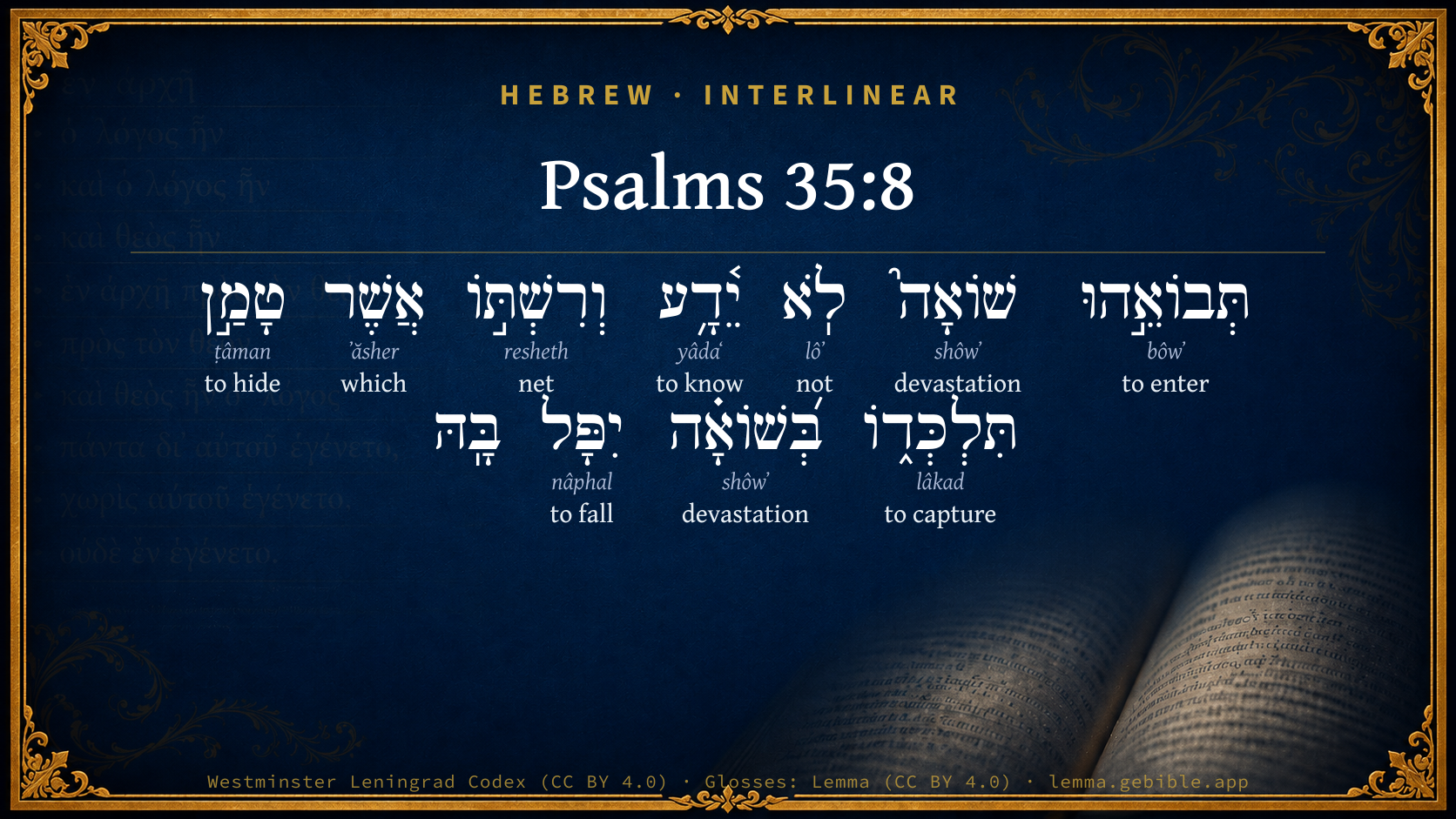
  1. תְּבוֹאֵ֣הוּ bôwʼ H935 “to enter · him” Verb, Qal, Imperfect, 3rd Person, Feminine, Singular + Suffix, Personal, 3rd Person, Masculine, Singular
  2. לֹֽא lôʼ H3808 “not” Particle, Negative
  3. יֵ֫דָ֥ע yâdaʻ H3045 “to know” Verb, Qal, Imperfect, 3rd Person, Masculine, Singular
  4. וְרִשְׁתּ֣וֹ resheth H7568 “and · net · his” Conjunction + Noun, Common, Feminine, Singular, Construct + Suffix, Personal, 3rd Person, Masculine, Singular
  5. אֲשֶׁר ʼăsher H834 “which” Particle, Relative
  6. טָמַ֣ן ṭâman H2934 “to hide” Verb, Qal, Perfect, 3rd Person, Masculine, Singular
  7. תִּלְכְּד֑וֹ lâkad H3920 “to capture · him” Verb, Qal, Imperfect, 3rd Person, Feminine, Singular + Suffix, Personal, 3rd Person, Masculine, Singular
  8. בְּ֝שׁוֹאָ֗ה shôwʼ H7722 “in/at · devastation” Preposition + Noun, Common, Feminine, Singular, Absolute
  9. יִפָּל nâphal H5307 “to fall” Verb, Qal, Imperfect, 3rd Person, Masculine, Singular

About this verse

These counts appear in no published source. They are computed here, from the morphology-tagged text and Lemma’s own curated glosses. What Lemma adds →

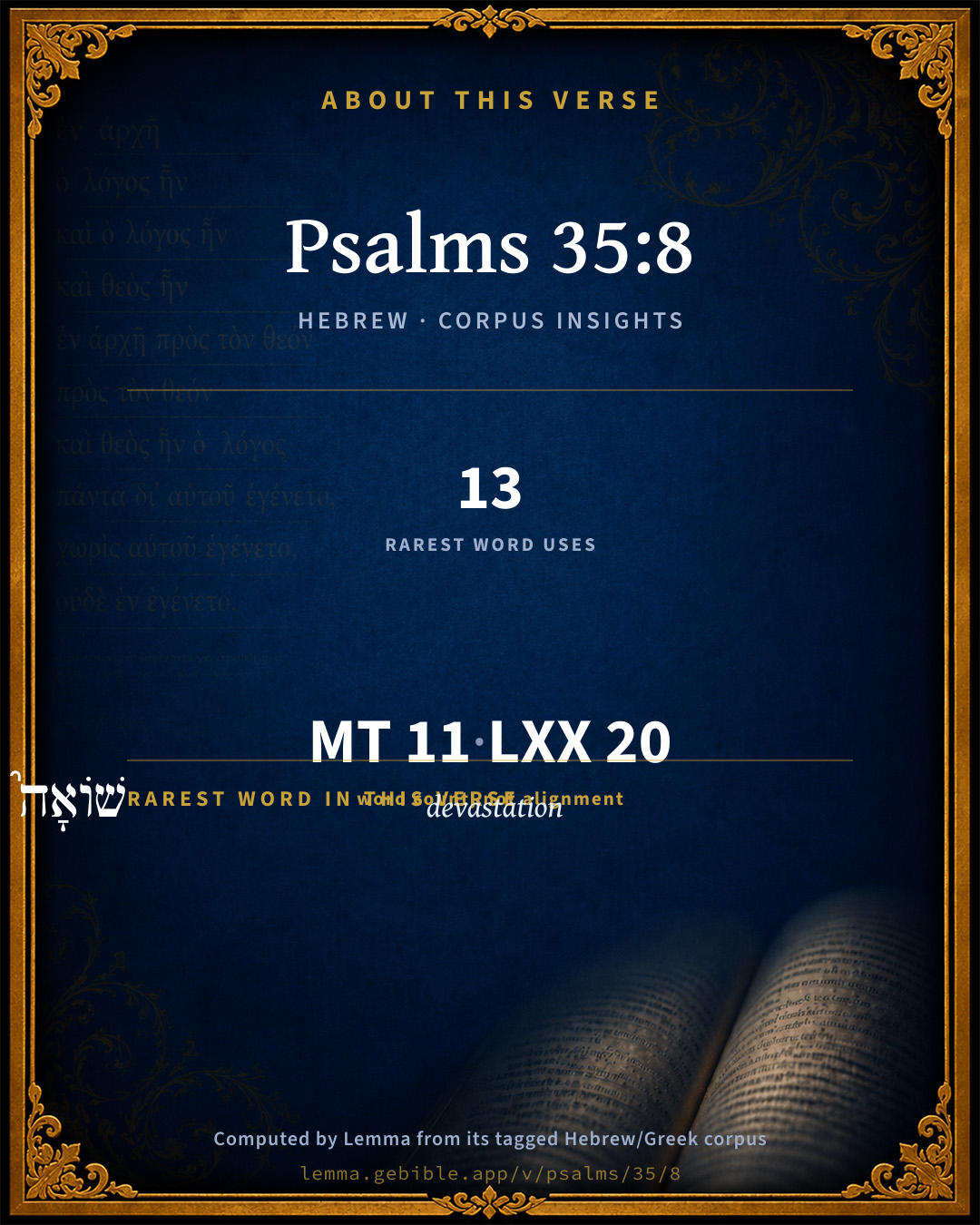
11
words
9
distinct lemmas
Wisdom
section

Notable vocabulary

The rarest word here is שׁוֹאָה֮ devastation H7722 — appearing just 13 times in the whole Hebrew Bible.

Shared distinctive vocabulary

שׁוֹאָה֮ devastation H7722 occurs in 12 verses of the Hebrew Bible. Also found in:

Grammatical profile

  • 5 verbs
  • 3 nouns
  • 1 preposition
  • 2 particles

Verb forms

  • תְּבוֹאֵ֣הוּ Qal · Imperfect
  • יֵ֫דָ֥ע Qal · Imperfect
  • טָמַ֣ן Qal · Perfect
  • תִּלְכְּד֑וֹ Qal · Imperfect
  • יִפָּל Qal · Imperfect

Repetition

A word recurs within this verse — often emphatic in Hebrew:

  • שׁוֹאָה֮ devastation H7722 ×2

Hebrew & Septuagint length

In English translation the verse runs 21 words from the Hebrew and 27 from the Septuagint (LXX English) — closely comparable.

A rough comparison of the two English renderings, which tokenize alike — not a word-level alignment.

Word counts can differ between the Hebrew and the Greek without any difference in meaning — e.g. the Hebrew direct-object marker אֵת has no separate Greek word, and Greek often adds the article ὁ.

In the original languages it is 11 Hebrew tokens and 20 Greek tokens — but the two are counted differently (Hebrew bundles its prefixes and suffixes into one token; the Greek is in lemma form), so that isn’t a like-for-like length.

Cross-references

18

Topical passages linked to Psalms 35:8 in the Treasury of Scripture Knowledge — connected by theme and wording, ordered by reader-vote popularity; previews shown in the World English Bible.

  • Psalms 141:9–10 Keep me from the snare which they have laid for me, From the traps of the workers of iniquity.
  • Luke 21:34 "So be careful, or your hearts will be loaded down with carousing, drunkenness, and cares of this life, and that day will come on you suddenly.
  • Psalms 9:15 The nations have sunk down in the pit that they made; In the net which they hid, their own foot is taken.
  • Proverbs 5:22 The evil deeds of the wicked ensnare him. The cords of his sin hold him firmly.
  • Psalms 57:6 They have prepared a net for my steps. My soul is bowed down. They dig a pit before me. They fall into the midst of it themselves. Selah.
  • Isaiah 47:11 Therefore shall evil come on you; you shall not know the dawning of it: and mischief shall fall on you; you shall not be able to put it away: and desolation shall come on you suddenly, which you don't know.
  • 1 Thessalonians 5:3 For when they are saying, "Peace and safety," then sudden destruction will come on them, like birth pains on a pregnant woman; and they will in no way escape.
  • 1 Samuel 18:17 Saul said to David, Behold, my elder daughter Merab, her will I give you as wife: only be valiant for me, and fight Yahweh's battles. For Saul said, Don't let my hand be on him, but let the hand of the Philistines be on him.
  • Esther 7:10 So they hanged Haman on the gallows that he had prepared for Mordecai. Then was the king's wrath pacified.
  • Psalms 7:15–16 He has dug a hole, And has fallen into the pit which he made.
  • Psalms 73:18–20 Surely you set them in slippery places. You throw them down to destruction.
  • Proverbs 29:1 He who is often rebuked and stiffens his neck Will be destroyed suddenly, with no remedy.
  • 1 Samuel 31:2–4 The Philistines followed hard on Saul and on his sons; and the Philistines killed Jonathan, and Abinadab, and Malchishua, the sons of Saul.
  • 2 Samuel 17:2–4 and I will come on him while he is weary and weak-handed, and will make him afraid; and all the people who are with him shall flee; and I will strike the king only;
  • 2 Samuel 17:23 When Ahithophel saw that his counsel was not followed, he saddled his donkey, and arose, and got him home, to his city, and set his house in order, and hanged himself; and he died, and was buried in the tomb of his father.
  • 2 Samuel 18:14–15 Then said Joab, I may not wait thus with you. He took three darts in his hand, and thrust them through the heart of Absalom, while he was yet alive in the midst of the oak.
  • Psalms 64:7 But God will shoot at them. They will be suddenly struck down with an arrow.
  • Matthew 27:3–5 Then Judas, who betrayed him, when he saw that Jesus was condemned, felt remorse, and brought back the thirty pieces of silver to the chief priests and elders,

Cross-references courtesy of OpenBible.info (CC BY 4.0).

Hebrew and Greek witnesses Masoretic Hebrew ↔ Greek Septuagint

The same verse in the two great witnesses to the Old Testament, shown verse-for-verse.

You’re reading Greek Psalm 34 (Hebrew Psalm 35). The Septuagint counts the superscription, so verse numbers can differ from the Hebrew — chapter-level alignment, not verse-by-verse. Numbering follows Rahlfs.

These are two independent witnesses, not word-aligned to each other, and the Septuagint is shown in lemma (dictionary) form.

Hebrew Psalms 35:8 Masoretic · Westminster Leningrad Codex

תְּבוֹאֵ֣הוּ שׁוֹאָה֮ לֹֽא יֵ֫דָ֥ע וְרִשְׁתּ֣וֹ אֲשֶׁר טָמַ֣ן תִּלְכְּד֑וֹ בְּ֝שׁוֹאָ֗ה יִפָּל בָּֽהּ

Let destruction come on him unawares. Let his net that he has hidden catch himself. Let him fall into that destruction.

World English Bible · Public Domain

Greek LXX Greek Psalm 34:8 Septuagint · lemma form

ἔρχομαι αὐτός παγίς ὅς οὐ γιγνώσκω καί ὁ θήρα ὅς κρύπτω συνλαμβάνω αὐτός καί ἐν ὁ παγίς πίπτω ἐν αὐτός

Let a snare which they know not come upon them; and the gin which they hid take them; and let them fall into the very same snare.

LXX2012 (modern English Septuagint) · Public Domain

On this verse, Ellicott's Commentary for English Readers discusses the Septuagint’s reading. Read the note in Commentary ↓

Hebrew: Westminster Leningrad Codex (CC BY 4.0). Greek: Septuagint (public domain); English from LXX2012 (modern English Septuagint) (Public Domain). How the Septuagint differs from the Hebrew →

Commentary

Notes on Psalms 35:8 from classic Christian and Jewish commentators (each source and its license shown beneath its notes). The classic Christian expositions comment on the surrounding passage and are grouped to its opening verse, so a note may address several verses; the Jewish commentaries on the Tanakh (Rashi and others) are per-verse, so they appear only where the commentator wrote on this verse.

Lemma curates 59 commentaries, every one of them public domain or Creative Commons licensed, each selected and text-cleaned for this edition rather than reprinted as found. About our sources →

Trapp's Complete Commentary

John Trapp

Psa 35:8 Let destruction come upon him at unawares; and let his net that he hath hid catch himself: into that very destruction let him fall.

Ver. 8. Let destruction come upon him unawares] i.e. Upon the whole rabble of them, as if they were all but one man. Or else he striketh at some chieftain among them. Let his destruction be as sudden as signal.

John Trapp, A Commentary or Exposition upon All the Books of the Old and New Testament (1647–1656) — public domain. Text from a community e-Sword module.

The Biblical Illustrator

Joseph S. Exell

Psa_35:8

Say unto my soul, I am thy salvation.

Saved or unsaved

I. the earnest entreaty of a troubled soul. It was said of the great Sir Isaac Newton that he had a white soul, so pure was it. But this can be said of very few. They do not feel their need of salvation. When you become awakened it is a crisis of your life. You begin to ask concerning things whether they be right or wrong. Your conscience is tender and sensitive. And you must hear for yourself. Say unto my soul--so reads the text. But whose soul? Why, the soul of every man who desires salvation.

II. the boon desired. It is salvation. Our Lord Jesus is willing to save all men. More willing than the men in the lifeboat to save the people from the wreck. Sometimes the lifeboat dare not venture out to sea; but there is never a time when the Lord Jesus will refuse to save shipwrecked souls. I was much touched to hear a lifeboat man say, that at a certain wreck off the Ormes Head, near Llandudno, when the lifeboat put off to save the passengers and sailors of the vessel in distress, it was impossible to take all of them into the boat, and many were left. The men would have gladly saved all, but their boat was not large enough. Now, our Lord can save all mankind. And He will save us from our faults as well as from our sins. And you need this, for faults will grow up into sins if not rooted out.

III. the certainty of God doing this. He says I am thy salvation. What God says, can and will be done. It is not I may, or I could do this; but I am thy salvation. If God can make a world so beautiful as this, can He not purify our souls? If He can tint the flower and make it lovely, cannot He redeem us from all iniquity?

IV. there is a personal assurance of salvation. Say unto my soul, I am thy salvation. Hannah More once said that if we preach about a privilege and do not mention the person who should have the privilege, it is like putting a letter into the post-office without any direction upon it. If you want this salvation, it is ready; but for whom is it intended? For every creature, and it is particularly addressed to you. Jesus did not say, Go into all the world and save nations, but Go into all the world and preach the good news to every creature. So, this salvation is meant for you. Then, when you are saved, your example shall bless the world. But until you are saved, your example is worth very little. (W. Birch.)

Full assurance

Many enemies were round David, but he feels there is only one thing God needs to do to make him strong. Let but God say unto his soul, I am thy salvation, and he will defy them all.

I. objections to the doctrine of full assurance.

1. Some say it is better a man should stand in jeopardy, better for him to have doubts and fears.

2. Others say full assurance cannot be had. But it is possible, and has been enjoyed by many. If it were impossible, would we, as here, be told to pray for it? Romanists and formalists object; the former because it would do away with Purgatory, and the latter because they want no one to be better than themselves.

3. Others because some have pretended to it who have never been saved.

4. Or because they think the doctrine makes men careless. But confidence of success stimulates exertion, and realizing assurance overcomes all difficulties.

5. Others who trust in their good feelings would have us groan in the Lord always. Of all the Diabolians, Mr. Live-by-feeling was one of the worst.

II. the text itself. It seems to say--

1. That David had his doubts, or he would not have thus prayed.

2. But he was not content to remain in doubt.

3. And he knew where to obtain full assurance. Then take each word of the text and note its force. It is by His word, and by His ministers, and by His Holy Spirit, God says this to the soul.

III. hear the preacher. He would speak to those who neither know nor care to know that they are saved; beware of your condition, for it is full of peril. And what folly on your part, for you have soon to die. And though you may not now feel it, you are most miserable. But do you wish to be saved? Then Christ is for thee. (C. H. Spurgeon.)

Heaven made sure, or the certainty of salvation

The words contain a petition for a benediction. The supplicant is a king, and his humble suit is to the King of kings: the king of Israel prays to the King of heaven and earth. He doth beg two things:--

1. That God would save him.

2. That God would certify him of it. So that the text may be distributed accordingly into salvation, and the assurance of it. The matter is assurance; the manner, how assured: Say unto my soul.

I. from the matter, or assurance, observe--

1. That salvation may be made sure to a man. David would never pray for that which could not be. Nor would St. Peter charge us with a duty which stood not in possibility to be performed (2Pe_1:10). Make your election sure. Paul directly proves it (2Co_13:5), Know ye not your own selves, how that Jesus Christ is in you, except ye be reprobates? We may then know that Christ is in us.

2. That the best saints have desired to make their salvation sure. David that knew it, yet entreats to know it more (Psa_41:11). I know thou favourest me; yet here still, Say unto my soul, I am thy salvation. A man can never be too sure of his going to heaven. If we purchase an estate here, we make it as sure, and our tenure as strong, as the brawn of the law or the brains of the lawyer can devise. Now from this desire of David we draw matter--

(1) Of consolation. Even he desired better assurance. Sometimes a dear saint may want feeling of the spirit of comfort. But God doth sometimes hide from men this comfort--to extend their desires, to enlarge their joys when they shall again find the consolation they thought lost. To try whether we will serve God gratis, though we get nothing for it (Job_1:9). To make us more careful of this comfort when we have it.

(2) Of reprehension to others who are thinking all is well when it is not so.

(3) Of instruction, teaching us to keep the even way of comfort; eschewing both the rock of presumption on the right hand, and the gulf of desperation on the left. Let us neither be over-bold nor over-fainting, but endeavour by faith to assure ourselves of Jesus Christ, and by repentance to assure ourselves of faith, and by an amended life to assure ourselves of repentance. For they must here live to Gods glory that would hereafter live in Gods glory.

3. In the next place, observe the means how we may come by this assurance. This is discovered in the text, Say unto my soul.

4. Such assurance is the sweetest comfort that can come to a man in this life. There is no potion of misery so embittered with gall but this can sweeten it with a comfortable relish. When enemies assault us, get us under, triumph over us, imagining that salvation itself cannot save us, what is our comfort? I know whom I have believed; I am sure the Lord will not forsake me. What state can there be wherein the stay of this heavenly assurance gives us not peace and joy?

II. the manner. Say unto my soul. God bath spoken--

1. By His own voice (Gen_3:8; Deu_4:15; Joh_12:28; 2Pe_1:17).

2. By His works (Psa_19:1).

3. By His Son (Heb_1:1).

4. By the Scriptures (Rom_15:4). Oh that we had hearts to bless God for His mercy, that the Scriptures are among us, and that not sealed up under an unknown tongue!

5. God speaks by His ministers, expounding and opening to us those Scriptures. These are dispensers of the mysteries of heaven. This voice is continually sounding in our churches, beating upon our ears; I would it could pierce our consciences, and that our lives would echo to it in an answerable obedience. How great should be our thankfulness! Let us not say of this blessing, as Lot of Zoar, Is it not a little one? nor be weary of manna with Israel, lest Gods voice grow dumb unto us, and, to our woe, we hear it speak no more. No, rather let our hearts answer with Samuel (1Sa_3:10), Speak, Lord, for thy servants hear. If we will not hear Him say to our souls, I am your salvation, we shall hear Him say, Depart from Me, I know you not.

6. God speaks by His Spirit: this Spirit beareth witness with our spirit, etc. Perhaps this is that voice behind us (Isa_30:21), as it were, whispering to our thoughts, This is the way, walk in it. It is the Churchs prayer (Son_1:2). The Holy Ghost is the kiss of God the Father. Whom God kisseth, He loveth. Now by all these ways doth God speak peace to our consciences, and say to our souls that He is our salvation: I am thy salvation.--The petition is ended. I will but look into the benediction, wherein I should consider these four circumstances: Who, What, To whom, When. Who?--The Lord. He alone can (Hos_13:9). What?--Salvation. A special good thing: every mans desire, though he be running hellward. Man would be blessed, though he takes the course to be cursed. I will give thee a lordship, saith God to Esau. I will give thee a kingdom, said God to Saul. I will give thee an apostleship, saith God to Judas. But, I will be thy salvation, He says to David, and to none but saints. To Whom?--My soul. Not others only, but mine. When?--In time present. I am. To conclude: it is salvation our prophet desires. Not riches. He that prefers riches before his soul doth but sell the horse to buy the saddle, or kill a good horse to catch a hare. He begs not honour: many have leapt from the high throne to the low pit. The greatest commander on earth hath not a foot of ground in heaven, except he can get it by entitling himself to Christ. He desires not pleasures; he knows there are as great miseries beyond prosperity as on this side it. And that all vanity is but the indulgence of the present time; a minute begins, continues, ends it: for it endures but the acting, and leaves no solace in the memory. In the fairest garden of delights there is somewhat that stings in the midst of all vain contents. The Christian seeks that better part which shall never be taken from him. (T. Adams.)

Soul salvation

Our text brings to our view the soul of man, and, whilst preaching therefrom, I also will try to show some of the causes of the apparent failure of Christianity. It is not Christianity which is at fault, but Christians who are not Christlike.

I. why is it that men do so neglect religion?

1. A large portion of the community is deceived by riches. They think all their happiness lies in what riches can give. Hence they toil early and late; they think about nothing else. But when they get rich they are never satisfied. I do not ask for an equal distribution of wealth, but I call upon the rich to be trustees for the world, and to say, Lord, all that I have is Thine; how shall I use it for Thy glory, and for the good of my fellow-men? Another cause of the apparent failure of Christianity is--

2. The errors of many teachers and ministers.

3. A third cause is the unreasonableness of scepticism. Christianity has blessed the lives of all who believed in it. It has made the drunkard sober, the thief honest, and has delivered men from the power of darkness into Gods marvellous light. The path of Christs truth will Carry the world to peace and happiness, if they will but walk therein.

4. The last cause which I shall mention is that people hold false notions about God. Many men think if they pay a large sum to a church, or to some good cause, God will smile upon them. And the unfortunate one who, time after time, relapses into sin believes God cannot forgive one who falls so often. He may forgive and bless those who live righteously, but can He bless me? He can: He is waiting to bless thee.

II. We have now to notice as earnest desire. David, remembering the past, and fearing for the future, earnestly desires soul salvation. Oh God! say unto my soul, I am thy salvation.

1. He desires salvation from the burden of sin. Even as a man working in a coal-pit, upon whom the earth has fallen, earnestly cries for help, so the Christian is in agony to be saved from the burden with which his sins have fallen upon his memory and his conscience.

2. We also have here an earnest desire for salvation from the power of sin. In the sad days of American slavery, I have read of a maiden being bought by a very wicked man for purposes of sin and shame, and she, weeping, as she was dragged along the road to his estate, shrieked piteously for a deliverer. Poor thing! the law gave the monster the power over her. But how different when we in the bondage of sin, cry out to God for help. Christ comes and delivers his people from the power of sin.

III. the delightful expectation of the text. It is to have Gods voice to be heard in the soul. Say unto my soul, I am thy salvation. There may be some here who cannot find peace and holiness, and who now cry for salvation. Losing your way whilst wandering in an underground cavern and your light burning out, it is delightful to hear the guide in the distance cry, All right, my friend, I know where you are, and will lead you safely out. Likewise the promise is, The Lord whom ye seek shall suddenly return to His temple. Pray on, hope on, believe on. You shall hear His voice, for He hath promised. (W. Birch.)

The Biblical Illustrator, edited by Joseph S. Exell (c. 1880s–1900s) — public domain. Text from a community e-Sword module.

Joseph Benson's Commentary

Psa 35:8-10. Let destruction come upon him — Upon each of thine and mine implacable enemies, of whom he had hitherto spoken. Or, rather, by this change of the plural number into the singular, he points at Saul, his chief and most implacable enemy. And my soul shall be joyful in the Lord — In and for his glory and service, which, by these means, will be advanced, and for his favour to me. All my bones shall say — My whole body, with all its members, as well as all the faculties of my soul, shall be affected with a deep sense of thy goodness toward me, and thereby shall set forth thy praise. The expressions are figurative, as where the bones are said to be vexed, and to rejoice, Psa 6:2; Psa 51:8, and the loins to bless, Job 31:20.

Joseph Benson's Commentary on the Old and New Testaments (1811–1818) — public domain. Text from a community e-Sword module.

J. A. Alexander on Psalms

Joseph Addison Alexander

8. (Psa 35:8) Let ruin come (upon) him (when) he does not know; and his net which he hid—let it take him—with ruin (to his ruin) let him fall into it. The first noun properly denotes a crash, as of a falling house, and then a ruin, both in the narrower and wider sense. When he does not know, unawares, unexpectedly, as in Isa 47:11, Job 9:5. The last clause may also be translated, into ruin let him fall into it, i.e. as the common version has it, into that very ruin. But it is simpler to lethim fall with ruin, i.e. ruinously to his own destruction.

Joseph Addison Alexander, The Psalms Translated and Explained (1850) — public domain. Text from a community e-Sword module.

Geneva Bible (1599)

Geneva Bible translators

When he promiseth to himself peace.

Which he prepared against the children of God.

Geneva Bible (1599) marginal notes — public domain. Text via Bolls.life.

Adam Clarke's Commentary

Verse 8. Let his net that he hath hid] See the notes on Ps 7:15; Ps 7:16.

Adam Clarke's Commentary on the Bible (1810–1826) — public domain. Text from a community e-Sword/MySword module.

John Calvin's Commentaries

8. Let confusion of which he is not aware come upon him. David again prays that God would cause to return upon the head of his enemies the mischief which they had directed against a just and an inoffensive man. The change from the plural to the singular number, even when the same subject, is spoken of, is, we know, a thing very common among the Hebrews. Accordingly, what is here said of one man is applicable to all David’s enemies in general, unless, perhaps, we are rather inclined to suppose that allusion is here made to Saul or some one of his nobles. But as it is certain that the prayer which he here offers against Saul as the head extends to the whole body, in other words, to all his followers, “Qu’il fait yci contre Saul comme le chef, s’estend a tout le corps, c’est a dire, tous ses adherens.” — Fr.

John Calvin's Commentaries (1540-1563) — public domain. Text from the Calvin Translation Society English edition (1840s-50s) via the Christian Classics Ethereal Library (ccel.org). Calvin's coverage is partial (roughly two-thirds of the Bible); uncommented books and verses are honest gaps, never fabricated. The 19th-century editor's footnotes and remarks are omitted so the notes are faithfully Calvin's own voice.

Ellicott's Commentary for English Readers

(8) Let destruction.—There is considerable difficulty here, and the ancient versions, by their variations, seem to point to some confusion in the text. The LXX., no doubt, are right in reading the pronouns as plurals, instead of singular. The word translated “destruction” means, primarily, a storm, or the crash that accompanies a storm (Pro_1:27), and if with the Syriac we might supply a clause, both parallelism and sense would be complete.

“Let men come upon him (them) unexpectedly.

Let the net which he had catch himself,

The pit which he (they) digged, let him (them) fall into it,

In ruin let him (them) fall into it.”

For “unawares,” see margin and Note, Son_6:12.

A Bible Commentary for English Readers, edited by Charles John Ellicott (1878–1897) — public domain. Text from a community e-Sword module.

The Cambridge Bible for Schools and Colleges

gen. ed. J. J. S. Perowne

8. Let his mischief recoil upon his own head. Cp. Psa_7:15; Psa_9:15; Psa_57:6; and with the first line cp. Isa_47:11. Does the singular individualise each one of the enemies, or particularise one above all the rest, or speak of them collectively in the mass? It is less easy to decide here than in Psa_7:2.

into that very destruction let him fall] R.V. renders, With destruction let him fall therein, retaining A.V. in the marg. But neither rendering is satisfactory; and it is possible (especially in view of the almost certain textual errors in Psa_35:5-7) that the original reading was, and his pit that he hath dug, let him fall therein.

The Cambridge Bible for Schools and Colleges (gen. ed. J. J. S. Perowne; Cambridge University Press, 1878–1918) — public domain. Text from a community e-Sword module.

John Gill's Exposition

Let destruction come upon him at unawares,.... Or a "storm" (r), such as is caused in the eastern countries by a south wind, very sudden, violent, and destructive (s): the singular number being here used, some Jewish commentators, as Kimchi, have thought Saul is particularly meant; and some Christian interpreters have been of opinion that Judas is intended: the imprecations here may be compared with those which respect him, Psa 109:6. Though this may regard every one of the enemies of David, or of Christ and his people, whose ruin and destruction will come upon them unawares; see Th1 5:3;

and let his net that he hath laid catch himself; a figurative expression, agreeable to the allusion before made, and which is explained in the next clause;

into that very destruction let him fall, which he had designed and contrived for others; so Haman was hanged on the same gallows he had prepared for Mordecai; and so it often is in the course of Providence, that the wicked fall into the same calamity they have intended and endeavoured to bring others into; see Psa 7:15.

(r) "tumultuosa calamitas", Cocceius; so Ainsworth; "tumultus", Vatablus. (s) See Thevenot, Tavernier, &c.

John Gill's Exposition of the Whole Bible (1746–1763) — public domain (CC PDM 1.0). Text via the HelloAO Bible API.

Albert Barnes' Notes on the Bible

Let destruction come upon him at unawares - Margin, which “he knoweth not of.” So the Hebrew. The meaning is, Let destruction come upon him when he is not looking for it, or expecting it.

And let his net that he hath hid catch himself - See the notes at Psa 7:15-16. The psalmist prays here that the same thing may occur to his enemy which his enemy had designed for him. It is simply a prayer that they might be treated as they purposed to treat him.

Albert Barnes' Notes on the Bible (1834–1885) — public domain. Text from a community e-Sword/MySword module.

Matthew Poole's English Annotations

Upon him, i.e. upon each of thine and mine implacable enemies, of whom he hath hitherto spoken.

Matthew Poole's English Annotations on the Holy Bible (1683–1685) — public domain. Text from a community e-Sword/MySword module.

The Treasury of David

Charles H. Spurgeon

Ver. 8. Let destruction come upon him at unawares. This tremendous imprecation is frequently fulfilled. God's judgments are often sudden and signal. Death enters the persecutor's house without pausing to knock at the door. The thunderbolt of judgment leaps from its hiding place, and in one crash the wicked are broken for ever. And let his net that he hath hid catch himself: into that very destruction let him fall. There is a lex talionis with God which often works most wonderfully. Men set traps and catch their own fingers. They throw up stones, and they fall upon their own heads. How often Satan outwits himself, and burns his fingers with his own coals! This will doubtless be one of the aggravations of hell, that men will torment themselves with what was once the fond devices of their rebellious minds. They curse and are cursed; they kick the pricks and tear themselves; they pour forth floods of fire, and it burns within and without.

Ver. 8. Let destruction come upon him at unawares. Or a storm, such as is caused in the Eastern countries by a south wind, very sudden, violent, and destructive. John Gill.

Ver. 8. Let his net that he hath hid catch himself: into that very destruction let him fall. By giving Ahithophel rope enough, the Lord preserved David from perishing. Who will not admire that Goliath should be slain with his own sword, and that proud Haman should hold Mordecai's stirrup, and be the herald of his honour? The wicked shall be undone by their own doings; all the arrows that they shoot at the righteous shall fall upon their own pates. Maxentius built a false bridge to drown Constantine, but was drowned himself. Henry the Third of France was stabbed in the very same chamber where he had helped to contrive the cruel massacre of the French Protestants. And his brother, Charles the Ninth, who delighted in the blood of the saints, had blood given him to drink, for he was worthy. It is usual with God to take persecutors in the snares and pits that they have laid for his people, many thousands in this nation have experienced; and though Rome and her confederates are this day laying snares and traps and digging pits for the righteous, who will rather burn than bow to their Baal, yet do but wait and weep, and weep and wait a little, and you shall see that the Lord will take them in the very snares and pits that they have laid and digged for his people. Condensed from Thomas Brooks.

Ver. 8. Let the net that he hath hid catch himself. Thou fool, who opposest thy counsels to those of the Most High. He who devises evil for another, falls at last into his own pit, and the most cunning finds himself caught by what he had prepared for another. But virtue without guile, erect like the lofty palm, rises with greater vigour when it is oppressed. Pietro Metastasio, 1698-1782.

Ver. 8. Destruction at unawares, an awful topic.

Psalms 35:9*

Charles H. Spurgeon's The Treasury of David (1869–1885) — public domain. Psalms only. Text from a community e-Sword/MySword module.

Whedon's Commentary on the Bible

Daniel D. Whedon

8. Destruction… at unawares—As to a lion caught in a “net” or “pit.” Quite a family of Hebrew words describe the General idea of defeat, overthrow, or destruction. The temporal sense must be adhered to in this place. David follows the policy of his enemies, and only prays that their evil devices may turn back upon them to their own defeat. The lex talionis—the principle of all retributive justice—is simply followed out. See Psa_35:17, and Psa_63:9

Daniel D. Whedon (gen. ed.), Commentary on the Old and New Testaments (1874–1909) — public domain. Text from a community e-Sword module.

The Pulpit Commentary

Let destruction come upon him at unawares; i.e. let the evil happen to him that he designed against others. As he sought to catch others in traps of which they knew nothing (ver. 7), so let an unexpected destruction come upon him. And let his net that he hath hid catch himself. (comp. Psa_9:15, 16 57:6 141:10) It is the perfection of poetic justice when "the engineer" is "hoist by his own petard." Into that very destruction lot him fall; rather, for destruction let him fall therein; i.e. let him not only fall into his own trap, but let his fall prove his destruction. David"s imprecations have always something about them from which the Christian shrinks; and this is particularly the case when he asks for his enemies" destruction.

The Pulpit Commentary (1880–1919), ed. H.D.M. Spence-Jones & Joseph S. Exell — public domain. Text from a community e-Sword module.

Rashi

Rabbi Shlomo Yitzchaki (Rashi)

darkness Heb. שואה, darkness, broine in Old French, obscurity.

and his net that he hid So is the custom to hide the net and to cover it with straw or with earth, in order that the one who passes over it should not notice it until he is trapped in it.

Rashi on the Tanakh — English translations: “The Judaica Press complete Tanach with Rashi, translated by A. J. Rosenberg” (CC BY 4.0); “Pentateuch with Rashi's commentary by M. Rosenbaum and A.M. Silbermann, 1929-1934” (public domain); “The Metsudah Tanach series, Lakewood, N.J” (CC BY 4.0); and “The Book of Joshua, Metsudah Publications, 1997” (CC BY 4.0). Text via Sefaria.

Lesson kit

Teaching starters — assembled from the data on this page, not authored interpretation. Every prompt links to the verse data it draws on. Edit before teaching.

Psalms, in the Wisdom, opens this verse with 11 words (9 distinct Hebrew lemmas). Its most distinctive word is shôwʼ (“devastation”). A historical commentator’s framing appears above. Read the whole chapter for the surrounding context.

Discussion questions

  1. The word shôwʼ carries the sense “devastation.” How does it shape the verse?
  2. Job 30:3 shares the word «devastation» with this verse. How do the two illuminate each other?
  3. “devastation” occurs 2× in this one verse. What is the effect of the repetition?
  4. These translations render this verse differently. What is at stake in choosing one wording over another?
  5. The verb «תְּבוֹאֵ֣הוּ» is Qal Imperfect. How does its form color the action?
  6. Reading how Trapp's Complete Commentary and The Biblical Illustrator read this verse, where do the two commentators agree and where do they part?

Things to notice

Reading settings

Reading text

Shown beneath each verse's original-language words.

Old Testament
Old Testament edition

Read the OT as the Masoretic Hebrew (MT) or the Greek Septuagint (LXX).

English shown for the Greek Septuagint (in the Hebrew ↔ Greek comparison).

Comparing translations? Open the Compare panel on any verse page to stack up to four side by side.