Joshua 15:17

Hebrew (Westminster Leningrad Codex) Joshua 15:17 appears in the Hebrew Old Testament. The text above is from the Westminster Leningrad Codex. Each word links to its Strong’s number, a concise gloss, and parsing drawn from the Open Scriptures Hebrew Bible morphology. Click any word for its full Brown-Driver-Briggs (BDB) entry.
Download image
Cite this verse

Joshua 15:17 (World English Bible). Public Domain. Lemma interlinear Bible study tool, https://lemma.gebible.app/v/joshua/15/17.

Show BibTeX & RIS
BibTeX
RIS
English Translation
Othniel the son of Kenaz, the brother of Caleb, took it: and he gave him Achsah his daughter as wife.
World English Bible · Public Domain
Highlights
  • 1 first appearance in the Hebrew Bible
Full analysis ↓
Download a study sheet

One document with this verse’s original text, its word-by-word gloss line, the meaning frame, cross-references with their text, attributed commentary, and full source and license credits — printable, and it pastes into notes with its structure intact.

This verse Autodidact and up

Study sheet (.html) Plain text (.txt)

A passage Seminary Student

Up to 50 verses in one chapter. A passage sheet keeps up to 6 commentary sources and 12 cross-references per verse, in the order this page ranks them, and says so on the sheet whenever that leaves anything out. Ask for a single verse and you get the Autodidact verse sheet above.

Everything on this page stays free to read, with no account — the sheet is a download of what is already on screen, not access to it.

Want to remove ads? Support Godless Engineer
Compare translations 3

The same verse in 3 English versions, stacked beneath the original-language interlinear above. Click any original word for its lexicon entry.

Each is an independent rendering of the whole verse — the interlinear is not word-aligned to these translations.

Highlighted words mark where these versions differ — a whole-verse word diff, not a word-by-word alignment.

  • World English Bible Public Domain
    Othniel the son of Kenaz, the brother of Caleb, took it: and he gave him Achsah his daughter as wife.
  • King James Version Public Domain
    And Othniel the son of Kenaz, the brother of Caleb, took it: and he gave him Achsah his daughter to wife.
  • unfoldingWord Literal Text CC BY-SA 4.0
    And Othniel, the son of Kenaz, the brother of Caleb, captured it. So he gave his daughter Achsah to him for a wife.

unfoldingWord Literal Text — © unfoldingWord, licensed CC BY-SA 4.0. Word-aligned USFM3 via Door43 (git.door43.org/unfoldingWord/en_ult).

Versions to compare (up to 4)

3 of 4 selected

Show all 18 translations

Every available English version of this verse, each an independent rendering of the whole verse.

  • World English Bible Public Domain
    Othniel the son of Kenaz, the brother of Caleb, took it: and he gave him Achsah his daughter as wife.
  • Berean Standard Bible Public Domain
    So Othniel son of Caleb’s brother Kenaz captured the city, and Caleb gave his daughter Acsah to him in marriage.
  • Majority Standard Bible Public Domain
    So Othniel son of Caleb’s brother Kenaz captured the city, and Caleb gave his daughter Acsah to him in marriage.
  • King James Version Public Domain
    And Othniel the son of Kenaz, the brother of Caleb, took it: and he gave him Achsah his daughter to wife.
  • American Standard Version (1901) Public Domain
    And Othniel the son of Kenaz, the brother of Caleb, took it: and he gave him Achsah his daughter to wife.
  • Revised Version (1885) Public Domain
    And Othniel the son of Kenaz, the brother of Caleb, took it: and he gave him Achsah his daughter to wife.
  • Geneva Bible (1599) Public Domain
    And Othniel, the sonne of Kenaz, the brother of Caleb tooke it: and he gaue him Achsah his daughter to wife.
  • Douay-Rheims (1899) Public Domain
    And Othoniel the son of Cenez, the younger brother of Caleb, took it: and he gave him Axa his daughter to wife.
  • Young's Literal Translation Public Domain
    And Othniel son of Kenaz, brother of Caleb, doth capture it, and he giveth to him Achsah his daughter for a wife.
  • Literal Standard Version CC BY-SA 4.0
    And Othniel son of Kenaz, brother of Caleb, captures it, and he gives his daughter Achsah to him for a wife.
  • Unlocked Literal Bible CC BY-SA 4.0
    When Othniel son of Kenaz, Caleb's brother, captured it, Caleb gave him Aksah his daughter as a wife.
  • unfoldingWord Literal Text CC BY-SA 4.0
    And Othniel, the son of Kenaz, the brother of Caleb, captured it. So he gave his daughter Achsah to him for a wife.
  • Darby Bible Public Domain
    And Othniel the son of Kenaz, the brother of Caleb, took it; and he gave him Achsah his daughter as wife.
  • World Messianic Bible Public Domain
    Othniel the son of Kenaz, the brother of Caleb, took it: and he gave him Achsah his daughter as wife.
  • Webster's Bible Public Domain
    And Othniel the son of Kenaz, the brother of Caleb, took it: and he gave him Achsah his daughter for a wife.
  • Free Bible Version CC BY-SA 4.0
    Othniel, son of Kenaz, brother of Caleb, captured the town so Caleb gave him his daughter Acsah to marry.
  • Bible in Basic English Public Domain
    And Othniel, the son of Kenaz, Caleb's brother, took it: so he gave him his daughter Achsah for his wife.
  • JPS Tanakh (1917) Public Domain
    And Othniel the son of Kenaz, the brother of Caleb, took it; and he gave him Achsah his daughter to wife.

Literal Standard Version (2020), Covenant Press — licensed CC BY-SA 4.0. Text via the HelloAO Bible API (eBible.org). Unlocked Literal Bible (unfoldingWord) — licensed CC BY-SA 4.0. Text via the HelloAO Bible API (eBible.org). unfoldingWord Literal Text — © unfoldingWord, licensed CC BY-SA 4.0. Word-aligned USFM3 via Door43 (git.door43.org/unfoldingWord/en_ult). Free Bible Version, Dr. Jonathan Gallagher — licensed CC BY-SA 4.0. Text via the HelloAO Bible API (eBible.org).

Word by word

More ways to search: Search by grammar → Find every occurrence → Compare this word →

Practice this passage: Drill this verse → Learn its vocabulary →

עַכְסָ֥ה
ʻAkçâh
H5915
“Achsah”
Noun, Proper
Part of Speech
Noun
Type
Proper
Full BDB Definition

Origin: from H5914

TWOT: None

Achsah = "ankle chain" or " anklet" - the daughter of Caleb and wife of Caleb's brother Othniel to whom she was given as a reward for capturing Debir
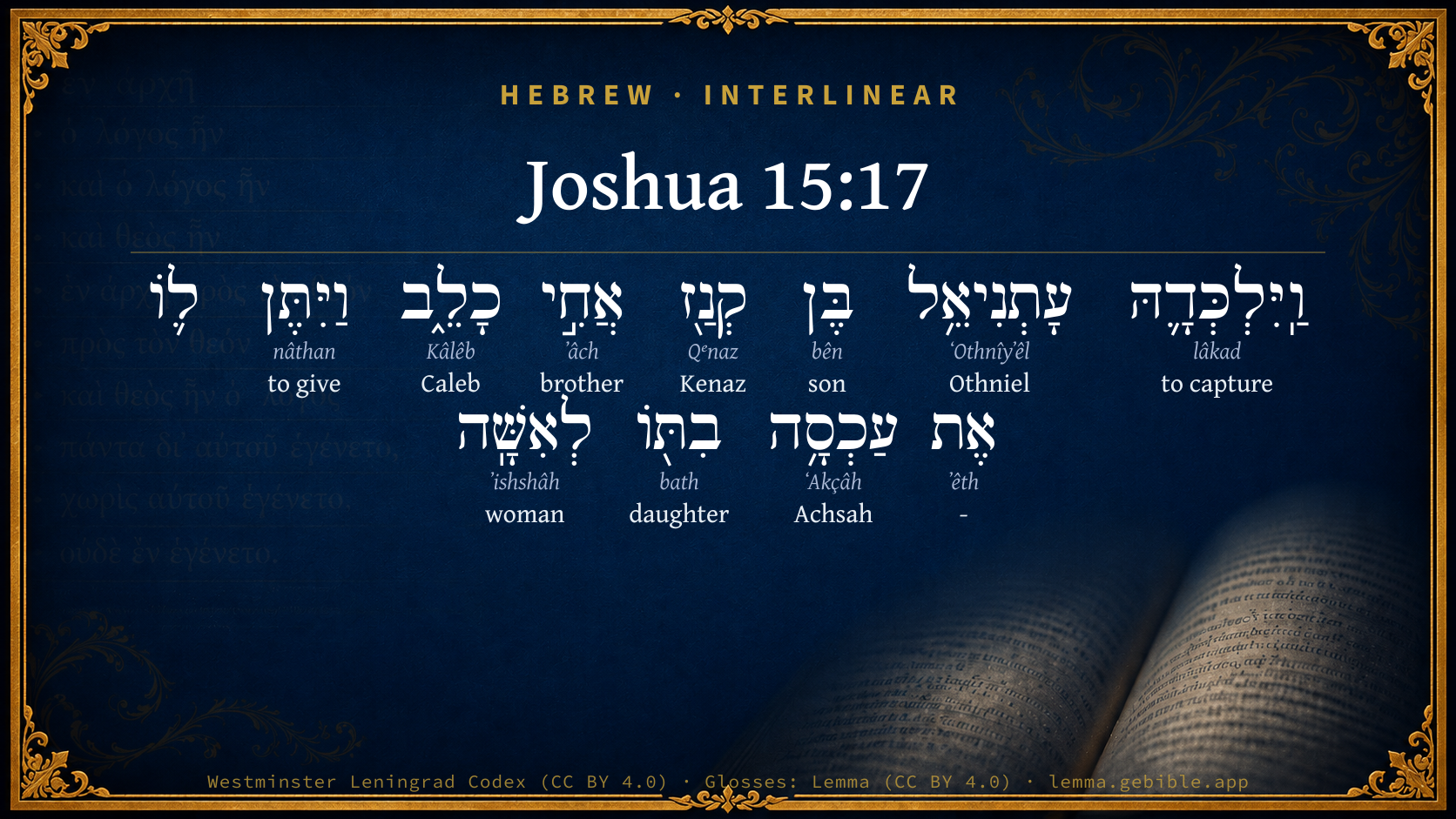
  1. וַֽיִּלְכְּדָ֛הּ lâkad H3920 “and · to capture · her” Conjunction + Verb, Qal, Sequential Imperfect, 3rd Person, Masculine, Singular + Suffix, Personal, 3rd Person, Feminine, Singular
  2. עָתְנִיאֵ֥ל ʻOthnîyʼêl H6274 “Othniel” Noun, Proper
  3. בֶּן bên H1121 “son of” Noun, Common, Masculine, Singular, Construct
  4. קְנַ֖ז Qᵉnaz H7073 “Kenaz” Noun, Proper
  5. אֲחִ֣י ʼâch H251 “brother of” Noun, Common, Masculine, Singular, Construct
  6. כָלֵ֑ב Kâlêb H3612 “Caleb” Noun, Proper
  7. וַיִּתֶּן nâthan H5414 “and · to give” Conjunction + Verb, Qal, Sequential Imperfect, 3rd Person, Masculine, Singular
  8. אֶת ʼêth H853 “-” Particle, Direct Object
  9. בִתּ֖וֹ bath H1323 “daughter · his” Noun, Common, Feminine, Singular, Construct + Suffix, Personal, 3rd Person, Masculine, Singular
  10. לְאִשָּֽׁה ʼishshâh H802 “to/for · woman” Preposition + Noun, Common, Feminine, Singular, Absolute

About this verse

These counts appear in no published source. They are computed here, from the morphology-tagged text and Lemma’s own curated glosses. What Lemma adds →

12
words
11
distinct lemmas
Historical
section

Notable vocabulary

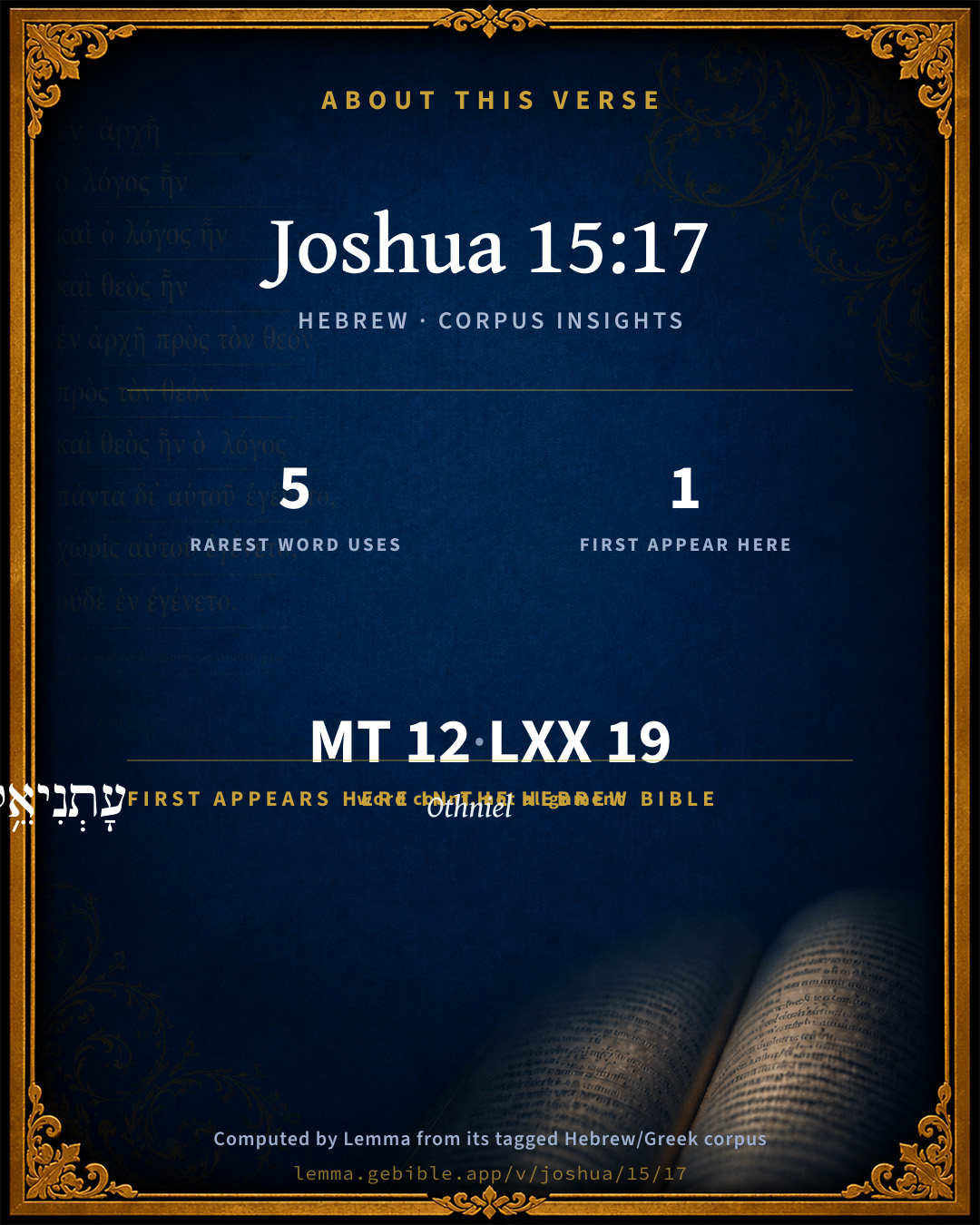
The rarest word here is עַכְסָ֥ה Achsah H5915 — appearing just 5 times in the whole Hebrew Bible.

First appearance in Scripture

This word makes its first canonical appearance in the Hebrew Bible here:

  • עָתְנִיאֵ֥ל Othniel H6274

Shared distinctive vocabulary

עַכְסָ֥ה Achsah H5915 occurs in 5 verses of the Hebrew Bible. Also found in:

Grammatical profile

  • 2 verbs
  • 8 nouns
  • 1 preposition
  • 1 particle

Verb forms

  • וַֽיִּלְכְּדָ֛הּ Qal · Sequential Imperfect
  • וַיִּתֶּן Qal · Sequential Imperfect

Hebrew & Septuagint length

In English translation the verse runs 20 words from the Hebrew and 21 from the Septuagint (LXX English) — closely comparable.

A rough comparison of the two English renderings, which tokenize alike — not a word-level alignment.

Word counts can differ between the Hebrew and the Greek without any difference in meaning — e.g. the Hebrew direct-object marker אֵת has no separate Greek word, and Greek often adds the article ὁ.

In the original languages it is 12 Hebrew tokens and 19 Greek tokens — but the two are counted differently (Hebrew bundles its prefixes and suffixes into one token; the Greek is in lemma form), so that isn’t a like-for-like length.

Cross-references

6

Topical passages linked to Joshua 15:17 in the Treasury of Scripture Knowledge — connected by theme and wording, ordered by reader-vote popularity; previews shown in the World English Bible.

  • Judges 1:13 Othniel the son of Kenaz, Caleb's younger brother, took it: and he gave him Achsah his daughter as wife.
  • Judges 3:9 When the children of Israel cried to Yahweh, Yahweh raised up a savior to the children of Israel, who saved them, even Othniel the son of Kenaz, Caleb's younger brother.
  • Joshua 14:6 Then the children of Judah drew near to Joshua in Gilgal: and Caleb the son of Jephunneh the Kenizzite said to him, You know the thing that Yahweh spoke to Moses the man of God concerning me and concerning you in Kadesh-barnea.
  • Judges 3:11 The land had rest forty years. Othniel the son of Kenaz died.
  • Numbers 32:12 save Caleb the son of Jephunneh the Kenizzite, and Joshua the son of Nun; because they have wholly followed Yahweh.
  • 1 Chronicles 2:49 She bore also Shaaph the father of Madmannah, Sheva the father of Machbena, and the father of Gibea; and the daughter of Caleb was Achsah.

Cross-references courtesy of OpenBible.info (CC BY 4.0).

Hebrew and Greek witnesses Masoretic Hebrew ↔ Greek Septuagint

The same verse in the two great witnesses to the Old Testament, shown verse-for-verse.

These are two independent witnesses, not word-aligned to each other, and the Septuagint is shown in lemma (dictionary) form.

Hebrew Joshua 15:17 Masoretic · Westminster Leningrad Codex

וַֽיִּלְכְּדָ֛הּ עָתְנִיאֵ֥ל בֶּן קְנַ֖ז אֲחִ֣י כָלֵ֑ב וַיִּתֶּן ל֛וֹ אֶת עַכְסָ֥ה בִתּ֖וֹ לְאִשָּֽׁה

Othniel the son of Kenaz, the brother of Caleb, took it: and he gave him Achsah his daughter as wife.

World English Bible · Public Domain

Greek LXX Joshua 15:17 Septuagint · lemma form

καί λαμβάνω αὐτός γοθονιηλ υἱός κενεζ ἀδελφός χαλεβ ὁ νέος καί δίδωμι αὐτός ὁ αχσαν θυγάτηρ αὐτός αὐτός γυνή

And Gothoniel the son of Chenez the brother of Chaleb took it; and he gave him Ascha his daughter to wife.

LXX2012 (modern English Septuagint) · Public Domain

On this verse, The Cambridge Bible for Schools and Colleges discusses the Septuagint’s reading. Read the note in Commentary ↓

Hebrew: Westminster Leningrad Codex (CC BY 4.0). Greek: Septuagint (public domain); English from LXX2012 (modern English Septuagint) (Public Domain). How the Septuagint differs from the Hebrew →

Targum (Aramaic paraphrase)

1

The Targum is the ancient Jewish Aramaic paraphrase of the Hebrew Scriptures — an interpretive translation, not the Hebrew text itself. Onkelos (literal) and Pseudo-Jonathan (expansive) render the Torah, and Jonathan the Prophets. Coverage is partial: where no permissively-licensed English translation exists for a verse, only the Aramaic is shown. This is verse-level text, not a word-by-word alignment to the Hebrew.

  1. Targum Jonathan Prophets (Joshua–Malachi)
    וְכַבְּשָׁהּ עָתְנִיאֵל בַּר קְנַז אֲחוּהִי דְכָלֵב וִיהַב לֵיהּ יַת עַכְסָה בְּרַתֵּיהּ לְאִתּוּ:

    (no public-domain English translation for this verse)

    Targum Jonathan — Aramaic: “Mikraot Gedolot” (public domain). English: “Sefaria Community Translation” (CC0 1.0 (public-domain dedication)); “London "Chaldee Paraphrase," 1871” (public domain). Text via Sefaria.

Commentary

Notes on Joshua 15:17 from classic Christian and Jewish commentators (each source and its license shown beneath its notes). The classic Christian expositions comment on the surrounding passage and are grouped to its opening verse, so a note may address several verses; the Jewish commentaries on the Tanakh (Rashi and others) are per-verse, so they appear only where the commentator wrote on this verse.

Lemma curates 59 commentaries, every one of them public domain or Creative Commons licensed, each selected and text-cleaned for this edition rather than reprinted as found. About our sources →

Trapp's Complete Commentary

John Trapp

Jos 15:17 And Othniel the son of Kenaz, the brother of Caleb, took it: and he gave him Achsah his daughter to wife.

Ver. 17. The son of Kenaz, the brother of Caleb.] So that Othniel and Achsah were brothers’ children. Hence some infer the lawfulness of such marriages now.

John Trapp, A Commentary or Exposition upon All the Books of the Old and New Testament (1647–1656) — public domain. Text from a community e-Sword module.

Tyndale Open Study Notes

Tyndale Open Resources

15:17 Othniel, Caleb’s nephew, became Israel’s first judge (Judg 3:9-11).

Tyndale Open Study Notes — © Tyndale Open Resources, licensed CC BY-SA 4.0. Text via the HelloAO Bible API.

Geneva Bible (1599)

Geneva Bible translators

Or, cousins.

Geneva Bible (1599) marginal notes — public domain. Text via Bolls.life.

The Cambridge Bible for Schools and Colleges

gen. ed. J. J. S. Perowne

17. Othniel the son of Kenaz] The younger brother of Caleb (comp. Jdg_1:13; Jdg_3:9; 1Ch_4:13). But it is not certain from these passages whether Kenaz was his father, or, as some think, the more remote ancestor and head of the tribe, whose descendants were called “sons of Kenaz” (Num_32:12). If Jephunneh was the father of Caleb, he was probably the father of Othniel also. The next mention of him is in Jdg_3:9, where we find him the first Judge of Israel after the death of Joshua (for his genealogy see 1Ch_4:13-14), delivering the Israelites from the tyranny of the Mesopotamian king, Chushanrishathaim.

the brother of Caleb] There is a doubt here whether Othniel was “filius Kenasi, frater Calebi,” or “filius Kenasi fratris Calebi.” For the second explanation comp. 2Sa_13:3; 2Sa_13:32, “Jonadab, the son of Shimeah David’s brother; for the first, 1Sa_26:6, “Abishai, the son of Zeruiah, and brother to Joab;” this is adopted by the Maronites, the LXX., and the Vulgate.

and he gave him Achsah] She had probably remained with her father at Hebron.

The Cambridge Bible for Schools and Colleges (gen. ed. J. J. S. Perowne; Cambridge University Press, 1878–1918) — public domain. Text from a community e-Sword module.

John Gill's Exposition

And Othniel the son of Kenaz, the brother of Caleb, took it,.... The relation of Othniel to Caleb is a little intricate, and, as it is understood, occasions objections to the marriage of Caleb's daughter to him; it seems, at first sight, that he was Caleb's own brother, a younger brother, and so uncle to his daughter, and such marriages were forbidden, Lev 18:14. Jarchi thinks he was the brother of Caleb by his mother's side; Kimchi, both by father and mother's side; but not to observe, that besides the word "brother" sometimes signifies only a kinsman, or near relation, and not precisely a brother; it is not Othniel that is called the brother of Caleb, but Kenaz, who was the father of Othniel; so that Caleb was Othniel's uncle, and Achsah and Othniel were brothers' children, or first cousins, between whom marriage was allowed of:

and he gave him Achsah his daughter to wife; according to the tenor of his proclamation, and the promise he made.

John Gill's Exposition of the Whole Bible (1746–1763) — public domain (CC PDM 1.0). Text via the HelloAO Bible API.

Albert Barnes' Notes on the Bible

Othniel was probably Caleb’s younger brother; the expression “son of Kenaz” being only an equivalent for the “Kenezite” Jos 14:6.

Albert Barnes' Notes on the Bible (1834–1885) — public domain. Text from a community e-Sword/MySword module.

Haydock's Catholic Bible Commentary

Brother. It is not clear in the original whether this relates to Cenez or to Othoniel, (Haydock) as younger is not found in [the] Hebrew but it is in the Syriac, Septuagint, and Judges i. 13. Many think that Cenez was the brother of Caleb. If Othoniel had been brother of the latter, they say he could not have legally married his niece. (Calmet) --- But though Moses forbids a nephew to marry his aunt, it does not follow that uncles could not take their nieces to wife, as they would be still the head; (Worthington) whereas there would be a sort of indecency for a nephew to command his aunt. The Jews allow these marriages, while the Samaritans condemn them, Leviticus xviii. 14. In confirmation of the Vulgate, we may remark, that Cenez is never (Calmet) clearly (Haydock) represented as the brother of Caleb; and there is no inconvenience in asserting that Othoniel was the brother of the latter, whether we take this word to denote a near relation, or strictly. In the former supposition, Othoniel might marry his cousin, Axa, the daughter of Caleb, while he himself was descended from Cenez, the brother of Jephone. (Calmet) --- But if we take the word strictly, as the remark of his being younger brother, both here and Judges i. 13., may seem to imply, we must then allow that Othoniel followed the custom of his nation, (Haydock) in marrying his niece. (Menochius) --- Septuagint here make him "the younger son of Cenez, who was brother of Caleb;" and in the Book of Judges, they say, "Gothoniel, the son of Cenez, (and) the younger brother of Caleb, first made himself master of it, under him;" as if Othoniel and Caleb had been born of the same mother, but of a different father, unless we suppose that they were only nearly related, and the former much less advanced in years; so that he might will marry the daughter of Caleb and afterwards become a judge and deliverer of Israel, Judges iii. 9. See Masius; Bonfrere. (Haydock)

George Leo Haydock (1774–1849), Haydock's Catholic Family Bible and Commentary, 1859 edition — public domain. Excludes Psalms (Douay-Rheims chapter numbering differs from Protestant) and Deuterocanonical books (Catholic canon only).

Matthew Poole's English Annotations

Object. This marriage was unlawful.

Answ. No; for it was not Othniel, but Kenaz, who was Caleb’s brother; and besides, the word brother is commonly used for any kinsman; and that Caleb was not properly Othniel’s brother sufficiently appears, because Caleb is constantly called the son of Jephunneh; and Othniel, the son of Kenaz here, and 1Ch 4:13.

Matthew Poole's English Annotations on the Holy Bible (1683–1685) — public domain. Text from a community e-Sword/MySword module.

Whedon's Commentary on the Bible

Daniel D. Whedon

17. Othniel the son of Kenaz, the brother of Caleb — The Septuagint, by mistake, here makes Othniel to be the brother of Caleb, thus making him marry his own brother’s daughter, his niece; a marriage if not unlawful, yet questionable. But the Septuagint corrects itself at Jdg_1:13, where all versions agree that Kenaz was Caleb’s brother, and Othniel Kenaz’s son. Othniel therefore married his own cousin.

Gave him Achsah — In being offered as a prize to the warriors it is probable that, in accordance with the spirit of the times, Achsah found a gratification to her feminine pride. The onset of battle was to be made all the more bravely for her beauty, rank, and dower. Of course, all the probabilities of winning lay within the circle of a few well-known heroes, and she would have the assurance of marrying the bravest man of Caleb’s princedom. And her best ambition was gratified, since Providence and Othniel’s bravery gave her the man of her probable choice — certainly the man who raised her from the rank of daughter of the sheikh to that of wife of the ruler of all the united tribes. Jdg_3:9.

Daniel D. Whedon (gen. ed.), Commentary on the Old and New Testaments (1874–1909) — public domain. Text from a community e-Sword module.

The Pulpit Commentary

The brother of Caleb. The Hebrew does not inform us whether Othniel or Kenaz were Caleb"s brother. But the fact (see note on Jos_14:6) that Caleb was the son of Jephunneh leads to the idea that the latter is meant. Othniel was a valiant and capable commander, as we learn from Jud_1:3:9.

The Pulpit Commentary (1880–1919), ed. H.D.M. Spence-Jones & Joseph S. Exell — public domain. Text from a community e-Sword module.

Rashi

Rabbi Shlomo Yitzchaki (Rashi)

He [Osniel] was the brother of Caleiv. He was his brother from his mother.

Rashi on the Tanakh — English translations: “The Judaica Press complete Tanach with Rashi, translated by A. J. Rosenberg” (CC BY 4.0); “Pentateuch with Rashi's commentary by M. Rosenbaum and A.M. Silbermann, 1929-1934” (public domain); “The Metsudah Tanach series, Lakewood, N.J” (CC BY 4.0); and “The Book of Joshua, Metsudah Publications, 1997” (CC BY 4.0). Text via Sefaria.

Lesson kit

Teaching starters — assembled from the data on this page, not authored interpretation. Every prompt links to the verse data it draws on. Edit before teaching.

Joshua, in the Historical, opens this verse with 12 words (11 distinct Hebrew lemmas). Its most distinctive word is ʻAkçâh (“Achsah”). A historical commentator’s framing appears above. Read the whole chapter for the surrounding context.

Discussion questions

  1. How does “Achsah” (ʻAkçâh) shape what this verse is saying?
  2. The word “Othniel” first appears here in Scripture. What is being introduced at this debut?
  3. Joshua 15:16 shares the word «Achsah» with this verse. How do the two illuminate each other?
  4. The translations on this page render this verse differently — a whole-verse word diff, not a word-by-word alignment. What might account for the different wordings?
  5. The verb «וַֽיִּלְכְּדָ֛הּ» is Qal Sequential Imperfect. How does its form color the action?
  6. Reading how Trapp's Complete Commentary and Tyndale Open Study Notes read this verse, where do the two commentators agree and where do they part?

Things to notice

Reading settings

Reading text

Shown beneath each verse's original-language words.

Old Testament
Old Testament edition

Read the OT as the Masoretic Hebrew (MT) or the Greek Septuagint (LXX).

English shown for the Greek Septuagint (in the Hebrew ↔ Greek comparison).

Comparing translations? Open the Compare panel on any verse page to stack up to four side by side.