Numbers 32:39

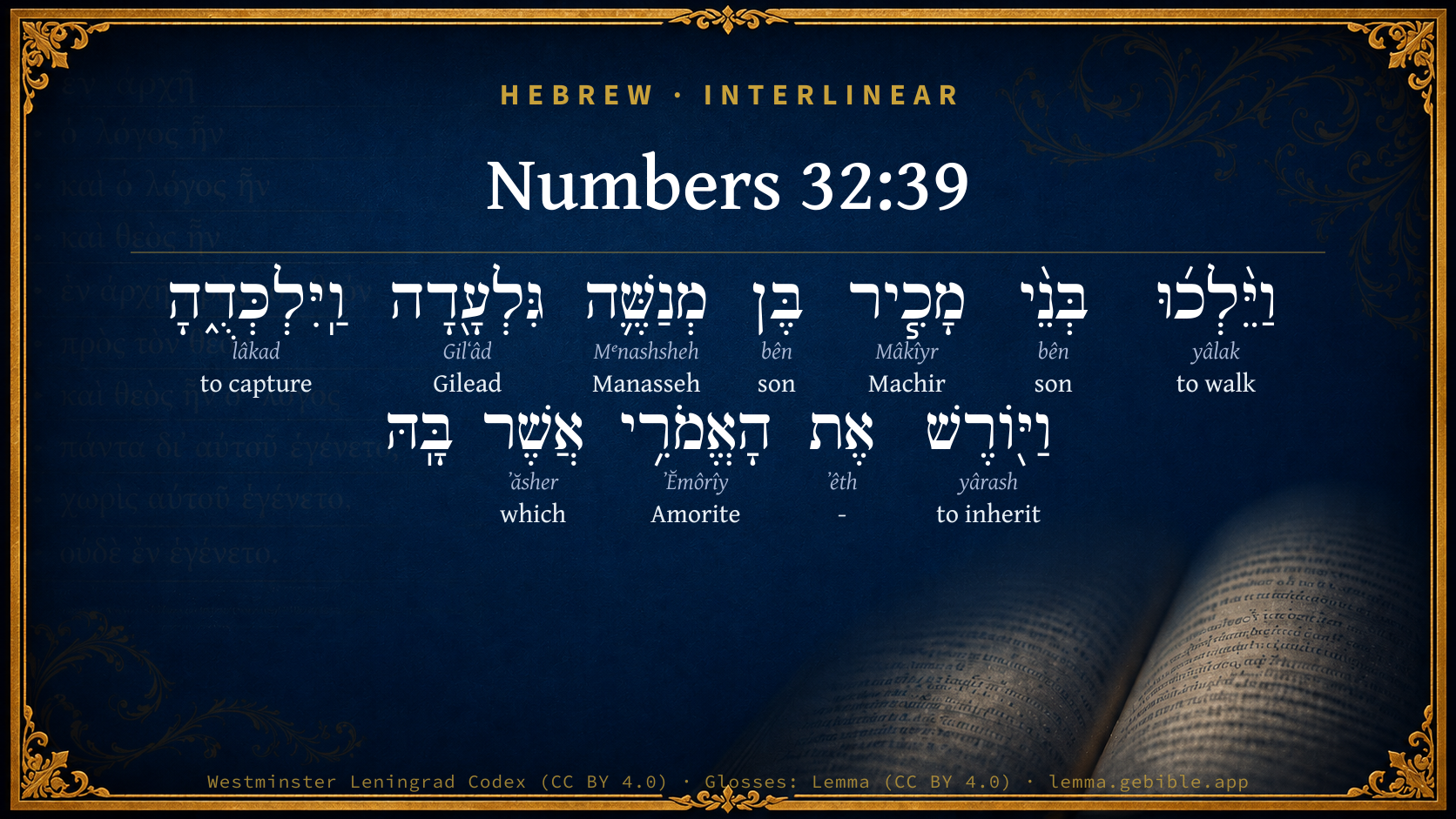
Hebrew (Westminster Leningrad Codex) Numbers 32:39 appears in the Hebrew Old Testament. The text above is from the Westminster Leningrad Codex. Each word links to its Strong’s number, a concise gloss, and parsing drawn from the Open Scriptures Hebrew Bible morphology. Click any word for its full Brown-Driver-Briggs (BDB) entry.
Download image
Cite this verse

Numbers 32:39 (World English Bible). Public Domain. Lemma interlinear Bible study tool, https://lemma.gebible.app/v/numbers/32/39.

Show BibTeX & RIS
BibTeX
RIS
English Translation
The children of Machir the son of Manasseh went to Gilead, and took it, and dispossessed the Amorites who were therein.
World English Bible · Public Domain
Download a study sheet

One document with this verse’s original text, its word-by-word gloss line, the meaning frame, cross-references with their text, attributed commentary, and full source and license credits — printable, and it pastes into notes with its structure intact.

This verse Autodidact and up

Study sheet (.html) Plain text (.txt)

A passage Seminary Student

Up to 50 verses in one chapter. A passage sheet keeps up to 6 commentary sources and 12 cross-references per verse, in the order this page ranks them, and says so on the sheet whenever that leaves anything out. Ask for a single verse and you get the Autodidact verse sheet above.

Everything on this page stays free to read, with no account — the sheet is a download of what is already on screen, not access to it.

Want to remove ads? Support Godless Engineer
Compare translations 3

The same verse in 3 English versions, stacked beneath the original-language interlinear above. Click any original word for its lexicon entry.

Each is an independent rendering of the whole verse — the interlinear is not word-aligned to these translations.

Highlighted words mark where these versions differ — a whole-verse word diff, not a word-by-word alignment.

  • World English Bible Public Domain
    The children of Machir the son of Manasseh went to Gilead, and took it, and dispossessed the Amorites who were therein.
  • King James Version Public Domain
    And the children of Machir the son of Manasseh went to Gilead, and took it, and dispossessed the Amorite which was in it.
  • unfoldingWord Literal Text CC BY-SA 4.0
    And the sons of Machir the son of Manasseh went to Gilead and captured it and dispossessed the Amorites who were in it.

unfoldingWord Literal Text — © unfoldingWord, licensed CC BY-SA 4.0. Word-aligned USFM3 via Door43 (git.door43.org/unfoldingWord/en_ult).

Versions to compare (up to 4)

3 of 4 selected

Show all 18 translations

Every available English version of this verse, each an independent rendering of the whole verse.

  • World English Bible Public Domain
    The children of Machir the son of Manasseh went to Gilead, and took it, and dispossessed the Amorites who were therein.
  • Berean Standard Bible Public Domain
    The descendants of Machir son of Manasseh went to Gilead, captured it, and drove out the Amorites who were there.
  • Majority Standard Bible Public Domain
    The descendants of Machir son of Manasseh went to Gilead, captured it, and drove out the Amorites who were there.
  • King James Version Public Domain
    And the children of Machir the son of Manasseh went to Gilead, and took it, and dispossessed the Amorite which was in it.
  • American Standard Version (1901) Public Domain
    And the children of Machir the son of Manasseh went to Gilead, and took it, and dispossessed the Amorites that were therein.
  • Revised Version (1885) Public Domain
    And the children of Machir the son of Manasseh went to Gilead, and took it, and dispossessed the Amorites which were therein.
  • Geneva Bible (1599) Public Domain
    And the children of Machir the sonne of Manasseh went to Gilead, and tooke it, and put out the Amorites that dwelt therein.
  • Douay-Rheims (1899) Public Domain
    Moreover the children of Machir, the son of Manasses, went into Galaad, and wasted it, cutting off the Amorrhites, the inhabitants thereof.
  • Young's Literal Translation Public Domain
    And sons of Machir son of Manasseh go to Gilead, and capture it, and dispossess the Amorite, who `is' in it;
  • Literal Standard Version CC BY-SA 4.0
    And sons of Machir son of Manasseh go to Gilead, and capture it, and dispossess the Amorite who [is] in it;
  • Unlocked Literal Bible CC BY-SA 4.0
    The descendants of Machir son of Manasseh went to Gilead and took it away from the Amorites who were in it.
  • unfoldingWord Literal Text CC BY-SA 4.0
    And the sons of Machir the son of Manasseh went to Gilead and captured it and dispossessed the Amorites who were in it.
  • Darby Bible Public Domain
    -- And the children of Machir the son of Manasseh went to Gilead, and took it, and they dispossessed the Amorites that were therein.
  • World Messianic Bible Public Domain
    The children of Machir the son of Manasseh went to Gilead, took it, and dispossessed the Amorites who were therein.
  • Webster's Bible Public Domain
    And the children of Machir the son of Manasseh went to Gilead, and took it, and dispossessed the Amorite who was in it.
  • Free Bible Version CC BY-SA 4.0
    The descendants of Machir, son of Manasseh, attacked Gilead and captured it. They drove out the Amorites who were living there.
  • Bible in Basic English Public Domain
    And the children of Machir, the son of Manasseh, went to Gilead and took it, driving out the Amorites who were living there.
  • JPS Tanakh (1917) Public Domain
    And the children of Machir the son of Manasseh went to Gilead, and took it, and dispossessed the Amorites that were therein.

Literal Standard Version (2020), Covenant Press — licensed CC BY-SA 4.0. Text via the HelloAO Bible API (eBible.org). Unlocked Literal Bible (unfoldingWord) — licensed CC BY-SA 4.0. Text via the HelloAO Bible API (eBible.org). unfoldingWord Literal Text — © unfoldingWord, licensed CC BY-SA 4.0. Word-aligned USFM3 via Door43 (git.door43.org/unfoldingWord/en_ult). Free Bible Version, Dr. Jonathan Gallagher — licensed CC BY-SA 4.0. Text via the HelloAO Bible API (eBible.org).

Word by word

More ways to search: Search by grammar → Find every occurrence → Compare this word →

Practice this passage: Drill this verse → Learn its vocabulary →

מָכִ֧יר
Mâkîyr
H4353
“Machir”
Noun, Proper
Part of Speech
Noun
Type
Proper
Full BDB Definition

Origin: from H4376

TWOT: None

Machir = "sold" - eldest son of Manasseh by an Aramite or Syrian concubine and progenitor of a large family - son of Ammiel, a powerful chief of one of the Transjordanic tribes who rendered essential services to Saul and to David
  1. וַיֵּ֨לְכ֜וּ yâlak H3212 “and · to walk” Conjunction + Verb, Qal, Sequential Imperfect, 3rd Person, Masculine, Plural
  2. בְּנֵ֨י bên H1121 “sons of” Noun, Common, Masculine, Plural, Construct
  3. בֶּן bên H1121 “son of” Noun, Common, Masculine, Singular, Construct
  4. מְנַשֶּׁ֛ה Mᵉnashsheh H4519 “Manasseh” Noun, Proper
  5. גִּלְעָ֖דָה Gilʻâd H1568 “Gilead · toward” Noun, Proper + Suffix, Demonstrative
  6. וַֽיִּלְכְּדֻ֑הָ lâkad H3920 “and · to capture · her” Conjunction + Verb, Qal, Sequential Imperfect, 3rd Person, Masculine, Plural + Suffix, Personal, 3rd Person, Feminine, Singular
  7. וַיּ֖וֹרֶשׁ yârash H3423 “and · to inherit” Conjunction + Verb, Hiphil, Sequential Imperfect, 3rd Person, Masculine, Singular
  8. אֶת ʼêth H853 “-” Particle, Direct Object
  9. הָאֱמֹרִ֥י ʼĔmôrîy H567 “the · Amorite” Particle, Definite Article + Noun, Gentilic, Masculine, Singular, Absolute
  10. אֲשֶׁר ʼăsher H834 “which” Particle, Relative

About this verse

These counts appear in no published source. They are computed here, from the morphology-tagged text and Lemma’s own curated glosses. What Lemma adds →

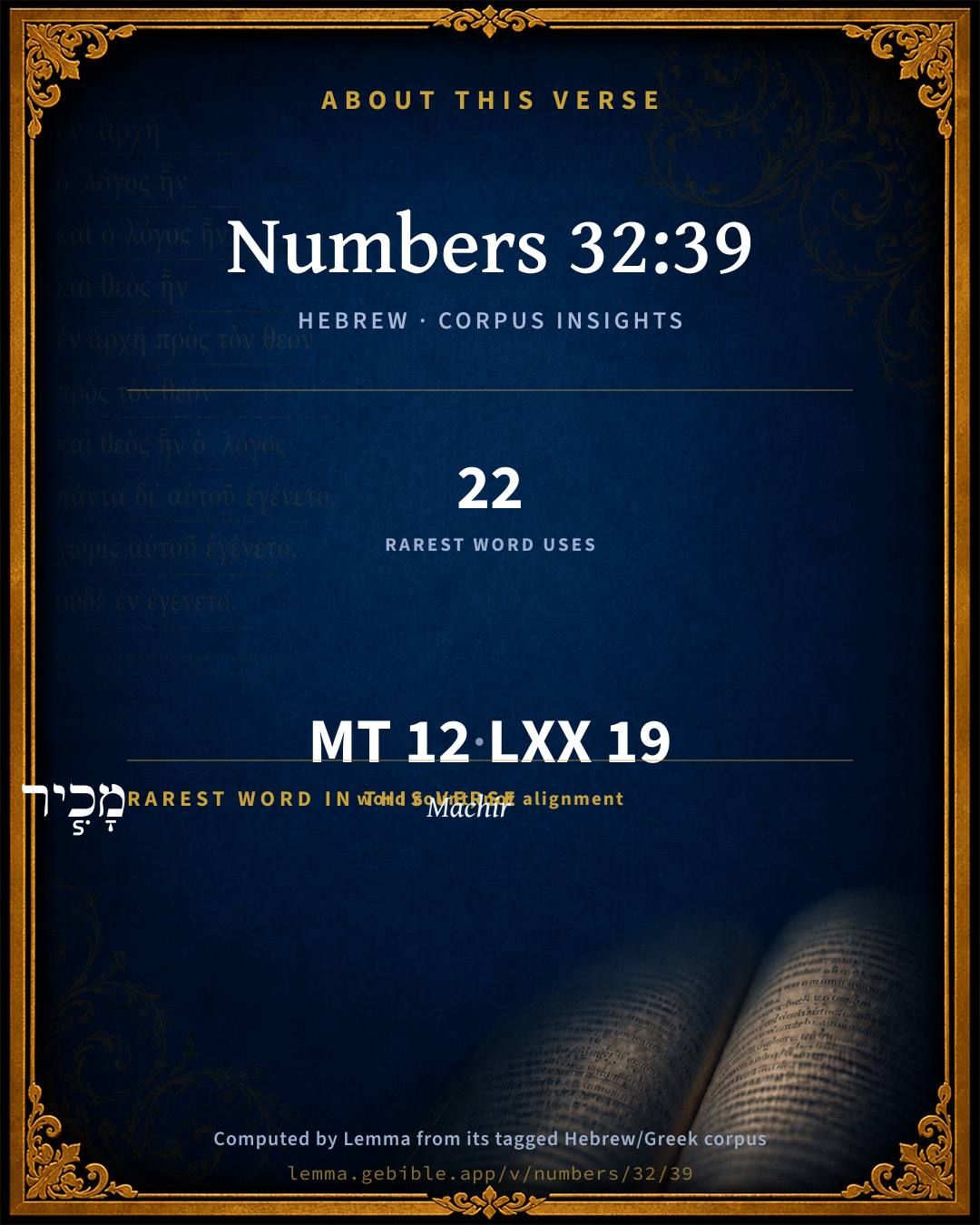
12
words
10
distinct lemmas
Pentateuch
section

Notable vocabulary

The rarest word here is מָכִ֧יר Machir H4353 — appearing just 22 times in the whole Hebrew Bible.

Shared distinctive vocabulary

מָכִ֧יר Machir H4353 occurs in 20 verses of the Hebrew Bible. Also found in:

Grammatical profile

  • 3 verbs
  • 6 nouns
  • 1 preposition
  • 2 particles

Verb forms

  • וַיֵּ֨לְכ֜וּ Qal · Sequential Imperfect
  • וַֽיִּלְכְּדֻ֑הָ Qal · Sequential Imperfect
  • וַיּ֖וֹרֶשׁ Hiphil · Sequential Imperfect

Repetition

A word recurs within this verse — often emphatic in Hebrew:

  • בְּנֵ֨י son H1121 ×2

Hebrew & Septuagint length

In English translation the verse runs 21 words from the Hebrew and 23 from the Septuagint (LXX English) — closely comparable.

A rough comparison of the two English renderings, which tokenize alike — not a word-level alignment.

Word counts can differ between the Hebrew and the Greek without any difference in meaning — e.g. the Hebrew direct-object marker אֵת has no separate Greek word, and Greek often adds the article ὁ.

In the original languages it is 12 Hebrew tokens and 19 Greek tokens — but the two are counted differently (Hebrew bundles its prefixes and suffixes into one token; the Greek is in lemma form), so that isn’t a like-for-like length.

Cross-references

3

Topical passages linked to Numbers 32:39 in the Treasury of Scripture Knowledge — connected by theme and wording, ordered by reader-vote popularity; previews shown in the World English Bible.

  • Genesis 50:23 Joseph saw Ephraim's children to the third generation. The children also of Machir, the son of Manasseh, were born on Joseph's knees.
  • Numbers 26:29 The sons of Manasseh: of Machir, the family of the Machirites; and Machir became the father of Gilead; of Gilead, the family of the Gileadites.
  • Joshua 17:1 [This] was the lot for the tribe of Manasseh; for he was the firstborn of Joseph. As for Machir the firstborn of Manasseh, the father of Gilead, because he was a man of war, therefore he had Gilead and Bashan.

Cross-references courtesy of OpenBible.info (CC BY 4.0).

Hebrew and Greek witnesses Masoretic Hebrew ↔ Greek Septuagint

The same verse in the two great witnesses to the Old Testament, shown verse-for-verse.

These are two independent witnesses, not word-aligned to each other, and the Septuagint is shown in lemma (dictionary) form.

Hebrew Numbers 32:39 Masoretic · Westminster Leningrad Codex

וַיֵּ֨לְכ֜וּ בְּנֵ֨י מָכִ֧יר בֶּן מְנַשֶּׁ֛ה גִּלְעָ֖דָה וַֽיִּלְכְּדֻ֑הָ וַיּ֖וֹרֶשׁ אֶת הָאֱמֹרִ֥י אֲשֶׁר בָּֽהּ

The children of Machir the son of Manasseh went to Gilead, and took it, and dispossessed the Amorites who were therein.

World English Bible · Public Domain

Greek LXX Numbers 32:39 Septuagint · lemma form

καί πορεύομαι υἱός μαχιρ υἱός μανασσή εἰς γαλαάδ καί λαμβάνω αὐτός καί ἀποὀλλύω ὁ ἀμορραῖος ὁ καταοἰκέω ἐν αὐτός

And a son of Machir the son of Manasse went to Galaad, and took it, and destroyed the Amorite who lived in it.

LXX2012 (modern English Septuagint) · Public Domain

Hebrew: Westminster Leningrad Codex (CC BY 4.0). Greek: Septuagint (public domain); English from LXX2012 (modern English Septuagint) (Public Domain). How the Septuagint differs from the Hebrew →

Targum (Aramaic paraphrase)

2

The Targum is the ancient Jewish Aramaic paraphrase of the Hebrew Scriptures — an interpretive translation, not the Hebrew text itself. Onkelos (literal) and Pseudo-Jonathan (expansive) render the Torah, and Jonathan the Prophets. Coverage is partial: where no permissively-licensed English translation exists for a verse, only the Aramaic is shown. This is verse-level text, not a word-by-word alignment to the Hebrew.

  1. Targum Onkelos Torah (Genesis–Deuteronomy)
    וַאֲזָלוּ בְּנֵי מָכִיר בַּר מְנַשֶׁה לְגִלְעָד וְכִבְשׁוּהָ וְתָרִיךְ יָת אֱמוֹרָאָה דִי בָּהּ

    (no public-domain English translation for this verse)

    Targum Onkelos — Aramaic: “Onkelos Genesis” (public domain); “Onkelos Exodus” (public domain); “Onkelos Leviticus” (public domain); “Onkelos Numbers” (public domain); “Onkelos Deuteronomy” (public domain). English: “Sefaria Community Translation” (CC0 1.0 (public-domain dedication)); “J.W. Etheridge. The Targums of Onkelos and Jonathan Ben Uzziel on the Pentateuch. London: Longmans, Green, 1862” (public domain). Text via Sefaria.

  2. Targum Pseudo-Jonathan Torah (Genesis–Deuteronomy)
    וַאֲזָלוּ בְּנֵי מָכִיר בַּר מְנַשֶׁה לְגִלְעָד וְכַבְּשׁוּהָ וּתְרִיכוּ יַת אֱמוֹרָאֵי דְבָהּ

    And the sons of Makir bar Menasheh went to Gilead and subdued it, and drave out the Amoraee who were therein.

    Targum Pseudo-Jonathan — Aramaic: “Targum Jonathan on Genesis” (public domain); “Targum Jonathan on Exodus” (public domain); “Targum Jonathan on Leviticus” (public domain); “Targum Jonathan on Numbers” (public domain); “Targum Jonathan on Deuteronomy” (public domain). English: “The Targum of Jonathan ben Uzziel, trans. J. W. Etheridge, London, 1862” (public domain). Text via Sefaria.

Commentary

Notes on Numbers 32:39 from classic Christian and Jewish commentators (each source and its license shown beneath its notes). The classic Christian expositions comment on the surrounding passage and are grouped to its opening verse, so a note may address several verses; the Jewish commentaries on the Tanakh (Rashi and others) are per-verse, so they appear only where the commentator wrote on this verse.

Lemma curates 59 commentaries, every one of them public domain or Creative Commons licensed, each selected and text-cleaned for this edition rather than reprinted as found. About our sources →

Keil & Delitzsch

C. F. Keil & F. Delitzsch

Moses gave the Manassites the land which was conquered by them; in fact, the whole of the kingdom of Bashan, including not only the province of Bashan, but the northern half of Gilead (see at Num 21:33-34). Of this the sons of Machir received Gilead, the modern Jebel Ajlun, between the Jabbok (Zerka) and the Mandhur (Hieromax, Jarmuk), because they had taken it and driven out the Amorites and destroyed them (see Deu 3:13). The imperfects in Num 32:39 are to be understood in the sense of pluperfects, the different parts being linked together by w consec. according to the simple style of the Semitic historical writings explained in the note on Gen 2:19, and the leading thought being preceded by the clauses which explain it, instead of their being logically subordinated to it. "The sons of Machir went to Gilead and took it...and Moses gave," etc., instead of "Moses gave Gilead to the sons of Machir, who had gone thither and taken it..." The words בּהּ ויּשׁב, "Machir dwelt therein (in Gilead)," do not point to a later period than the time of Moses, but simply state that the Machirites took possession of Gilead. As soon as Moses had given them the conquered land for their possession, they no doubt brought their families, like the Gadites and Reubenites, and settled them in fortified towns, that they might dwell there in safety, whilst the fighting men helped the other tribes to conquer Canaan. ישׁב signifies not merely "to dwell," but literally to place oneself, or settle down (e.g., Gen 36:8, etc.), and is even applied to the temporary sojourn of the Israelites in particular encampments (Num 20:1). - Machir (Num 32:40): for the sons of Machir, or Machirites (Num 26:29). But as Gilead does not mean the whole of the land with this name, but only the northern half, so the sons of Machir are not the whole of his posterity, but simply those who formed the family of Machirites which bore its father's name (Num 26:29), i.e., the seven fathers' houses or divisions of the family, the heads of which are named in Ch1 5:24. The other descendants of Machir through Gilead, who formed the six families of Gilead mentioned in Num 26:29-33, and Jos 17:2, received their inheritance in Canaan proper (Josh 17).

Keil & Delitzsch — Biblical Commentary on the Old Testament (1861–1891) — public domain (CC PDM 1.0). Text via the HelloAO Bible API. (Old Testament only.)

Tyndale Open Study Notes

Tyndale Open Resources

32:39-42 Three clans of Manasseh conquered part of Gilead and Bashan (cp. Deut 3:13-15; Josh 13:29-31). The location of Nobah remains uncertain (cp. Judg 8:11). • Towns of Jair: Hebrew Havvoth-jair (cp. Deut 3:14; Josh 13:30; Judg 10:4; 1 Kgs 4:13; 1 Chr 2:21-23).

Tyndale Open Study Notes — © Tyndale Open Resources, licensed CC BY-SA 4.0. Text via the HelloAO Bible API.

Jamieson, Fausset & Brown

Robert Jamieson, A. R. Fausset & David Brown

Gilead--now Jelud.

Jamieson, Fausset & Brown — Commentary Critical and Explanatory on the Whole Bible (1871) — public domain (CC PDM 1.0). Text via the HelloAO Bible API.

Ellicott's Commentary for English Readers

(39) And the children of Machir the son of Manasseh went . . . —Better, Now the children of Machir the son of Manasseh had gone to Gilead, and taken it, &c. (See Note on Num_32:33.)

A Bible Commentary for English Readers, edited by Charles John Ellicott (1878–1897) — public domain. Text from a community e-Sword module.

The Cambridge Bible for Schools and Colleges

gen. ed. J. J. S. Perowne

39. The individual action of clans (here and in Num_32:41 f.) is similar to that described in Jdg_1:3; Jdg_1:22. See prelim. note.

The Cambridge Bible for Schools and Colleges (gen. ed. J. J. S. Perowne; Cambridge University Press, 1878–1918) — public domain. Text from a community e-Sword module.

John Gill's Exposition

And Moses gave Gilead unto Machir the son of Manasseh,.... That is, to the children of Machir, who went and took it; though some say, as Aben Ezra observes, that Machir himself was now alive, and that it was given to him, but that is not probable; for, supposing him to be living when the children of Israel came out of Egypt, all that came from thence, who were twenty years old and upwards, died in the wilderness, excepting two, see Num 32:11,

and he dwelt therein; that is, the family of the Macharite; see Num 26:29.

John Gill's Exposition of the Whole Bible (1746–1763) — public domain (CC PDM 1.0). Text via the HelloAO Bible API.

Albert Barnes' Notes on the Bible

The children of Machir - Machir, the son of Manasseh, was long since dead: even his sons had been brought up upon Joseph’s knees Gen 50:23. But the renown acquired by his descendants raised his family almost to the dignity of a tribe; and the Machirites are in the next verse styled Machir, just as the children of Judah or of Ephraim are often spoken of as Judah or Ephraim. So in Jdg 5:14 Machir is coupled with Ephraim and Zebulun.

Went - i. e., “had gone:” the statement is preparatory to the ensuing record of the grant to them of the land they had won.

Gilead - More strictly part of north Gilead; which, though inhabited by the Amorites, had belonged to the kingdom of Og. Gilead was the district from which had sprung the ancestress of the Machirites (compare 1Ch 7:14).

Albert Barnes' Notes on the Bible (1834–1885) — public domain. Text from a community e-Sword/MySword module.

Matthew Poole's English Annotations

Took it, i.e. part of it; or Gilead is here taken more strictly. See Poole on "Num 32:29"; Gen 31:21; Deu 3:12,13.

Matthew Poole's English Annotations on the Holy Bible (1683–1685) — public domain. Text from a community e-Sword/MySword module.

Whedon's Commentary on the Bible

Daniel D. Whedon

39. Machir was the son of Manasseh by an Aramite or Syrian concubine. 1Ch_7:14, and Gen_46:20, Seventy.

The Amorite — Literally, the highlanders in contrast with the low-landers, the Canaanites. Jos_3:10, note.

Daniel D. Whedon (gen. ed.), Commentary on the Old and New Testaments (1874–1909) — public domain. Text from a community e-Sword module.

The Pulpit Commentary

The children of Machir. The relation of the Beni-Machir to the tribe of Manasseh is obscure, because all the Manassites were descended from Machir. In the absence of any direct information, we can only guess at the nature of the tie which united the Beni-Machir as a family, and kept them distinct from the other Manassite families. It is evident from their history that they formed a sub-tribe powerful enough to have a name of their own in Israel. (cf. verse 40 and Jud_1:5:14, and see note on verse 41) Went to Gilead. This would seem to refer to the expedition briefly recorded in Num_21:33. It is mentioned here out of place, in the simple historical style of the Pentateuch, because the gift of Gilead to Machir grew out of its conquest by Machir. The name Gilead is again used in a very vague sense, for the territory actually allotted to Machir was rather in Bashan than in Gilead proper.

The Pulpit Commentary (1880–1919), ed. H.D.M. Spence-Jones & Joseph S. Exell — public domain. Text from a community e-Sword module.

Rashi

Rabbi Shlomo Yitzchaki (Rashi)

ויורש — Understand this as the Targum does “AND HE DROVE OUT”, for the expression ריש is used in two different meanings, in the sense of ירושה (the Kal), “inheriting”, and in the sense of הורשה (the Hiphil) which denotes driving away and expelling (see Rashi on Numbers 14:24).

Rashi on the Tanakh — English translations: “The Judaica Press complete Tanach with Rashi, translated by A. J. Rosenberg” (CC BY 4.0); “Pentateuch with Rashi's commentary by M. Rosenbaum and A.M. Silbermann, 1929-1934” (public domain); “The Metsudah Tanach series, Lakewood, N.J” (CC BY 4.0); and “The Book of Joshua, Metsudah Publications, 1997” (CC BY 4.0). Text via Sefaria.

Lesson kit

Teaching starters — assembled from the data on this page, not authored interpretation. Every prompt links to the verse data it draws on. Edit before teaching.

Numbers, in the Pentateuch, opens this verse with 12 words (10 distinct Hebrew lemmas). Its most distinctive word is Mâkîyr (“Machir”). A historical commentator’s framing appears above. Read the whole chapter for the surrounding context.

Discussion questions

  1. The word Mâkîyr carries the sense “Machir.” How does it shape the verse?
  2. How does Genesis 50:23, which shares the word «Machir», read alongside this verse?
  3. What does the repetition of “son” (2× in this one verse) do in this verse?
  4. The translations on this page render this verse differently — a whole-verse word diff, not a word-by-word alignment. What might account for the different wordings?
  5. «וַיֵּ֨לְכ֜וּ» is a Qal Sequential Imperfect verb. How does that grammatical form shape the action described?
  6. Compare how Keil & Delitzsch and Tyndale Open Study Notes read this verse. Where do they agree or differ?

Things to notice

Reading settings

Reading text

Shown beneath each verse's original-language words.

Old Testament
Old Testament edition

Read the OT as the Masoretic Hebrew (MT) or the Greek Septuagint (LXX).

English shown for the Greek Septuagint (in the Hebrew ↔ Greek comparison).

Comparing translations? Open the Compare panel on any verse page to stack up to four side by side.