
Jeremiah 32:3

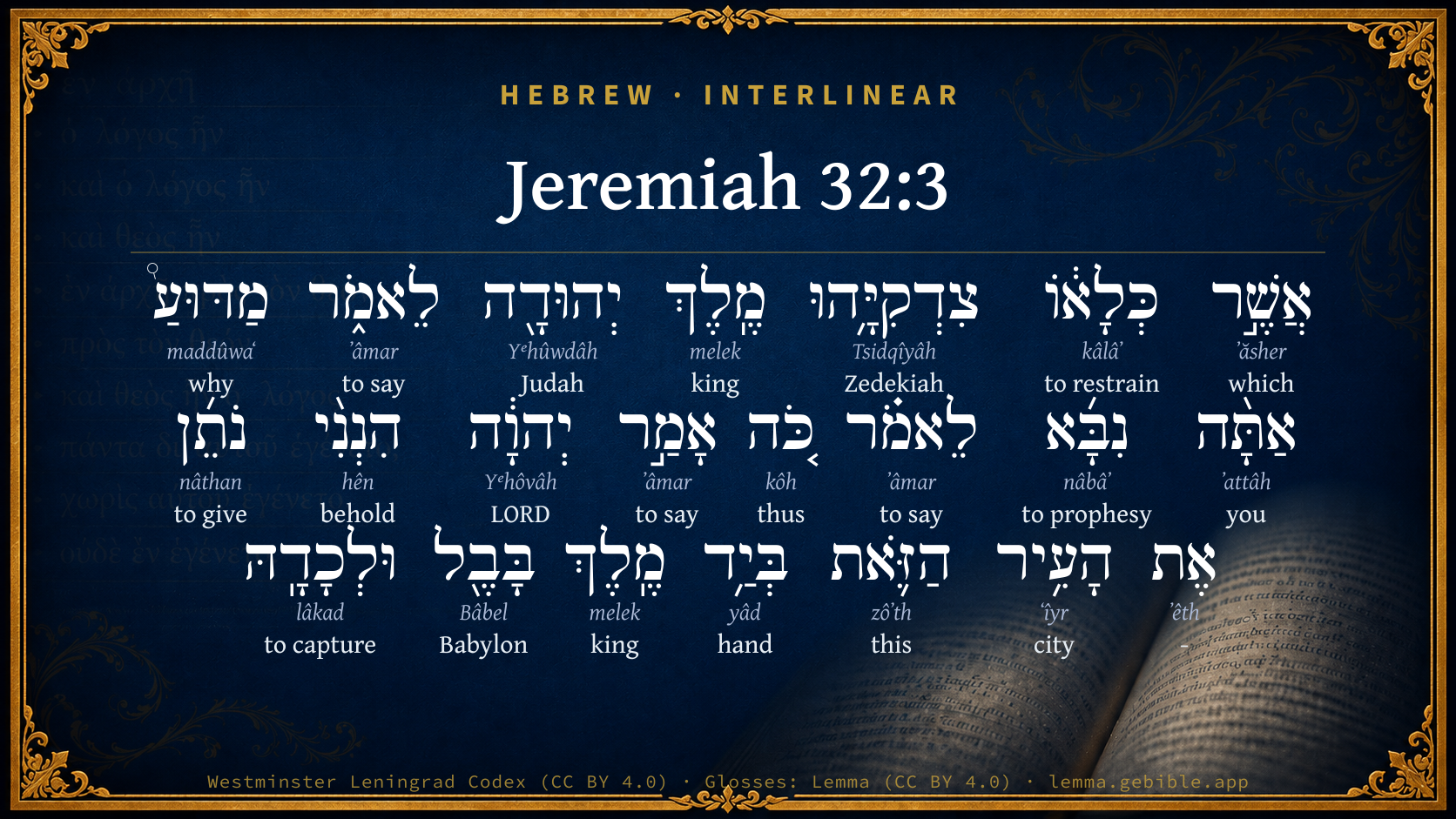
Hebrew (Westminster Leningrad Codex) Jeremiah 32:3 appears in the Hebrew Old Testament. The text above is from the Westminster Leningrad Codex. Each word links to its Strong’s number, a concise gloss, and parsing drawn from the Open Scriptures Hebrew Bible morphology. Click any word for its full Brown-Driver-Briggs (BDB) entry.
Download image
Cite this verse

Jeremiah 32:3 (World English Bible). Public Domain. Lemma interlinear Bible study tool, https://lemma.gebible.app/v/jeremiah/32/3.

Show BibTeX & RIS
BibTeX
RIS
English Translation
For Zedekiah king of Judah had shut him up, saying, Why do you prophesy, and say, Thus says Yahweh, Behold, I will give this city into the hand of the king of Babylon, and he shall take it;
World English Bible · Public Domain
Download a study sheet

One document with this verse’s original text, its word-by-word gloss line, the meaning frame, cross-references with their text, attributed commentary, and full source and license credits — printable, and it pastes into notes with its structure intact.

This verse Autodidact and up

Study sheet (.html) Plain text (.txt)

A passage Seminary Student

Up to 50 verses in one chapter. A passage sheet keeps up to 6 commentary sources and 12 cross-references per verse, in the order this page ranks them, and says so on the sheet whenever that leaves anything out. Ask for a single verse and you get the Autodidact verse sheet above.

Everything on this page stays free to read, with no account — the sheet is a download of what is already on screen, not access to it.

Want to remove ads? Support Godless Engineer
Compare translations 3

The same verse in 3 English versions, stacked beneath the original-language interlinear above. Click any original word for its lexicon entry.

Each is an independent rendering of the whole verse — the interlinear is not word-aligned to these translations.

Highlighted words mark where these versions differ — a whole-verse word diff, not a word-by-word alignment.

  • World English Bible Public Domain
    For Zedekiah king of Judah had shut him up, saying, Why do you prophesy, and say, Thus says Yahweh, Behold, I will give this city into the hand of the king of Babylon, and he shall take it;
  • King James Version Public Domain
    For Zedekiah king of Judah had shut him up, saying, Wherefore dost thou prophesy, and say, Thus saith the LORD, Behold, I will give this city into the hand of the king of Babylon, and he shall take it;
  • unfoldingWord Literal Text CC BY-SA 4.0
    Zedekiah king of Judah had imprisoned him and said, “Why do you prophesy and say, ‘Yahweh says this: Look, I am about to give over this city into the hand of the king of Babylon, and he will capture it.

unfoldingWord Literal Text — © unfoldingWord, licensed CC BY-SA 4.0. Word-aligned USFM3 via Door43 (git.door43.org/unfoldingWord/en_ult).

Versions to compare (up to 4)

3 of 4 selected

Show all 18 translations

Every available English version of this verse, each an independent rendering of the whole verse.

  • World English Bible Public Domain
    For Zedekiah king of Judah had shut him up, saying, Why do you prophesy, and say, Thus says Yahweh, Behold, I will give this city into the hand of the king of Babylon, and he shall take it;
  • Berean Standard Bible Public Domain
    For Zedekiah king of Judah had imprisoned him, saying: “Why are you prophesying like this? You claim that the LORD says, ‘Behold, I am about to deliver this city into the hand of the king of Babylon, and he will capture it.
  • Majority Standard Bible Public Domain
    For Zedekiah king of Judah had imprisoned him, saying: “Why are you prophesying like this? You claim that the LORD says, ‘Behold, I am about to deliver this city into the hand of the king of Babylon, and he will capture it.
  • King James Version Public Domain
    For Zedekiah king of Judah had shut him up, saying, Wherefore dost thou prophesy, and say, Thus saith the LORD, Behold, I will give this city into the hand of the king of Babylon, and he shall take it;
  • American Standard Version (1901) Public Domain
    For Zedekiah king of Judah had shut him up, saying, Wherefore dost thou prophesy, and say, Thus saith Jehovah, Behold, I will give this city into the hand of the king of Babylon, and he shall take it;
  • Revised Version (1885) Public Domain
    For Zedekiah king of Judah had shut him up, saying, Wherefore dost thou prophesy, and say, Thus saith the LORD, Behold, I will give this city into the hand of the king of Babylon, and he shall take it;
  • Geneva Bible (1599) Public Domain
    For Zedekiah King of Iudah had shut him vp, saying, Wherefore doest thou prophesie, and say, Thus saith the Lord, Beholde, I will giue this citie into the handes of the King of Babel, and he shall take it?
  • Douay-Rheims (1899) Public Domain
    For Sedecias king of Juda had shut him up, saying: Why dost thou prophesy, saying: Thus saith the Lord: Behold I will give this city into the hand of the king of Babylon, and he shall take it?
  • Young's Literal Translation Public Domain
    Where Zedekiah king of Judah hath shut him up, saying, `Wherefore art thou prophesying, saying, Thus said Jehovah, Lo, I am giving this city into the hand of the king of Babylon, and he hath captured it;
  • Literal Standard Version CC BY-SA 4.0
    where Zedekiah king of Judah has shut him up, saying, “Why are you prophesying, saying, Thus said YHWH: Behold, I am giving this city into the hand of the king of Babylon, and he has captured it;
  • Unlocked Literal Bible CC BY-SA 4.0
    Zedekiah king of Judah had imprisoned him and said, “Why do you prophesy and say, 'Yahweh says this: Look, I am about to give over this city into the hand of the king of Babylon, and he will capture it.
  • unfoldingWord Literal Text CC BY-SA 4.0
    Zedekiah king of Judah had imprisoned him and said, “Why do you prophesy and say, ‘Yahweh says this: Look, I am about to give over this city into the hand of the king of Babylon, and he will capture it.
  • Darby Bible Public Domain
    For Zedekiah king of Judah had shut him up, saying, Why dost thou prophesy and say, Thus saith Jehovah: Behold, I give this city into the hand of the king of Babylon, and he shall take it;
  • World Messianic Bible Public Domain
    For Zedekiah king of Judah had shut him up, saying, “Why do you prophesy, and say, ‘The LORD says, “Behold, I will give this city into the hand of the king of Babylon, and he will take it;
  • Webster's Bible Public Domain
    For Zedekiah king of Judah had confined him, saying, Why dost thou prophesy, and say, Thus saith the LORD, Behold, I will give this city into the hand of the king of Babylon, and he shall take it;
  • Free Bible Version CC BY-SA 4.0
    Zedekiah king of Judah had put him in prison, telling him: “Why do you have to prophesy like this? You say the Lord is saying, ‘Look, I'm going to hand over this city to the king of Babylon, and he will capture it.
  • Bible in Basic English Public Domain
    For Zedekiah, king of Judah, had had him shut up, saying, Why have you, as a prophet, been saying, The Lord has said, See, I will give this town into the hands of the king of Babylon, and he will take it;
  • JPS Tanakh (1917) Public Domain
    For Zedekiah king of Judah had shut him up, saying: 'Wherefore dost thou prophesy, and say: Thus saith the LORD: Behold, I will give this city into the hand of the king of Babylon, and he shall take it;

Literal Standard Version (2020), Covenant Press — licensed CC BY-SA 4.0. Text via the HelloAO Bible API (eBible.org). Unlocked Literal Bible (unfoldingWord) — licensed CC BY-SA 4.0. Text via the HelloAO Bible API (eBible.org). unfoldingWord Literal Text — © unfoldingWord, licensed CC BY-SA 4.0. Word-aligned USFM3 via Door43 (git.door43.org/unfoldingWord/en_ult). Free Bible Version, Dr. Jonathan Gallagher — licensed CC BY-SA 4.0. Text via the HelloAO Bible API (eBible.org).

Word by word

More ways to search: Search by grammar → Find every occurrence → Compare this word →

Practice this passage: Drill this verse → Learn its vocabulary →

כְּלָא֔וֹ
kâlâʼ
H3607
“to restrain · him”
Verb, Qal, Perfect, 3rd Person, Masculine, Singular + Suffix, Personal, 3rd Person, Masculine, Singular
Part of Speech
Verb
Stem
Qal
Form
Perfect
Person
3rd Person
Gender
Masculine
Number
Singular
Full BDB Definition

Origin: a primitive root

TWOT: 980

to restrict, restrain, withhold, shut up, keep back, refrain, forbid - (Qal) - to shut up - to restrain - to withhold - (Niphal) to be restrained - (Piel) to finish
  1. אֲשֶׁ֣ר ʼăsher H834 “which” Particle, Relative
  2. צִדְקִיָּ֥הוּ Tsidqîyâh H6667 “Zedekiah” Noun, Proper
  3. מֶֽלֶךְ melek H4428 “king of” Noun, Common, Masculine, Singular, Construct
  4. יְהוּדָ֖ה Yᵉhûwdâh H3063 “Judah” Noun, Proper
  5. לֵאמֹ֑ר ʼâmar H559 “to say” Preposition + Verb, Qal, Infinitive Construct
  6. מַדּוּעַ֩ maddûwaʻ H4069 “why” Particle, Interrogative
  7. אַתָּ֨ה ʼattâh H859 “you” Pronoun, Personal, 2nd Person, Masculine, Singular
  8. נִבָּ֜א nâbâʼ H5012 “prophesying” Verb, Niphal, Participle Active, Masculine, Singular, Absolute
  9. לֵאמֹ֗ר ʼâmar H559 “to say” Preposition + Verb, Qal, Infinitive Construct
  10. כֹּ֚ה kôh H3541 “thus” Adverb
  11. אָמַ֣ר ʼâmar H559 “to say” Verb, Qal, Perfect, 3rd Person, Masculine, Singular
  12. יְהוָ֔ה Yᵉhôvâh H3068 “LORD” Noun, Proper
  13. הִנְנִ֨י hên H2005 “behold · me” Particle, Demonstrative + Suffix, Personal, 1st Person, Common, Singular
  14. נֹתֵ֜ן nâthan H5414 “giving” Verb, Qal, Participle Active, Masculine, Singular, Absolute
  15. אֶת ʼêth H853 “-” Particle, Direct Object
  16. הָעִ֥יר ʻîyr H5892 “the · city” Particle, Definite Article + Noun, Common, Feminine, Singular, Absolute
  17. הַזֹּ֛את zôʼth H2063 “the · this” Particle, Definite Article + Pronoun, Demonstrative, Feminine, Singular
  18. בְּיַ֥ד yâd H3027 “in/at · hand of” Preposition + Noun, Common, Both, Singular, Construct
  19. מֶֽלֶךְ melek H4428 “king of” Noun, Common, Masculine, Singular, Construct
  20. בָּבֶ֖ל Bâbel H894 “Babylon” Noun, Proper
  21. וּלְכָדָֽהּ lâkad H3920 “and · to capture · her” Conjunction + Verb, Qal, Sequential Perfect, 3rd Person, Masculine, Singular + Suffix, Personal, 3rd Person, Feminine, Singular

About this verse

These counts appear in no published source. They are computed here, from the morphology-tagged text and Lemma’s own curated glosses. What Lemma adds →

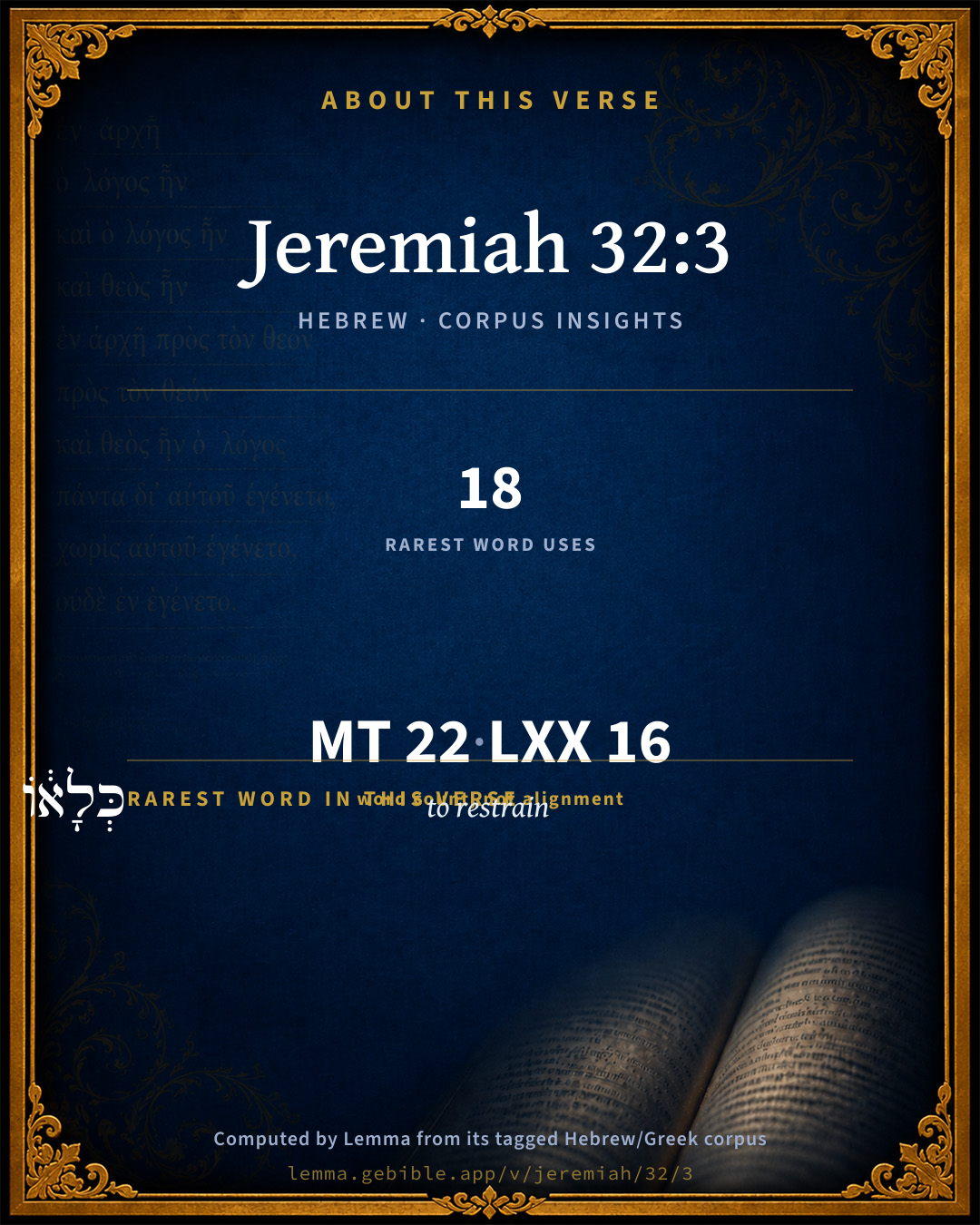
22
words
19
distinct lemmas
Prophets
section

Notable vocabulary

The rarest word here is כְּלָא֔וֹ to restrain H3607 — appearing just 18 times in the whole Hebrew Bible.

Shared distinctive vocabulary

כְּלָא֔וֹ to restrain H3607 occurs in 17 verses of the Hebrew Bible. Also found in:

Grammatical profile

  • 7 verbs
  • 8 nouns
  • 2 pronouns
  • 1 adverb
  • 4 particles

Verb forms

  • כְּלָא֔וֹ Qal · Perfect
  • לֵאמֹ֑ר Qal · Infinitive Construct
  • נִבָּ֜א Niphal · Participle Active
  • לֵאמֹ֗ר Qal · Infinitive Construct
  • אָמַ֣ר Qal · Perfect
  • נֹתֵ֜ן Qal · Participle Active
  • וּלְכָדָֽהּ Qal · Sequential Perfect

Repetition

Words recur within this verse — often emphatic in Hebrew:

  • לֵאמֹ֑ר to say H559 ×3
  • מֶֽלֶךְ king H4428 ×2

Hebrew & Septuagint length

In the original languages it is 22 Hebrew tokens and 16 Greek tokens — but the two are counted differently (Hebrew bundles its prefixes and suffixes into one token; the Greek is in lemma form), so that isn’t a like-for-like length.

Cross-references

16

Topical passages linked to Jeremiah 32:3 in the Treasury of Scripture Knowledge — connected by theme and wording, ordered by reader-vote popularity; previews shown in the World English Bible.

  • Jeremiah 34:2–3 Thus says Yahweh, the God of Israel, Go, and speak to Zedekiah king of Judah, and tell him, Thus says Yahweh, Behold, I will give this city into the hand of the king of Babylon, and he shall burn it with fire:
  • Jeremiah 21:4–7 Thus says Yahweh, the God of Israel, Behold, I will turn back the weapons of war that are in your hands, with which you fight against the king of Babylon, and against the Chaldeans who besiege you, without the walls; and I will gather them into the midst of this city.
  • Jeremiah 26:8–9 It happened, when Jeremiah had made an end of speaking all that Yahweh had commanded him to speak to all the people, that the priests and the prophets and all the people laid hold on him, saying, You shall surely die.
  • Jeremiah 32:28–29 Therefore thus says Yahweh: Behold, I will give this city into the hand of the Chaldeans, and into the hand of Nebuchadrezzar king of Babylon, and he shall take it:
  • Exodus 5:4 The king of Egypt said to them, "Why do you, Moses and Aaron, take the people from their work? Get back to your burdens!"
  • 2 Kings 6:31–32 Then he said, God do so to me, and more also, if the head of Elisha the son of Shaphat shall stand on him this day.
  • 2 Chronicles 28:22 In the time of his distress did he trespass yet more against Yahweh, this same king Ahaz.
  • Jeremiah 2:30 In vain have I struck your children; they received no correction: your own sword has devoured your prophets, like a destroying lion.
  • Jeremiah 5:3 O Yahweh, don't your eyes look on truth? you have stricken them, but they were not grieved; you have consumed them, but they have refused to receive correction: they have made their faces harder than a rock; they have refused to return.
  • Jeremiah 27:8 It shall happen, that the nation and the kingdom which will not serve the same Nebuchadnezzar king of Babylon, and that will not put their neck under the yoke of the king of Babylon, that nation will I punish, says Yahweh, with the sword, and with the famine, and with the pestilence, until I have consumed them by his hand.
  • Jeremiah 37:6–10 Then came the word of Yahweh to the prophet Jeremiah, saying,
  • Jeremiah 38:4 Then the princes said to the king, Let this man, we pray you, be put to death; because he weakens the hands of the men of war who remain in this city, and the hands of all the people, in speaking such words to them: for this man doesn't seek the welfare of this people, but the hurt.
  • Jeremiah 38:8 Ebedmelech went forth out of the king's house, and spoke to the king, saying,
  • Amos 7:13 but don't prophesy again any more at Bethel; for it is the king's sanctuary, and it is a royal house!"
  • Luke 20:2 They asked him, "Tell us: by what authority do you do these things? Or who is giving you this authority?"
  • Acts 6:12–14 They stirred up the people, the elders, and the scribes, and came against him and seized him, and brought him in to the council,

Cross-references courtesy of OpenBible.info (CC BY 4.0).

Hebrew and Greek witnesses Masoretic Hebrew ↔ Greek Septuagint

The same verse in the two great witnesses to the Old Testament, shown verse-for-verse.

These are two independent witnesses, not word-aligned to each other, and the Septuagint is shown in lemma (dictionary) form.

Hebrew Jeremiah 32:3 Masoretic · Westminster Leningrad Codex

אֲשֶׁ֣ר כְּלָא֔וֹ צִדְקִיָּ֥הוּ מֶֽלֶךְ יְהוּדָ֖ה לֵאמֹ֑ר מַדּוּעַ֩ אַתָּ֨ה נִבָּ֜א לֵאמֹ֗ר כֹּ֚ה אָמַ֣ר יְהוָ֔ה הִנְנִ֨י נֹתֵ֜ן אֶת הָעִ֥יר הַזֹּ֛את בְּיַ֥ד מֶֽלֶךְ בָּבֶ֖ל וּלְכָדָֽהּ

For Zedekiah king of Judah had shut him up, saying, Why do you prophesy, and say, Thus says Yahweh, Behold, I will give this city into the hand of the king of Babylon, and he shall take it;

World English Bible · Public Domain

Greek LXX Structure differs

In the Septuagint, Jeremiah is about an eighth shorter than the Hebrew and arranges its material differently — the Oracles Against the Nations (Hebrew chapters 46–51) appear in the middle of the Greek book, after 25:13. Because the chapter and verse boundaries do not line up, a verse-for-verse comparison with the Hebrew is not shown.

A verse-for-verse comparison isn’t shown here because the chapters and verses don’t line up. Switch to the LXX edition with the MT / LXX toggle above to read the Greek directly.

On this verse, The Cambridge Bible for Schools and Colleges discusses the Septuagint’s reading. Read the note in Commentary ↓

Hebrew: Westminster Leningrad Codex (CC BY 4.0). Greek: Septuagint (public domain); English from a public-domain English Septuagint. How the Septuagint differs from the Hebrew →

Targum (Aramaic paraphrase)

1

The Targum is the ancient Jewish Aramaic paraphrase of the Hebrew Scriptures — an interpretive translation, not the Hebrew text itself. Onkelos (literal) and Pseudo-Jonathan (expansive) render the Torah, and Jonathan the Prophets. Coverage is partial: where no permissively-licensed English translation exists for a verse, only the Aramaic is shown. This is verse-level text, not a word-by-word alignment to the Hebrew.

  1. Targum Jonathan Prophets (Joshua–Malachi)
    דְאַסְרֵיהּ צִדְקִיָה מְלַךְ שִׁבְטָא דְבֵית יְהוּדָה לְמֵימָר מַדֵין אַתְּ מִתְנַבֵּי לְמֵימָר כִּדְנַן אֲמַר יְיָ הָאֲנָא מָסַר יַת קַרְתָּא הָדָא בְּיַד מַלְכָּא דְבָבֶל וְיַכְבְּשִׁינָהּ:

    (no public-domain English translation for this verse)

    Targum Jonathan — Aramaic: “Mikraot Gedolot” (public domain). English: “Sefaria Community Translation” (CC0 1.0 (public-domain dedication)); “London "Chaldee Paraphrase," 1871” (public domain). Text via Sefaria.

Commentary

Notes on Jeremiah 32:3 from classic Christian and Jewish commentators (each source and its license shown beneath its notes). The classic Christian expositions comment on the surrounding passage and are grouped to its opening verse, so a note may address several verses; the Jewish commentaries on the Tanakh (Rashi and others) are per-verse, so they appear only where the commentator wrote on this verse.

Lemma curates 59 commentaries, every one of them public domain or Creative Commons licensed, each selected and text-cleaned for this edition rather than reprinted as found. About our sources →

Trapp's Complete Commentary

John Trapp

Jer 32:3 For Zedekiah king of Judah had shut him up, saying, Wherefore dost thou prophesy, and say, Thus saith the LORD, Behold, I will give this city into the hand of the king of Babylon, and he shall take it;

Ver. 3. For Zedekiah had shnt him up.] He who before had set him at liberty, and thereby haply hoped to have stopped his mouth; but that might not be.

Behold, I will give this city.] This holy city, as the false prophets styled it, and therefore held this prophecy little better than blasphemy.

John Trapp, A Commentary or Exposition upon All the Books of the Old and New Testament (1647–1656) — public domain. Text from a community e-Sword module.

Joseph Benson's Commentary

Jer 32:3-5. Jeremiah was shut up in the court of the prison — He was afterward put in the dungeon, Jer 37:16; and Jer 38:6. But now he was not under so severe a restraint. Compare Jer 32:26; Jer 32:28 of that chapter. For Zedekiah had shut him up, saying, Wherefore dost thou prophesy and say, &c. — This refers to the prophecy recorded Jer 34:2, &c., the particulars there mentioned being, in order of time, before the passages related in this chapter. We nowhere read that Zedekiah himself immediately commanded Jeremiah to be imprisoned: he seems rather to have been favourable to him, and to have been averse to his confinement; but God accounts princes to do that which their ministers or subordinate magistrates do with their connivance, or without their prohibition. Behold, I will give this city, &c., and Zedekiah shall not escape — Jeremiah prophesies that both the city and the court should fall into the hands of the king of Babylon: for God, whose city it was, in a peculiar manner would put it out of his protection, and give it into their hands; that, though Zedekiah should attempt to make his escape, he should be overtaken, and brought as a prisoner into Nebuchadnezzar’s presence, to his great confusion and terror, he having made himself particularly obnoxious to him by breaking his faith with him; that he should hear the king of Babylon pronounce his doom, and see with what fury and indignation he should look upon him, his eyes, as it is expressed, beholding Nebuchadnezzar’s eyes. He further prophesies that Zedekiah should be carried to Babylon, and continue a miserable captive there until God should visit him — That is, till God should put an end to his life by a natural death, as Nebuchadnezzar had long before put an end to every comfort of his life by putting out his eyes. And, lastly, he foretels that all their attempts to force the besiegers from their trenches would be ineffectual; for though they should fight with the Chaldeans, they should not prosper. For prophesying thus, that is, for bearing testimony to the truth, and giving them faithful warning of impending judgments, he is imprisoned.

Joseph Benson's Commentary on the Old and New Testaments (1811–1818) — public domain. Text from a community e-Sword module.

John Calvin's Commentaries

Then the reason is added why he was shut up in prison, — he had dared to prophesy against the city and the king himself. It was no wonder that the king’s mind was exasperated when Jeremiah boldly said that he would come into the hands of his enemies, for he had not only spoken of the ruin of the city, but also of the fall of the king; he had said that he would be brought before king Nebuchadnezar, and be led to Babylon, and be there until God visited him. We know how delicate are the ears of kings; it was then no wonder Zedekiah became incensed against Jeremiah; but yet he ought to have been softened and humbled when he found that this oracle had come from God. That he then still kept Jeremiah a prisoner, proves his madness and stupidity, for he had no regard for God. I shall proceed with the subject to-morrow.

John Calvin's Commentaries (1540-1563) — public domain. Text from the Calvin Translation Society English edition (1840s-50s) via the Christian Classics Ethereal Library (ccel.org). Calvin's coverage is partial (roughly two-thirds of the Bible); uncommented books and verses are honest gaps, never fabricated. The 19th-century editor's footnotes and remarks are omitted so the notes are faithfully Calvin's own voice.

The Cambridge Bible for Schools and Colleges

gen. ed. J. J. S. Perowne

3. For] Gi. and Co. supported by LXX render Where, to which Du. also inclines. Not so Dr.

3–5. These vv. form a parenthetical explanation, so that Jer_32:6 is to be connected immediately in sense with Jer_32:2.

The Cambridge Bible for Schools and Colleges (gen. ed. J. J. S. Perowne; Cambridge University Press, 1878–1918) — public domain. Text from a community e-Sword module.

John Gill's Exposition

For Zedekiah king of Judah had shut him up,.... In prison, at least in the court of the prison; he had given orders for his imprisonment, which were executed, and it was the same as if he had done it himself; the reason of which was, as follows:

saying, wherefore dost thou prophesy, and say, thus saith the Lord,

behold, I will give this city into the hand of the king of Babylon, and he shall take it? meaning the city of Jerusalem, now besieged by the king of Babylon. This prophecy stands in Jer 34:1; the prophecies of this book not being put together in proper order of time.

John Gill's Exposition of the Whole Bible (1746–1763) — public domain (CC PDM 1.0). Text via the HelloAO Bible API.

Albert Barnes' Notes on the Bible

For the prophecies on which the charge was grounded see Jer 21:4-7, Jer 21:9.

Albert Barnes' Notes on the Bible (1834–1885) — public domain. Text from a community e-Sword/MySword module.

Matthew Poole's English Annotations

We no where read that Zedekiah immediately commanded Jeremiah to be imprisoned, he seemeth rather to have been favourable to Jeremiah, and judicious interpreters think his present prison was a favourable prison; but God accounteth princes to do that which their ministers or subordinate magistrates do with their connivance, and without their hinderance. Though it be wild divinity for any to say, that inferior ministers or subjects are excused by the command of the superior, and the guilt lieth only on them; yet it is as wild to say they contract no guilt by the extravagant acts of subordinate magistrates, whom they put in place, and can punish and remove from their places.

Matthew Poole's English Annotations on the Holy Bible (1683–1685) — public domain. Text from a community e-Sword/MySword module.

The Pulpit Commentary

Had shut him up. A brief and general account of the circumstances related more in full in Jer 37. For the prophecies referred to, Jer_34:3-5 Jer_37:17 Jer_38:17-23. (the following verse is almost identical with Jer_34:3)

The Pulpit Commentary (1880–1919), ed. H.D.M. Spence-Jones & Joseph S. Exell — public domain. Text from a community e-Sword module.

unfoldingWord translationNotes

Door43 World Missions Community

Zedekiah king of Judah had imprisoned him

It might be best to translate so that the reader understands that other people helped Zedekiah do this. (See: Metonymy)

had imprisoned him

Here "him" refers to Jeremiah. It is not clear why Jeremiah is referring to himself by name here. You may translate using first person, as the UDB does. (See: First, Second, or Third Person)

Why do you prophesy and say

Zekekiah uses a question to rebuke Jeremiah. AT: "It is wrong for you to continue prophesying and saying" (See: Rhetorical Question)

I am about to give over this city into the hand of the king of Babylon

Yahweh speaks of the city as if it were a small object that one person could give to another. The word "hand" is a metonym for the power or control that the hand exercises. AT: "I am about to put this city under the control of the king of Babylon" or "I am about to allow the king of Babylon to do whatever he wants with this city" (See: Metaphor and Metonymy)

he will capture it

It might be best to translate so that the reader understands that other people would help the king of Babylon take control of the city.

he will certainly be given into the hand of the king of Babylon

The word "hand" is a metonym for the power or control that the hand exercises. This can be stated in active form. AT: "I will certainly put him under the control of the king of Babylon" or "I will certainly allow the king of Babylon to do whatever he wants with him" (See: Metonymy and Active or Passive)

His mouth will speak to the king's mouth, and his eyes will see the king's eyes

Here "mouth" and "eyes" represent the whole person. AT: "Zedekiah himself will see and directly speak with Nebuchadnezzar" (See: Synecdoche)

this is Yahweh's declaration

Yahweh speaks of himself by name to express the certainty of what he is declaring. See how you translated this in Jeremiah 1:8. AT: "this is what Yahweh has declared" or "this is what I, Yahweh, have declared" (See: First, Second, or Third Person)

you fight

Here "you" is plural and refers to the people in Jerusalem. (See: Forms of You)

translationWords

hand

Chaldea

declare

unfoldingWord translationNotes — © Distant Shores Media and the Door43 World Missions Community, licensed CC BY-SA 4.0. Source: git.door43.org/Door43/en_tn.

Lesson kit

Teaching starters — assembled from the data on this page, not authored interpretation. Every prompt links to the verse data it draws on. Edit before teaching.

Jeremiah, in the Prophets, opens this verse with 22 words (19 distinct Hebrew lemmas). Its most distinctive word is kâlâʼ (“to restrain”). A historical commentator’s framing appears above. Read the whole chapter for the surrounding context.

Discussion questions

  1. What does “to restrain” (kâlâʼ) contribute to the verse as a whole?
  2. How does Genesis 8:2, which shares the word «to restrain», read alongside this verse?
  3. What does the repetition of “to say” (3× in this one verse) do in this verse?
  4. These translations render this verse differently. What is at stake in choosing one wording over another?
  5. «כְּלָא֔וֹ» is a Qal Perfect verb. How does that grammatical form shape the action described?
  6. Compare how Trapp's Complete Commentary and Joseph Benson's Commentary read this verse. Where do they agree or differ?

Things to notice

Reading settings

Reading text

Shown beneath each verse's original-language words.

Old Testament
Old Testament edition

Read the OT as the Masoretic Hebrew (MT) or the Greek Septuagint (LXX).

English shown for the Greek Septuagint (in the Hebrew ↔ Greek comparison).

Comparing translations? Open the Compare panel on any verse page to stack up to four side by side.