
Job 36:8

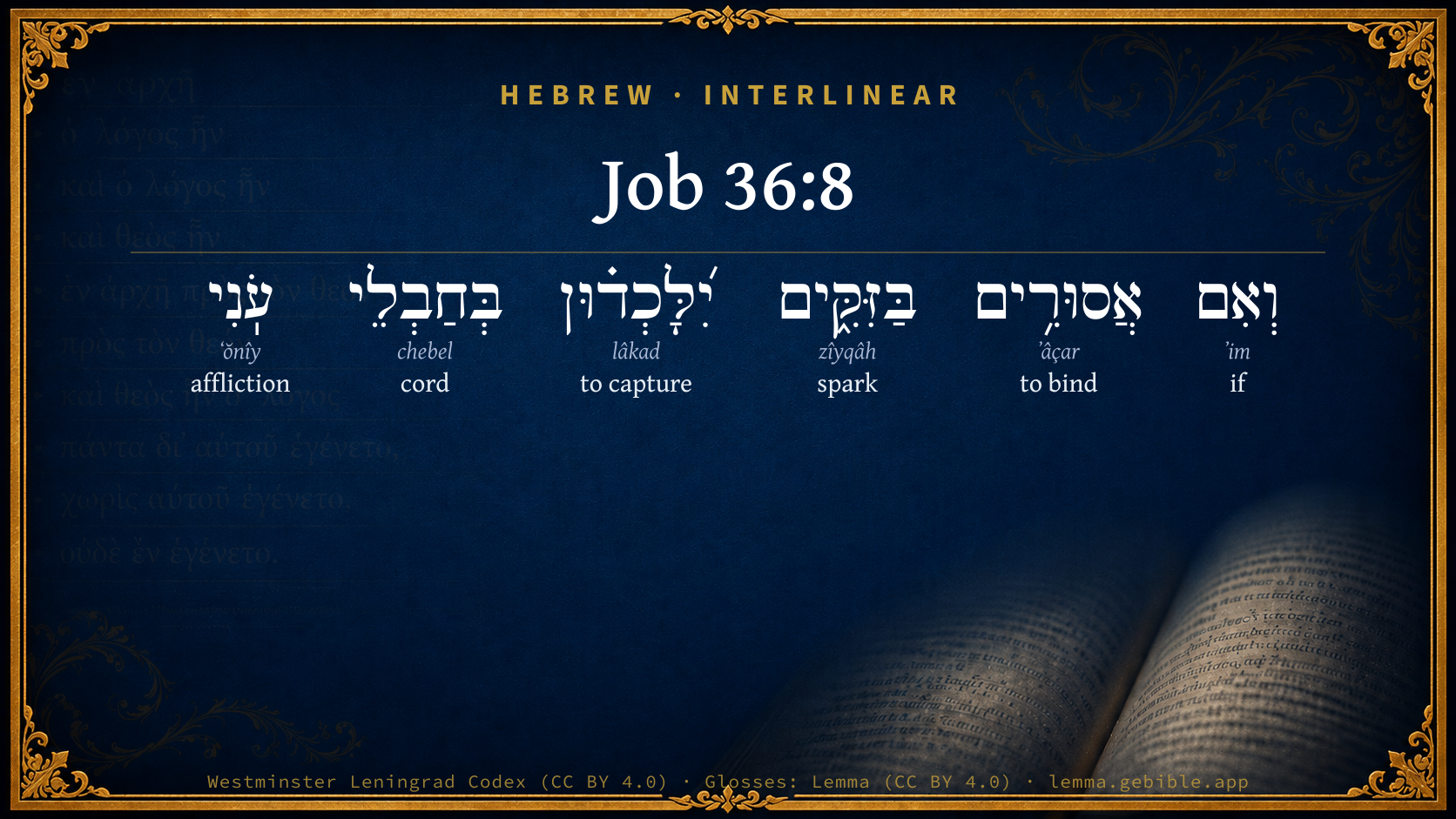
Hebrew (Westminster Leningrad Codex) Job 36:8 appears in the Hebrew Old Testament. The text above is from the Westminster Leningrad Codex. Each word links to its Strong’s number, a concise gloss, and parsing drawn from the Open Scriptures Hebrew Bible morphology. Click any word for its full Brown-Driver-Briggs (BDB) entry.
Download image
Cite this verse

Job 36:8 (World English Bible). Public Domain. Lemma interlinear Bible study tool, https://lemma.gebible.app/v/job/36/8.

Show BibTeX & RIS
BibTeX
RIS
English Translation
If they are bound in fetters, And are taken in the cords of afflictions,
World English Bible · Public Domain
Highlights
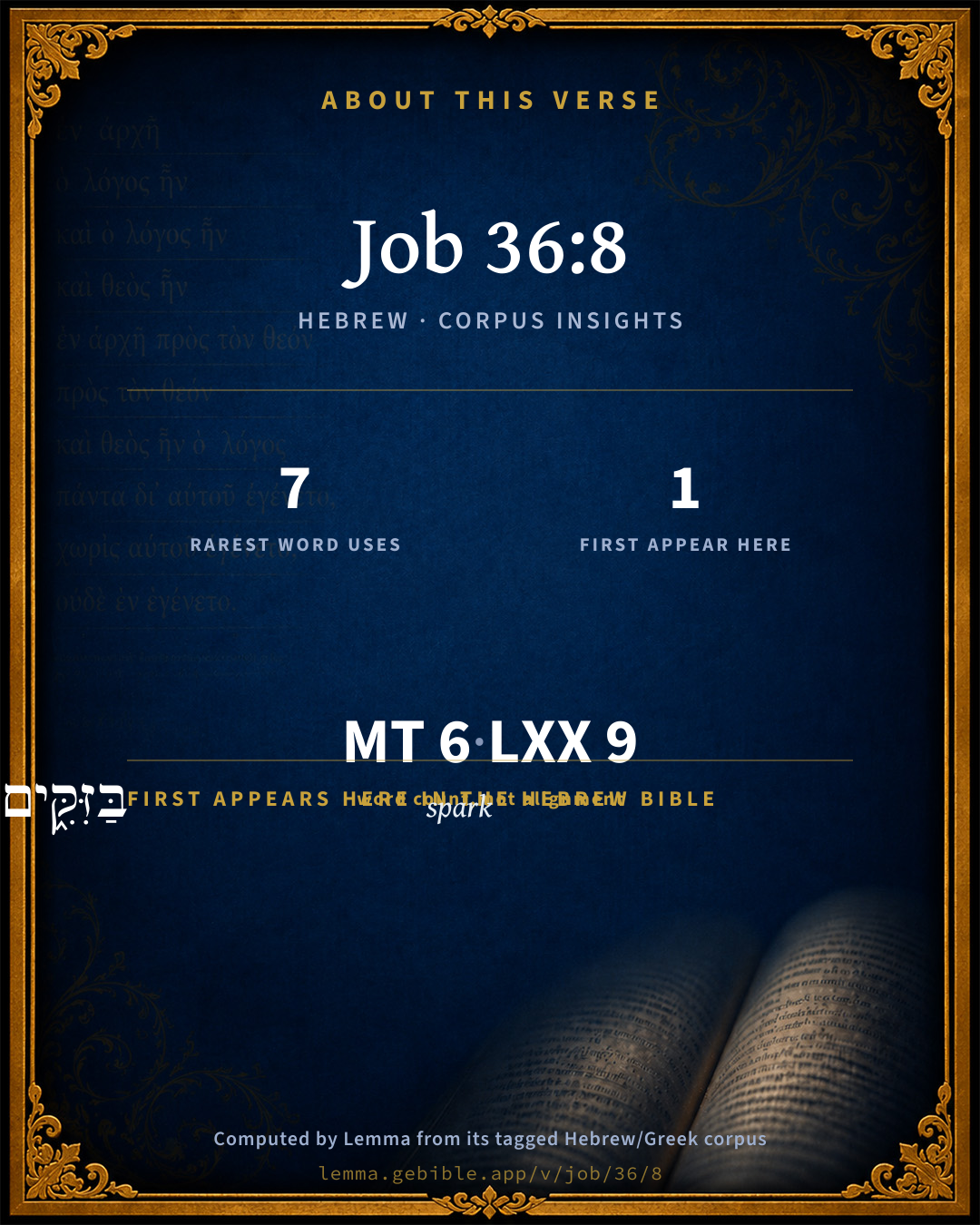
  • 1 first appearance in the Hebrew Bible
Full analysis ↓
Download a study sheet

One document with this verse’s original text, its word-by-word gloss line, the meaning frame, cross-references with their text, attributed commentary, and full source and license credits — printable, and it pastes into notes with its structure intact.

This verse Autodidact and up

Study sheet (.html) Plain text (.txt)

A passage Seminary Student

Up to 50 verses in one chapter. A passage sheet keeps up to 6 commentary sources and 12 cross-references per verse, in the order this page ranks them, and says so on the sheet whenever that leaves anything out. Ask for a single verse and you get the Autodidact verse sheet above.

Everything on this page stays free to read, with no account — the sheet is a download of what is already on screen, not access to it.

Want to remove ads? Support Godless Engineer
Compare translations 3

The same verse in 3 English versions, stacked beneath the original-language interlinear above. Click any original word for its lexicon entry.

Each is an independent rendering of the whole verse — the interlinear is not word-aligned to these translations.

Highlighted words mark where these versions differ — a whole-verse word diff, not a word-by-word alignment.

  • World English Bible Public Domain
    If they are bound in fetters, And are taken in the cords of afflictions,
  • King James Version Public Domain
    And if they be bound in fetters, and be holden in cords of affliction;
  • unfoldingWord Literal Text CC BY-SA 4.0
    But if bound in chains and they are caught in cords of affliction,

unfoldingWord Literal Text — © unfoldingWord, licensed CC BY-SA 4.0. Word-aligned USFM3 via Door43 (git.door43.org/unfoldingWord/en_ult).

Versions to compare (up to 4)

3 of 4 selected

Show all 18 translations

Every available English version of this verse, each an independent rendering of the whole verse.

  • World English Bible Public Domain
    If they are bound in fetters, And are taken in the cords of afflictions,
  • Berean Standard Bible Public Domain
    And if men are bound with chains, caught in cords of affliction,
  • Majority Standard Bible Public Domain
    And if men are bound with chains, caught in cords of affliction,
  • King James Version Public Domain
    And if they be bound in fetters, and be holden in cords of affliction;
  • American Standard Version (1901) Public Domain
    And if they be bound in fetters, And be taken in the cords of afflictions;
  • Revised Version (1885) Public Domain
    And if they be bound in fetters, and be taken in the cords of affliction;
  • Geneva Bible (1599) Public Domain
    And if they bee bound in fetters and tyed with the cordes of affliction,
  • Douay-Rheims (1899) Public Domain
    And if they shall be in chains, and be bound with the cords of poverty:
  • Young's Literal Translation Public Domain
    And if prisoners in fetters They are captured with cords of affliction,
  • Literal Standard Version CC BY-SA 4.0
    And if prisoners in chains || They are captured with cords of affliction,
  • Unlocked Literal Bible CC BY-SA 4.0
    If they are bound in chains and trapped in cords of suffering,
  • unfoldingWord Literal Text CC BY-SA 4.0
    But if bound in chains and they are caught in cords of affliction,
  • Darby Bible Public Domain
    And if, bound in fetters, they be held in cords of affliction,
  • World Messianic Bible Public Domain
    If they are bound in fetters, and are taken in the cords of afflictions,
  • Webster's Bible Public Domain
    And if they are bound in fetters, and are held in cords of affliction;
  • Free Bible Version CC BY-SA 4.0
    If they are bound in chains, tied down by ropes of suffering,
  • Bible in Basic English Public Domain
    And if they have been prisoned in chains, and taken in cords of trouble,
  • JPS Tanakh (1917) Public Domain
    And if they be bound in fetters, and be holden in cords of affliction;

Literal Standard Version (2020), Covenant Press — licensed CC BY-SA 4.0. Text via the HelloAO Bible API (eBible.org). Unlocked Literal Bible (unfoldingWord) — licensed CC BY-SA 4.0. Text via the HelloAO Bible API (eBible.org). unfoldingWord Literal Text — © unfoldingWord, licensed CC BY-SA 4.0. Word-aligned USFM3 via Door43 (git.door43.org/unfoldingWord/en_ult). Free Bible Version, Dr. Jonathan Gallagher — licensed CC BY-SA 4.0. Text via the HelloAO Bible API (eBible.org).

Word by word

More ways to search: Search by grammar → Find every occurrence → Compare this word →

Practice this passage: Drill this verse → Learn its vocabulary →

About this verse

These counts appear in no published source. They are computed here, from the morphology-tagged text and Lemma’s own curated glosses. What Lemma adds →

6
words
6
distinct lemmas
Wisdom
section

Notable vocabulary

The rarest word here is בַּזִּקִּ֑ים spark H2131 — appearing just 7 times in the whole Hebrew Bible.

First appearance in Scripture

This word makes its first canonical appearance in the Hebrew Bible here:

  • בַּזִּקִּ֑ים spark H2131

Shared distinctive vocabulary

בַּזִּקִּ֑ים spark H2131 occurs in 6 verses of the Hebrew Bible. Also found in:

Grammatical profile

  • 2 verbs
  • 3 nouns
  • 1 conjunction

Verb forms

  • אֲסוּרִ֥ים Qal · Participle Passive
  • יִ֝לָּכְד֗וּן Niphal · Imperfect

Hebrew & Septuagint length

In English translation the verse runs 14 words from the Hebrew and 14 from the Septuagint (LXX English) — the same length.

A rough comparison of the two English renderings, which tokenize alike — not a word-level alignment.

Word counts can differ between the Hebrew and the Greek without any difference in meaning — e.g. the Hebrew direct-object marker אֵת has no separate Greek word, and Greek often adds the article ὁ.

In the original languages it is 6 Hebrew tokens and 9 Greek tokens — but the two are counted differently (Hebrew bundles its prefixes and suffixes into one token; the Greek is in lemma form), so that isn’t a like-for-like length.

Cross-references

8

Topical passages linked to Job 36:8 in the Treasury of Scripture Knowledge — connected by theme and wording, ordered by reader-vote popularity; previews shown in the World English Bible.

  • Psalms 107:10 Some sat in darkness and in the shadow of death, Being bound in affliction and iron,
  • Proverbs 5:22 The evil deeds of the wicked ensnare him. The cords of his sin hold him firmly.
  • Job 13:27 You also put my feet in the stocks, And mark all my paths. You set a bound to the soles of my feet:
  • Job 19:6 Know now that God has subverted me, And has surrounded me with his net.
  • Job 33:18–19 He keeps back his soul from the pit, And his life from perishing by the sword.
  • Psalms 18:5 The cords of Sheol were round about me; The snares of death came on me.
  • Psalms 116:3 The cords of death surrounded me, The pains of Sheol got a hold of me. I found trouble and sorrow.
  • Lamentations 3:9 He has walled up my ways with hewn stone; he has made my paths crooked.

Cross-references courtesy of OpenBible.info (CC BY 4.0).

Hebrew and Greek witnesses Masoretic Hebrew ↔ Greek Septuagint

The same verse in the two great witnesses to the Old Testament, shown verse-for-verse.

These are two independent witnesses, not word-aligned to each other, and the Septuagint is shown in lemma (dictionary) form.

Hebrew Job 36:8 Masoretic · Westminster Leningrad Codex

וְאִם אֲסוּרִ֥ים בַּזִּקִּ֑ים יִ֝לָּכְד֗וּן בְּחַבְלֵי עֹֽנִי

If they are bound in fetters, And are taken in the cords of afflictions,

World English Bible · Public Domain

Greek LXX Job 36:8 Septuagint · lemma form

καί εἰ πεδάω ἐν χειροπέδη συνἔχω ἐν σχοινίον πενία

But they that are bound in fetters shall be holden in cords of poverty.

LXX2012 (modern English Septuagint) · Public Domain

Hebrew: Westminster Leningrad Codex (CC BY 4.0). Greek: Septuagint (public domain); English from LXX2012 (modern English Septuagint) (Public Domain). How the Septuagint differs from the Hebrew →

Commentary

Notes on Job 36:8 from classic Christian and Jewish commentators (each source and its license shown beneath its notes). The classic Christian expositions comment on the surrounding passage and are grouped to its opening verse, so a note may address several verses; the Jewish commentaries on the Tanakh (Rashi and others) are per-verse, so they appear only where the commentator wrote on this verse.

Lemma curates 59 commentaries, every one of them public domain or Creative Commons licensed, each selected and text-cleaned for this edition rather than reprinted as found. About our sources →

Trapp's Complete Commentary

John Trapp

Job 36:8 And if [they be] bound in fetters, [and] be holden in cords of affliction;

Ver. 8. And if they be bound in fetters] If it so happens, that through abuse of their prosperity and preferment, they wander, as they are men, out of the right way, and God sends out afflictions as his pursuivants to attack them, and lay them in cold irons for their correction, and to prevent judgment, Psa 107:10.

And be holden in cords of affliction] Or poverty; so that irretiti funibus misere vixerint (as the Tigurines here translate), they have only prisoners’ pittances, which will neither keep them alive nor suffer them to die.

John Trapp, A Commentary or Exposition upon All the Books of the Old and New Testament (1647–1656) — public domain. Text from a community e-Sword module.

Joseph Benson's Commentary

Job 36:8-10. If they be bound in fetters — If, through the vicissitude of worldly affairs, they are brought from their throne into a prison, as sometimes hath been done. Then he showeth them their work — Their evil works: by these afflictions he brings them to a sight of their sins; that then have exceeded — That they have greatly sinned by abusing their power and prosperity, which even good men are too prone to do. He openeth also, &c. — He inclines them to hearken to what God speaks by his rod, who would not hear in the time of their prosperity; namely, to hear the rod and him that hath appointed it; and commandeth — Either by his word or Spirit accompanying this affliction, and discovering the design of God in this dispensation; that they return from iniquity — The chief cause of their calamity and trouble.

Joseph Benson's Commentary on the Old and New Testaments (1811–1818) — public domain. Text from a community e-Sword module.

Whedon's Commentary on the Bible

Daniel D. Whedon

Strophe b — The sufferings the righteous experience are intended to be restorative, and at the same time to promote temporal and spiritual prosperity; failing of this, they entail destruction, Job_36:8-12.

8. Fetters and cords are used in a figurative sense. Arab writers, cited by Hitzig, formulate the thought thus: — “Sickness is God’s prison on the earth.” However lofty the elevation of the righteous, he is not beyond the afflictive hand of God; nay, quite as certainly as upon the lowliest shall the gathered clouds of adversity burst upon the heads of the highest, in order that their souls may also be severed and won from the deleterious influences of worldly prosperity. These glowing words (Job_36:8-12) have an oblique reference to Job. In the view of Elihu affliction is the voice of God to the soul, “not in anger, nor in wrath,” but in love. The contrast between the views of Elihu and those of “the friends,” as to the design of affliction, is most marked.

Daniel D. Whedon (gen. ed.), Commentary on the Old and New Testaments (1874–1909) — public domain. Text from a community e-Sword module.

Keil & Delitzsch

C. F. Keil & F. Delitzsch

8 And if they are bound with chains,

Holden in cords of affliction:

9 Then He declareth to them their doing

And their transgressions, that they have been vainglorious;

10 Then He openeth their ear to warning,

And commandeth them to turn from iniquity.

The subj. is in no case the רשׁעים (Hahn), but the צדיקים, or those who are as susceptible to discipline as it is needful to them, just as in Ps 107, which in general presents many instances for an extensive comparison with the speeches of Elihu. The chains, Job 36:8, are meant literally, and the bands, Job 36:8, figuratively; the Psalmist couples both in אסירי עני וברזל, Psa 107:10. The conclusion begins with Job 36:9, and is repeated in another application, Job 36:10. פּעל in the sense of maleficium, as Arab. fa‛alat, recalls מעשׂה, facinus, Job 33:17. כּי, Job 36:9, as in Job 36:10, an objective quod. It is not translated, however, quod invaluerint (Rosenm.), which is opposed to the most natural sense of the Hithpa., but according to Job 15:25 : quod sese extulerint. מוּסר, παιδεία, disciplina, interchanges here with the more rare מסר used in Job 33:16; there we have already also met with the phrase גּלה אזן, to uncover the ear, i.e., to open. אמר כּי corresponds to the Arab. amara an (bi-an), to command that. The fundamental thought of Elihu here once again comes unmistakeably to view: the sufferings of the righteous are well-meant chastisements, which are to wean them from the sins into which through carnal security they have fallen - a warning from God to penitence, designed to work their good.

Keil & Delitzsch — Biblical Commentary on the Old Testament (1861–1891) — public domain (CC PDM 1.0). Text via the HelloAO Bible API. (Old Testament only.)

Jamieson, Fausset & Brown

Robert Jamieson, A. R. Fausset & David Brown

If they be afflicted, it is no proof that they are hypocrites, as the friends maintain, or that God disregards them, and is indifferent whether men are good or bad, as Job asserts: God is thereby "disciplining them," and "showing them their sins," and if they bow in a right spirit under God's visiting hand, the greatest blessings ensue.

Jamieson, Fausset & Brown — Commentary Critical and Explanatory on the Whole Bible (1871) — public domain (CC PDM 1.0). Text via the HelloAO Bible API.

Adam Clarke's Commentary

Verse 8. And if they be bound in fetters] These are means which God uses, not of punishment, but of correction.

Adam Clarke's Commentary on the Bible (1810–1826) — public domain. Text from a community e-Sword/MySword module.

The Cambridge Bible for Schools and Colleges

gen. ed. J. J. S. Perowne

8. The expression “fetters” is rather to be taken figuratively, meaning affliction or adversity, as “cords of affliction” in the next clause suggests.

8–10. If life often appears to present a different picture and men are seen in affliction, this affliction is a discipline, needful to warn them and bring their evil before them.

The Cambridge Bible for Schools and Colleges (gen. ed. J. J. S. Perowne; Cambridge University Press, 1878–1918) — public domain. Text from a community e-Sword module.

John Gill's Exposition

And if they be bound in fetters,.... Not the wicked, as the Targum, but the righteous spoken of in Job 36:7, with which this is closely connected; and this is not to be understood of righteous kings on the throne in particular, or their special favourites, but of the righteous in general; and not in a literal sense, of their bonds and imprisonment for religion and righteousness sake, which is sometimes their lot; but in a figurative sense, of afflictions, as chastenings and corrections for sin, as appears by the next clause; and the design is to obviate an objection, and to show that the eye of God is upon them, and his heart towards them; and they are not the less objects of his love and delight, of his value and esteem, care and protection, though they are afflicted by him, and, as it may seem, used with some severity; seeing he has gracious ends and designs in all this, which are suggested in the following verses;

and be holden in cords of affliction; righteous men are not exempt from afflictions; the afflictions of the righteous are many, according to divine appointment, the covenant of grace, the declaration of God, the constant experience of good men, it being the way in which they are all led, and must enter into the kingdom; and the metaphor here used shows that afflictions are sometimes heavy upon them, like fetters and chains, and those made heavy by the hand of God pressing them sore, Lam 3:7; no affliction is joyous, but grievous and heavy in itself; it is indeed comparatively light when viewed with the weight of glory; and God can make a heavy affliction light with his presence, and the discoveries of his love; but they are heavy to the flesh, as Job felt his to be, Job 6:2; and, like fetters and cords, they cannot free themselves from them, or loose them, until it is the pleasure of God to take them off; and moreover by these they are sometimes held and restrained from going into more or greater sins, which is one use of them: as they are with afflictions hedged about that they cannot come out, any more than a person bound fast in a prison; so they are hedged up with thorns that they cannot go out after their lovers, Lam 3:7, Hos 2:6. Some render the phrase, "cords of poverty" (l); it is oftentimes the case of righteous persons to be poor, and to be sadly hampered with poverty, and out of which, by all that they can do, cannot extricate themselves; and sometimes they fall into it, and are held in it, after they have enjoyed much worldly prosperity, which was the case of Job. Mr. Broughton renders it, cords of anguish; and indeed the word for "cords" is used of the pains of a woman in travail, who has then great anguish and trouble; and anguish on various accounts lays hold on the righteous, and they are holden thereby, and cannot relieve themselves, Psa 119:143; and yet this is all in mercy, and to answer some good ends and purposes, as follow.

(l) "funibus paupertatis", Mercerus, Drusius; "funibus inopiae", Cocceius.

John Gill's Exposition of the Whole Bible (1746–1763) — public domain (CC PDM 1.0). Text via the HelloAO Bible API.

Albert Barnes' Notes on the Bible

And if they be bound in fetters - That is, if the righteous are thrown into prison, and are subjected to oppressions and trials, or if they are chained down, as it were, on a bed of pain, or crushed by heavy calamities, the eye of God is still upon them. Their sufferings should not be regarded either as proof that they are hypocrites, or that God is regardless of them, and is indifferent whether people are good or evil. The true solution of the difficulty was, that God was then accomplishing purposes of discipline, and that happy results would follow if they would receive affliction in a proper manner.

Albert Barnes' Notes on the Bible (1834–1885) — public domain. Text from a community e-Sword/MySword module.

Matthew Poole's English Annotations

If through the vicissitude of worldly affairs, and the righteous judgment of God upon them for their sins, they be brought from their throne into a prison, as sometimes hath been done.

Matthew Poole's English Annotations on the Holy Bible (1683–1685) — public domain. Text from a community e-Sword/MySword module.

The Pulpit Commentary

And if they be bound in fetters, and be holden in cords of affliction. On the other hand, there are doubtless eases where the righteous suffer adversity are even "bound in fetters," and "holden in cords of affliction". (Gen_39:20 Jer_40:1 Dan_3:21 Mat_14:3 Act_12:6 Act_16:24 Act_24:27, etc.) But even here God"s vigilance is not relaxed. On the contrary, he watches with the utmost care over their afflictions, apportioning them according to the needs of each, and making every possible effort, by means of them, to work their reformation (see the two following verses).

The Pulpit Commentary (1880–1919), ed. H.D.M. Spence-Jones & Joseph S. Exell — public domain. Text from a community e-Sword module.

John Wesley's Explanatory Notes

If - Through the vicissitude of worldly affairs, they are brought from their throne into a prison, as sometimes hath been done.

John Wesley, Explanatory Notes Upon the Whole Bible (1754–1765) — public domain. Text via the GEBible commentary corpus.

unfoldingWord translationNotes

Door43 World Missions Community

If they are bound in chains

Here the word "they" refers righteous people whom God will discipline if they sin. This can be stated in active form. AT: "If someone binds them in chains" or "If someone makes them a prisoner" (See: Active or Passive)

trapped in cords of suffering

Elihu speaks of a person being made to suffer as if that person were trapped in ropes that cause suffering. AT: "someone causes them to suffer" (See: Metaphor and Active or Passive)

their transgressions and their pride

The verb may be supplied from the previous phrase. AT: "he reveals to them their transgressions and their pride" (See: Ellipsis)

translationWords

bind

reveal

transgress

proud

unfoldingWord translationNotes — © Distant Shores Media and the Door43 World Missions Community, licensed CC BY-SA 4.0. Source: git.door43.org/Door43/en_tn.

Rashi

Rabbi Shlomo Yitzchaki (Rashi)

And if you see righteous men who are bound with chains of suffering and ailments, or caught with ropes of poverty. In an expression of lots or ropes, they are called חבלים, in an expression of worry, they are called חֶבְלֵי יוֹלֵדָה, pangs of a childbearing woman. with ropes of poverty Heb. בחבלי cordes in French. It is only because they sinned before Him, and He comes to requite them for their own good, to cleanse them and to admonish them to return to Him.

Rashi on the Tanakh — English translations: “The Judaica Press complete Tanach with Rashi, translated by A. J. Rosenberg” (CC BY 4.0); “Pentateuch with Rashi's commentary by M. Rosenbaum and A.M. Silbermann, 1929-1934” (public domain); “The Metsudah Tanach series, Lakewood, N.J” (CC BY 4.0); and “The Book of Joshua, Metsudah Publications, 1997” (CC BY 4.0). Text via Sefaria.

Lesson kit

Teaching starters — assembled from the data on this page, not authored interpretation. Every prompt links to the verse data it draws on. Edit before teaching.

Job, in the Wisdom, opens this verse with 6 words (6 distinct Hebrew lemmas). Its most distinctive word is zîyqâh (“spark”). A historical commentator’s framing appears above. Read the whole chapter for the surrounding context.

Discussion questions

  1. The word zîyqâh carries the sense “spark.” How does it shape the verse?
  2. The word “spark” first appears here in Scripture. What is being introduced at this debut?
  3. Psalms 149:8 shares the word «spark» with this verse. How do the two illuminate each other?
  4. The translations on this page render this verse differently — a whole-verse word diff, not a word-by-word alignment. What might account for the different wordings?
  5. The verb «אֲסוּרִ֥ים» is Qal Participle Passive. How does its form color the action?
  6. Reading how Trapp's Complete Commentary and Joseph Benson's Commentary read this verse, where do the two commentators agree and where do they part?

Things to notice

Reading settings

Reading text

Shown beneath each verse's original-language words.

Old Testament
Old Testament edition

Read the OT as the Masoretic Hebrew (MT) or the Greek Septuagint (LXX).

English shown for the Greek Septuagint (in the Hebrew ↔ Greek comparison).

Comparing translations? Open the Compare panel on any verse page to stack up to four side by side.