
Jeremiah 51:56

Hebrew (Westminster Leningrad Codex) Jeremiah 51:56 appears in the Hebrew Old Testament. The text above is from the Westminster Leningrad Codex. Each word links to its Strong’s number, a concise gloss, and parsing drawn from the Open Scriptures Hebrew Bible morphology. Click any word for its full Brown-Driver-Briggs (BDB) entry.
Download image
Cite this verse

Jeremiah 51:56 (World English Bible). Public Domain. Lemma interlinear Bible study tool, https://lemma.gebible.app/v/jeremiah/51/56.

Show BibTeX & RIS
BibTeX
RIS
English Translation
for the destroyer is come on her, even on Babylon, and her mighty men are taken, their bows are broken in pieces; for Yahweh is a God of recompenses, he will surely requite.
World English Bible · Public Domain
Download a study sheet

One document with this verse’s original text, its word-by-word gloss line, the meaning frame, cross-references with their text, attributed commentary, and full source and license credits — printable, and it pastes into notes with its structure intact.

This verse Autodidact and up

Study sheet (.html) Plain text (.txt)

A passage Seminary Student

Up to 50 verses in one chapter. A passage sheet keeps up to 6 commentary sources and 12 cross-references per verse, in the order this page ranks them, and says so on the sheet whenever that leaves anything out. Ask for a single verse and you get the Autodidact verse sheet above.

Everything on this page stays free to read, with no account — the sheet is a download of what is already on screen, not access to it.

Want to remove ads? Support Godless Engineer
Compare translations 3

The same verse in 3 English versions, stacked beneath the original-language interlinear above. Click any original word for its lexicon entry.

Each is an independent rendering of the whole verse — the interlinear is not word-aligned to these translations.

Highlighted words mark where these versions differ — a whole-verse word diff, not a word-by-word alignment.

  • World English Bible Public Domain
    for the destroyer is come on her, even on Babylon, and her mighty men are taken, their bows are broken in pieces; for Yahweh is a God of recompenses, he will surely requite.
  • King James Version Public Domain
    Because the spoiler is come upon her, even upon Babylon, and her mighty men are taken, every one of their bows is broken: for the LORD God of recompences shall surely requite.
  • unfoldingWord Literal Text CC BY-SA 4.0
    For the destroyers have come against her—against Babylon!—and her warriors have been captured. Their bows are broken, for Yahweh is the God of vengeance; he will surely carry out this repayment.

unfoldingWord Literal Text — © unfoldingWord, licensed CC BY-SA 4.0. Word-aligned USFM3 via Door43 (git.door43.org/unfoldingWord/en_ult).

Versions to compare (up to 4)

3 of 4 selected

Show all 18 translations

Every available English version of this verse, each an independent rendering of the whole verse.

  • World English Bible Public Domain
    for the destroyer is come on her, even on Babylon, and her mighty men are taken, their bows are broken in pieces; for Yahweh is a God of recompenses, he will surely requite.
  • Berean Standard Bible Public Domain
    For a destroyer is coming against her—against Babylon. Her warriors will be captured, and their bows will be broken, for the LORD is a God of retribution; He will repay in full.
  • Majority Standard Bible Public Domain
    For a destroyer is coming against her—against Babylon. Her warriors will be captured, and their bows will be broken, for the LORD is a God of retribution; He will repay in full.
  • King James Version Public Domain
    Because the spoiler is come upon her, even upon Babylon, and her mighty men are taken, every one of their bows is broken: for the LORD God of recompences shall surely requite.
  • American Standard Version (1901) Public Domain
    for the destroyer is come upon her, even upon Babylon, and her mighty men are taken, their bows are broken in pieces; for Jehovah is a God of recompenses, he will surely requite.
  • Revised Version (1885) Public Domain
    for the spoiler is come upon her, even upon Babylon, and her mighty men are taken, their bows are broken in pieces: for the LORD is a God of recompences, he shall surely requite.
  • Geneva Bible (1599) Public Domain
    Because the destroyer is come vpon her, euen vpon Babel, and her strong men are taken, their bowes are broken: for the Lord God that recompenceth, shall surely recompence.
  • Douay-Rheims (1899) Public Domain
    Because the spoiler is come upon her, that is, upon Babylon, and her valiant men are taken, and their bow is weakened, because the Lord, who is a strong revenger, will surely repay.
  • Young's Literal Translation Public Domain
    For come in against it -- against Babylon -- hath a spoiler, And captured have been its mighty ones, Broken have been their bows, For the God of recompences -- Jehovah -- doth certainly repay.
  • Literal Standard Version CC BY-SA 4.0
    For a spoiler has come in against her—against Babylon, || And her mighty ones have been captured, || Their bows have been broken, || For the God of recompenses—YHWH—certainly repays.
  • Unlocked Literal Bible CC BY-SA 4.0
    For the destroyers have come against her—against Babylon!—and her warriors have been captured. Their bows are broken, for Yahweh is the God of vengeance; he will surely carry out this repayment.
  • unfoldingWord Literal Text CC BY-SA 4.0
    For the destroyers have come against her—against Babylon!—and her warriors have been captured. Their bows are broken, for Yahweh is the God of vengeance; he will surely carry out this repayment.
  • Darby Bible Public Domain
    For the spoiler is come against her, against Babylon, and her mighty men are taken; their bows are broken in pieces; for Jehovah, the ùGod of recompences, will certainly requite.
  • World Messianic Bible Public Domain
    For the destroyer has come on her, even on Babylon. Her mighty men are taken. Their bows are broken in pieces, for the LORD is a God of retribution. He will surely repay.
  • Webster's Bible Public Domain
    Because the spoiler is come upon her, even upon Babylon, and her mighty men are taken, every one of their bows is broken: for the LORD God of recompenses shall surely requite.
  • Free Bible Version CC BY-SA 4.0
    A destroyer is coming to attack Babylon. Her soldiers will be taken prisoner, and their bows will be smashed, for the Lord is a God who punishes fairly; he will definitely pay them back.
  • Bible in Basic English Public Domain
    For the waster has come on her, even on Babylon, and her men of war are taken, their bows are broken: for the Lord is a rewarding God, and he will certainly give payment.
  • JPS Tanakh (1917) Public Domain
    For the spoiler is come upon her, even upon Babylon, and her mighty men are taken, their bows are shattered; for the LORD is a God of recompenses, He will surely requite.

Literal Standard Version (2020), Covenant Press — licensed CC BY-SA 4.0. Text via the HelloAO Bible API (eBible.org). Unlocked Literal Bible (unfoldingWord) — licensed CC BY-SA 4.0. Text via the HelloAO Bible API (eBible.org). unfoldingWord Literal Text — © unfoldingWord, licensed CC BY-SA 4.0. Word-aligned USFM3 via Door43 (git.door43.org/unfoldingWord/en_ult). Free Bible Version, Dr. Jonathan Gallagher — licensed CC BY-SA 4.0. Text via the HelloAO Bible API (eBible.org).

Word by word

More ways to search: Search by grammar → Find every occurrence → Compare this word →

Practice this passage: Drill this verse → Learn its vocabulary →

גְּמֻל֛וֹת
gᵉmûwlâh
H1578
“recompenses”
Noun, Common, Feminine, Plural, Absolute
Part of Speech
Noun
Type
Common
Gender
Feminine
Number
Plural
State
Absolute
Full BDB Definition

Origin: from H1576

TWOT: 360b

dealing, recompense
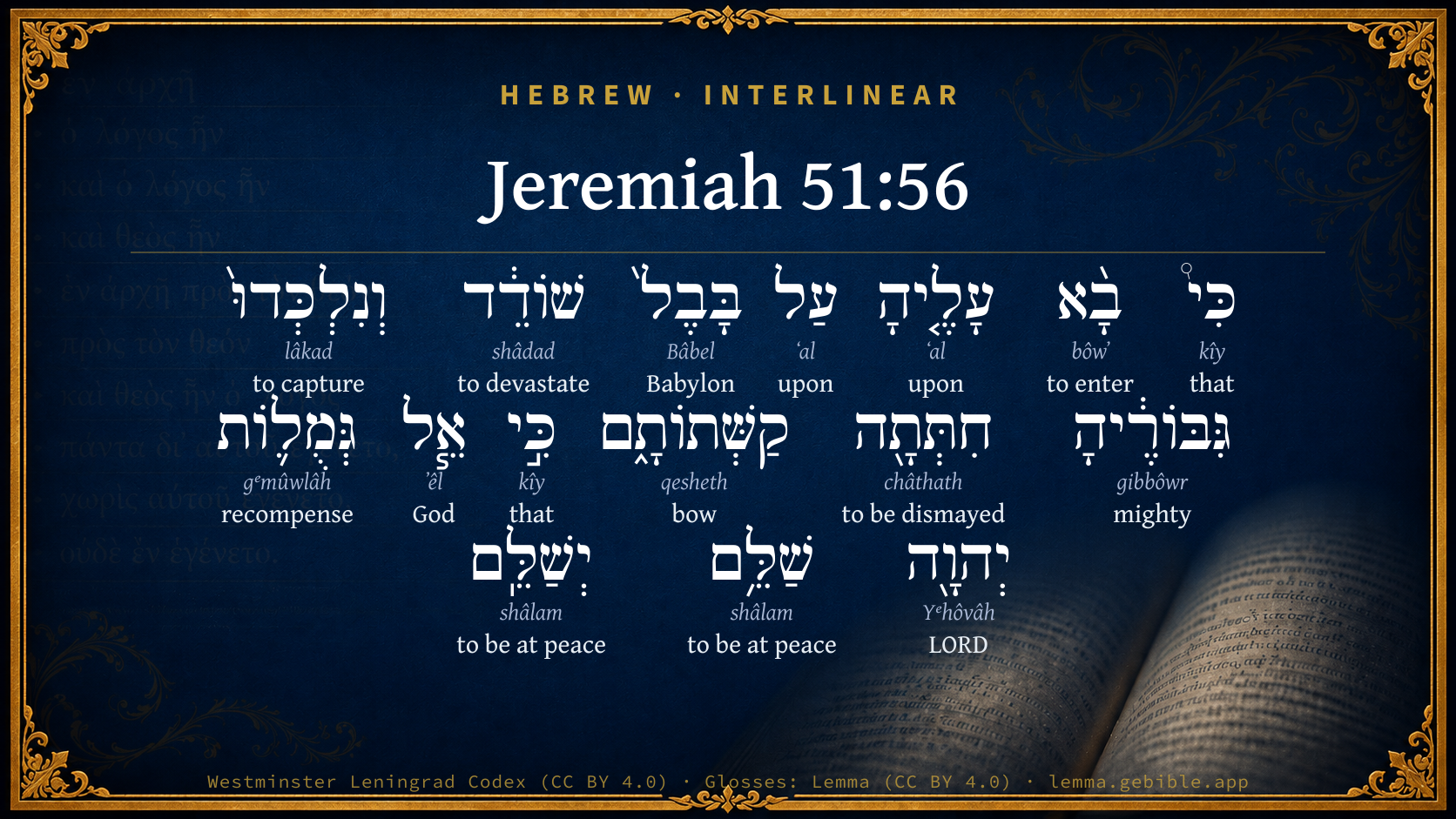
  1. כִּי֩ kîy H3588 “that” Conjunction
  2. בָ֨א bôwʼ H935 “to enter” Verb, Qal, Perfect, 3rd Person, Masculine, Singular
  3. עָלֶ֤יהָ ʻal H5921 “upon · her” Preposition + Suffix, Personal, 3rd Person, Feminine, Singular
  4. עַל ʻal H5921 “upon” Preposition
  5. בָּבֶל֙ Bâbel H894 “Babylon” Noun, Proper
  6. שׁוֹדֵ֔ד shâdad H7703 “devastating” Verb, Qal, Participle Active, Masculine, Singular, Absolute
  7. וְנִלְכְּדוּ֙ lâkad H3920 “and · to capture” Conjunction + Verb, Niphal, Sequential Perfect, 3rd Person, Common, Plural
  8. גִּבּוֹרֶ֔יהָ gibbôwr H1368 “mighty · her” Adjective, Adjective, Masculine, Plural, Construct + Suffix, Personal, 3rd Person, Feminine, Singular
  9. חִתְּתָ֖ה châthath H2865 “to be dismayed” Verb, Piel, Perfect, 3rd Person, Feminine, Singular
  10. קַשְּׁתוֹתָ֑ם qesheth H7198 “bows · their” Noun, Common, Feminine, Plural, Construct + Suffix, Personal, 3rd Person, Masculine, Plural
  11. כִּ֣י kîy H3588 “that” Conjunction
  12. אֵ֧ל ʼêl H410 “God of” Noun, Common, Masculine, Singular, Construct
  13. יְהוָ֖ה Yᵉhôvâh H3068 “LORD” Noun, Proper
  14. שַׁלֵּ֥ם shâlam H7999 “to be at peace” Verb, Piel, Infinitive Absolute
  15. יְשַׁלֵּֽם shâlam H7999 “to be at peace” Verb, Piel, Imperfect, 3rd Person, Masculine, Singular

About this verse

These counts appear in no published source. They are computed here, from the morphology-tagged text and Lemma’s own curated glosses. What Lemma adds →

16
words
13
distinct lemmas
Prophets
section

Notable vocabulary

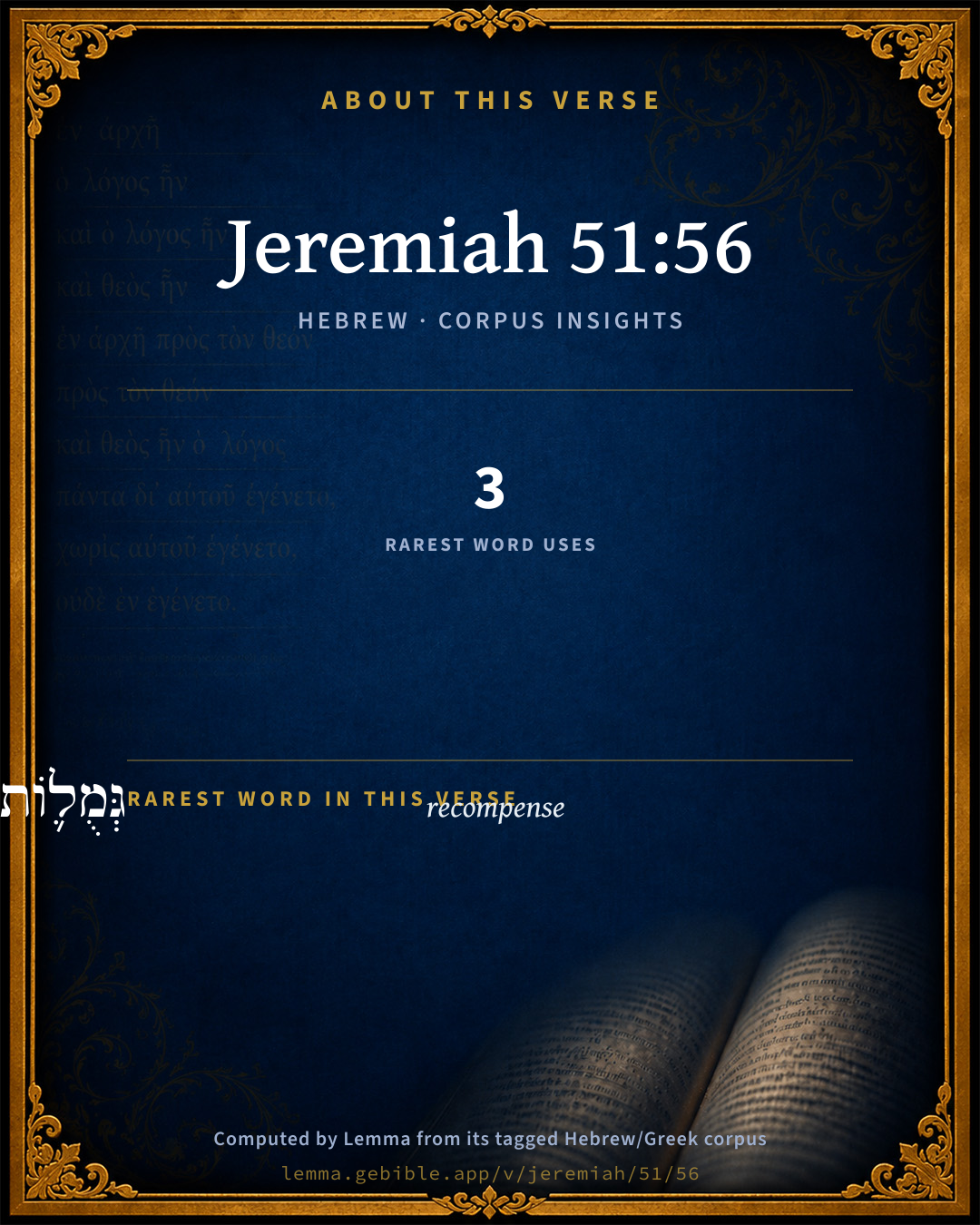
The rarest word here is גְּמֻל֛וֹת recompense H1578 — appearing just 3 times in the whole Hebrew Bible.

Shared distinctive vocabulary

גְּמֻל֛וֹת recompense H1578 occurs in 3 verses of the Hebrew Bible. Also found in:

Grammatical profile

  • 6 verbs
  • 5 nouns
  • 1 adjective
  • 2 prepositions
  • 2 conjunctions

Verb forms

  • בָ֨א Qal · Perfect
  • שׁוֹדֵ֔ד Qal · Participle Active
  • וְנִלְכְּדוּ֙ Niphal · Sequential Perfect
  • חִתְּתָ֖ה Piel · Perfect
  • שַׁלֵּ֥ם Piel · Infinitive Absolute
  • יְשַׁלֵּֽם Piel · Imperfect

Repetition

Words recur within this verse — often emphatic in Hebrew:

  • עָלֶ֤יהָ upon H5921 ×2
  • שַׁלֵּ֥ם to be at peace H7999 ×2
  • כִּי֩ that H3588 ×2

Cross-references

28

Topical passages linked to Jeremiah 51:56 in the Treasury of Scripture Knowledge — connected by theme and wording, ordered by reader-vote popularity; previews shown in the World English Bible.

  • Psalms 46:9 He makes wars cease to the end of the earth. He breaks the bow, and shatters the spear. He burns the chariots in the fire.
  • Psalms 94:1–2 Yahweh, you God to whom vengeance belongs, You God to whom vengeance belongs, shine forth.
  • Jeremiah 51:6 Flee out of the midst of Babylon, and save every man his life; don't be cut off in her iniquity: for it is the time of Yahweh's vengeance; he will render to her a recompense.
  • Jeremiah 51:48 Then the heavens and the earth, and all that is therein, shall sing for joy over Babylon; for the destroyers shall come to her from the north, says Yahweh.
  • Habakkuk 2:8 Because you have plundered many nations, all the remnant of the peoples will plunder you, because of men's blood, and for the violence done to the land, to the city and to all who dwell in it.
  • Deuteronomy 32:35 Vengeance is mine, and recompense, At the time when their foot shall slide: For the day of their calamity is at hand, The things that are to come on them shall make haste.
  • Psalms 76:3 There he broke the flaming arrows of the bow, The shield, and the sword, and the weapons of war. Selah.
  • Isaiah 59:18 According to their deeds, accordingly he will repay, wrath to his adversaries, recompense to his enemies; to the islands he will repay recompense.
  • Jeremiah 51:24 I will render to Babylon and to all the inhabitants of Chaldea all their evil that they have done in Zion in your sight, says Yahweh.
  • Genesis 49:24 But his bow abode in strength, The arms of his hands were made strong, By the hands of the Mighty One of Jacob, (From there is the shepherd, the stone of Israel),
  • 1 Samuel 2:4 The bows of the mighty men are broken; Those who stumbled are girded with strength.
  • Psalms 37:15 Their sword shall enter into their own heart. Their bows shall be broken.
  • Psalms 137:8 Daughter of Babylon, doomed to destruction, He will be happy who rewards you, As you have served us.
  • Isaiah 21:2 A grievous vision is declared to me; the treacherous man deals treacherously, and the destroyer destroys. Go up, Elam; besiege, Media; all the sighing of it have I made to cease.
  • Isaiah 34:8 For Yahweh has a day of vengeance, a year of recompense for the cause of Zion.
  • Isaiah 35:4 Tell those who are of a fearful heart, Be strong, don't be afraid: behold, your God will come [with] vengeance, [with] the recompense of God; he will come and save you.
  • Jeremiah 49:35 Thus says Yahweh of Hosts: Behold, I will break the bow of Elam, the chief of their might.
  • Jeremiah 50:10 Chaldea shall be a prey: all who prey on her shall be satisfied, says Yahweh.
  • Jeremiah 50:28–29 The voice of those who flee and escape out of the land of Babylon, to declare in Zion the vengeance of Yahweh our God, the vengeance of his temple.
  • Jeremiah 50:36 A sword is on the boasters, and they shall become fools; a sword is on her mighty men, and they shall be dismayed.
  • Jeremiah 51:30 The mighty men of Babylon have forborne to fight, they remain in their strongholds; their might has failed; they are become as women: her dwelling-places are set on fire; her bars are broken.
  • Ezekiel 39:3 and I will strike your bow out of your left hand, and will cause your arrows to fall out of your right hand.
  • Ezekiel 39:9 Those who dwell in the cities of Israel shall go forth, and shall make fires of the weapons and burn them, both the shields and the bucklers, the bows and the arrows, and the war clubs, and the spears, and they shall make fires of them seven years;
  • 2 Thessalonians 1:6 Since it is a righteous thing with God to repay affliction to those who afflict you,
  • Revelation 17:16 The ten horns which you saw, and the beast, these will hate the prostitute, and will make her desolate, and will make her naked, and will eat her flesh, and will burn her utterly with fire.
  • Revelation 18:5–6 for her sins have reached to the sky, and God has remembered her iniquities.
  • Revelation 18:20 Rejoice over her, O heaven, you saints, apostles, and prophets; for God has judged your judgment on her."
  • Revelation 19:2 for true and righteous are his judgments. For he has judged the great prostitute, who corrupted the earth with her sexual immorality, and he has avenged the blood of his servants at her hand."

Cross-references courtesy of OpenBible.info (CC BY 4.0).

Hebrew and Greek witnesses Masoretic Hebrew ↔ Greek Septuagint

The same verse in the two great witnesses to the Old Testament, shown verse-for-verse.

These are two independent witnesses, not word-aligned to each other, and the Septuagint is shown in lemma (dictionary) form.

Hebrew Jeremiah 51:56 Masoretic · Westminster Leningrad Codex

כִּי֩ בָ֨א עָלֶ֤יהָ עַל בָּבֶל֙ שׁוֹדֵ֔ד וְנִלְכְּדוּ֙ גִּבּוֹרֶ֔יהָ חִתְּתָ֖ה קַשְּׁתוֹתָ֑ם כִּ֣י אֵ֧ל גְּמֻל֛וֹת יְהוָ֖ה שַׁלֵּ֥ם יְשַׁלֵּֽם

for the destroyer is come on her, even on Babylon, and her mighty men are taken, their bows are broken in pieces; for Yahweh is a God of recompenses, he will surely requite.

World English Bible · Public Domain

Greek LXX Structure differs

In the Septuagint, Jeremiah is about an eighth shorter than the Hebrew and arranges its material differently — the Oracles Against the Nations (Hebrew chapters 46–51) appear in the middle of the Greek book, after 25:13. Because the chapter and verse boundaries do not line up, a verse-for-verse comparison with the Hebrew is not shown.

A verse-for-verse comparison isn’t shown here because the chapters and verses don’t line up. Switch to the LXX edition with the MT / LXX toggle above to read the Greek directly.

Hebrew: Westminster Leningrad Codex (CC BY 4.0). Greek: Septuagint (public domain); English from a public-domain English Septuagint. How the Septuagint differs from the Hebrew →

Targum (Aramaic paraphrase)

1

The Targum is the ancient Jewish Aramaic paraphrase of the Hebrew Scriptures — an interpretive translation, not the Hebrew text itself. Onkelos (literal) and Pseudo-Jonathan (expansive) render the Torah, and Jonathan the Prophets. Coverage is partial: where no permissively-licensed English translation exists for a verse, only the Aramaic is shown. This is verse-level text, not a word-by-word alignment to the Hebrew.

  1. Targum Jonathan Prophets (Joshua–Malachi)
    אֲרֵי אֱתוֹ עֲלָהּ עַל בָּבֶל בָּזוֹזִין וְאִתְאֲחִידוּ גִבְּרָהָא אִתְּבְרָא קַשְׁתּוֹתֵיהוֹן אֲרֵי אֱלָהָא מָרֵי גַמְלַיָא יְיָ שַׁלְמָא יְשַׁלֵם לְהוֹן גְמוּלְהוֹן:

    (no public-domain English translation for this verse)

    Targum Jonathan — Aramaic: “Mikraot Gedolot” (public domain). English: “Sefaria Community Translation” (CC0 1.0 (public-domain dedication)); “London "Chaldee Paraphrase," 1871” (public domain). Text via Sefaria.

Commentary

Notes on Jeremiah 51:56 from classic Christian and Jewish commentators (each source and its license shown beneath its notes). The classic Christian expositions comment on the surrounding passage and are grouped to its opening verse, so a note may address several verses; the Jewish commentaries on the Tanakh (Rashi and others) are per-verse, so they appear only where the commentator wrote on this verse.

Lemma curates 59 commentaries, every one of them public domain or Creative Commons licensed, each selected and text-cleaned for this edition rather than reprinted as found. About our sources →

Trapp's Complete Commentary

John Trapp

Jer 51:56 Because the spoiler is come upon her, [even] upon Babylon, and her mighty men are taken, every one of their bows is broken: for the LORD God of recompences shall surely requite.

Ver. 56. For the Lord God of recompenses.] Princeps ille et arbiter iustae talionis. God, who loveth to retaliate.

John Trapp, A Commentary or Exposition upon All the Books of the Old and New Testament (1647–1656) — public domain. Text from a community e-Sword module.

Jamieson, Fausset & Brown

Robert Jamieson, A. R. Fausset & David Brown

taken--when they were least expecting it, and in such a way that resistance was impossible.

Jamieson, Fausset & Brown — Commentary Critical and Explanatory on the Whole Bible (1871) — public domain (CC PDM 1.0). Text via the HelloAO Bible API.

Adam Clarke's Commentary

Verse 56. The Lord God of recompenses] The fall of Babylon is an act of Divine justice; whatever it suffers, it is in consequence of its crimes.

Adam Clarke's Commentary on the Bible (1810–1826) — public domain. Text from a community e-Sword/MySword module.

John Calvin's Commentaries

He confirms the former verse; for as the thing of which he speaks was difficult to be believed, he sets God before them, and shows that he would be the author of that war. He now continues his discourse and says, that desolators shall come against Babylon. He had ascribed to God what he now transfers to the Medes and the Persians. He had said, Jehovah hath desolated or wasted, שדד יהוה, shedad Jeve; he says now, coming is a desolator, שודד, shudad. Who is he? not God, but Cyrus, together with the united army of the Persians and the Medes; yea, with vast forces assembled from many nations, Now that the same name is given to God and to the Persians, this is done with regard to the ministration. Properly speaking, God was the desolator of Babylon; but as in this expedition he employed the services of men, and made the Persians and the Medes, as it were, his ministers, and the executioners of his judgment, the name which properly belongs to God is transferred to the ministers whom he employed. The same mode of speaking is also used when blessings are spoken of. He is said to have raised up saviors for his people, while yet he himself is the only Savior, nor can any mortal assume that name without sacrilege. (Judges 3:15; 2 Kings 13:5.) For God’s peculiar glory is taken away, when salvation is sought through the arm of men, as we have seen in Jeremiah 17. But though God is the only author of salvation, yet it is no objection to this truth, that he employs men in effecting his purposes. So also he converts men, illuminates their minds by the ministers of the gospel, and also delivers them from eternal death. (Luke 1:17.) Doubtless were any one to arrogate to himself what Christ is pleased to concede to the ministers of his gospel, he could by no means be endured; but as I have already said, we must bear this in mind, that though God acts by his own power and never borrows anything from any one, nor stands in need of any help, yet what properly belongs to him is, in a manner, applied to men, at least by way of concession. So now, then, the Prophet calls God the desolator, and afterwards he honors with the same title the Persians and the Medes.

He adds, that the valiant men of Babylon were taken, according to what we have before seen, that the city was so taken that no one resisted. Then he adds, that their bow was broken, there is a part stated for the whole; for under the word bow he includes all kinds of armor. But as bows were used at a distance, and as enemies were driven from the walls by casting arrows, the Prophet says that there would be no use made of bows, because the enemies would skew themselves in the middle of the city before the watchmen saw them, as we know that such was really the case. We now perceive why the Prophet mentions the bow rather than swords or other weapons.

The reason follows, Because Jehovah is the God of retributions, and recompensing her recompenses, that is, he will recompense. The Prophet here confirms all that he had said, and reasons from the nature or character of God himself. As then the fall of Babylon would hardly be believed by the faithful, the Prophet does not ask what God is in himself, but declares that he is the God of retributions, as though he had said, that it belonged to God, and that it could not be separated from his nature, to be the God of retributions, otherwise his judgment would be nothing, his justice would be nothing. For if the reprobate succeeded with impunity, and if the righteous were oppressed without any aid, would not God be like a stock of wood or an imaginary thing? For why has he power, except that he may exercise justice? But God cannot be without power.

We now, then, see how forcible is this confirmation, with which the Prophet doses his discourse: for it is the same as if he had said, that no doubt could possibly be entertained as to the fall of Babylon, because God is the God of retributions. Either there is no God, he says, or Babylon must be destroyed; how so? for if there be a God, he is the God of retributions; if he is the God of retributions, then recompensing he will recompense. Now, it is well known how wicked Babylon was, and in what various ways it had provoked the wrath of God. Then it was impossible for it to escape his hand unpunished, since it had in so many ways sought its own ruin.

John Calvin's Commentaries (1540-1563) — public domain. Text from the Calvin Translation Society English edition (1840s-50s) via the Christian Classics Ethereal Library (ccel.org). Calvin's coverage is partial (roughly two-thirds of the Bible); uncommented books and verses are honest gaps, never fabricated. The 19th-century editor's footnotes and remarks are omitted so the notes are faithfully Calvin's own voice.

Ellicott's Commentary for English Readers

(56) The Lord God of recompences . . .—The prophet clothes the law of retribution which he has been asserting throughout the chapter with a new majesty by connecting it with a new Divine Name (comp. Jer_23:6). Jehovah delights, as it were, to manifest Himself in that aspect. He is a God of retribution, Jehovah, and will be true to that title.

A Bible Commentary for English Readers, edited by Charles John Ellicott (1878–1897) — public domain. Text from a community e-Sword module.

John Gill's Exposition

Thus saith the Lord of hosts,.... Because what follows might seem incredible ever to be effected; it is introduced with this preface, expressed by him who is the God of truth, and the Lord God omnipotent:

the broad walls of Babylon shall be utterly broken; or rased up; the foundations of them, and the ground on which they stood made naked and bare, and open to public view; everyone of the walls, the inward and the outward, as Kimchi and Ben Melech interpret it. Curtius says (s) the wall of Babylon was thirty two feet broad, and that carriages might pass by each other without any danger. Herodotus (t) says it was fifty royal cubits broad, which were three fingers larger than the common measure; and both Strabo (u) and Diodorus Siculus (w) affirm, that two chariots drawn with four horses abreast might meet each other, and pass easily; and, according to Ctesias (x), the breadth of the wall was large enough for six chariots: or the words may be read, "the walls of broad Babylon" (y); for Babylon was very large in circumference; more like a country than a city, as Aristotle (z) says. Historians differ much about the compass of its wall; but all agree it was very large; the best account, which is that of Curtius (a), makes it to be three hundred and fifty eight furlongs (about forty five miles); with Ctesias it was three hundred and sixty; and with Clitarchus three hundred and sixty five, as they are both quoted by Diodorus Siculus (b); according to Strabo (c) it was three hundred and eighty five; and according to Dion Cassius (d) four hundred; by Philostratus (e) it is said to be four hundred and eighty; as also by Herodotus; and by Julian (f) the emperor almost five hundred. Pliny (g) reckons it sixty miles:

and her high gates shall be burnt with fire; there were a hundred of them, all of brass, with their posts and hinges, as Herodotus (h) affirms:

and the people shall labour in vain, and the folk in the fire, and they shall be weary; which some understand of the builders of the walls, gates, and city of Babylon, whose labour in the issue was in vain, since the end of them was to be broken and burned; but rather it designs the Chaldeans, who laboured in the fire to extinguish and save the city and its gates, but to no purpose.

(s) Hist. l. 5. c. 1. (t) L. 1. sive Clio, c. 178. (u) Geograph l. 16. p. 508. (w) Bibl. l. 2. p. 96. (x) Apud Diodor. ib. (y) "mari Babelis lati", Schmidt. (z) Politic. l. 3. c. 3. (a) Hist. l. 5. c. 1. (b) Ut supra. (Bibl. l. 2. p. 96.) (c) Ut supra. (Geograph l. 16. p. 508.) (d) Apud Marsham Canon. p. 590. (e) Vita Apollon. l. 1. e. 18. (f) Orat. 3. p. 236. (g) Nat. Hist. l. 6. c. 26. (h) L. 1. sive Clio, c. 179.

John Gill's Exposition of the Whole Bible (1746–1763) — public domain (CC PDM 1.0). Text via the HelloAO Bible API.

Albert Barnes' Notes on the Bible

Every one ... - Or, “Their bows are broken, for Yahweh is a God of recompenses; He will certainly requite.”

Albert Barnes' Notes on the Bible (1834–1885) — public domain. Text from a community e-Sword/MySword module.

Matthew Poole's English Annotations

Little more is said here than was before, only the words hint the taking of Babylon by a surprise, when the kin and the inhabitants were not aware of it, which he had be fore also told us, Jer 51:39,40. In this the prophet saith that God would act but as a just God, a

God of recompence. Where God’s people suffer wrong, and either cannot revenge themselves, or may not do it, being private person, (to whom God hath given no power of the sword,) if the can exercise faith and patience, they shall find God a Go of recompences, that can and will requite their enemies, all plead their cause.

Matthew Poole's English Annotations on the Holy Bible (1683–1685) — public domain. Text from a community e-Sword/MySword module.

The Pulpit Commentary

The Lord God of recompenses shall, etc.; rather, The Lord is a God of recompense; he will, etc.

The Pulpit Commentary (1880–1919), ed. H.D.M. Spence-Jones & Joseph S. Exell — public domain. Text from a community e-Sword module.

John Wesley's Explanatory Notes

Because - Little more is said here than was before, only the words hint the taking of Babylon by a surprize when the king, and the inhabitants were not aware of it, which we had before also told us, ver. 39, 40. Requite - The wrongs done to his people.

John Wesley, Explanatory Notes Upon the Whole Bible (1754–1765) — public domain. Text via the GEBible commentary corpus.

Lesson kit

Teaching starters — assembled from the data on this page, not authored interpretation. Every prompt links to the verse data it draws on. Edit before teaching.

Jeremiah, in the Prophets, opens this verse with 16 words (13 distinct Hebrew lemmas). Its most distinctive word is gᵉmûwlâh (“recompense”). A historical commentator’s framing appears above. Read the whole chapter for the surrounding context.

Discussion questions

  1. The word gᵉmûwlâh carries the sense “recompense.” How does it shape the verse?
  2. 2 Samuel 19:36 shares the word «recompense» with this verse. How do the two illuminate each other?
  3. “upon” occurs 2× in this one verse. What is the effect of the repetition?
  4. These translations render this verse differently. What is at stake in choosing one wording over another?
  5. The verb «בָ֨א» is Qal Perfect. How does its form color the action?
  6. Reading how Trapp's Complete Commentary and Jamieson, Fausset & Brown read this verse, where do the two commentators agree and where do they part?

Things to notice

Reading settings

Reading text

Shown beneath each verse's original-language words.

Old Testament
Old Testament edition

Read the OT as the Masoretic Hebrew (MT) or the Greek Septuagint (LXX).

English shown for the Greek Septuagint (in the Hebrew ↔ Greek comparison).

Comparing translations? Open the Compare panel on any verse page to stack up to four side by side.