Habakkuk 1:10

Hebrew (Westminster Leningrad Codex) Habakkuk 1:10 appears in the Hebrew Old Testament. The text above is from the Westminster Leningrad Codex. Each word links to its Strong’s number, a concise gloss, and parsing drawn from the Open Scriptures Hebrew Bible morphology. Click any word for its full Brown-Driver-Briggs (BDB) entry.
Download image
Cite this verse

Habakkuk 1:10 (World English Bible). Public Domain. Lemma interlinear Bible study tool, https://lemma.gebible.app/v/habakkuk/1/10.

Show BibTeX & RIS
BibTeX
RIS
English Translation
Yes, he scoffs at kings, and princes are a derision to him. He laughs at every stronghold, for he builds up an earthen ramp, and takes it.
World English Bible · Public Domain
Highlights
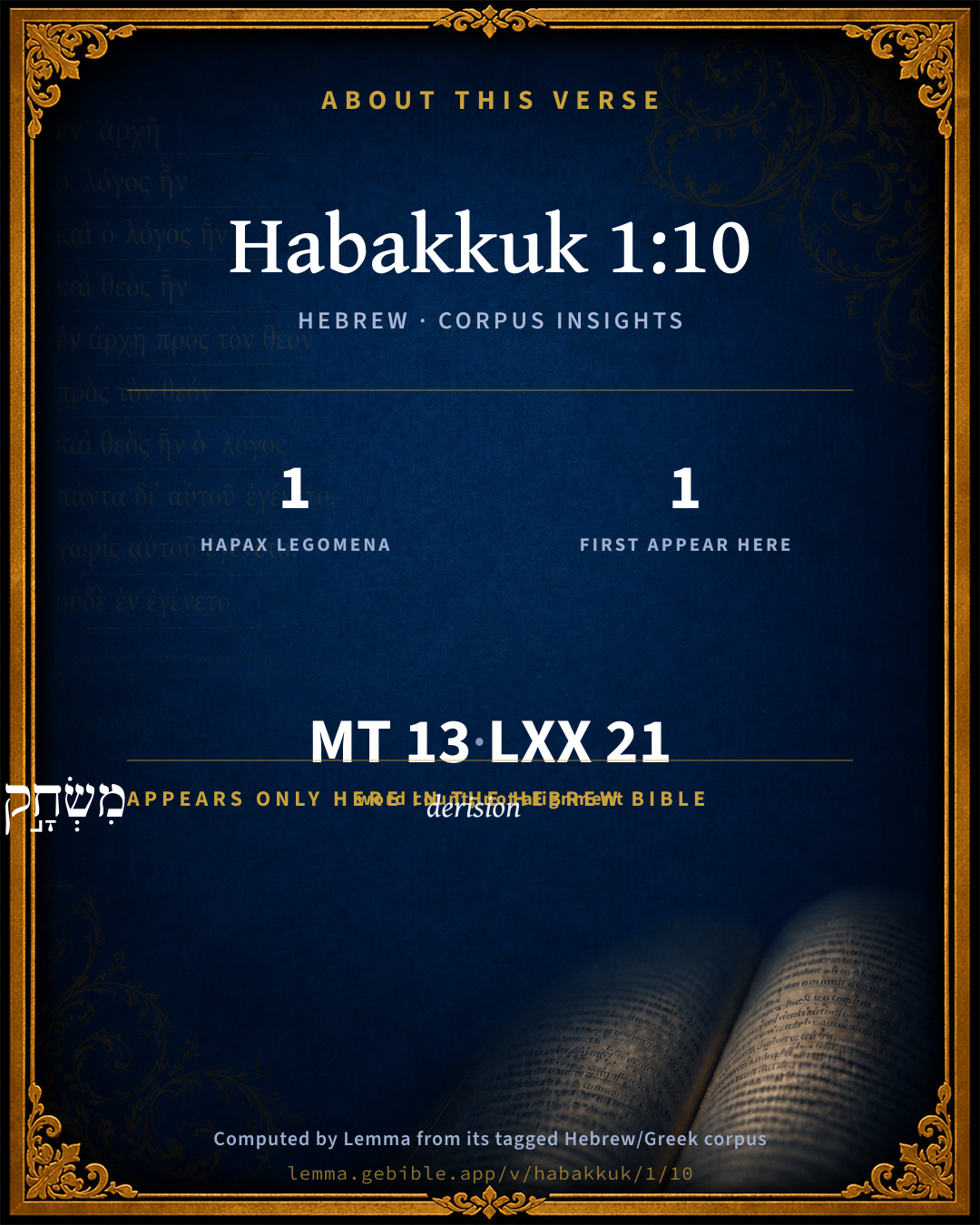
  • 1 hapax legomenon — only here in the Hebrew Bible
  • 1 first appearance in the Hebrew Bible
Full analysis ↓
Download a study sheet

One document with this verse’s original text, its word-by-word gloss line, the meaning frame, cross-references with their text, attributed commentary, and full source and license credits — printable, and it pastes into notes with its structure intact.

This verse Autodidact and up

Study sheet (.html) Plain text (.txt)

A passage Seminary Student

Up to 50 verses in one chapter. A passage sheet keeps up to 6 commentary sources and 12 cross-references per verse, in the order this page ranks them, and says so on the sheet whenever that leaves anything out. Ask for a single verse and you get the Autodidact verse sheet above.

Everything on this page stays free to read, with no account — the sheet is a download of what is already on screen, not access to it.

Want to remove ads? Support Godless Engineer
Compare translations 3

The same verse in 3 English versions, stacked beneath the original-language interlinear above. Click any original word for its lexicon entry.

Each is an independent rendering of the whole verse — the interlinear is not word-aligned to these translations.

Highlighted words mark where these versions differ — a whole-verse word diff, not a word-by-word alignment.

  • World English Bible Public Domain
    Yes, he scoffs at kings, and princes are a derision to him. He laughs at every stronghold, for he builds up an earthen ramp, and takes it.
  • King James Version Public Domain
    And they shall scoff at the kings, and the princes shall be a scorn unto them: they shall deride every strong hold; for they shall heap dust, and take it.
  • unfoldingWord Literal Text CC BY-SA 4.0
    And he, he mocks at kings, and rulers laughter to him. He, he laughs at every fortress, for he piles up dirt and captures it.

unfoldingWord Literal Text — © unfoldingWord, licensed CC BY-SA 4.0. Word-aligned USFM3 via Door43 (git.door43.org/unfoldingWord/en_ult).

Versions to compare (up to 4)

3 of 4 selected

Show all 18 translations

Every available English version of this verse, each an independent rendering of the whole verse.

  • World English Bible Public Domain
    Yes, he scoffs at kings, and princes are a derision to him. He laughs at every stronghold, for he builds up an earthen ramp, and takes it.
  • Berean Standard Bible Public Domain
    They scoff at kings and make rulers an object of scorn. They laugh at every fortress and build up siege ramps to seize it.
  • Majority Standard Bible Public Domain
    They scoff at kings and make rulers an object of scorn. They laugh at every fortress and build up siege ramps to seize it.
  • King James Version Public Domain
    And they shall scoff at the kings, and the princes shall be a scorn unto them: they shall deride every strong hold; for they shall heap dust, and take it.
  • American Standard Version (1901) Public Domain
    Yea, he scoffeth at kings, and princes are a derision unto him; he derideth every stronghold; for he heapeth up dust, and taketh it.
  • Revised Version (1885) Public Domain
    Yea, he scoffeth at kings, and princes are a derision unto him: he derideth every strong hold; for he heapeth up dust, and taketh it.
  • Geneva Bible (1599) Public Domain
    And they shall mocke the Kings, and the princes shalbe a skorne vnto them: they shall deride euery strong holde: for they shall gather dust, and take it.
  • Douay-Rheims (1899) Public Domain
    And their prince shall triumph over kings, and princes shall be his laughingstock: and he shall laugh at every strong hold, and shall cast up a mount, and shall take it.
  • Young's Literal Translation Public Domain
    And at kings it doth scoff, And princes `are' a laughter to it, At every fenced place it doth laugh, And it heapeth up dust, and captureth it.
  • Literal Standard Version CC BY-SA 4.0
    And he scoffs at kings, || And princes [are] a laughter to him, || He laughs at every fortification, || And he heaps up dust, and captures it.
  • Unlocked Literal Bible CC BY-SA 4.0
    So they mock kings, and rulers are only a mockery for them. They laugh at every stronghold, for they heap up earth and take them.
  • unfoldingWord Literal Text CC BY-SA 4.0
    And he, he mocks at kings, and rulers laughter to him. He, he laughs at every fortress, for he piles up dirt and captures it.
  • Darby Bible Public Domain
    Yea, he scoffeth at kings, and princes are a scorn unto him; he derideth every stronghold: for he heapeth up dust, and taketh it.
  • World Messianic Bible Public Domain
    Yes, they scoff at kings, and princes are a derision to them. They laugh at every stronghold, for they build up an earthen ramp and take it.
  • Webster's Bible Public Domain
    And they shall scoff at the kings, and the princes shall be a scorn to them: they shall deride every strong hold; for they shall heap dust, and take it.
  • Free Bible Version CC BY-SA 4.0
    They mock kings and scoff at rulers. They laugh in scorn at fortresses—they pile up earth ramps and capture them.
  • Bible in Basic English Public Domain
    He makes little of kings, rulers are a sport to him; all the strong places are to be laughed at; for he makes earthworks and takes them.
  • JPS Tanakh (1917) Public Domain
    And they scoff at kings, and princes are a derision unto them; they deride every stronghold, for they heap up earth, and take it.

Literal Standard Version (2020), Covenant Press — licensed CC BY-SA 4.0. Text via the HelloAO Bible API (eBible.org). Unlocked Literal Bible (unfoldingWord) — licensed CC BY-SA 4.0. Text via the HelloAO Bible API (eBible.org). unfoldingWord Literal Text — © unfoldingWord, licensed CC BY-SA 4.0. Word-aligned USFM3 via Door43 (git.door43.org/unfoldingWord/en_ult). Free Bible Version, Dr. Jonathan Gallagher — licensed CC BY-SA 4.0. Text via the HelloAO Bible API (eBible.org).

Word by word

More ways to search: Search by grammar → Find every occurrence → Compare this word →

Practice this passage: Drill this verse → Learn its vocabulary →

מִשְׂחָ֣ק
mischaq
H4890
“derision”
Noun, Common, Masculine, Singular, Absolute
Part of Speech
Noun
Type
Common
Gender
Masculine
Number
Singular
State
Absolute
Full BDB Definition

Origin: from H7831

TWOT: 1905f

object of derision
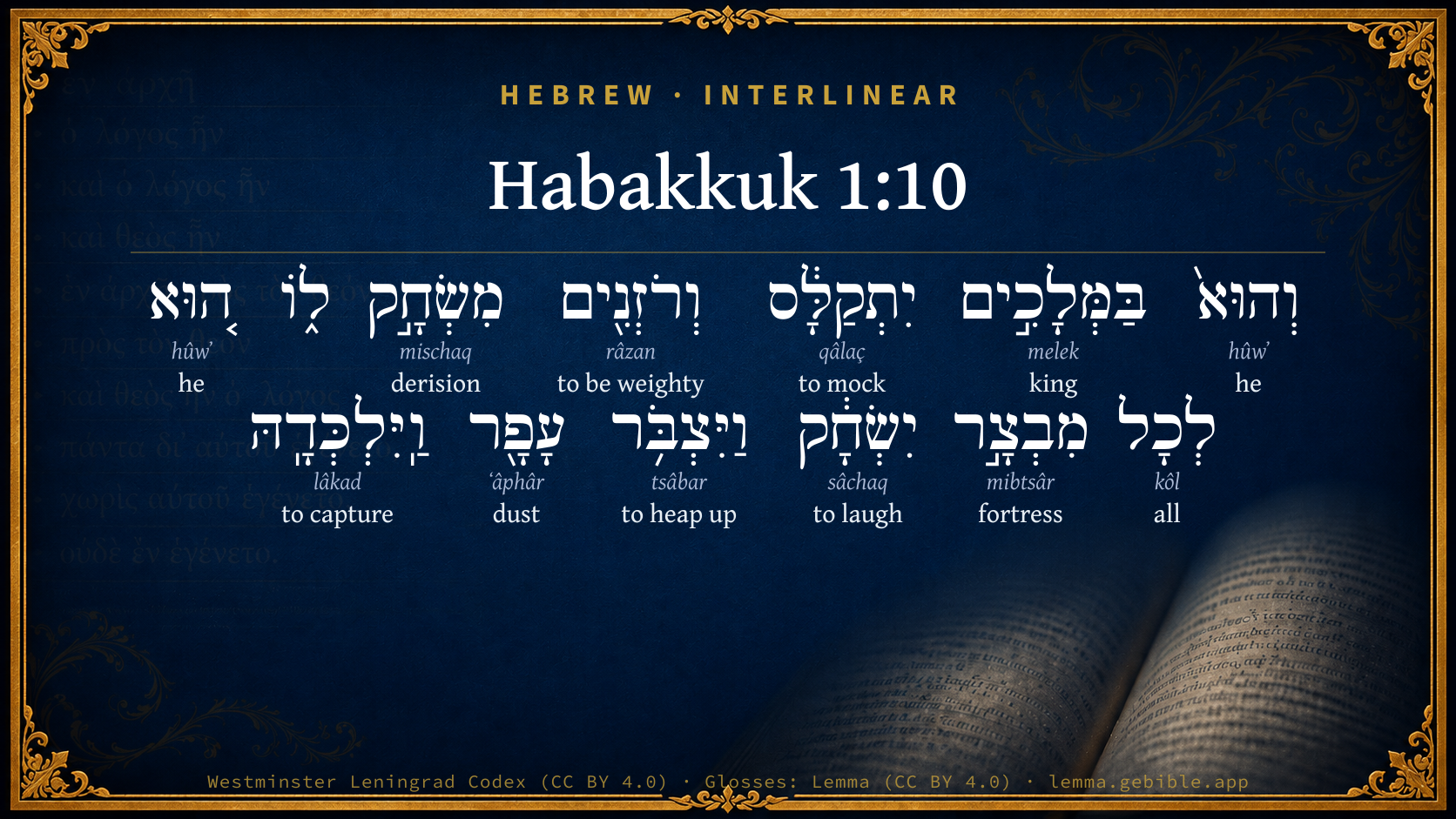
  1. וְהוּא֙ hûwʼ H1931 “and · he” Conjunction + Pronoun, Personal, 3rd Person, Masculine, Singular
  2. בַּמְּלָכִ֣ים melek H4428 “in/at the · kings” Preposition, Determined + Noun, Common, Masculine, Plural, Absolute
  3. יִתְקַלָּ֔ס qâlaç H7046 “to mock” Verb, Hithpael, Imperfect, 3rd Person, Masculine, Singular
  4. וְרֹזְנִ֖ים râzan H7336 “and · being weighty” Conjunction + Verb, Qal, Participle Active, Masculine, Plural, Absolute
  5. ה֚וּא hûwʼ H1931 “he” Pronoun, Personal, 3rd Person, Masculine, Singular
  6. לְכָל kôl H3605 “to/for · all of” Preposition + Noun, Common, Masculine, Singular, Construct
  7. מִבְצָ֣ר mibtsâr H4013 “fortress” Noun, Common, Masculine, Singular, Absolute
  8. יִשְׂחָ֔ק sâchaq H7832 “to laugh” Verb, Qal, Imperfect, 3rd Person, Masculine, Singular
  9. וַיִּצְבֹּ֥ר tsâbar H6651 “and · to heap up” Conjunction + Verb, Qal, Sequential Imperfect, 3rd Person, Masculine, Singular
  10. עָפָ֖ר ʻâphâr H6083 “dust” Noun, Common, Masculine, Singular, Absolute
  11. וַֽיִּלְכְּדָֽהּ lâkad H3920 “and · to capture · her” Conjunction + Verb, Qal, Sequential Imperfect, 3rd Person, Masculine, Singular + Suffix, Personal, 3rd Person, Feminine, Singular

About this verse

These counts appear in no published source. They are computed here, from the morphology-tagged text and Lemma’s own curated glosses. What Lemma adds →

13
words
11
distinct lemmas
Prophets
section

Notable vocabulary

1 hapax legomenon — a word that appears only here in the entire Hebrew Bible:

  • מִשְׂחָ֣ק derision H4890

First appearance in Scripture

This word makes its first canonical appearance in the Hebrew Bible here:

  • מִשְׂחָ֣ק derision H4890

Shared distinctive vocabulary

יִתְקַלָּ֔ס to mock H7046 occurs in 4 verses of the Hebrew Bible. Also found in:

Grammatical profile

  • 5 verbs
  • 5 nouns
  • 2 pronouns
  • 1 preposition

Verb forms

  • יִתְקַלָּ֔ס Hithpael · Imperfect
  • וְרֹזְנִ֖ים Qal · Participle Active
  • יִשְׂחָ֔ק Qal · Imperfect
  • וַיִּצְבֹּ֥ר Qal · Sequential Imperfect
  • וַֽיִּלְכְּדָֽהּ Qal · Sequential Imperfect

Repetition

A word recurs within this verse — often emphatic in Hebrew:

  • וְהוּא֙ he H1931 ×2

Hebrew & Septuagint length

In English translation the verse runs 27 words from the Hebrew and 31 from the Septuagint (LXX English) — closely comparable.

A rough comparison of the two English renderings, which tokenize alike — not a word-level alignment.

Word counts can differ between the Hebrew and the Greek without any difference in meaning — e.g. the Hebrew direct-object marker אֵת has no separate Greek word, and Greek often adds the article ὁ.

In the original languages it is 13 Hebrew tokens and 21 Greek tokens — but the two are counted differently (Hebrew bundles its prefixes and suffixes into one token; the Greek is in lemma form), so that isn’t a like-for-like length.

Cross-references

8

Topical passages linked to Habakkuk 1:10 in the Treasury of Scripture Knowledge — connected by theme and wording, ordered by reader-vote popularity; previews shown in the World English Bible.

  • 2 Chronicles 36:6 Against him came up Nebuchadnezzar king of Babylon, and bound him in fetters, to carry him to Babylon.
  • 2 Chronicles 36:10 At the return of the year king Nebuchadnezzar sent, and brought him to Babylon, with the goodly vessels of the house of Yahweh, and made Zedekiah his brother king over Judah and Jerusalem.
  • Isaiah 14:16 Those who see you shall gaze at you, they shall consider you, [saying], "Is this the man who made the earth to tremble, who shook kingdoms;
  • Jeremiah 32:24 Behold, the mounds, they are come to the city to take it; and the city is given into the hand of the Chaldeans who fight against it, because of the sword, and of the famine, and of the pestilence; and what you have spoken has happened; and, behold, you see it.
  • 2 Kings 24:12 and Jehoiachin the king of Judah went out to the king of Babylon, he, and his mother, and his servants, and his princes, and his officers: and the king of Babylon took him in the eighth year of his reign.
  • 2 Kings 25:6–7 Then they took the king, and carried him up to the king of Babylon to Riblah; and they gave judgment on him.
  • Jeremiah 33:4 For thus says Yahweh, the God of Israel, concerning the houses of this city, and concerning the houses of the kings of Judah, which are broken down [to make a defense] against the mounds and against the sword;
  • Jeremiah 52:4–7 It happened in the ninth year of his reign, in the tenth month, in the tenth day of the month, that Nebuchadrezzar king of Babylon came, he and all his army, against Jerusalem, and encamped against it; and they built forts against it round about.

Cross-references courtesy of OpenBible.info (CC BY 4.0).

Hebrew and Greek witnesses Masoretic Hebrew ↔ Greek Septuagint

The same verse in the two great witnesses to the Old Testament, shown verse-for-verse.

These are two independent witnesses, not word-aligned to each other, and the Septuagint is shown in lemma (dictionary) form.

Hebrew Habakkuk 1:10 Masoretic · Westminster Leningrad Codex

וְהוּא֙ בַּמְּלָכִ֣ים יִתְקַלָּ֔ס וְרֹזְנִ֖ים מִשְׂחָ֣ק ל֑וֹ ה֚וּא לְכָל מִבְצָ֣ר יִשְׂחָ֔ק וַיִּצְבֹּ֥ר עָפָ֖ר וַֽיִּלְכְּדָֽהּ

Yes, he scoffs at kings, and princes are a derision to him. He laughs at every stronghold, for he builds up an earthen ramp, and takes it.

World English Bible · Public Domain

Greek LXX Habakkuk 1:10 Septuagint · lemma form

καί αὐτός ἐν βασιλεύς ἐντρυφάω καί τύραννος παίγνιον αὐτός καί αὐτός εἰς πᾶς ὀχύρωμα ἐνπαίζω καί βάλλω χῶμα καί κρατέω αὐτός

And he shall be at his ease with kings, and princes are his toys, and he shall mock at every strong-hold, and shall cast a mound, and take possession of it.

LXX2012 (modern English Septuagint) · Public Domain

Hebrew: Westminster Leningrad Codex (CC BY 4.0). Greek: Septuagint (public domain); English from LXX2012 (modern English Septuagint) (Public Domain). How the Septuagint differs from the Hebrew →

Targum (Aramaic paraphrase)

1

The Targum is the ancient Jewish Aramaic paraphrase of the Hebrew Scriptures — an interpretive translation, not the Hebrew text itself. Onkelos (literal) and Pseudo-Jonathan (expansive) render the Torah, and Jonathan the Prophets. Coverage is partial: where no permissively-licensed English translation exists for a verse, only the Aramaic is shown. This is verse-level text, not a word-by-word alignment to the Hebrew.

  1. Targum Jonathan Prophets (Joshua–Malachi)
    וְהוּא עַל מַלְכַיָא מִתְלַעַב וְעַל שִׁלְטוֹנַיָא מְחַיָךְ הוּא לְכָל כְּרַךְ תַּקִיף מֵעִיק וּצְבַר מִלְיָתָא וְכַּבְשָׁהּ:

    (no public-domain English translation for this verse)

    Targum Jonathan — Aramaic: “Mikraot Gedolot” (public domain). English: “Sefaria Community Translation” (CC0 1.0 (public-domain dedication)); “London "Chaldee Paraphrase," 1871” (public domain). Text via Sefaria.

Commentary

Notes on Habakkuk 1:10 from classic Christian and Jewish commentators (each source and its license shown beneath its notes). The classic Christian expositions comment on the surrounding passage and are grouped to its opening verse, so a note may address several verses; the Jewish commentaries on the Tanakh (Rashi and others) are per-verse, so they appear only where the commentator wrote on this verse.

Lemma curates 59 commentaries, every one of them public domain or Creative Commons licensed, each selected and text-cleaned for this edition rather than reprinted as found. About our sources →

Trapp's Complete Commentary

John Trapp

Hab 1:10 And they shall scoff at the kings, and the princes shall be a scorn unto them: they shall deride every strong hold; for they shall heap dust, and take it.

Ver. 10. And they shall scoff at the kings] Heb. He shall scoff, i.e. Nebuchadnezzar shall, and that not once only, but often; shall make a practice of it, as the Hebrew word signifieth. Hithpael notat assiduam illusionem. Thus Adonibezek dealt by the kings he took, the Philistines by Saul, 1Sa 31:8-10, Nebuchadnezzar by Zedekiah, Jer 25:1-38 Jer 29:1-32 2Ki 25:1-30; as also by the kings of Egypt, Tyre, Arabia, and others whom he had taken, and used them, haply, as Tamerlane did Bajazet, or those other captive kings whom he caused as horses to draw his chariot. How much better Evilmerodach, who (mindful of the instability of all human affairs) lifted up the head and spoke to the heart of his prisoner, Jehoiachin, King of Judah, Jer 52:31; Cyrus, who honoured his captive Croesus, and made him of his council (neither was he less enriched by the good counsel Croesus gave him, than by all the wealth he had from him); our Edward III, who having the King of Scotland and the French king his prisoners here in England both together at one time, gave them stately entertainment, and made them princely pastime, by holding royal jousts in Smithfield for their delight!

And the princes shall be a scorn unto them] Through the just judgment of God, "who scorneth the scorners," Pro 3:34, that is, saith Rabbi Levi, facit ut aliis sint ludibrio, he maketh others mock them in their misery who in prosperity scoffed at those that were better than they. "Now therefore be ye not mockers, lest your bands be made strong," &c., Isa 28:22.

They shall deride every stronghold] As that which cannot long hold out against their assault. How should they, when God breaketh the bars and setteth open the gates to them? Amo 1:5; Amo 9:3 Pro 21:30.

For they shall heap dust, and take it] i.e. By casting up mounts and ramparts, take it with as much ease as if they were in sport. The Turks have their Asapi, or common soldiers, of whom they make no great reckoning, but to blunt the swords of their enemies and to fill up ditches with their dead bodies, that they may the better come at the town or fort which they would take.

John Trapp, A Commentary or Exposition upon All the Books of the Old and New Testament (1647–1656) — public domain. Text from a community e-Sword module.

Joseph Benson's Commentary

Hab 1:10-11. And they shall scoff at the kings, &c. — The Hebrew use the singular number here, (He shall scoff, &c.,) as well as in the following verse, and it is to be understood of the king of Babylon, who treated the kings he conquered with scorn and contempt: so he used Zedekiah and his princes. They shall deride every strong hold — They shall contemn, or count as nothing, the most strongly fortified places. They shall heap dust and take it — They shall cast up mounds against them, and so take them. Then shall his mind change, and he shall pass over — Rather, And shall pass over, (without the personal pronoun he,) that is, his mind shall change, and pass beyond the bounds of moderation. By this and the next clause, imputing this his power unto his god, was foretold that the king of Babylon should be made arrogant by his victories, and should impute them to the power of the false gods he worshipped. This was remarkably true of Belshazzar, Nebuchadnezzar’s successor, who, with his thousand lords, when he was drinking wine in the golden and silver vessels taken out of God’s temple, and was thereby triumphing over Jehovah and his people, praised the gods of gold and silver, &c., as the authors of their successes and victories. It was also remarkably verified in Nebuchadnezzar himself, who, as we find from Daniel 3., cast three otherwise innocent persons, and faithful to him, into a furnace of fire, because they would not fall down before the idol which he had set up. But Grotius, and many others, interpret the latter part of the verse thus: Saying this his strength is his god; that is, imputing all his success to his own skill and prowess; a sense of the words which answers remarkably to the character of Nebuchadnezzar, as given in the book of Daniel: see chapter Dan 3:17, and Dan 4:30, and Dan 5:20. Probably the extraordinary insanity which befell Nebuchadnezzar, as the punishment of his pride and arrogance, might be also here intended in the first clause of this verse, which in the Hebrew is, Then shall his spirit change and pass over, &c. Here, then, is a remarkable proof of what the psalmist says, namely, that God understandeth our thoughts afar off: for here the alteration that should in after times be made in Nebuchadnezzar’s mind by his prosperity is expressly foretold, together with the punishment that should follow upon it.

Joseph Benson's Commentary on the Old and New Testaments (1811–1818) — public domain. Text from a community e-Sword module.

Tyndale Open Study Notes

Tyndale Open Resources

1:10 The ancient battle tactic of building ramps of earth against the walls of cities under attack is widely attested in the ancient Near East (e.g., 2 Kgs 19:32; Nah 2:1).

Tyndale Open Study Notes — © Tyndale Open Resources, licensed CC BY-SA 4.0. Text via the HelloAO Bible API.

Geneva Bible (1599)

Geneva Bible translators

They shall cast up mounts against it.

Geneva Bible (1599) marginal notes — public domain. Text via Bolls.life.

Jamieson, Fausset & Brown

Robert Jamieson, A. R. Fausset & David Brown

scoff at . . . kings--as unable to resist them.

they shall heap dust, and take it--"they shall heap" earth mounds outside, and so "take every stronghold" (compare Sa2 20:15; Kg2 19:32) [GROTIUS].

Jamieson, Fausset & Brown — Commentary Critical and Explanatory on the Whole Bible (1871) — public domain (CC PDM 1.0). Text via the HelloAO Bible API.

Adam Clarke's Commentary

Verse 10. They shall scoff at the kings] No power shall be able to stand before them. It will be only as pastime to them to take the strongest places. They will have no need to build formidable ramparts: by sweeping the dust together they shall make mounts sufficient to pass over the walls and take the city.

Adam Clarke's Commentary on the Bible (1810–1826) — public domain. Text from a community e-Sword/MySword module.

John Calvin's Commentaries

The Prophet concludes the subject which he has been hitherto pursuing. He says that the Chaldeans would not come to engage in a doubtful war, but only to triumph over conquered nations. We indeed know that the Jews, though not excelling either in number or in riches, were yet so proud, that they looked down, as it were, with contempt on other nations, and we also know, that they vainly trusted in vain helps; for as they were in confederacy with the Egyptians, they thought themselves to be beyond the reach of danger. Hence the Prophet says, that kings and princes would be only a sport to the Chaldeans, and their fortresses would be only a derision to them. How so? For they will gather dust, he says; that is, will make a mound of the dust of the earth, and will thus penetrate into all fortified cities.

In short the Prophet intended to cut off every hope from the Jews, that they might humble themselves before God; or he intended to take away every excuse if they repented not, as it indeed happened; for we know that they did not repent notwithstanding these warnings, until vengeance at length fully overtook them. He then adds—

John Calvin's Commentaries (1540-1563) — public domain. Text from the Calvin Translation Society English edition (1840s-50s) via the Christian Classics Ethereal Library (ccel.org). Calvin's coverage is partial (roughly two-thirds of the Bible); uncommented books and verses are honest gaps, never fabricated. The 19th-century editor's footnotes and remarks are omitted so the notes are faithfully Calvin's own voice.

Ellicott's Commentary for English Readers

(10) Kings and princes are deposed or enthroned at the invader’s pleasure. Thus Nebuchadnezzar set Jehoiakim as a tributary sovereign on the throne of Jerusalem and three years later deposed his son and successor Jehciaohin and made Zedekiah king.

For they shall heap dust, and take it.—This means that they shall besiege and carry all strongholds by means of the mounds of earth commonly used in sieges. These mounds were employed either to place the besieger on a level with the besieged, and so facilitate the operations of siege engines, or to form an inclined plane, up which the besieger might march his men, and so take the place by escalade. We find they were used by the Egyptians (Eze_17:17) and the Assyrians (2Ki_19:32), as well as by the Babylonians (Jer_6:6, and passim). They are mentioned as employed by the Spartan king Archidamus in the celebrated siege of Platæa in B.C. 429 (Thucydides, lib. 2). In the present passage the term “dust” is used to indicate these mounds of earth, as expressing the contemptuous ease with which the invader effects his capture of strongholds.

A Bible Commentary for English Readers, edited by Charles John Ellicott (1878–1897) — public domain. Text from a community e-Sword module.

The Cambridge Bible for Schools and Colleges

gen. ed. J. J. S. Perowne

10. shall scoff at the kings] he scoffeth at kings. The Chaldean is referred to. All the verbs in the verse should be in the present: are a scorn, he derideth, he heapeth up.

shall heap dust] he heapeth up. The phrase refers to the dykes or “mounts” which the besiegers cast up in order to be on a level with the walls of the besieged fortress and command them, 2Sa_20:15; Jer_32:24. The ease and rapidity of the Chaldean operations is forcibly expressed. Nothing can withstand their impetuosity. Kings with their armies who might oppose them, and fortresses which might arrest their progress, they laugh at.

The Cambridge Bible for Schools and Colleges (gen. ed. J. J. S. Perowne; Cambridge University Press, 1878–1918) — public domain. Text from a community e-Sword module.

John Gill's Exposition

And they shall scoff at the kings,.... Or, "he shall" (u), Nebuchadnezzar king of the Chaldeans, and the army with him; who would make a jest of kings and their armies that should oppose them, as being not at all a match for them; as the kings of Judah, Jehoiakim and Zedekiah, they carried captive, and all others confederate with them, in whom they trusted, as the king of Egypt particularly; and which is observed to show the vanity of trusting in princes for safety; though it may also include all other kings the Chaldeans fought against, and the kingdoms they invaded and subdued:

and the princes shall be a scorn unto them; the nobles, counsellors, and ministers of state; or leaders and commanders of armies, and general officers, in whom great confidence is often put; but these the king of Babylon and his forces would mock and laugh at, as being nothing in their hands, and who would fall an easy prey to them:

they shall deride every strong hold; in Jerusalem, in the whole land of Judea, and in every other country they invade, or pass through, none being able to stand out against them:

for they shall heap dust, and take it; easily, as it were in sport, only by raising a dust heap, or a heap of dirt; by which is meant a mount raised up to give them a little rise, to throw in their darts or stones, or use their engines and battering rams to more advantage, and to scale the walls, and get possession. There are two other senses mentioned by Kimchi; as that they shall gather a great number of people as dust, and take it; or they shall gather dust to till up the trenches and ditches about the wall, that so they may come at it, and take it.

(u) "et ipse", Junius & Tremellius, Piscator, Drusius, Tarnovius, Grotius, Cocceius.

John Gill's Exposition of the Whole Bible (1746–1763) — public domain (CC PDM 1.0). Text via the HelloAO Bible API.

Albert Barnes' Notes on the Bible

And they - literally, “he,” the word stands emphatically, he, alone against all the kings of the earth

Shall scoff at the kings - and all their might taking them away or setting them up at his pleasure and caprice, subduing them as though in sport

And princes - literally, grave and majestic

Shall be a scorn unto them - i. e. him. Compare Job 41:29. So Nebuchadnezzar bound Jehoiakim 2Ch 36:6; Dan 1:2 “in fetters to carry him to Babylon;” then, on his submission made him for three years a tributary king 2Ki 24:1, then on his rebellion sent bands of Chaldees and other tributaries against him 2Ki 24:2; and then, or when Nebuchadnezzar took Jehoiachin, Jeremiah’s prophecy was fulfilled, that he should “be buried with the burial of an ass, dragged and cast forth beyond the gates of Jerusalem Jer 22:19, his dead body cast out in the day to the heat and in the night to the frost” Jer 36:30. On the one hand, the expression “slept with his fathers” does not necessarily imply that Jehoiakim died a peaceful death, since it is used of Ahab 1Ki 22:40 and Amaziah 2Ki 14:20, 2Ki 14:22 (in the other, Jeremiah’s prophecy was equally fulfilled, if the insult to his corpse took place when Nebuchadnezzar took away Jehoiachin three months after his father’s death. See Daniel. Josephus attributes both the death and disgrace to Nebuchadnezzar: Ant. x. 6. 3), then Nebuchadnezzar took away Jehoiachin; then Zedekiah. He had also many kings captive with him in Babylon. For on his decease Evil-Merodach brought Jehoiachin out of his prison after 27 years of imprisonment, “and set his throne above the throne of the kings that were with him in Babylon” 2Ki 25:27-28. Daniel says also to Nebuchadnezzar Dan 2:37-38; Dan 4:22, “Thou, O king, art a king of kings: for the God of heaven hath given thee a kingdom, power and strength and glory. And wheresoever the children of men dwell, the beasts of the field and the fowls of heaven hath He given into thine hand and hath made thee ruler over all.”

They (he) shall deride every strong hold - as, aforetime, when God helped her, Jerusalem laughed the Assyrian to scorn Isa 38:22.

For they (he) shall heap dust, and take it - as Nebuchadnezzar did Tyre, whose very name (Rock) betokened its strength. Jerome: “He shall come to Tyre, and, casting a mound in the sea, shall make an island a peninsula, and, amid the waves of the sea, land shall give an entrance to the city.”

The mount, or heaped-up earth, by which the besiegers fought on a level with the besieged, or planted their engines at advantage, was an old and simple form of siege, especially adapted to the great masses of the Eastern armies. It was used in David’s time 2Sa 20:15; and by the Assyrians 2Ki 19:32, Egyptians Ezra 17:17, Babylonians (Jer 6:6; Jer 32:24; Jer 33:4; Eze 4:2; Eze 21:22 (Eze 21:27 in Hebrew), Eze 26:8), and afterward, the Persians (Herodotus i. 162). Here he describes the rapidity of the siege. To heap up dust and to capture were one and the same thing.

It needed no great means; things slight as the dust sufficed in the hands of those employed by God. Portion by portion 2Ki 24:7, “the King of Babylon took; all that pertained to the king of Egypt, from the river of Egypt unto the river Euphrates.”

Albert Barnes' Notes on the Bible (1834–1885) — public domain. Text from a community e-Sword/MySword module.

Haydock's Catholic Bible Commentary

Prince, or "it," the nation, ver. 10. Hebrew, "They," &c. --- Laughingstock, (ridicule.) Nabuchodonosor raised or deposed princes as in jest. (Haydock) --- Sennacherib’s officers were or had been kings, Isaias x. 8. --- Mount. Thus cities were chiefly taken, Ezechiel iv. 1. (Calmet)

George Leo Haydock (1774–1849), Haydock's Catholic Family Bible and Commentary, 1859 edition — public domain. Excludes Psalms (Douay-Rheims chapter numbering differs from Protestant) and Deuterocanonical books (Catholic canon only).

Matthew Poole's English Annotations

They, both the king of Babylon and his soldiers, shall scoff, deride and contemn,

at the kings, which either confederated with the Jews, or else opposed the designs of the Chaldeans; as the kings of Egypt, of Tyre, &c.; or the kings of the Jews, as Jehoiachin and Zedekiah.

The princes, governors, counsellors, valiant commanders, and officers, shall be a scorn unto them, to the whole army of the Chaldeans.

They shall heap dust, and take it; by mighty mounts cast up, or by filling up the trenches about your cities and fortresses, shall master them.

Matthew Poole's English Annotations on the Holy Bible (1683–1685) — public domain. Text from a community e-Sword/MySword module.

The Pulpit Commentary

And they shall scoff, etc.; it, or he, scoffeth at kings. The Chaldean nation makes light of the power and persons of kings. Compare Nebuchadnezzar"s treatment of Jehoiakim (2Ch_36:6; 2Ki_24:1, 2Ki_24:3; Jer_22:19) and Jehoiachin. (2Ki_24:12, 2Ki_24:15) They shall deride every strong hold. The strongest fortress is no impediment to them. They shall heap dust. This refers to the raising of a mound or embankment for the purpose of attacking a city. (comp. 2Sa_20:15; 2Ki_19:32 2Ki_25:1) In the Assyrian monuments one often sees representations of these mounds, or of inclined planes constructed to facilitate the approach of the battering ram (see Bonomi, "Nineveh and its Palaces," pp. 181, 188, etc.; Layard, "Nineveh," etc., 2:369).

The Pulpit Commentary (1880–1919), ed. H.D.M. Spence-Jones & Joseph S. Exell — public domain. Text from a community e-Sword module.

John Wesley's Explanatory Notes

At the kings - Which opposed their designs. And take it - By mighty mounts cast up.

John Wesley, Explanatory Notes Upon the Whole Bible (1754–1765) — public domain. Text via the GEBible commentary corpus.

unfoldingWord translationNotes

Door43 World Missions Community

General Information:

Yahweh continues to describe the Chaldean soldiers.

So they mock kings, and rulers are only a mockery for them

These two phrases mean basically the same thing. The word "mockery" can be translated with a verbal phrase. AT: "So they mock kings, and rulers are only something for them to mock" or "So all they do is mock kings and rulers" (See: Parallelism and Abstract Nouns)

the wind will rush on

Yahweh speaks of how swiftly the Chaldean army moves from one city to the next as it conquers each one as if it were a wind that blows swiftly along. (See: Metaphor)

guilty men, those whose might is their god

This refers to the Chaldean soldiers.

translationWords

mock

king

rule

stronghold

guilt

false god

unfoldingWord translationNotes — © Distant Shores Media and the Door43 World Missions Community, licensed CC BY-SA 4.0. Source: git.door43.org/Door43/en_tn.

Rashi

Rabbi Shlomo Yitzchaki (Rashi)

And they shall mock the kings shall mock them. Every expression of קַלָּסָה is an expression for the speech of those speaking about another; some [of these speeches] are for good, and some for bad - parledic in O.F.

a laughingstock like שְּׂחוֹק, laughter, like מִשְׁמָר, a watch, and מִסְתָּר, a hiding place.

He shall scoff at every fortress If his enemy is in a strong fortress, he scoffs at him.

he piles up earth upon it with his many armies, each one carrying a load of earth. It [the pile] is before the wall as a high mound, and they [the Chaldeans] battle from upon it. This is called שְׁפִיכַת סוֹלְלָה, pouring a siege mound (cf. Isa. 37:33), for all of them are translated into Aramaic: וְיִצְבּוֹר עֲלָה מְלֵיתָא, and he piled upon it a filling. This is an expression of Milo, for in the city of David there was a high mound, and they would battle upon it. Atop the mound was built a tower whose slant was inclined to the sides, and around its base was a low wall to prevent the earth from falling.

Rashi on the Tanakh — English translations: “The Judaica Press complete Tanach with Rashi, translated by A. J. Rosenberg” (CC BY 4.0); “Pentateuch with Rashi's commentary by M. Rosenbaum and A.M. Silbermann, 1929-1934” (public domain); “The Metsudah Tanach series, Lakewood, N.J” (CC BY 4.0); and “The Book of Joshua, Metsudah Publications, 1997” (CC BY 4.0). Text via Sefaria.

Lesson kit

Teaching starters — assembled from the data on this page, not authored interpretation. Every prompt links to the verse data it draws on. Edit before teaching.

Habakkuk, in the Prophets, opens this verse with 13 words (11 distinct Hebrew lemmas). Its most distinctive word is mischaq (“derision”). A historical commentator’s framing appears above. Read the whole chapter for the surrounding context.

Discussion questions

  1. What does “derision” (mischaq) contribute to the verse as a whole?
  2. This verse holds 1 word here found nowhere else in the Hebrew Bible. What might the rare word draw attention to?
  3. The word “derision” first appears here in Scripture. What is being introduced at this debut?
  4. 2 Kings 2:23 shares the word «to mock» with this verse. How do the two illuminate each other?
  5. “he” occurs 2× in this one verse. What is the effect of the repetition?
  6. These translations render this verse differently. What is at stake in choosing one wording over another?
  7. The verb «יִתְקַלָּ֔ס» is Hithpael Imperfect. How does its form color the action?
  8. Reading how Trapp's Complete Commentary and Joseph Benson's Commentary read this verse, where do the two commentators agree and where do they part?

Things to notice

  • 1 word in this verse appears nowhere else in the Hebrew Bible.
  • 1 word makes its first canonical appearance in Scripture here.
  • This verse counts 13 Hebrew ↔ 21 Greek words.
  • These translations choose different wording for 28 words in this verse.
  • “he” occurs 2× in this single verse.

Reading settings

Reading text

Shown beneath each verse's original-language words.

Old Testament
Old Testament edition

Read the OT as the Masoretic Hebrew (MT) or the Greek Septuagint (LXX).

English shown for the Greek Septuagint (in the Hebrew ↔ Greek comparison).

Comparing translations? Open the Compare panel on any verse page to stack up to four side by side.