
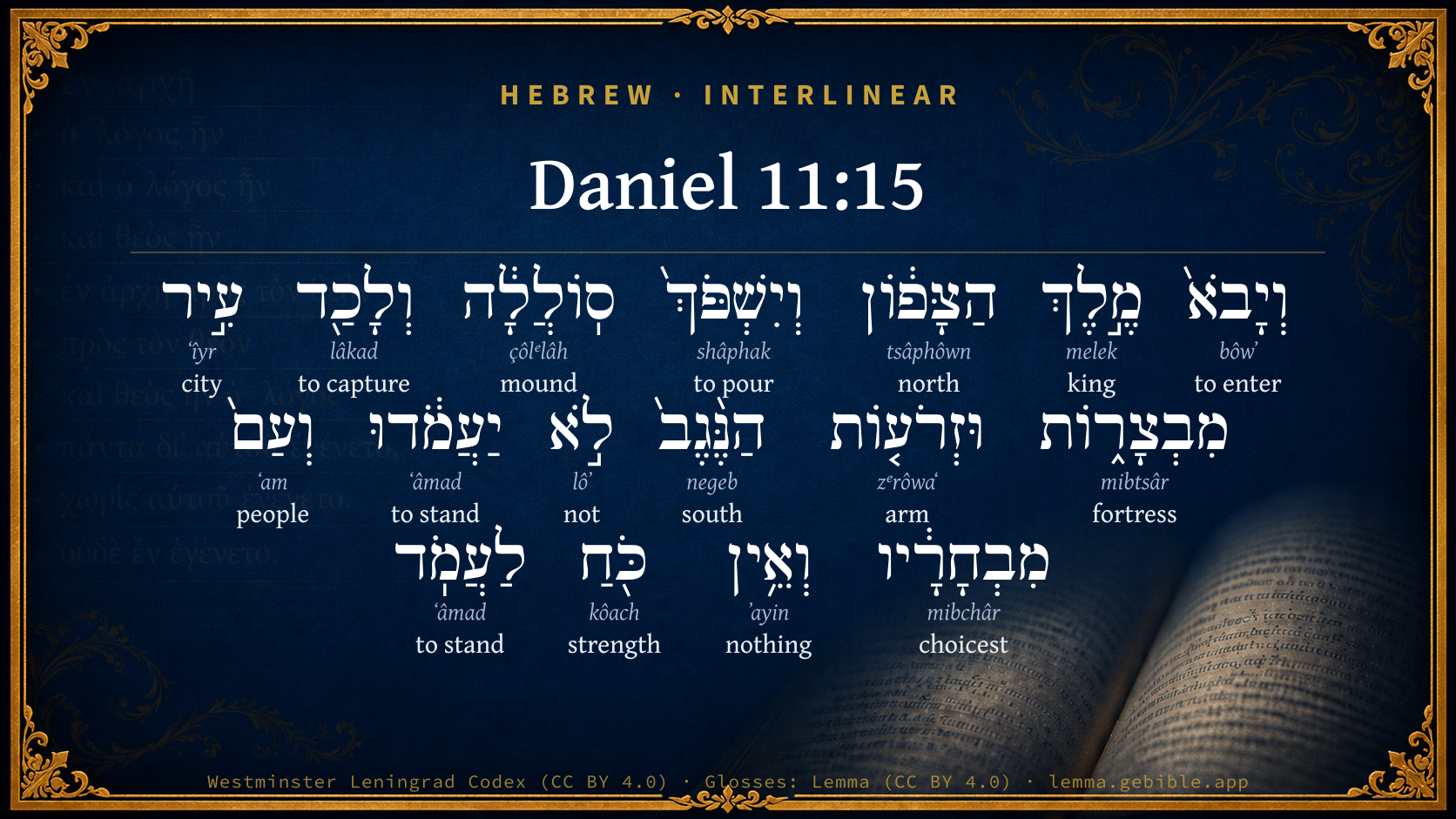
Daniel 11:15

Hebrew (Westminster Leningrad Codex) Daniel 11:15 appears in the Hebrew Old Testament. The text above is from the Westminster Leningrad Codex. Each word links to its Strong’s number, a concise gloss, and parsing drawn from the Open Scriptures Hebrew Bible morphology. Click any word for its full Brown-Driver-Briggs (BDB) entry.
Download image
Cite this verse

Daniel 11:15 (World English Bible). Public Domain. Lemma interlinear Bible study tool, https://lemma.gebible.app/v/daniel/11/15.

Show BibTeX & RIS
BibTeX
RIS
English Translation
So the king of the north shall come, and cast up a mound, and take a well-fortified city: and the forces of the south shall not stand, neither his chosen people, neither shall there be any strength to stand.
World English Bible · Public Domain
Download a study sheet

One document with this verse’s original text, its word-by-word gloss line, the meaning frame, cross-references with their text, attributed commentary, and full source and license credits — printable, and it pastes into notes with its structure intact.

This verse Autodidact and up

Study sheet (.html) Plain text (.txt)

A passage Seminary Student

Up to 50 verses in one chapter. A passage sheet keeps up to 6 commentary sources and 12 cross-references per verse, in the order this page ranks them, and says so on the sheet whenever that leaves anything out. Ask for a single verse and you get the Autodidact verse sheet above.

Everything on this page stays free to read, with no account — the sheet is a download of what is already on screen, not access to it.

Want to remove ads? Support Godless Engineer
Compare translations 3

The same verse in 3 English versions, stacked beneath the original-language interlinear above. Click any original word for its lexicon entry.

Each is an independent rendering of the whole verse — the interlinear is not word-aligned to these translations.

Highlighted words mark where these versions differ — a whole-verse word diff, not a word-by-word alignment.

  • World English Bible Public Domain
    So the king of the north shall come, and cast up a mound, and take a well-fortified city: and the forces of the south shall not stand, neither his chosen people, neither shall there be any strength to stand.
  • King James Version Public Domain
    So the king of the north shall come, and cast up a mount, and take the most fenced cities: and the arms of the south shall not withstand, neither his chosen people, neither shall there be any strength to withstand.
  • unfoldingWord Literal Text CC BY-SA 4.0
    Then the king of the North will come, heap up siege ramps, and capture a city with fortifications. The forces of the South will not stand, not even his choicest troops, for there will be no strength to stand.

unfoldingWord Literal Text — © unfoldingWord, licensed CC BY-SA 4.0. Word-aligned USFM3 via Door43 (git.door43.org/unfoldingWord/en_ult).

Versions to compare (up to 4)

3 of 4 selected

Show all 18 translations

Every available English version of this verse, each an independent rendering of the whole verse.

  • World English Bible Public Domain
    So the king of the north shall come, and cast up a mound, and take a well-fortified city: and the forces of the south shall not stand, neither his chosen people, neither shall there be any strength to stand.
  • Berean Standard Bible Public Domain
    Then the king of the North will come, build up a siege ramp, and capture a fortified city. The forces of the South will not stand; even their best troops will not be able to resist.
  • Majority Standard Bible Public Domain
    Then the king of the North will come, build up a siege ramp, and capture a fortified city. The forces of the South will not stand; even their best troops will not be able to resist.
  • King James Version Public Domain
    So the king of the north shall come, and cast up a mount, and take the most fenced cities: and the arms of the south shall not withstand, neither his chosen people, neither shall there be any strength to withstand.
  • American Standard Version (1901) Public Domain
    So the king of the north shall come, and cast up a mound, and take a well-fortified city: and the forces of the south shall not stand, neither his chosen people, neither shall there be any strength to stand.
  • Revised Version (1885) Public Domain
    So the king of the north shall come, and cast up a mount, and take a well fenced city: and the arms of the south shall not withstand, neither his chosen people, neither shall there be any strength to withstand.
  • Geneva Bible (1599) Public Domain
    So the King of the North shall come, and cast vp a mount, and take the strong citie: and the armes of the South shall not resist, neither his chosen people, neither shall there be any strength to withstand.
  • Douay-Rheims (1899) Public Domain
    And the king of the north shall come, and shall cast up a mount, and shall take the best fenced cities: and the arms of the south shall not withstand, and his chosen ones shall rise up to resist, and they shall not have strength.
  • Young's Literal Translation Public Domain
    `And the king of the north cometh in, and poureth out a mount, and hath captured fenced cities; and the arms of the south do not stand, nor the people of his choice, yea, there is no power to stand.
  • Literal Standard Version CC BY-SA 4.0
    And the king of the north comes in, and pours out a mound, and has captured fortified cities; and the arms of the south do not stand, nor the people of his choice, indeed, there is no power to stand.
  • Unlocked Literal Bible CC BY-SA 4.0
    The king of the North will come, pour out earth for siege mounds, and capture a city with fortifications. The forces of the South will not be able to stand, not even their best soldiers. There will be no strength to stand.
  • unfoldingWord Literal Text CC BY-SA 4.0
    Then the king of the North will come, heap up siege ramps, and capture a city with fortifications. The forces of the South will not stand, not even his choicest troops, for there will be no strength to stand.
  • Darby Bible Public Domain
    And the king of the north shall come, and cast up a mound, and take the well-fenced city; and the arms of the south shall not withstand, neither his chosen people, for there shall be no strength to withstand.
  • World Messianic Bible Public Domain
    So the king of the north will come and cast up a mound, and take a well-fortified city. The forces of the south won’t stand, neither will his select troops, neither will there be any strength to stand.
  • Webster's Bible Public Domain
    So the king of the north shall come, and cast up a mount, and take the most fortified cities: and the arms of the south shall not withstand, neither his chosen people, neither shall there be any strength to withstand.
  • Free Bible Version CC BY-SA 4.0
    Then the king of the north will come and build siege ramps and he will capture a city with strong defenses. The forces of the south will not be able to prevent it—even his best troops won't be able to resist the attack.
  • Bible in Basic English Public Domain
    So the king of the north will come, and put up earthworks and take a well-armed town: and the forces of the king of the south will make an attempt to keep their position, even the best of his army, but they will not have strength to do so.
  • JPS Tanakh (1917) Public Domain
    And the king of the north shall come, and cast up a mound, and take a well-fortified city; and the arms of the south shall not withstand; and as for his chosen people, there shall be no strength in them to withstand.

Literal Standard Version (2020), Covenant Press — licensed CC BY-SA 4.0. Text via the HelloAO Bible API (eBible.org). Unlocked Literal Bible (unfoldingWord) — licensed CC BY-SA 4.0. Text via the HelloAO Bible API (eBible.org). unfoldingWord Literal Text — © unfoldingWord, licensed CC BY-SA 4.0. Word-aligned USFM3 via Door43 (git.door43.org/unfoldingWord/en_ult). Free Bible Version, Dr. Jonathan Gallagher — licensed CC BY-SA 4.0. Text via the HelloAO Bible API (eBible.org).

Word by word

More ways to search: Search by grammar → Find every occurrence → Compare this word →

Practice this passage: Drill this verse → Learn its vocabulary →

סֽוֹלֲלָ֔ה
çôlᵉlâh
H5550
“mound”
Noun, Common, Feminine, Singular, Absolute
Part of Speech
Noun
Type
Common
Gender
Feminine
Number
Singular
State
Absolute
Full BDB Definition

Origin: from H5549 , but used passively

TWOT: 1506b

mound
  1. וְיָבֹא֙ bôwʼ H935 “and · to enter” Conjunction + Verb, Qal, Imperfect, 3rd Person, Masculine, Singular
  2. מֶ֣לֶךְ melek H4428 “king of” Noun, Common, Masculine, Singular, Construct
  3. הַצָּפ֔וֹן tsâphôwn H6828 “the · north” Particle, Definite Article + Noun, Common, Feminine, Singular, Absolute
  4. וְיִשְׁפֹּךְ֙ shâphak H8210 “and · to pour” Conjunction + Verb, Qal, Imperfect, 3rd Person, Masculine, Singular
  5. וְלָכַ֖ד lâkad H3920 “and · to capture” Conjunction + Verb, Qal, Sequential Perfect, 3rd Person, Masculine, Singular
  6. עִ֣יר ʻîyr H5892 “city of” Noun, Common, Feminine, Singular, Construct
  7. מִבְצָר֑וֹת mibtsâr H4013 “fortresses” Noun, Common, Masculine, Plural, Absolute
  8. וּזְרֹע֤וֹת zᵉrôwaʻ H2220 “and · arms of” Conjunction + Noun, Common, Both, Plural, Construct
  9. הַנֶּ֨גֶב֙ negeb H5045 “the · south” Particle, Definite Article + Noun, Common, Masculine, Singular, Absolute
  10. לֹ֣א lôʼ H3808 “not” Particle, Negative
  11. יַעֲמֹ֔דוּ ʻâmad H5975 “to stand” Verb, Qal, Imperfect, 3rd Person, Masculine, Plural
  12. וְעַם֙ ʻam H5971 “and · people of” Conjunction + Noun, Common, Masculine, Singular, Construct
  13. מִבְחָרָ֔יו mibchâr H4005 “choicest · his” Noun, Common, Masculine, Plural, Construct + Suffix, Personal, 3rd Person, Masculine, Singular
  14. וְאֵ֥ין ʼayin H369 “and · nothing” Conjunction + Particle, Negative
  15. כֹּ֖חַ kôach H3581 “strength” Noun, Common, Masculine, Singular, Absolute
  16. לַעֲמֹֽד ʻâmad H5975 “to stand” Preposition + Verb, Qal, Infinitive Construct

About this verse

These counts appear in no published source. They are computed here, from the morphology-tagged text and Lemma’s own curated glosses. What Lemma adds →

17
words
16
distinct lemmas
Prophets
section

Notable vocabulary

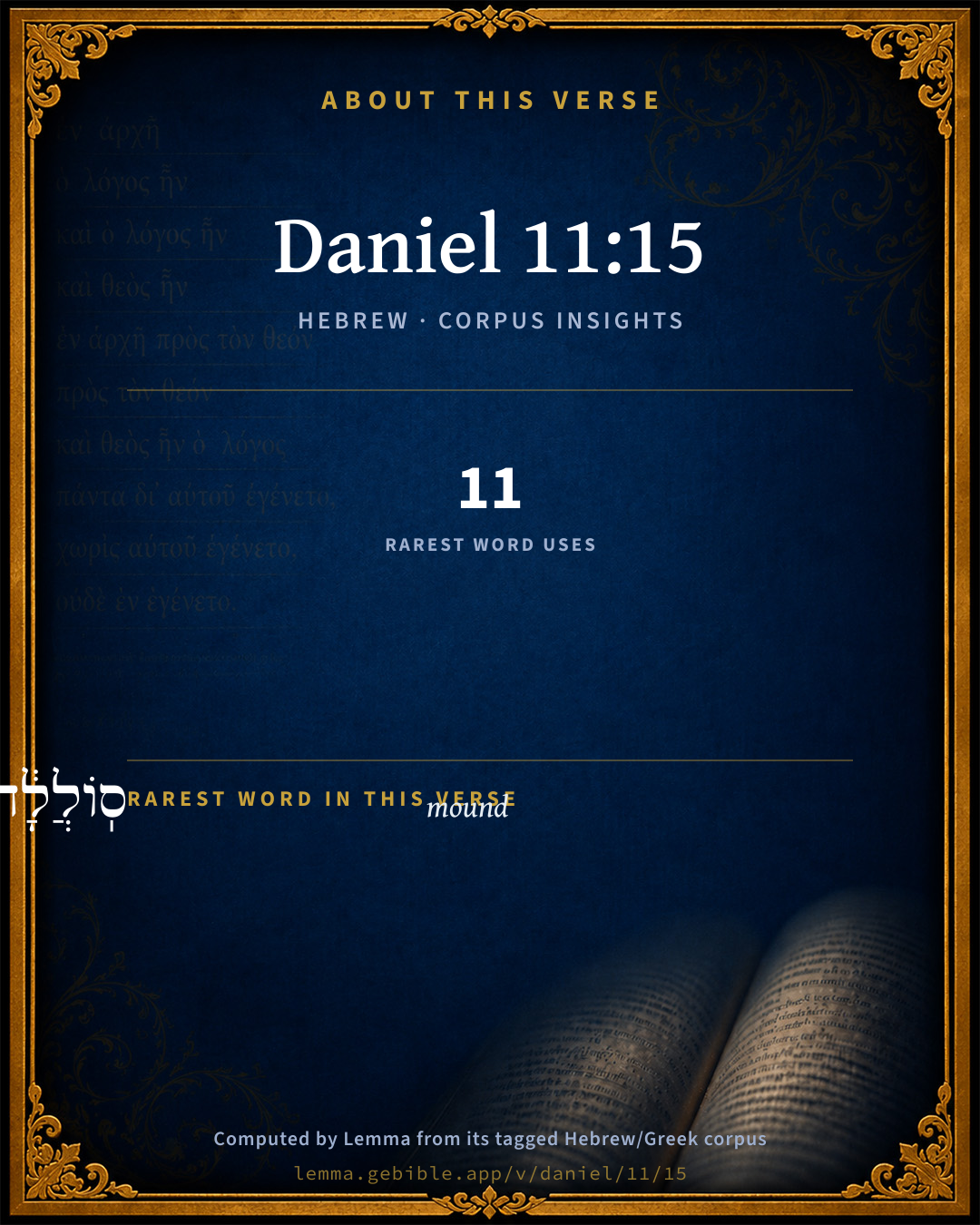
The rarest word here is סֽוֹלֲלָ֔ה mound H5550 — appearing just 11 times in the whole Hebrew Bible.

Shared distinctive vocabulary

סֽוֹלֲלָ֔ה mound H5550 occurs in 11 verses of the Hebrew Bible. Also found in:

Grammatical profile

  • 5 verbs
  • 10 nouns
  • 2 particles

Verb forms

  • וְיָבֹא֙ Qal · Imperfect
  • וְיִשְׁפֹּךְ֙ Qal · Imperfect
  • וְלָכַ֖ד Qal · Sequential Perfect
  • יַעֲמֹ֔דוּ Qal · Imperfect
  • לַעֲמֹֽד Qal · Infinitive Construct

Repetition

A word recurs within this verse — often emphatic in Hebrew:

  • יַעֲמֹ֔דוּ to stand H5975 ×2

Hebrew & Septuagint length

In English translation the verse runs 39 words from the Hebrew and 44 from the Septuagint (LXX English) — closely comparable.

A rough comparison of the two English renderings, which tokenize alike — not a word-level alignment.

Word counts can differ between the Hebrew and the Greek without any difference in meaning — e.g. the Hebrew direct-object marker אֵת has no separate Greek word, and Greek often adds the article ὁ.

Cross-references

10

Topical passages linked to Daniel 11:15 in the Treasury of Scripture Knowledge — connected by theme and wording, ordered by reader-vote popularity; previews shown in the World English Bible.

  • Jeremiah 6:6 For thus has Yahweh of Hosts said, Hew you down trees, and cast up a mound against Jerusalem: this is the city to be visited; she is wholly oppression in the midst of her.
  • Ezekiel 17:17 Neither shall Pharaoh with his mighty army and great company help him in the war, when they cast up mounds and build forts, to cut off many persons.
  • Joshua 1:5 There shall not any man be able to stand before you all the days of your life. As I was with Moses, so I will be with you; I will not fail you, nor forsake you.
  • Proverbs 21:30–31 There is no wisdom nor understanding Nor counsel against Yahweh.
  • Ezekiel 4:2 and lay siege against it, and build forts against it, and cast up a mound against it; set camps also against it, and plant battering rams against it round about.
  • Jeremiah 5:10 Go up on her walls, and destroy; but don't make a full end: take away her branches; for they are not Yahweh's.
  • Jeremiah 33:4 For thus says Yahweh, the God of Israel, concerning the houses of this city, and concerning the houses of the kings of Judah, which are broken down [to make a defense] against the mounds and against the sword;
  • Jeremiah 52:4 It happened in the ninth year of his reign, in the tenth month, in the tenth day of the month, that Nebuchadrezzar king of Babylon came, he and all his army, against Jerusalem, and encamped against it; and they built forts against it round about.
  • Daniel 8:7 I saw him come close to the ram, and he was moved with anger against him, and struck the ram, and broke his two horns; and there was no power in the ram to stand before him; but he cast him down to the ground, and trampled on him; and there was none who could deliver the ram out of his hand.
  • Daniel 11:6 At the end of years they shall join themselves together; and the daughter of the king of the south shall come to the king of the north to make an agreement: but she shall not retain the strength of her arm; neither shall he stand, nor his arm; but she shall be given up, and those who brought her, and he who became the father of her, and he who strengthened her in those times.

Cross-references courtesy of OpenBible.info (CC BY 4.0).

Hebrew and Greek witnesses Masoretic Hebrew ↔ Greek Septuagint

The same verse in the two great witnesses to the Old Testament, shown verse-for-verse.

These are two independent witnesses, not word-aligned to each other, and the Septuagint is shown in lemma (dictionary) form.

Hebrew Daniel 11:15 Masoretic · Westminster Leningrad Codex

וְיָבֹא֙ מֶ֣לֶךְ הַצָּפ֔וֹן וְיִשְׁפֹּךְ֙ סֽוֹלֲלָ֔ה וְלָכַ֖ד עִ֣יר מִבְצָר֑וֹת וּזְרֹע֤וֹת הַנֶּ֨גֶב֙ לֹ֣א יַעֲמֹ֔דוּ וְעַם֙ מִבְחָרָ֔יו וְאֵ֥ין כֹּ֖חַ לַעֲמֹֽד

So the king of the north shall come, and cast up a mound, and take a well-fortified city: and the forces of the south shall not stand, neither his chosen people, neither shall there be any strength to stand.

World English Bible · Public Domain

Greek LXX Daniel 11:15 Septuagint · lemma form

καί ἐπιἔρχομαι βασιλεύς βορέας καί ἐπιστρέφω ὁ δόρυ αὐτός καί λαμβάνω ὁ πόλις ὁ ὀχυρός καί ὁ βραχίων βασιλεύς αἴγυπτος ἵστημι μετά ὁ δυνάστης αὐτός καί οὐ εἰμί αὐτός ἰσχύς εἰς ὁ ἀντιἵστημι αὐτός

And the king of the north shall come in, and cast up a mound, and take strong cities: and the arms of the king of the south shall withstand, and his chosen ones shall rise up, but there shall be no strength to stand.

LXX2012 (modern English Septuagint) · Public Domain

On this verse, The Pulpit Commentary discusses the Septuagint’s reading. Read the note in Commentary ↓

Hebrew: Westminster Leningrad Codex (CC BY 4.0). Greek: Septuagint (public domain); English from LXX2012 (modern English Septuagint) (Public Domain). How the Septuagint differs from the Hebrew →

Commentary

Notes on Daniel 11:15 from classic Christian and Jewish commentators (each source and its license shown beneath its notes). The classic Christian expositions comment on the surrounding passage and are grouped to its opening verse, so a note may address several verses; the Jewish commentaries on the Tanakh (Rashi and others) are per-verse, so they appear only where the commentator wrote on this verse.

Lemma curates 59 commentaries, every one of them public domain or Creative Commons licensed, each selected and text-cleaned for this edition rather than reprinted as found. About our sources →

Trapp's Complete Commentary

John Trapp

Dan 11:15 So the king of the north shall come, and cast up a mount, and take the most fenced cities: and the arms of the south shall not withstand, neither his chosen people, neither [shall there be any] strength to withstand.

Ver. 15. So the king of the north shall come,] i.e., Not the Romans, as some would have it, but Antiochus Great still. He had been foiled at Raphia, now he greatly prevaileth against the Egyptians. If we princes, said our Henry VII, shall take every occasion that is offered, the world shall never be quiet, but wearied with continual wars.

And the armies of the south shall not withstand.] Scopas, the Egyptian general, though very skilful and valiant, shall be beaten by Antiochus into Sidon, besieged there, and forced to yield, all the power of Egypt being not able to raise the siege and relieve Scopas. The battle is not always to the strong. {Ecc 9:11}

John Trapp, A Commentary or Exposition upon All the Books of the Old and New Testament (1647–1656) — public domain. Text from a community e-Sword module.

Joseph Benson's Commentary

Dan 11:15-16. So the king of the north shall come and take the most fenced cities — It was in the absence of Antiochus that these advantages were obtained by the arms of Egypt; but his presence soon turned the scale, and changed the whole face of affairs: for being concerned to recover Judea, and the cities of Cœlosyria and Palestine, which Scopas had taken, he came again into those parts. Scopas was sent again to oppose him, but was defeated near the sources of Jordan, lost a great part of his army, and was pursued to Sidon, where he was shut up with ten thousand men, and closely besieged. Three famous generals were sent from Egypt to raise the siege; but they could not succeed, and at length Scopas was forced by famine to surrender, upon the hard conditions of having life only granted to him and his men; they were obliged to lay down their arms, and were sent away stripped and naked. Antiochus took also Gaza, and then all the other cities of that district, namely, Abila, Samaria, and Gadara; and afterward became master of the whole country. The arms of the south could not withstand him, neither his chosen people, neither Scopas nor the other great generals, nor the choicest troops who were sent against him; but he did according to his own will, and none was able to stand before him — Among others the Jews also readily submitted to him, went forth in solemn procession to meet him, received him splendidly into their city, supplied him with plenty of provisions for all his army and elephants, and assisted him in besieging the garrison which Scopas had left in the citadel. Thus he stood in the glorious land — And his power was established in Judea. Which by his hand shall be consumed — This clause, thus rendered, may be considered as referring to Antiochus’s maintaining his army with the provisions he drew from Judea, and thereby exhausting it; and to the distresses the country suffered, by the marching and counter-marching of hostile armies through it. Thus Josephus: “While Antiochus the Great was reigning in Asia, both the Jews and the inhabitants of Cœlosyria, by the laying waste of their countries, suffered many things. For when he carried on war against Ptolemy Philopater, and against his son, surnamed Epiphanes, it happened, that whether he was conqueror or conquered, they suffered alike: so that they were like a ship at sea in a storm, tossed by the waves on both sides; for whether Antiochus prospered, or met with a reverse, their sufferings were the same.” But then they could not be said to be consumed by the hand of Antiochus particularly; they were consumed as much, or more, by Scopas: and the Hebrew, כלה בידו, is capable of another interpretation; it may be translated, Which shall be perfected, or prosper, or flourish, in his hand; a sense which agrees as well with the truth of the text, and better with the truth of history. For Antiochus, to reward and encourage the Jews in their fidelity and obedience to him, gave orders that their city should be repaired, and the dispersed Jews should return and inhabit it; that they should be supplied with cattle and other provisions for sacrifices; that they should be furnished with timber and other materials for finishing and adorning the temple; that they should live all according to the laws of their country; that the priests and elders, the scribes and Levites, should be exempted from the capitation and other taxes; that those who then inhabited the city, or should return to it within a limited time, should be free from all tribute for three years, and that the third part of their tribute should be remitted to them for ever after; and also, that as many as had been taken and forced into servitude should be released, and their substance and goods be restored to them: see Bishop Newton.

Joseph Benson's Commentary on the Old and New Testaments (1811–1818) — public domain. Text from a community e-Sword module.

Tyndale Open Study Notes

Tyndale Open Resources

11:15 At Paneas in 198 BC, the king of the north (Antiochus III) defeated the Egyptian general Scopas, besieged and captured Sidon, a fortified city, and took control of Palestine.

Tyndale Open Study Notes — © Tyndale Open Resources, licensed CC BY-SA 4.0. Text via the HelloAO Bible API.

Geneva Bible (1599)

Geneva Bible translators

The Egyptians were not able to resist Scopas Antiochus’ captain.

Geneva Bible (1599) marginal notes — public domain. Text via Bolls.life.

Jamieson, Fausset & Brown

Robert Jamieson, A. R. Fausset & David Brown

king of . . . north--Antiochus the Great.

take . . . fenced cities--Scopas, the Egyptian general, met Antiochus at Paneas, near the sources of the Jordan, and was defeated, and fled to Sidon, a strongly "fenced city," where he was forced to surrender.

chosen people--Egypt's choicest army was sent under Eropus, Menocles, and Damoxenus, to deliver Scopas, but in vain [JEROME].

Jamieson, Fausset & Brown — Commentary Critical and Explanatory on the Whole Bible (1871) — public domain (CC PDM 1.0). Text via the HelloAO Bible API.

Adam Clarke's Commentary

Verse 15. So the king of the north] Antiochus came to recover Judea. Scopas was sent by Ptolemy to oppose him; but he was defeated near the fountains of Jordan, and was obliged to take refuge in Sidon with ten thousand men. Antiochus pursued and besieged him; and he was obliged by famine to surrender at discretion, and their lives only were spared. Antiochus afterwards besieged several of the fenced cities, and took them; in short, carried all before him; so that the king of the south, Ptolemy, and his chosen people, his ablest generals, were not able to oppose him.

Adam Clarke's Commentary on the Bible (1810–1826) — public domain. Text from a community e-Sword/MySword module.

John Calvin's Commentaries

The angel follows up the same sentiment. He says, When Antiochus the Great shall burst forth, there shall be no valor in the Egyptians to resist him, for he shall take a fortified city. There is a change of number here, for he means fortified cities. For he should recover the cities which he had formerly lost, and should arrive at the city Raphia in Egypt. The explanation follows, The arms of Egypt shall not stand, nor the people of its levies. This relates to Scopas, who was sent forth with large forces: at first he prospered, but he was afterwards vanquished in the conflict, and had no courage to persevere in resistance. It afterwards follows, —

John Calvin's Commentaries (1540-1563) — public domain. Text from the Calvin Translation Society English edition (1840s-50s) via the Christian Classics Ethereal Library (ccel.org). Calvin's coverage is partial (roughly two-thirds of the Bible); uncommented books and verses are honest gaps, never fabricated. The 19th-century editor's footnotes and remarks are omitted so the notes are faithfully Calvin's own voice.

Ellicott's Commentary for English Readers

(15) The king of the north.—This prince attacks the fortress of his rival, who is unable to resist him. Here it is supposed that the allusion is to the capture of Sidon by Antiochus the Great. The troops of Ptolemy under Scopas had acquired possession of Jerusalem and of various portions of Syria during the absence of Antiochus. Scopas and the Egyptian troops under him fled to Sidon, where they were forced by famine to surrender to the Syrians (B.C. 198).

The arms of the south.—Comp. Dan_11:31. The phrase means the armed force of the south.

A Bible Commentary for English Readers, edited by Charles John Ellicott (1878–1897) — public domain. Text from a community e-Sword module.

John Gill's Exposition

So the king of the north shall come, and cast up a mount, and take the most fenced cities,.... That is, Antiochus the great, king of Syria, should come into Coelesyria and Phoenicia, which was the part of the kingdom of Egypt he was to have by the league with Philip king of Macedon; and this is a prophecy of his expedition into those parts, and the success of it. Scopas, a general of Ptolemy, being sent by him into Coelesyria, had took many of the cities of it, and the land of Judea; but Antiochus, coming into those parts with his army, beat Scopas at the fountains of Jordan, and destroyed great part of his forces, and retook the cities of Coelesyria that Scopas had made himself master of, and subdued Samaria; upon which the Jews voluntarily submitted to him, and received him into their city, as Josephus (t) relates; and Polybius (u), as quoted by him, says, that Scopas being conquered by Antiochus, he took Batanea, Samaria, Abila, and Godara, and that the Jews in a little time surrendered to him; and so Livy says (w), that Antiochus reduced all the cities that Ptolemy had in Coelesyria into subjection to him; and these are the most fenced cities pointed at in this prophecy, against which the king of Syria cast up mounts, in order to take them; or placed battering engines before them, as the word also signifies, as Kimchi observes (x), by which stones were cast into the besieged cities:

and the arms of the south shall not withstand, neither his chosen people, neither shall there be any strength to withstand; all the forces of the king of Egypt mustered together would not be able to withstand the power of Antiochus, who would, as he did, carry all before him; not their most powerful armies, nor most courageous generals, nor valiant soldiers, the choicest of them, nor any auxiliaries called in to their assistance; for when Scopas was beaten by Antiochus at Jordan, he fled to Sidon with ten thousand soldiers, where he was shut up in a close siege; and though Ptolemy sent his famous and choicest commanders to his relief, Eropus, Menocles, and Damoxenus, as Jerome relates; yet they were not able to raise the siege, but by famine were forced to surrender; and he and his men were dismissed naked.

(t) Antiqu. l. 12. c. 3. sect. 3. (u) Histor. l. 16. apud Joseph. ib. (w) Hist. l. 33. (x) Sepher Shorash. rad.

John Gill's Exposition of the Whole Bible (1746–1763) — public domain (CC PDM 1.0). Text via the HelloAO Bible API.

Albert Barnes' Notes on the Bible

So the king of the north - Antiochus the Great.

Shall come - Shall come again into these provinces. This occurred after he had vanquished the army of the Egyptians at Paneas. He then took Sidon and Patara, and made himself master of the whole country. - Prideaux, iii. 198. This happened 198 b.c. Scopas, a general of Ptolemy, had been sent by him into Coelo-Syria and Palestine, with a view of subjecting those countries again to Egyptian rule. He was met by Antiochus at Paneas, near the sources of the Jordan, and defeated, and fled with ten thousand men to Sidon, where he fortified himself, but from where he was expelled by Antiochus.

And cast up a mount - A fortification. That is, he shall so entrench himself that he cannot be dislodged. The reference does not seem to be to any particular fortification, but to the general fact that he would so entrench or fortify himself that he would make his conquests secure.

And take the most fenced cities - Margin, “city of munitions” Hebrew, “city of fortifications.” The singular is used here in a collective sense; or perhaps there is allusion particularly to Sidon, where Scopas entrenched himself, making it as strong as possible.

And the arms of the south shall not withstand - Shall not be able to resist him, or to dislodge him. The power of the Egyptian forces shall not be sufficient to remove him from his entrenchments. The Hebrew is, “shall not stand;” that is, shall not stand against him, or maintain their position in his advances. The word “arms” (זרעות zero‛ôth) is used here in the sense of “heroes, warriors, commanders,” as in Eze 30:22, Eze 30:24-25.

Neither his chosen people - Margin, “the people of his choices.” Those whom he had selected or chosen to carry on the war - referring, perhaps, to the fact that he would deem it necessary to employ picked men, or to send the choicest of his forces in order to withstand Antiochus. Such an occurrence is in every way probable. To illustrate this, it is only necessary to say that the Egyptians sent three of their most distin. guished generals, with a select army, to deliver Sidon - Eropus, Menocles, and Damoxenus. - Lengerke, in loc.

Neither shall there be any stregnth to withstand - No forces which the Egyptians can employ. In other words, Antiochus would carry all before him. This is in strict accordance with the history. When Scopas was defeated by Antiochus at Paneas, near the sources of the Jordan, he fled and entrenched himself in Sidon. There he was followed and besieged by Antiochus. The king of Egypt sent the three generals above named, with a choice army, to endeavor to deliver Scopas, but they were unable. Scopas was obliged to surrender, in consequence of famine, and the chosen forces returned to Egypt.

Albert Barnes' Notes on the Bible (1834–1885) — public domain. Text from a community e-Sword/MySword module.

Haydock's Catholic Bible Commentary

Cities; Sidon, Gaza, and the citadel of Jerusalem, &c. (Calmet)

George Leo Haydock (1774–1849), Haydock's Catholic Family Bible and Commentary, 1859 edition — public domain. Excludes Psalms (Douay-Rheims chapter numbering differs from Protestant) and Deuterocanonical books (Catholic canon only).

Matthew Poole's English Annotations

Antiochus Epiphanes shall march on irresistibly and victoriously, besieging and taking fenced cities and strong holds, as Sidon, Samaria, &c., nor shall all the power of Egypt withstand him.

Matthew Poole's English Annotations on the Holy Bible (1683–1685) — public domain. Text from a community e-Sword/MySword module.

Whedon's Commentary on the Bible

Daniel D. Whedon

15, 16. Antiochus the Great shall come against Egypt, raise earthworks against “a well-fortified city,” and take it. This probably has reference to the capture of Sidon, where Scopas, the commander of the Ptolemic forces, after the Syrian king’s victory at Mount Pannius, had intrenched himself with ten thousand of his men. The result is thus stated: “And the forces of the south (i.e., Ptolemy’s) shall not withstand [Antiochus] nor (even) his [Ptolemy’s] chosen men, and there shall be no strength to withstand (Dan_11:16). And he [Antiochus] who shall come against him [Ptolemy] shall do as he wills, and none shall withstand him, and he shall stand in the land of glory with destruction in his hand.” This is a fair historical statement, from a Hebrew standpoint, of the trials of Antiochus the Great. The love of the Jews for the pleasant or “glorious” land is shown from the days of David onward. That other nationalities felt in the same way concerning their own native country is seen from the tale of Sanehat, an Egyptian of Abraham’s day, who, while dying in a foreign land, craved with his last breath to be buried in “the blessed land,” i.e., Egypt.

Daniel D. Whedon (gen. ed.), Commentary on the Old and New Testaments (1874–1909) — public domain. Text from a community e-Sword module.

The Pulpit Commentary

So the king of the north shall come, and cast up a mount, and take the most fenced cities: and the arms of the south shall not withstand, neither his chosen people, neither shall there be any strength to withstand. The version of the LXX is, "And the king of the north shall attack and turn his spears, and shall take the fortified city, and the arms of the King of Egypt shall stand with his rulers, and there shall not be strength in them to resist them." It is difficult to imagine what Hebrew text was before the translator when he rendered, "turn his spears." Theodotion agrees with the Massoretic in the first portion, and with the LXX in the latter. The Peshitta rendering is not unlike the Massoretic, "And the king of the north shall come and shall lay ambuscades, and shall conquer strong fastnesses; and the arms of the south shall not stand, because there is not in them might to stand; and his chosen people shall not stand, because there is not might in them to stand." The Vulgate, as usual, is closest to the Massoretic. The reference here is most probably to the capture of Sidon, into which Scopas, the general of Ptolemy, had thrown himself after his defeat at Paneas. Other strongholds and fortified cities were of necessity taken at the same time. The arms of the south shall not withstand, neither his chosen people. Ptolemy sent several successive armies to relieve Sidon, but was unable to compel Antiochus to give up the siege. Finally Scopas had to surrender. Neither shall there be any strength to withstand. Egypt was to all appearance helpless; there was neither wisdom in their counsels nor valour in their arms.

The Pulpit Commentary (1880–1919), ed. H.D.M. Spence-Jones & Joseph S. Exell — public domain. Text from a community e-Sword module.

Scofield Reference Notes

C. I. Scofield

king of the north

Antiochus the Great, B.C. 198.

The Scofield Reference Bible (1917 edition), notes by C. I. Scofield — public domain. Text from a community e-Sword module.

unfoldingWord translationNotes

Door43 World Missions Community

General Information:

The angel continues speaking to Daniel.

The king of the North will come

Here "king of the North" includes his army also. AT: "The army of the king of the North will come" (See: Synecdoche)

pour out earth for siege mounds

This refers to the piling up of earth in order for soldiers to reach the height of city walls in order to attack them. Soldiers and slaves would put loose earth in baskets, carry them to the right place, and pour it out in order to raise the mounds.

fortifications

walls and other things built to defend a city or fort from enemy soldiers

will not be able to stand

Here standing represents the ability to fight. AT: "will not be able to keep fighting against them" (See: Metonymy)

the one who comes will act according to his desires against him

"the invading king will do whatever he wants against the other king"

He will stand in

Here standing represents ruling. AT: "The king will begin to rule" (See: Metonymy)

the land of beauty

This refers to the land of Israel. See how you translated this in Daniel 08:09.

destruction will be in his hand

Here "destruction" represents the power to destroy. Also, the power to destroy is spoken of as if it were something that someone could hold in his hand. AT: "he will have power to destroy anything" (See: Metaphor)

translationWords

king

hand

unfoldingWord translationNotes — © Distant Shores Media and the Door43 World Missions Community, licensed CC BY-SA 4.0. Source: git.door43.org/Door43/en_tn.

Rashi

Rabbi Shlomo Yitzchaki (Rashi)

and the people of his chosen ones will be in the war.

will have no strength to stand before the king of the north, and although there is a superfluous “vav” here, it is customary for Scripture to speak in this manner as in, for example: “As for its nobles, there are none (וְאֵין) who proclaim the kingdom,” Isaiah (34:12).

Rashi on the Tanakh — English translations: “The Judaica Press complete Tanach with Rashi, translated by A. J. Rosenberg” (CC BY 4.0); “Pentateuch with Rashi's commentary by M. Rosenbaum and A.M. Silbermann, 1929-1934” (public domain); “The Metsudah Tanach series, Lakewood, N.J” (CC BY 4.0); and “The Book of Joshua, Metsudah Publications, 1997” (CC BY 4.0). Text via Sefaria.

Lesson kit

Teaching starters — assembled from the data on this page, not authored interpretation. Every prompt links to the verse data it draws on. Edit before teaching.

Daniel, in the Prophets, opens this verse with 17 words (16 distinct Hebrew lemmas). Its most distinctive word is çôlᵉlâh (“mound”). A historical commentator’s framing appears above. Read the whole chapter for the surrounding context.

Discussion questions

  1. The word çôlᵉlâh carries the sense “mound.” How does it shape the verse?
  2. How does 2 Samuel 20:15, which shares the word «mound», read alongside this verse?
  3. What does the repetition of “to stand” (2× in this one verse) do in this verse?
  4. These translations render this verse differently. What is at stake in choosing one wording over another?
  5. «וְיָבֹא֙» is a Qal Imperfect verb. How does that grammatical form shape the action described?
  6. Compare how Trapp's Complete Commentary and Joseph Benson's Commentary read this verse. Where do they agree or differ?

Things to notice

Reading settings

Reading text

Shown beneath each verse's original-language words.

Old Testament
Old Testament edition

Read the OT as the Masoretic Hebrew (MT) or the Greek Septuagint (LXX).

English shown for the Greek Septuagint (in the Hebrew ↔ Greek comparison).

Comparing translations? Open the Compare panel on any verse page to stack up to four side by side.