
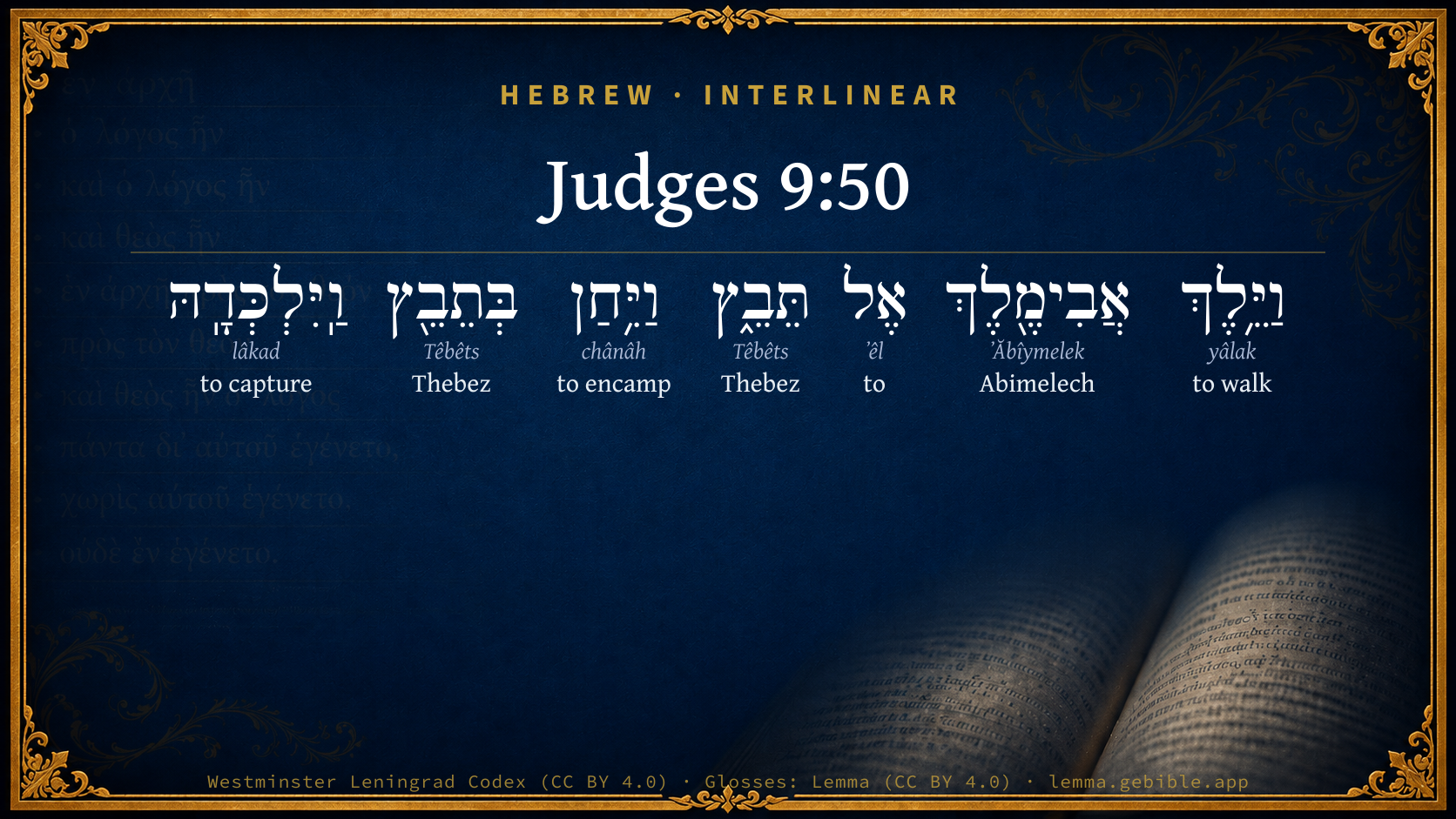
Judges 9:50

Hebrew (Westminster Leningrad Codex) Judges 9:50 appears in the Hebrew Old Testament. The text above is from the Westminster Leningrad Codex. Each word links to its Strong’s number, a concise gloss, and parsing drawn from the Open Scriptures Hebrew Bible morphology. Click any word for its full Brown-Driver-Briggs (BDB) entry.
Download image
Cite this verse

Judges 9:50 (World English Bible). Public Domain. Lemma interlinear Bible study tool, https://lemma.gebible.app/v/judges/9/50.

Show BibTeX & RIS
BibTeX
RIS
English Translation
Then went Abimelech to Thebez, and encamped against Thebez, and took it.
World English Bible · Public Domain
Highlights
  • 1 first appearance in the Hebrew Bible
Full analysis ↓
Download a study sheet

One document with this verse’s original text, its word-by-word gloss line, the meaning frame, cross-references with their text, attributed commentary, and full source and license credits — printable, and it pastes into notes with its structure intact.

This verse Autodidact and up

Study sheet (.html) Plain text (.txt)

A passage Seminary Student

Up to 50 verses in one chapter. A passage sheet keeps up to 6 commentary sources and 12 cross-references per verse, in the order this page ranks them, and says so on the sheet whenever that leaves anything out. Ask for a single verse and you get the Autodidact verse sheet above.

Everything on this page stays free to read, with no account — the sheet is a download of what is already on screen, not access to it.

Want to remove ads? Support Godless Engineer
Compare translations 3

The same verse in 3 English versions, stacked beneath the original-language interlinear above. Click any original word for its lexicon entry.

Each is an independent rendering of the whole verse — the interlinear is not word-aligned to these translations.

Highlighted words mark where these versions differ — a whole-verse word diff, not a word-by-word alignment.

  • World English Bible Public Domain
    Then went Abimelech to Thebez, and encamped against Thebez, and took it.
  • King James Version Public Domain
    Then went Abimelech to Thebez, and encamped against Thebez, and took it.
  • unfoldingWord Literal Text CC BY-SA 4.0
    Then Abimelech went to Thebez and encamped against Thebez, and he captured it.

unfoldingWord Literal Text — © unfoldingWord, licensed CC BY-SA 4.0. Word-aligned USFM3 via Door43 (git.door43.org/unfoldingWord/en_ult).

Versions to compare (up to 4)

3 of 4 selected

Show all 18 translations

Every available English version of this verse, each an independent rendering of the whole verse.

  • World English Bible Public Domain
    Then went Abimelech to Thebez, and encamped against Thebez, and took it.
  • Berean Standard Bible Public Domain
    Then Abimelech went to Thebez, encamped against it, and captured it.
  • Majority Standard Bible Public Domain
    Then Abimelech went to Thebez, encamped against it, and captured it.
  • King James Version Public Domain
    Then went Abimelech to Thebez, and encamped against Thebez, and took it.
  • American Standard Version (1901) Public Domain
    Then went Abimelech to Thebez, and encamped against Thebez, and took it.
  • Revised Version (1885) Public Domain
    Then went Abimelech to Thebez, and encamped against Thebez, and took it.
  • Geneva Bible (1599) Public Domain
    Then went Abimelech to Tebez, and besieged Tebez, and tooke it.
  • Douay-Rheims (1899) Public Domain
    Then Abimelech departing from thence came to the town of Thebes, which he surrounded and besieged with his army.
  • Young's Literal Translation Public Domain
    And Abimelech goeth unto Thebez, and encampeth against Thebez, and captureth it,
  • Literal Standard Version CC BY-SA 4.0
    And Abimelech goes to Thebez, and encamps against Thebez, and captures it,
  • Unlocked Literal Bible CC BY-SA 4.0
    Then Abimelech went to Thebez, and he encamped against Thebez and captured it.
  • unfoldingWord Literal Text CC BY-SA 4.0
    Then Abimelech went to Thebez and encamped against Thebez, and he captured it.
  • Darby Bible Public Domain
    Then Abim'elech went to Thebez, and encamped against Thebez, and took it.
  • World Messianic Bible Public Domain
    Then Abimelech went to Thebez and encamped against Thebez, and took it.
  • Webster's Bible Public Domain
    Then went Abimelech to Thebez, and encamped against Thebez, and took it.
  • Free Bible Version CC BY-SA 4.0
    Then Abimelech went to attack Thebez and captured it.
  • Bible in Basic English Public Domain
    Then Abimelech went to Thebez, and put his army in position against Thebez and took it.
  • JPS Tanakh (1917) Public Domain
    Then went Abimelech to Thebez, and encamped against Thebez, and took it.

Literal Standard Version (2020), Covenant Press — licensed CC BY-SA 4.0. Text via the HelloAO Bible API (eBible.org). Unlocked Literal Bible (unfoldingWord) — licensed CC BY-SA 4.0. Text via the HelloAO Bible API (eBible.org). unfoldingWord Literal Text — © unfoldingWord, licensed CC BY-SA 4.0. Word-aligned USFM3 via Door43 (git.door43.org/unfoldingWord/en_ult). Free Bible Version, Dr. Jonathan Gallagher — licensed CC BY-SA 4.0. Text via the HelloAO Bible API (eBible.org).

Word by word

More ways to search: Search by grammar → Find every occurrence → Compare this word →

Practice this passage: Drill this verse → Learn its vocabulary →

About this verse

These counts appear in no published source. They are computed here, from the morphology-tagged text and Lemma’s own curated glosses. What Lemma adds →

7
words
6
distinct lemmas
Historical
section

Notable vocabulary

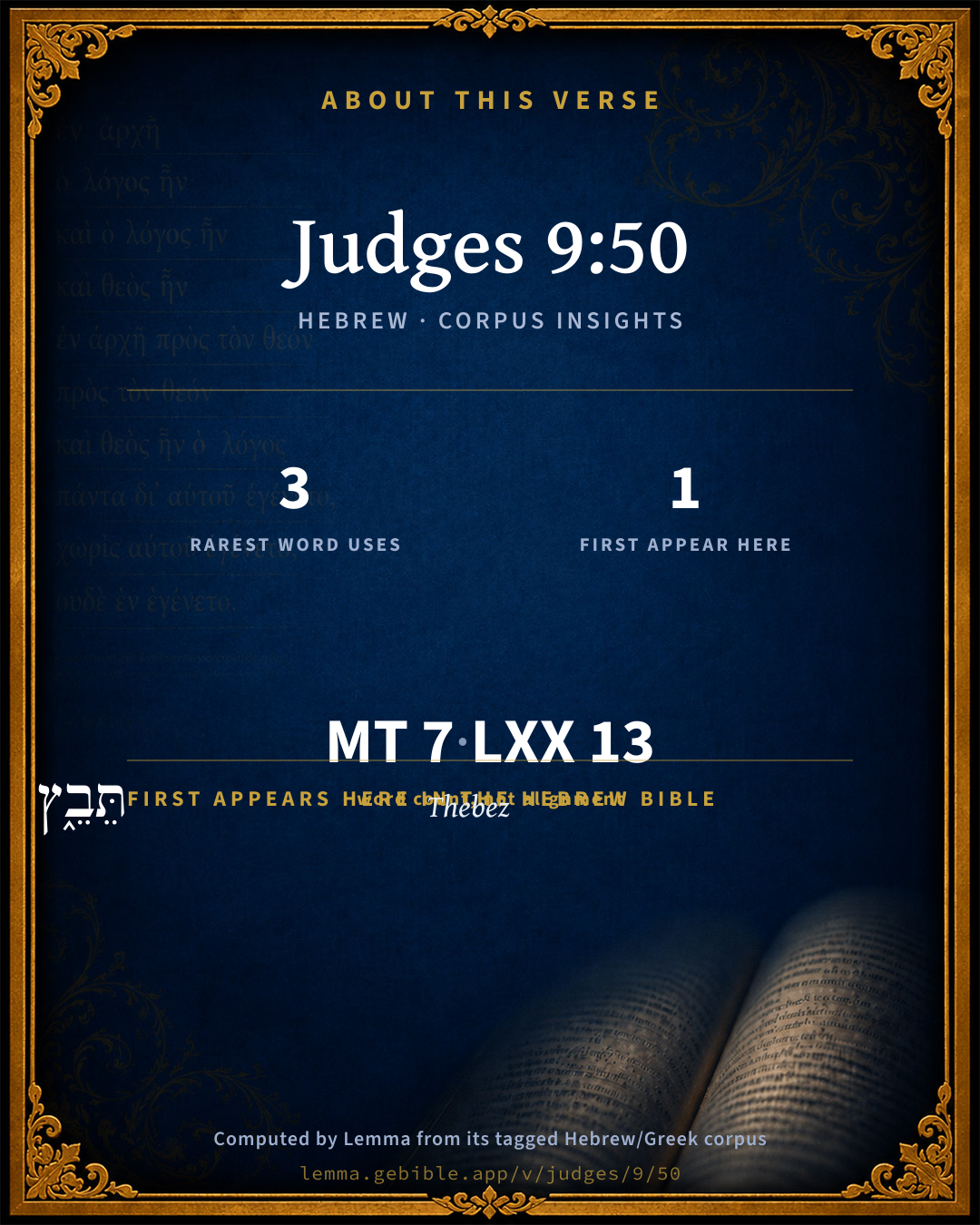
The rarest word here is תֵּבֵ֑ץ Thebez H8405 — appearing just 3 times in the whole Hebrew Bible.

First appearance in Scripture

This word makes its first canonical appearance in the Hebrew Bible here:

  • תֵּבֵ֑ץ Thebez H8405

Shared distinctive vocabulary

תֵּבֵ֑ץ Thebez H8405 occurs in 2 verses of the Hebrew Bible. Also found in:

Grammatical profile

  • 3 verbs
  • 3 nouns
  • 1 preposition

Verb forms

  • וַיֵּ֥לֶךְ Qal · Sequential Imperfect
  • וַיִּ֥חַן Qal · Sequential Imperfect
  • וַֽיִּלְכְּדָֽהּ Qal · Sequential Imperfect

Repetition

A word recurs within this verse — often emphatic in Hebrew:

  • תֵּבֵ֑ץ Thebez H8405 ×2

Hebrew & Septuagint length

In English translation the verse runs 12 words from the Hebrew and 13 from the Septuagint (LXX English) — closely comparable.

A rough comparison of the two English renderings, which tokenize alike — not a word-level alignment.

Word counts can differ between the Hebrew and the Greek without any difference in meaning — e.g. the Hebrew direct-object marker אֵת has no separate Greek word, and Greek often adds the article ὁ.

In the original languages it is 7 Hebrew tokens and 13 Greek tokens — but the two are counted differently (Hebrew bundles its prefixes and suffixes into one token; the Greek is in lemma form), so that isn’t a like-for-like length.

Hebrew and Greek witnesses Masoretic Hebrew ↔ Greek Septuagint

The same verse in the two great witnesses to the Old Testament, shown verse-for-verse.

These are two independent witnesses, not word-aligned to each other, and the Septuagint is shown in lemma (dictionary) form.

Hebrew Judges 9:50 Masoretic · Westminster Leningrad Codex

וַיֵּ֥לֶךְ אֲבִימֶ֖לֶךְ אֶל תֵּבֵ֑ץ וַיִּ֥חַן בְּתֵבֵ֖ץ וַֽיִּלְכְּדָֽהּ

Then went Abimelech to Thebez, and encamped against Thebez, and took it.

World English Bible · Public Domain

Greek LXX Judges 9:50 Septuagint · lemma form

καί πορεύομαι αβιμελεχ ἐκ βαιθηλβεριθ καί παρα ἐνβάλλω ἐν θηβης καί καταλαμβάνω αὐτός

And Abimelech went out of Baethel-berith, and encamped against Thebes, and took it.

LXX2012 (modern English Septuagint) · Public Domain

Hebrew: Westminster Leningrad Codex (CC BY 4.0). Greek: Septuagint (public domain); English from LXX2012 (modern English Septuagint) (Public Domain). How the Septuagint differs from the Hebrew →

Targum (Aramaic paraphrase)

1

The Targum is the ancient Jewish Aramaic paraphrase of the Hebrew Scriptures — an interpretive translation, not the Hebrew text itself. Onkelos (literal) and Pseudo-Jonathan (expansive) render the Torah, and Jonathan the Prophets. Coverage is partial: where no permissively-licensed English translation exists for a verse, only the Aramaic is shown. This is verse-level text, not a word-by-word alignment to the Hebrew.

  1. Targum Jonathan Prophets (Joshua–Malachi)
    וַאֲזַל אֲבִימֶלֶךְ לְתֵבֵץ וּשְׁרָא בְּתֵבֵץ וְכַבְּשָׁהּ:

    (no public-domain English translation for this verse)

    Targum Jonathan — Aramaic: “Mikraot Gedolot” (public domain). English: “Sefaria Community Translation” (CC0 1.0 (public-domain dedication)); “London "Chaldee Paraphrase," 1871” (public domain). Text via Sefaria.

Commentary

Notes on Judges 9:50 from classic Christian and Jewish commentators (each source and its license shown beneath its notes). The classic Christian expositions comment on the surrounding passage and are grouped to its opening verse, so a note may address several verses; the Jewish commentaries on the Tanakh (Rashi and others) are per-verse, so they appear only where the commentator wrote on this verse.

Lemma curates 59 commentaries, every one of them public domain or Creative Commons licensed, each selected and text-cleaned for this edition rather than reprinted as found. About our sources →

Matthew Henry's Commentary

We have seen the ruin of the Shechemites completed by the hand of Abimelech; and now it comes to his turn to be reckoned with who was their leader in villany. Thebez was a small city, probably not far from Shechem, dependent upon it, and in confederacy with it. Now,

I. Abimelech attempted the destruction of this city (Jdg 9:50), drove all the inhabitants of the town into the castle, or citadel, Jdg 9:51. When he had them there he did not doubt but he should do the same execution here that he had lately done at the strong-hold of the temple of Baal-berith, not considering that the tower of an idol-temple lay more exposed to divine vengeance than any other tower. He attempted to set fire to this tower, at least to burn down the door, and so force an entrance, Jdg 9:52. Those who have escaped and succeeded well in one desperate attempt are apt to think the like attempt another time not desperate. This instance was long after quoted to show how dangerous it is to come near the call of a besieged city, Sa2 11:20, etc. But God infatuates those whom he will ruin.

II. In the attempt he was himself destroyed, having his brains knocked out with a piece of a millstone, Jdg 9:57. No doubt this man was a murderer, whom, though he had escaped the dangers of the war with Shechem, yet vengeance suffered not to live, Act 28:4. Evil pursues sinners, and sometimes overtakes them when they are not only secure, but triumphant. Thebez, we may suppose, was a weak inconsiderable place, compared with Shechem. Abimelech, having conquered the greater, makes no doubt of being master of the less without any difficulty, especially when he had taken the city, and had only the tower to deal with; yet he lays his bones by that, and there is all his honour buried. Thus are the mighty things of the world often confounded by the weakest and those things that are most made light of. See here what rebukes those are justly put under many times by the divine providence that are unreasonable in their demands of satisfaction for injuries received. Abimelech had some reason to chastise the Shechemites, and he had done it with a witness; but when he will carry his revenges further, and nothing will serve but that Thebez also must be sacrificed to his rage, he is not only disappointed there, but destroyed; for verily there is a God that judges in the earth. Three circumstances are worthy of observation in the death of Abimelech: - 1. That he was slain with a stone, as he had slain his brethren all upon one stone. 2. That he had his skull broken. Vengeance aimed at that guilty head which had worn the usurped crown. 3. That the stone was cast upon him by a woman, Jdg 9:53. He saw the stone come; it was therefore strange he did not avoid it, but, no doubt, this made it so much the greater mortification to him to see from what hand it came. Sisera died by a woman's hand and knew it not; but Abimelech not only fell by the hand of a woman but knew it, and, when he found himself ready to breathe his last, nothing troubled him so much as this, that it should be said, A woman slew him. See, (1.) His foolish pride, in laying so much to heart this little circumstance of his disgrace. Here was no care taken about his precious soul, no concern what would become of that, no prayer to God for his mercy; but very solicitous he is to patch up his shattered credit, when there is no patching his shattered skull. "O let it never be said that such a mighty man as Abimelech was killed by a woman!" The man was dying, but his pride was alive and strong, and the same vain-glorious humour that had governed him all along appears now at last. Qualis vita, finis ita - As was his life, such was his death. As God punished his cruelty by the manner of his death, so he punished his pride by the instrument of it. (2.) His foolish project to avoid this disgrace; nothing could be more ridiculous; his own servant must run him through, not to rid him the sooner out of his pain, but that men say not, A woman slew him. Could he think that this would conceal what the woman had done, and not rather proclaim it the more? Nay, it added to the infamy of his death, for hereby he became a self-murderer. Better have it said, A woman slew him, than that it should be said, His servant slew him by his own order; yet now both will be said of him to his everlasting reproach. And it is observable that this very thing which Abimelech was in such care to conceal appears to have been more particularly remembered by posterity than most passages of his history; for Joab speaks of it as that which he expected David would reproach him with, for coming so nigh the wall, Sa2 11:21. The ignominy we seek to avoid by sin we do but perpetuate the remembrance of.

III. The issue of all is that Abimelech being slain, 1. Israel's peace was restored, and an end was put to this civil war; for those that followed him departed every man to his place, Jdg 9:55. 2. God's justice was glorified (Jdg 9:56, Jdg 9:57): Thus God punished the wickedness of Abimelech, and of the men of Shechem, and fulfilled Jotham's curse, for it was not a curse causeless. Thus he preserved the honour of his government, and gave warning to all ages to expect blood for blood. The Lord is known by the judgments which he executes, when the wicked is snared in the work of his own hands. Though wickedness may prosper awhile, it will not prosper always.

Matthew Henry's Commentary on the Whole Bible (1708–1710) — public domain (CC PDM 1.0). Text via the HelloAO Bible API.

Jamieson, Fausset & Brown

Robert Jamieson, A. R. Fausset & David Brown

ABIMELECH SLAIN. (Jdg 9:50-57)

Then went Abimelech to Thebez, and encamped against Thebez--now Tubas--not far from Shechem.

Jamieson, Fausset & Brown — Commentary Critical and Explanatory on the Whole Bible (1871) — public domain (CC PDM 1.0). Text via the HelloAO Bible API.

Trapp's Complete Commentary

John Trapp

Jdg 9:50 Then went Abimelech to Thebez, and encamped against Thebez, and took it.

Ver. 50. Then went Abimelech to Thebez.] Elijah the Tishbite’s country, and more famous for him than Thebes, in Greece, was afterwards for Pindarus the poet.

John Trapp, A Commentary or Exposition upon All the Books of the Old and New Testament (1647–1656) — public domain. Text from a community e-Sword module.

Keil & Delitzsch

C. F. Keil & F. Delitzsch

At length the fate predicted by Jotham (Jdg 9:20) overtook Abimelech.

Jdg 9:50-54

He went from Shechem to Thebez, besieged the town, and took it. Thebez, according to the Onom. thirteen miles from Neapolis (Shechem) on the road to Scythopolis (Beisan), has been preserved in the large village of Tubs on the north of Shechem (see Rob. Pal. iii. p. 156, and Bibl. Res. p. 305). This town possessed a strong tower, in which men and women and all the inhabitants of the town took refuge and shut themselves in. But when Abimelech advanced to the tower and drew near to the door to set it on fire, a woman threw a millstone down upon him from the roof of the tower and smashed his skull, whereupon he called hastily to the attendant who carried his weapons to give him his death-blow with his sword, that men might not say of him "a woman slew him." רכב פּלח, the upper millstone which was turned round, lapis vector (see Deu 24:6). תּריץ: from רצץ, with a toneless i, possibly to distinguish it from ותּרץ (from רוּץ). גּלגּלתּו, an unusual form for גּלגּלתּו, which is found in the edition of Norzi (Mantua, 1742).

Jdg 9:55-57

After the death of Abimelech his army was dissolved. ישׂראל אישׁ are the Israelites who formed Abimelech's army. In Jdg 9:56, Jdg 9:57, the historian closes this account with the remark, that in this manner God recompensed Abimelech and the citizens of Shechem, who had supported him in the murder of his brothers (Jdg 9:2), according to their doings. After the word "rendered" in Jdg 9:56 we must supply "upon his head," as in Jdg 9:57. Thus Jotham's curse was fulfilled upon Abimelech and upon the Shechemites, who had made him king.

Keil & Delitzsch — Biblical Commentary on the Old Testament (1861–1891) — public domain (CC PDM 1.0). Text via the HelloAO Bible API. (Old Testament only.)

Ellicott's Commentary for English Readers

(50) Thebez.—One of the cities in the league of “Baal of the Covenant,” perhaps, Tubas, ten miles north-east of Shechem, on a mound among the hills.

A Bible Commentary for English Readers, edited by Charles John Ellicott (1878–1897) — public domain. Text from a community e-Sword module.

The Cambridge Bible for Schools and Colleges

gen. ed. J. J. S. Perowne

50–57. The end of Abimelech

50. Thebez] 2Sa_11:21, probably the modern Ṭûbâs, about 10 m. N.E. of Nâblus on the road to Bçsân; so Eusebius, On. Sacr., 262, 44. Perhaps Thebez had been subject to Abimelech and had joined the revolt of Shechem.

The Cambridge Bible for Schools and Colleges (gen. ed. J. J. S. Perowne; Cambridge University Press, 1878–1918) — public domain. Text from a community e-Sword module.

John Gill's Exposition

But there was a strong tower within the city,.... The tower of Shechem was without the city, but this within, as towers generally are:

and hither fled all the men and women, and all they of the city; men, women, and children, man and maid servants, all the inhabitants of the city; the tower being a large place, having not only many rooms in it, but perhaps a large area in the midst of it, as well as it had battlements on the top of it:

and shut it to them; the gates of it, and which no doubt they strongly barred and bolted, to keep out the enemy:

and gat them up to the top of the tower; to observe the motions of Abimelech, and annoy him as much as they could with what they carried with them, as stones, and the like.

John Gill's Exposition of the Whole Bible (1746–1763) — public domain (CC PDM 1.0). Text via the HelloAO Bible API.

Albert Barnes' Notes on the Bible

The men of Thebez (modern Tubas) had, doubtless, joined the Shechemites in their rebellion against Abimelech.

Albert Barnes' Notes on the Bible (1834–1885) — public domain. Text from a community e-Sword/MySword module.

Haydock's Catholic Bible Commentary

Thebes, about 13 miles from Sichem, towards Scythopolis. (Eusebius) --- Besieged. Hebrew, &c., "took," as the sequel shews, (ver. 52,) since Abimelech was killed, as he was attacking the tower or citadel, in the midst of the city. (Calmet)

George Leo Haydock (1774–1849), Haydock's Catholic Family Bible and Commentary, 1859 edition — public domain. Excludes Psalms (Douay-Rheims chapter numbering differs from Protestant) and Deuterocanonical books (Catholic canon only).

Matthew Poole's English Annotations

Thebez; another town near to Shechem; and, as it seems, within its territory.

Matthew Poole's English Annotations on the Holy Bible (1683–1685) — public domain. Text from a community e-Sword/MySword module.

Whedon's Commentary on the Bible

Daniel D. Whedon

50. To Thebez — Where another insurrection had broken out. The site of Thebez is marked by the modern village Tubas, about ten miles northeast of Shechem.

Daniel D. Whedon (gen. ed.), Commentary on the Old and New Testaments (1874–1909) — public domain. Text from a community e-Sword module.

The Pulpit Commentary

Thebez. A place so called still existed in the time of Eusebius between Neapolis (i.e. Shechem) and Scythopolis (i.e. Beth-shean), about thirteen miles from Shechem. It still survives in the large and beautiful village of Tubas, which, Robinson tells us, is on the Roman road between Nabulus and Beishan. Thebez had evidently joined the rebellion against Abimelech.

The Pulpit Commentary (1880–1919), ed. H.D.M. Spence-Jones & Joseph S. Exell — public domain. Text from a community e-Sword module.

John Wesley's Explanatory Notes

Thebez - Another town near to Shechem; and, as it seems, within its territory.

John Wesley, Explanatory Notes Upon the Whole Bible (1754–1765) — public domain. Text via the GEBible commentary corpus.

unfoldingWord translationNotes

Door43 World Missions Community

Thebez

This is the name of a city. (See: How to Translate Names)

encamped against Thebez

"camped outside the city of Thebez"

translationWords

Abimelech

watchtower

unfoldingWord translationNotes — © Distant Shores Media and the Door43 World Missions Community, licensed CC BY-SA 4.0. Source: git.door43.org/Door43/en_tn.

Lesson kit

Teaching starters — assembled from the data on this page, not authored interpretation. Every prompt links to the verse data it draws on. Edit before teaching.

Judges, in the Historical, opens this verse with 7 words (6 distinct Hebrew lemmas). Its most distinctive word is Têbêts (“Thebez”). A historical commentator’s framing appears above. Read the whole chapter for the surrounding context.

Discussion questions

  1. The word Têbêts carries the sense “Thebez.” How does it shape the verse?
  2. The word “Thebez” first appears here in Scripture. What is being introduced at this debut?
  3. 2 Samuel 11:21 shares the word «Thebez» with this verse. How do the two illuminate each other?
  4. “Thebez” occurs 2× in this one verse. What is the effect of the repetition?
  5. These translations render this verse differently; the difference is in the English rendering, not the original. What questions does that raise?
  6. The verb «וַיֵּ֥לֶךְ» is Qal Sequential Imperfect. How does its form color the action?
  7. Reading how Matthew Henry's Commentary and Jamieson, Fausset & Brown read this verse, where do the two commentators agree and where do they part?

Things to notice

Reading settings

Reading text

Shown beneath each verse's original-language words.

Old Testament
Old Testament edition

Read the OT as the Masoretic Hebrew (MT) or the Greek Septuagint (LXX).

English shown for the Greek Septuagint (in the Hebrew ↔ Greek comparison).

Comparing translations? Open the Compare panel on any verse page to stack up to four side by side.