Esther 1:2

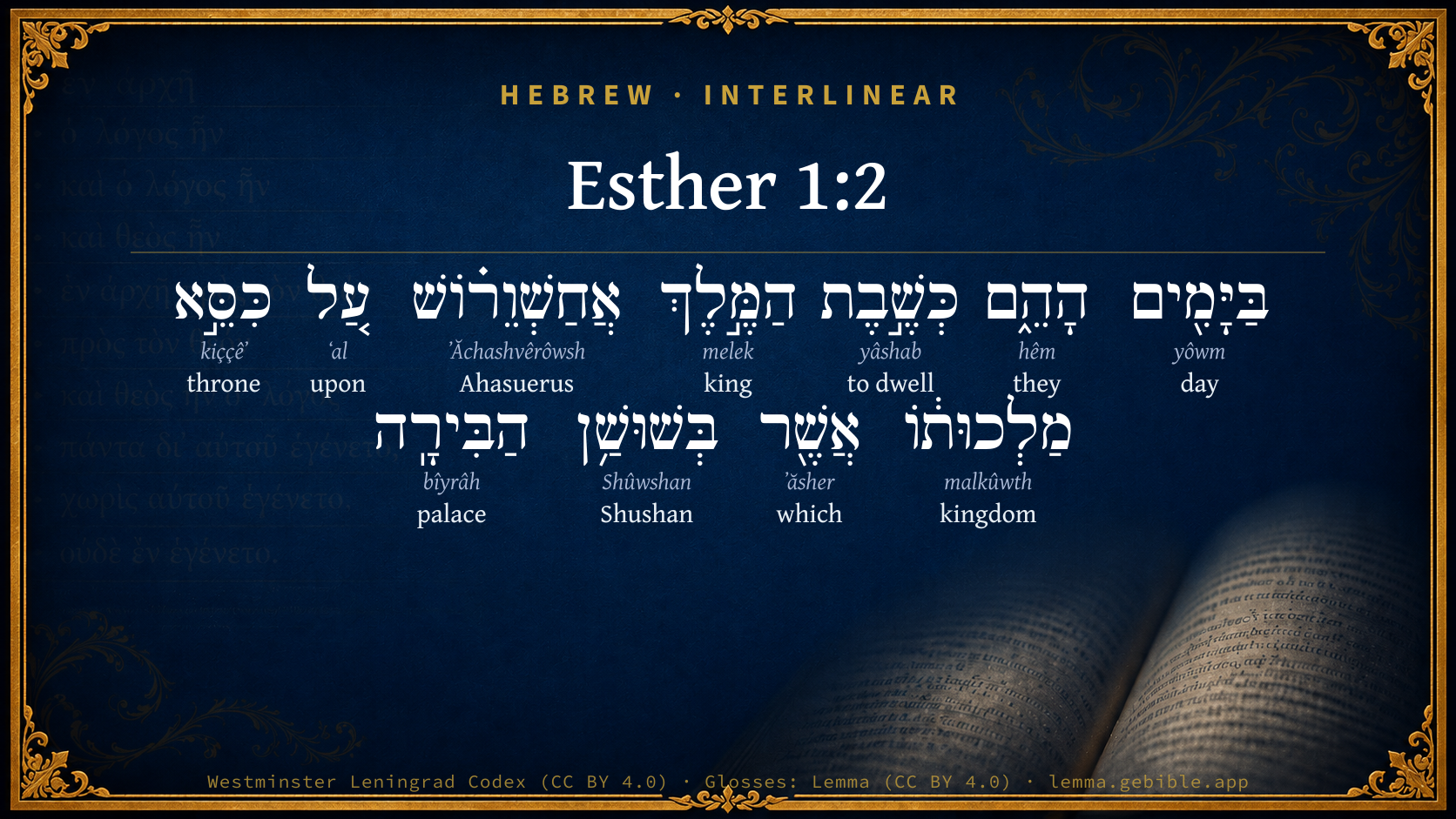
Hebrew (Westminster Leningrad Codex) Esther 1:2 appears in the Hebrew Old Testament. The text above is from the Westminster Leningrad Codex. Each word links to its Strong’s number, a concise gloss, and parsing drawn from the Open Scriptures Hebrew Bible morphology. Click any word for its full Brown-Driver-Briggs (BDB) entry.
Download image
Cite this verse

Esther 1:2 (World English Bible). Public Domain. Lemma interlinear Bible study tool, https://lemma.gebible.app/v/esther/1/2.

Show BibTeX & RIS
BibTeX
RIS
English Translation
that in those days, when the king Ahasuerus sat on the throne of his kingdom, which was in Shushan the palace,
World English Bible · Public Domain
Download a study sheet

One document with this verse’s original text, its word-by-word gloss line, the meaning frame, cross-references with their text, attributed commentary, and full source and license credits — printable, and it pastes into notes with its structure intact.

This verse Autodidact and up

Study sheet (.html) Plain text (.txt)

A passage Seminary Student

Up to 50 verses in one chapter. A passage sheet keeps up to 6 commentary sources and 12 cross-references per verse, in the order this page ranks them, and says so on the sheet whenever that leaves anything out. Ask for a single verse and you get the Autodidact verse sheet above.

Everything on this page stays free to read, with no account — the sheet is a download of what is already on screen, not access to it.

Want to remove ads? Support Godless Engineer
Compare translations 3

The same verse in 3 English versions, stacked beneath the original-language interlinear above. Click any original word for its lexicon entry.

Each is an independent rendering of the whole verse — the interlinear is not word-aligned to these translations.

Highlighted words mark where these versions differ — a whole-verse word diff, not a word-by-word alignment.

  • World English Bible Public Domain
    that in those days, when the king Ahasuerus sat on the throne of his kingdom, which was in Shushan the palace,
  • King James Version Public Domain
    That in those days, when the king Ahasuerus sat on the throne of his kingdom, which was in Shushan the palace,
  • unfoldingWord Literal Text CC BY-SA 4.0
    in those days, as the king Ahasuerus sat on the throne of his royalty, which was in Susa the citadel:

unfoldingWord Literal Text — © unfoldingWord, licensed CC BY-SA 4.0. Word-aligned USFM3 via Door43 (git.door43.org/unfoldingWord/en_ult).

Versions to compare (up to 4)

3 of 4 selected

Show all 18 translations

Every available English version of this verse, each an independent rendering of the whole verse.

  • World English Bible Public Domain
    that in those days, when the king Ahasuerus sat on the throne of his kingdom, which was in Shushan the palace,
  • Berean Standard Bible Public Domain
    In those days King Xerxes sat on his royal throne in the citadel of Susa.
  • Majority Standard Bible Public Domain
    In those days King Xerxes sat on his royal throne in the citadel of Susa.
  • King James Version Public Domain
    That in those days, when the king Ahasuerus sat on the throne of his kingdom, which was in Shushan the palace,
  • American Standard Version (1901) Public Domain
    that in those days, when the king Ahasuerus sat on the throne of his kingdom, which was in Shushan the palace,
  • Revised Version (1885) Public Domain
    that in those days, when the king Ahasuerus sat on the throne of his kingdom, which was in Shushan the palace,
  • Geneva Bible (1599) Public Domain
    In those dayes when the King Ahashuerosh sate on his throne, which was in the palace of Shushan,
  • Douay-Rheims (1899) Public Domain
    When he sat on the throne of his kingdom, the city Susan was the capital of his kingdom.
  • Young's Literal Translation Public Domain
    in those days, at the sitting of the king Ahasuerus on the throne of his kingdom, that `is' in Shushan the palace,
  • Literal Standard Version CC BY-SA 4.0
    in those days, at the sitting of King Ahasuerus on the throne of his kingdom, that [is] in Shushan the palace,
  • Unlocked Literal Bible CC BY-SA 4.0
    in those days King Ahasuerus sat on his royal throne in the fortress of Susa.
  • unfoldingWord Literal Text CC BY-SA 4.0
    in those days, as the king Ahasuerus sat on the throne of his royalty, which was in Susa the citadel:
  • Darby Bible Public Domain
    in those days, when the king Ahasuerus sat on the throne of his kingdom, which was in Shushan the fortress,
  • World Messianic Bible Public Domain
    in those days, when the King Ahasuerus sat on the throne of his kingdom, which was in Susa the palace,
  • Webster's Bible Public Domain
    That in those days, when the king Ahasuerus sat on the throne of his kingdom, which was in Shushan the palace,
  • Free Bible Version CC BY-SA 4.0
    At the time King Xerxes was ruling from his royal throne at the fortress in Susa.
  • Bible in Basic English Public Domain
    That in those days, when King Ahasuerus was ruling in Shushan, his strong town,
  • JPS Tanakh (1917) Public Domain
    that in those days, when the king Ahasuerus sat on the throne of his kingdom, which was in Shushan the castle,

Literal Standard Version (2020), Covenant Press — licensed CC BY-SA 4.0. Text via the HelloAO Bible API (eBible.org). Unlocked Literal Bible (unfoldingWord) — licensed CC BY-SA 4.0. Text via the HelloAO Bible API (eBible.org). unfoldingWord Literal Text — © unfoldingWord, licensed CC BY-SA 4.0. Word-aligned USFM3 via Door43 (git.door43.org/unfoldingWord/en_ult). Free Bible Version, Dr. Jonathan Gallagher — licensed CC BY-SA 4.0. Text via the HelloAO Bible API (eBible.org).

Word by word

More ways to search: Search by grammar → Find every occurrence → Compare this word →

Practice this passage: Drill this verse → Learn its vocabulary →

הַבִּירָֽה
bîyrâh
H1002
“the · palace”
Particle, Definite Article + Noun, Common, Feminine, Singular, Absolute
Part of Speech
Particle + Noun
Type
Common
Gender
Feminine
Number
Singular
State
Absolute
Full BDB Definition

Origin: of foreign origin

TWOT: 240

palace, castle - temple
  1. בַּיָּמִ֖ים yôwm H3117 “in/at the · days” Preposition, Determined + Noun, Common, Masculine, Plural, Absolute
  2. הָהֵ֑ם hêm H1992 “the · they” Particle, Definite Article + Pronoun, Personal, 3rd Person, Masculine, Plural
  3. כְּשֶׁ֣בֶת yâshab H3427 “like/as · to dwell” Preposition + Verb, Qal, Infinitive Construct
  4. הַמֶּ֣לֶךְ melek H4428 “the · king” Particle, Definite Article + Noun, Common, Masculine, Singular, Absolute
  5. אֲחַשְׁוֵר֗וֹשׁ ʼĂchashvêrôwsh H325 “Ahasuerus” Noun, Proper
  6. עַ֚ל ʻal H5921 “upon” Preposition
  7. כִּסֵּ֣א kiççêʼ H3678 “throne of” Noun, Common, Masculine, Singular, Construct
  8. מַלְכוּת֔וֹ malkûwth H4438 “kingdom · his” Noun, Common, Feminine, Singular, Construct + Suffix, Personal, 3rd Person, Masculine, Singular
  9. אֲשֶׁ֖ר ʼăsher H834 “which” Particle, Relative
  10. בְּשׁוּשַׁ֥ן Shûwshan H7800 “in/at · Shushan” Preposition + Noun, Proper

About this verse

These counts appear in no published source. They are computed here, from the morphology-tagged text and Lemma’s own curated glosses. What Lemma adds →

11
words
11
distinct lemmas
Historical
section

Notable vocabulary

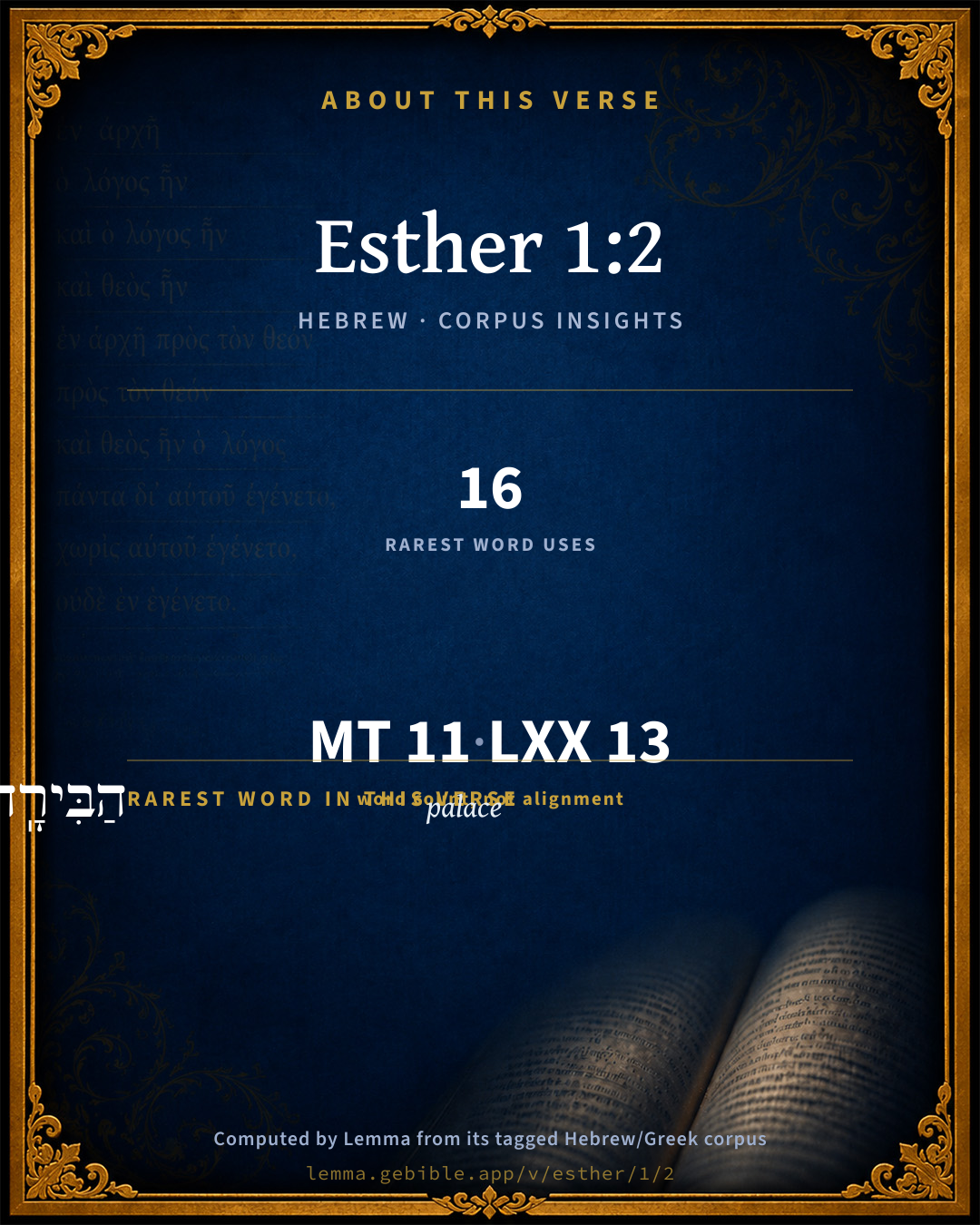
The rarest word here is הַבִּירָֽה palace H1002 — appearing just 16 times in the whole Hebrew Bible.

Shared distinctive vocabulary

הַבִּירָֽה palace H1002 occurs in 16 verses of the Hebrew Bible. Also found in:

Grammatical profile

  • 1 verb
  • 7 nouns
  • 1 pronoun
  • 1 preposition
  • 1 particle

Verb forms

  • כְּשֶׁ֣בֶת Qal · Infinitive Construct

Hebrew & Septuagint length

In English translation the verse runs 21 words from the Hebrew and 15 from the Septuagint (LXX English) — the Septuagint runs noticeably shorter here. See the side-by-side →

A rough comparison of the two English renderings, which tokenize alike — not a word-level alignment.

Word counts can differ between the Hebrew and the Greek without any difference in meaning — e.g. the Hebrew direct-object marker אֵת has no separate Greek word, and Greek often adds the article ὁ.

In the original languages it is 11 Hebrew tokens and 13 Greek tokens — but the two are counted differently (Hebrew bundles its prefixes and suffixes into one token; the Greek is in lemma form), so that isn’t a like-for-like length.

Cross-references

9

Topical passages linked to Esther 1:2 in the Treasury of Scripture Knowledge — connected by theme and wording, ordered by reader-vote popularity; previews shown in the World English Bible.

  • Nehemiah 1:1 The words of Nehemiah the son of Hacaliah. Now it happened in the month Chislev, in the twentieth year, as I was in Shushan the palace,
  • 2 Samuel 7:1 It happened, when the king lived in his house, and Yahweh had given him rest from all his enemies round about,
  • Daniel 8:2 I saw in the vision; now it was so, that when I saw, I was in Shushan the palace, which is in the province of Elam; and I saw in the vision, and I was by the river Ulai.
  • 1 Kings 1:46 Also Solomon sits on the throne of the kingdom.
  • Esther 2:3 and let the king appoint officers in all the provinces of his kingdom, that they may gather together all the beautiful young virgins to Shushan the palace, to the house of the women, to the custody of Hegai the king's chamberlain, keeper of the women; and let their things for purification be given them;
  • Esther 3:15 The posts went forth in haste by the king's commandment, and the decree was given out in Shushan the palace. The king and Haman sat down to drink; but the city of Shushan was perplexed.
  • Esther 4:16 Go, gather together all the Jews who are present in Shushan, and fast you for me, and neither eat nor drink three days, night or day: I also and my maidens will fast in like manner; and so will I go in to the king, which is not according to the law: and if I perish, I perish.
  • Esther 9:12–15 The king said to Esther the queen, The Jews have slain and destroyed five hundred men in Shushan the palace, and the ten sons of Haman; what then have they done in the rest of the king's provinces! Now what is your petition? and it shall be granted you: or what is your request further? and it shall be done.
  • Daniel 4:4 I, Nebuchadnezzar, was at rest in my house, and flourishing in my palace.

Cross-references courtesy of OpenBible.info (CC BY 4.0).

Hebrew and Greek witnesses Masoretic Hebrew ↔ Greek Septuagint

The same verse in the two great witnesses to the Old Testament, shown verse-for-verse.

Here the Septuagint runs noticeably shorter than the Hebrew — LXX2012 (modern English Septuagint) 15 words vs World English Bible 21. A rough length comparison of the two English translations, not a word-level alignment — read both below.

These are two independent witnesses, not word-aligned to each other, and the Septuagint is shown in lemma (dictionary) form.

Hebrew Esther 1:2 Masoretic · Westminster Leningrad Codex

בַּיָּמִ֖ים הָהֵ֑ם כְּשֶׁ֣בֶת הַמֶּ֣לֶךְ אֲחַשְׁוֵר֗וֹשׁ עַ֚ל כִּסֵּ֣א מַלְכוּת֔וֹ אֲשֶׁ֖ר בְּשׁוּשַׁ֥ן הַבִּירָֽה

that in those days, when the king Ahasuerus sat on the throne of his kingdom, which was in Shushan the palace,

World English Bible · Public Domain

Greek LXX Esther 1:2 Septuagint · lemma form

ἐν αὐτός ὁ ἡμέρα ὅτε θρονίζω ὁ βασιλεύς ἀρταξέρξης ἐν σουσά ὁ πόλις

in those days, when king Artaxerxes was on the throne in the city of Susa,

LXX2012 (modern English Septuagint) · Public Domain

On this verse, Adam Clarke's Commentary discusses the Septuagint’s reading. Read the note in Commentary ↓

Hebrew: Westminster Leningrad Codex (CC BY 4.0). Greek: Septuagint (public domain); English from LXX2012 (modern English Septuagint) (Public Domain). How the Septuagint differs from the Hebrew →

Commentary

Notes on Esther 1:2 from classic Christian and Jewish commentators (each source and its license shown beneath its notes). The classic Christian expositions comment on the surrounding passage and are grouped to its opening verse, so a note may address several verses; the Jewish commentaries on the Tanakh (Rashi and others) are per-verse, so they appear only where the commentator wrote on this verse.

Lemma curates 59 commentaries, every one of them public domain or Creative Commons licensed, each selected and text-cleaned for this edition rather than reprinted as found. About our sources →

Trapp's Complete Commentary

John Trapp

Est 1:2 [That] in those days, when the king Ahasuerus sat on the throne of his kingdom, which [was] in Shushan the palace,

Ver. 2. When the king Ahasuerus sat on the throne] Having peace with all men, being quiet and secure; though this lasted not long; for he was shamefully foiled by the Grecians (against whom he led an army of two millions of men), and forced to flee back again over Hellespont, in a poor fisher’s boat; which being overloaded, had sunk all, if the Persians by the casting away of themselves had not saved the life of their king. Omnia sunt hominum tenui pendentia filo, &c.

Which was in Shushan the palace] See Neh 1:1. Ptolemy, Strabo, and Pliny tell us, that in this city (situated upon the river Choaspes) was that famous palace of Cyrus, which was adorned with marble walls, golden pillars, and a great store of precious stones; shining as so many stars from the roof and sides of it, to the dazzling of the eyes of the beholders (Ptol. 1. 6, c. 3; Strab. lib. 15; Plin. 1. 6, c. 27; Herod. 1. 5; Athen. 1. 12, c. 3). Here it was, likely, that the kings of Persia sat to hear causes under a vine of gold, set with smaragds, as with so many clusters of grapes.

John Trapp, A Commentary or Exposition upon All the Books of the Old and New Testament (1647–1656) — public domain. Text from a community e-Sword module.

Joseph Benson's Commentary

Est 1:2. When Ahasuerus sat on the throne of his kingdom — Was settled in the quiet possession of it, enjoying peace and tranquillity throughout his large dominions; which was in Shushan the palace — “Which, after the conquest of the Medes, was made by Cyrus, and the rest of the Persian kings, the royal seat, that they might not be too far from Babylon. It stood upon the river Ulai, and was a place of such renown, that Strabo calls it, “a city most worthy to be praised,” informing us, that the whole country about it was amazingly fruitful, producing a hundred and sometimes two hundred fold. Darius Hystaspes enlarged and beautified it with a most magnificent palace, which Aristotle calls “a wonderful royal palace, shining with gold, amber, and ivory.” — Dodd. See Prideaux, and Calmet’s Dict. on the word Shushan.

Joseph Benson's Commentary on the Old and New Testaments (1811–1818) — public domain. Text from a community e-Sword module.

Tyndale Open Study Notes

Tyndale Open Resources

1:2 The fortress of Susa was the king’s winter capital during the cold months.

Tyndale Open Study Notes — © Tyndale Open Resources, licensed CC BY-SA 4.0. Text via the HelloAO Bible API.

Geneva Bible (1599)

Geneva Bible translators

That is, had rest and quietness.

Geneva Bible (1599) marginal notes — public domain. Text via Bolls.life.

Adam Clarke's Commentary

Verse 2. Sat on the throne of his kingdom] Having subdued all his enemies, and brought universal peace to his empire. See the commencement of the introduction.

Shushan the palace] The ancient city of Susa, now called [Persian] Shuster by the Persians. This, with Ecbatana and Babylon, was a residence of the Persian kings. The word הבירה habbirah, which we render the palace, should be rendered the city, ενσουσοιςτηπολει, as in the Septuagint.

Adam Clarke's Commentary on the Bible (1810–1826) — public domain. Text from a community e-Sword/MySword module.

Ellicott's Commentary for English Readers

(2) Shushan.—Susa. Mentioned also in Neh_1:1. It was the general abode of the Persian kings. (See Herod. vii. 6.)

A Bible Commentary for English Readers, edited by Charles John Ellicott (1878–1897) — public domain. Text from a community e-Sword module.

The Cambridge Bible for Schools and Colleges

gen. ed. J. J. S. Perowne

2. Shushan the palace] i.e. Susa. Ecbatana, Babylon, Persepolis, and Susa were all places of sojourn for the Persian court for longer or shorter periods.

‘Shushan the palace,’ which is to be distinguished from ‘Shushan the city’ (Est_9:13-15) was built by Darius, father of Xerxes, on the same plan as the palace at Persepolis. The city of Susa was cut in two by a wide river, anciently called the Choaspes, and now known under the name of Ab-Kharkha. The populous quarters on the right bank are now marked by hardly perceptible undulations of the plain; on the left, the royal city, the citadel, and the palace. “Three huge mounds, forming a rhomboidal mass, 4500 feet long from N. to S., and 3000 feet broad from E. to W., are a standing witness to the size and magnificence of the buildings which formed the ancient citadel or acropolis,” Driver in Camb. Bible on Dan_8:27.

M. Dieulafoy, a French architect and engineer, in 1884–6 carried out important excavations at Susa, and brought to light many interesting features, recovering the plan of the citadel, and extensive remains of the buildings of which it consisted. “Artaxerxes, in an inscription found on one of the columns, says: ‘My ancestor Darius built this Apadâna in ancient times. In the reign of Artaxerxes, my grandfather, it was consumed by fire. By the grace of Ahuramazda, Anaïtis, and Mithras, I have restored this Apadâna.’ An Apadâna was a large hall or throne-room. The Apadâna of Susa stood on the N. of the Acropolis: it formed a square of about 250 feet each way. The roof (which consisted of rafters and beams of cedar, brought from Lebanon) was supported by 36 columns in rows of six; the sides and back were composed of walls of brick, each pierced by four doors; the front of the hall was open. The columns were slender shafts of limestone, delicately fluted, and topped by magnificently carved capitals. In front of the hall, on each side, was a pylon or colonnade, with a frieze at the top 12 feet high, formed of beautifully enamelled bricks, the one decorated by a procession of lions, the other by a procession of ‘Immortals,’ the armed life-guards of the Persian kings. A garden surrounded the Apadâna, and in front of it on the south, was a large square for military manœuvres, etc. Adjoining it, on the east, was a large block of buildings forming the royal harem (the ‘house of the women’ of Est_2:3, etc.): south of this was the royal palace, with a court in the centre (Est_4:11; Est_5:1). The entire acropolis covered an area of 300 acres.[55]”

[55] Driver, ibid. who also points out that in one of the galleries of the Louvre, Paris, several rooms are devoted to sculptures, etc., brought from Susa, and to a restoration of parts of the Apadâna. He refers, among other works, to Dieulafoy, L’Acropole de Suse, Mme Dieulafoy, A Suse, Journal des Fouilles, and La Perse, la Chaldée, et la Susiane, Chap. xxxix., all with illustrations and maps.

The word bîrâh translated ‘palace’ (marg. castle) probably includes the idea of a stronghold as well as a royal residence, and in fact seems to have a still wider application in Est_9:6, where see note. The king’s place of residence is indicated by a different expression in Est_1:5, Est_2:8, Est_4:13, Est_7:7-8. Benjamin of Tudela, a Spanish-Hebrew traveller in the East in the 12th century (ed. Asher, London and Berlin, 1840, i. 117), mentions visiting the ruins of Xerxes’ palace, adding that even at that time 7000 Jews lived at Susa.

The Cambridge Bible for Schools and Colleges (gen. ed. J. J. S. Perowne; Cambridge University Press, 1878–1918) — public domain. Text from a community e-Sword module.

John Gill's Exposition

That in those days, when the King Ahasuerus sat on the throne of his kingdom,.... Not only was placed upon it, but settled in it; after Xerxes had subdued Egypt, in the second year of his reign (e), and enjoyed great peace and tranquillity:

which was in Shushan the palace; that is, the throne of his kingdom was in Shushan, the royal city of the kings of Persia; of which see Gill on Neh 1:1, Dan 8:2.

(e) Herodot. ib. (Thalia, sive, l. 3.) c. 7.

John Gill's Exposition of the Whole Bible (1746–1763) — public domain (CC PDM 1.0). Text via the HelloAO Bible API.

Haydock's Catholic Bible Commentary

Captial. Hebrew, "palace, (Protestants; Haydock) or castle," (Calmet) may also signify "a capital." (Montanus, &c.) --- Hystaspes founded this ancient royal city of Persia, (Pliny, [Natural History?] vi. 27.) or he greatly embellished it. (Calmet) (Ælian, Anim. xiii. 18.) (Tirinus) --- He seems to have resided here almost constantly. The preceding kings (Calmet) spent the winter in this warm climate, and perhaps the spring. See 2 Esdras i. 1. They spent other parts of the year at Ecbatana and at Babylon. (Calmet)

George Leo Haydock (1774–1849), Haydock's Catholic Family Bible and Commentary, 1859 edition — public domain. Excludes Psalms (Douay-Rheims chapter numbering differs from Protestant) and Deuterocanonical books (Catholic canon only).

Matthew Poole's English Annotations

Sat on the throne of his kingdom, i.e. either was lately advanced to it, or rather was settled in the peaceable possession of it.

The palace; or, the castle; or, the chief or royal city, as both, Jewish and Christian interpreters render it. Shushan might be the proper name of the palace, which thence was given to the whole city. Here the kings of Persia used to keep their courts chiefly in winter, as ordinarily they were in Ecbatana in summer.

Matthew Poole's English Annotations on the Holy Bible (1683–1685) — public domain. Text from a community e-Sword/MySword module.

Whedon's Commentary on the Bible

Daniel D. Whedon

2. Sat on the throne of his kingdom — That is, was quietly and firmly settled in his dominions; an oriental mode of representing an absolute monarch in possession of royal authority and power. The Asiatic kings are thus represented on the monuments, and Xerxes is said to have watched the battles of Thermopylae and Salamis while seated on a throne.

Shushan the palace — See note on Neh_1:1.

Daniel D. Whedon (gen. ed.), Commentary on the Old and New Testaments (1874–1909) — public domain. Text from a community e-Sword module.

The Pulpit Commentary

The throne of his kingdom, which was in Shushan. Though the Persian court resided a part of the year at Ecbatana, and occasionally visited Persepolis and Babylon (Xen., "Cyrop.," 8:6, "Anab.," 3:5, yet Susa was decidedly the ordinary seat of government, and ranked as the capital of the empire (see Herod., 3:49; Aeschyl., "Pers.," 11. 122, 123; Ctes., "Exe. Pers.," pessim, etc.). "Shushan the palace" is distinguished from Shushan the city, (Est_9:12-15) the one occupying a lofty but artificial eminence towards the west, while the other lay at the base of this mound, stretching out a considerable distance towards the east.

The Pulpit Commentary (1880–1919), ed. H.D.M. Spence-Jones & Joseph S. Exell — public domain. Text from a community e-Sword module.

John Wesley's Explanatory Notes

Sat - Was settled in the peaceable possession of it. Shushan - The chief or royal city. Shushan might be the proper name of the palace, which thence was given to the whole city. Here the kings of Persia used to keep their courts in winter, as at Exbatana in summer.

John Wesley, Explanatory Notes Upon the Whole Bible (1754–1765) — public domain. Text via the GEBible commentary corpus.

Rashi

Rabbi Shlomo Yitzchaki (Rashi)

when King Ahasuerus sat, etc. when the kingdom was firmly established in his hand. Our Sages, however, explained it differently in Tractate Megillah (11b).

Rashi on the Tanakh — English translations: “The Judaica Press complete Tanach with Rashi, translated by A. J. Rosenberg” (CC BY 4.0); “Pentateuch with Rashi's commentary by M. Rosenbaum and A.M. Silbermann, 1929-1934” (public domain); “The Metsudah Tanach series, Lakewood, N.J” (CC BY 4.0); and “The Book of Joshua, Metsudah Publications, 1997” (CC BY 4.0). Text via Sefaria.

Lesson kit

Teaching starters — assembled from the data on this page, not authored interpretation. Every prompt links to the verse data it draws on. Edit before teaching.

Esther, in the Historical, opens this verse with 11 words (11 distinct Hebrew lemmas). Its most distinctive word is bîyrâh (“palace”). The Greek Septuagint runs shorter here. A historical commentator’s framing appears above. Read the whole chapter for the surrounding context.

Discussion questions

  1. What does “palace” (bîyrâh) contribute to the verse as a whole?
  2. 1 Chronicles 29:1 shares the word «palace» with this verse. How do the two illuminate each other?
  3. Compared with the Hebrew, the Septuagint runs shorter here. What questions does that raise?
  4. These translations render this verse differently; the difference is in the English rendering, not the original. What questions does that raise?
  5. The verb «כְּשֶׁ֣בֶת» is Qal Infinitive Construct. How does its form color the action?
  6. Reading how Trapp's Complete Commentary and Joseph Benson's Commentary read this verse, where do the two commentators agree and where do they part?

Things to notice

Reading settings

Reading text

Shown beneath each verse's original-language words.

Old Testament
Old Testament edition

Read the OT as the Masoretic Hebrew (MT) or the Greek Septuagint (LXX).

English shown for the Greek Septuagint (in the Hebrew ↔ Greek comparison).

Comparing translations? Open the Compare panel on any verse page to stack up to four side by side.