Numbers 33:40

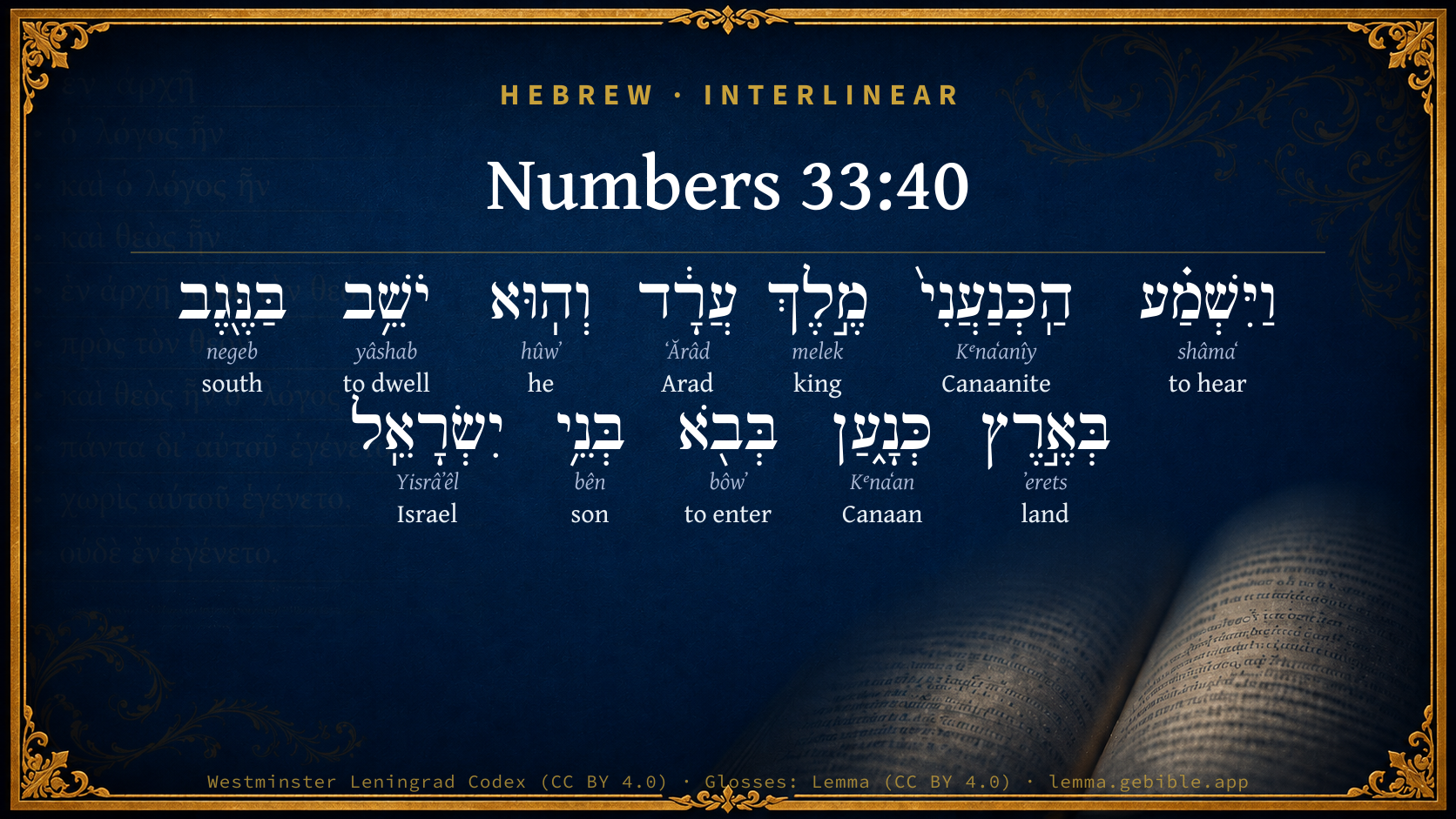
Hebrew (Westminster Leningrad Codex) Numbers 33:40 appears in the Hebrew Old Testament. The text above is from the Westminster Leningrad Codex. Each word links to its Strong’s number, a concise gloss, and parsing drawn from the Open Scriptures Hebrew Bible morphology. Click any word for its full Brown-Driver-Briggs (BDB) entry.
Download image
Cite this verse

Numbers 33:40 (World English Bible). Public Domain. Lemma interlinear Bible study tool, https://lemma.gebible.app/v/numbers/33/40.

Show BibTeX & RIS
BibTeX
RIS
English Translation
The Canaanite, the king of Arad, who lived in the South in the land of Canaan, heard of the coming of the children of Israel.
World English Bible · Public Domain
Download a study sheet

One document with this verse’s original text, its word-by-word gloss line, the meaning frame, cross-references with their text, attributed commentary, and full source and license credits — printable, and it pastes into notes with its structure intact.

This verse Autodidact and up

Study sheet (.html) Plain text (.txt)

A passage Seminary Student

Up to 50 verses in one chapter. A passage sheet keeps up to 6 commentary sources and 12 cross-references per verse, in the order this page ranks them, and says so on the sheet whenever that leaves anything out. Ask for a single verse and you get the Autodidact verse sheet above.

Everything on this page stays free to read, with no account — the sheet is a download of what is already on screen, not access to it.

Want to remove ads? Support Godless Engineer
Compare translations 3

The same verse in 3 English versions, stacked beneath the original-language interlinear above. Click any original word for its lexicon entry.

Each is an independent rendering of the whole verse — the interlinear is not word-aligned to these translations.

Highlighted words mark where these versions differ — a whole-verse word diff, not a word-by-word alignment.

  • World English Bible Public Domain
    The Canaanite, the king of Arad, who lived in the South in the land of Canaan, heard of the coming of the children of Israel.
  • King James Version Public Domain
    And king Arad the Canaanite, which dwelt in the south in the land of Canaan, heard of the coming of the children of Israel.
  • unfoldingWord Literal Text CC BY-SA 4.0
    And the Canaanite, the king of Arad (and he was dwelling in the Negev in the land of Canaan), heard when the sons of Israel came.

unfoldingWord Literal Text — © unfoldingWord, licensed CC BY-SA 4.0. Word-aligned USFM3 via Door43 (git.door43.org/unfoldingWord/en_ult).

Versions to compare (up to 4)

3 of 4 selected

Show all 18 translations

Every available English version of this verse, each an independent rendering of the whole verse.

  • World English Bible Public Domain
    The Canaanite, the king of Arad, who lived in the South in the land of Canaan, heard of the coming of the children of Israel.
  • Berean Standard Bible Public Domain
    Now the Canaanite king of Arad, who lived in the Negev in the land of Canaan, heard that the Israelites were coming.
  • Majority Standard Bible Public Domain
    Now the Canaanite king of Arad, who lived in the Negev in the land of Canaan, heard that the Israelites were coming.
  • King James Version Public Domain
    And king Arad the Canaanite, which dwelt in the south in the land of Canaan, heard of the coming of the children of Israel.
  • American Standard Version (1901) Public Domain
    And the Canaanite, the king of Arad, who dwelt in the South in the land of Canaan, heard of the coming of the children of Israel.
  • Revised Version (1885) Public Domain
    And the Canaanite, the king of Arad, which dwelt in the South in the land of Canaan, heard of the coming of the children of Israel.
  • Geneva Bible (1599) Public Domain
    And King Arad the Canaanite, which dwelt in the South of the land of Canaan, heard of the comming of the children of Israel)
  • Douay-Rheims (1899) Public Domain
    And king Arad the Chanaanite, who dwelt towards the south, heard that the children of Israel were come to the land of Chanaan.
  • Young's Literal Translation Public Domain
    And the Canaanite -- king Arad -- who is dwelling in the south, in the land of Canaan, heareth of the coming of the sons of Israel.
  • Literal Standard Version CC BY-SA 4.0
    And the Canaanite, king of Arad, who is dwelling in the south in the land of Canaan, hears of the coming of the sons of Israel.
  • Unlocked Literal Bible CC BY-SA 4.0
    The Canaanite, the king of Arad, who lived in the southern wilderness in the land of Canaan, heard of the coming of the people of Israel.
  • unfoldingWord Literal Text CC BY-SA 4.0
    And the Canaanite, the king of Arad (and he was dwelling in the Negev in the land of Canaan), heard when the sons of Israel came.
  • Darby Bible Public Domain
    And the Canaanite, the king of Arad who dwelt in the south in the land of Canaan, heard of the coming of the children of Israel.
  • World Messianic Bible Public Domain
    The Canaanite king of Arad, who lived in the South in the land of Canaan, heard of the coming of the children of Israel.
  • Webster's Bible Public Domain
    And king Arad the Canaanite who dwelt in the south in the land of Canaan, heard of the coming of the children of Israel.
  • Free Bible Version CC BY-SA 4.0
    (The Canaanite king of Arad, who lived in the Negev in the country of Canaan, found out that the Israelites were on their way.)
  • Bible in Basic English Public Domain
    And news of the coming of the children of Israel came to the king of Arad, the Canaanite, who was living in the South in the land of Canaan.
  • JPS Tanakh (1917) Public Domain
    And the Canaanite, the king of Arad, who dwelt in the South in the land of Canaan, heard of the coming of the children of Israel. —

Literal Standard Version (2020), Covenant Press — licensed CC BY-SA 4.0. Text via the HelloAO Bible API (eBible.org). Unlocked Literal Bible (unfoldingWord) — licensed CC BY-SA 4.0. Text via the HelloAO Bible API (eBible.org). unfoldingWord Literal Text — © unfoldingWord, licensed CC BY-SA 4.0. Word-aligned USFM3 via Door43 (git.door43.org/unfoldingWord/en_ult). Free Bible Version, Dr. Jonathan Gallagher — licensed CC BY-SA 4.0. Text via the HelloAO Bible API (eBible.org).

Word by word

More ways to search: Search by grammar → Find every occurrence → Compare this word →

Practice this passage: Drill this verse → Learn its vocabulary →

עֲרָ֔ד
ʻĂrâd
H6166
“Arad”
Noun, Proper
Part of Speech
Noun
Type
Proper
Full BDB Definition

Origin: from an unused root meaning to sequester itself

TWOT: None

Arad = "a wild ass" - a Benjamite, son of Beriah, who drove out the inhabitants of Gath (noun proper masculine) - a royal city of the Canaanites north of the wilderness of Judah (noun proper locative)
  1. וַיִּשְׁמַ֗ע shâmaʻ H8085 “and · to hear” Conjunction + Verb, Qal, Sequential Imperfect, 3rd Person, Masculine, Singular
  2. הַֽכְּנַעֲנִי֙ Kᵉnaʻanîy H3669 “the · Canaanite” Particle, Definite Article + Noun, Gentilic, Masculine, Singular, Absolute
  3. מֶ֣לֶךְ melek H4428 “king of” Noun, Common, Masculine, Singular, Construct
  4. וְהֽוּא hûwʼ H1931 “and · he” Conjunction + Pronoun, Personal, 3rd Person, Masculine, Singular
  5. יֹשֵׁ֥ב yâshab H3427 “dwelling” Verb, Qal, Participle Active, Masculine, Singular, Absolute
  6. בַּנֶּ֖גֶב negeb H5045 “in/at the · south” Preposition, Determined + Noun, Common, Masculine, Singular, Absolute
  7. בְּאֶ֣רֶץ ʼerets H776 “in/at · land of” Preposition + Noun, Common, Both, Singular, Construct
  8. כְּנָ֑עַן Kᵉnaʻan H3667 “Canaan” Noun, Proper
  9. בְּבֹ֖א bôwʼ H935 “in/at · to enter” Preposition + Verb, Qal, Infinitive Construct
  10. בְּנֵ֥י bên H1121 “sons of” Noun, Common, Masculine, Plural, Construct
  11. יִשְׂרָאֵֽל Yisrâʼêl H3478 “Israel” Noun, Proper

About this verse

These counts appear in no published source. They are computed here, from the morphology-tagged text and Lemma’s own curated glosses. What Lemma adds →

12
words
12
distinct lemmas
Pentateuch
section

Notable vocabulary

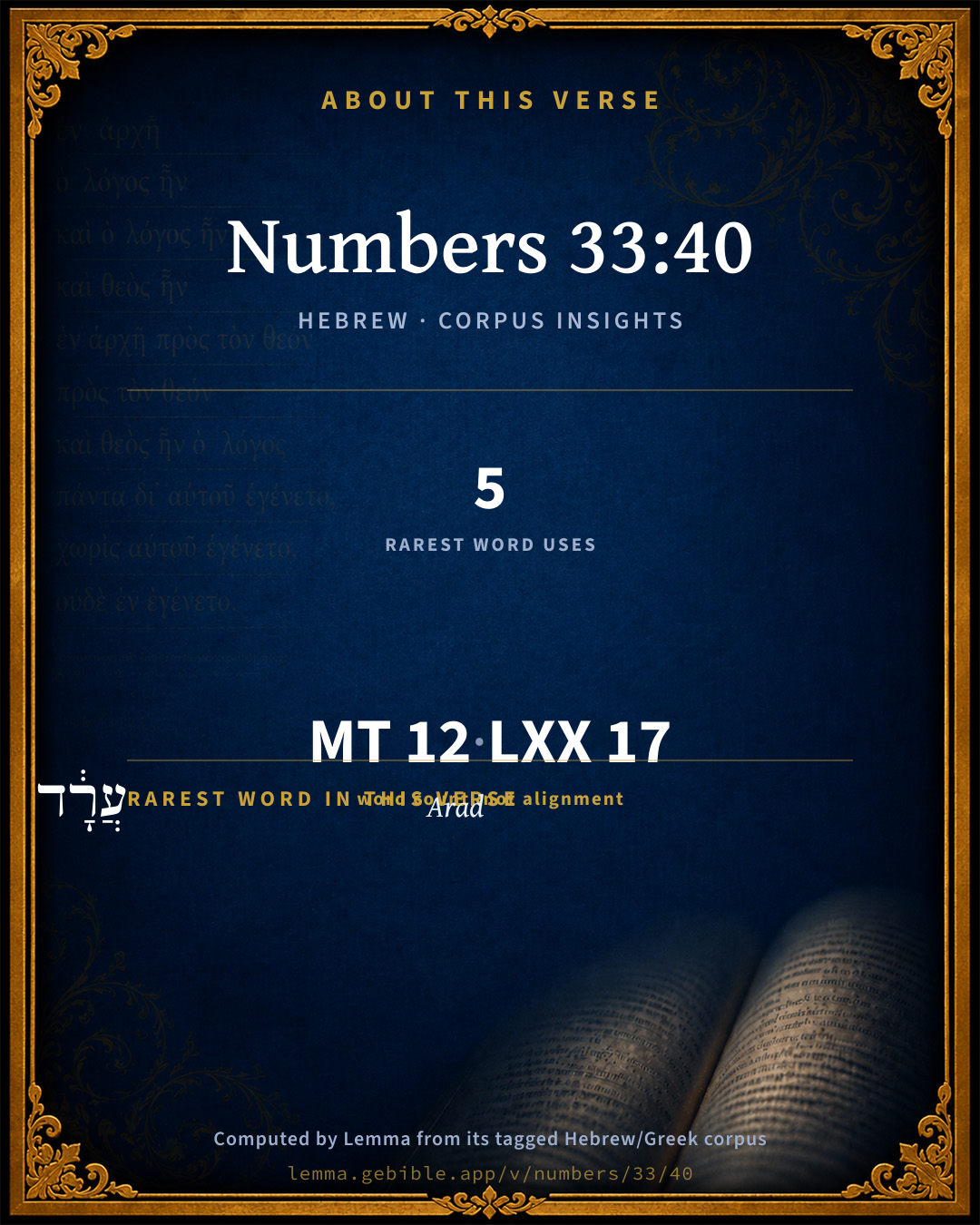
The rarest word here is עֲרָ֔ד Arad H6166 — appearing just 5 times in the whole Hebrew Bible.

Shared distinctive vocabulary

עֲרָ֔ד Arad H6166 occurs in 5 verses of the Hebrew Bible. Also found in:

Grammatical profile

  • 3 verbs
  • 8 nouns
  • 1 pronoun

Verb forms

  • וַיִּשְׁמַ֗ע Qal · Sequential Imperfect
  • יֹשֵׁ֥ב Qal · Participle Active
  • בְּבֹ֖א Qal · Infinitive Construct

Hebrew & Septuagint length

In English translation the verse runs 25 words from the Hebrew and 24 from the Septuagint (LXX English) — closely comparable.

A rough comparison of the two English renderings, which tokenize alike — not a word-level alignment.

Word counts can differ between the Hebrew and the Greek without any difference in meaning — e.g. the Hebrew direct-object marker אֵת has no separate Greek word, and Greek often adds the article ὁ.

In the original languages it is 12 Hebrew tokens and 17 Greek tokens — but the two are counted differently (Hebrew bundles its prefixes and suffixes into one token; the Greek is in lemma form), so that isn’t a like-for-like length.

Cross-references

1

Topical passages linked to Numbers 33:40 in the Treasury of Scripture Knowledge — connected by theme and wording, ordered by reader-vote popularity; previews shown in the World English Bible.

  • Numbers 21:1–9 The Canaanite, the king of Arad, who lived in the South, heard tell that Israel came by the way of Atharim; and he fought against Israel, and took some of them captive.

Cross-references courtesy of OpenBible.info (CC BY 4.0).

Hebrew and Greek witnesses Masoretic Hebrew ↔ Greek Septuagint

The same verse in the two great witnesses to the Old Testament, shown verse-for-verse.

These are two independent witnesses, not word-aligned to each other, and the Septuagint is shown in lemma (dictionary) form.

Hebrew Numbers 33:40 Masoretic · Westminster Leningrad Codex

וַיִּשְׁמַ֗ע הַֽכְּנַעֲנִי֙ מֶ֣לֶךְ עֲרָ֔ד וְהֽוּא יֹשֵׁ֥ב בַּנֶּ֖גֶב בְּאֶ֣רֶץ כְּנָ֑עַן בְּבֹ֖א בְּנֵ֥י יִשְׂרָאֵֽל

The Canaanite, the king of Arad, who lived in the South in the land of Canaan, heard of the coming of the children of Israel.

World English Bible · Public Domain

Greek LXX Numbers 33:40 Septuagint · lemma form

καί ἀκούω ὁ χανανίς βασιλεύς αραδ καί οὗτος καταοἰκέω ἐν γῆ χανααν ὅτε εἰςπορεύομαι ὁ υἱός ἰσραήλ

And Arad the Chananitish king (he too lived in the land of Chanaan) having heard when the children of Israel were entering the land—

LXX2012 (modern English Septuagint) · Public Domain

Hebrew: Westminster Leningrad Codex (CC BY 4.0). Greek: Septuagint (public domain); English from LXX2012 (modern English Septuagint) (Public Domain). How the Septuagint differs from the Hebrew →

Targum (Aramaic paraphrase)

2

The Targum is the ancient Jewish Aramaic paraphrase of the Hebrew Scriptures — an interpretive translation, not the Hebrew text itself. Onkelos (literal) and Pseudo-Jonathan (expansive) render the Torah, and Jonathan the Prophets. Coverage is partial: where no permissively-licensed English translation exists for a verse, only the Aramaic is shown. This is verse-level text, not a word-by-word alignment to the Hebrew.

  1. Targum Onkelos Torah (Genesis–Deuteronomy)
    וּשְׁמַע כְּנַעֲנָאָה מַלְכָּא דַעֲרָד וְהוּא יָתֵב בִּדְרוֹמָא בְּאַרְעָא דִכְנָעַן בְּמֵיתֵי בְּנֵי יִשְׂרָאֵל

    (no public-domain English translation for this verse)

    Targum Onkelos — Aramaic: “Onkelos Genesis” (public domain); “Onkelos Exodus” (public domain); “Onkelos Leviticus” (public domain); “Onkelos Numbers” (public domain); “Onkelos Deuteronomy” (public domain). English: “Sefaria Community Translation” (CC0 1.0 (public-domain dedication)); “J.W. Etheridge. The Targums of Onkelos and Jonathan Ben Uzziel on the Pentateuch. London: Longmans, Green, 1862” (public domain). Text via Sefaria.

  2. Targum Pseudo-Jonathan Torah (Genesis–Deuteronomy)
    וּשְׁמַע עֲמָלֵק חַיָיבָא וְאִתְחַבֵּר בִּכְנַעֲנָאֵי וּמְלַךְ בַּעֲרָד וּבֵית מוֹתְבֵיהּ בְּאַרַע דָרוֹמָא כַּד אָתוּ בְנֵי יִשְרָאֵל וְאַגִיחַ בְּהוֹן וּגְמָרוּ יַתְהוֹן וְיַת קִירְוֵויהוֹן

    And Amalek the wicked, who was combined with the Kenaanites, and reigned in Arad,-the house of his abode was in the land of the south,-heard that the sons of Israel were coming to wage war against them, and utterly to destroy their cities.

    Targum Pseudo-Jonathan — Aramaic: “Targum Jonathan on Genesis” (public domain); “Targum Jonathan on Exodus” (public domain); “Targum Jonathan on Leviticus” (public domain); “Targum Jonathan on Numbers” (public domain); “Targum Jonathan on Deuteronomy” (public domain). English: “The Targum of Jonathan ben Uzziel, trans. J. W. Etheridge, London, 1862” (public domain). Text via Sefaria.

Commentary

Notes on Numbers 33:40 from classic Christian and Jewish commentators (each source and its license shown beneath its notes). The classic Christian expositions comment on the surrounding passage and are grouped to its opening verse, so a note may address several verses; the Jewish commentaries on the Tanakh (Rashi and others) are per-verse, so they appear only where the commentator wrote on this verse.

Lemma curates 59 commentaries, every one of them public domain or Creative Commons licensed, each selected and text-cleaned for this edition rather than reprinted as found. About our sources →

Ellicott's Commentary for English Readers

(40) And King Arad . . . —See Num_21:1, and Note.

A Bible Commentary for English Readers, edited by Charles John Ellicott (1878–1897) — public domain. Text from a community e-Sword module.

The Cambridge Bible for Schools and Colleges

gen. ed. J. J. S. Perowne

40. A fragmentary statement strangely inserted, perhaps originally as a marginal note by a scribe. See on Num_21:1-3.

The Cambridge Bible for Schools and Colleges (gen. ed. J. J. S. Perowne; Cambridge University Press, 1878–1918) — public domain. Text from a community e-Sword module.

John Gill's Exposition

Speak unto the children of Israel, and say unto them,.... What was to be said, being what concerned the whole body of the people:

when ye are passed over Jordan into the land of Canaan; near to which they now were, and Moses was about to leave them; and therefore it was the more necessary to give them some instructions and directions what they should do, when they were come into it.

John Gill's Exposition of the Whole Bible (1746–1763) — public domain (CC PDM 1.0). Text via the HelloAO Bible API.

Whedon's Commentary on the Bible

Daniel D. Whedon

40. King Arad — A place, and not a person. Num_21:1, note.

Daniel D. Whedon (gen. ed.), Commentary on the Old and New Testaments (1874–1909) — public domain. Text from a community e-Sword module.

The Pulpit Commentary

And king Arad... heard of the coming. See on Num_21:1. The introduction of this notice, for which there seems no motive, and which has no assignable connection with the context, is extremely perplexing. It is not simply a fragment which has slipped in by what we call accident, (like Deu_10:6, Deu_10:7) for the longer statement in Num_21:1-3 occupies the same position in the historical narrative immediately after the death of Aaron. It is difficult to suppose that Moses wrote this verse and left it as it stands; it would rather seem as if a later hand had begun to copy out a statement from some earlier document in which it had itself perhaps become misplaced and had not gone on with it.

The Pulpit Commentary (1880–1919), ed. H.D.M. Spence-Jones & Joseph S. Exell — public domain. Text from a community e-Sword module.

unfoldingWord translationNotes

Door43 World Missions Community

The Canaanite, the king of Arad

"The Canaanite king of Arad"

Arad

This was the name of a Canaanite city. (See: How to Translate Names)

heard of the coming of the people of Israel

"heard that the people of Israel were coming"

translationWords

Canaan

king

desert

unfoldingWord translationNotes — © Distant Shores Media and the Door43 World Missions Community, licensed CC BY-SA 4.0. Source: git.door43.org/Door43/en_tn.

Rashi

Rabbi Shlomo Yitzchaki (Rashi)

וישמע הכנעני AND THE CANAANITE HEARD This is stated here to tell you that Aaron’s death was indeed the news he heard — that the clouds of glory that until now had protected Israel had departed, and he therefore believed that liberty was now given to wage war against Israel. It is on this account that this is again recorded here (see Rashi on Numbers 21:1) (Rosh Hashanah 3a).

Rashi on the Tanakh — English translations: “The Judaica Press complete Tanach with Rashi, translated by A. J. Rosenberg” (CC BY 4.0); “Pentateuch with Rashi's commentary by M. Rosenbaum and A.M. Silbermann, 1929-1934” (public domain); “The Metsudah Tanach series, Lakewood, N.J” (CC BY 4.0); and “The Book of Joshua, Metsudah Publications, 1997” (CC BY 4.0). Text via Sefaria.

Sforno

Rabbi Ovadia Sforno

The Canaanite, the king of Arod heard. This was also a merit for them, since they did not say, “Let us appoint (lit. place) a head and we will return to Egypt,” as their fathers had, even though they were at war. Instead, they made an oath to Hashem and fulfilled it.

Sforno on the Tanakh — English translation: “Yalkut, Sifsei Chachomim Chumash, Metsudah Publications, 2009” (CC BY 4.0). Text via Sefaria.

Lesson kit

Teaching starters — assembled from the data on this page, not authored interpretation. Every prompt links to the verse data it draws on. Edit before teaching.

Numbers, in the Pentateuch, opens this verse with 12 words (12 distinct Hebrew lemmas). Its most distinctive word is ʻĂrâd (“Arad”). A historical commentator’s framing appears above. Read the whole chapter for the surrounding context.

Discussion questions

  1. What does “Arad” (ʻĂrâd) contribute to the verse as a whole?
  2. Numbers 21:1 shares the word «Arad» with this verse. How do the two illuminate each other?
  3. These translations render this verse differently. What is at stake in choosing one wording over another?
  4. The verb «וַיִּשְׁמַ֗ע» is Qal Sequential Imperfect. How does its form color the action?
  5. Reading how Ellicott's Commentary for English Readers and The Cambridge Bible for Schools and Colleges read this verse, where do the two commentators agree and where do they part?

Things to notice

Reading settings

Reading text

Shown beneath each verse's original-language words.

Old Testament
Old Testament edition

Read the OT as the Masoretic Hebrew (MT) or the Greek Septuagint (LXX).

English shown for the Greek Septuagint (in the Hebrew ↔ Greek comparison).

Comparing translations? Open the Compare panel on any verse page to stack up to four side by side.