1 Peter 3:20

Greek (Tischendorf 8th ed.) 1 Peter 3:20 appears in the Greek New Testament. The text above is from the Tischendorf 8th edition. Each word links to its Strong’s number and a concise gloss. Click any word for its full Thayer’s Greek Lexicon entry.
Download image
Cite this verse

1 Peter 3:20 (World English Bible). Public Domain. Lemma interlinear Bible study tool, https://lemma.gebible.app/v/1-peter/3/20.

Show BibTeX & RIS
BibTeX
RIS
English Translation
who before were disobedient, when God waited patiently in the days of Noah, while the ark was being built. In it, few, that is, eight souls, were saved through water.
World English Bible · Public Domain
Download a study sheet

One document with this verse’s original text, its word-by-word gloss line, the meaning frame, cross-references with their text, attributed commentary, and full source and license credits — printable, and it pastes into notes with its structure intact.

This verse Autodidact and up

Study sheet (.html) Plain text (.txt)

A passage Seminary Student

Up to 50 verses in one chapter. A passage sheet keeps up to 6 commentary sources and 12 cross-references per verse, in the order this page ranks them, and says so on the sheet whenever that leaves anything out. Ask for a single verse and you get the Autodidact verse sheet above.

Everything on this page stays free to read, with no account — the sheet is a download of what is already on screen, not access to it.

Want to remove ads? Support Godless Engineer
Compare translations 3

The same verse in 3 English versions, stacked beneath the original-language interlinear above. Click any original word for its lexicon entry.

Each is an independent rendering of the whole verse — the interlinear is not word-aligned to these translations.

Highlighted words mark where these versions differ — a whole-verse word diff, not a word-by-word alignment.

  • World English Bible Public Domain
    who before were disobedient, when God waited patiently in the days of Noah, while the ark was being built. In it, few, that is, eight souls, were saved through water.
  • King James Version Public Domain
    Which sometime were disobedient, when once the longsuffering of God waited in the days of Noah, while the ark was a preparing, wherein few, that is, eight souls were saved by water.
  • unfoldingWord Literal Text CC BY-SA 4.0
    having disobeyed formerly, when the patience of God was waiting in the days of Noah, an ark being constructed, in which a few—that is, eight souls—were rescued through water,

unfoldingWord Literal Text — © unfoldingWord, licensed CC BY-SA 4.0. Word-aligned USFM3 via Door43 (git.door43.org/unfoldingWord/en_ult).

Versions to compare (up to 4)

3 of 4 selected

Show all 19 translations

Every available English version of this verse, each an independent rendering of the whole verse.

  • World English Bible Public Domain
    who before were disobedient, when God waited patiently in the days of Noah, while the ark was being built. In it, few, that is, eight souls, were saved through water.
  • Berean Standard Bible Public Domain
    who disobeyed long ago when God waited patiently in the days of Noah while the ark was being built. In the ark a few people, only eight souls, were saved through water.
  • Majority Standard Bible Public Domain
    who disobeyed long ago when God waited patiently in the days of Noah while the ark was being built. In the ark a few people, only eight souls, were saved through water.
  • King James Version Public Domain
    Which sometime were disobedient, when once the longsuffering of God waited in the days of Noah, while the ark was a preparing, wherein few, that is, eight souls were saved by water.
  • American Standard Version (1901) Public Domain
    that aforetime were disobedient, when the longsuffering of God waited in the days of Noah, while the ark was a preparing, wherein few, that is, eight souls, were saved through water:
  • Revised Version (1885) Public Domain
    which aforetime were disobedient, when the longsuffering of God waited in the days of Noah, while the ark was a preparing, wherein few, that is, eight souls, were saved through water:
  • Geneva Bible (1599) Public Domain
    Which were in time passed disobedient, when once the long suffering of God abode in the dayes of Noe, while the Arke was preparing, wherein fewe, that is, eight soules were saued in the water.
  • Douay-Rheims (1899) Public Domain
    Which had been some time incredulous, when they waited for the patience of God in the days of Noe, when the ark was a building: wherein a few, that is, eight souls, were saved by water.
  • Young's Literal Translation Public Domain
    who sometime disbelieved, when once the long-suffering of God did wait, in days of Noah -- an ark being preparing -- in which few, that is, eight souls, were saved through water;
  • Literal Standard Version CC BY-SA 4.0
    who sometime [ago] disobeyed when once the long-suffering of God waited, in [the] days of Noah—an ark being prepared—in which few, that is, eight souls, were saved through water,
  • Unlocked Literal Bible CC BY-SA 4.0
    They were disobedient when the patience of God was waiting in the days of Noah, in the days of the building of an ark, and God saved a few people—eight souls—by means of the water.
  • unfoldingWord Literal Text CC BY-SA 4.0
    having disobeyed formerly, when the patience of God was waiting in the days of Noah, an ark being constructed, in which a few—that is, eight souls—were rescued through water,
  • Darby Bible Public Domain
    heretofore disobedient, when the longsuffering of God waited in [the] days of Noah while the ark was preparing, into which few, that is, eight souls, were saved through water:
  • World Messianic Bible Public Domain
    who before were disobedient when God waited patiently in the days of Noah while the ship was being built. In it, few, that is, eight souls, were saved through water.
  • Webster's Bible Public Domain
    Who formerly were disobedient, when once the long-suffering of God waited in the days of Noah, while the ark was preparing, in which few, that is, eight souls, were saved by water.
  • Free Bible Version CC BY-SA 4.0
    that refused to believe, when God patiently waited in the time of Noah while the ark was being built. Only a few—in fact eight people—were saved “through water.”
  • Bible in Basic English Public Domain
    Who, in the days of Noah, went against God's orders; but God in his mercy kept back the punishment, while Noah got ready the ark, in which a small number, that is to say eight persons, got salvation through water:
  • Text-Critical English NT CC BY 4.0
    who disobeyed long ago when God waited patiently in the days of Noah, while the ark was being prepared, in which a few, that is, eight people, were saved through water.
  • Tyndale New Testament (1534) Public Domain
    which were in tyme passed disobedient when the longe sufferinge of God abode excedinge paciently in the dayes of Noe whyll the arcke was a preparinge wherin feawe (that is to saye.viii soules) were saved by water

Literal Standard Version (2020), Covenant Press — licensed CC BY-SA 4.0. Text via the HelloAO Bible API (eBible.org). Unlocked Literal Bible (unfoldingWord) — licensed CC BY-SA 4.0. Text via the HelloAO Bible API (eBible.org). unfoldingWord Literal Text — © unfoldingWord, licensed CC BY-SA 4.0. Word-aligned USFM3 via Door43 (git.door43.org/unfoldingWord/en_ult). Free Bible Version, Dr. Jonathan Gallagher — licensed CC BY-SA 4.0. Text via the HelloAO Bible API (eBible.org).

Word by word

More ways to search: Search by grammar → Find every occurrence → Compare this word →

Practice this passage: Drill this verse → Learn its vocabulary →

κιβωτοῦ
kibōtós
G2787
“ark”
Noun, Genitive, Singular, Feminine
Part of Speech
Noun
Case
Genitive
Number
Singular
Gender
Feminine
Full Thayer's Definition

Origin: of uncertain derivation

TDNT: None

1. a wooden chest or box 2. in the NT the ark of the covenant, in the temple at Jerusalem 3. of Noah's vessel built in the form of an ark
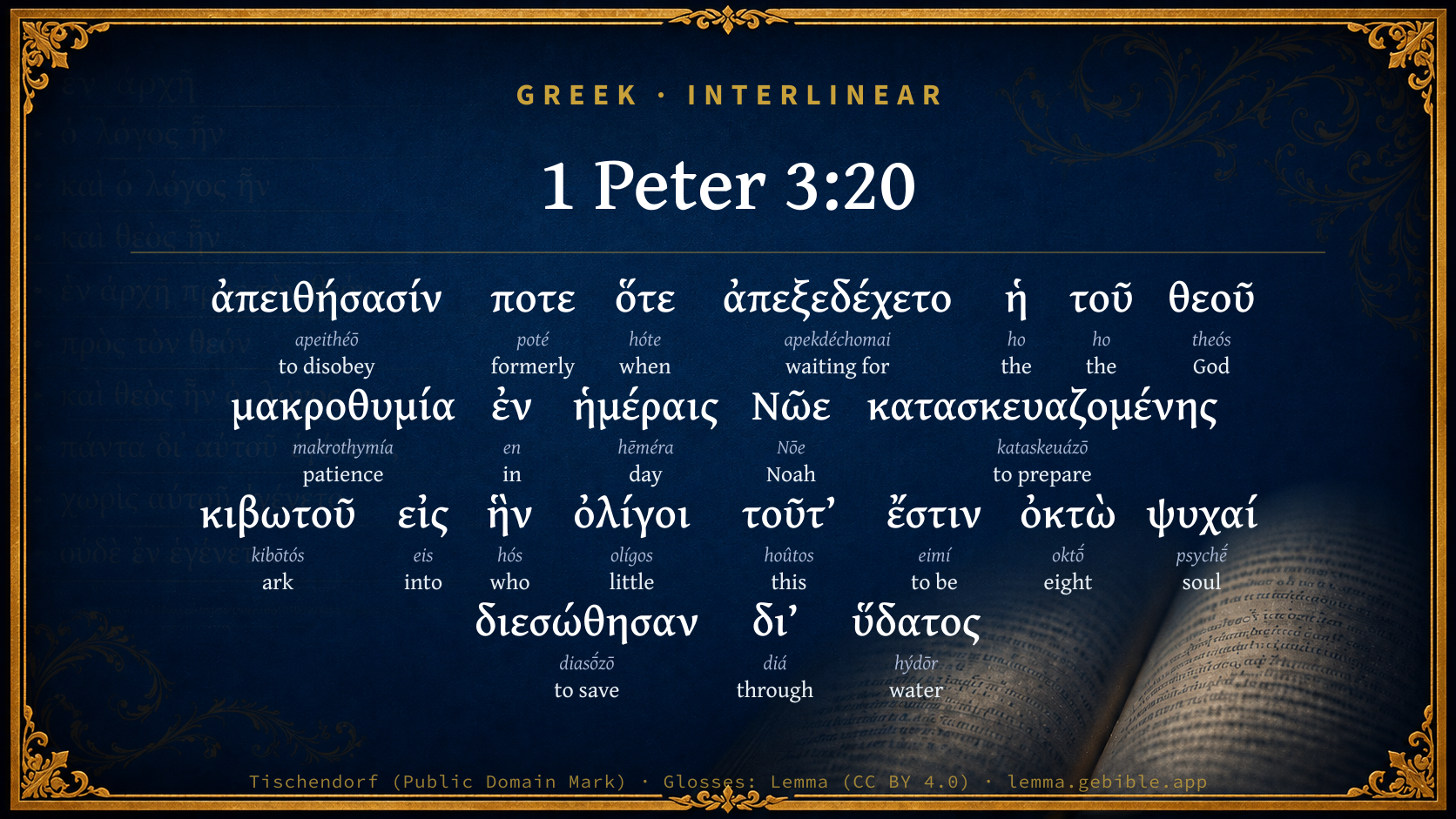
  1. ἀπειθήσασίν apeithéō G544 “to disobey” Verb, Aorist, Active, Participle, Dative, Plural, Masculine
  2. ποτε poté G4218 “formerly” Particle
  3. ὅτε hóte G3753 “when” Adverb
  4. ἀπεξεδέχετο apekdéchomai G553 “waiting for” Verb, Imperfect, Middle or Passive deponent, Indicative, 3rd person, Singular
  5. ἡ ho G3588 “the” Article, Nominative, Singular, Feminine
  6. τοῦ ho G3588 “the” Article, Genitive, Singular, Masculine
  7. θεοῦ theós G2316 “God” Noun, Genitive, Singular, Masculine
  8. μακροθυμία makrothymía G3115 “patience” Noun, Nominative, Singular, Feminine
  9. ἐν en G1722 “in” Preposition
  10. ἡμέραις hēméra G2250 “day” Noun, Dative, Plural, Feminine
  11. Νῶε Nōe G3575 “Noah” Noun, Proper, indeclinable
  12. κατασκευαζομένης kataskeuázō G2680 “to prepare” Verb, Present, Passive, Participle, Genitive, Singular, Feminine
  13. εἰς eis G1519 “into” Preposition
  14. ἣν hós G3739 “who” Relative pronoun, Accusative, Singular, Feminine
  15. ὀλίγοι olígos G3641 “little” Adjective, Nominative, Plural, Masculine
  16. τοῦτ’ hoûtos G3778 “this” Demonstrative pronoun, Nominative, Singular, Neuter
  17. ἔστιν eimí G1510 “to be” Verb, Present, Active, Indicative, 3rd person, Singular
  18. ὀκτὼ oktṓ G3638 “eight” Adjective, Numeral (indeclinable)
  19. ψυχαί psychḗ G5590 “soul” Noun, Nominative, Plural, Feminine
  20. διεσώθησαν diasṓzō G1295 “to save” Verb, Aorist, Passive, Indicative, 3rd person, Plural
  21. δι’ diá G1223 “through” Preposition
  22. ὕδατος hýdōr G5204 “water” Noun, Genitive, Singular, Neuter

About this verse

These counts appear in no published source. They are computed here, from the morphology-tagged text and Lemma’s own curated glosses. What Lemma adds →

23
words
22
distinct lemmas
General Epistles
section

Notable vocabulary

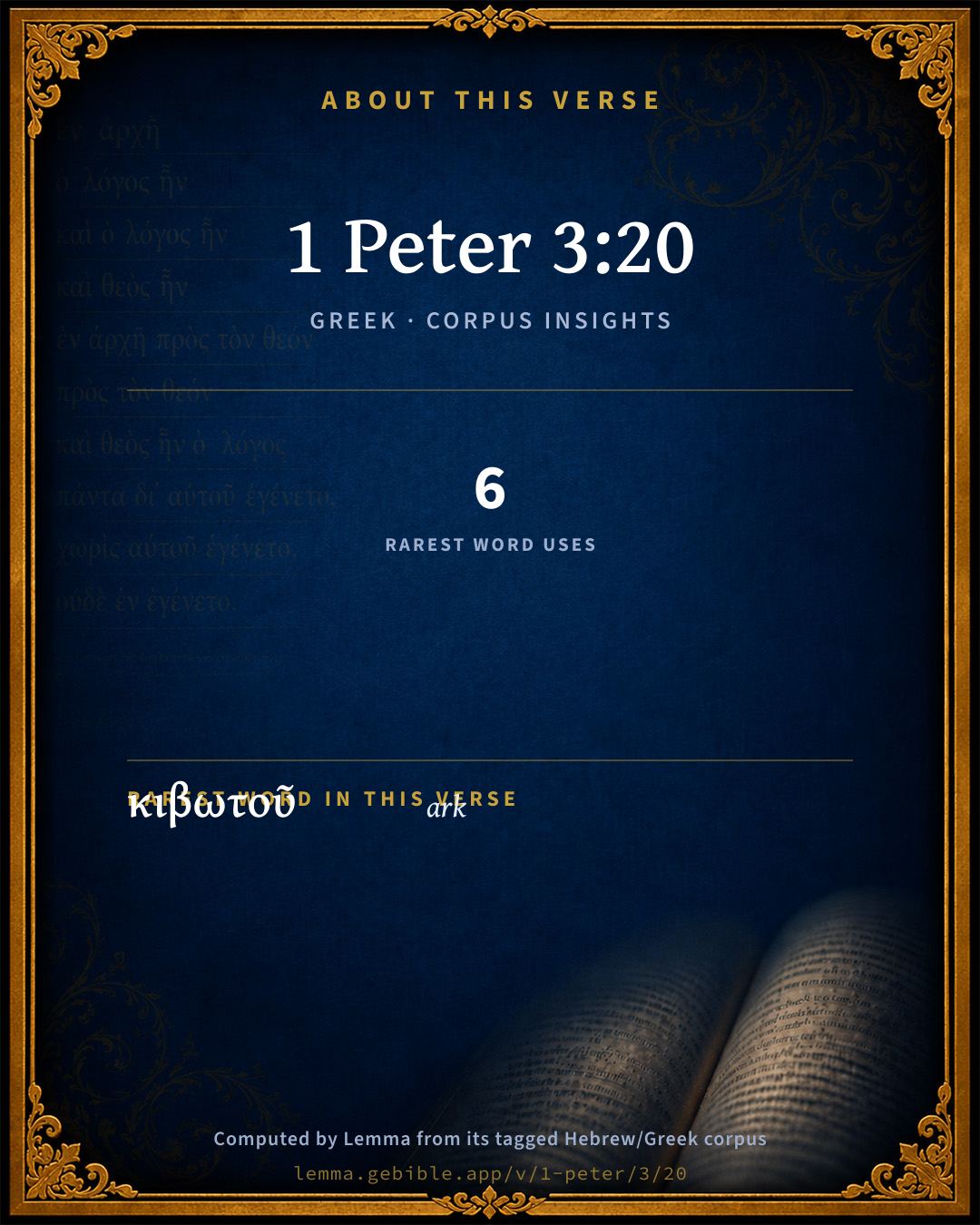
The rarest word here is κιβωτοῦ ark G2787 — appearing just 6 times in the whole Greek New Testament.

Shared distinctive vocabulary

κιβωτοῦ ark G2787 occurs in 6 verses of the Greek New Testament. Also found in:

Repetition

A word recurs within this verse:

Cross-references

20

Topical passages linked to 1 Peter 3:20 in the Treasury of Scripture Knowledge — connected by theme and wording, ordered by reader-vote popularity; previews shown in the World English Bible.

  • Hebrews 11:7 By faith, Noah, being warned about things not yet seen, moved with godly fear, prepared an ark for the saving of his house, through which he condemned the world, and became heir of the righteousness which is according to faith.
  • 2 Peter 2:5 and didn't spare the ancient world, but preserved Noah with seven others, a preacher of righteousness, when he brought a flood on the world of the ungodly;
  • Genesis 6:3 Yahweh said, "My Spirit will not strive with man forever, because he also is flesh; yet will his days be one hundred twenty years."
  • Genesis 6:5 Yahweh saw that the wickedness of man was great in the earth, and that every imagination of the thoughts of his heart was only evil continually.
  • Genesis 8:18 Noah went forth, with his sons, his wife, and his sons' wives with him.
  • Genesis 6:13–7:7 God said to Noah, "The end of all flesh has come before me, for the earth is filled with violence through them. Behold, I will destroy them with the earth.
  • Romans 2:4–5 Or do you despise the riches of his goodness, forbearance, and patience, not knowing that the goodness of God leads you to repentance?
  • Genesis 7:13 In the same day Noah, and Shem, Ham, and Japheth, the sons of Noah, and Noah's wife, and the three wives of his sons with them, entered into the ark;
  • Genesis 7:17–23 The flood was forty days on the earth. The waters increased, and lifted up the ark, and it was lifted up above the earth.
  • Matthew 7:14 How narrow is the gate, and restricted is the way that leads to life! Few are those who find it.
  • Matthew 24:37–39 "As the days of Noah were, so will be the coming of the Son of Man.
  • Genesis 8:1 God remembered Noah, all the animals, and all the cattle that were with him in the ark; and God made a wind to pass over the earth. The waters subsided.
  • Isaiah 30:18 Therefore will Yahweh wait, that he may be gracious to you; and therefore will he be exalted, that he may have mercy on you: for Yahweh is a God of justice; blessed are all those who wait for him.
  • Luke 12:32 Don't be afraid, little flock, for it is your Father's good pleasure to give you the Kingdom.
  • Luke 13:24–25 "Strive to enter in by the narrow door, for many, I tell you, will seek to enter in, and will not be able.
  • Luke 17:26–30 As it happened in the days of Noah, even so will it be also in the days of the Son of Man.
  • Romans 9:22 What if God, willing to show his wrath, and to make his power known, endured with much patience vessels of wrath made for destruction,
  • 2 Corinthians 2:15–16 For we are a sweet aroma of Christ to God, in those who are saved, and in those who perish;
  • 2 Peter 3:15 Regard the patience of our Lord as salvation; even as our beloved brother Paul also, according to the wisdom given to him, wrote to you;
  • Ephesians 5:26 that he might sanctify it, having cleansed it by the washing of water with the word,

Cross-references courtesy of OpenBible.info (CC BY 4.0).

Commentary

Notes on 1 Peter 3:20 from classic Christian and Jewish commentators (each source and its license shown beneath its notes). The classic Christian expositions comment on the surrounding passage and are grouped to its opening verse, so a note may address several verses; the Jewish commentaries on the Tanakh (Rashi and others) are per-verse, so they appear only where the commentator wrote on this verse.

Lemma curates 59 commentaries, every one of them public domain or Creative Commons licensed, each selected and text-cleaned for this edition rather than reprinted as found. About our sources →

Tyndale Open Study Notes

Tyndale Open Resources

3:20 Only eight people: That is, Noah, his wife, their three sons, and their wives (Gen 6:18; 8:18).

Tyndale Open Study Notes — © Tyndale Open Resources, licensed CC BY-SA 4.0. Text via the HelloAO Bible API.

Bengel's Gnomon

Johann Albrecht Bengel

1Pe 3:20. Ἀπειθήσασι, who had been unbelieving) who in their life had not believed the patriarchs, when they admonished them in the name of God.—ποτὲ, sometime) This sometime (used in 1Pe 3:5 also with reference to a long time [ago]), and this long-suffering, of which he speaks immediately after, have reference to all ages of the Old Testament previously to the death of Christ. It is called forbearance, Rom 3:26. Long-suffering preceded the first coming of Christ, as here shown, and His second coming, 2Pe 3:9, note.—ὅτε, when) The weak reading, ὅτι, is rightly refuted by Wolf. A certain edition, which has ὂτι, is very corrupt, even in this very word. Some copies have ὂτι, according to Erasmus, even in his first edition; but the Basileensis II. is the only one which is found, from which Erasmus rarely deviated, though he did in this instance, and with reason.—ἀπεξεδέχετο[32]) Other copies have ἅπαξ ἐδέχετο; but very few have this reading, ε being first corrupted into α, as is often the case; nor does the simple verb δέχεσθαι agree with the passage. See App. Crit. on this place. Ἀπεξεδέχετο, that is, God continued waiting, that men might believe. But there is greater force in the Greek double compound: He continued waiting on, until there was an end of His waiting, in the death of the men.—ἐν, in) Understand οἷον: that is, for instance [to wit], in the days of Noah. The most remarkable species is subjoined to the genus, for these reasons: 1) On no occasion did a greater number perish together than at the deluge. 2) By mention of water, Peter conveniently passes to the subject of baptism. 3) The destruction of the world by water is a prelude to its destruction by fire, 2Pe 3:6-7, in conjunction with the last judgment, ch. 1Pe 4:5. Nor is it matter of surprise that the word sometime is used in a wider meaning than the days of Noah; since also the days of Noah altogether were many more than the days of the building of the ark; but these, however, are immediately added. Compare with this the definite marking of time, which gradually becomes more particular, in Mar 14:30; Luk 4:25; Deu 31:10. O what ample (noble) preaching!—κατασκευαζομένης κιβωτοῦ, while an [not the] ark was in preparation) Κιβωτοῦ without the article: Heb 11:7. The expression is adapted to the mind of the unbelieving spectators. This building occupied a long season, for it is not probable that many assisted Noah in his work. During the whole of that time especially the long-suffering of God waited.—εἰς ἣν, into which) Having entered into the ark by faith, they sought and found safety.—ὀλίγοι, a few) It is the more probable that some out of so great a multitude repented, when the rain came; and though they had not believed while God was waiting, and while the ark was building, afterwards, when the ark was completed, and punishment assailed them, began to believe; and to these, and to all like them, Christ afterwards presented Himself as a preacher of grace. Luther attributed less weight to this interpretation in his homilies on 1st Peter, published in A.D. 1523; but shortly before his death he more decidedly embraced it. There is a well-known passage in his Comm. on Gen 7:1, and his Exposition of Hosea agrees with it, published in the year 1545, in which, ch. 1Pe 4:2, he referred the two days (spoken of by the prophet) to the descent into hell; and quoting this passage of Peter, he says; Here Peter plainly says, not only that Christ appeared to the fathers and patriarchs who were dead, some of whom undoubtedly Christ, on His resurrection, raised with Himself to eternal life, but also preached to some who in the time of Noah did not believe, and waited for the patience of God, that is, who hoped that God would not deal so severely with all flesh, in order that they might recognise that THEIR sins were FORGIVEN through the sacrifice of Christ. In accordance with this are the comments of L. Osiander on this passage, of Hutter, in Expl. Concordiæ, p. 993; and also of Peter Martyr, T. I. LL. CC., col. 783.—ὀκτὼ, eight) Ham, who was about to incur the curse, being taken from this number, there were seven, a sacred number.—διʼ ὕδατος, through water) διὰ, through; an appropriate particle, denoting passage, without consideration either of the peril which threatened from the waters in themselves, or of the safety afforded in their being borne above them in the ark. Thus the following verse accords with this.

[32] So ABC Vulg. Orig. 2,553d and 4,135a. Rec. Text has ἅπαξ ἐξεδέχετο, with no authority except Orig. 4,135a in a MS.

Bengel's Gnomon of the New Testament — English translation (T&T Clark, Edinburgh, 1860) — public domain. Text from a community e-Sword module.

Meyer's Critical & Exegetical Commentary

Heinrich August Wilhelm Meyer

1Pe_3:20. The words which begin this verse: ἀπειθήσασίν ποτε, characterize the spirits who are in prison according to their former conduct. The participle must not, with Wiesinger, be resolved into: although, notwithstanding the fact that they had been disobedient; an adversative relation of this kind must have been more plainly expressed.[214]

According to the uniform usage of the N. T., the word ἀπειθεῖν has here also the meaning of unbelief involving resistance; cf. chap. 1Pe_2:7-8, 1Pe_3:1, 1Pe_4:17. The translation: to be disobedient, is too inexact, for the word forms the antithesis to πιστεύειν.

ὅτε ἀπεξεδέχετο κ.τ.λ.] serves not only to specify the time when these spirits were unbelieving, but also to mark the guilt of the ἀπειθεῖν.

ἀπεκδέχεσθαι, according to N. T. usage, equivalent to: patient waiting, is here used absolutely, as in Rom_8:25 (comp. ἐκδέχεσθαι, Heb_10:13; thus Schott also). The narrative itself shows the object to which this waiting of Gods long-suffering was directed. Its duration is not to be limited to the seven days mentioned in Gen_7:4 (de Wette), for this is in keeping neither with the ἀπεξεδέχετο ἡ … μακροθυμία, nor the subsequent κατασκευαζομένης κιβωτοῦ, but embraces the whole period of 120 years mentioned in Gen_6:3.

The time specified by ὅτε κ.τ.λ. is still more precisely defined in the subsequent ἐν ἡμέραις Νῶε and the κατασκευαζομένης κιβωτοῦ; in such a way, however, that these adjuncts contain a reference to the exhortation to repentance then given, for Noah was not like the others, an unbeliever, but a believer, and the preparation of the ark gave unmistakeable testimony to the approaching judgment.κιβωτός without the article, the expression used by the LXX. for תֵּבָה, equal to ark, arca; comp. Mat_24:38; Luk_17:27; Heb_11:7 (Wiesinger).

[214] Hofmann has now justly given up his former explanation: without being obedient. Walthers interpretation is evidently entirely arbitrary: to the spirits, i.e. the devils and the damned in general, particularly to those damned who, etc. But neither is there a warrant for inserting οἶον (Bengel: subaudi οἶον, i. e. exempli gratia, in diebus Noe; subjicitur generi species maxime insignis).

REMARK 1.

Some of the interpreters who do not apply this passage to the descensus ad inferos, as Luther (in his Auslegung der Ep. Petri, 1523), the Socinians, Vorstius, Amelius, Grotius, etc., explain ἐκήρυξε as referring to the preaching of the apostles, assuming that the unbelievers in the time of Noah are mentioned only as types of the unbelievers in apostolic times. τὰ ἐν φυλακῇ πνεύματα they understand to mean the heathen alone, or those along with the Jews. Amelius: πνεύμ. hic in genere denotant homines, quemadmodum paulo post ψυχαί· ἐν φυλακῇ: in captivitate erant tum Judaei, sub jugo legis existentes, tum quoque gentiles, sub potestate diaboli jacentes. Illos omnes Christus liberavit; praedicationem verbi sui ad ipsos mittens et continuans et Apostolos divina virtute instruens.

REMARK 2.

Even interpreters who apply this passage to the descensus ad inferos, and understand ἐκήρυξε of the preaching of salvation,[215] are guilty of much arbitrariness, and especially in designating more precisely those to whom the preaching is addressed. Several of the Fathers, as Irenaeus, Tertullian, Hippolytus; many of the Scholastics; further, Zwingli, Calvin (in his Comment.), and others,hold those to have been the pious, especially the pious of the O. T.[216]

Marcion thinks the ΚΉΡΥΓΜΑ was addressed to those who, though in the O. T. termed ungodly, were actually better than the O. T. believers.

Clemens Al. supposes the ΔΊΚΑΙΟΙ ΚΑΤᾺ ΦΙΛΟΣΟΦΊΑΝ, who, however, were still without faith and in the trammels of idolatry.

Several commentators assume that not all unbelievers in the days of Noah are meant, but those only who, at first indeed unbelieving, had still repented at the last moment when the flood came upon them; this is the view of Suarez, Estius, Bellarmin, Luther (zu der Erklärung der Genesis, 1536, und zu Hosea IV. 2, v. J. 1545),[217] Peter Martyr, etc. Bengel says: Probabile est, nonnullos ex tanta multitudine, veniente pluvia, resipuisse: cumque non credidissent, dum expectaret Deus, postea, cum … poena ingrueret, credere coepisse, quibus postea Christus eorumque similibus se praeconem gratiae praestiterit. Wiesinger agrees with this interpretation, at least in so far that he assumes that the moral condition of the individual (at the time of the flood) was not in every case the same, but extremely varied; although, on the other hand, he finds fault with it on the ground that, in contradiction to the context, it limits the ἘΚΉΡΥΞΕ only to a part. Schott remarks, as against Wiesinger, that although some may in respect of moral condition have differed from the majority, or still have repented in the last moment, yet these were not among the spirits in durance who listened to Christs preaching.

[215] It must further be remarked that several commentators: Athanasius, Ambrosius, Erasmus, Calvin (in his Inslit. lib. II. 2, c. 16, § 9), understand Christs preaching as at once a praedicatio salvifica and praed. damnatoria. Calvin, however, does hold by the idea of κηρύσσειν, when he says: Contextus vim mortis (Christi) inde amplificat, quod ad mortuos usque penetraverit, dum piae animae ejus visitationis, quam sollicite exspectaverant, praesenti aspectu sunt potitae; contra reprobis clarius patuit, se excludi ab omni salute.

[216] Calvins exposition is singular: he interprets φυλακή equal to specula vel ipse excubandi actus; τὸ ἐν φυλ. πν. equals: the spirits of those who were on the watch-tower, i.e. in the expectation of salvation, or also in anxietas expectationis Christi, and then continues: Postquam (Ap.) dixit, Christi se mortuis manifestasse, mox addit: quum increduli fuissent olim, quo significat nihil nocuisse Sanctis Patribus quod impiorum multitudine paene obruti fuerunt. Exemplum vero ex tota vetustate prae aliis illustre deligit, nempe cum diluvio submersus fuit mundus. He removes the scruple, that the dative ἀπειθήσασι is not in harmony with this explanation, by observing that the apostles sometimes employ one case in room of another.

[217] On Luthers vacillation in interpreting this passage, see Köhler as above, and Schweizer as above, p. 7.

REMARK 3.

The view commonly accepted is that this preaching by Christ took place before His resurrection, whilst His body lay in the grave. Many even of the older dogmatists of the Lutheran Church, however, hold it to have been accomplished after His quickening, that is, in the time between this and His going forth from the grave. Quenstedt says: Christus θεάνθρωπος totaque adeo persona (non igitur secundum animam tantum nec secundum corpus tantum) post redunitionem animae ac corporis ad istud damnatorum που descendit; he fixes the time when this happened: illud momentum, quod intercessit inter ζωοποίησιν et ἀνάστασιν Christi stricte ita dictam. Hollaz: distinguendum inter resurrectionem externam et internam; illa est egressio e sepulcro et exterior coram hominibus manifestatio; haec est ipsa vivificatio; so, too, Hutter, Baier, Buddeus, etc. In like manner Schott: in the new spiritual life which in that mysterious hour of midnight He had put on, and before appearing with it on the upper world by His resurrection, He descended.

The verse does not indeed say that the ἐκήρυξε belongs to this very moment, but it does certainly point to the preaching having taken place after Christs restoration to life, as de Wette, Brückner, Wiesinger, Zezschwitz, have rightly acknowledged; for referring as ἐν ᾧ does to the πνεύματι connected with ζωοπωηθείς, it is arbitrary to find in πορευθεὶς ἐκήρυξε mention made of an act of Christ which took place after the θανατωθείς indeed, but yet before the ζωοποιηθείς. As, then, both expressions apply to Christ in His entire person, consisting of body and soul, what follows must not be conceived as an activity which He exercised in His spirit only and whilst separated from His body. In addition to this, if according to His intention His preaching was to be indeed a preaching of salvation, it must have had for its substance the work of redemption, completed only in the resurrection. Weiss (p. 232) objects that πνεῦμα is not equal to σῶμα πνευματικόν, and this is undoubtedly true; but it cannot prove anything against the view that Christ as the Risen One, that is, in His glorified body, preached to the spirits in prison, inasmuch as in this body the Lord is no longer ἐν σαρκί, but entirely ἐν πνεύματι.

Thus the passage says nothing as to Christs existence between His death and resurrection. If Act_2:31 presuppose the going of the dead Christ into Hades, the common dwelling-place of departed souls, this descensus ad inferos must not be identified with the one here mentioned, as also Wiesinger, Brückner, and Schott rightly observe; so that by drawing this distinction the disputed question, too, whether Christ descended into Hades, quoad animam or quoad animam et corpus, finds its correct solution. It must further be added that this passage gives no support whatever either to the doctrine of the Form. concordiae, that in Hades Christ overcame the devil, destroyed the power of hell, and despoiled the devil of his might, or to that of the Catholic Church of the limbus Patrum and Purgatory.

Connected with the words κατασκευαζομένης κιβωτοῦ are the thoughts which follow, in which stress is laid, not so much on the judgment which overtook unbelievers in the flood, as on the deliverance of the few.: εἰς ἣν ὀλίγοι.

διεσώθησαν διʼ ὕδατος] The preposition διά is to be explained not as equal to ἐκ (Act_28:4 : ὃν διασωθέντα ἐκ τῆς θαλάσσης), nor as if it were ἐν (in medio aquarum), nor equivalent to non obstante aqua (Gerhard), nor even as a preposition of time (eo tempore, quo aquae inundaverant); but is to be taken either locally or instrumentally. διʼ ὕδατος is then either: through the water, or equivalent to: by means of water. The former view (Bengel, Steiger, de Wette, Brückner, Wiesinger, formerly Hofmann also) seems to be confirmed by the verbum compos. διεσώθησαν. But διασώζειν, both in the LXX. and in the N. T. (cf. Mat_14:36; Luk_7:3, etc.), is often used as a strengthened form of σώζειν, without the peculiar force of διά being pressed. And thus it must be taken here, inasmuch as it contradicts the historical narrative in Genesis, to say that Noah and his family were saved by passing through the water. διά has accordingly here an instrumental force, so that διʼ ὕδατος indicates water as the medium through which the Noahites were delivered.[218] And this interpretation is alone in harmony with the context, inasmuch as the apostle in what follows gives special prominence to the fact that the N. T. deliverance is likewise effected by means of water. If water was the means of deliverance to Noah and those with him, in so far as it bore those hidden within the ark, and thus preserved them from destruction, comp. Gen_7:17-18 (Weiss, p. 313; thus also Wolf, Pott, Jachmann, Schott), this implies recourse to a pregnant construction, inasmuch as the apostle unites the two thoughts in one: they were saved by going into the ark and they were saved διʼ ὕδατος. Hofmann seeks to avoid the assumption of a pregnancy by explaining ὝΔΩΡ here as the water which began to overflow the earth, and which compelled Noah to enter with those belonging to him into the ark, in support of which he appeals to Gen_7:11; Gen_7:13. But although these passages state that both the entering into the ark and the beginning of the deluge took place on the same day, still the latter event is not indicated as the motive of the former. According to the narrative in Genesis, it was the command of God which moved the Noahites to enter the ark, and as soon as they had done so, and God had closed the ark, the deluge commenced; cf. Gen_7:1; Gen_7:16-17.

Further, on Hofmanns interpretation water can be regarded only in a very loose sense as the medium of deliverance; nor would it be in keeping with the subsequent parallelism. It must be noted that ὕδατος is anarthrous, and although by the term no other water can be understood than that of the flood, yet Peters object here is not to show that the same water which destroyed some served as the means of deliverance for others, but merely to state that the deliverance of Noah and those with him was effected by water, in order that this water then may be recognised as the type of the saving water of baptism (comp. Schott).

ὀλίγοι, τοῦτʼ ἐστιν ὀκτὼ ψυχαί] ΤΟῦΤʼ ἘΣΤΙΝ Κ.Τ.Λ. justifies the use of the expression ὈΛΊΓΟΙ; so much stress is laid on this particular, very probably in order to point out, on the one hand, the great number of those who perished, and on the other, the proportion to be looked for at the final judgment.

[218] Wiesinger has expressed himself in favour of the first version, but then remarks: the writer conceives the water at the same time as the saving element; Fronmüller, too, combines both interpretations: in which few souls sought shelter, and were saved through the water and by it; this is evidently altogether unwarrantable.

Meyer — Critical and Exegetical Commentary on the New Testament — English translation by Peter Christie, edited by Frederick Crombie (T&T Clark, 1880) — public domain. Text from a community e-Sword module.

Geneva Bible (1599)

Geneva Bible translators

Men.

This word (once) showeth that there was a furthermost day appointed, and if that were once past, there should be no more.

Geneva Bible (1599) marginal notes — public domain. Text via Bolls.life.

Jamieson, Fausset & Brown

Robert Jamieson, A. R. Fausset & David Brown

once--not in the oldest manuscripts.

when . . . the long-suffering of God waited in the days of Noah--Oldest manuscripts. Greek, "was continuing to wait on" (if haply men in the hundred twenty years of grace would repent) until the end of His waiting came in their death by the flood. This refutes ALFORD'S idea of a second day of grace having been given in Hades. Noah's days are selected, as the ark and the destroying flood answer respectively to "baptism" and the coming destruction of unbelievers by fire.

while the ark was a-preparing-- (Heb 11:7). A long period of God's "long-suffering and waiting," as Noah had few to help him, which rendered the world's unbelief the more inexcusable.

wherein--literally, "(by having entered) into which."

eight--seven (the sacred number) with ungodly Ham.

few--so now.

souls--As this term is here used of living persons, why should not "spirits" also? Noah preached to their ears, but Christ in spirit, to their spirits, or spiritual natures.

saved by water--The same water which drowned the unbelieving, buoyed up the ark in which the eight were saved. Not as some translate, "were brought safe through the water." However, the sense of the preposition may be as in Co1 3:15, "they were safely preserved through the water," though having to be in the water.

Jamieson, Fausset & Brown — Commentary Critical and Explanatory on the Whole Bible (1871) — public domain (CC PDM 1.0). Text via the HelloAO Bible API.

Adam Clarke's Commentary

Verse 20. When once the long-suffering of God waited] In Pirkey Aboth, cap. v. 2, we have these words: "There were ten generations from Adam to Noah, that the long-suffering of God might appear; for each of these generations provoked him to anger, and went on in their iniquity, till at last the deluge came."

Were saved by water.] While the ark was preparing, only Noah's family believed; these amounted to eight persons; and these only were saved from the deluge διυοατος, on the water: all the rest perished in the water; though many of them, while the rains descended, and the waters daily increased, did undoubtedly humble themselves before God, call for mercy, and receive it; but as they had not repented at the preaching of Noah, and the ark was now closed, and the fountains of the great deep broken up, they lost their lives, though God might have extended mercy to their souls.

Adam Clarke's Commentary on the Bible (1810–1826) — public domain. Text from a community e-Sword/MySword module.

John Calvin's Commentaries

Thus far the Apostle’s words seem to agree together, and with the thread of the argument; but what follows is attended with some difficulty; for he does not mention the faithful here, but only the unbelieving; and this seems to overturn the preceding exposition. Some have for this reason been led to think that no other thing is said here, but that the unbelieving, who had formerly persecuted the godly, found the Spirit of Christ an accuser, as though Peter consoled the faithful with this argument, that Christ, even when dead, punished them. But their mistake is discovered by what we shall see in the next chapter, that the Gospel was preached to the dead, that they might live according to God in the spirit, which peculiarly applies to the faithful. And it is further certain that he repeats there what he now says. Besides, they have not considered that what Peter meant was especially this, that as the power of the Spirit of Christ shewed itself to be vivifying in him, and was known as such by the dead, so it will be towards us.

Let us, however, see why it is that he mentions only the unbelieving; for he seems to say, that Christ in spirit appeared to those who formerly were unbelieving; but I understand him otherwise, that then the true servants of God were mixed together with the unbelieving, and were almost hidden on account of their number. I allow that the Greek construction is at variance with this meaning, for Peter, if he meant this, ought to have used the genitive case absolute. But as it was not unusual with the Apostles to put one case instead of another, and as we see that Peter here heaps together many things, and no other suitable meaning can be elicited, I have no hesitation in giving this explanation of this intricate passage; so that readers may understand that those called unbelieving are different from those to whom he said the Gospel was preached.

After having then said that Christ was manifested to the dead, he immediately adds, When there were formerly unbelievers; by which he intimated, that it was no injury to the holy fathers that they were almost hidden through the vast number of the ungodly. For he meets, as I think, a doubt, which might have harassed the faithful of that day. They saw almost the whole world filled with unbelievers, that they enjoyed all authority, and that life was in their power. This trial might have shaken the confidence of those who were shut up, as it were, under the sentence of death. Therefore Peter reminds them, that the condition of the fathers was not different, and that though the multitude of the ungodly then covered the whole earth, their life was yet preserved in safety by the power of God.

He then comforted the godly, lest they should be cast down and destroyed because they were so few; and he chose an example the most remarkable in antiquity, even that of the world drowned by the deluge; for then in the common ruin of mankind, the family of Noah alone escaped. And he points out the manner, and says that it was a kind of baptism. There is then in this respect also nothing unsuitable.

The sum of what is said is this, that the world has always been full of unbelievers, but that the godly ought not to be terrified by their vast number; for though Noah was surrounded on every side by the ungodly, and had very few as his friends, he was not yet drawn aside from the right course of his faith.

When once the long-suffering of God waited This ought to be applied to the ungodly, whom God’s patience rendered more slothful; for when God deferred his vengeance and did not immediately execute it, the ungodly boldly disregarded all threatenings; but Noah, on the contrary, being warned by God, had the deluge for a long time before his eyes. Hence his assiduity in building the ark; for being terrified by God’s judgment, he shook off all torpidity.

John Calvin's Commentaries (1540-1563) — public domain. Text from the Calvin Translation Society English edition (1840s-50s) via the Christian Classics Ethereal Library (ccel.org). Calvin's coverage is partial (roughly two-thirds of the Bible); uncommented books and verses are honest gaps, never fabricated. The 19th-century editor's footnotes and remarks are omitted so the notes are faithfully Calvin's own voice.

Ellicott's Commentary for English Readers

(20) Which sometime were disobedient.—The absence of the definite article here in the Greek (contrary to St. Peter’s usage in participial sentences—e.g., 1Pe_1:5; 1Pe_1:7; 1Pe_1:10; 1Pe_1:17) makes it possible to think that the spirits mentioned in this verse are not co-extensive with those in prison. It is, literally, to men who once upon a time were disobedient. Our Lord preached to the whole class of spirits in prison, of all times and races; and then, to magnify the bounty of this act, St. Peter instances a particular group of them, who were the most marked criminals of any, and whose case suggested a useful application. He has a reason for using the word “disobedient.” It would not describe all sinners, but those who had heard and been convinced by the word of God, but refused to accept it. (See Note on 1Pe_3:2.) This was the case with those to whom Noah preached (2Pe_2:5); and, in spite of their “disobedience,” Christ, after His innocent and sacrificial death, went in spirit and preached a gospel to them. Now, let it be recollected that St. Peter’s object through the whole of this section is to encourage the Hebrew Christians to be ready, through a good conscience, for a brave martyrdom, if need be. They are to think how their deaths, like Christ’s, may bring their persecutors to God. Nay—he seems to imply—their very spirits going forth into the world of spirits may conceivably carry a gospel of some kind even to Hebrew relatives who have passed away, like those Antediluvians, in the “disobedience” which was characteristic of the Jews. St. Clement of Alexandria, who derives the notion from the Shepherd of Hermas, gives his belief that the Apostles also, when they died, preached to those who had died before them; and though there is little that throws light on our occupation in the intermediate state, it can hardly be pronounced impossible for some spirits to be allowed to follow Christ’s example there by preaching to spirits in prison. Many expositors, afraid of the consequences of admitting that there could be a possible gospel for men who died impenitent, have supposed that the imprisoned spirits to whom Christ went were the less wicked people destroyed by the Flood; others that they were those who had some motions of penitence when the rain began to fall; but these ideas are foreign to the text, which only tells us that they “were disobedient,” and adds nothing to extenuate their crime. They are a typical instance of men who died “as evil doers” (1Pe_3:17).

When once the longsuffering of God waited.—The word “once” has no business in the text, originating only in an ingenious but unnecessary guess of Erasmus. The clause serves to heighten the guilt of the poor sinners to whom Christ preached in prison. Not only did they die a judicial death for their extreme sensuality (Gen_6:3; Gen_6:11), not only did they disobey an isolated call to repentance from Noah, but continuously, through all the time of the building of the ark (traditionally 120 years), they went on refusing to listen. Sodom and Gomorrah were destroyed without a preacher to warn them, the Canaanites were annihilated without an offer of repentance, but these abandoned Antediluvians sinned in spite of the long ministry of Noah, and died impenitent. Both their wickedness and God’s longsuffering with them were embodied in Hebrew proverbs, which St. Peter’s readers would know, and yet Christ had a gospel for them.

While the ark.—Better, while an ark. It does not merely describe the period of the disobedience, but rather changes the thought altogether. We now turn from the destruction of the majority to the salvation of the few.

Wherein.—Literally, whereinto—i.e., by getting into which.

Few, that is, eight souls were saved.—The mention of disobedience calls up to the Apostle’s mind at once the vast number of Hebrews who rejected the gospel of Christ. As in 1Pe_2:4 et seq., so here, he establishes the readers against the thought, “Can I be right and all these people wrong?” by showing that from the beginning it was always a small number who accepted salvation, and they should naturally expect it to be so now. It is better to be one of the eight in the ark than of the many disobedient in the water.

By water.—Or, through water. The very water which drowned the disobedient was the instrument of saving to those who believed, for it floated their ark. It cannot be denied that this is a little forced. So, in the same way, in 1Pe_2:8, the same stone is to some a sanctuary, to some a stumbling-block. This pregnant word “water” leads on to the next thought.

A Bible Commentary for English Readers, edited by Charles John Ellicott (1878–1897) — public domain. Text from a community e-Sword module.

The Cambridge Bible for Schools and Colleges

gen. ed. J. J. S. Perowne

20. which sometime were disobedient] The words that follow, however, appear to limit the range of the preaching within comparatively narrow boundaries. The “spirits” of whom St Peter speaks were those who had “once been disobedient:” the “once” being further defined as the time when “the long-suffering of God was waiting in the days of Noah.” We naturally ask as we read the words, (1) why the preaching was confined to these, or (2) if the preaching itself was not so confined, why this was the only aspect of it on which the Apostle thought fit to dwell? The answer to the first question cannot be given with any confidence. It is behind the veil which we cannot lift. All that we can say is that the fact thus revealed gives us at least some ground for seeing in it a part of God’s dealings with the human race, and that it is not unreasonable to infer an analogous treatment of those who were in an analogous condition. The answer to the second question is, perhaps, to be found in the prominence given to the history of Noah in our Lord’s eschatological teaching, as in Mat_24:37-38, Luk_17:26-27, and in the manifest impression which that history had made on St Peter’s mind, as seen in his reference to it both here and 2Pe_2:5; 2Pe_3:6. It is a conjecture, but not, I think, an improbable or irreverent one, that the disciple’s mind may have been turned by our Lord’s words to anxious enquiries as to the destiny of those who had been planting and building, buying and selling, when “the flood came and took them all away,” and that what he now states had been the answer to such enquiries. What was the result of the preaching we are not here told, the Apostle’s thoughts travelling on rapidly to the symbolic or typical aspect presented by the record of the Flood, but the notes on ch. 1Pe_4:6 will shew that his mind still dwelt on it, and that he takes it up again as a dropped thread in the argument of the Epistle. It will be noted, whatever view we may take of the interpretation of the passage as a whole, that it is the disobedience, and not any after-repentance at the moment of death, of those who lived in the days of Noah that is here dwelt on.

Such is, it is believed, the natural and true interpretation of St Peter’s words. It finds a confirmation in the teaching of some of the earliest fathers of the Church, in Clement of Alexandria (Strom. vi. 6), and Origen, and Athanasius (cont. Apollin. i. 13), and Cyril of Alexandria (in Joann. xvi. 16); Even Augustine, at one time, held that the effect of Christ’s descent into Hades had been to set free some who were condemned to the torments of Hell (Epist. ad Euodium, clxiv.), and Jerome (on Mat_12:29, Eph_4:10) adopted it without any hesitation. Its acceptance at an early date is attested by the apocryphal Gospel of Nicodemus, nearly the whole of which is given to a narrative of the triumph of Christ over Hades and Death, who are personified as the Potentates of darkness. It tells how He delivered Adam from the penalty of his sin, and brought the patriarchs from a lower to a higher blessedness, and emptied the prison-house, and set the captives free, and erected the cross in the midst of Hades, that there also it might preach salvation. Legendary and fantastic as the details may be, they testify to the prevalence of a wide-spread tradition, and that tradition is more naturally referred to the teaching of St Peter in this passage as the germ out of which it was developed than to any other source. As a matter of history, the article “He descended into Hell,” i.e. into Hades, first appeared in the Apostles’ Creed at a time when the tradition was almost universally accepted, and when the words of the Creed could not fail to be associated in men’s minds with the hope which it embodied.

It must be admitted, however, that the weight of many great names may be urged on behalf of other interpretations, and that some of them display, to say the least, considerable ingenuity. The common element in all of them is the desire to evade what seems the natural inference from the words, that they point to a wider hope of repentance and conversion as possible after death than the interpreters were willing to admit. They divide themselves into two classes: (1) those who accept the words as referring to a descent into Hades, and (2) those who give them an entirely different interpretation. Under (1) we have (a) the view already noticed that the “preaching” was one of condemnation, anticipating the final judgment. It has been shewn to be untenable, and has so few names of weight on its side that it does not deserve more than a passing notice, (b) The view that Christ descended into Hades to deliver the souls of the righteous, of Seth, and Abel, and Abraham, and the other saints of the Old Testament, can claim a somewhat higher authority. It entered, as has been seen, into the Gospel of Nicodemus. It was adopted by Irenæus, Tertullian, Hippolytus. It was popular alike in the theology of many of the Schoolmen, and in mediæval art. It was accepted by Zwingli and Calvin among the Reformers, and receives a partial sanction from the teaching of our own Church as seen in the original form of Art. iii. as drawn up in 1552; and in the metrical paraphrase of the Apostles’ Creed which was at one time attached with a quasi-authority to the Prayer-Book, and in which we find the statement that Christ descended into Hell that He might be

“To those who long in darkness were

The true joy of their hearts.”

It is obvious, however, that whatever probability may attach to this speculation as such, it has scarcely any real point of contact with St Peter’s words. He speaks of “the days of Noah:” it takes in the whole patriarchal age, if not the whole history of Israel. He speaks of those who had been “disobedient.” It assumes penitence and faith, and at least a partial holiness. The touch of poetry in Calvin’s view that the word for “prison” should be taken as meaning the “watch-tower” upon which the spirits of the righteous were standing, as in the attitude of eager expectation, looking out for the coming of the King whom they had seen, as afar off, in the days of their pilgrimage, cannot rescue it from its inherent untenableness. (c) A modification of the previous view has found favour with some writers, among whom the most notable are Estius, Bellarmine, Luther, Bengel. They avoid the difficulty which we have seen to be fatal to that view, and limit the application of St Peter’s words to those who had lived in the time of the Deluge, and they make the preaching one of pardon or deliverance, but, under the influence of the dogma that “there is no repentance in the grave,” they assume that the message of the Gospel came to those only who turned to God before they sank finally in the mighty waters. It need hardly be said that this was to strain Scripture to make it fit in with their own theories, and to read into the words something that is not found there. St Peter, as has been urged above, would have said, “to those who were sometime disobedient and afterwards repented” if this had been what he meant to say.

(2) The other interpretation avoids all these minor difficulties by going altogether on a different track. It has the authority of some great representative theologians, Augustine among the Fathers (ut supra), Aquinas among the Schoolmen (Summ. Theolog. iii. Qu. LII. Art. 3), Bishop Pearson among Anglican divines. It starts with denying that there is any reference at all to the descent into Hades. Christ, it says, went in Spirit, not in the flesh, i.e. before His Incarnation, and preached to the spirits who are now in prison under condemnation, or were then in the prison-house of selfishness and unbelief, or simply in that of the body. He preached in Noah’s preaching, and that preaching was without effect except for the souls of Noah and his household. There is something, perhaps, attractive in the avoidance of what have been regarded as dangerous inferences from the natural meaning of St Peter’s words, something also in the bold ingenuity which rejects at once that natural meaning and the Catholic tradition which grew out of it: but, over and above the grave preliminary objection that it never would have suggested itself but for dogmatic prepossessions, it is not too much to say that it breaks down at every point. It disconnects the work of preaching from the death of Christ with which St Peter connects it. It empties the words “he went” of all significance and reduces them to an empty pleonasm. It substitutes a personal identification of the preaching of Christ with that of Noah for the more scriptural language, as in ch. 1Pe_1:11, that the Spirit which prompted the latter was one with the Spirit which Christ gave to His disciples. The whole line of exegesis comes under the condemnation of being “a fond thing vainly invented” for a dogmatic purpose. A collection of most of the passages from the Fathers bearing on the subject will be found in the Notes to “Pearson on the Creed” on the Article “He descended into Hell,” and in the Article Eschatology by the present writer in Smith’s Dictionary of Christian Biography.

wherein few, that is, eight souls were saved by water] The last words admit of being taken either locally “they were saved, i.e. were brought safely, through the water,” “were delivered from the destruction which it brought to others,” or instrumentally, “they were saved by means of the water.” The latter interpretation presents, at first, the difficulty that it represents the waters of the deluge, as well as the ark, as a means of deliverance. The parallelism between the type and the antitype in the next verse, leaves, however, no doubt that this was the thought which St Peter had in his mind. He saw in the very judgment which swept away so many that which brought deliverance to others. In the stress laid upon the “few” that were thus saved, we may legitimately recognise the impression made by our Lord’s answer to the question, Are there few that be saved? (Luk_13:23). The Apostle looked round him and saw that those who were in the way of salvation were few in number. He looked back upon the earliest records of the work of a preaching of repentance and found that then also few only were delivered. In the reference to the “long-suffering” of God as waiting and leading to repentance, we find a striking parallel to the language of 2Pe_3:9, and in both we cannot doubt that the thought present to the writer’s mind was that “God was not willing that any should perish.”

The Cambridge Bible for Schools and Colleges (gen. ed. J. J. S. Perowne; Cambridge University Press, 1878–1918) — public domain. Text from a community e-Sword module.

John Gill's Exposition

Who is gone into heaven,.... After he had been risen forty days, where he is received, and will remain, until the restitution of all things; and where he appears in the presence of God for his people, and ever lives to make intercession for them; and is entered as their forerunner, and is preparing mansions of glory for them; and will come again, and take them to himself, to be for ever with him, and from hence they expect him:

and is on the right hand of God; where Stephen saw him; and which is an honour never conferred on any angel, or man; and shows that Christ had done his work, and that in a way acceptable to God; the Vulgate Latin version here adds "swallowing up death, that we might be made heirs of eternal life"; but is not supported by any copy or version:

angels and authorities and powers being made subject unto him; by "angels" may be meant angels both good and bad, who are all in subjection to Christ; and by authorities and powers, the kings, princes, and governors of this world, who hold their dominions from and under the Lord Jesus Christ; and which is an argument why believers should patiently bear all their sufferings and afflictions, since Christ has the government in his hands, and he rules and overrules all things for good; and when he pleases, he can put a stop to the rage and persecutions of men; and so the apostle returns to his former argument, in the following chapter.

Next: 1 Peter Chapter 4

John Gill's Exposition of the Whole Bible (1746–1763) — public domain (CC PDM 1.0). Text via the HelloAO Bible API.

Trapp's Complete Commentary

John Trapp

20 Which sometime were disobedient, when once the longsuffering of God waited in the days of Noah, while the ark was a preparing, wherein few, that is, eight souls were saved by water.

Ver. 20. Which sometimes were disobedient] Gr. unpersuadable, uncounsellable. They jeered where they should have feared, and thought Noah no wiser than the prior of St Bartholomew’s in London, who upon a vain prediction of an idle astrologer, went and built him a house at Harrow on the Hill, to secure himself from a supposed flood, foretold by that astrologer. (Holinshed.)

John Trapp, A Commentary or Exposition upon All the Books of the Old and New Testament (1647–1656) — public domain. Text from a community e-Sword module.

Albert Barnes' Notes on the Bible

Which sometime were disobedient - Which were “once,” or “formerly,” (ποτε pote,) disobedient or rebellious. The language here does not imply that they had ceased to be disobedient, or that they had become obedient at the time when the apostle wrote; but the object is to direct the attention to a former race of people characterized by disobedience, and to show the patience evinced under their provocations, in endeavoring to do them good. To say that people were formerly rebellious, or rebellious in a specified age, is no evidence that they are otherwise now. The meaning here is, that they did not obey the command of God when he called them to repentance by the preaching of Noah. Compare 2Pe 2:5, where Noah is called “a preacher of righteousness.”

When once the long suffering of God waited in the days of Noah - God waited on that guilty race for 120 years, Gen 6:3, a period sufficiently protracted to evince his long-suffering toward one generation. It is not improbable that during that whole period Noah was, in various ways, preaching to that wicked generation. Compare the notes at Heb 11:7.

While the ark was a preparing - It is probable that preparations were made for building the ark during a considerable portion of that time. Peter’s, at Rome, was a much longer time in building; and it is to be remembered that in the age of the world when Noah lived, and with the imperfect knowledge of the arts of naval architecture which must have prevailed, it was a much more serious undertaking to construct an ark that would hold such a variety and such a number of animals as that was designed to, land that would float safely for more than a year in an universal flood, than it was to construct such a fabric as Peter’s, in the days when that edifice was raised.

Wherein few, that is, eight souls - Eight persons - Noah and his wife, his three sons and their wives, Gen 7:7. The allusion to their being saved here seems to be to encourage those whom Peter addressed to perseverance and fidelity, in the midst of all the opposition which they might experience. Noah was not disheartened. Sustained by the Spirit of Christ - the presence of the Son of God - he continued to preach. He did not abandon his purpose, and the result was that tie was saved. True, they were few in number who were saved; the great mass continued to be wicked; but this very fact should be an encouragement to us - that though the great mass of any one generation may be wicked, God can protect and save the few who are faithful.

By water - They were borne up by the waters, and were thus preserved. The thought on which the apostle makes his remarks turn, and which leads him in the next verse to the suggestions about baptism, is, that water was employed in their preservation, or that they owed their safety, in an important sense, to that element. In like manner we owe our salvation, in an important sense, to water; or, there is an important agency which it is made to perform in our salvation. The apostle does not say that it was in the same way, or that the one was a type designed to represent the other, or even that the efficacy of water was in both cases the same; but he says, that as Noah owed his salvation to water, so there is an important sense in which water is employed in ours. There is in certain respects - he does not say in all respects - a resemblance between the agency of water in the salvation of Noah, and the agency of water in our salvation. In both cases water is employed, though it may not be that it is in the same manner, or with precisely the same efficacy.

Albert Barnes' Notes on the Bible (1834–1885) — public domain. Text from a community e-Sword/MySword module.

Matthew Poole's English Annotations

Which; which spirits in prison.

Question. When were these spirits, to whom Christ preached by Noah, in prison?

Answer. Then when Peter wrote this Epistle. The Greek participle of the present tense is here to be supplied, and the word thus read, preached to the spirits which are in prison, viz. now at this time; and so the time of their being in prison is opposed to the time of their being disobedient; their disobedience going before their imprisonment; q.d. They were disobedient then, they are in prison now.

Sometime; viz. in the days of Noah, when they were upon earth.

Were disobedient; would not believe what Noah told them in God’s name, nor be brought to repentance by his preaching.

When once; not always, but for a determinate time, viz. one hundred and twenty years; which term being expired, there was no hope left for them that they should be spared.

The long-suffering of God; i.e. God in his patience and long-suffering.

Waited; for the repentance and reformation of that rebellious generation.

In the days of Noah; till the one hundred and twenty years were run out, and the ark, which was preparing for the security of him and his family, were finished.

Eight souls; i.e. eight persons, Noah, and his wife, his three sons, and their wives.

Were saved by water; either:

1. By water is here put for in, as Rom 4:11, that believe, though they be not circumcised: the same Greek preposition is used as here, and the words may be read, by, or through, or rather in uncircumcision; for uncircumcision was not the cause or means of their believing. See the like use of this particle, 2Pe 3:5. Thus, saved in the water, is as much as, notwithstanding the water, or the water not hindering; so 1Ti 2:15, saved in childbearing, where the same preposition is used. Or:

2. By water; the water which drowned the world, lifting up the ark and saving Noah and his household.

Question. Doth not this place countenance the papists’ limbus, or the place where the souls of the Old Testament fathers were reserved (as they pretend) till Christ’s coming in the flesh?

Answer. No: for:

1. The spirits here mentioned were disobedient, which cannot be said of the fathers of the Old Testament, who were true believers.

2. The spirits here mentioned are not said to be delivered out of prison, but only that Christ by his Spirit preached to them, and to his preaching to them their disobedience is opposed.

3. According to the papists, Noah and his family must be in their limbus, whereas they are opposed to those disobedient spirits to whom Christ is said to preach.

Matthew Poole's English Annotations on the Holy Bible (1683–1685) — public domain. Text from a community e-Sword/MySword module.

Whedon's Commentary on the Bible

Daniel D. Whedon

20. Disobedient—They disbelieved the preaching of Noah, and disobeyed his calls to repentance.

Waited—Literally, was waiting; and it continued to wait for their repenting through a hundred and twenty years, when the end came.

Few—Only eight; very few compared with the vast number that might have escaped.

Were saved—From destruction by the flood, by means of the water which bore up the ark.

Daniel D. Whedon (gen. ed.), Commentary on the Old and New Testaments (1874–1909) — public domain. Text from a community e-Sword module.

The Pulpit Commentary

Which sometime were disobedient, when once the long-suffering of God waited in the days of Noah, while the ark was a-preparing, wherein few, that is, eight souls were saved by water. Omit the word "once" (apax), which is without authority. Wherein; literally, into which; they were saved by entering into it. The last words may mean, "they were carried safely through the water," or, "they were saved by water;" that is, the water bore up the ark. (Gen_7:17, Gen_7:18) The argument of ver. 21 makes the second interpretation the more probable. The verse now before us limits the area of the Lord"s preaching: without it we might have supposed that he preached to the whole multitude of the dead, or at least to all the ungodly dead whose spirits were in prison. Why does St. Peter specify the generation that was swept away by the Flood? Did they need the preaching of the Christ more than other sinful souls? or was there any special reason why that grace should be vouchsafed to them rather than to others? The fact must have been revealed to the apostle; but evidently we are in the presence of a mystery into which we can see only a little way. Those antediluvians were a conspicuous instance of men who suffered for evil doing (see ver. 17); as Christ is the transcendent Example of one who suffered for well-doing. It is better to suffer with him than with them: they are in prison. His chosen are with him in Paradise. But St. Peter cannot rest in the contemplation of the Lord"s death as an example; he must pass on to the deeper, the more mysterious aspects of that most stupendous or" events. The Lord suffered concerning sins, for the sake of unrighteous men; not only did he die for them, he did not rest from his holy work even while his sacred body lay in the grave; he went and preached to some whose sins had been most notorious, and most signally punished. The judgment had been one of unexampled awfulness; eight souls only were saved in the ark, many thousands perished. It may be that St. Peter mentions the fewness of the saved to indicate one reason for this gracious visit. It seems that the awful destruction of the Deluge had made a deep impression upon his mind; he mentions it twice in his Second Epistle (2:5; 3:6); he saw in it a solemn anticipation of the last tremendous judgment. Doubtless he remembered well how the Lord, in his great prophetic discourse upon the Mount of Olives, had compared the days of Noah to the coming of the Son of man; (Mat_24:37-39) those words seem to give a special character to the Deluge, separating it from other lesser judgments, and investing it with a peculiar awfulness. It may be that the apostle"s thoughts had dwelt much upon the many mysterious problems (such as the great destruction of infant life) connected with it; and that a special revelation was vouchsafed to him to clear up some of his difficulties. These spirits, in prison at the time of the descent into Hades, had aforetime been disobedient. The Greek word (ajpeiqhsasi) means literally "disbelieving;" but here, as in 1Pe_2:7 and elsewhere, it stands for that willful unbelief which sets itself in direct opposition to the will of God. They were guilty of unbelief, and of the disobedience which results from unbelief. Noah was a "preacher of righteousness" (ruxen 2Pe_2:5, where the Greek word is khrux, the substantive corresponding with the verb ejkh here); the vast structure of the ark was a standing warning as it rose slowly before their eyes. The long-suffering of God waited all those hundred and twenty years, (Gen_6:3) as now the Lord is "long-suffering to usward, not willing that any should perish, but that all should come to repentance". (2Pe_3:9) But they heeded neither the preaching of Noah nor the long-suffering of God; and at last "the Flood came, and took them all away. So shall also the coming of the Son of man be." Eight only were saved then; they doubtless suffered for well-doing; they had to endure much scorn and derision, perhaps persecution. But they were not disobedient. "By faith Noah, being warned of God of things not seen as yet, moved with fear, prepared an ark to the saving of his house." The eight were brought safe through (dieswqhsan); they were saved through the water; the water bore them up, possibly rescued them from persecution. But the rest perished; the destruction of life was tremendous; we know not how many thousands perished: they suffered for evil-doing. But the degrees of guilt must have varied greatly from open pro-faulty and hostility to silent doubt; while there were many children and very young persons; and it may be that many repented at the last moment. It is better to suffer for well-doing than for evil-doing; but even suffering for evil-doing is sometimes blessed to the salvation of the soul; and it may be that some of these, having been "judged according to men in the flesh," now "live according to God in the spirit". (1Pe_4:6) For it is impossible to believe that the Lord"s preaching was a "concio damnatoria." The Lord spoke sternly sometimes in the days of his flesh, but it was the warning voice of love; even that sternest denunciation of the concentrated guilt and hypocrisy of the Pharisees ended in a piteous wail of loving sorrow. It cannot he that the most merciful Savior would have visited souls irretrievably lost merely to upbraid them and to enhance their misery. He had just suffered for sins, the Just for the unjust: is it not possible that one of the effects of that suffering might have been "to bring unto God" some souls who once had been alienated from God by wicked works, but had not wholly hardened their hearts; who, like the men of Tyro and Sidon, Sodom and Gomorrah, had not the opportunities which we enjoy, who had not been once enlightened and made partakers of the heavenly gift and the powers of the world to come? Is it not possible that in those words, "which sometime were disobedient," there may be a hint that that disobedience of theirs was not the "eternal sin" which, according to the reading of the two most ancient manuscripts inruxen) Mar_3:29, is the awful lot of those who have never forgiveness? The Lord preached to the spirits in prison; that word (ejkh) is commonly used of the heralds of salvation, and St. Peter himself, in the next chapter, tells us that "the gospel was preached (eujhggelisqh) to them that are dead." The gospel is the good tidings of salvation through the cross of Christ. The Lord had just died upon the cross: is it not possible that, in the moment of victory, he announced the saving power of the cross to some who had greatly sinned; as at the time of his resurrection "many bodies of the saints who slept arose"? There is one more question which forces itself upon us What was the result of this preaching? Did the spirits in prison listen to the Savior"s voice? Were they delivered from that prison where they had been so long confined? Here Scripture is almost silent; yet we read the words of hope ins, 1Pe_4:6, "For this cause was the gospel preached also to them that are dead, that they might be judged according to men in the flesh, but live according to God in the spirit." The good news was announced to them that they might live; then may we not dare to hope that some at least listened to that gracious preaching, and were saved even out of that prison by the power of the Savior"s cross? May we not venture to believe, with the author of the "Christian Year," that even in that dreary scene the Savior"s eye reached the thronging band of sou and that his cross and Passion, his agony and bloody sweat, might (we know not how or in what measure) "set the shadowy realms from sin and sorrow free?" It seems desirable to add a brief summary of the history of opinion on this much-controverted passage. The early Greek Fathers appear to have held, with one consent, that St. Peter is hero speaking of that descent into Hades of which he had spoken in his first great sermon. (Act_2:31) Justin Martyr, in his" Dialogue with Trypho" (sect. 72), accuses the Jews of having erased from the prophecies of Jeremiah the following words: "The Lord God of Israel remembered his dead who slept in the land of the tomb, and descended to them to preach to them the good news of his salvation." Irenseus quotes the same passage, attributing it in one place to Isaiah, in another to Jeremiah, and adds that the Lord"s purpose was to deliver them and to save them (extrahere eos et salvare cos). Tertullian says that the Lord descended into the lower parts of the earth, to make the patriarchs partakers of himself (compotes sui; "De Anima," c. 55). Clement of Alexandria quotes Hermas as saying that "the apostles and teachers who had preached the Name of the Son of God and had fallen asleep, preached by his power and faith to those who had fallen asleep before them" ("Strom.," 2:9). "And then," Bishop Pearson, from whose notes on the Creed these quotations are taken, continues, "Clement supplies that authority with a reason of his own, that as the apostles were to imitate Christ while they lived, so did they also imitate him after death, and therefore preached to the souls in Hades, as Christ did before them." The earliest writers do not seem to have thought that any change in the condition of the dead was produced by Christ"s descent into Hades. The Lord announced the gospel to the dead; the departed saints rejoiced to hear the glad tidings, as now the angels rejoice over each repentant sinner. Origen, in his second homily on 1 Kings, taught that the Lord, descending into Hades, brought the souls of the holy dead, the patriarchs and prophets, out of Hades into Paradise; no souls could pass the flaming sword till he had led the way; but now, through his grace and power, the blessed dead who die in the Lord enter at once into the rest of Paradise not yet heaven, but an intermediate place of rest, far better than that from which the saints of the old covenant were delivered. In this view Origen was followed by many of the later Fathers. But St. Peter says nothing of any preaching to departed saints. Christ "went and preached," he says, "unto the spirits in prison, which sometime were disobedient." Hence Jerome, Ambrose, Augustine, and others were led to suppose that the Lord not only raised the holy dead to a higher state of blessedness, but preached also to the disobedient, and that some of these believed, and were by his grace delivered from "prison." Some few, as Cyril of Alexandria, held that the Lord spoiled the house of the strong man armed (sesulhto twn pneumatwn oJ a dhv), and released all his captives. This Augustine reckoned as a heresy. But in his epistle to Euodius (Ep. 99 and 164) Augustine, much exercised (as he says, "vehementissime commotus") by the difficulties of the question, propounded the interpretation which became general in the Western Church, being adopted by Bode, Thomas Aquinas, De Lyra, and later by Beza, Hammond, Leighton, Pearson, etc. "The spirits in prison," he says, "are the unbelieving who lived in the days of Noah, whose spirits, i.e. souls, had been shut up in the flesh and in the darkness of ignorance, as in a prison comp. "Paradise Lost," 11:723]. Christ preached to them, not in the flesh, inasmuch as he was not yet incarnate, but in the spirit, i.e. according to his Divine nature (secundum divinitatem)." But this interpretation does not satisfy St. Peter"s words. The hypothesis that Christ preached through the instrumentality of Noah does not adequately represent the participle poreuqeiv; the word fulakh cannot be taken metaphorically of the flesh in which the soul is confined. If, with Beza, we understand it as meaning "who are now in prison," we escape one difficulty, but another is introduced; for it is surely forced and unnatural to make the time of the verb and that of the dative clause different. The words ejn fulakh must describe the condition of the spirits at the time of the Savior"s preaching. Some commentators, as Socinus and Grotius, refer St. Peter"s words to the preaching of Christ through the apostles. These writers understand fulakh of the prison of the body, or the prison of sin; and explain St. Peter as meaning that Christ preached through the apostles to the Jews who were under the yoke of the Law, and to the Gentiles who lay under the power of the devil; and they regard the disobedient in the time of Noah as a sample of sinners in any age. But this interpretation is altogether arbitrary, and cannot be reconciled with the apostle"s words. Other views are that our Lord descended into hell to triumph over Satan (on which see Pearson on the Creed, art. 5.); that his preaching was a concio damnatoria an announcement of condemnation, not of salvation (which is disproved by; 1Pe_4:6) that the spirits in prison were holy souls waiting for Christ, the prison being (according to Calvin) "specula, sire ipse excubandi actus;" that they were heathens, who lived according to their light, but in idolatry. We may mention, in conclusion, the monstrous explanation of the heretic Marcion, that they were those who in the Old Testament are called ungodly, but were really better than those whom the Old Testament regards as saints.

The Pulpit Commentary (1880–1919), ed. H.D.M. Spence-Jones & Joseph S. Exell — public domain. Text from a community e-Sword module.

John Wesley's Explanatory Notes

When the longsuffering of God waited - For an hundred and twenty years; all the time the ark was preparing: during which Noah warned them all to flee from the wrath to come.

John Wesley, Explanatory Notes Upon the Whole Bible (1754–1765) — public domain. Text via the GEBible commentary corpus.

Scofield Reference Notes

C. I. Scofield

once

Omit "once."

The Scofield Reference Bible (1917 edition), notes by C. I. Scofield — public domain. Text from a community e-Sword module.

Cambridge Greek Testament for Schools and Colleges

20. ποτε. The days of their disobedience are described as being long past at the time when the tidings was preached to them.

ἀπεξεδέχετο is read by nearly all Greek MSS. The reading of the T.R. ἅπαξ ἐξεδέχετο seems to have been a conjectural reading of Erasmus—but ἅπαξ ἐδέχετο is read by some cursives; ἅπαξ would imply that the time of Noah was the only occasion when God exercised such patience.

ἀπεκδέχεσθαι is used several times by St Paul of Christians waiting for the return of Christ etc. but except in this verse the object or person waited for is always expressed.

εἰς ἣν is probably a “pregnant construction” = by entering into which ark, cf. Mar 13:16; Act 7:4; 1Pe 5:12 etc. It is not probably governed by διεσώθησαν (as Dr Bigg suggests who contrasts it with εἰς θεόν which he connects with σώζει).

ψυχαί is used of living persons in Gen 46:22 and Act 2:41; Act 7:14; Act 27:37; Rom 13:1.

διασώζειν is used of making a person perfectly whole, Mat 14:36; Luk 7:3, of St Paul being brought safely through to Felix, Act 23:24, and of escaping safe to land, Act 27:44; Act 28:1; Act 28:4.

διʼ ὕδατος might mean merely, were brought safely through the water. But more probably it means were saved by means of water. The same water which drowned the guilty bore in safety the inmates of the ark. This makes the analogy with the water of Baptism more forcible. So in the first prayer in our Baptismal Office, “Almighty and everlasting God, who of thy great mercy didst save Noah and his family from perishing by water,” the words “by water” should probably be connected with “save” and not with “perishing.” The prayer specifies three instances in which God has employed “water” mystically (a) the Flood, (b) the Red Sea, (c) the Baptism of Jesus.

NOTE. For similar instances where the meaning of σώζεσθαι διά has been disputed, cf. 1Co 3:15 σωθήσεται οὕτω δὲ ὡς διὰ πυρός—where the sense is probably not saved as it mere by means of fire but escape as it were through the fire like a man whose house is burned over his head; 1Ti 2:15 σωθήσεται διὰ τῆς τεκνογονίας, which might mean that woman shall be brought safely through the pain and peril of childbearing—but more probably = saved by means of the childbearing, which was part of the penalty of woman’s sin (Gen 3:16), but by which she has attained her truest dignity, especially when it culminated in the childbearing by woman of the Incarnate Son of God.

Cambridge Greek Testament for Schools and Colleges (Cambridge University Press, 1896; 21 vols, various authors incl. Carr, Maclear, Plummer, Farrar, Lumby, Moule, M. R. James, Simcox) — public domain. Text from a community e-Sword module.

Alford’s Greek Testament

Henry Alford

20.] which were once disobedient (this clause is a secondary and dependent one, descriptive of the spirits intended: that they were those of men who were formerly disobedient) when (ὅτε marks distinctively the time intended by the ποτέ) the longsuffering of God was waiting (and this marks the period of their disobedience, viz. those 120 years of Gen 6:3. ἀπεξεδέχετο, imperf.: the ἀπ- betokening the full time during which it was exercised. “Exspectabat donec exspectandi finis erat.” Beng.) in the days of Noah while the ark (κιβωτοῦ anarthrous as the well-known name for the ark in the LXX) was being prepared, in which (pregn. constr., “by having entered into which:” not “into which,” see below) a few persons, that is eight souls (individuals: ψυχαί, as being in the body: the distinction may be noted here, but is not always kept: the disembodied are ψυχαί in Rev 6:9, Rev 20:4) were saved (from drowning) by water (not, “into which a few, &c. got safe through the water,” which was not the fact. The water is in the Apostle’s view the medium of saving, inasmuch as it bore up the ark: cf. the next verse: or it may be, and so Bengel, Steiger, De Wette, Huther, “through (the) water”). So much for the exegesis of the detail of this passage; from which it will be seen that we have regarded it, in common with the majority of Commentators, as necessarily pointing to an event in our Lord’s redemptive agency which happened, as regards time, in the order of the context here: and that that event was, His going (whether between His death and resurrection, or after the latter, will be presently discussed) to the place of custody of departed spirits, and there preaching to those spirits, which were formerly disobedient when God’s longsuffering waited in the days of Noah. Thus far I conceive our passage stands committed: and I do not believe it possible to make it say less, or other, than this. What was the intent of that preaching, and what its effect is not here revealed; the fact merely is stated. The statement of the fact, however, has been felt to be accompanied by such great difficulties, that other meanings have been sought for the passage than that which the words present at first sight. Expositors have endeavoured to remove the idea that the gospel was preached to the dead in Hades, either, 1. by denying the reference to our Lord’s descent thither at all, or, 2. by admitting that, but supposing it to have had another purpose. I give, following the classification in Huther’s note, an account of the principal upholders of these views. Under I., I place all those who deny any reference to Christ’s descent into Hades, distinguishing the minor differences between them as to what κήρυγμα is there indicated.

I. 1. Augustine, , Thos. Aquinas, Lyra, Hammond, Beza, Scaliger, Leighton, Horneius, Gerhard, al., and recently Hofmann, Schriftbeweis ii. 1. 335-341, maintain that the κήρυγμα was the preaching of righteousness by Noah to his contemporaries: that Noah thus preached not of himself, but by virtue of the Spirit of Christ inspiring him; and that thus his preaching was in fact a preaching by Christ in the Spirit. So, e. g. Augustine, Ep. 164 (99), vol. ii., suggests, that the “spiritus conclusi in carcere” may be “animæ quæ tunc erant in carne, atque ignorantiæ tenebris velut carcere claudebantur.” Also that Christ had not indeed come in the flesh, but from the beginning of the race came from time to time to convict the evil, to console the good, or to admonish both. For this He came not in flesh, but in spirit, i. e. in substantia Deitatis. But he qualifies this by asking, “Quid facit Filius sine Spiritu Sancto, vel sine Patre, cum inseparabilia sint omnia opera Trinitatis?” But this arbitrary interpretation of φυλακή = “caro, et ignorantiæ tenebræ,” is not common to all the supporters of this view. Beza represents a large class: “Christus.… jam olim in diebus Noe.… prædicavit spiritibus illis, qui nunc in carcere meritas dant pœnas, utpote qui recta monenti Noe.… parere olim recusarint.” Thus Scaliger, Horneius, al.: and Hofmann, except that he joins ποτέ with πορευθεὶς ἐκήρυξεν, not with ἀπειθήσασιν. It must be evident to every unprejudiced scholar, how alien such an interpretation is from the plain meaning and connexion of the words and clauses. Not a word is indicated by St. Peter on the very far-off lying allusion to the fact that the Spirit of Christ preached in Noah: not a word, here, on the fact that Noah himself preached to his contemporaries. Again, the same subject χριστός runs through the whole, without a hint, that we are dealing with historical matter of fact in ἔπαθεν, θανατωθείς, ζωοποιηθείς, and with recondite figure in πορευθεὶς ἐκήρυξεν. Again, whether we take the metaphorical φυλακή of Aug., which I suppose will find hardly any advocates, or the τοῖς νῦν ἐν φυλακῇ of Beza, al., it cannot surely be doubted that we are equally putting force on the Apostle’s words, and that the τοῖς ἐν φυλακῇ πνεύμασιν must describe the local condition of the πνεύματα at the time when the preaching took place. Moreover πορευθείς, as compared with ver. 22 (which Hofmann gets most lamely over, by saying that it presents no greater difficulty than the statement that Christ accompanied the Israelites through the wilderness in 1Co 10:4: to which we may answer, If this were a plain statement involving such an application of the word, we might then discuss the intelligibility of it)—the part. ἀπειθήσασιν, marked off by the ποτέ as not belonging to the same time as the ἐκήρυξεν (which Hofmann shews he feels, by his impracticable attempt to connect ποτέ with ἐκήρυξεν), shew, as plainly as words can shew, that we are reading of some act of Christ which He then, at the time described, went and did, with reference to spirits who were, at some other time (ποτέ) specified (ὅτε), in a certain state (ἀπειθήσασι). And, which has not been sufficiently noticed, a crowning objection to this view is the use of the word πνεύμασιν, connecting ἐν ᾧ (πνεύματι) our Lord’s state, with the state of those to whom He preached: a word only used of men when departed out of this life (ref.).

I. 2. Several Commentators, principally Socinian, but also Vorst., Grot., Schöttgen, al., understand by τὰ ἐν φυλ. πν. either the Gentiles, or the Jews (“sub jugo legis existentes”) and Gentiles (“sub potestate diaboli jacentes:” so in both cases, Schöttg. and Amelius) together, and by ἐκήρυξεν the preaching of the Spirit of Christ by the Apostles. These expositors take the mention of the disobedient in Noah’s time to be merely by way of sample of the disobedient in all time, or, at least, in the time when the Apostle was writing. So Grot.: “adjungere voluit Petrus similitudinem a temporibus Noe, ut ostendat quanto res nunc melius per Christum quam tunc per Noen processerit.” As Huther well says, “How this interpretation heaps on caprice upon caprice, need not be shewn.” I will add, that its fautors do not appear to attempt to justify it philologically, as indeed it is plain they cannot. Every word of every clause protests against it.

II. We now come to those who understand the passage of our Lord’s descent into Hades, but, offended by the idea of the possibility of salvation being opened to spirits of the disobedient kept awaiting judgment, diverge from one another and from the ‘prima facie’ explanation.

II. 1. Flacius, Calov., Buddæus, Wolf, Aretius, al., understand τὰ ἐν φηλ. πν. of souls awaiting condemnation, but explain ἐκήρυξεν of announcing, not salvation, but condemnation. So Hollaz (in Huther),—“fuit prædicatio Christi in inferno non evangelica, quæ hominibus tantum in regno gratiæ annunciatur, sed legalis, elenchtica, terribilis, eaque turn verbalis, qua ipsos æterna supplicia promeritos esse convincit, tum realis, qua inimanem terrorem iis incussit.” But, besides that κηρύσσειν, as remarked above, has, as applied to Christ and His Apostles, but the one meaning of preaching the good tidings of salvation,—besides the utter superfluity of such a ‘concio damnatoria’ to spirits already reserved to damnation,—what a context would such a meaning give, in the midst of a passage intended to convey consolation and encouragement by the blessed consequences of Christ’s sufferings! See this well insisted on in Wiesinger’s careful discussion of the opinions on our passage, p. 241.

II. 2. Some of the Fathers, as Iren. (iv. 27. 2, p. 264; v. 31. 1, p. 331; al.; see Stieren’s Index, p. 1017), Tertullian, Hippolytus,—the Schoolmen, Zwingle, Calvin, al., explain ἐκήρυξεν rightly, of announcing salvation, but regard τὰ ἐν φυλ. πνεύματα as the spirits of the just, especially of the O. T. saints. The most extraordinary instance of this class of interpreters is Calvin, who explains φυλακή to mean “specula, sive ipse excubandi actus:” and the spirits in φυλακή are, according to him, those which were in waiting for Christ’s salvation: “piæ animæ in spem salutis promissæ intentæ, quasi eminus eam considerarent.” Then he proceeds, “Postquam dixit, Christum se mortuis manifestasse, mox addit: quum increduli fuissent olim; quo significat, nihil nocuisse sanctis patribus quod impiorum multitudine pæne obruti fuerint:” and regards this consideration as one calculated to console the believers, few as they were in the midst of the ungodly world. And having thus interpreted, he ingenuously confesses, “Discrepat, fateor, ab hoc sensu Græca syntaxis; debuerat enim Petrus, si hoc vellet, genitivum absolutum ponere. Sed quia apostolis novum non est liberius casum unum ponere alterius loco, et videmus Petrum hic confuse multas res simul coacervare, nec vero aliter aptus sensus elici poterat: non dubitavi ita resolvere orationem implicitam, quo intelligerent lectores, alios vocari incredulos, quam quibus prædicatum fuisse evangelium dixit.” A sentence to be well remembered for many reasons.

II. 3. Suarez, Estius, Bellarmine, Luther (on Hos 4:2, anno 1545, quoted in Bengel), Peter Martyr, Bengel, al., assume that the words refer, not to all the unbelievers of Noah’s time, but only to those who repented at the last moment when the flood was upon them. “Probabile est,” says Bengel, “nonnullos ex tanta multitudine, veniente pluvia, resipuisse: cumque non credidissent dum exspectaret Deus, postea cum arca structa esset et pœna ingrueret, credere cœpisse: quibus postea Christus, eorumque similibus, se præconem gratiæ præstiterit.”

II. 4. Athanasius, Ambrose, Erasmus, Calvin (Instit. 2:16. 9), hold both kinds of prædication, the ‘evangelica’ to the spirits of the just, the ‘damnatoria’ to those of the disobedient.

One or two singular interpretations do not fall under any of the above classes: e. g. Marcion maintained that the preaching of Christ was to those whom the O. T. calls ungodly, but who were in reality better than the O. T. saints; Clem.-alex. (Strom. vi. 6, p. 762 P.), that they were the δίκαιοι κατὰ φιλοσοφίαν, who were nevertheless imprisoned under idolatry.

It remains that we should enquire, whether this preaching to the imprisoned spirits by our Lord, took place between His death and His resurrection, or after the latter. The answer will very much depend on the sense which we give to ἐν ᾧ. The argument which Wiesinger so much insists on, that the clauses must come in chronological sequence, will not determine for us; because ἐν ᾧ καὶ.… might very well be a taking up again of πνεύματι, recapitulating some former act also done in the Spirit: qu. d. “put to death in the flesh, but made alive in the Spirit,—that Spirit in which also, ere He was made alive with the full resurrection life, He” &c. And this I incline to think the sense of the passage: ἐν ᾧ referring not to the complex resurrection life, but properly and strictly to the Spirit, in which the Lord never ceased to be, even when His complex life of body and soul was dissolved. And Wiesinger is in fact assuming too much, when he says that “Christ ζωοποιηθεὶς πνεύματι” is the subject of the sentence: that subject is simply χριστός from ver. 18, of whatever period we understand this act. When again Wiesinger says that πορευθ. ἐκήρυξεν cannot be understood of the time intermediate, because in no case can we think of our Lord’s state in death in dualistic wise, so that while His body was held by the bands of death, His Spirit should be carrying on the Messianic work,—I answer, why not? Surely the reply to the penitent thief implies a πορευθῆναι, and in that πορευθῆναι a joy and triumph sufficient to be the subject of a consoling promise at that terrible moment. And might not the reasoning be turned, with as much propriety? Might not we say that it is impossible to conceive of our Lord during that time as other than employed in the Spirit in which He continued, not to exist merely, but to live? That, granted that His dying words imply a special delivering of his Spirit into the hands of his Father, and by consequence, a resting of his Spirit in those Hands in the death-state,—yet must we not conceive of His Spirit as going thither, where “the righteous souls are in the hand of God?” And if so, who shall place a limit to His power or will to communicate with any departed spirits of whatever character? So that, while I would not say that the conditions of the passage are not satisfied by the supposition that the event happened after the Resurrection, I believe there can be no reason for saying that they are not, on the other hypothesis. And I own, that the ἐν ᾧ καί inclines me to this other. It seems most naturally to be taken as a resumptive explanation of πνεύματι with a view to something (ver. 21) which is to follow; and the ἐν, capable indeed of being otherwise explained, yet seems to favour this idea,—that the Lord was strictly speaking ἐν πνεύματι when that happened which is related.

From all then which has been said, it will be gathered, that with the great majority of Commentators, ancient and modern, I understand these words to say, that our Lord, in His disembodied state, did go to the place of detention of departed spirits, and did there announce His work of redemption, preach salvation in fact, to the disembodied spirits of those who refused to obey the voice of God when the judgment of the flood was hanging over them. Why these rather than others are mentioned,—whether merely as a sample of the like gracious work on others, or for some special reason unimaginable by us, we cannot say. It is ours to deal with the plain words of Scripture, and to accept its revelations as far as vouchsafed to us. And they are vouchsafed to us to the utmost limit of legitimate inference from revealed facts. That inference every intelligent reader will draw from the fact here announced: it is not purgatory, it is not universal restitution; but it is one which throws blessed light on one of the darkest enigmas of the divine justice: the cases where the final doom seems infinitely out of proportion to the lapse which has incurred it. And as we cannot say to what other cases this κήρυγμα may have applied, so it would be presumption in us to limit its occurrence or its efficacy. The reason of mentioning here these sinners, above other sinners, appears to be, their connexion with the type of baptism which follows. If so, who shall say, that the blessed act was confined to them?

The literature of the foregoing passage is almost a library in itself. The principal Commentators nave given accounts more or less complete, of the history of its interpretation. The most concise and comprehensive is that in De Wette’s Handbuch.

21,

Henry Alford, The Greek Testament (1849–1861) — public domain. Text from a community e-Sword module.

Vincent's Word Studies in the New Testament

Marvin R. Vincent

In which [εις ην] . Lit., into which. A pregnant construction; into which they were gathered, and in which they were saved.

By water [δια] . Rev., through. Some take this as instrumental, by means of water; other as local, by passing through the water, or being brought safely through the water into the ark. Rev., in margin, were brought safely through water.

Marvin R. Vincent, Word Studies in the New Testament (1887–1900) — public domain. Text from a community e-Sword/MySword module.

Lesson kit

Teaching starters — assembled from the data on this page, not authored interpretation. Every prompt links to the verse data it draws on. Edit before teaching.

1 Peter, in the General Epistles, opens this verse with 23 words (22 distinct Greek lemmas). Its most distinctive word is kibōtós (“ark”). A historical commentator’s framing appears above. Read the whole chapter for the surrounding context.

Discussion questions

  1. How does “ark” (kibōtós) shape what this verse is saying?
  2. Matthew 24:38 shares the word «ark» with this verse. How do the two illuminate each other?
  3. “the” occurs 2× in this one verse. What is the effect of the repetition?
  4. The translations on this page render this verse differently — a whole-verse word diff, not a word-by-word alignment. What might account for the different wordings?
  5. Reading how Tyndale Open Study Notes and Bengel's Gnomon read this verse, where do the two commentators agree and where do they part?

Things to notice

Reading settings

Reading text

Shown beneath each verse's original-language words.

Old Testament
Old Testament edition

Read the OT as the Masoretic Hebrew (MT) or the Greek Septuagint (LXX).

English shown for the Greek Septuagint (in the Hebrew ↔ Greek comparison).

Comparing translations? Open the Compare panel on any verse page to stack up to four side by side.