Colossians 3:7

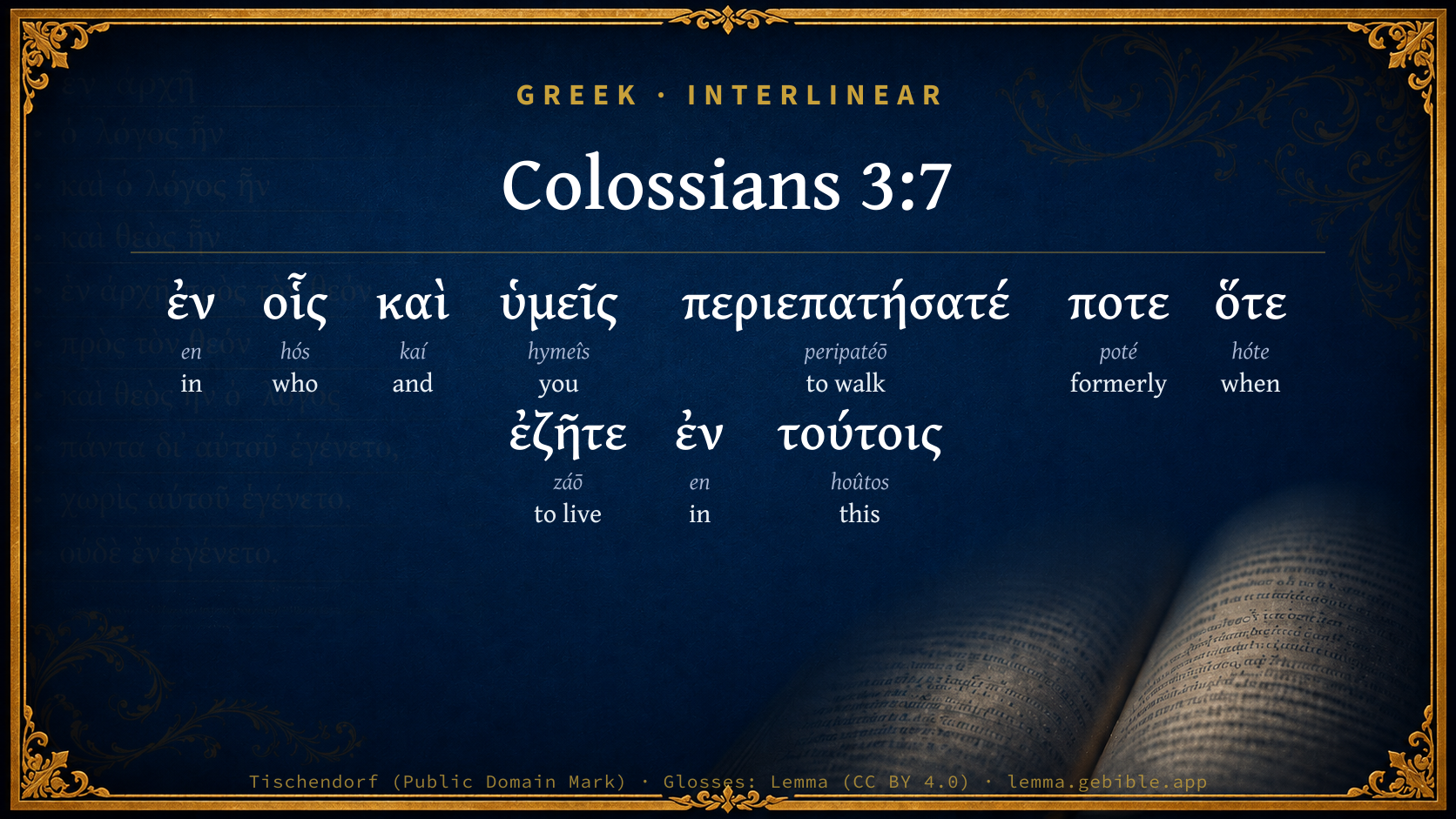
Greek (Tischendorf 8th ed.) Colossians 3:7 appears in the Greek New Testament. The text above is from the Tischendorf 8th edition. Each word links to its Strong’s number and a concise gloss. Click any word for its full Thayer’s Greek Lexicon entry.
Download image
Cite this verse

Colossians 3:7 (World English Bible). Public Domain. Lemma interlinear Bible study tool, https://lemma.gebible.app/v/colossians/3/7.

Show BibTeX & RIS
BibTeX
RIS
English Translation
You also once walked in those, when you lived in them;
World English Bible · Public Domain
Download a study sheet

One document with this verse’s original text, its word-by-word gloss line, the meaning frame, cross-references with their text, attributed commentary, and full source and license credits — printable, and it pastes into notes with its structure intact.

This verse Autodidact and up

Study sheet (.html) Plain text (.txt)

A passage Seminary Student

Up to 50 verses in one chapter. A passage sheet keeps up to 6 commentary sources and 12 cross-references per verse, in the order this page ranks them, and says so on the sheet whenever that leaves anything out. Ask for a single verse and you get the Autodidact verse sheet above.

Everything on this page stays free to read, with no account — the sheet is a download of what is already on screen, not access to it.

Want to remove ads? Support Godless Engineer
Compare translations 3

The same verse in 3 English versions, stacked beneath the original-language interlinear above. Click any original word for its lexicon entry.

Each is an independent rendering of the whole verse — the interlinear is not word-aligned to these translations.

Highlighted words mark where these versions differ — a whole-verse word diff, not a word-by-word alignment.

  • World English Bible Public Domain
    You also once walked in those, when you lived in them;
  • King James Version Public Domain
    In the which ye also walked some time, when ye lived in them.
  • unfoldingWord Literal Text CC BY-SA 4.0
    in which you also formerly walked when you were living in them.

unfoldingWord Literal Text — © unfoldingWord, licensed CC BY-SA 4.0. Word-aligned USFM3 via Door43 (git.door43.org/unfoldingWord/en_ult).

Versions to compare (up to 4)

3 of 4 selected

Show all 19 translations

Every available English version of this verse, each an independent rendering of the whole verse.

  • World English Bible Public Domain
    You also once walked in those, when you lived in them;
  • Berean Standard Bible Public Domain
    When you lived among them, you also used to walk in these ways.
  • Majority Standard Bible Public Domain
    When you lived among them, you also used to walk in these ways.
  • King James Version Public Domain
    In the which ye also walked some time, when ye lived in them.
  • American Standard Version (1901) Public Domain
    wherein ye also once walked, when ye lived in these things;
  • Revised Version (1885) Public Domain
    in the which ye also walked aforetime, when ye lived in these things.
  • Geneva Bible (1599) Public Domain
    Wherein ye also walked once, when ye liued in them.
  • Douay-Rheims (1899) Public Domain
    In which you also walked some time, when you lived in them.
  • Young's Literal Translation Public Domain
    in which also ye -- ye did walk once, when ye lived in them;
  • Literal Standard Version CC BY-SA 4.0
    in which you also—you once walked, when you lived in them;
  • Unlocked Literal Bible CC BY-SA 4.0
    It is in these things that you also once walked when you lived in them.
  • unfoldingWord Literal Text CC BY-SA 4.0
    in which you also formerly walked when you were living in them.
  • Darby Bible Public Domain
    In which *ye* also once walked when ye lived in these things.
  • World Messianic Bible Public Domain
    You also once walked in those, when you lived in them,
  • Webster's Bible Public Domain
    In which ye also walked formerly, when ye lived with them.
  • Free Bible Version CC BY-SA 4.0
    At one time you lived like that when you behaved in such a way,
  • Bible in Basic English Public Domain
    Among whom you were living in the past, when you did such things.
  • Text-Critical English NT CC BY 4.0
    You too once walked in these ways when you lived among them.
  • Tyndale New Testament (1534) Public Domain
    In which thynges ye walked once. when ye lived in them.

Literal Standard Version (2020), Covenant Press — licensed CC BY-SA 4.0. Text via the HelloAO Bible API (eBible.org). Unlocked Literal Bible (unfoldingWord) — licensed CC BY-SA 4.0. Text via the HelloAO Bible API (eBible.org). unfoldingWord Literal Text — © unfoldingWord, licensed CC BY-SA 4.0. Word-aligned USFM3 via Door43 (git.door43.org/unfoldingWord/en_ult). Free Bible Version, Dr. Jonathan Gallagher — licensed CC BY-SA 4.0. Text via the HelloAO Bible API (eBible.org).

Word by word

More ways to search: Search by grammar → Find every occurrence → Compare this word →

Practice this passage: Drill this verse → Learn its vocabulary →

About this verse

These counts appear in no published source. They are computed here, from the morphology-tagged text and Lemma’s own curated glosses. What Lemma adds →

10
words
9
distinct lemmas
Pauline Epistles
section

Shared distinctive vocabulary

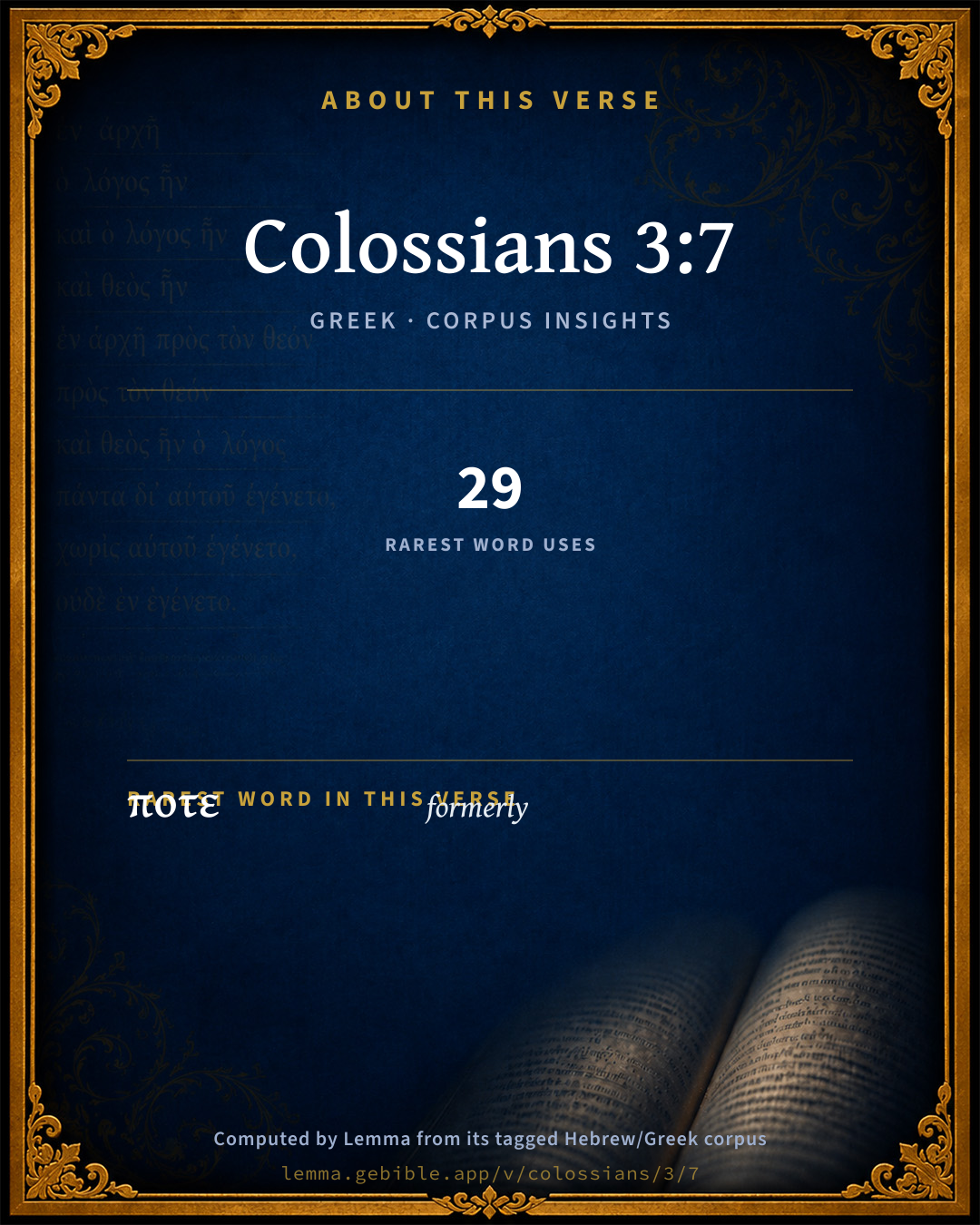
ποτε formerly G4218 occurs in 28 verses of the Greek New Testament. Also found in:

Repetition

A word recurs within this verse:

Cross-references

7

Topical passages linked to Colossians 3:7 in the Treasury of Scripture Knowledge — connected by theme and wording, ordered by reader-vote popularity; previews shown in the World English Bible.

  • Ephesians 2:2 in which you once walked according to the course of this world, according to the prince of the powers of the air, the spirit who now works in the children of disobedience;
  • 1 Peter 4:3–4 For we have spent enough of our past time doing the desire of the Gentiles, and having walked in lewdness, lusts, drunken binges, orgies, carousings, and abominable idolatries.
  • Romans 6:19–20 I speak in human terms because of the weakness of your flesh, for as you presented your members as servants to uncleanness and to wickedness upon wickedness, even so now present your members as servants to righteousness for sanctification.
  • Titus 3:3 For we were also once foolish, disobedient, deceived, serving various lusts and pleasures, living in malice and envy, hateful, and hating one another.
  • 1 Corinthians 6:11 Such were some of you, but you were washed. But you were sanctified. But you were justified in the name of the Lord Jesus, and in the Spirit of our God.
  • Romans 7:5 For when we were in the flesh, the sinful passions which were through the law, worked in our members to bring forth fruit to death.
  • Colossians 2:13 You were dead through your trespasses and the uncircumcision of your flesh. He made you alive together with him, having forgiven us all our trespasses,

Cross-references courtesy of OpenBible.info (CC BY 4.0).

Commentary

Notes on Colossians 3:7 from classic Christian and Jewish commentators (each source and its license shown beneath its notes). The classic Christian expositions comment on the surrounding passage and are grouped to its opening verse, so a note may address several verses; the Jewish commentaries on the Tanakh (Rashi and others) are per-verse, so they appear only where the commentator wrote on this verse.

Lemma curates 59 commentaries, every one of them public domain or Creative Commons licensed, each selected and text-cleaned for this edition rather than reprinted as found. About our sources →

Bengel's Gnomon

Johann Albrecht Bengel

Col 3:7. Ἐζῆτε, in which ye lived) as if in your essential first principle, origin, [i.e. these sins were the very air which you breathed from your birth, they were your] native element. Comp. Gal 5:25, on the spiritual life.

Bengel's Gnomon of the New Testament — English translation (T&T Clark, Edinburgh, 1860) — public domain. Text from a community e-Sword module.

Meyer's Critical & Exegetical Commentary

Heinrich August Wilhelm Meyer

Col_3:7. Transition to the following exhortation; and how touching through the effect of the contrast!

ἐν οἷς] is, with the reading διʼ ὅ in Col_3:6, necessarily to be referred to the υἱοὺς τ. ἀπειθ.: among whom ye also walked once, by which is meant, not external association (which in fact was not cancelled by conversion, 1Co_5:10), but the fellowship of moral conduct. But, even with the reading διʼ ἅ in Col_3:6, ἐν οἷς is to be taken (comp. Eph_2:2 f.) as inter quos (Vatablus, Rosenmüller, de Wette, Schenkel, Bleek), and not to be referred, as it commonly is (Chrysostom, however, seems to understand it as masculine) to the vices named in Col_3:5, because the relative most naturally attaches itself to what immediately precedes, in order to continue the discourse, and because, if ἐν οἷς refer to the sins, then ἐζῆτε ἐν τούτοις once more asserts substantially the same thing, so that the discourse gains nothing in thoughtfulness through the two verbs, as in Gal_5:25, but is unduly amplified. The distinctions which in this case have been attempted between περιπατεῖν and ζῆν still make the one or the other appear as self-evident. See e.g. Calvin: vivere and ambulare are distinguished from each other like potentia (comp. Grotius: moveri) and actus, the former preceding and the latter following; Beza (and Estius): vivere denotes naturae habitum, ambulare, ἐνέργειαν ipsam; Bähr (comp. Olshausen and Reiche): the former refers more to the disposition, the latter to the outward conduct; Hofmann: the state of life (ἐζῆτε), with which the conduct in detail (περιεπατ.) harmonized.

ὅτε ἐζῆτε ἐν τούτοις] ἐζῆτε stands emphatically and pregnantly first: when ye lived in these, i.e. when ye were alive therein, inasmuch as the ἀπεθάνετε of Col_3:3 had not yet set in in your case, the requirement of the νεκροῦν in Col_3:5 was still strange to you, and these disgraceful things formed the element and sphere of activity of your life. On ζῆν, to be alive, in contrast to the being dead, comp. Rom_7:9; 2Co_13:4; also Col_2:20; ἐν τούτοις[145] is neuter, grouping together demonstratively, and setting forth contemptuously, the states of vice spoken of. According to Flatt, Böhmer, and Huther, it is masculine: then, when ye belonged to the children of disobedience, so that ζῆν ἐν κόσμῳ (Col_2:20) and ἀναστρέφειν ἐν τῷ κόσμῳ (2Co_1:11) would have to be compared. In opposition to this view it may be urged that ὅτε ἐζῆτε ἐν τούτοις, in this sense, would be a very meaningless and superfluous more precise designation of the ποτέ, whereas, according to the view above adopted, it is thoughtful and characteristic.[146]

On the change from the merely historical aorist to the descriptive imperfect, lending a lively colour to the representation, and claiming the closer attention of the reader who had passed more rapidly over the περιεπατ., comp. Kühner, II. 1, p. 133, and Reisig, ad Soph. O. C. p. 254 f.

[145] With the Recepta αὐτοῖς any other reference than that, which οἷς has, is excluded; hence the origin of μὐτοῖς.

[146] Hence not to be attributed, with Holtzmann, to the tautological style of the author, in remembrance of 1Co_6:11.

Meyer — Critical and Exegetical Commentary on the New Testament — English translation by Peter Christie, edited by Frederick Crombie (T&T Clark, 1880) — public domain. Text from a community e-Sword module.

Expositor's Greek Testament

ed. W. Robertson Nicoll

Col 3:7 . ἐν οἶς : in which vices. If τ . υἱοὺς τ . ἀπ . be retained, the probable translation is “in whom”. Lightfoot thinks in any case the reference to the vices is to be preferred, the chief reason being that Paul could not blame his readers for living among the Gentiles. But, as Meyer points out, περιεπ . implies participation in conduct. καὶ ὑμεῖς : you as well as those who still practise these vices. περιεπατήσατέ : a Hebraistic metaphor expressing moral conduct. ἐζῆτε ἐν τούτοις : “ye were living in them,” i.e. , in these vices. The reference is to their pre-Christian state, in which sin was the atmosphere of their lives. The change of tense should be noticed.

The Expositor's Greek Testament, edited by W. Robertson Nicoll (1897–1910) — public domain. Text from a community e-Sword module.

Jamieson, Fausset & Brown

Robert Jamieson, A. R. Fausset & David Brown

sometime--"once."

walked . . . when ye lived in them--These sins were the very element in which ye "lived" (before ye became once for all dead with Christ to them); no wonder, then, that ye "walked" in them. Compare on the opposite side, "living in the Spirit," having as its legitimate consequence, "walking in the Spirit" (Gal 5:25). The "living" comes first in both cases, the walking follows.

Jamieson, Fausset & Brown — Commentary Critical and Explanatory on the Whole Bible (1871) — public domain (CC PDM 1.0). Text via the HelloAO Bible API.

Adam Clarke's Commentary

Verse 7. In the which ye also walked sometime] When ye were in your unconverted state, ye served divers lusts and pleasures. See Clarke on Ro 7:5, and "Eph 2:2".

Adam Clarke's Commentary on the Bible (1810–1826) — public domain. Text from a community e-Sword/MySword module.

John Calvin's Commentaries

7. In which ye walked. Erasmus mistakingly refers this to men, rendering it, “inter quos,” (“among whom,”) for there can be no doubt that Paul had in view the vices, in which he, says that the Colossians had walked, during the time that they lived in them. For living and walking differ from each other, as power does from action. Living holds the first place: walking comes afterwards, as in Galatians 5:25,

If ye live in the SPIRIT, WALK also in the Spirit.

By these words he intimates, that it were an unseemly thing that they should addict themselves any more to the vices, to which they had died through Christ. See the sixth chapter of the Epistle to the Romans. It is an argument from a withdrawment of the cause to a withdrawment of the effect.

John Calvin's Commentaries (1540-1563) — public domain. Text from the Calvin Translation Society English edition (1840s-50s) via the Christian Classics Ethereal Library (ccel.org). Calvin's coverage is partial (roughly two-thirds of the Bible); uncommented books and verses are honest gaps, never fabricated. The 19th-century editor's footnotes and remarks are omitted so the notes are faithfully Calvin's own voice.

Ellicott's Commentary for English Readers

(7) In the which ye also walked some time, when ye lived (were living) in them.—The former condition of heathenism was that in which “they were living,” with contagion of evil on every side. But St. Paul is not content without noting their own active participation—“ye walked in them.” (Comp. Eph_4:17-20.)

A Bible Commentary for English Readers, edited by Charles John Ellicott (1878–1897) — public domain. Text from a community e-Sword module.

The Cambridge Bible for Schools and Colleges

gen. ed. J. J. S. Perowne

7. In the which] “things,” mentioned just above.—Otherwise we may render, “among whom” (R. V. margin); i.e. among “the children of disobedience.” If those words are not retained in the text, this latter rendering of course falls.

walked] The same verb is rendered (by A. V.) in the parallel, Eph_2:3, “had our conversation,” that is, our action and intercourse in life. The metaphor “walk” in such a sense is common in St Paul. See above on Col_1:10.—With this searching appeal to memory cp. 1Co_6:11; Eph_2:2; Eph_4:22; Eph_5:8; Tit_3:3; 1Pe_4:3.

sometime] “Sumtyme,” Wyclif; antique English for “once on a time.” So “sometimes” in the A. V. of Eph_2:13.—In Eph_2:3 (parallel here) the A.V. renders the same Greek, “in times past.”

lived] Not merely “existed,” or “dwelt,” but found what seemed “life.” See on Col_2:20 above. From the “life” issues the “walk,” as Lightfoot points out.—“He argues from the withdrawal of the cause to the withdrawal of the effect” (Calvin).

in them] Far better, with mss. &c., in these things (R. V.).

The Cambridge Bible for Schools and Colleges (gen. ed. J. J. S. Perowne; Cambridge University Press, 1878–1918) — public domain. Text from a community e-Sword module.

John Gill's Exposition

In the which ye also walked some time,.... Either in or among the children of disobedience, Col 3:6, or rather in the afore mentioned sins, Col 3:5. Sin is a road or path, in which sinners walk a way of their own, or of their own choosing and approving, though a dark and crooked one, and which leads to destruction: walking herein denotes a continued series of sinning, a persisting in it, a progress therein, a proceeding from evil to evil, taking pleasure, and going on securely in it; and which is the case and state of God's elect before conversion, which is a turning of them from darkness to light, from the power of Satan to God, and out of the ways of sin, into the paths of righteousness, when the course of their walk, of their lives and conversations, is altered; and which is suggested here, and made use of as another reason for the mortification of the deeds of the body of sin, taken from their former state, and their deliverance out of it; and therefore the time past of their lives, when they walked in these things, should suffice, and they should now cease from sin, from a series and course of sinning:

when ye lived in them; in sins, and were dead in them; for to be dead in sin, and to live in sin, is the same thing; living in sin is the death of sin. To live in sin is to live after the flesh, after the dictates of corrupt nature, to live a sinful course of life; it is for a man to give up himself to sin, be wholly bent upon it, take delight in it, and make it his work and business. This had been the case of these believers, but now they were dead to sin, and it became them to live no longer therein, but to mortify it by denying it, and abstaining from it, and living soberly, righteously, and godly.

John Gill's Exposition of the Whole Bible (1746–1763) — public domain (CC PDM 1.0). Text via the HelloAO Bible API.

Trapp's Complete Commentary

John Trapp

7 In the which ye also walked some time, when ye lived in them.

Ver. 7. When ye lived in them] Man’s life is a walk, and each action a step either to heaven or hell.

John Trapp, A Commentary or Exposition upon All the Books of the Old and New Testament (1647–1656) — public domain. Text from a community e-Sword module.

Albert Barnes' Notes on the Bible

In the which - In all which evil passions.

Ye also walked sometime - You formerly lived. These were the common vices of the pagan; Eph 5:8, note; 1Co 6:10-11, notes; compare Rom 1:24-32, notes.

Albert Barnes' Notes on the Bible (1834–1885) — public domain. Text from a community e-Sword/MySword module.

Matthew Poole's English Annotations

In the which; some render it, amongst whom; but, alas! They lived amongst such disobedient ones still; therefore we do better render it in which, i.e. sins or vices.

Ye, the now believing Colossians, also walked some time; had heretofore practised and exercised; and had not only been infected with the venom of them, in descending from polluted parents, but lived in them, were servants to them, Rom 6:17,19, while in a sensual course of life they were carried away with them, 1Co 12:2, before their conversion, when they did live and reign in their mortal bodies, Col 1:21; 1Co 6:11; Eph 2:3,11,12; 5:8.

Matthew Poole's English Annotations on the Holy Bible (1683–1685) — public domain. Text from a community e-Sword/MySword module.

Whedon's Commentary on the Bible

Daniel D. Whedon

7. Ye also walked—They had once been alive to these things, and freely practised them, as did the mass of heathens around them. But they had now become alive to God, and had put off those sins.

Daniel D. Whedon (gen. ed.), Commentary on the Old and New Testaments (1874–1909) — public domain. Text from a community e-Sword module.

The Pulpit Commentary

In which also ye walked once, when you were living in these (things) (Eph_2:3 Eph_5:8; Rom_6:19-21; 1Co_6:11 1Co_12:2; Tit_3:3; 1Pe_4:3) Even retaining "sons of disobedience" in ver. 6, it seems better, with Alford, Lightfoot, and the English Version, to read oi=v as neuter, "in which," referring to the same antecedent (ver. 5)as "because of which" in ver. 6; not "amongst whom" (Ellicott, Meyer). The latter interpretation is against the general usage of "walk in" with St. Paul (Col_4:5; Eph_2:2, 10 4:17; Rom_6:4; 2Co_4:2) and seems to condemn the mere fact of living "amongst the sons of disobedience" (see, on the other (1Co_5:9, 1Co_5:10; Php_2:15; Joh_17:15; 1Pe_2:12) The parallel "because of which" (ver. 6) gives also its force: these sins are visited with the Divine anger, and moreover are the very sins in which the Colossians aforetime had lived; observe the same connection in Eph_5:6-8; 1Co_6:10, 1Co_6:11. "Were living" stands opposed to "make dead" of ver. 5, and to "ye died". (ver. 3: Col_2:20; Gal_2:20) it marks the time when "the old man" (ver. 9), with his "earthly members" (ver. 5) was alive and active. (comp. Rom_7:5, Rom_7:9, "sin came to life "In these things" (toutoiv, not aujtoiv: Revised Text) points to the things enumerated in ver. 6, with a mental gesture of contempt.

The Pulpit Commentary (1880–1919), ed. H.D.M. Spence-Jones & Joseph S. Exell — public domain. Text from a community e-Sword module.

John Wesley's Explanatory Notes

Living denotes the inward principle; walking, the outward acts.

John Wesley, Explanatory Notes Upon the Whole Bible (1754–1765) — public domain. Text via the GEBible commentary corpus.

The People's New Testament

B. W. Johnson

7. In the which ye also walked. They had been Gentile heathen, and among them licentiousness was at that time universal. See notes on 1 Cor. 6:9–11. Even moralists sanctioned every kind of unchastity except that of a wife.

B. W. Johnson's The People's New Testament with Notes (1889–1891) — public domain. Electronic text from the Christian Classics Ethereal Library (CCEL) ThML edition.

Cambridge Greek Testament for Schools and Colleges

7. ἐν οἷς. Certainly neuter with the short form of Col 3:6, and almost certainly neuter even with the long form, for “περιπατεῖν ἐν is most commonly used of things, not of persons, especially in this and the companion epistle, Col 4:5; Eph 2:2; Eph 2:10; Eph 4:17; Eph 5:2” (Lightfoot). In fact 2Th 3:11 appears to be the only passage in St Paul’s Epistles where this is not the case, exclusive of course of such phrases as περιπατεῖν ἐν Χριστῷ.

καὶ ὑμεῖς. In implied distinction from the ungodly among whom you no longer are.

περιεπατήσατέ cf. Col 1:10. ποτε, Col 1:21.

ὅτε ἔζητε ἐν τούτοις. τούτοις neut. emphatic (Joh 9:31), and perhaps contemptuous. For ζῆν ἐν cf. Col 2:20, finding interest and spending energy in these things, “tanquam in vestro principio, origine, elemento” (Beng.). Wetstein compares Cicero, Ep. IX. 26, “Vivas, inquis, in literis? Quidquam me aliud agere censes? aut possem vivere, nisi in literis viverem?”

Cambridge Greek Testament for Schools and Colleges (Cambridge University Press, 1896; 21 vols, various authors incl. Carr, Maclear, Plummer, Farrar, Lumby, Moule, M. R. James, Simcox) — public domain. Text from a community e-Sword module.

International Critical Commentary

7. ἐν οἷς καὶ ὑμεῖς περιεπατήσατέ ποτε, ὅτε ἐζῆτε ἐν τούτοις. The reading τούτοις is certain, being that of א A B C D* al. αὐτοῖς is read in Dc G K L, most MSS., Chrys., Theodoret, al.

If the doubtful words in ver. 6 are omitted, οἷς and τούτοις are of necessity both neuter, and refer to the vices mentioned. If the words are retained, the pronouns may be both neuter, or the first masculine and the second neuter, or the first neuter, and the second masculine. To the last view, which is that of Huther and others, it may be objected, that ζῆν ἐν is never used in the N.T. of living amongst persons, while it is frequently used with things, ἐν ἁμαρτίᾳ, Rom 6:2; ἐν κόσμῳ, 2:20; ἐν σαρκί, Php 1:22. So in classical writers, ἐν ἀρετῇ, ἐν φιλοσοφίᾳ, etc. Meyer, De Wette, Braune, and Ellicott take οἷς as masc., τούτοις neuter. In favour of this seems to be the partial parallel, Eph 2:2, Eph 2:3, εἰ τοῖς υἱοῖς τῆς ἀπειθείας ἐν οἷς καὶ ἡμεῖς πάντες ἀνεστράφημέν ποτε, a parallel which Ellicott thinks leaves no room for doubt. Of course, περιπατεῖν ἐν would then be understood to denote not mere outward living amongst, but participation in a course of life. Alford and Lightfoot argue that, independently of the rejection of the doubtful words, it is better to take οἷς as neuter, since περιπατεῖν ἐν is most commonly used of things, not of persons, especially in this and the companion Epistle, 4:5, Eph 2:2, Eph 2:10, Eph 2:4:17, Eph 2:5:2. In 2Th 3:11, indeed, we have τινας περιπατοῦντας ἐν ὑμῖν ἀτάκτως: but the addition of ἀτάκτως there makes the expression not quite parallel. So Eph 2:3 Lightfoot regards as not parallel on account of the addition ἐν ταῖς ἐπιθυμίαις τῆς σαρκὸς ἡμῶν. But this addition does not affect the connexion of ἐν οἷς ἀνεστρ. And Alford admits that, if the clause ἐπὶ τ. υἱ. τ. ἁπ. is retained, this parallel goes far to decide the matter.

ὅτε ἐζῆτε ἐν τούτοις, i.e. before ye died to the world; ἐζῆτε being in contrast with ἀπεθάνετε. The change of tense is to be observed. περιεπατήσατε, aorist, because denoting single acts, ἐζῆτε expressing the containing state. For the difference in sense, compare Gal 5:25, εἰ ζῶμεν πνεύματι, πνεύματι καὶ στοιχῶμεν. “Vivere et ambulare inter se differunt, quemadmodum potentia et actus; vivere praecedit, ambulare sequitur,” Calvin.

International Critical Commentary — older volumes (1896–1929), various authors — public domain. Text from a community e-Sword module.

Vincent's Word Studies in the New Testament

Marvin R. Vincent

In the which [εν οις] . The omission of upon the children, etc., necessitates the reference to which things (ver. 6) Otherwise we might render among whom.

Walked - lived. Walked, referring to their practice, lived, to their condition. Their conduct and their condition agreed. Compare Gal 5:25.

Marvin R. Vincent, Word Studies in the New Testament (1887–1900) — public domain. Text from a community e-Sword/MySword module.

Lightfoot's Colossians and Philemon

J. B. Lightfoot

ἐν οἷς κ.τ.λ.] The clause ἐπὶ τοὺς ὑιοὺς τῆς ἀπειθείας having been struck out, ἐν οἷς must necessarily be neuter and refer to the same as δι’ ἅ. Independently of the rejection of the clause, this neuter seems more probable in itself than the masculine: for (1) The expression περιπατεῖν ἐν is most commonly used of things, not of persons, especially in this and the companion epistle; iv. 5, Ephes. ii. 2, 10, iv. 17, v. 2; (2) The Apostle would hardly denounce it as a sin in his Colossian converts that they ‘walked among the sons of disobedience’; for the Christian, though not of the world, is necessarily in the world: comp. 1 Cor. v. 10. The apparent parallel, Ephes. ii. 3 ἐν οἷς καὶ ἡμεῖς πάντες ἀνεστράφημέν ποτε ἐν ταῖς ἐπιθυμίαις τῆς σαρκὸς ἡμῶν (where οἷς seems to be masculine), does not hold, because the addition ἐν ταῖς ἐπιθυμίαις κ.τ.λ. makes all the difference. Thus the rejection of the clause, which was decided by textual considerations, is confirmed by exegetical reasons.

7. καὶ ὑμεῖς] ‘ye, like the other heathen’ (i. 6 καὶ ἐν ὑμῖν), but in the next verse καὶ ὑμεῖς is rather ‘ye yourselves’, ‘ye notwithstanding your former lives’.

ὅτε ἐζῆτε κ.τ.λ.] ‘When ye lived in this atmosphere of sin, when ye had not yet died to the world’.

ἐν τούτοις] ‘in these things.’ We should have expected αὐτοῖς, but τούτοις is substituted as more emphatic and condemnatory: comp. Ephes. v. 6 διὰ ταῦτα γὰρ ἐρχεται κ.τ.λ. The two expressions ζῆν ἐν and περιπατεῖν ἐν involve two distinct ideas, denoting the condition of their life and the character of their practice respectively. Their conduct was conformable to their circumstances. Comp. Gal. v. 25 εἰ ζῶμεν πνεύματι, πνεύματι καὶ στοιχῶμεν.

J. B. Lightfoot, St Paul's Epistles to the Colossians and Philemon: a revised text with introductions, notes and dissertations (London: Macmillan, 1875) — public domain. Electronic text from Project Gutenberg (ebook #50857). Covers Colossians and Philemon only (the verse-by-verse notes; introductions and dissertations are omitted); Lightfoot's companion Galatians and Philippians volumes are not included, as the available public-domain scans carry garbled Greek that cannot be faithfully reproduced.

Lesson kit

Teaching starters — assembled from the data on this page, not authored interpretation. Every prompt links to the verse data it draws on. Edit before teaching.

Colossians, in the Pauline Epistles, opens this verse with 10 words (9 distinct Greek lemmas). Its most distinctive word is poté (“formerly”). A historical commentator’s framing appears above. Read the whole chapter for the surrounding context.

Discussion questions

  1. How does “formerly” (poté) shape what this verse is saying?
  2. Luke 22:32 shares the word «formerly» with this verse. How do the two illuminate each other?
  3. “in” occurs 2× in this one verse. What is the effect of the repetition?
  4. These translations render this verse differently. What is at stake in choosing one wording over another?
  5. Reading how Bengel's Gnomon and Meyer's Critical & Exegetical Commentary read this verse, where do the two commentators agree and where do they part?

Things to notice

  • These translations choose different wording for 8 words in this verse.
  • “in” occurs 2× in this single verse.
  • 9 distinct Greek lemmas span 10 words in this verse.

Reading settings

Reading text

Shown beneath each verse's original-language words.

Old Testament
Old Testament edition

Read the OT as the Masoretic Hebrew (MT) or the Greek Septuagint (LXX).

English shown for the Greek Septuagint (in the Hebrew ↔ Greek comparison).

Comparing translations? Open the Compare panel on any verse page to stack up to four side by side.