

Acts 1:13
Greek (Tischendorf 8th ed.) Acts 1:13 appears in the Greek New Testament. The text above is from the Tischendorf 8th edition. Each word links to its Strong’s number and a concise gloss. Click any word for its full Thayer’s Greek Lexicon entry.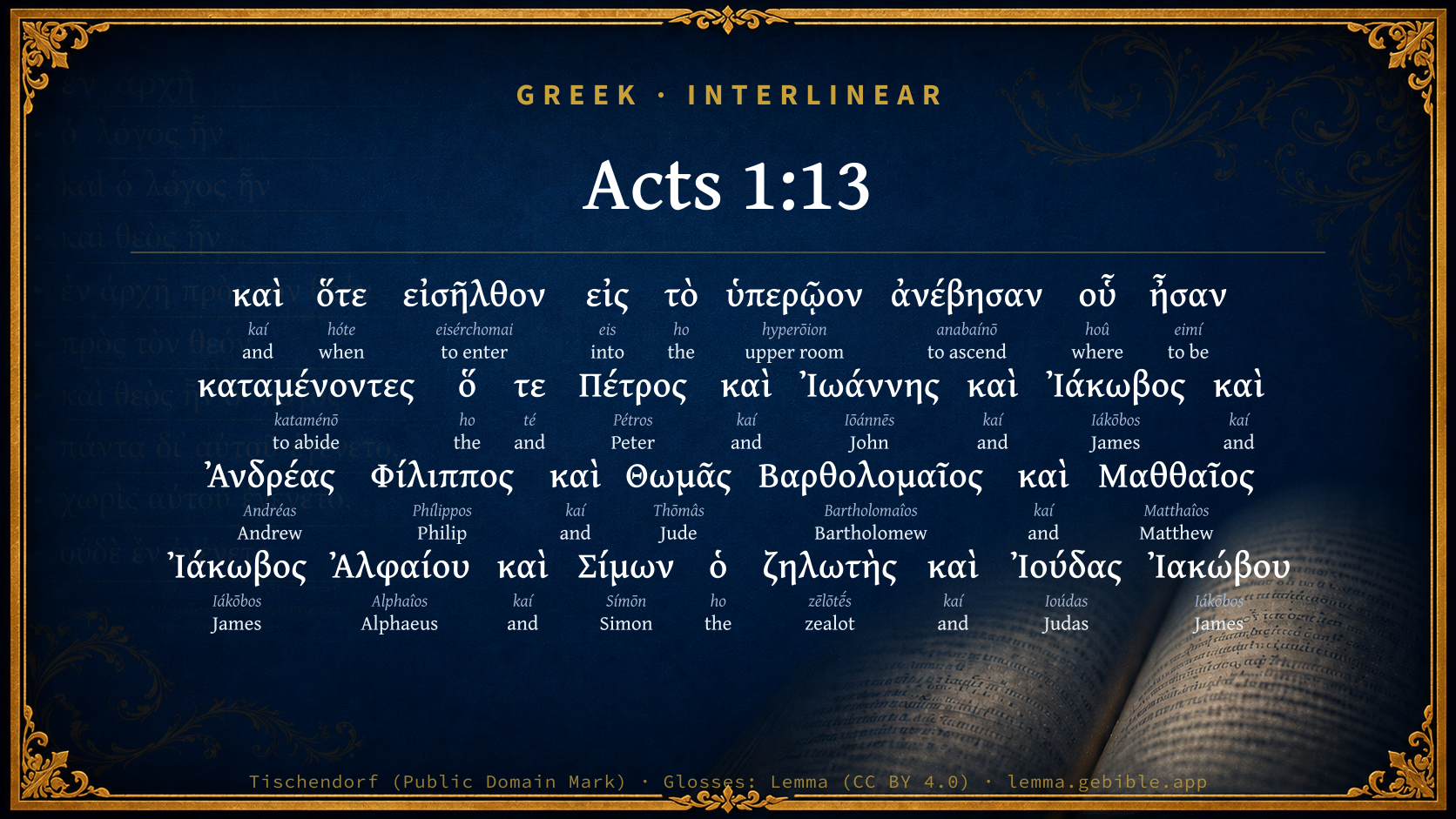
When they had come in, they went up into the upper room, where they were staying; that is Peter, John, James, Andrew, Philip, Thomas, Bartholomew, Matthew, James the son of Alphaeus, Simon the Zealot, and Judas the son of James.
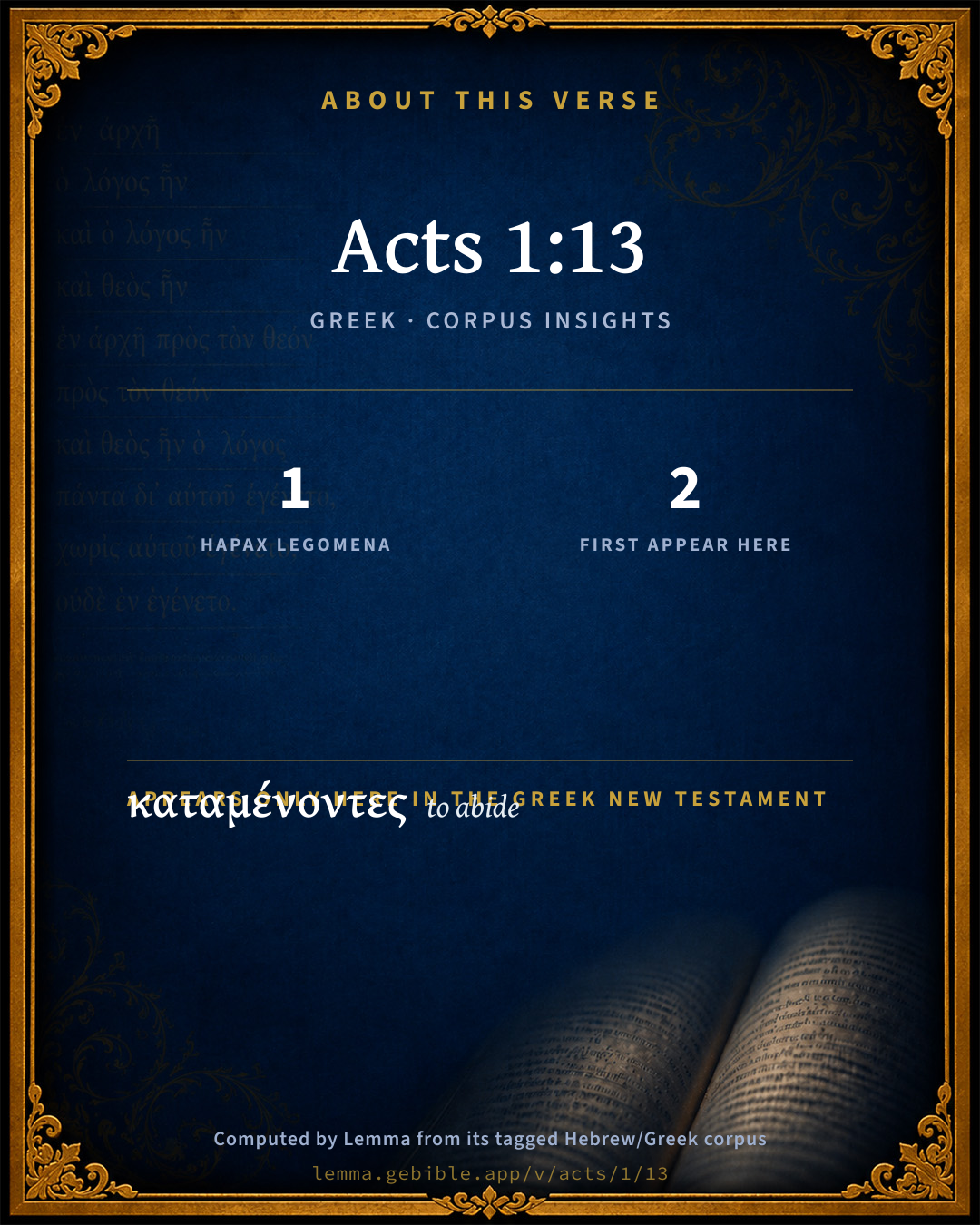
- 1 hapax legomenon — only here in the Greek New Testament
- 2 first appearances in the Greek New Testament
Download a study sheet
One document with this verse’s original text, its word-by-word gloss line, the meaning frame, cross-references with their text, attributed commentary, and full source and license credits — printable, and it pastes into notes with its structure intact.
This verse Autodidact and up
A passage Seminary Student
Up to 50 verses in one chapter. A passage sheet keeps up to 6 commentary sources and 12 cross-references per verse, in the order this page ranks them, and says so on the sheet whenever that leaves anything out. Ask for a single verse and you get the Autodidact verse sheet above.
Everything on this page stays free to read, with no account — the sheet is a download of what is already on screen, not access to it.
Compare translations 3
The same verse in 3 English versions, stacked beneath the original-language interlinear above. Click any original word for its lexicon entry.
Each is an independent rendering of the whole verse — the interlinear is not word-aligned to these translations.
Highlighted words mark where these versions differ — a whole-verse word diff, not a word-by-word alignment.
-
World English Bible Public Domain
When they had come in, they went up into the upper room, where they were staying; that is Peter, John, James, Andrew, Philip, Thomas, Bartholomew, Matthew, James the son of Alphaeus, Simon the Zealot, and Judas the son of James.
-
King James Version Public Domain
And when they were come in, they went up into an upper room, where abode both Peter, and James, and John, and Andrew, Philip, and Thomas, Bartholomew, and Matthew, James the son of Alphaeus, and Simon Zelotes, and Judas the brother of James.
-
unfoldingWord Literal Text CC BY-SA 4.0
And when they arrived, they went up into the upper chamber where they were staying, both Peter and John, and James and Andrew, Philip and Thomas, Bartholomew and Matthew, James of Alphaeus and Simon the Zealot, and Judas of James.
unfoldingWord Literal Text — © unfoldingWord, licensed CC BY-SA 4.0. Word-aligned USFM3 via Door43 (git.door43.org/unfoldingWord/en_ult).
Show all 19 translations
Every available English version of this verse, each an independent rendering of the whole verse.
-
World English Bible Public Domain
When they had come in, they went up into the upper room, where they were staying; that is Peter, John, James, Andrew, Philip, Thomas, Bartholomew, Matthew, James the son of Alphaeus, Simon the Zealot, and Judas the son of James.
-
Berean Standard Bible Public Domain
When they arrived, they went to the upper room where they were staying: Peter and John, James and Andrew, Philip and Thomas, Bartholomew and Matthew, James son of Alphaeus, Simon the Zealot, and Judas son of James.
-
Majority Standard Bible Public Domain
When they arrived, they went to the upper room where they were staying: Peter and James, John and Andrew, Philip and Thomas, Bartholomew and Matthew, James son of Alphaeus, Simon the Zealot, and Judas son of James.
-
King James Version Public Domain
And when they were come in, they went up into an upper room, where abode both Peter, and James, and John, and Andrew, Philip, and Thomas, Bartholomew, and Matthew, James the son of Alphaeus, and Simon Zelotes, and Judas the brother of James.
-
American Standard Version (1901) Public Domain
And when they were come in, they went up into the upper chamber, where they were abiding; both Peter and John and James and Andrew, Philip and Thomas, Bartholomew and Matthew, James `the son' of Alphaeus, and Simon the Zealot, and Judas `the son' of James.
-
Revised Version (1885) Public Domain
And when they were come in, they went up into the upper chamber, where they were abiding; both Peter and John and James and Andrew, Philip and Thomas, Bartholomew and Matthew, James the son of Alphaeus, and Simon the Zealot, and Judas the son of James.
-
Geneva Bible (1599) Public Domain
And when they were come in, they went vp into an vpper chamber, where abode both Peter and Iames, and Iohn, and Andrew, Philip, and Thomas, Bartlemew, and Matthewe, Iames the sonne of Alpheus, and Simon Zelotes, and Iudas Iames brother.
-
Douay-Rheims (1899) Public Domain
And when they were come in, they went up into an upper room, where abode Peter and John, James and Andrew, Philip and Thomas, Bartholomew and Matthew, James of Alpheus, and Simon Zelotes, and Jude the brother of James.
-
Young's Literal Translation Public Domain
and when they came in, they went up to the upper room, where were abiding both Peter, and James, and John, and Andrew, Philip, and Thomas, Bartholomew, and Matthew, James, of Alphaeus, and Simon the Zelotes, and Judas, of James;
-
Literal Standard Version CC BY-SA 4.0
and when they came in, they went up into the upper room, where were abiding both Peter, and James, and John, and Andrew, Philip, and Thomas, Bartholomew, and Matthew, James, of Alphaeus, and Simon the Zealot, and Judas, of James;
-
Unlocked Literal Bible CC BY-SA 4.0
When they arrived, they went up into the upper chamber, where they were staying. They were Peter, John, James, Andrew, Philip, Thomas, Bartholomew, Matthew, James son of Alphaeus, Simon the Zealot, and Judas son of James.
-
unfoldingWord Literal Text CC BY-SA 4.0
And when they arrived, they went up into the upper chamber where they were staying, both Peter and John, and James and Andrew, Philip and Thomas, Bartholomew and Matthew, James of Alphaeus and Simon the Zealot, and Judas of James.
-
Darby Bible Public Domain
And when they were come into [the city], they went up to the upper chamber, where were staying both Peter, and John, and James, and Andrew, Philip and Thomas, Bartholomew and Matthew, James [son] of Alphaeus, and Simon the zealot, and Jude [the brother] of James.
-
World Messianic Bible Public Domain
When they had come in, they went up into the upper room where they were staying, that is Peter, Yochanan, Jacob, Andrew, Philip, Thomas, Bartholomew, Matthew, Jacob the son of Halfai, Simon the Zealot, and Judah the son of Jacob.
-
Webster's Bible Public Domain
And when they had come in, they went into an upper room, where abode both Peter, and James, and John, and Andrew, Philip, and Thomas, Bartholomew, and Matthew, James the son of Alpheus, and Simon Zelotes, and Judas the brother of James.
-
Free Bible Version CC BY-SA 4.0
When they arrived, they went upstairs to the upper room where they were staying: Peter, John, James and Andrew; Philip and Thomas; Bartholomew and Matthew; James the son of Alphaeus, Simon the Zealot, and Judas the son of James.
-
Bible in Basic English Public Domain
And when they came in, they went up into the room where they were living; Peter and John and James and Andrew, Philip and Thomas, Bartholomew and Matthew, James, the son of Alphaeus, and Simon the Zealot, and Judas, the son of James.
-
Text-Critical English NT CC BY 4.0
After entering the city, they went up to the upper room where they were staying. Those present were Peter, James, John, Andrew, Philip, Thomas, Bartholomew, Matthew, James the son of Alphaeus, Simon the Zealot, and Judas the son of James.
-
Tyndale New Testament (1534) Public Domain
And when they were come in they went vp into a parler where abode both Peter and Iames Iohn and Andrew Philip and Thomas Bartlemew and Mathew Iames the sonne of Alpheus and Simon Zelotes and Iudas Iames sonne.
Literal Standard Version (2020), Covenant Press — licensed CC BY-SA 4.0. Text via the HelloAO Bible API (eBible.org). Unlocked Literal Bible (unfoldingWord) — licensed CC BY-SA 4.0. Text via the HelloAO Bible API (eBible.org). unfoldingWord Literal Text — © unfoldingWord, licensed CC BY-SA 4.0. Word-aligned USFM3 via Door43 (git.door43.org/unfoldingWord/en_ult). Free Bible Version, Dr. Jonathan Gallagher — licensed CC BY-SA 4.0. Text via the HelloAO Bible API (eBible.org).
Word by word
More ways to search: Search by grammar → Find every occurrence → Compare this word →
Practice this passage: Drill this verse → Learn its vocabulary →
- Appears 1× in the Greek New Testament
- First appears here
- Part of Speech
- Verb
- Tense
- Present
- Voice
- Active
- Mood
- Participle
- Case
- Nominative
- Number
- Plural
- Gender
- Masculine
Full Thayer's Definition
- καὶ kaí G2532 “and” Conjunction
- ὅτε hóte G3753 “when” Adverb
- εἰσῆλθον eisérchomai G1525 “to enter” Verb, Aorist, Active, Indicative, 3rd person, Plural
- εἰς eis G1519 “into” Preposition
- τὸ ho G3588 “the” Article, Accusative, Singular, Neuter
- ὑπερῷον hyperōion G5253 “upper room” Noun, Accusative, Singular, Neuter
- ἀνέβησαν anabaínō G305 “to ascend” Verb, Aorist, Active, Indicative, 3rd person, Plural
- οὗ hoû G3757 “where” Adverb
- ἦσαν eimí G1510 “to be” Verb, Imperfect, Active, Indicative, 3rd person, Plural
- καταμένοντες kataménō G2650 “to abide” Verb, Present, Active, Participle, Nominative, Plural, Masculine
- ὅ ho G3588 “the” Article, Nominative, Singular, Masculine
- τε té G5037 “and” Particle
- Πέτρος Pétros G4074 “Peter” Noun, Nominative, Singular, Masculine
- καὶ kaí G2532 “and” Conjunction
- Ἰωάννης Iōánnēs G2491 “John” Noun, Nominative, Singular, Masculine
- καὶ kaí G2532 “and” Conjunction
- Ἰάκωβος Iákōbos G2385 “James” Noun, Nominative, Singular, Masculine
- καὶ kaí G2532 “and” Conjunction
- Ἀνδρέας Andréas G406 “Andrew” Noun, Nominative, Singular, Masculine
- Φίλιππος Phílippos G5376 “Philip” Noun, Nominative, Singular, Masculine
- καὶ kaí G2532 “and” Conjunction
- Θωμᾶς Thōmâs G2381 “Jude” Noun, Nominative, Singular, Masculine
- Βαρθολομαῖος Bartholomaîos G918 “Bartholomew” Noun, Nominative, Singular, Masculine
- καὶ kaí G2532 “and” Conjunction
- Μαθθαῖος Matthaîos G3156 “Matthew” Noun, Nominative, Singular, Masculine
- Ἰάκωβος Iákōbos G2385 “James” Noun, Nominative, Singular, Masculine
- Ἀλφαίου Alphaîos G256 “Alphaeus” Noun, Genitive, Singular, Masculine
- καὶ kaí G2532 “and” Conjunction
- Σίμων Símōn G4613 “Simon” Noun, Nominative, Singular, Masculine
- ὁ ho G3588 “the” Article, Nominative, Singular, Masculine
- ζηλωτὴς zēlōtḗs G2207 “zealot” Noun, Nominative, Singular, Masculine
- καὶ kaí G2532 “and” Conjunction
- Ἰούδας Ioúdas G2455 “Judas” Noun, Nominative, Singular, Masculine
- Ἰακώβου Iákōbos G2385 “James” Noun, Genitive, Singular, Masculine
About this verse
These counts appear in no published source. They are computed here, from the morphology-tagged text and Lemma’s own curated glosses. What Lemma adds →
- 34
- words
- 23
- distinct lemmas
- Acts
- section
Notable vocabulary
1 hapax legomenon — a word that appears only here in the entire Greek New Testament:
- καταμένοντες to abide G2650
First appearance in Scripture
These words make their first canonical appearance in the Greek New Testament here:
Shared distinctive vocabulary
ὑπερῷον upper room G5253 occurs in 4 verses of the Greek New Testament. Also found in:
Cross-references
44Topical passages linked to Acts 1:13 in the Treasury of Scripture Knowledge — connected by theme and wording, ordered by reader-vote popularity; previews shown in the World English Bible.
- Acts 20:8 There were many lights in the upper chamber where we were gathered together.
- Luke 22:12 He will show you a large, furnished upper room. Make preparations there."
- Mark 14:15 He will himself show you a large upper room furnished and ready. Make ready for us there."
- Matthew 10:2–4 Now the names of the twelve apostles are these. The first, Simon, who is called Peter; Andrew, his brother; James the son of Zebedee; John, his brother;
- Mark 2:14 As he passed by, he saw Levi, the son of Alphaeus, sitting at the tax office, and he said to him, "Follow me." And he arose and followed him.
- Mark 3:16–19 Simon, to whom he gave the name Peter;
- Acts 2:38 Peter said to them, "Repent, and be baptized, everyone of you, in the name of Jesus Christ for the forgiveness of sins, and you will receive the gift of the Holy Spirit.
- Acts 10:9–33 Now on the next day as they were on their journey, and got close to the city, Peter went up on the housetop to pray at about noon.
- Acts 12:17 But he, beckoning to them with his hand to be silent, declared to them how the Lord had brought him out of the prison. He said, "Tell these things to James, and to the brothers." Then he departed, and went to another place.
- James 1:1 James, a servant of God and of the Lord Jesus Christ, to the twelve tribes which are in the Dispersion: Greetings.
- Revelation 1:1–3 This is the Revelation of Jesus Christ, which God gave him to show to his servants the things which must happen soon, which he sent and made known by his angel to his servant, John,
- Matthew 4:18–22 Walking by the sea of Galilee, he saw two brothers: Simon, who is called Peter, and Andrew, his brother, casting a net into the sea; for they were fishermen.
- Matthew 9:9 As Jesus passed by from there, he saw a man called Matthew sitting at the tax collection office. He said to him, "Follow me." He got up and followed him.
- Mark 5:37 He allowed no one to follow him, except Peter, James, and John the brother of James.
- Mark 9:2 After six days Jesus took with him Peter, James, and John, and brought them up onto a high mountain privately by themselves, and he was changed into another form in front of them.
- Mark 14:33 He took with him Peter, James, and John, and began to be greatly troubled and distressed.
- Luke 5:27–29 After these things he went out, and saw a tax collector named Levi sitting at the tax office, and said to him, "Follow me!"
- Luke 6:13–16 When it was day, he called his disciples, and from them he chose twelve, whom he also named apostles:
- John 1:40–46 One of the two who heard John, and followed him, was Andrew, Simon Peter's brother.
- John 6:5–7 Jesus therefore lifting up his eyes, and seeing that a great multitude was coming to him, said to Philip, "Where are we to buy bread, that these may eat?"
- John 11:16 Thomas therefore, who is called Didymus, said to his fellow disciples, "Let's go also, that we may die with him."
- John 12:21–22 These, therefore, came to Philip, who was from Bethsaida of Galilee, and asked him, saying, "Sir, we want to see Jesus."
- John 13:23–25 One of his disciples, whom Jesus loved, was at the table, leaning against Jesus' breast.
- John 14:8–9 Philip said to him, "Lord, show us the Father, and that will be enough for us."
- John 18:17 Then the maid who kept the door said to Peter, "Are you also one of this man's disciples?" He said, "I am not."
- John 18:25–27 Now Simon Peter was standing and warming himself. They said therefore to him, "You aren't also one of his disciples, are you?" He denied it, and said, "I am not."
- John 20:26–29 After eight days again his disciples were inside, and Thomas was with them. Jesus came, the doors being locked, and stood in the midst, and said, "Peace be to you."
- John 21:2 Simon Peter, Thomas called Didymus, Nathanael of Cana in Galilee, and the sons of Zebedee, and two others of his disciples were together.
- John 21:15–24 So when they had eaten their breakfast, Jesus said to Simon Peter, "Simon, son of Jonah, do you love me more than these?" He said to him, "Yes, Lord; you know that I have affection for you." He said to him, "Feed my lambs."
- Acts 2:14 But Peter, standing up with the eleven, lifted up his voice, and spoke out to them, "You men of Judea, and all you who dwell at Jerusalem, let this be known to you, and listen to my words.
- Acts 3:1–10 Peter and John were going up into the temple at the hour of prayer, the ninth hour.
- Acts 4:13 Now when they saw the boldness of Peter and John, and had perceived that they were unlearned and ignorant men, they marveled. They recognized that they had been with Jesus.
- Acts 4:19 But Peter and John answered them, "Whether it is right in the sight of God to listen to you rather than to God, judge for yourselves,
- Acts 8:14–25 Now when the apostles who were at Jerusalem heard that Samaria had received the word of God, they sent Peter and John to them,
- Acts 9:32–43 It happened, as Peter went throughout all those parts, he came down also to the saints who lived at Lydda.
- Acts 12:2–3 He killed James, the brother of John, with the sword.
- Acts 15:7–11 When there had been much discussion, Peter rose up and said to them, "Brothers, you know that a good while ago God made choice among you, that by my mouth the Gentiles should hear the word of the Gospel, and believe.
- Acts 15:13 After they were silent, James answered, "Brothers, listen to me.
- Galatians 1:19 But of the other apostles I saw no one, except James, the Lord's brother.
- Galatians 2:9 and when they perceived the grace that was given to me, James and Cephas and John, they who were reputed to be pillars, gave to me and Barnabas the right hand of fellowship, that we should go to the Gentiles, and they to the circumcision.
- 1 John 1:1–5 That which was from the beginning, that which we have heard, that which we have seen with our eyes, that which we saw, and our hands touched, concerning the Word of life
- Jude 1:1 Jude, a servant of Jesus Christ, and brother of James, to those who are called, sanctified by God the Father, and kept for Jesus Christ:
- 1 Corinthians 15:7 Then he appeared to James, then to all the apostles,
- 2 John 1:1 The elder, to the chosen lady and her children, whom I love in truth; and not I only, but also all those who know the truth;
Cross-references courtesy of OpenBible.info (CC BY 4.0).
Lesson kit
Teaching starters — assembled from the data on this page, not authored interpretation. Every prompt links to the verse data it draws on. Edit before teaching.
Acts, in the Acts, opens this verse with 34 words (23 distinct Greek lemmas). Its most distinctive word is kataménō (“to abide”). A historical commentator’s framing appears above. Read the whole chapter for the surrounding context.
Discussion questions
- The word kataménō carries the sense “to abide.” How does it shape the verse?
- This verse holds 1 word here found nowhere else in the Greek New Testament. What might the rare word draw attention to?
- 2 words here appear for the first time in Scripture. What is being introduced at this debut?
- Acts 9:37 shares the word «upper room» with this verse. How do the two illuminate each other?
- “James” occurs 3× in this one verse. What is the effect of the repetition?
- The translations on this page render this verse differently — a whole-verse word diff, not a word-by-word alignment. What might account for the different wordings?
- Reading how Joseph Benson's Commentary and The Pulpit Commentary read this verse, where do the two commentators agree and where do they part?
Things to notice
- 1 word in this verse appears nowhere else in the Greek New Testament.
- 2 words make their first canonical appearance in Scripture here.
- These translations choose different wording for 12 words in this verse.
- “James” occurs 3× in this single verse.
- 23 distinct Greek lemmas span 34 words in this verse.
Commentary
Notes on Acts 1:13 from classic Christian and Jewish commentators (each source and its license shown beneath its notes). The classic Christian expositions comment on the surrounding passage and are grouped to its opening verse, so a note may address several verses; the Jewish commentaries on the Tanakh (Rashi and others) are per-verse, so they appear only where the commentator wrote on this verse.
Lemma curates 59 commentaries, every one of them public domain or Creative Commons licensed, each selected and text-cleaned for this edition rather than reprinted as found. About our sources →
Joseph Benson's Commentary
Joseph Benson's Commentary on the Old and New Testaments (1811–1818) — public domain. Text from a community e-Sword module.
The Pulpit Commentary
The Pulpit Commentary (1880–1919), ed. H.D.M. Spence-Jones & Joseph S. Exell — public domain. Text from a community e-Sword module.
Tyndale Open Study Notes
Tyndale Open Resources
Tyndale Open Study Notes — © Tyndale Open Resources, licensed CC BY-SA 4.0. Text via the HelloAO Bible API.
Bengel's Gnomon
Johann Albrecht Bengel
Bengel's Gnomon of the New Testament — English translation (T&T Clark, Edinburgh, 1860) — public domain. Text from a community e-Sword module.
Meyer's Critical & Exegetical Commentary
Heinrich August Wilhelm Meyer
Meyer — Critical and Exegetical Commentary on the New Testament — English translation by Peter Christie, edited by Frederick Crombie (T&T Clark, 1880) — public domain. Text from a community e-Sword module.
Expositor's Greek Testament
ed. W. Robertson Nicoll
The Expositor's Greek Testament, edited by W. Robertson Nicoll (1897–1910) — public domain. Text from a community e-Sword module.
Geneva Bible (1599)
Geneva Bible translators
Geneva Bible (1599) marginal notes — public domain. Text via Bolls.life.
Jamieson, Fausset & Brown
Robert Jamieson, A. R. Fausset & David Brown
Jamieson, Fausset & Brown — Commentary Critical and Explanatory on the Whole Bible (1871) — public domain (CC PDM 1.0). Text via the HelloAO Bible API.
Adam Clarke's Commentary
Adam Clarke's Commentary on the Bible (1810–1826) — public domain. Text from a community e-Sword/MySword module.
John Calvin's Commentaries
John Calvin's Commentaries (1540-1563) — public domain. Text from the Calvin Translation Society English edition (1840s-50s) via the Christian Classics Ethereal Library (ccel.org). Calvin's coverage is partial (roughly two-thirds of the Bible); uncommented books and verses are honest gaps, never fabricated. The 19th-century editor's footnotes and remarks are omitted so the notes are faithfully Calvin's own voice.
Ellicott's Commentary for English Readers
A Bible Commentary for English Readers, edited by Charles John Ellicott (1878–1897) — public domain. Text from a community e-Sword module.
The Cambridge Bible for Schools and Colleges
gen. ed. J. J. S. Perowne
The Cambridge Bible for Schools and Colleges (gen. ed. J. J. S. Perowne; Cambridge University Press, 1878–1918) — public domain. Text from a community e-Sword module.
John Gill's Exposition
John Gill's Exposition of the Whole Bible (1746–1763) — public domain (CC PDM 1.0). Text via the HelloAO Bible API.
Trapp's Complete Commentary
John Trapp
John Trapp, A Commentary or Exposition upon All the Books of the Old and New Testament (1647–1656) — public domain. Text from a community e-Sword module.
Albert Barnes' Notes on the Bible
Albert Barnes' Notes on the Bible (1834–1885) — public domain. Text from a community e-Sword/MySword module.
Haydock's Catholic Bible Commentary
George Leo Haydock (1774–1849), Haydock's Catholic Family Bible and Commentary, 1859 edition — public domain. Excludes Psalms (Douay-Rheims chapter numbering differs from Protestant) and Deuterocanonical books (Catholic canon only).
Matthew Poole's English Annotations
Matthew Poole's English Annotations on the Holy Bible (1683–1685) — public domain. Text from a community e-Sword/MySword module.
Whedon's Commentary on the Bible
Daniel D. Whedon
Daniel D. Whedon (gen. ed.), Commentary on the Old and New Testaments (1874–1909) — public domain. Text from a community e-Sword module.
John Wesley's Explanatory Notes
John Wesley, Explanatory Notes Upon the Whole Bible (1754–1765) — public domain. Text via the GEBible commentary corpus.
Scofield Reference Notes
C. I. Scofield
The Scofield Reference Bible (1917 edition), notes by C. I. Scofield — public domain. Text from a community e-Sword module.
McGarvey & Pendleton's Commentaries
J. W. McGarvey
J. W. McGarvey (with Philip Y. Pendleton), Commentaries on the New Testament (The Fourfold Gospel, 1914; Acts; and the epistles) — public domain. Text from a community e-Sword/MySword module.
The People's New Testament
B. W. Johnson
B. W. Johnson's The People's New Testament with Notes (1889–1891) — public domain. Electronic text from the Christian Classics Ethereal Library (CCEL) ThML edition.
Cambridge Greek Testament for Schools and Colleges
Cambridge Greek Testament for Schools and Colleges (Cambridge University Press, 1896; 21 vols, various authors incl. Carr, Maclear, Plummer, Farrar, Lumby, Moule, M. R. James, Simcox) — public domain. Text from a community e-Sword module.
Alford’s Greek Testament
Henry Alford
Henry Alford, The Greek Testament (1849–1861) — public domain. Text from a community e-Sword module.
Vincent's Word Studies in the New Testament
Marvin R. Vincent
Marvin R. Vincent, Word Studies in the New Testament (1887–1900) — public domain. Text from a community e-Sword/MySword module.