1 Thessalonians 3:4

Greek (Tischendorf 8th ed.) 1 Thessalonians 3:4 appears in the Greek New Testament. The text above is from the Tischendorf 8th edition. Each word links to its Strong’s number and a concise gloss. Click any word for its full Thayer’s Greek Lexicon entry.
Download image
Cite this verse

1 Thessalonians 3:4 (World English Bible). Public Domain. Lemma interlinear Bible study tool, https://lemma.gebible.app/v/1-thessalonians/3/4.

Show BibTeX & RIS
BibTeX
RIS
English Translation
For most assuredly, when we were with you, we told you beforehand that we are to suffer affliction, even as it happened, and you know.
World English Bible · Public Domain
Download a study sheet

One document with this verse’s original text, its word-by-word gloss line, the meaning frame, cross-references with their text, attributed commentary, and full source and license credits — printable, and it pastes into notes with its structure intact.

This verse Autodidact and up

Study sheet (.html) Plain text (.txt)

A passage Seminary Student

Up to 50 verses in one chapter. A passage sheet keeps up to 6 commentary sources and 12 cross-references per verse, in the order this page ranks them, and says so on the sheet whenever that leaves anything out. Ask for a single verse and you get the Autodidact verse sheet above.

Everything on this page stays free to read, with no account — the sheet is a download of what is already on screen, not access to it.

Want to remove ads? Support Godless Engineer
Compare translations 3

The same verse in 3 English versions, stacked beneath the original-language interlinear above. Click any original word for its lexicon entry.

Each is an independent rendering of the whole verse — the interlinear is not word-aligned to these translations.

Highlighted words mark where these versions differ — a whole-verse word diff, not a word-by-word alignment.

  • World English Bible Public Domain
    For most assuredly, when we were with you, we told you beforehand that we are to suffer affliction, even as it happened, and you know.
  • King James Version Public Domain
    For verily, when we were with you, we told you before that we should suffer tribulation; even as it came to pass, and ye know.
  • unfoldingWord Literal Text CC BY-SA 4.0
    For also when we were with you, we were telling you in advance that we are about to be afflicted, just as also it happened and you know.

unfoldingWord Literal Text — © unfoldingWord, licensed CC BY-SA 4.0. Word-aligned USFM3 via Door43 (git.door43.org/unfoldingWord/en_ult).

Versions to compare (up to 4)

3 of 4 selected

Show all 19 translations

Every available English version of this verse, each an independent rendering of the whole verse.

  • World English Bible Public Domain
    For most assuredly, when we were with you, we told you beforehand that we are to suffer affliction, even as it happened, and you know.
  • Berean Standard Bible Public Domain
    Indeed, when we were with you, we kept warning you that we would suffer persecution; and as you know, it has come to pass.
  • Majority Standard Bible Public Domain
    Indeed, when we were with you, we kept warning you that we would suffer persecution; and as you know, it has come to pass.
  • King James Version Public Domain
    For verily, when we were with you, we told you before that we should suffer tribulation; even as it came to pass, and ye know.
  • American Standard Version (1901) Public Domain
    For verily, when we were with you, we told you beforehand that we are to suffer affliction; even as it came to pass, and ye know.
  • Revised Version (1885) Public Domain
    For verily, when we were with you, we told you beforehand that we are to suffer affliction; even as it came to pass, and ye know.
  • Geneva Bible (1599) Public Domain
    For verily when we were with you, we told you before that we should suffer tribulations, euen as it came to passe, and ye knowe it.
  • Douay-Rheims (1899) Public Domain
    For even when we were with you, we foretold you that we should suffer tribulations, as also it is come to pass, and you know.
  • Young's Literal Translation Public Domain
    for even when we were with you, we said to you beforehand, that we are about to suffer tribulation, as also it did come to pass, and ye have known `it';
  • Literal Standard Version CC BY-SA 4.0
    for even when we were with you, we said to you beforehand that we are about to suffer tribulation, as it also came to pass, and you have known [it];
  • Unlocked Literal Bible CC BY-SA 4.0
    Truly, when we were with you, we told you in advance that we were about to suffer affliction, and that happened, as you know.
  • unfoldingWord Literal Text CC BY-SA 4.0
    For also when we were with you, we were telling you in advance that we are about to be afflicted, just as also it happened and you know.
  • Darby Bible Public Domain
    for also, when we were with you, we told you beforehand we are about to be in tribulation, even as also it came to pass, and ye know.)
  • World Messianic Bible Public Domain
    For most certainly, when we were with you, we told you beforehand that we are to suffer affliction, even as it happened, and you know.
  • Webster's Bible Public Domain
    For verily, when we were with you, we told you before that we should suffer tribulation; even as it came to pass, and ye know.
  • Free Bible Version CC BY-SA 4.0
    Even while we were with you we kept on warning you that we would suffer persecution soon— and as you well know that is exactly what has happened.
  • Bible in Basic English Public Domain
    And when we were with you, we said to you that trouble was before us; and so it came about, as you see.
  • Text-Critical English NT CC BY 4.0
    In fact, when we were with you, we told you in advance that we were going to suffer affliction, and as you well know, it has now happened.
  • Tyndale New Testament (1534) Public Domain
    For verely when I was with you I tolde you before that we shulde suffre tribulacion even as it came to passe and as ye knowe.

Literal Standard Version (2020), Covenant Press — licensed CC BY-SA 4.0. Text via the HelloAO Bible API (eBible.org). Unlocked Literal Bible (unfoldingWord) — licensed CC BY-SA 4.0. Text via the HelloAO Bible API (eBible.org). unfoldingWord Literal Text — © unfoldingWord, licensed CC BY-SA 4.0. Word-aligned USFM3 via Door43 (git.door43.org/unfoldingWord/en_ult). Free Bible Version, Dr. Jonathan Gallagher — licensed CC BY-SA 4.0. Text via the HelloAO Bible API (eBible.org).

Word by word

More ways to search: Search by grammar → Find every occurrence → Compare this word →

Practice this passage: Drill this verse → Learn its vocabulary →

θλίβεσθαι
thlíbō
G2346
“to press”
Verb, Present, Passive, Infinitive
Part of Speech
Verb
Tense
Present
Voice
Passive
Mood
Infinitive
Full Thayer's Definition

Origin: akin to the base of G5147

TDNT: 05:19,3

1. to press (as grapes), press hard upon 2. a compressed way a. narrow straitened, contracted 3. metaph. to trouble, afflict, distress
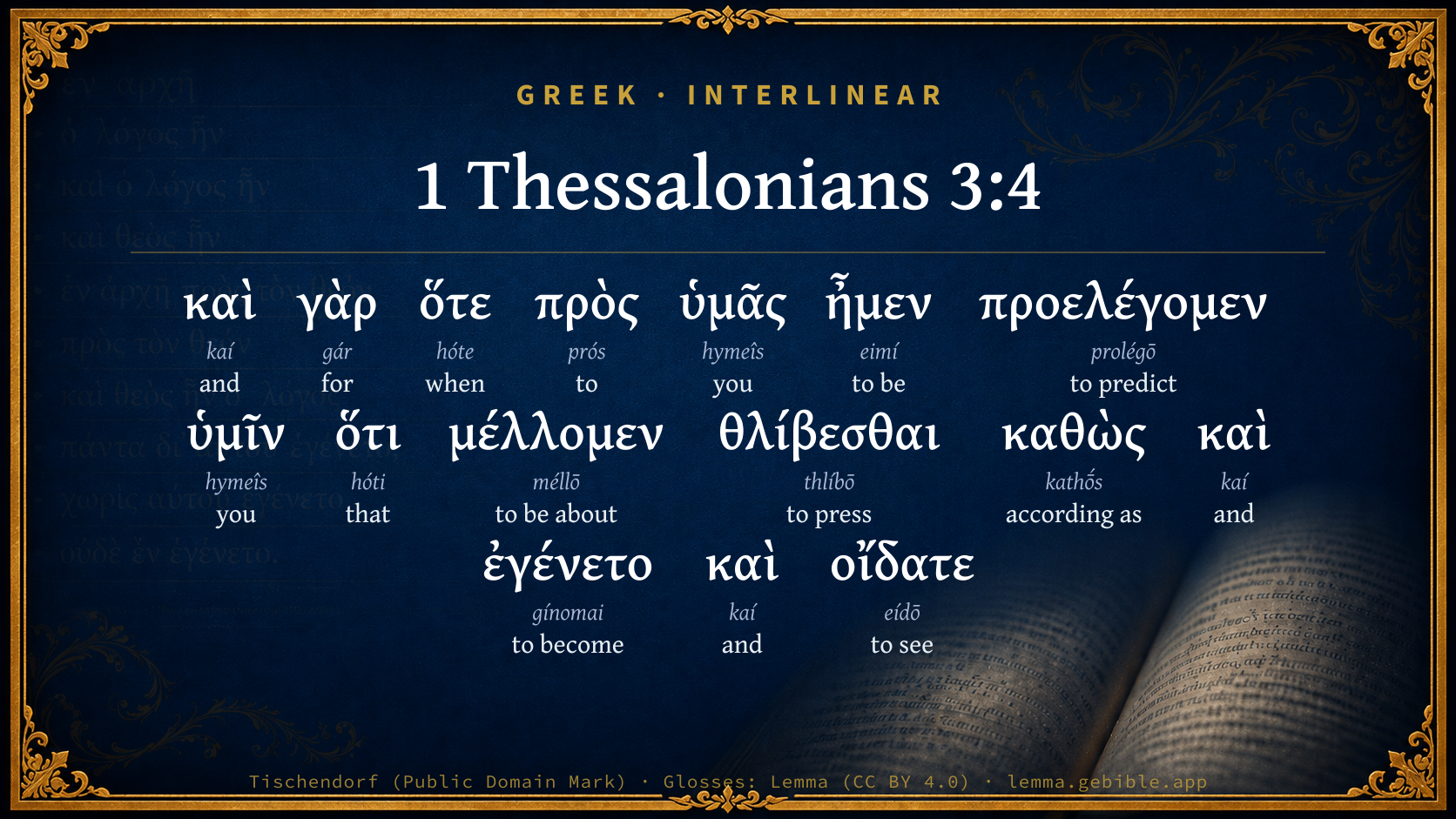
  1. καὶ kaí G2532 “and” Conjunction
  2. γὰρ gár G1063 “for” Conjunction
  3. ὅτε hóte G3753 “when” Adverb
  4. πρὸς prós G4314 “to” Preposition
  5. ὑμᾶς hymeîs G5210 “you” Personal pronoun, 2nd person, Accusative, Plural
  6. ἦμεν eimí G1510 “to be” Verb, Imperfect, Active, Indicative, 1st person, Plural
  7. προελέγομεν prolégō G4302 “to predict” Verb, Imperfect, Active, Indicative, 1st person, Plural
  8. ὑμῖν hymeîs G5210 “you” Personal pronoun, 2nd person, Dative, Plural
  9. ὅτι hóti G3754 “that” Conjunction
  10. μέλλομεν méllō G3195 “to be about” Verb, Present, Active, Indicative, 1st person, Plural
  11. καθὼς kathṓs G2531 “according as” Adverb
  12. καὶ kaí G2532 “and” Conjunction
  13. ἐγένετο gínomai G1096 “to become” Verb, Aorist, Middle deponent, Indicative, 3rd person, Singular
  14. καὶ kaí G2532 “and” Conjunction
  15. οἴδατε eídō G1492 “to see” Verb, Perfect, Active, Indicative, 2nd person, Plural

About this verse

These counts appear in no published source. They are computed here, from the morphology-tagged text and Lemma’s own curated glosses. What Lemma adds →

16
words
13
distinct lemmas
Pauline Epistles
section

Notable vocabulary

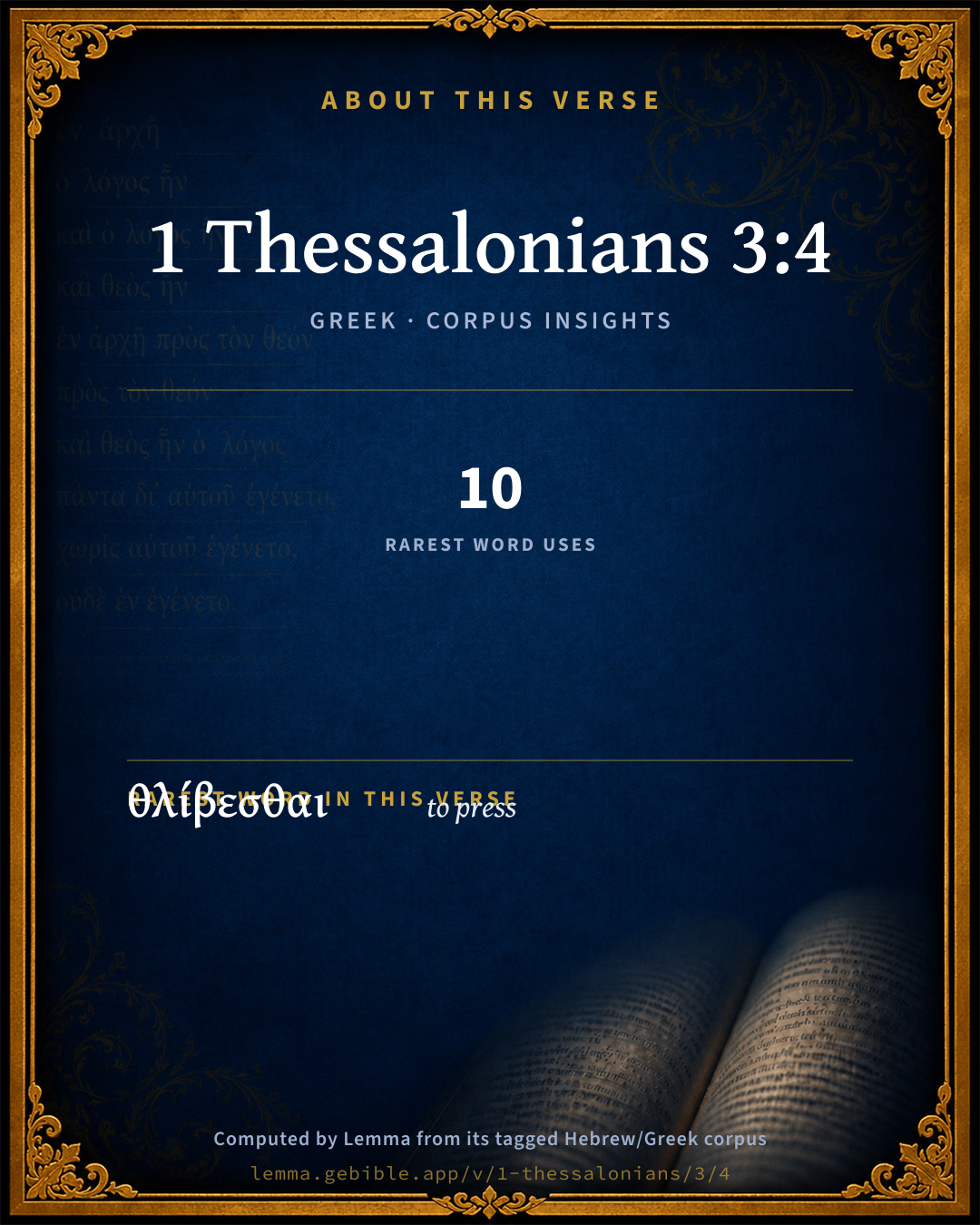
The rarest word here is θλίβεσθαι to press G2346 — appearing just 10 times in the whole Greek New Testament.

Shared distinctive vocabulary

θλίβεσθαι to press G2346 occurs in 10 verses of the Greek New Testament. Also found in:

Repetition

Words recur within this verse:

Cross-references

9

Topical passages linked to 1 Thessalonians 3:4 in the Treasury of Scripture Knowledge — connected by theme and wording, ordered by reader-vote popularity; previews shown in the World English Bible.

  • 1 Thessalonians 2:14 For you, brothers, became imitators of the assemblies of God which are in Judea in Christ Jesus; for you also suffered the same things from your own countrymen, even as they did from the Jews;
  • 2 Corinthians 8:1–2 Moreover, brothers, we make known to you the grace of God which has been given in the assemblies of Macedonia;
  • 1 Thessalonians 2:2 but having suffered before and been shamefully treated, as you know, at Philippi, we grew bold in our God to tell you the Gospel of God in much conflict.
  • Acts 17:13 But when the Jews of Thessalonica had knowledge that the word of God was proclaimed by Paul at Beroea also, they came there likewise, agitating the multitudes.
  • John 16:1–3 "These things have I spoken to you, so that you wouldn't be caused to stumble.
  • 2 Thessalonians 1:4–6 so that we ourselves boast about you in the assemblies of God for your patience and faith in all your persecutions and in the afflictions which you endure.
  • Acts 17:1 Now when they had passed through Amphipolis and Apollonia, they came to Thessalonica, where there was a synagogue of the Jews.
  • Acts 17:5–9 But the unpersuaded Jews took along some wicked men from the marketplace, and gathering a crowd, set the city in an uproar. Assaulting the house of Jason, they sought to bring them out to the people.
  • Acts 20:24 But these things don't count; nor do I hold my life dear to myself, so that I may finish my race with joy, and the ministry which I received from the Lord Jesus, to fully testify to the Gospel of the grace of God.

Cross-references courtesy of OpenBible.info (CC BY 4.0).

Commentary

Notes on 1 Thessalonians 3:4 from classic Christian and Jewish commentators (each source and its license shown beneath its notes). The classic Christian expositions comment on the surrounding passage and are grouped to its opening verse, so a note may address several verses; the Jewish commentaries on the Tanakh (Rashi and others) are per-verse, so they appear only where the commentator wrote on this verse.

Lemma curates 59 commentaries, every one of them public domain or Creative Commons licensed, each selected and text-cleaned for this edition rather than reprinted as found. About our sources →

The Biblical Illustrator

Joseph S. Exell

1Th_3:4

When we were with you we told you

The minister to warn his people of future suffering

I.

Ministers should warn young converts of the difficulties of the Christian. They must be taught that a suffering hour will come, and they must expect it. Otherwise there will be inevitable disappointment, and unbelief will be engendered in other matters and perhaps apostasy.

II. When Christians have received these warnings they should forearm themselves.

1. The greatest calamities may be mitigated by forethought and prudence.

2. There are promises of Divine grace of which the Christian should possess himself before they are wanted.

3. Otherwise, in spite of the strongest caution and the most efficient provision, Christians will sink under their trials.

III. The heavier the trial the greater the reward. For our light affliction we shall have an eternal weight of glory. (W. Burditt, M. A.)

Tribulation

We all know in a general way that this word means affliction, sorrow, anguish; but it is quite worth our while to know how it means this. It is derived from the Latin tribulum which was the threshing instrument or harrow, whereby the Roman husbandman separated the corn from the husks; and tribulatio was the act of this separation. But some Latin writer of the Christian Church appropriated the word and image for setting forth of a higher truth; and sorrow, distress, and adversity being the appointed means for the separating in men of whatever in them was light, trivial, and poor, for the solid and the true--their chaff from their wheat--he therefore called these sorrows and trials tribulations, threshings, that is, of the inner spiritual man, without which there could be no fitting him for the heavenly garner. (Abp. Trench.)

The benefit of tribulation

Thus God schooleth and nurtureth His people, that so through many tribulations they may enter to their rest. Frankincense, when it is put into the fire, giveth the greater perfume; spice, if it be pounded, smelleth the sweeter; the earth, when it is torn up with the plough, becometh more fruitful; the seed in the ground, after frost and snow and winter storms, springeth the ranker; the nigher the vine is pruned to the stock, the greater grape it yieldeth; the grape, when it is most pressed and beaten, maketh the sweetest wine; fine gold is the better, when it is cast in the fire; rough stones with hewing are squared and made fit for building; cloth is rent and cut, that it may be made a garment; linen is bucketed, and washed, and wrung, and beaten, and is the fairer. (Bp. Jewel.)

How to deal with troubles

Wesley was one day walking along a road with a Christian man who was relating his troubles, and at the same time saying he did not know what he should do. As his companion was expressing his doubts they happened to pass a stone fence over which a cow was looking. Do you know, asked Wesley, why that cow looks over that wall? No, replied the friend in trouble. I will tell you, answered Wesley, because she cannot look through it. And that is what you must do with your troubles, look over and above them. (W. Baxendale.)

Gods purpose in troubles

Troubles are often the tools by which God fashions us for better things. Far up the mountain sides lies a block of granite, and says to itself How happy am I in my serenity--above the winds, above the trees, almost above the flight of birds! Here I rest age after age, and nothing disturbs me! Yet, what is it? It is only a bare block of granite, jutting out of the cliff, and its happiness is the happiness of death. By and by comes the miner, and with strong and repeated strokes he drills a hole in its top, and the rock says, What does this mean? Then the black powder is poured in, and with a blast that makes the mountain echo the block is blown asunder, and goes crashing down the valley. All! it exclaims as it falls, why this rending? Then some saws to fashion it; and humbled now and willing to be nothing, it is borne away from the mountain and conveyed to the city. Now it is chiselled and polished till, at length, finished in beauty it is raised high in the air to be the top stone on some monument of the countrys glory. (H. W. Beecher.)

Unmoved by trial

I have seen a tree proudly crowning the summit of a naked rock, and there, with its roots spread out over the bare stone, and sent down into every cranny in search of food, it stood securely moored to the stormy crag. I have wondered how it could grow up there, starved on the bare, naked rock, and how it had survived the rough nursing of many a winter blast. Yet, like some neglected, ragged child, who from early childhood has been familiar with adversities, it has lived and grown and held itself erect on its weather-beaten crag when the pride of the valley has bent to the storm; like men who, scorning to yield, bravely nail their colours to the mast, there it maintains its defiant position, and keeps its green flag waving on natures rugged battlements. (T. Guthrie, D. D.)

Christian tribulation

How is it, brother? I do not ask you whether you like the cup which you are now drinking; but look back twenty years. What has made you so versatile? What has made you so patient? What has made you so broad, so deep, so rich? God put pickaxes into you, though you did not like it. He dug wells of salvation in you. He took you in His strong hand, and shook you by His north wind, and rolled you in His snows, and fed you with the coarsest food, and clothed you in the coarsest raiment, and beat you as a flail beats grain till the straw is gone, and the wheat is left. And you are what you are by the grace of Gods providence, many of you. By fire, by anvil strokes, by the hammer that breaks the flinty rock, God played miner, and blasted you out of the rock, and then He played stamper and crushed you, and then He played smelter and melted you, and now you are gold free from the rock, by the grace of Gods severity to you. (H. W. Beecher.)

Christian progress a cause of tribulation

Crossing the ocean, I used to hang over the side of the Java to watch the stroke of the wave against the ships cut water. I noticed, when it was foggy, and we were making only seven or eight knots an hour, there was but little stir in the water; but when, in fair weather, we went fourteen knots an hour, the ocean tossed in front of the prow and boiled on either side. So, just in proportion as a Christian makes headway in Christian enterprise, in that ratio will there be commotion and excited resistance in the waters. If nothing has been said against you, if you have never been assaulted, if everybody seems pleased with you, you are simply making little or no progress; you are water logged, and, instead of mastering the wave, the wave masters you. (T. De Witt Talmage, D. D.)

The Biblical Illustrator, edited by Joseph S. Exell (c. 1880s–1900s) — public domain. Text from a community e-Sword module.

Meyer's Critical & Exegetical Commentary

Heinrich August Wilhelm Meyer

1Th_3:4. Reason of αὐτοὶ γὰρ οἴδατε.

πρὸς ὑμᾶς] The accusative, as in Gal_1:18; Gal_2:5; 1Co_16:7, etc.

Also μέλλομεν is neither to be restricted to Paul (Oecumenius, Estius, Osiander, Nat. Alexander, Macknight), nor to Paul and his companions (Hofmann), nor to Paul and the Thessalonians (Grotius, Koppe); but, as κείμεθα 1Th_3:3, to be taken generally: we Christians in general. Μέλλομεν θλίβεσθαι however, is distinguished from the simple futureit characterizes the sufferings as inevitable, as predetermined in the counsels of God.

οἴδατε] from your own experience. Baumgarten-Crusius incorrectly refers it to προελέγομεν.

Meyer — Critical and Exegetical Commentary on the New Testament — English translation by Peter Christie, edited by Frederick Crombie (T&T Clark, 1880) — public domain. Text from a community e-Sword module.

Expositor's Greek Testament

ed. W. Robertson Nicoll

1Th 3:4 . Cf. Act 17:3 ; Act 17:6 ; Act 17:13 f.

The Expositor's Greek Testament, edited by W. Robertson Nicoll (1897–1910) — public domain. Text from a community e-Sword module.

Jamieson, Fausset & Brown

Robert Jamieson, A. R. Fausset & David Brown

that we should suffer--Greek, "that we are about (we are sure) to suffer" according to the appointment of God (Th1 3:3).

even as--"even (exactly) as it both came to pass and ye know"; ye know both that it came to pass, and that we foretold it (compare Joh 13:19). The correspondence of the event to the prediction powerfully confirms faith: "Forewarned, forearmed" [EDMUNDS]. The repetition of "ye know," so frequently, is designed as an argument, that being forewarned of coming affliction, they should be less readily "moved" by it.

Jamieson, Fausset & Brown — Commentary Critical and Explanatory on the Whole Bible (1871) — public domain (CC PDM 1.0). Text via the HelloAO Bible API.

Adam Clarke's Commentary

Verse 4. That we should suffer tribulation] I prepared you for it, because I knew that it was according to their nature for wicked men to persecute the followers of God.

Adam Clarke's Commentary on the Bible (1810–1826) — public domain. Text from a community e-Sword/MySword module.

Ellicott's Commentary for English Readers

(4) For verily, when . . .—To appreciate the nature of the argument, see the passages referred to in the margin.

A Bible Commentary for English Readers, edited by Charles John Ellicott (1878–1897) — public domain. Text from a community e-Sword module.

The Cambridge Bible for Schools and Colleges

gen. ed. J. J. S. Perowne

4. For verily, when we were with you, we told you before] More precisely, used to tell you; this was no single warning, but one repeated and familiar. For other references to the apostles’ previous instruction, see ch. 1Th_2:11-12; 1Th_4:1-2; 2Th_2:5; 2Th_2:15; 2Th_3:10.

that we should suffer tribulation] So rendered again in 2Th_1:4; 2Th_1:6, and elsewhere in the A.V.; but the word is the same as that used in 1Th_3:3; 1Th_3:7, and ch. 1Th_1:6—affliction (R. V.). The A.V. too often breaks the connection of the sacred writer’s thought by needless variations of this sort.

should is made clearer by the Revised are to suffer: this was matter of certainty in the future, being Divinely appointed (1Th_3:3),—a thing one might count upon. And so the event proved: even as it came to pass, and ye know.

All this is recalled to the minds of the readers and dwelt on with iteration, not to justify the Apostle’s foresight—for it needed no gift of prophecy to anticipate persecution at Thessalonica—but to make them realise how well they had been prepared for what they are now experiencing, and so far to reconcile them to it; comp. Joh_14:29; 1Pe_4:12, “Beloved, count it not strange.” Dr Jowett gives an admirable analysis of the causes of persecution in the Apostolic times in his notes upon this Chapter (The Epp. of St Paul to the Thessalonians, &c., pp. 70–73, 2nd edition), from which we extract the following sentences:—“The fanatic priest, led on by every personal and religious motive; the man of the world, caring for none of these things, but not the less resenting the intrusion on the peace of his home; the craftsman, fearing for his gains; the accursed multitude, knowing not the law, but irritated at the very notion of this mysterious society of such real, though hidden strength, would all work together towards the overthrow of those who seemed to them to be turning upside down the political, religious, and social order of the world.… The actual persecution of the Roman government was slight, but what may be termed social persecution and the illegal violence employed towards the first disciples unceasing.”

The Cambridge Bible for Schools and Colleges (gen. ed. J. J. S. Perowne; Cambridge University Press, 1878–1918) — public domain. Text from a community e-Sword module.

John Gill's Exposition

For, verily, when we were with you,.... In presence, in person, as they then were in heart and affection; when they were first among them, and preached the Gospel to them:

we told you before; before it came to pass;

that we should suffer tribulation: which they might say by virtue of Christ's prediction to all his disciples, that they should have tribulation in the world; and upon its being the common case of God's people, and the usual way through which they enter the kingdom; and the Apostle Paul might foretell this, upon the discovery that was made to him how many things he should suffer for the sake of Christ, and which therefore he always, and in every place expected; and he might have a particular revelation of the disturbance and opposition he was to meet with at Thessalonica:

even as it came to pass, and ye know; referring to the tumult and uproar in Act 17:5, and which should be considered so far from being a discouragement, that it was a great confirmation of the truth of their mission and ministry; nor could it be so surprising to them as it might have been had they had no previous taste of it.

John Gill's Exposition of the Whole Bible (1746–1763) — public domain (CC PDM 1.0). Text via the HelloAO Bible API.

Trapp's Complete Commentary

John Trapp

4 For verily, when we were with you, we told you before that we should suffer tribulation; even as it came to pass, and ye know.

Ver. 4. We told you before] Darts foreseen are dintless: premonition is the best premunition. Troubles foretold come never a whit the sooner, but far the easier; whereas coming unexpected, they find weak minds secure, make them miserable, leave them desperate.

John Trapp, A Commentary or Exposition upon All the Books of the Old and New Testament (1647–1656) — public domain. Text from a community e-Sword module.

Albert Barnes' Notes on the Bible

For verily, when we were with you, we told you before ... - It is not mentioned in the history Acts 17 that Paul thus predicted that special trials would come upon them, but there is no improbability in what is here said. He was with them long enough to discourse to them on a great variety of topics, and nothing can be more probable, than that in their circumstances, the subjects of persecution and affliction would be prominent topics of discourse. There was every reason to apprehend that they would meet with opposition on account of their religion, and nothing was more natural than that Paul should endearour to prepare their minds for it beforehand,

That we should suffer tribulation - We who preached to you; perhaps also including those to whom they preached.

Even as it came to pass, and ye know - When Paul, Silas, and Timothy were driven away, and when the church was so much agitated, by the opposition of the Jews; Act 17:5-8.

Albert Barnes' Notes on the Bible (1834–1885) — public domain. Text from a community e-Sword/MySword module.

Matthew Poole's English Annotations

The apostle having said that they knew they were appointed to sufferings, tells them here they knew it because he had told them of it. Paul, by some extraordinary instinct or revelation, often foresaw his sufferings, and God more generally told him of them at his first conversion, Act 9:16; and he told them of them that they might reckon upon sufferings. A faithful minister will not only tell the people of the crown, but of the cross of Christ. And what he foretold of his sufferings, he tells them

came to pass; whereby they might be strengthened further in their faith about the gospel he had preached to them, and not be offended at his sufferings, being foretold to them, as well as appointed of God.

Matthew Poole's English Annotations on the Holy Bible (1683–1685) — public domain. Text from a community e-Sword/MySword module.

Whedon's Commentary on the Bible

Daniel D. Whedon

4. We told you before—Of that hard but holy mission you were fairly forewarned.

Daniel D. Whedon (gen. ed.), Commentary on the Old and New Testaments (1874–1909) — public domain. Text from a community e-Sword module.

The Pulpit Commentary

For; assigning the reason why they should not be moved by these afflictions. Verily, when we were with you, we told you before that we; here also Christians in general. Should suffer. Not a simple future, but denoting that it was thus appointed in the counsels of God that their tribulation was the result of the Divine purpose. Tribulation (affliction); even as it came to pass, and ye know; that is, from your own experience. The affliction, then, was not some strange thing which had befallen them.

The Pulpit Commentary (1880–1919), ed. H.D.M. Spence-Jones & Joseph S. Exell — public domain. Text from a community e-Sword module.

Burkitt's Expository Notes on the New Testament

William Burkitt

Our apostle informed the Thessalonians in the foregoing verse, with the purpose and decree of God concerning the afflictions which were before them; in this verse he appeals to themselves, as to his own sincerity, in acquainting them, at their first conversion, that they must, through many tribulations, enter into the kingdom of God, and it came to pass accordingly; when we were with you, says the apostle, we told you, before it came to pass, that we should suffer triblulation, and it shortly after came to pass as we told you.

Learn hence, that it is the duty of the ministers of Christ to give timely warning of, and to acquaint young converts early with, the pleasure of God, to exercise all that belong to him with the cross, with a variety of afflictions, trials, and sufferings, before they come, that so they may not stumble, nor be offended at them when they come. The sincerity of our apostle is here very remarkable; when he came first to preach the gospel at Thessalonica, he did not flatter them with the expectation of an earthly paradise of pleasure, but told them plainly, that Christianity had a cross attending it, that a suffering hour would come, and they must expect it; when we were with you, we told you that we should suffer tribulation.

Learn, 2. That when Christians have had timely notice from the ministers of God, and from the word of God, of approaching trials and troubles, before they come, they ought to fore-arm themselves, and not to faint or sink under them when they come, much less to forsake religion because of them, but to continue stedfast, knowing that the heavier the cross is, the weightier will their crown be; for affliction, there is glory; for light affliction, a weight of glory, and for light affliction, which is but of a moment, a far more exceeding and eternal weight of glory, 2Co 4:17.

William Burkitt's Expository Notes on the New Testament (1700–1703) — public domain. Text from a community e-Sword module.

McGarvey & Pendleton's Commentaries

J. W. McGarvey

For verily, when we were with you, we told you beforehand that we are to suffer affliction; even as it came to pass, and ye know . [As to the affliction which Paul foretold and which came upon them, see Act_17:5-9 ]

J. W. McGarvey (with Philip Y. Pendleton), Commentaries on the New Testament (The Fourfold Gospel, 1914; Acts; and the epistles) — public domain. Text from a community e-Sword/MySword module.

The People's New Testament

B. W. Johnson

4. For … we told you. He had faithfully forewarned them that tribulation would come.

B. W. Johnson's The People's New Testament with Notes (1889–1891) — public domain. Electronic text from the Christian Classics Ethereal Library (CCEL) ThML edition.

unfoldingWord translationNotes

Door43 World Missions Community

Truly

This word marks that there is more to the truth than what has just been said. AT: "Moreover"

to suffer affliction

"to be mistreated by others"

I could no longer stand it

Paul was describing his own emotions by using an idiom. AT: "I could not longer wait patiently" (See: Idiom)

I sent

It is implied that Paul sent Timothy. This can be made explicit. AT: "I sent Timothy" (See: Assumed Knowledge and Implicit Information)

our labor

"our hard work among you" or "our teaching among you"

in vain

"useless"

translationWords

amen

suffer

afflicted

faith

tempt

labor

unfoldingWord translationNotes — © Distant Shores Media and the Door43 World Missions Community, licensed CC BY-SA 4.0. Source: git.door43.org/Door43/en_tn.

Cambridge Greek Testament for Schools and Colleges

4. καὶ γὰρ ὅτε πρὸς ὑμᾶς ἧμεν, προελέγομεν κ.τ.λ. In support of the rule just stated, the Apostles recall their own definite and repeated warnings. For εἰμὶ πρός—the “with” of personal converse—cf. 2Th 2:5; 2Th 3:1; 2Th 3:10; also Gal 1:18; Joh 1:1. The impf. προελέγομεν, like ἐλέγομεν in 2Th 2:5, supposes reiterated warning; the language of the sequel, μέλλομεν κ.τ.λ., sustains the sense “fore-tell” for this verb—otherwise it might be rendered, “we told you openly (or plainly),” as in R.V. margin; cf. πρόκειμαι in 2Co 8:12. The same ambiguity attaches to προ-λέγω in 2Co 13:2; Gal 5:21.

ὅτι μέλλομεν θλίβεσθαι, that we are to be afflicted (writers and readers; see note on κείμεθα, 1Th 3:3). The persecution of the missionaries and their converts sprang from the same source (see 1Th 2:14 f.; Act 17:5), the malignity and persistence of which were patent from the first in Thessalonica.

Ὅτι μέλλομεν, not μέλλοιμεν: the moods of oratio recta are almost always in N.T. Greek taken over unchanged in the subordinate clause, whether the verbum dicendi be primary or historical in tense; see Winer-Moulton, p. 376.

καθὼς καὶ ἐγένετο καὶ οἴδατε, as indeed it proved, and you know: an appeal to the facts of the case and the experience of the readers. On the latter point, and the recurrence of this appeal (cf. 1Th 3:3), see notes to 1Th 1:5 and 1Th 2:1. The reminder should help to prevent the Thessalonian believers from being “shaken amid these afflictions”: what had happened was natural and expected; it is “no strange thing” (1Pe 4:12).

Cambridge Greek Testament for Schools and Colleges (Cambridge University Press, 1896; 21 vols, various authors incl. Carr, Maclear, Plummer, Farrar, Lumby, Moule, M. R. James, Simcox) — public domain. Text from a community e-Sword module.

Alford’s Greek Testament

Henry Alford

4.] reason for οἴδατε.

πρὸς ὑμ., see reff.

μέλλομεν may be taken either as the recit. present, or better as representing the counsel of God, as in ὁ ἐρχόμενος and the like. The subject to μέλλ., as above, being ‘we Christians.’

οἴδατε, viz. by experience.

Henry Alford, The Greek Testament (1849–1861) — public domain. Text from a community e-Sword module.

Lesson kit

Teaching starters — assembled from the data on this page, not authored interpretation. Every prompt links to the verse data it draws on. Edit before teaching.

1 Thessalonians, in the Pauline Epistles, opens this verse with 16 words (13 distinct Greek lemmas). Its most distinctive word is thlíbō (“to press”). A historical commentator’s framing appears above. Read the whole chapter for the surrounding context.

Discussion questions

  1. The word thlíbō carries the sense “to press.” How does it shape the verse?
  2. Matthew 7:14 shares the word «to press» with this verse. How do the two illuminate each other?
  3. “and” occurs 3× in this one verse. What is the effect of the repetition?
  4. These translations render this verse differently; the difference is in the English rendering, not the original. What questions does that raise?
  5. Reading how The Biblical Illustrator and Meyer's Critical & Exegetical Commentary read this verse, where do the two commentators agree and where do they part?

Things to notice

Reading settings

Reading text

Shown beneath each verse's original-language words.

Old Testament
Old Testament edition

Read the OT as the Masoretic Hebrew (MT) or the Greek Septuagint (LXX).

English shown for the Greek Septuagint (in the Hebrew ↔ Greek comparison).

Comparing translations? Open the Compare panel on any verse page to stack up to four side by side.