
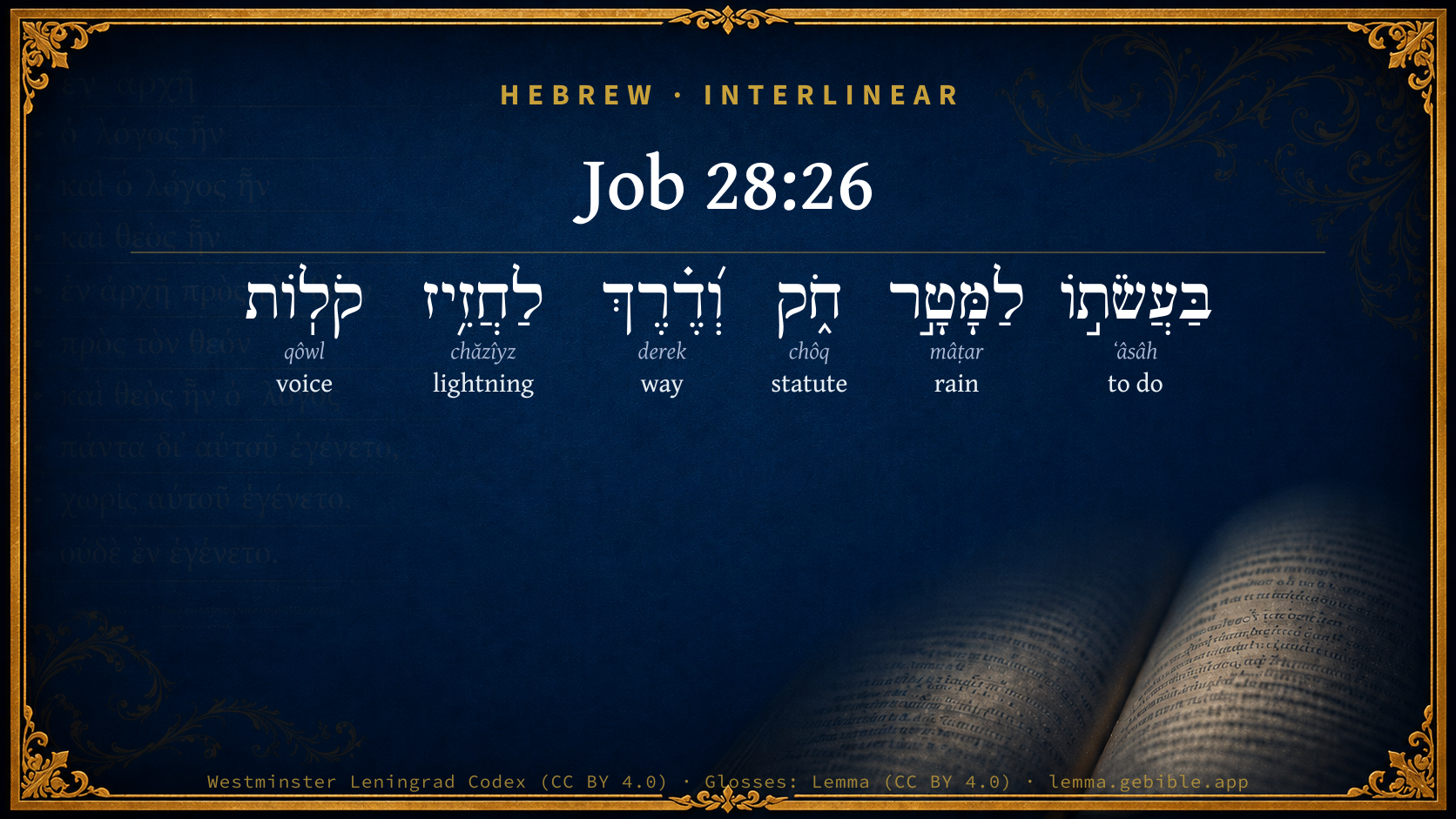
Job 28:26

Hebrew (Westminster Leningrad Codex) Job 28:26 appears in the Hebrew Old Testament. The text above is from the Westminster Leningrad Codex. Each word links to its Strong’s number, a concise gloss, and parsing drawn from the Open Scriptures Hebrew Bible morphology. Click any word for its full Brown-Driver-Briggs (BDB) entry.
Download image
Cite this verse

Job 28:26 (World English Bible). Public Domain. Lemma interlinear Bible study tool, https://lemma.gebible.app/v/job/28/26.

Show BibTeX & RIS
BibTeX
RIS
English Translation
When he made a decree for the rain, And a way for the lightning of the thunder;
World English Bible · Public Domain
Highlights
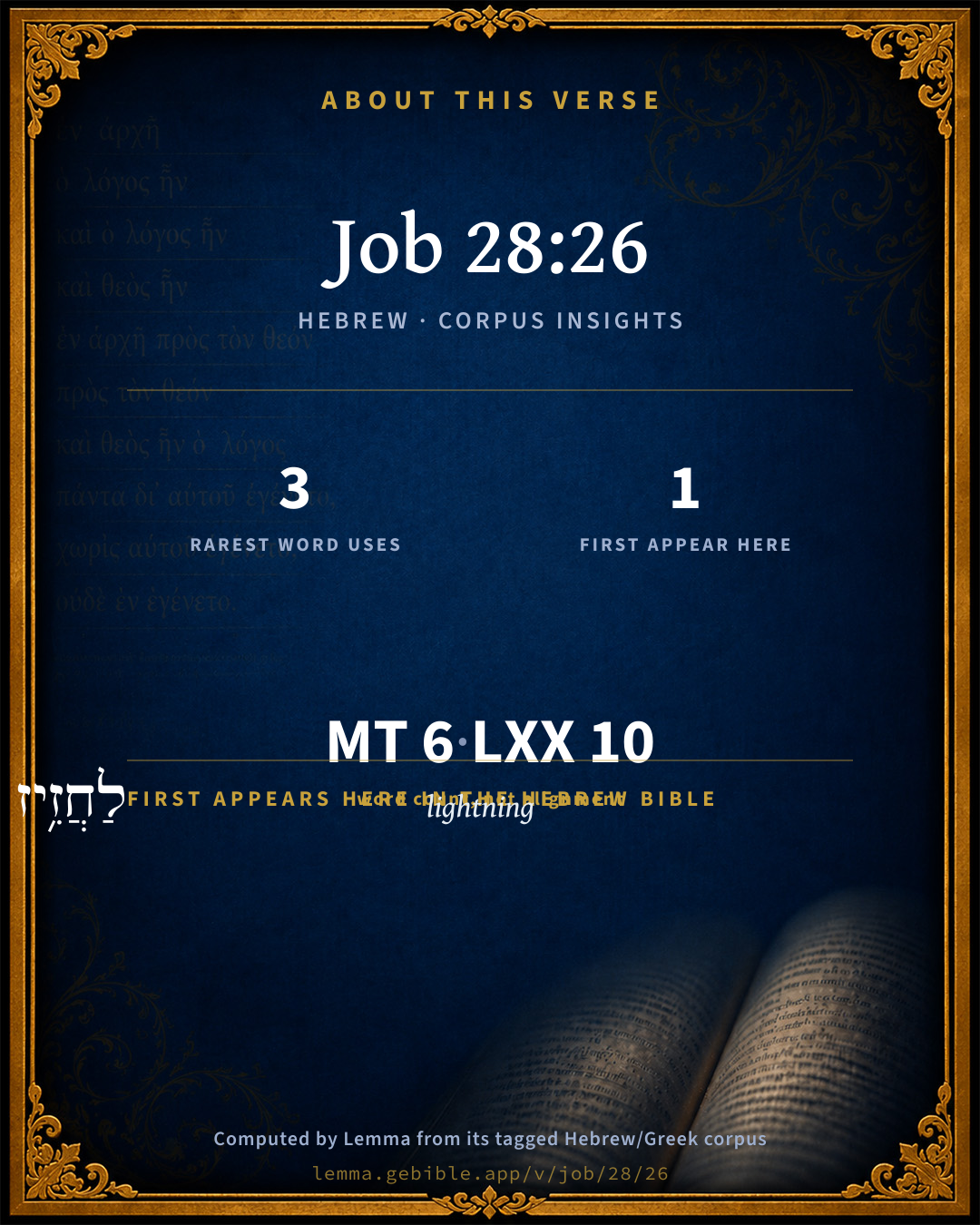
  • 1 first appearance in the Hebrew Bible
Full analysis ↓
Download a study sheet

One document with this verse’s original text, its word-by-word gloss line, the meaning frame, cross-references with their text, attributed commentary, and full source and license credits — printable, and it pastes into notes with its structure intact.

This verse Autodidact and up

Study sheet (.html) Plain text (.txt)

A passage Seminary Student

Up to 50 verses in one chapter. A passage sheet keeps up to 6 commentary sources and 12 cross-references per verse, in the order this page ranks them, and says so on the sheet whenever that leaves anything out. Ask for a single verse and you get the Autodidact verse sheet above.

Everything on this page stays free to read, with no account — the sheet is a download of what is already on screen, not access to it.

Want to remove ads? Support Godless Engineer
Compare translations 3

The same verse in 3 English versions, stacked beneath the original-language interlinear above. Click any original word for its lexicon entry.

Each is an independent rendering of the whole verse — the interlinear is not word-aligned to these translations.

Highlighted words mark where these versions differ — a whole-verse word diff, not a word-by-word alignment.

  • World English Bible Public Domain
    When he made a decree for the rain, And a way for the lightning of the thunder;
  • King James Version Public Domain
    When he made a decree for the rain, and a way for the lightning of the thunder:
  • unfoldingWord Literal Text CC BY-SA 4.0
    when he made a decree for the rain and a path for the flash of the thunders,

unfoldingWord Literal Text — © unfoldingWord, licensed CC BY-SA 4.0. Word-aligned USFM3 via Door43 (git.door43.org/unfoldingWord/en_ult).

Versions to compare (up to 4)

3 of 4 selected

Show all 18 translations

Every available English version of this verse, each an independent rendering of the whole verse.

  • World English Bible Public Domain
    When he made a decree for the rain, And a way for the lightning of the thunder;
  • Berean Standard Bible Public Domain
    when He set a limit for the rain and a path for the thunderbolt,
  • Majority Standard Bible Public Domain
    when He set a limit for the rain and a path for the thunderbolt,
  • King James Version Public Domain
    When he made a decree for the rain, and a way for the lightning of the thunder:
  • American Standard Version (1901) Public Domain
    When he made a decree for the rain, And a way for the lightning of the thunder;
  • Revised Version (1885) Public Domain
    When he made a decree for the rain, and a way for the lightning of the thunder:
  • Geneva Bible (1599) Public Domain
    When he made a decree for the rayne, and a way for the lightening of the thunders,
  • Douay-Rheims (1899) Public Domain
    When he gave a law for the rain, and a way for the sounding storms.
  • Young's Literal Translation Public Domain
    In His making for the rain a limit, And a way for the brightness of the voices,
  • Literal Standard Version CC BY-SA 4.0
    In His making for the rain a limit, || And a way for the brightness of the voices,
  • Unlocked Literal Bible CC BY-SA 4.0
    He made a decree for the rain and a path for the thunder.
  • unfoldingWord Literal Text CC BY-SA 4.0
    when he made a decree for the rain and a path for the flash of the thunders,
  • Darby Bible Public Domain
    In appointing a statute for the rain, and a way for the thunder's flash:
  • World Messianic Bible Public Domain
    When he made a decree for the rain, and a way for the lightning of the thunder,
  • Webster's Bible Public Domain
    When he made a decree for the rain, and a way for the lightning of the thunder:
  • Free Bible Version CC BY-SA 4.0
    He set a limit for the rain and made a path for the lightning.
  • Bible in Basic English Public Domain
    When he made a law for the rain, and a way for the thunder-flames;
  • JPS Tanakh (1917) Public Domain
    When He made a decree for the rain, and a way for the storm of thunders;

Literal Standard Version (2020), Covenant Press — licensed CC BY-SA 4.0. Text via the HelloAO Bible API (eBible.org). Unlocked Literal Bible (unfoldingWord) — licensed CC BY-SA 4.0. Text via the HelloAO Bible API (eBible.org). unfoldingWord Literal Text — © unfoldingWord, licensed CC BY-SA 4.0. Word-aligned USFM3 via Door43 (git.door43.org/unfoldingWord/en_ult). Free Bible Version, Dr. Jonathan Gallagher — licensed CC BY-SA 4.0. Text via the HelloAO Bible API (eBible.org).

Word by word

More ways to search: Search by grammar → Find every occurrence → Compare this word →

Practice this passage: Drill this verse → Learn its vocabulary →

About this verse

These counts appear in no published source. They are computed here, from the morphology-tagged text and Lemma’s own curated glosses. What Lemma adds →

6
words
6
distinct lemmas
Wisdom
section

Notable vocabulary

The rarest word here is לַחֲזִ֥יז lightning H2385 — appearing just 3 times in the whole Hebrew Bible.

First appearance in Scripture

This word makes its first canonical appearance in the Hebrew Bible here:

  • לַחֲזִ֥יז lightning H2385

Shared distinctive vocabulary

לַחֲזִ֥יז lightning H2385 occurs in 3 verses of the Hebrew Bible. Also found in:

Grammatical profile

  • 1 verb
  • 5 nouns

Verb forms

  • בַּעֲשֹׂת֣וֹ Qal · Infinitive Construct

Hebrew & Septuagint length

In English translation the verse runs 17 words from the Hebrew and 20 from the Septuagint (LXX English) — closely comparable.

A rough comparison of the two English renderings, which tokenize alike — not a word-level alignment.

Word counts can differ between the Hebrew and the Greek without any difference in meaning — e.g. the Hebrew direct-object marker אֵת has no separate Greek word, and Greek often adds the article ὁ.

In the original languages it is 6 Hebrew tokens and 10 Greek tokens — but the two are counted differently (Hebrew bundles its prefixes and suffixes into one token; the Greek is in lemma form), so that isn’t a like-for-like length.

Cross-references

11

Topical passages linked to Job 28:26 in the Treasury of Scripture Knowledge — connected by theme and wording, ordered by reader-vote popularity; previews shown in the World English Bible.

  • Job 38:25 Who has cut a channel for the flood water, Or the path for the thunderstorm;
  • Job 37:3 He sends it forth under the whole sky, And his lightning to the ends of the earth.
  • Zechariah 10:1 Ask of Yahweh rain in the spring time, Yahweh who makes storm clouds, And he gives rain showers to everyone for the plants in the field.
  • Job 36:26 Behold, God is great, and we don't know him. The number of his years is unsearchable.
  • Job 36:32 He covers his hands with the lightning, And commands it to strike the mark.
  • Job 37:11 Yes, he loads the thick cloud with moisture. He spreads abroad the cloud of his lightning.
  • Job 38:27 To satisfy the waste and desolate ground, To cause the tender grass to spring forth?
  • Psalms 29:3–10 Yahweh's voice is on the waters. The God of glory thunders, even Yahweh on many waters.
  • Psalms 148:8 Lightning and hail, snow and clouds; Stormy wind, fulfilling his word;
  • Jeremiah 14:22 Are there any among the vanities of the nations that can cause rain? or can the sky give showers? Aren't you he, Yahweh our God? therefore we will wait for you; for you have made all these things.
  • Amos 4:7 "I also have withheld the rain from you, When there were yet three months to the harvest; And I caused it to rain on one city, And caused it not to rain on another city. One place was rained on, And the piece where it didn't rain withered.

Cross-references courtesy of OpenBible.info (CC BY 4.0).

Hebrew and Greek witnesses Masoretic Hebrew ↔ Greek Septuagint

The same verse in the two great witnesses to the Old Testament, shown verse-for-verse.

These are two independent witnesses, not word-aligned to each other, and the Septuagint is shown in lemma (dictionary) form.

Hebrew Job 28:26 Masoretic · Westminster Leningrad Codex

בַּעֲשֹׂת֣וֹ לַמָּטָ֣ר חֹ֑ק וְ֝דֶ֗רֶךְ לַחֲזִ֥יז קֹלֽוֹת

When he made a decree for the rain, And a way for the lightning of the thunder;

World English Bible · Public Domain

Greek LXX Job 28:26 Septuagint · lemma form

ὅτε ποιέω οὕτως ὑετός ἀριθμέω καί ὁδός ἐν τινάγμα φωνή

When he made them, thus he saw and numbered them, and made a way for the pealing of the thunder.

LXX2012 (modern English Septuagint) · Public Domain

Hebrew: Westminster Leningrad Codex (CC BY 4.0). Greek: Septuagint (public domain); English from LXX2012 (modern English Septuagint) (Public Domain). How the Septuagint differs from the Hebrew →

Commentary

Notes on Job 28:26 from classic Christian and Jewish commentators (each source and its license shown beneath its notes). The classic Christian expositions comment on the surrounding passage and are grouped to its opening verse, so a note may address several verses; the Jewish commentaries on the Tanakh (Rashi and others) are per-verse, so they appear only where the commentator wrote on this verse.

Lemma curates 59 commentaries, every one of them public domain or Creative Commons licensed, each selected and text-cleaned for this edition rather than reprinted as found. About our sources →

Trapp's Complete Commentary

John Trapp

Job 28:26 When he made a decree for the rain, and a way for the lightning of the thunder:

Ver. 26. When he made a decree for the rain] And hence it is that it raineth upon one city, and not upon another, Amo 4:7. {See Trapp on "Amo 4:7"} The rise of rain out of vapours drawn up from the earth by the heat of the sun, and the generation of it in the clouds, is no less wonderful than the use of it is necessary for the refreshing and fattening of the earth; allaying the heat, and nourishing the herb and tree, &c. These showers may seem to arise and be carried up and down at random, and without a law; but Job assureth us that God maketh a decree, a statute, or a bound for them, and that he gives or withholds rain at his pleasure.

And a way for the lightning of the thunder] Or, for the lightning and the thunder. In both which there is much of God to be seen and heard; these being the harbingers, as it were, and officers to make room for him, and to manifest his power, which the greatest must acknowledge, Psa 29:1-2, and the saints must take comfort in, Job 28:11. As for those impious wretches, that slight these wonderful works of Almighty God, and speak basely of them (as he of whom Mr Perkins somewhere writeth, that hearing it thunder, said it was nothing but Tom Tumbrel a hooping his tubs, and was thereupon killed with a thunder bolt; and those old Italians that used, in time of thunder, to ring their greatest bells, and shoot off their greatest ordinance, &c., on purpose to drown the noise of the heavens); as they are worse than Pharaoh and Caligula, and other heathens, who styled their chief god Altitonans, the high thunderer; so they shall one day see the Lord Christ suddenly coming upon them as lightning, and dreadfully thundering out that dismal Discedite , Go, ye cursed.

John Trapp, A Commentary or Exposition upon All the Books of the Old and New Testament (1647–1656) — public domain. Text from a community e-Sword module.

Joseph Benson's Commentary

Job 28:26. When — At the first creation, he settled that course and order which should afterward be continued; he made a decree for the rain — An appointment, and, as it were, a statute law, that it should fall upon the earth, and that in such times, and places, and proportions, and manner, as he should think fit, either for correction or mercy, as Elihu speaks, Job 37:13. And a way for the lightning of the thunder — A path, or egress, for it out of the thick cloud in which it was shut up, and, as it were, imprisoned; and the course which it should take, and in which it should proceed, to accomplish the purposes intended by him.

Joseph Benson's Commentary on the Old and New Testaments (1811–1818) — public domain. Text from a community e-Sword module.

Jamieson, Fausset & Brown

Robert Jamieson, A. R. Fausset & David Brown

The decree regulating at what time and place, and in what quantity, the rain should fall.

a way--through the parted clouds (Job 38:25; Zac 10:1).

Jamieson, Fausset & Brown — Commentary Critical and Explanatory on the Whole Bible (1871) — public domain (CC PDM 1.0). Text via the HelloAO Bible API.

Adam Clarke's Commentary

Verse 26. When he made a decree for the rain] When he determined how that should be generated, viz., By the heat of the sun evaporation is produced: the particles of vapour being lighter than the air on the surface, ascend into the atmosphere, till they come to a region where the air is of their own density; there they are formed into thin clouds, and become suspended. When, by the sudden passages of lightning, or by winds strongly agitating these clouds, the particles are driven together and condensed so as to be weightier than the air in which they float, then they fall down in the form of rain; the drops being greater or less according to the force or momentum, or suddenness, of the agitation by which they are driven together as well as to the degree of rarity in the lower regions of the atmosphere through which they fall.

A way for the lightning of the thunder] ודרך לחזיז קולות vederech lachaziz koloth. קול kol signifies voice of any kind; and koloth is the plural and is taken for the frequent claps or rattlings of thunder. חז chaz signifies to notch, indentate, or serrate, as in the edges of the leaves of trees; חזיז chaziz must refer to the zigzag form which lightning assumes in passing from one cloud into another. We are informed that "this is a frequent occurrence in hot countries." Undoubtedly it is; for it is frequent in cold countries also. I have seen this phenomenon in England in the most distinct manner for hours together, with a few seconds of interval between each flash. Nothing can better express this appearance than the original word.

Adam Clarke's Commentary on the Bible (1810–1826) — public domain. Text from a community e-Sword/MySword module.

The Cambridge Bible for Schools and Colleges

gen. ed. J. J. S. Perowne

26. a decree for the rain] This “decree” comprises all the laws that regulate the rain, appointing its measure and its seasons as early and latter rain.

26–27. The idea of the preceding verse taken up anew and expanded—in creation God saw Wisdom and searched it out.

The Cambridge Bible for Schools and Colleges (gen. ed. J. J. S. Perowne; Cambridge University Press, 1878–1918) — public domain. Text from a community e-Sword module.

John Gill's Exposition

Then did he see it, and declare it,.... His own wisdom, when he made and executed his decrees concerning rain, lightning, and thunder; he saw it in himself, and as it appeared in the works of his hands, which he looked on and approved of, and saw that all was very good; and he declared it to others, by his works of nature and providence; for they declare the glory of God, and particularly the glory of his wisdom:

he prepared it, yea, and searched it out; he prepared it in his counsels, according to which he wrought all things in the creation, and still does in Providence; and his searching out denotes his perfect knowledge of it, and the way and course of it, or he takes with it, though it is unsearchable, and past finding out by us. Mr. Broughton understands this of a person, as do some others, even Christ, the Wisdom of God; rendering the words, "then he saw her, and showed her", &c. and so the passages in Pro 8:27, may be a comment on these words and the foregoing; for when the above decrees were formed in the divine mind, then he "saw" his Wisdom, his Logos, his eternal Son; for he was by him, and with him, and in him, lying in his bosom; he looked at him in creation, and made man after his image, the idea he had formed of his human nature, and made all things for his sake; and he viewed him with the utmost delight and pleasure, as being the express image of his person; he declared him to be his only begotten Son, saying, "this day I have begotten thee", Psa 2:7; be made him known to the angels, as the Targum here expresses it, and what he designed to do by him, and with him; which occasioned the revolt of many of them from him; and he declared him to Adam as soon as there was an opportunity and occasion for it; he prepared him in his eternal purposes to be the Redeemer and Saviour of his people, to be the Head of the church, and the Judge of quick and dead; he searched him out in his infinite wisdom, and found him, singled him out, laid help on him with his holy oil anointed him, and appointed him to be the ransomer of his chosen ones, Job 33:24.

John Gill's Exposition of the Whole Bible (1746–1763) — public domain (CC PDM 1.0). Text via the HelloAO Bible API.

Albert Barnes' Notes on the Bible

When he made a decree for the rain - A statute or law (חק chôq) by which the rain is regulated. It is not sent by chance or hap-hazard. It is under the operation of regular and settled laws. We cannot suppose that those laws were understood in the time of Job, but the fact might be understood that the rain was regulated by laws, and that fact would show that God was qualified to impart wisdom. His kingdom was a kingdom of settled law and not of chance or caprice, and if the rain was regulated by statute, it was fair to presume that he did not deal with his people by chance, and that afflictions were not sent without rule; compare the notes at Job 5:6.

And a way - A path through which the rapid lightning should pass - referring, perhaps, to the apparent “opening” in the clouds in which the lightning seems to move along.

The lightning of the thunder - The word “lightning” here (חזיז chăzı̂yz) properly means “an arrow,” from הזז hāzaz, obsolete, to pierce through, to transfix, to performate; and hence, the lightning - from the rapidity with which it passes - like an arrow. The word “thunder” (קולות qôlôt) means voices, and hence, “thunder,” as being by way of eminence the voice of God; compare Psa 29:3-5. The whole expression here means “the thunder-flash.” Coverdale renders this, “when he gave the mighty floods a law;” but it undoubtedly refers to the thunderstorm, and the idea is, that he who controls the rapid lightning, regulating its laws and directing its path through the heavens, is qualified to communicate truth to people, and can explain the great principles on which his government is administered.

Albert Barnes' Notes on the Bible (1834–1885) — public domain. Text from a community e-Sword/MySword module.

Haydock's Catholic Bible Commentary

Storms; or Hebrew, "for the lightning, which attends thunder." (Calmet)

George Leo Haydock (1774–1849), Haydock's Catholic Family Bible and Commentary, 1859 edition — public domain. Excludes Psalms (Douay-Rheims chapter numbering differs from Protestant) and Deuterocanonical books (Catholic canon only).

Matthew Poole's English Annotations

When he made; which was either from eternity, or at the first creation, when he settled that course and order which should afterwards be continued. Or, when he maketh: but our translation seems best to suit with the then in the next verse, where the sense is completed.

Decree for the rain; an appointment, and as it were a statute law, that it should fall upon the earth, and that in such times, and places, and proportions, and manner as he should think fit, either for correction or for mercy, as Elihu speaks, Job 37:13. A way, or path, how it should get out of the thick cloud, in which it was shut up, and as it were imprisoned; or, a course, which should for the future be observed, as to the time, and measure, and ends, and other circumstances belonging to it.

Matthew Poole's English Annotations on the Holy Bible (1683–1685) — public domain. Text from a community e-Sword/MySword module.

Whedon's Commentary on the Bible

Daniel D. Whedon

26. A decree — A law.

Thunder — Hebrew, Voices. Thunder was the voice of God. Psa_29:3. The manifestation of the divine presence was frequently attested by thunder. The ancient Jews, according to Buxtorf, called an oracle of God The daughter of the voice, or thunder. See note, Job_38:25. The book of Proverbs enlarges upon the work of divine wisdom in the creation of the world. Pro_8:22-31.

Daniel D. Whedon (gen. ed.), Commentary on the Old and New Testaments (1874–1909) — public domain. Text from a community e-Sword module.

The Pulpit Commentary

When he made a decree for the rain. God "made a decree for the rain" when be placed the fall of rain under fixed and unalterable laws. In some countries rainy seasons begin almost regularly on a fixed day in the calendar, while for several months in the year it is almost certain that rain will not fall. Even where there is no such exact regularity as this, the rainfall has its laws, since there are maxima and minima which are never exceeded. And a way for the lightning of the thunder. God gave laws to the electric current, and prescribed the "way" that it should take in its passage from heaven to earth, or from cloud to cloud, or from earth to heaven. Everything was ruled beforehand by Infinite Wisdom.

The Pulpit Commentary (1880–1919), ed. H.D.M. Spence-Jones & Joseph S. Exell — public domain. Text from a community e-Sword module.

John Wesley's Explanatory Notes

When - At the first creation, when he settled that course and order which should be continued. A decree - An appointment and as it were a statute law, that it should fall upon the earth, in such times, and places, and proportions.

John Wesley, Explanatory Notes Upon the Whole Bible (1754–1765) — public domain. Text via the GEBible commentary corpus.

unfoldingWord translationNotes

Door43 World Missions Community

a path for the thunder

"he decided how the thunder can be heard" or "he decided the path of the thunderstorm"

See, the fear of the Lord—that is wisdom

The abstract noun "fear" can be expressed with the verbs "fear" or "respect." The abstract noun "wisdom" can be expressed with the word "wise." AT: "Listen, if you fear the Lord, you will be wise" (See: Abstract Nouns)

to depart from evil is understanding

Here "depart from evil" means refusing to do evil things. The abstract noun "understanding" can be expressed with the verb "understand." AT: "if you refuse to do evil, then you will understand many things" (See: Metaphor)

translationWords

decree

fear

lord

unfoldingWord translationNotes — © Distant Shores Media and the Door43 World Missions Community, licensed CC BY-SA 4.0. Source: git.door43.org/Door43/en_tn.

Rashi

Rabbi Shlomo Yitzchaki (Rashi)

a decree A set decree according to all the lands, and a spring and rivulet to water each land by His making a way for all the clouds, so that two thunders do not emerge through one hole, lest it destroy the world.

Rashi on the Tanakh — English translations: “The Judaica Press complete Tanach with Rashi, translated by A. J. Rosenberg” (CC BY 4.0); “Pentateuch with Rashi's commentary by M. Rosenbaum and A.M. Silbermann, 1929-1934” (public domain); “The Metsudah Tanach series, Lakewood, N.J” (CC BY 4.0); and “The Book of Joshua, Metsudah Publications, 1997” (CC BY 4.0). Text via Sefaria.

Lesson kit

Teaching starters — assembled from the data on this page, not authored interpretation. Every prompt links to the verse data it draws on. Edit before teaching.

Job, in the Wisdom, opens this verse with 6 words (6 distinct Hebrew lemmas). Its most distinctive word is chăzîyz (“lightning”). A historical commentator’s framing appears above. Read the whole chapter for the surrounding context.

Discussion questions

  1. How does “lightning” (chăzîyz) shape what this verse is saying?
  2. This is the first place “lightning” appears in Scripture (first appears here). What does its debut here establish?
  3. How does Job 38:25, which shares the word «lightning», read alongside this verse?
  4. The translations on this page render this verse differently — a whole-verse word diff, not a word-by-word alignment. What might account for the different wordings?
  5. «בַּעֲשֹׂת֣וֹ» is a Qal Infinitive Construct verb. How does that grammatical form shape the action described?
  6. Compare how Trapp's Complete Commentary and Joseph Benson's Commentary read this verse. Where do they agree or differ?

Things to notice

Reading settings

Reading text

Shown beneath each verse's original-language words.

Old Testament
Old Testament edition

Read the OT as the Masoretic Hebrew (MT) or the Greek Septuagint (LXX).

English shown for the Greek Septuagint (in the Hebrew ↔ Greek comparison).

Comparing translations? Open the Compare panel on any verse page to stack up to four side by side.