
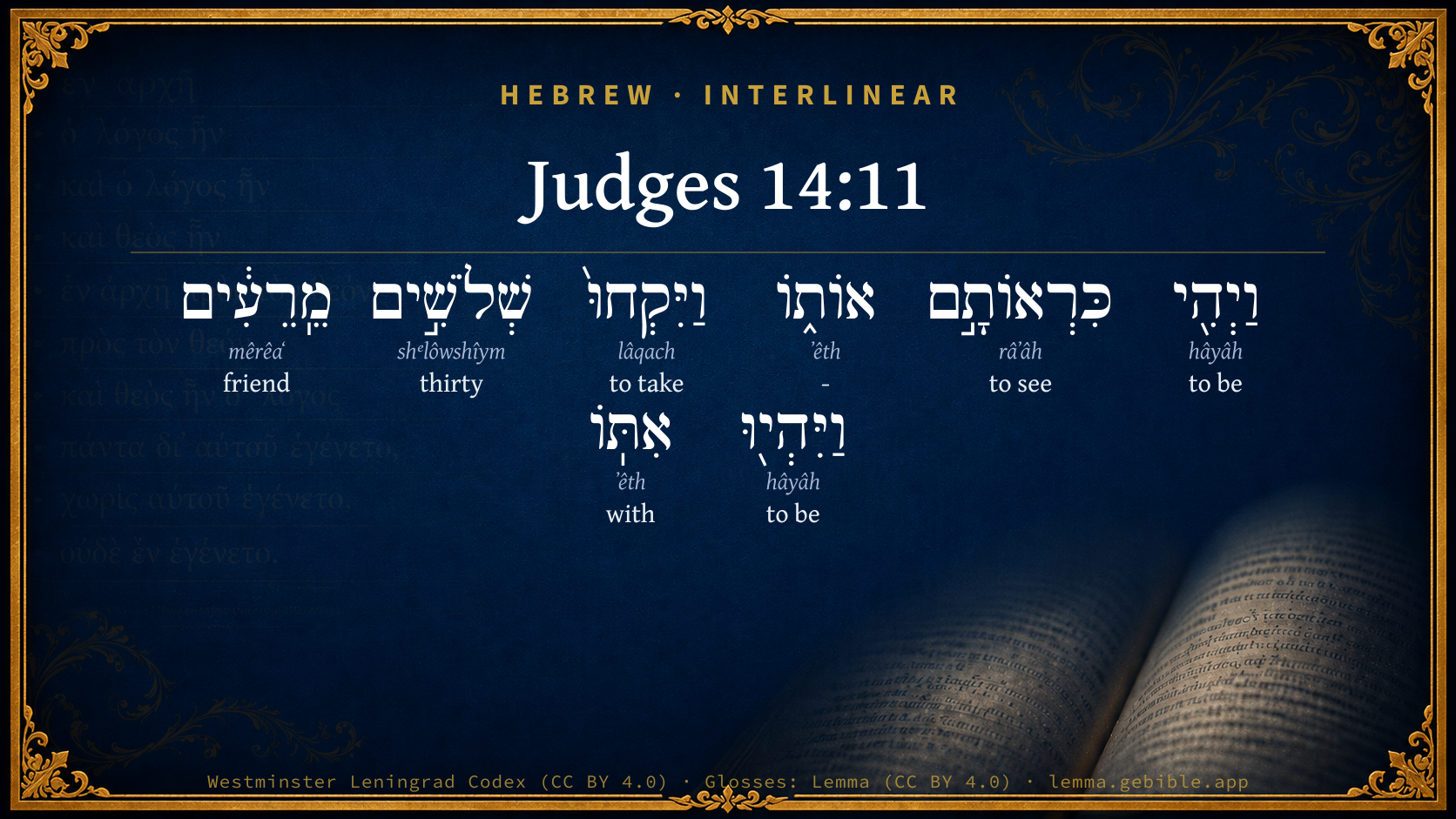
Judges 14:11

Hebrew (Westminster Leningrad Codex) Judges 14:11 appears in the Hebrew Old Testament. The text above is from the Westminster Leningrad Codex. Each word links to its Strong’s number, a concise gloss, and parsing drawn from the Open Scriptures Hebrew Bible morphology. Click any word for its full Brown-Driver-Briggs (BDB) entry.
Download image
Cite this verse

Judges 14:11 (World English Bible). Public Domain. Lemma interlinear Bible study tool, https://lemma.gebible.app/v/judges/14/11.

Show BibTeX & RIS
BibTeX
RIS
English Translation
It happened, when they saw him, that they brought thirty companions to be with him.
World English Bible · Public Domain
Download a study sheet

One document with this verse’s original text, its word-by-word gloss line, the meaning frame, cross-references with their text, attributed commentary, and full source and license credits — printable, and it pastes into notes with its structure intact.

This verse Autodidact and up

Study sheet (.html) Plain text (.txt)

A passage Seminary Student

Up to 50 verses in one chapter. A passage sheet keeps up to 6 commentary sources and 12 cross-references per verse, in the order this page ranks them, and says so on the sheet whenever that leaves anything out. Ask for a single verse and you get the Autodidact verse sheet above.

Everything on this page stays free to read, with no account — the sheet is a download of what is already on screen, not access to it.

Want to remove ads? Support Godless Engineer
Compare translations 3

The same verse in 3 English versions, stacked beneath the original-language interlinear above. Click any original word for its lexicon entry.

Each is an independent rendering of the whole verse — the interlinear is not word-aligned to these translations.

Highlighted words mark where these versions differ — a whole-verse word diff, not a word-by-word alignment.

  • World English Bible Public Domain
    It happened, when they saw him, that they brought thirty companions to be with him.
  • King James Version Public Domain
    And it came to pass, when they saw him, that they brought thirty companions to be with him.
  • unfoldingWord Literal Text CC BY-SA 4.0
    And it happened, in their seeing him, that they took 30 companions, and they were with him.

unfoldingWord Literal Text — © unfoldingWord, licensed CC BY-SA 4.0. Word-aligned USFM3 via Door43 (git.door43.org/unfoldingWord/en_ult).

Versions to compare (up to 4)

3 of 4 selected

Show all 18 translations

Every available English version of this verse, each an independent rendering of the whole verse.

  • World English Bible Public Domain
    It happened, when they saw him, that they brought thirty companions to be with him.
  • Berean Standard Bible Public Domain
    And when the Philistines saw him, they selected thirty men to accompany him.
  • Majority Standard Bible Public Domain
    And when the Philistines saw him, they selected thirty men to accompany him.
  • King James Version Public Domain
    And it came to pass, when they saw him, that they brought thirty companions to be with him.
  • American Standard Version (1901) Public Domain
    And it came to pass, when they saw him, that they brought thirty companions to be with him.
  • Revised Version (1885) Public Domain
    And it came to pass, when they saw him, that they brought thirty companions to be with him.
  • Geneva Bible (1599) Public Domain
    And when they sawe him, they brought thirtie companions to be with him.
  • Douay-Rheims (1899) Public Domain
    And when the citizens of that place saw him, they brought him thirty companions to be with him.
  • Young's Literal Translation Public Domain
    and it cometh to pass when they see him, that they take thirty companions, and they are with him.
  • Literal Standard Version CC BY-SA 4.0
    and it comes to pass, when they see him, that they take thirty companions, and they are with him.
  • Unlocked Literal Bible CC BY-SA 4.0
    As soon as her relatives saw him, they brought him thirty of their friends to be with him.
  • unfoldingWord Literal Text CC BY-SA 4.0
    And it happened, in their seeing him, that they took 30 companions, and they were with him.
  • Darby Bible Public Domain
    And when the people saw him, they brought thirty companions to be with him.
  • World Messianic Bible Public Domain
    When they saw him, they brought thirty companions to be with him.
  • Webster's Bible Public Domain
    And it came to pass, when they saw him, that they brought thirty companions to be with him.
  • Free Bible Version CC BY-SA 4.0
    When the Philistine people saw him, they arranged for thirty men to accompany him.
  • Bible in Basic English Public Domain
    And he took thirty friends, and they were with him.
  • JPS Tanakh (1917) Public Domain
    And it came to pass, when they saw him, that they brought thirty companions to be with him.

Literal Standard Version (2020), Covenant Press — licensed CC BY-SA 4.0. Text via the HelloAO Bible API (eBible.org). Unlocked Literal Bible (unfoldingWord) — licensed CC BY-SA 4.0. Text via the HelloAO Bible API (eBible.org). unfoldingWord Literal Text — © unfoldingWord, licensed CC BY-SA 4.0. Word-aligned USFM3 via Door43 (git.door43.org/unfoldingWord/en_ult). Free Bible Version, Dr. Jonathan Gallagher — licensed CC BY-SA 4.0. Text via the HelloAO Bible API (eBible.org).

Word by word

More ways to search: Search by grammar → Find every occurrence → Compare this word →

Practice this passage: Drill this verse → Learn its vocabulary →

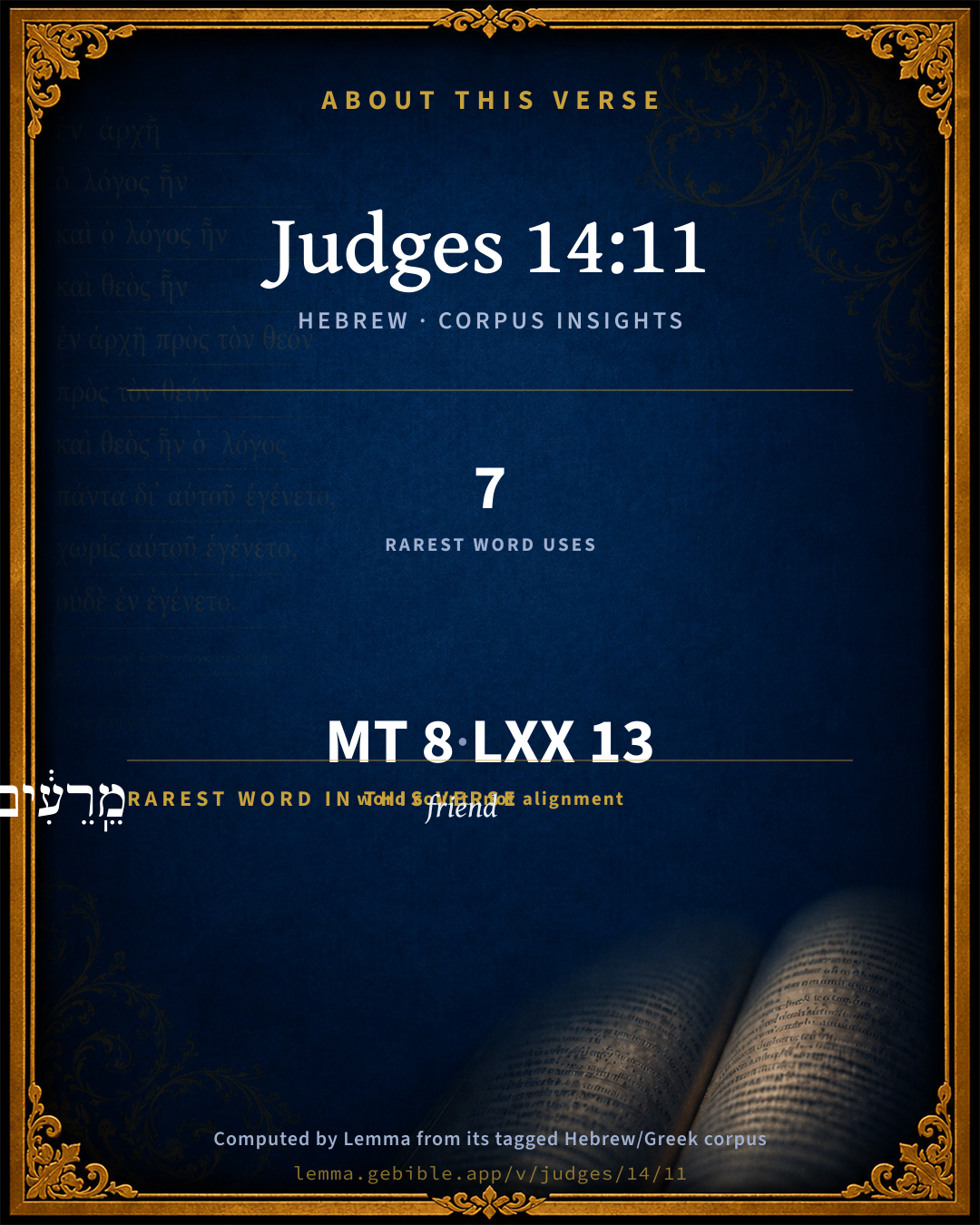
About this verse

These counts appear in no published source. They are computed here, from the morphology-tagged text and Lemma’s own curated glosses. What Lemma adds →

8
words
7
distinct lemmas
Historical
section

Notable vocabulary

The rarest word here is מֵֽרֵעִ֔ים friend H4828 — appearing just 7 times in the whole Hebrew Bible.

Shared distinctive vocabulary

מֵֽרֵעִ֔ים friend H4828 occurs in 7 verses of the Hebrew Bible. Also found in:

Grammatical profile

  • 4 verbs
  • 1 noun
  • 1 adjective
  • 1 preposition
  • 1 particle

Verb forms

  • וַיְהִ֖י Qal · Sequential Imperfect
  • כִּרְאוֹתָ֣ם Qal · Infinitive Construct
  • וַיִּקְחוּ֙ Qal · Sequential Imperfect
  • וַיִּהְי֖וּ Qal · Sequential Imperfect

Repetition

A word recurs within this verse — often emphatic in Hebrew:

  • וַיְהִ֖י to be H1961 ×2

Hebrew & Septuagint length

In English translation the verse runs 15 words from the Hebrew and 19 from the Septuagint (LXX English) — closely comparable.

A rough comparison of the two English renderings, which tokenize alike — not a word-level alignment.

Word counts can differ between the Hebrew and the Greek without any difference in meaning — e.g. the Hebrew direct-object marker אֵת has no separate Greek word, and Greek often adds the article ὁ.

In the original languages it is 8 Hebrew tokens and 13 Greek tokens — but the two are counted differently (Hebrew bundles its prefixes and suffixes into one token; the Greek is in lemma form), so that isn’t a like-for-like length.

Cross-references

4

Topical passages linked to Judges 14:11 in the Treasury of Scripture Knowledge — connected by theme and wording, ordered by reader-vote popularity; previews shown in the World English Bible.

  • John 3:29 He who has the bride is the bridegroom; but the friend of the bridegroom, who stands and hears him, rejoices greatly because of the bridegroom's voice. This, my joy, therefore is made full.
  • 1 Samuel 10:23 They ran and fetched him there; and when he stood among the people, he was higher than any of the people from his shoulders and upward.
  • 1 Samuel 16:6 It happened, when they had come, that he looked at Eliab, and said, Surely Yahweh's anointed is before him.
  • Matthew 9:15 Jesus said to them, "Can the friends of the bridegroom mourn, as long as the bridegroom is with them? But the days will come when the bridegroom will be taken away from them, and then they will fast.

Cross-references courtesy of OpenBible.info (CC BY 4.0).

Hebrew and Greek witnesses Masoretic Hebrew ↔ Greek Septuagint

The same verse in the two great witnesses to the Old Testament, shown verse-for-verse.

These are two independent witnesses, not word-aligned to each other, and the Septuagint is shown in lemma (dictionary) form.

Hebrew Judges 14:11 Masoretic · Westminster Leningrad Codex

וַיְהִ֖י כִּרְאוֹתָ֣ם אוֹת֑וֹ וַיִּקְחוּ֙ שְׁלֹשִׁ֣ים מֵֽרֵעִ֔ים וַיִּהְי֖וּ אִתּֽוֹ

It happened, when they saw him, that they brought thirty companions to be with him.

World English Bible · Public Domain

Greek LXX Judges 14:11 Septuagint · lemma form

καί γίγνομαι ὅτε ὁράω αὐτός καί λαμβάνω τριάκοντα κλητός καί εἰμί μετά αὐτός

And it came to pass when they saw him, that they took thirty guests, and they were with him.

LXX2012 (modern English Septuagint) · Public Domain

On this verse, Ellicott's Commentary for English Readers discusses the Septuagint’s reading. Read the note in Commentary ↓

Hebrew: Westminster Leningrad Codex (CC BY 4.0). Greek: Septuagint (public domain); English from LXX2012 (modern English Septuagint) (Public Domain). How the Septuagint differs from the Hebrew →

Targum (Aramaic paraphrase)

1

The Targum is the ancient Jewish Aramaic paraphrase of the Hebrew Scriptures — an interpretive translation, not the Hebrew text itself. Onkelos (literal) and Pseudo-Jonathan (expansive) render the Torah, and Jonathan the Prophets. Coverage is partial: where no permissively-licensed English translation exists for a verse, only the Aramaic is shown. This is verse-level text, not a word-by-word alignment to the Hebrew.

  1. Targum Jonathan Prophets (Joshua–Malachi)
    וַהֲוָה כַּד חֲזוֹ יָתֵיהּ וְדַבָּרוּ תְּלָתִין חֲבֵרִין וַהֲווֹ עִמֵיהּ:

    (no public-domain English translation for this verse)

    Targum Jonathan — Aramaic: “Mikraot Gedolot” (public domain). English: “Sefaria Community Translation” (CC0 1.0 (public-domain dedication)); “London "Chaldee Paraphrase," 1871” (public domain). Text via Sefaria.

Commentary

Notes on Judges 14:11 from classic Christian and Jewish commentators (each source and its license shown beneath its notes). The classic Christian expositions comment on the surrounding passage and are grouped to its opening verse, so a note may address several verses; the Jewish commentaries on the Tanakh (Rashi and others) are per-verse, so they appear only where the commentator wrote on this verse.

Lemma curates 59 commentaries, every one of them public domain or Creative Commons licensed, each selected and text-cleaned for this edition rather than reprinted as found. About our sources →

Trapp's Complete Commentary

John Trapp

Jdg 14:11 And it came to pass, when they saw him, that they brought thirty companions to be with him.

Ver. 11. And it came to pass, when they saw him.] His stature, strength, countenance, carriage, &c.

That they brought thirty companions to be with him.] Honoris quidem specie, sed cautionis ergo: under a pretence of doing him honour, but indeed to secure themselves, they set a guard upon him. So the Turks at this day suffer no stranger to come into the presence of their Emperor, but they clasp him by the arms, under colour of doing him honour, but indeed lest he should offer the Emperor any violence, as Miles Cobelite, a poor wounded Christian soldier, did Amurah III, whom he slew under pretence of coming near to crave his life of him. {a}

{a} Turk. Hist., p. 200, 715.

John Trapp, A Commentary or Exposition upon All the Books of the Old and New Testament (1647–1656) — public domain. Text from a community e-Sword module.

Joseph Benson's Commentary

Jdg 14:11. When they saw him — Or, observed him, his stature, and strength, and countenance, and carriage, which were extraordinary. They brought thirty companions — Partly in compliance with the custom of having bride-men; though they were not so numerous, but principally by way of caution, and as a guard put upon him under a pretence of respect and affection.

Joseph Benson's Commentary on the Old and New Testaments (1811–1818) — public domain. Text from a community e-Sword module.

Geneva Bible (1599)

Geneva Bible translators

That is, her parents or friends.

Geneva Bible (1599) marginal notes — public domain. Text via Bolls.life.

Adam Clarke's Commentary

Verse 11. They brought thirty companions] These are called in Scripture children of the bride-chamber, and friends of the bridegroom. See the whole of this subject particularly illustrated in the observations at the end, Clarke "Joh 3:25".

Adam Clarke's Commentary on the Bible (1810–1826) — public domain. Text from a community e-Sword/MySword module.

Ellicott's Commentary for English Readers

(11) When they saw him.—The reason why this clause is added is somewhat obscure, and this is perhaps the reason why the LXX. and Josephus, without any warrant, render it “when they were afraid of him, which would involve a change in the reading.

They brought thirty companions.—It was necessary to the splendour of the marriage feast that there should be these paranymphs (shoshbenim, or “children of the bride-chamber,” Mat_9:15). The fact that Samson had brought none with him seems to prove that his marriage was highly unpopular among his own countrymen. Thirty, however, was a most unusual number.

A Bible Commentary for English Readers, edited by Charles John Ellicott (1878–1897) — public domain. Text from a community e-Sword module.

The Cambridge Bible for Schools and Colleges

gen. ed. J. J. S. Perowne

11. when they saw him] With a slight change LXX. cod. A etc. read because they feared him; they must be the Philistines, though not mentioned in the context. The sight of Samson, or their fear of him, induced the Philistines to procure thirty companions (cf. Jdg_14:20), nominally as friends and supporters, but really in self-defence. The text does not give an altogether satisfactory sense, and may have suffered from alterations. If we read that he brought, which would be an improvement, we must treat when they saw him as an interpolation. This is Moore’s view, and Budde proposes further re-arrangements; the original state of the verse is not easy to recover. The thirty (cf. Son_3:7 sixty) are of course Philistines, Jdg_14:18. At village weddings in Syria the bridegroom is still attended by a body-guard of young men with their leader (Jdg_14:20), who superintend the festivities and bear the cost. This ancient institution probably goes back to days when the party really needed protection (Wetzstein, Z. f. Ethnologie, 1873, 288 f.).

The Cambridge Bible for Schools and Colleges (gen. ed. J. J. S. Perowne; Cambridge University Press, 1878–1918) — public domain. Text from a community e-Sword module.

John Gill's Exposition

And it came to pass; when they saw him,.... That is, the Philistines, the citizens of Timnath, when they saw that he was come to consummate his marriage:

that they brought thirty companions to be with him; to be the bridegroom's men, or children of the bridechamber, as they are called, Mat 9:15 or friends of the bridegroom, Joh 3:29 to keep him company during the nuptial feast: this they did according to custom, and in honour and respect unto him; though some think, and so Josephus (l), that they were brought to be guards upon him, observing that he was a man of great might, strength, and courage, so that they were afraid of him, lest he should have some design upon them; but it is not certain that there was anything very visible or terrible in him, more than in another man, that showed him to be of extraordinary courage and strength, since it was but at times the Spirit of the Lord came upon him, and as yet he had done nothing to their knowledge which showed him to be such; had they indeed known of his encounter with the lion, they might have had such thoughts of him, but this they knew nothing of.

(l) Ut supra. (Antiqu. l. 5. c. 8. sect. 6.)

John Gill's Exposition of the Whole Bible (1746–1763) — public domain (CC PDM 1.0). Text via the HelloAO Bible API.

Albert Barnes' Notes on the Bible

Thirty companions - These were “the children of the bride-chamber” (Mat 9:15; see Jdg 14:20). From the number of them it may be inferred that Samson’s family was of some wealth and importance.

Albert Barnes' Notes on the Bible (1834–1885) — public domain. Text from a community e-Sword/MySword module.

Haydock's Catholic Bible Commentary

With him. Some imagine that these were placed to watch his motions. But he had surely invited them, ver. 15. During the time that the nuptials were celebrated, these men (who are called the friends of the bridegroom, Matthew ix. 15,) are said to have been exempted from all public charges. (Montanus) (Calmet)

George Leo Haydock (1774–1849), Haydock's Catholic Family Bible and Commentary, 1859 edition — public domain. Excludes Psalms (Douay-Rheims chapter numbering differs from Protestant) and Deuterocanonical books (Catholic canon only).

Matthew Poole's English Annotations

When they saw him, or, observed or considered him, his stature, and strength, and countenance, and carriage, which were extraordinary.

They brought thirty companions to be with him; partly in compliance with the custom of having bridemen; of which see Mat 9:15; Mar 2:19; Joh 3:29, though they were not so numerous; and principally by way of caution, and as a guard put upon him under a pretence of respect and affection.

Matthew Poole's English Annotations on the Holy Bible (1683–1685) — public domain. Text from a community e-Sword/MySword module.

Whedon's Commentary on the Bible

Daniel D. Whedon

11. When they saw him — That is, when the bride’s parents and relatives saw him. Bush and others think these words indicate that they saw in Samson’s stature and bearing something that aroused their suspicions, and told them he was a man to be watched, and they therefore brought thirty companions more, for the purpose of setting so many spies about him rather than for showing him respect or honour. But the phrase to be with him hardly harmonizes with such a thought, and the joviality and good cheer of their intercourse is against it. The parents and friends of the bride had seen Samson before, and had there been any thing suspicious about his stature and countenance they would have discovered it before this time. The verse merely means that when they saw him make his appearance with his parents in Timnath, to celebrate the wedding feast, they proceeded at once to do their part in furnishing him guests.

Daniel D. Whedon (gen. ed.), Commentary on the Old and New Testaments (1874–1909) — public domain. Text from a community e-Sword module.

The Pulpit Commentary

When they saw him, i.e. when the father and mother and friends of the bride saw him approaching, they went to meet him with the thirty companions who had been selected. We still see a strong resemblance to the wedding arrangements referred to in Mat_9:15, and Mat_25:1-12; only in this case they were young men instead of young women who went out to meet the bridegroom. We may observe, by the way, that the scale of the wedding feast, as regards numbers and duration, indicates that Samson s family was one of wealth and position.

The Pulpit Commentary (1880–1919), ed. H.D.M. Spence-Jones & Joseph S. Exell — public domain. Text from a community e-Sword module.

John Wesley's Explanatory Notes

Saw him - Or, observed him, his stature, and strength, and countenance, and carriage, which were extraordinary. Brought - Partly in compliance with the custom of having bride-men; though they were not so numerous; but principally by way of caution, and as a guard put upon him under a pretense of respect and affection.

John Wesley, Explanatory Notes Upon the Whole Bible (1754–1765) — public domain. Text via the GEBible commentary corpus.

Rashi

Rabbi Shlomo Yitzchaki (Rashi)

Friends. Companions who formed the retinue of wedding attendants.

Rashi on the Tanakh — English translations: “The Judaica Press complete Tanach with Rashi, translated by A. J. Rosenberg” (CC BY 4.0); “Pentateuch with Rashi's commentary by M. Rosenbaum and A.M. Silbermann, 1929-1934” (public domain); “The Metsudah Tanach series, Lakewood, N.J” (CC BY 4.0); and “The Book of Joshua, Metsudah Publications, 1997” (CC BY 4.0). Text via Sefaria.

Lesson kit

Teaching starters — assembled from the data on this page, not authored interpretation. Every prompt links to the verse data it draws on. Edit before teaching.

Judges, in the Historical, opens this verse with 8 words (7 distinct Hebrew lemmas). Its most distinctive word is mêrêaʻ (“friend”). A historical commentator’s framing appears above. Read the whole chapter for the surrounding context.

Discussion questions

  1. What does “friend” (mêrêaʻ) contribute to the verse as a whole?
  2. How does Genesis 26:26, which shares the word «friend», read alongside this verse?
  3. What does the repetition of “to be” (2× in this one verse) do in this verse?
  4. The translations on this page render this verse differently — a whole-verse word diff, not a word-by-word alignment. What might account for the different wordings?
  5. «וַיְהִ֖י» is a Qal Sequential Imperfect verb. How does that grammatical form shape the action described?
  6. Compare how Trapp's Complete Commentary and Joseph Benson's Commentary read this verse. Where do they agree or differ?

Things to notice

Reading settings

Reading text

Shown beneath each verse's original-language words.

Old Testament
Old Testament edition

Read the OT as the Masoretic Hebrew (MT) or the Greek Septuagint (LXX).

English shown for the Greek Septuagint (in the Hebrew ↔ Greek comparison).

Comparing translations? Open the Compare panel on any verse page to stack up to four side by side.