
Joshua 14:11

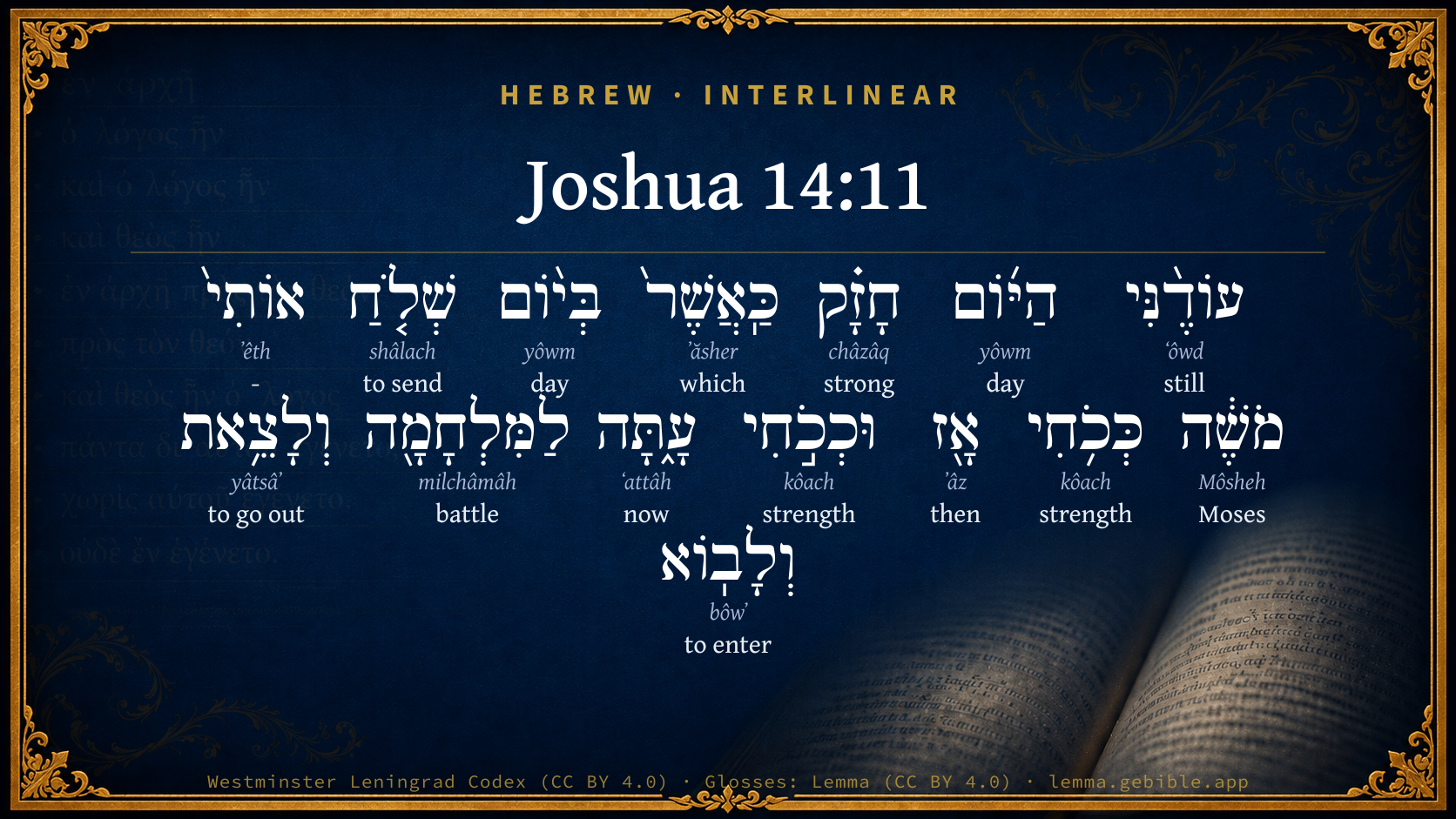
Hebrew (Westminster Leningrad Codex) Joshua 14:11 appears in the Hebrew Old Testament. The text above is from the Westminster Leningrad Codex. Each word links to its Strong’s number, a concise gloss, and parsing drawn from the Open Scriptures Hebrew Bible morphology. Click any word for its full Brown-Driver-Briggs (BDB) entry.
Download image
Cite this verse

Joshua 14:11 (World English Bible). Public Domain. Lemma interlinear Bible study tool, https://lemma.gebible.app/v/joshua/14/11.

Show BibTeX & RIS
BibTeX
RIS
English Translation
As yet I am as strong this day as I as in the day that Moses sent me: as my strength was then, even so is my strength now, for war, and to go out and to come in.
World English Bible · Public Domain
Download a study sheet

One document with this verse’s original text, its word-by-word gloss line, the meaning frame, cross-references with their text, attributed commentary, and full source and license credits — printable, and it pastes into notes with its structure intact.

This verse Autodidact and up

Study sheet (.html) Plain text (.txt)

A passage Seminary Student

Up to 50 verses in one chapter. A passage sheet keeps up to 6 commentary sources and 12 cross-references per verse, in the order this page ranks them, and says so on the sheet whenever that leaves anything out. Ask for a single verse and you get the Autodidact verse sheet above.

Everything on this page stays free to read, with no account — the sheet is a download of what is already on screen, not access to it.

Want to remove ads? Support Godless Engineer
Compare translations 3

The same verse in 3 English versions, stacked beneath the original-language interlinear above. Click any original word for its lexicon entry.

Each is an independent rendering of the whole verse — the interlinear is not word-aligned to these translations.

Highlighted words mark where these versions differ — a whole-verse word diff, not a word-by-word alignment.

  • World English Bible Public Domain
    As yet I am as strong this day as I as in the day that Moses sent me: as my strength was then, even so is my strength now, for war, and to go out and to come in.
  • King James Version Public Domain
    As yet I am as strong this day as I was in the day that Moses sent me: as my strength was then, even so is my strength now, for war, both to go out, and to come in.
  • unfoldingWord Literal Text CC BY-SA 4.0
    Still I strong today just as on the day Moses sent me. As my strength then, so my strength now, for war, and for going out and for coming in.

unfoldingWord Literal Text — © unfoldingWord, licensed CC BY-SA 4.0. Word-aligned USFM3 via Door43 (git.door43.org/unfoldingWord/en_ult).

Versions to compare (up to 4)

3 of 4 selected

Show all 18 translations

Every available English version of this verse, each an independent rendering of the whole verse.

  • World English Bible Public Domain
    As yet I am as strong this day as I as in the day that Moses sent me: as my strength was then, even so is my strength now, for war, and to go out and to come in.
  • Berean Standard Bible Public Domain
    still as strong today as I was the day Moses sent me out. As my strength was then, so it is now for war, for going out, and for coming in.
  • Majority Standard Bible Public Domain
    still as strong today as I was the day Moses sent me out. As my strength was then, so it is now for war, for going out, and for coming in.
  • King James Version Public Domain
    As yet I am as strong this day as I was in the day that Moses sent me: as my strength was then, even so is my strength now, for war, both to go out, and to come in.
  • American Standard Version (1901) Public Domain
    As yet I am as strong this day as I as in the day that Moses sent me: as my strength was then, even so is my strength now, for war, and to go out and to come in.
  • Revised Version (1885) Public Domain
    As yet I am as strong this day as I was in the day that Moses sent me: as my strength was then, even so is my strength now, for war and to go out and to come in.
  • Geneva Bible (1599) Public Domain
    And yet am as strong at this time, as I was when Moses sent me: as strong as I was then, so strong am I nowe, either for warre, or for gouernment.
  • Douay-Rheims (1899) Public Domain
    As strong as I was at that time when I was sent to view the land: the strength of that time continueth in me until this day, as well to fight as to march.
  • Young's Literal Translation Public Domain
    yet `am' I to-day strong as in the day of Moses' sending me; as my power then, so `is' my power now, for battle, and to go out, and to come in.
  • Literal Standard Version CC BY-SA 4.0
    yet today I [am] strong as in the day of Moses’ sending me; as my power [was] then, so [is] my power now, for battle, and to go out, and to come in.
  • Unlocked Literal Bible CC BY-SA 4.0
    I am still as strong this day as I was in the day that Moses sent me out. My strength is now as my strength was then, for war and for going and coming.
  • unfoldingWord Literal Text CC BY-SA 4.0
    Still I strong today just as on the day Moses sent me. As my strength then, so my strength now, for war, and for going out and for coming in.
  • Darby Bible Public Domain
    I am still this day strong, as in the day that Moses sent me: as my strength was then, even so is my strength now, for war, both to go out and to come in.
  • World Messianic Bible Public Domain
    As yet I am as strong today as I was in the day that Moses sent me. As my strength was then, even so is my strength now for war, to go out and to come in.
  • Webster's Bible Public Domain
    As yet I am as strong this day, as I was in the day that Moses sent me: as my strength was then, even so is my strength now, for war, both to go out, and to come in.
  • Free Bible Version CC BY-SA 4.0
    but I'm still as strong today as when Moses sent me out. I'm as strong and ready for battle or for whatever may come as I was then.
  • Bible in Basic English Public Domain
    And still, I am as strong today as I was when Moses sent me out: as my strength was then, so is it now, for war and for all the business of life.
  • JPS Tanakh (1917) Public Domain
    As yet I am as strong this day as I was in the day that Moses sent me; as my strength was then, even so is my strength now, for war, and to go out and to come in.

Literal Standard Version (2020), Covenant Press — licensed CC BY-SA 4.0. Text via the HelloAO Bible API (eBible.org). Unlocked Literal Bible (unfoldingWord) — licensed CC BY-SA 4.0. Text via the HelloAO Bible API (eBible.org). unfoldingWord Literal Text — © unfoldingWord, licensed CC BY-SA 4.0. Word-aligned USFM3 via Door43 (git.door43.org/unfoldingWord/en_ult). Free Bible Version, Dr. Jonathan Gallagher — licensed CC BY-SA 4.0. Text via the HelloAO Bible API (eBible.org).

Word by word

More ways to search: Search by grammar → Find every occurrence → Compare this word →

Practice this passage: Drill this verse → Learn its vocabulary →

חָזָ֗ק
châzâq
H2389
“strong”
Adjective, Adjective, Masculine, Singular, Absolute
Part of Speech
Adjective
Type
Adjective
Gender
Masculine
Number
Singular
State
Absolute
Full BDB Definition

Origin: from H2388

TWOT: 636a

strong, stout, mighty - strong - severe, sharp, hot - firm, hard - a strong one (substantive)
  1. עוֹדֶ֨נִּי ʻôwd H5750 “still · my” Adverb + Suffix, Personal, 1st Person, Common, Singular
  2. הַיּ֜וֹם yôwm H3117 “the · day” Particle, Definite Article + Noun, Common, Masculine, Singular, Absolute
  3. כַּֽאֲשֶׁר֙ ʼăsher H834 “like/as · which” Preposition + Particle, Relative
  4. בְּי֨וֹם yôwm H3117 “in/at · day of” Preposition + Noun, Common, Masculine, Singular, Construct
  5. שְׁלֹ֤חַ shâlach H7971 “to send” Verb, Qal, Infinitive Construct
  6. אוֹתִי֙ ʼêth H853 “- · me” Particle, Direct Object + Suffix, Personal, 1st Person, Common, Singular
  7. מֹשֶׁ֔ה Môsheh H4872 “Moses” Noun, Proper
  8. כְּכֹ֥חִי kôach H3581 “like/as · strength · my” Preposition + Noun, Common, Masculine, Singular, Construct + Suffix, Personal, 1st Person, Common, Singular
  9. אָ֖ז ʼâz H227 “then” Adverb
  10. וּכְכֹ֣חִי kôach H3581 “and · like/as · strength · my” Conjunction + Preposition + Noun, Common, Masculine, Singular, Construct + Suffix, Personal, 1st Person, Common, Singular
  11. עָ֑תָּה ʻattâh H6258 “now” Adverb
  12. לַמִּלְחָמָ֖ה milchâmâh H4421 “to/for the · battle” Preposition, Determined + Noun, Common, Feminine, Singular, Absolute
  13. וְלָצֵ֥את yâtsâʼ H3318 “and · to go out” Conjunction + Preposition + Verb, Qal, Infinitive Construct
  14. וְלָבֽוֹא bôwʼ H935 “and · to enter” Conjunction + Preposition + Verb, Qal, Infinitive Construct

About this verse

These counts appear in no published source. They are computed here, from the morphology-tagged text and Lemma’s own curated glosses. What Lemma adds →

15
words
13
distinct lemmas
Historical
section

Shared distinctive vocabulary

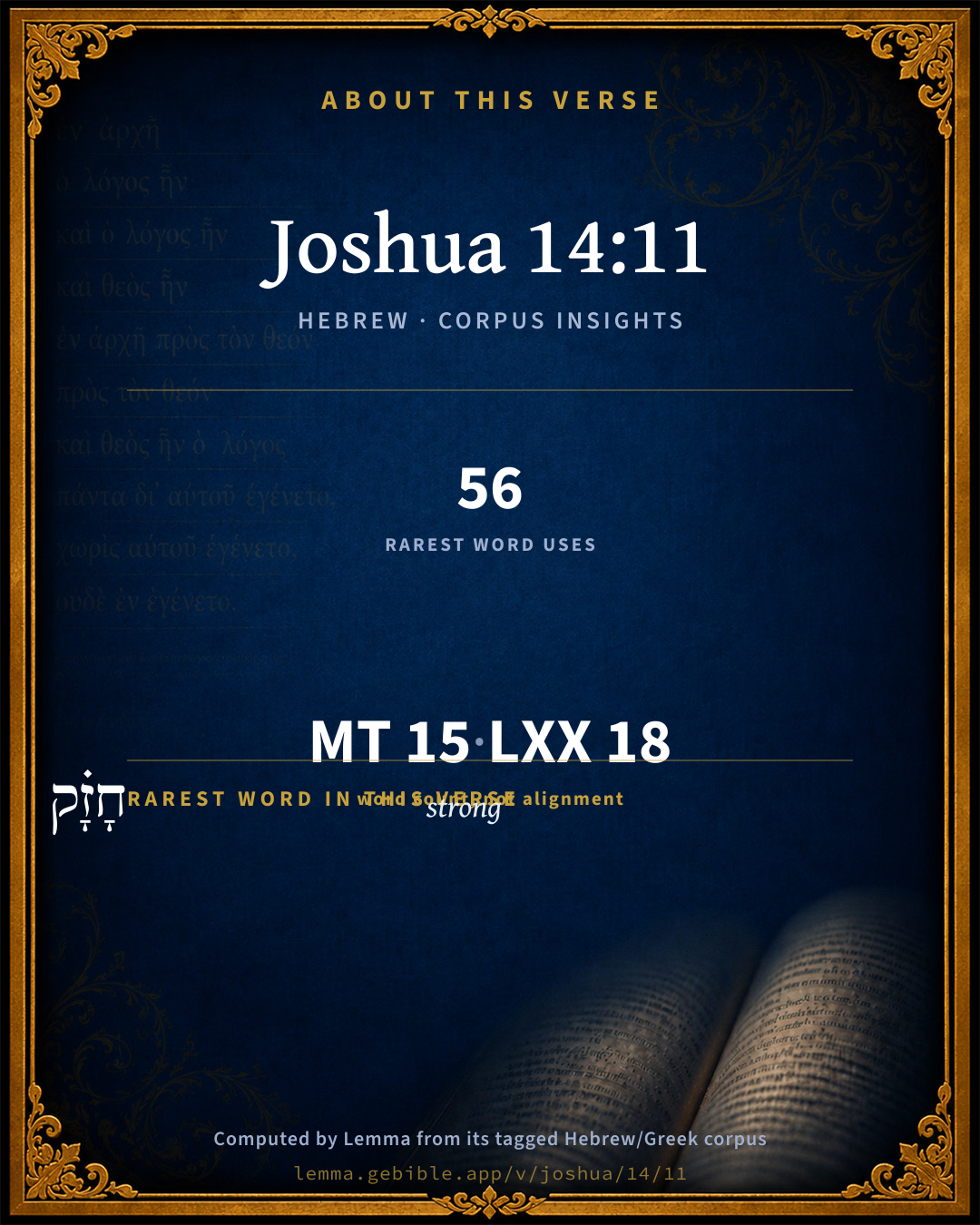
חָזָ֗ק strong H2389 occurs in 54 verses of the Hebrew Bible. Also found in:

Grammatical profile

  • 3 verbs
  • 6 nouns
  • 1 adjective
  • 3 adverbs
  • 2 particles

Verb forms

  • שְׁלֹ֤חַ Qal · Infinitive Construct
  • וְלָצֵ֥את Qal · Infinitive Construct
  • וְלָבֽוֹא Qal · Infinitive Construct

Repetition

Words recur within this verse — often emphatic in Hebrew:

  • הַיּ֜וֹם day H3117 ×2
  • כְּכֹ֥חִי strength H3581 ×2

Hebrew & Septuagint length

In English translation the verse runs 39 words from the Hebrew and 27 from the Septuagint (LXX English) — the Septuagint runs noticeably shorter here. See the side-by-side →

A rough comparison of the two English renderings, which tokenize alike — not a word-level alignment.

Word counts can differ between the Hebrew and the Greek without any difference in meaning — e.g. the Hebrew direct-object marker אֵת has no separate Greek word, and Greek often adds the article ὁ.

In the original languages it is 15 Hebrew tokens and 18 Greek tokens — but the two are counted differently (Hebrew bundles its prefixes and suffixes into one token; the Greek is in lemma form), so that isn’t a like-for-like length.

Cross-references

4

Topical passages linked to Joshua 14:11 in the Treasury of Scripture Knowledge — connected by theme and wording, ordered by reader-vote popularity; previews shown in the World English Bible.

  • Deuteronomy 34:7 Moses was one hundred twenty years old when he died: his eye was not dim, nor his natural force abated.
  • Psalms 103:5 Who satisfies your desire with good things, So that your youth is renewed like the eagle's.
  • Deuteronomy 31:2 He said to them, I am one hundred twenty years old this day; I can no more go out and come in: and Yahweh has said to me, You shall not go over this Jordan.
  • Psalms 90:10 The days of our years are seventy, Or even by reason of strength eighty years; Yet their pride is but labor and sorrow, For it passes quickly, and we fly away.

Cross-references courtesy of OpenBible.info (CC BY 4.0).

Hebrew and Greek witnesses Masoretic Hebrew ↔ Greek Septuagint

The same verse in the two great witnesses to the Old Testament, shown verse-for-verse.

Here the Septuagint runs noticeably shorter than the Hebrew — LXX2012 (modern English Septuagint) 27 words vs World English Bible 39. A rough length comparison of the two English translations, not a word-level alignment — read both below.

These are two independent witnesses, not word-aligned to each other, and the Septuagint is shown in lemma (dictionary) form.

Hebrew Joshua 14:11 Masoretic · Westminster Leningrad Codex

עוֹדֶ֨נִּי הַיּ֜וֹם חָזָ֗ק כַּֽאֲשֶׁר֙ בְּי֨וֹם שְׁלֹ֤חַ אוֹתִי֙ מֹשֶׁ֔ה כְּכֹ֥חִי אָ֖ז וּכְכֹ֣חִי עָ֑תָּה לַמִּלְחָמָ֖ה וְלָצֵ֥את וְלָבֽוֹא

As yet I am as strong this day as I as in the day that Moses sent me: as my strength was then, even so is my strength now, for war, and to go out and to come in.

World English Bible · Public Domain

Greek LXX Joshua 14:11 Septuagint · lemma form

ἔτι εἰμί σήμερον ἰσχύς ὡσεί ὅτε ἀποστέλλω ἐγώ μωυσῆς ὡσαύτως ἰσχύω νῦν ἐκἔρχομαι καί εἰςἔρχομαι εἰς ὁ πόλεμος

I am still strong this day, as when the Lord sent me: just so strong am I now to go out and to come in for war.

LXX2012 (modern English Septuagint) · Public Domain

On this verse, Haydock's Catholic Bible Commentary discusses the Septuagint’s reading. Read the note in Commentary ↓

Hebrew: Westminster Leningrad Codex (CC BY 4.0). Greek: Septuagint (public domain); English from LXX2012 (modern English Septuagint) (Public Domain). How the Septuagint differs from the Hebrew →

Targum (Aramaic paraphrase)

1

The Targum is the ancient Jewish Aramaic paraphrase of the Hebrew Scriptures — an interpretive translation, not the Hebrew text itself. Onkelos (literal) and Pseudo-Jonathan (expansive) render the Torah, and Jonathan the Prophets. Coverage is partial: where no permissively-licensed English translation exists for a verse, only the Aramaic is shown. This is verse-level text, not a word-by-word alignment to the Hebrew.

  1. Targum Jonathan Prophets (Joshua–Malachi)
    עַד כְּעַן אֲנָא יוֹמָא דֵין תַּקִיף כִּדְבְּיוֹמָא דִשְׁלַח יָתִי מֹשֶׁה כְּחֵילִי כִּבְכֵן וְכֵן חֵילִי דִכְעָן לְאַגָחָא קְרָבָא וּלְמִפַּק וּלְמֵיעָל:

    (no public-domain English translation for this verse)

    Targum Jonathan — Aramaic: “Mikraot Gedolot” (public domain). English: “Sefaria Community Translation” (CC0 1.0 (public-domain dedication)); “London "Chaldee Paraphrase," 1871” (public domain). Text via Sefaria.

Commentary

Notes on Joshua 14:11 from classic Christian and Jewish commentators (each source and its license shown beneath its notes). The classic Christian expositions comment on the surrounding passage and are grouped to its opening verse, so a note may address several verses; the Jewish commentaries on the Tanakh (Rashi and others) are per-verse, so they appear only where the commentator wrote on this verse.

Lemma curates 59 commentaries, every one of them public domain or Creative Commons licensed, each selected and text-cleaned for this edition rather than reprinted as found. About our sources →

Trapp's Complete Commentary

John Trapp

Jos 14:11 As yet I [am as] strong this day as [I was] in the day that Moses sent me: as my strength [was] then, even so [is] my strength now, for war, both to go out, and to come in.

Ver. 11. As yet I am strong this day.] Viridis et vegeta senectus singulare Dei donum est {Deu 34:7} Mr Dod, as he was another Moses for meekness, so for health of body in extreme old age; a mercy that he much valued. Deficere potius quam desinere visus est.

John Trapp, A Commentary or Exposition upon All the Books of the Old and New Testament (1647–1656) — public domain. Text from a community e-Sword module.

Tyndale Open Study Notes

Tyndale Open Resources

14:11 Caleb judged himself to be as strong at eighty-five as he had been at forty. He still felt equipped to travel and fight—to continue both ordinary and extraordinary pursuits.

Tyndale Open Study Notes — © Tyndale Open Resources, licensed CC BY-SA 4.0. Text via the HelloAO Bible API.

Geneva Bible (1599)

Geneva Bible translators

Hebrew, to go out and come in.

Geneva Bible (1599) marginal notes — public domain. Text via Bolls.life.

Adam Clarke's Commentary

Verse 11. Even so is my strength now] I do not ask this place because I wish to sit down now, and take my ease; on the contrary, I know I must fight, to drive out the Anakim, and I am as able and willing to do it as I was forty-five years ago, when Moses sent me to spy out the land.

Adam Clarke's Commentary on the Bible (1810–1826) — public domain. Text from a community e-Sword/MySword module.

Ellicott's Commentary for English Readers

(11) As yet I am as strong this day . . .—But by Jos_13:1, “Joshua had aged.” Yet Joshua died at the age of 110, only 25 years older than Caleb was at this time. They were contemporaries. But the far greater responsibility lying upon Joshua (with a possible difference of temperament) may very naturally account for the one man’s having aged so much more rapidly than the other.

A Bible Commentary for English Readers, edited by Charles John Ellicott (1878–1897) — public domain. Text from a community e-Sword module.

The Cambridge Bible for Schools and Colleges

gen. ed. J. J. S. Perowne

11. As yet I am] “To day Y am of fẏue and eiçti çeer, so myçti as that tyme Y was myghti, whanne Y was sent to aspie,” Wyclif.

The Cambridge Bible for Schools and Colleges (gen. ed. J. J. S. Perowne; Cambridge University Press, 1878–1918) — public domain. Text from a community e-Sword module.

John Gill's Exposition

As yet I am as strong this day as I was in the day that Moses sent me,.... To spy the land, forty five years ago; suggesting that he was as sound in his mind, understanding, judgment and memory, and as hale, strong, and robust in his body now, as he had been so long ago; which was a wonderful instance of the care of divine Providence over him in upholding him in life, and continuing him in vigour and health at such an age, when the carcasses of so many thousands had pined away and fell in the wilderness:

as my strength was then, even so is my strength now for war; he had the same strength of body and courage of mind to engage in warlike enterprises as he had so many years ago; and this he the rather mentions, to prevent any objection Joshua might make to the giving of Hebron to him, since being inhabited by giants, it required a large share of strength and courage to attempt the conquest of it: but Caleb had strength

both to go out, and to come in; to do any civil business, to preside over his tribe, or to govern any city, and its appendages, that should be put into his hands.

John Gill's Exposition of the Whole Bible (1746–1763) — public domain (CC PDM 1.0). Text via the HelloAO Bible API.

Haydock's Catholic Bible Commentary

March. Hebrew, "to enter and to go out." Septuagint add, "to war."

George Leo Haydock (1774–1849), Haydock's Catholic Family Bible and Commentary, 1859 edition — public domain. Excludes Psalms (Douay-Rheims chapter numbering differs from Protestant) and Deuterocanonical books (Catholic canon only).

Matthew Poole's English Annotations

For war; not only for counsel, but for action, for marching and fighting. And therefore this gift will not be cast away upon an unprofitable and unserviceable person.

To go out, and to come in; to perform all the duties belonging to my place.

Matthew Poole's English Annotations on the Holy Bible (1683–1685) — public domain. Text from a community e-Sword/MySword module.

Whedon's Commentary on the Bible

Daniel D. Whedon

11. Strong this day — As strong to defend his heritage as he was forty-five years ago to win it. He had kept the ten commandments which his own ears had heard from Jehovah’s voice so well, that they had been permanent youth in his blood and bones.

Go out — To the battle.

Come in — With the spoils. See Jdg_1:20. This was no senile boast of youthful strength, as the three sons of Anak found to their cost. Jos_15:14. The old hero never became, like his fellow Joshua, ruler of all Israel, but he had a son-in-law-nephew that did.}

Daniel D. Whedon (gen. ed.), Commentary on the Old and New Testaments (1874–1909) — public domain. Text from a community e-Sword module.

The Pulpit Commentary

As yet am I as strong this day. A vigorous and respected old age is ordinarily, by Nature"s own law, the decreed reward for a virtuous youth and a temperate manhood. Caleb"s devotion to God"s service had preserved him from the sins as well as from the faithlessness and murmuring of the Israelites. And thus, with a body not enfeebled by indulgence, he presents himself before Joshua with undiminished strength, at a time when most men are sinking under the weight of their infirmities, and is ready still for battle with the most formidable foes.

The Pulpit Commentary (1880–1919), ed. H.D.M. Spence-Jones & Joseph S. Exell — public domain. Text from a community e-Sword module.

John Wesley's Explanatory Notes

For war - Not only for counsel, but for action; for marching and fighting. And therefore this gift will not be cast away upon an unprofitable and unserviceable person. To go out, and to come in - To perform all the duties belonging to my place. Moses had said, that at eighty years old, even our strength is labour and sorrow. But Caleb was an exception to this rule: At eighty-five years old, his strength was still ease and joy. This he got by following the Lord fully.

John Wesley, Explanatory Notes Upon the Whole Bible (1754–1765) — public domain. Text via the GEBible commentary corpus.

Lesson kit

Teaching starters — assembled from the data on this page, not authored interpretation. Every prompt links to the verse data it draws on. Edit before teaching.

Joshua, in the Historical, opens this verse with 15 words (13 distinct Hebrew lemmas). Its most distinctive word is châzâq (“strong”). The Greek Septuagint runs shorter here. A historical commentator’s framing appears above. Read the whole chapter for the surrounding context.

Discussion questions

  1. The word châzâq carries the sense “strong.” How does it shape the verse?
  2. How does Exodus 3:19, which shares the word «strong», read alongside this verse?
  3. What does the repetition of “day” (2× in this one verse) do in this verse?
  4. The Septuagint runs shorter here than the Hebrew. What might account for the difference?
  5. The translations on this page render this verse differently — a whole-verse word diff, not a word-by-word alignment. What might account for the different wordings?
  6. «שְׁלֹ֤חַ» is a Qal Infinitive Construct verb. How does that grammatical form shape the action described?
  7. Compare how Trapp's Complete Commentary and Tyndale Open Study Notes read this verse. Where do they agree or differ?

Things to notice

Reading settings

Reading text

Shown beneath each verse's original-language words.

Old Testament
Old Testament edition

Read the OT as the Masoretic Hebrew (MT) or the Greek Septuagint (LXX).

English shown for the Greek Septuagint (in the Hebrew ↔ Greek comparison).

Comparing translations? Open the Compare panel on any verse page to stack up to four side by side.