Acts 11:2

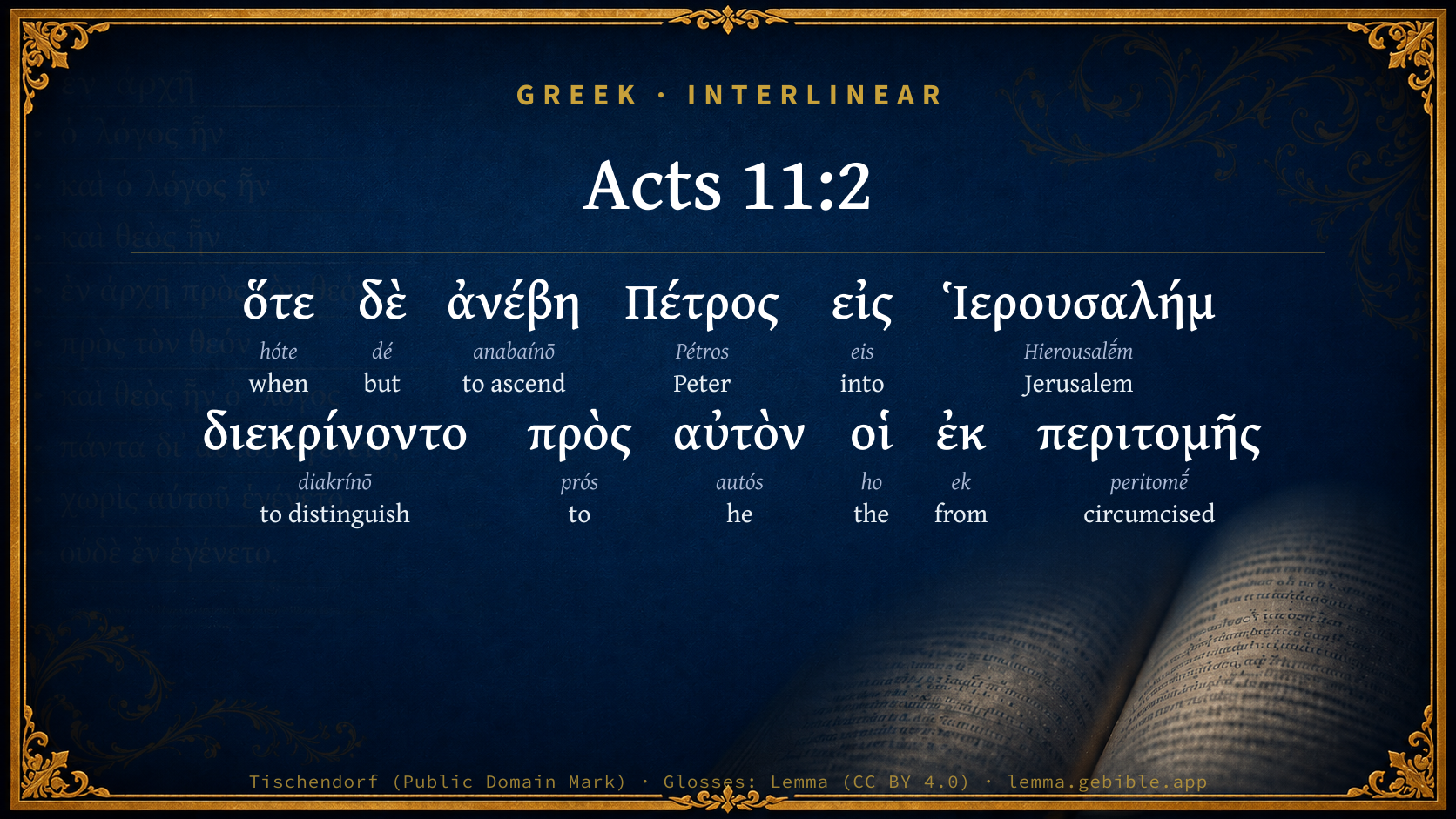
Greek (Tischendorf 8th ed.) Acts 11:2 appears in the Greek New Testament. The text above is from the Tischendorf 8th edition. Each word links to its Strong’s number and a concise gloss. Click any word for its full Thayer’s Greek Lexicon entry.
Download image
Cite this verse

Acts 11:2 (World English Bible). Public Domain. Lemma interlinear Bible study tool, https://lemma.gebible.app/v/acts/11/2.

Show BibTeX & RIS
BibTeX
RIS
English Translation
When Peter had come up to Jerusalem, those who were of the circumcision contended with him,
World English Bible · Public Domain
Download a study sheet

One document with this verse’s original text, its word-by-word gloss line, the meaning frame, cross-references with their text, attributed commentary, and full source and license credits — printable, and it pastes into notes with its structure intact.

This verse Autodidact and up

Study sheet (.html) Plain text (.txt)

A passage Seminary Student

Up to 50 verses in one chapter. A passage sheet keeps up to 6 commentary sources and 12 cross-references per verse, in the order this page ranks them, and says so on the sheet whenever that leaves anything out. Ask for a single verse and you get the Autodidact verse sheet above.

Everything on this page stays free to read, with no account — the sheet is a download of what is already on screen, not access to it.

Want to remove ads? Support Godless Engineer
Compare translations 3

The same verse in 3 English versions, stacked beneath the original-language interlinear above. Click any original word for its lexicon entry.

Each is an independent rendering of the whole verse — the interlinear is not word-aligned to these translations.

Highlighted words mark where these versions differ — a whole-verse word diff, not a word-by-word alignment.

  • World English Bible Public Domain
    When Peter had come up to Jerusalem, those who were of the circumcision contended with him,
  • King James Version Public Domain
    And when Peter was come up to Jerusalem, they that were of the circumcision contended with him,
  • unfoldingWord Literal Text CC BY-SA 4.0
    And when Peter came up to Jerusalem, those from the circumcision were disputing with him,

unfoldingWord Literal Text — © unfoldingWord, licensed CC BY-SA 4.0. Word-aligned USFM3 via Door43 (git.door43.org/unfoldingWord/en_ult).

Versions to compare (up to 4)

3 of 4 selected

Show all 19 translations

Every available English version of this verse, each an independent rendering of the whole verse.

  • World English Bible Public Domain
    When Peter had come up to Jerusalem, those who were of the circumcision contended with him,
  • Berean Standard Bible Public Domain
    So when Peter went up to Jerusalem, the circumcised believers took issue with him
  • Majority Standard Bible Public Domain
    So when Peter went up to Jerusalem, the circumcised believers took issue with him
  • King James Version Public Domain
    And when Peter was come up to Jerusalem, they that were of the circumcision contended with him,
  • American Standard Version (1901) Public Domain
    And when Peter was come up to Jerusalem, they that were of the circumcision contended with him,
  • Revised Version (1885) Public Domain
    And when Peter was come up to Jerusalem, they that were of the circumcision contended with him,
  • Geneva Bible (1599) Public Domain
    And when Peter was come vp to Hierusalem, they of the circumcision contended against him,
  • Douay-Rheims (1899) Public Domain
    And when Peter was come up to Jerusalem, they that were of the circumcision contended with him,
  • Young's Literal Translation Public Domain
    and when Peter came up to Jerusalem, those of the circumcision were contending with him,
  • Literal Standard Version CC BY-SA 4.0
    and when Peter came up to Jerusalem, those of circumcision were contending with him,
  • Unlocked Literal Bible CC BY-SA 4.0
    When Peter had come up to Jerusalem, they who belonged to the circumcision group criticized him;
  • unfoldingWord Literal Text CC BY-SA 4.0
    And when Peter came up to Jerusalem, those from the circumcision were disputing with him,
  • Darby Bible Public Domain
    and when Peter went up to Jerusalem, they of the circumcision contended with him,
  • World Messianic Bible Public Domain
    When Peter had come up to Jerusalem, those who were of the circumcision contended with him,
  • Webster's Bible Public Domain
    And when Peter had come to Jerusalem, they that were of the circumcision contended with him,
  • Free Bible Version CC BY-SA 4.0
    When Peter arrived back in Jerusalem, those who believed circumcision was still essential argued with him.
  • Bible in Basic English Public Domain
    And when Peter came to Jerusalem, those who kept the rule of circumcision had an argument with him,
  • Text-Critical English NT CC BY 4.0
    So when Peter came up to Jerusalem, those of the circumcision faction began disputing with him,
  • Tyndale New Testament (1534) Public Domain
    And when Peter was come vp to Ierusalem they of the circumcision reasoned wyth him

Literal Standard Version (2020), Covenant Press — licensed CC BY-SA 4.0. Text via the HelloAO Bible API (eBible.org). Unlocked Literal Bible (unfoldingWord) — licensed CC BY-SA 4.0. Text via the HelloAO Bible API (eBible.org). unfoldingWord Literal Text — © unfoldingWord, licensed CC BY-SA 4.0. Word-aligned USFM3 via Door43 (git.door43.org/unfoldingWord/en_ult). Free Bible Version, Dr. Jonathan Gallagher — licensed CC BY-SA 4.0. Text via the HelloAO Bible API (eBible.org).

Word by word

More ways to search: Search by grammar → Find every occurrence → Compare this word →

Practice this passage: Drill this verse → Learn its vocabulary →

διεκρίνοντο
diakrínō
G1252
“to distinguish”
Verb, Imperfect, Middle, Indicative, 3rd person, Plural
Part of Speech
Verb
Tense
Imperfect
Voice
Middle
Mood
Indicative
Person
3rd person
Number
Plural
Full Thayer's Definition

Origin: from G1223 and G2919

TDNT: 18:46,5

1. to separate, make a distinction, discriminate, to prefer 2. to learn by discrimination, to try, decide a. to determine, give judgment, decide a dispute 3. to withdraw from one, desert 4. to separate one's self in a hostile spirit, to oppose, strive with dispute, contend 5. to be at variance with one's self, hesitate, doubt
  1. ὅτε hóte G3753 “when” Adverb
  2. δὲ dé G1161 “but” Conjunction
  3. ἀνέβη anabaínō G305 “to ascend” Verb, Aorist, Active, Indicative, 3rd person, Singular
  4. Πέτρος Pétros G4074 “Peter” Noun, Nominative, Singular, Masculine
  5. εἰς eis G1519 “into” Preposition
  6. Ἱερουσαλήμ Hierousalḗm G2419 “Jerusalem” Noun, Proper, indeclinable
  7. πρὸς prós G4314 “to” Preposition
  8. αὐτὸν autós G846 “he” Personal pronoun, Accusative, Singular, Masculine
  9. οἱ ho G3588 “the” Article, Nominative, Plural, Masculine
  10. ἐκ ek G1537 “from” Preposition
  11. περιτομῆς peritomḗ G4061 “circumcised” Noun, Genitive, Singular, Feminine

About this verse

These counts appear in no published source. They are computed here, from the morphology-tagged text and Lemma’s own curated glosses. What Lemma adds →

12
words
12
distinct lemmas
Acts
section

Notable vocabulary

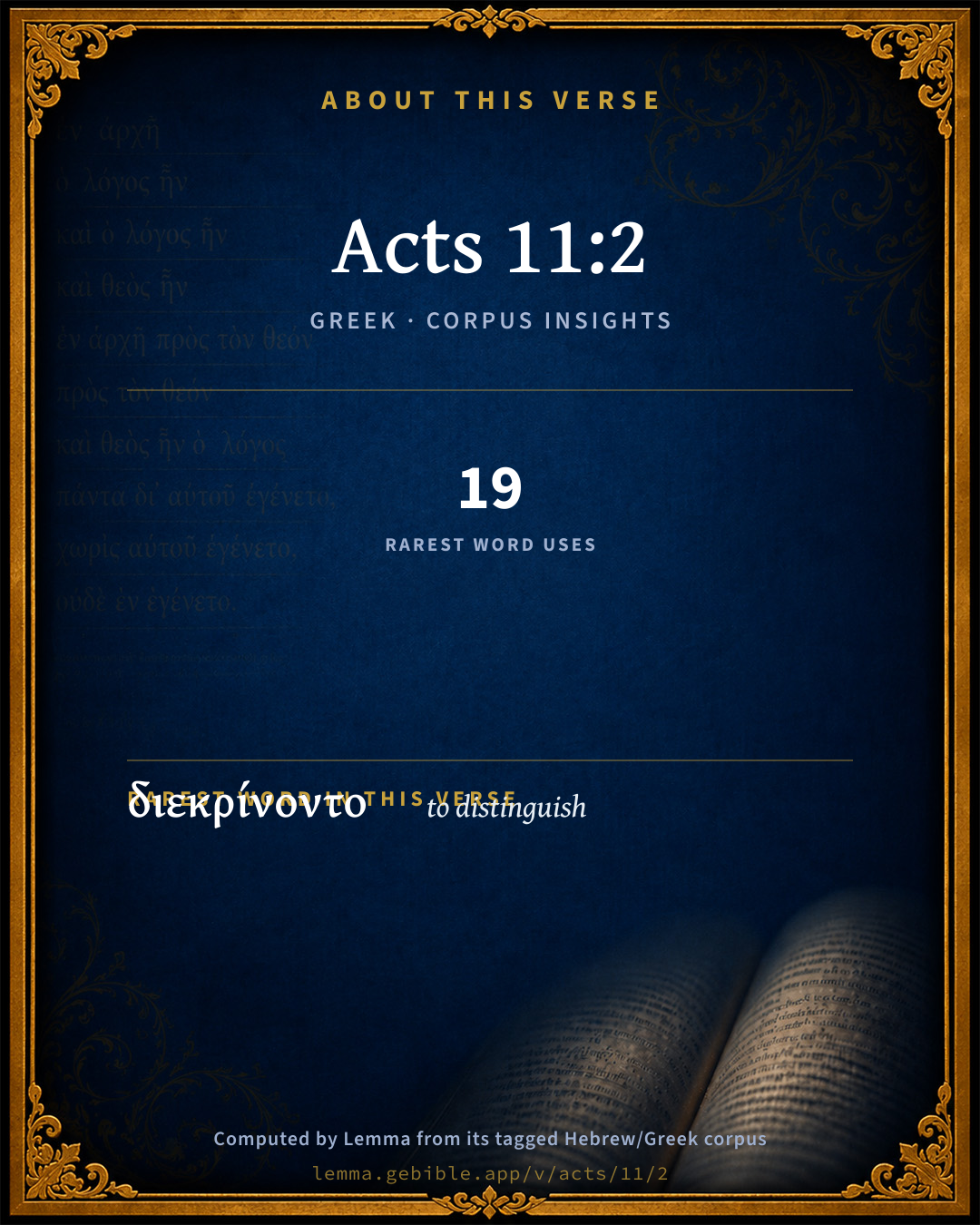
The rarest word here is διεκρίνοντο to distinguish G1252 — appearing just 19 times in the whole Greek New Testament.

Shared distinctive vocabulary

διεκρίνοντο to distinguish G1252 occurs in 18 verses of the Greek New Testament. Also found in:

Cross-references

6

Topical passages linked to Acts 11:2 in the Treasury of Scripture Knowledge — connected by theme and wording, ordered by reader-vote popularity; previews shown in the World English Bible.

  • Acts 10:45 They of the circumcision who believed were amazed, as many as came with Peter, because the gift of the Holy Spirit was also poured out on the Gentiles.
  • Acts 10:9 Now on the next day as they were on their journey, and got close to the city, Peter went up on the housetop to pray at about noon.
  • Acts 15:1 Some men came down from Judea and taught the brothers, "Unless you are circumcised after the custom of Moses, you can't be saved."
  • Acts 21:20–23 They, when they heard it, glorified God. They said to him, "You see, brother, how many thousands there are among the Jews of those who have believed, and they are all zealous for the law.
  • Galatians 2:12–14 For before some people came from James, he ate with the Gentiles. But when they came, he drew back and separated himself, fearing those who were of the circumcision.
  • Acts 15:5 But some of the sect of the Pharisees who believed rose up, saying, "It is necessary to circumcise them, and to charge them to keep the law of Moses."

Cross-references courtesy of OpenBible.info (CC BY 4.0).

Commentary

Notes on Acts 11:2 from classic Christian and Jewish commentators (each source and its license shown beneath its notes). The classic Christian expositions comment on the surrounding passage and are grouped to its opening verse, so a note may address several verses; the Jewish commentaries on the Tanakh (Rashi and others) are per-verse, so they appear only where the commentator wrote on this verse.

Lemma curates 59 commentaries, every one of them public domain or Creative Commons licensed, each selected and text-cleaned for this edition rather than reprinted as found. About our sources →

Bengel's Gnomon

Johann Albrecht Bengel

Act 11:2. Διεκρίνοντο, discussed or contended) i.e. they showed that they had doubts as to that point.

Bengel's Gnomon of the New Testament — English translation (T&T Clark, Edinburgh, 1860) — public domain. Text from a community e-Sword module.

Expositor's Greek Testament

ed. W. Robertson Nicoll

Act 11:2 . διεκρίνοντο , cf. Jude, Act 11:9 , with dative of the person (Polyb., ii., 22, 11). For similar construction as here see LXX, Eze 20:35-36 , see Grimm-Thayer, sub v. Otherwise in Act 10:20 . οἱ ἐκ περιτομῆς , cf. Gal 2:12 ; we can scarcely confine the term here to those mentioned in Act 10:45 (although Dr. Hort takes this view as most probable), but how far there was a section of the Church at Jerusalem who could thus be described at this time it is difficult to say, see Ramsay, St. Paul , p. 44.

The Expositor's Greek Testament, edited by W. Robertson Nicoll (1897–1910) — public domain. Text from a community e-Sword module.

Jamieson, Fausset & Brown

Robert Jamieson, A. R. Fausset & David Brown

they . . . of the circumcision--not the Jewish Christians generally, for here there were no other, but such as, from their jealousy for "the middle wall of partition" which circumcision raised between Jew and Gentile, were afterwards known as "they of the circumcision." They doubtless embraced apostles as well as others.

Jamieson, Fausset & Brown — Commentary Critical and Explanatory on the Whole Bible (1871) — public domain (CC PDM 1.0). Text via the HelloAO Bible API.

Adam Clarke's Commentary

Verse 2. Contended with him] A manifest proof this that the primitive Church at Jerusalem (and no Church can ever deserve this name but the Jerusalem Church) had no conception of St. Peter's supremacy, or of his being prince of the apostles. He is now called to account for his conduct, which they judged to be reprehensible; and which they would not have attempted to do had they believed him to be Christ's vicar upon earth, and the infallible Head of the Church. But this absurd dream is every where refuted in the New Testament.

Adam Clarke's Commentary on the Bible (1810–1826) — public domain. Text from a community e-Sword/MySword module.

John Calvin's Commentaries

2. They reasoned with him. Obstinacy doth for the most part accompany error. This was now a fault having in it too gross ignorance, in that they did not quietly receive the Gentiles into their bosom, united to them by the same Spirit of faith. But they do not only leap back, but also contend with Peter contentiously, and blame him for his fact, which deserved great praise. They hear that the Gentiles have embraced the Word of God; what letteth them then from embracing them, that they may be coupled together under the government of one God? For what more holy bond can there be, than when all men, with one consent, are coupled and joined to God? And why should not those grow together into one body who make the Messiah of God their head? But because they saw the external form of the law broken, they thought that heaven and earth did go together.

And note, that although Luke said before that the apostles and brethren had heard this fame, yet he spake nothing of offense; but he bringeth in now, as it were, a new sect of men, which did contend with Peter. The brethren, saith he, heard, and there an end; it followeth, When Peter was come to Jerusalem, those which were of the circumcision did contend with him, who were undoubtedly unlike to the first; again, these words περιτομης, do not simply signify the Jews, but those who were too much addicted to keeping the ceremonies of the law. For there were none of Jerusalem in Christ’s flock at that time, save only those which were circumcised. From whom, then, could he distinguish those men? Lastly, it seemeth to be a thing unlike to be true that the apostles, and those which were moderate being of the number of the faithful, did attempt this combat. For though they had been offended, yet they might have conferred with Peter privately, and have demanded some reason of his fact. By these reasons am I moved to think that those are said to be of the circumcision who did make so great account of circumcision, that they granted no man a place in the kingdom of God, unless he took upon him the profession of the law, and, being admitted into the Church by this holy rite, did put off uncleanness.

John Calvin's Commentaries (1540-1563) — public domain. Text from the Calvin Translation Society English edition (1840s-50s) via the Christian Classics Ethereal Library (ccel.org). Calvin's coverage is partial (roughly two-thirds of the Bible); uncommented books and verses are honest gaps, never fabricated. The 19th-century editor's footnotes and remarks are omitted so the notes are faithfully Calvin's own voice.

Ellicott's Commentary for English Readers

(2) They that were of the circumcision contended with him.—The conversion of the Gentiles at Cæsarea had given a new significance to the name of “those of the circumcision.” From this time forth they are a distinct section, often a distinct party, in the Church, and here we have the first symptom of the line which they were about to take. They contended with Peter (the tense implies continuous or repeated discussion) because he had eaten with those who were uncircumcised, and therefore, from the Jewish point of view, unclean.

A Bible Commentary for English Readers, edited by Charles John Ellicott (1878–1897) — public domain. Text from a community e-Sword module.

The Cambridge Bible for Schools and Colleges

gen. ed. J. J. S. Perowne

2. they that were of the circumcision] This must have been the whole Church, at the time when the event occurred, for there were no Christians as yet except Jews and proselytes, but St Luke’s narrative was compiled at a time when “they that were of the circumcision” had become a distinct party, and when their influence had begun to work division in the Christian societies. He therefore employs a name which when he wrote was full of significance, although it had its origin only in the circumstances to which he here applies it. Those who had been born Jews and knew of Jesus as conforming to the Law, and who had not heard of Peter’s vision nor seen the gift of the Holy Ghost to Cornelius and his friends, as those who had been with Peter had done, were to be pardoned, if their scruples caused them to question the conduct of the Apostle at this time; yet when they heard his story they were satisfied (see Act_11:18), but many Jewish Christians elsewhere continued to make this subject a cause of contention. See Act_15:1.

contended with him] The verb is a very significant one. It is the same that is used with a negative in Act_10:20, Act_11:12, “nothing doubting,” and Act_15:9, “making no difference.” The thought of these men who contended was that the difference between Jew and Gentile should still be maintained, and that any close fellowship (such as was involved in living at the same board) with those who accepted Christianity otherwise than through the gate of submission to the Mosaic Law, should be avoided. As the Jews in Caesarea had (Act_10:22) behaved towards Cornelius, before he became a Christian, so would the Judaizing feeling have prompted the Church of Christ to deal with him still. And when we think on the prejudice which, by generations of ceremonial observance, had grown up among the Jews, we cannot wonder greatly at what they did. A whole nation is not brought to a change of feeling in a day.

The Cambridge Bible for Schools and Colleges (gen. ed. J. J. S. Perowne; Cambridge University Press, 1878–1918) — public domain. Text from a community e-Sword module.

John Gill's Exposition

And when Peter was come up to Jerusalem,.... From Caesarea, after he had stayed some certain days in Cornelius's house; so a journey from Caesarea to Jerusalem is called an ascending from the one to the other, Act 25:1 because Jerusalem stood on higher ground, as well as was the metropolis of the country; and this was a journey of six hundred furlongs, or seventy five miles, for so far, according to Josephus (t), was Caesarea distant from Jerusalem:

they that were of the circumcision, which phrase designs not only the circumcised Jews that believed in Christ, for such were all they of the church at Jerusalem, or at least proselytes that had been circumcised, for as yet there were no uncircumcised Gentiles among them; but those of them, who were most strenuous for circumcision, and made it not only a bar of church communion, but even of civil conversation:

these contended with him; litigated the point, disputed the matter with him, complained against him, and quarrelled with him. Epiphanius says (u), that Cerinthus, that arch-heretic, was at the head of this contention.

(t) De Bello Jud. l. 1. c. 3. sect. 5. (u) Contr. Haeres. l. 1. Haeres. 28.

John Gill's Exposition of the Whole Bible (1746–1763) — public domain (CC PDM 1.0). Text via the HelloAO Bible API.

Trapp's Complete Commentary

John Trapp

2 And when Peter was come up to Jerusalem, they that were of the circumcision contended with him,

Ver. 2. Contended with him] They should rather have commended him: so hard it is to part with a rooted error: so ordinary it is for faithful ministers to meet with such as will dare to reprehend what they do not comprehend, and precipitate a censure.

John Trapp, A Commentary or Exposition upon All the Books of the Old and New Testament (1647–1656) — public domain. Text from a community e-Sword module.

Albert Barnes' Notes on the Bible

They that were of the circumcision - Christians who had been converted from among the Jews.

Contended with him - Disputed; reproved him; charged him with being in fault. This is one of the circumstances which show conclusively that the apostles and early Christians did not regard Peter as having any particular supremacy over the church, or as being in any special sense the vicar of Christ upon earth. If he had been regarded as having the authority which the Roman Catholics claim for him, they would have submitted at once to what he had thought proper to do. But the earliest Christians had no such idea of Peter’s so-called authority. This claim for Peter is not only opposed to this place, but to every part of the New Testament.

Albert Barnes' Notes on the Bible (1834–1885) — public domain. Text from a community e-Sword/MySword module.

Haydock's Catholic Bible Commentary

Disputed against him. St. Epiphanius makes Cerintbus, who was the next heresiarch to Simon Magus, the author of this dispute. He likewise says it was he, who excited the Jews against St. Paul, (Acts xxi.) and that the first Council of Jerusalem was convened to condemn him. (St. Epiphanius, hæres. 28. chap. ii)

George Leo Haydock (1774–1849), Haydock's Catholic Family Bible and Commentary, 1859 edition — public domain. Excludes Psalms (Douay-Rheims chapter numbering differs from Protestant) and Deuterocanonical books (Catholic canon only).

Matthew Poole's English Annotations

They that were of the circumcision; they were such Jews as conversed with them of the church, and argued against them for taking in the Gentiles into any fellowship with them. But it may be that the believing Jews might for a time be very weak, and offended at it, until they were further satisfied by the following relation of St. Peter: till then they disputed, and brought what arguments they could against it.

Matthew Poole's English Annotations on the Holy Bible (1683–1685) — public domain. Text from a community e-Sword/MySword module.

Whedon's Commentary on the Bible

Daniel D. Whedon

2. Come up—From the maritime lowlands upon which Cesarea and Joppa stood. But in ancient times the term up was customarily used not only in regard to approaching any high locality, but any great capital, or point of moral or political eminence. Xenophon’s history of the march to Babylon (from which his ten thousand made a famous retreat) is entitled the Anabasis, that is, the Going-up, although Babylon was in a vast plain really lower than Asia Minor, whence Xenophon started. This use of up arises partly front the fact that ancient great cities were usually for defence placed upon some strong height, and, partly from the idea of elevation, associated with greatness and power.

They that were of the circumcision—Greek, οι εκ περιτομης, those from circumcision. All the Christians then in Jerusalem were circumised Jews, and so of the circumcision; but Luke uses the phrase as designation of the partisans of necessary circumcision.

Contended with him—They held him not for a pope, but a heretic. What will become of Moses, the Law, and the Temple if he, the most eminent of the apostles, lowers himself to the level of Saul of Tarsus, and allows baptism to be, not the sequence, but the substitute of circumcision!

Daniel D. Whedon (gen. ed.), Commentary on the Old and New Testaments (1874–1909) — public domain. Text from a community e-Sword module.

The Pulpit Commentary

They that were of the circumcision. At first sight this phrase, which was natural enough in Act_10:45, seems an unnatural one in the then condition of the Church, when all the members of it were "of the circumcision," and there were no Gentile converts at all. But the explanation of it is to be found in the circumstance of St. Luke himself being a Gentile; perhaps also, as Alford suggests, in his use of language suited to the time when he wrote. It is an indication, too, of the purpose of St. Luke in writing his history, viz. to chronicle the progress of Gentile Christianity. Peter, having completed his rounds, (Act_9:32) returned to Jerusalem, which was still the abode of the apostles. He was, no doubt, anxious to commune with his brother apostles upon the momentous matter of the Gentile converts; but he was at once attacked by the bigotry of the zealous Jews.

The Pulpit Commentary (1880–1919), ed. H.D.M. Spence-Jones & Joseph S. Exell — public domain. Text from a community e-Sword module.

McGarvey & Pendleton's Commentaries

J. W. McGarvey

See notes one verse 1

J. W. McGarvey (with Philip Y. Pendleton), Commentaries on the New Testament (The Fourfold Gospel, 1914; Acts; and the epistles) — public domain. Text from a community e-Sword/MySword module.

Cambridge Greek Testament for Schools and Colleges

2. διεκρίνοντο πρὸς αὐτόν, they contended with him. The verb is the same which is used (Act 10:20), with a negative, μηδὲν διακρινόμενος, nothing doubting, and presently in this chapter (Act 11:12) μηδὲν διακρίναντα making no difference. The contention of these opponents of Peter’s conduct was that the difference between Jew and Gentile should still be maintained, and that any close fellowship (such as was involved in living at the same board) with those who accepted Christianity otherwise than through the gate of submission to the Mosaic Law should be avoided. As the Jews felt it their duty (Act 10:28) to behave towards Cornelius and such as he before they became Christians, so would the Judaizing feeling have prompted the Jewish Christians to deal with him still. And when we think on the prejudice which, by generations of ceremonial observance, had grown up among the Jews, we cannot wonder greatly at what they did. A whole nation is not brought to a change of feeling in a day.

οἱ ἐκ περιτομῆς, they that were of the circumcision. This must have been the whole Church, at the time when the event occurred, for there were no Christians as yet except Jews and proselytes. But St Luke’s narrative was compiled at a time when ‘they that were of the circumcision’ had become a distinct party, and when their influence had begun to work division in the Christian societies. He therefore employs a name which when he wrote was full of significance, although it had its origin only in the circumstances to which he here applies it. Those who had been born Jews and knew of Jesus as conforming to the Law, and who had not heard of Peter’s vision nor seen the gift of the Holy Ghost to Cornelius and his friends, as those who had been with Peter had done, were to be pardoned, if their scruples caused them to question the conduct of the Apostle at this time; yet when they heard his story they were satisfied (see Act 11:18), but many Jewish Christians elsewhere continued to make this subject a cause of contention. See Act 15:1.

Cambridge Greek Testament for Schools and Colleges (Cambridge University Press, 1896; 21 vols, various authors incl. Carr, Maclear, Plummer, Farrar, Lumby, Moule, M. R. James, Simcox) — public domain. Text from a community e-Sword module.

Alford’s Greek Testament

Henry Alford

2.] οἱ ἐκ περιτομῆς must have come into use later as designating the circumcised generally: in this case all those spoken of would belong to the circumcision. Luke uses it in the sense of the time when he wrote the account.

Henry Alford, The Greek Testament (1849–1861) — public domain. Text from a community e-Sword module.

Vincent's Word Studies in the New Testament

Marvin R. Vincent

They of the circumcision. See on ch. Act 5:45.

Marvin R. Vincent, Word Studies in the New Testament (1887–1900) — public domain. Text from a community e-Sword/MySword module.

Lesson kit

Teaching starters — assembled from the data on this page, not authored interpretation. Every prompt links to the verse data it draws on. Edit before teaching.

Acts, in the Acts, opens this verse with 12 words (12 distinct Greek lemmas). Its most distinctive word is diakrínō (“to distinguish”). A historical commentator’s framing appears above. Read the whole chapter for the surrounding context.

Discussion questions

  1. The word diakrínō carries the sense “to distinguish.” How does it shape the verse?
  2. How does Matthew 16:3, which shares the word «to distinguish», read alongside this verse?
  3. The translations on this page render this verse differently — a whole-verse word diff, not a word-by-word alignment. What might account for the different wordings?
  4. Compare how Bengel's Gnomon and Expositor's Greek Testament read this verse. Where do they agree or differ?

Things to notice

Reading settings

Reading text

Shown beneath each verse's original-language words.

Old Testament
Old Testament edition

Read the OT as the Masoretic Hebrew (MT) or the Greek Septuagint (LXX).

English shown for the Greek Septuagint (in the Hebrew ↔ Greek comparison).

Comparing translations? Open the Compare panel on any verse page to stack up to four side by side.