
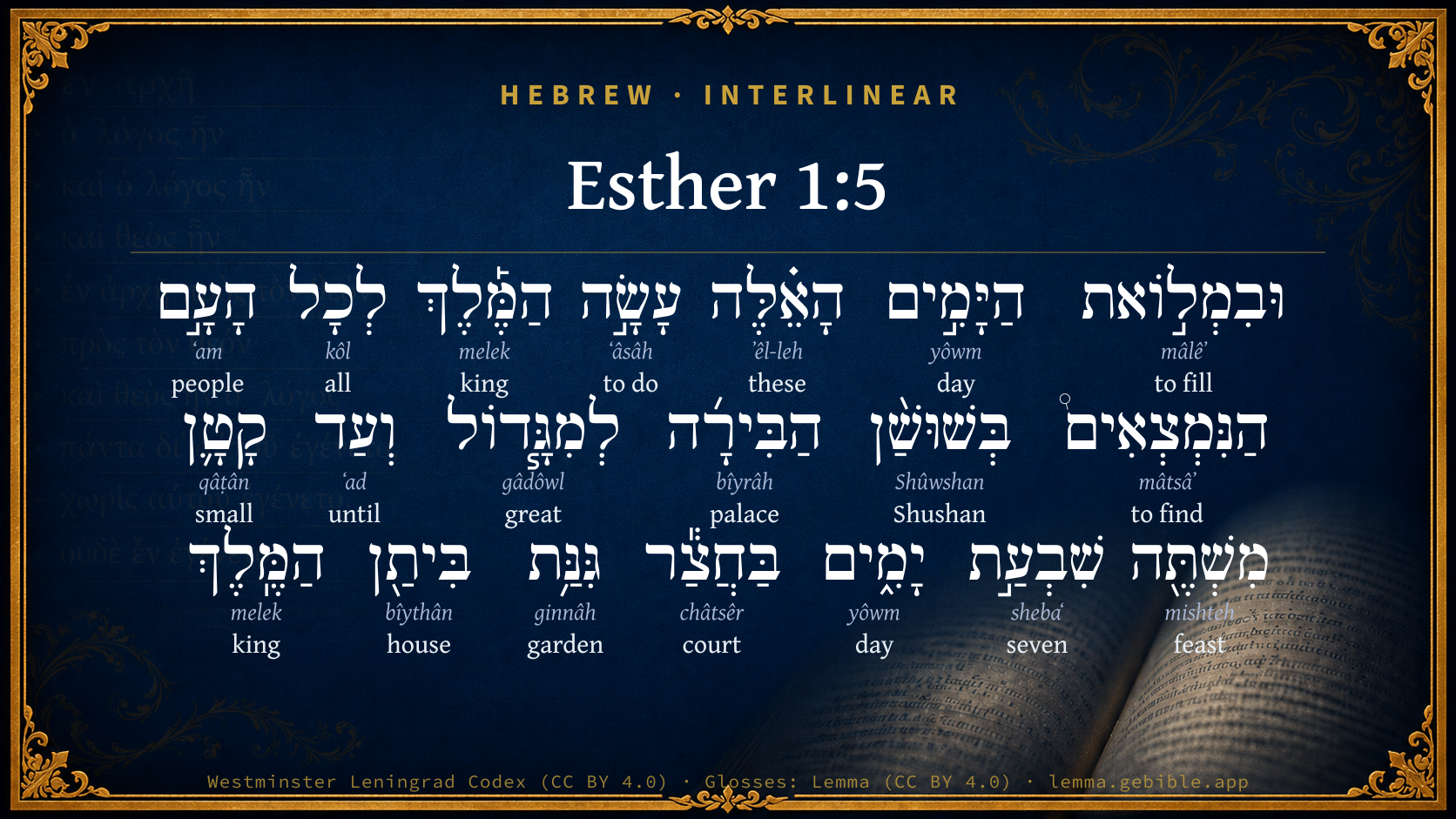
Esther 1:5

Hebrew (Westminster Leningrad Codex) Esther 1:5 appears in the Hebrew Old Testament. The text above is from the Westminster Leningrad Codex. Each word links to its Strong’s number, a concise gloss, and parsing drawn from the Open Scriptures Hebrew Bible morphology. Click any word for its full Brown-Driver-Briggs (BDB) entry.
Download image
Cite this verse

Esther 1:5 (World English Bible). Public Domain. Lemma interlinear Bible study tool, https://lemma.gebible.app/v/esther/1/5.

Show BibTeX & RIS
BibTeX
RIS
English Translation
When these days were fulfilled, the king made a feast to all the people who were present in Shushan the palace, both great and small, seven days, in the court of the garden of the king's palace.
World English Bible · Public Domain
Highlights
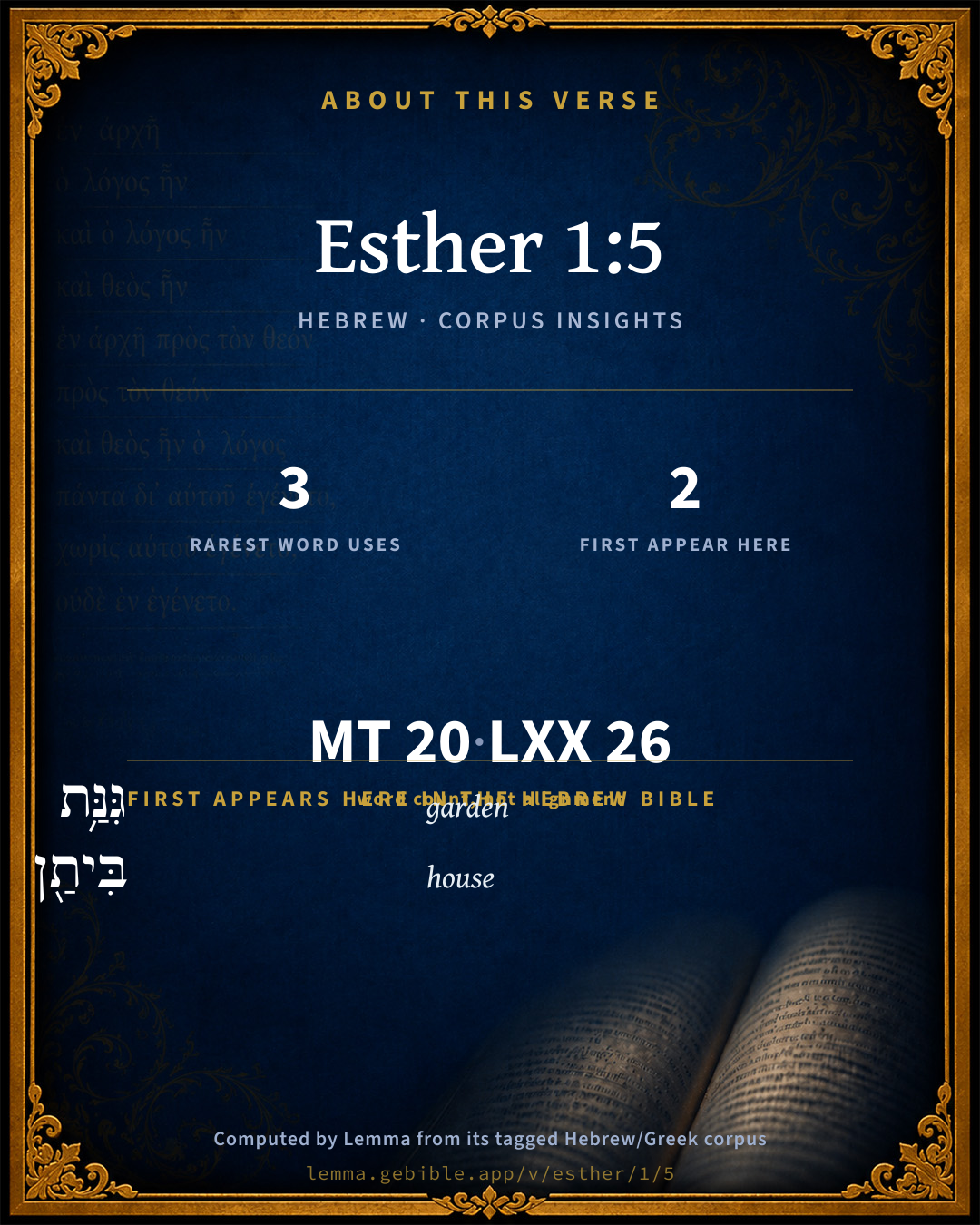
  • 2 first appearances in the Hebrew Bible
Full analysis ↓
Download a study sheet

One document with this verse’s original text, its word-by-word gloss line, the meaning frame, cross-references with their text, attributed commentary, and full source and license credits — printable, and it pastes into notes with its structure intact.

This verse Autodidact and up

Study sheet (.html) Plain text (.txt)

A passage Seminary Student

Up to 50 verses in one chapter. A passage sheet keeps up to 6 commentary sources and 12 cross-references per verse, in the order this page ranks them, and says so on the sheet whenever that leaves anything out. Ask for a single verse and you get the Autodidact verse sheet above.

Everything on this page stays free to read, with no account — the sheet is a download of what is already on screen, not access to it.

Want to remove ads? Support Godless Engineer
Compare translations 3

The same verse in 3 English versions, stacked beneath the original-language interlinear above. Click any original word for its lexicon entry.

Each is an independent rendering of the whole verse — the interlinear is not word-aligned to these translations.

Highlighted words mark where these versions differ — a whole-verse word diff, not a word-by-word alignment.

  • World English Bible Public Domain
    When these days were fulfilled, the king made a feast to all the people who were present in Shushan the palace, both great and small, seven days, in the court of the garden of the king's palace.
  • King James Version Public Domain
    And when these days were expired, the king made a feast unto all the people that were present in Shushan the palace, both unto great and small, seven days, in the court of the garden of the king's palace;
  • unfoldingWord Literal Text CC BY-SA 4.0
    And when those days were fulfilled, the king made a feast for all the people who were found in Susa the citadel, from the greatest even to the least, for seven days, in the courtyard of the garden of the palace of the king.

unfoldingWord Literal Text — © unfoldingWord, licensed CC BY-SA 4.0. Word-aligned USFM3 via Door43 (git.door43.org/unfoldingWord/en_ult).

Versions to compare (up to 4)

3 of 4 selected

Show all 18 translations

Every available English version of this verse, each an independent rendering of the whole verse.

  • World English Bible Public Domain
    When these days were fulfilled, the king made a feast to all the people who were present in Shushan the palace, both great and small, seven days, in the court of the garden of the king's palace.
  • Berean Standard Bible Public Domain
    At the end of this time, in the garden court of the royal palace, the king held a seven-day feast for all the people in the citadel of Susa, from the least to the greatest.
  • Majority Standard Bible Public Domain
    At the end of this time, in the garden court of the royal palace, the king held a seven-day feast for all the people in the citadel of Susa, from the least to the greatest.
  • King James Version Public Domain
    And when these days were expired, the king made a feast unto all the people that were present in Shushan the palace, both unto great and small, seven days, in the court of the garden of the king's palace;
  • American Standard Version (1901) Public Domain
    And when these days were fulfilled, the king made a feast unto all the people that were present in Shushan the palace, both great and small, seven days, in the court of the garden of the king's palace.
  • Revised Version (1885) Public Domain
    And when these days were fulfilled, he king made a feast unto all the people that were present in Shushan the palace, both great and small, seven days, in the court of the garden of the king’s palace;
  • Geneva Bible (1599) Public Domain
    And when these dayes were expired, the King made a feast to all the people that were founde in the palace of Shushan, both vnto great and small, seuen dayes, in the court of the garden of the Kings palace,
  • Douay-Rheims (1899) Public Domain
    And when the days of the feast were expired, he invited all the people that were found in Susan, from the greatest to the least: and commanded a feast to be made seven days in the court of the garden, and of the wood, which was planted by the care and the hand of the king.
  • Young's Literal Translation Public Domain
    And at the fulness of these days hath the king made to all the people who are found in Shushan the palace, from great even unto small, a banquet, seven days, in the court of the garden of the house of the king --
  • Literal Standard Version CC BY-SA 4.0
    And at the fullness of these days the king has made a banquet to all the people who are found in Shushan the palace, from great even to small, [for] seven days, in the court of the garden of the house of the king—
  • Unlocked Literal Bible CC BY-SA 4.0
    When these days were completed, the king gave a feast lasting seven days. It was for all the people in the fortress of Susa, from the greatest to the least significant. It was held in the courtyard of the garden of the king's palace.
  • unfoldingWord Literal Text CC BY-SA 4.0
    And when those days were fulfilled, the king made a feast for all the people who were found in Susa the citadel, from the greatest even to the least, for seven days, in the courtyard of the garden of the palace of the king.
  • Darby Bible Public Domain
    And when these days were expired, the king made a feast to all the people that were present in Shushan the fortress, both to great and small, seven days, in the court of the garden of the king's palace.
  • World Messianic Bible Public Domain
    When these days were fulfilled, the king made a seven day feast for all the people who were present in Susa the palace, both great and small, in the court of the garden of the king’s palace.
  • Webster's Bible Public Domain
    And when these days had expired, the king made a feast for all the people that were present in Shushan the palace, both for great and small, seven days, in the court of the garden of the king's palace;
  • Free Bible Version CC BY-SA 4.0
    After that the king gave a feast lasting for seven days for all the people, great and small, who were there in the fortress of Susa in the garden courtyard of the king's pavilion.
  • Bible in Basic English Public Domain
    And at the end of that time, the king gave a feast for all the people who were present in Shushan, the king's town, small as well as great, for seven days, in the outer square of the garden of the king's house.
  • JPS Tanakh (1917) Public Domain
    And when these days were fulfilled, the king made a feast unto all the people that were present in Shushan the castle, both great and small, seven days, in the court of the garden of the king's palace;

Literal Standard Version (2020), Covenant Press — licensed CC BY-SA 4.0. Text via the HelloAO Bible API (eBible.org). Unlocked Literal Bible (unfoldingWord) — licensed CC BY-SA 4.0. Text via the HelloAO Bible API (eBible.org). unfoldingWord Literal Text — © unfoldingWord, licensed CC BY-SA 4.0. Word-aligned USFM3 via Door43 (git.door43.org/unfoldingWord/en_ult). Free Bible Version, Dr. Jonathan Gallagher — licensed CC BY-SA 4.0. Text via the HelloAO Bible API (eBible.org).

Word by word

More ways to search: Search by grammar → Find every occurrence → Compare this word →

Practice this passage: Drill this verse → Learn its vocabulary →

בִּיתַ֖ן
bîythân
H1055
“house of”
Noun, Common, Masculine, Singular, Construct
Part of Speech
Noun
Type
Common
Gender
Masculine
Number
Singular
State
Construct
Full BDB Definition

Origin: probably from H1004

TWOT: 241c

house, palace
  1. וּבִמְל֣וֹאת mâlêʼ H4390 “and · in/at · to fill” Conjunction + Preposition + Verb, Qal, Infinitive Construct
  2. הַיָּמִ֣ים yôwm H3117 “the · days” Particle, Definite Article + Noun, Common, Masculine, Plural, Absolute
  3. הָאֵ֗לֶּה ʼêl-leh H428 “the · these” Particle, Definite Article + Pronoun, Demonstrative, Common, Plural
  4. עָשָׂ֣ה ʻâsâh H6213 “to do” Verb, Qal, Perfect, 3rd Person, Masculine, Singular
  5. הַמֶּ֡לֶךְ melek H4428 “the · king” Particle, Definite Article + Noun, Common, Masculine, Singular, Absolute
  6. לְכָל kôl H3605 “to/for · all of” Preposition + Noun, Common, Masculine, Singular, Construct
  7. הָעָ֣ם ʻam H5971 “the · people” Particle, Definite Article + Noun, Common, Masculine, Singular, Absolute
  8. הַנִּמְצְאִים֩ mâtsâʼ H4672 “the · finding” Particle, Definite Article + Verb, Niphal, Participle Active, Masculine, Plural, Absolute
  9. בְּשׁוּשַׁ֨ן Shûwshan H7800 “in/at · Shushan” Preposition + Noun, Proper
  10. הַבִּירָ֜ה bîyrâh H1002 “the · palace” Particle, Definite Article + Noun, Common, Feminine, Singular, Absolute
  11. לְמִגָּ֧דוֹל gâdôwl H1419 “to/for · from · great” Preposition + Preposition + Adjective, Adjective, Masculine, Singular, Absolute
  12. וְעַד ʻad H5704 “and · until” Conjunction + Preposition
  13. קָטָ֛ן qâṭân H6996 “small” Adjective, Adjective, Masculine, Singular, Absolute
  14. מִשְׁתֶּ֖ה mishteh H4960 “feast” Noun, Common, Masculine, Singular, Absolute
  15. שִׁבְעַ֣ת shebaʻ H7651 “seven” Adjective, Cardinal number, Masculine, Singular, Construct
  16. יָמִ֑ים yôwm H3117 “days” Noun, Common, Masculine, Plural, Absolute
  17. בַּחֲצַ֕ר châtsêr H2691 “in/at · court of” Preposition + Noun, Common, Both, Singular, Construct
  18. גִּנַּ֥ת ginnâh H1594 “garden of” Noun, Common, Feminine, Singular, Construct
  19. הַמֶּֽלֶךְ melek H4428 “the · king” Particle, Definite Article + Noun, Common, Masculine, Singular, Absolute

About this verse

These counts appear in no published source. They are computed here, from the morphology-tagged text and Lemma’s own curated glosses. What Lemma adds →

20
words
18
distinct lemmas
Historical
section

Notable vocabulary

The rarest word here is בִּיתַ֖ן house H1055 — appearing just 3 times in the whole Hebrew Bible.

First appearance in Scripture

These words make their first canonical appearance in the Hebrew Bible here:

  • גִּנַּ֥ת garden H1594
  • בִּיתַ֖ן house H1055

Shared distinctive vocabulary

בִּיתַ֖ן house H1055 occurs in 3 verses of the Hebrew Bible. Also found in:

Grammatical profile

  • 3 verbs
  • 12 nouns
  • 3 adjectives
  • 1 pronoun
  • 1 preposition

Verb forms

  • וּבִמְל֣וֹאת Qal · Infinitive Construct
  • עָשָׂ֣ה Qal · Perfect
  • הַנִּמְצְאִים֩ Niphal · Participle Active

Repetition

Words recur within this verse — often emphatic in Hebrew:

  • הַיָּמִ֣ים day H3117 ×2
  • הַמֶּ֡לֶךְ king H4428 ×2

Hebrew & Septuagint length

In English translation the verse runs 37 words from the Hebrew and 34 from the Septuagint (LXX English) — closely comparable.

A rough comparison of the two English renderings, which tokenize alike — not a word-level alignment.

Word counts can differ between the Hebrew and the Greek without any difference in meaning — e.g. the Hebrew direct-object marker אֵת has no separate Greek word, and Greek often adds the article ὁ.

In the original languages it is 20 Hebrew tokens and 26 Greek tokens — but the two are counted differently (Hebrew bundles its prefixes and suffixes into one token; the Greek is in lemma form), so that isn’t a like-for-like length.

Cross-references

3

Topical passages linked to Esther 1:5 in the Treasury of Scripture Knowledge — connected by theme and wording, ordered by reader-vote popularity; previews shown in the World English Bible.

  • Esther 7:7–8 The king arose in his wrath from the banquet of wine [and went] into the palace garden: and Haman stood up to make request for his life to Esther the queen; for he saw that there was evil determined against him by the king.
  • 2 Chronicles 30:21–25 The children of Israel who were present at Jerusalem kept the feast of unleavened bread seven days with great gladness; and the Levites and the priests praised Yahweh day by day, [singing] with loud instruments to Yahweh.
  • 2 Chronicles 7:8–9 So Solomon held the feast at that time seven days, and all Israel with him, a very great assembly, from the entrance of Hamath to the brook of Egypt.

Cross-references courtesy of OpenBible.info (CC BY 4.0).

Hebrew and Greek witnesses Masoretic Hebrew ↔ Greek Septuagint

The same verse in the two great witnesses to the Old Testament, shown verse-for-verse.

These are two independent witnesses, not word-aligned to each other, and the Septuagint is shown in lemma (dictionary) form.

Hebrew Esther 1:5 Masoretic · Westminster Leningrad Codex

וּבִמְל֣וֹאת הַיָּמִ֣ים הָאֵ֗לֶּה עָשָׂ֣ה הַמֶּ֡לֶךְ לְכָל הָעָ֣ם הַנִּמְצְאִים֩ בְּשׁוּשַׁ֨ן הַבִּירָ֜ה לְמִגָּ֧דוֹל וְעַד קָטָ֛ן מִשְׁתֶּ֖ה שִׁבְעַ֣ת יָמִ֑ים בַּחֲצַ֕ר גִּנַּ֥ת בִּיתַ֖ן הַמֶּֽלֶךְ

When these days were fulfilled, the king made a feast to all the people who were present in Shushan the palace, both great and small, seven days, in the court of the garden of the king's palace.

World English Bible · Public Domain

Greek LXX Esther 1:5 Septuagint · lemma form

ὅτε δέ ἀναπληρόω ὁ ἡμέρα ὁ γάμος ποιέω ὁ βασιλεύς πότος ὁ ἔθνος ὁ εὑρίσκω εἰς ὁ πόλις ἐπί ἡμέρα ἕξ ἐν αὐλή οἶκος ὁ βασιλεύς

when, I say, the days of the marriage feast were completed, the king made a banquet to the nations who were present in the city six days, in the court of the king's house,

LXX2012 (modern English Septuagint) · Public Domain

Hebrew: Westminster Leningrad Codex (CC BY 4.0). Greek: Septuagint (public domain); English from LXX2012 (modern English Septuagint) (Public Domain). How the Septuagint differs from the Hebrew →

Commentary

Notes on Esther 1:5 from classic Christian and Jewish commentators (each source and its license shown beneath its notes). The classic Christian expositions comment on the surrounding passage and are grouped to its opening verse, so a note may address several verses; the Jewish commentaries on the Tanakh (Rashi and others) are per-verse, so they appear only where the commentator wrote on this verse.

Lemma curates 59 commentaries, every one of them public domain or Creative Commons licensed, each selected and text-cleaned for this edition rather than reprinted as found. About our sources →

Trapp's Complete Commentary

John Trapp

Est 1:5 And when these days were expired, the king made a feast unto all the people that were present in Shushan the palace, both unto great and small, seven days, in the court of the garden of the king’s palace;

Ver. 5. The king made a feast unto all the people] This was not amiss, so that care were taken that no irregulares gulares unsatisfied appitites, were found among them; for kings should carry themselves toward their people as kindly as parents do toward their children, and shepherds toward their sheep. Are they not therefore called patres patriae, fathers of their country, and shepherds of their people? ποιμενες λαων. David and Cyrus were taken from the sheepfolds to feed men, Psa 78:70.

Both unto great and small] Pell-mell, one with another, to show his liberality; which yet he might better have bestowed in another away, than in belly cheer, and such open housekeeping to all comers without difference; since this is rather prodigality than bounty.

Seven days] Too long together to be a feasting; since at such times men are so apt to exceed and lash out; eating that on earth that they must digest in hell; and drowning both bodies and souls in wine and strong drink, as Richard III did his brother Clarence in a butt {A cask for wine or ale, of capacity varying from 108 to 140 gallons.} of Malmsey.

In the court of the garden] In the banqueting house, or sub dio, in the open air in the garden, where they had elbow room, and all manner of delights, fit to have been seasoned and allayed with the sight of a sepulchre (the Jews built their tombs beforehand in their gardens), or else of a death’s head (as was the manner of the Egyptians at their great feasts), to keep them from surfeiting.

John Trapp, A Commentary or Exposition upon All the Books of the Old and New Testament (1647–1656) — public domain. Text from a community e-Sword module.

Joseph Benson's Commentary

Est 1:5. Made a feast unto all the people in Shushan — Not only to the inhabitants of Shushan, but to all that were then present in the city out of all parts of his dominions. In the court of the garden of the king’s palace — In the entrance of the royal palace. The Persian gardens were exceedingly large and pleasant.

Joseph Benson's Commentary on the Old and New Testaments (1811–1818) — public domain. Text from a community e-Sword module.

Tyndale Open Study Notes

Tyndale Open Resources

1:5 A second, briefer banquet allowed members of every level of society (from the greatest to the least) to experience the king’s majestic wealth. Because of the large numbers of people who could attend, this continuous open-house reception was held outdoors in the paved courtyard of the palace garden.

Tyndale Open Study Notes — © Tyndale Open Resources, licensed CC BY-SA 4.0. Text via the HelloAO Bible API.

Adam Clarke's Commentary

Verse 5. A feast unto all the people] The first was a feast for the nobles in general; this, for the people of the city at large.

In the court of the garden] As the company was very numerous that was to be received, no apartments in the palace could be capable of containing them; therefore the court of the garden was chosen.

Adam Clarke's Commentary on the Bible (1810–1826) — public domain. Text from a community e-Sword/MySword module.

Ellicott's Commentary for English Readers

(5) All the people.—So we find Cyrus feasting “all the Persians” (Herod. i. 126).

A Bible Commentary for English Readers, edited by Charles John Ellicott (1878–1897) — public domain. Text from a community e-Sword module.

The Cambridge Bible for Schools and Colleges

gen. ed. J. J. S. Perowne

5. in the court of the garden] See notes on Est_1:2.

The Cambridge Bible for Schools and Colleges (gen. ed. J. J. S. Perowne; Cambridge University Press, 1878–1918) — public domain. Text from a community e-Sword module.

John Gill's Exposition

And when these days were ended,.... The one hundred and eighty, in which the nobles, princes, and great men of the kingdom were feasted:

the king made a feast unto all the people that were present in Shushan the palace, both unto great and small; of every age, rank, state and condition of life; these were the common people, whether inhabitants of the city or country people there on business, whether natives or foreigners; according to the Targum, there were Israelites there, but not Mordecai and his family; yea, it is said in the Midrash (n), that they were all Jews, and that their number was 18,500; but this is not probable; it is very likely there were some Jews among them, as there were many in the army of Xerxes, when he made his expedition into Greece, according to the poet Choerilus (o); which is not to be wondered at, since there were so many of them in his dominions, and they men of valour and fidelity, and to whose nation he was so kind and favourable: and this feast was kept

seven days in the court of the garden of the king's palace; which no doubt was very large, and sufficient to hold such a number as was assembled together on this occasion, when there was not room enough for them in the palace. There is in history an account of a Persian king that supped with 15,000 men, and in the supper spent forty talents (p).

(n) Midrash Esther, fol. 94. 1. (o) Apud Joseph. contr. Apion. l. 1. c. 22. (p) Ctesias & Dinon in Athenaei Deipnosoph. l. 4.

John Gill's Exposition of the Whole Bible (1746–1763) — public domain (CC PDM 1.0). Text via the HelloAO Bible API.

Albert Barnes' Notes on the Bible

Feasts on this extensive scale were not unusual in the East. Cyrus is said on one occasion to have feasted “all the Persians.” Even ordinarily, the later Persian monarchs entertained 15,000 persons at their table.

Albert Barnes' Notes on the Bible (1834–1885) — public domain. Text from a community e-Sword/MySword module.

Haydock's Catholic Bible Commentary

Expired, (Feuardent) or in the last week. (Menochius) (Calmet) --- King. The Persian monarchs delighted in agriculture. Cyrus the younger, planted trees at Sardis, and never ate till he had taken some exercise of this or of a military nature. (Xenophon Memor.; Cicero Senect.)

George Leo Haydock (1774–1849), Haydock's Catholic Family Bible and Commentary, 1859 edition — public domain. Excludes Psalms (Douay-Rheims chapter numbering differs from Protestant) and Deuterocanonical books (Catholic canon only).

Matthew Poole's English Annotations

All the people that were present; both such as constantly resided there, and such as were come thither upon their occasions, of whatsoever condition or quality.

In the court of the garden: the Persian gardens were exceeding large and pleasant.

Matthew Poole's English Annotations on the Holy Bible (1683–1685) — public domain. Text from a community e-Sword/MySword module.

Whedon's Commentary on the Bible

Daniel D. Whedon

5. When these days were expired — That is, at the end of the one hundred and eighty days.

Unto all the people that were present in Shushan — Literally, as the margin, all that were found at Shushan. Probably not all the princes of the empire were to be found at the palace at the same time, but such of them as were found there at the time indicated were honoured with this magnificent banquet. But this feast was not for the princes only, but for all the people, irrespective of rank, for the writer is careful to say that it was made both unto great and small. Some have supposed two banquets, one lasting one hundred and eighty, and the other seven days, the former for the princes and nobles, the latter for the inhabitants of Shushan. But this supposition is unnecessary. No doubt the one hundred and eighty days, as remarked above, were enlivened by many a feast, at which only nobles and princes were present; but this grand feast, which lasted seven days, was an occasion of general revelry, in which princes and people alike participated.

The court of the garden of the king’s palace — Oriental palaces had a park or garden connected with them, adorned with trees and fountains. The court of such garden was either the great hall that opened immediately upon it or the garden itself. Loftus identifies this court with the great colonnade, of which we have given a cut on page 436. He remarks: “It stands on an elevation in the centre of the mound, the remainder of which we may well imagine to have been occupied, after the Persian fashion, with a garden and fountains. Thus the colonnade would represent the ‘court of the garden of the king’s palace,’ with its ‘pillars of marble.’ I am even inclined to believe that the expression ‘Shushan the palace,’ applies especially to this portion of the existing ruins in contradistinction to the citadel and the city of Shushan.” But according to Fergusson, “the feast took place, not in the interior of any hall, but out of doors, in tents erected in one of the courts of the palace, such as we may easily fancy existed in front of either the eastern or western porches of the great central building.” Comp. note on Est_5:1.

Daniel D. Whedon (gen. ed.), Commentary on the Old and New Testaments (1874–1909) — public domain. Text from a community e-Sword module.

The Pulpit Commentary

A feast unto all the people that were found in Susa. The males only are intended, as appears from ver. 9. So Cyrus on one occasion feasted "the entire Persian army," slaughtering for them all his father"s flocks, sheep, goats, and oxen (Herod., 1:126). In the court of the garden. The "court of the garden" is probably the entire space surrounding the central hall of thirty-six pillars at Susa, including the three detached porticoes of twelve pillars each, described by Mr. Loftus in his "Chaldaea and Susiana" (pp. 365-372). This is a space nearly 350 feet long by 250 wide, with a square of 145 feet taken out of it for the central building. The area exceeds 60, 000 square feet.

HOMILIES BY W. DINWIDDLE Vers. 5-7.

Vanity.

A special banquet wound up the protracted festivities. Of this banquet note

1. It was given to the inhabitants of Shushan, both great and small, and it lasted seven days. The close of the six months" feasting with the nobles and governors, at which imperial affairs were probably discussed, was to be celebrated by a great flourish of kingly magnificence. The banquet to the capital was evidently the climax and crown of the rejoicings.

2. Special arrangements had to be made for the accommodation of so vasta crowd. These arrangements were on a most extravagant scale. We are dazzled by columns of marble, variously-coloured hanging"s, couches and vessels of gold, and wine usually reserved for the king"s use. Everything was done "according to the state of the king." From these things we may learn

I THAT VANITY WHEN INDULGED GROWS QUICKLY. Nothing will satisfy it. It ever cries for more. The sight of the king"s "excellent majesty" by the governors of 127 provinces was something to remember, but it was not enough; a whole city must be gathered to view and to be impressed by the royal grandeurs.

II THAT VANITY, AS IT GROWS, GETS WONDERFULLY BLIND. It loses all perception of its own folly, and it commits its follies as if others also were equally blind. It thus virtually loses the end on which its greed fastens. There are always eyes about it keen enough to penetrate its illusions, and hearts that form, if they do not express, a true judgment.

III THAT VANITY IS COSTLY. No expenditure was too great for the king to lavish in indulging and feeding his weakness. No thought of the sin of such waste entered his mind. No fear of possible straits in the future stayed his hand. It is likely that he possessed far more than sufficient treasure to meet the demands of the festival. But suppose it were so, that would not diminish the sin of perverting to vain uses a wealth which, if wisely applied, might have been helpful to beneficent ends. Money is a great power in the world either for good or for evil, and men are responsible to God for the use they make of it. Think of the good that may be done by it:

1. In assisting the poor.

2. In encouraging sound institutions of an educational andbenevolent character.

3. In supporting Christian Churches with their attendantmachineries.

4. In contributing to gospel missions among the heathen.

IV THAT VANITY IS BURDENSOME. The physical and mental toil of the king must have been very trying during the long feast and its closing banquet. Yet what will not vanity endure to attain its object? In this it is like every other ungoverned lust greed of gain, fleshly appetite, worldly ambition. If not under the grace of God, men will submit to greater hardships and burdens in pursuit of things that are sinful and disappointing than in the pursuit of what is necessary to true honour and happiness.

1. If the main burden of this great festival did not fall on the king, then itwould fall on the king"s servants. These would have a hard time of it. They would be held responsible for every failing or mishap. Despotic lords have little consideration for their servants, and despotic mistresses too. Vanity is another name for self-love, which always makes those who are in bondage to it indifferent to the claims of inferiors.

2. Apart from the king and his servants, a heavy burden would fall on the empire. Not immediately, perhaps, but soon. The attack of Greece involved the loss of myriads of lives and untold treasure. Families everywhere were plunged into mourning and desolation. The provinces were impoverished; and as the king"s exchequer had to be supplied, the people were ground down by heavy imposts. Vanity, when inordinately indulged, and especially by persons in power, becomes burdensome in numerous ways to many.

V THAT VANITY, apart from its consequences, IS A SIN AGAINST CONSCIENCE AND AGAINST GOD; or, in other words, a violation of natural and revealed law.

1. Against conscience, or the law of nature. The moral sentiment of allages, and the common verdict of living men, condemn a vain-glorying or self-conceited spirit as opposed to a just estimate of self. Even the vain are quick to discover and condemn vanity in others. Humility is taught by the law of the natural conscience to be the proper habit of man in all circumstances.

2. Against God, or the law of God"s word. The upliftings of the heart under vanity are at variance with that Divine revelation of righteousness and love by which all men are condemned as sinners, and made dependent on the mercy that is offered in Christ. All self-glorying manifests ignorance or forgetfulness of the true relation which the gospel reveals as subsisting between man, the transgressor, and God, the Redeemer. The faith which submits all to God in Christ is an emptying of self, and a putting on of the "Holy and Just One," who was "meek and lowly in heart." God is therefore dishonoured, his truth resisted, and his mercy despised, when men who confess his name become "high-minded" or "puffed up" in self-conceit. "God forbid that I should glory," said Paul, "save in the cross of Jesus Christ. " Humility before God and men is Christlike, and the rightful clothing of the followers of the Lamb. D.

The Pulpit Commentary (1880–1919), ed. H.D.M. Spence-Jones & Joseph S. Exell — public domain. Text from a community e-Sword module.

unfoldingWord translationNotes

Door43 World Missions Community

When these days were completed

"At the end of that feast"

a feast lasting seven days

This was a second feast that was only for the officials in Susa. AT: "another feast that lasted seven days"

fortress

This refers to a castle, stronghold or fortified city.See how you translated this in Esther 1:1.

Susa

See how you translated the name of this place in Esther 1:2. (See: How to Translate Names)

a mosaic pavement

A "mosaic" consists of colored stones arranged in an attractive pattern.

porphyry

This is a kind of red and purple rock that contained pieces of crystal.

translationWords

feast

court

silver

gold

unfoldingWord translationNotes — © Distant Shores Media and the Door43 World Missions Community, licensed CC BY-SA 4.0. Source: git.door43.org/Door43/en_tn.

Rashi

Rabbi Shlomo Yitzchaki (Rashi)

the garden a place where vegetables are sown.

orchard where trees are planted.

Rashi on the Tanakh — English translations: “The Judaica Press complete Tanach with Rashi, translated by A. J. Rosenberg” (CC BY 4.0); “Pentateuch with Rashi's commentary by M. Rosenbaum and A.M. Silbermann, 1929-1934” (public domain); “The Metsudah Tanach series, Lakewood, N.J” (CC BY 4.0); and “The Book of Joshua, Metsudah Publications, 1997” (CC BY 4.0). Text via Sefaria.

Lesson kit

Teaching starters — assembled from the data on this page, not authored interpretation. Every prompt links to the verse data it draws on. Edit before teaching.

Esther, in the Historical, opens this verse with 20 words (18 distinct Hebrew lemmas). Its most distinctive word is bîythân (“house”). A historical commentator’s framing appears above. Read the whole chapter for the surrounding context.

Discussion questions

  1. How does “house” (bîythân) shape what this verse is saying?
  2. 2 words make their first appearance in Scripture here. What does this debut establish?
  3. How does Esther 7:7, which shares the word «house», read alongside this verse?
  4. What does the repetition of “day” (2× in this one verse) do in this verse?
  5. The translations on this page render this verse differently — a whole-verse word diff, not a word-by-word alignment. What might account for the different wordings?
  6. «וּבִמְל֣וֹאת» is a Qal Infinitive Construct verb. How does that grammatical form shape the action described?
  7. Compare how Trapp's Complete Commentary and Joseph Benson's Commentary read this verse. Where do they agree or differ?

Things to notice

Reading settings

Reading text

Shown beneath each verse's original-language words.

Old Testament
Old Testament edition

Read the OT as the Masoretic Hebrew (MT) or the Greek Septuagint (LXX).

English shown for the Greek Septuagint (in the Hebrew ↔ Greek comparison).

Comparing translations? Open the Compare panel on any verse page to stack up to four side by side.