
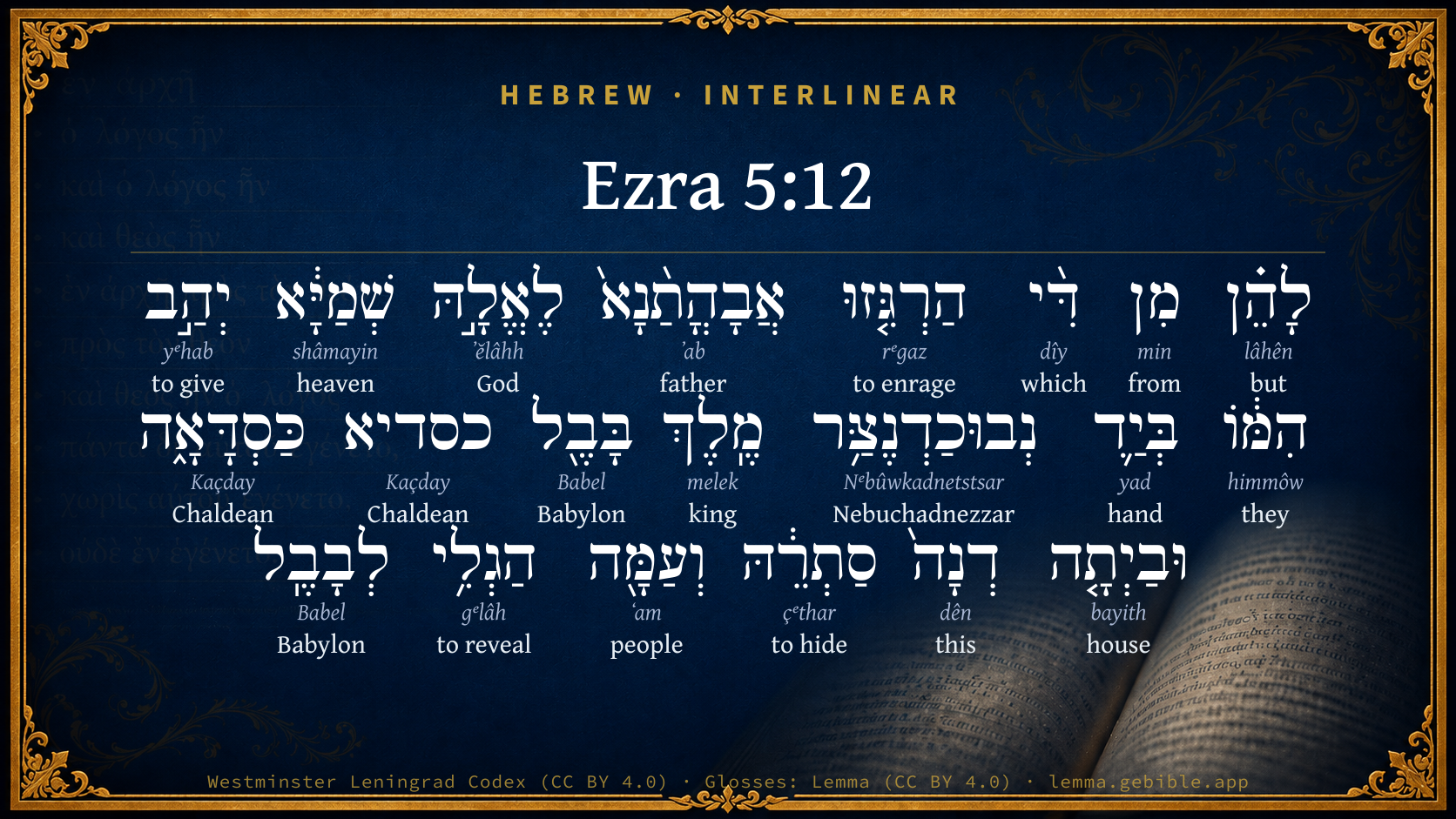
Ezra 5:12

Hebrew (Westminster Leningrad Codex) Ezra 5:12 appears in the Hebrew Old Testament. The text above is from the Westminster Leningrad Codex. Each word links to its Strong’s number, a concise gloss, and parsing drawn from the Open Scriptures Hebrew Bible morphology. Click any word for its full Brown-Driver-Briggs (BDB) entry.
Download image
Cite this verse

Ezra 5:12 (World English Bible). Public Domain. Lemma interlinear Bible study tool, https://lemma.gebible.app/v/ezra/5/12.

Show BibTeX & RIS
BibTeX
RIS
English Translation
But after that our fathers had provoked the God of heaven to wrath, he gave them into the hand of Nebuchadnezzar king of Babylon, the Chaldean, who destroyed this house, and carried the people away into Babylon.
World English Bible · Public Domain
Highlights
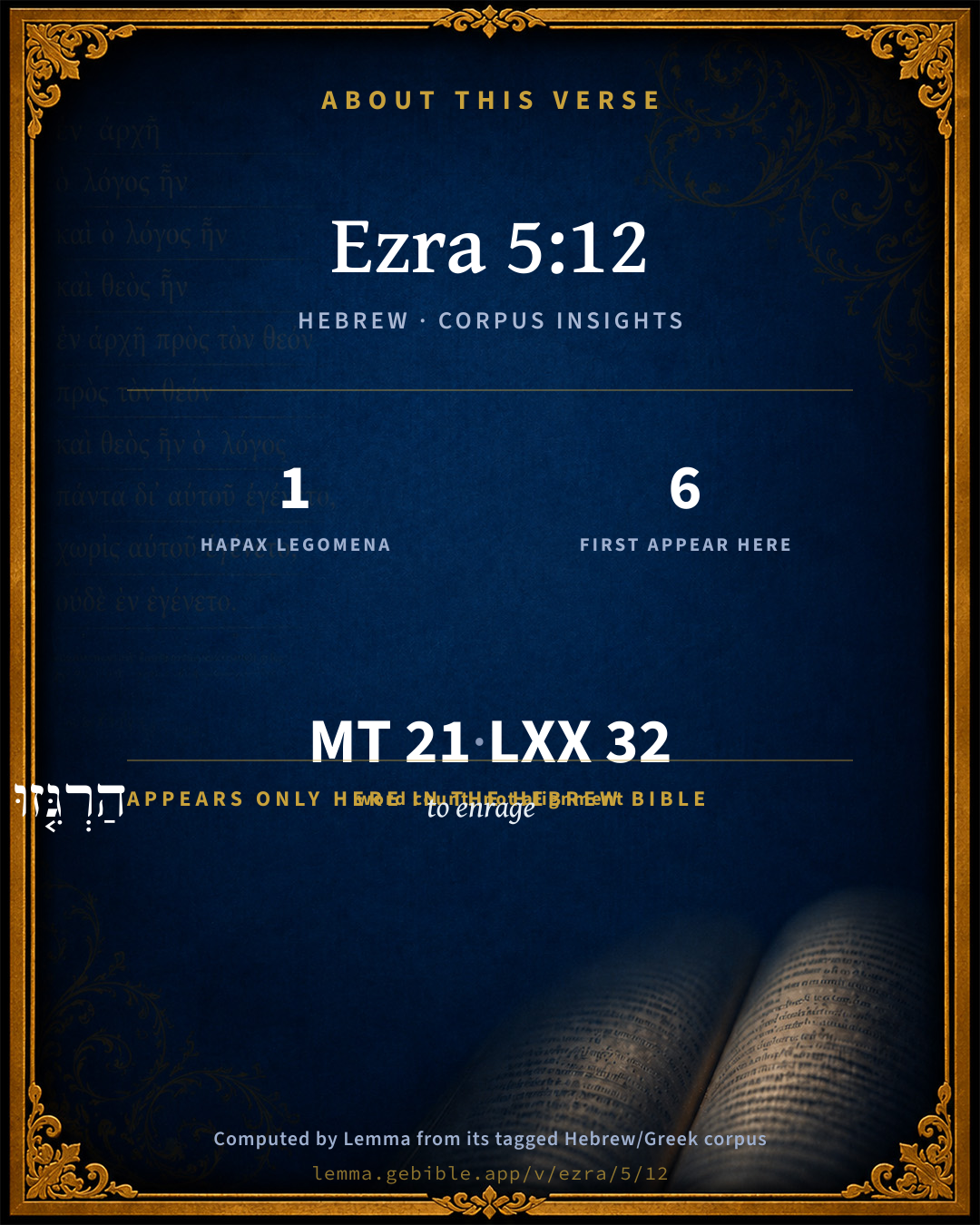
  • 1 hapax legomenon — only here in the Hebrew Bible
  • 6 first appearances in the Hebrew Bible
Full analysis ↓
Download a study sheet

One document with this verse’s original text, its word-by-word gloss line, the meaning frame, cross-references with their text, attributed commentary, and full source and license credits — printable, and it pastes into notes with its structure intact.

This verse Autodidact and up

Study sheet (.html) Plain text (.txt)

A passage Seminary Student

Up to 50 verses in one chapter. A passage sheet keeps up to 6 commentary sources and 12 cross-references per verse, in the order this page ranks them, and says so on the sheet whenever that leaves anything out. Ask for a single verse and you get the Autodidact verse sheet above.

Everything on this page stays free to read, with no account — the sheet is a download of what is already on screen, not access to it.

Want to remove ads? Support Godless Engineer
Compare translations 3

The same verse in 3 English versions, stacked beneath the original-language interlinear above. Click any original word for its lexicon entry.

Each is an independent rendering of the whole verse — the interlinear is not word-aligned to these translations.

Highlighted words mark where these versions differ — a whole-verse word diff, not a word-by-word alignment.

  • World English Bible Public Domain
    But after that our fathers had provoked the God of heaven to wrath, he gave them into the hand of Nebuchadnezzar king of Babylon, the Chaldean, who destroyed this house, and carried the people away into Babylon.
  • King James Version Public Domain
    But after that our fathers had provoked the God of heaven unto wrath, he gave them into the hand of Nebuchadnezzar the king of Babylon, the Chaldean, who destroyed this house, and carried the people away into Babylon.
  • unfoldingWord Literal Text CC BY-SA 4.0
    However, because of this, that our fathers caused the God of heaven to be angry, he gave them into the hand of Nebuchadnezzar, the king of Babylon, the Chaldean, and he destroyed this house and caused the people to be exiled to Babylon.

unfoldingWord Literal Text — © unfoldingWord, licensed CC BY-SA 4.0. Word-aligned USFM3 via Door43 (git.door43.org/unfoldingWord/en_ult).

Versions to compare (up to 4)

3 of 4 selected

Show all 18 translations

Every available English version of this verse, each an independent rendering of the whole verse.

  • World English Bible Public Domain
    But after that our fathers had provoked the God of heaven to wrath, he gave them into the hand of Nebuchadnezzar king of Babylon, the Chaldean, who destroyed this house, and carried the people away into Babylon.
  • Berean Standard Bible Public Domain
    But since our fathers angered the God of heaven, He delivered them into the hand of Nebuchadnezzar king of Babylon, the Chaldean who destroyed this temple and carried away the people to Babylon.
  • Majority Standard Bible Public Domain
    But since our fathers angered the God of heaven, He delivered them into the hand of Nebuchadnezzar king of Babylon, the Chaldean who destroyed this temple and carried away the people to Babylon.
  • King James Version Public Domain
    But after that our fathers had provoked the God of heaven unto wrath, he gave them into the hand of Nebuchadnezzar the king of Babylon, the Chaldean, who destroyed this house, and carried the people away into Babylon.
  • American Standard Version (1901) Public Domain
    But after that our fathers had provoked the God of heaven unto wrath, he gave them into the hand of Nebuchadnezzar king of Babylon, the Chaldean, who destroyed this house, and carried the people away into Babylon.
  • Revised Version (1885) Public Domain
    But after that our fathers had provoked the God of heaven unto wrath, he gave them into the hand of Nebuchadnezzar king of Babylon, the Chaldean, who destroyed this house, and carried the people away into Babylon.
  • Geneva Bible (1599) Public Domain
    But after that our fathers had prouoked the God of heauen vnto wrath, he gaue them ouer into the hand of Nebuchadnezzar King of Babel the Caldean, and he destroyed this house, and caryed the people away captiue vnto Babel.
  • Douay-Rheims (1899) Public Domain
    But after that our fathers had provoked the God of heaven to wrath, he delivered them into the hands of Nabuchodonosor the king of Babylon the Chaldean: and he destroyed this house, and carried away the people to Babylon.
  • Young's Literal Translation Public Domain
    but after that our fathers made the God of heaven angry, he gave them into the hand of Nebuchadnezzar king of Babylon the Chaldean, and this house he destroyed, and the people he removed to Babylon;
  • Literal Standard Version CC BY-SA 4.0
    but after that our fathers made the God of the heavens angry, he gave them into the hand of Nebuchadnezzar king of Babylon the Chaldean, and this house he destroyed, and the people he removed to Babylon;
  • Unlocked Literal Bible CC BY-SA 4.0
    However, when our ancestors enraged the God of heaven, he gave them into the hand of Nebuchadnezzar king of Babylon, the Chaldean, who destroyed this house and took the people into exile in Babylon.
  • unfoldingWord Literal Text CC BY-SA 4.0
    However, because of this, that our fathers caused the God of heaven to be angry, he gave them into the hand of Nebuchadnezzar, the king of Babylon, the Chaldean, and he destroyed this house and caused the people to be exiled to Babylon.
  • Darby Bible Public Domain
    But after that our fathers had provoked the God of the heavens to wrath, he gave them into the hand of Nebuchadnezzar king of Babylon, the Chaldean, and he destroyed this house, and carried the people away unto Babylon.
  • World Messianic Bible Public Domain
    But after our fathers had provoked the God of heaven to wrath, he gave them into the hand of Nebuchadnezzar king of Babylon, the Kasdian, who destroyed this house and carried the people away into Babylon.
  • Webster's Bible Public Domain
    But after that our fathers had provoked the God of heaven to wrath, he gave them into the hand of Nebuchadnezzar the king of Babylon, the Chaldean, who destroyed this house, and carried the people away into Babylon.
  • Free Bible Version CC BY-SA 4.0
    But our forefathers made the God of heaven angry, so he handed them over to Nebuchadnezzar, king of Babylon, the Chaldean, who destroyed this Temple and deported the people to Babylon.
  • Bible in Basic English Public Domain
    But when the God of heaven was moved to wrath by our fathers, he gave them up into the hands of Nebuchadnezzar, king of Babylon, the Chaldaean, who sent destruction on this house and took the people away into Babylon.
  • JPS Tanakh (1917) Public Domain
    But because that our fathers had provoked the God of heaven, He gave them into the hand of Nebuchadnezzar king of Babylon, the Chaldean, who destroyed this house, and carried the people away into Babylon.

Literal Standard Version (2020), Covenant Press — licensed CC BY-SA 4.0. Text via the HelloAO Bible API (eBible.org). Unlocked Literal Bible (unfoldingWord) — licensed CC BY-SA 4.0. Text via the HelloAO Bible API (eBible.org). unfoldingWord Literal Text — © unfoldingWord, licensed CC BY-SA 4.0. Word-aligned USFM3 via Door43 (git.door43.org/unfoldingWord/en_ult). Free Bible Version, Dr. Jonathan Gallagher — licensed CC BY-SA 4.0. Text via the HelloAO Bible API (eBible.org).

Word by word

More ways to search: Search by grammar → Find every occurrence → Compare this word →

Practice this passage: Drill this verse → Learn its vocabulary →

הַרְגִּ֤זוּ
rᵉgaz
H7265
“to enrage”
Adjective, V, Plural
Part of Speech
Adjective
Number
Plural
Full BDB Definition

Origin: corresponding to H7264

TWOT: 2987

(Aphel) to rage, enrage
  1. לָהֵ֗ן lâhên H3861 “but” Adjective, C
  2. מִן min H4481 “from” Adjective, R
  3. דִּ֨י dîy H1768 “which” Adjective, T
  4. אֲבָהֳתַ֨נָא֙ ʼab H2 “fathers · our” Adjective, N, Common + Suffix, Personal, 1st Person, Common, Plural
  5. לֶאֱלָ֣הּ ʼĕlâhh H426 “to/for · God of” Adjective, T + Noun, Common, Masculine, Singular, Construct
  6. שְׁמַיָּ֔א shâmayin H8065 “heaven(s) · the” Adjective, N, Common + Particle, Definite Article
  7. יְהַ֣ב yᵉhab H3052 “to give” Adjective, V, Plural
  8. הִמּ֔וֹ himmôw H1994 “they” Adjective, P
  9. בְּיַ֛ד yad H3028 “in/at · hand of” Adjective, R + Noun, Common, Feminine, Singular, Construct
  10. נְבוּכַדְנֶצַּ֥ר Nᵉbûwkadnetstsar H5020 “Nebuchadnezzar” Adjective, N
  11. מֶֽלֶךְ melek H4430 “king of” Adjective, N, Common
  12. בָּבֶ֖ל Babel H895 “Babylon” Adjective, N
  13. כסדיא Kaçday H3679 “Chaldeans · the” Adjective, N + Particle, Definite Article
  14. כַּסְדָּאָ֑ה Kaçday H3679 “Chaldean · the” Adjective, N + Particle, Definite Article
  15. וּבַיְתָ֤ה bayith H1005 “and · house · the” Adjective, C + Noun, Common, Masculine, Singular, Determined + Particle, Definite Article
  16. דְנָה֙ dên H1836 “this” Adjective, P
  17. סַתְרֵ֔הּ çᵉthar H5642 “to hide · him” Adjective, V, Plural + Suffix, Personal, 3rd Person, Masculine, Singular
  18. וְעַמָּ֖ה ʻam H5972 “and · people · the” Adjective, C + Noun, Common, Masculine, Singular, Determined + Particle, Definite Article
  19. הַגְלִ֥י gᵉlâh H1541 “to reveal” Adjective, V, Plural
  20. לְבָבֶֽל Babel H895 “to/for · Babylon” Adjective, R + Noun, Proper

About this verse

These counts appear in no published source. They are computed here, from the morphology-tagged text and Lemma’s own curated glosses. What Lemma adds →

21
words
19
distinct lemmas
Historical
section

Notable vocabulary

1 hapax legomenon — a word that appears only here in the entire Hebrew Bible:

  • הַרְגִּ֤זוּ to enrage H7265

First appearance in Scripture

These words make their first canonical appearance in the Hebrew Bible here:

  • לָהֵ֗ן but H3861
  • הַרְגִּ֤זוּ to enrage H7265
  • בָּבֶ֖ל Babylon H895
  • כסדיא Chaldean H3679
  • סַתְרֵ֔הּ to hide H5642
  • וְעַמָּ֖ה people H5972

Grammatical profile

  • 3 nouns
  • 13 adjectives
  • 5 particles

Repetition

Words recur within this verse — often emphatic in Hebrew:

  • בָּבֶ֖ל Babylon H895 ×2
  • כסדיא Chaldean H3679 ×2

Hebrew & Septuagint length

In English translation the verse runs 37 words from the Hebrew and 35 from the Septuagint (LXX English) — closely comparable.

A rough comparison of the two English renderings, which tokenize alike — not a word-level alignment.

Word counts can differ between the Hebrew and the Greek without any difference in meaning — e.g. the Hebrew direct-object marker אֵת has no separate Greek word, and Greek often adds the article ὁ.

In the original languages it is 21 Hebrew tokens and 32 Greek tokens — but the two are counted differently (Hebrew bundles its prefixes and suffixes into one token; the Greek is in lemma form), so that isn’t a like-for-like length.

Cross-references

24

Topical passages linked to Ezra 5:12 in the Treasury of Scripture Knowledge — connected by theme and wording, ordered by reader-vote popularity; previews shown in the World English Bible.

  • 2 Chronicles 36:16–17 but they mocked the messengers of God, and despised his words, and scoffed at his prophets, until the wrath of Yahweh arose against his people, until there was no remedy.
  • Daniel 9:5 we have sinned, and have dealt perversely, and have done wickedly, and have rebelled, even turning aside from your precepts and from your ordinances;
  • 2 Kings 24:2 Yahweh sent against him bands of the Chaldeans, and bands of the Syrians, and bands of the Moabites, and bands of the children of Ammon, and sent them against Judah to destroy it, according to the word of Yahweh, which he spoke by his servants the prophets.
  • Nehemiah 9:26–27 Nevertheless they were disobedient, and rebelled against you, and cast your law behind their back, and killed your prophets that testified against them to turn them again to you, and they committed awful blasphemies.
  • Jeremiah 39:1–14 It happened when Jerusalem was taken, (in the ninth year of Zedekiah king of Judah, in the tenth month, came Nebuchadrezzar king of Babylon and all his army against Jerusalem, and besieged it;
  • Deuteronomy 28:15–68 But it shall come to pass, if you will not listen to the voice of Yahweh your God, to observe to do all his commandments and his statutes which I command you this day, that all these curses shall come on you, and overtake you.
  • Deuteronomy 29:24–28 even all the nations shall say, Why has Yahweh done thus to this land? what means the heat of this great anger?
  • Deuteronomy 31:17 Then my anger shall be kindled against them in that day, and I will forsake them, and I will hide my face from them, and they shall be devoured, and many evils and troubles shall come on them; so that they will say in that day, Haven't these evils come on us because our God is not among us?
  • Deuteronomy 32:30 How should one chase a thousand, Two put ten thousand to flight, Except their Rock had sold them, Yahweh had delivered them up?
  • Judges 2:14 The anger of Yahweh was kindled against Israel, and he delivered them into the hands of spoilers who despoiled them; and he sold them into the hands of their enemies round about, so that they could not any longer stand before their enemies.
  • Judges 4:2 Yahweh sold them into the hand of Jabin king of Canaan, who reigned in Hazor; the captain of whose host was Sisera, who lived in Harosheth of the Gentiles.
  • Judges 6:1 The children of Israel did that which was evil in the sight of Yahweh: and Yahweh delivered them into the hand of Midian seven years.
  • 1 Kings 9:6–9 But if you shall turn away from following me, you or your children, and not keep my commandments and my statutes which I have set before you, but shall go and serve other gods, and worship them;
  • 2 Kings 21:12–15 therefore thus says Yahweh, the God of Israel, Behold, I bring such evil on Jerusalem and Judah, that whoever hears of it, both his ears shall tingle.
  • 2 Kings 24:10–17 At that time the servants of Nebuchadnezzar king of Babylon came up to Jerusalem, and the city was besieged.
  • 2 Kings 25:1 It happened in the ninth year of his reign, in the tenth month, in the tenth day of the month, that Nebuchadnezzar king of Babylon came, he and all his army, against Jerusalem, and encamped against it; and they built forts against it round about.
  • 2 Kings 25:8–30 Now in the fifth month, on the seventh day of the month, which was the nineteenth year of king Nebuchadnezzar, king of Babylon, came Nebuzaradan the captain of the guard, a servant of the king of Babylon, to Jerusalem.
  • 2 Chronicles 7:19–22 But if you turn away, and forsake my statutes and my commandments which I have set before you, and shall go and serve other gods, and worship them;
  • 2 Chronicles 34:24–25 Thus says Yahweh, Behold, I will bring evil on this place, and on the inhabitants of it, even all the curses that are written in the book which they have read before the king of Judah.
  • 2 Chronicles 36:6–10 Against him came up Nebuchadnezzar king of Babylon, and bound him in fetters, to carry him to Babylon.
  • Psalms 106:40 Therefore Yahweh burned with anger against his people. He abhorred his inheritance.
  • Isaiah 59:1–2 Behold, Yahweh's hand is not shortened, that it can't save; neither his ear heavy, that it can't hear:
  • Jeremiah 5:29 Shall I not visit for these things? says Yahweh; shall not my soul be avenged on such a nation as this?
  • Daniel 1:1–2 In the third year of the reign of Jehoiakim king of Judah came Nebuchadnezzar king of Babylon to Jerusalem, and besieged it.

Cross-references courtesy of OpenBible.info (CC BY 4.0).

Hebrew and Greek witnesses Masoretic Hebrew ↔ Greek Septuagint

The same verse in the two great witnesses to the Old Testament, shown verse-for-verse.

These are two independent witnesses, not word-aligned to each other, and the Septuagint is shown in lemma (dictionary) form.

Hebrew Ezra 5:12 Masoretic · Westminster Leningrad Codex

לָהֵ֗ן מִן דִּ֨י הַרְגִּ֤זוּ אֲבָהֳתַ֨נָא֙ לֶאֱלָ֣הּ שְׁמַיָּ֔א יְהַ֣ב הִמּ֔וֹ בְּיַ֛ד נְבוּכַדְנֶצַּ֥ר מֶֽלֶךְ בָּבֶ֖ל כסדיא כַּסְדָּאָ֑ה וּבַיְתָ֤ה דְנָה֙ סַתְרֵ֔הּ וְעַמָּ֖ה הַגְלִ֥י לְבָבֶֽל

But after that our fathers had provoked the God of heaven to wrath, he gave them into the hand of Nebuchadnezzar king of Babylon, the Chaldean, who destroyed this house, and carried the people away into Babylon.

World English Bible · Public Domain

Greek LXX Ezra 5:12 Septuagint · lemma form

αὐτός ἀπό ὅτε δέ παραὀργίζω ὁ πατήρ ἐγώ ὁ θεός ὁ οὐρανός δίδωμι αὐτός εἰς χείρ ναβουχοδονοσορ βασιλεύς βαβυλών ὁ χαλδαῖος καί ὁ οἶκος οὗτος καταλύω καί ὁ λαός ἀποοἰκίζω εἰς βαβυλῶνα

But after that our fathers provoked the God of heaven, he gave them into the hands of Nabuchodonosor the Chaldean, king of Babylon, and he destroyed this house, and carried the people captive to Babylon.

LXX2012 (modern English Septuagint) · Public Domain

In the Septuagint this is one book — Esdras B (2 Esdras): Ezra is chapters 1–10, Nehemiah 11–23.

Hebrew: Westminster Leningrad Codex (CC BY 4.0). Greek: Septuagint (public domain); English from LXX2012 (modern English Septuagint) (Public Domain). How the Septuagint differs from the Hebrew →

Commentary

Notes on Ezra 5:12 from classic Christian and Jewish commentators (each source and its license shown beneath its notes). The classic Christian expositions comment on the surrounding passage and are grouped to its opening verse, so a note may address several verses; the Jewish commentaries on the Tanakh (Rashi and others) are per-verse, so they appear only where the commentator wrote on this verse.

Lemma curates 59 commentaries, every one of them public domain or Creative Commons licensed, each selected and text-cleaned for this edition rather than reprinted as found. About our sources →

Trapp's Complete Commentary

John Trapp

Ezr 5:12 But after that our fathers had provoked the God of heaven unto wrath, he gave them into the hand of Nebuchadnezzar the king of Babylon, the Chaldean, who destroyed this house, and carried the people away into Babylon.

Ver. 12. But after that our fathers had provoked] Sin is the breeder of dissention that sets heaven and earth at odds, and hurleth confusion over the whole creation, Isa 59:2 Num 11:31. There were more remarkable expressions of God’s anger upon man’s sin in the dead body of a man than of a beast: one made unclean but till the evening; the other, for seven days.

He gave them into the hands of Nebuchadnezzar] This is still the property of sin unpardoned, to raise the Posse comitatus, all the armies of God against the sinner.

John Trapp, A Commentary or Exposition upon All the Books of the Old and New Testament (1647–1656) — public domain. Text from a community e-Sword module.

Joseph Benson's Commentary

Ezr 5:12-14. After that our fathers had provoked the God of heaven — It was to punish us for our sins, that we were, for a time, put out of the possession of this house, and not because the gods of the nations had prevailed against our God. But in the first year of Cyrus, &c. — We have the royal decree of Cyrus to justify us, and bear us out in what we do. And he not only permitted, but charged and commanded us, to build this house, and to build it in its place, (Ezr 5:15,) the same place where it had stood before. And the vessels also, &c. — These also he delivered to one whom he intrusted with the care of them, and commanded him to restore them to their ancient place and use. And these we have to show in confirmation of what we allege.

Joseph Benson's Commentary on the Old and New Testaments (1811–1818) — public domain. Text from a community e-Sword module.

Tyndale Open Study Notes

Tyndale Open Resources

5:12 destroyed this Temple and exiled the people: See 2 Kgs 25:9-17.

Tyndale Open Study Notes — © Tyndale Open Resources, licensed CC BY-SA 4.0. Text via the HelloAO Bible API.

Ellicott's Commentary for English Readers

(12) Gave them into the hand of Nebuchadnezzar the king of Babylon, the Chaldean.—These words not only show that the people regarded themselves as punished by the sole hand of God, but also remind the overthrowers of the Chaldean power that they also themselves are no more than instruments of the same Divine will.

A Bible Commentary for English Readers, edited by Charles John Ellicott (1878–1897) — public domain. Text from a community e-Sword module.

The Cambridge Bible for Schools and Colleges

gen. ed. J. J. S. Perowne

12. after that] So R.V., R.V. marg. ‘because that’. The purpose of the passage is to account for the destruction of the Temple and the captivity of God’s people. The conjunction is not temporal, but causal: ‘for this reason, namely, that &c.’ The rendering of the R.V. margin is preferable.

provoked … unto wrath] The word used here for ‘provoke’ is found in the Hebrew books with this meaning only in Job_12:6. Elsewhere to ‘shake’, ‘disquiet’, 1Sa_28:15; Isa_13:13; Isa_23:11; Jer_50:34.

the God of heaven] See on Ezr_1:2. A general description of Israel’s provocation of their God is given in 2Ch_36:14-21.

Nebuchadnezzar] Cf. on Ezr_1:7 : the Chaldean, i.e. the Babylonian.

The Cambridge Bible for Schools and Colleges (gen. ed. J. J. S. Perowne; Cambridge University Press, 1878–1918) — public domain. Text from a community e-Sword module.

John Gill's Exposition

But after that our fathers had provoked the God of heaven unto wrath,.... By their idolatries; which accounts for it how it was that they who were the servants of the great God of heaven and earth, and this temple built for the honour of his name, were not preserved by him; but they were carried captive, and this house left desolate: it was for their sins for which

he (God) gave them into the hand of Nebuchadnezzar the king of Babylon the Chaldean, who destroyed this house, and carried the people away into Babylon; see Ch2 36:19.

John Gill's Exposition of the Whole Bible (1746–1763) — public domain (CC PDM 1.0). Text via the HelloAO Bible API.

The Pulpit Commentary

Our fathers provoked the God of heaven unto wrath. Mainly by their long series of idolatries, with the moral abominations that those idolatries involved the sacrifice of children by their own parents, the licentious rites belonging to the worship of Baal, and the unmentionable horrors practised by the devotees of the Dea Syra. For centuries, with only short and rare intervals, "the chief of the priests, and the people, had transgressed very much after all the abominations of the heathen," and had even "polluted the house of the Lord which he had hallowed in Jerusalem". (2Ch_36:14) Therefore, he gave them into the hand of Nebuchadnezzar the king of Babylon. He punished, as he always does, national apostasy with national destruction. Making an idolatrous people, but a less guilty one, his sword, he cut off Judah, as he had previously cut off Israel, causing the national life to cease, and even removing the bulk of the people into a distant country. Not by his own power or might did Nebuchadnezzar prevail. God could have delivered the Jews from him as easily as he had delivered them in former days from Jabin, (Jud 4:2-24) and from Zerah, (2Ch_14:11-15) and from Sennacherib. (2Ki_19:20-36) But he was otherwise minded; he gave them into the hand of Nebuchadnezzar". (comp. 2Ch_36:17) He divided their counsels, paralysed their resistance, caused Pharaoh Hophra to desert their cause, (2Ki_24:7) and left them helpless and unprotected. Nebuchadnczzar was his instrument to chastise his guilty people, and in pursuing his own ends merely worked out the purposes of the Almighty.

The Pulpit Commentary (1880–1919), ed. H.D.M. Spence-Jones & Joseph S. Exell — public domain. Text from a community e-Sword module.

Keil & Delitzsch

C. F. Keil & F. Delitzsch

For this reason (להן), because (מן־דּי = מאשׁר, e.g., Isa 43:4) our fathers provoked the God of heaven, He gave them into the hand of Nebuchadnezzar king of Babylon, the Chaldean, and he (Nebuch.) destroyed this house, and carried the people away into Babylon. For כּסדּיא the Keri requires כּסדּאה, the ordinary form of the absolute state of the noun in ai. סתר, Pael, in the sense of destroy, appears only here in biblical Chaldee, but more frequently in the Targums. עמּה, its people, would refer to the town of Jerusalem; but Norzi and J. H. Mich. have עמּהּ, and the Masora expressly says that the word is to be written without Mappik, and is therefore the stat. emphat. for עמּא.

Keil & Delitzsch — Biblical Commentary on the Old Testament (1861–1891) — public domain (CC PDM 1.0). Text via the HelloAO Bible API. (Old Testament only.)

unfoldingWord translationNotes

Door43 World Missions Community

General Information:

The letter from Tattenai to the king continues. Tattenai continues to tell the king what the Judeans had told him beginning in Esra 5:11.

enraged the God of heaven

"made the God of heaven become very angry with us"

he gave them into the hand of Nebuchadnezzar king of Babylon, the Chaldean, who destroyed this house and took the people

The hand is a metonym for power or control. Also, "Nebuchadnezzar" represents his army. AT: "allowed the army of Nebuchadnezzar, king of Babylon, the Chaldean, to destroy this house and to take the people" (See: Metonymy)

destroyed this house

"tore down this house"

Cyrus issued a decree to rebuild the house of God

Cyrus ordered that the people rebuild God's temple.

translationWords

Nebuchadnezzar

Babylon

exile

Cyrus

decree

house of God

unfoldingWord translationNotes — © Distant Shores Media and the Door43 World Missions Community, licensed CC BY-SA 4.0. Source: git.door43.org/Door43/en_tn.

Rashi

Rabbi Shlomo Yitzchaki (Rashi)

But now But now, since our forefathers angered the God of the heavens, He delivered them into the hands of the Chaldean king of Babylon, and he destroyed this House and exiled the people to Babylon.

Rashi on the Tanakh — English translations: “The Judaica Press complete Tanach with Rashi, translated by A. J. Rosenberg” (CC BY 4.0); “Pentateuch with Rashi's commentary by M. Rosenbaum and A.M. Silbermann, 1929-1934” (public domain); “The Metsudah Tanach series, Lakewood, N.J” (CC BY 4.0); and “The Book of Joshua, Metsudah Publications, 1997” (CC BY 4.0). Text via Sefaria.

Lesson kit

Teaching starters — assembled from the data on this page, not authored interpretation. Every prompt links to the verse data it draws on. Edit before teaching.

Ezra, in the Historical, opens this verse with 21 words (19 distinct Hebrew lemmas). Its most distinctive word is rᵉgaz (“to enrage”). A historical commentator’s framing appears above. Read the whole chapter for the surrounding context.

Discussion questions

  1. What does “to enrage” (rᵉgaz) contribute to the verse as a whole?
  2. This verse holds 1 word here found nowhere else in the Hebrew Bible. What might the rare word draw attention to?
  3. 6 words here appear for the first time in Scripture. What is being introduced at this debut?
  4. 2 Chronicles 36:16–17 shares this passage’s theme. How do the two illuminate each other?
  5. “Babylon” occurs 2× in this one verse. What is the effect of the repetition?
  6. These translations render this verse differently; the difference is in the English rendering, not the original. What questions does that raise?
  7. Reading how Trapp's Complete Commentary and Joseph Benson's Commentary read this verse, where do the two commentators agree and where do they part?

Things to notice

  • 1 word in this verse appears nowhere else in the Hebrew Bible.
  • 6 words make their first canonical appearance in Scripture here.
  • This verse counts 21 Hebrew ↔ 32 Greek words.
  • These translations choose different wording for 12 words in this verse.
  • “Babylon” occurs 2× in this single verse.

Reading settings

Reading text

Shown beneath each verse's original-language words.

Old Testament
Old Testament edition

Read the OT as the Masoretic Hebrew (MT) or the Greek Septuagint (LXX).

English shown for the Greek Septuagint (in the Hebrew ↔ Greek comparison).

Comparing translations? Open the Compare panel on any verse page to stack up to four side by side.