
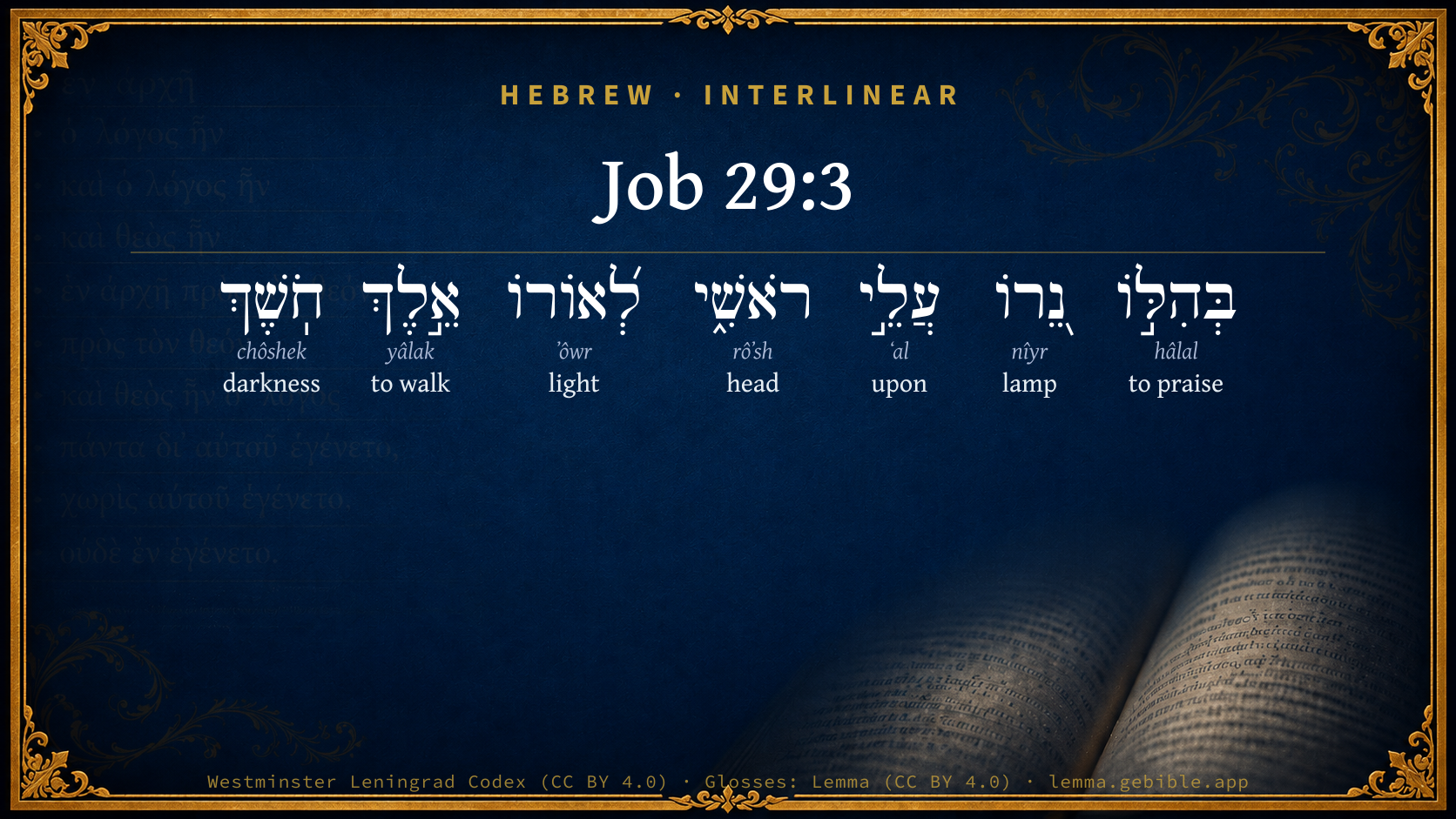
Job 29:3

Hebrew (Westminster Leningrad Codex) Job 29:3 appears in the Hebrew Old Testament. The text above is from the Westminster Leningrad Codex. Each word links to its Strong’s number, a concise gloss, and parsing drawn from the Open Scriptures Hebrew Bible morphology. Click any word for its full Brown-Driver-Briggs (BDB) entry.
Download image
Cite this verse

Job 29:3 (World English Bible). Public Domain. Lemma interlinear Bible study tool, https://lemma.gebible.app/v/job/29/3.

Show BibTeX & RIS
BibTeX
RIS
English Translation
When his lamp shone on my head, And by his light I walked through darkness;
World English Bible · Public Domain
Download a study sheet

One document with this verse’s original text, its word-by-word gloss line, the meaning frame, cross-references with their text, attributed commentary, and full source and license credits — printable, and it pastes into notes with its structure intact.

This verse Autodidact and up

Study sheet (.html) Plain text (.txt)

A passage Seminary Student

Up to 50 verses in one chapter. A passage sheet keeps up to 6 commentary sources and 12 cross-references per verse, in the order this page ranks them, and says so on the sheet whenever that leaves anything out. Ask for a single verse and you get the Autodidact verse sheet above.

Everything on this page stays free to read, with no account — the sheet is a download of what is already on screen, not access to it.

Want to remove ads? Support Godless Engineer
Compare translations 3

The same verse in 3 English versions, stacked beneath the original-language interlinear above. Click any original word for its lexicon entry.

Each is an independent rendering of the whole verse — the interlinear is not word-aligned to these translations.

Highlighted words mark where these versions differ — a whole-verse word diff, not a word-by-word alignment.

  • World English Bible Public Domain
    When his lamp shone on my head, And by his light I walked through darkness;
  • King James Version Public Domain
    When his candle shined upon my head, and when by his light I walked through darkness;
  • unfoldingWord Literal Text CC BY-SA 4.0
    when his lamp shone over my head, I walked darkness by his light,

unfoldingWord Literal Text — © unfoldingWord, licensed CC BY-SA 4.0. Word-aligned USFM3 via Door43 (git.door43.org/unfoldingWord/en_ult).

Versions to compare (up to 4)

3 of 4 selected

Show all 18 translations

Every available English version of this verse, each an independent rendering of the whole verse.

  • World English Bible Public Domain
    When his lamp shone on my head, And by his light I walked through darkness;
  • Berean Standard Bible Public Domain
    when His lamp shone above my head, and by His light I walked through the darkness,
  • Majority Standard Bible Public Domain
    when His lamp shone above my head, and by His light I walked through the darkness,
  • King James Version Public Domain
    When his candle shined upon my head, and when by his light I walked through darkness;
  • American Standard Version (1901) Public Domain
    When his lamp shined upon my head, And by his light I walked through darkness;
  • Revised Version (1885) Public Domain
    When his lamp shined upon my head, and by his light I walked through darkness;
  • Geneva Bible (1599) Public Domain
    When his light shined vpon mine head: and when by his light I walked thorowe the darkenesse,
  • Douay-Rheims (1899) Public Domain
    When his lamp shined over my head, and I walked by his light in darkness?
  • Young's Literal Translation Public Domain
    In His causing His lamp to shine on my head, By His light I walk `through' darkness.
  • Literal Standard Version CC BY-SA 4.0
    In His causing His lamp to shine on my head, || By His light I walk [through] darkness.
  • Unlocked Literal Bible CC BY-SA 4.0
    when his lamp shined on my head, and when I walked through darkness by his light.
  • unfoldingWord Literal Text CC BY-SA 4.0
    when his lamp shone over my head, I walked darkness by his light,
  • Darby Bible Public Domain
    When his lamp shone over my head, [and] by his light I walked through darkness;
  • World Messianic Bible Public Domain
    when his lamp shone on my head, and by his light I walked through darkness,
  • Webster's Bible Public Domain
    When his candle shined upon my head, and when by his light I walked through darkness;
  • Free Bible Version CC BY-SA 4.0
    His light shone above me and lit my way through the darkness.
  • Bible in Basic English Public Domain
    When his light was shining over my head, and when I went through the dark by his light.
  • JPS Tanakh (1917) Public Domain
    When His lamp shined above my head, and by His light I walked through darkness;

Literal Standard Version (2020), Covenant Press — licensed CC BY-SA 4.0. Text via the HelloAO Bible API (eBible.org). Unlocked Literal Bible (unfoldingWord) — licensed CC BY-SA 4.0. Text via the HelloAO Bible API (eBible.org). unfoldingWord Literal Text — © unfoldingWord, licensed CC BY-SA 4.0. Word-aligned USFM3 via Door43 (git.door43.org/unfoldingWord/en_ult). Free Bible Version, Dr. Jonathan Gallagher — licensed CC BY-SA 4.0. Text via the HelloAO Bible API (eBible.org).

Word by word

More ways to search: Search by grammar → Find every occurrence → Compare this word →

Practice this passage: Drill this verse → Learn its vocabulary →

About this verse

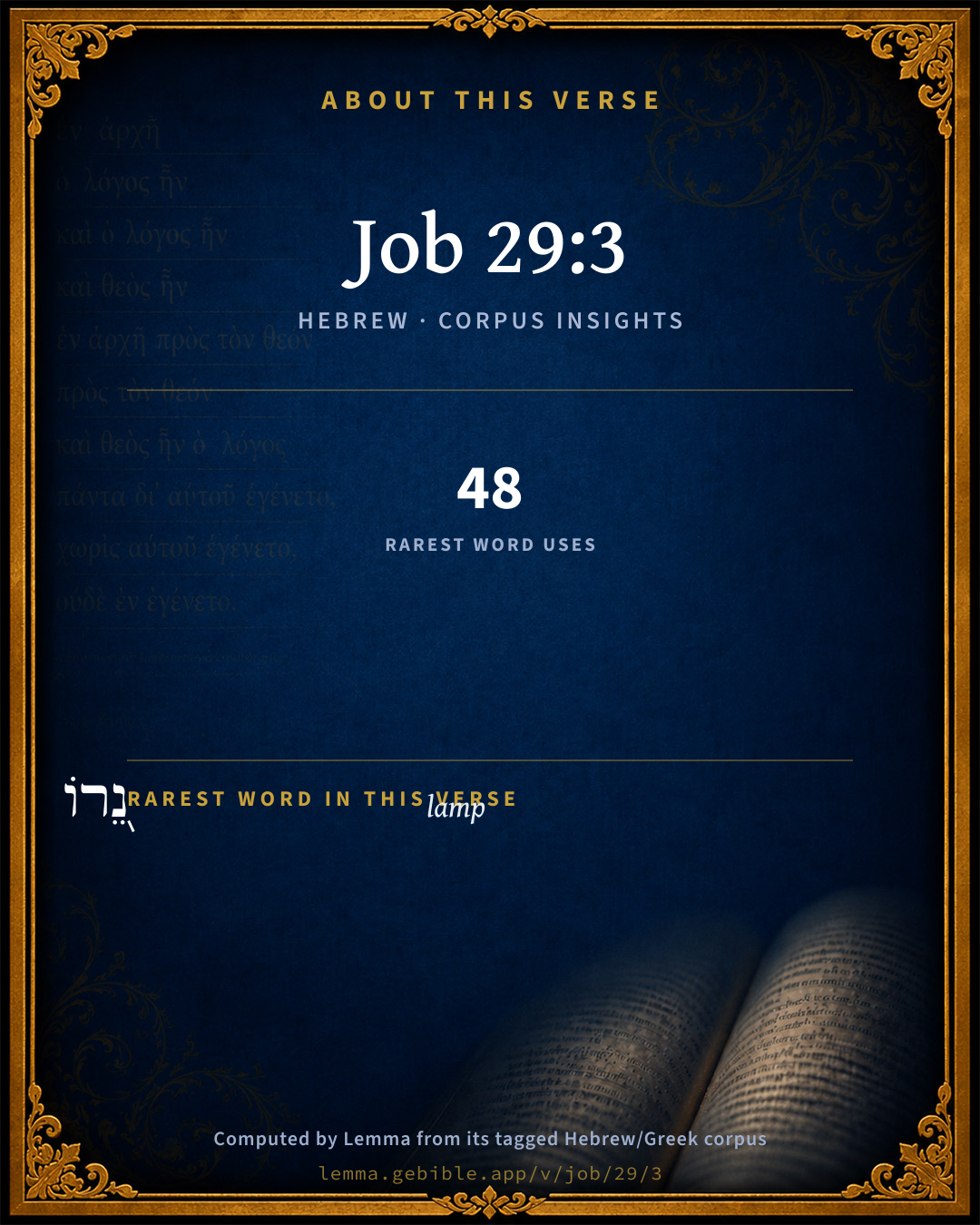
These counts appear in no published source. They are computed here, from the morphology-tagged text and Lemma’s own curated glosses. What Lemma adds →

7
words
7
distinct lemmas
Wisdom
section

Shared distinctive vocabulary

נֵ֭רוֹ lamp H5216 occurs in 42 verses of the Hebrew Bible. Also found in:

Grammatical profile

  • 2 verbs
  • 4 nouns
  • 1 preposition

Verb forms

  • בְּהִלּ֣וֹ Hiphil · Infinitive Construct
  • אֵ֣לֶךְ Qal · Imperfect

Hebrew & Septuagint length

In English translation the verse runs 15 words from the Hebrew and 16 from the Septuagint (LXX English) — closely comparable.

A rough comparison of the two English renderings, which tokenize alike — not a word-level alignment.

Word counts can differ between the Hebrew and the Greek without any difference in meaning — e.g. the Hebrew direct-object marker אֵת has no separate Greek word, and Greek often adds the article ὁ.

Cross-references

17

Topical passages linked to Job 29:3 in the Treasury of Scripture Knowledge — connected by theme and wording, ordered by reader-vote popularity; previews shown in the World English Bible.

  • Psalms 18:28 For you will light my lamp, Yahweh. My God will light up my darkness.
  • John 8:12 Again, therefore, Jesus spoke to them, saying, "I am the light of the world. He who follows me will not walk in the darkness, but will have the light of life."
  • Job 18:6 The light shall be dark in his tent, His lamp above him shall be put out.
  • John 12:46 I have come as a light into the world, that whoever believes in me may not remain in the darkness.
  • Ephesians 5:8 For you were once darkness, but are now light in the Lord. Walk as children of light,
  • Job 11:17 Life shall be clearer than the noonday; Though there is darkness, it shall be as the morning.
  • Job 22:28 You shall also decree a thing, and it shall be established to you. Light shall shine on your ways.
  • Psalms 84:11 For Yahweh God is a sun and a shield. Yahweh will give grace and glory. He withholds no good thing from those who walk blamelessly.
  • Proverbs 24:20 For there will be no reward to the evil man; And the lamp of the wicked shall be snuffed out.
  • Psalms 23:4 Even though I walk through the valley of the shadow of death, I will fear no evil, for you are with me. Your rod and your staff, they comfort me.
  • Psalms 27:1 Yahweh is my light and my salvation. Whom shall I fear? Yahweh is the strength of my life. Of whom shall I be afraid?
  • Proverbs 13:9 The light of the righteous shines brightly, But the lamp of the wicked is snuffed out.
  • Isaiah 2:4 He will judge between the nations, And will decide concerning many peoples; And they shall beat their swords into plowshares, And their spears into pruning-hooks. Nation shall not lift up sword against nation, Neither shall they learn war any more.
  • Ephesians 5:14 Therefore he says, "Awake, you who sleep, and arise from the dead, and Christ will shine on you."
  • Job 21:17 "How often is it that the lamp of the wicked is put out? That their calamity comes on them? That God distributes sorrows in his anger?
  • Psalms 4:6 Many say, "Who will show us any good?" Yahweh, let the light of your face shine on us.
  • Proverbs 20:20 Whoever curses his father or his mother, His lamp shall be put out in blackness of darkness.

Cross-references courtesy of OpenBible.info (CC BY 4.0).

Hebrew and Greek witnesses Masoretic Hebrew ↔ Greek Septuagint

The same verse in the two great witnesses to the Old Testament, shown verse-for-verse.

These are two independent witnesses, not word-aligned to each other, and the Septuagint is shown in lemma (dictionary) form.

Hebrew Job 29:3 Masoretic · Westminster Leningrad Codex

בְּהִלּ֣וֹ נֵ֭רוֹ עֲלֵ֣י רֹאשִׁ֑י לְ֝אוֹרוֹ אֵ֣לֶךְ חֹֽשֶׁךְ

When his lamp shone on my head, And by his light I walked through darkness;

World English Bible · Public Domain

Greek LXX Job 29:3 Septuagint · lemma form

ὡς ὅτε αὔγω ὁ λύχνος αὐτός ὑπέρ κεφαλή ἐγώ ὅτε ὁ φῶς αὐτός πορεύομαι ἐν σκότος

As when his lamp shone over my head; when by his light I walked through darkness.

LXX2012 (modern English Septuagint) · Public Domain

Hebrew: Westminster Leningrad Codex (CC BY 4.0). Greek: Septuagint (public domain); English from LXX2012 (modern English Septuagint) (Public Domain). How the Septuagint differs from the Hebrew →

Commentary

Notes on Job 29:3 from classic Christian and Jewish commentators (each source and its license shown beneath its notes). The classic Christian expositions comment on the surrounding passage and are grouped to its opening verse, so a note may address several verses; the Jewish commentaries on the Tanakh (Rashi and others) are per-verse, so they appear only where the commentator wrote on this verse.

Lemma curates 59 commentaries, every one of them public domain or Creative Commons licensed, each selected and text-cleaned for this edition rather than reprinted as found. About our sources →

Trapp's Complete Commentary

John Trapp

Job 29:3 When his candle shined upon my head, [and when] by his light I walked [through] darkness;

Ver. 3. When his candle shined upon my head] When I was apparently blessed by him, and all went hail well with me. The sun smote me not by day nor the moon by night, Psa 121:6, but both seemed to be made and to make for me. Nay, more; the sweet sunshine of God’s loving countenance was displayed upon me, which is not like the winter sun, that casts a goodly countenance when it shines, but gives little comfort and heat. Job had both counsel and comfort from God; and that when other men were to seek of both: for,

By his light I walked through darkness] Without the least fear of those evils and miseries that put others into very great distemper. So Noah was - Mediis tranquillus in undis. Abraham stands upon the hill, and seeth the cities of the plain burning. David can walk (not step) through (not cross) the valley (not a dark entry) of the shadow of death (the darkest side of death), and not fear (though he should go back again in the same way). And why? "for thou art with me," saith he, "thy rod and thy staff they comfort me," Psa 23:4.

John Trapp, A Commentary or Exposition upon All the Books of the Old and New Testament (1647–1656) — public domain. Text from a community e-Sword module.

Geneva Bible (1599)

Geneva Bible translators

When I felt his favor.

I was free from affliction.

Geneva Bible (1599) marginal notes — public domain. Text via Bolls.life.

Jamieson, Fausset & Brown

Robert Jamieson, A. R. Fausset & David Brown

candle--when His favor shone on me (see on Job 18:6 and Psa 18:28).

darkness--By His safeguard I passed secure through dangers. Perhaps alluding to the lights carried before caravans in nightly travels through deserts [NOYES].

Jamieson, Fausset & Brown — Commentary Critical and Explanatory on the Whole Bible (1871) — public domain (CC PDM 1.0). Text via the HelloAO Bible API.

Adam Clarke's Commentary

Verse 3. When his candle shined upon my head] Alluding most probably to the custom of illuminating festival or assembly rooms by lamps pendant from the ceiling. These shone literally on the heads of the guests.

By his light I walked through darkness] His light - prosperity and peace - continued to illuminate my way. If adversity came, I had always the light of God to direct me. Almost all the nations of the world have represented their great men as having a nimbus or Divine glory about their heads, which not only signified the honour they had, but was also an emblem of the inspiration of the Almighty.

Adam Clarke's Commentary on the Bible (1810–1826) — public domain. Text from a community e-Sword/MySword module.

Ellicott's Commentary for English Readers

(3) When his candle shined.—See Isa_1:10.

A Bible Commentary for English Readers, edited by Charles John Ellicott (1878–1897) — public domain. Text from a community e-Sword module.

The Cambridge Bible for Schools and Colleges

gen. ed. J. J. S. Perowne

3. This verse expands “preserved” or “watched over” in Job_29:2.

his candle shined upon] Or, his lamp shined over. God’s lamp shone above him, and lighted his path, so that the darkness before him was made to be light, Isa_42:16. God’s “lamp” is a figure for His favour and enlightenment and prospering of him.

The Cambridge Bible for Schools and Colleges (gen. ed. J. J. S. Perowne; Cambridge University Press, 1878–1918) — public domain. Text from a community e-Sword module.

John Gill's Exposition

When his candle shined upon my head,.... Which may be understood either of outward prosperity, sometimes signified by a candle, Job 18:5; and may be called the candle of the Lord, because it is from him, it is of his lighting and setting up; and its shining on his head may denote the large measure and degree of it possessed by him, in allusion to torches carried on high to light with; or lamps, or candles, set up in the higher part of the house to give the more light; or to the sun in the firmament, and especially when in its meridian, and shines clearest right over our heads, and casts no shadow: or else it may be understood of light in a figurative sense, not of the light of nature in men, which, though called the candle of the Lord, Pro 20:27; yet, in man's fallen state, shines not clearly; and with respect to this there was no difference in Job than heretofore; but rather it is the light of grace, the true light, which had shone upon him and in him, but now not so clearly as formerly, and as he could wish for; or else the word of God, which is a light unto the feet, and a lamp to the path; or it may be, best of all, the favour of God, the light of his countenance he had before enjoyed, having had a comfortable display of his love, a clear view of interest in it, and had the blessings of it bestowed upon him, and enjoyed by him; and nothing was more desirable by him, as is by every good man, than the return of the light of God's countenance; and that he might be remembered with his special favour, as his people are, and as he had been in times past:

and when by his light I walked through darkness; that is, either by the light of outward prosperity he had escaped those calamities, distresses, and dangers, and got over those difficulties which attended others, though now surrounded with them; or by the light of divine grace, or of the word of God, and especially by and in the light of God's countenance, he walked cheerfully and comfortably, without any fear of the darkness of affliction and calamities, or of the dark valley of the shadow of death, or of the prince of darkness, or of the darkness of hell and damnation; but now clouds of darkness being about him, and he without the light of God's countenance, could not see the way in which he walked and therefore wished that that again might be lifted up upon him.

John Gill's Exposition of the Whole Bible (1746–1763) — public domain (CC PDM 1.0). Text via the HelloAO Bible API.

Albert Barnes' Notes on the Bible

When his candle shined upon my head - Margin, or, “lamp;” compare notes Job 18:6. It was remarked in the note on that place, that it was common to have lamps or lights always burning in a house or tent. When Job speaks of the lamps shining “on his head,” the allusion is probably to the custom of suspending a lamp from the ceiling - a custom which prevails among the wealthy Arabs. “Scott.” Virgil speaks of a similar thing in the palace of Dido:

- Dependent lychni laquearibus aureis Incensi.

Aeneid i. 726.

“From gilded roofs depending lamps display

Nocturnal beams that imitate the day.”

Dryden

See, also Lucretius, ii. 24. Indeed the custom is common everywhere and the image is a beautiful illustration of the divine favor - of light and happiness imparted by God, the great source of blessedness from above. The Hebrew word rendered “shined” בהלו behilô) has been the occasion of some perplexity in regard to its form. According to Ewald, Hebrew Gram. p. 471, and Gesenius, Lex, it is the Hiphil form of הלל hâlal - to shine, the He preformative being dropped. The sense is, “In his causing the light to shine.” Others suppose that it is the infinitive of the Qal, with a pleonastic suffix; meaning “when it shined;” that is, the light. The sense is essentially the same; compare Schultens and Rosenmuller in loc.

And when by his light - Under his guidance and direction.

I walked through darkness - “Here is reference probably to the fires or other lights which were carried before the caravans in their nightly travels through the deserts.” “Noyes.” The meaning is, that God afforded him protection, instruction, and guidance. In places, and on subjects that would have been otherwise dark, he counselled and led him. He enjoyed the manifestations’ of the divine favor; his understanding was enlightened, and he was enabled to comprehend subjects that would have been otherwise perplexing and difficult. He refers, probably, to the inquiries about the divine government and administration, and to the questions that came before him as a magistrate or an umpire - questions that he was enabled to determine with wisdom.

Albert Barnes' Notes on the Bible (1834–1885) — public domain. Text from a community e-Sword/MySword module.

Matthew Poole's English Annotations

His candle, i.e. his favour and blessing, oft signified by the name light; as his displeasure and a state of affliction is frequently called darkness. Upon my head, or, over my head, to comfort and direct me. The ground of the expression is this, that lights used to be carried and set on high, that men may make the better use of them, as the sun for that end was placed above us.

I walked through darkness; I passed safely through many difficulties, and dangers, and common calamities, which befell others who lived round about me, and overcame those troubles which fell upon myself.

Matthew Poole's English Annotations on the Holy Bible (1683–1685) — public domain. Text from a community e-Sword/MySword module.

Whedon's Commentary on the Bible

Daniel D. Whedon

3. When his candle shined — Literally, When he, his lamp, shone above my head. The glory of a providential God, under a figure of marked beauty, is represented as taking the place of the lamp which Orientals are accustomed to suspend, often from the ceiling, in every occupied apartment. Thus the light shone the live-long night upon the heads of those who slept below on the floors or divans. (Note, Job_18:6.) Ecc_12:6 figures existence under the image of a golden lamp, (bowl,) suspended from the ceiling by a silver cord, upon the breaking of which life ceases. (DELITZSCH, Bib. Psych., 269.) The second clause of the verse may contain, as Kitto supposes, an allusion to the torches or cressets carried aloft in the night marches of large caravans.

Daniel D. Whedon (gen. ed.), Commentary on the Old and New Testaments (1874–1909) — public domain. Text from a community e-Sword module.

The Pulpit Commentary

When his candle shined upon my head. (comp. Psa_18:28, "For thou wilt light my candle: the Lord my God will enlighten my darkness A "candle," or "lamp," is a general symbol in Scripture for life and prosperity. God is said to light men"s candles when he blesses them and maizes his countenance to shine upon them; conversely, when he withdraws his favour he is said to put their candles out. (Job_18:6 Job_21:17) And when by his light I walked through darkness. The light of God"s countenance shining about a man"s path enables him to walk securely even through thick darkness, i.e. through trouble and perplexity.

The Pulpit Commentary (1880–1919), ed. H.D.M. Spence-Jones & Joseph S. Exell — public domain. Text from a community e-Sword module.

John Wesley's Explanatory Notes

Darkness - I passed safely through many difficulties, and dangers, and common calamities.

John Wesley, Explanatory Notes Upon the Whole Bible (1754–1765) — public domain. Text via the GEBible commentary corpus.

Rashi

Rabbi Shlomo Yitzchaki (Rashi)

when He lit His candle [This is] an expression of light and joy.

by His light I would go. In every occasion of darkness and trouble that came to the world, I had light.

Rashi on the Tanakh — English translations: “The Judaica Press complete Tanach with Rashi, translated by A. J. Rosenberg” (CC BY 4.0); “Pentateuch with Rashi's commentary by M. Rosenbaum and A.M. Silbermann, 1929-1934” (public domain); “The Metsudah Tanach series, Lakewood, N.J” (CC BY 4.0); and “The Book of Joshua, Metsudah Publications, 1997” (CC BY 4.0). Text via Sefaria.

Lesson kit

Teaching starters — assembled from the data on this page, not authored interpretation. Every prompt links to the verse data it draws on. Edit before teaching.

Job, in the Wisdom, opens this verse with 7 words (7 distinct Hebrew lemmas). Its most distinctive word is nîyr (“lamp”). A historical commentator’s framing appears above. Read the whole chapter for the surrounding context.

Discussion questions

  1. What does “lamp” (nîyr) contribute to the verse as a whole?
  2. How does Exodus 25:37, which shares the word «lamp», read alongside this verse?
  3. These translations render this verse differently. What is at stake in choosing one wording over another?
  4. «בְּהִלּ֣וֹ» is a Hiphil Infinitive Construct verb. How does that grammatical form shape the action described?
  5. Compare how Trapp's Complete Commentary and Geneva Bible (1599) read this verse. Where do they agree or differ?

Things to notice

Reading settings

Reading text

Shown beneath each verse's original-language words.

Old Testament
Old Testament edition

Read the OT as the Masoretic Hebrew (MT) or the Greek Septuagint (LXX).

English shown for the Greek Septuagint (in the Hebrew ↔ Greek comparison).

Comparing translations? Open the Compare panel on any verse page to stack up to four side by side.