Hebrews 7:10

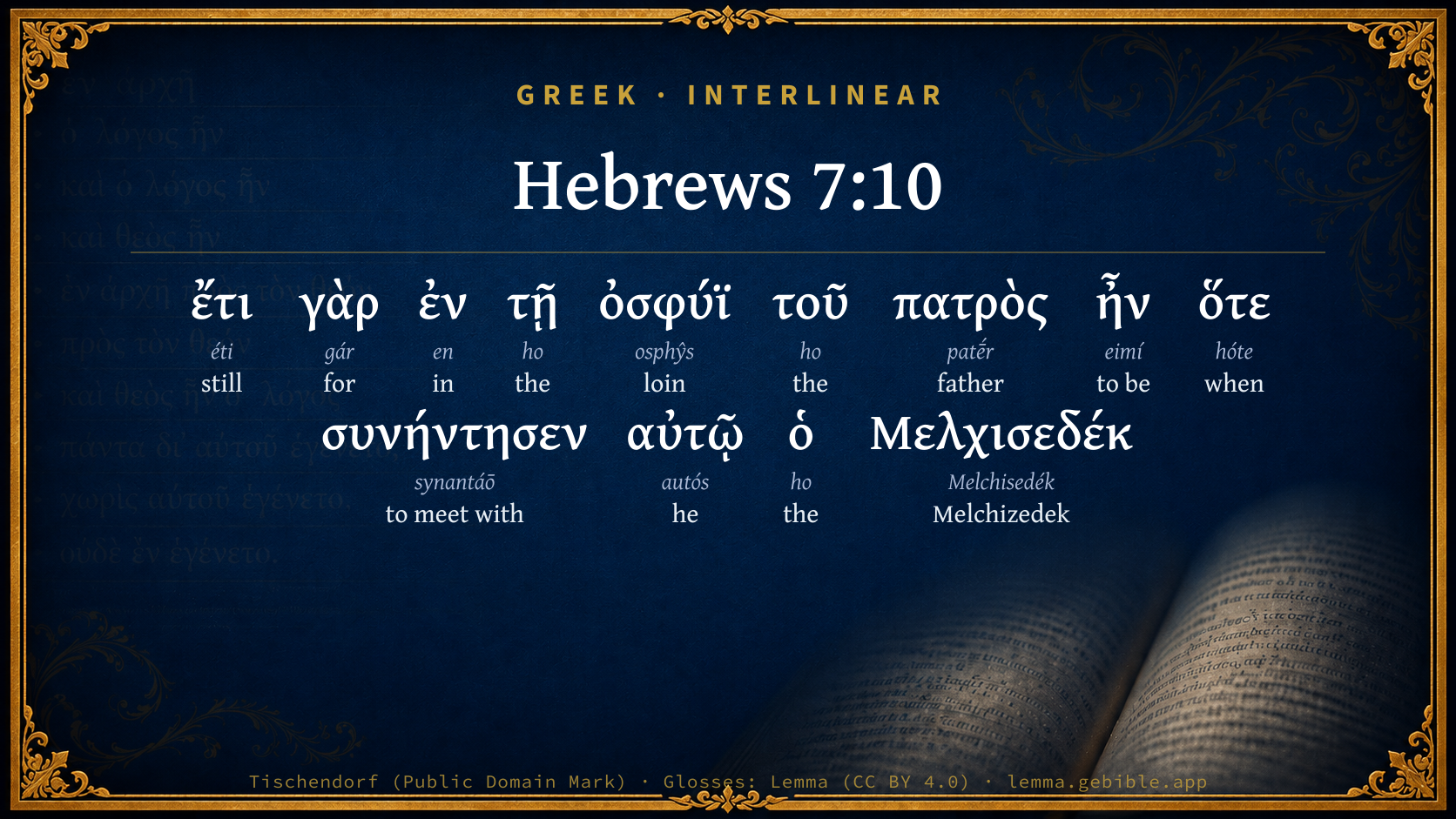
Greek (Tischendorf 8th ed.) Hebrews 7:10 appears in the Greek New Testament. The text above is from the Tischendorf 8th edition. Each word links to its Strong’s number and a concise gloss. Click any word for its full Thayer’s Greek Lexicon entry.
Download image
Cite this verse

Hebrews 7:10 (World English Bible). Public Domain. Lemma interlinear Bible study tool, https://lemma.gebible.app/v/hebrews/7/10.

Show BibTeX & RIS
BibTeX
RIS
English Translation
for he was yet in the loins of his father when Melchizedek met him.
World English Bible · Public Domain
Download a study sheet

One document with this verse’s original text, its word-by-word gloss line, the meaning frame, cross-references with their text, attributed commentary, and full source and license credits — printable, and it pastes into notes with its structure intact.

This verse Autodidact and up

Study sheet (.html) Plain text (.txt)

A passage Seminary Student

Up to 50 verses in one chapter. A passage sheet keeps up to 6 commentary sources and 12 cross-references per verse, in the order this page ranks them, and says so on the sheet whenever that leaves anything out. Ask for a single verse and you get the Autodidact verse sheet above.

Everything on this page stays free to read, with no account — the sheet is a download of what is already on screen, not access to it.

Want to remove ads? Support Godless Engineer
Compare translations 3

The same verse in 3 English versions, stacked beneath the original-language interlinear above. Click any original word for its lexicon entry.

Each is an independent rendering of the whole verse — the interlinear is not word-aligned to these translations.

Highlighted words mark where these versions differ — a whole-verse word diff, not a word-by-word alignment.

  • World English Bible Public Domain
    for he was yet in the loins of his father when Melchizedek met him.
  • King James Version Public Domain
    For he was yet in the loins of his father, when Melchisedec met him.
  • unfoldingWord Literal Text CC BY-SA 4.0
    because he was still in the loin of his father when Melchizedek met him.

unfoldingWord Literal Text — © unfoldingWord, licensed CC BY-SA 4.0. Word-aligned USFM3 via Door43 (git.door43.org/unfoldingWord/en_ult).

Versions to compare (up to 4)

3 of 4 selected

Show all 19 translations

Every available English version of this verse, each an independent rendering of the whole verse.

  • World English Bible Public Domain
    for he was yet in the loins of his father when Melchizedek met him.
  • Berean Standard Bible Public Domain
    For when Melchizedek met Abraham, Levi was still in the loin of his ancestor.
  • Majority Standard Bible Public Domain
    For when Melchizedek met Abraham, Levi was still in the loin of his ancestor.
  • King James Version Public Domain
    For he was yet in the loins of his father, when Melchisedec met him.
  • American Standard Version (1901) Public Domain
    for he was yet in the loins of his father, when Melchizedek met him.
  • Revised Version (1885) Public Domain
    for he was yet in the loins of his father, when Melchizedek met him.
  • Geneva Bible (1599) Public Domain
    For hee was yet in the loynes of his father Abraham, when Melchi-sedec met him.
  • Douay-Rheims (1899) Public Domain
    For he was yet in the loins of his father, when Melchisedech met him.
  • Young's Literal Translation Public Domain
    for he was yet in the loins of the father when Melchisedek met him.
  • Literal Standard Version CC BY-SA 4.0
    for he was yet in the loins of the father when Melchizedek met him.
  • Unlocked Literal Bible CC BY-SA 4.0
    because Levi was in the body of his ancestor when Melchizedek met Abraham.
  • unfoldingWord Literal Text CC BY-SA 4.0
    because he was still in the loin of his father when Melchizedek met him.
  • Darby Bible Public Domain
    For he was yet in the loins of his father when Melchisedec met him.
  • World Messianic Bible Public Domain
    for he was yet in the body of his father when Melchizedek met him.
  • Webster's Bible Public Domain
    For he was yet in the loins of his father, when Melchisedec met him.
  • Free Bible Version CC BY-SA 4.0
    for he was yet to be born from his father when Melchizedek met Abraham.
  • Bible in Basic English Public Domain
    Because he was still in his father's body when Melchizedek came to him.
  • Text-Critical English NT CC BY 4.0
    For Levi was still in the loins of his ancestor Abraham when Melchizedek met him.
  • Tyndale New Testament (1534) Public Domain
    For he was yet in the loynes of his father Abraham when Melchisech met him.

Literal Standard Version (2020), Covenant Press — licensed CC BY-SA 4.0. Text via the HelloAO Bible API (eBible.org). Unlocked Literal Bible (unfoldingWord) — licensed CC BY-SA 4.0. Text via the HelloAO Bible API (eBible.org). unfoldingWord Literal Text — © unfoldingWord, licensed CC BY-SA 4.0. Word-aligned USFM3 via Door43 (git.door43.org/unfoldingWord/en_ult). Free Bible Version, Dr. Jonathan Gallagher — licensed CC BY-SA 4.0. Text via the HelloAO Bible API (eBible.org).

Word by word

More ways to search: Search by grammar → Find every occurrence → Compare this word →

Practice this passage: Drill this verse → Learn its vocabulary →

About this verse

These counts appear in no published source. They are computed here, from the morphology-tagged text and Lemma’s own curated glosses. What Lemma adds →

13
words
11
distinct lemmas
General Epistles
section

Notable vocabulary

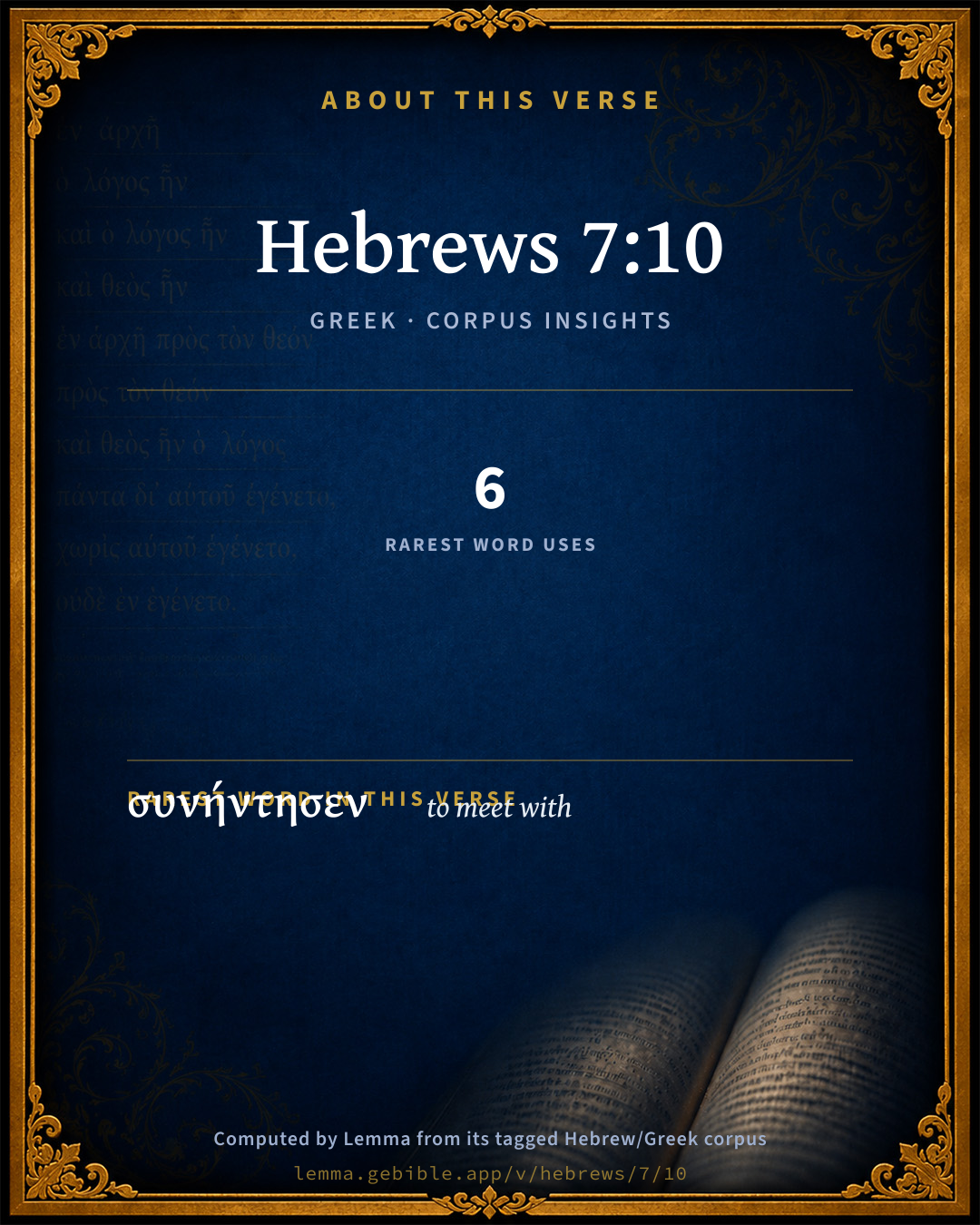
The rarest word here is συνήντησεν to meet with G4876 — appearing just 6 times in the whole Greek New Testament.

Shared distinctive vocabulary

συνήντησεν to meet with G4876 occurs in 6 verses of the Greek New Testament. Also found in:

Repetition

A word recurs within this verse:

Cross-references

3

Topical passages linked to Hebrews 7:10 in the Treasury of Scripture Knowledge — connected by theme and wording, ordered by reader-vote popularity; previews shown in the World English Bible.

  • Genesis 35:11 God said to him, "I am God Almighty. Be fruitful and multiply. A nation and a company of nations will be from you, and kings will come out of your loins.
  • Genesis 46:26 All the souls who came with Jacob into Egypt, who were his direct descendants, besides Jacob's sons' wives, all the souls were sixty-six.
  • Hebrews 7:5 They indeed of the sons of Levi who receive the priest's office have a commandment to take tithes of the people according to the law, that is, of their brothers, though these have come out of the loins of Abraham,

Cross-references courtesy of OpenBible.info (CC BY 4.0).

Commentary

Notes on Hebrews 7:10 from classic Christian and Jewish commentators (each source and its license shown beneath its notes). The classic Christian expositions comment on the surrounding passage and are grouped to its opening verse, so a note may address several verses; the Jewish commentaries on the Tanakh (Rashi and others) are per-verse, so they appear only where the commentator wrote on this verse.

Lemma curates 59 commentaries, every one of them public domain or Creative Commons licensed, each selected and text-cleaned for this edition rather than reprinted as found. About our sources →

Bengel's Gnomon

Johann Albrecht Bengel

Heb 7:10. Ἔτι, still) He says, still, not already now. The offspring, after withdrawing from the power of the parent, become their own guardian; but while they are under the power of the parent, nay, in his loins, they follow his condition. It may be said, Was not Christ Himself, according to the flesh, as well as Levi, in the loins of Abraham? Comp. Act 2:30. Ans. Christ is expressly set forth by the psalm as a priest after the order of Melchisedec, and that too in such a way that Melchisedec is made like to the Son of GOD, not the Son of GOD to Melchisedec: nor is Christ subjected to Abraham, but stands in opposition to the sons of Levi. And Abraham, when Melchisedec blessed him, Gen 14:19, already had the promises, Heb 7:6; namely, those in which were included both the blessing expressed more generally and the natural seed, and so also Levi, Gen 12:3; Gen 12:7; Gen 13:15-16: but those promises under which Christ was comprehended, followed Abraham’s meeting with Melchisedec, as well as the faith of Abraham, which was in the highest degree commended, Gen 15:1, etc., where we have the remarkable beginning, After these things.

Bengel's Gnomon of the New Testament — English translation (T&T Clark, Edinburgh, 1860) — public domain. Text from a community e-Sword module.

Meyer's Critical & Exegetical Commentary

Heinrich August Wilhelm Meyer

Heb_7:10. Proof for the assertion Heb_7:9. When Abraham gave the tenth to Melchisedec, he was as yet childless, and therefore at that time still bore his descendants as in germ in himself. When, accordingly, by the presentation of the tenth he acknowledged a superior rank of Melchisedec over himself, he rendered homage to the latter not only in his own person, but at the same time as the representative of his posterity, as yet incapable of independent action, because as yet unborn.

ἔτι ἐν τῇ ὀσφύϊ τοῦ πατρὸς εἶναι] to be as yet in the loins of the father, or to be yet unborn. The expression is explained by the analogous ἐξέρχεσθαι ἐκ τῆς ὀσφύος τινός, Heb_7:5 : by generation to proceed, from ones loins.

τοῦ πατρός] is not to be taken, with Bleek, as a universally recognised designation of Abraham (i.e. as father of the Jews and Christians). It stands in special relation to Levi; thus: his father, wherein, of course, seeing Abraham was the great-grandfather of Levi, πατήρ is to be understood in the wider sense, or as progenitor.

Meyer — Critical and Exegetical Commentary on the New Testament — English translation by Peter Christie, edited by Frederick Crombie (T&T Clark, 1880) — public domain. Text from a community e-Sword module.

Jamieson, Fausset & Brown

Robert Jamieson, A. R. Fausset & David Brown

in the loins of his father--that is, forefather Abraham. Christ did not, in this sense, pay tithes in Abraham, for He never was in the loins of an earthly father [ALFORD]. Though, in respect to His mother, He was "of the fruit of (David's, and so of) Abraham's loins," yet, being supernaturally, without human father, conceived, as He is above the natural law of birth, so is he above the law of tithes. Only those born in the natural way, and so in sin, being under the curse, needed to pay tithe to the priest, that he might make propitiation for their sin. Not so Christ, who derived only His flesh, not also the taint of the flesh, from Abraham. BENGEL remarks, The blessings which Abraham had before meeting Melchisedec were the general promises, and the special one of a natural seed, and so of Levi; but the promises under which Christ was comprehended, and the faith for which Abraham was so commended, followed after Abraham's meeting Melchisedec, and being blessed by him: to which fact. Gen 15:1, "After these things," calls our attention. This explains why Christ, the supernatural seed, is not included as paying tithes through Abraham to Melchisedec.

Jamieson, Fausset & Brown — Commentary Critical and Explanatory on the Whole Bible (1871) — public domain (CC PDM 1.0). Text via the HelloAO Bible API.

Adam Clarke's Commentary

Verse 10. For he was yet in the loins of his father] That is, Levi was seminally included in Abraham, his forefather.

Adam Clarke's Commentary on the Bible (1810–1826) — public domain. Text from a community e-Sword/MySword module.

John Gill's Exposition

If therefore perfection were by the Levitical priesthood,.... The priesthood which was established in the tribe of Levi; so called, to distinguish it from that which was before this institution, from the times of Adam, as well as from the priesthood of Melchizedek, and from the priesthood of Christ, and from that of his people under the Gospel, who are all priests; as well as to restrain it to the subject of the apostle's discourse: the design of which is to show, that there is no perfection by it; as is clear from the priests themselves, who were but men, mortal men, sinful men, and so imperfect, and consequently their priesthood; and from their offerings, between which, and sin, there is no proportion; and at best were but typical of the sacrifice of Christ; and could neither make the priests nor the worshippers perfect, neither in their own consciences, nor in the sight of God: moral actions are preferred before them, and yet by these there is no perfection, justification, and salvation; to which may be added, that the sacrifices the priests offered did not extend to all kind of sins, only to sins of ignorance, not to presumptuous ones; and there were many under that dispensation punished with death; and at most they only delivered from temporal, not eternal punishment, and only entitled to a temporal life, not an eternal one.

For under it the people received the law: not the moral law, which was given to Adam in innocence, and as it came by Moses, it was before the Levitical priesthood took place; but the ceremonial law, and which was carnal, mutable, and made nothing perfect: the Syriac version renders it, "by which a law was imposed upon the people"; to regard the office of priesthood, and the priests in it, and bring their sacrifices to them; and the Arabic version reads, "the law of a the priest's office"; which office was after the law of a carnal commandment, and so imperfect, as is manifest from what follows: for had perfection been by it,

what further need was there that another priest should arise after the order of Melchisedec, and not be called after the order of Aaron? that there was another priest promised and expected, and that he should arise after the order of Melchizedek, and who was to make his soul an offering for sin, is certain, Ezr 2:63 and such an one is risen, even Jesus of Nazareth; and yet there would have been no need of him, and especially that he should be of a different order from Aaron's, had there been perfection by the Levitical priesthood.

John Gill's Exposition of the Whole Bible (1746–1763) — public domain (CC PDM 1.0). Text via the HelloAO Bible API.

Trapp's Complete Commentary

John Trapp

10 For he was yet in the loins of his father, when Melchisedec met him.

Ver. 10. In the loins of his father] So we were all in the loins of Adam when he fell (as all the country is in a parliament man), and fell with him.

John Trapp, A Commentary or Exposition upon All the Books of the Old and New Testament (1647–1656) — public domain. Text from a community e-Sword module.

Albert Barnes' Notes on the Bible

For he was yet in the loins of his father - Abraham is here called the father of Levi, by a common use of the word, referring to a more remote ancestor than the literal father. The meaning of the apostle is, that he was even then, in a certain sense, in the loins of Abraham, when Melchizedek met him; or it was all the same as if he were there, and had then an existence. The relation which subsisted between him and Abraham, in the circumstances of the case, implied the same thing as if he had then been born, and had acted for himself by paying tithes. Instances of this occur constantly. A father sells a farm, to which his son would he heir, and it is the same as if the son had sold it. He has no more control over it than if he had been present and disposed of it himself. A father acknowledges fealty to a government for a certain title or property which is to descend to his heirs, and it is all one as if the heir had himself done it; and it is not improper to say that it is the same as if he had been there and acted for himself.

For some valuable remarks on the nature of the reasoning here employed, see Stuart on the Hebrews; Excursus xiv. The reasoning here is, indeed, especially such as would be suited to impress a Jewish mind, and perhaps more forcibly than it does ours. The Jews valued themselves on the dignity and honor of the Levitical priesthood, and it was important to show them on their own principles, and according to their own sacred writings, that the great ancestor of all the Levitical community had himself acknowledged his inferiority to one who was declared also in their own writings Psa 110:1-7 to be like the Messiah, or who was of the same “order.” At the same time, the reasoning concedes nothing false; and conveys no wrong impression. It is not mere fancy or accommodation, nor is it framed on allegory or cabalistic principles. It is founded in truth, and such as might be used anywhere, where regard was shown to pedigree, or respect was claimed on account of the illustrious deeds of an ancestor. It would be regarded as sound reasoning in a country like England, where titles and ranks are recognized, and where various orders of nobility exist. The fact that a remote ancestor had done homage or fealty to the ancestor of another class of titled birth, would be regarded as proof of acknowledged inferiority in the family, and might be used with force and propriety in an argument. Paul has done no more than this.

(Several excellent and evangelical commentators explain the passage on the principle of representations, the admission of which relieves it from many difficulties. If we allow that Abraham was the representative of his seed, and of the sons of Levi among the number, then they unquestionably may be said to have paid tithes in him, in a most obvious and intelligible sense. That Abraham is to be here regarded, as not only the natural but covenant head of Israel, is argued from what is said in Psa 110:6, of his having “had the promises,” which promises manifestly did not belong to him alone, but to him and to his seed, Gen 17:4-9. The land of Canaan never was actually given to Abraham. He obtained the promise or grant of it, as the representative of his posterity, who came to its enjoyment when four hundred years had expired. By those who adopt this view, the passage is supposed to contain an illustration of the manner in which Adam and Christ represent those who respectively belong to them.

And here let it be noticed, that the objection against Abraham’s representative character, grounded by our author on the fact, “that there had been no appointment of Abraham to act in that capacity by Levi,” might with equal force be urged against the representation of Adam and Christ, which the reader will find established in the supplementary notes on Rom. 5. As to the force of the argument, on this principle, there can be no doubt. If the representative, the covenant, as well as the natural head, of the sons of Levi, paid tithes and acknowledged inferiority to Melchizedek, their inferiority follows as a matter of course. They are supposed to be comprehended in their head. “This,” says Mr. Scott, “incontestibly proved the inferiority of the Levitical priesthood to that of the Messiah, nay, its absolute dependence on him, and subserviency to him;” and, we may add, is sound reasoning alike in every country, in Palestine and in ours, in England or America. On the whole we cannot but think that whatever difficulties some may have in admitting the principle of representation here, far greater difficulties lie on the other side.

Even Prof. Stuart, in his celebrated 14th Excursus, (which for ingenuity deserves, perhaps, all the praise awarded by Bloomfield, Barnes, and others,) resolves the apostle’s reasoning into a mere “argumentum a.d. hominem,” although, in the passage, there is no evidence of any such thing. He has indeed instanced two cases of “argumentum a.d. hominem,” or rather two passages, in both of which the same example occurs Mat 12:27; Luk 11:19. But if the reader consult these passages, he will find that mistake is impossible. The plainest indication is given, that the argument proceeds on the principle of all adversary. It would require no small ingenuity, however, to press this passage into the same rank with those now quoted. It clearly belongs to a different class, and the apostle proceeds with his argument, without the slightest indication that it was grounded rather on what was admitted, than on what was strictly true.)

Albert Barnes' Notes on the Bible (1834–1885) — public domain. Text from a community e-Sword/MySword module.

Matthew Poole's English Annotations

For, introduceth the proof, that Levi tithed in Abraham, being virtually in him, as his productive cause; so near is the unity and identity of descending children; and as truly were the posterity of Adam in him when he ate, sinned, and fell, Rom 5:12. To remove all question of the truth of it, the time is annexed to it, when Melchisedec met Abraham, and blessed him, then did Levi pay tenths in him; so as Melchisedec was greater than the Levitical priest: Christ, typified by him, being greater than himself, must be greater than them also.

Matthew Poole's English Annotations on the Holy Bible (1683–1685) — public domain. Text from a community e-Sword/MySword module.

The People's New Testament

B. W. Johnson

10. He was yet. All Israel, kings and priests, though yet unborn, were represented in Abraham. Hence Levi paid tithes, and thus confessed the superiority of the priesthood of Melchizedek.

B. W. Johnson's The People's New Testament with Notes (1889–1891) — public domain. Electronic text from the Christian Classics Ethereal Library (CCEL) ThML edition.

Alford’s Greek Testament

Henry Alford

10.] for he was yet in the loins of his father (i. e. his forefather, Abraham: for Isaac was not yet born, much less Jacob. But we need not hence understand τοῦ πατρός to mean “the patriarch,” as, strange to say, Bleek does. On the expression cf. ver. 5) when Melchisedek met him (on the questions, for the most part unprofitable (cf. ὡς ἔπος εἰπεῖν), which have been raised on this proof, see Bleek, Ebrard, and Owen. It may fairly be replied to one of them, whether Christ also did not pay tithe in Abraham, that He never was in the loins of an earthly father).

Henry Alford, The Greek Testament (1849–1861) — public domain. Text from a community e-Sword module.

Vincent's Word Studies in the New Testament

Marvin R. Vincent

In the loins of his father [εν τη οσφυι του πατρος] . His own father; not of Abraham.

When Melchisedec met him. In the person of Abraham. The whole Jewish law, its ordinances and priesthood, are regarded as potentially in Abraham. When Abraham paid tithes, Levi paid tithes. When Abraham was blessed, Israel was blessed. It is a kind of reasoning which would appeal to Hebrews, who so strongly emphasized the solidarity of their race. Comp. Rom 9:4, 5.

Marvin R. Vincent, Word Studies in the New Testament (1887–1900) — public domain. Text from a community e-Sword/MySword module.

Westcott on Hebrews & the Epistles of John

Brooke Foss Westcott

10. ἔτι yap ἐν τῇ ὀσφύϊ...1] Oomp. Ὁ. 5 ἐξελ. ἐκ τῆς dog. The repetition of the phrase, which occurs again in the N.T. only in Acta ii. 30, empha-

VIL 10]

sises the idea of the real unity of Abraham's race in the conditions of their earthly existence. By this teaching a mystery is indicated to us into which we can see but a little way, a final antithesis in our being; we feol at every turn that we are dependent on the past, and that tho fature will depend in a large degree upon ourselves. This is one aspect of life, and it is not overlooked in Scripture. At the same time it does not give a complete view of our position. On tho one side our outward life is conditioned by our ancestry: on the other side we stand in virtue of our ‘ spirit’ in immediate, personal connexion with God (c. xii. 9). Each man is at once an individual of ἃ race and a new power in the evolution of the race. He is born (Traducianism), and also he is created (Creationism). Comp. Martensen Dogm. § 74. Additional Note on iv. 12.

τοῦ πατρόςἾ The context in the absence of farther definition, requires the sense ‘his father’ (not ‘our fathor’). Abraham, who was the father of all Israel (Luke i. 73; John viii. 53, 56; Acts vil. 2; James ii. 21; Rom. iv. 1, 12, ὁ πατὴρ ἡμῶν), can be spoken of also as the father of Levi in particular, through Isaac and Jacob.

(c) The Levitical priesthood and the priesthood of Christ (11—25).

Having interpreted the type of an absolute priesthood, independent of doscent and uninterrupted by death (v. 3) offored in the record of Melchizedok, and having pointod out the thoughts to which that history might guide a student of the O.T., in respect of the later priesthood of the Law, the writer goes on to consider in detail tho charactcristics of tho Lovitical priesthood and of the Law which it essentially represented in relation to the Priesthood of Ohrist. The Levitical priesthood (generally) was incapable of offecting that at which a priesthood aims, the ‘ perfecting’ of the worshipper; an ond which tho

there ariseth another priest, “who hath been made not after the law of a carnal commandment but after the power of an indissoluble life; ſor ἐξ ts witnessed af Him, Thou art a priest for ever, After the order of Meichizedek. : For therete a disannulling of a Soregoing commandmeni, because of tls weakness and unprofttableness— "9 for the Law made nothing perfect— and a bringing in thereupon of a better hope, through which we draw nigh to God. © And inasmuch ae He hath not received His office without the taking of an oath—*" for while they (the Lovitical pricats) have been made pricsts without any taking of an oath, He was made with taking of an oath, through Him that saith to Him, The Lord sware and will not repent Himeet/, Thou art a priest for ever— "by 420 much also hath Jesus become surety of a better covenant. ™ And while they have been made priests many tn number, because they are hindered by death from abiding with men, “He, because He abideth for ever, hath His priesthood inviolable. . ΒΦ Whence also He is able to save to the uttermost them that come unto God through Him, secing He ever liveth to make intercession for them. 11—14. The Levitical priesthood and the Law, which it represented, were aliko transitional and transitory. It is assumed that the object of the Law was to bring or to prepare for bringing the people to ‘perfection’: divine legislation can have no other end. The priesthood, on which the Law rested, embodied its ruling idea. And conversely in the Law as a com. plete system we can see the aim of the priesthood. The priesthood

thorofure was dosigned to assist in bringing about this ‘ perfection.’

If then there had been a bringing to perfection through the Levitical pricethood—if in other words there had been a bringing to perfection through the Law—there would have been no nood of anothor priesthood, If on the other hand the whole Law failed to accomplish that to which it pointed, theu so far also the prieethood failed. Such a failure, not a failure but the fulfilment of the divine purpose, was indicated by the promise of another priesthood in a new line.

Brooke Foss Westcott (1825–1901), The Epistle to the Hebrews (1889) and The Epistles of St John (1883) — public domain (pre-1929). Text recovered from Internet Archive / Google Books OCR scans. Westcott’s Gospel of John commentary is not included (its OCR lost the chapter running-heads required for reliable verse-keying). Some Greek quoted in the Hebrews volume is imperfectly rendered by the OCR.

Lesson kit

Teaching starters — assembled from the data on this page, not authored interpretation. Every prompt links to the verse data it draws on. Edit before teaching.

Hebrews, in the General Epistles, opens this verse with 13 words (11 distinct Greek lemmas). Its most distinctive word is synantáō (“to meet with”). A historical commentator’s framing appears above. Read the whole chapter for the surrounding context.

Discussion questions

  1. What does “to meet with” (synantáō) contribute to the verse as a whole?
  2. Luke 9:37 shares the word «to meet with» with this verse. How do the two illuminate each other?
  3. “the” occurs 3× in this one verse. What is the effect of the repetition?
  4. The translations on this page render this verse differently — a whole-verse word diff, not a word-by-word alignment. What might account for the different wordings?
  5. Reading how Bengel's Gnomon and Meyer's Critical & Exegetical Commentary read this verse, where do the two commentators agree and where do they part?

Things to notice

Reading settings

Reading text

Shown beneath each verse's original-language words.

Old Testament
Old Testament edition

Read the OT as the Masoretic Hebrew (MT) or the Greek Septuagint (LXX).

English shown for the Greek Septuagint (in the Hebrew ↔ Greek comparison).

Comparing translations? Open the Compare panel on any verse page to stack up to four side by side.