

Hebrews 10:39
Greek (Tischendorf 8th ed.) Hebrews 10:39 appears in the Greek New Testament. The text above is from the Tischendorf 8th edition. Each word links to its Strong’s number and a concise gloss. Click any word for its full Thayer’s Greek Lexicon entry.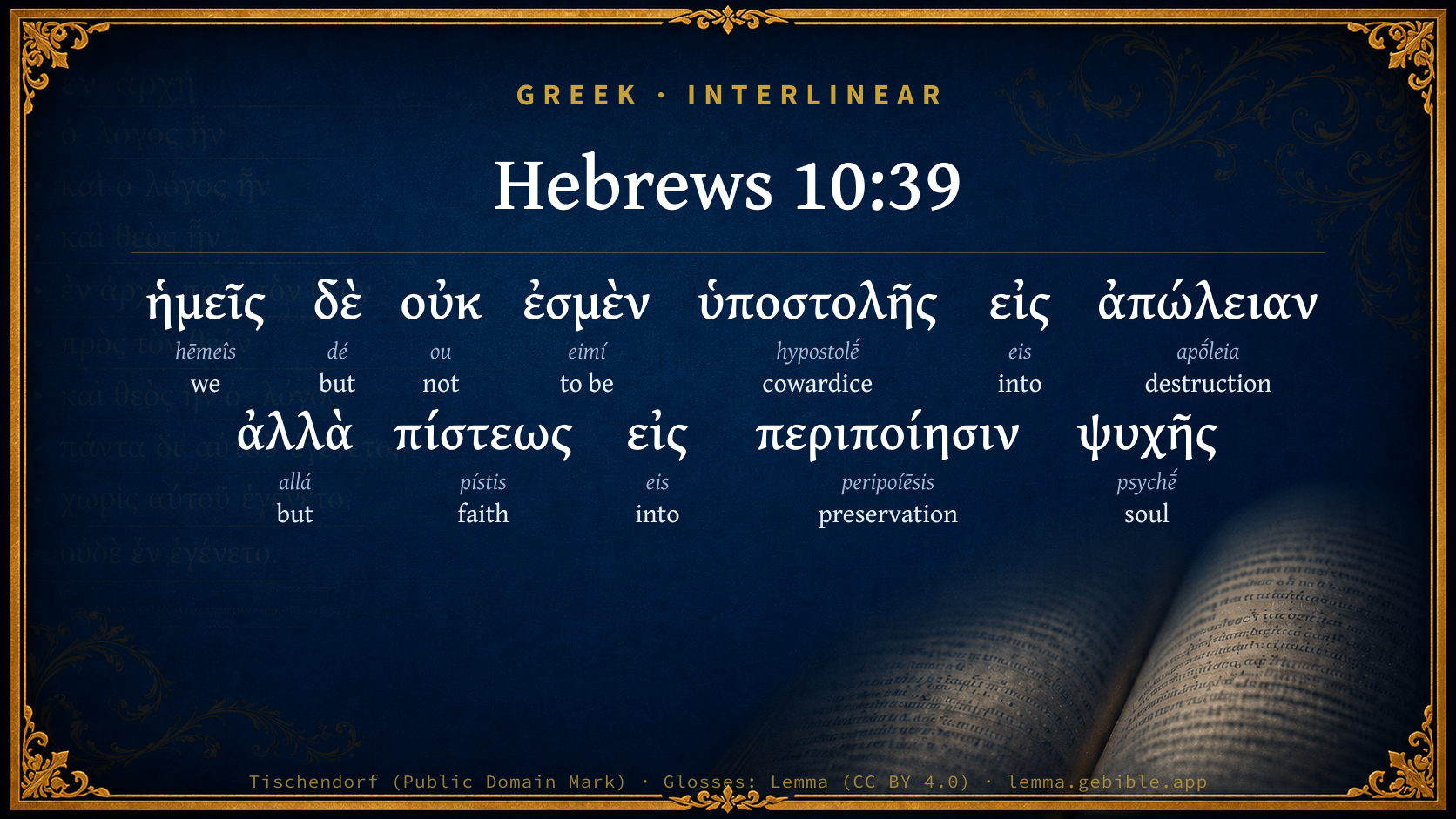
But we are not of those who shrink back to destruction, but of those who have faith to the saving of the soul.
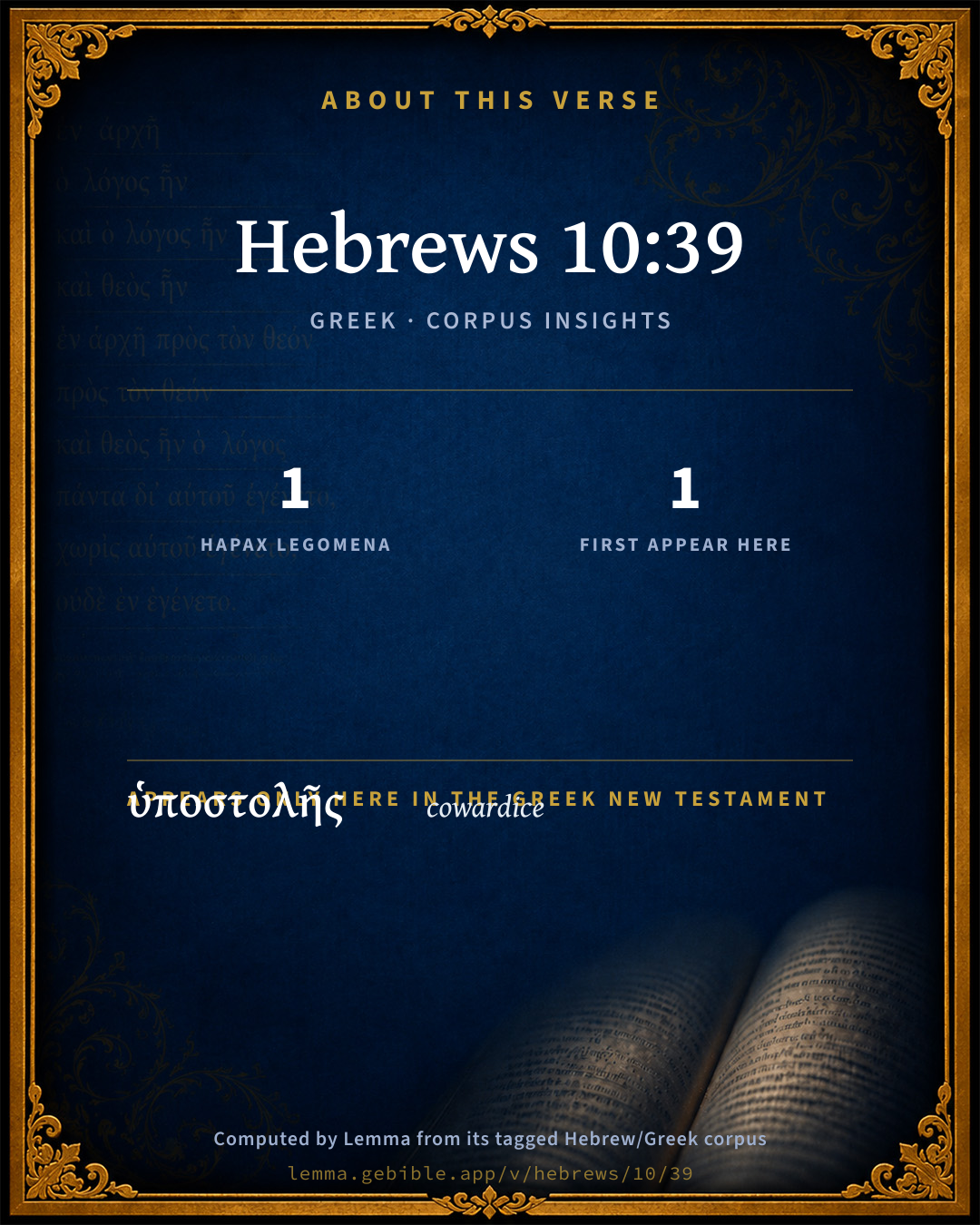
- 1 hapax legomenon — only here in the Greek New Testament
- 1 first appearance in the Greek New Testament
Download a study sheet
One document with this verse’s original text, its word-by-word gloss line, the meaning frame, cross-references with their text, attributed commentary, and full source and license credits — printable, and it pastes into notes with its structure intact.
This verse Autodidact and up
A passage Seminary Student
Up to 50 verses in one chapter. A passage sheet keeps up to 6 commentary sources and 12 cross-references per verse, in the order this page ranks them, and says so on the sheet whenever that leaves anything out. Ask for a single verse and you get the Autodidact verse sheet above.
Everything on this page stays free to read, with no account — the sheet is a download of what is already on screen, not access to it.
Compare translations 3
The same verse in 3 English versions, stacked beneath the original-language interlinear above. Click any original word for its lexicon entry.
Each is an independent rendering of the whole verse — the interlinear is not word-aligned to these translations.
Highlighted words mark where these versions differ — a whole-verse word diff, not a word-by-word alignment.
-
World English Bible Public Domain
But we are not of those who shrink back to destruction, but of those who have faith to the saving of the soul.
-
King James Version Public Domain
But we are not of them who draw back unto perdition; but of them that believe to the saving of the soul.
-
unfoldingWord Literal Text CC BY-SA 4.0
But we ourselves are not of shrinking back to destruction, but of faith to the preservation of the soul.
unfoldingWord Literal Text — © unfoldingWord, licensed CC BY-SA 4.0. Word-aligned USFM3 via Door43 (git.door43.org/unfoldingWord/en_ult).
Show all 19 translations
Every available English version of this verse, each an independent rendering of the whole verse.
-
World English Bible Public Domain
But we are not of those who shrink back to destruction, but of those who have faith to the saving of the soul.
-
Berean Standard Bible Public Domain
But we are not of those who shrink back and are destroyed, but of those who have faith and preserve their souls.
-
Majority Standard Bible Public Domain
But we are not of those who shrink back and are destroyed, but of those who have faith and preserve their souls.
-
King James Version Public Domain
But we are not of them who draw back unto perdition; but of them that believe to the saving of the soul.
-
American Standard Version (1901) Public Domain
But we are not of them that shrink back unto perdition; but of them that have faith unto the saving of the soul.
-
Revised Version (1885) Public Domain
But we are not of them that shrink back unto perdition; but of them that have faith unto the saving of the soul.
-
Geneva Bible (1599) Public Domain
But we are not they which withdrawe our selues vnto perdition, but follow faith vnto the conseruation of the soule.
-
Douay-Rheims (1899) Public Domain
But we are not the children of withdrawing unto perdition, but of faith to the saving of the soul.
-
Young's Literal Translation Public Domain
and we are not of those drawing back to destruction, but of those believing to a preserving of soul.
-
Literal Standard Version CC BY-SA 4.0
But we are not of those drawing back to destruction, but of those believing to a preserving of soul.
-
Unlocked Literal Bible CC BY-SA 4.0
But we are not any of those who turn back to destruction. Instead, we are some of those who have faith for keeping our soul.
-
unfoldingWord Literal Text CC BY-SA 4.0
But we ourselves are not of shrinking back to destruction, but of faith to the preservation of the soul.
-
Darby Bible Public Domain
But *we* are not drawers back to perdition, but of faith to saving [the] soul.
-
World Messianic Bible Public Domain
But we are not of those who shrink back to destruction, but of those who have faith to the saving of the soul.
-
Webster's Bible Public Domain
But we are not of them who draw back to perdition; but of them that believe to the saving of the soul.
-
Free Bible Version CC BY-SA 4.0
But we're not the kind of people who draw back and end up being lost. We are those who trust in God to save us.
-
Bible in Basic English Public Domain
But we are not of those who go back to destruction; but of those who have faith even to the salvation of the soul.
-
Text-Critical English NT CC BY 4.0
But we are not among those who shrink back and are destroyed, but among those who have faith and preserve their souls.
-
Tyndale New Testament (1534) Public Domain
We are not whiche withdrawe oure selves vnto dampnacion but partayne to fayth to the wynnynge of the soule.
Literal Standard Version (2020), Covenant Press — licensed CC BY-SA 4.0. Text via the HelloAO Bible API (eBible.org). Unlocked Literal Bible (unfoldingWord) — licensed CC BY-SA 4.0. Text via the HelloAO Bible API (eBible.org). unfoldingWord Literal Text — © unfoldingWord, licensed CC BY-SA 4.0. Word-aligned USFM3 via Door43 (git.door43.org/unfoldingWord/en_ult). Free Bible Version, Dr. Jonathan Gallagher — licensed CC BY-SA 4.0. Text via the HelloAO Bible API (eBible.org).
Word by word
More ways to search: Search by grammar → Find every occurrence → Compare this word →
Practice this passage: Drill this verse → Learn its vocabulary →
- Appears 1× in the Greek New Testament
- First appears here
- Part of Speech
- Noun
- Case
- Genitive
- Number
- Singular
- Gender
- Feminine
Full Thayer's Definition
- ἡμεῖς hēmeîs G2249 “we” Personal pronoun, 1st person, Nominative, Plural
- δὲ dé G1161 “but” Conjunction
- οὐκ ou G3756 “not” Particle, Negative
- ἐσμὲν eimí G1510 “to be” Verb, Present, Active, Indicative, 1st person, Plural
- ὑποστολῆς hypostolḗ G5289 “cowardice” Noun, Genitive, Singular, Feminine
- εἰς eis G1519 “into” Preposition
- ἀπώλειαν apṓleia G684 “destruction” Noun, Accusative, Singular, Feminine
- ἀλλὰ allá G235 “but” Conjunction
- πίστεως pístis G4102 “faith” Noun, Genitive, Singular, Feminine
- εἰς eis G1519 “into” Preposition
- περιποίησιν peripoíēsis G4047 “preservation” Noun, Accusative, Singular, Feminine
- ψυχῆς psychḗ G5590 “soul” Noun, Genitive, Singular, Feminine
About this verse
These counts appear in no published source. They are computed here, from the morphology-tagged text and Lemma’s own curated glosses. What Lemma adds →
- 12
- words
- 11
- distinct lemmas
- General Epistles
- section
Notable vocabulary
1 hapax legomenon — a word that appears only here in the entire Greek New Testament:
- ὑποστολῆς cowardice G5289
First appearance in Scripture
This word makes its first canonical appearance in the Greek New Testament here:
- ὑποστολῆς cowardice G5289
Shared distinctive vocabulary
περιποίησιν preservation G4047 occurs in 5 verses of the Greek New Testament. Also found in:
Repetition
A word recurs within this verse:
- εἰς into G1519 ×2
Cross-references
27Topical passages linked to Hebrews 10:39 in the Treasury of Scripture Knowledge — connected by theme and wording, ordered by reader-vote popularity; previews shown in the World English Bible.
- 1 John 5:5 Who is he who overcomes the world, but he who believes that Jesus is the Son of God?
- 1 Peter 1:5 who by the power of God are guarded through faith for a salvation ready to be revealed in the last time.
- Mark 16:16 He who believes and is baptized will be saved; but he who disbelieves will be condemned.
- 2 Thessalonians 2:12–14 that they all might be judged who didn't believe the truth, but had pleasure in unrighteousness.
- 1 Samuel 15:11 It repents me that I have set up Saul to be king; for he is turned back from following me, and has not performed my commandments. Samuel was angry; and he cried to Yahweh all night.
- 2 Peter 3:7 But the heavens that now are, and the earth, by the same word have been stored up for fire, being reserved against the day of judgment and destruction of ungodly men.
- 1 John 5:16 If anyone sees his brother sinning a sin not leading to death, he shall ask, and God will give him life for those who sin not leading to death. There is a sin leading to death. I don't say that he should make a request concerning this.
- Psalms 44:18 Our heart has not turned back, Neither have our steps strayed from your path,
- Luke 11:26 Then he goes, and takes seven other spirits more evil than himself, and they enter in and dwell there. The last state of that man becomes worse than the first."
- John 6:40 This is the will of the one who sent me, that everyone who sees the Son, and believes in him, should have eternal life; and I will raise him up at the last day."
- John 20:31 but these are written, that you may believe that Jesus is the Christ, the Son of God, and that believing you may have life in his name.
- 1 Thessalonians 5:9 For God didn't appoint us to wrath, but to the obtaining of salvation through our Lord Jesus Christ,
- Hebrews 11:1 Now faith is assurance of things hoped for, proof of things not seen.
- Proverbs 1:32 For the backsliding of the simple will kill them. The careless ease of fools will destroy them.
- Proverbs 14:14 The unfaithful will be repaid for his own ways; Likewise a good man will be rewarded for his ways.
- John 3:15–16 that whoever believes in him should not perish, but have eternal life.
- John 17:12 While I was with them in the world, I kept them in your name. Those whom you have given me I have kept. None of them is lost, except the son of destruction, that the Scripture might be fulfilled.
- Acts 16:30–31 and brought them out and said, "Sirs, what must I do to be saved?"
- Romans 10:9–10 that if you will confess with your mouth the Lord Jesus, and believe in your heart that God raised him from the dead, you will be saved.
- 2 Thessalonians 2:3 Let no one deceive you in any way. For it will not be, unless the departure comes first, and the man of sin is revealed, the son of destruction,
- Hebrews 6:6–9 and then fell away, it is impossible to renew them again to repentance; seeing they crucify the Son of God for themselves again, and put him to open shame.
- John 5:24 "Most assuredly I tell you, he who hears my word, and believes him who sent me, has eternal life, and doesn't come into judgment, but has passed out of death into life.
- 1 Timothy 6:9 But those who are determined to be rich fall into a temptation and a snare and many foolish and harmful lusts, such as drown men in ruin and destruction.
- Hebrews 10:26 For if we sin willfully after we have received the knowledge of the truth, there remains no more a sacrifice for sins,
- Jude 1:12–13 These are hidden rocky reefs in your love feasts when they feast with you, shepherds who without fear feed themselves; clouds without water, carried along by winds; autumn leaves without fruit, twice dead, plucked up by the roots;
- Revelation 17:11 The beast that was, and is not, is himself also an eighth, and is of the seven; and he goes to destruction.
- Revelation 17:8 The beast that you saw was, and is not; and is about to come up out of the abyss and to go into destruction. Those who dwell on the earth and whose names have not been written in the book of life from the foundation of the world will marvel when they see that the beast was, and is not, and shall be present.
Cross-references courtesy of OpenBible.info (CC BY 4.0).
Lesson kit
Teaching starters — assembled from the data on this page, not authored interpretation. Every prompt links to the verse data it draws on. Edit before teaching.
Hebrews, in the General Epistles, opens this verse with 12 words (11 distinct Greek lemmas). Its most distinctive word is hypostolḗ (“cowardice”). A historical commentator’s framing appears above. Read the whole chapter for the surrounding context.
Discussion questions
- How does “cowardice” (hypostolḗ) shape what this verse is saying?
- 1 word here appears nowhere else in the Greek New Testament. Why might the author reach for such rare wording?
- This is the first place “cowardice” appears in Scripture (first appears here). What does its debut here establish?
- How does Ephesians 1:14, which shares the word «preservation», read alongside this verse?
- What does the repetition of “into” (2× in this one verse) do in this verse?
- These translations render this verse differently; the difference is in the English rendering, not the original. What questions does that raise?
- Compare how The Biblical Illustrator and Tyndale Open Study Notes read this verse. Where do they agree or differ?
Things to notice
- 1 word in this verse appears nowhere else in the Greek New Testament.
- 1 word makes its first canonical appearance in Scripture here.
- These translations choose different wording for 12 words in this verse.
- “into” occurs 2× in this single verse.
- 11 distinct Greek lemmas span 12 words in this verse.
Commentary
Notes on Hebrews 10:39 from classic Christian and Jewish commentators (each source and its license shown beneath its notes). The classic Christian expositions comment on the surrounding passage and are grouped to its opening verse, so a note may address several verses; the Jewish commentaries on the Tanakh (Rashi and others) are per-verse, so they appear only where the commentator wrote on this verse.
Lemma curates 59 commentaries, every one of them public domain or Creative Commons licensed, each selected and text-cleaned for this edition rather than reprinted as found. About our sources →
The Biblical Illustrator
Joseph S. Exell
The Biblical Illustrator, edited by Joseph S. Exell (c. 1880s–1900s) — public domain. Text from a community e-Sword module.
Tyndale Open Study Notes
Tyndale Open Resources
Tyndale Open Study Notes — © Tyndale Open Resources, licensed CC BY-SA 4.0. Text via the HelloAO Bible API.
Bengel's Gnomon
Johann Albrecht Bengel
Bengel's Gnomon of the New Testament — English translation (T&T Clark, Edinburgh, 1860) — public domain. Text from a community e-Sword module.
Meyer's Critical & Exegetical Commentary
Heinrich August Wilhelm Meyer
Meyer — Critical and Exegetical Commentary on the New Testament — English translation by Peter Christie, edited by Frederick Crombie (T&T Clark, 1880) — public domain. Text from a community e-Sword module.
Jamieson, Fausset & Brown
Robert Jamieson, A. R. Fausset & David Brown
Jamieson, Fausset & Brown — Commentary Critical and Explanatory on the Whole Bible (1871) — public domain (CC PDM 1.0). Text via the HelloAO Bible API.
Adam Clarke's Commentary
Adam Clarke's Commentary on the Bible (1810–1826) — public domain. Text from a community e-Sword/MySword module.
John Calvin's Commentaries
John Calvin's Commentaries (1540-1563) — public domain. Text from the Calvin Translation Society English edition (1840s-50s) via the Christian Classics Ethereal Library (ccel.org). Calvin's coverage is partial (roughly two-thirds of the Bible); uncommented books and verses are honest gaps, never fabricated. The 19th-century editor's footnotes and remarks are omitted so the notes are faithfully Calvin's own voice.
Ellicott's Commentary for English Readers
A Bible Commentary for English Readers, edited by Charles John Ellicott (1878–1897) — public domain. Text from a community e-Sword module.
The Cambridge Bible for Schools and Colleges
gen. ed. J. J. S. Perowne
The Cambridge Bible for Schools and Colleges (gen. ed. J. J. S. Perowne; Cambridge University Press, 1878–1918) — public domain. Text from a community e-Sword module.
Trapp's Complete Commentary
John Trapp
John Trapp, A Commentary or Exposition upon All the Books of the Old and New Testament (1647–1656) — public domain. Text from a community e-Sword module.
Albert Barnes' Notes on the Bible
Albert Barnes' Notes on the Bible (1834–1885) — public domain. Text from a community e-Sword/MySword module.
Haydock's Catholic Bible Commentary
George Leo Haydock (1774–1849), Haydock's Catholic Family Bible and Commentary, 1859 edition — public domain. Excludes Psalms (Douay-Rheims chapter numbering differs from Protestant) and Deuterocanonical books (Catholic canon only).
Matthew Poole's English Annotations
Matthew Poole's English Annotations on the Holy Bible (1683–1685) — public domain. Text from a community e-Sword/MySword module.
Whedon's Commentary on the Bible
Daniel D. Whedon
Daniel D. Whedon (gen. ed.), Commentary on the Old and New Testaments (1874–1909) — public domain. Text from a community e-Sword module.
The Pulpit Commentary
The Pulpit Commentary (1880–1919), ed. H.D.M. Spence-Jones & Joseph S. Exell — public domain. Text from a community e-Sword module.
John Wesley's Explanatory Notes
John Wesley, Explanatory Notes Upon the Whole Bible (1754–1765) — public domain. Text via the GEBible commentary corpus.
Burkitt's Expository Notes on the New Testament
William Burkitt
William Burkitt's Expository Notes on the New Testament (1700–1703) — public domain. Text from a community e-Sword module.
The People's New Testament
B. W. Johnson
B. W. Johnson's The People's New Testament with Notes (1889–1891) — public domain. Electronic text from the Christian Classics Ethereal Library (CCEL) ThML edition.
Cambridge Greek Testament for Schools and Colleges
Cambridge Greek Testament for Schools and Colleges (Cambridge University Press, 1896; 21 vols, various authors incl. Carr, Maclear, Plummer, Farrar, Lumby, Moule, M. R. James, Simcox) — public domain. Text from a community e-Sword module.
Alford’s Greek Testament
Henry Alford
Henry Alford, The Greek Testament (1849–1861) — public domain. Text from a community e-Sword module.
Vincent's Word Studies in the New Testament
Marvin R. Vincent
Marvin R. Vincent, Word Studies in the New Testament (1887–1900) — public domain. Text from a community e-Sword/MySword module.
Westcott on Hebrews & the Epistles of John
Brooke Foss Westcott
Brooke Foss Westcott (1825–1901), The Epistle to the Hebrews (1889) and The Epistles of St John (1883) — public domain (pre-1929). Text recovered from Internet Archive / Google Books OCR scans. Westcott’s Gospel of John commentary is not included (its OCR lost the chapter running-heads required for reliable verse-keying). Some Greek quoted in the Hebrews volume is imperfectly rendered by the OCR.