Hebrews 2:6

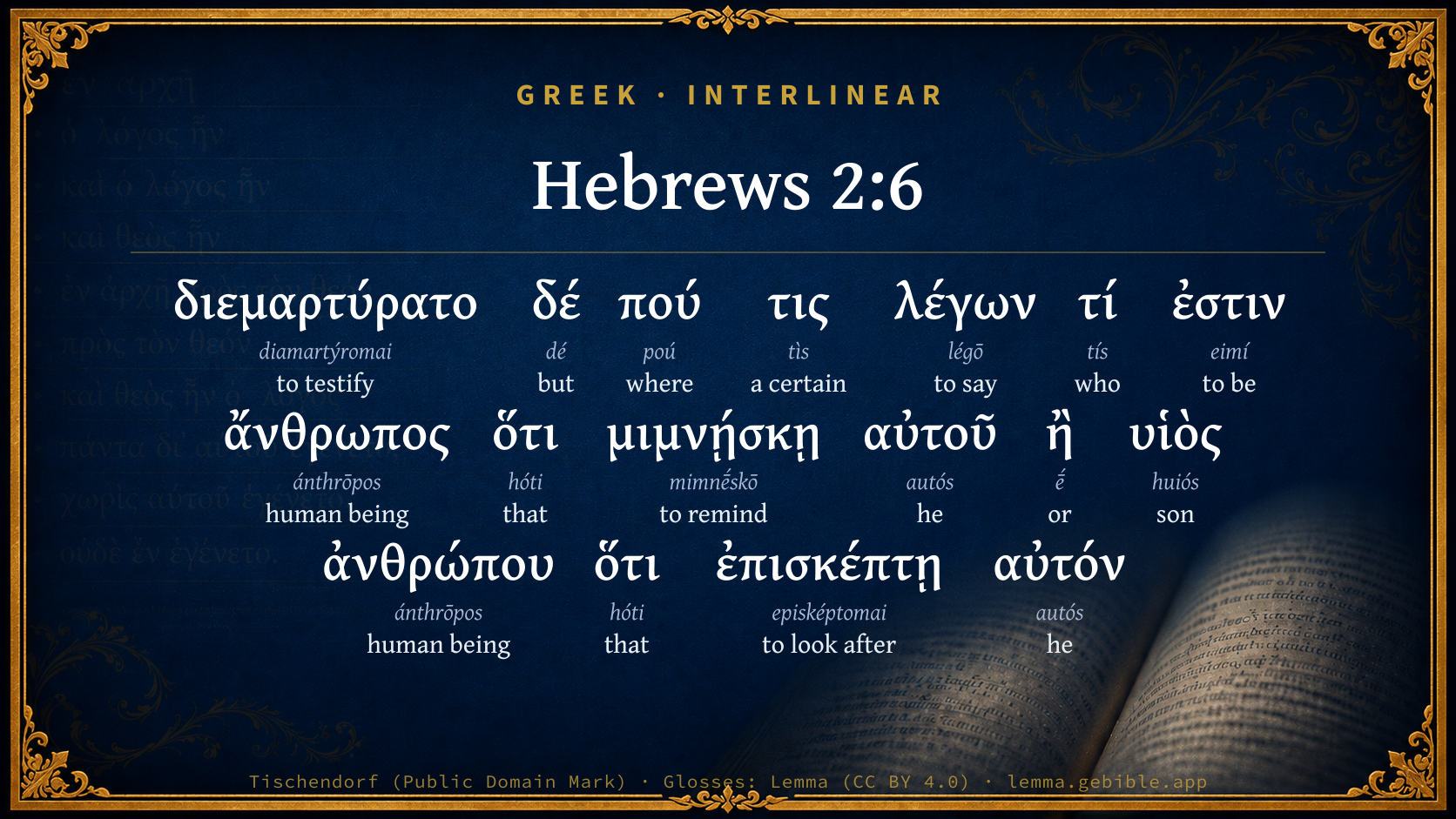
Greek (Tischendorf 8th ed.) Hebrews 2:6 appears in the Greek New Testament. The text above is from the Tischendorf 8th edition. Each word links to its Strong’s number and a concise gloss. Click any word for its full Thayer’s Greek Lexicon entry.
Download image
Cite this verse

Hebrews 2:6 (World English Bible). Public Domain. Lemma interlinear Bible study tool, https://lemma.gebible.app/v/hebrews/2/6.

Show BibTeX & RIS
BibTeX
RIS
English Translation
But one has somewhere testified, saying, "What is man, that you think of him? Or the son of man, that you care for him?
World English Bible · Public Domain
Download a study sheet

One document with this verse’s original text, its word-by-word gloss line, the meaning frame, cross-references with their text, attributed commentary, and full source and license credits — printable, and it pastes into notes with its structure intact.

This verse Autodidact and up

Study sheet (.html) Plain text (.txt)

A passage Seminary Student

Up to 50 verses in one chapter. A passage sheet keeps up to 6 commentary sources and 12 cross-references per verse, in the order this page ranks them, and says so on the sheet whenever that leaves anything out. Ask for a single verse and you get the Autodidact verse sheet above.

Everything on this page stays free to read, with no account — the sheet is a download of what is already on screen, not access to it.

Want to remove ads? Support Godless Engineer
Compare translations 3

The same verse in 3 English versions, stacked beneath the original-language interlinear above. Click any original word for its lexicon entry.

Each is an independent rendering of the whole verse — the interlinear is not word-aligned to these translations.

Highlighted words mark where these versions differ — a whole-verse word diff, not a word-by-word alignment.

  • World English Bible Public Domain
    But one has somewhere testified, saying, "What is man, that you think of him? Or the son of man, that you care for him?
  • King James Version Public Domain
    But one in a certain place testified, saying, What is man, that thou art mindful of him? or the son of man that thou visitest him?
  • unfoldingWord Literal Text CC BY-SA 4.0
    Instead, someone somewhere testified, saying, “What is man, that you remember him, or a son of man, that you watch over him?

unfoldingWord Literal Text — © unfoldingWord, licensed CC BY-SA 4.0. Word-aligned USFM3 via Door43 (git.door43.org/unfoldingWord/en_ult).

Versions to compare (up to 4)

3 of 4 selected

Show all 19 translations

Every available English version of this verse, each an independent rendering of the whole verse.

  • World English Bible Public Domain
    But one has somewhere testified, saying, "What is man, that you think of him? Or the son of man, that you care for him?
  • Berean Standard Bible Public Domain
    But somewhere it is testified in these words: “What is man that You are mindful of him, or the son of man that You care for him?
  • Majority Standard Bible Public Domain
    But somewhere it is testified in these words: “What is man that You are mindful of him, or the son of man that You care for him?
  • King James Version Public Domain
    But one in a certain place testified, saying, What is man, that thou art mindful of him? or the son of man that thou visitest him?
  • American Standard Version (1901) Public Domain
    But one hath somewhere testified, saying, What is man, that thou art mindful of him? Or the son of man, that thou visitest him?
  • Revised Version (1885) Public Domain
    But one hath somewhere testified, saying, What is man, that thou art mindful of him? Or the son of man, that thou visitest him?
  • Geneva Bible (1599) Public Domain
    But one in a certaine place witnessed, saying, What is man, that thou shouldest bee mindefull of him? or the sonne of man, that thou wouldest consider him?
  • Douay-Rheims (1899) Public Domain
    But one in a certain place hath testified, saying: What is man, that thou art mindful of him: or the son of man, that thou visitest him?
  • Young's Literal Translation Public Domain
    and one in a certain place did testify fully, saying, `What is man, that Thou art mindful of him, or a son of man, that Thou dost look after him?
  • Literal Standard Version CC BY-SA 4.0
    and one in a certain place testified fully, saying, “What is man, that You are mindful of him, || Or a son of man, that You look after him?
  • Unlocked Literal Bible CC BY-SA 4.0
    Instead, someone has somewhere testified, saying, “What is man, that you are mindful of him? Or a son of man, that you care for him?
  • unfoldingWord Literal Text CC BY-SA 4.0
    Instead, someone somewhere testified, saying, “What is man, that you remember him, or a son of man, that you watch over him?
  • Darby Bible Public Domain
    but one has testified somewhere, saying, What is man, that thou rememberest him, or son of man that thou visitest him?
  • World Messianic Bible Public Domain
    But one has somewhere testified, saying, “What is man, that you think of him? Or the son of man, that you care for him?
  • Webster's Bible Public Domain
    But one in a certain place testified, saying, What is man, that thou art mindful of him? or the son of man, that thou visitest him?
  • Free Bible Version CC BY-SA 4.0
    But as it's been said, “What are human beings that you should worry about them? What is a son of man that you should care about him?
  • Bible in Basic English Public Domain
    But a certain writer has given his witness, saying, What is man, that you keep him in mind? what is the son of man, that you take him into account?
  • Text-Critical English NT CC BY 4.0
    But in one place someone has testified: “What is man that yoʋ are mindful of him, or the son of man that yoʋ care for him?
  • Tyndale New Testament (1534) Public Domain
    But one in a certayne place witnessed sayinge. What is man that thou arte myndfull of him?

Literal Standard Version (2020), Covenant Press — licensed CC BY-SA 4.0. Text via the HelloAO Bible API (eBible.org). Unlocked Literal Bible (unfoldingWord) — licensed CC BY-SA 4.0. Text via the HelloAO Bible API (eBible.org). unfoldingWord Literal Text — © unfoldingWord, licensed CC BY-SA 4.0. Word-aligned USFM3 via Door43 (git.door43.org/unfoldingWord/en_ult). Free Bible Version, Dr. Jonathan Gallagher — licensed CC BY-SA 4.0. Text via the HelloAO Bible API (eBible.org).

Word by word

More ways to search: Search by grammar → Find every occurrence → Compare this word →

Practice this passage: Drill this verse → Learn its vocabulary →

πού
poú
G4225
“where”
Particle
Part of Speech
Particle
Full Thayer's Definition

Origin: genitive case of an indefinite pronoun pos (some) otherwise obsolete (cf G4214 )

TDNT: None

1. where?, in what place?
  1. διεμαρτύρατο diamartýromai G1263 “to testify” Verb, Aorist, Middle deponent, Indicative, 3rd person, Singular
  2. δέ dé G1161 “but” Conjunction
  3. τις tìs G5100 “a certain” Indefinite pronoun, Nominative, Singular, Masculine
  4. λέγων légō G3004 “to say” Verb, Present, Active, Participle, Nominative, Singular, Masculine
  5. τί tís G5101 “who” Interrogative pronoun, Nominative, Singular, Neuter
  6. ἐστιν eimí G1510 “to be” Verb, Present, Active, Indicative, 3rd person, Singular
  7. ἄνθρωπος ánthrōpos G444 “human being” Noun, Nominative, Singular, Masculine
  8. ὅτι hóti G3754 “that” Conjunction
  9. μιμνῄσκῃ mimnḗskō G3403 “to remind” Verb, Present, Middle or Passive deponent, Indicative, 2nd person, Singular
  10. αὐτοῦ autós G846 “he” Personal pronoun, Genitive, Singular, Masculine
  11. ἢ ḗ G2228 “or” Particle
  12. υἱὸς huiós G5207 “son” Noun, Nominative, Singular, Masculine
  13. ἀνθρώπου ánthrōpos G444 “human being” Noun, Genitive, Singular, Masculine
  14. ὅτι hóti G3754 “that” Conjunction
  15. ἐπισκέπτῃ episképtomai G1980 “to look after” Verb, Present, Middle or Passive deponent, Indicative, 2nd person, Singular
  16. αὐτόν autós G846 “he” Personal pronoun, Accusative, Singular, Masculine

About this verse

These counts appear in no published source. They are computed here, from the morphology-tagged text and Lemma’s own curated glosses. What Lemma adds →

17
words
14
distinct lemmas
General Epistles
section

Notable vocabulary

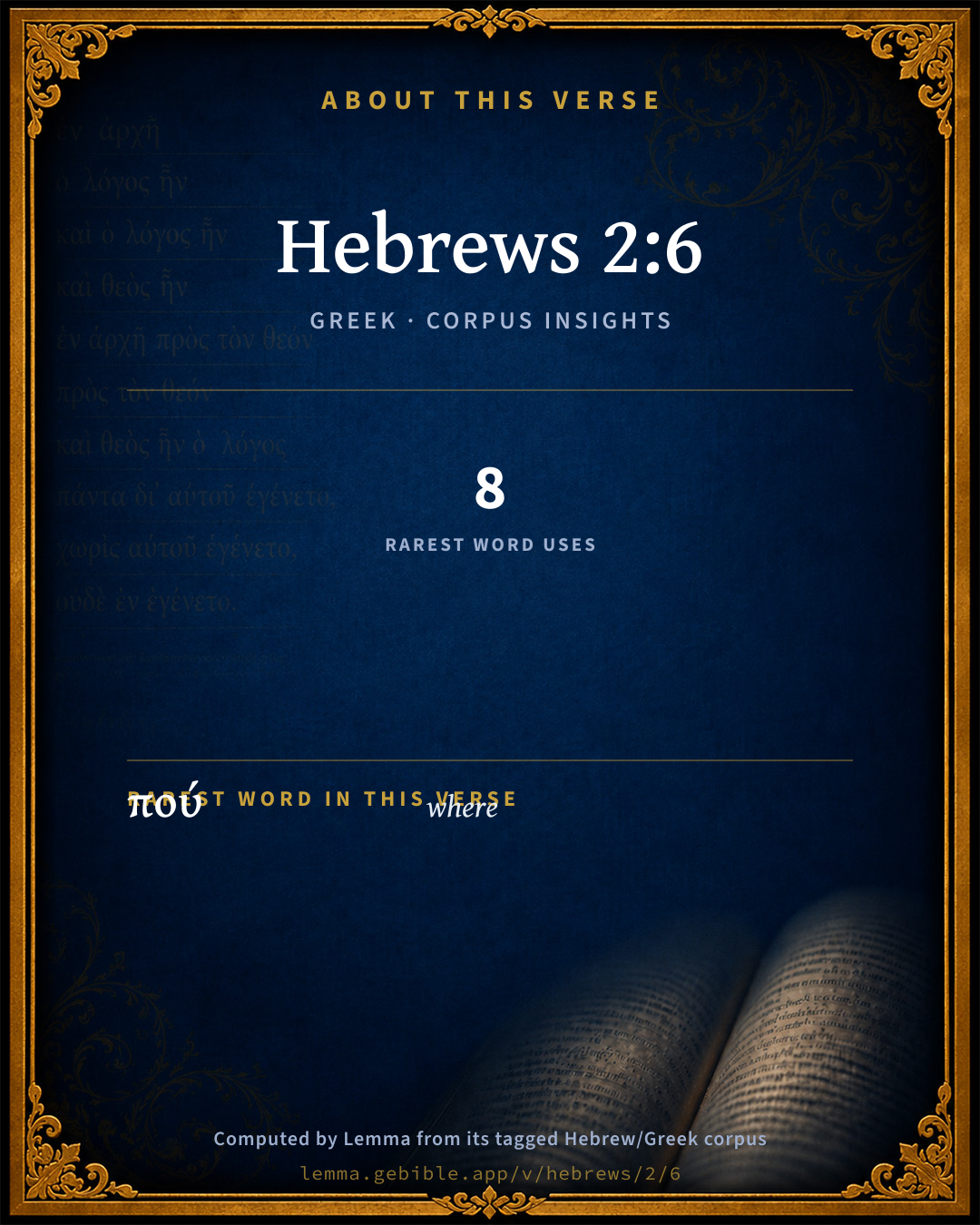
The rarest word here is πού where G4225 — appearing just 8 times in the whole Greek New Testament.

Shared distinctive vocabulary

πού where G4225 occurs in 8 verses of the Greek New Testament. Also found in:

Repetition

Words recur within this verse:

  • ἄνθρωπος human being G444 ×2
  • ὅτι that G3754 ×2
  • αὐτοῦ he G846 ×2

Cross-references

10

Topical passages linked to Hebrews 2:6 in the Treasury of Scripture Knowledge — connected by theme and wording, ordered by reader-vote popularity; previews shown in the World English Bible.

  • Psalms 8:4–8 What is man, that you think of him? The son of man, that you care for him?
  • Psalms 144:3 Yahweh, what is man, that you care for him? Or the son of man, that you think of him?
  • Job 7:17–18 What is man, that you should magnify him, That you should set your mind on him,
  • Isaiah 51:12 I, even I, am he who comforts you: who are you, that you are afraid of man who shall die, and of the son of man who shall be made as grass;
  • Job 15:14 What is man, that he should be clean? He who is born of a woman, that he should be righteous?
  • Job 25:6 How much less man, who is a worm! The son of man, who is a worm!"
  • Hebrews 4:4 For he has said this somewhere about the seventh day, "God rested on the seventh day from all his works;"
  • Genesis 50:24 Joseph said to his brothers, "I am dying, but God will surely visit you, and bring you up out of this land to the land which he swore to Abraham, to Isaac, and to Jacob."
  • Luke 7:16 Fear took hold of all, and they glorified God, saying, "A great prophet has arisen among us!" and, "God has visited his people!"
  • 1 Peter 1:11 searching for who or what kind of time the Spirit of Christ, which was in them, pointed to, when he predicted the sufferings of Christ, and the glories that would follow them.

Cross-references courtesy of OpenBible.info (CC BY 4.0).

Commentary

Notes on Hebrews 2:6 from classic Christian and Jewish commentators (each source and its license shown beneath its notes). The classic Christian expositions comment on the surrounding passage and are grouped to its opening verse, so a note may address several verses; the Jewish commentaries on the Tanakh (Rashi and others) are per-verse, so they appear only where the commentator wrote on this verse.

Lemma curates 59 commentaries, every one of them public domain or Creative Commons licensed, each selected and text-cleaned for this edition rather than reprinted as found. About our sources →

Jamieson, Fausset & Brown

Robert Jamieson, A. R. Fausset & David Brown

But--It is not to angels the Gospel kingdom is subject, BUT . . .

one . . . testified--the usual way of quoting Scripture to readers familiar with it. Psa 8:5-7 praises Jehovah for exalting MAN, so as to subject all the works of God on earth to him: this dignity having been lost by the first Adam, is realized only in Christ the Son of man, the Representative Man and Head of our redeemed race. Thus Paul proves that it is to MAN, not to angels, that God has subjected the "world to come." In Heb 2:6-8, MAN is spoken of in general ("him . . . him . . . his); then at Heb 2:9, first JESUS is introduced as fulfilling, as man, all the conditions of the prophecy, and passing through death Himself; and so consequently bringing us men, His "brethren," to "glory and honor."

What, &c.--How insignificant in himself, yet how exalted by God's grace! (Compare Psa 144:3). The Hebrew, "Enosh" and "Ben-Adam," express "man" and "Son of man" in his weakness: "Son of man" is here used of any and every child of man: unlike, seemingly, the lord of creation, such as he was originally (Gen. 1:1-2:25), and such as he is designed to be (Psa 8:1-9), and such as he actually is by title and shall hereafter more fully be in the person of, and in union with, Jesus, pre-eminently the Son of man (Heb 2:9).

art mindful--as of one absent.

visitest--lookest after him, as one present.

Jamieson, Fausset & Brown — Commentary Critical and Explanatory on the Whole Bible (1871) — public domain (CC PDM 1.0). Text via the HelloAO Bible API.

The Biblical Illustrator

Joseph S. Exell

Heb_2:6

What is man?

What is man?

To answer this question with anything like completeness it would be necessary to discourse upon it in much detail. Reference would have to be made to various sciences--psychology, physiology, anthropology, sociology; and even then the answer would be inadequate, for all the scientists together are unable to take the full measure of man. It is possible, however, to ponder the question with reference to one or two of the more salient points that it suggests, in such a way as to arrive briefly at an answer that may suffice for a moral purpose. Naturally, the question at the outset throws us back on history and the records of the past. What has man been? what was his beginning? It is almost lost in the dimness of remote antiquity. All we can say is, that, like every other living thing, his course has been upward and onward from a lower form, that in strength, in beauty, in intellect, in moral power, he has progressed by a slow development. On any supposition there must have been a period when he first acquired personality, when, to his sensuous and instinctive impulses, there were superadded reason and will, and those higher emotions and faculties which we commonly speak of as pertaining to the soul. There must have been a time when man first knew what right and wrong were, and what sin was; and there must have been a time when man first committed sin and experienced the sense of shame. So that whether chaps,

2. or 3. of Genesis are historical or not, they are spiritually true. Theyfurnish an exact description of what man was, and what he did, in that early stage of his being, when he acquired the power of choosing between good and evil. They narrate that change in the evolution of the race which corresponds to the change in the evolution of the man when he arrives at years of discretion, and can be treated as a moral being, having a sense of moral responsibility. And it does not require the slightest remission of candour, or fancy of interpretation, to read the Biblical description of mans origin in correspondence with the suggestions of science: And the Lord God formed man of the dust … and man became a living soul. Here we have a statement of the lowest possible origin of man, from the dust of the ground, with the addition that there was infused into him afterwards by the Almighty that quality of his nature which made him like the Almighty, and capable of what the best men have attained. It existed only in the germ at first, this principle of the higher life; but it was a germ having a power of development which was almost inexhaustible--a germ that has gone on working marvellously ever since; so that, from the teaching of experience only, we do not know what limits to set to the possible development of man. There was once a wise king, as Jeremy Taylor tells us, who was raised to the throne from the position of a ploughman, and kept his country shoes always by him to remind him from whence he had sprung. It would be well if we would in like manner often think of what we were, and what, in many respects, we still are, with the traces of our lower birth still about us. We should be less disposed to think that all things exist for man, and that man is the measure of all things. We should assume an attitude of more reverent and waiting humility towards Him from whom we and all things are sprung. Again, the recollection of our low beginning would tend to produce a salutary effect on our moral conduct. What more common pretext for their mode of life is offered by the sensual and intemperate than that they are following the dictates of their nature? Yes; but which nature? The lover? that which they share with the brute, and have perhaps inherited from the brute? Does ever humanity fall so low as when it makes such an appeal? Remember, then, from whence you have sprung, or at any rate what you have been, and you will not be forward to plead for liberty to do what your nature dictates. For man only became man, and deserved to be styled man, when he learnt bow to control his appetites. But further, for those even who are cognizant of the higher nature in man and who are striving to live according to that, nature, it is useful to remember the other side of their being. The higher nature has been evolved out of the lower. We are the products of evolution from various ancestors; we have inherited our several dispositions, whether good or bad; we are, to a large extent, the creatures of our circumstances; our higher life is governed by precisely the same laws which control the lives of plants and animals; we are subject in our higher nature to similar conditions of degeneration and mortification. We cannot, then, be what we like to be without regard to the environment in which we are placed. Though we boast of our free-will, we act on the greatest number of occasions simply on the impulse of the strongest motive. And therefore it is absolutely needful for our spiritual well-being that we place our-elves in a favourable environment, that we put ourselves in the way of being actuated by good motives, that we cultivate habits of prayer and watchfulness. Thus we are admonished by the laws of the animal life, which we share with the brutes. And, moreover, the higher nature of man is not only subject to the laws which govern the animal life, but it is inextricably interwoven with the animal nature in himself. His goodness from day to day depends on what use he makes of his lower nature. Bodily ill-health will weaken his self-control, and curtal(his spiritual powers: bodily indulgence will enervate his will, and expose him to special temptations. So that a great part of the activity of the higher nature depends on a proper treatment of the lower. Hence the necessity for exercising self-discipline, in order to keep the lower passions under proper control. It needs no asceticism, no going out rote the wilderness to feed on locusts and wild honey to accomplish this. It needs not that the lower feelings should be crushed, but rather that they should be made sublime by becoming the ready instruments of the higher self. And then the man becomes a harmonious, a dignified, a noble being, armed and fully equipped to do Gods bidding at all times. Then he can indeed lift up his head above the animal creation, and feel that he is a being of a different mould from them. Then he can find in himself the working of a spirit of life to whose continuance the destruction of the body is no impediment. Then he can even dare to claim kindred with God Himself Rom_8:13-14). (W. L. Paige Cox, M. A.)

What is man?

The question of all antiquity, and perhaps the question around which for years to come the greatest theological and scientific strife will take place, is this: What is man? The answer that the Christian Church will give will not of course accord in all points with the answer of the scientist who denies the revelation which comes from God. Yet, strange to say, though by different paths, and for every different purposes, we come in one sense to the same conclusion as the scientist: that there are possibilities in man which, if only they be evolved, will raise him to an infinite height, and bestow upon him a power that is possessed by no other creature in the universe. We hold that man is intended by God to be elevated step by step by the power of the gospel, until he becomes a partaker of the very glory of God. The scientist holds--if he denies revelation, I mean--that man is gradually, by a process of evolution, and by the development of the species, to be so elevated that at last all that is called God shall be found in him, and that man thus becomes a God to himself and to creation. But there is little question that the answer will be that the earth is the Lords and the fulness thereof; that man is but the deputy or vicegerent of his God; and that if man can be elevated to the position to which Almighty God intended him to attain, he shall be one with God in the person of the Lord Jesus Christ; he shall be elevated, step by step, by the gospel power, until he shall attain to the highest glory of God: The glory that Thou gavest Me I have given them, that they may be one, even as We are one: I in them and Thou in Me, that they may be made perfect in one. I know no motive power that can touch mans nature when it be elevated above the self-consciousness of self-seeking, so much as the inquiry what God meant man to be, what God made man for originally, what He considers him to be now, and what are the possibilities God has put before man in and through the glorious Saviour Jesus Christ our Lord. My purpose, therefore, is to inquire whether, if Gods revelation be the power by which mankind can be elevated to its highest possible destiny, we are prepared to carry out that purpose, and to glorify God as our Saviour in all things, by giving up ourselves to His service, to live the devoted live that the Church should live and to rise above the selfishness of mere personal salvation; remembering that there is a still more glorious aim than merely to be saved, and to enter personally into the glory of God, and it is this--that in her corporate, capacity, the Church should see that the individual life and personality is in one sense to be lost, and that when the individual soul forgets even its own personal salvation and its aspirations to everlasting happiness, then, and then only, does it really attain to the highest possible dignity of man; and that when the Church as a whole becomes, as she should be, greatly thoughtful on behalf of the individuals or units that one by one make up the perfection of the body of Christ which is His Church, then only will she fulfil her high destiny upon earth. Now let us proceed to the inquiry, taking our answer from Gods own Word. What is man? Can anything more magnificent be conceived than the dignity wherewith God originally endowed him? Whole step by step God evolved the glories and beauties of creation, one and one only purpose was in the Master-Maker, and that was to prepare the wonderful sphere in which man as the top stone of all should be happy and blessed, and should glorify his Maker. And when that wonderful series of preparations was completed, we find that even the Almighty Maker, the great Creator, has to pause as it were, in order that He may give greater dignity and greater glory to the creation of the creature which is to be possessor of all!--and instead of that mere fiat, Let there be and there was, we hear the Triune God saying, Let Us make man in Our own image and after Our own likeness. And then God made man, as the apostle Paul says, the image and glory of God! Surely from that moment we should expect the sphere of man to be great. But suddenly all the glory is swept away, and the creature for whom God had worked so long ceases to enjoy his original position; for by one act of folly he has severed himself from God, and, sin entering into the world, and death by sin, all the greatness of man would seem to be lost for ever. Nor from that time forward, as far as physical manifestation goes, has there ever been a recovery of the creatures lost dignity; and if now (however much modern science rejects the doctrine of the fall) the inquiry rings through the vault of heaven What is man? the answer would appear to be that man has become a thing of naught. Yea, ye, fly every man at his best state is altogether vanity. Man is even like a vapour that appeareth for a little time, and then vanisheth away. Yet, though this his fallen condition urges one to think with pain of the creature, let me invite you to pause before you condemn humanity after that modern fashion which is at the opposite extreme to that which speaks of man rising upwards and becoming God. Let me ask you to look at the fallen creature and see how, even after the fall, there are magnificent proofs in him of the original power of God, and that he is by no means to be condemned as a hopeless cripple. We gaze upon the ruins of a city and, from these ruins we gather is former magnificence and greatness; and it is by the style of these ruins that we judge of the city. So let me ask you to look at man for a moment, and as you see in this fallen creature powers that never were found in any other, you shall be compelled to give him your admiration, and honour him for the possibilities that lie buried beneath the surface, and which may elevate him into something almost Divine if only he can be delivered from the dominion of sin. Look, for instance, at the power or revenge as inherited in the vilest and worst of men. We find no other creature in the world who, for the mere sake of obtain-ink vengeance on its own behalf, will determine to sacrifice its own life. Look at the power of covetousness--that ambition and yearning after money and place, which the apostle describes as idolatry; and observe the wondrous powers there are in the creature who, for the mere sake of advancing himself, will slave and toil in order that he may be elevated above his fellows. Look again on that awful power of remorse, which comes over those who have fallen and sunk into despair. Can anything prove more clearly than the workings of remorse the very magnificence of the creature who is capable of such conditions and emotions? It would seem, if we watch a man in the activities of remorse, as if we were able to stand on a height within himself and so contemplate the utter misery of his own ruined, fallen slate. Surely there is no other creature in the world such as this. Therefore, as we look at man in his fall, again we are compelled to say, What is man? and to answer back, Man is not merely the wreck of his former self-though that we believe most solemnly--but a wonderful creature, a marvellous being, fitted, if only liberated from his fallen condition, to stand once more in the presence of God. At length, after four thousand years, during which God had from time to time been essaying to reveal Himself unto men, the oracle would seem to have become altogether dumb, when an angel appears to a virgin in Nazareth, and tells that a holy thing shall be born of her which shall be called the Son of God; and there bursts from the inspired lips of Zacharias the cry that God hath visited and redeemed His people, and that the Dayspring from on high hath visited us; and the Lord Jesus, as the true Word made flesh, appears among men. And now, what see we as the result of Jehovah deigning to appear in the flesh? First, the manifestation of what mall should be and could be if only the purpose of God was fulfilled; secondly, the manifestation of what God still determined to accomplish in man, because in Christ Jesus He would purchase humanity to Himself; and, thirdly, the manifestation of what may be done by those brought into personal contact and union with Him, being made one with the Son of God, by the faith which He requires us to exercise. We also see that in place of limitation, which had appeared to be working for so many centuries, expansion commenced, and has been wondrously proceeding from the day that the Lord Jesus returned to His Father in heaven. For when about to pass back to the glory of God, arid to be hidden from mens eyes for a little while, we hear from His lips the blessed truth that Ye shall receive power and Ye shall be witnesses unto Me, and in ten days from that time a third great series of manifestations commences. No longer ,in men see the form of the Son of God, but the power of the Holy Ghost in the sons of God. Jehovah-Elohim had appeared unto man; Jehovah Jesus had appeared for man; and now, in the Church of God, and in the fulness of His power, the Jehovah Spirit would appear in man. From that day forward the work of expansion commences, and for eighteen hundred years the great power of the Lord, the Holy Ghost, has been exhibit d in this world working out the complete man (Eph_4:13; Eph_5:25, &e.). The Second Man, who is the Lord from heaven, will not be complete until His Bride be brought unto Him, His glorious Church, wit; out spot or wrinkle or any such thing; and so each sinner that is joined to Jesus Christ by His Spirit is made a member of His body, of His flesh, and of His bones, and we live in Him, we live by Him, and we may now live for Him, in order that hereafter we may live with Him in the manifested glory that awaits Gods Son. And now when we see the Man Christ Jesus made perfect through suffering, and then lifted up to the throne of God that by His Spirit He may draw men into absolute unity with Himself, say, oh say, What is man? What is man, as we see him in the person of Gods Son? What is man, as we see him in the purpose of God, which is to be carried out in soul after soul of those that are redeemed and united vitally unto the Lord Jesus Christ? And what is man when we consider the triumphs of this gospel? What but this truth, as the truth is in Jesus, has made man such as he has occasionally been seen? What but this could have made a Paul, a Peter, or a John? What but this could have given us an Augustine, a Wycliffe, a Huss, a Savonarola, a Luther? What but this in these latter days could give us those blessed missionaries who have stood before the world as witnesses for the power of Christ? What but this, the purpose of God, to glorify man, the purpose of God that man should have dominion in and through the Lord Jesus Christ, and that all may bee-me workers together with Him, if only they he vitally united to the Man? (H. W.Webb Peploe, M. A.)

What is man?

We need not only a true philosophy of God but a true philosophy of man, in order to right,, thinking of the gospel. The idolater thinks man inferior to birds and beasts and creeping things, before which he prostrates himself. The materialist reckons him to be the chance product of natural forces which have evolved him, and before which he is therefore likely to pass away. The pseudoscience of the time makes him of one blood with ape and gorilla, and assigns him a common origin with the beasts. See what gigantic systems of error have developed from mistaken conceptions of the true nature and dignity of man!

I. MAN AS GOD MADE HIM

1. the Divine likeness (Gen_1:27). Our mental and moral nature is made on the same plan as Gods: the Divine in miniature. Truth, love, and purity, like the principles of mathematics, are the same in us as in Him. If it were nut so, we could not know or understand Him. But since it is so, it has been possible for Him to take on Himself our nature, and that we should be one day transformed to the perfect image of His beauty.

2. Royal supremacy (Gen_1:28). Man was intended to be Gods vicegerent and representative. King in a palace stored with all to plea-e him, monarch and sovereign of all the lower orders of creation. The sun to labour for him as a very Hercules; the moon to light his nights, or lead the waters round the earth in tides, cleansing his coasts; elements of nature to be his slaves and messengers; flowers to scent his path; fruits to please his taste; birds to sing for him; fish to feed him; beasts to toil for him and carry him. Not a cringing slave, but a king, crowned with the glory of rule, and with the honour of universal supremacy. Only a little lower than angels, because they are not, like him, entangled with flesh and blood. This is man as God made him to be.

II. MAN AS SIN HAS MADE HIM (Heb_2:8).

His crown is rolled in the dust, his honour tarnished. His sovereignty is strongly disputed by the lower orders of creation. If trees nourish him, it is after strenuous care, anal they often disappoint. If the earth supplies him with food, it is in tardy response to exhausting toil. If the beasts serve him, it is because they have been laboriously tamed and trained, whilst vast numbers roam the forest glades, setting him at defiance. If he catch the fish of the sea, or the bird of the air, he must wait long in cunning concealment. Some traces of the old lordship are still apparent in the terror which the sound of the human voice and the glance of the eye side inspire into the lower orders, in the feats of lion-tamer or snake-charmer. But for the most part anarchy and rebellion have laid waste his fair realm. So degraded has man become that he has bowed before the objects that he was to command, and has prostrated his royal form in shrines dedicated to birds, and four-footed beasts, and creeping things.

III. MAN AS CHRIST CAN MAKE HIM (Heb_2:9).--What help is that? cries an objector; of course He is crowned with glory and honour, since He is the Son of God. But, notice, the glory and honour mentioned here are altogether different from the glory of Heb_1:3. That was the incommunicable glory of His Deity. This is is the acquired glory of His humanity.

1. We behold Him.--Behold Him, Christian. The wreaths of empire are on His brow. The keys of death and Hades swing at His girdle. The mysterious living creatures, representatives of creation, attest that He is worthy. All things in heaven, and earth, and under the earth, and in the seas worship Him; so do the bands of angels, beneath whom He stooped for a little season, on our behalf.

2. And as He is, we too shall be. He is there as the type and representative of redeemed men. We are linked with Him in indissoluble union. Through Him we shall get back our lost empire. We to, shall be crowned with glory and honour. The day is not far distant when we shall sit at His side; joint heirs in His empire; comrades in His glory, as we have been comrades in His sorrows; beneath our feet all things visible and invisible, thrones and principalities and powers; whilst above us shall be the unclouded empyrean of our Fathers love, for ever and for ever. Oh, destiny of surpassing bliss! Oh, rapture of saintly hearts! Oh, miracle of Divine Omnipotence! (F. B.Meyer, B. J.)

Gods special care of man

1. Gods special care of man, and His singular love towards him.

2. The same manifested in a most glorious manner, in the humiliation and exaltation of Christ.

3. The admiration, or rather amazement at such a stupendous manifestation of such stupendous love. All the works of God are in themselves excellent and wonderful, but the work of redemption by Christ is matter of greatest wonder and astonishment even to the angels. (G. Lawson.)

What is man?

He doth not speak of man in his first creation--he retained that estate but a while--therefore he would rather have deplored than admired it. He doth not speak of man as be is after his fall, for in that respect he is most miserable, not glorious; therefore he must needs speak of man as he is ingrafted into Christ, by whom he is advanced to wonderful and unspeakable glory. What is man? Not only considered in his first creation, but even in his renovation, what is the best man that ever was, that God should have any respect to him? By creation indeed he is the workmanship of God, the image of God Almighty; yet for all that., in respect of his original, he was taken out of the ground. He is but a piece of earth; since the Fall he is a mass of sin; though he be regenerate, and by faith ingrafted into Christ, yet still he hath sin in him and must die. Therefore what is this man, that Thou shouldest pour down so many blessings on him? that the sun, moon, and stars, should give him light? that the birds of the air, fishes of the sea, the casts of the field should be his meat? that be should walk as a king on earth? especially that Thou shouldest send Thy only Son to die for him, make him a member of His body, and provide an everlasting kingdom for him in the life to come? What is vile, wretched, sinful, corrupted man, that Thou shouldest be so far mindful of him? protect him with the shield of Thy favours from all dangers? That Thou shouldest vouchsafe him Thy Word and sacraments? That Thou shouldest give him Thy Holy Spirit to help him to pray, and to comfort him in all miseries? We should not be like the peacock spreading forth our golden feathers, and say within ourselves, What goodly men be we! We ought to think basely of ourselves--what are we that God should regard us? What am I and my fathers house, said that regal prophet, that Thou hast brought me hitherto? What are we miserable wretches, that God Almighty should do anything for us? we are less than the least of all His mercies. Yet we are wont to vaunt of ourselves, do ye not know who I am? Dost thou not consider to whom thou speakest? yes, very well. I speak to dust and ashes. Let no high conceit of ourselves enter into our minds, let us think basely of ourselves, What am I, O Lord, that Thou shouldest give me the least thing in the world? A drop of drink, a crust of bread, a hole to hide my head in, especially that Thou shouldest give me Thine only Son, and together with Him all things that be good? What is any man in the world? Art thou a rich man? God can puff away thy riches and make thee poor. Art thou a wise man? God can take away thy senses and make thee a fool. Art thou a beautiful man? God can send the pox and many diseases to take away thy beauty Art thou a strong man? God can send sickness and make thee weak. Art thou a gentleman, a knight, a lord? yet thy breath is in Gods hand. This night He can take away thy soul from thee, and what art thou then? Therefore let us all have an humble opinion of ourselves, let us cast down ourselves at Gods feet, and say, What are we, O Lord, that Thou art mindful of us, that Thou so graciously visitest us, especially with Thy everlasting mercies in Christ Jesus. (W. Jones, D. D.)

The littleness of man

The intense beauty of the Arctic firmament can hardly be imagined. It looked close above our heads, with its stars magnified in glory and the very planets twinkling so much as to baffle the observations of our astronomer. I am afraid to speak of some of these night-scenes. I have trodden the deck and its floes when the life of earth seemed suspended, its movements, its sounds, its colouring, its companionships; and as I looked on the radiant hemisphere circling above, as if rendering worship to the unseen Centre of light, I have ejaculated in humility of spirit, Lord, what is man, that Thou art mindful of him? And then I have thought of the kindly world we bad left, with its revolving sunshine and shadow and the other stars that gladden it in their changes, and the hearts that warmed to us there, till I lost myself in memories of those who are not, and they bore me back to the stars again. (Dr. Kanes Arctic Explorations.)

The Biblical Illustrator, edited by Joseph S. Exell (c. 1880s–1900s) — public domain. Text from a community e-Sword module.

Joseph Benson's Commentary

Heb 2:6. But one in a certain place — Namely, David, Psa 8:4; testified, saying, What is man — The Hebrew word אנושׁ, used in the Psalm, means weak, miserable, and mortal man; man in his fallen state; obnoxious to grief, sorrow, anxiety, pain, trouble, and death: that thou art mindful of him — What is he to the vast expanse of the heavens, to the moon and the stars which thou hast ordained? This Psalm seems to have been composed by David in a clear, moon-shiny, and star-light night, while he was contemplating the wonderful fabric of the heaven; because, in his magnificent description of its luminaries, he takes no notice of the sun, the most glorious of them all. The words here cited concerning dominion, were doubtless in some sense applicable to Adam; although, in their complete and highest sense, they belong to none but the second Adam. It has indeed been a great question among interpreters, whether the Psalm speaks of man in general, and of the honour which God put upon him in his creation, or only of the man Christ Jesus. But upon comparing the contents of it with this chapter, it seems evident that both are included. For the design of the Psalm appears plainly to have been to display and celebrate the great love and kindness of God to mankind: not only in their creation, but also in their redemption by Christ Jesus; whom, as he was man, God advanced to the honour here spoken of, that he might carry on that great and glorious work. Some parts of the Psalm, however, relate more eminently to Christ than to man in general, and accordingly are so interpreted, both by our Lord and by his apostles, particularly Heb 2:2; Heb 2:6. Or the Son of man — Hebrew, בן אדם, the son of Adam, of one made out of the earth; that thou visitest him — The sense rises: we are mindful of him that is absent; but to visit denotes the care of one present. And it is worthy of observation, that the Hebrew word occurring in the Psalm, and rendered visitest, though variously used, yet constantly denotes the action of a superior toward an inferior, and commonly expresses some act of God toward his people for good. And especially in the term visiting used to express the stupendous act of God in sending his Son to take our nature upon him, as Luk 1:68; Luk 1:78. “He hath visited and redeemed his people;” and “The day-spring from on high hath visited us.” This was the ground of the psalmist’s admiration, and will be a cause of admiration to all believers through eternal ages.

Joseph Benson's Commentary on the Old and New Testaments (1811–1818) — public domain. Text from a community e-Sword module.

Tyndale Open Study Notes

Tyndale Open Resources

2:6-8 These verses quote Ps 8:4-6. Psalm 8 speaks of the position God has given humanity, but the author of Hebrews applies it as a prediction about Christ, who is the fulfillment and representative head of humanity.

2:6 What are mere mortals: These two lines of the psalm proclaim God’s special attention to human beings. • a son of man (or the Son of Man): The phrase son of man speaks of human existence; it parallels mere mortals in the previous line. In the Gospels Jesus frequently referred to himself with this phrase.

Tyndale Open Study Notes — © Tyndale Open Resources, licensed CC BY-SA 4.0. Text via the HelloAO Bible API.

Bengel's Gnomon

Johann Albrecht Bengel

Heb 2:6. Διεμαρτύρατο δέ που τὶς, but one in a certain place testified) one, viz. a witness. David did not here speak of himself; wherefore it was not necessary to introduce his name. Nor should we stop short with the intermediate messengers, but should look to the word of GOD, when it has testified once for all. David testified in Psalms 8, to which this chapter often refers, even from the tenth verse, as we shall see. Δὲ, but, forms an antithesis between the angels and Him to whom the psalm testifies that all things are subjected.—τί ὲστιν—ποδῶν αὐτοῦ) So altogether the LXX., Psa 8:5-7. That clause, and Thou hast set Him over the works of Thy hands, the apostle does not assume, at least in his reasoning, but deduces the “all things” from what goes before and follows in the psalm. There are mentioned in that clause the works of GOD’S hands, i.e. heaven, the moon and stars. (The sun is wanting, either because, as the slavery and deliverance of his seed was shown to Abraham in the night time, Gen 15:12; so the humiliation and exaltation of the Messiah were shown to David and sung by him during the night; as also the word of the Lord seems to have come to Job by night, Job 38:7; Job 38:31-32; or because Messiah, when forsaken on the cross, saw the moon and stars after that the sun was darkened.) But the authority of Christ continues beyond the duration of these.—τί ἐστιν ἄνθρωπος) what is man with respect to the works of GOD, the heaven, etc.; but what is man with respect to God Himself? The expression is thus more humble than if he had said: Who am I? A man, ἄνθρωπος, without the article, as one of many, אנוש, a man, παθητὸς, subject to sufferings and death.—ὅτι μιμνήσκῃ αὐτοῦ, that Thou art mindful of him) Such is the description of the Messiah’s condition, in which He might seem to have passed away from the remembrance and care of God. Whence, with wonderful humilty, He is astonished Himself at this very thing, the remembrance of Him: how much more at so great glory prepared for Him? It could not be otherwise, Act 2:24; but He prays as if it could scarcely be so.—ἢ, or) בן אדם, the son of man, in this passage, conveys the notion of something more insignificant than אדם, man.—υἱὸς ἀνθρώπου) בן אדם, comp. Psa 49:3.[10] Again without the article.—ἐπισκέπτῃ αὐτὸν, takest account of him, visitest him) An increase in the force of the expression; for remembrance refers even to the absent; ἐπισκέπτεσθαι, to visit or look after, denotes the care of one present.

[10] See the Hebrew בְנֵי אָדָם. Also Psa 144:3.—ED.

Bengel's Gnomon of the New Testament — English translation (T&T Clark, Edinburgh, 1860) — public domain. Text from a community e-Sword module.

Meyer's Critical & Exegetical Commentary

Heinrich August Wilhelm Meyer

Heb_2:6 attaches itself closely to Heb_2:5, in that the adversative δέ (different from the disjunctive ἀλλά, but, on the contrary. Comp. Hartung, Partikell. I. p. 171), as Heb_4:13; Heb_4:15, Heb_9:12, Heb_10:27, Heb_12:13, 1Co_7:15; 1Co_7:25 fin., and frequently, as it were correcting the preceding negative statement, now places in opposition the actual state of the question: Some one, however (some one, on the contrary), testified in a certain place and said. Quite wrongly does Heinrichs suppose an entirely new section of the epistle to begin with Heb_2:6.

πού τις] The wavering character of this form of citation is derived by Grotius from the consideration that the Psalms were the work of different authors, and the authors of particular psalms were often unknown. But the eighth Psalm, here cited, is, both in the Hebrew and the LXX., expressly ascribed to David. According to Koppe (Excursus I. ad epist. ad Roman., 2d ed. p. 379), Dindorf, Schulz, Heinrichs (comp. also Stengel), the indefiniteness of the formula is to be explained by the fact that the author is citing from memory. But the words agree too exactly with the LXX. to be a citation from memory, and, moreover, the indefinite που occurs again, Heb_4:4, in connection with the citation of Gen_2:2, thus in connection with an appeal to a passage of the O. T. Scripture, of which the place where it is found could not possibly escape the memory of our author. De Wette, after the precedent of Bleek [cf. Peshito: the Scripture witnesses, and says], regards it as the most correct supposition that the author was not concerned about the particular writers of Scripture, since for him God or the Holy Ghost spoke through the Scripture. Yet, if the reason for the form of expression is to be sought in this, then in general we should hardly expect the personal indication τίς to be added, but rather a passive construction to be chosen. According to Hofmann, finally, ̔πού τις is intended to declare that it is indeed a matter of indifference for his purpose who said this, and where it is found; that it is adduced as the utterance of some man, only an utterance which comes invested with the authority of Scripture! The indefinite mode of citation has probably no other than a rhetorical ground, inasmuch as the author presupposes a universal acquaintance with the passage, without concerning himself to learn whether it is known to all or not. So substantially also Chrysostom (τοῦτο δὲ αὐτό, οἶμαι, τὸ κρύπτειν καὶ μὴ τιθέναι τὸν εἰρηκότα τὴν μαρτυρίαν, ἀλλʼ ὡς περιφερομένην καὶ κατάδηλον οὖσαν εἰσάγειν, δεικνύντος ἐστίν, αὐτοὺς σφόδρα ἐμπείρους εἶναι τῶν γραφῶν), Oecumenius, Theophylact, Primasius, Jac. Cappellus, Cornelius a Lapide [Owen: the reason is plain; both person and place were sufficiently known to them to whom he wrote], Calov, Tholuck, Bloomfield, Alford, Maier, Moll, Kurtz, al. The same reticence in the mode of citation is often found with Philo. Comp. e.g. de ebrietate, p. 248 (ed. Mangey, I. p. 365): εἶπε γάρ πού τις (sc. Abraham, Gen_20:12). Further examples see in Bleek, Abth. II. 1 Hälfte, p. 239.

The citation, which extends to ̔ποδῶν αὐτοῦ, Heb_2:8, is from Psa_8:5-7 (46). The utterance in its historic sense contains a declaration with regard to man in general; but the author, on the ground of the ideal import of the passage, as likewise in particular on the ground of the expression υἱὸς ἀνθρώπου, which in consequence of Dan_7:13 was current with the Jews as an appellation of the Messiah (comp. Joh_12:34), which, too, was one often bestowed by Jesus upon Himself, finds in it a declaration concerning the Son of man κατʼ ἐξοχήν, i.e. concerning Christ.[44] Paul, too, has Messianically interpreted the psalm, 1Co_15:27 f. (comp. Eph_1:22).

Τί ἐστιν ἄνθρωπος κ.τ.λ.] What is man that Thou art mindful of him, or the son of man that Thou regardest him! i.e., in the sense of the original, How small, weak, and insignificant, as compared with the majestic heavenly bodies, is man, that Thou shouldst nevertheless take a loving and careful interest in him! In the application: How great and full of dignity is man, that Thou so greatly distinguishest him with loving care! (Kuinoel, Heinrichs, Böhme, Bleek, Stein; otherwise, de Wette, Hofmann, Schriftbew. II. 1, p. 45, 2 Aufl.; Riehm, Lehrbegr. des Hebräerbr. p. 361; Alford, Moll, Kurtz, al.). Thus the author could understand the words, although the being mindful and looking upon do not very well accord therewith, in that he was guided in his acceptance of them pre-eminently by the final clause δόξῃ … αὐτοῦ.

ἤ] instead of this ו is found in the Hebrew, thus introduces a purely parallel member, in such wise that υἱὸς ἀνθρώπου is identical with ἄνθρωπος in the first member, and is distinguished therefrom only as a more sharply defined presentation of the same notion.

[44] In contradiction with the design of the whole explication, as this clearly manifests itself from the context, do Beza, Piscator, Storr, Ebrard, Delitzsch (p. 57, 59), Hofmann (Schriftbew. II. 1, p. 45, 2 Aufl.), Alford, Moll, and others, refer ἄνθρωπος, even in the sense of our author, and νἱὸς ἀνθρώπου to man generally, namely, to the man of the New Covenant, inasmuch as he shall receive the dominion over all things, in the possession of which Christ is already set. When Ebrard, p. 84, asserts that the Messianic interpretation of the non-Messianic eighth Psalm cannot be laid to the account of the author of the epistle, without charging him with a downright Rabbinical misunderstanding of a psalm; and when, in like manner, Delitzsch, p. 57, declares it not at all conceivable that the author of our epistle should without any explanation have referred ἄνθρωπος and υἱὸς ἀνθρώπου of the psalm to Christ, unless we are to attribute the uttermost limitation of thought to the N. T. exposition of Scripture, that is nothing else than a controlling of the author of the epistle by preconceived opinions of ones own, from which, in the face of 1Co_15:27 f., one ought to have shrunk. For the rest, against the view espoused by Ebrard, Delitzsch, and Hofmann, comp. also Riehm, Lehrbegr. des Hebräerbr. p. 368 ff., note.

Meyer — Critical and Exegetical Commentary on the New Testament — English translation by Peter Christie, edited by Frederick Crombie (T&T Clark, 1880) — public domain. Text from a community e-Sword module.

Geneva Bible (1599)

Geneva Bible translators

He showeth that the use of this kingly dignity consisteth herein, that men might not only [in] Christ recover that dignity which they have lost, but also might be through him advanced above all things, which dignity of men David describeth most excellently.

What is there in man that thou shouldest have so great regard of him, and do him that honor?

He calleth all the citizens of that heavenly kingdom as they are considered in themselves, before that God giveth them the liberty, of that city in Christ, Man, and Son of man.

Geneva Bible (1599) marginal notes — public domain. Text via Bolls.life.

Adam Clarke's Commentary

Verse 6. But one in a certain place] This one is David; and the certain place, Ps 8:4-6. But why does the apostle use this indeterminate mode of quotation? Because it was common thus to express the testimony of any of the inspired writers; אמר ההוא amar hahu kethab, thus saith a certain scripture. So Philo, De Plant. Noe: Ειπε γαρ που, he saith somewhere; ειπε γαρ τις, a certain person saith. Thus even the heathens were accustomed to quote high authorities; so Plato, Tim.: Ὡς εφη τις, as a certain person saith, meaning Heraclitus. See in Rosenmuller. It is such a mode of quotation as we sometimes use when we speak of a very eminent person who is well known; as that very eminent person, that great philosopher, that celebrated divine, that inspired teacher of the Gentiles, the royal psalmist, the evangelical prophet, hath said. The mode of quotation therefore implies, not ignorance, but reverence.

What is man] This quotation is verbatim from the Septuagint; and, as the Greek is not as emphatic as the Hebrew, I will quote the original: מה אנוש כי תזכרנו ובן אדם כי תפקדנו mah enosh ki thizkerennu, uben Adam ki thiphkedennu; What is miserable man, that thou rememberest him? and the son of Adam, that thou visitest him? The variation of the terms in the original is very emphatic. Adam, אדם, is the name given to man at his creation, and expresses his origin, and generic distinction from all other animals. Enosh, אנוש, which signifies sick, weak, wretched, was never given to him till after his fall. The son of Adam means here, any one or all of the fallen posterity of the first man. That God should remember in the way of mercy these wretched beings, is great condescension; that he should visit them, manifest himself to them, yea, even dwell among them, and at last assume their nature, and give up his life to ransom them from the bitter pains of eternal death, is mercy and love indescribable and eternal.

Adam Clarke's Commentary on the Bible (1810–1826) — public domain. Text from a community e-Sword/MySword module.

Ellicott's Commentary for English Readers

(6) But one in a certain place.—Better, somewhere. The expression is perfectly indefinite (comp. Heb_4:4). As a rule, the words of Scripture are in this Epistle quoted as God’s own utterances; and though the nature of the quotation (which is an address to God) made this impossible here, the writer seems gladly to avoid the mention of the human prophet, perhaps as distracting the thought from the divine prophecy. This studious indefiniteness in citation is common in Philo, and sometimes occurs where he cannot possibly have been in doubt as to the source of his quotation.

Testified.—That is, in Biblical usage, solemnly declared: the words are no light exclamation of wonder. The quotation which follows (from Psa_8:4-6) agrees verbally with the LXX. version. The only point of doubt is whether the last clause of Heb_2:7 was included in the quotation, as in some very good ancient authorities it is absent from the text. The weight of external evidence is certainly in its favour; but it is easier to see how a scribe may have introduced the clause through his familiarity with the Psalm than to explain its omission if it stood in the original text of this Epistle. The Greek translation here faithfully represents the Hebrew, except in one point. For “a little lower than the angels,” the Hebrew text has “a little less than God.” The change (which is similar to that noticed in Heb_1:6) was probably introduced by the translators on a principle which we may often trace in their work—a wish to tone down expressions relating to the Deity which seemed strong or bold. In quoting the passage the writer does not depart from the rendering most familiar to the readers of the Greek Bible; but, though the clause in its altered form accords well with what had preceded the quotation, and, so to speak, more completely interweaves the words of the Psalm with the context in which they are here placed, yet no stress is laid on “angels.” The argument of this section would not be affected materially if the true rendering of the Hebrew were restored. The eighth Psalm is an expression of amazement that God, who has “set His glory upon the heavens,” should deign to remember man. Not only is He “mindful of man,” but He has made him but “little less than God,” “crowned him with honour,” given him “dominion over” all His works. The original blessing pronounced on man (Gen_1:28) is clearly in the Psalmist’s thought, and suggests his words. The language which here precedes (Heb_2:5) and follows (Heb_2:8) shows that the last clause (“thou didst subject all things under his feet”) bears the stress of the quotation. (That the same words are the groundwork of 1Co_15:24-28 is one of the most interesting coincidences between this Epistle and St. Paul.) It is easy to see, therefore, for what purpose these verses are here adduced. Not to angels is “the world to come” subjected: in the Scripture there are found words declaring that a divine decree has subjected all things to man. How the thought is combined with the argument of the whole passage will be seen in Heb_2:9. A question at once arises: Did the meaning here assigned to the Psalm exist in David’s thought? If not, on what principle does this application rest? David had in mind the words of the primal blessing, and probably did not himself think of more than those words seemed to imply. But the complete meaning of God’s words can be learnt only when they are fulfilled in history. To Him who speaks in Scripture the material dominion was the symbol of a higher and a universal rule, to be fulfilled in the Son of Man when the fulness of time should come. The Psalm is not directly Messianic,—it relates to man; but it is through the Man Christ Jesus that it receives its complete fulfilment for mankind.

A Bible Commentary for English Readers, edited by Charles John Ellicott (1878–1897) — public domain. Text from a community e-Sword module.

The Cambridge Bible for Schools and Colleges

gen. ed. J. J. S. Perowne

6. but one in a certain place testified] The writer was of course perfectly well aware that the Psalm on which he proceeds to comment is the 8th Psalm. This indefinite mode of quotation (“some one, somewhere”) is common in Philo and the Rabbis. Scripture is often quoted by the words “It saith” or “He saith” or “God saith. Possibly the indefinite form (comp. Heb_4:4)—which is not found in St Paul—is only here adopted because God is Himself addressed in the Psalm. (See Schöttgen, Nov. Hebr. p. 928.)

What is man] The Hebrew word—enosh—means man in his weakness and humiliation. The “what” expresses a double feeling—how mean in himself! how great in Thy love! The Psalm is only Messianic in so far as it implies man’s final exaltation through Christ’s incarnation. It applies, in the first instance, and directly, to man; and only in a secondary sense to Jesus as man. But St Paul had already (1Co_15:27; Eph_1:22) applied it in a Messianic sense, and “Son of man” was a Messianic title (Dan_7:13). Thus the Cabbalists regarded the name Adam as an anagram for Adam, David, Moses, and regarded the Messiah as combining the dignity of all three. David twice makes the exclamation—“What is man?”;—once when he is thinking of man’s frailty in connection with his exaltation by God (Psalms 8); and once (Psa_144:3) when he is thinking only of man’s emptiness and worthlessness, as being undeserving of God’s care, (comp. Job_7:17).

The Cambridge Bible for Schools and Colleges (gen. ed. J. J. S. Perowne; Cambridge University Press, 1878–1918) — public domain. Text from a community e-Sword module.

John Gill's Exposition

Thou madest him a little lower than the angels,.... In the Hebrew text it is, "than Elohim", which some render, "than God"; but it is rightly rendered by the apostle, "than angels"; and so the Targum, Jarchi, Aben Ezra, Kimchi, and Ben Melech, interpret it. Christ was made a little lower than the angels, through the assumption of the human nature, which is inferior to angels, especially the corporeal part of it, and in this Kimchi makes the lessening to be; and more especially as that was assumed by Christ, with the infirmities of it; and by reason of the straits and indigencies he was brought into in it; besides, he was in it made under the law, which was given by angels, and to some parts of which they are not subject; and sometimes he stood in need of the ministry and support of angels, and had it; particularly he was made lower than they, when he was deprived of the gracious presence of God, and in the time of his sufferings and death; and which seem chiefly to be respected, as appears from Heb 2:9 and the word "little" may not so much intend the degree of his humiliation, as the duration of it; for it may be rendered, "a little while"; in which sense it is used in Act 5:34 as the Hebrew word is in Psa 37:10 and so may respect the time of his suffering death; and at most the time from his incarnation to his resurrection; for he could not continue long in this low estate, which is matter of joy to us; he could not be held by the cords of death, but must rise, and be exalted above angels, as he is: and he was made so low by God, Jehovah the Father, whose name is excellent in all the earth, Psa 8:1 he preordained him to this low estate; he prepared a body for him, and had a very great hand in his sufferings and death; though neither of these were contrary to his will:

thou crownest him with glory and honour; with that glory he had with the Father before the world was, and which followed upon his sufferings and death; for through them he entered into it, and upon his resurrection had it, and he is ascended on high, where he has the honour to sit at the right hand of God, which none of the angels have; and therefore is now above them, though once for a while below them, and they are now subject to him:

and didst set him over the works of thy hands: over angels, principalities, and powers; over the kings of the earth, and all the inhabitants of it, and all things in it, and made him higher than the heavens, and gave him a name above every name.

John Gill's Exposition of the Whole Bible (1746–1763) — public domain (CC PDM 1.0). Text via the HelloAO Bible API.

Trapp's Complete Commentary

John Trapp

6 But one in a certain place testified, saying, What is man, that thou art mindful of him? or the son of man, that thou visitest him?

Ver. 6. But one in a certain place] The full sense is, but he hath subjected it to Christ, as David testified, Psa 8:4-5; where whatsoever is spoken to man is here applied to the man Christ Jesus; and so is proper to the saints by virtue of their union with Christ. In which respect they are more glorious than heaven, angels, or any creature. {a}

{a} Accommodatio est facilis ad personam Christi, si interpretes non vellent esse nimis ingeniosi. Ames. in Psa 8:5.

John Trapp, A Commentary or Exposition upon All the Books of the Old and New Testament (1647–1656) — public domain. Text from a community e-Sword module.

Albert Barnes' Notes on the Bible

But one in a certain place testified - The apostle was writing to those who were supposed to be familiar with the Hebrew Scriptures, and where it would be necessary only to make a reference in general without mentioning the name. The place which is quoted here is Psa 8:4-6. The “argument” of the apostle is this, that there stood in the sacred Scriptures a declaration that “all things were placed under the control and jurisdiction of man,” but that that had not yet been accomplished. It was not true (Heb 2:8) that all things were subject to him, and the complete truth of that declaration would be found only in the jurisdiction conferred on the Messiah - the man by way of eminence - the incarnate Son of God. It would not occur to anyone probably in reading the Psalm that the verse here quoted had any reference to the Messiah. It seems to relate to the dominion which God had given man over his works in this lower world, or to the fact that he was made lord over all things.

That dominion is apparent, to a considerable extent, everywhere, and is a standing proof of the truth of what is recorded in Gen 1:26, that God originally gave dominion to man over the creatures on earth, since it is only by this supposition that it can be accounted for that the horse, and the elephant, and the ox, and even the panther and the lion, are subject to the control of man. The argument of Paul seems to be this: Originally this control was given to man. It was absolute and entire. All things were subject to him, and all obeyed. Man was made a little lower than the angels, and was the undisputed lord of this lower world. He was in a state of innocence. But he rebelled, and this dominion has been in some measure lost. It is found complete only in the “second man the Lord from heaven” 1Co 15:47, the Lord Jesus to whom this control is absolutely given. He comes up to the complete idea of man - man as he was in innocence, and man as he was described by the Psalmist, as having been made a little lower than the angels, and having entire dominion over the world.

Much difficulty has been felt by commentators in regard to this passage, and to the principle on which it is quoted. The above seems to me to be what is most probably true. There are two other methods by which an attempt has been made to explain it. One is, that Paul uses the words here by way of “allusion,” or “accommodation” (Doddridge), as words that will express his meaning, without designing to say that the Psalm originally had any reference to the Messiah. Most of the later commentators accord with this opinion. The other opinion is, that David originally referred to the Messiah - that he was deeply and gratefully affected in view of the honor that God had conferred on him; and that in looking down by faith on the posterity that God had promised him (see 2Sa 7:16), he saw one among his own descendants to whom God would give this wide dominion, and expresses himself in the elevated language of praise. This opinion is defended by Prof. Stuart; see his Commentary on Hebrews, Excursus IX.

(That the grand and ultimate reference, in Psa 8:1-9, is to the person of the Messiah, none can reasonably doubt. Both our Lord and his apostles have affirmed it; Mat 21:15-16; 1Co 15:27; Eph 1:22. Add to these, the place before us, where - as the quotation is introduced “in the midst of an argument, and by way of proof” - the idea of “accommodation” is inconsistent with the wisdom and honesty of the apostles, and therefore inadmissible. The opposite extreme, however, of “sole and original” reference to the Messiah is not so certain. There is a more obvious and primary reference, which at once strikes the reader of the Psalm, and which, therefore, should not be rejected, until disproved. The conjecture, which a learned author mentioned above, has made, regarding the course of thought in the Psalmist’s mind, supposing him to have been occupied with the contemplation of the covenant, as recorded in 2 Sam. 7 and of that illustrious descendant, who should be the Son of God, and on whom should be conferred universal empire - at the very time in which he composed the Psalm - is ingenious, but not satisfactory.

The least objectionable view is that of primary and secondary, or prophetic reference. This relieves us from the necessity of setting aside the obvious sense of the original place, and, at the same time, preserves the more exalted sense, which our Lord and his apostles have attached to it, and the Spirit of course intended to convey. And in order to preserve this last sense, it is not necessary to ascertain what was the course of feeling in the Psalmist’s mind, or whether “he” really had the Messiah in view, since the prophets, on many occasions, might be ignorant of the full import of the words which the Holy Ghost dictated to them. This view, moreover, is all that the necessity of the case demands. It suits the apostle’s argument, since the great and prophetic reference is to the Messiah. It presents, also, a complete πληρωσις plērōsis of Psa 8:1-9, which it is allowed on all hands the primary reference alone could not do. It is sufficiently clear that such universal dominion belongs not to man, in his present fallen state. Even if it be allowed that the contemplation of David regarded “man as innocent, as he was when created,” yet absolutely universal dominion did not belong to Adam. Christ alone is Lord of all. Creation animate and inanimate is subject to him.

Here then we have what has been well styled: “the safe middle point, the μέτρον ἀριστὸν metron ariston, between the two extremes of supposing this, and such like passages, to belong only to the Messiah, or only to him concerning whom they were first spoken.” This middle point has been ably defended by Dr. Middleton. “Indeed.” says he, “on no other hypothesis can we avoid one of two great difficulties; for else we must assert that the multitudes of applications made by Christ and his apostles are fanciful and unauthorized, and wholly inadequate to prove the points for which they are cited; or, on the other band, we must believe that the obvious and natural sense of such passages was never intended, and that it is a mere illusion. Of Psa 8:1-9 the primary import is so certain that it could not be mistaken.” The only objection to this double reference, worthy of being noticed, is connected with the clause, Ἠλαττωσας αὐτον βραχύτι παρ ̓ ἀγγελους Ēlattōsas auton brachuti par angelous, which, it is affirmed, must possess two senses, not only different, but opposite and contradictory.

In its primary application to man, the idea is plainly that of exaltation and honor. Such was the dignity of man that he was made “but a little” lower than the angels; on the other hand, the secondary, or prophetic application, gives to the language the sense of humiliation or depression. For, considering the original dignity of Christ, the being made lower than the angels, cannot otherwise be regarded. But may not the clause, in both applications, have the idea of exaltation attached to it? If so, the objection is at once met. And that this is the case has, we think, been satisfactorily made out. “What,” asks Prof. Stuart “is his (Paul’s) design?” To prove that Christ in his human nature is exalted above angels. How does he undertake to prove this? First by showing that this nature is made but little inferior to that of the angels, and next that it has been exalted to the empire of the world.” This note has been extended to such length, because it involves a “principle” applicable to a multitude of passages. On the whole, it may be observed in reference to all these cases of quotation, that the mind of the pious and humble reader will not be greatly distressed by any difficulties connected with their application, but will ever rest satisfied with the assertion and authority of people, who spake as they were moved by the Holy Spirit.)

What is man ... - What is there in man that entitles him to so much notice? Why has God conferred on him so signal honors? Why has he placed him over the works of his hands? He seems so insignificant; his life is so much like a vapor; he so soon disappears, that the question may well be asked why this extraordinary dominion is given him? He is so sinful also, and so unworthy; so much unlike God, and so passionate and revengeful; is so prone to abuse his dominion, that it may well be asked why God has given it to him? Who would suppose that God would give such a dominion over his creatures to one who was so prone to abuse it as man has shown himself to be? He is so feeble, also, compared with other creatures - even of those which are made subject to him - that the question may well be asked why God has conceded it to him? Such question may be asked when we contemplate man as he is. But similar questions may be asked, if, as was probably the case, the Psalm here be supposed to have had reference to man “as he was created.”

Why was one so feeble, and so comparatively without strength, placed over this lower world, and the earth made subject to his control? Why is it that when the heavens are so vast and glorious Psa 8:3, God has taken such notice of man? Of what consequence can he be amidst works so wonderful? “When I look on the heavens and survey their greatness and their glory,” is the sentiment of David, “why is it that man has attracted so much notice, and that he has not been wholly overlooked in the vastness of the works of the Almighty? Why is it that instead of this he has been exalted to so much dignity and honor?” This question, thus considered, strikes us with more force now than it could have struck David. Let anyone sit down and contemplate the heavens as they are disclosed by the discoveries of modern astronomy, and he may well ask the question, “What is man that he should have attracted the attention of God, and been the object of so much care?”

The same question would not have been inappropriate to David if the Psalm be supposed to have had reference originally to the Messiah, and if he was speaking of himself particularly as the ancestor of the Messiah. “What is man; what am I; what can any of my descendants be, who must be of mortal frame, that this dominion should be given him? Why should anyone of a race so feeble, so ignorant, so imperfect, be exalted to such honor?” We may ask the question here, and it may be asked in heaven with pertinency and with power, ‘Why was man so honored as to be united to the Godhead? Why did the Deity appear in the human form? What was there in man that should entitle him to this honor of being united to the Divinity, and of being thus exalted above the angels?’ The wonder is not yet solved; and we may well suppose that the angelic ranks look with amazement - but without envy - on the fact that “man,” by his union with the Deity in the person of the Lord Jesus, has been raised above them in rank and in glory. “Or the son of man.” This phrase means the same as “man,” and is used merely to give variety to the mode of expression. Such a change or variety in words and phrases, when the same thing is intended, occurs constantly in Hebrew poetry. The name “son of man” is often given to Christ to denote his intimate connection with our race, and the interest which he felt in us, and is the common term which the Saviour uses when speaking of himself. Here it means “man,” and maybe applied to human nature everywhere - and therefore to human nature in the person of the Messiah.

That thou visitest him - That thou shouldst regard him or treat him with so much honor. Why is he the object of so much interest to the Divine Mind?

Albert Barnes' Notes on the Bible (1834–1885) — public domain. Text from a community e-Sword/MySword module.

Haydock's Catholic Bible Commentary

But one; to wit, the author of the 8th Psalm said, what is man, &c. that it, man, or mankind, considered in his own frail nature, corrupted by sin, guilty of eternal death, that thou shouldst be mindful of him, restore him to thy favour, and bestow such graces upon him? But the words of the psalm, and of St. Paul in this place, though they may be understood of every man, yet are to be taken as particularly spoken of Christ as man, or of the human nature of Christ, exalted by the real union with the divine person of the Son of God. (Witham) --- If the sacred humanity of Jesus Christ spoke in this manner, when visited by the eternal word, with what humility ought a sinner to say: What is man?

George Leo Haydock (1774–1849), Haydock's Catholic Family Bible and Commentary, 1859 edition — public domain. Excludes Psalms (Douay-Rheims chapter numbering differs from Protestant) and Deuterocanonical books (Catholic canon only).

Matthew Poole's English Annotations

But one in a certain place testified: the Spirit proves affirmatively out of one of the prophets, that with these Hebrews it might have the more weight and authority, by an elliptical speech, that this world to come was subject to the great gospel Minister: But to Jesus he put in subjection the world to come, as one testifieth. This one was the king and prophet David, a Lord and Son to whom was this Jesus; the title of the 8th Psalm (Psa 8:1-9) ascribes it to him: he is not particularly named, because these Hebrews well knew it, yet he διεμαρτυρατο, thoroughly testified, or most expressly, giving a full confirmation of what is asserted, that Jesus is the Lord of the world to come: and this certain place was a well known place, and very ready with those, even Psa 8:1-9.

Saying; making it known by word and writing there beyond any contradiction.

What is man? the subject of David’s admiration is not the first Adam, nor any mere man, but the gospel Prophet, God-man, a most eminent One, the Messiah of these Hebrews, the man Christ Jesus, 1Ti 2:5; and to him only are the privileges vouchsafed agreeable, and by him only enjoyed. For Adam had now lost his dominion when this Psalm was penned, and was never so honoured as to have all things under his feet, even principalities and powers, which Christ had, Heb 2:8; Eph 1:20-22; and Christ interprets it of himself, Mat 21:16. The expostulation is resolvable: Man is nothing in himself, that such royalty should be assigned to him.

That thou art mindful of him; that God should respect him, should remember and design such a worm as man for so great preferment, as union to the Deity and universal dominion.

Or the Son of man: this is the peculiar title of the Second Adam. Adam was a man, but not the son of man, but of God by creation, Luk 3:38; but the Spirit testifieth this of Christ, Dan 7:13; Lord of the sabbath, Luk 6:5; God-man, Joh 3:13; 5:27.

That thou visitest him; επισκεπτη, to be peculiarly inspected; and with a special care concerned for him, so industriously and with so great a providence to afford him suitable succour. The form of it is an expostulation with admiration: it is an amazement at the discovery of so stupendous love to man. How emptied he himself for sinners! This work of Christ is the greatest wonder and astonishment to angels.

Matthew Poole's English Annotations on the Holy Bible (1683–1685) — public domain. Text from a community e-Sword/MySword module.

Whedon's Commentary on the Bible

Daniel D. Whedon

6. But one—The indefiniteness of the quotation compliments his readers, by presupposing that they know all about the books quoted. The division into chapters and verses for easy reference did not exist in the apostle’s day.

One—You know who.

In a certain place—You know where. This was a customary style of quotation with Philo and the Rabbies. The quotation is from Psalm viii, and is David’s pensive words on contemplating the glory of the heavens above, and the insignificant magnitude of man below. Modern astronomy reads a deeper meaning into the words than David’s science knew. It is, indeed, a wonderful thing that so minute a body as man should be distinguished above the vast globes that swim through immensity. But an immortal, intelligent being is of more value than an infinite number of globes of dead matter. They might just as well be nonexistent, leaving pure space alone, except as they may serve the welfare of an intelligent being.

Man… son of man—An expressive parallelism. Jesus assumed to himself the epithet son of man as expressive of his humiliation. We see no direct reference by the psalmist to Christ.

Visitest—As a physician does a patient, or as a patron does his favourite.

Daniel D. Whedon (gen. ed.), Commentary on the Old and New Testaments (1874–1909) — public domain. Text from a community e-Sword module.

The Pulpit Commentary

But one in a certain place (or, somewhere) testified, saying. The phrase does not imply uncertainty as to the passage cited. It is one used by Philo when exact reference is not necessary. It is equivalent to "but we do find the following testimony with regard to man." We say to man; for the eighth psalm, from which the citation comes, evidently refers to man generally; not primarily or distinctively to the Messiah. Nor does it appear to have been ranked by the Jews among the Messianic psalms. It would be arbitrary interpretation to assign to it (as some have done) an original meaning of which it contains no signs. This being the ease, how are we to explain its application to Christ, which is not confined to this passage, but is found also in 1Co_15:27? There is no real difficulty. True, the psalm speaks of man only; but it is of man regarded according to the ideal position assigned to him in Genesis 1., as God"s vicegerent. Man as he now is (says the writer of this Epistle) does not fulfill this ideal; but Christ, the Son of man, and the Exalter of humanity, does. Therefore in him we find the complete fulfillment of the meaning of the psalm. If it be still objected that the application (in which sovereignty over all created things is inferred) transcends the meaning of the psalm, which refers to this earth only panta in ver. 6. of the psalm being taken in a wider sense than seems justified by the following verses, which confine the application to earthly creatures, it may be replied

(1) that the idea of the psalmist is to be gathered, not only from Gen_1:28, which he quotes, but, further, from the whole purport of Genesis 1., of which the psalm is a lyrical expression, including the conception of man having been made in God"s image, and invested with a sovereignty little short of Divine;

(2) that, if the application does transcend the scope of the psalm, it was open to an inspired writer of the New Testament thus to extend its meaning, as seen in the new light from Christ. Taking the latter view, we have but to put the argument thus, in order to see its force and legitimacy: In Psalm 8. (read in connection with Genesis 1, on which it is founded) a position is assigned to man which at present he does not realize; but its whole idea is fulfilled, and more than fulfilled, in Christ. It is to be observed that the original reference of the psalm to man generally is not only evident in itself, but also essential to the writer"s argument. For he is now passing from the view set forth in Hebrews 1., of what the SON is in himself, to the further view of his participation in humanity, in order to exalt humanity to the position forfeited through sin; and thus (as has been shown in the foregoing summary) to lead up to the idea of his being our great High Priest. What is man, that thou art mindful of him? or the son of man, that thou visitest him? In the psalm this exclamation comes after a contemplation of the starry heavens, which had impressed the psalmist"s mind with a sense of God"s transcendent glory. In contrast with this glory, man"s insignificance and unworthiness occur to him, as they have similarly occurred to many; but, at the same time, he thought of the high position assigned to man in the account of the creation, on which position he next enlarges. He asks how it can be that man, being what he is now, can be of such high estate. Thus the Epistle carries out truly the idea of the psalm, which is that man"s appointed position in the scale of things is beyond what he seems now to realize.

The Pulpit Commentary (1880–1919), ed. H.D.M. Spence-Jones & Joseph S. Exell — public domain. Text from a community e-Sword module.

John Wesley's Explanatory Notes

What is man - To the vast expanse of heaven, to the moon and the stars which thou hast ordained! This psalm seems to have been composed by David, in a clear, moonshiny, and starlight night, while he was contemplating the wonderful fabric of heaven; because in his magnificent description of its luminaries, he takes no notice of the sun, the most glorious of them all. The words here cited concerning dominion were doubtless in some sense applicable to Adam; although in their complete and highest sense, they belong to none but the second Adam. Or the son of man, that thou visitest him - The sense rises: we are mindful of him that is absent; but to visit, denotes the care of a present God. Psalm viii, 4.

John Wesley, Explanatory Notes Upon the Whole Bible (1754–1765) — public domain. Text via the GEBible commentary corpus.

Godbey's Commentary on the New Testament

William B. Godbey

6, 7. No angel was ever subjected to mortality. For the Son of God to submit to the disabilities of birth, babyhood, childhood and mortal manhood was an inconceivable humiliation, such as no angel ever knew. As His humiliation was consummate beyond conception, so His exaltation is proportionally transcendent.

William B. Godbey, Commentary on the New Testament (1896–1900) — public domain. Text from a community e-Sword module.

The People's New Testament

B. W. Johnson

6. But one in a certain place. David, in Ps. 8:4.

B. W. Johnson's The People's New Testament with Notes (1889–1891) — public domain. Electronic text from the Christian Classics Ethereal Library (CCEL) ThML edition.

Cambridge Greek Testament for Schools and Colleges

6. διεμαρτύρατο δέ πού τις. The writer was of course perfectly well aware that the Psalm on which he proceeds to comment is the 8th Psalm. This indefinite mode of quotation (“some one, somewhere”) is common in Philo (De ebriet., Opp. I. 365, where he quotes Gen 20:12 with the formula εἶπε γάρ πού τις) and the Rabbis. Scripture is often quoted by the words “It saith “or “He saith “or “God saith.” Possibly the indefinite form (comp. Heb 4:4)—which is not found in St Paul—is only here adopted because God is Himself addressed in the Psalm. (See Schöttgen, Nov. Hebr., p. 928.)

Τί ἐστιν ἄνθρωπος. The Hebrew word—אֱנוֹש—means man in his weakness and humiliation. The “what” expresses a double feeling—how mean in himself! how great in Thy love! The Psalm is only Messianic in so far as it implies man’s final exaltation through Christ’s incarnation. It applies, in the first instance, and directly, to Man: and only in a secondary sense to Jesus as man. But St Paul had already (1Co 15:27; Eph 1:22) applied it in a Messianic sense, and “Son of man” was a Messianic title (Dan 7:13). Thus the Cabbalists regarded the name Adam as an anagram for Adam, David, Moses, and regarded the Messiah as combining the dignity of all three. David twice makes the exclamation—“What is man?”;—once when he is thinking of man’s frailty in connexion with his exaltation by God (Psalms 8); and once (Psa 144:3) when he is thinking only of man’s emptiness and worthlessness, as being undeserving of God’s care (comp. Job 7:17).

Cambridge Greek Testament for Schools and Colleges (Cambridge University Press, 1896; 21 vols, various authors incl. Carr, Maclear, Plummer, Farrar, Lumby, Moule, M. R. James, Simcox) — public domain. Text from a community e-Sword module.

Alford’s Greek Testament

Henry Alford

6.] But (“δέ introduces a contrast to a preceding negative sentence frequently in our Epistle: cf. ch. 4:13, 15; 9:12; 10:27; 12:13. It makes a more sharply marked contrast than ἀλλά, as our aber or vielmehr as compared with sondern.” Bleek. Cf. Thuc. i. 125, ἐνιαυτὸς μὲν οὐ διετρίβη, ἔλασσον δέ: ib. 5, οὐκ ἔχοντός πω αἰσχύνην τούτου τοῦ ἔργου, φέροντος δέ τι καὶ δόξης μᾶλλον: id. iv. 86, οὐκ ἐπὶ κακῷ, ἐπʼ ἐλευθερώσει δὲ τῶν Ἑλλήνων παρελήλυθα: Herod. ix. 8, οὔκω ἀποτετείχιστο, ἐργάζοντο δέ: and see many other examples in Hartung, Partikellehre, i. 171. δέ then here introduces the positive in contradistinction to the negative sentence preceding. An ellipsis follows it, to be supplied in the thought, ‘it is far otherwise, for’.…) one somewhere (no inference can be drawn from this indefinite manner of citation, either that the Writer was quoting from memory, as Koppe, Schulz, al., or that he did not know who was the author of the Psalm, as Grot. Rather may we say, that it shews he was writing for readers familiar with the Scriptures, and from whom it might well be expected that they would recognize the citation without further specification. He certainly is not quoting from memory, seeing that the words agree exactly with the LXX: and Psa_8 both in the Heb. and LXX has a superscription indicating that it was written by David. Chrys. says, τοῦτο δὲ αὐτὸ οἶμαι τὸ κρύπτειν κ. μὴ τιθέναι τὸν εἰρηκότα τὴν μαρτυρίαν ἀλλʼ ὡς περιφερομένην κ. κατάδηλον οὖσαν εἰσάγειν, δεικνύοντός ἐστιν αὐτοὺς σφόδρα ἐμπείρους εἶναι τῶν γραφῶν. And Thl., οὐ λέγει τὸ ὄνομα τοῦ εἰπόντος ἅτε πρὸς ἐπιστήμονας τῶν γραφῶν διαλεγόμενος. Bleek quotes numerous instances of the same formula citandi from Philo, as applied both to Scripture writers and profane authors. Thus De Ebrietate, § 14, vol. i. p. 365 end, εἶπε γάρ πού τις, viz. Abraham, in Gen 20:12: De Opif. Mund. § 5, p. 5, ὅπερ καὶ τῶν ἀρχαίων εἶπέ τις, viz. Plato: al. And our Writer has again, ch. 4:4, εἴρηκε γάρ που περὶ τῆς ἑβδόμης οὕτως, viz. Gen 2:2. In all such cases the indefiniteness is designed and rhetorical. We can hardly infer, with Bleek and De Wette, that the Writer meant to express his feeling that the O. T. books had no human authors, but God Himself: for in this case, as Lünemann remarks, the personal τις would hardly have been used, but a passive construction adopted instead) testified (the word διαμαρτυρέω has in Attic law the technical sense of appearing as a witness previously to the admission of a cause into court, for the plaintiff or defendant, to substantiate or oppugn its admissibility: so Harpocration, πρὸ τοῦ εἰσαχθῆναι τὴν δίκην εἰς τὸ δικαστήριον, ἐξῆν τῷ βουλομένῳ διαμαρτυρῆσαι ὡς εἰσαγώγιμός ἐστιν ἡ δίκη, ἢ οὐκ εἰσαγώγιμος. Hence the deponent middle, διαμαρτύρομαι, is to call in, or invoke witnesses to the justice of one’s cause or truth of one’s assertion. And thus it acquires its less proper senses of conjuring, earnestly beseeching, on the one hand: and affirming, positively asserting, either absolutely, as here, or with an accusative of reference, on the other. Both these two are found in the N. T. See reff.: the former occurs chiefly in the pastoral Epistles, the latter in reff. Acts, 1 Thess., Jer.), saying (this seems the proper place for a few remarks on the sense of the citation which follows, and on the connexion of thought in the rest of the chapter. The general import of the eighth Psalm may be described as being, to praise Jehovah for His glory and majesty, and His merciful dealing with and exaltation of mankind. All exegesis which loses sight of this general import, and attempts to force the Psalm into a direct and exclusive prophecy of the personal Messiah, goes to conceal its true prophetic sense, and to obscure the force and beauty of its reference to Him. This has been done by Bleek and others, who have made ‘the Son of Man’ a direct title here of Christ. It is man who in the Psalm is spoken of, in the common and most general sense: the care taken by God of him, the lordship given to him, the subjection of God’s works to him. This high dignity he lost, but this high dignity he has regained, and possesses potentially in all its fulness and glory, restored and for ever secured to him. How? and by whom? By one of his own race, the MAN Christ Jesus. Whatever high and glorious things can be said of man, belong de proprio jure to Him only, propriâ personâ to Him only, but derivatively to us His brethren and members. And this is the great key to the interpretation of all such sayings as these: whatever belongs to man by the constitution of his nature, belongs κατʼ ἐξοχήν to that man, who is the constituted head of man’s nature, the second Adam, who has more than recovered all that the first Adam lost. To those who clearly apprehend and firmly hold this fundamental doctrine of Christianity, the interpretation of ancient prophecy, and the N. T. application of O. T. sayings to Christ, become a far simpler matter than they ever can be to others. And so here, it is to man, not to angels, that the ‘world to come’ is subjected. This is the argument: and, as far as the end of ver. 8, it is carried on with reference to man, properly so called. There is here as yet no personal reference to our Lord, who is first introduced, and that in his lower personal human Name, at ver. 9. This has been missed, and thus confusion introduced into the argument, by the majority of Commentators. To hold that our Lord is from the first intended by ἄνθρωπος and υἱὸς ἀνθρώπου here, is to disturb altogether the logical sequence, which runs thus: ‘It is not to angels that He has subjected the latter dispensation, but to man. Still, we do not see man in possession of this sovereignty. No; but we do see Jesus, whose humiliation fulfilled the conditions of manhood, crowned with glory and honour, and thus constituted the Head of our race, so that His death and sufferings were our deliverance and our perfecting. And for this to be so, the Sanctifier and the sanctified must be all of one race.’ And the rest of the chapter is spent in laying forth with inimitable beauty and tenderness the necessity and effect of Jesus being thus made like us. The whole process of this second chapter stands without parallel for tender persuasiveness amidst the strictest logical coherence. And yet both of these are concealed and spoiled, unless we take these words of the Psalm, and the argument founded on them, of man generally, and then, and not till then, of Jesus, as man like ourselves. And so Clem.-alex. (Strom. iv. 3, pp. 566 f. P), Chrys., Thl., Thdrt. (τὸ δὲ “τί ἐστιν ἄνθρωπος” εἴρηται μὲν περὶ τῆς κοινῆς φύσεως, ἁρμόττει δὲ τῇ ἐξ ἡμῶν ἀπαρχῇ, ὡς οἰκειουμένῃ τὰ πάσης τῆς φύσεως. See also on the Psalm): so Pellicanus, Calvin, Piscator, Schlichting, Grot., Jansen., Bengel, and almost all the moderns, including Delitzsch. The principal upholders of the other view are Beza (in part), Calov., Seb.-Schmidt, and the Lutheran Commentators, and recently Bleek), What is man (some, e. g. Kuinoel, have understood this to mean, “How great, how noble, is man; who even amongst the immensity of all these heavenly works of God, yet is remembered and visited of Him!” but against this are the words here used in the Heb.: אֱנוֹשׁ in the first member of the parallel, and בֶּן־אָדָם in the second, both betokening man on his lower side, of weakness and inferiority. There can be little doubt that the ordinary view is right—not ‘quantus est homo,’ but ‘quantulus est homo.’ This agrees far better also with the wonder expressed at God’s thinking of and visiting him, below), that thou art mindful of him (i. e. objectively,—as shewn by Thy care of him), or (in the Heb. י; ἤ is here doubtless substituted for it by the LXX, to indicate that the second member of the parallelism does not point to another subject additional to the first. Bleek is hardly right, when he says, that the ἤ has here a meaning somewhat modified from καί, as bringing out more definitely ‘the Son of Man,’ the Messiah, who follows. For (see above), the thought of Him is as yet in the background,—nay, carefully kept back; and the reference as yet to man generally) the son of man (proceeding on the same view as that given above, it would be irrelevant here to enter on an enquiry as to the application of this title to our Lord, by others and by Himself,—inasmuch as it is not here appropriated to Him, but used of any and every son of Adam. It is true, our thoughts at once recur to Him on reading the words—but, if we are following the train of thought, only as their ulterior, not as their immediate reference), that Thou visitest (reff.: the common word by which the LXX express the Heb. פָּקַד, and almost always in a good sense (see exceptions, Jer 5:9, Jer 5:29 al., in Trommius). The good sense is never departed from in the N. T. It is often found in the classics: e. g. in Ajax’s celebrated speech, Soph. Aj. 854, ὦ θάνατε θάνατε, νῦν μʼ ἐπίσκεψαι μολών: Eur. Heracl. 869, ὦ Ζεῦ, χρόνῳ μὲν τἄμʼ ἐπεσκέψω κακά. It is very commonly used of a physician or other visiting the sick; so Xen. Cyr. v. 4. 10, ὡς ἐπισκέψαιτο τὸν Γαδάταν πῶς ἔχοι ἐκ τοῦ τραύματος: Mem. iii. 11. 10. See Palm and Rost’s Lex.) him?

Henry Alford, The Greek Testament (1849–1861) — public domain. Text from a community e-Sword module.

Vincent's Word Studies in the New Testament

Marvin R. Vincent

In a certain place [που] . Only here and ch. 4 4, signifying indefinite quotation. It does not mean that the writer is ignorant of the author or of the place, but assumes that the readers know it, and that it is a matter of no moment who said it or where it is written.

Testified [διεμαρτυρατο] . Mostly in Luke and Acts. Only here in Hebrews. In Paul only in 1st Thessalonians. See on 1Th 2:12. It implies a solemn, earnest testimony.

What is man. The Hebrew interrogation, mah, what, what kind of, implies "how small or insignificant" compared with the array of the heavenly bodies; not "how great is man."

The son of man. Hebrew son of Adam, with a reference to his earthly nature as formed out of the dust. Very often in Ezekiel as a form of address to the prophet, LXX, uiJe ajnqrwpou son of man. The direct reference of these words cannot be to the Messiah, yet one is reminded that the Son of man was Christ 's own title for himself. Visitest [επισκεπτη] . The primary sense of the verb is to look upon; hence, to look after or inspect; to visit in order to inspect or help. Similarly the Latin visere means both to look at and to visit. An ejpiskopov is an overlooker, and ejpiskoph is visitation. The verb only here in Hebrews, o P., very often in LXX See on Mt 25:36. Here in the sense of graciously and helpfully regarding; caring for.

Thou madest him a little lower than the angels [ηλαττωσας] . Rend. thou didst for some little time make him lower than the angels. jElattoun to make less or inferior, only here, ver. 9, and Joh 3:30. Often in LXX (principally Sirach). Bracu ti, the Hebrew as A. V. a little; of degree. The LXX translators interpreted it, apparently, of time, "for some little time." Although there is precedent for both meanings in both Class. and N. T., the idea of time better suits the whole line of thought, and would probably, as Robertson Smith observes, have appeared to a Greek reader the more natural interpretation. For this sense see Isa 57:17; Act 5:34. He who has been described as superior to the angels, was, for a short time, on the same plane with man, and identified with an economy which was under the administration of angels. This temporary subordination to angels was followed by permanent elevation over them. Par' ajggelouv. The Hebrew is m'elohim, than God. Elohim is used in a wide sense in O. T. : see, for instance, Psa 82:6, where God addresses the judges by that titles and declares that he himself called them to their office and gave them their name and dignity. Comp. Joh 10:34 and Psa 29:1, LXX uiJoi qeou sons of God, A. V. mighty. The LXX translators understand it, not as representing the personal God, but that which is divine, in which sense it would be appropriate to angels as having divine qualities.

Marvin R. Vincent, Word Studies in the New Testament (1887–1900) — public domain. Text from a community e-Sword/MySword module.

Lesson kit

Teaching starters — assembled from the data on this page, not authored interpretation. Every prompt links to the verse data it draws on. Edit before teaching.

Hebrews, in the General Epistles, opens this verse with 17 words (14 distinct Greek lemmas). Its most distinctive word is poú (“where”). A historical commentator’s framing appears above. Read the whole chapter for the surrounding context.

Discussion questions

  1. What does “where” (poú) contribute to the verse as a whole?
  2. Mark 15:47 shares the word «where» with this verse. How do the two illuminate each other?
  3. “human being” occurs 2× in this one verse. What is the effect of the repetition?
  4. The translations on this page render this verse differently — a whole-verse word diff, not a word-by-word alignment. What might account for the different wordings?
  5. Reading how Jamieson, Fausset & Brown and The Biblical Illustrator read this verse, where do the two commentators agree and where do they part?

Things to notice

  • These translations choose different wording for 15 words in this verse.
  • “human being” occurs 2× in this single verse.
  • 14 distinct Greek lemmas span 17 words in this verse.

Reading settings

Reading text

Shown beneath each verse's original-language words.

Old Testament
Old Testament edition

Read the OT as the Masoretic Hebrew (MT) or the Greek Septuagint (LXX).

English shown for the Greek Septuagint (in the Hebrew ↔ Greek comparison).

Comparing translations? Open the Compare panel on any verse page to stack up to four side by side.