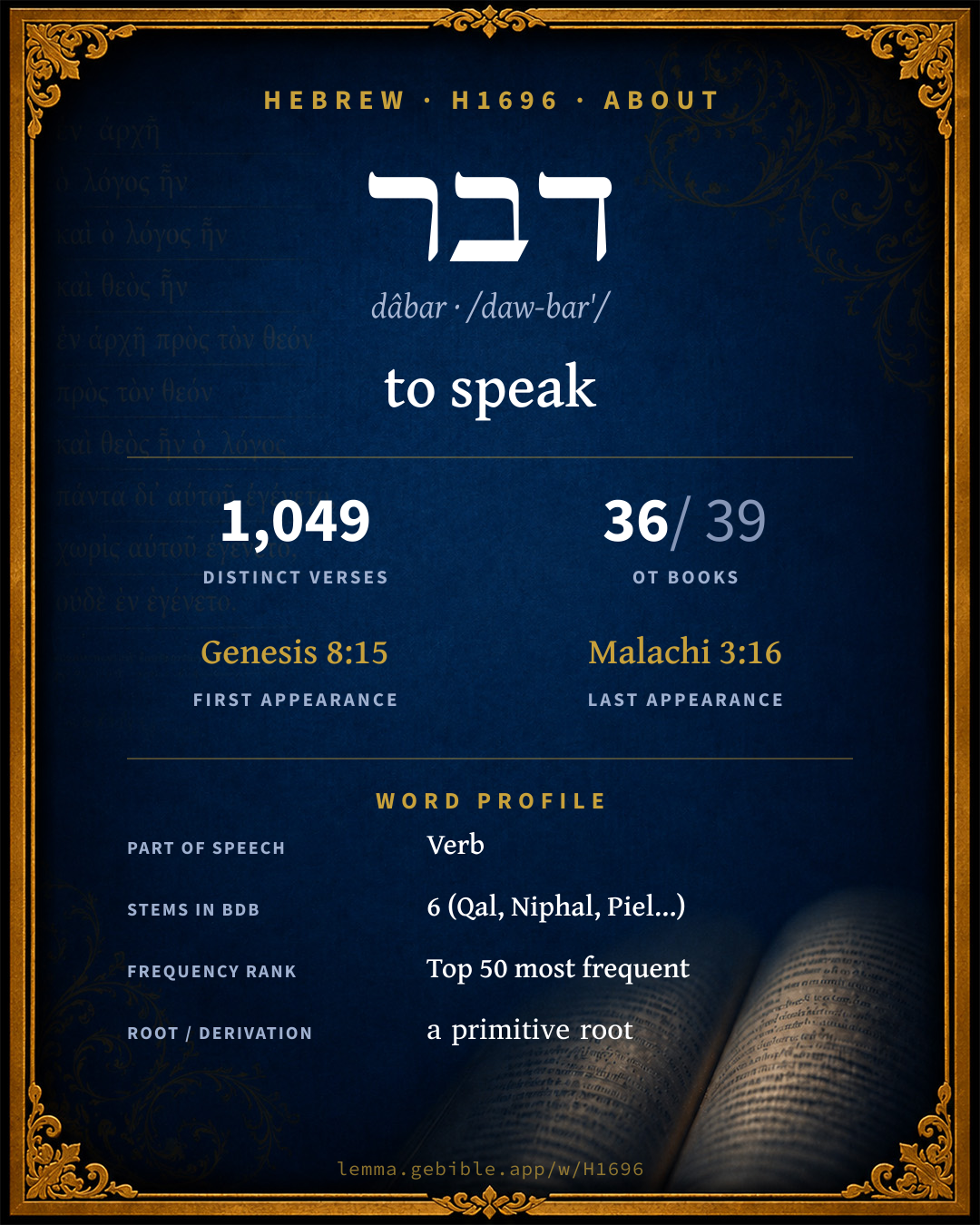
דָבַר
to speak
also: declare, converse, command, promise fuller range ↓
Full lexicon entry — Brown-Driver-Briggs (BDB)
From Brown-Driver-Briggs (BDB)
Where this word appears
Grammar key — what these labels mean
Part of speech
- Verb
- An action or state-of-being word.
Stem
- Piel
- An intensive or resultative active stem. Here: ‘with acc. rei’
- Qal
- The basic, simple active stem — the plain form of the verb (“he wrote”). Here: ‘only inf.’
- Hithpael
- The reflexive or reciprocal stem (the subject acts on itself).
- Niphal
- Usually the simple passive or reflexive of the Qal (“he was written”).
- Hiphil
- The causative active stem (“he caused / brought about”).
- Pual
- The passive counterpart of the Piel.
Form
- Perfect
- A completed action or state — Hebrew marks aspect (completeness) more than strict tense (“he wrote”).
- Sequential Imperfect
- An imperfect with prefixed waw — the standard past-narrative form (waw-consecutive imperfect).
- Infinitive Construct
- A bound verbal noun, frequently with prepositions (“to write / in writing”).
- Imperative
- A direct command (“write!”).
- Imperfect
- An incomplete, ongoing, or future action (“he will / would write”).
- Participle Active
- A verbal adjective expressing ongoing or characteristic action (“writing / one who writes”).
- Sequential Perfect
- A perfect with prefixed waw continuing a preceding imperfect or command (waw-consecutive perfect).
- Cohortative
- A first-person volitional form expressing wish or resolve (“let me / let us write”).
- Infinitive Absolute
- An unbound verbal noun, often intensifying or standing in for a finite verb.
- Jussive
- A third- or second-person volitional form expressing wish or command (“let him write”).
- Participle Passive
- A verbal adjective expressing action received (“written”).
State
- Absolute
- The independent form of a noun, not bound to a following word.
- Construct
- A noun bound to a following noun in a possessive / “of” relationship (the construct chain).
Person
- 3rd Person
- The one spoken about (“he / she / it / they”).
- 1st Person
- The speaker (“I / we”).
- 2nd Person
- The one addressed (“you”).
Gender
- Masculine
- Grammatically masculine.
- Common
- Either gender — not distinguished for this form.
- Feminine
- Grammatically feminine.
Number
- Singular
- One.
- Plural
- More than one (in Hebrew, generally three or more).
Every verse where H1696 appears in the Book of 1 Samuel — 38 distinct verses. Click any verse to open its interlinear word-by-word view. Verse text shown in the World English Bible for context — . Each verse’s Hebrew form is shown with its reference; the English is not keyword-highlighted, since the data carries no word-level English alignment. Use “Compare translations” on any verse to read it across multiple English versions. This concordance covers the Hebrew Bible; Septuagint (Greek Old Testament) occurrences are not indexed here.
1 Samuel
- 1 Samuel 1:13 מְדַבֶּ֣רֶת Piel ptcp.act fs Now Hannah, she spoke in her heart; only her lips moved, but her voice was not heard: therefore Eli thought she had been drunken.
- 1 Samuel 1:16 דִּבַּ֥רְתִּי Piel pf 1cs Don't count your handmaid for a wicked woman; for out of the abundance of my complaint and my provocation have I spoken hitherto.
- 1 Samuel 2:3 תְדַבְּרוּ֙ Piel juss 2mp Talk no more so exceeding proudly; Don't let arrogance come out of your mouth; For Yahweh is a God of knowledge, By him actions are weighed.
- 1 Samuel 3:9 דַּבֵּ֣ר Piel impv 2ms Therefore Eli said to Samuel, Go, lie down: and it shall be, if he call you, that you shall say, Speak, Yahweh; for your servant hears. So Samuel went and lay down in his place.
- 1 Samuel 3:10 דַּבֵּ֔ר Piel impv 2ms Yahweh came, and stood, and called as at other times, Samuel, Samuel. Then Samuel said, Speak; for your servant hears.
- 1 Samuel 3:12 דִּבַּ֖רְתִּי Piel pf 1cs In that day I will perform against Eli all that I have spoken concerning his house, from the beginning even to the end.
- 1 Samuel 3:17 דִּבֶּ֣ר דִּבֶּ֥ר Piel pf 3ms Piel pf 3ms He said, "What is the thing that [Yahweh] has spoken to you? Please don't hide it from me. God do so to you, and more also, if you hide anything from me of all the things that he spoke to you."
- 1 Samuel 4:20 וַ/תְּדַבֵּ֨רְנָה֙ conj + Piel wimpf 3fp About the time of her death the women who stood by her said to her, Don't be afraid; for you have brought forth a son. But she didn't answer, neither did she regard it.
- 1 Samuel 8:21 וַֽ/יְדַבְּרֵ֖/ם conj + Piel wimpf 3ms + sfx pers 3mp Samuel heard all the words of the people, and he rehearsed them in the ears of Yahweh.
- 1 Samuel 9:6 יְדַבֵּ֖ר Piel impf 3ms He said to him, See now, there is in this city a man of God, and he is a man who is held in honor; all that he says comes surely to pass: now let us go there; peradventure he can tell us concerning our journey whereon we go.
- 1 Samuel 9:21 דִּבַּ֣רְתָּ Piel pf 2ms Saul answered, Am I not a Benjamite, of the smallest of the tribes of Israel? and my family the least of all the families of the tribe of Benjamin? why then speak you to me after this manner?
- 1 Samuel 9:25 וַ/יְדַבֵּ֥ר conj + Piel wimpf 3ms When they were come down from the high place into the city, he talked with Saul on the housetop.
- 1 Samuel 10:25 וַ/יְדַבֵּ֨ר conj + Piel wimpf 3ms Then Samuel told the people the manner of the kingdom, and wrote it in a book, and laid it up before Yahweh. Samuel sent all the people away, every man to his house.
- 1 Samuel 11:4 וַ/יְדַבְּר֥וּ conj + Piel wimpf 3mp Then came the messengers to Gibeah of Saul, and spoke these words in the ears of the people: and all the people lifted up their voice, and wept.
- 1 Samuel 14:19 דִּבֶּ֤ר Piel pf 3ms It happened, while Saul talked to the priest, that the tumult that was in the camp of the Philistines went on and increased: and Saul said to the priest, Withdraw your hand.
- 1 Samuel 15:16 דִּבֶּ֧ר דַּבֵּֽר Piel pf 3ms Piel impv 2ms Then Samuel said to Saul, Stay, and I will tell you what Yahweh has said to me this night. He said to him, Say on.
- 1 Samuel 16:4 דִּבֶּ֣ר Piel pf 3ms Samuel did that which Yahweh spoke, and came to Bethlehem. The elders of the city came to meet him trembling, and said, Come you peaceably?
- 1 Samuel 17:23 מְדַבֵּ֣ר וַ/יְדַבֵּ֖ר Piel ptcp.act ms conj + Piel wimpf 3ms As he talked with them, behold, there came up the champion, the Philistine of Gath, Goliath by name, out of the ranks of the Philistines, and spoke according to the same words: and David heard them.
- 1 Samuel 17:28 בְּ/דַבְּר֖/וֹ prep + Piel inf.cs + sfx pers 3ms Eliab his eldest brother heard when he spoke to the men; and Eliab's anger was kindled against David, and he said, Why are you come down? and with whom have you left those few sheep in the wilderness? I know your pride, and the naughtiness of your heart; for you have come down that you might see the battle.
- 1 Samuel 17:31 דִּבֶּ֣ר Piel pf 3ms When the words were heard which David spoke, they rehearsed them before Saul; and he sent for him.
- 1 Samuel 18:1 לְ/דַבֵּ֣ר prep + Piel inf.cs It happened, when he had made an end of speaking to Saul, that the soul of Jonathan was knit with the soul of David, and Jonathan loved him as his own soul.
- 1 Samuel 18:22 דַּבְּר֨וּ Piel impv 2mp Saul commanded his servants, [saying], Commune with David secretly, and say, Behold, the king has delight in you, and all his servants love you: now therefore be the king's son-in-law.
- 1 Samuel 18:23 וַֽ/יְדַבְּר֞וּ conj + Piel wimpf 3mp Saul's servants spoke those words in the ears of David. David said, Seems it to you a light thing to be the king's son-in-law, seeing that I am a poor man, and lightly esteemed?
- 1 Samuel 18:24 דִּבֶּ֥ר Piel pf 3ms The servants of Saul told him, saying, On this manner spoke David.
- 1 Samuel 19:1 וַ/יְדַבֵּ֣ר conj + Piel wimpf 3ms Saul spoke to Jonathan his son, and to all his servants, that they should kill David. But Jonathan, Saul's son, delighted much in David.
- 1 Samuel 19:3 אֲדַבֵּ֥ר Piel impf 1cs and I will go out and stand beside my father in the field where you are, and I will commune with my father of you; and if I see anything, I will tell you.
- 1 Samuel 19:4 וַ/יְדַבֵּ֨ר conj + Piel wimpf 3ms Jonathan spoke good of David to Saul his father, and said to him, Don't let the king sin against his servant, against David; because he has not sinned against you, and because his works have been very good toward you:
- 1 Samuel 20:23 דִּבַּ֖רְנוּ Piel pf 1cp As touching the matter which you and I have spoken of, behold, Yahweh is between you and me forever.
- 1 Samuel 20:26 דִבֶּ֥ר Piel pf 3ms Nevertheless Saul didn't say anything that day: for he thought, Something has happened to him. He is not clean. Surely he is not clean.
- 1 Samuel 24:16 לְ/דַבֵּ֞ר prep + Piel inf.cs It came to pass, when David had made an end of speaking these words to Saul, that Saul said, Is this your voice, my son David? Saul lifted up his voice, and wept.
- 1 Samuel 25:9 וַ/יְדַבְּר֧וּ conj + Piel wimpf 3mp When David's young men came, they spoke to Nabal according to all those words in the name of David, and ceased.
- 1 Samuel 25:17 מִ/דַּבֵּ֖ר prep + Piel inf.cs Now therefore know and consider what you will do; for evil is determined against our master, and against all his house: for he is such a worthless fellow that one can't speak to him.
- 1 Samuel 25:24 וּֽ/תְדַבֶּר conj + Piel juss 3fs She fell at his feet, and said, On me, my lord, on me be the iniquity; and please let your handmaid speak in your ears. Hear the words of your handmaid.
- 1 Samuel 25:30 דִּבֶּ֥ר Piel pf 3ms It shall come to pass, when Yahweh shall have done to my lord according to all the good that he has spoken concerning you, and shall have appointed you prince over Israel,
- 1 Samuel 25:39 וַ/יְדַבֵּ֣ר conj + Piel wimpf 3ms When David heard that Nabal was dead, he said, Blessed be Yahweh, who has pleaded the cause of my reproach from the hand of Nabal, and has kept back his servant from evil: and the evil-doing of Nabal has Yahweh returned on his own head. David sent and spoke concerning Abigail, to take her to him as wife.
- 1 Samuel 25:40 וַ/יְדַבְּר֤וּ conj + Piel wimpf 3mp When the servants of David were come to Abigail to Carmel, they spoke to her, saying, David has sent us to you, to take you to him as wife.
- 1 Samuel 28:17 דִּבֶּ֣ר Piel pf 3ms Yahweh has done to you, as he spoke by me: and Yahweh has torn the kingdom out of your hand, and given it to your neighbor, even to David.
- 1 Samuel 28:21 דִּבַּ֖רְתָּ Piel pf 2ms The woman came to Saul, and saw that he was sore troubled, and said to him, Behold, your handmaid has listened to your voice, and I have put my life in my hand, and have listened to your words which you spoke to me.
About this entry
At a glance — auto-summarized from this page’s data, not written by a person. Every figure links to its source below. This summary describes the numbers; it doesn’t interpret them.
דבר (dâbar) is a Hebrew verb most often rendered “to speak.” Translators differ — “spake” in the King James Version, then “spoke” (unfoldingWord Literal Text), as the renderings breakdown shows. With 1,049 verses in 36 books, it is one of the most common word in the Hebrew Bible. It first appears in Genesis 8:15. Read the stem: it spans 6 stems, including Qal and Niphal. The sections below give every sense, occurrence, and version rendering.
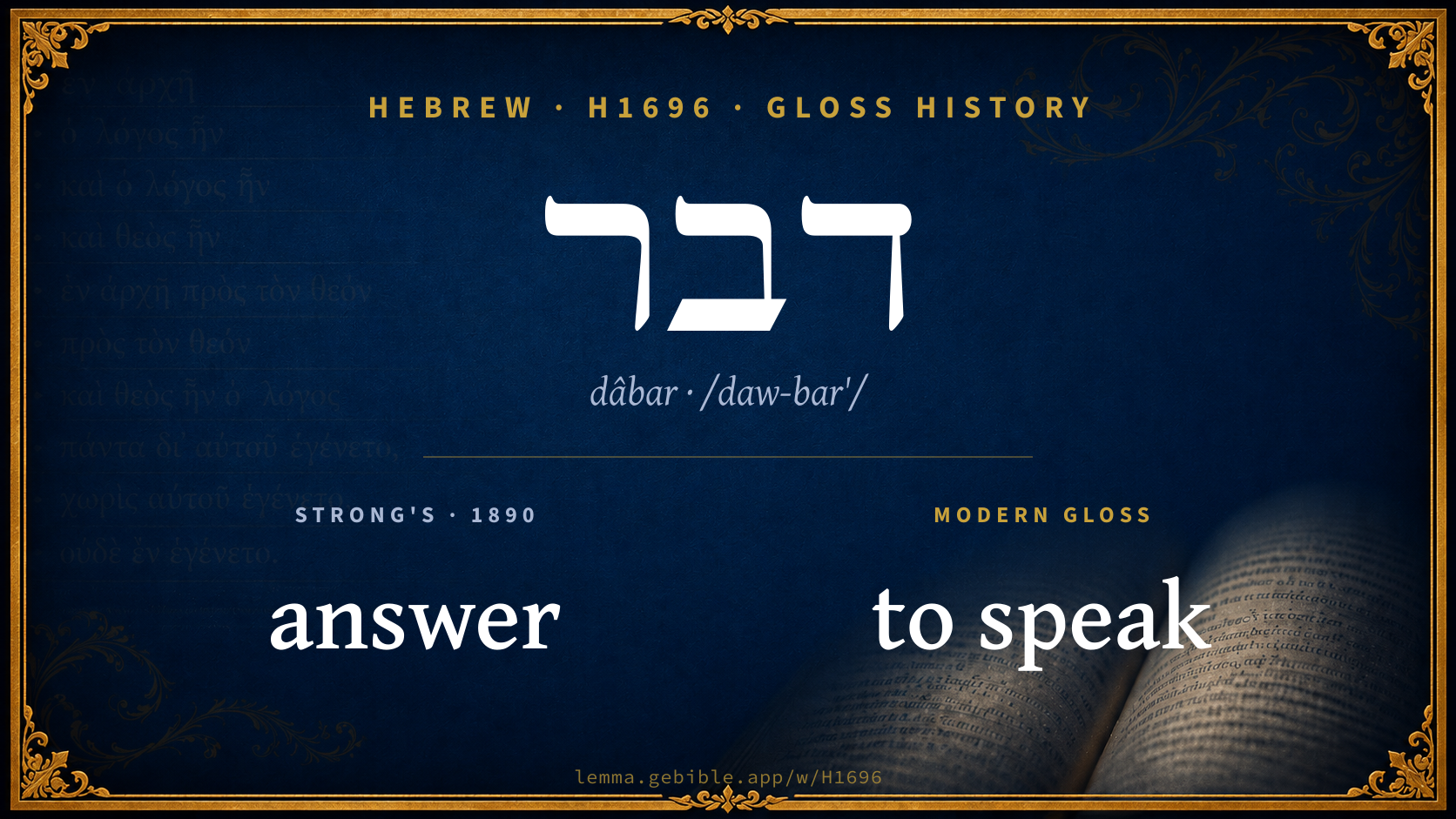
Gloss history
Strong's 1890 vs modern scholarship
About this word
Strong's H1696 catalogs a Hebrew word from the Hebrew Old Testament.
These counts are not copied from any lexicon or concordance. They are computed here, from the morphology-tagged Hebrew Old Testament. What Lemma adds →
- 1,049
- distinct verses
- The word appears in 1,049 distinct verses.
- 36 / 39
- OT books
- The word appears in 36 of 39 Old Testament books.
- #33
- by frequency
- Top 50 most frequent Hebrew words (rank 33 of 8,640 Hebrew words by occurrence).
View all 1,049 occurrences in the concordance →
By section of the Old Testament
By traditional corpus
Conventional, traditional groupings — biblical authorship is debated, so this is a traditional corpus grouping, not an authorship claim. Each share is this word’s portion of its verses in that division of the Hebrew canon. Each figure is a share of the word’s 1,049 distinct verses.
- Prophets (Nevi'im) 486 verses · 46%
- Torah (Pentateuch) 389 verses · 37%
- Writings (Ketuvim) 174 verses · 17%
How translations render this word
Counts come from each version’s own published word-to-Strong’s tagging or interlinear alignment — an approximate guide to how each version renders this word, not a word-level alignment the data otherwise carries. Because each total is that version’s own tagged count, the per-version totals vary from one another and need not match the appearance or distinct-verse counts above. These counts may also differ from a printed concordance because Lemma counts each distinctly tagged rendering and does not collapse phrase taggings into a single head-word total. This is a fixed set of word-tagged versions (KJV, ASV, BSB, ULT) and does not change with the reading translation you choose elsewhere. Each version’s license is shown beside its name below (and on Sources).
- King James Version: Spake 229×, Speak 139×, He spake 43×
- American Standard Version: Spake 240×, Speak 114×, He spake 44×
- Berean Standard Bible: Speak 126×, Said 120×, Spoke 72×
- unfoldingWord Literal Text: Spoke 232×, Speak 183×, And 143×
King James Version Public Domain
Renders H1696 across 1,143 tagged occurrences — most commonly:
Plus other, less common renderings. Plus 204 renderings that appear only once — usually multi-word phrases or single function words the recovered tagging swept in, not distinct renderings.
American Standard Version Public Domain
Renders H1696 across 1,137 tagged occurrences — most commonly:
Plus other, less common renderings. Plus 244 renderings that appear only once — usually multi-word phrases or single function words the recovered tagging swept in, not distinct renderings.
Berean Standard Bible Public Domain
Renders H1696 across 1,112 tagged occurrences — most commonly:
Plus other, less common renderings. Plus 225 renderings that appear only once — usually multi-word phrases or single function words the recovered tagging swept in, not distinct renderings. Not rendered by a distinct English word in 26 further occurrences.
unfoldingWord Literal Text CC BY-SA 4.0
Renders H1696 across 1,330 tagged occurrences — most commonly:
Plus other, less common renderings. Plus 112 renderings that appear only once — usually multi-word phrases or single function words the recovered tagging swept in, not distinct renderings.
24 senses and sub-senses in the full BDB
Hebrew verbs can shift meaning by stem (binyan): Qal is the basic action, Niphal is often passive or reflexive, Piel often intensifies or makes it factitive, and Hiphil is typically causative. The senses below are grouped under the stem BDB assigns to each. This entry also uses Pual (the passive of Piel) and Hithpael (reflexive or reciprocal).
What do BDB’s symbols mean?
BDB uses these scholarly abbreviations:
| Symbol | Meaning |
|---|---|
| 𝔊 | the Septuagint (the ancient Greek translation, LXX) |
| 𝔙 | the Vulgate (the Latin translation) |
| 𝔖 | the Syriac version (the Peshitta) |
| 𝔗 | the Targum (the Aramaic translation) |
| ψ | the Psalms |
| √ | root (the underlying root or stem) |
| ‖ | parallel passage (a synonymous or contrasted parallel) |
| † | the dagger: every passage where the word occurs is cited |
The 24 senses and sub-senses the full Brown-Driver-Briggs lexicon distinguishes for this word, in lexicon order (not ranked by frequency), with BDB’s own verbatim wording and sub-sense lettering. Shown in Hebrew script with BDB’s own scholarly abbreviations. The condensed entry is in the Lexicon Entry tab. See also the Forms in the corpus table below.
Qal
- only inf. (once?) & pt.: Inf. sf. בְּדָרְרֶ֑ךָ (by attraction to בְּשָׁפְטֶ֑ךָ for usual Piel) ψ 51:6; Pt. דֹּבֵר Ex 6:29 + 30 times; pl. דֹּבְרִים Nu 36:5 ψ 109:20; cstr. דֹּבְרֵי ψ 5:7 + 3 times; f. דֹּבְרוֹת Nu 27:7 ψ 31:19; pass. דָּבֻר Pr 25:11;—speak, abs. Nu 27:7; 32:27; 36:5 (P) ψ 51:6 (?); דָּבָר דָּבֻר word spoken Pr 25:11; with acc. rei דֹּבֵר דָּבָר speaking a word Jb 2:13; אמת ψ 15:2, תמים Am 5:10, (מ) ישׁרים Pr 16:13; Is 33:15, צדק Is 45:19, שׁלום Est 10:3 ψ 28:3, שׁקר(ים) ψ 63:12; 101:7; Je 40:16, כזב ψ 5:7; 58:4, רע ψ 109:20, נבלה Is 9:16, הַוַּת נפשׁו Mi 7:3; with אֶל of person, unto Gn 16:13 (J) Ex 6:29 (P) Je 38:20; 40:16 Dn 10:11 Jon 3:2; בְּאָזְנֵי in the ears of Dt 5:1; Je 28:7; עַל concerning, about ψ 31:19; 109:20; Je 32:42 (sometimes rendered against, but dub.); עִם with ψ 28:3; הַמַּלְאָךְ הַדֹּבֵר בִּי the angel that spake with me (as a prophet, an instrument of communicating with Israel) Zc 1:9, 13, 14; 2:2, 7; 4:1, 4, 5; 5:5, 10; 6:4 (vid. prep. בְּ III. 2 Ew§ 217 f. (3)). e.g. Psalms 51:6
Niphal
- Pf. נִדְבְּרוּ Mal 3:16, נִדְבָּ֑רוּ ψ 119:23, נִדְבַּרְנוּ Mal 3:13; Pt. הַנִּדְבָּרִים Ez 33:30; reciprocal sense, speak with one another, talk, abs. Mal 3:16; with בְּ, against ψ 119:23; Ez 33:30; with עַל, concerning, about Mal 3:13 (RV against, vid. Ew § 217 i.) e.g. Malachi 3:16
Piel
- Pf. דִּבֶּר Gn 12:4 +, דִּבֵּ֑ר Gn 21:1 + (on דִּבֶּ֑ר Ex 12:25 Dt 26:19 v. Bö§ 1021 d (1) Köi 188); Impf. יְדַבֵּר Gn 44:7 +, יְדַבֶּר־ Gn 44:18 +; תְּדַבְּרוּן Gn 32:20, תְּדַבֵּר֑וּן ψ 58:2; Imv. דַּבֵּר Gn 24:38 +, דַּבֶּר־ Ex 11:2 +; Inf. דַּבֵּר Gn 24:50 +, דַּבֶּר־ Is 59:13 +; Pt. מְדַבֵּר Gn 27:6 +; f. מְדַבֶּרֶת 1 S 1:13 +;—(הַדִּבֵּר Je 5:13, inf. Ki 48, prob. Ol§ 182 e Kö§ 23 (5), perhaps MV; but more prob. a noun, as Ges§ 52 (2), Anm. 3 Ew§ 156 a, dub. pf. as Sta§ 222; בְּיוֹם דִּבֶּר Ex 6:28 Nu 3:1 Dt 4:15; תְּחִלַּת דִּבֶּר־ Ho 1:2, inf. Ki48 Bö§ 987 (7) Kö§ 23 (5); but more prob. pf., as Ges§ 52 (2), Anm. 3);—speak, e.g. Genesis 12:4
- 1. abs. Dt 18:17 + (throughout the literature) usually with לֵאמֹר, less freq. וַיֹּאמֶר: 2 K 18:28 +, cf. the phrases †דברתי (י׳) אני Ez 5:13 + 18 times Ez; †כי י׳ דבר Is 1:2; 21:17; 22:25; 24:3; 25:8; Je 13:15; Jo 4:8; Ob 18; †כי פי י׳ דבר Is 1:20; 40:5; 58:14; Mi 4:4; †פי ידבר ψ 49:4; †(י)דבר פי ψ 66:14; 145:21; †השׁכם ודבר Je 17:13; 25:3; 35:14; †עוד זה מדבר Jb 1:16, 17, 18. e.g. Deuteronomy 18:17
- 2. with acc. rei, very frequently, ד׳ את הדברים האלה Ex 20:1 Dt 5:19 +; לָמָּה תְּדַבֵּר עוֹד דְּבָרֶיךָ why speakest thou any more of thy affairs? 2 S 19:30; עַד אִם־דִּבַּרְתִּי דְּבָרָ֑י until I have told my errand Gn 24:33; seld. sq. דָּבָר indef.; as ד׳ דָּבָר Is 58:13 speak a (mere, empty) word; so prob. also ד׳ דְּבָרִים Ho 10:4; with other nouns, e.g. דבר קשׁות spake rough words Gn 42:7, 30 (E); ד׳ גבהה proud words 1 S 2:3; טבות friendly words Je 12:6; טוב 1 S 19:4 1 K 22:13 Est 7:9; שׁקר Is 59:3 +, כזב Dn 11:27, אמת Je 9:4 +, שׁוא ψ 12:3 +; דבר שׁיר utter, sing a song Ju 5:12; משׁל 1 K 5:12; יְהוּדִית the Jewish language Ne 13:24; †סרה rebellion Dt 13:6 Je 28:16; 29:32. e.g. Exodus 20:1
- 3. with persons:
- a. rarely acc. יָֽכְלוּ דַבְּרוֹ לְשָׁלֹם they could [not] speak unto him peaceably Gn 37:4 (J; but Ew§ 282 a about him); וַיְדַבֵּר … אֹתָם Nu 26:3 (P, but text corrupt vid. Di; no satisfactory explanation yet given, possibly read אִתָּם vid. d). e.g. Genesis 37:4
- b. most frequently with אֶל throughout the literature: Gn 8:15 +; cf. phrases וַיְדַבֵּר י׳ אֶל מֹשֶׁה לֵאמֹר Ex 6:10 + 87 times; P; but †וידבּר י׳ אל משׁה לך Ex 32:7; 33:1 (JE); דבּר אל אהרן Lv 6:18 + 8 times (P); דבר אל בני ישׂראל Ex 6:9 + 38 times (P); elsewhere, Ex 19:6 (E) Dt 1:3; 4:45 (D) ד׳ אל (כל) העדה Ex 12:3 Lv 19:2 Nu 16:24, 26 (P); ד׳ אל לב speak unto one’s heart Gn 24:45, i.e. to oneself, cf. also ד׳ על לִבָּהּ 1 S 1:13, v. 5 infr.; אל is used inexactly for על 1 S 3:12 1 K 16:12 Is 16:13 Je 27:13; 30:4; 33:14; 36:7, 31; 40:2; 50:1; 51:12, 62 where it is rendered concerning or against. e.g. Genesis 8:15
- c. with לְ, speak to 1 K 2:19 Ez 32:21 Dn 2:4; ליהוה speak, sing to Yahweh words of a song Jos 10:12 (D) 2 S 22:1 (= ψ 18:1 title); in D, דבר ל promise to, in phrases †כאשׁר דבר(י׳) ל Dt 1:11, 21; 6:3; 9:3; 10:9; 11:25; 12:20; 15:6; 18:2; 26:18; 27:3; 29:12 Jos 13:14, 33; 22:4; 23:5, 10 (all D); אשׁר דבר ל Dt 9:28 1 K 8:24, 25, 26 (= 2 Ch 6:15, 16, 17).—דבר ל Gn 24:7; 28:15; 49:28 Ex 32:34 (J) Jos 9;21 (P) Ju 14:7 2 S 23:3 Is 30:10 Zc 9:10 usually rendered speak to, but often rather promise to. הֲיֵשׁ לְדַבֶּר־לָךְ אֶל־הַמֶּלֶךְ is it possible to speak for thee unto the king? 2 K 4:13 (by attraction to לַעֲשׂוֹת לָךְ). e.g. 1 Kings 2:19
- d. with †אֵת speak with Gn 17:3, 22, 23; 21:2; 23:8; 34:6, 8; 35:13, 15 Ex 25:22; 31:18; 34:29, 33, 34, 35 Nu 3:1; 7:89 Jos 22:15, 21 (all P) Gn 35:14; 41:9; 42:7; 45:15 Jos 17:14 (all E) Dt 5:21; sources of S K Ch 2 S 3:27; 7:7 = 1 Ch 17:6 1 K 8:15 = 2 Ch 6:4 1 K 22:24 = 2 Ch 18:23 2 Ch 10:10 (= אל 1 K 12:10) Je 5:5; 7:22; 9:7; 35:2; 38:25 Ez 2:1; 3:22, 24, 27; 14:4; 20:3; 44:5 Dn 1:19 Zc 8:16; cf. phrases †דבר חד את אחד speak one with another Ez 33:30; †דבר משׁפטים את speak judgments with, usually = give judgment against, (not Je 12:1), Je 1:16; 4:12; 12:1; 39:5; 52:9 (= 2 K 25:6); דבר טבות את speak kindly with 2 K 25:28 = Je 52:32. e.g. Genesis 17:3
- e. c. †עִם speak with, (not P), Gn 29:9; 31:24, 29 Ex 19:9; 20:19(×2), 22; 33:9 Nu 11:17; 22:19 Jos 24:27 (all JE) Dt 5:4; 9:10 Ju 6:17 1 S 9:25 (𝔊 Th We Dr וַיִּרְבְּדוּ לְ spread a couch for) 17:23 2 S 13:22 1 K 1:14, 22 2 K 6:33; 18:26 2 Ch 9:1 (= אֶל 1 K 10:2) Ne 9:13 Est 6:14 Je 32:4 Dn 8:18; 9:22; 10:11, 15, 17, 19 Ho 12:5; דִּבַּרְתִּי אֲנִי עִם לִבִּי I Spake, communed with my heart Ec 1:16. e.g. Genesis 29:9
- f. †לִפְנֵי before, in the presence of Ex 6:12 Nu 36:1 (P) Ju 11:11 1 K 3:22 Est 8:3. e.g. Exodus 6:12
- 4. with בְּ:
- a. instrumental, דבר בְּ speak with, by, or by means of a person (vid. supr. Qal ad fin.) Nu 12:2(×2), 6, 8 (E) 2 S 23:2 (cf. Dr), 1 K 22:28 = 2 Ch 18:27, Hb 2:1; †דִּבֶּר בְּשֵׁם speak in the name of Ex 5:23 (J) Dt 18:19, 20(×2), 22 1 Ch 21:19 Je 20:9; 26:16; 29:23; 44:16 Dn 9:6 Zc 13:3; †ביד by the hand of Nu 17:5; 27:23 Jos 20:2 (P) 1 S 28:17 1 K 8:53 + 13 times K, 2 Ch 10:15 (= 1 K 12:15) Is 20:2 Je 37:2; 50:1 Ez 38:17. e.g. Numbers 12:2
- b. local (fig.), בְּאָזְנֵי in the ears of Gn 20:8 (E) Ex 11:2 Dt 32:44 (J) Gn 23:16 Nu 14:28 Jos 20:4 (P) Dt 31:28, 30 Ju 9:2, 3 1 S 8:21; 11:4; 25:24 2 S 3:19(×2) Je 26:15 Pr 23:9; †דבר בלב speak in the heart Ec 2:15. e.g. Genesis 20:8
- c. of the object, speak of, about (prep. בְּ IV. e Ew§ 217 f. (2)) Dt 6:7; 11:19 1 S 19:3, 4 ψ 119:46; 122:8; propose for (a wife) 1 S 25:39 cf. Ct 8:8). e.g. Deuteronomy 6:7
- d. of hostility, against (Ew§ 217 f. (1)) Nu 12:1, 8; 21:5, 7 (E) Jb 19:18 ψ 50:20; 78:19. e.g. Numbers 12:1
- e. of price, בְּנַפְשׁוֹ at the cost of his life 1 K 2:23 (vid. בְּ III. 3). e.g. 1 Kings 2:23
- 5. with †עַל, of the object concerning or about which one speaks Gn 18:19 Nu 10:29 (J) Jos 23:14 (D) Ju 9:3 1 S 25:30 1 K 2:4, 27; 5:13(×2); 14:2, 22:23 (= 2 Ch 18:22), 2 K 10:10, 19:21 = Is 37:22, 1 Ch 22:11 2 Ch 23:3 Je 1:16; 18:7, 8, 9; 42:19. It may have this sense in most if not all of the following, where RV renders 1 K 2:18, 19 Est 7:9 Je 18:20 for; 2 Ch 32:16 Ne 6:12 Je 11:17; 16:10; 25:13; 26:13, 19; 35:17 Ez 36:5 Dn 9:12; 11:36 Ho 7:13 Am 3:1 against; and 1 K 9:5 2 K 22:19 Je 10:1; 19:15 unto (על is used for אל unto 2 Ch 32:19 Je 6:10; 25:2; 26:2 Ho 12:11); cf. the phrase †דבר על לב speak upon the heart, speak kindly, comfort Gn 34:3; 50:21 (E) Ju 19:3 Ru 2:13, 1 S 1:13 (seemingly from context על for אל, to her heart, to herself, vid. Dr), 2 S 19:8 2 Ch 30:22; 32:6 Is 40:2 Ho 2:16. e.g. Genesis 18:19
- 6. with infin. †דבר לעשׂות promise to do Ex 32:14 (J) Dt 1:14 Ez 6:10 Jon 3:10; †דבר לתת promise to give Dt 19:8; †דבר למחות threaten to blot out 2 K 14:27; cf. †דבר להזהיר i.e. so as to warn Ez 3:18; 33:8. e.g. Exodus 32:14
- —וַתָּקָם וַתְּדַבֵּר אֶת־כָּל־זֶרַע הַמַּמְלָכָה 2 Ch 22:10 𝔊 ἀπώλεσε, 𝔙 interfecit, scribal error for וַתְּאַבֵּד 2 K 11:1. Other explanations: plot against, waylay (Arabic دَبَّرَ) Thes MV; pronounce sentence, ellipt. וַתְּדַבֵּר מִשְׁפָּטִים GesHdw Rob; but cf. VB— e.g. 2 Chronicles 22:10
Pual
- Impf. בַּיּוֹם שֶׁיְּדֻבַּר־בָּהּ in the day when she may be spoken for Ct 8:8 (vid. Pi. 4 c); Pt. נִכְבָּדוֹת מְדֻבָּר בָּךְ glorious things are being spoken in thee (RV Pe MV of thee) ψ 87:3. e.g. Song of Solomon 8:8
Hithpael
- Pt. מִדַּבֵּר = מִתְדַּבֵּר with acc. מִדַּבֵּר הַדָּבָר הַזֶּה speaking this word 2 S 14:13; שָׁמַע (אֵת הַקּוֹל) מִדַּבֵּר אֶל׳ heard (the voice, or) one speaking unto Nu 7:89 (P) Ez 2:2; 43:6 (Di Nu 7:89 would read מְדַבֵּר after 𝔊; the meaning not appreciably different from Piel; the Hithp. difficult to reconcile with אֶל). e.g. 2 Samuel 14:13
Hiphil
- Impf. וַיַּדְבֵּר עַמִּים תַּחְתָּי ψ 18:48 (2 S 22:48 has וּמֹרִיד for rare וַיַּדְבֵּר), יַדְבֵּר עַמִּים תַּחְתֵּינוּ 47:4; either (cf. Aramaic דַּבַּר) leads subject (so Ges coegit, De Now), or (cf. Arabic أَدْبَرَ turn the back, retreat) puts to flight, fig. for subdues (so Hi). e.g. Psalms 18:48
Senses from the full Brown-Driver-Briggs lexicon (Brown, Driver, Briggs; Oxford 1906 — public domain), digitized via Sefaria, supplemented by the OpenScriptures HebrewLexicon (CC BY 4.0). Full attribution on Sources.
Word origin
vb. speak (original meaning dub.; range in order Thes is conjectural and not comprehensive enough; treiben MV does not explain Arabic or Heb. usage, but only Aramaic A meaning go away, sustained by Arabic دَبَرَ بِهِ go away with it, would best explain the four branches of usage:—(1) Arabic دَبَرَ depart, perish, iv. retreat, fig. retrograde, decline; دَبْرٌ passing away, death; Assyrian dabâru, Pi. drive away, Bez Orient. Diplom. Vocab., Dibbara, pest-god, Hpt in KAT 2500, דֶּבֶר pestilence. (2) Arabic دَبَرَ follow behind, in time, place, or station; دَبْرٌ part behind, دُبُرٌ back, דְּבִיר hindmost chamber of temple. (3) Syriac ܕܒܰܪ lead, guide, cattle, sheep, government, take a wife, = Aramaic דְּבר; Syriac ܕܳܒܽܘܪܳܐ, Aramaic דַּבָּר leader; Syriac ܕܽܘܒܳܪܳܐ, Aramaic דַּבָּרָא guidance; Syriac ܕܰܒܪܳܐ Aramaic דַּבְרָא, Heb. דֹּבֶר; Syriac ܡܰܕܒܰܪ, Aramaic מַדְבְּרָא, Heb. מִדְבָּר pasture, wilderness; Arabic دِبْرٌ, Syriac ܕܶܒܘܽܪܻܝܬܳܐ, Aramaic דַּבַּרְתָּא, Heb. דְּבוֹרָה swarm of bees, may be in this line, as led by their queen, so Thes. (4) Arabic دَبَّرَ consider the end or issue (of an affair), relate (a story or tradition); دَبَّرَ فِى consider, دَبَّرَ عَلَى plan against; Ph. דבר speak; Heb. דִּבֶּר etc. Syn. of אָמַר say, as Aramaic מַלֵּל with אֲמַר; Gk. λαλεῖν, λέγειν; Lat. loqui, dicere; Germ. reden, sagen)—
— Brown-Driver-Briggs (Oxford 1906, public domain), digitized via Sefaria, supplemented by the OpenScriptures HebrewLexicon (CC BY 4.0). See Sources.
Origin: a primitive root
Jastrow Dictionary
A second Hebrew/Aramaic lexicon for comparison, covering Aramaic and post-biblical (Talmudic, Targumic, Midrashic) usage that the biblical-Hebrew BDB does not. Matched by lemma rather than by Strong’s number, so a lemma may carry more than one Jastrow headword (shown separately below), and the entries cover usage well beyond the Bible.
דָּבַר
- (b. h.) to join, arrange, lead (the flock); v. next w.
- (b. h.) to converse, speak. Ber. 31ᵇ, a. fr. דִּבְּרָה תורה כלשון ב"א the Torah speaks according to the language of men, i.e. uses metaphors and phrases adapted to human understanding. Sot. 12ᵇ שעתיד לְדַבֵּר וכ׳ destined to speak to Divinity. Ter. I, 2 חרש שדִּבְּרוּ … מְדַבֵּר wherever the scholars use the word ḥērēsh, they mean one who neither hears nor talks. Mekh. Bo 7, end, a. fr. או אינו מְדַבֵּר אלא ב־ or does perhaps the text speak only of—? [מְדַבֵּר as a noun, v. s. v.].
- to hold communion, converse. Mekh. Bo, introd. לא נ׳ עמו וכ׳ the Lord did not hold communion with him outside the capital of Egypt. Ib. fr.
- , same, esp. part. f. מִדַּבֶּרֶת being on terms of intimacy with a man. Keth. I, 8 ראוה מד׳ עם אחד (omit בשוק); expl. ib. 13ᵃ. Ib. VII, 6 מד׳ עם כל אדם she is intimate with everybody. Ib. לכשהיא מד׳ בתוך ביתה וכ׳ when her neighbors can hear her voice in moments of intimacy with her husband.
- to make submissive, persuade, v. דִּיבּוּר. Macc. 11ᵃ דִבֵּר לחוד יַדְבֵּר לחוד the Piel dibber has one meaning (speaking harshly), and the Hif. yadber another.
דְּבַר
- 1. to seize, take, lead, drive. Targ. Gen. XIX, 15; a. fr. (h. לקח).—Ib. XXXI, 18; a. fr. (h. נהג).
- 2. to conduct one’s self (cmp. נָהַג). Erub. 14ᵇ, a. e. פוק חזי מאי עמא ד׳ go out and see how the people conduct themselves (what the religious usage is). Koh. R. to IX, 10, v. כְּלוּם.
- 1. to lead, drive. Targ. O. Ex. III, 1 ed. Berl. (ed. דְּבַר). Ib. XIV, 21 (ed. דְּבַר, h. text ויולך). Targ. Ez. XVI, 12; a. e.—Keth. 62ᵇ sq. עד כמה קא מְדַבְּרַת אלמנות חיים how long yet wilt thou lead a life of living widowhood (separation from a living husband)?
- 2. to carry off. Targ. Ezek. XXXIII, 6; a. e.
- to take, lead. Targ. Is. XIV, 2; a. fr.—Bets. 21ᵇ אַדְבְּרֵיה וכ׳ took him out on a walk; ib. 29ᵃ. Y. Yeb. XIII, 13ᶜ bot. מַדְבְּרוּן לה גבר they introduce to her a suitor.
- 1. to be seized, taken away. Targ. Prov. XXIV, 11. Targ. Ez. XXXIII, 6. Targ. II Kings II, 9 sq.; a. e.
- 2. to conduct one’s self. Targ. Gen. XXXIII, 14 אֵידַבַּר ed. Berl. (h. text אתנהלה).
דָּבָר
- preced.)
- 1. word, utterance, command (cmp. דִּיבּוּר). B. Bath. 56ᵇ (ref. to Deut. XIX, 15) ד׳ ולא חצי ד׳ a statement (testimony) but not a partial statement. Mekh. Bo, introd. היה הד׳ לאהרן (Tanḥ. ib. 5 דבור) the word of the Lord came to &c.; a. fr.—דְּבַר תורה according to the Biblical law. Erub. 81; a. fr.—Pl. דְּבָרִים, constr. דִּבְרֵי. ד׳ תורה Biblical laws; ד׳ סופרים Rabbinical laws. Ib. Yeb. IX, 3; a. fr.—ד׳ קבלה prophetic exhortations or incidental utterances in other Biblical books than the Pentateuch. Ḥag. 10ᵇ; Nidd. 23ᵃ; a. e.—B. Mets. 49ᵃ; Bekh. 13ᵇ ד׳ יש בהם משום מחוסרי אמנה to word of mouth the rules concerning the faithless are applied, i.e. a verbal agreement is morally binding. B. Mets. 48ᵃ הנושא ונותן בד׳ וכ׳ he who contracts verbally has no legal claim. Ib. ד׳ ואיכא … קאי באבל he who retracts a verbal transaction with which a payment of money was connected, comes under the category of those against whom the words ‘but the scholars declared’ (ib. IV, 2) has been pronounced.—דִּבְרֵי הַיָּמִים the Book of Chronicles. Lev. R. s. 1. B. Bath. 14ᵇ.—דָּבָר אַחֵר (abbrev. ד"א) another interpretation (is this). Gen. R. s. 1, beg.; a. fr.—2) thing, affair, object, occurrence &c. Sot. 28ᵇ ד׳ שיש בו דעת לישאל an object which has sense to ask, i.e. a rational being, opp. ד׳ שאין וכ׳ dumb creatures &c.—Num. R. s. 11 ד׳ שבינך לבינו that which concerns only thy relation to God; v. בֵּין.—ד׳ שבממון a monetary affair. B. Mets. 94ᵃ; a. fr.—ד׳ הלמד מענינו a thing (law) derived from the context on the very subject. Sifra, introd.; a. fr.—ד׳ אחר (abbr. ד"א) something not to be named, a) idolatry. Men. XIII, 10 ואין צריך לומר לד"א much less priests who have been offering to idols; a. fr.—b) swine. Ber. 43ᵇ (prov.) תלה ליה קורא לד"א וכ׳ hang a palm shoot around the swine and it will follow its habits (of wallowing in the mud). Sabb. 129ᵃ sq.; a. e.—c) leprosy Ib. אי פגע בד"א קשה לד"א if he meets a swine (after blood letting), he is in danger of becoming a leper.—d) unchaste conduct, sexual intercourse, sodomy &c. Ib. 17ᵇ על בנותיהן משום ד"א ועל ד"א משום ד"א they forbade connection with their daughters on account of idolatry, and decreed something else (that a gentile child should be unclean as though afflicted with gonorrhœa) on account of sodomy. Ber. 8ᵇ צנועין בד"א chaste in marital life; a. fr.—Pl. as above.—בעל ד׳ the person to deal with, opponent, party. B. Mets. 14ᵃ לאו ב"ד דידי את I have nothing to do with thee; a. fr.—לא היו ד׳ מעולם there were no such things, I deny it outright. Shebu. 41ᵇ; a. fr.—ד׳ בגב, ד׳ בגו, v. גַּב, גֵּו. e.g. Deuteronomy 19:15
דֶּבֶר
- , esp. Targ. Ez. XXXIII, 6) death, pestilence. Ab. V, 8. Sabb. 33ᵃ; a. fr.—Esp. the plague of pestilence in Egypt. Ex. R. s. 12. Tanḥ. Vaëra 14; a. fr.
דַּבָּר
- (דבר) leader.—Pl. דַּבָּרִין. Snh. 8ᵃ ד׳ אחד וכ׳ a generation must have one leader, but not two.
A Dictionary of the Targumim, the Talmud Babli and Yerushalmi, and the Midrashic Literature (Marcus Jastrow; London, Luzac, 1903) — Public Domain. Digitized via Sefaria. Digitized via Sefaria. Full attribution on Sources.
Forms in the corpus
The 370 distinct written forms H1696 takes in the Hebrew Bible, most frequent first — each parse links to that stem’s occurrences in the concordance. Hebrew forms include their vowel points and cantillation, so a single lemma takes many written forms.
The 60 most common forms are shown; 310 rarer forms follow in the full concordance.
Same root — word family
Other BDB entries built from the same root as H1696, grouped by Strong’s listed origin. These share a root / origin per the lexicon — not necessarily a shared meaning. Each links to that word’s own entry.
Derived from this word
- דבורה dᵉbôwrâh H1682 bee
- דביר dᵉbîyr H1687 holy of holies
- דבר dâbâr H1697 word
- דבר deber H1698 pestilence
- דבר dôber H1699 pasture
- דברה dôbᵉrâh H1702 raft
- דברה dabbârâh H1703 word
- מדבר midbâr H4057 wilderness
Compare all same-root words → Showing 4 of 9 — not the complete family. They share a root, not necessarily a meaning.
Septuagint verse parallels
This word appears in 1,001 verses that also exist in the Greek Old Testament (Septuagint), out of the 1,049 Hebrew verses it occurs in. You can read those verses in Greek by switching the Old Testament edition to the Septuagint.
Read these verses in the Septuagint
- Genesis 8:15
- Exodus 1:17
- Leviticus 1:1
- Numbers 1:1
- Deuteronomy 1:1
- Joshua 1:3
- Judges 1:20
- Ruth 1:18
- 1 Samuel 1:13
- 2 Samuel 2:27
- 1 Kings 1:14
- 2 Kings 1:3
This is a verse-level parallel only — the same verses exist in both the Hebrew and Greek Old Testaments. No word-level Hebrew↔Greek correspondence is claimed: the data carries no such alignment, so no Greek word is shown as this Hebrew word’s translation. Coverage is not total — the Septuagint omits the deuterocanon and renumbers the Psalms, so some Hebrew verses have no direct Greek parallel.