Numbers 12:2

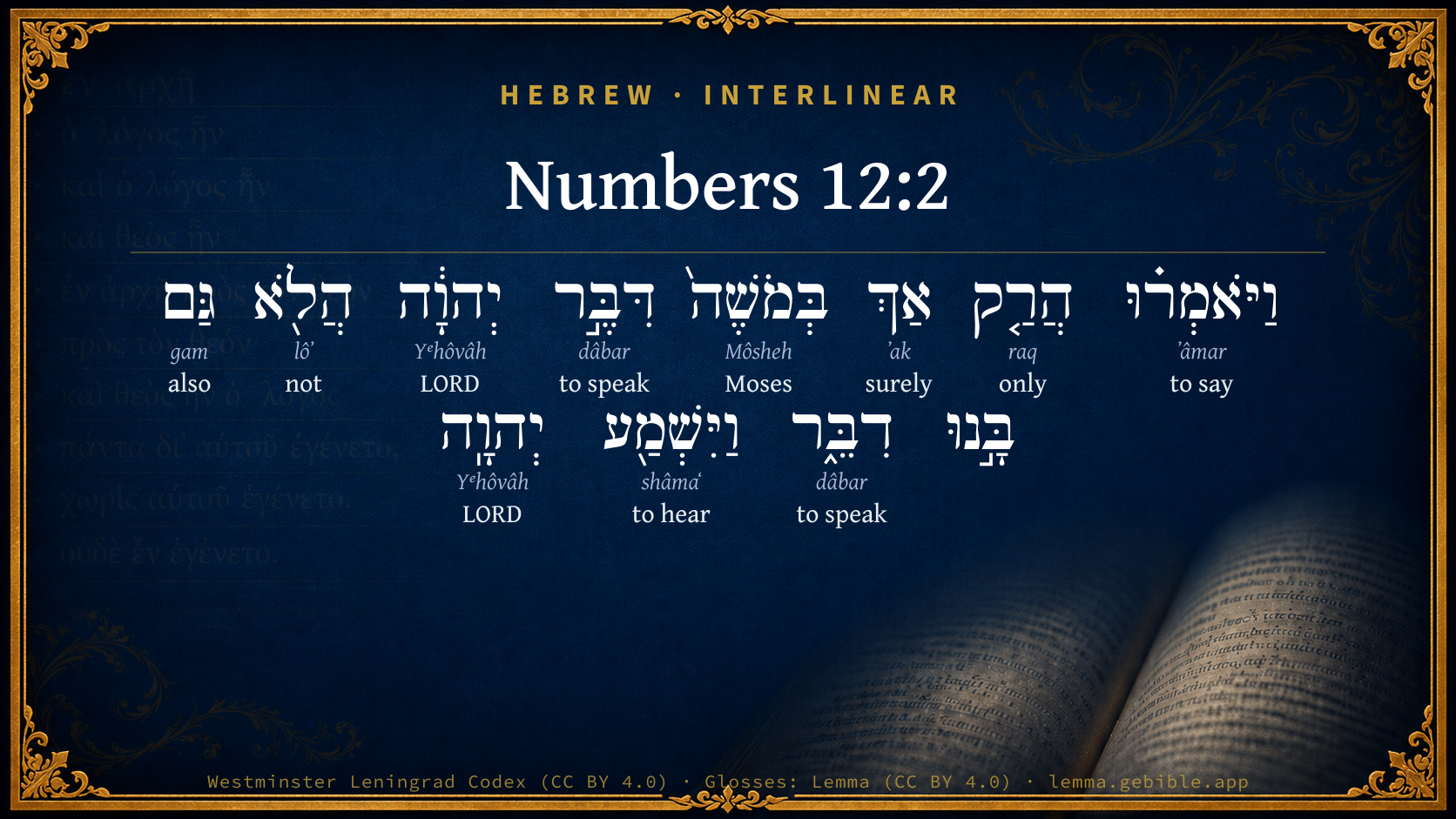
Hebrew (Westminster Leningrad Codex) Numbers 12:2 appears in the Hebrew Old Testament. The text above is from the Westminster Leningrad Codex. Each word links to its Strong’s number, a concise gloss, and parsing drawn from the Open Scriptures Hebrew Bible morphology. Click any word for its full Brown-Driver-Briggs (BDB) entry.
Download image
Cite this verse

Numbers 12:2 (World English Bible). Public Domain. Lemma interlinear Bible study tool, https://lemma.gebible.app/v/numbers/12/2.

Show BibTeX & RIS
BibTeX
RIS
English Translation
They said, Has Yahweh indeed spoken only with Moses? Hasn't he spoken also with us? Yahweh heard it.
World English Bible · Public Domain
Download a study sheet

One document with this verse’s original text, its word-by-word gloss line, the meaning frame, cross-references with their text, attributed commentary, and full source and license credits — printable, and it pastes into notes with its structure intact.

This verse Autodidact and up

Study sheet (.html) Plain text (.txt)

A passage Seminary Student

Up to 50 verses in one chapter. A passage sheet keeps up to 6 commentary sources and 12 cross-references per verse, in the order this page ranks them, and says so on the sheet whenever that leaves anything out. Ask for a single verse and you get the Autodidact verse sheet above.

Everything on this page stays free to read, with no account — the sheet is a download of what is already on screen, not access to it.

Want to remove ads? Support Godless Engineer
Compare translations 3

The same verse in 3 English versions, stacked beneath the original-language interlinear above. Click any original word for its lexicon entry.

Each is an independent rendering of the whole verse — the interlinear is not word-aligned to these translations.

Highlighted words mark where these versions differ — a whole-verse word diff, not a word-by-word alignment.

  • World English Bible Public Domain
    They said, Has Yahweh indeed spoken only with Moses? Hasn't he spoken also with us? Yahweh heard it.
  • King James Version Public Domain
    And they said, Hath the LORD indeed spoken only by Moses? hath he not spoken also by us? And the LORD heard it.
  • unfoldingWord Literal Text CC BY-SA 4.0
    And they said, “Did Yahweh really only speak in Moses? Did he not speak also in us?” And Yahweh heard.

unfoldingWord Literal Text — © unfoldingWord, licensed CC BY-SA 4.0. Word-aligned USFM3 via Door43 (git.door43.org/unfoldingWord/en_ult).

Versions to compare (up to 4)

3 of 4 selected

Show all 18 translations

Every available English version of this verse, each an independent rendering of the whole verse.

  • World English Bible Public Domain
    They said, Has Yahweh indeed spoken only with Moses? Hasn't he spoken also with us? Yahweh heard it.
  • Berean Standard Bible Public Domain
    “Does the LORD speak only through Moses?” they said. “Does He not also speak through us?” And the LORD heard this.
  • Majority Standard Bible Public Domain
    “Does the LORD speak only through Moses?” they said. “Does He not also speak through us?” And the LORD heard this.
  • King James Version Public Domain
    And they said, Hath the LORD indeed spoken only by Moses? hath he not spoken also by us? And the LORD heard it.
  • American Standard Version (1901) Public Domain
    And they said, Hath Jehovah indeed spoken only with Moses? hath he not spoken also with us? And Jehovah heard it.
  • Revised Version (1885) Public Domain
    And they said, Hath the LORD indeed spoken only with Moses? hath he not spoken also with us? And the LORD heard it.
  • Geneva Bible (1599) Public Domain
    And they saide, What? hath the Lord spoken but onely by Moses? hath he not spoken also by vs? and the Lord heard this.
  • Douay-Rheims (1899) Public Domain
    And they said: Hath the Lord spoken by Moses only? hath he not also spoken to us in like manner? And when the Lord heard this,
  • Young's Literal Translation Public Domain
    and they say, `Only by Moses hath Jehovah spoken? also by us hath he not spoken?' and Jehovah heareth.
  • Literal Standard Version CC BY-SA 4.0
    and they say, “Has YHWH only spoken by Moses? Has he not also spoken by us?” And YHWH hears.
  • Unlocked Literal Bible CC BY-SA 4.0
    They said, “Has Yahweh spoken only with Moses? Has he not spoken also with us?” Now Yahweh heard what they said.
  • unfoldingWord Literal Text CC BY-SA 4.0
    And they said, “Did Yahweh really only speak in Moses? Did he not speak also in us?” And Yahweh heard.
  • Darby Bible Public Domain
    And they said, Has Jehovah indeed spoken only to Moses? has he not spoken also to us? And Jehovah heard it.
  • World Messianic Bible Public Domain
    They said, “Has the LORD indeed spoken only with Moses? Hasn’t he spoken also with us?” And the LORD heard it.
  • Webster's Bible Public Domain
    And they said, Hath the LORD indeed spoke only by Moses? hath he not spoke also by us? And the LORD heard it.
  • Free Bible Version CC BY-SA 4.0
    “Is it only through Moses that the Lord speaks?” they asked. “Doesn't he speak through us too?” The Lord heard all this.
  • Bible in Basic English Public Domain
    And they said, Have the words of the Lord been given to Moses only? have they not come to us? And the Lord took note of it.
  • JPS Tanakh (1917) Public Domain
    And they said: 'Hath the LORD indeed spoken only with Moses? hath He not spoken also with us?' And the LORD heard it. —

Literal Standard Version (2020), Covenant Press — licensed CC BY-SA 4.0. Text via the HelloAO Bible API (eBible.org). Unlocked Literal Bible (unfoldingWord) — licensed CC BY-SA 4.0. Text via the HelloAO Bible API (eBible.org). unfoldingWord Literal Text — © unfoldingWord, licensed CC BY-SA 4.0. Word-aligned USFM3 via Door43 (git.door43.org/unfoldingWord/en_ult). Free Bible Version, Dr. Jonathan Gallagher — licensed CC BY-SA 4.0. Text via the HelloAO Bible API (eBible.org).

Word by word

More ways to search: Search by grammar → Find every occurrence → Compare this word →

Practice this passage: Drill this verse → Learn its vocabulary →

הֲרַ֤ק
raq
H7535
“only”
Particle, Interrogative + Adverb
Part of Speech
Particle + Adverb
Full BDB Definition

Origin: the same as H7534 as a noun

TWOT: 2218a

only, altogether, surely - only - only, nought but, altogether (in limitation) - save, except (after a negative) - only, altogether, surely (with an affirmative) - if only, provided only (prefixed for emphasis) - only, exclusively (for emphasis)
  1. וַיֹּאמְר֗וּ ʼâmar H559 “and · to say” Conjunction + Verb, Qal, Sequential Imperfect, 3rd Person, Masculine, Plural
  2. אַךְ ʼak H389 “surely” Particle, Accusative
  3. בְּמֹשֶׁה֙ Môsheh H4872 “in/at · Moses” Preposition + Noun, Proper
  4. דִּבֶּ֣ר dâbar H1696 “to speak” Verb, Piel, Perfect, 3rd Person, Masculine, Singular
  5. יְהוָ֔ה Yᵉhôvâh H3068 “LORD” Noun, Proper
  6. הֲלֹ֖א lôʼ H3808 “not” Particle, Interrogative + Particle, Negative
  7. גַּם gam H1571 “also” Particle, Accusative
  8. דִבֵּ֑ר dâbar H1696 “to speak” Verb, Piel, Perfect, 3rd Person, Masculine, Singular
  9. וַיִּשְׁמַ֖ע shâmaʻ H8085 “and · to hear” Conjunction + Verb, Qal, Sequential Imperfect, 3rd Person, Masculine, Singular
  10. יְהוָֽה Yᵉhôvâh H3068 “LORD” Noun, Proper

About this verse

These counts appear in no published source. They are computed here, from the morphology-tagged text and Lemma’s own curated glosses. What Lemma adds →

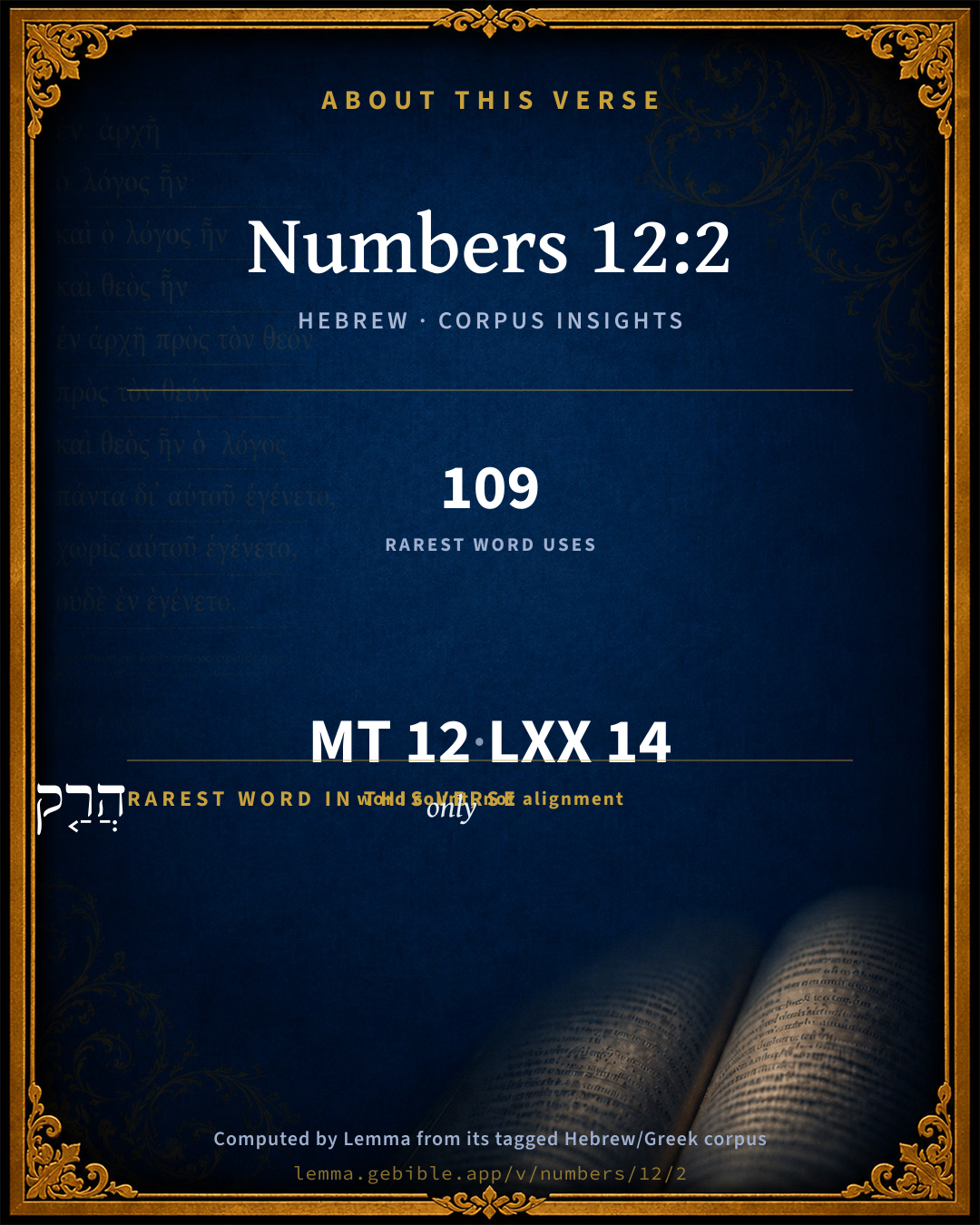
12
words
9
distinct lemmas
Pentateuch
section

Grammatical profile

  • 4 verbs
  • 3 nouns
  • 1 preposition
  • 1 adverb
  • 3 particles

Verb forms

  • וַיֹּאמְר֗וּ Qal · Sequential Imperfect
  • דִּבֶּ֣ר Piel · Perfect
  • דִבֵּ֑ר Piel · Perfect
  • וַיִּשְׁמַ֖ע Qal · Sequential Imperfect

Repetition

Words recur within this verse — often emphatic in Hebrew:

  • דִּבֶּ֣ר to speak H1696 ×2
  • יְהוָ֔ה LORD H3068 ×2

Hebrew & Septuagint length

In English translation the verse runs 18 words from the Hebrew and 22 from the Septuagint (LXX English) — closely comparable.

A rough comparison of the two English renderings, which tokenize alike — not a word-level alignment.

Word counts can differ between the Hebrew and the Greek without any difference in meaning — e.g. the Hebrew direct-object marker אֵת has no separate Greek word, and Greek often adds the article ὁ.

In the original languages it is 12 Hebrew tokens and 14 Greek tokens — but the two are counted differently (Hebrew bundles its prefixes and suffixes into one token; the Greek is in lemma form), so that isn’t a like-for-like length.

Cross-references

20

Topical passages linked to Numbers 12:2 in the Treasury of Scripture Knowledge — connected by theme and wording, ordered by reader-vote popularity; previews shown in the World English Bible.

  • Numbers 16:3 and they assembled themselves together against Moses and against Aaron, and said to them, You take too much on you, seeing all the congregation are holy, everyone of them, and Yahweh is among them: why then lift yourselves up above the assembly of Yahweh?
  • Ezekiel 35:12–13 You shall know that I, Yahweh, have heard all your insults which you have spoken against the mountains of Israel, saying, They are laid desolate, they are given us to devour.
  • Isaiah 37:4 It may be Yahweh your God will hear the words of Rabshakeh, whom the king of Assyria his master has sent to defy the living God, and will rebuke the words which Yahweh your God has heard. Therefore lift up your prayer for the remnant that is left.
  • Micah 6:4 For I brought you up out of the land of Egypt, And redeemed you out of the house of bondage. I sent before you Moses, Aaron, and Miriam.
  • Philippians 2:3 doing nothing through rivalry or through conceit, but in humility, each counting others better than himself;
  • Philippians 2:14 Do all things without murmurings and disputes,
  • Numbers 11:1 The people were as murmurers, [speaking] evil in the ears of Yahweh: and when Yahweh heard it, his anger was kindled; and the fire of Yahweh burnt among them, and devoured in the uttermost part of the camp.
  • 2 Kings 19:4 It may be Yahweh your God will hear all the words of Rabshakeh, whom the king of Assyria his master has sent to defy the living God, and will rebuke the words which Yahweh your God has heard. Therefore lift up your prayer for the remnant that is left.
  • Romans 12:10 In love of the brothers be tenderly affectionate one to another; in honor preferring one another;
  • Numbers 11:29 Moses said to him, Are you jealous for my sake? would that all Yahweh's people were prophets, that Yahweh would put his Spirit on them!
  • 2 Samuel 11:27 When the mourning was past, David sent and took her home to his house, and she became his wife, and bore him a son. But the thing that David had done displeased Yahweh.
  • Romans 12:3 For I say, through the grace that was given me, to every man who is among you, not to think of himself more highly than he ought to think; but to think reasonably, as God has apportioned to each person a measure of faith.
  • 1 Peter 5:5 Likewise, you younger ones, be subject to the elder. Yes, all of you gird yourselves with humility, to subject yourselves to one another; for "God resists the proud, but gives grace to the humble."
  • Genesis 29:33 She conceived again, and bare a son, and said, "Because Yahweh has heard that I am hated, he has therefore given me this son also." She named him Simeon.
  • Exodus 5:1 Afterward Moses and Aaron came, and said to Pharaoh, "This is what Yahweh, the God of Israel, says, 'Let my people go, that they may hold a feast to me in the wilderness.'"
  • Exodus 7:10 Moses and Aaron went in to Pharaoh, and they did so, as Yahweh had commanded: and Aaron cast down his rod before Pharaoh and before his servants, and it became a serpent.
  • Psalms 94:7–9 They say, "Yah will not see, Neither will Jacob's God consider."
  • Proverbs 13:10 Pride only breeds quarrels, But with ones who take advice is wisdom.
  • Exodus 4:30 Aaron spoke all the words which Yahweh had spoken to Moses, and did the signs in the sight of the people.
  • Exodus 15:20–21 Miriam the prophetess, the sister of Aaron, took a tambourine in her hand; and all the women went out after her with tambourines and with dances.

Cross-references courtesy of OpenBible.info (CC BY 4.0).

Hebrew and Greek witnesses Masoretic Hebrew ↔ Greek Septuagint

The same verse in the two great witnesses to the Old Testament, shown verse-for-verse.

These are two independent witnesses, not word-aligned to each other, and the Septuagint is shown in lemma (dictionary) form.

Hebrew Numbers 12:2 Masoretic · Westminster Leningrad Codex

וַיֹּאמְר֗וּ הֲרַ֤ק אַךְ בְּמֹשֶׁה֙ דִּבֶּ֣ר יְהוָ֔ה הֲלֹ֖א גַּם בָּ֣נוּ דִבֵּ֑ר וַיִּשְׁמַ֖ע יְהוָֽה

They said, Has Yahweh indeed spoken only with Moses? Hasn't he spoken also with us? Yahweh heard it.

World English Bible · Public Domain

Greek LXX Numbers 12:2 Septuagint · lemma form

καί εἶπον μή μωυσῆς μόνος λαλέω κύριος οὐ καί ἐγώ λαλέω καί ἀκούω κύριος

And they said, Has the Lord spoken to Moses only? has he not also spoken to us? and the Lord heard it.

LXX2012 (modern English Septuagint) · Public Domain

Hebrew: Westminster Leningrad Codex (CC BY 4.0). Greek: Septuagint (public domain); English from LXX2012 (modern English Septuagint) (Public Domain). How the Septuagint differs from the Hebrew →

Targum (Aramaic paraphrase)

2

The Targum is the ancient Jewish Aramaic paraphrase of the Hebrew Scriptures — an interpretive translation, not the Hebrew text itself. Onkelos (literal) and Pseudo-Jonathan (expansive) render the Torah, and Jonathan the Prophets. Coverage is partial: where no permissively-licensed English translation exists for a verse, only the Aramaic is shown. This is verse-level text, not a word-by-word alignment to the Hebrew.

  1. Targum Onkelos Torah (Genesis–Deuteronomy)
    וַאֲמָרוּ הַלְחוֹד בְּרַם בְּמשֶׁה מַלִיל יְיָ הֲלָא אַף עִמָנָא מַלִיל וּשְׁמִיעַ קֳדָם יְיָ

    (no public-domain English translation for this verse)

    Targum Onkelos — Aramaic: “Onkelos Genesis” (public domain); “Onkelos Exodus” (public domain); “Onkelos Leviticus” (public domain); “Onkelos Numbers” (public domain); “Onkelos Deuteronomy” (public domain). English: “Sefaria Community Translation” (CC0 1.0 (public-domain dedication)); “J.W. Etheridge. The Targums of Onkelos and Jonathan Ben Uzziel on the Pentateuch. London: Longmans, Green, 1862” (public domain). Text via Sefaria.

  2. Targum Pseudo-Jonathan Torah (Genesis–Deuteronomy)
    וְאָמְרוּ הַלְחוֹד בְּרַם עִם משֶׁה מַלֵיל יְיָ דְאִתְפְּרַשׁ מִתַּשְׁמִישׁ דְעָרִיס הֲלָא אוֹף עִמָנָא מַלֵיל וּשְׁמִיעַ קֳדָם יְיָ

    And they said, Hath the Lord spoken only with Mosheh, that he should be separated from the married life? Hath He not spoken with us also? And it was heard before the Lord.

    Targum Pseudo-Jonathan — Aramaic: “Targum Jonathan on Genesis” (public domain); “Targum Jonathan on Exodus” (public domain); “Targum Jonathan on Leviticus” (public domain); “Targum Jonathan on Numbers” (public domain); “Targum Jonathan on Deuteronomy” (public domain). English: “The Targum of Jonathan ben Uzziel, trans. J. W. Etheridge, London, 1862” (public domain). Text via Sefaria.

Commentary

Notes on Numbers 12:2 from classic Christian and Jewish commentators (each source and its license shown beneath its notes). The classic Christian expositions comment on the surrounding passage and are grouped to its opening verse, so a note may address several verses; the Jewish commentaries on the Tanakh (Rashi and others) are per-verse, so they appear only where the commentator wrote on this verse.

Lemma curates 59 commentaries, every one of them public domain or Creative Commons licensed, each selected and text-cleaned for this edition rather than reprinted as found. About our sources →

Trapp's Complete Commentary

John Trapp

Num 12:2 And they said, Hath the LORD indeed spoken only by Moses? hath he not spoken also by us? And the LORD heard [it].

Ver. 2. Hath the Lord spoken only by Moses.] Every man would be something at home; and many care not to raise themselves upon other men’s ruins. Self-love teacheth such to turn the glass, to see themselves bigger, others lesser than they are. That man hath true light that can be content to be a candle before the sun of others.

And the Lord heard it.] Without any delation of Moses. But while Moses is dumb, God speaks; while he is deaf, God hears and stirs. The more silent the patient is, the more shrill his wrong will be.

John Trapp, A Commentary or Exposition upon All the Books of the Old and New Testament (1647–1656) — public domain. Text from a community e-Sword module.

Joseph Benson's Commentary

Num 12:2. By us — Are not we prophets as well as he? So Aaron was made, (Exo 4:15-16,) and so Miriam is called, Exo 15:20. And Moses hath debased and mixed the holy seed, which we have not done. Why then should he take all power to himself, and make rulers as he pleaseth, without consulting us? The Lord heard — Observed their words and carriage to Moses.

Joseph Benson's Commentary on the Old and New Testaments (1811–1818) — public domain. Text from a community e-Sword module.

Tyndale Open Study Notes

Tyndale Open Resources

12:2 The challenge to Moses’ authority was, by implication, a rejection of the Lord’s choice of Moses as Israel’s leader. • the Lord heard: The same phrase in 11:1 foreshadows the Lord’s response.

Tyndale Open Study Notes — © Tyndale Open Resources, licensed CC BY-SA 4.0. Text via the HelloAO Bible API.

Jamieson, Fausset & Brown

Robert Jamieson, A. R. Fausset & David Brown

Hath the Lord indeed spoken only by Moses? hath he not also spoken by us?--The prophetical name and character was bestowed upon Aaron (Exo 4:15-16) and Miriam (Exo 15:20); and, therefore, they considered the conduct of Moses, in exercising an exclusive authority in this matter, as an encroachment on their rights (Mic 6:4).

Jamieson, Fausset & Brown — Commentary Critical and Explanatory on the Whole Bible (1871) — public domain (CC PDM 1.0). Text via the HelloAO Bible API.

Adam Clarke's Commentary

Verse 2. Hath the Lord indeed spoken only by Moses?] It is certain that both Aaron and Miriam had received a portion of the prophetic spirit, (see Ex 4:15, and Ex 15:20), and therefore they thought they might have a share in the government; for though there was no kind of gain attached to this government, and no honour but such as came from God, yet the love of power is natural to the human mind; and in many instances men will sacrifice even honour, pleasure, and profit to the lust of power.

Adam Clarke's Commentary on the Bible (1810–1826) — public domain. Text from a community e-Sword/MySword module.

Ellicott's Commentary for English Readers

(2) Hath the Lord indeed spoken only by Moses?—There is probably a reference in these words to the facts related in Exo_4:10-16, where Moses speaks of his own slowness of speech (Num_12:10), and where it is said of Aaron, “And he shall be thy spokesman unto the people” (Num_12:16). Miriam also is spoken of in Exo_15:20 as “the prophetess.” “Such is the depravity of human nature,” writes Calvin, “that they not only abuse the gifts of God towards the brother whom they despise, but by an ungodly and sacrilegious glorification extol the gifts themselves in such a manner as to hide the Author of the gifts.”

A Bible Commentary for English Readers, edited by Charles John Ellicott (1878–1897) — public domain. Text from a community e-Sword module.

The Cambridge Bible for Schools and Colleges

gen. ed. J. J. S. Perowne

2. They do not deny Moses’ prophetic capacity, but they claim an equality with him. If Num_12:1 is not a fragment of a separate narrative, as some think, we must suppose that Moses’ marriage was the particular case which gave rise to their claim.

indeed spoken only] The Heb. is emphatic by the use (not found elsewhere) of the two synonyms—spoken only and solely.

with Moses] R.V. marg. ‘by Moses’ is a possible rendering, implying that Jehovah makes use of His prophet as a channel of communication with other men. But in Num_12:6 the poetic parallelism shews that ‘with him (in a dream)’ is equivalent to ‘unto him (in a vision).’ It is better, therefore, to retain that meaning here.

The Cambridge Bible for Schools and Colleges (gen. ed. J. J. S. Perowne; Cambridge University Press, 1878–1918) — public domain. Text from a community e-Sword module.

John Gill's Exposition

And they said, hath the Lord, indeed spoken only by Moses?.... They own he had spoken by him; this was so notorious that it could not be denied:

hath he not spoken also by us? are we not prophets as well as he? the Lord spake to Aaron while he was in Egypt, and had made him a good spokesman in his name, and bore this testimony of him, that he could speak well, and Miriam is expressly called a prophetess, Exo 4:14 Exo 15:20; and this being the case, they stomached it that they should have no concern in the choice and appointment of the seventy elders:

and the Lord heard it; for perhaps this was said secretly between themselves; but God, that sees, and hears, and knows all things, took notice of what was spoken by them, and resented it; for it was ultimately against himself, who had ordered Moses to do what he did.

John Gill's Exposition of the Whole Bible (1746–1763) — public domain (CC PDM 1.0). Text via the HelloAO Bible API.

Matthew Poole's English Annotations

Are not we prophets as well as he? so Aaron was made, Exo 4:15,16, and so Miriam is called, Exo 15:20. See also Mic 6:4. And Moses hath debased and mixed the holy seed, which we have not done. Why then should he take all power to himself, and make rulers as he pleaseth, without consulting us in the case? The Lord heard it, i. e. observed their words and carriage to Moses.

Matthew Poole's English Annotations on the Holy Bible (1683–1685) — public domain. Text from a community e-Sword/MySword module.

Whedon's Commentary on the Bible

Daniel D. Whedon

2. Only by Moses — Jealousy of Moses, as the exclusive organ of divine revelation, is the inspiration of this unpleasant affair. Human forbearance is put to a severe test when those who were once our equals or inferiors are promoted to dignities and honours far above us. This truthfulness to fallen human nature is no small confirmation of the reality of this account.

And the Lord heard — The fact here mentioned prepares the way for the divine judgment which follows.

Daniel D. Whedon (gen. ed.), Commentary on the Old and New Testaments (1874–1909) — public domain. Text from a community e-Sword module.

The Pulpit Commentary

And they said, Hath the Lord indeed spoken only by Moses? hath he not spoken also by us? This is evidently not the "speaking against Moses" mentioned in the previous verse, for that is distinctly said to have been on the score of Moses" marriage. This is their justification of themselves for daring to dispute his judgment and arraign his proceedings; a thing which clearly required justification. Moses himself, or more likely others for him, had remonstrated with them on the language they were using. They retorted that Moses had no monopoly of Divine communications; Aaron also received the revelation of God by Urim and Thummim, and Miriam was a prophetess. They were acknowledged in a general sense as sharing with him the leadership of Israel; (see Mic_6:4) upon this they meant to found a claim to coordinate authority. They would have had perhaps all matters settled in a family council in which they should have had an equal voice. It was hard for them both to forget that Moses was only their younger brother: for Miriam that she had saved his life as an infant; for Aaron that he had been as prominent as Moses in the original commission from God to the people. And the Lord heard it. In one sense he hears everything; in another sense there are many things which he does not choose to hear, because he does not wish to take judicial notice of them. Thus he had not "heard" the passionate complaints of Moses himself a short time before, because his will was then to pardon, not to punish. (cf. Isa_42:19 Mal_3:16)

The Lord listening.

"And the Lord heard it." Compare with this the words," And the Lord hearkened and heard". (Mal_3:16) We are thus reminded that God listens not only to take note of our sinful words, but to record every loving, faithful word, spoken of him or for him. What a proof of the omnipotence of God! Wonderful that he should attend to every prayer addressed to him. Still more so that he should listen to every word spoken not to him but to others. But at the same moment he can hear the brooks murmuring over their rocky beds, the trees clapping their hands, the floods lifting up their voice, the birds singing in the branches, the young lions roaring for their prey, and every sound of joy or cry of pain, every hymn of praise or word of falsehood issuing from human lips. (Psa_139:3, Psa_139:4, Psa_139:6) Without speaking of direct prayers we may seek illustrations of the truth that God listens to everything we say to one another, records it, passes his judgment on it, and lays it up in store as one of the materials of his future verdict on our lives. We may regard this truth

I AS AN ENCOURAGEMENT. As illustrations

1. Turn to the scene described in Mal_3:16. A few godly persons are trying to keep alive the flame of piety in a godless age (verses 13-15). Apply to social means of grace for mutual edification.

2. See that Christian man on a lonely walk, courteously conversing with a stranger, and seeking to recommend Christ to him. The stranger may go away to pray or to scoff, but that is not all. God hears and records the words as one of the good deeds done in the body. (2Co_5:10)

3. A godly mother in the midst of daily duties, not only praying but soliloquizing, as in Psa_62:1, Psa_62:2, Psa_62:5-7. Whether or not she may say Psa_5:1, God does "give ear," and the words are "acceptable". (Psa_19:14)

4. Sufferers lamenting; e. g. Hagar; (Gen_16:11) Ishmael; (Gen_21:17) Israel in Egypt; (Exo_2:24) mourners in Zion. (Isa_30:19)

II AS A WARNING. The truth has its shady as well as its sunny side. We may apply to

1. The swearer"s prayer, not intended for the ear of God, but reaching it.

2. Calumnies and backbitings, e.g., against Moses (verses 1, 2), or other servants of God; (cf. Zep_2:8) perhaps disliked because their lives are a rebuke to others. (cf. Psa_94:4, Psa_94:7, Psa_94:8, 9 Joh_15:18)

3. Impure words. The youth would be ashamed all day if his mother accidentally heard. But God heard.

4. Solitary words of repining or rebellion. Spoken in haste, they are soon regretted, and you say, "Well, at any rate nobody heard them." Stop and think again. (Num_11:1 Psa_139:7) The ear of God, like his eye, is in every place." Therefore Mat_12:37. This truth leads us by a single step to the heart of the gospel. (Act_20:21) And if we say Psa_17:3, God will hear that too, and give us strength to serve him with "righteous lips" and "joyful lips". P. (Psa_19:14)

The Pulpit Commentary (1880–1919), ed. H.D.M. Spence-Jones & Joseph S. Exell — public domain. Text from a community e-Sword module.

John Wesley's Explanatory Notes

By us - Are not we prophets as well as he? so Aaron was made, Exod. iv, 15, 16, and so Miriam is called, Exod. xv, 20. And Moses hath debased and mixed the holy seed, which we have not done. Why then should he take all power to himself, and make rulers as he pleaseth, without consulting us. The Lord heard - Observed their words and carriage to Moses.

John Wesley, Explanatory Notes Upon the Whole Bible (1754–1765) — public domain. Text via the GEBible commentary corpus.

Rashi

Rabbi Shlomo Yitzchaki (Rashi)

הרק אך FOR HAS INDEED THE LORD SPOKEN with him alone.

הלא גם בנו HAS HE NOT ALSO [SPOKEN] WITH US, and we have not separated from our spouses! (Sifrei Bamidbar 100).

Rashi on the Tanakh — English translations: “The Judaica Press complete Tanach with Rashi, translated by A. J. Rosenberg” (CC BY 4.0); “Pentateuch with Rashi's commentary by M. Rosenbaum and A.M. Silbermann, 1929-1934” (public domain); “The Metsudah Tanach series, Lakewood, N.J” (CC BY 4.0); and “The Book of Joshua, Metsudah Publications, 1997” (CC BY 4.0). Text via Sefaria.

Lesson kit

Teaching starters — assembled from the data on this page, not authored interpretation. Every prompt links to the verse data it draws on. Edit before teaching.

Numbers, in the Pentateuch, opens this verse with 12 words (9 distinct Hebrew lemmas). Its most distinctive word is raq (“only”). A historical commentator’s framing appears above. Read the whole chapter for the surrounding context.

Discussion questions

  1. The word raq carries the sense “only.” How does it shape the verse?
  2. How does Numbers 16:3, which shares this passage’s theme, read alongside this verse?
  3. What does the repetition of “to speak” (2× in this one verse) do in this verse?
  4. The translations on this page render this verse differently — a whole-verse word diff, not a word-by-word alignment. What might account for the different wordings?
  5. «וַיֹּאמְר֗וּ» is a Qal Sequential Imperfect verb. How does that grammatical form shape the action described?
  6. Compare how Trapp's Complete Commentary and Joseph Benson's Commentary read this verse. Where do they agree or differ?

Things to notice

Reading settings

Reading text

Shown beneath each verse's original-language words.

Old Testament
Old Testament edition

Read the OT as the Masoretic Hebrew (MT) or the Greek Septuagint (LXX).

English shown for the Greek Septuagint (in the Hebrew ↔ Greek comparison).

Comparing translations? Open the Compare panel on any verse page to stack up to four side by side.